

The recognition that disabilities affect an individual throughout their life and that they have a right to education at all levels has prompted laws and policies to address equal access to postsecondary education. The revision of the United States’ (US) Individuals with Disabilities Education Act (IDEA) in 1997 is a prime example (U.S. Department of Education, 2012). This is consistent with the worldwide trend of adopting a civil rights model in disability policymaking (Switzer, Reference Switzer2003), as demonstrated by the United Nations’ Convention on the Rights of Persons with Disabilities (2006). Thus, many countries have policies to mandate transition services to increase the participation rate of persons with disabilities in higher education. Since the 1980s, transition planning and postschool outcomes have received a great deal of attention in international special education research, which has influenced classroom instruction and school policies (Cameto, Levine, & Wagner, Reference Cameto, Levine and Wagner2004). Recent legislation has recognised the broadened conceptualisation of transition planning and services from employment to quality of life in adulthood and has become known as transition-focused education (Kohler & Field, Reference Kohler and Field2003).
A transition planning system typically provides a framework for identifying long-range goals and the services and strategies that will help students as they move from school to adult life (National Center on Secondary Education and Transition, 2007). Effective transition planning has been found to be of utmost importance in maximising the postsecondary school outcomes for students with disabilities. It lowers dropout rates and increases postsecondary enrolment and the percentage of students with disability with gainful employment after leaving secondary schools (Katsiyannis, Zhang, Landmark, & Reber, Reference Katsiyannis, Zhang, Landmark and Reber2009). A major US survey conducted in 1991 of the postsecondary education participation of students with specific learning difficulties (SLD) reflected a significantly lower rate than that of the population without disabilities (Wagner et al., Reference Wagner, Newman, D'Amico, Jay, Butler-Nalin, Marder and Cox1991). However, rates of participation for students with SLD are now similar to that of their peers in the general population following the widespread practices of transition planning (Cameto, Knokey, & Sanford, Reference Cameto, Knokey and Sanford2011).
Polat, Kalambouka, Boyle, and Nelson (Reference Polat, Kalambouka, Boyle and Nelson2001) have reported that a lack of policy is problematic, but of equal concern is the fact that, even where policy exists, there is no guarantee of appropriate strategies to oversee transition for young people with disabilities into adult life. The inconsistent availability and the quality of advice, which can result in confusion and isolation for both the individuals with disabilities and their families (McGukin, Shevlin, Bell, & Devecchi, Reference McGukin, Shevlin, Bell and Devecchi2011), have been criticised as obstacles to successful school transition (Merriman, Reference Merriman2007). The lack of adequate transition planning is considered a key barrier preventing successful outcomes after students with disabilities have left school (Graham & Mascia, Reference Graham and Mascia2005). Research on transition services has reiterated the same conclusions since the 1980s (e.g., Blalock & Patton, Reference Blalock and Patton1996; Connor, Reference Connor2012; Dalke & Schmitt, Reference Dalke and Schmitt1987; Janiga & Costenbader, Reference Janiga and Costenbader2002; Kosine, Reference Kosine2007; Poon-McBrayer, Reference Poon-McBrayer2012).
The concept of transition planning is still new in Hong Kong (Poon-McBrayer, Reference Poon-McBrayer2009). In fact, the term has not been used in any official documents. However, a policy released in 2008 required schools to set up student support teams (SSTs) for students with disabilities in regular secondary schools, and one of the duties of the SSTs was to help students plan for postschool options (Education Bureau, 2012), with a focus on students with SLD. This policy aligns with the international trend to recognise the complex nature and needs created by SLD and the fact that SLD, as a category, constitutes the largest proportion of students with disabilities at various levels of schooling (Fuller, Healey, Bradley, & Hall, Reference Fuller, Healey, Bradley and Hall2004). A brief review of the development of special education policies is significant as a key background for the previously mentioned policy and will thus be delineated next.
Brief Review of the Development of Special Education Policies
With the establishment of a special education unit within the Education Department, which has since been merged into the current Education Bureau, the Hong Kong Government began to take over the financial responsibility and control of the education for children with disabilities in 1960 (Hong Kong Government, 1977). Disability education policies in Hong Kong were first embedded in the general education policies, beginning with the introduction of 6 years of universal education in 1971 and then 9 years in 1978 (Hong Kong Government, 1978). The policy of compulsory education for all is the first and probably most significant milestone in the education of students with disabilities for two reasons: (a) students with disabilities were officially recognised to have a right to participate in the education system; and (b) the Hong Kong Government, through the education system, had a responsibility to cater for students with a wide range of abilities and needs (Education Commission, 1990).
Integration Policy
In 1997, the integration policy became official with a 2-year pilot scheme that represented the second major milestone in the education of students with disabilities (Poon-McBrayer, Reference Poon-McBrayer2004). Notwithstanding many operational, systemic, and teacher preparation issues (e.g., Forlin, Reference Forlin2010a, Reference Forlin2010b; Hong Kong Primary Education Research Association & Special Education Society of Hong Kong, 2006; Poon-McBrayer, Reference Poon-McBrayer2004), the integration of students with disabilities into the mainstream schools has been expanded to all primary and most secondary schools through the use of financial incentives. However, there is still no policy mandate to accommodate the needs of students with disabilities in higher education institutions.
Policies Concerning Students With Specific Learning Difficulties
Statistical figures for students with various types of disabilities at different levels of education in Hong Kong are not readily available. A recent study has estimated that the local prevalence rate for SLD is approximately 9.7–12.6% of the population (Chan, Ho, Tsang, Lee, & Chung, Reference Chan, Ho, Tsang, Lee and Chung2007). Historically, students with SLD have been neglected or ignored (Poon-McBrayer, Reference Poon-McBrayer2009), and simply referred to as slow or unmotivated (Education Commission, 1990; Hong Kong Government, 1977). Their needs have been easily confused or they have been misdiagnosed as low- or under-achievers (Poon-McBrayer, Reference Poon-McBrayer2009).
Policies addressing the needs of students with SLD in Hong Kong have changed frequently over the last three decades. In the 1980s, they were first accommodated by intensive remedial teaching, smaller class sizes, resource classes, and tutoring after school (Education Commission, 1990) in general schools where they were considered unmotivated students and/or low-achievers. In the 1990s, following the Education Commission's (1990) recommendation, the establishment of skills opportunity schools (SOSs) and practical schools (PSs) that offered vocation-oriented programs for junior secondary students with severe SLD became the key approach. These historic policies reinforced the belief that these students lacked academic aptitude but did not have a disability. Such a perception by education policymakers was again revealed in the former Education Department's letter sent to the Equal Opportunity Commission (EOC) in 2000, suggesting that SLD not be regarded as a disability so as not to require special treatment or accommodation from schools when the EOC was preparing the Code of Practice on Education under the Disability Discrimination Ordinance (Chu, Reference Chu2008). The persistence of this view can be seen in the government's mandate to convert both SOSs and PSs into regular secondary schools by the school year of 2004–2005 in the name of integration (Poon-McBrayer, Reference Poon-McBrayer2005; Poon-McBrayer, Reference Poon-McBrayer2011).
Targeting students with SLD, a 3-tier intervention model was launched as a pilot scheme in 2006 (Jockey Club Learning Support Network Project Brief, 2006) and became an official policy in 2008 (Education Bureau, 2012). The amount of individualised support increases with each tier. Tier 1 is the lowest level and relies on quality teaching in the regular classroom as the key strategy to support students with transient or mild learning difficulties. Tier 2 includes pullout programs for students assessed to have persistent learning difficulties. Tier 3 offers intensive individualised support for students with the most severe needs (Education Bureau, 2012). Although this appears to be a well thought out, child-centred, comprehensive program designed to provide a quality educational experience for students with SLD, there is a significant flaw in the policy. The policy does not require schools to document support strategies throughout the tier system, and there are no guidelines on how to achieve quality teaching or criteria for judging whether a higher tier of intervention is needed.
Another key feature of this program is that schools are expected to set up a student support team (SST) as a monitoring mechanism (Education Bureau, 2012). Specifically, the SST should coordinate the drawing up of an individual education plan for students requiring Tier-3 support to include a long-term or annual plan with long-term education goals and postschool options. Although the provision of transition services is clearly implied in ‘postschool options’, there is no guideline or framework on how to achieve effective transition planning. Five years into the implementation of this policy, little data on its implementation status is available.
Purpose of Study and Research Questions
A large volume of studies on transition policies and practices specific to secondary students with SLD can be found in the international literature. However, little is known about the transition status of Hong Kong secondary students with SLD since the introduction of the 3-tier intervention policy. This study thus intends to offer a triangulated portrayal of the current status by consolidating data from policymakers, parents, advocacy groups, service providers, and service recipients of the higher education sector. Three research questions are used to guide data collection and analysis:
(1) What are the intentions and expectations of policymakers for the 2008 policy on secondary school transition services?
(2) What are the parents’ experiences with regard to transition services?
(3) What is the current status of support services for students with SLD in higher education?
Methodology
In order to achieve the aims of this study, qualitative research methods were adopted. Three research methods were selected: (a) an ‘elite’ group interview (Marshall & Rossman, Reference Marshall and Rossman1999) of selected government officials, (b) a focus group interview of 10 parents of students with SLD, and (c) observation of a discussion forum hosted by an advocacy group for postsecondary students with SLD and university student affair personnel. The purpose of the elite interview with government officials, who were selected because of their knowledge and expertise (Marshall & Rossman, Reference Marshall and Rossman1999), was to understand policy intentions and future plans in support services. The focus group interview with parents aimed to provide a warm social setting for a homogeneous group of participants to reflect on their experiences (Larson, Grudens-Schuck, & Allen, Reference Larson, Grudens-Schuck and Allen2004), which in turn offered broad insights into school practices. The observation in the discussion forum aimed at understanding the potential impact of the school support practices on the current status of university support services triangulated by experiences of postsecondary students with SLD. Written consent to audiotape the interviews and forum was sought from all participants.
Participant Selection and Data Collection
Policymakers
Nomination of key education officers responsible for school support services was the responsibility of the chief officer in charge of support services. To gain an understanding of potentially different expectations for each sector of the school system, one senior education officer responsible for overseeing the implementation of support services at the primary schools and one senior education officer responsible for overseeing the implementation of support services at the secondary schools was nominated. Another officer, who now works directly with schools as a senior inspector, was nominated by the primary sector officer because he was involved in the early stage of school support policy development and implementation. The officers’ agreement to participate was secured following a phone briefing of the research and the receipt of research details and a consent form. The group interview was conducted at a location and time of their choice. The three education officers are aliased in this study as Officer A (primary school sector), Officer B (secondary school sector), and Officer C (senior inspector). They took turns among themselves to help each other reflect and explain the intention of the 2008 policy and began with the development of policies from resource classes in the 1970s to the mandate of a whole-school approach for inclusive education. Key questions to solicit their interpretations of the policy for transition services and expectations of school practices included:
(1) What school practices does the government expect with this 2008 policy for transition services?
(2) How do you feel about the current practices?
Parents
Parent participants were selected according to the criterion sampling strategy to ensure informants’ direct involvement in their children's education (Patton, Reference Patton2002). Thus, active members of the largest parent organisation for SLD in Hong Kong were approached with a brief description of the study, and parents meeting the selection criteria were invited to participate. Having a child with SLD at senior secondary grades was another selection criterion in order to examine the experiences of transition services. The sample included 10 mothers. A signed consent form was secured prior to interviews. One of the participants helped to coordinate a choice of location and time for the focus group interview. Open-ended questions were designed to capture reflections of interviewees’ experiences on their awareness of the transition policy, experiences with the transition services, and the ramifications for their children's future planning.
Stakeholders’ Forum
In 2009, a professional advocacy group that consisted of local developmental neurologists invited all of the 10 public and private local universities to provide information regarding the current status of support for students with SLD in the higher education sector. The pressure asserted by this professional advocacy group drew a response rate of 100% with these findings: (a) only one university reported the enrolment of ‘a few’ students with SLD and others had none; (b) universities had a general policy for equal opportunities with no specific policy and implementation accountability for appropriate support to students with SLD; and (c) none of the institutions had a disability support unit or information on available support services, procedures for getting assessment support, and strategies on study/exam skills for students with SLD (Hung, Reference Hung2010). In 2011, the professional advocacy group organised a forum to examine the progress made in each of the participating institutions and provided a platform for service providers and recipients to discuss issues openly. Thus, both institution representatives and higher education students registered with SLD were invited. Fourteen student affairs officers of the local universities attended to represent service providers. Because of the low number of students with SLD enrolled in higher education institutions, only two students who previously sought help from this advocacy group attended. The two third-year students of different majors attended the same university. The forum host began by asking each university representative to report the number of students with SLD enrolled in their institutions and the current service systems, followed by the student participants describing their experiences with support services. Because of my previous engagement in various capacities with the advocacy group, I was invited to attend as an expert guest of the forum and given permission to observe and take notes, which were written in English.
Data Analysis
Field notes were recorded immediately after group interviews and the forum to capture reflections. Verbatim transcripts of the interviews were created and analysed in conjunction with field notes for contextual meaning. Open coding is the process of identifying concepts from chunks of raw data (Corbin & Strauss, Reference Corbin and Strauss2008), and Attride-Stirling's model of thematic networks (Reference Attride-Stirling2001) was selected as the procedure to analyse data and interpret patterns of experiences. To ensure data credibility and trustworthiness, member checks were conducted with participants after the transcription and the first level of coding. All interviews and the forum were conducted in Chinese. A bilingual researcher in the area of disability studies who was consulted on coding provided expert advice throughout the process of theme development. Only the raw data used in the article was translated into English, the accuracy of which was confirmed by the bilingual researcher. Findings reported are from the analysis and triangulation of data of the multiple sources.
Findings
In order to respond to the three research questions, findings from the three data sources are organised under three prongs: (a) policymakers’ expectation for school practices, (b) parents’ experiences with transition services, and (c) current status of support services in higher education. The central themes of each prong are presented next.
No Expectation to Implement Transition Services From Policymakers
Aiming at understanding policy intentions, three themes from the elite group interview of senior education officers were derived. Although working in different education sectors, their perspectives on policy intentions were unified. First, the key government representatives did not expect schools to provide transition services. Officer B, who was responsible for overseeing the secondary school support services, stated, ‘Oh, under the current policy, we only expect schools to transfer student information from primary to secondary and from secondary to postsecondary if the students continue their studies’. Others nodded to agree.
Second, there was a clear expectation for school personnel to share the responsibilities of supporting students with special needs. The officers emphasised the expectation for shared responsibilities in building inclusive schools, as exemplified by Officer A, who said,
We want principals, panel chairs, teachers, and social workers to work as a team to support special needs students while we give schools freedom to decide on the membership of each student support team. We are pleased to see that most schools accept the concept of whole-school approach.
Absence of School Transition Services
Because the interview of policymakers was conducted before that of parents and the lack of expectation for schools to offer transition services was made clear, it was not surprising to find that none of the parents was aware of the policy for transition services or had any knowledge of or experience with such services. When the general purposes and expected outcomes of transition services were explained to them, they were indignant, with one of the parents exclaiming, ‘If there is a policy for schools to help plan for the postschool life, why is it not done? It would be very nice to get more information about options for my son.’ Most parents expressed the need to have professional guidance with regard to career and education options, as well as psychological counselling and social skills development for their children with SLD. Two parents were not sure what support would be helpful to them.
In the absence of school transition services, most parents focused their efforts on seeking accommodations in public examinations to improve access to postsecondary education for their children. Some desperate parents who had the financial means had already arranged for their children to enter overseas universities ‘to spare [them] from repeated failure under this lousy education system’, as one parent exclaimed. Because of their children's low grades at school, some parents searched for vocational programs and pre-professional qualification programs, such as basic electronic application programs, in the hope of leading to higher education later on. Only one parent pursued the goal of her son's immediate entry to a local university program.
In sum, parents generally lacked knowledge and resources to prepare their children for postschool life but did not want their children to join the workforce upon the completion of secondary education. They advocated for their children based on the little information they had and hoped that their children could eventually participate in some form of higher education.
Advocacy as Impetus for Higher Education Support Provisions
The forum aimed to check the progress of support service provisions for students with SLD and engage service providers and recipients in dialogues. Progress in support structures and services was noted despite vast differences among the institutions. Three themes were observed from this forum: (a) a low participation rate of, and limited support services for, students with SLD in higher education, (b) a positive correlation between the lack of clear support structure and the underidentification of postsecondary students with SLD, and (c) the pace of progress dependent on resource availability and a result of the pressure from advocacy groups.
Low Participation Rate
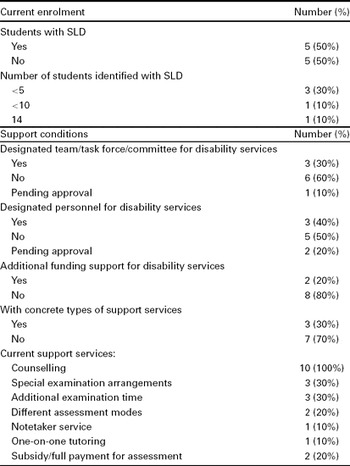
The extremely low enrolment of local students with SLD in higher education institutions persisted (see Table 1). Of the 10 universities, one stood out with a huge increase from zero to 14 students with SLD since the 2009 survey. This was attributed to the continual growth of exchange students from western countries, particularly those from North America who brought documentations to demand services comparable to what they received in their parent universities. Half of the institutions, however, still claimed that no student with SLD was enrolled in their institutions. Current support services are still limited in scope with a focus on counselling, and only three of the 10 institutions have a designated team and personnel directly responsible for disability services (see Table 1).
Current Enrolment and Support Conditions in Local Universities (N = 10)

Note. SLD = specific learning difficulties.
Correlation Between Support Structure and Identification
After representatives of five universities declared no known enrolment of students with SLD, the host of the forum and student participants immediately responded. The host representative emphasised the fact that she personally knew several students with SLD enrolling in those institutions and that these students did not reveal their difficulties because they did not feel that these institutions had any support services. The two student participants added that a few of their peers with SLD did not seek help for that very reason and that they would advocate for themselves because they were assessed in American schools and understood their right to accommodations. The lack of clear support structure appears to be highly correlated with the underidentification of students with SLD.
Role of Advocacy Groups for Current Development
To follow up on the progress made 2 years after the initial effort to pressure higher education institutions to develop structures and services, the host representing the advocacy group asked representatives to describe current support systems. The institution with the highest number of students with SLD, totalling 14 students, reported a significant expansion of their professional team with designated personnel to provide services with a wider scope than others with the help of large external donations. Two other institutions have also set up a task force or standing committee and have developed a structure and workflow to provide services for students with disabilities (see Table 1). Others attributed the lack of government policy and resources to fund disability services for their lack of progress. The varied progress made under pressure from the advocacy group was still apparent.
Discussions
This study examined the current status of transition services 4 years into the introduction of the 2008 policy and its effect on the higher education participation of students with SLD. Taken together, data from policymakers, parents, university personnel, and students with SLD have reflected a lack of transition services likely associated with no expectation of policy implementation from policymakers and correlated with the very low participation rate of, and limited support services for, students with SLD in higher education. The root of the problem is tied to policy in two ways: (a) policy as rhetoric at the secondary level, and (b) a policy vacuum for support at the postsecondary level. In addition, the role played by the advocacy group in the absence of policy mandates was unique and prominent. Discussions will surround these insights.
Impact of Policy as Rhetoric
Ng (Reference Ng2008) noted that policy rhetoric tends to use language to maintain an impression of coming from moral high grounds and to gain positive views of the public toward the policymakers. Such motives may explain the lack of expectations from policymakers for transition services to be implemented in Hong Kong schools. The impact of policies remaining as rhetoric can be seen in various aspects: the nonaccountability of school practices leading to policy–practice discrepancy (Kavale, Spaulding, & Beam, Reference Kavale, Spaulding and Beam2009) and minimisation of parent advocacy (e.g., Poon-McBrayer, Reference Poon-McBrayer2012), both of which are evident from the data reported in this study.
Policy–Practice Discrepancy
Literature on inclusive education has revealed that policy, inadequate resources, organisation of school systems, and poor teacher training and attitudes (e.g., Forlin, Reference Forlin2010a, Reference Forlin2010b; Poon-McBrayer, Reference Poon-McBrayer2004; UNESCO Bangkok, 2011) contribute to practices falling short. Students with disabilities are consequently short-changed in various ways (e.g., Brandt, Reference Brandt2011; Breen, Wildy, & Saggers, Reference Breen, Wildy and Saggers2011; Bringewatt & Gershoff, Reference Bringewatt and Gershoff2010). This common phenomenon challenges all due to its complexity, but efforts to tackle it must continue.
Minimisation of Parent Advocacy
Parents have been the single most effective advocates for their children in ensuring service continuity (Johnson, Bruininks, & Thurlow, Reference Johnson, Bruininks and Thurlow1987) and successful transition to adult life (Pascall & Hendey, Reference Pascall and Hendey2004). The lack of transition services in secondary schools, as reflected by findings, contributes to the paucity of parents’ knowledge about these services and minimises their ability to advocate for their children. The current low participation rate of students with SLD in local higher education reflects such impact.
Impact of Policy Vacuum
Even though education policies do not guarantee services, they do provide the foundation for practices. The widespread transition planning practices and improved postschool outcomes as reported in the existing literature (e.g., Katsiyannis et al., Reference Katsiyannis, Zhang, Landmark and Reber2009) are evidence of the benefit of the presence of policies. The lack of policies for disability support at the postsecondary level in Hong Kong has contributed to the current status of an extremely low participation rate of students with SLD, and the slow development of support systems in higher education institutions, which in turn caused some students with SLD to be reluctant to seek help. Together, they have formed a vicious cycle to become barriers for each other and have hindered the development of support services beyond secondary education.
Roles of Advocacy Groups
Findings reflect that the advocacy group that hosted the forum has played a significant role in advancing the development of support services at the higher education sector in the absence of a policy mandate. This group has become the de facto monitor to pressure higher education institutions to take action by bringing them together to report on their progress 2 years after the survey in 2009. Having an advocacy group play such a prominent and direct role in progressing the higher education support systems is unique to Hong Kong. In nations such as the US and the United Kingdom, the implementation of transition services has resulted primarily from policy mandates. Essentially, the movement toward disability support at the postsecondary level in Hong Kong is a true ‘bottom-up’ instead of the usual ‘top-down’ approach by policy mandates. Such advocacy is crucial, given that people with disabilities often struggle with policy support due to a lack of political power (Shaddock, Reference Shaddock2003).
Recommendations and Conclusion
As discussed previously, the transition policy as merely rhetoric and the policy vacuum for the higher education sector have adversely affected parent advocacy and access to higher education by students with SLD. The lack of legislative mandates seems to be the apparent distinction between Hong Kong and elsewhere when comparing issues encountered in asserting education rights of persons with disabilities. Recommendations thus revolve around the use of legislation to turn policies from rhetoric to reality and to empower advocates.
From Rhetoric to Reality via Legislation
Laws play an important role in helping students with disabilities worldwide in overcoming discrimination and gaining the right to education (United Nations Educational, Scientific and Cultural Organization, 2009). Research studies in the US and Canada have reported a definitive positive impact of legal entitlements to individuals with disabilities (Kovacs Burns & Gordon, Reference Kovacs Burns and Gordon2010). Likewise, Australia's education sectors, including higher education, are to comply with the Disability Discrimination Act (DDA) of 1992 and the Disability Standards for Education, introduced in 2005 (Australian Government ComLaw, 2005), which clarified students’ rights and responsibilities and the obligations of universities to provide students with services (Australian Vice-Chancellors’ Committee, 2006). Enacted on October 1, 2010, the Equality Act (The National Archives, 2010), Britain's new comprehensive antidiscrimination law, is an effort to strengthen the provision of accommodations in all aspects with additional specific guidelines for higher education provisions. Taiwan is among the earliest countries in Asia, and also perhaps the most proactive, in using legislation to safeguard the educational rights of students with disabilities, beginning with the enactment of the Special Education Act of 1984 and the subsequent revisions of the law to specify the rights of, and services for, students with disabilities (Ministry of Education, Republic of China [Taiwan], 2006).
Although Hong Kong has the Disability Discrimination Ordinance (DDO; 1995), it lacks specific details to ensure service delivery and thus plays a limited role in securing transition services and beyond. The huge gap in higher education participation rates of students with SLD between Hong Kong and the above countries is to some extent attributed to the differences in requirement details in their laws. The IDEA (U.S. Department of Education, 2004) and No Child Left Behind Act (NCLD; 2001) are prime examples. If the IDEA and NCLB are taken as a model, the existing DDO can be revised to include requirements and accountability mechanisms for identification, assessment, individual education plans (IEPs), transition planning, and postsecondary support services.
Empowering Advocates via Legislation
Advocacy can be considered a product of the rights-based legal provisions for people with disabilities, with the aim of helping individuals with disabilities to access entitled social services and to exercise their decision-making power (Flynn, Reference Flynn2010). The effect of legislation on empowering persons with disabilities and their parents as advocates has been apparent in the history of special education litigations (e.g., Martin, Martin, & Terman, Reference Martin, Martin and Terman1996). The DDO in Hong Kong does not include parents’ role in disability advocacy and the policy for parent participation is often ignored. Thus, the use of legislation is recommended to enhance their ability to advocate.
Parent Advocacy
In some countries, such as the US, parents’ right to be informed and to participate are mandated by the law (Cortiella & National Center for Learning Disabilities, Reference Cortiella2006). If schools are required by law to inform parents of support policies and their right to participate in the decision-making for their children's education, their ability to advocate for their children will be enhanced. The paucity of parents’ knowledge, as shown by data examined in this study, can be minimised, and parents will therefore be better prepared to make informed decisions for their children.
Self-advocacy
Self-advocacy has drawn a great deal of attention and found to be extremely important for the lifelong outcomes of individuals with disabilities (e.g., Hadley, Reference Hadley2011; Mishna, Muskat, Farnia, & Wiener, Reference Mishna, Muskat, Farnia and Wiener2011). In the case of Hong Kong, participating students with SLD in the forum have basically informed institutions of hidden barriers to services and heightened sensitivity of service providers. Such outcomes echo what has long been found elsewhere for at least two decades (e.g., Algozzine, Browder, Karvonen, Test, & Wood, Reference Algozzine, Browder, Karvonen, Test and Wood2001; Hammer, Reference Hammer2004; Phillips, Reference Phillips1990; Wehmeyer & Palmer, Reference Wehmeyer and Palmer2003; Wehmeyer & Schwartz, Reference Wehmeyer and Schwartz1997). Laws with adequate details can provide a platform for all to monitor practices and strengthen students’ ability to self-advocate.
Training Professionals as Advocates
The significant role played by the advocacy group of developmental neurologists to increase institutional awareness and push forward the establishment of support structures is evident from this study. This evidence serves as a reminder to educators of teaching, medical, social work, counselling, and educational psychology professions to include in their curriculum the role of advocacy and strategies to be advocates for their clients and students, as done elsewhere (e.g., Athanases & Martin, Reference Athanases and Martin2006; Grace, Reference Grace2001; Larrabee & Morehead, Reference Larrabee and Morehead2010).
Concluding Remarks
The rights of individuals with disabilities to education, employment, and public access have been among the central considerations of public policies in countries mentioned earlier. Transition planning plays a pivotal role both in terms of monitoring the support services at the school level and in gaining access to further education. Findings from policymakers, parents, and the stakeholders’ forum affirm the inadequacy of existing policies, the lack of policies beyond school levels, and the insufficiency of the DDO to protect disability rights. Consequently, Hong Kong significantly lags behind in providing transition planning at the school level and support services at the postsecondary level for students with disabilities when compared with western and even some Asian societies. The Hong Kong Government must strive to close the policy–practice gap and move from rhetoric to reality. A key way forward is to include necessary details and monitoring mechanisms in the DDO to ensure appropriate and timely service delivery. Educators of relevant professions should also examine how to include elements in their training programs to nurture the future professionals to advocate for their students or clients to further ascertain the provision of transition services and access to higher education.
As part of China, a signatory of the United Nations Convention on the Rights of Persons with Disabilities, Hong Kong is to comply with the human rights standards and live up to its commitment for providing services at the school level and equitable access to higher education by students with SLD. The crucial link between the two sectors of education is effective transition planning, which we owe to these students.