Introduction
It is estimated that, if the current spate of environmental overexploitation is not slowed down, the ecosystem's capacity to promote food security will be greatly jeopardized in the foreseeable future (Quaye, Reference Quaye2008; Diao and Sarpong, Reference Diao and Sarpong2011; Alhassan, Reference Alhassan2015). This is especially so in the face of a burgeoning human population which is estimated to be 9 billion by the year 2050. Worsening this problem is the scourge of climate change (Agyei, Reference Agyei2016). As a result of their poverty levels, it has been postulated that smallholder farmers (such as those in the Upper-West Region) cannot easily adjust to climate change and as such, would be among the worst affected by such misfortunes (Campbell et al., Reference Campbell2014; Alhassan, Reference Alhassan2015). It is therefore not surprising that the need for food security and environmental protection are the driving forces behind Goal 2 of the United Nations Sustainable Development Goals (Keesstra et al., Reference Keesstra2016). The environment–food security nexus—otherwise called sustainable agriculture, is defined as a farming process that combines ‘the goals of productivity, food security…and ecological soundness’ (Thrupp, Reference Thrupp2000). Sustainable agriculture seeks among other things, to equip the marginalized to mitigate the negative effects of environmental degradation on their livelihood. A switch over to sustainable agriculture implies ‘changes in production methods, models and policies, as well as the full participation of local people’ (Thrupp, Reference Thrupp2000, emphasis mine). Such a paradigm shift allows for grassroots ownership of such improved production methods. Thrupp's argument is a good juncture for a little more detail about the tenets of grassroots participation, which is discussed next.
Grassroots participation
Grassroots participation is seen as ‘an active process by which beneficiary/client groups influence the direction and execution of a development project with a view to enhancing their well-being in terms of income, personal growth, self-reliance or other values they cherish’ (Paul, Reference Paul1987, emphasis mine). This definition views the self-reliance of beneficiaries as the outcome of the entire participatory process. A genuinely participatory process gives room for information sharing, allowing stakeholders to learn from one another. By so doing, the knowledge created would be more impactful compared with situations where each stakeholder works in isolation (Pretty, Reference Pretty1995).
Chambers (Reference Chambers1985) has extolled the benefits of allowing the poor to participate in all development interventions meant for their betterment. An important tenet of participation in rural agricultural development is placing value on local farmers’ knowledge and analysis of their experiences (ibid). This reduces the tendency for change agents and other technocrats to superimpose their knowledge on rural farmers (Chambers, Reference Chambers1985; Chambers and Ghildyal, Reference Chambers and Ghildyal1985; Chambers, Reference Chambers1994). It, in turn, empowers farmers to engage in agronomic practices that are ecologically sustainable. Empowered farmers are equipped to ensure that whatever agronomic practices learnt from technocrats are adopted and perpetuated even when support from change agents ends (Chambers and Ghildyal, Reference Chambers and Ghildyal1985; Altieri, Reference Altieri1989; Izac and Swift, Reference Izac and Swift1994; Altieri, Reference Altieri2009).
The research problem
In the face of evidence pointing to anthropogenic activities as major causes of environmental degradation and food shortages in some parts of the world (Wood et al., Reference Wood2006; Chappell and LaValle, Reference Chappell and Lavalle2011; Gomiero et al., Reference Gomiero, Pimentel and Paoletti2011), there is the need to involve relevant stakeholders in order to address this problem. Ghana's UWR is not only the poorest, but also its economy heavily relies on smallholder farmers. It is thus likely to be hardest hit by the ramifications of agricultural practices that are not sustainable. In an effort to avert this, issues pertaining to improved agriculture for food security in northern Ghana have attracted research interests (see, for instance, Quaye, Reference Quaye2008; Alhassan, Reference Alhassan2015).
Studies further show that smallholder farmers’ ability to almost single-handedly subsist on the ecosystem for generations is ample evidence that they are naturally experimental: trying out various farming approaches in order to settle on the best (Bentley et al., Reference Bentley, Van Mele and Acheampong2010; Vogl et al., Reference Vogl2015). In Ghana, for instance, there is evidence pointing to Ghanaian local taboos and folklore that protect the fragile ecosystem on which agriculture depends (Adom and Kquofi, Reference Adom and Kquofi2016). It is also known that NGOs are well versed in participatory processes (Chambers and Ghildyal, Reference Chambers and Ghildyal1985; Fernandez, Reference Fernandez1987; Bratton, Reference Bratton1989; Weiss and Clarke, Reference Weiss and Clarke2001) which can be harnessed to promote the two main tenets of sustainable agriculture: food security and ecological protection.
However, apart from some anecdotal evidence from NGO reports, there has been little empirical research on the various participatory approaches NGOs use to elicit farmers’ involvement in sustainable agriculture in UWR. Similarly, there is hardly any evidence showing the extent to which these participatory approaches can influence farmers’ likelihood of adopting sustainable agronomic practices introduced to them by change agents.
A study of such participatory approaches and their link to sustainable agriculture is especially important in current times since it could hold the solution to smallholder farmers’ ability to subsist continuously on the fragile ecology. It is especially essential as humanity makes frantic efforts to find a lasting solution to the complications of environmental degradation, climate change and food insecurity. Perhaps it is about time humanity embraced a paradigm shift aimed at reversing all proclivities that subjugate the grassroots and prevent knowledge sharing between technocrats and smallholder farmers. The use of grassroots participatory approaches may well hold the solution to more sustainable agronomic practices that can protect the fragile environment on which smallholder farmers depend for food security. This way, both NGO technocrats and smallholder farmers can achieve advances which neither could alone (Chambers, Reference Chambers1985). It is based on these aforementioned arguments that the UWR was a good study site for this research. Thus, though the region registers a ubiquitous presence of NGOs, it is still bedeviled with the gradual creep of the dry Sahel climate and pernicious food security needs. In light of this, two research questions drive the study:
1. What types of grassroots participatory approaches do NGOs use when working with smallholder farmers in the UWR?
2. Are these participatory approaches associated with farmers’ adoption of improved sustainable agronomic practices?
The ladder of participation: a framework for analyzing the various types of participation
The origin of the ladder of participation can be traced to Arnstein (Reference Arnstein1969), a social worker and urban development expert who sought to integrate the views of the have-nots in decisions that have a direct bearing on their wellbeing. This framework has undergone a number of metamorphoses in the hands of many (including Choguill, Reference Choguill1996; Kinyashi, Reference Kinyashi2006; Tritter and McCallum, Reference Tritter and Mccallum2006; Collins and Ison, Reference Collins and Ison2009). Due to its enduring relevance, it has been copiously used as a framework for local level participation (see for instance Connor, Reference Connor1988; Hart, Reference Hart1992; Ruesga and Knight, Reference Ruesga and Knight2013; Stelmach, Reference Stelmach2016). In spite of some minor tweaks made on Arnstein's original work, her central objective of empowering the marginalized to take central stage in decisions regarding their own wellbeing is still relevant. This research therefore uses Arnstein's (Reference Arnstein, Legates and Stout2015) ladder of citizen participation as a framework for identifying the various types of participation NGOs use in their work with smallholder farmers in the UWR.
The ladder is an eight-point ranking that shows the various levels at which the marginalized in society can participate in development that affects their wellbeing. The intensity of local participation is dependent on the level at which the NGO falls within this metaphorical ladder. Thus, the higher one climbs the ladder, the more the grassroots participate in the development intervention (see Fig. 1).
Ladder of Citizen Participation.

The first two levels—manipulation and therapy—are called non-participation since they have no trace of participation in them. With non-participation, change agents often exploit the have-nots under the guise of participation. Manipulation occurs when organizations contrive phony forms of participation, which are really aimed at getting citizens to accept a predetermined course of action (Arnstein, Reference Arnstein, Legates and Stout2015). It is akin to a charade performed under the guise of allowing local level participation. A worse variant of non-participation, therapy, occurs when power holders educate and moralize the have-nots about their inadequacies. ‘The intent is to cure participants of attitudes and behaviors that [change agents] do not like under the guise of seeking their advice’ (Arnstein, Reference Arnstein, Legates and Stout2015). This variant of participation merely aims to ‘educate’ or ‘cure’ the poor (Arnstein, Reference Arnstein, Legates and Stout2015) of their ignorance. In situations of manipulation and therapy, change agents do not engage in genuine deliberations with beneficiaries before interventions are introduced (Bentley et al., Reference Bentley, Van Mele and Acheampong2010).
The remaining six types of participation have increasing robustness as one climbs the metaphorical ladder. Of the remaining six levels, informing, consultation and placation are limited because the grassroots cannot participate beyond having their voices heard. These are collectively called degrees of tokenism. Under degrees of tokenism, the have-nots cannot influence the direction of the intervention; they can have their say but the development agency will always have their way in the project, as it were. The third category is what Arnstein (Reference Arnstein, Legates and Stout2015) describe as citizen power which encapsulates partnerships, delegated power and citizen control. These three levels imbue the grassroots with more powers that they can leverage to determine the direction of the project. According to Connor (Reference Connor1988), citizen control—the highest level of the metaphorical ladder of participation—is the holy grail in development interventions. Thus, apart from manipulation and therapy, the remaining six all have traces of participation in them but with increasing succession starting from the least as informing and the highest as citizen control (see Fig. 1).
Arnstein's (Reference Arnstein, Legates and Stout2015) framework is especially relevant when working with the less privileged. As NGOs often profess to represent the interest of the less privileged (Bratton, Reference Bratton1989; Lewis and Kanji, Reference Lewis and Kanji2009), this framework is appropriate for determining the extent to which the grassroots participate in their own development agenda. It, therefore, serves as a framework in the analysis of the various types of participation that the sampled NGOs use in the UWR.
Study area and methodology
A brief profile of UWR
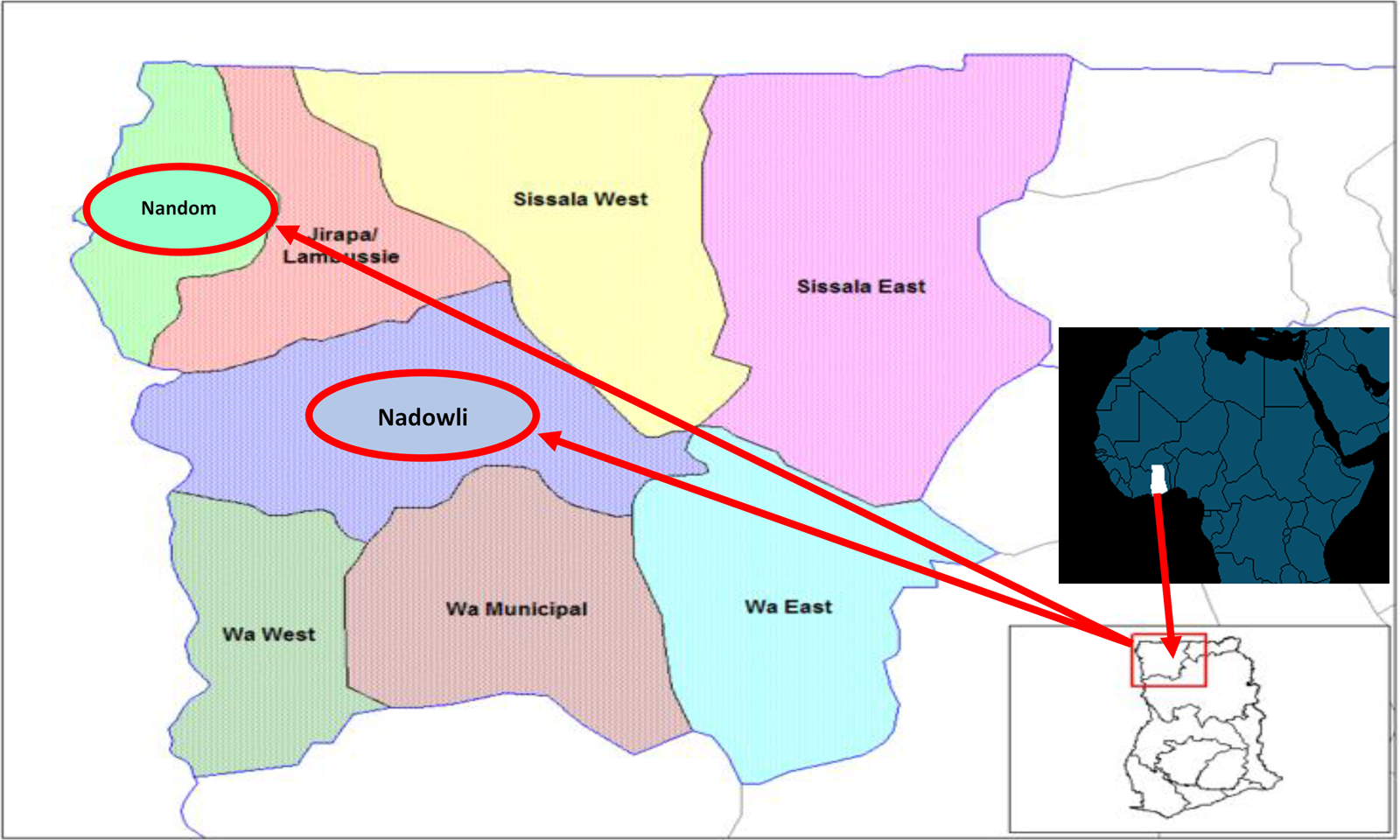
The UWR was the last of ten regions carved out of the then Upper Region in the year 1983 (Ayee, Reference Ayee2012). It is located in the north-western part of Ghana (see Fig. 2) with a total land area of 18,476 km2 (Luginaah, Reference Luginaah2008; Adeku et al., Reference Adeku, Amuzu, Fayorsey and Anaman2013). It shares a boundary to the north with Burkina Faso, to the south with the Northern Region, to the east with the Upper-East Region and to the west with Ivory Coast (Adeku et al., Reference Adeku, Amuzu, Fayorsey and Anaman2013).
Map of Upper-West Region indicating the two study districts within the contexts of Ghana and Africa.

With its regional capital as Wa, the 2010 population and housing census report estimates its population to be over 700,000, most of whom are engaged in smallholder farming mainly for household subsistence (Luginaah, Reference Luginaah2008; Ghana Statistical Service, 2012). Maize and millet are the two main crops grown in the region. Other staple crops grown are sorghum, yam as well as leguminous crops such as cowpea, groundnuts and beans. Locals also rear small ruminants such as goats and rabbits together with guinea fowls and chicken. Smallholder agriculture in the region is mainly a rural phenomenon since well over 90% of smallholder farmers are rural dwellers (Ghana Statistical Service, 2015).
The UWR is located within the guinea savannah ecological zone. The climate in the region is one of the driest spanning from around October to around April per year. Atmospheric temperature in the region can be as high as 40°C in March (Adeku et al., Reference Adeku, Amuzu, Fayorsey and Anaman2013). One of the biggest threats the region faces is the gradual creep of the Sahel climate (consisting of scattered trees and shrubs) into the region. As most farmers in the region depend on rain-fed agriculture, the threat of a compromised ecology due to environmental degradation is expected to have a heavy toll on the agricultural livelihood of the people of UWR. A number of NGOs have therefore dedicated themselves to addressing this problem in the region. Two districts that have especially registered a high number of NGOs in UWR are Nandom and Nadowli districts as encircled in Figure 2. One of their approaches is to help promote sustainable agronomic practices to safeguard the fragile ecosystem on which smallholder farmers depend for subsistence.
Sampling relevant implementing NGOs
Purposive sampling (Patton, Reference Patton2002) was used to select two NGOs that use participatory approaches to implement projects focused on sustainable agriculture. A reconnaissance study conducted pointed to two local NGOs in UWR that meet this criterion. For this study, the two NGOs have been anonymized and given the pseudonyms NGO A and NGO B.
The next stage involved interviews with relevant officers from the two sampled NGOs in order to understand the various participatory approaches they embarked on when implementing the project. To this end, the collective case study approach (see Fig. 3) which seeks to explore a number of individual cases so as to ‘provide insight into an issue’ (Creswell, Reference Creswell2012) was adopted. Thus, one key informant was purposively selected from each of the two NGOs based on their direct involvement with the project. This helped me unearth the various participatory approaches used by their respective NGOs, and how these approaches influenced farmers’ adoption of renewable agronomic practices. A list of the various farmers groups, their locations and their local leaders was also obtained from officials of the two implementing local NGOs to aid in eliciting information from individual beneficiary farmers.
The collective case study design. It was used to study the two local NGOs so as to get an insight into the various types of participatory approaches aimed at promoting sustainable agriculture.

Brief profile of the two sampled local NGOs
NGO A is a faith-based local NGO established in 1973 to bridge the poverty gap between the inhabitants of Nandom and the rest of Ghana. It has particularly carved a niche for itself in the area of agriculture. In the areas of local level participation and sustainable agriculture, NGO A's interests include promotion of improved soil and water management practices, group formation and animation and the participation of rural folks in their own development. NGO B on the other hand became a registered local NGO in the year 1995. Its mission is to be a performance-oriented organization committed to poverty reduction, ecological balance, gender equity, good governance and sustainable development using participatory approaches (emphases mine), networking and advocacy to meet the needs of district assemblies, communities and civil society.
Based on their collective aim of enlisting grassroots participation in development, both NGOs were selected and funded by an international development organization, to implement a project called Enhancing Livelihoods through Climate Change Adaptation Learning Project (ELCAP) between 2012 and 2015. ELCAP was a flagship project aimed at learning by doing. The project entailed the creation of avenues for the confluence of ideas between implementing NGOs and beneficiary communities. While NGO A operated in the communities of Goziir and Walateng, NGO B operated in Zambogu and Penetobo. Since it had run its course, it was appropriate to examine the extent to which the two implementing NGOs were able to use their various participatory approaches to help farmers adopt renewable agronomic practices that could protect the fragile ecology on which farmers subsisted.
Sampling approach at the beneficiary Farmers’ level
Convenient sampling (Patton, Reference Patton2002) was used to select farmers who lived in localities where NGO A and NGO B operated for focus group discussions. Care was taken to ensure that respondents were duly represented in terms of gender, age groupings, as well as types of crops grown and animals reared. This way, respondents would be in a position to explain their experiences of the various participatory approaches as well as their effect on farmers’ adoption of sustainable farming methods. Table 1 summarizes the sampling approaches used for the study. In each beneficiary community, I noticed signs of data saturation (Creswell, Reference Creswell2012) by the time we started the second focus group discussion because the second group often repeated much of what was discussed in the first.
Sampling of respondents and data collection

Source: Grassroots Participation and Sustainable Agriculture Survey, 2017 (N = 250).
The views of 250 beneficiary farmers were also elicited using stratified random sampling (Robson, Reference Robson1995; Patton, Reference Patton2002; Creswell, Reference Creswell2012). Beneficiaries were stratified based on whether they belonged to NGO A or NGO B. From each NGO stratum, 125 beneficiaries were randomly selected using simple random sampling (Creswell, Reference Creswell2012). This formed 250 total beneficiaries from both strata of beneficiary groups.
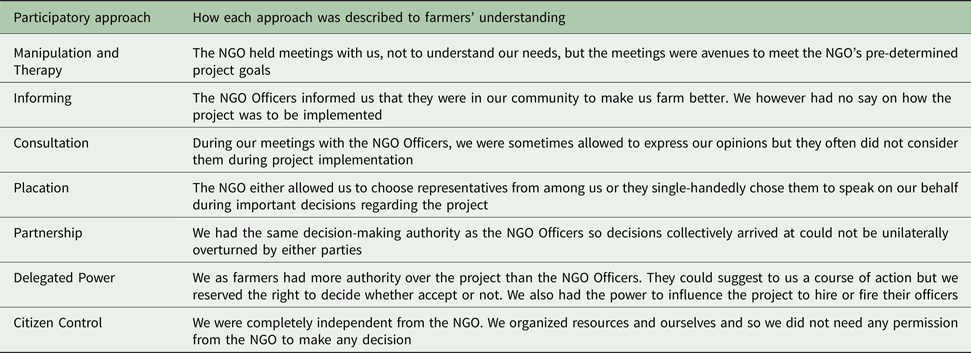
To make Arnstein's ladder of participation comprehensible to farmers, each of the eight levels on the ladder was explained using key words that characterize them as shown in Table 2. Farmers then indicated whether they agreed or disagreed with each of the levels on the ladder.
Proximate descriptions of Arnstein's typology of participation during data collection

Source: Arnstein (Reference Arnstein, Legates and Stout2015).
Data collection and analysis
A two-phase exploratory sequential mixed method design (Creswell, Reference Creswell2012) was used for data collection and analysis. This entailed an initial exploration of sampled NGOs’ participatory approaches through eight series of Focus Group Discussions with project beneficiaries and six key informant interviews with local leaders of project beneficiaries and officers from the two sampled NGOs (see Table 1). Responses gathered were typed out verbatim. These responses were then coded and thematically analyzed to embody the voice and lived experiences of respondents. To this end, structural codes (Saldaña, Reference Saldaña2009) were created from the data with the aid of Atlas.ti, a qualitative data analysis software.
Themes from the qualitative data were then developed into a structured questionnaire which was administered to individual beneficiary farmers. It was used to identify any possible association between Arnstein's typology of participation on the one hand and farmers’ adoption of sustainable agricultural practices on the other. Information gathered from respondents regarding the contributions of the two implementing NGOs was put together and analyzed using chi-square and the marginal effects from logistic regressions in order to tease out the differences and similarities between the two NGOs.
Estimating farmers’ likelihood of adopting of sustainable agronomic practices
The second research question sought to determine whether an association existed between the identified typology of participation and farmers’ likelihood of adopting sustainable farming methods. To this end, the marginal effects derived from logistics regression (Acock, Reference Acock2008) of the association were estimated. Compost preparation and half-moon farming methods were used as dummied dependent variables since they were the most prominent among ELCAP's interventions. Compost preparation therefore became model 1 while half-moon farming became model 2 in the presentation of findings. The main independent variables on the other hand were Arnstein's typology of participation.
Measures adopted to ensure rigorous findings
To ensure that the findings correctly got at what I sought to measure, I used different data collection tools (FGD guide, in-depth interview guide and a structured questionnaire) as a form of data triangulation. To reduce errors in the data collection process, four experienced research assistants who were proficient in Dagaare—the language of respondents—were recruited to help with data collection. A 2-day orientation exercise was held to bring them up to speed on the purpose of the study and how to administer the data collection tools. To ensure respondents’ easy comprehension of questions, all four research assistants took turns translating survey questions from English into Dagaare to the hearing of the research team. The data collection tools were then pre-tested with farmers in Yiziiri, a community with similar socio-economic and demographic characteristics to those of the sampled communities. Questions that were vague to respondents were identified and restructured for clarity. To reduce human errors resulting from fatigue, each research assistant was instructed not to administer beyond five questionnaires per day. Field workers were also instructed to allow participants who felt tired during interviews, to take as many breaks as they required. These measures were taken in an effort to ensure that interpretations were fair and representative of the reality on the ground.
Presentation of findings and discussion
Findings are discussed within the domains of the two research questions guiding the study. To this end, an overview of the two NGOs’ participatory approaches is discussed using Arnstein's (Reference Arnstein, Legates and Stout2015) broad categories of non-participation: degrees of tokenism and degrees of citizen power. The writers’ eight-point rungs of local level participation are then nestled within the two NGOs’ participatory activities in order to unearth the nuanced differences between the two NGOs. This is followed by an assessment of the association between the identified participatory approaches and farmers’ adoption of the project's sustainable agronomic practices. The final section gives a summary of key points raised in the research and my contribution to knowledge.
An overview of the two NGOs’ participatory approaches
An overview of the two NGOs’ activities within the framework of Arnstein's (Reference Arnstein, Legates and Stout2015) broad categorization of the typology of participation revealed that while NGO A focused on the lower to middle levels of participation (non-participation and degrees of tokenism), NGO B's activities focused on degrees of citizen power and some aspects of degrees of tokenism. As Table 3 indicates, a majority of NGO A's beneficiaries (92.98%) agreed that they personally participated in ELCAP through degrees of tokenism. This, according to Arnstein (Reference Arnstein, Legates and Stout2015) occurs when the power relation between the NGO and the grassroots is so lopsided that a one-way flow of information from the NGOs to the grassroots holds sway. NGO A manifested traces of degrees of tokenism in how it rolled out its sustainable agricultural initiatives. Focus group discussants at the two beneficiary communities under NGO A largely agreed that before NGO A started working with them, the NGO had predetermined what package to roll out. Beneficiaries were only informed on what to do in order to benefit from the project; how to form groups, how many per group and which person was designated in the community to register groups that met NGO A's selection criteria.
The three categories of participation NGOs engaged farmers in

Source: Grassroots Participation and Sustainable Agriculture Survey, 2017 (N = 250).
Notes: The figures displayed in the cells are the row percentages. N = 250. Figures in brackets are absolute number of respondents (frequencies).
This one-sided approach to local level participation is what Cleaver (Reference Cleaver1999) bemoans. These petite bourgeoisie (to borrow from the Marxist theory of class struggle) NGO A designated for selecting deserving farmers sometimes created unnecessary red tape that constricted the flow of any concern from the bottom (farmers) to the top (NGO officialdom). If at all information percolated to the top, it would have been so massaged and refined by the go-between person that it would have lost its original substance.
Conversely, an overwhelming majority of NGO B's beneficiaries (92.25%) agreed that they personally participated through degrees of citizen power (see Table 3). Under degrees of citizen power, the decision-making authority of the grassroots is so strengthened that the implementing NGO cannot unilaterally make any decision exclusive of the grassroots.
Of the 250 beneficiaries sampled, very few opined that NGO A and NGO B used non-participation when working with farmers. In terms of absolute numbers, only six respondents from NGO A as against one person from NGO B agreed that their respective implementers worked with them through non-participation. As shown in Table 3 above, there was thus a statistically significant difference between the two NGOs in terms of their use of participatory approaches when working with smallholder farmers. While NGO B's participatory approaches were related to degrees of citizen power, NGO A leaned toward degrees of tokenism. This relationship between the local NGOs implementing the ELCAP project and the degrees to which beneficiaries participated in its planning and implementation is strong (Cramer's V = 0.85) and is statistically significant.
Comparison of NGOs’ approaches using Arnstein's (Reference Arnstein, Legates and Stout2015) eight-point continuum
When Arnstein's (Reference Arnstein, Legates and Stout2015) eight-point rungs of local level participation is nestled within the two NGOs’ participatory environment, it would be realized that NGO B used higher levels of participation like delegated power and partnership compared to NGO A which used lower rungs like consultation, informing, manipulation and therapy. Placation served as the nexus between the two NGOs since it was common to both (illustration shown in Fig. 4). How each of the two NGOs conceptualized the term participation is discussed next for the purposes of clarity.
Participatory approaches used by NGO B and NGO A.

Grassroots participation under NGO A
When asked how exactly NGO A conceptualized local level participation, both officers and beneficiaries agreed that it meant working with the grassroots from the very inception of the project. Thus, NGO A did the planning, implementation, monitoring and evaluation of all projects with the involvement of beneficiaries. The level of farmers’ participation under NGO A was however weak. NGO A's degree of local level involvement was within the lower rungs of Arnstein's (Reference Arnstein, Legates and Stout2015) ladder of participation such as degrees of tokenism. Beneficiaries were more of passive recipients of agricultural interventions tailor-made by NGO A. More specifically, it employed consultation (level 4 on Fig. 4). Consultation is characteristically lopsided since information flow from the top to the bottom and vice versa is in favor of the top (Arnstein, Reference Arnstein, Legates and Stout2015). Here, series of meetings with participants can be used as a smokescreen aimed to divert attention from the lopsided power structure (Kinyashi, Reference Kinyashi2006). The following account by the ELCAP Project Officer for NGO A regarding how smallholder farmers were involved in the planning and implementation of the project gives credence to NGO A's inclination to use consultation
‘…participation here [in NGO A means]… starting the journey with the clients. [It means] to even find out what kinds of farming activities they do; especially those that are bad. Before we introduce a project or teach locals any of our farming methods, we often start with the farmer in the planning process so that… nothing becomes new as we march forward. So we always involve them at every point of the project [emphases mine].’
(In-depth interview with NGO A Officer in charge of ELCAP)
Operating under the principle of consultation, NGO A may have sought the opinions of beneficiaries but was not duty-bound to incorporate these opinions in their decisions (Arnstein, Reference Arnstein, Legates and Stout2015). Oftentimes, consultation is used as a façade aimed at sending the message to stakeholders that the locals have ‘participated in participation’ (Arnstein, Reference Arnstein1969). In reality, however, no long-lasting benefits may accrue to the locals since the NGOs can easily disregard their viewpoints. This is because the decision-making scales are tilted in favor of the NGO. Using consultation, NGO A was able to identify local farming practices but the NGO took over from there by single-handedly introducing a panacea that they deemed fit for the farmers’ problems.
There are however, some situations in which consultation can inure to the benefit of the grassroots: for example, when one needs to make very quick decisions. Since higher levels of participation like partnership allows for negotiation between the grassroots and the NGO before consensus is reached, it sometimes impedes swift decision-making. The bureaucratic process of allowing every stakeholder to air their views generates unnecessary red tape, which can lead to farmers missing out on important periods of the farming calendar. For example, smallholder farmers in the study area depend largely on the weather for farming. Since the study area is characteristically arid and has shorter periods of rainfall per annum, consultation or lower types of participation would be appropriate in situations where farmers need to quickly start farming in order to take advantage of the rains. Thus, consultation could be an appropriate participatory approach in peculiar situations.
There were also elements of non-participation in NGO A's conceptualization of participation. This is implied in the Project Manager's words that they often ‘teach local farmers’ improved farming methods after knowing how the latter did their farming. Thus, NGO A pre-packaged its interventions but only needed to see how the locals did theirs before they taught them ‘improved’ farming the NGO A way, as it were. The fact that the NGO came to ‘teach locals’ smacks of an element of therapy (Arnstein, Reference Arnstein, Legates and Stout2015). Therapy (level 2 on Fig. 4) is premised on the belief that local farmers lack knowledge in good farming practices and therefore need to be taught improved methods. Local farmers’ contribution in this ‘teaching’ process is not needed by the NGO. Therapy is derived from an analogy of ‘mental illness’ [where] ‘…under a masquerade of involving citizens in planning, the experts subject [farmers] to clinical group therapy’ (Arnstein, Reference Arnstein1969). The intention is to ’ “educate” or “cure” the participants’ of their ignorance in sustainable agronomic practices.
Grassroots participation under NGO B
In comparison to NGO A, NGO B's concept of local level participation can be appreciated through how they sought to understand the felt needs of the locals. NGO B engaged in a series of discussions starting from community-wide meetings aimed at identifying various local level needs. These meetings were often followed by validation exercises aimed at confirming that the interventions they had collectively come up with reflected the needs of beneficiary groups. Thus, NGO B often endeavored to enlist the full participation of all beneficiaries. In the words of the NGO B Project Officer,
‘…participation always starts from the grounds where the community helps us identify their needs and problems so that together with the beneficiaries, we come up with solutions for it [sic]. Then we plan with the local people's felt needs in mind. After that, we go back and tell them that based on their recommendations, these are the plans we have collectively agreed to execute. We get their input once more just to be sure that the interventions capture what they really need before we start implementation with them.’
(In-depth interview with NGO B Officer in charge of ELCAP)
NGO B's concept of participation hinged strongly on partnership, a lateral, rather than a hierarchical relationship that allowed for a two-way flow of information between the two actors. Partnership (level 6 on Fig. 4) is often an avenue for an open dialog between the haves and have-nots (Arnstein, Reference Arnstein, Legates and Stout2015). It is strengthened when both parties have an equal stake in determining the direction of the project and are expected to contribute in equal measure to its success. Given that the grassroots do not have the wherewithal, their contributions were quantified through their labor, time, land and other natural resources available to them. With partnership, decisions collectively arrived at by the two parties cannot be unilaterally overturned by either of the two partners (Arnstein, Reference Arnstein, Legates and Stout2015). At this level, ‘participation [of farmers was] seen as a right, not just a means to achieve project goals’ (Pretty, Reference Pretty1995).
In many instances, NGO B only facilitated the participatory process by helping farmers identify the sustainable farming practices that were available but left the ultimate decision-making regarding which practice to adopt in the hands of farmers. Here, each participating farmer had the freedom to choose which farming practice best suited them based on their peculiar circumstances. This was confirmed by the NGO B Officer who reported that ‘[t]he community people largely owned the whole participatory process and the resultant benefits. We as NGO B just provided technical backstopping from behind the scene.’
This was corroborated by beneficiaries of NGO B. In the words of a key informant at Penetobo, one of NGO B's beneficiary communities, ‘[w]hatever activity we want[ed] to do, we [discussed and agreed] after which [NGO B] helped us implement it. We would allow the youth to talk, the old to talk [and] women to talk.’ It was often based on these series of open and frank discussions that farmers came up with their felt needs. NGO B then proceeded to support farmers implement these felt needs. Thus, rather than superimpose their will on beneficiaries, NGO B created avenues for open and frank discussions of all interventions by beneficiaries of all demographic groupings before implementation.
Both NGOs however rarely used the highest level of participation (citizen control) in its true sense as espoused by Arnstein (Reference Arnstein, Legates and Stout2015). Accordingly, citizen control (level 8 of Fig. 4) is seen as the gold standard as far as local level participation is concerned. Grassroots members operating under this gold standard have far more decision-making powers than the NGO and therefore can make policy and managerial level decisions without recourse to the NGO. Citizen control was not manifested in this project since neither of the two beneficiary groups was able to source funding and other resources for their own development independent of their respective NGOs. Both NGOs controlled funding at their level.
Sustainable agronomic practices the NGOs introduced
Low soil fertility and water stress were among the factors that impinged on food access among farmers prior to ELCAP. To address these problems, ELCAP sought to build on local knowledge by introducing improved sustainable agronomic practices to farmers. These were composting, zai farming, ‘tea manure’ preparation and half-moon farming methods. Among these four sustainable agronomic practices introduced by the project, composting and half-moon farming stood out as the most impactful. The next discussion entails how the various types of participation influenced the adoption of these two prominent agronomic practices. This is then followed by brief discussions of ‘tea manure’ preparation and zai farming.
Introduction of composting and half-moon farming methods
The FGDs confirmed that beneficiaries had an idea about compost preparation before the NGOs’ interventions. However, its use was not very pronounced due to two reasons. First, beneficiaries’ compost production method was not effective since the materials did not decompose as expected and secondly, the backbreaking method involved in digging huge holes in order to bury biodegradable materials discouraged old and feeble people from compost preparation. In the face of such challenges, beneficiary farmers who lacked the wherewithal to purchase chemical fertilizer coped with dwindling soil nutrients by spreading animal droppings on their farms during the dry season in preparation for the rains. Unfortunately, by the time the droppings decomposed and became useful to the crops, the crops would have long matured and produced abysmal yields, or even died due to lack of nutrients. The process of decomposition was therefore slow when farmers simply spread biodegradable materials on the field without using any methodical process. Farmers took up composting again after a more effective method was introduced to them. This was confirmed by an officer from NGO B who revealed that
‘When we introduced compost preparation, farmers were very reluctant to work with us… but with a little more convincing, they began to appreciate our approach. Our compost preparation did not require too much fatigue in digging so more people were interested and participated. We taught them how to dig holes measuring sixty centimetres wide… and the depth, sixty centimetres. Beyond sixty centimetres, the compost does not turn out very well because there are no microbes… and there is no air circulation down there.’
The half-moon farming method on the other hand was especially good for degraded lands. This farming method is traced to farmers in Niger (Zougmoré et al., Reference Zougmoré, Zida and Kambou2003). The technology was later transferred to farmers in Burkina Faso and subsequently shared with farmers in the study area through the initiative of the ELCAP project. The method involved the creation of semi-circular stone boundaries on gently sloping degraded lands. Since the climatic characteristic of the UWR is semi-arid, the semi-circular boundaries were created to prevent erosion by trapping and retaining scarce water and soil nutrients. Animal droppings and other biodegradable matter were then deposited into the half-moon after loosening the bare and crusted sand. Figure 5 depicts farmers’ transition from merely spreading animal droppings on farms to composting and half-moon farming methods.
From the crude method of spreading organic matter on farms to composting and half-moon farming.

Effects of participatory approaches on farmers’ likely adoption of sustainable agronomic practices
Model 1: beneficiaries’ likelihood of adopting composting
As model 1 in Table 4 shows, informing registered a significant but inverse association with farmers’ likelihood of adopting composting as a sustainable farming method. This suggest that an implementing NGO that involved the grassroots through the medium of informing, one of the least robust participatory approaches, reported a reduction in the likelihood of their beneficiaries adopting composting by 27.27%.
Farmers’ likelihood of adopting ELCAP's composting and half-moon farming methods

***P < 0.01, **P < 0.05, (standard errors in parentheses).
Conversely, consultation and placation had significant and direct associations with farmers’ likelihood of composting. Thus, while using placation increased farmer's likelihood of adopting composting by 18.38%, consultation increased the likelihood to 40.44%. This means that farmers who participated in the compost training exercises through consultation or placation (which are more robust than informing) registered increases in their likelihood of adopting the farming method. Based on model 1 therefore, it can be concluded that consultation and placation were the appropriate approaches when eliciting the interest of local farmers in adopting composting as a sustainable agronomic practice.
A comparative analysis of the two implementing NGOs’ approaches to promoting composting bears this out as shown in model 1 (Table 4). Beneficiaries under NGO B have a statistically significant and positive association with their likelihood of adopting composting. Thus, NGO B's beneficiaries, who often participated in the intervention through higher levels of participation were 25.60% more likely to adopt composting than beneficiaries under NGO A which used less robust participatory approaches.
Model 2: Beneficiaries’ likelihood of adopting half-moon farming
In the same vein, participatory approaches with less robustness reduced farmers’ likelihood of adopting half-moon farming as shown in model 2 of Table 4. Manipulation/therapy, though statistically significant, had an inverse association with farmers’ likelihood of using half-moon. This suggests that involving farmers through the medium of manipulation/therapy reduced their likelihood of adopting half-moon farming method by 26.75%. Similar results pertain with an NGO that used informing: their beneficiaries were 19.40% less likely to adopt half-moon farming method. As we climb Arnstein's (Reference Arnstein, Legates and Stout2015) metaphorical ladder, the association in model 2 becomes more direct. Thus, consultation, placation and partnership were significant and directly associated with farmers’ likelihood of adopting half-moon farming. This means that an implementing NGO that employed consultation placation and partnership increased by 30.58, 23.44 and 31.47%, respectively, their farmers’ likelihood of adopting and using half-moon farming method. This is logical given that participatory approaches that use consultation and above normally elicit the views of the grassroots in the process. This engenders local ownership responsibility since they are made to feel that they are involved in decisions regarding the project and are obliged to see to its fruition. It can thus be surmised that a juxtaposition of Arnstein's (Reference Arnstein, Legates and Stout2015) typology of participation against the two main farming methods—half moon and composting—generally confirms the theory that higher levels of grassroots participation inures to the benefit of the grassroots.
Other sustainable agricultural methods introduced to farmers
Beyond half-moon farming and composting, two other sustainable agronomic practices, tea manuring and zai micro-dozing methods, were also introduced to beneficiaries at latter stages of the project. Tea manuring consisted of a permeable sack of biodegradable materials, tied up and immersed into water for a period of 4 days to 2 weeks for the content to putrefy and percolate into the water. This mixture provided nutrients and water to crops. The term tea manuring derives from ordinary tea bags since tea manuring also go through a similar (albeit longer) process in tea preparation. In the words of an Officer from NGO A, ‘When you apply your compost, because of how dry the soil is, you add the tea manure to the soil to help the crops grow well.’
The zai micro-dosing farming method on the other hand involved the precise application of manure in small holes into which crops were planted. This maximized the use of manure. It also retained water thereby preventing runoffs in the semi-arid climatic region of the UWR where water scarcity is a major bane to farming. This farming method started in Burkina Faso (Reij et al., Reference Reij, Tappan, Smale, Speilman and Pandya-Lorch2009). Apart from checking soil erosion, the small holes dug for manure application in zaï farming attracts micro-organisms and other creeping insects which contribute to good soil and water retention (Reij et al., Reference Reij, Tappan, Smale, Speilman and Pandya-Lorch2009, Nyantakyi-Frimpong and Bezner-Kerr, Reference Nyantakyi-Frimpong and Bezner-Kerr2015).
Conclusion
This study has been a comparative assessment of how two NGOs in the semi-arid climatic region of Northern Ghana are leveraging grassroots participation to promote sustainable agronomic practices among smallholder farmers. Using Arnstein's ladder of participation as a framework, the study has shown that farmers’ inclination to adopt and practice sustainable agronomic practices is hinged on the grassroots participatory approaches used by their implementing NGOs. In general, higher levels of grassroots participation, though time-consuming and sometimes bedeviled with winding bureaucracy, tends to galvanize grassroots support and increases the likelihood of the grassroots adopting sustainable agronomic interventions introduced by NGOs. This suggests that no matter how well-intentioned NGOs’ activities may be toward smallholder farmers, they will only have lasting impact on the livelihood of smallholder farmers when they are actively involved in the intervention.
As the world continues to grapple with the problems of climate change, environmental degradation, food shortage as well as increasing donor fatigue, NGOs would need to maximize the use of the little resources at their disposal in their bid to extricate poor smallholder farmers from the shackles of poverty and food insecurity. They also need to reconcile the food needs of an increasing human population with the earth's carrying capacity. As the study has shown, one effective approach to solving the aforementioned problems is to enlist the full participation of smallholder farmers in this process. This way, development interventions will be tailored to meet the felt need of the grassroots, thereby invoking local ownership and beneficiaries’ responsibility for perpetuating project benefits after projects are completed. The work therefore contributes to a better understanding of the relevance of collaborative work in the promotion of sustainable agriculture. The study has argued that rather than view smallholder farmers as passive recipients of aid, they ought to be seen as active participants in agricultural interventions geared toward their wellbeing after all, they, more than anyone else, are in the best position to determine their felt needs.