Illite definition and characteristics
The term ‘illite’ was introduced by Grim et al. (Reference Grim, Bray and Bradley1937) who stated that it ‘is not proposed as a specific mineral name, but as a general term for the clay mineral constituent of argillaceous sediments belonging to the mica group’. This new name corresponded to the operational definition of the 10 Å dioctahedral component of clay fractions of sedimentary rocks, identifiable by X-ray diffraction (XRD). For practical reasons, the term ‘illite’ is still often used in this broad sense, in particular in the XRD studies of sediments and sedimentary rocks. Later XRD studies (e.g. Środoń, Reference Środoń1984) showed that the Fithian illite of Grim et al. (Reference Grim, Bray and Bradley1937) is a physical mixture of non-expandable illite and what was then interpreted to be an ordered, mixed-layerillite-smectite with ~9% S (percentage of smectite layers).
Maegdefrau and Hofmann (Reference Maegdefrau and Hofmann1938) described a pure micaceous, dioctahedral, clay-sized mineral from the hydrothermally altered volcanic ash deposit in Füzzéradvány near Sárospatak (northern Hungary) and called it ‘sarospatakite’. Its monomineralic nature has been confirmed by later studies (e.g. ‘Zempléni’ illite of Środoń, Reference Środoń1984; Szegedi, Reference Szegedi and Konta1988). However, this term was seldom recognized, and illite was accepted by the international mineralogical community (Rieder et al., Reference Rieder, Cavazzini, D’yakonov, Frank-Kamenetskii, Gottardi, Guggenheim, Koval’, Müller, Neiva, Radoslovich, Robert, Sassi, Takeda, Weiss and Wones1999) as a mineral series name, applicable to materials from various environments (not only to sediments). According to these recommendations of the International Mineralogical Association (IMA), repeated by the Association Internationale pour l’Etude les Argiles (AIPEA; Guggenheim et al., Reference Guggenheim, Adams, Bain, Bergaya, Brigatti, Drits, Formoso, Galan, Kogure and Stanjek2006), illite, glauconite, and brammalite are three series of interlayer-deficient micas (previously referred to as hydromicas). Their common characteristic, quoted in IMA and AIPEA recommendations, is the number of positive interlayer charges in formula, which correspond to fixed, i.e. non-exchangeable cations (hereinafter FIX), of 0.60–0.85/O10(OH)2, much less than the theoretical 1.00/O10(OH)2 of true micas. No separate name was assigned to the interlayer-deficient analogues of tobelite (ammonium mica) and aluminoceladonite (Mg-rich mica, leucophyllite in the older literature: Seifert, Reference Seifert1968). The latter is a clay-sized mineral that forms a solid-solution series with illite (Drits et al., Reference Drits, Zviagina, McCarty and Salyn2010; Zviagina et al., Reference Zviagina, Drits, Środoń, McCarty and Dorzhieva2015). The chemical composition of this series, including samples with quantified expandable interlayers, and investigated by Drits et al. (Reference Drits, Zviagina, McCarty and Salyn2010), varies over a broad range:
 $$ \begin{array}{l}{\mathrm{FIX}}_{0.66\hbox{--} 0.84}{\mathrm{EXCH}}_{0.01\hbox{--} 0.18}\left({{\mathrm{Al}}^{\mathrm{VI}}}_{1.08\hbox{--} 1.96}{\mathrm{Fe}}_{0\hbox{--} 0.33}{\mathrm{Mg}}_{0.05\hbox{--} 0.60}\right)\\ {}\left({\mathrm{Si}}_{4\hbox{--} 3.15}{{\mathrm{Al}}^{\mathrm{IV}}}_{0\hbox{--} 0.85}\right){\mathrm{O}}_{10}{\left(\mathrm{OH}\right)}_2,\end{array} $$
where FIX represents K, and EXCH represents Na and Ca, assumed to be exchangeable. Consequently, in the IMA classification, the illite series is the interlayer-deficient analogue of the entire phengite series including the end-members: muscovite, tobelite, and aluminoceladonite. Brammalite is the analogue of paragonite; and glauconite is the analogue of celadonite.
Common characteristics of the interlayer-deficient micas are their submicron size and frequent partial swelling after saturation with ethylene glycol or glycerol, evidenced by modified peak positions and intensities of the 001 series of reflections. Such partially swelling samples always contain a small amount of hydrated exchangeable cations (typically Ca2+ or Na+), in addition to the dominant non-hydrated, fixed cations (K+, NH4+, Na+). Mixed layering with smectite, deduced from the XRD and chemical characteristics, and confirmed by modeling of the XRD patterns (Reynolds and Hower, Reference Reynolds and Hower1970), was not fully consistent with later results of electron microscopy studies, which allowed observation and measurement of the smallest individual clay crystallites, called ‘fundamental particles’ (Nadeau et al., Reference Nadeau, Wilson, McHardy and Tait1984). Electron microscopy revealed that smectite is composed of physically separable (by osmotic swelling) monolayer fundamental particles. Randomly interstratified illite-smectite (R0) and most R1 ordered illite-smectites (cf. Moore and Reynolds, Reference Moore and Reynolds1997, for the nomenclature) are composed of such monolayer particles interlayered with two-layer and thicker illite particles, i.e. particles containing only fixed cations between silicate layers (Fig. 1), while R>1 ordered illite-smectite (<~15% S as measured by XRD) is composed exclusively of two-layer and thicker illite particles (Środoń et al., Reference Środoń, Eberl and Drits2000, table 1). Swelling of such R>1 minerals is not related to the presence of smectite monolayers, but to the hydrated exchange cations present on the outer planar surfaces of thin illite fundamental particles (Fig. 1). Such swelling can be eliminated by using the PVP-10 intercalation (Eberl et al., Reference Eberl, Nüesch, Šucha and Tsipursky1998). From such a perspective, swelling samples with <15% smectite by XRD should be regarded as pure end-member fine-grained illites (expandable illites), and not mixed-layer illite-smectites, and such nomenclature will be used throughout the paper. Swelling gradually disappears as illite crystallites grow thicker (tens of layers) and thus more rigid.
Model of alteration of smectite towards illite, through mixed-layer illite-smectite, presenting the evolution of fundamental particles of smectite and illite and the locations in the illite structure of the components considered in the present review.

Plotting fixed- vs exchange-cation charges for a series of monomineralic samples, including smectites, illite-smectites, and expandable illites (Fig. 2), revealed that the illitic layer charge (Q i) is stable and equal to ~0.95/O10(OH)2 (Środoń et al., Reference Środoń, Zeelmaekers and Derkowski2009), confirming that illites are indeed the interlayer cation-deficient micas (Gaudette et al., Reference Gaudette, Eades and Grim1964). According to the dehydration/rehydration experiments of Drits and McCarty (Reference Drits and McCarty2007), the few empty sites in the illite interlayer are occupied by water molecules, while Nieto et al. (Reference Nieto, Mellini and Abad2010) argued in favor of the hydronium (H3O+) cations.
Plot of exchangeable cations vs fixed cations charges for a series of monomineralic clays, including smectites, mixed-layer illite-smectites, and expandable illites, demonstrating that the interlayer charge of illite is 0.95/O10(OH)2, thus less than the charge of true mica (adapted from Środoń et al., Reference Środoń, Zeelmaekers and Derkowski2009).

The fixed-cation charge in expandable and non-expandable illite formula (FIX, 0.60–0.85/O10(OH)2 in Rieder et al. (Reference Rieder, Cavazzini, D’yakonov, Frank-Kamenetskii, Gottardi, Guggenheim, Koval’, Müller, Neiva, Radoslovich, Robert, Sassi, Takeda, Weiss and Wones1999) recommendations) results from the combination of a genuine deficit of the interlayer cations and the effect of thin crystallites. FIX depends on Q i and on the mean number of silicate layers in a given sample’s crystals, n, which determines the proportion of the number of illitic interlayers to the number of silicate layers, (n − 1)/n:
 $$ \mathrm{F}\mathrm{I}\mathrm{X}={Q}_i(n-1)/n $$
Fifteen per cent smectite corresponds approximately to n=3 (Środoń et al., Reference Środoń, Eberl and Drits2000), thus FIX should be expected to vary, approximately, from 0.63 for samples dominated by such very thin crystallites to 0.86 when 10-layer thick crystallites are dominant, and to 0.95 if there were infinitely thick crystallites. Eqn (1) demonstrates that the thin crystallite effect is dominant; if there were no interlayer cation deficit (Q i=1), FIX for 3-layer thick crystallites would be 0.67. Eqn (1) is equivalent to Eqn 7 of Środoń et al. (Reference Środoń, Zeelmaekers and Derkowski2009) and can be used also to estimate approximate mean illite layer thickness from FIX. According to the international recommendations (Rieder et al., Reference Rieder, Cavazzini, D’yakonov, Frank-Kamenetskii, Gottardi, Guggenheim, Koval’, Müller, Neiva, Radoslovich, Robert, Sassi, Takeda, Weiss and Wones1999; Guggenheim et al., Reference Guggenheim, Adams, Bain, Bergaya, Brigatti, Drits, Formoso, Galan, Kogure and Stanjek2006), minerals with FIX >0.85 (the mean layer thickness of ~10 layers) should be classified as true micas, in spite of the fact that they are often still submicron in size, thus traditionally regarded as clay minerals (fully non-expandable illites). This distinction based on FIX seems arbitrary, considering the illite growth mechanism, discussed below, so the problem needs further research.
Illites nucleate as two-layer-thick fundamental particles and they grow first by increasing the number of layers and then in all three dimensions, producing typically log-normal distributions of illite crystallite thickness (Środoń et al., Reference Środoń, Eberl and Drits2000). If such nucleation takes place within smectite crystals, randomly interstratified illite-smectite is the initial result. The product evolves into the expandable illite when all smectite monolayers have dissolved (Fig. 1). Considering the illite nucleation and growth mechanisms, two-layer fundamental particles with FIX of ~0.47 should also be included in the definition of illite, in particular when considering the role of illite in the global cycling of elements. Rarely, most often hydrothermal, clay minerals composed exclusively of two-layer illitic or brammalitic particles do exist; they appear in XRD as regular (1:1) interstratifications of illite or brammalite and smectite (Brown and Weir, Reference Brown and Weir1963, Rodriguez Gallego and Alías Pérez, Reference Rodriguez Gallego and Alías Pérez1965; Hong et al., Reference Hong, Zhang, Wan, Hou and Du2008), and are given the separate mineral name of rectorite (formerly allevardite; Bailey, Reference Bailey1982; Guggenheim et al., Reference Guggenheim, Adams, Bain, Bergaya, Brigatti, Drits, Formoso, Galan, Kogure and Stanjek2006). They seem to originate by rapid nucleation unrelated to any pre-existing smectite crystals (no smectite monolayers, no growth of two-layer illite particles). High-resolution electron microscopy studies document the presence of such rectoritic domains also in regular shales (review by Dong, Reference Dong2005).
Illite abundance
The pioneers of clay science realized very early that illite is a particularly abundant mineral series on the Earth’s surface. According to the estimates of Garrels and Mackenzie (Reference Garrels and Mackenzie1971), based on normative calculations of bulk-rock chemical composition (Table 1a), illite accounts for 27% of the mass of sedimentary rocks, as the second most abundant mineral after quartz. Most sedimentary illite comes from mudrocks, which contain ~45% of illite+smectite (Table 1b; dioctahedral 2:1 clays of Środoń et al., Reference Środoń, Drits, McCarty, Hsieh and Eberl2001). This value corresponds well with the estimate of Garrels and Mackenzie (Reference Garrels and Mackenzie1971), if their number for the mass fraction of mudstones in sedimentary rocks (70%) is used. Warr (Reference Warr2022) presented a much smaller estimate of illite abundance in sedimentary rocks: 14.7%, which is based on the quantitative XRD data. The difference seems to result mainly from radically different estimates of mudstone abundance (70% of Garrels and Mackenzie vs 33% of Warr). According to Warr (Reference Warr2022), the mass of illitic products of hydrothermal and metamorphic alterations of igneous rocks is close to half of his estimate of the illite mass contained in the sedimentary rocks.
(a) Normative mineral composition of igneous and sedimentary rocks (from Garrels and Mackenzie, Reference Garrels and Mackenzie1971); (b) XRD mineral compositions of mudrocks (from Środoń et al., Reference Środoń, Drits, McCarty, Hsieh and Eberl2001)

Two major factors explain this unique abundance of illite on the Earth’s surface, which is much greater than that of all other clay minerals. First, the chemical composition of illite encompasses most major elements in proportions close to the average composition of the upper continental crust (cf. Rudnick and Gao, Reference Rudnick, Gao, Holland and Turekian2003); second, illite is stable in the rock cycle: at elevated temperatures and during recycling, regardless of whether this stability results from slow kinetics (Lippmann, Reference Lippmann1982) or thermodynamic equilibrium (Aja and Rosenberg, Reference Aja and Rosenberg1992). In turn, the abundance of illite, in conjunction with its structure, explains its important role in the global cycling of elements.
Illite behavior in the rock cycle
Weathering
The fate of illite in the weathering zone depends heavily on the climatic conditions. There is growing evidence that in hot and arid climates, illite may crystallize locally in soils at the expense of dissolving feldspars (Bétard et al., Reference Bétard, Caner, Gunnell and Bourgeon2009, and literature cited therein). In soils maturing in warm, wet climates, however, detrital illite dissolves and kaolinite crystallizes (e.g. West and Dumbleton, Reference West and Dumbleton1970; Meyer, Reference Meyer1976). During less aggressive weathering, detrital illite either survives, only losing some potassium from its edges, creating so-called frayed edges and wedges (Zaunbrecher et al., Reference Zaunbrecher, Cygan and Elliott2015), or loses the interlayer cations more or less completely, turning first into dioctahedral illite-vermiculite or vermiculite (Hong et al., Reference Hong, Churchman, Yin, Li and Li2014), and eventually into smectite (Righi et al., Reference Righi, Räisänen and Gillot1997). The relative impact of these processes on the fate of illite in the weathering zone has not been evaluated so far, but a long experience with K-Ar dating of sedimentary rocks provided evidence that commonly at least part of detrital illite survives weathering and transport and is recycled (Fig. 3) into new sediments (e.g. Środoń et al., Reference Środoń, Clauer and Eberl2002).
The key aspects of illite behavior in the rock cycle (modified from Eberl, Reference Eberl, Fowden, Barber and Tinker1984).

Sedimentation
In older literature (reviewed by Weaver, Reference Weaver1967), crystallization of illite in marine sediments was postulated to explain the removal of potassium from seawater. Later, it became evident that during sedimentation in the marine environment clays adsorb potassium as an exchangeable cation, but illite neoformation does not take place (Weaver, Reference Weaver1967). Eberl and Hower (Reference Eberl and Hower1976) explained this phenomenon as reflecting the very slow reaction rate of illitization in seawater at the surface temperature, which was confirmed by modeling K-Ar data from the Gulf Coast sedimentary profiles (Środoń et al., Reference Środoń, Clauer and Eberl2002). On the other hand, the crystallization of glauconite (an Fe- and Mg-rich analogue of illite) at the seawater–sediment interface is very well documented, and consequently glauconite has been used widely in sedimentary chronostratigraphy (Odin, Reference Odin1982).
Locally, massive crystallization of illite rich in Fe3+ and Mg, called ferruginous illite, takes place in saline lake environments. It forms in some locations almost monomineralic illitic rocks (e.g. Jung et al., Reference Jung, Alexanian, Blot, Oberlin and Rey1954; Gabis, Reference Gabis1963; Norrish and Pickering, Reference Norrish and Pickering1983; Hay et al., Reference Hay, Guldman, Matthews, Lander, Duffin and Kyser1991). Its synsedimentary origin was confirmed by K-Ar dating (Norrish and Pickering, Reference Norrish and Pickering1983) and a study of a contemporary saline lake (Furquim et al., Reference Furquim, Barbiéro, Graham, Queiroz Neto, Ferreira and Furian2010). Chemically, ferruginous illites fall within the illite field as defined by IMA (Rieder et al., Reference Rieder, Cavazzini, D’yakonov, Frank-Kamenetskii, Gottardi, Guggenheim, Koval’, Müller, Neiva, Radoslovich, Robert, Sassi, Takeda, Weiss and Wones1999, table 3), but plots on a tetrahedral Al vs octahedral Fe3+ diagram between common Al-illites and glauconite (Gabis, Reference Gabis1963). They exhibit a distinct barrel-shaped crystal morphology (Środoń and Elsass, Reference Środoń and Elsass1994; Eggleton and Fitz Gerald, Reference Eggleton and Fitz Gerald2011), very different from flat crystallites of common illites. Also, an R>1 authigenic illitic mineral which crystallized in a Turonian marine marsh (Sandler and Saar, Reference Sandler and Saar2007) falls into the ferruginous illite category.
Diagenesis
It was realized quite early that sedimentary environments undergoing burial diagenesis are where illite crystallization occurs primarily. This conclusion was based on the XRD observation of smectite illitization progressing with depth in borehole profiles (Burst, Reference Burst1957) and K-Ar dating of clay fractions producing ages younger than sedimentation age (Hower et al., Reference Hower, Hurley and Pinson1963) and decreasing with depth (Weaver and Wampler, Reference Weaver and Wampler1970). The detailed documentation of this process was first performed in the U.S. Gulf of Mexico sedimentary basin (Perry and Hower, Reference Perry and Hower1970; Weaver and Beck, Reference Weaver and Beck1971; Aronson and Hower, Reference Aronson and Hower1976; Hower et al., Reference Hower, Eslinger, Hower and Perry1976) and then this approach was followed in numerous basins worldwide. It was established that illitization of smectite starts at ~60–70°C and it reaches the stage of expandable illite at ~160–180°C. Burial illitization can be pre-tectonic or post-tectonic, and quite often it takes place at relatively shallow depths, caused by the migration of hot fluids (review by Środoń, Reference Środoń2007). Kaolinite also undergoes illitization, but without a mixed-layering stage (e.g. Środoń et al., Reference Środoń, Kotarba, Biroň, Sucha, Clauer and Wójtowicz2006). As sedimentary rocks also commonly contain detrital illite, it is difficult to evaluate the volume of illite neoformed in a single diagenetic cycle. A second, but much less abundant (Table 1) product of burial diagenesis of sedimentary rocks is chlorite. Chlorite is often a by-product of smectite illitization, as excess Mg and Fe are released in this reaction (e.g. Środoń et al., Reference Środoń, Elsass, McHardy and Morgan1992; Środoń et al., Reference Środoń, Zeelmaekers and Derkowski2009).
Hydrothermal mineralization
Illite is the most common hydrothermal alteration product of smectite in felsic volcanic effusives and tuffs. The alteration of smectite follows the same pattern as in shales undergoing burial diagenesis and metamorphism (e.g. Šucha et al., Reference Šucha, Środoń, Elsass and McHardy1996; Ylagan et al., Reference Ylagan, Altaner and Pozzuoli2000), except for the common presence of the 1M polytype, as discussed below. Illitization in the hydrothermal systems is often more heterogeneous than in shales, as demonstrated using XRD through the common occurrence of random and ordered interstratified illite-smectites in one sample (Inoue et al., Reference Inoue, Utada and Wakita1992).
Metamorphism
The division of post-sedimentary alteration of sediments into diagenetic and metamorphic processes is arbitrary and based on an illite characteristic, namely a value of 0.52°2θ for the Kübler index (KI), which is the width of the 001 illite XRD reflection measured at half-maximum (Ferreiro Mählmann et al., Reference Ferreiro Mählmann, Rahn and Potel2024, and literature therein) and standardized (Warr and Ferreiro Mählmann, Reference Warr and Ferreiro Mählmann2015). The KI value 0.32°2θ is used to divide anchizone metamorphism (~200–300°C) from that of the higher-temperature epizone.
In the anchizone, illite is still slightly expandable and growing, becoming fully non-expandable close to the epizone boundary (e.g. McDowell and Elders, Reference McDowell and Elders1980). This growth is accompanied by modifications of the three-dimensional structure. In older literature, it was generally accepted that during anchimetamorphism the polytype 1M d was first replaced by 1M and finally by 2M 1 (e.g. Árkai, Reference Árkai and Ribbe2002, and literature therein), but high-resolution transmission electron microscopy studies led to doubt about the existence of the 1M polytype in shales, indicating direct 1M d to 2M 1 alteration instead (Grubb et al., Reference Grubb, Peacor and Jiang1991; Dong, Reference Dong2005). In volcanic materials, 1M illite often replaces 1M d, and it in turn is replaced by the 2M 1 structure (Eberl et al., Reference Eberl, Środoń, Lee, Nadeau and Northrop1987; Lonker and Fitz Gerald, Reference Lonker and Fitz Gerald1990; Peacor et al., Reference Peacor, Bauluz, Dong and Tillick2002; Bozkaya et al., Reference Bozkaya, Bozkaya, Uysal and Banks2016; Środoń et al., Reference Środoń, Anczkiewicz, Dunkl, Vlahović, Velić, Tomljenović, Kawiak, Banaś and von Eynatten2018; Bozkaya et al., Reference Bozkaya, Günal-Türkmenoğlu, Göoncüoğlu and Okuyucu2021).
Epizonal illite with KI<0.32°2θ is still clay sized, and in volcanic rocks the 1M polytype may exist along with the 2M 1 (Lonker and Fitz Gerald, Reference Lonker and Fitz Gerald1990), but chemically such illite corresponds to true mica of the IMA classification (interlayer charge >0.85/O10(OH)2). At higher temperatures, it recrystallizes into coarse-grained 2M 1 true mica (McDowell and Elders, Reference McDowell and Elders1980), or 3T mica under ultra-high pressure (Frey et al., Reference Frey, Hunziker, Jäger and Stern1983; Sassi et al., Reference Sassi, Guidotti, Rieder and De Pieri1994).
Uplift and erosion
The rock cycle can be terminated at any stage and the rocks undergo uplift and erosion, which interrupt the crystallization of illite and deliver illite into the weathering zone. The key aspects of illite behavior in the rock cycle, taking this aspect into account, are summarized in Fig. 3. More detailed considerations of illite and the behavior of other clay minerals in the rock cycle have been presented by Meunier and Velde (Reference Meunier and Velde2004) and Warr (Reference Warr2022).
Illite as a carrier of elements
K and H2O in illite
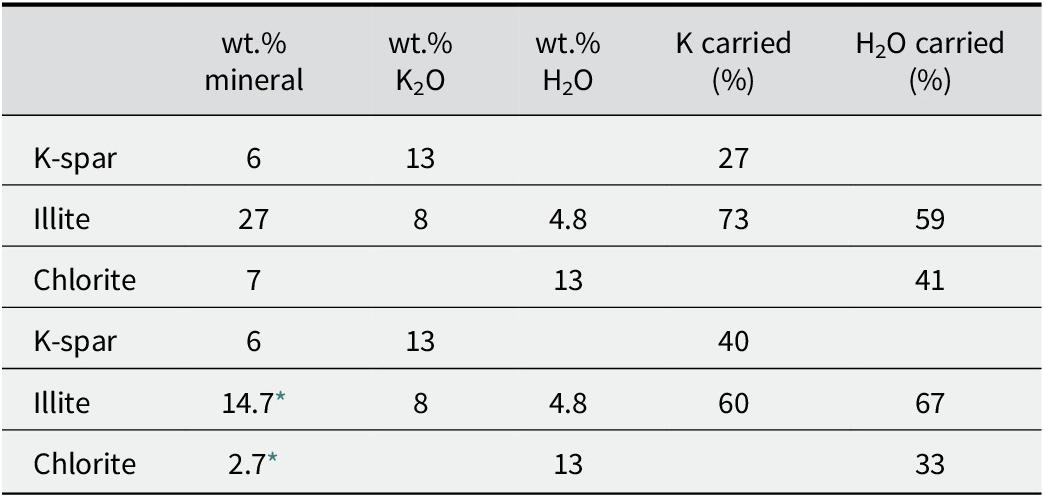
Illite is a major carrier of potassium in sedimentary rocks because: (1) illite is abundant and (2) illite is rich in K2O. Accurate quantification is difficult because of NH4-for-K substitution in illite (see next subsection) and illite’s variable crystallite thickness (Eqn (1)), both contributing to variable potassium content. If the average value of K content (8% as K2O, corresponding to average FIX of 0.72) is accepted for illite, and 13% is accepted for K-feldspar (based on data of Smith, Reference Smith1974) as the second most abundant carrier of potassium in sedimentary rocks, and the mineral-abundance estimates of Garrels and Mackenzie (Reference Garrels and Mackenzie1971) are used, it appears that almost three-quarters of sedimentary potassium is carried by illite (Table 2). A smaller proportion (three-fifths) is obtained if the illite and chlorite abundances, as calculated by Warr (Reference Warr2022), are used. In both calculations, true micas contribute to the illite pool, as Garrels and Mackenzie (Reference Garrels and Mackenzie1971) and Warr (Reference Warr2022) counted true micas and illite as the same. Such a proportion seems to result from the massive transfer of potassium from dissolving K-feldspar to crystallizing illite in the course of diagenesis (Weaver and Beck, Reference Weaver and Beck1971; Hower et al., Reference Hower, Eslinger, Hower and Perry1976). As a consequence, illite is the dominant natural supplier of nutrient potassium in soils developed on sedimentary rocks, as observed by Barré et al. (Reference Barré, Velde and Abbadie2007).
Budget for potassium and water in their main carriers in sedimentary rocks

Mineral composition of sedimentary rocks (wt.% mineral) from Garrels and Mackenzie (Reference Garrels and Mackenzie1971) and from Warr (Reference Warr2022; numbers with*).
Illite and chlorite are the two common minerals with abundant structural water in sedimentary rocks altered by diagenesis, with smectite and kaolinite already illitized and/or chloritized. Chlorite carries much more water (Table 2) but the much greater abundance of illite makes this mineral the dominant carrier. Illite carries its water deep into the epizone, where it recrystallizes into coarser-grained true micas, passing its water to these minerals. Structural water initially in illite seems of particular importance in the subduction zones involving sediments, as H2O released from hydrous minerals plays a critical role in the development of magmatic arcs (Li et al., Reference Li, Massonne, Willner, Tang and Liu2008).
NH4 in illite
The ammonium ion remains an under-estimated component of illite. Many chemical analyses of this clay mineral still do not include N, even in spite of: (1) the early finding of Stevenson (Reference Stevenson1962) that most sedimentary-rock nitrogen is contained in illite; (2) the discovery of a significant ammonium content in hydrothermal sericites (Yamamoto and Nakahira, Reference Yamamoto and Nakahira1966; Kozáč et al., Reference Kozáč, Očenáš and Derco1977) and in illite-smectite of the Gulf Coast sedimentary profiles (Cooper and Abedin, Reference Cooper and Abedin1981); and (3) the introduction of a separate mineral name, tobelite, for hydrothermal NH4-sericites (Higashi, Reference Higashi1982; the term was accepted later for true ammonium micas: Rieder et al., Reference Rieder, Cavazzini, D’yakonov, Frank-Kamenetskii, Gottardi, Guggenheim, Koval’, Müller, Neiva, Radoslovich, Robert, Sassi, Takeda, Weiss and Wones1999). Similar NH4-illites were later described from anthracite-bearing sedimentary rocks (Daniels and Altaner, Reference Daniels and Altaner1990; Šucha et al., Reference Šucha, Kraus and Madejová1994). These latter studies pointed clearly to the origin of illite ammonium from diagenesis of organic matter, first postulated by Cooper and Abedin (Reference Cooper and Abedin1981). Nitrogen isotope studies indicate that ammonium in hydrothermal illites and illite-smectites may also originate from organic diagenesis/metamorphism (Bobos and Williams, Reference Bobos and Williams2017).
The present author studied the ammonium content of illites in bentonites and shales from diagenetic sequences using bulk-rock chemical and quantitative XRD analyses, in order to evaluate the budget of nitrogen in rocks. The study of bentonites from four sedimentary basins (Środoń, Reference Środoń2010) confirmed that: ammonium is located in illite layers of interstratified illite-smectite (Fig. 4); in the course of diagenetic illitization ammonium is imported from outside illite-smectite and from outside the bentonite rock; and the level of NH4 for K substitution in illite is stable or decreasing in the course of diagenesis, ranging from 5 to 48%. This parameter is an indicator of the volume of organic diagenesis that occurred in the sedimentary basin under investigation.
Ammonium in bentonite rock vs fraction of illite in the rock, plotted separately for various sedimentary basins (from Środoń, Reference Środoń2010). WB = Welsh Borderlands, ESB = East Slovak Basin, USCB = Upper Silesia Coal Basin. Plots extrapolate close to zero, demonstrating that ammonium is held in illite.

Środoń and Paszkowski (Reference Środoń and Paszkowski2011) found that 28–98% of nitrogen in the Carboniferous shales from Donbas, Ukraine, is held by the inorganic fraction of the rock, mostly by illite, which is consistent with the estimates of Krooss et al. (Reference Krooss, Jurisch and Plessen2006). In common shales, with organic carbon content of <10%, there is more ammonium in illite than could have been released in the course of diagenesis from the organic matter present in the rock. Illites in such shales are sinks for ammonium imported from outside the rock. Shales with greater organic content are net exporters of ammonium. The level of NH4-for-K substitution in the studied shale illites ranged from 3 to 64% and was greater if there was less illite in the rock, indicating that the supply of ammonium is the limiting factor. Modeling the ammonium release from the organic matter and its simultaneous incorporation by the neoformed illite gives realistic levels of NH4-for-K substitution if a realistic ratio of illite-smectite to organic matter is used for the modeled basin. Inconsistent with the experimental data is the modeled increase of the NH4 substitution with the progress of diagenesis. This discrepancy seems to indicate that part of the released ammonium migrates up the section and becomes fixed there. Cooper and Abedin (Reference Cooper and Abedin1981) came to the same conclusion when analyzing the Gulf Coast data.
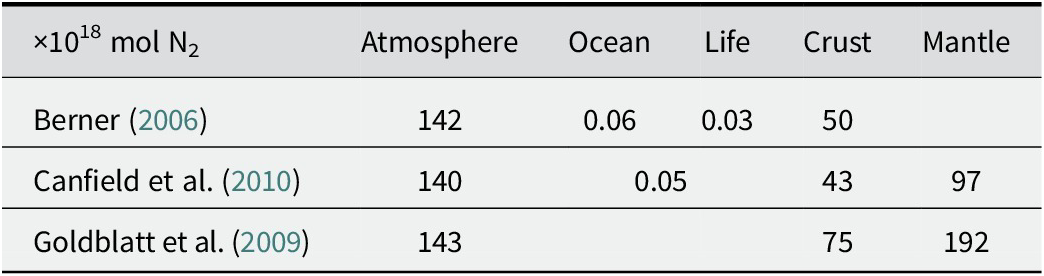
Illite passes at least part of its ammonium to phengite mica during recrystallization, and phengite loses it only above 800°C (Yang et al., Reference Yang, Busigny, Wang and Xia2017). Because the Earth’s crust and mantle were originally degassed, the transport of nitrogen fixed in illite in the subduction zone setting is held responsible for replenishing the crust and mantle with nitrogen (Goldblatt et al., Reference Goldblatt, Claire, Lenton and Matthews2009), to a level comparable with the atmospheric nitrogen pool (Table 3). NH4+ released from illite during metamorphic processes and then oxidized in red beds was indicated as a possible source of nitrogen in natural gas of the North German Basin (Mingram et al., Reference Mingram, Hoth, Luders and Harlov2005). In soils, illite acts as a nitrogen fertilizer. For example, Holloway and Dahlgren (Reference Holloway and Dahlgren1999) calculated that 2570 kg ha–1 of nitrogen becomes available in their study area during soil formation from a slate.
Budget for nitrogen in Earth’s components

Boron in illite
Early on, Goldschmidt and Peters (Reference Goldschmidt and Peters1932) recognized a strong enrichment of boron in shales and marine sediments compared with the precursor igneous rocks (from 10 ppm in continental igneous rocks to 100 ppm in shales; Spivack et al., Reference Spivack, Palmer and Edmond1987). Illite (Harder, Reference Harder1958) and illite-smectite (Tourtelot et al., Reference Tourtelot, Schultz and Huffman1961) were recognized as the main carriers of boron. Two mechanisms of the enrichment have been considered: extracting boron from seawater and pore water by adsorption in smectitic interlayers, and the substitution of B for Si in the tetrahedral sheet of illite (Perry, Reference Perry1972, and literature cited therein), dominant in burial diagenetic environments, as B sorption decreases with increasing temperature and does not occur above 100°C (You et al., Reference You, Spivack, Gieskes, Rosenbauer and Bischoff1995). The tetrahedral B accounts for 80–90% of this element in marine shales, indicating that the observed average B enrichment of shales with respect to igneous rocks is a cumulative product of multiple cycles of weathering, sedimentation, and burial (Spivack et al., Reference Spivack, Palmer and Edmond1987). Williams et al. (Reference Williams, Hervig, Wieser and Hutcheon2001a) indicated kerogen as a potential source of B during burial diagenesis. At anchimetamorphic temperatures, during 1M d into 2M 1 polytype recrystallization, illite loses B which enters into neoformed metamorphic minerals (e.g. tourmaline; Reynolds, Reference Reynolds1965).
The present author studied B in illite-smectite by the approach analogous to that used for nitrogen: quantitative XRD mineralogy of the bulk rock combined with chemical analysis (Środoń, Reference Środoń2010). Study of bentonites confirmed that B is held in illite and not smectite layers (Fig. 5), and showed that it originates from outside illite-smectite and outside the rock: replacement of adsorbed B from smectite to tetrahedral B in illite, if present, is insignificant compared with the fixation of B from pore waters. Like ammonium, the degree of B substitution in illite is stable or decreases during the course of diagenesis. Thus B and NH4 display very similar diagenetic behaviors: illite captures both components released during the diagenesis of organic matter, as concluded by Williams et al. (Reference Williams, Hervig and Hutcheon2001b). In one diagenetic cycle, bentonitic illite may fix up to 1100 ppm of B.
Boron in bentonite rock vs fraction of illite in the rock, plotted separately for different sedimentary basins (from Środoń, Reference Środoń2010). WB = Welsh Borderlands, ESB = East Slovak Basin, USCB = Upper Silesia Coal Basin. Plots extrapolate close to zero, demonstrating that boron is held in illite.

Illite is most often the dominant carrier of B in sedimentary rocks, but there are exceptions. Boron is captured by kaolinite and hematite during lateritic weathering and can survive in these minerals in oxidized sedimentary rocks (Fig. 6; Jewuła et al., Reference Jewuła, Środoń, Kuligiewicz, Mikołajczak and Liivamägi2022). Occasionally, detrital biotite can be the dominant carrier of B (Jewuła et al., Reference Jewuła, Środoń, Kuligiewicz, Mikołajczak and Liivamägi2022). These data confirm the conclusions of Spivack et al. (Reference Spivack, Palmer and Edmond1987) that the B content of mudstones should not be regarded as a paleosalinity indicator, as proposed in the early stages of sedimentary B studies (Frederickson and Reynolds, Reference Frederickson and Reynolds1960).
Distribution of boron among mineral components of mudstones in five Ediacaran/Cambrian sedimentary basins of the East European Craton (from Jewuła et al., Reference Jewuła, Środoń, Kuligiewicz, Mikołajczak and Liivamägi2022).

Because illite-smectite is the dominant clay mineral in mudrocks (Table 1), B is held mostly in illite, and B has an exceptionally high neutron absorption cross-section; neutron well logging used in borehole geophysics can evaluate the amount of clay and other clay-related shale properties (e.g. Zorski et al., Reference Zorski, Ossowski, Środoń and Kawiak2011).
Rb and Cs in illite
Rubidium and cesium are trace elements that generally follow potassium in geological processes. Processes in the crust fractionate these elements strongly (e.g. Breiter et al., Reference Breiter, Broska and Uher2015). Latest-stage magmatic fluids from granitic systems are often particularly enriched in Rb and even more in Cs (e.g. London, Reference London1997). As a consequence of the crustal processes, the detrital-mineral components of sedimentary rocks contain very variable Rb and Cs contents. K-feldspars and micas are their dominant primary carriers. Illite was recognized early as the major authigenic carrier of Rb (Horstman, Reference Horstman1957). Reynolds (Reference Reynolds1963) documented an anchimetamorphic decrease in the Rb content in illite, and explained it by crystallization of low-Rb illite at the expense of dissolving, low-Rb, authigenic K-feldspar. Later studies confirmed anchimetamorphic Rb decrease. Tamura (Reference Tamura1961) observed the high selectivity by illite of cesium and explained it by sorption at crystal edges. This line of experimental research, aimed at understanding radioactive 137Cs behavior in the environment, was also applied to Rb (Sawhney, Reference Sawhney1972) and dominated the studies of Rb and Cs behavior in sediments. Sorption on wedges (e.g. Wampler et al., Reference Wampler, Krogstad, Elliott, Kahn and Kaplan2012) and frayed edges (e.g. Fuller et al., Reference Fuller, Shaw, Ward, Haigh, Mosselmans, Peacock, Stackhouse, Dent, Trivedi and Burke2015) was considered, and regarded as reversible (e.g. Brouwer et al., Reference Brouwer, Baeyens, Maes and Cremers1983; de Koning and Comans, Reference de Koning and Comans2004) or irreversible (Fuller et al., Reference Fuller, Shaw, Ward, Haigh, Mosselmans, Peacock, Stackhouse, Dent, Trivedi and Burke2015). Derkowski and McCarty (Reference Derkowski and McCarty2017) inferred that illite is the main sink for Cs on the Earth’s surface, and that sedimentary Rb is equally distributed between illite and K-feldspar.
A recent study by Środoń and Jewuła (Reference Środoń and Jewuła2025), based on chemical analysis and quantitative XRD mineralogy of the bulk rock, revealed that illites in basins invaded by hydrothermal fluids have elevated Rb contents and very elevated Cs contents (Fig. 7). The same observation can be made using clay fractions separated by the Jackson (Reference Jackson1975) procedure from bentonites in such basins (Fig. 8), which indicates that the Rb and Cs measured are non-exchangeable. In basins without hydrothermal overprint, mudstone illites contain, on average, 70% more Rb and 2.4 times more Cs than the average upper continental crust values. The budget of Rb in such mudstones is dominated by the amounts contained in true micas and K-feldspar, i.e. the minerals of mostly detrital origin, and illite – a mineral of at least partially authigenic, diagenetic origin. Illite contains about half of mudstone Cs, true mica typically has the second largest Cs content, and the Cs contents in K-feldspar are important in rare circumstances (Fig. 9). Recent data (Środoń and Jewuła, Reference Środoń and Jewuła2025) indicate that a significant part of the Rb and Cs in mudrocks is locked in the crystal structures of minerals, and that authigenic illite acquires most of its Rb and Cs, like K, NH4, and B, during crystallization in the course of diagenesis. In one diagenetic cycle, the bentonitic illites under study acquired, on average, 161 ppm Rb and 11 ppm Cs. In hydrothermally affected basins, these average values reached 239 ppm Rb and 81 ppm Cs. The impact of Cs and Rb sorption at illite and mica wedges and/or frayed edges (Wampler et al., Reference Wampler, Krogstad, Elliott, Kahn and Kaplan2012) on the total budgets of these elements cannot be evaluated from the present data and remains a challenge for further studies.
Rubidium (A) and cesium (B) vs potassium in bulk shales from the Keuper basin in northern Silesia (Poland), presenting the difference between burial diagenesis (NW profiles) and the hydrothermal overprint (SE profiles). The dashed lines represent the Cs/Rb ratio of the upper continental crust (from Środoń and Jewuła, Reference Środoń and Jewuła2025).

Cesium vs rubidium in monomineral illite-smectite and expandable illite clay fractions, plotted separately for basins affected only by burial diagenesis (green symbols) and invaded by hydrothermal fluids (red symbols). The dashed line represents the Cs/Rb ratio of the upper continental crust (from Środoń and Jewuła, Reference Środoń and Jewuła2025).

Distribution of rubidium and cesium among mineral components of mudstones in seven sedimentary basins unaffected by hydrothermal overprint (from Środoń and Jewuła, Reference Środoń and Jewuła2025). The bold numbers represent wt.% of a given mineral in the rock, and the concentrations of Rb and Cs in these minerals (ppm) are given in italic.

Summary and conclusions
The mineralogy of illite, its behavior in the rock cycle, and its role in the global cycling of selected elements, are reviewed here, focusing on previous published results of the author.
-
(1) Illite is a charge-deficient mica, with Q i = 0.95/O10(OH)2, displaying swelling properties and a fixed cation charge of as little as 0.6/O10(OH)2 if illite crystals are very thin (a few silicate layers).
-
(2) Illite is one of the most abundant minerals of sedimentary rocks due to its chemical composition, stability at high temperatures, and relative resistivity to weathering, which results in massive recycling.
-
(3) Illite abundance and composition implies its important role in the global cycling of water and elements (K, N, B, Rb, Cs).
-
(4) In subducting sediments, illite delivers more water in its structure than any other mineral.
-
(5) In soils, illite is the dominant natural source of two of the three most important nutrients, K and N.
-
(6) During burial of sediments, crystallizing illite acts as the major sink for ammonium and boron liberated in the course of diagenesis of the organic matter.
-
(7) During burial of sediments, crystallizing illite accumulates Cs and Rb. Mudstone illites contain, on average, 70% more Rb and 2.4 times more Cs than the upper continental crust. Illites from the basins invaded by hydrothermal fluids are characterized by much larger Cs values.
Data availability statement
This is a review article: the data used are available in the quoted references.
Acknowledgements
Many thanks to Peng Yuan who inspired me to write this paper, to four reviewers, including Laurence Warr and Marion Wampler, whose comments significantly improved the shape of this review, and to Andrzej Łaptaś for his help with the figures.
Financial support
The financial support came from the institution employing the author.
Competing interests
The author declares none.