1. Introduction
Environmental constraints have long been seen as one of the prime movers of populations. In many parts of the world, populations have had to move to new areas after sedentary agriculture exhausted natural soil fertility in the former location. Increasing demographic pressure in the recent decades has only expedited this process. In dry regions, where water rather than land is the primary limiting factor, population growth has resulted in overuse of water and land and, in turn, eventual out-migration (Bilsborrow, Reference Bilsborrow1992).
Existing migration theories treat environmental-stress-induced migration as a distress phenomenon influenced by ‘push’ factors. Such migration can in turn lead to sub-optimal land use and further degradation of land owing mainly to shortage of labour of able bodied persons of the households (Scherr and Yadav, Reference Scherr and Yadav1998). Similarly, additional income earned from out-migration could expedite the degradation process by inducing private investment in water extraction; in absence of the additional income, investment in ground water extraction may remain limited. Environmental factors, in general, form part of the set of structural factors that motivate households to make a variety of decisions, including migration. There is, however, little understanding on the interface between development and migration in general and resource degradation and migration in particular.
The recent discourse on migration poses a counterview asserting that efforts for rural development do not reduce migration; at best it may only change the pattern of migration. It has been argued that migration, especially circular migration, is often seen as a means to augment additional income rather than being a survival mechanism for the poor (Ghatak, et al., Reference Ghatak, Levin and Price1996; Munshi and Rosenweig, Reference Munshi and Rosenzweig2005; Farrington, et al., Reference Farrington, Deshingkar, Johnson and Start2006; Kundu and Srangi, Reference Kundu and Sarangi2007). There are, however, certain inadequacies in the existing body of literature as noted by a number of scholars (Stark and Levhari, Reference Stark and Levhari1982; MacDowell and Haan, Reference MacDowell and Haan1997; Hann, Reference Haan, De1999; Haan and Rogaly, Reference Haan and Rogaly2002; Srivatsava and Bhattacharya, Reference Srivatsava and Bhattacharya2002).Footnote 1 Households in developing economies have multiple reasons for migration. It could be a combination of distress and precautionary migration. Standing (Reference Standing1985) refers to migration as a ‘safety-valve mechanism’ that may help prevent a further decline in livelihood status. Similarly, the Indian National Commission on Rural Labour distinguishes between survival- and subsistence-driven migration (NCRL, 1991). The complexities in analysing migration have led to refinements in the dichotomous perspective on ‘push’ and ‘pull’ factors shaping out-migration, which often is not a one-time movement (Mandel, Reference Mandel, Eickleman and Piscatori1990). This calls for a dynamic context to understand migration decisions.
There are a few studies that have carefully examined the impact of degradation of water and land on migration. A recent study by Chopra and Gulati (Reference Chopra and Gulati2001) shows that land degradation has a significant positive impact on out-migration. They find moreover that better management of common property land resources through creation of property rights has a negative impact on out-migration. The study, however, is based on secondary data for regions in India and captures migration indirectly though higher sex (female/male) ratio.
An important feature of the migration literature in India is lack of generalizability (Haan and Dubey, Reference Haan and Dubey2006), thus calling for more location specific research based on primary investigation. Environmental aspect is yet another critical gap in the literature. The present study aims at bridging this gap. Drawing upon the existing literature – theoretical as well as empirical – the study seeks to examine migration decisions in the light of the socio–economic, environmental and cultural context existing at the place of origin. The analysis incorporates impact of degradation of private land, as well as common pool resources (CPRs), on migration decisions. There are two important propositions underlying the empirical investigation: First migration is not a once-and-for-all decision, and these decisions could be influenced by a combination of distress as well as income-augmenting motives. And second, apart from actual income gains, the decisions are shaped by what people perceive as desirable from the vantage point of households’ socio–economic–cultural attributes.
The study is located in three dry land districts in Gujarat, India, and is based on primary data collected from over one thousand households. Gujarat is a particularly interesting region because it is characterized by adverse agro-climatic conditions with degraded land and water resources, yet having a dynamic and diversified economy.
2. Migration from dry land regions: a review of evidence and issues
Migration literature in India, barring a few studies, has paid little attention to the conditions prevailing in the place of originFootnote 2 (Banerjee, Reference Banerjee1986; Appleyard, Reference Appleyard and Appleyard1988; Yadava and Yadava, Reference Yadava and Yadava1998). Similarly, the studies, based on official statistics on in-migration, have focused on the place of destination. This often leaves out short duration, seasonal or circulating, migration, which may have special significance in the context of livelihood among both poor as well as ‘not-so-poor’. This is particularly true for the dry land areas where drought-induced migration is fairly common and has a long history. The recent spur of interest in the question of ‘staying put’ reinstates the importance of socio–cultural–historical factors. At the same time, it highlights unequal opportunities, especially among the poor, to seek migration as a livelihood option. This section discusses some of these aspects in the context of the study region.
2.1 Distress versus development induced migration
Until the late 1980s, households with medium- to large-sized land holdings, with some investment in irrigation, did not have to move out of dry land regions for subsistence purposes (NIRD, 2000).Footnote 3 Migration for such relatively wealthy households growing high-valued commercial crops like oil seeds, spices, horticulture was mainly for better prospects rather than a distress move. Similarly, areas with moderately good soil and ground water table could also escape distress migration.
While this may hold true for many who migrate from rural areas, the larger reality is that of selectivity bias in terms of who can manage to migrate and what kind of opportunities they find (Cashin and Sahay, Reference Cashin and Sahay1996; Yadava and Yadava, Reference Yadava and Yadava1998).Footnote 4 There is evidence from the rural areas that the landless or the very poor and socially marginalized communities have the least chance of migration (Connell et al., Reference Connell, Dasgupta, Roy and Lipton1976; Lipton, Reference Lipton1980; Oberai et al., Reference Oberai, Prasad and Sardana1989).
There is often an element of distress even among those who apparently migrate for income enhancement (Sah and Shah, Reference Sah and Shah2005). When households find very bleak chances of actually realizing the expected benefits from migration, it leads to a perception of ‘distress’ among both those who actually migrate and those who consider migration as inevitable in future.Footnote 5
2.2 Risk aversions and precautionary migration
A dominant tradition in migration studies analyses employment decisions and migration through the risk-aversion expected-income-maximization model. In this model, a migrant household compares the risk associated with life-long income in agriculture vis-à-vis urban jobs (Stark and Levhari, Reference Stark and Levhari1982). With declining quality and quantity of land and water resources, households face a situation of increasing risk in terms of the future flow of income from agriculture.
In India, there is ample evidence of long-term migration of people from drought-prone regions of Gujarat, Maharashtra, Rajasthan, etc., to other parts, including hilly areas in the north. Historically, dry land regions in India have been more prone to out-migration (Visaria and Kothari, Reference Visaria and Kothari1984; NIRD, 2000; Shah, Reference Shah, Shah, Rutten and Streefkerk2002a; Deshingkar and Start, Reference Deshingkar and Start2003; Sah and Shah, Reference Sah and Shah2005). Weather-induced uncertainty and a low level of land productivity appear to be largely responsible for this pattern. Of late, rapid depletion in land and water resources appears to have only aggravated the situation. The three consecutive droughts in the mid 1980s seem to have changed the above pattern, which resulted in migration, even among the landed. The migration decision for these households arose mainly out of a precautionary motive, i.e. households chose to migrate because of uncertainty about future prospects. The aim was to maintain at least the pre-migration level in the face of the risks associated with uncertain rainfall (as indicated by Standing, Reference Standing1985). Precautionary migration as a conceptual category is thus different from development induced (accumulative) migration on the one hand, and also from that which is essential for survival (or coping with subsistence living). In reality these categories may overlap, and as a result, the distinction among them may get blurred.
2.3 Land degradation, labour markets and circulatory migration
In dry areas of India and elsewhere, difficulties in establishing property rights over groundwater result in farm households pumping out ground water at a rate faster than that of their neighbours (Shah, Reference Shah2002b). Shifting to certain high risk and more remunerative crops forms an important strategy, though it is driven primarily by a short-term perspective. Another strategy is to keep the land idle or to lease it out. Such risk-averse strategies may have significant environmental implications and may have a direct impact on labour markets and migration (Bilsborrow, Reference Bilsborrow1992; Leighton, Reference Leighton1999). Firstly, it may lead to increased migration, mainly of a circular type, resulting in a rise in wage rates during periods during the peak season. Secondly, it may pull labour from regions with a higher level of degradation and from among the poorer communities such as tribals who have a lower reservation price. Overall, it may aggravate the problem of sub-optimal use of land – both in the place of origin as well as destination.
Although there is no firm estimate, official documents suggest that there are about 30 million workers engaged in circular/seasonal migration. According to the recent document of the XIth Five Year Plan, short-term or circular migrants are the most vulnerable and exploited among the informal workers, who need special attention under the new policies. The analysis of motives as well as impact of migration thus may remain lopsided if it overlooks the phenomenon of circular migration, which constitutes a formidable proportion of the total migrants in the country (Breman, Reference Breman1996; MacDowell and Haan, Reference MacDowell and Haan1997).Footnote 6
2.4 Socio-cultural context
A number of socio–cultural factors such as age, sex, marital status, location and access to information impinge upon migration decisions (Taylor, Reference Taylor and Jackson1969). A number of studies observe that migration decisions are often influenced by what the households and their kin think of the potential migrants’ place of relocation and the labour market (Haan and Rogaly, Reference Haan and Rogaly2002), suggesting thereby that the social world of the migrant's place of origin influences and in turn is influenced by migration. Social networking, based on castes and family relationships, creates strong pillars of support for out-migrants from relatively less developed regions. Access to institutional credit is cited as an effective mechanism for reducing the dependence on social networking. In reality, this may have only limited impact in a scenario where the dependence is not merely for seeking financial help, but also involves support in terms of information, strategic contacts, and social identity which play a significant role in getting the right kind of work, given the imperfect labour markets within developing economies.
The study region is endowed with good ‘social networking’, which may help overcome some of the risks and costs of migration. But, this can work only up to a point, beyond which overcrowding occurs. At this juncture, a process of return migration and plowing back of savings into the rural economy may start.Footnote 7 What is also important is to recognize that migrants tend to seek social acceptability or respectability in the place of migration. Ensuring social acceptability is particularly important among those in the middle and upper strata of households who adopt a strategy of ‘precautionary’ and/or ‘development induced’ migration (Engelshoven, Reference Engelshoven, Shah, Rutten and Streefkerk2002). This, however, does not apply to the social outcasts, who do not have any social networking or marketable labour. They face the worst situation in the place to which they migrate. According to Dasgupta (Reference Dasgupta1993: 255–256), unable to find even seasonal work, some of these migrants become beggars in the streets of cities; in the market sense these migrants become ‘non-people’.
2.5 Remittances and on-farm investment
Besides helping with consumption over the seasons and years, remittances from migrants also enhance on-farm investment, though much of the remittances may be used to pay off debts (Oberai and Singh, Reference Oberai and Singh1980). This phenomenon has been observed in the case of dry land regions in India (Walker and Ryan, Reference Walker and Ryan1990; Shah, Reference Shah, Shah, Rutten and Streefkerk2002a). A substantial part of ground water irrigation seems to be financed through such migration, directly or indirectly, via servicing the debt incurred for such investments. The evidence on impact of remittances on agriculture, however, is mixed. Those from the relatively better economic strata are likely to invest in agriculture as compared to those with chronic indebtedness. An important feature of the region is return migration of at least some of those who made a better fortune as workers in the diamond industry; these workers set up a small household unit for diamond cutting/polishing back in their villages.
Given this backdrop, we move to the next section, depicting the extent and nature of migration in the study region.
3. The study region and migration
The study is based mainly on primary data collected from six villages in three districts of Saurashtra, a dry land region in Gujarat. Almost half of the 25 districts in the state are designated, fully or partly, as drought or desert prone (Government of India, 1994). Normally, every third year is a drought or semi-drought year in parts of the state. The districts are Surendranagar, Amreli and Jamnagar which represent some of the most drought-prone regions in the state, characterized by low level of rainfall (<500 mm per year) and a high proportion of wasteland relative to total geographical area (GIDE, 2002). In each district, two talukas (sub-districts) were selected, representing relatively high and low levels of land degradation. The selection was based on both the extent and the severity of degradation in terms of soil nutrients, as well as depth and salinity influencing productivity in agriculture. Severity was captured mainly through qualitative information obtained from informed persons at the taluka as well as the village level. Subsequently, one village representing each taluka was selected to carry out primary surveys. The village selection was based on multiple criteria: soil type, extent of irrigation, village size, distance from a large urban or industrial centre and presence of reasonably successful watershed programmes. Broadly, the six sample villages can be grouped into three categories of land degradation: moderate, high and very high.
Collection of primary data was undertaken in two stages. The first stage involved a complete listing of the 1,227 households with a total population of 6,631 that inhabited the study villages. A household survey was undertaken to obtain information about important variables such as land size and extent of degraded land; labour force and occupational diversification; migration during different years and duration; distance, type of work, remuneration; other assets; types of crop grown and income and on-farm investment and direct benefits from watershed programmes. Data were also collected about households from which occupants had migrated, partially or completely.
3.1 Land degradation, irrigation and incidence of migration
There are no systematic time-series data measuring land degradation and changes over time in the study villages. Nevertheless, discussions with informed farmers in the villages as well as soil scientists in the region suggest increased land degradation in the recent past, especially over the past two decades. The survey villages represent different types of land degradation: coastal salinity in Jamnagar district, aridity in Surendranagar district and shallow soil in Amreli district.
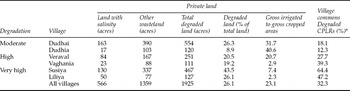
Table 1 shows that land degradation on private land is a serious problem in the region. Between 9% and 43% of the land or a total of almost 2,000 acres of privately owned land belonging to nearly 60% of the landed households was reported as degraded. On average, 26% of the total private land owned in our study area can be considered degraded.Footnote 8
Degradation of private lands in sample villages

*Based on village level information about common property land resources, including pastures. If CPLRs have ceased to be used as important sources of fodder or fuel because of the declining quality, such land has been considered as degraded. The percentages refer to degraded area to total CPLRs.
Twenty-three per cent of cropped area in the study region is irrigated. Thirty-eight per cent of landed households irrigated at least part of their land. Irrigation is a major mediating factor that counters the effect of private land degradation. This notion emerged clearly during our discussion with the village community, that is, irrigated private land is not perceived as degraded even if the land is saline or eroded. While the estimates of degradation of private land in table 1 do not take into consideration its irrigation status, these kinds of perceptions highlight the critical importance of irrigation as a countervailing factor to land degradation.
Village pastures and other common property land resources (CPLRs) are important assets, particularly for the landless. We find that on average 32% of CPLRs are degraded. As table 1 shows, CPLR degradation varies from 12% to 64% among the study villages. Our data suggests that CPLR degradation is far higher than private land degradation. We identify as degraded CPLRs those lands that were previously used as a source of fodder but are currently not in use due to overdepletion. Village-level degradation is estimated by calculating the proportion of degraded land in the village to total CPLRs in the village.
3.2 Land and livestock
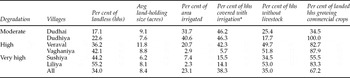
Table 2 shows that a significant 34% of households in the study villages are landless. The percent of landless households is somewhat low in the moderately degraded villages relative to the medium and high degradation villages. Among those with land, the average land holding is 8.4 acres.
Asset base among sample households (hhs)

*For those with land.
Approximately, 40% of landed households have access to irrigation. Sixty-seven per cent of landed households grow high valued commercial crops like cotton, groundnut, and spices. The type of crop choice can partly be explained by how important livestock is to agricultural households. Traditional herder communities tend to choose crops such as bajri, which has a high fodder value. Approximately 65% of all households own livestock. However, the extent of livestock ownership is found to be higher among the landed; the majority (57%) of the landless have no livestock as compared to 23% among landed households. The landless own one unit of livestock (in terms of adult cattle units (ACUs); 5 sheep/goats = 1 ACU.). Compared to this, the landed with no or limited irrigation own two ACUs (10 sheep/goats) of livestock and the richer landed on average own 3 ACUs (15 sheep/goats).
3.3 Incidence of migration
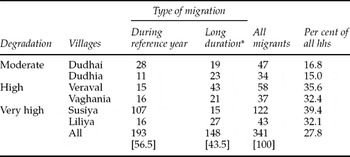
Table 3 presents the incidence of migration in the study villages. Nearly 28% of all households reported migration of at least one person from the household. This includes both short-term (i.e. seasonal or circulatory migration during the reference/previous drought year) as well as long-term (i.e. in the last 10–12 years but retaining a part of the household's economic base as well as decision making).Footnote 9 While there are no readily available estimates of household level out-migration for Gujarat state,Footnote 10 evidence from microlevel studies in dry land regions suggests a somewhat similar proportion of households reporting at least one person going out for economic reasons (Deshingkar and Start, Reference Deshingkar and Start2003). Migration appears to be higher in the medium and highly degraded villages relative to villages with moderate land degradation. Our data suggests that both long-term and short-term migration is prevalent nearly to the same degree in the surveyed households.
Incidence of migration among households in the study villages (no of households)

*Includes 6 hhs which also have other member/s who have migrated during the reference year. Refers to the households having at least one member (son or brother) who migrated during the past 10–15 years but continues to remain part of the household as they share both income as well as expenditure with the family. The information was obtained by asking how many years it has been since the person migrated.
3.4 Migration among landless and landed
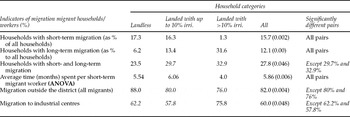
In order to assess whether the rich and poor had different patterns of migration, we studied migration among the landed and landless (see table 4). Approximately 23% of the landless and 30% of the landed households count a migrant among their household. Among landed households, the proportion of migrants is slightly higher in the case of those with more than 10% irrigation (32.9%) as compared to those with no or less than 10% irrigation (29.7%). However, our data shows that the rich and poor participate in different forms of migration. While nearly 58% of all households with migration undertake short-term migration,Footnote 11 the proportion among the landless is 17.3% as compared to only 1.3% among the category of asset-rich. Conversely, 31.6% among the category of asset-rich (the landed with more than 10% irrigation) of households reported long-term migration with at least one household member living outside the village for a long period of time during the last 10 years.Footnote 12 These members visit their families especially during festivals and other social functions, and also have some kind of arrangements for sharing income from and expenditure on different activities.Footnote 13 The proportion of long-term migration is 6.2% in the case of landless households, which increases to 13.4% among the middle-category and touches a high of 32.9% for the top category.
Distance and duration of migration

Note: Figures in parentheses indicate values of Pearson Chi-square. Refers to migrant workers within the households. It is possible that if there is more than one migrant worker in a household, they may have different destinations. The result indicates a significant association between the indicators of migration and the categories of land holding size. We also tried to test for the difference in the proportion of households/workers along these categories (with Bonfferoni's adjustment). The results were found to be significant in most of the cases.
The average duration of short-term migration (during the reference year) was about 6 months. This ranges from 6 months in the case of middle-range households, 5.5 months among the landless and 4 months among the landed with better irrigation facilities. When it comes to migrant destinations, a large proportion of migrants (82% in fact) go out of the district. However, if we consider long-distance migration to industrially developed cities such as Surat, Mumbai, Ahmedabad and Rajkot, the proportion is about 60%. Significantly differing pairs of proportions after Bonferroni adjustment are also shown in table 4.
3.5 Education and occupation among migrants
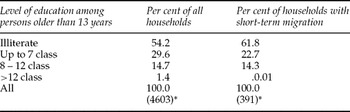
Educational attainment could be an important feature associated with migration. We examined level of education among those who engaged in migration. It is observed that whereas 54% of the population above 13 years was illiterate, the proportion among households with short-term migrants was about 62% (see table 5). The pattern across landed and landless households confirms the generally observed scenario of positive association between ownership of land and literacy. It is observed that whereas 25% of the landless households do not have even a single literate person, the proportion among the landed is 13% of all the households in the study villages.
Educational attainment and migration

*Number of persons older than 13 years.
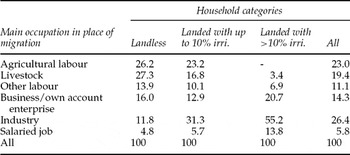
Table 6 presents information on the main occupation of migrant workers. It is observed that while 42% of the households are engaged in activities related to agriculture and livestock at the destination point, the rest find opportunities in the non-farm sector, in areas such as industry, trade, and service. More than one-fourth of the migrant workers are found to be engaged in industry, especially, diamond cutting and polishing, which has more or less played the function of a coping mechanism in the wake of frequent droughts that plague the region. It may be noted that migration to Surat to work in the diamond industry has a genesis in by far the most severe consecutive droughts in the region, and is still being viewed as an important coping mechanism under the situation of frequent droughts (Basant et al., Reference Basant, Kumar and Parthasarathy1998). Another 14% have started their own businesses/own account enterprises. Only about 6% have found salaried jobs. The proportion of households engaged in these non-farm activities, however, is significantly higher among the landed households with better irrigation facility. A similar pattern is observed in the case of business and service.Footnote 14 Of course, those engaged in the diamond industry also constitute a fairly differentiated lot, as noted earlier. This highlights the differential paths taken by migrants from the landed and landless households when it comes to occupation.
Occupations among migrant workers

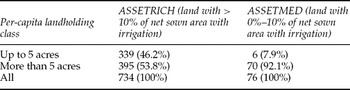
Distribution of per-capita landholding by dummies of asset

4. Determinants of migration
4.1 The model
In the dry land regions of Gujarat, migration decisions are part of the labour allocation decisions made by households to maintain a certain consumption basket and to improve their living standards. In general, our review of the literature and understanding of ground reality suggest that six major sets of factors influence out-migration from rural households. These are: asset base, status of farm economy, degradation of land, human capital, social networking, and various pull factors.Footnote 15 The impact of these variables may, however, vary across the types of out-migration, i.e. long-term and distress short-term migration.Footnote 16 The impact of each of these variables will also depend on other socio–economic factors such as nature of education, presence of specific caste groups and indebtedness.
We postulate that rural households maximize their long-term income by adopting a diversified portfolio of production and labour allocation decisions, which includes migration. The decision to migrate is depicted in equation (1) as

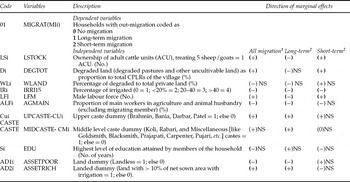
where Mi refers to migration status in household i. We estimate equation (1) by using binomial logistic regression with ‘no migration’ as the reference category. Moreover, we also estimated equation (1) using a multinomial logistic regression model with households having ‘no migration’ (MIGRAT=0) as the reference category and those with long-term migrants (MIGRAT=1) and short-term migrants (MIGRAT=2) representing the two categories of migration among the households. The coefficients of multinomial logit estimate marginal effect of an independent (explanatory) variable on the probability of the two categories of migration, i.e. long-term migration and short-term migration, in relation to the reference category (i.e. ‘no migration’). Long-term migration refers to those households with at least one person migrating out for work for more than a year during the past 10 years. Short-term migration is defined as a household with at least one person migrating outside the village for work during the reference year.Footnote 17 The variables that are hypothesized to influence migration are presented in table 7. All the explanatory variables are household-level variables except for Dj, which refers to degradation of village common lands in village j.
Dependent and independent variables in estimating migration and its determinants

1 = Based on Binary Logistic Regression with no migration as reference category.
2 = Based on Multinomial Logistic Regression with no migration as reference category.
NS = Not significant statistically.
We hypothesize that ownership of livestock could induce migration, particularly short-term; it is less likely to induce long-term migration. Degradation of land both under private (WLAND) as well as public ownership (DEGTOT) is expected to induce migration because of the perceived non-sustainability in the short run. On the other hand, irrigation (IRRI15), which improves land quality, is likely to decrease the probability of migration.
A large male labour force (LFM) may also induce migration owing to the more likelihood of surplus labour that could be dispensed, at least in the short run, without losing income from the households’ economic activities in the village. The greater the proportion of workers in agriculture and animal husbandry (AGMAIN), the more the household is invested in rural activities and hence less likely to migrate.
Human capital and social networking/links are represented by education and caste. Educated and higher caste households are expected to engage in long-term migration because of their superior skills and access to new opportunities.
To estimate the impact of wealth on migration we created two dummy variables, ASSETPOOR and ASSETRICH, which are compared with their reference variable ASSETMED. ASSETPOOR are those who do not have land, while ASSETRICH are those who possess land with more than 10% of the net cultivated land receiving irrigation. The rest are considered as ASSETMED, consisting of those who possess land with no or less than 10% irrigation. Combining irrigation with land is particularly relevant in light of the fact that land per se matters little in terms of income or livelihood security in a region where frequent droughts have become the norm in the past two decades. Incidentally, more than 92% of the ASSETRICH possess per-capita land of more than 5 acres, as compared to 58% in the case of ASSETMED (see table 6a). It is imperative that ASSETRICH are not only better in terms of level of irrigation but also richer in terms of per capita land holding compared to ASSETMED. Here water or irrigation is the primary constraining factor. For wealthier households with irrigated land, migration to superior jobs or precautionary migration is an attractive option. We also hypothesize that the landless are less likely to migrate, particularly long term, relative to the landed with no or poor access to irrigation. Frequent droughts and low demand for farm labour are likely to motivate their migration.
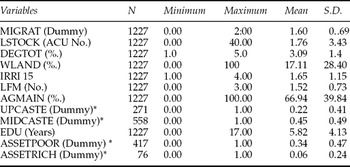
Table 8 presents summary statistics on the variables. It is observed that some important variables such as area of degraded land, ownership of livestock, and educational attainment vary significantly across households. Similarly, the number of the male labour force per household also varies substantially between zero and three. The proportion of main workers in agriculture also has a significant variation with a mean of 67% and a standard deviation of 39.4.
Summary statistics for the dependent and independent variables

*N represents values corresponding to code 1 of Dummy variables.
4.2 Main results
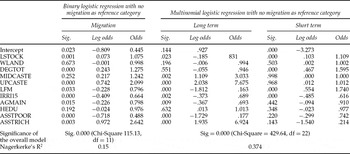
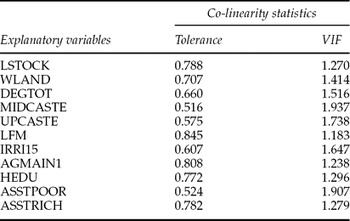
Table 9 presents results of the binomial and multinomial logit analysis, predicting incidence of migration among households in the study villages. The predictive power and the two models have been found to be statistically significant at the 5% level. Additionally, we have also checked for multi co-linearity using the variance inflation factor (VIF). The results are presented in table 10.
Results of binary and multinomial logistic regressions

Co-linearity statistics for independent variables

Note: In order to rule out multi co-linearity among the independent variables, a multiple linear regression was estimated. The above results suggest that for all the variables VIF remains below 2.5 and tolerance > 0.4. This suggests that there is no reason to suspect multi-co-linearity.
4.2.1 Incidence of migration
Binary logistic regression results reveal that eight out of eleven independent variables are statistically significant. Ownership of livestock (LSTOCK), village level degradation of land (DEGTOT), higher social status (UPPERCASTE), and relatively better economic status (ASSETRICH) positively influence the migration behaviour. As expected, irrigation (IRRI15), proportion of main workers engaged in agriculture (AGMAIN) and landlessness (ASSETPOOR) reduce the odds of migration. Moreover, number of males in labour force (LFM) also reduces the probability of migration. The variable, however, may exert differential impact on short- and long-term migration as observed subsequently. It may be noted that among the households with more than one male member in the labour force, almost 60% belonged to medium asset category (land with less than 10% irrigation). These households may not have the need or the compulsion to seek work outside the village. Prima facie, these results tend to indicate a mixed picture where ownership of livestock and larger proportion of irrigated area increase the likelihood of migration, whereas being landless reduces the likelihood of migration; access to irrigation per se, reduces migration. Similarly, larger size male labour force reduces chances of migration. How far does the pattern vary across two types of migration that appear to be mutually exclusive across the households?
4.2.2 Long-term migration
The pattern of long-term migration presents interesting results with eight out of the 11 explanatory variables having significant effects. As expected, ownership of livestock (LSTOCK) and irrigation (IRRI15) have significant negative effects on the probability of long-term migration in the household. Similarly, proportion of main workers (AGMAIN) engaged in agriculture also has negative effect on long-term migration. Together this may suggest that a relatively stronger base in the primary sector activities such as agriculture and livestock may hold back the workforce to support the household economy within the village. This is probably what is reflected by the fact that number of male workers in the households also has a negative effect on long-term migration.
On the other hand, the results indicate negative effect of ASSETPOOR (landless) on long-term migration. This, however, may not necessarily imply that the very poor households do not aspire to long-term migration. Rather, a more realistic depiction of the situation is that the landless are unable to obtain such opportunities given their weak financial base on the one hand and social networking on the other. Interestingly, among those with land and irrigation, the relatively better households (i.e. the ASSETRICH) have higher probability of long-term migration compared to the households in the middle category (ASSETMED, i.e. those with land but no or limited irrigation) and also the landless (ASSETPOOR). The households from higher strata of castes (HIGHCASTE and MIDCASTE) are found to have positive effects on long-term migration as compared to the category of socially marginal communities.
Overall, the results tend to suggest that those at the bottom level of land ownership (i.e. landless) can not afford to opt for long-term migration as compared to those who own land especially with more than 10% irrigated area. Social networks or contacts do seem to matter positively. Strangely, level of land degradation or education did not show significant effect on long-term migration with relation to ‘no migration’. The scenario is somewhat different for short-term migration, at least in the case of village level land degradation.
4.2.3 Short-term migration
The results for short-term migration are somewhat less complex. First of all, only four out of the 11 explanatory variables show significant effects on short-term migration, which is quite different from the results discussed above. As expected, extent of irrigation (IRRI15) seems to be holding back households from opting for short-term migration, which often involves ‘inferior’ type of labour work as compared to working on one's own field. Conversely, those having more livestock (LSTOCK) tend to go out for short-term migration; a part of this could be moving along with the livestock and/or in search of fodder, especially during the summer season. Larger number of male members in labour force seems to facilitate such short-term migration as also suggested by positive and significant effect of LFM.
It is important to note that village level degradation of land (DEGTOT) does influence short-term migration as noted earlier. What is somewhat surprising is that landlessness (ASSETPOOR) does not exert significant influence in determining short-term migration per se. This observation is at variance from what we observed earlier where landless worked as an impediment to long-term migration. Similarly, the variables pertaining to better social status (MIDCASTE and HIGHCASTE) do not suggest significant effect on short-term migration, unlike in the case of long-term migration.
The above findings thus suggest a divergent scenario across the two categories of migration, depicted by three major differences. First, whereas land ownership and castes matter for long-term migration, they do not appear to be important for influencing short-term migration. Second, degradation of land does not effect long-term migration but does influence village level short-term migration. And, third, size of male labour force and livestock have opposite effects on long- and short-term migration. It is found that only the extent of irrigation (IRRI15) has similar (‘-’) effect on both types of migration in relation to ‘no migration’.
While the above findings are more or less consistent with the hypothesized relationships, the following observations deserve special attention:
a) Demographic factors, such as the size of the male labour force, exert a positive impact on short-term migration but a negative impact on long-term migration. The greater the proportion of workers engaged in agriculture in the household, the less likely it is that the household has a migrant member.
b) Degradation of land, especially private land, does not influence out-migration. CPLRs, which are primarily used for livestock activity, influence short-term migration. Thus, migration of short duration appears to be an important labour allocation strategy, especially for herder communities.
c) Large landholding coupled with relatively higher level of irrigation is an important factor influencing long-duration migration. Landed households with poor or no irrigation are less likely to migrate for long term, whereas the chances further drop in the case of landless households.
d) Irrigation has an unequivocal impact on migration. Whether it is short-term or long-term migration, access to irrigation has a significant negative influence on migration. This may imply that these households treat irrigation as a substitute for quality of land.
e) Social networking is another important factor influencing migration, particularly of long term. Households belonging to a higher and middle caste status have a higher probability of long-term migration as compared to those belonging to the lower caste status. This, once again, confirms the commonly observed phenomenon of chain migration, confined mainly to the enterprising peasant community (called the patels), in some of the rapidly industrializing urban centres such as Surat, Jamnagar and Rajkot within the state of Gujarat.
5. Conclusions
This analysis provides some interesting insights into the nexus between land degradation, migration and economic assets in a dry land region in India where frequent droughts create acute water scarcity. The analysis is placed within a framework where decisions of migration/staying-put are taken in a socio–culturally contextualized households setting; where push and pull factors are seen as operating simultaneously.
The analysis suggested the need for promoting productivity of land and water resources in a sustainable manner so as to enable sustenance of livelihood, especially among landed households. Improvement of CPLRs may help enhance livestock base among the landless, which in turn may work as an important avenue for diversification of the sources of income in the drought prone region. But improvement in the status of land and water alone may not be sufficient. This may still necessitate effective implementation of employment guarantee schemes in the vicinity where workers could commute rather than resort to circular migration of the distress type. The policy approach, therefore, should work simultaneously on issues such as resource regeneration, employment creation and also reduction of the distress element in migration decisions.