Introduction
Relying largely upon the resource-based view of the firm (e.g., Barney, Reference Barney1991), many studies have argued that high-performance work systems (HPWSs) improve firm performance significantly, as they leverage human capital through the acquisition, development, and motivation of the best talent (e.g., Kehoe & Wright, Reference Kehoe and Wright2013; Piening, Baluch, & Salge, Reference Piening, Baluch and Salge2013; Posthuma, Campion, Masimova, & Campion, Reference Posthuma, Campion, Masimova and Campion2013; Nyberg, Moliterno, Hale, & Lepak, Reference Nyberg, Moliterno, Hale and Lepak2014). A growing body of evidence indicates that firms using HPWSs have better operational and financial performance (e.g., Bowen & Ostroff, Reference Bowen and Ostroff2004; Combs, Liu, Hall, & Ketchen, Reference Combs, Liu, Hall and Ketchen2006; Sun, Aryee, & Law, Reference Sun, Aryee and Law2007; Subramony, Reference Subramony2009). Recent studies have also found diverse mediation mechanisms in this relationship, that is, HPWSs improve firm performance through enhanced job satisfaction, commitment, psychological empowerment, work motivation, social exchange, and social climate as well as reduced turnover and absenteeism (e.g., Macky & Boxall, Reference Macky and Boxall2007; Takeuchi, Lepak, Wang, & Takeuchi, Reference Takeuchi, Lepak, Wang and Takeuchi2007; Messersmith, Pankaj, Lepak, & Gould-Williams, Reference Messersmith, Pankaj, Lepak and Gould-Williams2011; Jiang, Hu, & Baer, Reference Jiang, Hu and Baer2012).
While promising results are accumulating, studies have called for further investigation to enrich their theoretical explanations and buttress their empirical findings (Becker & Gerhart, Reference Becker and Gerhart1996; Khilji & Wang, Reference Khilji and Wang2006). Indeed, several studies found either no relationship or a negative relationship between HPWSs and firm performance (Cappelli & Neumark, Reference Cappelli and Neumark2001; Godard, Reference Godard2001; Guest, Michie, Conway, & Sheehan, Reference Guest, Michie, Conway and Sheehan2003; Wright, Gardner, Moynihan, & Allen, Reference Wright, Gardner, Moynihan and Allen2005). Other studies have highlighted the need to address the contextual conditions (e.g., strategy, technology, leadership philosophy, organizational culture, unionization, and the human resource [HR] power) moderating the efficacy of HPWSs (e.g., Boyer, Leong, Ward, & Krajewski, Reference Boyer, Leong, Ward and Krajewski1997; Welbourne, Reference Welbourne2005; Sheehan, Cooper, Holland, & De Ceri, Reference Sheehan, Cooper, Holland and De Ceri2007; Boxall, Reference Boxall2012).
This study conceptualizes the influence of the HR function as a critical moderator in the HPWS–performance link, which has attracted much less attention than have other contextual factors, despite its importance, and has been explored mainly through two separate constructs: the HR function’s strategic involvement (Golden & Ramanujam, Reference Golden and Ramanujam1985; Wright, McMahan, McCormick, & Sherman, Reference Wright, McMahan, McCormick and Sherman1998; Teo & Rodwell, Reference Teo and Rodwell2003) and power (Welbourne & Andrews, Reference Welbourne and Andrews1996; Galang & Ferris, Reference Galang and Ferris1997; Chung & Kang, Reference Chung and Kang2013). We argue that influence is a more appropriate construct than power for the HR function, which is rarely in a position to impose sanctions on other organizational members (Ulrich & Brockbank, Reference Ulrich and Brockbank2005; Morris & Snell, Reference Morris and Snell2011), and that strategic involvement is a necessary but not sufficient condition for having a say in decision making or influence over others’ behaviors (Rifkin, Reference Rifkin2003; Cornwall & Brock, Reference Cortina2005). Given the inevitable struggles among stakeholders within organizations (March, Reference March1962; Novicevic & Harvey, Reference Novicevic and Harvey2001), we argue that the impact of HPWSs on firm performance is conditioned by the strength of the HR function’s influence.
This study addresses two important theoretical and empirical questions in the strategic human resource management (SHRM) literature: (1) Do HPWSs positively affect firm performance? (2) Does the influence of the HR function’s influence moderate the relationship between HPWSs and firm performance? Investigating these two questions is critical to a deeper understanding of the linkage between HPWSs and firm performance. On one hand, such an investigation could provide empirical evidence of whether HPWSs are positively associated with firm performance. On the other, it would also add value to the literature by conceptualizing and testing the HR function’s influence as a critical moderator in the HPWS–performance linkage. Investigating this construct is also intriguing because it leads us to the long-standing debate over the respective merits of the universalistic and contingency perspectives (Dyer & Reeves, Reference Dyer and Reeves1995; Boxall & Purcell, Reference Boxall and Purcell2000; Martin-Alcazar, Romero-Fernandez, & Sanchez-Gardey, Reference Martin-Alcazar, Romero-Fernandez and Sanchez-Gardey2005; Guest, Reference Guest2011). We argue that the two perspectives are neither antithetical nor mutually exclusive and that support for one perspective over another is ultimately an empirical issue, as discussed later.
This study is organized in four sections. The first section reviews theoretical and empirical studies on the relationship between HPWSs and firm performance while shedding light on the importance of the HR function’s influence as a moderator in this relationship; it then clarifies our position on the universalistic and contingency perspective debate. Next section presents an empirical test of the hypotheses using data collected from firms in South Korea. The penultimate section discusses the interpretation of the main results, the implications of the findings, and future lines of research stemming from this study. The final section summarizes the conclusions.
Theoretical Background and Hypotheses
The impact of HPWSs on firm performance
There is no universally agreed-upon definition of the term HPWS owing to differences regarding the theoretical, empirical, and practical approaches adopted by different researchers (Boxall & Macky, Reference Boxall and Macky2009). Nonetheless, an HPWS can be broadly described as a group of separate but interconnected HR practices designed to enhance employees’ skills and effort (Datta, Guthrie, & Wright, Reference Datta, Guthrie and Wright2005; Takeuchi et al., Reference Takeuchi, Lepak, Wang and Takeuchi2007). The term has been used interchangeably with various related terms, such as high-commitment work systems (e.g., Arthur, Reference Arthur1994; Whitener, Reference Whitener2001) and high-involvement work systems (e.g., Edwards & Wright, Reference Edwards and Wright2001; Wood, Van Veldhoven, Croon, & de Menezes, Reference Wood, Van Veldhoven, Croon and de Menezes2012). The HR practices usually comprising HPWSs include incentive compensation, extensive staffing, intensive training and development, flexible job design, and employee participation (e.g., Pfeffer, Reference Pfeffer1994; Delery & Doty, Reference Delery and Doty1996; Appelbaum, Bailey, Berg, & Kalleberg, Reference Appelbaum, Bailey, Berg and Kalleberg2000).
The HPWS notion originated in the United States and gained traction in the discussion of the decline of US manufacturing competitiveness. A key stimulus for this concern was the rise of Japanese ‘lean production’ systems in the 1970s and 1980s, including techniques such as quality circles, just-in-time, and team-based work designs, which helped improve quality, cost, flexibility, and delivery (Ouchi, Reference Ouchi1981; Womack, Jones, & Roos, Reference Womack, Jones and Roos1990). This discussion has recently been revived by the rise of ‘offshoring’ to low-cost producers such as China and India. The need to reform US mass production systems, perceived to have provided employees with little responsibility, discretion, incentives, or opportunity to improve their skills, has been emphasized in leading studies on various manufacturing industries (MacDuffie, Reference MacDuffie1995; Appelbaum et al., Reference Appelbaum, Bailey, Berg and Kalleberg2000; Boxall, Reference Boxall2012).
Reflecting this concern, a large body of research, generally falling under the banners of SHRM, has been conducted on the degree to which HR systems can contribute to firm performance (e.g., Richard & Johnson, Reference Richard and Johnson2001; Liao, Toya, Lepak, & Hong, Reference Liao, Toya, Lepak and Hong2009; Chi & Lin, Reference Chi and Lin2010). This SHRM research has focused on finding a positive relationship between HR practices and firm performance, relying heavily on the resource-based view of the firm. The resource-based view argues that inimitable resources such as HR can provide firms with a sustained competitive advantage because they are often unique, causally ambiguous, difficult to imitate, and systematically organized throughout the firm (Barney, Reference Barney1991; Barney & Wright, Reference Barney and Wright1998). This view dominates our conceptual thinking about SHRM and performance, as demonstrated by the burgeoning interest in human capital (e.g., Wright, Dunford, & Snell, Reference Wright, Dunford and Snell2001; Guest, Reference Guest2011; Shaw, Park, & Kim, Reference Shaw, Park and Kim2013; Nyberg et al., Reference Nyberg, Moliterno, Hale and Lepak2014).
The recent integration of social exchange theory (e.g., Blau, Reference Blau1964; Takeuchi et al., Reference Takeuchi, Lepak, Wang and Takeuchi2007) into SHRM research has also helped unlock the ‘black box’ in the link between HPWSs and firm performance. Central to this perspective is the norm of reciprocity between employer and employees: HPWSs offer employees inducements such as job security and training/career development opportunities, while employees reciprocate through greater commitment and motivation. In this way, HPWSs align employee goals with organizational goals and values while increasing discretionary efforts (Liao et al., Reference Liao, Toya, Lepak and Hong2009; Jiang, Hu, & Baer, Reference Jiang, Hu and Baer2012; Kehoe & Wright, Reference Kehoe and Wright2013; Posthuma et al., Reference Posthuma, Campion, Masimova and Campion2013).
Accumulating evidence suggests that HPWSs positively affect firm performance through their positive impact on employees’ skills, discretionary efforts, and commitment (Wall & Wood, Reference Wall and Wood2005; Liao et al., Reference Liao, Toya, Lepak and Hong2009; Kehoe & Wright, Reference Kehoe and Wright2013). Recent meta-analytic studies (Combs et al., Reference Combs, Liu, Hall and Ketchen2006; Subramony, Reference Subramony2009; Jiang, Hu, & Baer, Reference Jiang, Hu and Baer2012) strongly support the argument that HPWSs are positively associated with diverse firm performance measures such as productivity and profitability. This positive relationship has also been found in studies conducted in South Korea (e.g., Bae & Sa, Reference Bae and Sa2003; Kim & Cho, Reference Kim and Cho2008; Kwon, Jeong, & Bae, Reference Kwon, Jeong and Bae2010). We therefore propose the following hypothesis:
Hypothesis 1: There is a positive relationship between HPWSs and firm performance.
From a more macro perspective, SHRM researchers have also endeavored to uncover mechanisms through which HPWSs can contribute to firm performance, and have proposed three theoretical perspectives: universalistic, contingency, and configurational (e.g., Delery & Doty, Reference Delery and Doty1996; Lengnick-Hall, Lengnick-Hall, Andrade, & Drake, Reference Lengnick-Hall, Lengnick-Hall, Andrade and Drake2009). The universalistic perspective argues that some HR practices are ‘universally’ better than others, and that all firms are thus better off if they adopt these ‘best practices’ (or ‘high-performance work practices’). The contingency perspective argues that the efficacy of HPWSs depends on the ‘fit’ between the HR practices and other aspects of the firm (particularly strategy) because different business strategies require different sets of employee attitudes and skills (e.g., Youndt, Snell, Dean, & Lepak, Reference Youndt, Snell, Dean and Lepak1996; Bowen & Ostroff, Reference Bowen and Ostroff2004). Finally, the configurational perspective argues that ‘bundles’ of specific HR practices, rather than individual HR practices, improve firm performance because they generate ‘synergy’ effects in which certain practices reinforce one another to improve organizational efficiency and effectiveness. This shifts attention from the concept of ‘universality’ or ‘external fit’ to that of an ‘internal fit’ among HR practices (e.g., Ichniowski, Shaw, & Prennushi, Reference Ichniowski, Shaw and Prennushi1997; Buller & McEvoy, Reference Buller and McEvoy2012). Among these perspectives, the contingency perspective is particularly intriguing, as it leads us to the issue of contextual conditions as moderators in the HPWS–performance link. We discuss this issue in the following section.
The HR function’s influence as moderator
Guided by the contingency perspective, a number of researchers have highlighted the need to discuss the contextual conditions moderating HPWS efficacy. Dyer and Reeves (Reference Dyer and Reeves1995) argue, for example, that consistent evidence of a linkage between HPWSs and firm performance may have been found, despite the many approaches to measuring the constellation of HR practices, because other organizational variables impact the relationship. The contextual conditions hypothesized to moderate the efficacy of HPWSs include strategy, industry characteristics, technology, leadership philosophy, organizational/national culture, unionization, and HR power (e.g., Boyer et al., Reference Boyer, Leong, Ward and Krajewski1997; Welbourne, Reference Welbourne2005; Sheehan et al., Reference Sheehan, Cooper, Holland and De Ceri2007; Boxall, Reference Boxall2012).
This study focuses on the influence of the HR function, which has received much less attention than other contextual factors in the literature despite its importance. Previous studies have explored this contextual factor mainly through two separate constructs: the HR function’s strategic involvement (Golden & Ramanujam, Reference Golden and Ramanujam1985; Wright et al., Reference Wright, McMahan, McCormick and Sherman1998; Teo & Rodwell, Reference Teo and Rodwell2003) and its power (Welbourne & Andrews, Reference Welbourne and Andrews1996; Galang & Ferris, Reference Galang and Ferris1997; Chung & Kang, Reference Chung and Kang2013). We believe that we can synthesize these into a more integrative construct: the HR function’s influence.
The term ‘influence’ is often used interchangeably with ‘power,’ which is commonly defined as the ability of a person (or group) to impose his/her will upon others despite resistance (Weber, 1922/Reference Weber1978). It is the threat of sanctions that differentiates power from influence: power is associated with the threat of sanctions for noncompliance, whereas influence does not interfere with others’ freedom (Dahl & Steinbrickner, Reference Dahl and Stinebrickner2003; Simpson, Farrell, Orina, & Rothman, Reference Simpson, Farrell, Orina and Rothman2014). The exercise of influence occurs mainly through persuasion, information, and advice (Mokken & Stokman, Reference Mokken and Stokman1976). The HR function as a staff unit is rarely in a position to impose sanctions on other organizational members (or groups) (Ulrich & Brockbank, Reference Ulrich and Brockbank2005; Kim & Kang, Reference Kim and Kang2011; Morris & Snell, Reference Morris and Snell2011), and thus influence seems to be a more appropriate construct than power in this context. On the other hand, the most important source of influence is a strategic location in the communication and information networks others use in the determination of their behavior (Mokken & Stokman, Reference Mokken and Stokman1976), and thus strategic involvement could be considered a prerequisite of influence. If not strategically involved in the process of formulating and implementing HPWSs, the HR function lacks the opportunity to influence the behaviors of others within those systems (Golden & Ramanujam, Reference Golden and Ramanujam1985; Teo & Rodwell, Reference Teo and Rodwell2003). Strategic involvement is not a sufficient condition, however, for having a say in decision making or influence over others’ behaviors, that is, without genuine empowerment, strategic involvement can quickly become a token exercise or remain an empty, unfulfilled promise (Rifkin, Reference Rifkin2003; Cornwall & Brock, Reference Cortina2005). This study therefore synthesizes the two constructs of the HR function’s power and strategic involvement into the HR function’s influence, that is, its ability to be effectively integrated into the strategic management process as a strategic partner, achieve organizational consensus, and develop conditions conducive to innovative practices and the achievement of organizational goals (McGourty, Lemuel, & Dominck, Reference McGourty, Lemuel and Dominick1996).
Although firms can pursue a multitude of strategies, each strategic orientation requires unique attitudes and role behaviors for superior performance. HR activities are the primary means used to elicit and reinforce the kinds of employee behaviors a firm requires (Jackson, Schuler, & Rivero, Reference Jackson, Schuler and Rivero1989; Youndt et al., Reference Youndt, Snell, Dean and Lepak1996; Delery & Shaw, Reference Delery and Shaw2001). Thus, researchers have emphasized the importance of the integration between human resource management (HRM) and strategy (Martell & Carroll, Reference Martell and Carroll1995; Wright et al., Reference Wright, McMahan, McCormick and Sherman1998; Rose & Kumar, Reference Rose and Kumar2006; Lepak, Taylor, Tekleab, Marrone, & Cohen, Reference Lepak, Taylor, Tekleab, Marrone and Cohen2007). It must be emphasized, however, that neither a fit between HRM and firm strategy nor the mere presence of HPWSs secures stronger firm performance (Becker & Huselid, Reference Becker and Huselid2006; Guest & Bryson, Reference Guest and Bryson2009). Effective policy design can impact employee behavior, but it may be useless if it is not properly implemented or if the HR function fails to create a shared understanding of its added value throughout the firm (Khilji & Wang, Reference Khilji and Wang2006; Nishii, Lepak, & Schneider, Reference Nishii, Lepak and Schneider2008; Raes, Heijltjes, Glunk, & Roe, Reference Raes, Heijltjes, Glunk and Roe2011).
To achieve an organization-wide commitment to and shared understanding of the value of HPWSs, messages about HPWSs must come from top management – those who hold the formal power base of the organizational function (Collins & Clark, Reference Collins and Clark2003; Raes et al., Reference Raes, Heijltjes, Glunk and Roe2011). Successful HPWS implementation also requires line managers’ active participation and cooperation, as they actually implement HR practices and thus have a more direct impact on their subordinates’ motivation, commitment, and discretionary behavior (Andersen, Cooper, & Zhu, Reference Andersen, Cooper and Zhu2007; Bos-Nehles, Reference Bos-Nehles2010). The knowledge and skills required to implement strategies often reside in nonmanagerial employees (Grant, Reference Grant1996; Guthrie, Reference Guthrie2001), and employees’ perceptions of the rationales behind HPWSs are important in steering their responses to the systems (Nishii, Lepak, & Schneider, Reference Nishii, Lepak and Schneider2008). Thus, employees’ acceptance of and commitment to an HPWS are also indispensable for its successful implementation (Mossholder, Hettie, Richardson, & Settoon, Reference Mossholder, Hettie, Richardson and Settoon2011; Den Hartog, Boon, Verburg, & Croon, Reference Den Hartog, Boon, Verburg and Croon2013).
However, the organizational context is characterized by diversity, competing interests, and scarce resources. Organizational members do not remain passive. Instead, they are actively engaged in the intraorganizational competition for the opportunity to influence critical decision making in pursuit of their own interests and preferences (March, Reference March1962; Novicevic & Harvey, Reference Novicevic and Harvey2001). As such, the resource-based view promise of a rational commitment to the maximization of HR as a source of competitive advantage cannot be easily realized (Sheehan et al., Reference Sheehan, Cooper, Holland and De Ceri2007). Given the inevitable struggles among stakeholders within organizations, the HR function must be influential enough to create the necessary shared understanding of its added value. Nevertheless, the HR function often lacks the authority and influence to ensure that HPWSs are effectively utilized (Galang & Ferris, Reference Galang and Ferris1997; Morris & Snell, Reference Morris and Snell2011; Chung & Kang, Reference Chung and Kang2013). This generates a vicious circle: if strategic decision makers perceive that the HR function does not contribute to firm performance (and is therefore neither important nor effective), they will fail to include HR executives in strategic decision making; then, as HR executives have no input in firm strategy, they will likely be unable to contribute maximally to firm performance. The self-perpetuating cycle of powerlessness illustrates how the inability of the HR function to contribute to organizational success stems from its lack of authority, which in turn only reinforces the withholding of authority from the HR function (Galang & Ferris, Reference Galang and Ferris1997; Lawler & Mohrman, Reference Lawler and Mohrman2003; Sheehan et al., Reference Sheehan, Cooper, Holland and De Ceri2007).
In short, an HPWS is an interdependent set of human-capital-enhancing HR practices that requires an agent to synthetically design and implement it. The HR function is the agent that designs and implements HPWSs and ultimately impacts employee behaviors through its generic tasks such as selection, staffing, development, training, and rewards. In this way, the HR function plays the role of linking mechanism between HPWSs and firm performance. However, the HR function is unable to ensure that HPWSs are effectively implemented and utilized as a cohesive, consistent system, unless it is actively involved in the strategic management process with strong influence over the behaviors of other organizational members. Given the inevitable struggles among stakeholders within organizations, the impact of HPWSs on firm performance is conditioned by the strength of the HR function’s influence.
In fact, several studies have shown that the HR function’s power and strategic involvement have a significant impact on HPWS implementation (Kossek, Reference Kossek1987; Frost & Egri, Reference Frost and Egri1991; Ferris, Galang, Thornton, & Wayne, Reference Ferris, Galang, Thornton and Wayne1995), and that HR power plays a significant role in determining the success of HPWSs (Wolfe, Reference Wolfe1995; Chung & Kang, Reference Chung and Kang2013). Research has also found that greater involvement of the HR function in the strategic management process is strongly related to perceptions of HR effectiveness and firm performance (Wright et al., Reference Wright, McMahan, McCormick and Sherman1998; Edelman, Brush, & Manolova, Reference Edelman, Brush and Manolova2005). Nikandrou and Papalexandris (Reference Nikandrou and Papalexandris2007) also found that successful companies had increased HR involvement in their strategic decisions, formalized HR practices, built organizational capability through training and development, and devolved HR activities to line managers. Therefore, we propose the following hypothesis:
Hypothesis 2: The influence of the HR function moderates the relationship between HPWSs and firm performance such that the relationship is stronger when the HR function has a higher level of influence.
The debate between the universalistic and contingency perspectives
As Boxall and Purcell (Reference Boxall and Purcell2000: 186) note, most SHRM research engages in the debate over the respective merits of the universalistic and contingency perspectives. Guest (Reference Guest2011: 7) argues that this debate would have been settled long ago in favor of the contingency perspective because of its strong logic, but the available empirical evidence appears to favor the universalistic perspective (e.g., Dyer & Reeves, Reference Dyer and Reeves1995; Combs et al., Reference Combs, Liu, Hall and Ketchen2006; Rose & Kumar, Reference Rose and Kumar2006; Clinton & Guest, Reference Clinton and Guest2013). Martin-Alcazar, Romero-Fernandez, and Sanchez-Gardey (Reference Martin-Alcazar, Romero-Fernandez and Sanchez-Gardey2005) also argue that the application of a rigorous deductive logic in research leads proponents of the universalistic perspective to a comparatively superior level of statistical strength in the testing of their hypotheses but also to a lack of consideration of crucial variables, constructs, and relationships; on the other hand, the contingency approach does not match the statistical strength of the universalistic approach, as it uses more sophisticated empirical techniques, but its arguments build a theoretical body more solid than are the universalistic foundations. In this regard, Clinton and Guest recently note that, ‘despite extensive research, we seem no closer to argument about which approach is best able to explain the impact of HRM’ (Reference Clinton and Guest2013: 529).
In this debate, we support the view proposed by a number of researchers (Youndt et al., Reference Youndt, Snell, Dean and Lepak1996; Boxall & Purcell, Reference Boxall and Purcell2000; Martin-Alcazar, Romero-Fernandez, & Sanchez-Gardey, Reference Martin-Alcazar, Romero-Fernandez and Sanchez-Gardey2005) and assume that the universalistic and contingency perspectives can be complementary although they appear to be competing. The universalistic perspective implies a direct relationship between HPWSs and firm performance, while the contingency perspective posits that an organization’s contextual conditions either augment or diminish the impact of HPWSs on performance. Analytically, this distinction can be operationally defined as a main effect for the universalistic perspective and as interaction (or moderation) effects for the contingency perspective. The value of the universalistic perspective lies in its demonstration of the strategic importance of HPWSs, whereas the contingency perspective complements the universalistic perspective by introducing contextual relationships. The main assumptions of the perspectives are thus neither antithetical nor mutually exclusive, and support for one perspective over another is ultimately an empirical issue.
Empirically, a main effect alone can be found without an interaction effect, supporting the universalistic perspective (e.g., Huselid, Reference Huselid1995; Sheehan et al., Reference Sheehan, Cooper, Holland and De Ceri2007; Clinton & Guest, Reference Clinton and Guest2013). On the other hand, both of these effects can exist simultaneously, supporting both the universalistic and contingency perspectives (e.g., Delery & Doty, Reference Delery and Doty1996; Kinnie, Hutchinson, Purcell, Rayton, & Swart, Reference Kinnie, Hutchinson, Purcell, Rayton and Swart2005; Purcell, Kinnie, Swart, Rayton, & Hutchinson, Reference Purcell, Kinnie, Swart, Rayton and Hutchinson2009). In such a situation, the strength of support for each perspective depends on the extent of each effect. Furthermore, a main effect may be predominantly a function of an interaction effect; the analysis would then support the contingency perspective (e.g., Youndt et al., Reference Youndt, Snell, Dean and Lepak1996; Guthrie, Spell, & Nyamori, Reference Guthrie, Spell and Nyamori2002).
Methods
Research setting and sample
This study used data from the Workplace Panel Survey (WPS) collected by the Korea Labor Institute. The WPS has been conducted every 2 years since 2005 to gather information about the HR and labor relations practices of South Korean firms. The WPS questionnaire contains questions regarding a firm’s HR and labor relations practices as well as factual data such as the number of employees, sales revenue, and assets of the firm. The WPS has been administered to a stratified sample of firms selected from among those with more than 30 employees. Of the available WPS data sets, we chose to use the most recent one, collected in 2011.
Of the 632 manufacturing firms that participated in the 2011 survey, 569 had all their performance data and were thus included in the sample. We conducted a logistic regression to check for potential bias resulting from our exclusion of firms missing performance data. A dependent variable was coded 1 if a firm was included in the sample and 0 if it was not. The independent variables in this regression included those commonly identified as characterizing a firm: firm type, firm age, firm size, presence of a union, and capital intensity. None of these variables was significant, indicating that the difference between the firms in the sample and those excluded from it was not significant.
Measures
HPWS
Based on our literature review, we created the measure of HPWSs by selecting relevant items from those included in the WPS. The HPWS measure used in this study was a composite of four items frequently used by previous studies (Arthur, Reference Arthur1994; Huselid, Reference Huselid1995; Guthrie, Spell, & Nyamori, Reference Guthrie, Spell and Nyamori2002): emphasis on loyalty and commitment, use of internal promotions with long-term employment relationships, use of teams, and use of training focused on employee development. Sample items included ‘the company uses internal promotion to maintain long-term employment relationships with the employees’ and ‘the company provides extensive training programs for the employees.’ An HR manager from each participating firm was asked to respond to the items, and all items were measured with 5-point Likert scales ranging from ‘strongly disagree’ to ‘strongly agree.’ The inter-item reliability estimate (Cronbach’s α) of the HPWS measure was 0.64, slightly lower than the conventional criterion of 0.70 (Nunnally, Reference Nunnally1978). The HPWS measure’s relatively low Cronbach’s α level may be a function of its small number of items. Nonetheless, as suggested by researchers, the measure may be acceptable given that the study is exploratory in nature and the items are grounded in the literature (Cortina, Reference Cornwall and Brock1993; Bernardi, Reference Bernardi1994; Hair, Tatham, Anderson, & Black, Reference Hair, Tatham, Anderson and Black2006). Furthermore, according to Van de Ven and Ferry (Reference Van de Ven and Ferry1980), a measure with a Cronbach’s α value above 0.60 can be considered acceptable when the unit of analysis is an organization. Thus, we decided to use the HPWS measure but to interpret the results with caution.
Influence of the HR function
Based on our literature review (Truss, Gratton, Hailey, Stiles, & Zaleska, Reference Truss, Gratton, Hailey, Stiles and Zaleska2002; Hailey, Farndale, & Truss, Reference Hailey, Farndale and Truss2005; Kim & Kang, Reference Kim and Kang2011), we selected relevant items contained in the WPS to construct the measure of the influence of the HR function. The measure consisted of four items: ‘the HR department makes a significant contribution to corporate strategy planning,’ ‘the HR department is regarded as a strategic partner,’ ‘HR issues are integrated with the corporate strategy,’ and ‘the HR department successfully supports the achievement of strategic goals.’ An HR manager from each participating firm was asked to respond to the items along a 5-point Likert scale ranging from ‘strongly disagree’ to ‘strongly agree.’ The Cronbach’s α of the measure was 0.846.
Firm performance
Following previous researchers’ suggestions (Venkatraman & Ramanujam, Reference Venkatraman and Ramanujam1986; Dyer & Reeves, Reference Dyer and Reeves1995), we assessed firm performance in terms of the following two aspects: operational (i.e., nonfinancial) performance and financial performance. First, we created a measure of operational performance from the items contained in the WPS. The measure was relative in the sense that the questions asked respondents to assess operational performance relative to the performance of competitors in the same industry. Specifically, HR managers were asked to evaluate their respective firm’s competitive advantages over other firms in the same industry in the following areas: labor productivity, product quality, employee-initiated innovation, and product improvement. All the items were measured with 5-point Likert scales ranging from ‘not competitive at all’ to ‘highly competitive.’ The inter-item reliability estimate (Cronbach’s α) of the measure was 0.749. Second, we assessed firms’ financial performance with sales revenue per employee (sales revenue divided by the number of employees in 2011). In HR research, sales revenue per employee is considered to represent the extent to which a firm’s workforce is efficiently creating output and has often been used to compare a firm’s performance with that of others (Cappelli & Neumark, Reference Cappelli and Neumark2001; Datta, Guthrie, & Wright, Reference Datta, Guthrie and Wright2005).
Control variables
Our analyses included several control variables commonly considered to affect a firm’s operational and financial performance. First, we controlled for the possible effects of firm type using a dummy created for two types of firms – private-owned businesses and corporations. Firm age (i.e., the number of operational years) was included to control for any effects related to the length of business operation (Huselid, Reference Huselid1995). Firm size, measured as the number of employees, and capital intensity, measured as total assets divided by the sales of each firm, were included to control for any advantages related to economy of scale (Jackson & Schuler, Reference Jackson and Schuler1995; Guthrie, Reference Guthrie2001; Datta, Guthrie, & Wright, Reference Datta, Guthrie and Wright2005; Wright et al., Reference Wright, Gardner, Moynihan and Allen2005). The presence of a labor union was also controlled for because unions may affect financial performance (Freeman & Medoff, Reference Freeman and Medoff1984; Guthrie, Reference Guthrie2001). In addition, we controlled for the potential effects of market conditions by including the severity of market competition and customer demand for the products as control variables. Each of these two control variables was measured by asking respondents to answer the following questions about competition and customer demand, respectively: ‘How severe is the competition in the domestic market for your main products?’ and ‘Have the demands for your major products been increasing?’
Test of the measurement model
To empirically validate the measurement model of this study, we performed confirmatory factor analysis. Each multi-item measure (i.e., HPWS, influence of the HR function, operational performance) was specified as one dimensional with the appropriate items loading only on their respective constructs (factors), and all constructs were specified in a single measurement model. Although the χ2 value was significant (χ2/df=2.724, p<.05), the values of all other fit indices (CFI=0.958, NFI=0.935, TLI=0.944, RMSEA=0.052, SRMR=0.054) were all within the recommended ranges suggested by the literature (Kline, Reference Kline2005). Thus, we concluded that the measurement model of this study had an adequate model fit.
Results
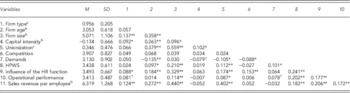
Table 1 shows the means, standard deviations, and correlation matrix for all variables. As predicted by the hypothesis, the correlations between HPWS and both operational and financial performance were positive, providing preliminary support for the hypotheses.
Descriptive statistics and zero-order correlations

Note. N=569.
a 1=corporations, 0=private-owned businesses.
b Log transformed.
c 1=unionized, 0=not unionized.
HPWS=high-performance work system; HR=human resources.
†p<.10; *p<.05; **p<.01.
To test our hypotheses, we conducted multiple regression analyses with operational performance and sales revenue per employee as outcome variables. The procedure for each of the two outcome variables was the same. In step 1, the control variables (e.g., firm type, firm size) were entered as a set. In step 2, the influence of the HR function was entered in order to control for the effects it may have on HPWS, firm performance, or the relationship between the two. In step 3, HPWS was entered to examine its main effect on firm performance. A significant effect in this step would provide support for Hypothesis 1. In step 4, the interaction term obtained by multiplying the influence of the HR function by HPWS was included. A significant effect in this step would indicate the existence of the moderating effect of the HR function’s influence, thereby supporting Hypothesis 2. To avoid multicollinearity issues, we used the centering procedure for regression analysis employing interaction terms (Aiken & West, Reference Aiken and West1991).
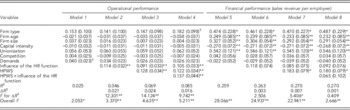
Table 2 presents the results of the hierarchical multiple regression analyses. With the characteristics potentially affecting a firm’s performance (firm type, firm age, firm size, capital intensity, unionization, competition, and demands) and the influence of the HR function controlled, HPWS had a significant main effect on operational performance (B=0.128, p<.01) and on sales revenue per employee (B=0.183, p<.05). The findings provide support for Hypothesis 1. Other things being equal, HPWSs are effective in improving operational and financial performance.
Firm performance regressed on HPWS and the influence of the HR function

Note. N=569. Unstandardized regression coefficients are presented. Standard errors in parentheses.
† p<.10; *p<.05; **p<.01.
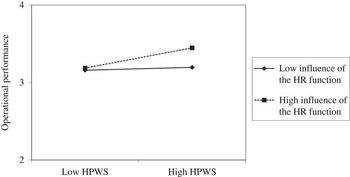
We introduced the interaction terms into the regression models to investigate the moderating effect of the HR function’s influence on the HPWS–firm performance relationship. As reported in Table 2, the interaction between HPWS and the HR function’s influence was significant in predicting operational performance (B=0.137, p<.01). To support Hypothesis 2, the form of the interaction needed to conform to the hypothesized pattern. Following conventional procedures, we plotted simple slopes at 1 SD above and below the mean of the moderator (see Figure 1). Consistent with Hypothesis 2, the slope of the relationship between HPWS and operational performance was positive when the influence of the HR function was higher (simple slope=0.213, t=4.907, p<.01), while their relationship was weaker and insignificant when the influence of the HR function was lower (simple slope=0.030, t=0.656, p=.512).
The interaction between HPWS and the influence of the HR function

The findings show that HPWS had a significant main effect on firm performance (both operational and financial), thereby providing support for Hypothesis 1. In addition, the influence of the HR function had a significant moderating effect on the HPWS–operational performance relationship. Specifically, the relationship was stronger when the function was highly influential. Thus, Hypothesis 2 was also supported.
Discussion
Overview and implications of findings
As discussed, much conceptual and empirical research has been conducted on the linkage between HPWSs and firm performance, broadening our knowledge about the role of HR practices in organizations. While some studies have demonstrated a positive relationship between HPWSs and firm performance (Combs et al., Reference Combs, Liu, Hall and Ketchen2006; Sun, Aryee, & Law, Reference Sun, Aryee and Law2007; Subramony, Reference Subramony2009), others have reported either no relationship or even a negative relationship (e.g., Cappelli & Neumark, Reference Cappelli and Neumark2001; Godard, Reference Godard2001; Guest et al., Reference Guest, Michie, Conway and Sheehan2003; Wright et al., Reference Wright, Gardner, Moynihan and Allen2005). The conflicting findings may be partly due to the potential effect of contextual factors on the relationship between HPWSs and firm performance. In this study, we examined the impact of HPWSs on firm performance as well as the effect of the HR function’s influence in the HPWS–performance linkage as a contextual factor. Given that other organizational members (or groups) have their own interests that may conflict with the HR function (March, Reference March1962; Novicevic & Harvey, Reference Novicevic and Harvey2001), the HR function should be influential enough as a strategic partner to achieve a shared understanding of the value of HRM throughout the organization; this is indispensable for the efficacy of HPWSs.
Our investigation of these hypotheses engages in the debate over the respective merits of the universalistic and contingency perspectives. As stated at the outset, they are neither antithetical nor mutually exclusive; it is analytically feasible to have both main effects supporting the universalistic perspective and moderating effects supporting the contingency perspective. Indeed, our analysis did find both the main effect of HPWSs on firm performance (both operational and financial) and the moderating effect of the HR function’s influence on the HPWS–firm performance (operational performance) relationship. No moderating effect was found for financial performance, but the link between HRM and financial performance tends to be loose in HR research. This may occur because stakeholders are likely to appropriate potential profits generated by the HR function and practices before potential profits translate into actual profits, whereas operational performance is closer to the actual value generated by the HR function and practice and is thus harder for stakeholders to appropriate (Coff, Reference Coff1997; Crook, Todd, Combs, Woehr, & Ketchen, Reference Crook, Todd, Combs, Woehr and Ketchen2011).
Accordingly, it would be appropriate to conclude from our study that HPWSs are ‘universally’ beneficial to firms while the presence of an influential HR function intensifies the effect of HPWSs on firm performance. The findings support the idea that the universalistic and contingency perspectives are not necessarily incompatible; rather, they can be complementary. Our findings are also in line with those of earlier empirical studies that provided support for the positive relationship between the HR function’s power and strategic involvement and the efficacy of HPWSs (e.g., Wright et al., Reference Wright, McMahan, McCormick and Sherman1998; Welbourne & Cyr, Reference Welbourne and Cyr1999; Edelman, Brush, & Manolova, Reference Edelman, Brush and Manolova2005; Nikandrou & Papalexandris, Reference Nikandrou and Papalexandris2007; Chung & Kang, Reference Chung and Kang2013).
Since the Asian financial crisis of the late 1990s, South Korean firms have increasingly adopted HPWSs to not only improve their performance but also gain legitimacy from internal and external stakeholders (e.g., Bae & Lawler, Reference Bae and Lawler2000; Rowley & Bae, Reference Rowley and Bae2004). On the other hand, HR functions in Korean firms remain largely administrative and thus have only limited influence (Kim & Kang, Reference Kim and Kang2011; Kim & Ryu, Reference Kim and Ryu2011). In fact, the HR function in the firms of many other Asian nations also has a relatively low status (Long, Ismail, & Amin, Reference Long, Ismail and Amin2013). This tendency is problematic because, according to the findings of this study, a firm’s efforts for HPWSs can be more beneficial when they accompany a highly influential HR function.
What is to be done?
Studies of SHRM have long suggested that the HR function should play a more proactive and strategic role (Brockbank, Reference Brockbank1999; Lawler & Mohrman, Reference Lawler and Mohrman2003; Ulrich & Brockbank, Reference Ulrich and Brockbank2005; Lengnick-Hall et al., Reference Lengnick-Hall, Lengnick-Hall, Andrade and Drake2009). They have prescribed the characteristics an HR function requires to become more effective in contemporary organizations. For example, Brockbank (Reference Brockbank1999) suggested that the activities performed by a strategic HR function must be long term, comprehensive, planned, and aligned with business strategies. Ulrich and Brockbank (Reference Ulrich and Brockbank2005) suggested that an HR function should act as a strategic partner and change agent. Lawler and Mohrman (Reference Lawler and Mohrman2003) argued that, to become strategic, an HR function must highlight the knowledge and competency aspects of corporate strategy and actively participate in its development and implementation.
However, HR functions in most organizations are still cast in the position of influencing without authority and in demonstrating effectiveness without the benefit of objective criterion measures (Ulrich & Brockbank, Reference Ulrich and Brockbank2005; Morris & Snell, Reference Morris and Snell2011), although there is evidence of the emerging importance of HR and the increasing involvement of HR functions in firm strategy (Brockbank, Reference Brockbank1999; Kim & Kang, Reference Kim and Kang2011). The question is, then, how HR functions can gain influence in the organization, breaking the self-perpetuating cycle of powerlessness.
As social influence theory (Tedeschi & Melburg, Reference Tedeschi and Melburg1984; Morrison & Bies, Reference Morrison and Bies1991) argues, influence in an organization is largely a function of how effectively an organizational actor creates and manages his/her image. Organizational actors influence definitions of ‘reality’ through the use of language and symbolic actions, and it is on the basis of this constructed reality, rather than the objective or materially concrete reality, that organizational members act. Without objective characteristics, the HR function needs to actively engage in various impression management behaviors to create and maintain the perception that HRM is a critical and strategic concern of the organization, because it deals with the organization’s primary asset (i.e., HR) and presents problems to which the organization must attend. Symbolic actions also serve to influence interpretive frames, which include not only the use of norms and values to evaluate the effectiveness of the HR function but also information about one’s capability to cope with these concerns (Galang & Ferris, Reference Galang and Ferris1997; Bowen & Ostroff, Reference Bowen and Ostroff2004; Mossholder et al., Reference Mossholder, Hettie, Richardson and Settoon2011).
Symbolic actions require the HR function’s effective and consistent communication and information sharing with other organizational members. Research has found significant differences in perceptions of SHRM and actual HR priorities even among chief executive officers, HR directors, and other senior managers (Bartram, Stanton, Leggat, Casimir, & Fraser, Reference Bartram, Stanton, Leggat, Casimir and Fraser2007). Therefore, the involvement of HR executives on boards of directors is indispensable. Access to this level of decision making not only recognizes the legitimate authority of the HR function but also provides the HR function with the opportunity to create a shared meaning with other senior executives of what the function can contribute as a strategic partner (Golden & Ramanujam, Reference Golden and Ramanujam1985). Strategic management process is largely a matter of interactions among organizational actors (Hoon, Reference Hoon2007), but it does not always occur through formal mechanisms such as meetings of boards of directors. It is access to both formal and informal decision making that provides a linkage to strategic management processes (Mokken & Stokman, Reference Mokken and Stokman1976; Buyens & De Vos, Reference Buyens and De Vos2001). Thus, HR professionals must actively engage in both formal and informal communication with executives and other managers. The closer relationship HR professionals develop with other functions in their organizations, the stronger influence they can have on those functions (Pfeffer, Reference Pfeffer2010).
As discussed, line managers’ cooperation is critical for the successful implementation of HPWSs because the line managers have a more direct impact on their subordinates’ motivation, commitment, and discretionary behavior (Andersen, Cooper, & Zhu, Reference Andersen, Cooper and Zhu2007; Bos-Nehles, Reference Bos-Nehles2010; Guest, Reference Guest2011). HR professionals therefore must actively communicate with line managers. As Cohen and Bradford (Reference Cohen and Bradford2003) argue, influence without formal authority is possible only through the ‘law of reciprocity,’ as critical colleagues respond to your requests only when they choose to. HR professionals should thus develop ‘give-and-take’ relationships with line managers through which equivalent ‘currencies’ can be exchanged over time. As Lawler and Mohrman (Reference Lawler and Mohrman2003) suggest, an effective way to create this kind of involvement is to utilize task teams that have both line managers and HR professionals through which the HR function can have an opportunity not only to be close to the business but also to develop a close relationship with line managers. Partnership requires increasing the trust in line managers and transferring HR accountability to them in many areas where the HR function has previously exercised control and provided service.
During HPWS implementation, employees may feel anxious about substantial changes such as new responsibilities and intended consequences to themselves. The HR function therefore should not only encourage feedback about employee attitudes toward strategic planning and activities but also inform employees about the intent and implications of the new programs to alleviate their concerns (Kim & Kang, Reference Kim and Kang2011). Truss (Reference Truss2001) found that organizations could reduce the gap between implemented and perceived HR activities by communicating information on the changes in HR programs to employees. As an employee advocate, the HR function should also creatively seek and implement the means by which employees may voice opinions and feel ownership of the business. Whatever the context within which HR professionals find themselves, caring for, listening to, and responding to employees remain a major piece of HR work. Neglecting this role may negatively impact employees’ sense of well-being and commitment to the organization. The HR function then loses direct contact with employees and is no longer able to represent the employees’ voice at the top management level (Ulrich & Brockbank, Reference Ulrich and Brockbank2005; Gilbert, Winne, & Sels, Reference Gilbert, Winne and Sels2011).
In addition to symbolic actions, HR professionals also need to develop the skills necessary to be a strategic partner. They lack influence because many HR professionals are not seen as capable of fulfilling their role as a strategic partner (Bartram et al., Reference Bartram, Stanton, Leggat, Casimir and Fraser2007; Lengnick-Hall et al., Reference Lengnick-Hall, Lengnick-Hall, Andrade and Drake2009). HR executives must fully understand the complexity of the various aspects of HRM in order to bring HR to the strategic planning table and to effectively integrate HR activities with business-oriented perspectives. Whereas there are other board members at the table well versed in the business perspective, the HR executive is likely to be the only person with expertise in HR (Wright et al., Reference Wright, McMahan, McCormick and Sherman1998; Lawler & Mohrman, Reference Lawler and Mohrman2003). In addition, HR executives can expand and enrich the parameters of HR agendas through which strategic alternatives may be defined and created (Brockbank, Reference Brockbank1999). For example, by engaging in environmental scanning behaviors, HR executives can discover new ‘threats’ that they can control and cope with even when their functional responsibility does not deal with the critical contingencies defined objectively by the organization’s strategic and environmental requirements (Russ, Galang, & Ferris, Reference Russ, Galang and Ferris1998).
Apart from the advantage of developing better communicational channels between HR professionals and line managers discussed above, the rotation of people (individuals rotating within the HR function and into and out of the HR function) offers opportunities for educational development. Without knowledge of the multiple activities that occur in HR, it is very difficult for HR managers and executives to bring a full picture of the HR function to any strategic function. Beyond that, unless HR executives have had some experience in business roles, it may be difficult for them to understand the business well enough to act as a strategic partner when it comes to HR system design and strategy development. HR professionals must learn more about the business, and line managers must become more proficient at managing their HR (Lawler & Mohrman, Reference Lawler and Mohrman2003).
To become influential as a strategic partner, HR professionals must accurately assess the organization’s needs, constraints, and opportunities. They must understand the organization’s environment and internal contexts while developing and implementing programs and policies that meet the organization’s needs. Baird and Meshoulam (Reference Baird and Meshoulam1988) itemize the kinds of skills that HR professionals need to possess: (a) information management skills – statistics, analysis, and research; (b) planning skills – the knowledge of planning and planning methodologies plus statistics techniques; (c) management skills – skills in the various business functions and environmental analysis; (d) integration skills – competency at managing organizational interfaces, and skill in assessing the organization plus setting priorities; and (e) change-management skills – the skills of anticipating the future, facilitating changes, and developing organizational activities.
In sum, the HR function needs to break the self-perpetuating cycle of powerlessness. Influence as conceptualized in this study may be constructed as a reward for a job well done. The more management believes that the HR function contributes to the achievement of organizational objectives, the more its role will be integrated into the strategic management process of the organization (Galang & Ferris, Reference Galang and Ferris1997; Rose & Kumar, Reference Rose and Kumar2006). Then, the HR function can use the legitimate authority associated with organizational board representation as an avenue for influence and strengthen the uptake of HR policy initiatives. The formal authority of a board position also allows the HR function to create a shared understanding of the added value that these policies create for the organization. Innovative HR practices are thus accepted and used by line managers as part of their everyday work (Golden & Ramanujam, Reference Golden and Ramanujam1985; Bowen & Ostroff, Reference Bowen and Ostroff2004; Sheehan et al., Reference Sheehan, Cooper, Holland and De Ceri2007). Indeed, where HR executives are highly involved in strategic management process, other organizational members tend to evaluate the HR function more positively (Wright et al., Reference Wright, McMahan, McCormick and Sherman1998). A competent HR function is given more respect, resources, authority, and responsibility, which feed into its ability to be effective in the value creation process of the organization (Uen, Ahlstrom, Chen, & Tseng, Reference Uen, Ahlstrom, Chen and Tseng2012). In order to realize this positive cycle, HR professionals must first prepare themselves as a strategic partner.
Limitations and suggestions for future research
The findings of this study should be interpreted cautiously, given its inherent limitations. First, this study relied on self-reported and cross-sectional data and was consequently susceptible to common method bias. This bias might be particularly problematic for the relationship between HPWSs and operational performance as the data for these variables were collected from a single respondent at one time. However, we concluded that common method bias did not pose serious problems because the respondents – HR managers – possessed accurate knowledge of their respective firm’s HPWSs and performance. In addition, the team who administered WPS rigorously conducted a variety of interviews with the HR managers during the data collection process to increase the reliability and validity of the responses (Kim & Kang, Reference Kim and Kang2011). Harman’s one-factor test revealed that no single factor accounted for a majority of the covariance in the variable, also suggesting the nonexistence of common method bias (Podsakoff & Organ, Reference Podsakoff, MacKenzie, Lee and Podsakoff1986; Podsakoff, MacKenzie, Lee, & Podsakoff, Reference Podsakoff and Organ2003).
Another legitimate concern is reversed causality. Researchers investigating the relationship between HR practices and firm performance have long been concerned about reversed causality, particularly in studies using a cross-sectional research design (e.g., Delaney & Huselid, Reference Delaney and Huselid1996; Delery & Doty, Reference Delery and Doty1996; Guthrie, Reference Guthrie2001). In this article, data were analyzed and the findings were discussed as if HPWSs affected firm performance, but this interpretation is limited by the cross-sectional nature of the data. As researchers have pointed out, the findings of this study may support our hypothesis that HPWSs affect firm performance; as this study employed a cross-sectional research design, however, its findings can also be used to suggest that firm performance affects HPWSs. To overcome this limitation, future research must use alternative research designs (e.g., Van De Voorde, Paauwe, & Van Veldhoven, Reference Van De Voorde, Paauwe and Van Veldhoven2010; Piening, Baluch, & Salge, Reference Piening, Baluch and Salge2013) to propose more reliable causal inferences concerning the relationship between HPWSs and firm performance as well as the role of the HR function.
Our study supporting both the universalistic and contingency perspectives is only one step of the many that will be necessary to gain a deeper understanding of the HPWS–performance relationship. More theoretical and empirical studies are needed to better understand how the universalistic and contingency perspectives may or may not converge. In addition, while this study focused on the moderating effects of the HR function’s influence on the HPWS–performance linkage, other contextual conditions, such as technology, leadership philosophy, and labor-management atmosphere, may also affect this relationship. The value of contingency research is that it allows researchers to look deeper into the HPWS–performance linkage. Future studies should thus examine other contextual conditions as moderators to gain further insights into the HPWS–performance relationship.
Conclusion
This study examined the impact of HPWSs on firm performance as well as the moderating effect of the HR function’s influence in the HPWS–performance linkage in order to contribute to the universalistic and contingency perspective debates in a manufacturing environment. Our analysis indicated the existence of both the main effects supporting the universalistic perspective and the moderating effects supporting the contingency perspective. In this respect, HPWSs can be regarded as universal or best practices while the presence of an influential HR function can intensify the effect of HPWSs on firm performance. The findings support the idea that the universalistic and contingency perspectives are not necessarily incompatible but, rather, may actually be complementary.
Acknowledgement
This work was supported by the Ajou university research fund.