Introduction
Obesity in childhood and adolescence has become one of the most important public health issues around the world because it can lead to various chronic diseases, escalating medical expenses and the long-term burden on society and the economy. The worldwide prevalence of overweight and obesity in children and adolescents has been increasing in recent years (Janssen et al., Reference Janssen, Katzmarzyk, Boyce, Vereecken, Mulvihill and Roberts2005), including Taiwan (Chen et al., Reference Chen, Fox, Haase and Wang2006). A global survey revealed a high prevalence of overweight and obesity in 10- to 16-year-olds, reaching 25.1% in the US, 19.3% in Canada and 18.4% in England (Janssen et al., Reference Janssen, Katzmarzyk, Boyce, Vereecken, Mulvihill and Roberts2005). Similarly, the prevalence of overweight and obesity in 7th to 9th graders was 23.1% in Taiwan (Liou et al., Reference Liou, Liou and Chang2010).
It has been well-documented that obesity is positively correlated with insulin resistance, metabolic syndrome and various cardiovascular risk factors in children and adolescents (Weiss et al., Reference Weiss, Dziura, Burgert, Tamborlane, Taksali and Yeckel2004; Cali & Caprio, Reference Cali and Caprio2008). Obesity in teenage could also have an immediate negative effect on skeletal and endocrine systems (Must, Reference Must1996). Furthermore, obesity has a detrimental effect on psychological health. A national survey in the US showed that overweight and obese 12- to 14-year-olds had lower self-esteem and self-confidence, and were more likely to be depressed (Swallen et al., Reference Swallen, Reither, Haas and Meier2005).
Obesity in childhood and adolescence can also have a negative impact on health in adulthood. The exercise and dietary habits established in childhood could be carried over to adulthood (Perez-Rodrigo & Aranceta, Reference Perez-Rodrigo and Aranceta2003). It has been shown that obesity and overweight in childhood and adolescence could increase the risk of obesity and various chronic diseases (Must et al., Reference Must, Jacques, Dallal, Bajema and Dietz1992; Srinivasan et al., Reference Srinivasan, Bao, Wattigney and Berenson1996, Reference Srinivasan, Myers and Berenson2002). A 32-year longitudinal study indicated that overweight teenagers had higher all-cause and cardiovascular mortality rates (Hoffmans et al., Reference Hoffmans, Kromhout and de Lezenne Coulander1988).
Since obesity is associated with various chronic diseases, obesity-related medical expenses could escalate with the growing rate of obesity in youth. The health insurance cost of obesity-related diseases in Taiwan, including cardiovascular diseases, stroke, diabetes, hypercholesterolaemia and hypertension, is approximately $16.2 billion NT (US$1≊NT$30) in 2000–2002, accounting for 2.90% of total health insurance cost (Fu et al., Reference Fu, Wen, Yeh and Chang2008). In the US, the obesity-related medical cost of 6- to 17-year-olds tripled from 1979 to 1999 (Wang & Dietz, Reference Wang and Dietz2002). If the current obesity trend continues, the medical cost for obesity-related diseases is estimated to account for 16–18% of total medical cost in 2030 (Wang et al., Reference Wang, Beydoun, Liang, Caballero and Kumanyika2008). Obesity prevalence has been increasing in Taiwan (Chen et al., Reference Chen, Fox, Haase and Wang2006; Liou et al., Reference Liou, Huang and Chou2009), indicating that the obesity-related medical cost will soon become a significant burden on national health insurance. In addition to medical costs, childhood obesity can also result in considerable social costs. For example, obesity is associated with lower academic achievements in high school students (Ding et al., Reference Ding, Lehrer, Rosenquist and Audrain-McGovern2009). A longitudinal study in nine European countries showed that teenagers with higher BMI received fewer years of education, especially in females (Brunello et al., Reference Brunello, Michaud and Sanz-de-Galdeano2009). Obesity-related diseases could also result in a significant loss of gross national product, mainly due to the loss in work force (Popkin et al., Reference Popkin, Kim, Rusev, Du and Zizza2006).
Obesity can be affected by a complex set of observed and unobserved factors. These factors, including physical activity, dietary behaviours and socioeconomic status, can be endogenous in nature if they are correlated with the error term or unobserved factors related to obesity (Amarasinghe et al., Reference Amarasinghe, D'Souza, Brown, Oh and Borisova2009). Lack of physical activity has been suggested as one of the major risk factors for obesity in childhood and adolescence (Janssen et al., Reference Janssen, Katzmarzyk, Boyce, Vereecken, Mulvihill and Roberts2005). On the other hand, being overweight or obese could reduce the likelihood of participating in physical activity in youth (Ball et al., Reference Ball, Crawford and Owen2000). The majority of public health propaganda focuses on promoting physical activity in all populations. Although it is very important to prevent the development of obesity in persons with normal weight, those who are already overweight or obese cannot be ignored, especially with the growing size of this population. Despite all the efforts in promoting physical activity, the prevalence of obesity in children and adolescents still continues to grow in many countries. One of the possible reasons is that the interventions aiming to increase physical activity in obese children and adolescents have had limited effects (Robinson et al., Reference Robinson, Killen, Kraemer, Wilson, Matheson and Haskell2003; Reilly et al., Reference Reilly, Kelly, Montgomery, Williamson, Fisher and McColl2006; Taylor et al., Reference Taylor, McAuley, Williams, Barbezat, Nielsen and Mann2006).
The two-way causal relationship indicates the endogeneity between obesity and physical activity. Indeed, the endogeneity between these two variables has been suggested in American adults (Yen et al., Reference Yen, Chen and Eastwood2009), but it has not been investigated in children and adolescents. Failing to account for endogeneity would result in biased estimation of coefficients. It may at least partially explain why several studies have failed to find an association between obesity and physical activity in children and adolescents (Garaulet et al., Reference Garaulet, Martinez, Victoria, Perez-Llamas, Ortega and Zamora2000; Deforche et al., Reference Deforche, Lefevre, De Bourdeaudhuij, Hills, Duquet and Bouckaert2003). The estimation strategies of previous studies on the association between obesity and physical activity are mostly within the framework of ordinary least squares (OLS). The OLS methods treat the dependent and independent variables as a one-way cause–effect relationship and are unable to account for endogeneity. It investigates the relationship between overweight/obese and physical activity in children and adolescents by taking endogeneity into consideration. This study develops an endogenous bivariate probit model by defining overweight/obesity as a binary variable and adopting the time spent on reading and homework as the instrumental variables (IVs). The model is estimated by the Maximum Likelihood Method according to Newey (Reference Newey1987). The data were from a national survey of students in grades 5–9 in Taiwan.
Methods
Data
The original data were collected from the students in 50 primary schools and junior high schools across 21 out of 25 districts in Taiwan. Data were collected during September 2007 as the baseline data (n=21,189) and followed up in June 2008 (n=12,672). Six schools did not take part in the follow-up study. Those who did not complete both surveys (n=8517) and those who did not report weight and height (n=1830 in 2007, n=1261 in 2008) were excluded. This resulted in 10,339 participants distributed across 34 primary schools (grades 5–6) and ten junior high schools (grades 7–9). The study used the baseline data from the 2007 survey. After excluding the subjects with incomplete information, 4008 boys and 4197 girls were included. The study procedure was in accordance with the Helsinki Declaration of 1975, as revised in 1983.
The participants completed the questionnaire independently during classes. Self-reported weight and height were used to calculate body mass index (BMI). The International Obesity Task Force (IOTF) criteria of the specific sex and age (Cole et al., Reference Cole, Bellizzi, Flegal and Dietz2000) were used to categorize weight status. For example, the definitions of overweight in 12-year-old boys and girls are BMI>21.22 and >21.68, respectively. The definitions of overweight in 13-year-old boys and girls are BMI>21.91 and >22.58, respectively. The variable Overweight equals 1 if the subject falls in the overweight or obese category.
The amount of physical activity was estimated using the International Physical Activity Questionnaire (IPAQ). This was designed to be used in population studies to assess exercise behaviours of the subjects with sufficient reliability and validity (Craig et al., Reference Craig, Marshall, Sjostrom, Bauman, Booth and Ainsworth2003). It collects information on the frequency, intensity and duration of physical activities at work, home, transport or recreation during the previous 7 days. The amount of physical activity (in metabolic equivalents-minutes, METs-min) is calculated using the formula:
 $${\rm PA}\ ({\rm METs{-}min}) = 8 \times ({\rm vigorous\ min})\times {\rm days} + 4 \times ({\rm moderate\ min}) \cr \times {\rm days} + 3.3 \times ({\rm walking\ min}) \times {\rm days}$$
.
The participants were asked to estimate daily time spent watching TV, using a computer (excluding academic purposes), reading and doing homework out of school during weekdays and weekend. The participants self-reported the frequency of breakfast consumption per week. They were also asked ‘which beverages do you usually drink?’ Beverage preferences were divided into two groups: ‘sugar-sweetened drinks’ and ‘non-sugar-sweetened drinks’. Sugar-sweetened drinks included all sweetened soft drinks, fruit drinks (sweetened fruit juice, fruit-flavoured drink or drinks that contained fruit juice in part), milky tea (with sweetener) and other sweetened drinks. Non-sugar-sweetened drinks included water, tea (without sweetener), 100% fruit juice (without sweetener) and other non-sugar-sweetened drinks.
A pilot study was conducted in one of the participating schools to examine the test–retest reliability of the questionnaire. A total of 120 students (grade 6) completed two surveys separated by 2 weeks. The Pearson correlation coefficients of the various categories between the two surveys were 0.67 for IPAQ, 0.76 for TV watching, 0.71 for computer use, 0.66 for reading, 0.72 for doing homework, 0.67 for breakfast consumption and 0.69 for drinking habits, suggesting acceptable test–retest reliability of the questionnaire.
Data analysis
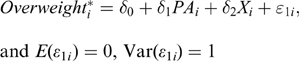
The health economic model developed in this research can simultaneously determine three types of behaviour that may result in overweight and obesity, including physical activity, sedentary activity and dietary behaviour. Firstly, let Overweight be a binary variable taking the value of 1 if the individual's BMI is classified as overweight or obese and 0 otherwise. Suppose an unobservable latent variable (Overweight*) is a linear function of physical activity (PA) and other variables (X):
 $$Overweight^*_i=\delta_0+\delta_1PA_i+\delta_2X_i+\varepsilon_{1i},\cr and\ E(\varepsilon_{1i})=0,\ Var(\varepsilon_{1i})=1$$
, where ε 1i is an error term, i indexes the individual and X indicates a vector of variables that affect individual i's overweight and obesity condition, including demographic factors and lifestyles.
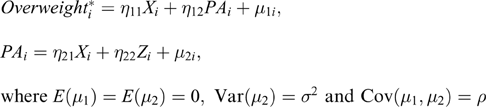
If it is reasonable to assume that PA is independent of ε 1Equation (1) can be estimated by a probit model. However, PA may not be exogenous for two reasons. One is that Overweight and PA may affect each other. The other is that there may be unobservable factors that affect both Overweight and PA. Under these conditions, PA is endogenous and the independence is violated. Thus, the probit model in Equation (1) will yield a biased estimate. To solve the endogeneity problem, a bivariate probit model with continuous endogenous regressors is used to estimate the effect of PA on Overweight as the following simultaneous equations system:
 $$Overweight^*_i=\eta_{11}X_i+\eta_{12}PA_i+\mu_{1i},\cr PA_i=\eta_{21}X_i+\eta_{22}Z_i+\mu_{2i},\cr {\rm where}\ E(\mu_1)=E(\mu_2)=0,\ {\rm Var}(\mu_2)=\sigma_2\ {\rm and\ Cov}(\mu_1,\mu_2)=\rho$$
.
In Equation (2), Z is a vector of variables (instruments) that are related to PA and ρ is the correlation between the error terms. A Wald test of the significance of ρ can be used to identify the endogeneity of PA. If ρ=0, the probit model is an appropriate specification (i.e. Equation (1)). If ρ is non-zero, then PA is endogenous and it is more appropriate to use the bivariate probit model with continuous endogenous regressors. The simultaneous model in Equation (2) can be estimated by the Maximum Likelihood Estimator method according to Newey's approach (Newey, Reference Newey1987).
Results
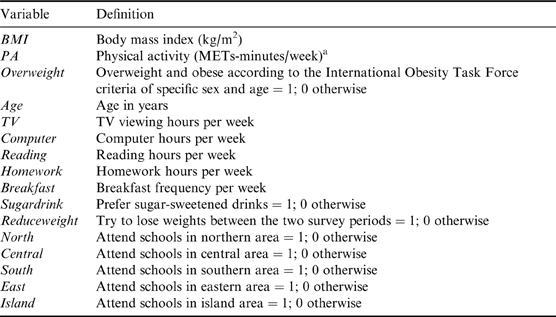
The definitions of variables are shown in Table 1. The Overweight variable equals 1 when the subject's BMI is higher than the definition of overweight according to the IOTF criteria. Dietary behaviour is represented by the variables Breakfast and Sugardrink to reveal their consistency on eating breakfast and the preference for sugar-sweetened drinks. The samples are also distinguished by geographical areas to account for the potential regional differences.
Variable definitions

a MET, metabolic equivalents.
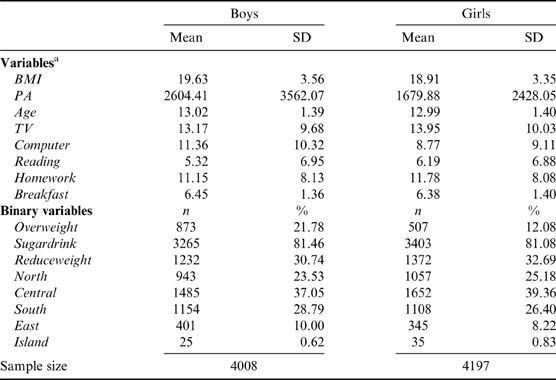
Table 2 shows the descriptive statistics of the variables in separated samples of boys and girls. Boys have higher BMI and a higher percentage of overweight. On average, boys have more physical activity and spend more time on the computer, while girls spend slightly more time watching TV, reading and doing homework. Boys and girls have similar dietary behaviours. They have breakfast almost every day, while more than 80% of them prefer sugar-sweetened drinks.
Descriptive statistics of data, 5th–9th grade children, Taiwan 2007–2008
a See Table 1 for units.
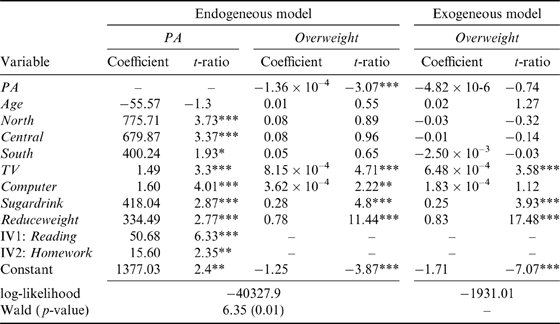
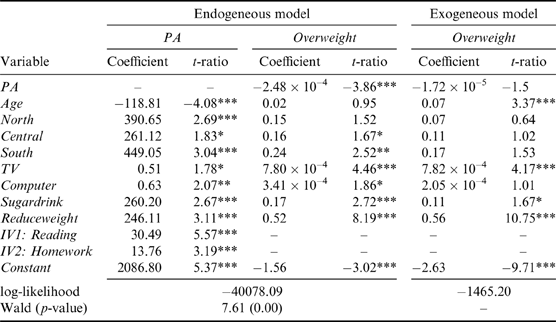
The comparisons between the endogenous and exogenous probit models for Overweight in boys and girls are presented in Table 3 and 4, respectively. The Overweight equation is estimated by the bivariate probit model with continuous endogenous regressor, using Reading and Homework as instrument variables (IVs) in the PA equation. Instrument variables are required to be partially correlated to PA, but not related to Overweight. Reading and Homework represent the sedentary behaviours that are expected to affect participation in physical activities (Feldman et al., Reference Feldman, Barnett, Shrier, Rossignol and Abenhaim2003; Huang et al., Reference Huang, Wong and Salmon2013), but which are not likely to directly affect the overweight condition through the energy consumption process (Vicente-Rodriguez et al., Reference Vicente-Rodriguez, Rey-Lopez, Martin-Matillas, Moreno, Warnberg and Redondo2008). Except for the inferences above, the statistical examination of IVs in Tables 3 and 4 shows that Reading and Homework are significantly related to PA at the 1% level in boys and girls. The Wald test also supports the endogeneity in both sexes. More importantly, the coefficient of PA is insignificant in the exogenous models, but it becomes significantly negative in the endogenous models in both boys and girls. Therefore, ignoring the endogeneity between Overweight and PA would result in a biased and weak estimation, as can be seen in the exogenous models.
Comparison of the estimations of endogenous and exogenous probit models for Overweight in boys, Taiwan 2007–2008
*p<0.1, **p<0.05, ***p<0.01.
Comparison of the estimations of endogenous and exogenous probit models for Overweight in girls, Taiwan 2007–2008
*p<0.1, **p<0.05, ***p<0.01.
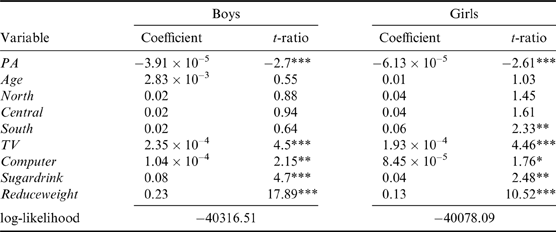
In boys and girls, TV and Sugardrink are both positively related to Overweight. As expected, longer time watching TV and preference for sugar-sweetened drinks are important factors leading to overweight in children and adolescents. More specifically, Table 5 shows the marginal effects of the variables in endogenous bivariate probit models in boys and girls. The marginal effect of PA in boys is 0.0000391, indicating that an extra 1000 METs-min per week of physical activity would reduce the probability of being overweight by 3.91% in boys. Physical activity is even more effective in reducing the probability of being overweight in girls. The same amount of extra physical activity can reduce the probability by 6.13% in girls.
Marginal effects of variables in endogenous bivariate probit models in boys and girls, Taiwan 2007–2008
*p<0.1, **p<0.05, ***p<0.01.
Discussion
This study reveals the endogenous relationship between overweight and physical activity in children and adolescents. This relationship presents a vicious circle in which lower levels of physical activity lead to overweight, while those who are already overweight engage in less physical activity. It could make combating obesity in childhood and adolescence more difficult as the overweight youth are unable to increase energy expenditure through physical activity. This vicious circle could at least partially explain the increasing prevalence of obesity in children and adolescents because once they become overweight, it is difficult to return to ideal body weight with decreasing levels of physical activity. To further support this notion, the interventions aiming to increase physical activity in obese children and adolescent have had little effect (Robinson et al., Reference Robinson, Killen, Kraemer, Wilson, Matheson and Haskell2003; Reilly et al., Reference Reilly, Kelly, Montgomery, Williamson, Fisher and McColl2006; Taylor et al., Reference Taylor, McAuley, Williams, Barbezat, Nielsen and Mann2006).
Although numerous studies have shown that physical activity is a major determinant of BMI in children and adolescents using exogenous, OLS-based methods (Li et al., Reference Li, Zhai, Yang, Schouten, Hu and He2007; Wilks et al., Reference Wilks, Besson, Lindroos and Ekelund2011), some researchers have still reported no relationship between these two variables (Garaulet et al., Reference Garaulet, Martinez, Victoria, Perez-Llamas, Ortega and Zamora2000; Deforche et al., Reference Deforche, Lefevre, De Bourdeaudhuij, Hills, Duquet and Bouckaert2003). The inconsistency of previous studies may be partially attributed to the endogeneity between overweight and physical activity. The exogenous models in this study show that PA is unrelated to Overweight. On the other hand, there is a significantly negative relationship between these two variables in the endogenous models. Similarly, the endogeneity between obesity and exercise (Yen et al., Reference Yen, Chen and Eastwood2009) and other social variables (Auld, Reference Auld2011) has been reported in adults. The endogenous models in this study still support the traditional concept that physical activity could be an effective way to prevent obesity in children and adolescents.
Factors influencing physical activity in children and adolescence include body-related issues, resources, convenience, social factors, fitness and support from parents and peers (Zabinski et al., Reference Zabinski, Saelens, Stein, Hayden-Wade and Wilfley2003; Gray et al., Reference Gray, Janicke, Ingerski and Silverstein2008). Overweight children reported feeling a significantly greater number of barriers to being physically active than their normal-weight counterparts (Zabinski et al., Reference Zabinski, Saelens, Stein, Hayden-Wade and Wilfley2003). In addition, overweight girls tend to report higher barriers than overweight boys, especially in body-related barriers (Allison et al., Reference Allison, Dwyer and Makin1999; Zabinski et al., Reference Zabinski, Saelens, Stein, Hayden-Wade and Wilfley2003). It is not surprising that the children who report more barriers to physical activity are also less physically active (Zabinski et al., Reference Zabinski, Saelens, Stein, Hayden-Wade and Wilfley2003). One of the major barriers to participation in physical activity in teenage girls is ‘I am self-conscious about my looks when I exercise’ (Robbins et al., Reference Robbins, Pender and Kazanis2003; Zabinski et al., Reference Zabinski, Saelens, Stein, Hayden-Wade and Wilfley2003). Therefore, those who perceive themselves to be overweight and obese may be reluctant to participate in physical activity because they are uncomfortable about how they look (Storch et al., Reference Storch, Milsom, Debraganza, Lewin, Geffken and Silverstein2007). Easily achievable, regular, low- to moderate-intensity activities may be useful in overcoming embarrassment and more appropriate for overweight youth to begin with (Ball et al., Reference Ball, Crawford and Owen2000). The body-related barrier may also be reduced through counselling that focuses on increasing body-esteem and self-worth, reducing the value of shape and appearance, and appreciating their bodies for what they can do, rather than how they look (Zabinski et al., Reference Zabinski, Saelens, Stein, Hayden-Wade and Wilfley2003).
In addition to body-related barriers, social barriers are also significantly associated with physical activity in overweight youth (Gray et al., Reference Gray, Janicke, Ingerski and Silverstein2008). A recent review revealed that overweight children are more likely to be victimized by their peers compared with children of normal weight (Sentenac et al., Reference Sentenac, Arnaud, Gavin, Molcho, Gabhainn and Godeau2012). The situation is the same in the US (Fox & Farrow, Reference Fox and Farrow2009), Europe (Brixval et al., Reference Brixval, Rayce, Rasmussen, Holstein and Due2012) and China (Guo et al., Reference Guo, Ma, Nie, Xu, Xu and Zhang2010). Several studies have pointed out that peer victimization could result in negative attitudes towards exercise and reduced physical activity in overweight children (Faith et al., Reference Faith, Leone, Ayers, Heo and Pietrobelli2002; Storch et al., Reference Storch, Milsom, Debraganza, Lewin, Geffken and Silverstein2007; Gray et al., Reference Gray, Janicke, Ingerski and Silverstein2008). It creates a vicious circle in which overweight children are further discouraged from being physically active. Peer victimization may also reduce the effectiveness of intervention programmes that aim to promote physical activity in this population. Education programmes that aim to improve coping mechanisms and problem-solving skills can help overweight children to deal with peer victimization and enjoy physical activity (Faith et al., Reference Faith, Leone, Ayers, Heo and Pietrobelli2002). In addition, programmes that can prevent peer victimization of overweight and obese children are also important. It has been suggested that interventions involving various aspects of environment, such as family, peer group, classroom, teachers and administration, appear to be more effective in reducing peer victimization (Vreeman & Carroll, Reference Vreeman and Carroll2007).
Not all peer interactions are negative for overweight children engaging in physical activity. Overweight children were found to increase their motivation to exercise and the amount of physical activity performed, while spending less time on sedentary activities, when paired with another normal weight or overweight child (Salvy et al., Reference Salvy, Roemmich, Bowker, Romero, Stadler and Epstein2009; Rittenhouse et al., Reference Rittenhouse, Salvy and Barkley2011). The presence of peers could increase the enjoyment of exercise, which in turn could lead to higher motivation to exercise (Duncan et al., Reference Duncan, Duncan, Strycker and Chaumeton2007). However, overweight youth reported being alone on more occasions than their normal-weight counterparts (Salvy et al., Reference Salvy, Roemmich, Bowker, Romero, Stadler and Epstein2009). Most physical activities suitable for children and adolescents require peers. Without friends, it is difficult for overweight children and adolescents to maintain the exercise habit alone for an extended period of time. Therefore, group-based exercise clubs that comprise overweight children or adolescents may be able to initiate their motivation for physical activity. Furthermore, the school programmes that provide direct contact, such as participating in shared projects, between normal weight and overweight children may enhance social networks and promote physical activity in overweight youth (Saylor & Leach, Reference Saylor and Leach2009).
Increased physical activity in overweight children and adolescents could improve their health even without changing their body weight. It has been shown that overweight children and adolescents with higher levels of cardiorespiratory fitness have lower risk for hypertension than those who are overweight and unfit (Chen et al., Reference Chen, Fox, Haase and Wang2006). When an exercise habit developed at an early age is carried over to adulthood, it could help to maintain fitness levels in adults. It has been revealed that in obese adults, having higher levels of cardiorespiratory fitness is associated with reduced risk of mortality and morbidity (Lee et al., Reference Lee, Blair and Jackson1999). Therefore, it is crucial to increase the enjoyment of, and motivation to participate in, physical activity in overweight children and adolescents.
Time spent watching TV is positively correlated with Overweight in the endogenous model in both boys and girls, while time spent on using the computer is only significant in girls. The effect of TV on Overweight is larger than that of Computer in girls. Prospective (Dietz & Gortmaker, Reference Dietz and Gortmaker1985) and intervention (Robinson, Reference Robinson1999; French et al., Reference French, Mitchell and Hannan2012) studies have revealed a causal effect of TV viewing on obesity in young populations. Nevertheless, watching TV and other sedentary behaviours did not appear to displace physical activity in this study, similar to previous results (Rey-Lopez et al., Reference Rey-Lopez, Vicente-Rodriguez, Biosca and Moreno2008). Therefore, it is possible that the effect of watching TV on overweight comes from increased energy intake, such as eating unhealthy snacks while watching TV and/or a greater exposure to the marketing of energy-dense foods (Swinburn & Shelly, Reference Swinburn and Shelly2008). Although a significant relationship exists between TV viewing and body fatness among children and adolescents, it is likely to be too small to be of substantial practical relevance (Marshall et al., Reference Marshall, Biddle, Gorely, Cameron and Murdey2004).
One of the limitations of this study is that the physical activity and lifestyle information were collected using a self-reported questionnaire. It is possible that the data may be biased by subjectivity and/or incomplete recall, especially in younger children. Future studies could use a longitudinal design with objective measurements such as an accelerometer to further elucidate the relationship between physical activity and obesity in the young population.
From an empirical point of view, it is necessary to address endogeneity of health and behavioural outcomes to derive unbiased estimates. This study reveals the endogenous relationship between being overweight or obese and the level of physical activity in children and adolescents in a national sample. In addition, to promote physical activity in the general population an emphasis should be put on overweight and obese children and adolescents in order to break the vicious circle. Appropriate counselling programmes, as well as peer support, are crucial for the promotion of physical activity in overweight and obese children and adolescents.
Acknowledgment
This study was supported by a grant from the National Science Council, Taiwan (NSC 100-2410-H-260-055).