A variety of known ventricular and supraventricular arrhythmias occur in children after surgery for CHDs, Reference Haas and Camphausen1 including post-operative junctional ectopic tachycardia, atrial flutter and fibrillation with rapid ventricular response, ectopic atrial tachycardias, atrioventricular-node re-entry tachycardias, and ventricular tachycardias. Reference Haas and Camphausen2 Junctional ectopic tachycardia is the most common malignant post-operative tachyarrhythmia representing 60% of arrhythmias and causing increased morbidity and mortality in children. Patients most at risk include those undergoing repair for Tetralogy of Fallot, truncus arteriosus, atrioventricular canal, or ventricular septal defects. Reference Sahu, Das and Siddharth3 For patients with junctional ectopic tachycardia refractory to treatment with sedation, analgesia, cooling, and electrolyte replacements, anti-arrhythmic medications may be required. Adequate rate and rhythm control are important keystones in post-operative management because heart rate reduction reduces oxygen demand and helps facilitate atrial pacing, which ultimately enables adequate diastolic filling and improves cardiac output. Reference Valsangiacomo, Schmid and Schüpbach4,Reference Walsh, Saul and Sholler5 Amiodarone has long been considered one of the leading anti-arrhythmic agents for pharmacologic intervention in the management of junctional ectopic tachycardia and other supraventricular and ventricular arrhythmias. Reference Kovacikova, Hakacova, Dobos, Skrak and Zahorec6 Despite its effectiveness, the use of the original amiodarone formulation in children with junctional ectopic tachycardia has historically been used with great caution due to its adverse hemodynamic effects. Reference Cushing, Cooper, Gralinski and Lipicky7 Amiodarone contains co-solvents polysorbate 80 and benzyl alcohol, both associated with profound hypotension. Reference Cushing, Cooper, Gralinski and Lipicky7–Reference Platou and Refsum9 In 2008, the FDA approved a new formulation of intravenous amiodarone, PM101 (Nexterone® Injection, Prism Pharmaceuticals, Inc., King of Prussia, PA, USA), 10 that contains different solvents found to be devoid of hypotensive effects Reference Souney, Cooper and Cushing11 and when compared to amiodarone does not have the same dramatic and persistent reduction in BP. Reference Cushing, Cooper, Gralinski and Lipicky7 For the purposes of this study, we refer to the newer amiodarone formulation explicitly as “PM101” and the older formulation as “amiodarone.”
Our study is a single-center, retrospective, descriptive study examining the hemodynamic profile of PM101 when used for post-operative junctional ectopic tachycardia and other tachyarrhythmias in children. Currently, there are no published pediatric data on the hemodynamic differences with amiodarone versus PM101 in the treatment of junctional ectopic tachycardia. Our primary hypothesis is that aggressive dosing of PM101 in post-operative cardiac patients who develop tachyarrhythmias is both effective at controlling junctional ectopic tachycardia and unlikely to cause hemodynamic compromise.
Materials and methods
This was a single-center, retrospective study of patients admitted to the PICU following congenital heart surgery between 1 January, 2012 and 31 December, 2020 who were treated with PM101. Only records in existence at the time of Institutional Review Board review and approval were accessed for review. Akron Children’s Hospital Institutional Review Board committee reviewed the study and granted approval on 5 April 2021 (Project number 1698915). Institutional Review Board waived need for informed consent from patients. Data were obtained from local Enterprise Data warehouse, consisting of data from the Virtual PICU Systems, Epic Electronic Health Record, and the medication administration data. All data were de-identified prior to analysis.
Clinical data collected from Virtual PICU Systems database and Epic medical charts included patients’ age, weight, type of arrhythmia detected, as well as original and post-operative cardiac anatomy. Baseline hemodynamic measurements (including heart rate, mean arterial pressures, lactate levels, and inotropic agents) were measured prior to amiodarone administration (hour 0) and up to 72 hours after timing of first amiodarone dose (hour 72).
Vasoactive-Inotropic Score was calculated using the formula in Figure 1 obtained from A. Belletti et al’s calculation (Fig 1).
Belletti et al. calculation used for VIS. Vasoactive-Inotropic Score: Evolution, Clinical Utility, and Pitfalls. Belletti A, Lerose CC, Zangrillo A, Landoni G. Vasoactive-Inotropic Score: Evolution, Clinical Utility, and Pitfalls. J Cardiothorac Vasc Anesth. 2021 Oct;35(10):3067-3077.

The study population included 33 patients consisting of 22 male and 11 female patients between the ages of 1.1 and 1,460 days (Mean (SD) 186 (354)). All patients included in the study were treated with PM101 for junctional ectopic tachycardia and other tachyarrhythmias following congenital cardiac repair. Per Electronic Health Record documentation, three patients received PM101 for ectopic atrial tachycardia, and four patients received PM101 for either Wolf-Parkinson White syndrome, supraventricular tachycardia, pre-ventricular complexes occurring in a pattern of bigeminy leading to an unspecified tachyarrhythmia resulting in hemodynamic collapse, or an accelerated junctional rhythm. The patient with supraventricular tachycardia received adenosine and digoxin prior to PM101 and the patient with Wolf-Parkinson White received digoxin prior to PM101.
Exclusion criteria were patients treated with PM101 prior to 2012 and patients who received the original amiodarone formulation. Details of PM101 administration included number of PM101 boluses and total dose (in milligrams per kilogram) over 72 hours. In patients who developed adverse outcomes, resuscitative efforts and outcomes were reviewed in detail.
To define time points for analysis, we a priori defined rate control as the time difference between first dose of PM101 given and start time of pacing. We defined rhythm control as the time difference between the first dose of PM101 given and discontinuation of pacing.
The primary aim of this paper was to review outcomes of an aggressive PM101 protocol. Therefore, we examined 37 arrhythmic events for 33 patients requiring PM101 to enhance the sample size and provide evidence that PM101 may be aggressively and safely administered. Of the 37 sets of data from the 33 patients, only 19 could be included in calculating rate control and 26 were included in calculating rhythm control. If patients were post-operatively paced for an abnormal rhythm and then later received PM101 once junctional ectopic tachycardia or another tachyarrhythmia developed, their data were excluded in rate control calculations. If the time of pacing discontinuation was prior to time of initial PM101 dose, their data were excluded in rhythm control calculations. Time-sensitive points were obtained from the time of Epic orders, times designated in medical documentation, and rhythms labelled in the extracted Virtual PICU Systems data.
Adverse outcomes from administration were defined as a Vasoactive-Inotropic Score >20, patients requiring ECMO or CPR, or patient death. Reduction in heart rate due to rhythm control was not considered cardiovascular collapse.
SPSSv25.0 software was utilised to perform the analysis. T-tests were coupled with correlation and linear regression analyses. P-values were from paired samples t-tests. Repeated measures of heart rate beyond 6 hours from time 0 had insignificant (p = 0.324) time effect.
Our institution’s protocol for the treatment of junctional ectopic tachycardia involves correction of electrolytes and maximising of sedation while minimising use of inotropes. If junctional ectopic tachycardia persists, total digitalising loading dose is determined and administered appropriately. Then, if patient’s heart rate is <150, atrial pacing is attempted, but if the heart rate remains >150 beats per minute patient is given 5 mg/kg of PM101 over 60 minutes. If rate control is achieved with loading dose, then infusion may be discontinued upon discussion with Electrophysiology physician. If needed, a 5 mg/kg/dose over 60 minutes may be continued up to 25 mg/kg in 24-hour period. The maintenance dosing is determined with Electrophysiology physician. Patient is actively cooled to 35°C only if they remain in junctional ectopic tachycardia despite above interventions.
Results
Statistics were based on 37 sets of data as 3 patients had been treated with PM101 at different times, therefore having different ages and weights from their first administration of PM101.
The average change in heart rate from hour 0 to 6 from time of first dose of PM101 was -26.9 beats per minute with a p-value of <0.001 (Supplemental Table S1). This result showed a statistically significant therapeutic decrease in heart rate for resolution of tachyarrhythmia.
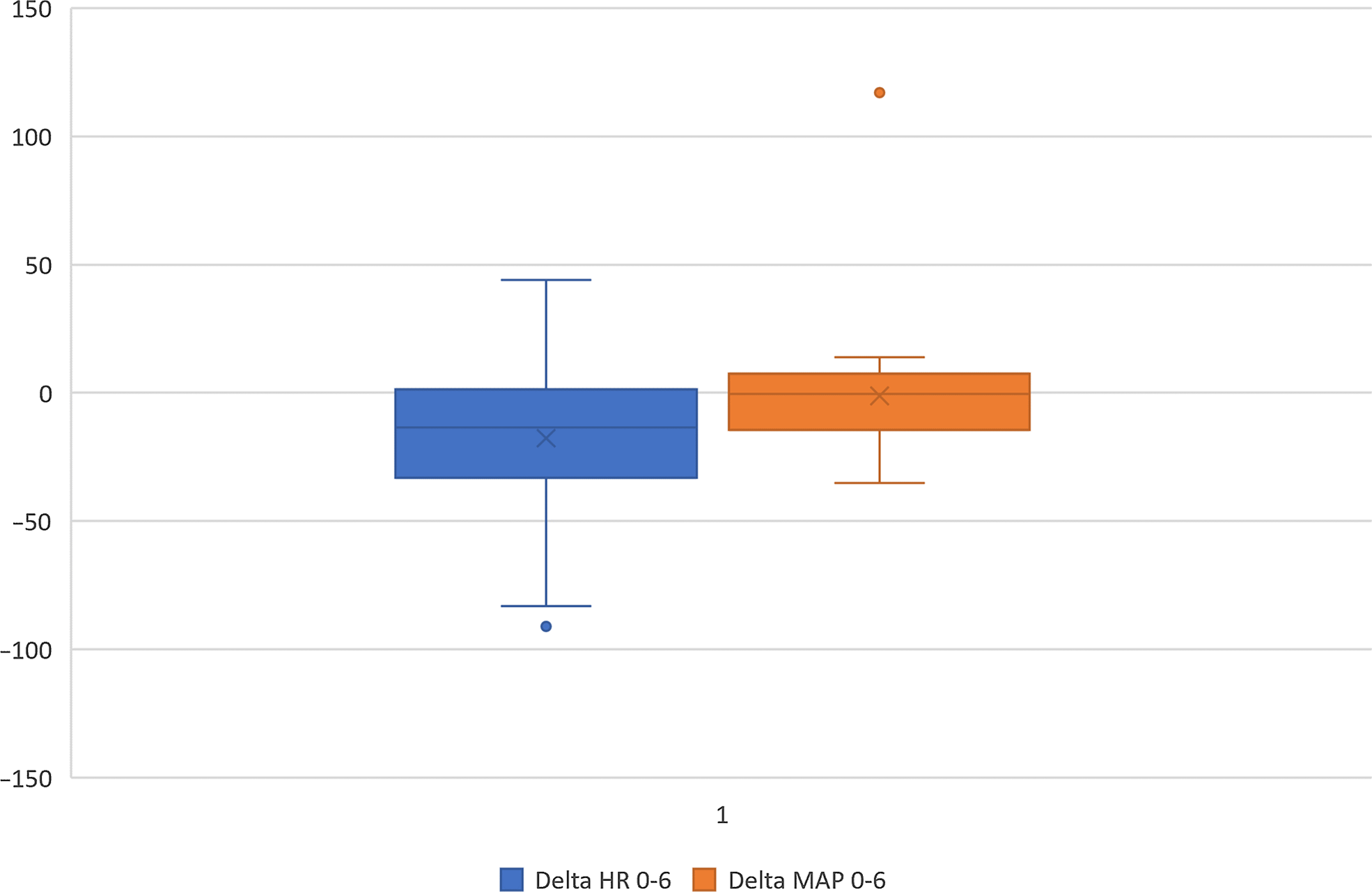
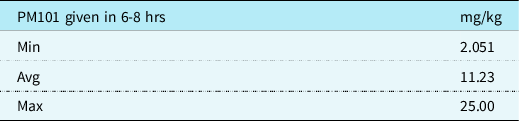
The average change in mean arterial pressures from hour 0 to 6 from time of first dose of PM101 was -3.4 mm Hg with a p-value of 0.243 (Supplemental Table S1). There was no statistically significant decrease in mean arterial pressures between hours 0 and 6. Figure 2 graphically displays the comparison between change in heart rate and change in mean arterial pressure within the first 6 hours. Patients received up to 25 mg/kg in an 8-hour periods (Table 1).
Graphical display of difference between heart rate and mean arterial pressures for all 37 data points (hour 0 and 6).

Amount of PM101 administered in 8-hour period.

Minimum, average, and maximum amount of PM101 given in mg per kilogram over a 6- to 8-hour period for patients.
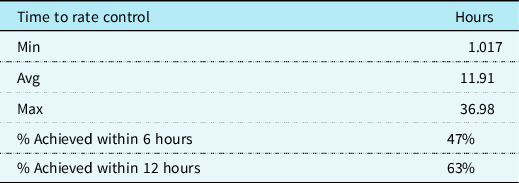
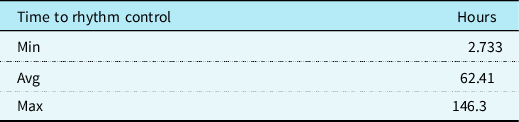
Time to rate control ranged from 1.017 to 36.98 hours, with 47% of patients achieving rate control within 6 hours and 63% within 12 hours of amiodarone administration (Table 2). Time to rhythm control ranged from 2.733 to 146.3 hours (Table 3).
Time to rate control.

Minimum, average, and maximum number of hours to rate control of patients who received PM101.
Time to rhythm control.

Minimum, average, and maximum number of hours to rhythm control of patients who received PM101.
Lactate levels were obtained at intensivists’ discretion and not as part of a routine or standard in the post-operative period for 19 different subjects. There was an average 0.32 decrease in lactate levels from hour 0 to hour 6 and 0.57 average decrease from hour 0 to hour 24 from times of PM101 administration.
Within the data, there were 5 ventricular septal defects, 12 Tetralogy of Fallot, and 3 atrioventricular canal repairs. All other surgical repairs performed in conjunction and considered less likely to result in junctional ectopic tachycardia with these procedures are not listed.
There were 3 deaths amongst all 33 subjects. No deaths were related to PM101 as there was no correlation between time of PM101 administration and time of death (Supplemental Table S2). Four patients had adverse events around the time of amiodarone administration. These cases are described below:
Patient 1 was treated with two doses of PM101 5 mg/kg (both doses given over 1 hour) without changes in hemodynamics during infusion, but also without achieving junctional ectopic tachycardia rate control. Unresolved junctional ectopic tachycardia resulted in fluid and vasopressin refractory hypotension without acidosis or decreased urine output. Mean arterial pressures improved with Epinephrine infusion, but this worsened junctional ectopic tachycardia. Epinephrine infusion decreased then mean arterial pressures decreased to 30s with heart rate 150s requiring IVF bolus and increases in vasopressin and epinephrine infusions. While programming the pump, the patient derailed into ventricular fibrillation, went into pulseless electrical activity, then back into junctional ectopic tachycardia.
Patient 2 had arrhythmia concerning for supraventricular tachycardia versus junctional ectopic tachycardia not responding to two doses of adenosine. Patient given PM101 1 mg/kg IV followed by second dose of 1 mg/kg IV (both doses administered over 30 minutes). Due to complications with pacing wires, patient was unable to be paced then became bradycardic to <50. CPR started then patient became hypotensive requiring IVF resuscitation and epinephrine infusion. BP then stabilised with return of junctional rhythm in 150s.
Patient 3 developed junctional ectopic tachycardia in OR after cardiac surgery. Rate control was not achieved with cooling, dexmedetomidine, digoxin, and amiodarone. Their junctional ectopic tachycardia was initially treated conservatively over several hours before more aggressive dosing to a total dose of 20 mg/kg over a period of 8 hours. Junctional ectopic tachycardia remained in 200s with minimal improvement after increased interval amiodarone dosing. Acid-base status, lactate, NIRS measurements, and other endpoints of resuscitation collectively worsened while still unable to achieve rate control at which time patient was placed on VA-ECMO. They received an additional 15 mg/kg of PM101 once cannulated, providing support that PM101 administration was not causative for unstable hemodynamics.
Patient 4 underwent cardiac surgery (pump time 101 minutes and cross-clamp time 49 minutes) and then later developed supraventricular tachycardia with a heart rate of 220s that later self-resolved. Early the next morning patient developed junctional ectopic tachycardia that did not improve after attempts to overdrive pace. Patient was given 5 mg/kg over 90 minutes and halfway through developed acute hypotension and subsequent pulseless electrical activity requiring 2 minutes of CPR then achieved Return of Spontaneous Circulation.
Discussion
The original formulation of amiodarone was first described as effective when given enterally in children in 1980. Reference Coumel and Fidelle12 While IV amiodarone is the only anti-arrhythmic prospectively studied with double-blinded randomisation in the pediatric population, Reference Saul, Scott and Brown13 the concern for hemodynamic compromise has led to its superiority and safety being extensively studied. Published reports from 1994 to 2008 have shown 4 to 58% of patients experiencing hemodynamic compromise with IV amiodarone, Reference Lane, Nguyen, Niemann, Bolte, Etheridge and Gausche-Hill14 with infants, patients with cardiac dysfunction or poor hemodynamics, and patients with rapid amiodarone infusion showing to be most at risk for hemodynamic collapse. Reference Maghrabi, Uzun, Kirsh, Balaji, Von Bergen and Sanatani15 Saul et al reported an 87% prevalence of adverse events in a randomised trial, attributing two deaths to IV amiodarone administration. Reference Saul, Scott and Brown13 There have also been several isolated case reports of cardiovascular collapse in children receiving IV amiodarone. Reference Jan, Fu, Lin and Hwang16–Reference Xavier, Haranal, Reddy and Melagiriyappa19 Maghrabi et al showed an association between amiodarone and cardiovascular collapse within 12 hours of administration, with collapse mostly occurring in the first 90 minutes of administration, half of the cases occurring during infusion with initial bolus. Maghrabi et al study disclosed the possibility that the collapse was secondary to uncontrolled arrhythmia rather than amiodarone formulation. Reference Maghrabi, Uzun, Kirsh, Balaji, Von Bergen and Sanatani15
Given the significant literature surrounding amiodarone’s adverse effects, many studies have published their recommended dosing regimen. Studies have shown that repeated doses of IV amiodarone can be administered at 5 mg/kg/dose IV over 20–60 minutes, up to 15 mg/kg over a 24-hour period, followed by a continuous infusion of 10–20 mg/kg/day Reference Lane, Nguyen, Niemann, Bolte, Etheridge and Gausche-Hill14 in children for supraventricular tachycardia/Ventricular Tachycardia with a pulse. Haas et al recommended 5 mg/kg over 1 hour followed by a continuous infusion of 10–20 mg/kg/day. Reference Haas and Camphausen2 Laird et al recommended 10 mg/kg divided into two 5 mg/kg over 10 minutes each followed by an infusion of 10-15 mg/kg/day over 48–72 hours. Reference Laird, Snyder, Kertesz, Friedman, Miller and Fenrich20 Haas et al compared patients who received IV amiodarone (within 60 minutes from tachyarrhythmia onset) to patients treated >60 minutes from onset. They were able to show an immediate decrease in heart rate within the first hour, but not a statistically significant difference in heart rate between the sub-groups. Reference Haas and Camphausen1 Their study gave 5.1 + 6.5 mg/kg of amiodarone at 120 minutes and 8.7 + 9.6 mg/kg at 4 hours and determined that the administration of amiodarone resulted in a significant and beneficial reduction in heart rate that allowed rapid rate and rhythm control without hemodynamic compromise. Reference Haas and Camphausen1
IV amiodarone’s known potential for hemodynamic compromise prompted the development of PM101, which was approved for use in 2008. While there is a plethora of published data regarding the safety and efficacy of amiodarone in children, there have been no data analysing the hemodynamic effects of PM101 in pediatric literature. This deficit in the literature could potentially limit the number of institutions willing to switch from amiodarone to PM101. Rochelson et al compared IV sotalol (a newly available agent) to an unspecified formulation of amiodarone in the treatment of children with post-operative junctional ectopic tachycardia. They found both agents were safe and efficacious, although IV sotalol may lead to a faster improvement in heart rate. Reference Rochelson, Valdés and Asadourian21 The study’s recent publication date could indicate the use of the PM101 in the study, although it is not exactly known. PM101 is proven to be an effective anti-arrhythmic that is devoid of co-solvents associated with hypotension even when given as a bolus Reference Cushing, Kowey, Cooper, Massey, Gralinski and Lipicky22 allowing for a more rapid administration of the loading dose. Common side effects include thrombophlebitis with infusion, patients feeling hot, and headaches. Reference Cushing, Adams, Cooper, Kowey and Lipicky23
Our study sought to provide evidence that PM101 was not only safe, but also effective at resolving junctional ectopic tachycardia in the post-operative cardiac patients (Tables 2 and 3). Within an 8-hour period, 25 mg/kg of PM101 was able to be given without hemodynamic compromise (Supplemental Table S1). Of the 33 patients included in the study, there were 4 patient deaths that were unrelated to timing of PM101 administration. Separately, 4 patients had adverse outcomes surrounding the time of PM101 administration (Vasoactive-Inotropic Score >20 or requiring CPR or ECMO). Patient 1’s refractory tachycardia resulted from end-organ effects rather than the amiodarone infusion. Patient 2’s bradycardia was a result of a broken pacer wire rather than amiodarone infusion. Patient 3’s adverse outcome was most likely due to insufficient dosing of amiodarone and failure to achieve rate control leading to worsening end-organ effects from junctional ectopic tachycardia. Of the 4 patients, only 1 patient (patient 4) had a convincing hemodynamic correlation between the amiodarone administration, although its benefits strongly outweighed its risks as the patient continued to receive amiodarone for rate control after being placed on ECMO.
In addition to the favourable hemodynamic response of PM101, it has a widespread compatibility with other medications, in contrast to amiodarone Reference Souney, Cowee and Cushing24,Reference Souney, Cowee and Mosher25 and is more easily stored. Also, its formulation permits advanced preparation of a pre-mixed product that allows ready-to-use dosage forms available during emergencies. Pre-mixed dosage forms can be stored in emergency carts or automated dispensing systems for immediate access in ready-to-use doses. Reference Souney, Cowee and Mosher25
Strengths of the study include the relative ease of access to data and amount of data obtained. We were able to pull all necessary data from the enterprise data warehouse with supplementation from manual Epic chart review for further clarification, with adequate amounts of data to perform reliable data analysis.
Our study is limited by being a single-center, retrospective, uncontrolled cohort study. Determining the precise timing of initiation and discontinuation of pacing was difficult using the retrospective data contained within the Electronic Health Record. We attempted to overcome this limitation using our a priori definitions of rate control and rhythm control. However, limitations in the available data did affect the calculations. Prospective studies with standardisation of treatment groups are needed to overcome limitations and provide more accurate data. Although our study relies on a substantial amount of data extracted into Virtual PICU Systems, the lack of actual telemetry, and more granular high-frequency vital sign data, available for review sets tremendous limitations and user error potential for those at the bedside entering vital signs into the EMR. Therefore, a thorough chart view of each patient was reviewed in detail to verify Virtual PICU Systems data with providers’ and nursing documentation through Epic’s “Notes” section.
Junctional ectopic tachycardia is a frequently challenging problem in the post-operative management of patients with CHD. The combination of an excessively fast heart rate with loss of atrioventricular synchrony often leads to hemodynamic deterioration and even death. In the past, therapeutic options for junctional ectopic tachycardia have been limited. Digoxin, propafenone, and procainamide have not been shown to be effective as single agents in controlling junctional ectopic tachycardia. Reference Garson, Moak, Smith and Norton26,Reference Walsh, Saul and Sholler5 There has been benefit shown with the addition of hypothermia to procainamide. Reference Mandapati, Byrum and Kavey27,Reference Walsh, Saul and Sholler5 Our institution no longer uses procainamide as clinicians found the pro-arrhythmic complications were less tolerated than aggressive dosing of PM101. We do not consider this a limitation of the study as the overall aim was to provide hemodynamic parameters of early and aggressive PM101 dosing. In addition, the need for backup pacing cannot be underestimated as it not only restores atrioventricular synchrony but it may be needed for patients who develop sinus bradycardia from treatment Reference Laird, Snyder, Kertesz, Friedman, Miller and Fenrich20 .
Our single-center study shows that PM101 can be used safely and effectively for the management of junctional ectopic tachycardia and other malignant tachyarrhythmias. Its favourable hemodynamic profile allows for the delivery of higher than previously reported total dosage, up to 25 mg/kg over 8 hours, leading to both rate and rhythm control to allow for safe pacing in this critical post-operative period. We believe that these results can be applied in other institutions by those caring for post-operative cardiac patients, including surgeons, electrophysiologists, cardiologists, and intensivists.
Supplementary material
To view supplementary material for this article, please visit https://doi.org/10.1017/S1047951122002888
Financial support
This research received no specific grant from any funding agency, commercial, or not-for-profit sectors.
Conflicts of interest
None.
Ethical standards
None to disclose.