Social anxiety disorder (SAD) is among the most common forms of pediatric psychopathology (Burstein et al., Reference Burstein, Georgiades, Lamers, Swanson, Cui, He and Merikangas2012; Duchesne, Larose, Vitaro, & Tremblay, Reference Duchesne, Larose, Vitaro and Tremblay2010; Merikangas, He, Burstein, et al., Reference Merikangas, He, Burstein, Swanson, Avenevoli, Cui and Swendsen2010). However, considerable heterogeneity exists in the developmental predictors, trajectories of SAD development, and outcomes for these children. Anxiety symptoms can be first detected in toddlerhood (Pine & Klein, Reference Pine, Klein, Rutter, Bishop, Pine, Scott, Stevenson, Taylor and Thapar2008), and they can be seen in the preschool age years, most commonly involving symptoms of social anxiety disorder, separation anxiety disorder, and generalized anxiety disorder (Franz et al., Reference Franz, Angold, Copeland, Costello, Towe-Goodman and Egger2013). However, in terms of the prevalence of anxiety disorders (all subtypes), which reaches approximately 32% by adolescence (Merikangas, He, Brody, et al. Reference Merikangas, He, Brody, Fisher, Bourdon and Koretz2010), there is a dearth of information about young children's symptoms, which is critical information for advancing early detection and amelioration of this highly prevalent form of psychological distress.
The need for early identification of risk for anxiety disorder is evident. Childhood anxiety symptoms are associated with significant impairment in familial, social, and academic domains (Duchesne et al., Reference Duchesne, Larose, Vitaro and Tremblay2010) and are frequently comorbid with other internalizing symptoms, particularly depression (Essau, Conradt, & Petermann, Reference Essau, Conradt and Petermann1999; Sonntag, Wittchen, Höfler, Kessler, & Stein, Reference Sonntag, Wittchen, Höfler, Kessler and Stein2000). For example, anxiety symptoms have pervasive negative effects on children including declines in academic performance (Merikangas et al., Reference Merikangas, He, Brody, Fisher, Bourdon and Koretz2010), lower social competence (Pine & Klein, Reference Pine, Klein, Rutter, Bishop, Pine, Scott, Stevenson, Taylor and Thapar2008), greater likelihood of peer rejection (Flanagan, Erath, & Bierman, Reference Flanagan, Erath and Bierman2008), concurrent depression (Biederman et al., Reference Biederman, Petty, Hirshfeld-Becker, Henin, Faraone, Fraire and Rosenbaum2007), and increased risk of substance use/abuse (Wolitzky-Taylor, Bobova, Zinbarg, Mineka, & Craske, Reference Wolitzky-Taylor, Bobova, Zinbarg, Mineka and Craske2012). Furthermore, untreated, early anxiety disorders increase risks for long-term mental and physical health problems (Biederman et al., Reference Biederman, Petty, Hirshfeld-Becker, Henin, Faraone, Fraire and Rosenbaum2007; Flanagan et al., Reference Flanagan, Erath and Bierman2008). Therefore, it is important to identify early in development which children are at highest risk for developing clinically meaningful and stable anxiety symptoms.
Extreme fearful temperament that is identified in infancy or early childhood is highly stable, and it is the best earlier predictor of social withdrawal and anxiety symptoms later in childhood and in adolescence (Chronis-Tuscano et al., Reference Chronis-Tuscano, Degnan, Pine, Perez-Edgar, Henderson, Diaz and Fox2009; Hirshfeld-Becker et al., Reference Hirshfeld-Becker, Biederman, Henin, Faraone, Davis, Harrington and Rosenbaum2007. Despite the robust prediction, not all temperamentally fearful children become socially withdrawn or develop anxiety symptoms. Several moderating factors have been examined (Degnan, Almas, & Fox, Reference Degnan, Almas and Fox2010; Ollendick & Benoit, Reference Ollendick and Benoit2012) including maternal overprotection or overcontrol (Johnson et al., Reference Johnson, Olino, Klein, Dyson, Bufferd, Durbin and Hayden2016; Lewis-Morrarty et al., Reference Lewis-Morrarty, Degnan, Chronis-Tuscano, Rubin, Cheah, Pine and Fox2012), social reticence (Degnan et al., Reference Degnan, Almas, Henderson, Hane, Walker and Fox2014), and attention bias to threat (Pérez-Edgar et al., Reference Pérez-Edgar, Reeb-Sutherland, McDermott, White, Henderson, Degnan and Fox2011). Another possible reason for this discontinuity is that there is considerable heterogeneity among children that are identified as temperamentally fearful who may be at differential risk for maladaptive developmental outcomes.
In our work, we have tackled the heterogeneity issue head on by identifying a form of heightened fearfulness. Specifically, this form is characterized by a pattern of fearful behavior wherein fear is most extreme, relative to other children, in low-threat situations (e.g., a puppet show; Buss, Reference Buss2011). What is particularly unique about this pattern of fearful behavior is that children who exhibit high fear in low threat situations are quite often not the same children who are identified as behaviorally inhibited, nor are they distinguishable from other fearful/shy children if they are observed only in high threat situations (e.g., a spider; Buss, Reference Buss2011). This pattern of dysregulated fear (DF), shown in two longitudinal samples, (a) is stable from age 2 to age 5 (Buss, Reference Buss2011); (b) predicts social withdrawal/inhibition in preschool (Buss, Reference Buss2011; Buss et al., Reference Buss, Davis, Ram and Coccia2018); (c) predicts social reticence with unfamiliar peers in the laboratory at age 5 (Buss et al., Reference Buss, Davis, Kiel, Brooker, Beekman and Early2013); (d) is associated with a distinct pattern of physiology, neural, and attentional processes (Buss et al., Reference Buss, Davis, Ram and Coccia2018; Morales, Pérez-Edgar, & Buss, Reference Morales, Pérez-Edgar and Buss2015; Phelps, Brooker, & Buss, Reference Phelps, Brooker and Buss2016); and (e) predicts SAD symptoms at age 6 (Buss et al., Reference Buss, Davis, Kiel, Brooker, Beekman and Early2013).
What is still unknown is whether DF continues to confer risk for social anxiety symptoms as these at-risk children transition into adolescence. Available epidemiological evidence suggests that adolescence represents a developmental period of elevated risk for anxiety, as rates of anxiety increase sharply during this period (Copeland, Angold, Shanahan, & Costello, Reference Copeland, Angold, Shanahan and Costello2014; Merikangas et al., Reference Merikangas, He, Brody, Fisher, Bourdon and Koretz2010). Social anxiety disorder is also associated with an increased risk for depression (Biederman et al., Reference Biederman, Petty, Hirshfeld-Becker, Henin, Faraone, Fraire and Rosenbaum2007), with some evidence suggesting that the presence of SAD in childhood is associated with nearly a threefold increase in depression by young adulthood (Copeland et al., Reference Copeland, Angold, Shanahan and Costello2014). Furthermore, symptoms of social anxiety have been found to mediate the longitudinal link between childhood fearfulness and lifetime depression (Gladstone & Parker, Reference Gladstone and Parker2006).
Socioemotional trajectories are shaped by the environmental context in which children and adolescents are embedded. Parents’ own anxiety and threat biases can influence the way parents behave toward their children. For instance, maternal anxiety is often associated with overprotective behavior (Gar, Hudson, & Rapee, Reference Gar, Hudson, Rapee, Hudson and Rapee2005; Kennedy, Rapee, & Edwards, Reference Kennedy, Rapee and Edwards2009). Some mothers of fearful infants can have difficulty being sensitive, responsive, and appropriately supportive of their infants’ needs (Gartstein et al., Reference Gartstein, Bridgett, Rothbart, Robertson, Iddins, Ramsay and Schlect2010), often perceiving them as vulnerable (Dadds & Roth, Reference Dadds, Roth, Vasey and Dadds2001). In response to fearful behaviors, parents may engage in a controlling and intrusive pattern of behavior including overprotective parenting (Johnson et al., Reference Johnson, Olino, Klein, Dyson, Bufferd, Durbin and Hayden2016; Lewis-Morrarty et al., Reference Lewis-Morrarty, Degnan, Chronis-Tuscano, Rubin, Cheah, Pine and Fox2012; Mount, Crockenberg, Jó, & Wagar, Reference Mount, Crockenberg, Jó and Wagar2010). These behaviors have been associated with the maintenance of shy behavior and increasing anxiety symptoms (Duchesne et al., Reference Duchesne, Larose, Vitaro and Tremblay2010). Overinvolved parenting is particularly fundamental in the development of anxiety disorders (Murray, Creswell, & Cooper, Reference Murray, Creswell and Cooper2009), accounting for substantial variation in anxiety symptoms during childhood (Van Der Bruggen, Stams, & Bögels, Reference Van Der Bruggen, Stams and Bögels2008). This empirical evidence supports models of anxiety development that argue for a mutually reinforcing parent–child dynamic (Dadds & Roth, Reference Dadds, Roth, Vasey and Dadds2001). In this model, when a child experiences fear, they solicit (directly or indirectly) support from their parent. This in turn results in the effective alleviation of the child's distress, thus reinforcing the parent's overprotective behavior and the child's need for parental intervention, which eventually increases risk for anxiety development (Dadds & Roth, Reference Dadds, Roth, Vasey and Dadds2001). We have tested this process and have demonstrated that overprotection mediates the relation between toddler fear and later social anxiety in preschool and kindergarten (Kiel & Buss, Reference Kiel and Buss2011, Reference Kiel and Buss2012, Reference Kiel and Buss2014). In contrast, parents who are sensitive to their fearful children's needs (i.e., intervene only when the child's coping resources are exhausted), display warmth, and appropriately support autonomy have children who do not increase in social wariness or fear reactivity (Booth-LaForce & Oxford, Reference Booth-Laforce and Oxford2008; Kiel, Premo, & Buss, Reference Kiel, Premo and Buss2015). Therefore, one goal of the current study was to examine the role of parental overprotection in predicting social anxiety symptoms during adolescence.
As children transition through late childhood into adolescence, peer relationships become more important and introduce new experiences that can increase risk for the development social anxiety (see Henderson, Green & Wick, Reference Henderson, Green, Wick, Pérez-Edgar and Fox2018; Rubin, Barstead, Smith, & Bowker, Reference Rubin, Barstead, Smith, Bowker, Pérez-Edgar and Fox2018 for reviews of this literature for BI children). Temperamentally fearful and anxious children display social reticence and often avoid interaction with same-age peers (Buss et al., Reference Buss, Davis, Kiel, Brooker, Beekman and Early2013; Degnan et al., Reference Degnan, Almas, Henderson, Hane, Walker and Fox2014; Fox, Henderson, Rubin, Calkins, & Schmidt, Reference Fox, Henderson, Rubin, Calkins and Schmidt2001). The tendency to withdraw from novel, unfamiliar social situations makes these children less assertive, and by the transition to adolescence, they are more likely to experience peer rejection/victimization. Fearful children also have fewer friends compared with their peers and report greater anxiety and loneliness than others (Suway, Degnan, Sussman, & Fox, Reference Suway, Degnan, Sussman and Fox2012), and these differences extend through adolescence and adulthood (Gest, Reference Gest1997). This type of social withdrawal may prevent the development of age-appropriate social skills, leading to negative self-perceptions and lower self-esteem (Rubin, Burgess, Kennedy, & Stewart, Reference Rubin, Burgess, Kennedy, Stewart and Barkley2003) and difficulty with establishing high quality friendships (Rubin, Wojslawowicz, Rose-Krasnor, Booth-LaForce, & Burgess, Reference Rubin, Wojslawowicz, Rose-Krasnor, Booth-LaForce and Burgess2006). Withdrawn children likewise experience less peer acceptance (Hymel, Rubin, Rowden, & LeMare, Reference Hymel, Rubin, Rowden and LeMare1990), more peer rejection (Gazelle & Faldowski, Reference Gazelle and Faldowski2014), and more depressive symptoms (Erath, Flanagan, Bierman, & Tu, Reference Erath, Flanagan, Bierman and Tu2010). Therefore, in the current study kindergarten-age social withdrawal and adolescents’ concurrent peer relationships were examined as additional risk indicators for social anxiety for DF children.
The goals of the current study were to assess the following at the transition to early adolescence (at ~ ages 11–13):
(1) We evaluated continued risk for social anxiety symptoms for DF children. We hypothesized that DF would predict greater social anxiety in early adolescence. Given evidence for gender differences in the prevalence of anxiety symptoms in adolescence (McLean, Asnaani, Litz, & Hofmann, Reference McLean, Asnaani, Litz and Hofmann2011), we also explored gender differences.
(2) We examined the extent to which developmentally more proximal risk factors such as social reticence (from early childhood) as well as concurrent peer relationships and parental monitoring were associated with social anxiety in adolescence. We explored this in a series of additive models, and we hypothesized that DF would predict social anxiety symptoms beyond these more proximal risk factors. We also explored whether the effect of DF on social anxiety in adolescence was mediated through these proximal risk factors, although we did not hypothesize that this would be the case. Finally, in line with previous work (Bosquet & Egeland, Reference Bosquet and Egeland2006; Johnson et al., Reference Johnson, Olino, Klein, Dyson, Bufferd, Durbin and Hayden2016; Lewis-Morrarty et al., Reference Lewis-Morrarty, Degnan, Chronis-Tuscano, Rubin, Cheah, Pine and Fox2012; Williams et al., Reference Williams, Degnan, Perez-Edgar, Henderson, Rubin, Pine and Fox2009), we also examined parenting and peer relations as potential moderators of the relationship between DF and social anxiety in adolescence.
Method
Participants
The participants were 112 mothers and their 2-year-old children, who had been recruited for a larger longitudinal study through recorded local birth announcements (M age = 24.05 months, SD age = 1.50 months; 43.8% female). The sample was a low-risk, community sample from a large, Midwestern university town. The majority of the sample was middle to upper-middle class (1.8% = $16,000–20,000; 4.5% = $21,000–30,000; 10.9% = $31,000–40,000; 18.2% = $41,000–50,000; 9.1% = $51,000–60, 000; and 42.7% = above $61,000), college educated (8.2% = high school education; 21.9% = some college or technical education; 30.9% = college graduate; and 36.3% = graduate training), and largely White (91.9% White, 3.6% African American, 1.8% Hispanic, 1.8% Asian American, and 0.9% South American Indian). At the time of recruitment, 70% of the children had siblings (M siblings = 1.05, SD siblings = 1.15, range = 0–9). A subset of the original sample completed a number of follow-up surveys approximately 11 years later as the children reached adolescence (n = 61, M age = 12.96 years, SD age = 0.73, 42.6% female). The family demographics of the subsample remained largely consistent. The majority of the sample remained middle to upper-middle class (3.1% = $21,000–30,000; 1.5% = $31,000–40,000; 4.6% = $41,000–50,000; 1.5% = $51,000–60, 000; and 86.2% = above $61,000), college educated (6.2% = high school education; 12.3% = some college or technical education; 24.6% = college graduate; and 52.3% = graduate training), and largely White (91.8% White, 4.9% African American, 1.6% Hispanic, and 1.6% South American Indian). At the follow-up time, 95% of the children had siblings (M siblings = 3.79, SD siblings = 4, range = 2–6). Further information about attrition is presented in the Results section.
Procedures
During the initial laboratory visit at age 2 years, the mothers and their children completed a series of tasks that included six novel tasks. These tasks included low-threat episodes (Clown and Puppet Show), medium-threat episodes (Stranger Working and Stranger Approach), and high-threat episodes (Robot and Spider), which were developed out of the Laboratory Temperament Assessment Battery (Lab-TAB; Goldsmith, Reilly, Lemery, Longley, & Prescott (Reference Goldsmith, Reilly, Lemery, Longley and Prescott1994) and previous studies that were designed to observe toddler behavior (Buss, Reference Buss2011). Two low-threat episodes, Clown and Puppet Show, involved a second experimenter who was dressed as a clown or was using puppets behind a stage who then enthusiastically asked the toddler to play a series of short games. Two medium-threat episodes involved either a female stranger working in the room for 2 min (Stranger Working) or a male stranger who began a short conversation with the toddler (Stranger Approach). Two high-threat episodes involved remote controlled toys, a robot in the corner and a large spider attached to a truck that approached the toddler and then retreated two times with 10 s in between each movement.
Behavioral coding was used to construct the measures of dysregulated fear and maternal overprotectiveness that are described below. For more detail on the coding system, refer to previous studies (Buss, Reference Buss2011). The coders achieved reliability of at least κ = .65 and 80% agreement with the master coder prior to coding these measures independently. Throughout the coding of the six episodes, reliability on about 15–20% of the cases was assessed to avoid coder drift and the same reliability criterion was achieved.
During the fall of kindergarten, parents completed several questionnaires to assess their children's behavioral and social-emotional adjustment. At the early adolescent follow-up (ages 11–13), the youth and their families completed a set of online questionnaires. The youth measures described below assessed fear and anxiety in home, school, and other social contexts. The parental measures assessed the youth's anxiety as well as parent protectiveness, monitoring, and control.
Measures
Dysregulated fear
We conceptualized dysregulated fear as change (specifically for a DF pattern, the lack of change) in the level of fear that was elicited across episodes that varied in threat levels (see Buss, Reference Buss2011, for full details). To measure fear, we created composites that consisted of the average of the following variables for each episode (coded second-by-second): the duration of proximity to mother, freezing, bodily fear, facial fear, and a reverse-scored latency to freeze (the coding agreement was 80–100%; κ = .61–.73). We then used these fear composites as the dependent variable in a multilevel model, accounting for within-toddler nesting of episodes, with threat level of the episodes (a contrast variable) as the predictor. We then extracted each toddler's slope by using the empirical Bayes estimate to analyze individual differences in changes of fear across the episodes with different threat levels. Higher and more positive slopes indicated different levels of fear across the episodes, consistent with expected regulation based on the threat levels of the episodes. Less pronounced positive or negative slopes indicated little to no change, or higher fear, across the episodes. As we reported previously, slope and intercept were highly correlated (r = -.80), demonstrating that the toddlers with flatter slopes started out at higher levels of fear in the low threat situations. For the current analyses, we reversed the values for the DF slope such that higher scores indicate greater dysregulated fear. Note that this is different than it is in other publications (Buss, Reference Buss2011; Buss et al., Reference Buss, Davis, Kiel, Brooker, Beekman and Early2013).
Anxiety Symptoms
Parent-reported anxiety
Parents completed the Screen for Child Anxiety Related Disorders (SCARED; Birmaher, Khetarpal, Cully, Brent, & McKenzie, Reference Birmaher, Khetarpal, Cully, Brent and McKenzie1995) as a part of the 11-year follow-up to assess their youth's levels of anxiety (e.g., “My child doesn't like to be with people he/she doesn't know well”). The parents rated items that ranged from 0 (Not true or hardly ever true) to 2 (Very true or often true). For the current study, we used the sum of the seven items from the Social Anxiety scale (α = .85).
Youth-reported anxiety
Youth completed two instruments to measure social anxiety symptoms. First, they completed the SCARED (Birmaher et al., Reference Birmaher, Khetarpal, Cully, Brent and McKenzie1995), rating items on a scale that ranged from 0 (Not true or hardly ever true) to 2 (Very true or often true) that indicate levels anxiety (e.g., “I do not like to be with people I don't know well”). Again, we used the sum of the seven items from the Social Anxiety scale (α = .77). Youth also completed the Social Anxiety Scale for Adolescents (SAS-A; La Greca & Stone, Reference La Greca and Stone1993) to assess social anxiety symptoms. The SAS-A questionnaire includes 18 items that are designed to measure youth's subjective experience of social anxiety including fear of negative evaluation (e.g., “I worry about what others think of me”) and social avoidance in new situations or more generally (e.g., “I only talk to people I know really well”), which were rated on a 5-point scale, 1 (Not at all) to 5 (All of the time). The total sum of all of the items was used in the analyses (α = .93).
Covariates
Kindergarten social withdrawal
During the fall of kindergarten, mothers completed the Social Inhibition scales from the McArthur Health and Behavior Questionnaire (HBQ; Armstrong & Goldstein, Reference Armstrong and Goldstein2003). Three items (e.g., “Shy with other children”) were rated by mothers on a scale from 0 (rarely applies) to 2 (certainly applies), with α = .77. This measure of social withdrawal was used as a covariate in the current study.
Adolescent peer relationships
At the adolescent follow-up, youth completed a peer relationships scale, which consisted of 14 items that were drawn from instruments that were designed to assess different facets of peer relationships. For the current study, we created a total peer relationships score (α = .87), which consisted of the participant's scores on the subscales that measured social self-concept (Harter, Reference Harter1988), friendship quality (Bukowski, Hoza, & Boivin, Reference Bukowski, Hoza and Boivin1994), and perceived victimization (reverse scored; Schwartz, Farver, Chang, & Lee-Shin, Reference Schwartz, Farver, Chang and Lee-Shin2002).
Adolescent parental protectiveness
Children completed a maternal overprotectiveness questionnaire (MO; Edwards, Rapee, Kennedy, & Spence, Reference Edwards, Rapee, Kennedy and Spence2010). This measure included 13 items that assessed protective behaviors that mothers engaged in when they were children (e.g., “When I was a child, my mother would often do things for me I could do for myself”). The children rated how much they agreed with the various statements on a scale from 1 (Strongly disagree) to 5 (Strongly agree), with α = .86.
Adolescent parental monitoring
The parents completed the Parental Monitoring Questionnaire (PMQ; Kerr & Stattin, Reference Kerr and Stattin2000) to assess their knowledge of their children's activities (e.g., “Do you know what friends your child spends time with in their free time?”). The 24 items from this questionnaire were rated on a scale from 1 (Almost Never) to 5 (Almost Always), with α = .78.
Statistical Analyses
Prior to the analyses, all of the study variables were examined for distribution and univariate and multivariate outliers. Next, the descriptive statistics and correlations were computed to examine the bivariate associations among the study variables. Finally, a series of hierarchical regression analyses were conducted to examine the predictive relationships among DF at age 2 and the social anxiety symptoms that were reported during the adolescent follow-up. To account for the potential effects of more proximal correlates of anxiety symptoms, the measures of social inhibition, parenting, and peer relations were covaried. Additionally, gender was included as a covariate in the final model to examine whether it predicted adolescents’ social anxiety symptoms. In each model, the main effect of DF was entered in step 1, social withdrawal at kindergarten assessment was entered as a covariate in step 2, and the parenting and peer variables that were assessed during the adolescent follow-up were entered in step 3. Finally, each of the proximal risk factors was tested as a potential mediator of the longitudinal relationship between DF and adolescent anxiety symptom outcomes.
Of the 112 families who participated in the laboratory visit at 2 years, 61 families provided data at the early adolescent follow-up (M age = 12.96 years, SD = 0.73). A systematic evaluation of the attrition effects indicated that those who dropped out between the age 2 assessment and the kindergarten assessment (18.8%) and the kindergarten assessment and the adolescent follow-up (44.6%) did not differ from those who participated in the adolescent follow-up study with respect to participant gender, age, race, family socioeconomic status, parent marital status, or parent-rated toddler temperamental or behavioral traits (e.g., inhibition to novelty, internalizing behaviors, and fearfulness; .06 < p < .99).Footnote 1
To account for the missing data due to attrition, multiple imputation (MI) was employed. We used MI based on simulation research evidence suggesting that MI performs very well for small samples (as small as n = 50) or for samples with up to 50% of missing data (Graham, Reference Graham2009). Following the current guidelines for enhancing inferences for datasets with up to 50% missing data, 40 imputations were completed and pooled by using the multivariate imputation by chained equations in the MICE package (van Buuren & Groothuis-Oudshoorn, Reference van Buuren and Groothuis-Oudshoorn2011) of the R computing environment (R version 3.5.0, 2018; R Development Core Team, 2008). A test of mediation was completed by using the Lavaan package in R (Rosseel, Reference Rosseel2012).
Results
Data screening and descriptive statistics
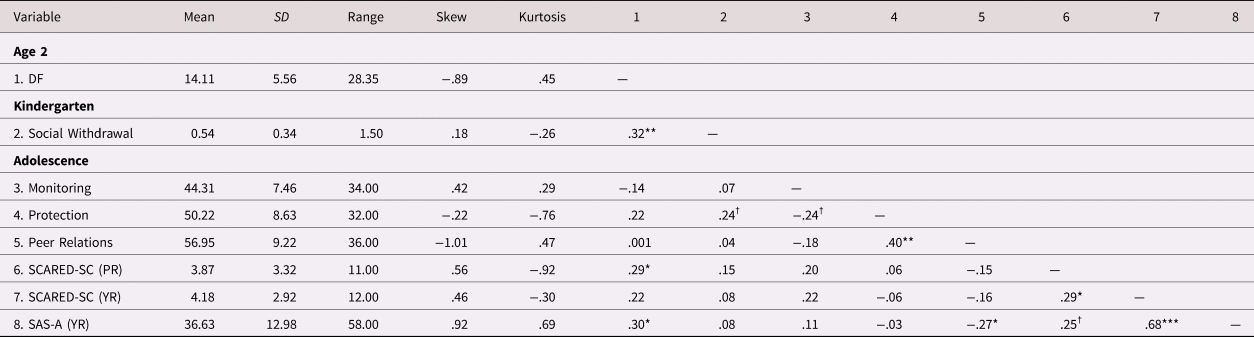
There was no evidence of significant skew or kurtosis for the study variables. One multivariate outlier was identified for youth self-reported anxiety by using the Mahalanobis distance and was removed from the subsequent analyses. The descriptive statistics and correlations for all of the study variables are presented in Table 1. Approximately 49% of the sample scored at or above the cutoff score that was established for the social anxiety subscale of the SCARED, and 16% of the youth scored above the cutoff score for the SAS-A. The concordance between parent and youth self-reported social anxiety subscale of the SCARED was moderate. Dysregulated fear was correlated with two of the three indices of adolescent social anxiety, both parent- and youth-reported social anxiety symptoms. To examine whether gender differences were present across the study measures, independent t tests were completed. Gender differences were not observed for any of the outcomes that were examined in this study (the values for t ranged from 0.006 to 1.253).
Descriptive statistics and bivariate correlations among study variables

Note: SCARED-SC = Screen for Child Anxiety Related Emotional Disorders–Social Anxiety subscale; SAS-A = Social Anxiety Scale for Adolescents; PR = parent report; YR = youth-report; †p < .10 *p < .05 **p < .01 ***p < .001.
Analyses of attrition and missing data
Families who did not complete assessments at each wave of the study did not differ from those that completed all of the study assessments on any of the demographic or predictor variables ps > .36. As the pattern of missingness was not found to depend on the observed data, there was no evidence that the assumption of missing completely at random (MCAR) was violated. The complete case analysis (i.e., listwise deletion) and MI yielded the same pattern of results. Therefore, the pooled estimates that were obtained from the 40 MI datasets are reported below.
Hierarchical Regression Analyses
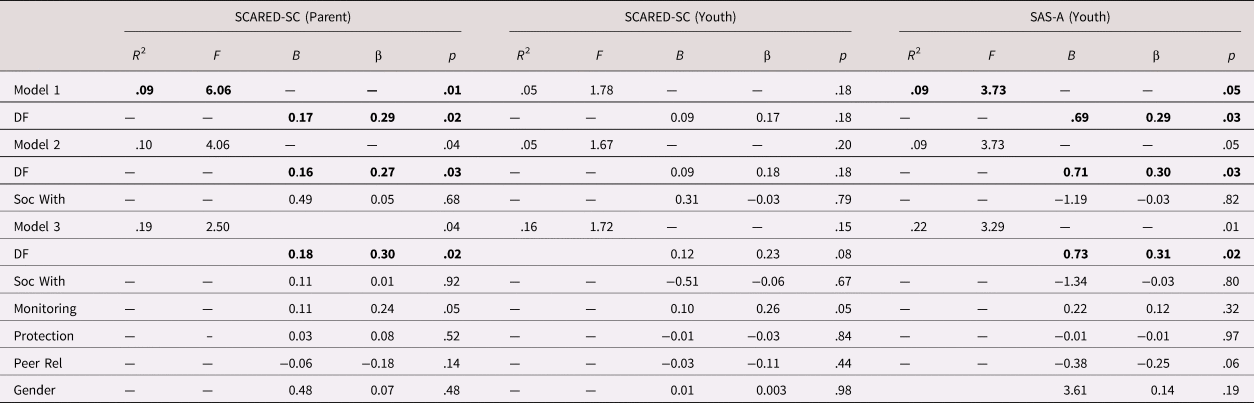
The results of the three regression models for predicting youth self-reported and parent-reported social anxiety are presented in Table 2. Consistent with our hypotheses, DF predicted greater parent-reported SCARED social anxiety and youth self-reported SAS-A total score in the models that included DF as the unique predictor (Model 1). However, DF did not predict SCARED social anxiety as reported by the youth, b = 0.11, p = .13. Turning to Model 2 where kindergarten social withdrawal was added to the model, DF remained a significant predictor of the youth self-reported SAS-A total score when kindergarten-age social withdrawal was covaried. Finally, to examine the unique contribution of DF relative to more the proximal predictors, concurrent parental monitoring, protectiveness, and adolescent's peer relationships were entered as covariates in the models for predicting social anxiety outcomes (Model 3). Dysregulated fear continued to predict higher levels of parent-reported SCARED social anxiety beyond the significant concurrent relationship between parental monitoring and parent-reported social anxiety symptoms. Likewise, in the model for predicting youth SAS-A total score, only DF and youths’ concurrent peer relationships predicted higher levels of adolescents’ social anxiety symptoms. Finally, while controlling for the significant contribution of concurrent peer relationships, there was a marginally significant relationship between DF and youth self-reported SCARED social anxiety such that DF predicted greater social anxiety symptoms, b = 0.13, p = .07. In summary, DF assessed at age 2 emerged as a predictor of adolescents’ symptoms of social anxiety as reported by adolescents and their parents. These predictive relationships remained significant when the models accounted for the effects of the more proximal correlates of parental control and peer relationships.
Hierarchical regressions predicting adolescent social anxiety symptoms

Note: SCARED-SC = Screen for child anxiety related emotional disorders–social anxiety subscale; SAS-A = Social anxiety scale for adolescents; DF = Slope score for dysregulated fear; Soc With = Kindergarten social withdrawal; Peer Rel = Peer relationships.
Tests of Mediation and Moderation Effects
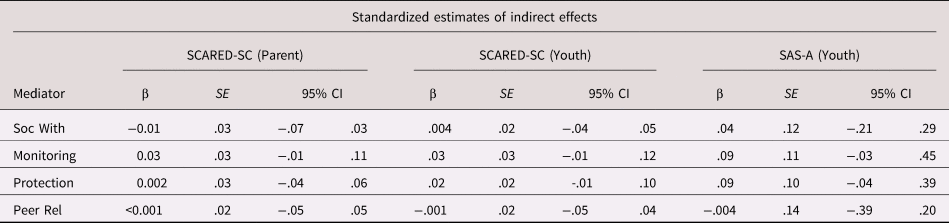
For each measure of adolescent anxiety symptom outcomes, four mediation models were tested with the following mediators: kindergarten social withdrawal, parental monitoring, parental protectiveness, and peer relationships. As shown in Table 3, there was no evidence of a significant mediation involving any of the four potential mediator variables. Therefore, the predictive relationship between DF and adolescent social anxiety symptoms could not be accounted for by proximal psychosocial indicators of anxiety risk.
Tests of mediation effects involving proximal risk indicators

Note: SCARED-SC = Screen for child anxiety related emotional disorders–social anxiety subscale; SAS-A = Social anxiety scale for adolescents; Soc With = Kindergarten social withdrawal; Peer Rel = Peer relationships.
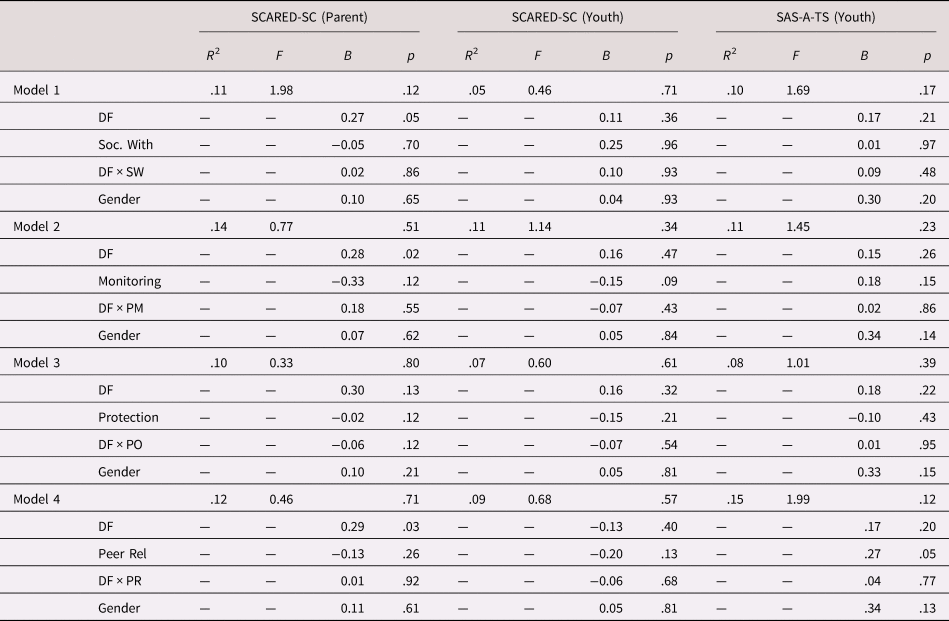
Finally, we examined the possibility that DF interacted with parent monitoring, parental protectiveness, and peer relationships to predict adolescent anxiety symptom outcomes. We tested these interactions individually across all three anxiety-symptom outcomes. As shown in Table 4, there was no evidence of moderation for any of the analyses.
Proximal environmental variables as moderators of the relationship between DF and adolescent social anxiety symptoms

Note: SCARED-SC = Screen for child anxiety related emotional disorders–social anxiety subscale; SAS-A = Social anxiety scale for adolescents; DF = Slope score for dysregulated fear; SW = Kindergarten social withdrawal; PM = Parent Monitoring; PO = Parent Protectiveness; Peer Rel = Peer relationships.
Discussion
Dysregulated fear—a type of fearful temperament that is characterized by high levels of fear in low-threat situations—has been identified as a robust predictor of childhood social anxiety spectrum symptoms. Specifically, in our initial study, toddlers who demonstrated a DF profile were found to be at an elevated risk for social withdrawal upon their transition to kindergarten (Buss, Reference Buss2011) and were also more likely to develop symptoms of social anxiety by age 6 (Buss et al., Reference Buss, Davis, Kiel, Brooker, Beekman and Early2013). The present study examined whether the pattern of DF that was observed at age 2 continued to predict specific risk for social anxiety symptoms into early adolescence. The findings of the present study supported the study hypotheses. We found that DF uniquely predicted adolescents’ social anxiety symptoms—as reported by youth and their parents—beyond the prediction from more proximal measures of behavioral (e.g., kindergarten social withdrawal) and environmental risk factors (e.g., high parental monitoring, poor peer relations).
Consistent with prior research that documented an association between fearful temperamental traits that are observed during the second year of life and social anxiety symptoms in adolescence (Clauss & Blackford, Reference Clauss and Blackford2012), we found that toddlers’ DF was associated with elevated social anxiety symptoms in adolescence. It has been suggested that the longitudinal linkage between fearful temperamental traits and social anxiety symptoms in adolescence is attributable to the preservation of an emotional, behavioral, and biological profile that specifically predisposes an individual to fear and to withdraw from novel social situations (Schwartz, Snidman, & Kagan, Reference Schwartz, Snidman and Kagan1999). Our findings support the previous finding that DF was a specific risk for social withdrawal at children's transition to kindergarten (Buss, Reference Buss2011), and they indicate that, as predicted, this social anxiety risk trajectory continued into early adolescence. Moreover, the DF profile was found to predict social anxiety symptoms in adolescence beyond the prediction that was made by the social withdrawal behaviors that were assessed at the children's transition to kindergarten. This suggests that the unique pattern of toddler fear in situations that pose low threat and that are not feared by most toddlers may represent risk for their later development of social anxiety problems. Understanding the circumstances that exacerbate and mitigate this risk is the next important step in this program of research.
Extensive literature has documented the role of environmental factors that alter temperamentally fearful toddlers’ trajectories toward anxiety-related outcomes. In particular, parental overprotectiveness has been identified as a factor that increases one's risk for anxiety in early childhood (Kiel & Buss, Reference Kiel and Buss2011; Kiel & Maack, Reference Kiel and Maack2012; Kiel et al., Reference Kiel, Premo and Buss2015) and adolescence (Rapee, Reference Rapee2009). Similarly, certain aspects of peer relationships (e.g., victimization, rejection) not only influence children's risk for anxiety symptomatology but also likely reflect the extent of social impairment that is associated with social anxiety (Erath et al., Reference Erath, Flanagan and Bierman2007; Su, Pettit, & Erath, Reference Su, Pettit and Erath2016). Given the importance of the proximal influence of parents and peers on adolescents’ social anxiety symptom presentation, we investigated the longitudinal association between DF and adolescents’ social anxiety symptoms while accounting for concurrent measures of anxiety-related parenting behaviors and peer relationships. It is noteworthy that the DF profile that was observed during toddlerhood uniquely predicted adolescents’ social anxiety symptoms beyond the concurrent associations between social anxiety and adolescents’ experiences of parenting and peer relationships. Moreover, we found that the significant predictions of DF held for both parent- and self-reported adolescent social anxiety symptoms. However, it is interesting to note that for youth self-report a significant effect was only found by using the SAS-A, despite similar effect sizes and a high correlation between the two youth-reported measures. We speculate that this is largely due to differences between the two self-reported instruments. The SAS-A is a comprehensive measure of social anxiety symptoms that assesses fear of negative evaluation, social avoidance of new people, and general social avoidance, whereas the SCARED is designed as a screening instrument with only seven social anxiety items. The SAS-A may be the more sensitive method for capturing the range of variation in youth-reported social anxiety symptoms. It is interesting that DF is more predictive of self-report items that comprise social anxiety diagnostic criteria than those that reflect a milder set of social anxiety/shyness symptoms.
While there is evidence in the extant literature that the link between early fearful temperament and anxiety outcomes is moderated by parenting (e.g., Degnan et al., Reference Degnan, Almas and Fox2010; Lewis-Morrarty et al., Reference Lewis-Morrarty, Degnan, Chronis-Tuscano, Rubin, Cheah, Pine and Fox2012; Williams et al., Reference Williams, Degnan, Perez-Edgar, Henderson, Rubin, Pine and Fox2009) and peer relationships (Bosquet & Egeland, Reference Bosquet and Egeland2006; Degnan et al., Reference Degnan, Almas, Henderson, Hane, Walker and Fox2014), we did not observe a moderation effect in our analyses. Notably, the mediation models further indicated that the longitudinal relationship between DF and adolescent social anxiety symptoms was not attributable to these more temporally proximal risk factors of social anxiety symptoms in adolescence. In other words, although these are known risk factors for social anxiety development, perhaps for children whose early appearing fearfulness persists through adolescence, they appear not to contribute to the trajectory to adolescent social anxiety. Thus, the current results provide further support for DF as a meaningful developmental antecedent of youth anxiety risk that may directly and uniquely shape youths’ trajectory of social anxiety risk over an extended period of childhood.
These null findings are not entirely consistent with the extant literature, including our own work. For example, in examining parenting as a mediator, we have demonstrated that maternal overprotection mediates the association from toddler fearful temperament to social withdrawal at age 6 (Kiel & Buss, Reference Kiel and Buss2011, Reference Kiel and Buss2014). We provide two possible explanations for these differences. First, it may be that the effects of parental overprotection have a stronger influence earlier in development. In our previous work, maternal overprotection was observed concurrently with fearful temperament at age 2 (Kiel & Buss, Reference Kiel and Buss2011, Reference Kiel and Buss2012, Reference Kiel and Buss2014), and most of the work is also focused in early childhood (e.g., Rapee, Reference Rapee2014; Rapee, Kennedy, Ingram, Edwards, & Sweeney, Reference Rapee, Kennedy, Ingram, Edwards and Sweeney2010). Consistent with the models of anxious parenting (Dadds, Roth, Vasey, & Dadds, Reference Dadds, Roth, Vasey and Dadds2001; Ollendick & Benoit, Reference Ollendick and Benoit2012), this protective behavior for fearful children reinforces the fear rather than dampening it (Buss & Kiel, Reference Buss and Kiel2011) and increases risk for anxiety symptoms across development. Second, although there is evidence that these types of parenting behaviors are stable (Kiel & Buss, Reference Kiel and Buss2011), the type of and the contexts in which the protective behavior is observed across development may be important as well. As we have repeatedly demonstrated with DF, it is in low-threat contexts that these behaviors (DF and parenting) matter the most (Buss, Reference Buss2011; Kiel & Buss, Reference Kiel and Buss2012). The type of overprotective parenting and monitoring that was measured in the current study tap into more general or global assessments of these parenting practices, and they do not capture specific parent behaviors in specific contexts.
Despite evidence in the literature for gender differences in anxiety during adolescence (Beesdo, Knappe, & Pine, Reference Beesdo, Knappe and Pine2009; McLean et al., Reference McLean, Asnaani, Litz and Hofmann2011), we did not find that gender was associated with outcomes or predictors. Evidence for gender differences in our previous work has been limited as well. Specifically, the DF profile contains an equal representation of boys and girls (Buss, Reference Buss2011), which is consistent with the temperament literature early in development, where most gender differences emerge only in parent-reported behaviors (Chaplin & Aldao, Reference Chaplin and Aldao2013). Moreover, gender differences are often found as moderating effects in our longitudinal work (Buss, Brooker, & Leuty, Reference Buss, Brooker and Leuty2008), consistent with the broader literature (e.g., Kiel & Hummel, Reference Kiel and Hummel2017). The robust findings of sex-based differences in the emergence of social anxiety disorder—with differences in the onset during early adolescence favoring girls (Beesdo et al., Reference Beesdo, Knappe and Pine2009)—warrants further examination of differences in trajectories and differential risk factors for girls and boys. For instance, there is accumulating evidence that links anxiety development, especially in girls, to aspects of pubertal development (Carter, Silverman, & Jaccard, Reference Carter, Silverman and Jaccard2011; Negriff, Hillman, & Dorn, Reference Negriff, Hillman and Dorn2011; Reardon, Leen-Feldner, & Hayward, Reference Reardon, Leen-Feldner and Hayward2009). An examination of pubertal effects was beyond the scope and design of the current study, and we did not include a rigorous measure of pubertal development. However, we did have a single item that was drawn from the Pubertal Development Scale (Peterson et al., Reference Petersen, Crockett, Richards and Boxer1988), a youth-reported question on perceived pubertal timing (“Has your physical development (body changes) been earlier, about the same, or later than friends your age?”). Post hoc analyses between this item and all of the study variables, including gender, revealed no significant associations. Given the limitations of the single-item measure and narrow age range of the current study, these null findings are not particularly informative. Future work should address how pubertal development and/or pubertal timing may interact with gender and early temperamental vulnerability to predict the development of anxiety in long-term longitudinal studies.
There are a few limitations that limit the generalizability of the results. This study followed a low-risk, community sample of children, and the follow-up was conducted exclusively via survey. Therefore, we were only able to assess the presence of symptoms rather than focusing on diagnoses of social anxiety. There was a relatively large gap between the assessments in this sample (prior assessment in spring of kindergarten), precluding a full picture of intervening processes. Because of the large gap between assessments, there was significant attrition. However, this is largely consistent with our studies from similar samples (see Gillom & Shaw, Reference Gilliom and Shaw2004; Motti-Stefanidi, Asendorpf, & Masten, Reference Motti-Stefanidi, Asendorpf and Masten2012; Schulenberg, Bryant, & O'Malley, Reference Schulenberg, Bryant and O'Malley2004) and we found no evidence for systematic attrition based on early temperamental risk. As previously mentioned, we did not include a rigorous measure of pubertal status or timing, despite evidence in the extant literature that puberty has been associated with anxiety symptoms for girls (Carter et al., Reference Carter, Silverman and Jaccard2011; Negriff et al., Reference Negriff, Hillman and Dorn2011; Reardon et al., Reference Reardon, Leen-Feldner and Hayward2009). Despite these limitations, it is striking that toddler DF predicted adolescent social anxiety symptoms, which clearly warrants further study with different samples. Future research should also improve on the assessment of more proximal influences, which may exacerbate or mitigate the risk that is posed by toddler DF. We controlled for two important proximal factors that are known to be associated with anxiety in late childhood and adolescence, parental monitoring/overprotection and the quality of peer relationships, and future longitudinal research would benefit from examining the bidirectional influences of child DF on these factors and of these factors on toddler fear.
Conclusion and Implications
In conclusion, our results extend prior research that has indicated that DF predicts social anxiety symptoms into early adolescence. Prior to this report, DF has been shown to predict social anxiety symptoms up to age 6 (Buss et al., Reference Buss, Davis, Kiel, Brooker, Beekman and Early2013). However, other studies have demonstrated that a stable fearful temperament has been linked to the development of social anxiety into adolescence (Chronis-Toscano et al., Reference Chronis-Tuscano, Degnan, Pine, Perez-Edgar, Henderson, Diaz and Fox2009). These results provide the first evidence that DF at the very early age of 24 months predicts social anxiety symptoms in adolescence, even after taking into consideration the social wariness that the children experienced during the kindergarten years, concurrent reports of peer difficulties, and parental overprotection and monitoring behavior in early adolescence. These findings are notable because they contribute to our understanding of the lasting effects of early temperamental risk for maladaptive trajectories and highlight the unique contribution of DF.
There is considerable heterogeneity in symptomatology, risk factors, and biomarkers across anxious adolescents (Shackman, Fox, Oler, Shelton, Davidson, & Kalin, Reference Shackman, Fox., Oler, Shelton, Davidson and Kalin2013). Such a pattern of heterogeneity underscores the importance of (a) understanding the developmental etiology of those that are at highest risk for anxiety, (b) identifying individual patterns of symptom trajectory, (c) creating an evidence base of treatments that are matched to distinct symptom patterns, and (d) translating evidence-based treatments into practice. We contend that the early identification of those at highest risk will have important translational implications to address these four gaps in the field. We have accumulated evidence across studies now that implicate DF as such a marker (Buss, Reference Buss2011; Buss et al., Reference Buss, Davis, Kiel, Brooker, Beekman and Early2013, Reference Buss, Davis, Ram and Coccia2018). Further longitudinal, mechanistic work is needed to (a) identify the cascade of experiences across childhood and adolescence and (b) to examine the underlying processes that account for the link between high fear to low threat situations and the development of social anxiety symptoms.
Acknowledgments
We wish to thank the families who participated in this longitudinal study and the numerous staff and students who helped to collect and code the data at the University of Missouri and Penn State University.
Financial support
Funding for this study was provided by two grants to K. Buss (National Institute of Health Grant R01 MH067750 and the Pennsylvania State University Social Science Research Institute).