Introduction/Background
Different racial and ethnic groups continue to face disparities in healthcare. Most of the literature citing healthcare disparities involves adult populations, while paediatric populations are less widely studied. For example, in adults, a study demonstrated that age-adjusted heart failure-related cardiovascular death rate was almost 3-fold higher for African American patients compared to White patients. Reference Glynn, Lloyd-Jones, Feinstein, Carnethon and Khan1 This population has also been shown to less likely receive referrals to cardiac rehabilitation. Reference Li, Fonarow and Mukamal2 Hospitalised Black adult patients in the intensive care unit have also been shown to experience higher incidences of severe sepsis and fatality when compared to White patients. Reference Barnato, Alexander, Linde-Zwirble and Angus3
In paediatrics, despite a limited body of literature, there are reports of healthcare disparities similar to adult populations. One study found that Black children were less likely to undergo laparoscopic treatment for appendicitis and higher incidence of complex disease, such as perforation. Reference Kokoska, Bird, Robbins, Smith, Corsi and Campbell4 Another study found that Black paediatric patients undergoing neurologic procedures, specifically cerebral spinal fluid shunt placement, had an increased likelihood of inpatient death and non-routine discharge compared with white patients. Reference Attenello, Ng and Wen5 Despite such studies and their findings, more research is needed to further characterise disparities, especially in paediatrics with critical illnesses such as CHDs.
Recent studies have found that Black and Hispanic patients with CHDs experienced higher morbidity, longer post-operative length of stay following palliative surgeries, and higher mortality rates when compared to Whites. Reference Benavidez, Gauvreau and Jenkins6–Reference Dean, McHugh, Conaway, Hillman and Gutgesell8 In these reports, disparities are linked to various socio-economic factors, including insurance type, access to high-volume surgical centres, geographic location, median income, language barriers, and maternal education level. Reference Oster, Strickland and Mahle7–Reference Doty14 However, these associations are not consistent throughout the literature and appear to be influenced by surgical era and data sources. Reference Benavidez, Gauvreau and Jenkins6 Given the inconsistencies in the literature, Reference Kronebusch, Gray and Schlesinger11,Reference Milazzo, Sanders, Armstrong and Li12,Reference Chan, Pinto and Bratton9,Reference Doty14,Reference Franklin, Spiegelhalter and Sullivan15 more research is needed to further understand the potential underlying causes for racial and ethnic disparities in outcomes during the surgical management of CHDs. Our centre is one with a robust black population, and our catchment area demographics are well-suited to investigations of racial disparities between black and white groups. To address this knowledge gap, we aimed to describe our centre’s experience regarding racial differences in timing, haemodynamic profile, and short- and long-term outcomes of patients with single-ventricle physiology as they progress through single-ventricle palliation.
Materials and methods
This is a single-centre retrospective study including single ventricle (SV) patients who underwent staged palliation between January 2010 and December 2020, at Children’s Healthcare of Atlanta, a free-standing, university-affiliated quaternary children’s hospital. An internal surgical database was queried, and eligible patient encounters were identified. The study was approved by the Children’s Healthcare of Atlanta Institutional Review Board (IRB# 00000210). Informed consent was waived.
Data and definitions
Demographic features including age, weight, sex, and race/ethnicity; clinical characteristics including genetic syndrome, primary cardiac diagnosis, type of systemic ventricle, pre-stage 2 and pre-stage 3 cardiac catheterisation haemodynamics and transthoracic echocardiogram findings, and stage 2 and stage 3 perioperative and hospital course variables were collected. We divided the study group (n = 552) by race into White (n = 325), Black (n = 201), and others (n = 26). The others group included Asian, Pacific Islander, and Hispanic. Due to the small sample size of the “other group,” they were excluded, and comparison was completed between the Black and White groups (total n = 526). All transthoracic echocardiograms were reviewed and graded by a senior non-invasive imaging paediatric cardiologist (EF) and senior fellow (MA).
Statistical analysis
We focused on comparing outcomes between Black and White patients. The main outcome variables were survival time and a composite poor outcome defined as either interstage (between stage 2 and stage 3) death/transplant, loss to follow-up, or not being a surgical candidate. Continuous variables were reported as medians with interquartile ranges and categorical variables as frequencies and percentages. Wilcoxon rank-sum tests and chi-square tests (or Fisher’s exact) were performed appropriately. Survival analysis was conducted to assess the effect of race on survival time. The Kaplan–Meier method was used to estimate survival curves for each race, and the log-rank test was employed to compare the survival curves between the 2 races. To assess the independent effect of race on survival time, Cox regression analysis was conducted. Multivariable Cox regression models were employed to adjust for relevant covariates. The hazard ratio and associated confidence interval were estimated to quantify the effect of race on survival time. The significance level was set at α = 0.05 for all statistical tests, and all reported p-values were two-tailed. Statistical analysis was performed using SAS software version 9.4 (Cary, NC).
Results
Demographics and clinical characteristics
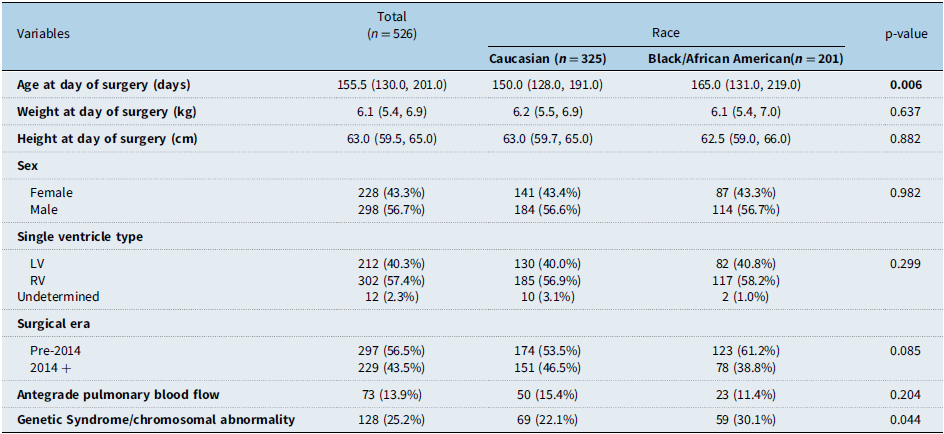
During the study period, a total of 526 patients underwent stage 2 palliation for single-ventricle physiology and met the inclusion criteria. Of these, 325 (61.8%) were White, and 201 (38.2%) Black (Figure 1a). The distribution of fundamental diagnoses in each group is presented in Figure 1b. Demographics of the cohort are presented in table 1, showing the comparison between White and Black patients. Black patients were older at time of stage 2 palliation [median age 165 days (IQR 131, 219) vs. 150 days (IQR 128, 191), p = 0.006] and had a higher percentage of patients with genetic syndromes/chromosomal abnormalities (30.1% vs. 22.1%, p = 0.044). Otherwise, the two groups were very comparable (Table 1).
(a). Flow chart of cohort stratified by race. (b). Distribution of fundamental diagnosis in each group.

Demographics and patient characteristics of overall cohort stratified by race

Results depicted in n (percentile), median (inter quartile range/IQR).
LV = left ventricle; RV = right ventricle.
Prestage 2 cardiac catheterisation and stage 2 palliation
At the pre-stage 2 cardiac catheterisation, patients in the Black group had higher haemoglobin [13.3 g/dl vs. 12.9 g/dl, p = 0.027]. Otherwise, the two groups had similar pressures, saturations, and haemodynamics. There was no difference between the two groups in regard to pre-stage 2 atrioventricular valve regurgitation and single-ventricle function on the transthoracic echocardiogram. During the stage 2 surgical encounter, patients in the Black group had longer cardiopulmonary bypass times [87 minutes (IQR 59.9, 117.5) vs. 74 minutes (IQR 49.0, 107.0), p = 0.001]. The two groups had similar peri-operative outcomes such as duration of mechanical ventilation, hospital length of stay, and operative mortality (Supplemental Table 1).
Interstage patient characteristics and outcomes
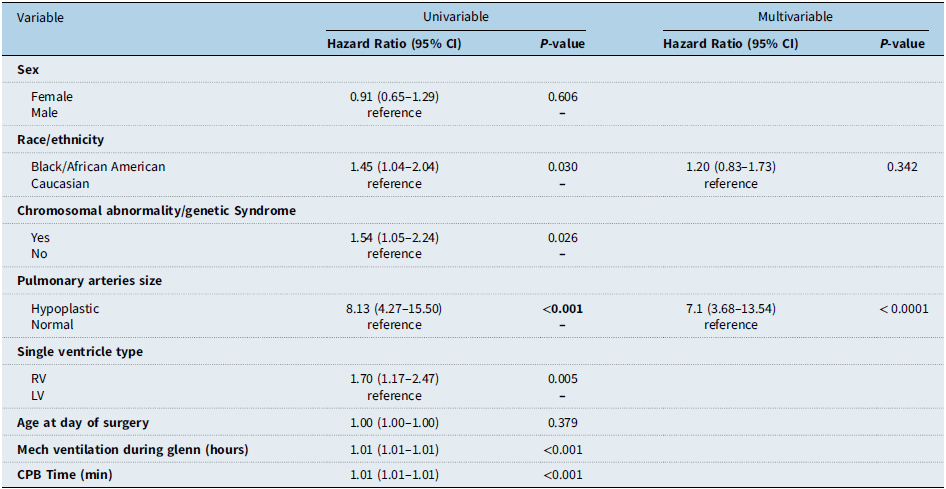
Table 2 presents patient characteristics and interstage outcomes for the two groups. The two groups were similar with regard to post-stage 2 transthoracic echocardiogram findings, interstage mortality (5.5% vs. 4.6%, p = 0.644), interstage transplantation (1.7% vs. 2.0%, p = 0.802) and non-Fontan candidacy (15.7% vs. 20.9%, p = 0.129), and overall poor outcomes (22.2% vs. 28.4%, p = 0.109). Poor outcomes were defined as either interstage mortality, interstage transplantation, or non-Fontan candidacy (Supplemental Table 2).
Univariable and multivariable factors associated with poor outcomes after index surgery

RV = right ventricle; LV = left ventricle; CPB = cardiopulmonary bypass.
Pre-stage 3 cardiac catheterisation and stage 3 palliation
There was no significant difference between the groups at the pre-stage 3 catheterisation regarding saturations, haemodynamics, and pulmonary artery sizes. There was no significant difference between the groups in the pre-stage 3 transthoracic echocardiogram. There was no significant difference between the groups regarding stage 3 operative variables and post-operative outcomes (Supplemental Table 3).
Cox regression analysis
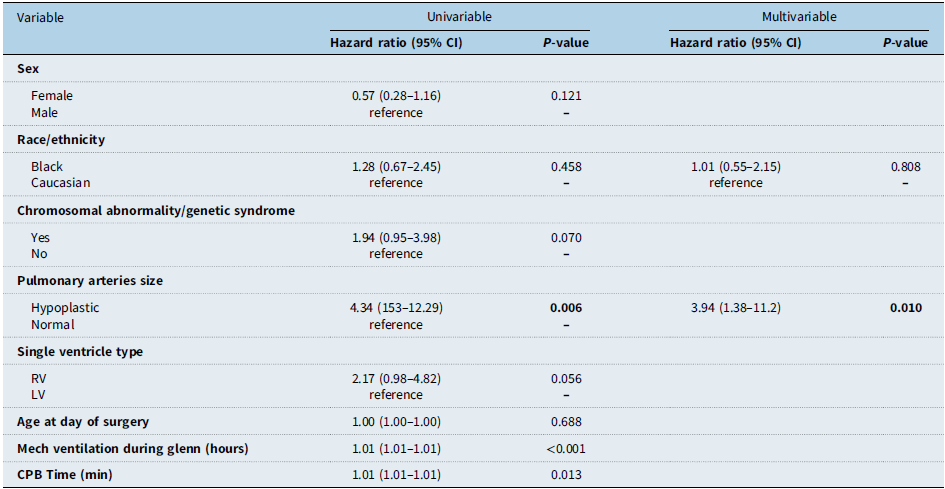
In the Cox regression analysis, we examined risk factors and association with long-term survival after Stage 2. In the multivariable analysis, patients with hypoplastic pulmonary arteries (z-scores < −2) had 3.94 higher odds (95% CI 1.38–11.2, p = 0.01) for mortality, and 7.1 higher odds (95% CI 3.68–13.54, p < 0.0001) for poor outcomes defined by interstage mortality, interstage transplantation, or non-Fontan candidacy when controlling for cardiopulmonary bypass times, and age at stage 2 palliation (Table 3). We also conducted a univariable and multivariable survival analysis of the cohort excluding patients with hypoplastic pulmonary arteries that are present in supplemental Tables 4 and 5.
Univariable and multivariable factors associated with long-term survival after index surgery

Cumulative incidence of poor outcomes and survival analysis
Over the follow-up period, there was no significant difference in long term survival between groups (Figure 2a). On the other hand, there was a significantly higher risk for occurrence composite poor outcome (interstage mortality, interstage transplant, and non-Fontan candidacy) in Black race patients (aOR 1.45, 95% CI 1.04–2.07, p = 0.03) (Table 3, Figure 2b). When adjusting for confounders, this difference did not persist (Table 3).
(a). Cumulative incidence plot of survival following superior cavopulmonary anastomosis (Stage 2 palliation) by patient race. (b). Cumulative incidence plot of poor outcomes (Interstage mortality, interstage transplantation, and not a fontan candidate) following superior cavopulmonary anastomosis (Stage 2 palliation) by patient race.

Discussion
This study, focusing on the impact of race (Black vs White patients), found that significant differences exist in single-ventricle patients based on race regarding the timing of stage 2 surgery, duration of cardiopulmonary bypass, and frequency of genetic syndromes. From stage 2 to stage 3, there was no difference in the survival by race. However, combined cardiovascular end points were significantly more likely to occur in Black race. Additionally, the study found a strong association between hypoplastic pulmonary arteries and mortality at stage 2.
The timing of staged surgical palliation for infants with single-ventricle physiology is standardised with some modifications based on the underlying anatomy and physiology. Children with single-ventricle physiology often undergo an initial palliative procedure in the early newborn period, followed by stage 2 palliation between four and 6 months of age, and later followed by stage 3 palliation/Fontan completion between 2 and 4 years of age. Reference Milazzo, Sanders, Armstrong and Li12,Reference Sengupta, Gauvreau, Kaza, Hoganson, Del Nido and Nathan16–Reference Meza, Hickey and Blackstone18 It is unclear why the age at stage 2 was greater in Black patients in our group. Since we note similar weight at stage 2, the timing may have been influenced by slower weight gain. There was a higher incidence of patients with genetic syndromes in Black race, which may have further impacted weight gain. Delay of surgical palliation especially at stage 2 prolongs ventricular volume loading and may alter short- and long-term outcome. In addition, timely staging provides an opportunity for early detection and repair of complications such as pulmonary artery distortion, outflow tract obstruction, and aortic arch obstruction, which otherwise may adversely affect risk and candidacy for Fontan completion. Reference Berdat, Belli, Lacour-Gayet, Planché and Serraf19–Reference Beshish, Brady and Golloshi24
These subtle differences in the pre-stage 2 demographics may influence outcomes and provide an alternative explanation for differences in outcomes by race and may not be fully explored yet. In a study published in 2002, Milazzo et al report a very significant difference in the median age at stage 2 (11 vs. 5 months, p = 0.01) and stage 3 (60 vs. 36 months, p = 0.005) palliation for African American patients compared to White race patients. The authors propose socio-economic and race-related healthcare delivery as factors contributing to the differences in timing. While the causal drivers of the socio-economic, racial, and international gaps that we document are beyond the scope of this paper, we speculate that a variety of potential mechanisms may be relevant. Recent evidence suggests that differences in access to and utilisation of high-quality healthcare across the income distribution may be amplified by a racial gradient. Black infants and mothers may face disproportionate supply-side barriers within the healthcare system (e.g., due to financial incentives within the Medicaid managed care reimbursement system), as well as demand-side barriers rooted in a long history of racism. In addition, a large and persistent racial wealth gap in the US, policy-induced racial segregation, racial disparities in pollution exposure, and cumulative stress due to racial discrimination are likely other important causes of poor health outcomes among Black Americans. Reference Kennedy-Moulton, Persson, Rossin-Slater, Wherry and Aldana25 This study is however based on 11 African American patients (total n = 40). The study also does not provide details around differences in diagnosis, comorbidities, and other clinical differences that may provide additional explanations. In contrast, the study by Ingaramo et al based on a multicentre database from 29 hospitals analysed 423 patients undergoing stage 2 procedure and found no difference in age at surgery by race. They also found no difference in the immediate post-operative outcomes by race /ethnicity. That study did not have data on interstage events and pre- and post-staged palliation assessments. In contrast, our study was based on more than 500 contemporary patients from a single-centre and provides a detailed picture of the clinical features and for the first time allows complete analysis through stages 2 and 3. Additionally, our study provides details from pre- and post-staged palliation assessments including catheterisation data. In this study, the finding that immediate post-operative survival was not impacted by race is an important finding, even though there were important pre-operative differences. Further, the proportion of Black patients in our study (38.2%) is significantly larger than any of the previous studies and therefore offers a greater degree of assurance in the interpretation of the data.
When looking at longer term outcomes after stage 2 palliation, we chose to look beyond survival and assessed combined cardiovascular end point (interstage mortality, interstage heart transplantation, and non-candidacy for Fontan) as a marker of poor outcome. Survival analysis for this combined endpoint did demonstrate an effect of race with Black race patients more likely to have such a combined endpoint. Our study was not able to provide a rational explanation for the difference in this outcome. However, as we have seen in other studies of outcomes in congenital heart surgeries, race continues to be a risk factor for poor outcomes. Reference Benavidez, Gauvreau and Jenkins6,Reference Ross, Latham, Tjoeng, Everhart and Jimenez26,Reference Kucik, Cassell and Alverson27 The role of race and its various interactions with other demographic, clinical, and other factors need continued research.
Limitations
Our findings are subject to all limitations inherent to a single-centre retrospective study. There may have been important clinical variables that could not be measured and were not obtained. For example, the languages that are spoken by the families, socio-economic status, and type of insurance would have been valuable. However, this was not available for analysis. This type of data would be useful to determine the cause of increased poor outcomes and older age at timing of stage 2 in Black patients. Having a large free-standing children’s hospital in a diverse urban area (47.7% Black and 39.1% non-Hispanic White by census data) would suggest that the reason is not due to travel from further areas as postulated in the study by Milazzo et al, Reference Milazzo, Sanders, Armstrong and Li12 but we cannot completely rule that out given the large referral area of our institution. The generalisability of our findings, although consistent with prior studies, needs to be taken into consideration. We were also limited in the ability to assess other racial groups, such as Asian, Hispanic, and Pacific Islander patients due to the small sample size. It would have been interesting to see if there was any difference between the races in comparison to our current findings.
Conclusion
In summary, in this single-centre retrospective study comparing single-ventricle patients as they progress through stages of palliation, we found significant differences by race in the in the timing of stage 2 surgery and other clinical factors related to stage 2 but no difference in the post-stage 2 mortality. Race also did not impact interstage survival or post-stage 3 survival. However, patients of Black race were more likely to experience combined cardiac events leading to poor outcome. Further studies are needed to focus on and better understand these racial differences to improve the quality of care and overall outcomes of our patients.
Acknowledgements
None.
Financial support
This research received no specific grant from any funding agency, commercial, or not-for-profit sectors.
Competing interests
The authors declare none.
Ethical standard
The authors assert that all procedures contributing to this work comply with the ethical standards of the relevant national guidelines on human experimentation and with the Helsinki Declaration of 1975, as revised in 2008, and have been approved by the institutional committees (Institutional Review Board at the Children’s Healthcare of Atlanta).
Supplementary material
The supplementary material for this article can be found at https://doi.org/10.1017/S1047951124026726.