Introduction
… I ran into a friend from college, and I was wearing a suit, and she had never seen me in a suit except when I acted in a play. So we were sort of laughing about that, and she asked me if I feel like I'm playing a role these days. And I think she meant more generally with law school and firms. And I do sort of feel like that. But in some ways I don't mind it that much if I can think of it in those terms, because that means it's not fundamentally changing who I am. Just like a role in a play is something you do for a month or two, this is something I feel like I'll do for a year or two between the hours of eight and eight, or whatever the hours turn out to be. (David, second-year law student)Footnote 1
At the time of this research interview, David had recently accepted an offer for a summer internship at a large corporate law firm, which would later lead to an offer to join the firm after graduation. Considering that he entered law school with a stated commitment to human rights practice, it is not surprising that David described his upcoming corporate lawyer role with some distance. It is perhaps more surprising that in the above excerpt he seems to so readily accept this protracted experience of role playing that he will perform “between the hours of eight and eight.” Later in the interview, however, he turns to the more plaintive tone common among students in my sample who switched from public-interest to corporate-law job trajectories during law school: “That makes me really sad, to think that I'm [planning to work in a large firm] because I was scared … or I wasn't able to take a leap of faith on something else, or I'm doing this because my practical side won over my romantic side, but the truth is, there is some level of accuracy to that.”
As he anticipated working as a large-firm associate, David drew a sharp distinction between what he labeled his “true self,” committed to progressive social change, and his upcoming performance of the lawyer role. This bifurcation strategy resonates with Erving Goffman's account of “role distancing”—the process by which individuals create and maintain conceptual distance from the “virtual self implied in the role” (Goffman Reference Goffman1961, 108). In Goffman's analysis, roles that are proximate and embraced contribute powerfully to self-definition: “At one extreme, one finds that the performer can be fully taken in by his own act; he can be sincerely convinced that the impression of reality which he stages is the real reality” (Goffman Reference Goffman1959, 17). In contrast, many roles can be enacted with relative distance, expressing a “pointed separateness between the individual and his putative (commonly accepted) role” (Goffman Reference Goffman, Brissett and Edgley1974, 103). While navigating role performances, the individual encounters complicating “role conflicts,” often arising from lapses in “audience segregation” (Goffman Reference Goffman, Brissett and Edgley1974, 137).
This article examines the development of professional role distancing among three student cohorts, focusing on changes between the first and second year of law school. In addition to longitudinal interviews, the study employs a novel identity mapping method that operationalizes Goffman's role analysis by providing visual representations of the self over time. Empirical studies of legal education have largely focused on the front-stage dynamics of the law school classroom. Less attention has been paid to students' back-stage experiences of the professional role within their ongoing processes of self-construction. This article aims to address this gap by shedding light on three questions at the intersection of the empirical literature on professional socialization and the normative literature on the proper relationship between a lawyer's personal identity and professional role: (1) How do law students conceive of their anticipated professional roles in relation to other roles in their lives? (2) How do these conceptions of professional identity change during law school? and (3) How does professional identity formation relate to early legal job-path decisions?
The site for this study is a top-tier law school with a liberal and public-interest-oriented reputation. While observations at this site cannot be generalized to all law schools, the overrepresentation of public-interest-career ambitions and opportunities in large corporate law firms presents a setting where the relationship between initial job paths and conceptions of professional identity is thrown into sharp relief. By examining the dynamics of the early professional self at this site, I aim to generate hypotheses about lawyer socialization more broadly. Furthermore, the chosen site highlights the institutional shock within the legal profession at the onset of the Great Recession, as the school transitioned from a context that offered entitlement to high-status employment to a context that offered relative job scarcity.
The timing of the data collection, which spans 2008 to 2014, complements the longstanding sociolegal inquiry into law school socialization by examining new lawyers in the context of the Great Recession, the current crisis in legal education (Tamanaha Reference Tamanaha2012; Rubin Reference Rubin2014), and recent transformations in the nature of legal practice, particularly rising early-career job mobility (Dinovitzer et al. Reference Dinovitzer, Garth, Nelson, Plickert, Sandefur, Sterling and Wilkins2014). In the Wave 3 report from the recently completed After the JD Study, which tracked a national sample of lawyers from the JD class of 2000 over the first twelve years of their legal careers, the authors note that while their respondents largely “weathered the storm” of the recession by drawing on established “skills, clients, and connections,” more recent law graduates likely felt the full brunt of the contraction in the legal job market (Dinovitzer et al. Reference Dinovitzer, Garth, Nelson, Plickert, Sandefur, Sterling and Wilkins2014). This article takes an initial look at a segment of recession-era graduates and considers variation in how the market context may influence students' accounts of professional role distancing and career decisions.
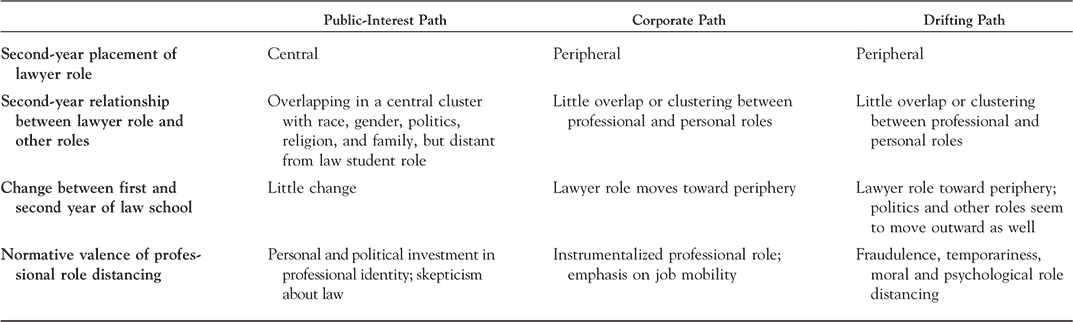
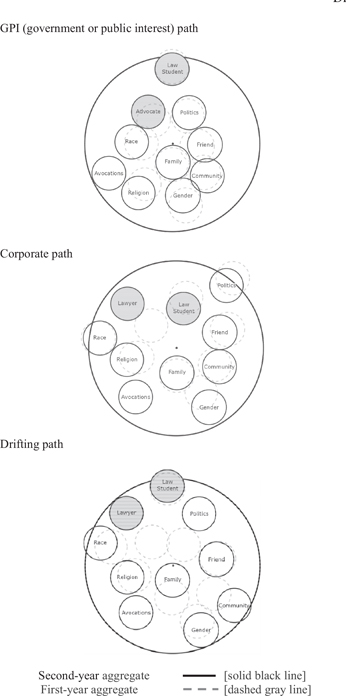
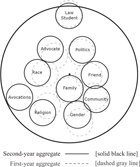
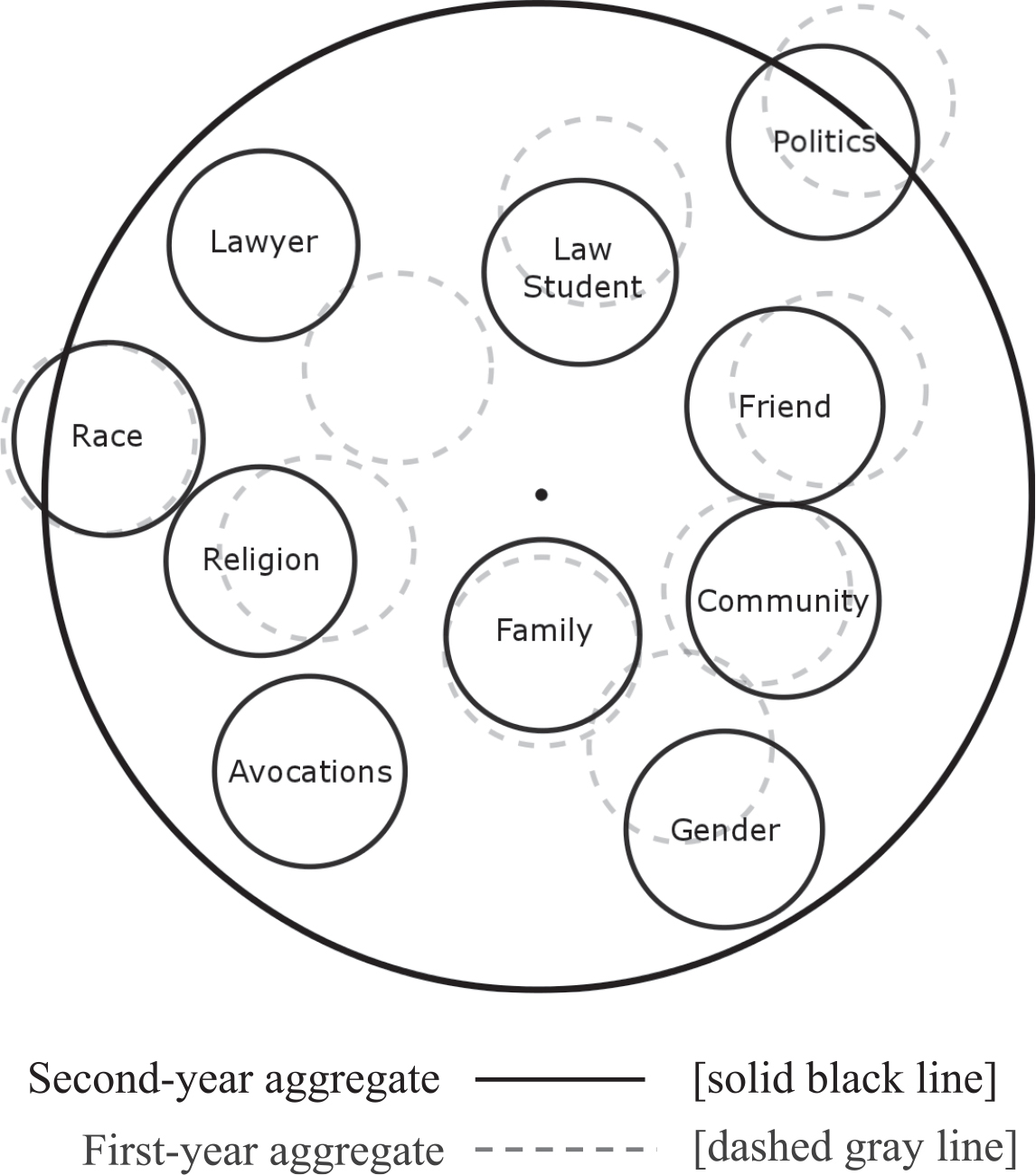
To anticipate the analysis below, I posit a typology of contingent selves corresponding to three typical job paths in my sample. (1) Students committed to careers in “government or public interest” (hereafter, GPI) tended to report highly integrated professional identities that changed little over the course of their legal education. On their identity maps, these respondents tended to place the anticipated professional role in a central cluster, while the law student role was located on the periphery. (2) In contrast, corporate-path students (those who stated a preference from the beginning of law school to work in large corporate law firms) tended to report a substantial and increasing bifurcation between central personal roles and the peripheralized lawyer role. These respondents generally experienced a more proximate relationship to the law student role. (3) In the third category are students who, as described by a large body of empirical literature, “drift” from a GPI trajectory to a private-firm trajectory. Between the first and second year of law school, drifting-path respondents in my sample often experienced a pronounced shift roughly from a GPI identity type to a corporate identity type, as the professional role moved toward the periphery of their self-conceptions. Drifting respondents maintained a distant placement of the law student role. The drifting category is marked by accounts of fraudulence as respondents struggled to maintain temporary role performances as corporate lawyers while reporting moral and psychological reservations about their anticipated jobs. This typology is summarized in Table 1. A side-by-side comparison of the aggregate maps for each job path is included in Figure 1.
Summary of General Characteristics by Job Path

| Public-Interest Path | Corporate Path | Drifting Path | |
|---|---|---|---|
| Second-year placement of lawyer role | Central | Peripheral | Peripheral |
| Second-year relationship between lawyer role and other roles | Overlapping in a central cluster with race, gender, politics, religion, and family, but distant from law student role | Little overlap or clustering between professional and personal roles | Little overlap or clustering between professional and personal roles |
| Change between first and second year of law school | Little change | Lawyer role moves toward periphery | Lawyer role toward periphery; politics and other roles seem to move outward as well |
| Normative valence of professional role distancing | Personal and political investment in professional identity; skepticism about law | Instrumentalized professional role; emphasis on job mobility | Fraudulence, temporariness, moral and psychological role distancing |
Aggregate Identity Maps by Job Path

This analysis is agnostic regarding causal mechanisms that might explain identity changes and job-path decisions; rather, the aim is to provide thick descriptions of the self-conceptions that follow from students' initial job-path decisions. Although the data suggest implications for our understanding of how professional identity formation relates to race, gender, and class, I focus here on the job-path variable, which emerges from this analysis as a strong correlate with distinctive experiences of the early professional self. These findings render the young corporate lawyer as a “divided self,” acculturated into a norm of professional role distancing. I discuss how this portrait of professional socialization may lend support to calls for a more integrated norm of lawyer identity, while at the same time challenging a crude dichotomy between good GPI lawyers and bad corporate lawyers. The article concludes with theory-building contributions, underscoring the highly contingent, processual, and flexible nature of professional identity. Respondents' accounts are deeply embedded in generational backgrounds, market context, and sectoral divisions and competition within the profession. As they negotiated their identities during law school, respondents revealed and resisted the hierarchies and legitimating projects of the legal field.
Normative Perspectives on Lawyer Role Distancing
Legal scholars perennially debate the extent to which lawyers should identify with their roles at work. The standard conception of lawyer identity requires a bright-line division between personal values and the professional self in order to limit paternalism toward clients, role confusion, and the delegation of legislative and policing authority to individual lawyers (Spaulding Reference Spaulding2003). This view has been described as “bleached out professionalism” (Levinson Reference Levinson1993, 1578) and “thin professional identity” (Spaulding Reference Spaulding2003) in accordance with lawyers' fundamental principle of “neutral partisanship” (Simon Reference Simon1978). The standard conception draws support from theories of adversarial advocacy and from the ABA Model Rules of Professional Conduct.Footnote 2
Critics of the standard conception counter that professional bifurcation results in a problematically amoral and apolitical lawyer, ill-suited to the public responsibilities of the legal profession and to the discretion and judgment inherent to legal practice. On both sides of this debate scholars generally agree that lawyers will find some clients' ends morally abhorrent; however, the literature is divided on whether this moral incongruity leads to alienation within the lawyer role, or merely a benign discomfort inherent in the professional project. For critics of the standard conception, the lawyer seeking to preserve moral integrity must undergo a Goffmanesque process of role distancing, resulting in both a moral distance from clients' ends and a “psychological distance between oneself, or one's moral personality, and one's role” (Postema Reference Postema1980, 75). For legal philosopher Gerald Postema (Reference Postema1980, 77), this distancing is an inescapable feature of lawyer identity:
First, the lawyer distances himself or herself from the argument: it is not one's own argument, but that of the client… . Second, after becoming thus detached from the argument, the lawyer is increasingly tempted to identify with this stance of detachment. What first offers itself as a device for distancing oneself from personally unacceptable positions becomes a defining feature of one's professional self-concept … [leading to] a deep moral skepticism. When such detachment is defined as a professional ideal, as it is by the standard conception, the lawyer is even more apt to adopt these attitudes.
Cause lawyering, as a “tradition defined by its rejection of thin identity,” takes the critique of bifurcation to its extreme by explicitly investing the professional role with moral and political commitments (Spaulding Reference Spaulding2003, 7). Through their efforts to realize a personal vision of social progress, cause lawyers pursue an embraced professional identity, seeking to “find in their practice an opportunity to lead an unalienated professional life, to find something to believe in” (Scheingold and Sarat Reference Scheingold and Sarat2004, 51).
Scholars in this debate have lamented the lack of empirical research on professional role distancing among lawyers. For example, Norman Spaulding qualifies his defense of the standard conception with the caveat that “the particular orientation of the self toward the lawyering role it invites … [has] not been systematically examined” (2003, 3). Proponents of the standard conception generally assert that the prevailing norms compel lawyers to integrate their professional and personal roles—in alignment with the cause lawyering model, but in violation of the requirements of neutral partisanship. Accordingly, Spaulding describes the typical lawyer as “fundamentally self-centered—the result of seeking thick identity in the role” (2003, 66). Spaulding concedes, however, that this claim is only an assumption: “Without direct evidence of how lawyers view their role, we cannot be sure whether lawyers are animated by the ideology of neutral partisanship” (2003, 64).
Empirical Research on Law School Socialization
While the traditional debate on lawyer identity has been primarily normative, the growing empirical literature on law school socialization provides a rich source of related evidence on the “intense and transformative impact of legal education on students' understandings of what it means to be a lawyer” (Scheingold and Sarat Reference Scheingold and Sarat2004, 57). Extant research unpacks the ideological content of legal pedagogy and reveals the socialization processes by which legal reasoning and epistemology are transmitted to new lawyers (Granfield Reference Granfield1992; Mertz Reference Mertz2007). Bifurcation under the standard conception features centrally in this literature as “legal education is the domain in which the conventional, client-centered ethos of lawyering is perhaps most fully and regularly expressed” (Scheingold and Sarat Reference Scheingold and Sarat2004, 51).
These studies tend to side with the critics of professional bifurcation. According to a long line of qualitative research, as students are trained to “think like a lawyer,” they learn to eschew moral, political, and other contextual aspects of case analysis. The dominant empirical view holds that this bifurcation contributes to student alienation and the often-reported “drift” away from public-interest-career commitment among law students (Kubey Reference Kubey1976; Stover Reference Stover1989; Erlanger et al. Reference Erlanger, Cahill, Epp and Haines1996). This drift, which has been shown to affect 50 percent or more of students who claim initial public-interest-career aspirations (Kubey Reference Kubey1976; Stover Reference Stover1989), is not entirely explained by financial considerations (Chambers Reference Chambers1992; Kornhauser and Revesz Reference Kornhauser and Revesz1995; McGill Reference McGill2006). Instead, scholars have pointed to “disjunctures” between students' “interests in justice and the ones articulated in law school” (Granfield Reference Granfield1992, 37). As a result, students experience a transition from “justice-oriented consciousness to game-oriented consciousness” (Granfield Reference Granfield1992, 52) and a transition in vocabularies of motive from “public interest” to “zealous advocacy” for one's client irrespective of the client's cause (Schleef Reference Schleef2006, 121). Although the empirical literature produces mixed findings on whether students become more conservative or liberal during law school (Stover Reference Stover1989), there is general agreement that students tend to adopt an apolitical stance toward professional identity, in which “political commitments are exiled to the private realm and replaced by ideals that are intrinsic to legal practice” (Scheingold and Sarat Reference Scheingold and Sarat2004, 58).
A minority of empirical studies discuss the benign and positive effects of the split between students' personal and professional values. Robert Granfield finds that despite the “traumatic and unsettling experiences” among public-interest-oriented students who undergo ideological distancing, the “overwhelming majority expressed the feeling that law school had been positive and enriching” (1992, 41–42). In Debra Schleef's account, law students often welcome their lessons in bifurcation, as evidenced by their gratification in moot court exercises. Schleef concludes that students generally “will have little trouble separating their true beliefs from their actions as lawyers” (1997, 645).
Increasingly, research on law school socialization has focused on variation by race, class, and gender (Guinier, Fine, and Balin Reference Guinier, Fine and Balin1997; Costello Reference Costello2005; Desmond-Harris Reference Desmond‐Harris2006). For example, Costello describes a traumatic and alienating “identity dissonance” among female and nonwhite students as they transition into the profession (2005). In contrast, white males (particularly those with moderate political views) experience relative consonance between their professional identities as lawyers and their previous identities (Costello 2005).
Studies of the socialization of medical doctors suggest strong parallels to the bifurcation training described in the legal profession. Medical students are required to adopt norms of “detached concern” (Fox and Lief Reference Fox and Lief1963) and neutrality (Becker, Geer, and Edward Reference Becker, Geer and Edward1961) through an “emotional socialization” (Hafferty Reference Hafferty1988, 346). As students are initiated into metaphors of the body as machine and production system, and doctors as technicians and supervisors of labor (Shapiro Reference Shapiro1987), they learn to approach patients in a depersonalized fashion. The patient is thus reduced to a biomechanical “case,” in contrast to a more holistic biopsychosocial approach (Engel Reference Engel1982). These lessons pervade the curriculum, but are most clearly instantiated by interactions with cadavers and unconscious patients.
Furthermore, Goffman offered surgeons as an example of professional role embracement, but he was also careful to point out that surgeons experience some distancing within their occupational activities. He criticized the popular account that while a (male) surgeon “may be a father, a husband, or a baseball fan at home, he is [at work] one and only one thing, a surgeon, and being a surgeon provides a fully rounded impression of the man. In our society, the surgeon, if anyone, is allowed and obliged to put himself into his work and get a self out of it” (1974, 108). Although Goffman emphasized surgeons' proximate relationship to the professional role, particularly in the “situated activity system” of surgery (Goffman Reference Goffman1961), he also illustrated gaps in this role embracement when the surgeon reveals “a careful, bemused look … implying, ‘This is not the real me’” (1974, 109).
Some commentators have argued that, across disciplines, becoming a professional is a demobilizing process whereby students adopt a more “politically subordinated role” (Schmidt Reference Schmidt2001, 2). According to this criticism, professional education has the ability to “redefine who you are in the deepest sense, pushing you away from developing and acting upon your own vision and guiding ideas” (Schmidt Reference Schmidt2001, 280). As the professional student renounces a highly personal and political identification with the work role, he or she may experience a concomitant shift from “an idealistic to a pragmatic orientation” (Ondrack Reference Ondrack1975, 97).
Data and Methodology
This study draws on an integrated multimethod longitudinal analysis of three student cohorts at a single site between 2008 and 2014. The primary data consist of semistructured interviews, identity mapping, and ethnographic field observations at law firm interview programs, career development events, and other law school settings.Footnote 3
Most students at the site begin their legal careers as associates in “Big Law,” a relatively well-defined category of large corporate law firms that generally have uniform starting salaries and hiring practices. These large firms have emerged over the past several decades, resulting in a “bifurcated bar” (Abel Reference Abel1989; Heinz, Nelson, and Laumann Reference Heinz, Nelson and Laumann1998) in which new lawyers in Big Law earn roughly double what new lawyers earn in small firms and triple what new lawyers earn in solo practice, government, public interest, and legal aid (Dinovitzer et al. Reference Dinovitzer, Garth, Sander, Sterling and Wilder2004).Footnote 4 By their second year of law school, nearly all respondents fell into three job-path categories: (1) pursuing a government or public-interest (GPI) position,Footnote 5 (2) pursuing a corporate-law position, or (3) “drifting” from a first-year preference for GPI positions to a second-year preference for the corporate law sector.
These job paths are defined by students' decisions regarding the window of opportunity to work for large firms, which generally opens and closes with the hiring process at the end of the first-year summer. The primary analysis examines the “2011 cohort” (n = 19) and the “2012 cohort” (n = 25), labeled for the year respondents entered the study as first-year law students. These respondents were interviewed twice: generally in the early spring semester of their first and second years of law school. The timing of the interviews was designed to examine students' accounts before and after the decision to apply to large firms. All of the 2011 and 2012 cohort interviews included identities mapping.
The discussion of these primary two cohorts is supplemented by data from the earlier “2008 cohort” (n = 22), which began as a pilot sample. This cohort was originally interviewed during respondents' second year of law school and then again in follow-up interviews in 2010 (n = 18), 2012 (n = 14), and 2014 (n = 17) during their first three years of legal practice. Respondents in this cohort produced maps only in their final 2014 interviews. The timing of the cohorts is summarized in Table 2.
Interview and Mapping Data by Cohort

| First Year | Second Year | Post-JD | |
|---|---|---|---|
| 2008 cohort | Interview | Interview and map | |
| 2011 cohort | Interview and map | Interview and map | |
| 2012 cohort | Interview and map | Interview and map |
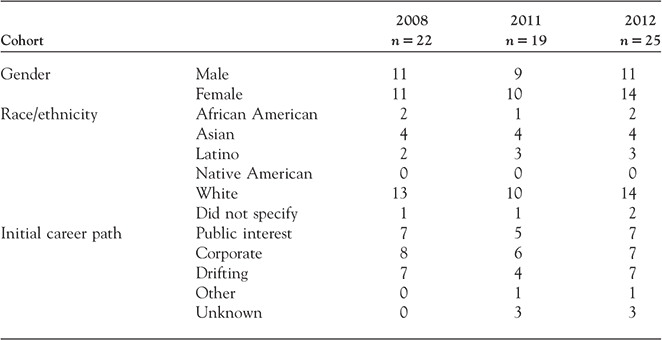
Most respondents were recruited by requesting their volunteer participation through in-person announcements in first-year classes. This approach was supplemented by a small amount of snowball and purposive sampling. Table 3 gives a breakdown of the sample characteristics. The sample is approximately reflective of the law school's demographics and those of new lawyers across the profession, but may overrepresent women and racial minorities within the corporate category and overrepresent white men within the GPI and drifting categories (see Dinovitzer et al. Reference Dinovitzer, Garth, Sander, Sterling and Wilder2004).
Sample Characteristics

| 2008 | 2011 | 2012 | ||
|---|---|---|---|---|
| Cohort | n = 22 | n = 19 | n = 25 | |
| Gender | Male | 11 | 9 | 11 |
| Female | 11 | 10 | 14 | |
| Race/ethnicity | African American | 2 | 1 | 2 |
| Asian | 4 | 4 | 4 | |
| Latino | 2 | 3 | 3 | |
| Native American | 0 | 0 | 0 | |
| White | 13 | 10 | 14 | |
| Did not specify | 1 | 1 | 2 | |
| Initial career path | Public interest | 7 | 5 | 7 |
| Corporate | 8 | 6 | 7 | |
| Drifting | 7 | 4 | 7 | |
| Other | 0 | 1 | 1 | |
| Unknown | 0 | 3 | 3 |
Interview coding and analysis were done with the qualitative data package, TAMS (Text-Analysis Markup System). Codes were created both deductively based on secondary readings and through an iterative process of analytic induction (Glaser and Strauss Reference Glaser and Strauss1967; Patton Reference Patton1990) by which codes were identified during successive waves of analysis.
The interviews, which averaged an hour in length, were based on a semistructured protocol beginning with the open-ended question: “What brought you to law school?” The ensuing conversation was largely nondirected, encouraging respondents to narrate their own paths to law school, the job process, and beyond. The flow of the interviews was highly adaptive to the directions taken by respondents. This approach draws on narrative sociology (Maines Reference Maines1993), which examines how narratives reveal norms, identities, and larger social processes (Ewick and Silbey Reference Ewick and Silbey1998).
The identity-mapping exercise was introduced midway through each interview. This method provides visualizations of Goffman's role theory in order to explore the relationship between students' emerging professional roles and their broader processes of self-construction. Goffman's account of personal identity emphasizes the continual alignment of roles on a spectrum, some more proximate, embraced, central constituents of identity, and others more distant and detached (1959). This view of role distancing broadly comports with the prevailing sociological understanding of the self as an “ineffable source of subjective experience” (Kunda Reference Kunda1992) rooted in narratives, role management, life plans, and identifications that are always emergent and in process. By discussing with respondents the temporal and multivalent dimensions of their maps, this exercise aims to provide snapshots of role alignments without reifying a portrait of the self.
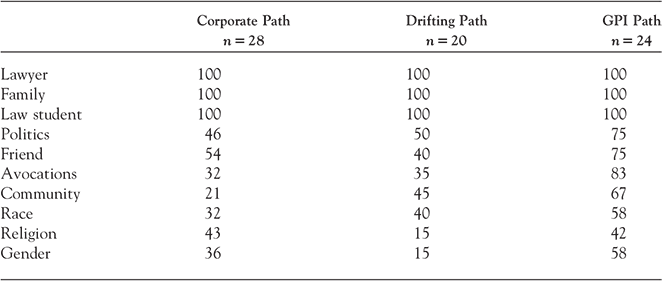
Respondents were presented with a large circle representing the respondent's identity on an otherwise blank white sheet of paper. They were then asked to draw and label small circles that represent the roles they enact in their daily lives and to place those roles in the position that most accurately reflects how strongly each role contributes to their sense of self: closer to the center for roles they consider essential and further from the center for roles they tend to enact in a more distant fashion. Respondents were prompted to include any roles they occupy in their daily lives. The only roles they were specifically directed to include were the law student and anticipated lawyer roles. The frequency with which each coded role category was found is tabulated in Table 4. Precautions were designed through pilot interviews to avoid priming respondents toward particular conceptions of professional identity. Instructions and responses to common follow-up questions were consistent across the interviews.
Rate of Inclusion (Percentage) for Each Coded Role Category

| Corporate Path | Drifting Path | GPI Path | |
|---|---|---|---|
| n = 28 | n = 20 | n = 24 | |
| Lawyer | 100 | 100 | 100 |
| Family | 100 | 100 | 100 |
| Law student | 100 | 100 | 100 |
| Politics | 46 | 50 | 75 |
| Friend | 54 | 40 | 75 |
| Avocations | 32 | 35 | 83 |
| Community | 21 | 45 | 67 |
| Race | 32 | 40 | 58 |
| Religion | 43 | 15 | 42 |
| Gender | 36 | 15 | 58 |
In each interview, the mapping exercise was followed by a fifteen- to thirty-minute interpretive dialogue in which respondents explained their placement and labeling of their roles. The richest data from the mapping exercise arise from hearing respondents' interpretations, as the maps provide a visual and tangible catalyst for discussion of abstract questions about identity. The maps have also proven amenable to quantitative analysis. The seventy-two maps from respondents who participated in first- and second-year interviews and who belonged to the primary three job-path categories were coded, measured, and aggregated.Footnote 6 A side-by-side comparison of the aggregate maps for each job path can be found in Figure 1.
This technique draws on a rich tradition of mapping methodologies in cognitive science and social psychology, which traces its roots to classic studies in “topological psychology” (Lewin Reference Lewin, Heider and Heider1936). I follow Katsiaficas et al. (Reference Katsiaficas, Futch, Fine and Sirin2011) in extending these methodologies from spatial analyses to a focus on representations of the “visual narrative of self” (2011, 123). In their investigation of how immigrant adolescents experience multiple identities, Katsiaficas et al. employ identity mapping in order to “make visible [the adolescents'] selves across place, relations and time” (2011, 123). These maps consisted of creative sketches produced by children in response to the prompt: “Draw a map of your many selves as a student, a female, a Muslim American, a daughter, an immigrant, etc. that tells us a story about the joys and challenges you experience” (Sirin and Fine Reference Sirin and Fine2008, 215). Like Katsiaficas et al., my use of identity mapping aims to access “preverbal, affect-laden, metaphoric, and/or relational” narratives of self (Katsiaficas et al. Reference Katsiaficas, Futch, Fine and Sirin2011, 123). My approach diverges from that of Katsiaficas et al. in my use of standardized mapping parameters, such as the consistent size of the circle and the instruction to orient role identities with respect to the distance from the center. This approach is tailored to my inquiry into how respondents conceive of relative distancing among roles and how these conceptions vary across population variables and over time.
Findings
The GPI (Government or Public-Interest) Path: Professional Role Integration
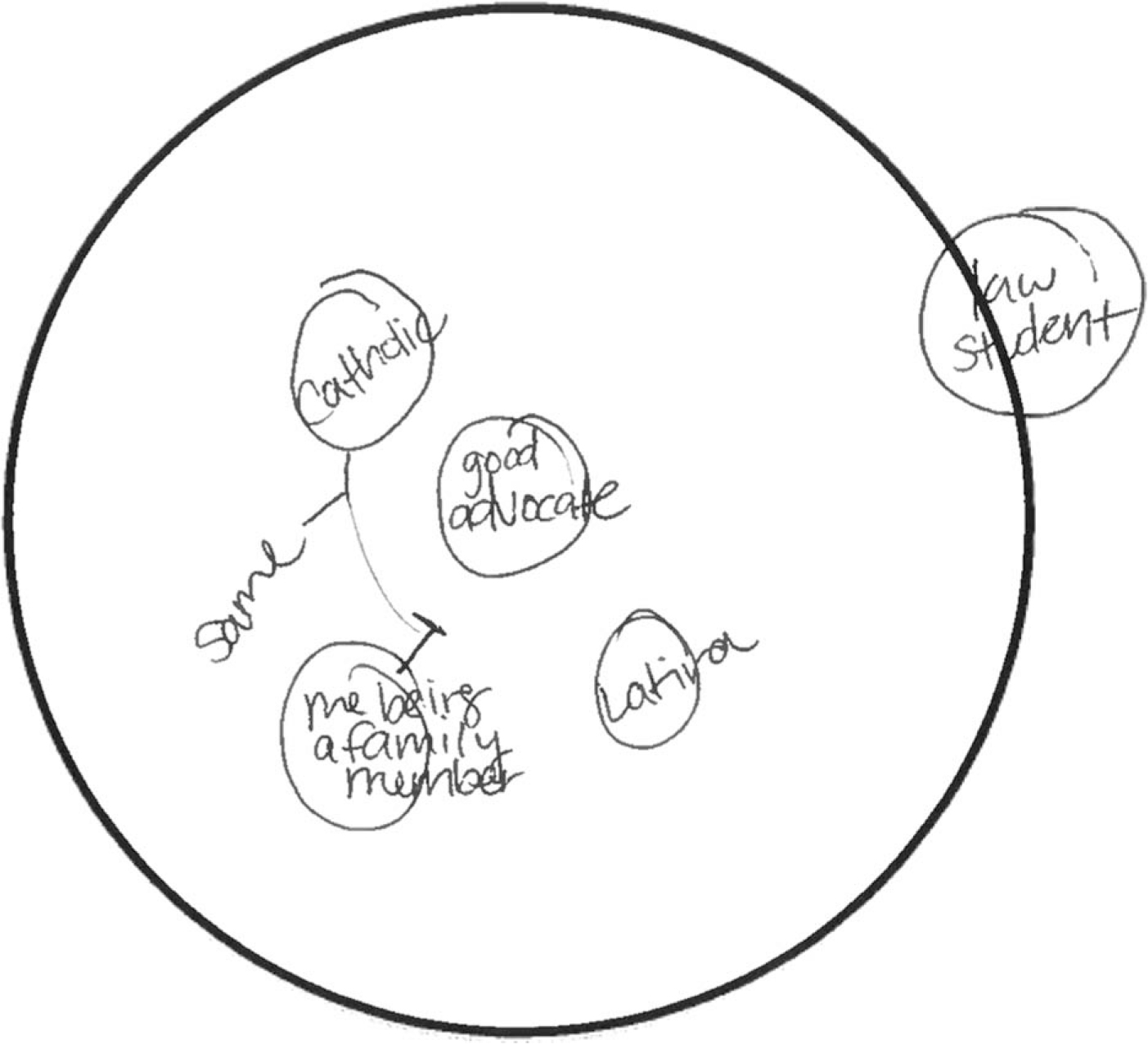
Figure 2 is an identity map from Laura, a second-year law student from the 2012 cohort who reported that she hoped to begin her postgraduation career in a nonprofit setting working on death penalty appeals or indigent defense. We will return to several other aspects of Figure 2, but I want to begin by focusing on Laura's central placement of the lawyer role (labeled “good advocate”), which is surrounded by an equidistant cluster of highly personal roles (“Catholic,” “me being a family member,” and “Latina”). In this respect, Laura instantiates the aggregate finding that GPI-path respondents, in both their first and second years of law school, tended to place the lawyer role in a central position, tightly integrated with other constitutive roles. This finding is roughly consistent with the cause lawyering perspective, wherein lawyers strive to “overcome alienation with belief and to break down the barriers between vocation and commitment” (Scheingold and Sarat Reference Scheingold and Sarat2004, 124). In our interpretive dialogue following the mapping exercise, Laura explained that these occupational identity barriers are not entirely dismantled. Instead, she acknowledged a tension between her conception of professional role integration and the lessons she received in law school regarding the bifurcated nature of the conventional lawyer role:
Second-Year Public-Interest Identity Map (Laura)
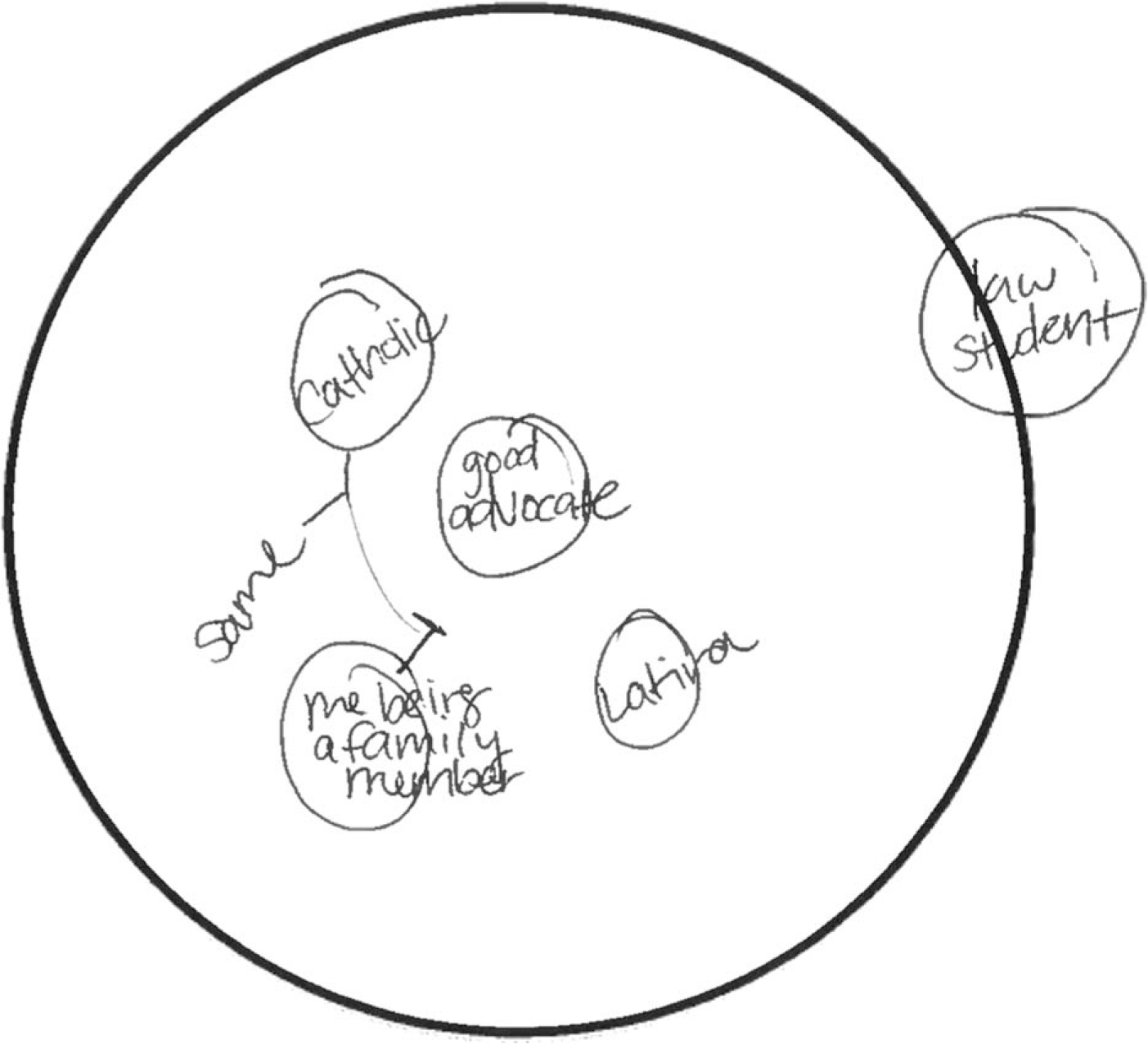
Central is “advocate,” which is not necessarily an attorney. Just like an advocate for the communities that I care about, which includes minority communities, lower-income communities, and maybe particularly people who are in prison or who are part of the criminal justice system in some way. But I also think part of being an advocate will be being a lawyer, but I think being a lawyer I'll be pissed off… . I won't be able to say everything I want to say in my personal life.
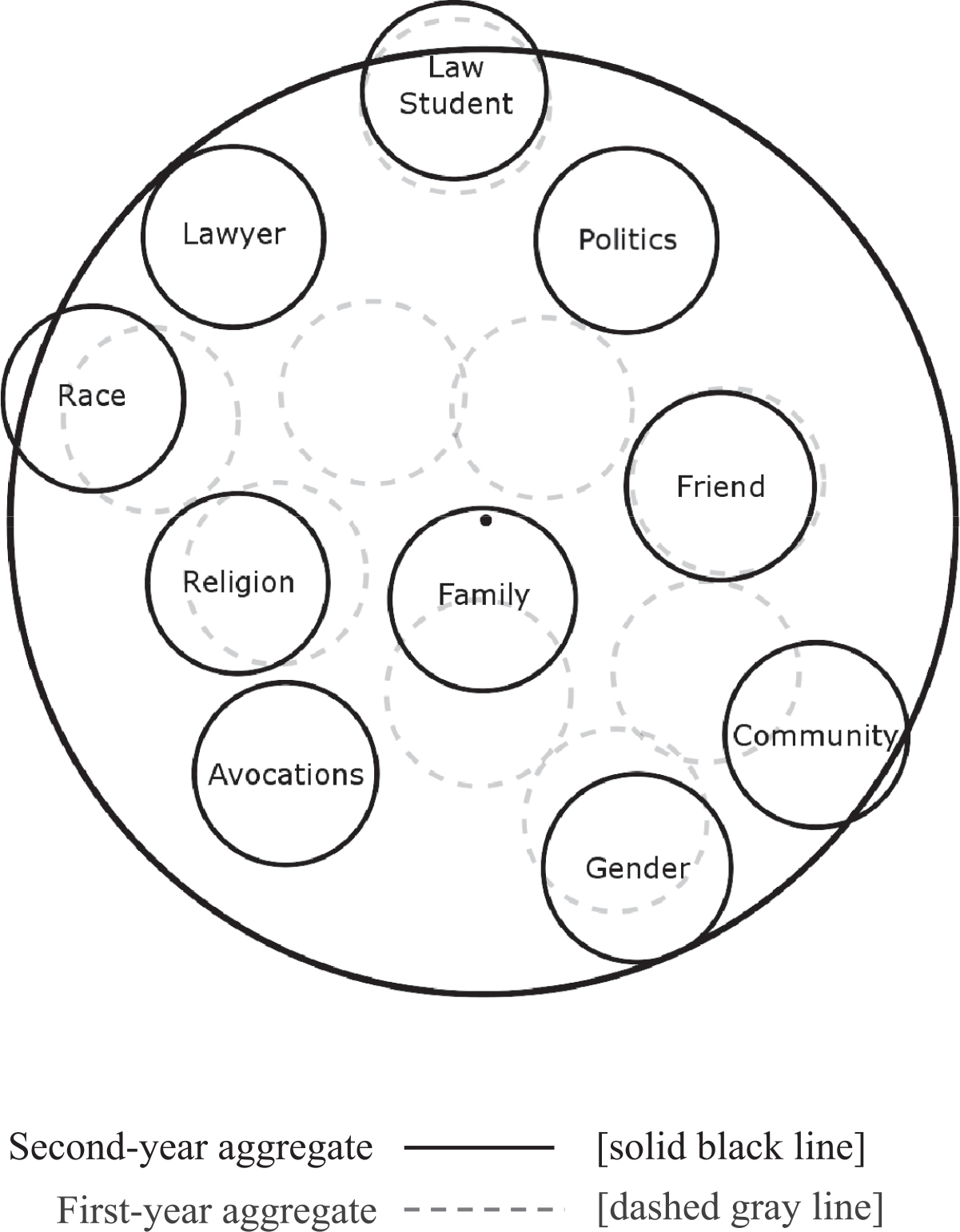
GPI respondents' ambivalence about the professional constraints attaching to lawyer identity was reflected in their frequent use of alternative labels for the lawyer role, such as “advocate,” “activist,” and “public interest career.” These respondents generally claimed to reject the narrow legal definition of client-centered advocacy, instead conceiving of advocacy more broadly as promotion of a social movement by legal and extralegal means—what might be described as “social advocacy” in contrast to “legal advocacy.” Several GPI respondents even included the word “law” as a role identity on their maps and placed it on the far periphery. This skepticism regarding the “law” in “lawyer” reflects a highly political sense of professional purpose and a partial rejection of the limitations attaching to the conventional lawyer role. Below I provide an empirical portrait of professional role integration and its limitations and exceptions. Although these findings primarily arise from qualitative analysis, they are also illustrated with aggregate map data (Figure 3).
Aggregate Identity Map for GPI (Government or Public-Interest) Path
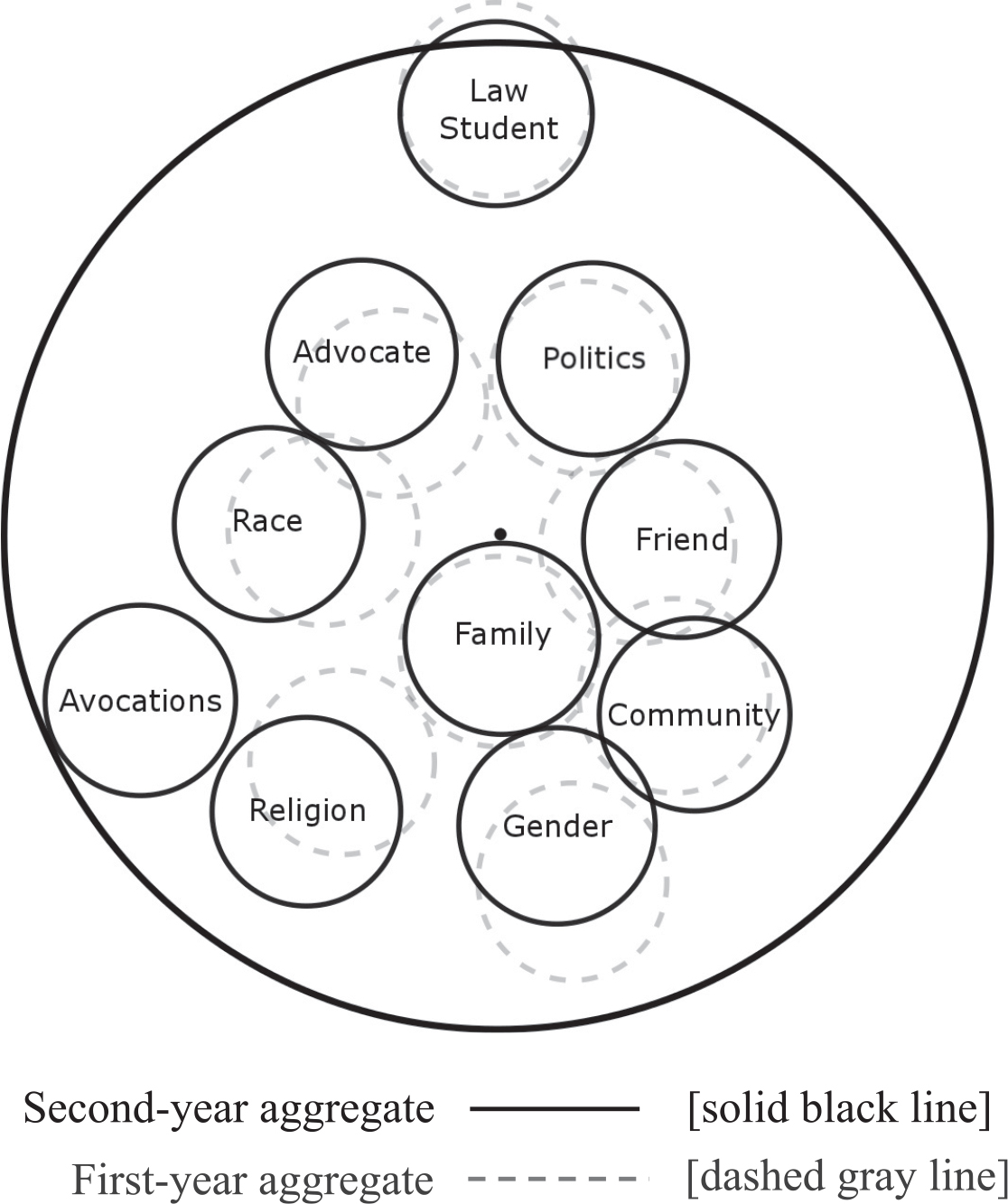
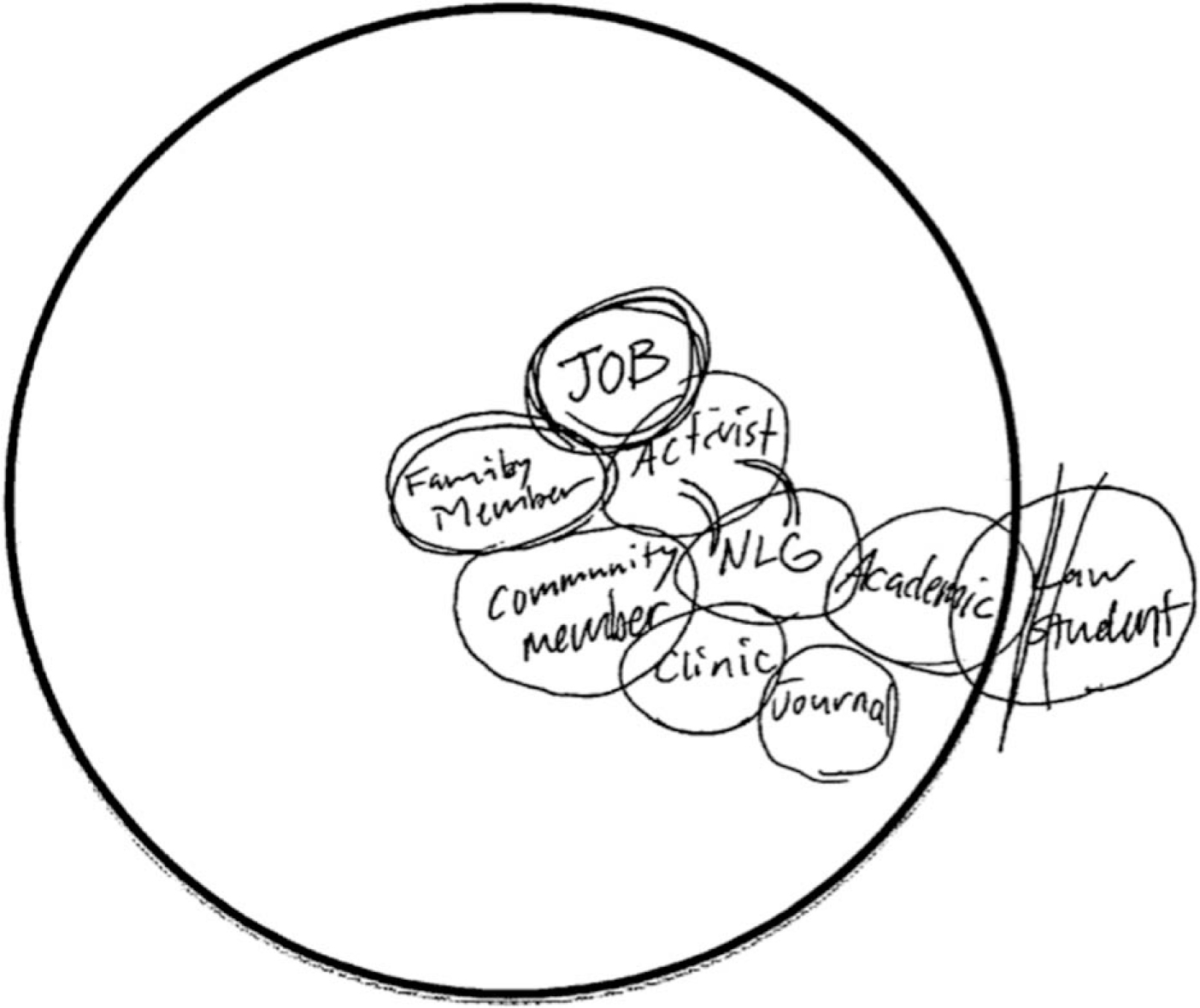
Figure 3 shows relative aggregate consistency in the GPI path between the first and second year across most roles. The lawyer role (labeled “advocate” in the aggregate map to reflect the common substitutions for “lawyer”) moved slightly outward from the center, but was not ejected to the periphery as in the aggregate corporate- and drifting-path maps discussed below (see Figure 1 for a side-by-side comparison of the aggregate maps for each path). For many GPI respondents, not only are the bulk of their role identities at a similar distance from the center, they are physically overlapping. Brian, a GPI student in his second year, exhibited this overlap to an extreme (Figure 4).
Second-Year Public-Interest Identity Map (Brian)
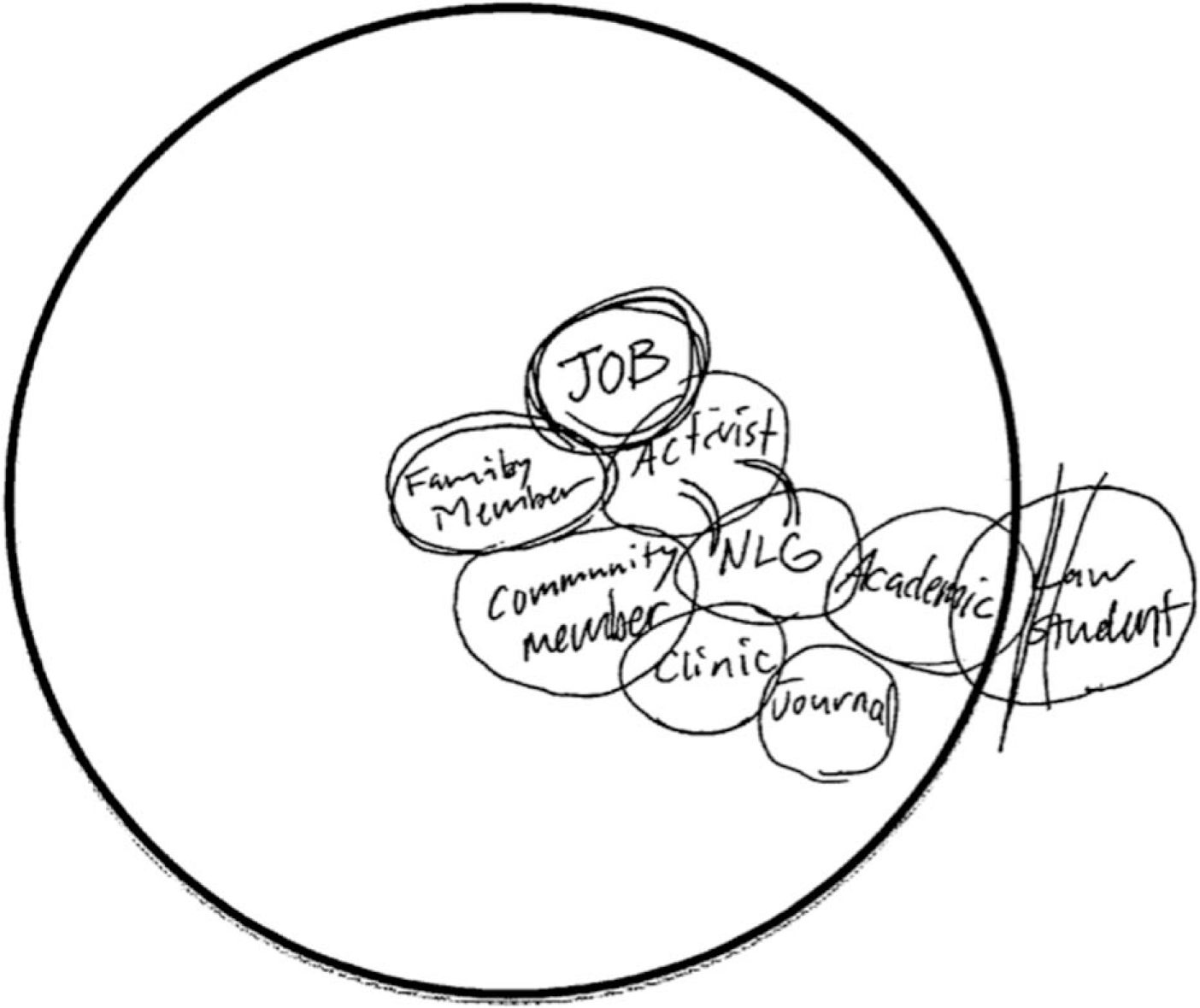
Consistent with this description of overlapping and clustered roles, GPI respondents often reported that their professional motivations were rooted in racial, gender, political, religious, community, and family roles. As Brian explained, his integrated experience of professional identity reflects his family's progressive political orientation: “Everything is definitely tied up with my role as a family member since my family is really defined by being activists and community members.” Later in the interview, he extended this concept of family support to his home community: “My friends, the community that I've grown up with, these people are all so proud of me back at home for getting into this law school and for pursuing my dream of being that social-justice advocate.”
The political component of Brian's professional role integration is evidenced in Figure 4 by the overlap of “job” with “activist” and “NLG” (National Lawyers Guild, a progressive association of public-interest law students and lawyers). As discussed in the following sections, the centrality of political roles among second-year GPI respondents diverges markedly from the other two job paths. This distinctly politicized and nonbifurcated professional identity is consistent with the view of cause lawyers in the literature: “Moral and political commitment, the defining attributes of cause lawyers, are, for most of their peers, relegated to the margins of their professional lives” (Scheingold and Sarat Reference Scheingold and Sarat2004, 2).
While race and gender are difficult to analyze in a small-n study, the data suggest a possible amendment to Costello's claim that non-white-male students tend to experience an elevated dissonance with the professional role (2015, 119). Minority and female GPI respondents in the present study often claimed that race and gender contributed to experiences of professional role integration. For example, Laura, the GPI student introduced above, cited her Catholic and Latina identities as sources for commitment to a GPI job path. In her second-year interview, she described at length how her summer internship with a death penalty appeals practice was directly inspired by the religious lessons she received from an early age in “forgiveness and people having a second chance.” Her Latina identity figures prominently in her expressed desire to work on issues that affect women and, as quoted above, “minority communities.” This explicit infusion of race, gender, and religion into the professional role is also evidenced in Laura's frustrations with legal pedagogy: “In law school, you don't say, ‘As a white male, my perspective is X’ or ‘As an Asian female’ … you're supposed to just state your opinion like it's objective fact, and the professor tells you whether or not it's right, but that's not the way I think.”
A working-class background may also tend to enhance professional role integration among GPI respondents. As previous studies have noted, in a context of extreme student loan burdens, these students may find it particularly difficult to “afford” to pursue GPI jobs when more lucrative large-firm opportunities are available to them (Erlanger et al. Reference Erlanger, Cahill, Epp and Haines1996). Yet GPI respondents in the present study tended to suggest that a working-class background can encourage a politicized and integrated view of professional identity by fueling empathy for disadvantaged clients and a priority on distributive justice goals. One such student explained: “It never occurred to me [to apply to large firms]. The whole reason I am [in law school] is I feel like working people get treated badly or … disrespectfully.”
The conspicuous exception to this aggregate portrait of GPI role integration is the law student role. Returning to Brian's second-year map (Figure 4), while every role identity overlaps, it is noteworthy that “law student” is the farthest from the center, lying almost entirely outside the identity space. Furthermore, Brian explained that the vertical lines he drew through “law student” signified ambivalence toward legal education. This distancing from the law student role is consistent with previous research on the experience of public-interest-oriented students who face “repeated indoctrination in the conventional ethos of client-oriented lawyering” (Scheingold and Sarat Reference Scheingold and Sarat2004, 58). For these students, legal education is an “obstacle course,” where norms and incentives are heavily structured to value conventional lawyering and, in particular, corporate law careers (Scheingold and Sarat Reference Scheingold and Sarat2004, 67).
GPI students' accounts of politicized and integrated professional identity may be best understood against the backdrop of the public-interest subculture within the law school. The norms of this subculture are reinforced in multiple venues, including interactions in tightly knit ideological cliques (described further in the drifting-path section below) and career development events for GPI employment. I attended twelve such events over the course of the study. Often, public-interest attorneys would directly implore students to take the integrated view of professional identity: “Your commitment to social justice has to be central to who you are… . We're a rare stream in the legal profession. It's not so rare that people come into law school with high ideals and want to be able to look themselves in the mirror after a day at their job… . But committed people are rare.”
The influence of potential employers is intensified when students begin applying to GPI jobs. Many respondents reported that giving integrated accounts of professional identity is an important signal in job interviews, where respondents perceive that commitment to an organization's political goals is valued more than grades or other qualifications. In contrast to the identity crises and experiences of fraudulence described in the drifting-path experience, GPI respondents generally insisted that their self-presentations in job interviews were genuine reflections of their deeply held views regarding professional purpose. Nevertheless, in a highly competitive market, GPI respondents described going to great lengths to optimize the impressions they gave to interviewers, often investing in new clothing and carefully scripting and rehearsing their anticipated interview responses. These experiences seemed to induce moderate role distancing among GPI-path respondents; however, this effect appears to be much less pronounced than found in the drifting-path experience of moral and psychological distancing described below.
GPI respondents in my sample often emphasized the recession in their accounts of integrated and politicized views of professional identity. For some respondents, the subprime mortgage crisis raised a direct call for legal services dealing with poverty and housing, which helped solidify their GPI career aspirations. A first-year GPI respondent explained: “The [recession] is exposing all kinds of ugly power and inequality … I feel like I need to be a part of a … movement right now to help steer things in a better direction.” Although these students expressed concerns about dwindling job opportunities in the public-interest sector, the recession generally did not seem to produce more risk-averse and instrumentalized accounts of professional motivation among GPI respondents—unlike the corporate and drifting paths below. Instead, the effect appears to be in the opposite direction, supporting students' politicization of their anticipated professional selves. A GPI respondent explained: “I'm not going to sell out [by working in the private sector] now when our work is needed more than ever.”
It is important to note that the GPI category is diverse. Some respondents present the paradigmatic integrated cause lawyering identity both in their first and second year of law school. They place the professional role in the very center of their maps (see Laura and Brian above) and emphasize the political and personal significance of their work as lawyers. But other GPI respondents, often explicitly concerned with work-life balance, expressed reservations about enacting a central professional role. Work-life balance can be, for some respondents, a strong motivation for working in the GPI sector under the assumption of shorter work hours and a clear separation of work and home life.
There is also diversity within “public-interest practice.” Many respondents whom I classified in the GPI path pursued what they often called “middle road” public-interest careers, such as positions in government and plaintiff-side firms. These respondents often described this work as only partially aligned with their political values while providing better income and job security when compared to legal-aid or nonprofit organizations. While precisely defining the middle-road category is beyond the scope of the current discussion, I speculate that these respondents may tend to experience a slightly more instrumentalized and distant professional role than those intending to work in the nonprofit sector (as “cause lawyers”).
An interesting subset is the case of public defenders, who have been a central example in the normative discourse on lawyer professionalism (see Ogletree Reference Ogletree1993). Each of the five respondents in my sample who aspired to be public defenders reported deep political motivations for their career goals, rooted in concerns about inequality, race, and mass incarceration. At the same time, they anticipated moral distancing in cases where they would be required to advocate for a client whose cause they might not support. One such respondent noted, “I had a friend who told me her first client as a [public defender] committed rape. That would be really hard. I don't even know if I could do that.” Three of these respondents expressed enthusiasm for the opportunity to appear frequently in court and “be a real lawyer.” In this regard, these respondents seem to put traditional client representation at the forefront of their accounts of professional purpose. Thus the public defender example complicates the notion of a politically motivated rejection of neutral partisanship among GPI respondents. It also raises the possibility that some students' career decisions may be influenced by the extent to which they can tolerate the discomfort inherent in truly acting as the client's agent, as required by conventional professionalism.
The Corporate-Law Path: Professional Role Distancing
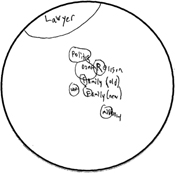
The corporate-law path consists of respondents who stated a preference for large-firm jobs in both their first and second year of law school. Relative to the GPI path, these respondents, particularly in their second year, tended to view their upcoming legal positions as instrumental and distant from what they conceived as their core identities. In contrast to what we will see in the drifting-path experience in the next section, corporate-path respondents generally expressed few qualms about this compartmentalization. These themes are evident in Sam's second-year identity map (Figure 5), where he explained that “lawyer” is placed on the far periphery because, as he put it, “I came to law school to get a job.” Unlike the GPI respondents cited above, Sam described the lawyer role as distinct and distant from other constitutive identities, such as religious, political, and familial roles. Family is his most central role, including both his existing family roles (“family (old)” in Figure 5) and his intention to have children in the near future (“family (new)”). Citing the recession, he reported that his financial instrumentalization of the lawyer role is driven by “self-preservation” in a context of widespread financial uncertainty.
Second-Year Corporate Identity Map (Sam)
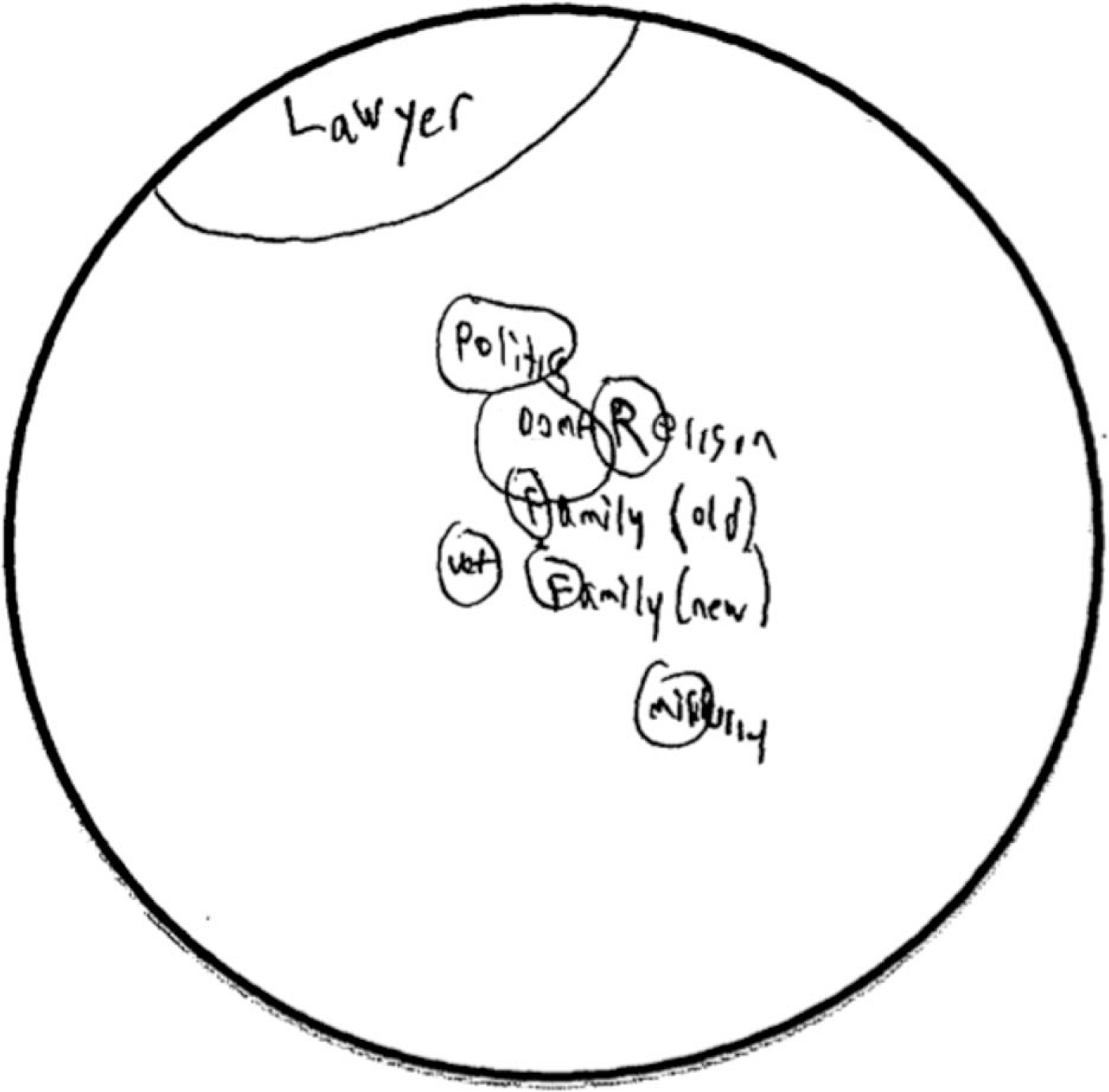
In our interpretive conversation regarding Figure 5, Sam elaborated on his nonintegrated view of professional identity by contrasting his anticipated lawyer role with his previous hyperintegrated experience in the military. As a solider, he experienced near total role embracement: “It becomes your whole identity … because part of your identity is obedience to orders, but you just do what you're supposed to do because that's just central to you. It's an alien concept not to be a Marine … . When I'm in military mode, everything else just kind of falls away.” Goffman describes this degree of radical role embracement as “disappear[ing] completely into the virtual self available in the situation to be fully seen in terms of the image” (1961, 106). When I asked Sam to compare his experience in the military with his expectations about the integration of the lawyer role, he commented that the “contrast couldn't be bigger.” Although we might not expect to find the same degree of radical role embracement among lawyers, it may nevertheless be surprising that the lawyer role is as distant and detached from personal roles as we find in Sam's account and in the aggregate corporate-path map (Figure 6).
Aggregate Identity Map for Corporate Path
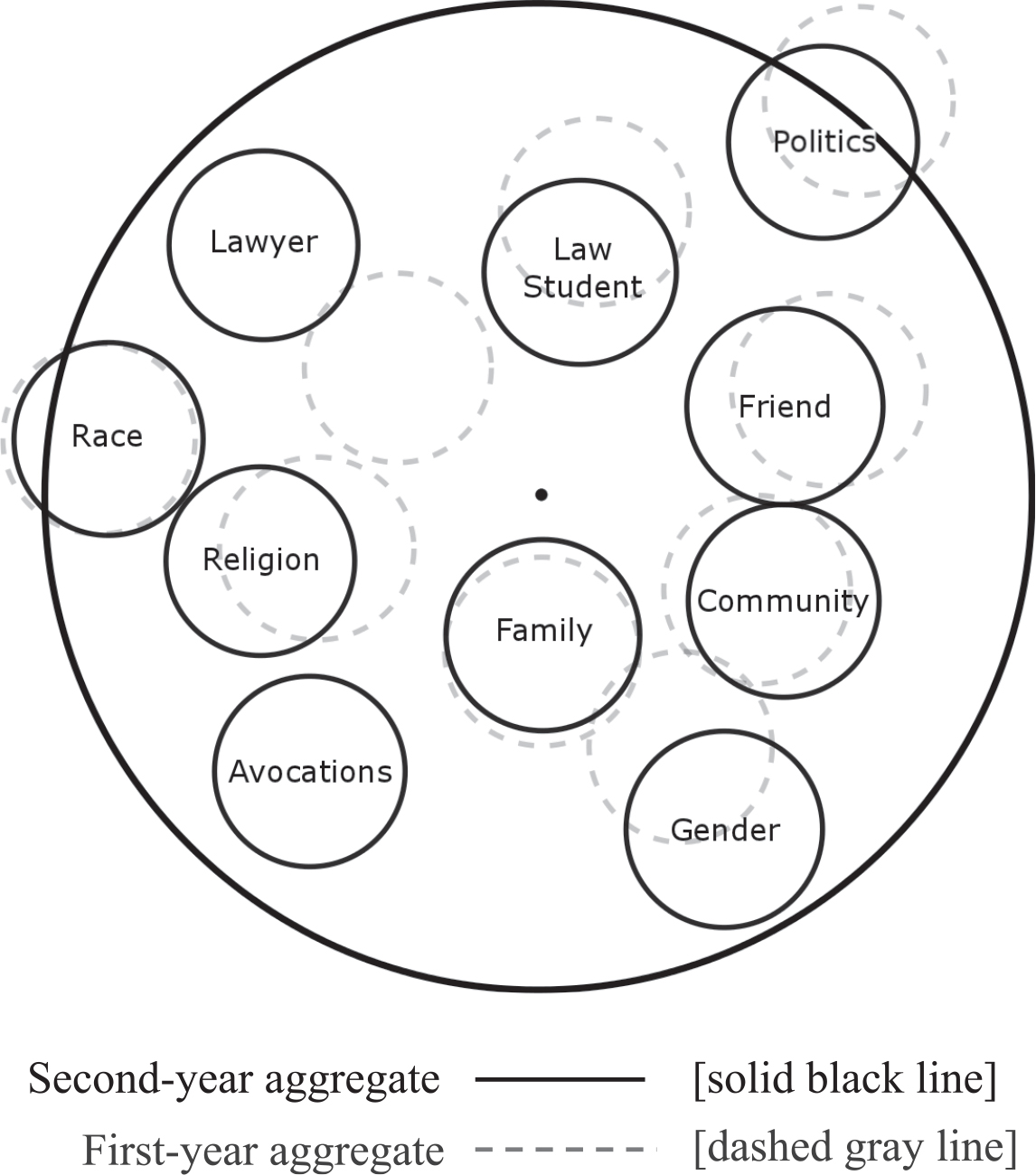
As we saw earlier, GPI respondents tended to locate the professional role in the center of their identity maps, while placing the law student role on the periphery. The aggregate corporate map shows the opposite pattern. Between the first and second year of law school, “lawyer” moved toward the outer edge of the identity space, while “law student” remained relatively central. The aggregate political, racial, religious, and gender roles appear somewhat further from the center than found in the GPI path. Consistent with the peripheral placement of these roles, corporate-path maps tended to be characterized by greater compartmentalization (fewer overlapping roles) in contrast to the characteristic overlap found in the GPI path. These aggregate mapping observations are generally supportive of the qualitative analysis below. Corporate-path respondents tended to describe a more bifurcated conception of the lawyer role in sharp contrast to the cause lawyering picture of a personalized and politicized professional identity. A second-year corporate-path respondent explained: “Even things that I'm passionate about in the law are secondary to me. I'm ok with that … [Being a lawyer] is not central to my being at all. I want to be a lawyer just so that I can provide for the things that I want out of life.”
While political role identifications tended to be placed on the periphery of corporate-path identity maps, Sam is an exception to this trend. He placed “vet” (war veteran), “politics,” and “DOMA” (Defense of Marriage Act) in a central cluster; however, he clarified that these role placements did not suggest a priority on social change or politics in his career. Instead, Sam explained that he generally avoids politics: “[DOMA and veterans' issues are] the only politics that I actually care about … Other than that, I don't care [about] formal politics of Democrat, Republican … I didn't vote this year because there's better things to be doing.”
A salient exception to these apolitical accounts is that many corporate-path students reported placing importance on pro bono, diversity, and signs of political affiliations as factors in choosing among large firms. A second-year corporate-path respondent explained: “These firms all pretty much look the same … asking about pro bono is a way to ask about the values of the people there … to get a sense of whether I'd fit in.”
The relatively central placement of “law student” is unique to the aggregate corporate-path experience (see Table 5). Although many corporate-path respondents described themselves as politically active, they also tended to be the most amenable to an education that privileges the apolitical application of legal rules and that requires bifurcation of personal values from the craft of lawyering. Thus, among corporate-path respondents, a proximate view of the law student role (including its lessons in conventional professionalism) is consistent with a distant view of professional identity. For example, a second-year corporate-path respondent who located the law student role in a central position and the lawyer role in a distant position explained that he not only consented to lessons in bifurcated professional identity; he in fact placed great value on the compartmentalized nature of his anticipated professional role: “Despite all my rhetoric about being involved in society and about how that's why I want to a lawyer, I kind of also just want to have a job that's not involved in the big issues. I like to compartmentalize. I would like to be involved in a community group, maybe ten hours per week, but not have it be my job.”
Aggregate Second-Year “Law Student” and “Lawyer” Placements

| Central Lawyer Role | Peripheral Lawyer Role | |
|---|---|---|
| Central law student role | Corporate path | |
| Peripheral law student role | GPI path | Drifting path |
Unlike the drifting respondents discussed in the following section, corporate-path distancing from professional identity generally was not accompanied by accounts of fraudulence, moral compromise, and concerns about the habitability of the lawyer role. The benefits offered by large-firm employment with respect to prestige, salary, and pursuing a practice area based on intellectual interest may support a general portrait of relatively benign role distancing in the corporate path. This claim is supported by students' experiences of the large-firm hiring process. While drifting path respondents reported identity crises during the interview program, many corporate-path respondents found the interviews helpful in clarifying their interests. A second-year corporate-path respondent explained: “I had to say what I want to do and who I want to be, and who I want to work with 32 times. And if I can't sell it to myself or to the firms … it doesn't make any sense if you can't talk with a sincere passion about what your interests are. It has been a true litmus test for my interests.”
Most corporate-path respondents described their upcoming jobs at law firms as a temporary step in a long-term career plan. A second-year corporate-path respondent explained: “The only reason I'm going to a firm is to get that nest egg … and to get the training, to get that line on my resume.” Mobility plans often included an eventual exit from the large-firm sector or the legal professional all together, as the following first-year corporate-path respondent explained: “I plan to be a lawyer for however long it takes to do something else. It's more of a launching pad for me. Step 1: Go to law school. Step 2: Pay off massive debt. Step 3: Get out of massive law firm and pursue other opportunities like smaller firms or business.” This temporariness in the large-firm lawyer role does not appear to be rooted in moral distancing from professional activities, as described among drifting respondents below.
The notion that these students will pay down their loans within a few years of firm practice and then move to different jobs and even different sectors is well supported by the After the JD data. Seven years after law school, half of elite-school graduates who began their careers in large firms had moved to other practice settings (Dinovitzer et al. Reference Dinovitzer, Nelson, Plickert, Sandefur and Sterling2009).
While corporate-path respondents generally described their jobs in financially instrumental terms, they were consistently wary of the possibility of sacrificing happiness in exchange for salary. Nearly every corporate-path respondent mentioned that long hours are an undeniable aspect of large-firm life: “In terms of working the long hours, it's going to happen … But that's what you sign up for to make the money … The downside is you really don't have a personal life … the firm takes over your life, especially when you're beginning … .” But corporate-path respondents were roughly split on whether they viewed work-life balance as a serious concern. Some of these respondents explained their peripheral placement of the lawyer role by reference to work-life issues: “I don't live to work … . I would like to work to live … so this [lawyer role] must stay outside [the central cluster in the identity circle].” Most corporate-path respondents admitted an element of “sacrifice” in their conception of their anticipated lawyer roles: “[Associates in large firms] make an obscene amount of money to do fairly remedial things in their first couple of years. You're selling your time.” But these conceptions of sacrifice generally were not accompanied by the self-shaming accounts of “selling out” found among drifting respondents. A second-year corporate-path respondent explained, “you should never sell your soul, but you certainly [can] rent it. I'll rent them my soul for you know, a couple hours, or you know, a couple years of my life, if it means that I get to have a good quality of life for the rest of it.” The same respondent continued this reflection, asserting that his corporate lawyer role would not affect his core identity:
If they want to pay me that much money to like sit and look at pieces of paper all day and if they want me to work even 80 hours a week … and they want to pay me 160K, go right ahead. I'll do that. Whatever, I still get to be me … . And just cause I'm doing something dumb doesn't mean I can't have fun doing it.
Another respondent added that the exchange rate of time for salary is only adequate for him because he is genuinely interested in large-firm practice: “I understand how this works. You're selling your time. And not at a terribly high hourly rate. You really are working two $80,000-a-year jobs. So you have to like what you're doing.” These concerns about exchanging intrinsic for extrinsic satisfaction suggest a limit to the instrumentalization of the anticipated lawyer role among some corporate-path respondents.
Race, class, and gender are less prominent in corporate-path accounts of professional identity when compared to GPI respondents. This observation appears consistent with the aggregate map finding that corporate-path respondents tended to locate their racial and gender identities near the periphery of their maps.
For a few respondents, class played a substantial role in accounts of professional role distancing. Three corporate-path respondents from working-class backgrounds suggested that the financial instrumentalization of their corporate lawyer identities may be particularly extreme but less troubling to them because, relative to students from wealthier backgrounds, they (and their families) consider large-firm salaries to be extraordinarily high: “My parents were like, ‘How much is the salary? Hundred and sixty … thousand. That's more than the two of us make combined every year’ … They're making retirement plans earlier I think.” Another working-class corporate-path respondent explained: “I'd be stupid not to take the opportunity [to work in a large firm] … It is really weird to make more money than my dad, when I have no real skills … [E]ven though I don't really know what I want to do with my life, the money just kind of makes the decision [to work at a large firm] easy.”
Several women and two men in the corporate path (including Sam, the respondent cited earlier in this section) explained that the lawyer role was peripheral because they worried that their work life might encroach on their plans to have children. A first-year female corporate-path respondent explained:
I want [being a lawyer] to be a central thing in my life because it's going to probably be where most of my waking hours are, but I don't ever really want to be in a position where my job subsumes me, and I don't think it will. I've wanted to be a parent since I was a very little kid … and I can't really see the job subsuming that … I think that's going to be a real tension point for me.
Some corporate-path respondents explained that they would ideally prefer to enact a more central lawyer role, because a deep investment in their professional identities might improve their chances at upward career mobility, but they felt that their plans to have children were incompatible with professional role embracement. A first-year female corporate-path respondent explained: “The truth of the matter is, if I have a kid I'm never going to be as, well ‘successful’ is the wrong word, but I'm never going to be able to gun as hard as someone who doesn't. And that is a trade-off you make.” These concerns were often directly tied to gender. A second-year female corporate-path respondent explained: “Women can't have it all. That's how it works. You're not going to have it all if you want to do everything well. You have to decide what your priority is and for me it's my family … . So if [the lawyer role] starts moving in towards the middle then that's going to be a problem.”
These accounts resonate with previous empirical studies of law firms and other professional settings where women face heightened levels of work-family conflict (Wharton and Blair-Loy Reference Wharton and Blair‐Loy2006) and greater penalties for having children (Wallace and Kay Reference Wallace and Kay2012, 405). In the large-firm sector, women are increasingly represented among new associates but experience far less representation among partners. A leading explanation for this persistent inequality has been that the partner track was built on a traditional white male model, drawing heavily on forms of symbolic capital that disadvantage women, and an understanding that lawyers have a stay-at-home spouse who manages their nonwork life (Garth and Sterling Reference Garth and Sterling2009). This traditional model is organized under a “schema of work devotion,” which assumes that “high-level workers will be dedicated to their jobs and will not spend significant time on other obligations” (Blair-Loy Reference Blair‐Loy2003, 1–2). Several female corporate-path respondents anticipated these concerns. One such respondent reported that she learned during a call-back interview with a large firm that the only way for women who have children to advance to partnership was to have their spouse stay home: “Literally any women in that office who had made partner and had a child, their husbands were house husbands. They literally did not work at all, because of the strain of her career.” This respondent felt that asking her husband to stop working was not an option. This trend is corroborated by the After the JD Study, which finds that women are more likely to report that they left law firm practice in order to care for children (Dinovitzer et al. 2004, 62). For some women in the corporate path, expectations of gender discrimination may limit work devotion, which can contribute to accounts of professional role distancing.
When discussing the Great Recession, corporate-path respondents tended to place a strong emphasis on job security and student debt. A common refrain was that the decision to work for a large firm was relatively uncomplicated because in a tough economic climate, “you have to put food on the table.” Previous research has shown that corporate-bound students at elite law schools tend to view their legal education as “little more than a credentialing and sorting mechanism where the goal is to amass certain visible, rankable signals of success” (Wilkins and Gulati Reference Wilkins and Gulati2000, 1252). The recession seemed to intensify this effect. Within my exploratory data, there appears to be a qualitative differentiation between pre- and post-financial-crisis respondents in the corporate path. Members of the earlier cohort, who entered law school in 2007, expressed moderate anxiety about the likely imminent impact of the recession, but were overall optimistic about their opportunities and were indeed highly successful in securing large-firm internships (although some of these offers were later deferred or rescinded). The later two cohorts, who entered law school in 2010 and 2011, were more concerned from the start of their legal education about the oversaturated market for entry-level lawyers. Adding to their financial worries, tuition at the site for this study increased by more than 60 percent between 2007 and 2011. Given these economic pressures, it is perhaps not surprising that corporate-path respondents from the later cohorts tended to place particular emphasis on the financially instrumental nature of their anticipated lawyer roles.
While the aggregate picture of professional role distancing and instrumentalization is representative of most corporate-path respondents' accounts, it is important to note exceptions. For example, some respondents deemphasized financial motivations for pursuing large-firm positions, instead pointing to their longstanding interests in particular practice settings. One first-year corporate-path respondent who hoped to pursue a career in entertainment law decried her classmates for their instrumental attitudes toward becoming a large-firm attorney: “No one in law school talks about dreams, which I find very troubling. I like dreams, I have them, and no one cares. People just want to be partner because of money I guess … . But … that's not my dream.” Other prominent exceptions to financial instrumentalization in the corporate path were found among respondents who carried minimal or no educational debt due to receiving merit-based scholarships or family support. One such corporate-path respondent reported a central professional role and explained this conception by discussing a sense of freedom to choose among career path options: “I think most [of my classmates] are going to find jobs. There's a really, really intense anxiety that I don't share with my classmates. I don't know if it's that I'm naïve or that I don't have loans or that I just think it will work out because it usually does.”
The Drifting Path: Professional Role Distancing and Fraudulence
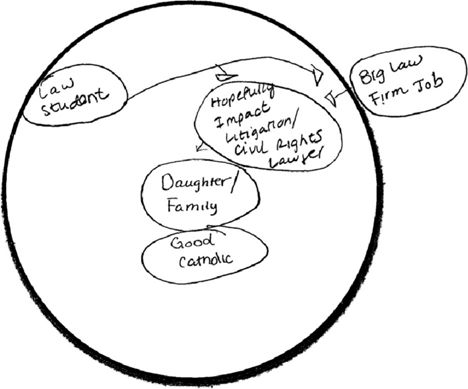
The drifting path consists of respondents who between the first and second year of law school shifted from an intention to begin their legal careers in the public-interest sector to an intention to begin in the large-firm sector. As indicated in Figure 7, Sara, a second-year drifting-path respondent from the 2011 cohort, planned to begin her career in “Big Law” (at a large corporate law firm) and then after a few years “hopefully” return to her initial public-interest career aspiration as a “civil rights lawyer.” Sara explained that her anticipated civil rights position would be a more proximate professional role than her anticipated “Big Law Firm Job,” which she placed entirely outside the identity circle. She described the opportunity to work in Big Law as a necessary sacrifice given the scarcity of job opportunities and her substantial student debt. However, she expressed concern that working in a large firm could lead to becoming “addicted to money,” which might interfere with her desire to return to the public-interest sector. This fear of self-transformation—of actually becoming a “corporate lawyer” rather than temporarily portraying one—was a common theme among drifting path respondents.
Second-Year Drifting Identity Map (Sara)

Aggregate identity Map for Drifting Path
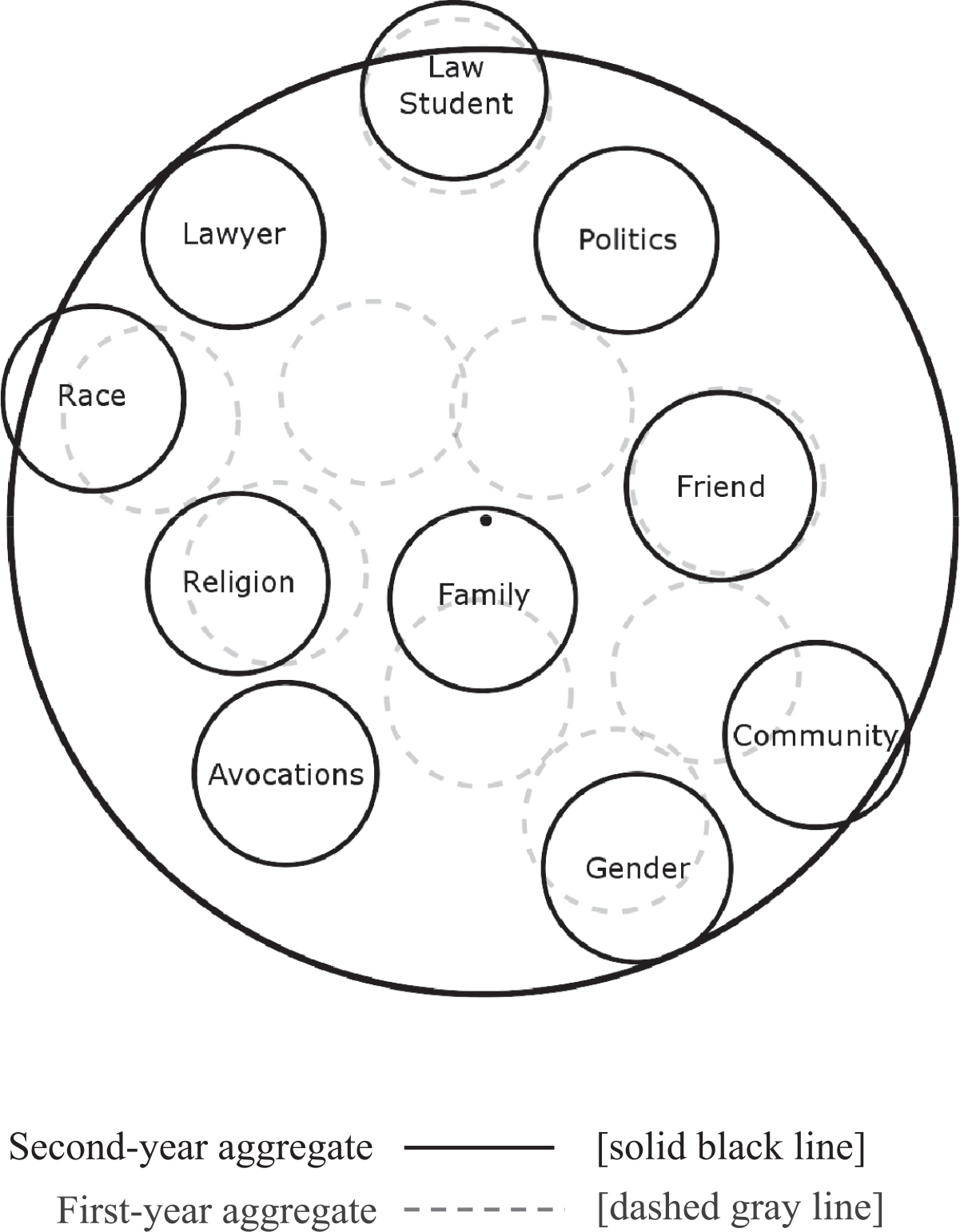
As evident in Figure 8, drifting respondents in their first year of law school tended to place the lawyer role in a central cluster. In their second year, after they had accepted internship offers with large firms, they tended to place the lawyer role on the periphery. The analysis below suggests that between the first- and second-year interviews, drifting respondents generally transitioned from an integrated cause lawyering conception of lawyer identity to an instrumentalized conception fraught with moral and psychological role distancing and feelings of fraudulence. Regarding the law student role, drifting respondents reported substantial distancing in both years, similar to the GPI path, as they described a disjuncture between their initial political motivations for attending law school and the decontextualized and bifurcated nature of lawyering presented in legal education (Granfield Reference Granfield1992; Mertz Reference Mertz2007). These path comparisons are summarized in Table 5.
Along with the peripheral movement of the lawyer role, “politics” also moves outward in the second-year aggregate drifting-path map. Interview analysis generally corroborated this shift, as second-year drifting respondents tended to describe a transition away from first-year accounts of professional purpose rooted in cause lawyering goals. In their second year, these respondents were generally pessimistic about their ability to reconcile their political ideals with large-firm practice—in Granfield's terms, to “neutralize the contradiction experienced by accepting [large firm] employment” (1992, 166). The standard conception of lawyer identity, which holds that political viewpoints are irrelevant to being a good lawyer, seemed to offer little consolation. For example, a drifting-path respondent who cited bifurcated professionalism to explain her choice to work in a large firm offered the following caveat: “That's probably just a justification for myself so I don't have to feel like a sellout.”
Nearly every drifting-path respondent reported that he or she intended the position in the large-firm sector to be a temporary stint followed by a return to GPI practice. While accounts of temporariness were also prominent in the corporate path, those respondents were primarily concerned with work-life balance and mobility in their future careers. In the drifting path, accounts of temporariness were often laden with moral distancing and role playing as respondents worried that they had “sold out” by choosing to work for large firms. A second-year drifting respondent explained:
[The firm where I will be working] defends the biggest companies … and they're being sued by the public-interest organizations that I might have worked at … I know it's all part of the legal system and everyone deserve a defense, but I also kind of feel like I switched sides … like I have to actively fight for the wrong side now.
Feelings of fraudulence are particularly salient in drifting students' accounts of the law firm hiring program hosted by the law school, which occurs at the end of students' first-year summers. In these job interviews, drifting students often present themselves in a new light while struggling to conceal a great degree of ambivalence. A second-year drifting-path respondent described his efforts to construct new “interview answers” to questions about his personal and professional motivations:
I have to shape my life experiences into a narrative arc … and tell my life as a story with a beginning, middle, and end. And the conclusion has to be “why I want to be a lawyer,” or “why I wanted to go to law school,” or “why I want to work for a firm,” or “for this firm.” And that seems totally false.
Many drifting respondents shared this view that the self-narratives they presented in job interviews were markedly different from their “true” self-narratives, which retained public-interest ideals. Goffman illuminates how these multiple self-conceptions can be maintained through meticulous “audience segregation” and by concealing motives that are incompatible with an “idealized” version of the role (1959, 30). For many drifting students, cultivating this idealized impression can require going to great lengths to avoid revealing one's reservations about working in the large-firm sector, especially when interviewers inquired about the public-interest orientation suggested by their resumes. These respondents typically rehearsed their interview approach with the law school's career development staff and were coached to spin their public-interest experience as training for a career in corporate law. One second-year drifting student reported that when she was questioned about her public-interest background, she would equivocate by answering a different question than the one asked (what she termed, “pulling a Sarah Palin”). Many drifting students resorted to deception, as explained by a second-year drifting respondent: “I bombed every interview until I realized that you have to lie.” This respondent credited his use of deception for his eventual success in securing a summer associate position in a large firm:
When I was talking to [law firm interviewers] I told them I was interested in class actions, which is true … but I told them I was interested in them because I saw it as a legal mechanism that is often stretched beyond its proper scope … . If I told them what I believe, I definitely don't think I would have gotten a job. I think [that] before I had just been figuring out ways not to tell [interviewers] what I really thought. And then I shifted to affirmatively telling them lies. So I guess that helps. I guess that's what it takes.
Ethnographic observations of the near-campus hiring program underscore the powerfully dramaturgical nature of many students' first interactions with large firms. The hiring program is held at a large upscale hotel near the law school where over 200 corporate law firms (and a few smaller firms and governmental employers) convert hotel rooms into interviewing offices. Students often arrange up to twenty or more short interviews over the week-long program. Similar to other elite law schools, this is the key recruitment event for the large-firm sector at this site. Students who secure a summer internship will generally later be offered a postgraduation position with the firm. Among students at the event, there is a consistent use of theater-speak as they wait between interviews in what some students labeled the “green room,” a hotel room reserved by the law school. Students complained of “butterflies” and “stage fright” and wished each other to “break a leg” and to succeed in being invited for “callbacks,” second-round interviews held on site at law firm offices. When the time for an interview approached, students walked down the narrow, dimly lit hallways passing classmates who waited in front of closed doors, adjusting their often newly purchased suits and quietly murmuring to themselves, glancing at note cards, perhaps reviewing some memorized responses to common questions or details about a particular firm. On the doors, firms had written notes instructing applicants to either knock at the scheduled interview time or a certain number of minutes after the scheduled time or not at all. Upon the opening of the door, drifting-path respondents in particular often reported feeling as though the curtains had opened for a stage performance. A second-year drifting respondent with a theatre background made the dramaturgical analogy explicit: “[The interviews] are like twenty opening nights … . It's a different audience but it feels like you're performing the same play over and over. By the third or fourth interview, I felt like I knew my lines pretty well.” Although this respondent, like those cited above, reported that he had felt somewhat fraudulent when deceiving law firm interviewers by concealing his serious reservations about working in the large-firm sector, he emphasized the need for some measure of authenticity in one's interview script. He explained: “The only auditions where you get the part are the times when you find something true in the monologue you're reading.”
Goffman used similar terms in describing the continual challenge faced by daily role performers to “foster the impression that the routine they are presently performing is their only routine or at least their most essential one” (1959, 48). For many drifting respondents, crafting convincing job interview performances while suppressing doubt and moral reservations required great effort. Several of these respondents underscored the contrast between the meticulously crafted self-image they maintained during job interviews and their relatively unguarded discussion of career plans and deliberations in the confidential setting of the research interviews for this study.
In contrast to the majority drifting-path experience, some drifting students described the role-playing aspect of the hiring program in less dramatic terms, often emphasizing the informal nature of interview conversations. A second-year drifting-path respondent explained: “[The interviewers] just want to see if you're awkward … if you trip over everything … . They want to make sure you can put on a suit and you aren't a maniac.” Several respondents reported that their interviewers seemed to view the hiring program primarily as a means to collect law school transcripts, which employers are not permitted to request from students before the interviews. These respondents explained that, in their view, job offers were made largely on the basis of grades rather than interview performances.
Accounts of professional role distancing in the drifting path should be contextualized within the public-interest subculture of first-year students at the site. Many drifting respondents reported membership in tightly knit first-year cliques of public-interest-oriented students, whose norms stressed differentiation from those classmates deemed “corporate sellouts.” A first-year drifting respondent explained: “We [public-interest-oriented students] can be pretty judgmental … . We do kind of feel like it's us versus them.” When asked to elaborate, this respondent clarified that “the ‘them’ is … we call them ‘gunners,’ people who are just competitive. And then there's the mainstream of law students who are really corporate and don't seem to have their hearts in the right place.” Another respondent claimed that this antagonism toward corporate-bound students represents anticipated future legal battles: “[Corporate-bound classmates] are the people I am going to actually be fighting against. They could literally be on the other side of the courtroom … . They're going to have a team of lawyers and all of the money and paralegals … .” Another first-year drifting respondent reported that she encountered harsh views toward corporate-bound students at the very beginning of her law school experience when an upperclassmen pointed out that students who wear suits at the beginning of the academic year are participating in the corporate-firm hiring program and warned: “It'll be amazing next year when you see your public interest friends walking around school in suits.” When another drifting respondent later decided to apply to large firms, he described feeling judged while walking in a law school hallway when two “public-interest” students approached him and exclaimed: “Oh no! Not you!” They explained that they had placed bets on which classmates would apply to firms and they had lost in his case. These accounts of peer judgment may weigh on students' job-path decisions but they may also influence how drifting respondents experience and describe their views of professional identity. For drifting respondents, expressing harsh judgments toward corporate law practice during the first year of law school can be turned against themselves and can manifest as moral distancing and self-shaming when they later decide to apply to large firms.
Experiences of moral distancing were further revealed by several drifting respondents' comments about selecting a practice area. Rose, a drifting respondent in her second year after graduation, provides a representative example. Rose reported that she had chosen the “least dirty practice area” within her firm, which in her estimation was intellectual property. Since she had little background in intellectual property law or the technical substance of the cases handled by the practice, she found herself relegated to the most tedious work:
I've been doing really menial stuff, like I make binders. I would say about 50 percent of what I do is making binders. Going through someone's expert report and pulling together everything cited in there into a binder. Stuff that I don't need a law degree for … . The other stuff they do, I would say I'm not really qualified for because I don't have a science or technical background.
Rose reported that she considered joining the firm's white-collar criminal defense practice, which she anticipated would be far more intellectually engaging, but she was deterred by what she perceived to be moral shortcomings: “I'm thinking, ‘No. You'd feel so bad about yourself if you did that.’ I can see myself doing criminal defense if I were a public defender, but not defending corporate criminals, even though someone has to do it because everyone is entitled to a defense.” Even within the intellectual property practice, which in her estimation was relatively morally benign, Rose expressed distancing between her true public-interest identity and her daily role performances at work. She explained: “For the first time since I was in high school, I'm not involved in any sort of public-interest or volunteer or pro bono work. That's actually an adjustment that I don't like at all but there's nothing I can do about it.” Rose tied these experiences of role distancing to her overall sense of job dissatisfaction, which she framed in severe terms: “The worst thought is that I'm going to work here every day until I'm too old to work.”
My limited drifting-path data with respect to race and gender appears consistent with Costello's claim that female and minority students experience an elevated dissonance with professional identity due to law schools' normative “upper-middle-class white male” habitus (Costello Reference Costello2005, 57). For women and minorities in Costello's account, the transition into the profession is often traumatic and alienating as these students “tended to suffer from feelings of inauthenticity, recognizing that they were attempting to play a role rather than doing something that came ‘naturally’” (2005, 26). My analysis tends to similarly suggest that traditional outsiders to the profession may experience a heightened degree of professional role distancing; however, the baseline portrait of moral distancing, financial instrumentalization, and concerns about fraudulence is salient in the accounts of white male respondents in the drifting path as well. Variation by race and gender is perhaps most evident in respondents' experiences of the job interview process. Female and minority drifting respondents often emphasized the steep challenge they faced in convincing interviewers that they were serious about practicing in large firms given the public-interest orientation suggested by their resumes. A white female drifting-path respondent explained: “[Before law school] when I worked at a nonprofit, it was mostly women and mostly people of color … . Going into these interviews in this white-male dominated corporate world … . I kept worrying that they would see me as this radical public-interest girl.” Further research is needed to parse the effects of these identity variables within job-path categories.
Several drifting respondents who have working-class family backgrounds reported that the decision to apply to large firms was motivated by immediate family financial needs. These students described extreme financial instrumentalization of their corporate law positions, which may have contributed to heightened experiences of role distancing and inauthenticity. At the same time, their accounts of instrumentalization emphasized necessity and seemed less fraught with self-shaming (as “sellouts”) than many other drifting students' accounts. While these respondents also reported deception in interviews, they emphasized necessity and seemed less worried that the performed corporate lawyer self would become their “true” identity. A drifting-path respondent from a working-class background explained: “I know I'll get out [of the firm] in a couple years. There's not really any way that I would stay long-term. It's really just a means to an end … it's a necessary evil for a couple years.”
The recession was frequently emphasized in respondents' accounts of drift, particularly among the 2011 and 2012 cohort. The 2008 cohort enjoyed prerecession market conditions when they applied for second-summer internships, although some of their postgraduation job offers were later rescinded. 2011 and 2012 respondents tended to place a stronger emphasis on financial risk as a factor in their decisions to work in large firms. These respondents often explained that their plan to postpone public-interest careers for a few years while taking a position in corporate law was “just being smart financially and thinking long-term.” For students at elite law schools, obtaining a position at a large firm often presents itself as an easier option than applying for jobs in other sectors. When this ease of application is combined with new risk considerations arising from contraction in the legal job market, many drifting respondents reported that the decision to work in the large-firm sector rather than “rolling the dice” with later public-interest opportunities felt overdetermined. A second-year drifting-path respondent from the 2011 cohort explained: “I just feel lucky to have a job. I can't emphasize that enough.” For those drifting respondents whose job-path decisions were deeply influenced by the recession, the market context may have contributed to the instrumental nature of their accounts of corporate lawyer identity. At the same time, the recession context often seemed to bolster a financial necessity justification for taking a large-firm position. This justification seemed to diminish narratives of self-shaming and moral distancing.
As with the other paths, it is important to note heterogeneity within the drifting category. Many drifting students did not transition from a clear first-year GPI preference to a clear corporate-law preference over the course of their first year of law school. Instead, they often described a vague and uncertain initial public-interest commitment and a similarly uncertain and tentative decision to apply to large firms at the end of the first year. Students who were particularly noncommittal about sectoral paths seemed to describe reduced moral distancing and fraudulence with respect to the corporate lawyer role in their second-year interviews. Unlike the paradigmatic drifting case, noncommittal students were unlikely to characterize themselves as “sellouts” for having abandoned previously stated commitments to public-interest-sector positions. Hence, the degree of certainty expressed in drifting students' initial public-interest commitments may contribute to experiences of the moral dimension of distancing from the corporate lawyer role.
Summary of Empirical Findings
Above I have presented a compendium of evidence revealing experiences of professional role distancing among law students and early-career lawyers. In addition, I have shown that this distancing can vary according to students' job-path decisions during the first two years of law school. To summarize, among the students interviewed for this study, GPI-path respondents tended to report a relatively stable, central, and clustered conception of professional identity, integrating political, racial, religious, and gender roles. Corporate-path respondents tended to report an increasingly distant relationship to professional identity. Drifting-path respondents tended to experience a similar distancing with respect to professional identity, while struggling with concerns about fraudulence as they conceived of their enactment of the corporate lawyer role as a temporary and morally suspect performance.
For many respondents, the recession intensified these dynamics. Students in both the corporate and drifting paths cited the recession as a contributing factor in their accounts of financially instrumentalizing the lawyer role, pursuing jobs they did not previously desire, and attaching less civic or political importance to their work in the profession. It is perhaps not surprising that students' public-interest ideals may decline in a period of field-level institutional shock where “established cultural ends are jettisoned” leading to “new strategies of action” and new “styles of self” (Swidler Reference Swidler1986, 278–79). We might have predicted that the recession would flatten law students into a more homogeneous instrumentalized professional identity type. However, some GPI respondents claimed that the recession provided a strong source of motivation for investing the professional role with personal and political values amid a heightened call for social change.
Discussion
Assessing the causal mechanisms that produce these identity dynamics is beyond the scope of this article. Instead, my focus has been to explore the association between professional identity and job paths. For example, above we saw several similarities between Laura and Sara, who were the initial examples in the discussion of the public-interest and drifting paths, respectively. Both are Latina, Catholic, and belong to the later cohorts (2011 and 2012). Both had public-interest work experience prior to law school. In their first-year interviews and maps, both respondents presented accounts of integrated, cause lawyering identity and social justice motivations for attending law school and for pursuing GPI positions. However, in their second year, Laura had sustained an integrated view of professional identity while Sara had switched to a more instrumentalized corporate lawyer identity profile. My analysis shifts attention from what precedes (and causes) job-path decisions to what follows from them. Thus the following discussion considers internal and external normative dimensions of respondents' distinctive identity experiences.
This focus on the period beyond the first year of law school is supported by exploratory insights from post-JD interviews regarding the continued flexibility of professional identity. In the aggregate placement of the lawyer role, respondents tended to show a surprising consistency between their second-year law school interviews and their post-JD follow-up interviews. The clear exceptions were those respondents who changed sectors in their first few years of practice. Of particular interest here, the post-JD interviews shed light on Laura's hope that she could reclaim a more proximate professional identity if she were to return to a public-interest law position. Support for the notion that a future sectoral change might bring about a shift in professional role distancing can be found in the accounts of three drifting respondents from the 2008 cohort whose offers to work with large firms were deferred or rescinded soon before graduation. In such cases, firms often encouraged students to begin their legal careers in public-interest-practice settings, generally with the firm's temporary financial support and an uncertain expectation that they could be invited to join the firm after some months or years. When these respondents were employed in public-interest-practice settings they reported in follow-up interviews a strong shift to the professional identity type associated with their new sector. In other words, although these respondents reported a more distant and instrumental view of the lawyer role when they anticipated jobs in corporate law firms, they changed to a more proximate and politicized professional role identification when they began working in public-interest practice. These accounts suggest a possible amendment to our understanding of professional socialization. While legal education certainly influences the shaping of professional selves, these selves can be quickly modified when students and new lawyers change career paths. Such flexibility in early-career professional identity is perhaps well adapted to the widespread job mobility found among new lawyers. The After the JD Study reveals that lawyers change jobs and even sectors frequently in their first years of practice (Dinovitzer et al. Reference Dinovitzer, Garth, Nelson, Plickert, Sandefur, Sterling and Wilkins2014).
Implications for the Profession
Within the limitations on generalizability, how might these findings contribute to normative debates about the professional identity of lawyers? Distancing from an occupational role may at first glance carry a presumption of internal malignance. Much of the normative literature on lawyer identity supports this presumption by detailing the “high personal cost” of the standard bifurcated conception (Postema 1984, 289). However, if we take Goffman's analysis as a starting place, professional role distancing is not a priori harmful. Instead, role distancing is a continual constitutive practice by which we produce a cohesive sense of self by arranging roles on a spectrum of identification. Conceiving of some roles as relatively distant can theoretically yield benefits as well as harms. For example, role distancing may function as a “device to alleviate the moral burden” that many drifting students attach to working in corporate law firms (Dan-Cohen Reference Dan‐Cohen2002, 259). Given that most lawyers leave large firms within the first few years of practice (Dinovitzer et al. Reference Dinovitzer, Garth, Sander, Sterling and Wilder2004,Reference Dinovitzer, Nelson, Plickert, Sandefur and Sterling2009), professional role distancing may provide an effective mechanism for enduring a temporary job experience that many respondents described as a moral compromise.
It is worth emphasizing that viewing one's professional role in a distant fashion, as “just a job,” can protect one's sense of independence against the demands of a challenging occupation. Drawing on research that distinguishes jobs (where work provides extrinsic material rewards), careers (where work provides extrinsic and some intrinsic rewards, with an emphasis on professional advancement), and callings (where work provides intrinsic fulfillment and a sense of social value), we might conclude that all three conceptions are well represented within this sample (Bellah et al. Reference Bellah, Madsen, Sullivan, Swidler and Tipton1985; Wrzesniewski et al. Reference Wrzesniewski, McCauley, Rozin and Schwartz1997). We can roughly correlate the drifting path with jobs, the corporate path with careers, and the GPI path with callings, while acknowledging that there are respondents within each category who present exceptions to these generalizations. This finding supports the hypothesis that jobs, careers, and callings can coexist within one occupation (Wrzesniewski et al. Reference Wrzesniewski, McCauley, Rozin and Schwartz1997). While the “calling” conception may stand out as particularly advantageous, previous research has warned that this perspective can be taken too far. Kreiner, Hollensbe, and Sheep's study of identity work among priests underscored the “pitfalls of high role and identity infusion” as the “demands of the social identities infringe upon the uniqueness of the personal identity” (Kreiner, Hollensbe, and Sheep Reference Kreiner, Hollensbe and Sheep2006, 1032). Priests often reported overidentification: “[Being a priest is] just part and parcel of every cell in my body. I'm a dad. I'm a husband. I'm an outdoors man. I'm a priest … . It all goes together … . You are a priest whether you have your collar on or not” (1047). This theme was further evidenced by priests who reported wearing their collars at home and carrying the title “Father” into their personal relationships (1041). Over the course of their careers, many of these priests seemed to push back against the “greedy” and “intrusive” nature of the occupational role (1051). One priest explained: “I have backed off of that overidentification to the point where I feel like I have a reasonable distance from it” (1050). Other priests expressed the related concern, much like the drifting law students in the present study, that they lacked “identity transparency” (1041–42). They believed that “their ‘true selves' often couldn't be revealed to parishioners or the general public because those true selves were incongruent with what a priest should do, say, or be” (1041–42). It is important, then, to acknowledge that even in an occupation that is generally framed as a religious calling, individuals may aspire to limit their professional role embracement, rather than simply seeking to maximize it. This point is corroborated by the corporate-path respondents cited above who emphasized work-life balance and parenting as counterbalances against a professional role that threatens to “subsume” their identities.
Nevertheless, professional role distancing raises potential hazards for lawyers. Those drifting respondents who experience protracted psychological and moral distancing at a job where they work long hours can be expected to face substantial internal conflicts. In the constructive view of personal identity, how can this role distancing be maintained? Legal theorists have cautioned us that while role distancing (particularly with respect to “official roles”) may be beneficial in some cases, “the more roles are kept at a protective distance, the less there is to protect … . At the limit, we face the specter of the impersonal self: insubstantial, desolate, empty” (Dan-Cohen Reference Dan‐Cohen2002, 154). Fortunately, my respondents did not express this degree of desolation. I do not mean to suggest that lawyers generally approach this limit, although some popular accounts of lawyers' dissatisfaction may characterize them as such. Rather than the “impersonal self,” I suggest that we consider the implications of the conventional lawyer (and, in particular, the early-career corporate lawyer) as a “divided self,” acculturated into a norm of professional role distancing.
For corporate-path respondents, unlike the typical drifting path experience, reduced identification with the professional role often appeared to be an internally benign experience, as they reported few concerns with fraudulence and moral reservations. However, this distancing may raise external concerns for clients, the profession, and society. A recent collaborative essay by two prominent figures in the corporate-law sector and a scholar on lawyer professionalism argues that lawyers in the current “period of stress and transition” need both “core legal competencies but also complementary competencies involving broad vision, knowledge, and organizational skills” (Heineman, Lee, and Wilkins Reference Heineman, Lee and Wilkins2014, 5–6). The authors suggest that lawyers in the amoral mold may fall short in serving all three of their fundamental roles as “expert technicians, wise counselors, and effective leaders” (5). This viewpoint suggests an expectation within the corporate-practice sector that new lawyers should be personally invested in their work. The bifurcated and instrumentalized account of professional identity found among many corporate lawyers-in-training in my sample may not be an ideal fit with these expectations.
Furthermore, conceptions of professional identity that separate one's work role from political, racial, family, and gender roles may discourage lawyers' enthusiasm for the civic dimension of professionalism. Given that large firms' pro bono contributions and financial support of public-interest organizations have become increasingly vital to the provision of public-interest services (Boutcher Reference Boutcher, Granfield and Mather2009; Cummings and Rhode Reference Cummings and Rhode2010), the legal profession's commitment to social justice causes has come to rely substantially on corporate lawyers. To claim that greater integration of the lawyer role would promote civic professionalism is not necessarily to call for students to be trained in the politicized cause lawyering tradition or for lawyers to be “deprofessionalized,” such that legal ethics dissolve into personal morality (Wasserstrom Reference Wasserstrom1975). Yet, it may be necessary to challenge the hard distinction between public-interest and corporate practice, particularly in the exaggerated accounts of differentiation offered by some first-year law students as they begin to shape their perceptions of professional identity. Specifically, bringing corporate lawyers-in-training closer to the integrated conception may better prepare them for their public obligations as lawyers. This position is consistent with Catherine Albiston's argument that a view of public interest lawyering as “separate and different from traditional private practice” runs the risk of “relieving private practitioners from any sense of personal responsibility for the public interest, and too often relegates public interest lawyering to the less prestigious margins of the profession” (Albiston 2014, 557).
Some legal educators have long encouraged their students to adopt a “reflective” approach to “committing oneself to [the lawyer] role” so that they may experience more “control” in their careers rather than “simply fulfilling a ‘role’ … or feeling detached from what may seem (and may be) the arbitrariness of the lawyer's job” (Bellow and Moulton Reference Bellow and Moulton1978, 11). These views are echoed in the findings of recent large-scale studies of legal education, which suggest that law school provides an effective training in cognitive and practical skills but neglects the third fundamental apprenticeship in “professional identity and purpose” (Sullivan et al. Reference Sullivan, Colby, Welch Wagner, Bond and Shulman2007, 132–33). This apprenticeship would help students “situate themselves within the profession … to work in society with integrity and a sense of loyalty to clients and to the public good” (Silver, Garver, and Watkins Reference Silver, Garver and Watkins2011, 376). Lacking this training, students are left ill-equipped to “handle the stress of law practice” and to fulfill their “commitment to the public good” (Silver, Garver, and Watkins Reference Silver, Garver and Watkins2011, 402).
For legal educators and administrators, promoting an integrated professional role may be a means of rehabilitating the image of legal education in a time of crisis. Law schools are increasingly held accountable for the contradiction between the public-interest expectations of incoming law students and the bleached-out version of lawyer professionalism that is instilled during legal education. William Simon, a prominent normative critic of professional role bifurcation, notes that “no social role encourages such ambitious moral aspirations as the lawyer's, and no social role so consistently disappoints the aspirations it encourages” (1998, 1). Fostering a more integrated conception of professional identity may help bring the profession in line with its aspirations.
Theoretical Implications
Although public-interest and corporate-law careers are starkly contrasted in the accounts of many respondents, this analysis also reveals how these two highly prominent legal sectors are deeply intertwined and symbiotic subfields within the hierarchies and legitimation efforts of the larger US legal field (Dezalay and Garth Reference Dezalay and Garth2012). From the postfunctionalist perspective, professions are often viewed as semi-autonomous agents that have lost their “traditional autonomy” (Friedson 1986, 1) as they increasingly experience bureaucratization and competition over jurisdictions of expertise (Larson Reference Larson1977; Abbott Reference Abbott1988). Accordingly, scholarship on legal education has argued that law schools collectively seek to “monopolize the field of legitimate knowledge” (Granfield Reference Granfield1994, 55) as they strive to reproduce and maintain the legal profession's elite social position (Kennedy 1983; Granfield Reference Granfield1992; Schleef Reference Schleef2006). From this perspective, we might consider how the more instrumental professional identities associated with corporate-bound respondents may bolster the profession's eliteness by emphasizing highly skilled technical services (as “hired guns”) to powerful clients. The public-interest respondents' more integrated identities may be viewed by many lawyers as a “deviant strain within the profession” that poses a field-level threat to conventional professionalism by “destabilizing the dominant understanding of lawyering as properly wedded to moral neutrality and technical competence” (Sarat and Scheingold 1998, 3). At the same time, cause lawyering is generally viewed as a boon to lawyers' standing in society as it “elevates the moral posture of the legal profession beyond a crude instrumentalism,” and serves to “reconnect law and morality and make tangible the idea that lawyering is a ‘public profession,’ one whose contribution to society goes beyond the aggregation, assembling, and deployment of technical skills” (Scheingold and Sarat Reference Scheingold and Sarat2004, 23). In sum, the public-interest and corporate-law sectors and their associated identity types are not entirely independent spheres but instead are highly interactive. As students decide which legal sector to pursue and begin to conceive of who they will be as lawyers in their anticipated practice settings, they draw on competing notions of prestige and professional purpose that are embedded in the larger machinery of a modern profession, where the “structures of rewards and careers that orient actors toward both corporate law and public service” not only influence career decisions but also “combin[e] to build the prosperity of the field as a whole” (Dezalay and Garth 2012, 2314).Footnote 7
These findings present a more complex, heterogeneous, flexible, and continually constitutive portrait than is found in the existing literature on occupational identity. Kreiner, Hollensbe, and Sheep suggest that occupational fields that encourage a sense of “calling” present powerful “identity demands,” which tend to “push individuals toward a high degree of overlap between personal and occupational identity” (2006, 1039–40). However, Kreiner, Hollensbe, and Sheep admit that this general correlation between occupational field and professional role identification may be limited by the existence of fields that allow “more varied perceptions of the strength of identity demands” (Reference Kreiner, Hollensbe and Sheep2006, 1053). The present study suggests that the legal field may contain wide-ranging accounts of the strength of identity demands. This claim is evidenced by the substantial variation both in respondents' accounts of professional identification and the extent of their over time identity shifts during law school. For the priests, pursuing a calling involved not only changes in what one does, but an “ontological change upon orientation to the priesthood” (1046). In contrast, accounts of ontological transformations varied widely among respondents in the present study. Drifting respondents often expressed concerns about a shift away from their “true” selves. However, corporate path respondents tended to view working as a large-firm associate as a light and provisional role that only slightly altered core personal identities. GPI respondents often attempted to resist internalizing lawyer socialization and instead sought to sustain previous identities rooted in social advocacy. This heterogeneity highlights how identities are negotiated amid contradictory messages from the legal field—that law is a calling with great civic and personal importance but that law is also rooted in norms of apolitical neutral partisanship and bifurcation between personal values and professional behavior. These messages are filtered through students' continually evolving identities and moral lenses. Furthermore, this identity-level analysis problematizes a picture of lawyers as stable actors seeking optimal role balance. Many respondents, particularly in the drifting path, presented a less agentic account of their role alignments. Not only did these respondents locate “lawyer” on the periphery of their identity maps, they also explained that they had little control over this role placement and only “hoped” that the role would move in the future. Thus, rather than assuming the actor as an antecedent to occupational role management, this analysis suggests a processual interplay between an actor's alignment of roles within the contradictory identity demands of an occupational field and the construction of the actor's personal identity in the first place.
The contingent nature of professional identity is further underscored by generational factors. Sociologists in the 1950s and 1960s emphasized the powerful contribution that one's occupation made to (particularly male) self-construction as “one of the more important parts of [an individual's] social identity, of his self” (Hughes Reference Hughes1958, 42–43). Goffman similarly stated that “a self virtually awaits the individual entering a position … . He will find a ‘me’ ready made for him” (1961, 87–88). However, sociologists have more recently suggested that these descriptions no longer apply (Beck Reference Beck2000). The increased job mobility (and precariousness) associated with the rise of “liquid modernity” has led to a diminished capacity for the work role to provide a stable long-term anchor for the self (Bauman Reference Bauman2004). This recent trend makes a sharp contrast with the past notion that “identity, once selected, had to be built once and for all, for life, and so was in principle at the least the employment, the vocation, the life-work. …” (Bauman Reference Bauman2004, 27). Under the terms of liquid modernity, workers emphasize flexibility and prefer to “keep each current identity temporary, to embrace it lightly, to make sure that it will fall away once the arms are open to embrace its new, brighter, or just untested replacement” (Bauman Reference Bauman2004, 28, emphasis added). Drawing on the findings of the present study, we may hypothesize that some new professionals place greater autonomy demands on their occupational roles, as they consider each job an experimental step in their pursuit of an ideally self-expressive vocation. In contrast, other new professionals may expect less self-fulfillment and agency within their occupational roles as they come to view each temporary position as distinct from and supportive of more deeply-rooted, long-term identities (such as family roles). The corporate-path law students discussed above tend to illustrate the reduced-agency trend. When these respondents described exit options from large firms, they strongly emphasized the liquidity and lightness of their corporate lawyer identities. Drifting respondents often shared this emphasis on exit options and mobility, but worried that their large-firm role performances could become ingrained in their self-concepts. For GPI respondents, a particular job may be viewed as a lightly embraced stint, but the overall career identification as a “public-interest advocate” (or a similar label) tended to be aspirationally described as a lifelong, stable, and deeply constitutive role.
Future Research
The discussion of gender, class, and race in this analysis has tended to suggest that these variables can cut both ways with respect to professional role identification—often as sources of distancing among corporate-bound students and as sources of integration among GPI students. These contradictory dynamics underscore the complex interplay between job paths and students' identity processes. A larger or more targeted sample would be needed to analyze the interactions between job paths and other social identities. Following Costello (Reference Costello2005), such inquiries should consider race, class, and gender not only as independent variables that contribute to experiences of professional selves, but also dependent variables that are shaped by professionalization.
This analysis has revealed distancing largely with respect to anticipated lawyer roles. Expanding this inquiry beyond the early stages of lawyers' careers is needed to investigate the extent to which this distancing may reflect initial discomfort in the professional role, which may subside over time. The scope conditions of these findings could be clarified along several comparative axes. To address broader issues within the legal profession, more empirical attention should be paid to lower-tier law schools. The literature has emphasized elite schools where most students pursue jobs in large firms. While research in such settings can provide conceptual insights into how students navigate the transition into the profession, these settings are not representative of the legal profession as a whole. Another limitation of this research design, which is shared by most empirical studies of law school socialization (but see Costello Reference Costello2005; Schleef Reference Schleef2006), is that the sample is endogenous to the legal profession. More comparative research is needed on identity formation in multiple professional fields to examine how patterns among law students reflect distinctive effects of legal pedagogy and the legal job market. In addition, cross-national comparative research on legal education is needed to shed light on the common claim that US lawyers' professional role conceptions reflect the ethos of US law.