

A key aspect of presidential democracies is the political and technical support that presidents obtain from their trusted advisers. Presidents rely on their assistance to collect, analyze, coordinate, and present information in a timely fashion. Ideally, chiefs of state would rather have complete control over their cabinet by appointing ministers who are loyal to their policy agendas. However, for various reasons, presidents often find themselves in situations that require them to use cabinet appointments as bargaining chips to attain the necessary support to pursue their policies.
Although appointing members of other parties to the cabinet enhances governability for minority presidents, they risk the loss of agency in the policy areas entrusted to said ministers. Hence, this approach is a double-edged sword. This article addresses the strategies that presidents employ to minimize the agency loss that results from inviting into the cabinet ministers from parties different from their own. In particular, it focuses on how the executive office of the president can be transformed as a way to circumvent the influence of ministers over policy and thereby keep tabs on how policy is shaped.
A growing body of literature shows how, in the U.S. case, chiefs of state define the incentives for creating these inner circles of advisers, strengthening their technical capacity, and centralizing them—near the presidential office (Moe Reference Moe1989, Reference Moe1990a, Reference Moeb; Neustadt Reference Neustadt1990; Moe and Wilson Reference Moe and Wilson1994; Ragsdale and Theis Reference Ragsdale and Theis1997; Burke Reference Burke2000; Lewis Reference Lewis2003). In Latin America, however, this is a rather unexplored field (Bonvecchi and Scartascini Reference Bonvecchi and Scartascini2014). Only recently has a research agenda emerged on the presidential center. This agenda has made inroads into the roles and functions of the region’s government centers, as well as the definition of their theoretical and conceptual aspects (Alessandro et al. Reference Alessandro, Lafuente and Santiso2013, Reference Alessandro, Lafuente and Santiso2014). Progress has also been made in understanding the ways advisers influence decisionmaking processes in the executive office and the type of presidential leadership adopted (Méndez Reference Méndez2007; Arana Reference Arana Araya2012; Siavelis Reference Siavelis2012, Reference Siavelis2013).
However, very few existing studies focus on the internal organization and resources of the presidential office or the factors that lead chiefs of state to redesign or transform the structure of their office. A notable exception is the work by Inácio and Llanos (Reference Inácio and Llanos2015), who argue that the growth of the presidential office correlates with the political challenges presidents face. In coalition governments, when the cabinet is shared by various political parties, the executive office of the president grows in number and types of agencies to fulfill two purposes. First, given the fragmentation of the cabinet, presidents create agencies to receive the needed support from their inner circle to advance their governmental agenda. Second, presidents augment the bureaucracy to increase the amount of patronage available in their office. While we generally agree with Inácio and Llanos’s line of reasoning, we believe that their explanation overlooks one of the most important incentives for Latin American heads of state to redesign the internal structure of their offices: presidents seek to minimize the agency loss that comes about when handing out cabinet posts to coalition parties over which they may have little control in terms of policy orientation.
Consider the example of Colombia’s Cambio Radical Party (CR). In September 2015, private television channels aired an advertisement in which the vice president and the minister of housing and transportation, both members of CR, credited as their own the accomplishments in some particular housing and public infrastructure policies of the government of President Juan Manuel Santos—who was not acknowledged at all in the TV ad and who belongs to a different party. Toward the end of the ad, CR’s leader explains that they expected to repeat these successes in other towns and municipalities. While the policy itself did not diverge from what President Santos wanted, CR presented the achievements as solely its own, as part of its bid for the presidency in the following election (W Radio Colombia 2015).
Presidents are also exposed to the risk that partisan ministers will take advantage of their positions to prioritize their party’s agenda when their goals and incentives diverge from those of other political parties (Martínez-Gallardo and Schleiter Reference Martínez-Gallardo and Schleiter2015). In other words, presidents cannot assume that ministers are loyal to them. The frequency of conflicts between heads of state and their ministers—even those of their own party—exacerbate this risk. The following example helps illustrate this point.
In 2008, Colombia’s economy grew at a grueling 2.5 percent; a crawl, compared to 2007’s 7.5 percent vigorous growth rate. Facing this situation, the government announced an ambitious investment program and subsidies to create jobs and shield the Colombian economy against the risk of recession. This program required the coordination of dozens of investment projects executed by seven different ministries. Then-president Álvaro Uribe decided to create the Presidential Council of Countercyclical Policy instead of assigning this responsibility to the Ministry of Finance, which at the time was run by someone affiliated with Uribe’s own party. Sources close to the government stated that this presidential council did not aim to make public policy but to serve as Uribe’s trusted watchdog to ensure that the various ministries met their goals in the crisis (Vélez Vieira Reference Vélez Vieira2009).
If the risk of agency loss is a crucial factor for cabinet selection, then we need to understand the tools available to the chief of state to minimize that problem.
Taking Colombia as a case study, this article analyzes the conditions under which heads of state decide to monitor coalition partners, and how they do it. We suggest that presidents strategically redesign their executive offices to address the ministry drift. Presidents who have the possibility to create or transform the organizations attached to their office have an additional tool to monitor or limit the flexibility of their ministers. This article argues that the greater the number of ministers in the cabinet who belong to parties different from the president’s, the greater the transformations to the office of the president.
This study makes two relevant contributions to the literature. First, it sheds empirical light on the internal dynamics of the presidential office and the pressures that result from coalitional politics in Colombia. Our data collection effort fills the current gap of information on the topic of the executive office. We produced rigorous, systematic data that allow for comparisons within the region and possibly beyond its borders. Second, it contributes to the growing literature on how presidents manage coalition members that are not aligned with presidents’ preferences.
To substantiate our claims, this article reviews the literature and derives testable hypotheses about the strategic transformation of the executive office of the president. It goes on to explain why the Colombian case is appropriate to test our hypotheses. It presents the empirical strategy and the results of our time-series model. Some comments on the implications of this research for further studies conclude.
Literature and Theory
We believe that presidents are interested in formulating policies. That is perhaps the stronger argument as to why they seek to get elected in the first place. The ability of presidents to dictate policy hinges on having enough political support to get laws approved. Therefore, to study presidential dynamics, we rely on two broad bodies of literature. On the one hand, we borrow from the literature on coalitions in presidential systems. As explained by Mainwaring and Shugart (Reference Mainwaring and Shugart1997), multiparty presidentialism is a “difficult combination” because it makes minority governments more likely. From this literature, we extract the strategies presidents employ to support their policies. On the other hand, we consider the literature on delegation, to look at the relationship between presidents and ministers from the perspective of the agency dilemma. Ministers are agents of the president, but their loyalties do not necessarily align. Ministers are responsible to the government in which they take part, but also to the party to which they belong.
Presidential Coalition Politics
Presidents play a central role in policymaking in Latin America, as has been amply demonstrated (Ardanaz et al. Reference Ardanaz, Scartascini and Tommasi2011; Morgenstern and Nacif Reference Morgenstern and Nacif2002; Amorim Neto Reference Amorim Neto1998; Bonvecchi and Scartascini Reference Bonvecchi and Scartascini2014). Latin American constitutions offer presidents two basic strategies to achieve their policy goals: they can seek them either through statutes or through executive prerogatives. The former implies going through the standard legislative process; namely, sending a bill to the legislature and expecting approval. According to Amorim Neto (Reference Amorim Neto1998), when presidents work with the legislature, they signal their intention to cooperate and to consider the views and interests of legislators in the policymaking process.
In contrast, when presidents govern via executive prerogatives, they take advantage of institutional resources that allow them to act unilaterally, regardless of legislators’ preferences. This second strategy is limited, though. Separation of powers implies congressional oversight on the executive, and many Latin American countries have various institutional frameworks that allow legislatures—and judiciaries—to control the scope of presidents’ decree powers (Carey and Shugart Reference Carey and Shugart1998; Mainwaring and Shugart Reference Mainwaring and Shugart1997; Shugart and Carey Reference Shugart and Carey1992).
Furthermore, electoral volatility plagues many Latin American countries, where volatility is twice as high as in established democracies (Su Reference Su2014), making divided governments the norm (Alcántara Reference Alcántara2012). For instance, Deheza (Reference Deheza1998) shows that between 1958 and 1994, 56 percent of the governments of 9 Latin American countries were coalition governments. In these scenarios, presidents need to adopt different strategies to get their policies through the legislature. Two such strategies include building coalitions in Congress and making political alliances via cabinet appointments.
Party fragmentation and electoral volatility mean that presidents take office with diminished legislative contingents. However, legislators and parties often want to jump on the president’s bandwagon to have access to resources that would help them get re-elected. So it is in the interest of both heads of state and legislators to form broad coalitions to secure the numbers needed to govern (Chasquetti Reference Chasquetti2001; Batista Reference Batista2014; Geddes Reference Geddes1994). Usually, presidents cement their legislative coalitions with a combination of cabinet portfolio allocations and pork.
The strategic use of the presidential cabinet has been well documented in the literature. Contrary to what happens in the U.S. case, Latin American presidents do not require congressional approval for cabinet appointments. Instead, presidents are relatively free to appoint and dismiss ministers as they see fit. This ability becomes a useful tool in the coalition-building process, but it is contingent on factors such as varying levels of legislative support, constitutional legislative powers, and popularity (Inácio and Llanos Reference Inácio and Llanos2015; Alemán and Tsebelis Reference Alemán and Tsebelis2011; Chasquetti Reference Chasquetti2001; Chasquetti et al. Reference Chasquetti2013; Martínez-Gallardo Reference Martínez-Gallardo2014; Amorim Neto Reference Amorim Neto1998, Reference Amorim Neto2006). As a result, cabinet appointments can be used to infer presidential strategies. Every time presidents make appointments, they reveal which interests they are willing to please, how they expect to exercise executive power, and how they relate to the legislature.
The president’s use of targeted beneficial spending programs, or pork, in order to overcome ideological or political resistance and build coalitions has also been acknowledged (Pereira and Rennó Reference Pereira and Rennó2003; Pereira and Mueller Reference Pereira and Mueller2004; Alston and Mueller Reference Alston and Mueller2006; Pachón and Johnson Reference Pachón and Johnson2016). This literature highlights how legislators’ access to budgetary resources increases the likelihood of their political survival and how, thus, they are willing to exchange votes (parliamentary support) for government spending on local projects.
According to Raile et al. (Reference Raile, Pereira and Power2011), the roles and effects of portfolio allocation and pork in executive-legislative exchange in multiparty presidential systems are not independent. These scholars state that portfolio allocation and pork are imperfect substitutable resources in the sense that after establishing a baseline for exchange with the portfolio allocation, executives can use pork to deal with ongoing legislative needs. Here, the allocation of a cabinet portfolio “represents a sunk cost in this business relationship, while pork represents the everyday operating expenses” (Raile et al. Reference Raile, Pereira and Power2011, 325).
In this way, presidents have margin to implement their agendas. However, the durability and stability of these coalitions are uncertain, because legislators often join out of personal or partisan interests instead of loyalty to the presidential policy program. As Martínez-Gallardo et al. (Reference Martínez-Gallardo and Schleiter2015) point out, the literature commonly assumes that ministers owe their loyalty to the president. Nevertheless, the reality is quite different. Ministers may have their own political incentives that do not align with those of the president. Partisan ministers may have greater loyalty to the political party to which they owe their position in the cabinet than to the president who actually appointed them. This means that ministers face pressures from two competing principals, their party leader and the head of state (Carey Reference Carey2007; Samuels and Shugart Reference Samuels and Shugart2010; Arana Reference Arana Araya2012; Martínez-Gallardo Reference Martínez-Gallardo2014.
This agency dilemma is not exclusively related to party-affiliated ministers. Even if presidents appoint people from their own political party or nonpartisan technocrats, it is hard to assume that these ministers are going to be homogenously faithful agents. These ministers also have political or personal incentives that could diverge from the president’s, and therefore they will pursue goals that may conflict with the president’s aims. In fact, according to Martínez-Gallardo and Schleiter (Reference Martínez-Gallardo and Schleiter2015), the common occurrence of high-profile conflicts between presidents and ministers, including those from their own party, found in Latin America contradicts the literature’s assumption that nonpartisan and own-party ministers are loyal agents.
Presidential Delegation and Agency Loss
The bulk of the delegation literature has focused on legislators and the role of Congress in specifying public policy (Lewis Reference Lewis2003). Legislators prefer to delegate policymaking authority to the executive when they believe that delegation will increase their electoral opportunities relative to policymaking in Congress; namely, when the policy in question has concentrated benefits and dispersal costs, or when unpopular policies need to be enacted. In these situations, delegation is aimed at reducing legislative decisionmaking costs. On the other hand, Congress prefers to make policy itself when the opposite is true (Weingast et al. Reference Weingast, Shepsle and Johnsen1981; Fiorina Reference Fiorina1982; Horn Reference Horn1995; Epstein and O’Halloran Reference Epstein and O’Halloran1999; Lewis Reference Lewis2003).
However, legislators face a problem when delegating authority: how can they persuade bureaucrats to comply with their wishes? One key source of bureaucratic drift is moral hazard. This occurs when bureaucrats exploit information asymmetries to pursue their own political preferences, taking actions that work against the interest of the legislature. This agency loss is a restatement of the classic principal-agent problem. There will always be a tension between the efficiency gains that the delegation provides and the risk that bureaucracies will expropriate these efficiency gains for themselves.
According to McCubbins (Reference McCubbins1999), there are three circumstances in which agency losses may appear in the politics of delegation between the legislative branch and the bureaucracy. The first occurs when the bureaucracy has agenda control. In other words, the legislative delegates to the executive the authority to take action without requiring the legislative’s consent in advance. This puts the legislative in the position of having to respond to the action ex post, rather than being able to veto it ex ante. Agency loss might also occur when a conflict of interest exists between the legislative and the executive, or when the legislative lacks an effective check or control on the agent’s actions, in the sense that once decisions are taken by the bureaucracy, the legislative cannot overturn them.
McCubbins et al. (Reference McCubbins, Noll and Weingast1987) explain that Congress can address the bureaucratic drift through two mechanisms. The first instrument is an ex ante one, and consists in changing the procedural rules to which administrative agencies are subject. These procedural rules will create a set of conditions that cause the agency to generate the policy outcomes that the legislative wants to reach. The second mechanism is an ex post one: legislative oversight in which members of Congress establish “fire alarms”—procedures that enable organized interests to notify them when executive branch actors are deviating from legislative intent. Following McCubbins et al., the most effective means for achieving political control of an agency is to establish ex ante constraints on its flexibility (restricting the agency’s decisionmaking before it makes policy choices), rather than to rely on ex post punishment or oversights.Footnote 1 In other words, writing into the law precisely what the agency is to achieve and how it is to do so.
This methodological bias toward Congress has prompted the assumption that the legislative dominates the politics of delegation, ignoring the incentives presidents have in contexts, such as Latin America, where they not only sit at the center of the policymaking process but also concentrate the responsibility over the executive’s decisions. In this setting, chiefs of state delegate significant authority over policy formulation, enactment, and implementation to their ministers (Martínez-Gallardo Reference Martínez-Gallardo2014). As in other instances of delegation, information asymmetries between the interests of ministers and the president can occur, and ministers might employ the authority delegated to them to work toward different goals.
This risk is more prevalent when the minister represents a given political party. As Figueiredo and Limongi (Reference Figueiredo and Limongi2008) argue, not only do politicians pursue jobs; political parties join governments in order to influence public policy and meanwhile win votes. Therefore, by sharing the cabinet with coalition partners, presidents include in the decisionmaking process actors with a political agenda that may not be well aligned with their own. According to Martínez-Gallardo and Schleiter (Reference Martínez-Gallardo and Schleiter2015), in this context, ministers could exploit information asymmetries between them and the president to pursue their own political preferences or to appropriate the benefits of the enacted policy with the intention of increasing the electoral opportunities for their party.
In cases like this, presidents face the problem of persuading ministers to comply with their desires, or at least reducing the information asymmetries between their ministers and them. In presidential systems, the heads of state have a series of strategies that allow them to face this moral hazard.
One strategy available to the president is the appointment of ministers who do not represent a party. According to Martínez-Gallardo and Schleiter (Reference Martínez-Gallardo and Schleiter2015), nonpartisan ministers alleviate the problem of partisans as poor agents of the presidential agenda. However, Pereira et al. (Reference Pereira, Batista, Praça and Lopez2017) argue that the situation of agency loss cannot be anticipated and resolved completely by appointing nonpartisan ministers. Once ministers are chosen, there is always a chance of policy drift. Therefore, presidents must use a monitoring mechanism to minimize this risk. In this context, Pereira et al. argue that presidents use junior ministers as watchdogs of coalitions, particularly when coalition partners are ideologically distant from the president’s preferences.
Another strategy presidents may use to reduce the risk of ministerial drift is delegating decisions to ideologically close partners. According to Batista (Reference Batista2014), the greater the ideological distance between the president and the minister, the lower the minister’s influence over executive decisions. Batista (Reference Batista2013) also claims that presidents can monitor ministers who are not aligned with them through centralized mechanisms of inspection of policy decisions.
Along the same lines, Mejía-Guinand (Reference Mejía-Guinand2014, Reference Mejía-Guinand2016) shows how Latin American presidents use statutes to control what the heads of the central planning agencies ought to do. At one extreme, long statutes with extremely detailed language intend to micromanage the policymaking process, whereas at the other extreme, vague statutes that leave many details unspecified increase the delegation of policymaking to bureaucrats (Huber and Shipan Reference Huber and Shipan2002).
Furthermore, Inácio and Llanos (Reference Inácio and Llanos2015) highlight another strategy for controlling policy drift: the institutional development of the presidency. These scholars argue that the growth of the presidential office correlates with the political challenges presidents face.
Following the approach presented by Inácio and Llanos (Reference Inácio and Llanos2015), we propose that presidents strategically redesign the executive office of the president to address ministry drift. The head of state creates or transforms agencies in the office to reduce the information asymmetries between the ministries and the president. Presidents invest agencies in the office with the ability to monitor or coordinate the activity of different ministries. By altering the procedural rules of these agencies, presidents constrain the flexibility of ministries and restrict the capacity of ministers to make policy decisions.
The most common way to achieve this is to assign agencies in the executive office of the president functions that allow them to coordinate, with the respective ministry, the formulation or implementation of public policy. Therefore, these agencies are able to require constant information from the minister, limiting the minister’s ability to dictate policy. We hypothesize that the greater the number of ministers in the cabinet who belong to parties different from the president’s, the greater the transformations to the executive office.
We also analyze the relationship between the size of the president´s legislative contingent and the executive office of the president. Minority presidents are more likely to form politically heterogeneous cabinets, which, in turn, increase the chance of ministerial drift. So the logical connection between the size of the presidential party in Congress and the changes to the executive office of the president is mediated by the heterogeneity of the cabinet. We hypothesize that the smaller the legislative delegation of the president’s party, the greater the transformations to the executive office of the president.
The first hypothesis refers to the agency dilemma, and we believe it to be a more adequate explanation of why presidents purposively modify the executive office of the president. We expect the percentage of ministers from other parties to be positively related to changes in the structure of the office. The second hypothesis is related to the coalition politics literature. We do not expect to observe a direct effect of legislative support on changes to the office. We aim to demonstrate the nature of these hypotheses with our data.
Colombian Case Study
To understand how presidents use the strategic redesign of the executive office of the president as a tool to address ministry drift, we analyze the Colombian case. This is a good test case for three reasons. First, there is great variation in the internal structure of the presidential office. Between 1958 and 2016, presidents who moved into Casa de Nariño undertook 389 transformations that affected the size of the executive office of the president. Compared with Brazil and Argentina, the other two cases studied in the region by Inácio and Llanos (Reference Inácio and Llanos2015), not only is this number of transformations much larger, making Colombia a more extreme case, but also the number of units that belong to the presidential center is, on average, 32 in Colombia, whereas in Argentina the average is 27 and in Brazil 26.
Second, as Inácio and Llanos (Reference Inácio and Llanos2015) show, Brazil and Argentina experienced changes in the executive office of the president that resemble a rollercoaster ride with frequent up-and-down, erratic movements. This pattern contrasts with the changes in the office that occur under a smoother and more gradual pattern. Therefore, studying the Colombian case allows us to delve into the spectrum of positions in relation to the phenomenon of interest, in this case changes in the executive office of the president, in order to gain greater insights by looking at it from all angles.
Third, during the last 60 years, Colombia has made considerable changes to its political system. From 1958 to 1991, Colombia had a two-party system in which government coalitions were formed along party lines and the executive wielded considerable control over the policymaking process. Beginning in 1991, a constitutional change significantly lowered entry barriers for new parties, drastically changing the party landscape. Traditional parties lost ground, making it quite difficult to win the presidency without a multiparty coalition. This development allows us to test the effect of presidential coalitions on cabinet formation and agency loss under a two-party system and a multiparty one.
The Colombian Political System
Two important milestones in its national history shape Colombia’s current political system: the 1991 Constitution and the 2003 political reform. Before 1991, presidents had ample room for maneuvering, which allowed them to avoid legislative immobility and bypass judicial oversight. The old 1886 Constitution authorized the executive exclusively to introduce legislation in strategic areas, as well as to issue administrative decrees with limited judicial controls (Cárdenas et al. Reference Cárdenas, Junguito and Pachón2008). Also before 1991, the constitution gave the president extensive appointment powers and made it very difficult for Congress to override a presidential veto.Footnote 2
Currently, the Colombian political system is characterized by multiple parties, which compete for the control of the bicameral legislature as well as the presidency. Political competition takes place within a framework of administrative decentralization. Congressional seats are distributed following a proportional rule (D’Hondt method) using open or closed lists in a single national district, in the case of the Senate, and in 33 electoral districts, in the case of the House of Representatives.Footnote 3
The responsibilities and capabilities of the presidential office were shaped by the 1991 constitutional process, including the legislative powers of the executive. According to Carroll and Pachón (Reference Carroll and Pachón2016), the executive branch presents roughly 10 percent of the bills voted in the legislative period, and of these initiatives, about 66 percent pass. In contrast, only 17 percent of the bills crafted on the floor of the House are approved. This difference in success rates reveals the relevant role of the president’s office in legislative procedure.
Although the president still has broad operating space in the policy formulation process, executive powers were substantially curtailed by the 1991 Constitution. One of the main purposes of the new constitution was to balance the distribution of power among the branches, thus strengthening Congress and the courts. Under the previous legal framework, the head of state could easily override legislative control, declaring emergency states that allowed him to issue decree-laws on almost any policy topic (Cárdenas et al. Reference Cárdenas, Junguito and Pachón2008). Cárdenas et al. argue that the introduction of restrictions to the president’s office resulted in higher transaction costs, which reduced the efficiency of policymaking and decreased the ability of the Colombian economy to respond to exogenous shocks through fiscal policy.
The president retains a significant role in two aspects: the formulation of budgetary law and the administrative reforms. The 1991 Constitution established that it is the sole responsibility of the national government to formulate and present to Congress the Rents Budget and Appropriations Law (Presupuesto de Rentas y Ley de Apropiaciones), which determines the available resources and fixes the expenditure items of the next fiscal year. Congress may propose modifications to the original bill to reallocate resources among spending sectors, in coordination with the Ministry of Finance and Public Credit, but cannot change the total amount of the budget.
Regarding administrative reforms, the Constitution of 1991 and its legal development through laws 489 of 1998 and 790 of 2002 authorizes the president to suppress, merge, or restructure entities of the central administration. In addition, the constitution and law authorize Congress to delegate to the president, for a limited time, extraordinary faculties to create new administrative structures at the central level of government.
Carroll and Pachón (Reference Carroll and Pachón2016) show that the 1991 reforms made the president more reliant on the legislature. However, by the 1990s, the party system had become excessively fragmented, because parties could run multiple lists in the same district. According to Rodríguez and Botero (Reference Rodríguez Raga and Botero2006), in 2002, the electoral year with the highest level of party atomization, 63 different parties tried to win a seat in the Senate, with 319 different lists. These conditions made executive-legislative bargaining extremely difficult and forced a major constitutional amendment in 2003. In general, this reform tried to overcome the rapid deinstitutionalization of the political system. The political reform required parties to run only one list per district—thus ending intraparty competition—introduced electoral thresholds, established the D’Hondt method for seat distribution, and allowed parties to present either open or closed lists (Rodríguez and Botero Reference Rodríguez Raga and Botero2006).
Because of the 2003 reform, multiparty coalitions have become more frequent.Footnote 4 As shown by Mejía-Guinand and Botero (Reference Mejía-Guinand and Botero2018), coalitional and cabinet politics in Colombia have suffered important transformations following major changes of the political system. In the period known as Frente Nacional (1958–74), the presidency alternated between the two major parties (Conservative and Liberal), congressional seats were evenly distributed, and even Supreme Court Justices were appointed following a strict partisan balance (Hartlyn Reference Hartlyn1988). However, the formal end of this elite pact did not automatically translate into greater political competition. Majority governments continued to be the norm, even though the major parties became gradually more fragmented.
This increased fragmentation made an upward shift after the constitutional process in 1991, which made the crafting of majorities in Congress increasingly difficult, forcing the president to appoint members of other parties to the cabinet. This situation has posed a difficult trade-off between support for policy and loyalty to presidents. According to Mejía-Guinand and Botero (Reference Mejía-Guinand and Botero2018), these trade-offs have been handled differently in consonance with the political conjuncture. In particular, to successfully form ample coalitions with other parties, presidents ought to include some outsiders in the cabinet. Conversely, a majority president is correlated with single-party cabinets.
The Executive Office of the President: DAPRE
The creation of the organizational structure of the executive office of the president goes back to the late nineteenth century. Law 3 of 1898 created the General Secretariat of the Presidency of the Republic, based on a simple scheme consisting of the president, his private secretary, a military aide, and a limited group of economic advisers. In 1956, Decree 0133 changed the General Secretariat of the Presidency into the Administrative Department of the Presidency of the Republic (DAPRE, for its Spanish acronym). This new arrangement was responsible for the coordination, management, and control of the various units that, since then, are part of the internal structure of the office.
The founding of DAPRE marked the first steps toward the institutionalization of the executive office of the president (Mejía-Guinand and Botero Reference Mejía-Guinand and Botero2018). This executive office is defined as the set of agencies that, under the direct control and supervision of the president, support the president in constructing leadership (Inácio and Llanos Reference Inácio and Llanos2015; Ragsdale and Theis Reference Ragsdale and Theis1997; Arana Reference Arana Araya2012) and governance (Moe and Wilson Reference Moe and Wilson1994). These agencies are part of the executive but do not constitute the cabinet. The DAPRE is structured around two areas: administrative support and mission.
The area of administrative support is responsible for the services driving the operation of the presidency. Overall, these services focus on security and logistics of the president. In turn, the mission area consists of a set of advisers responsible for assisting the president in the exercise of the executive’s constitutional and legal functions. To do this, DAPRE has been organized around specialized units; namely, Presidential High Advisory Offices (Altas Consejerías Presidenciales), Presidential Advisory Offices (Consejerías Presidenciales), Presidential Programs (Programas Presidenciales), and Presidential Directions (Direcciones). The directors of these offices are freely appointed or removed directly by the president. These positions enjoy a special administrative regime (in terms of contracts, salaries, and benefits) that differs from the rest of the public sector.
In the current structure of DAPRE there are five High Advisory Offices: High Commission for Peace; High Counselor for Post-Conflict, Human Rights and Security; High Councilor for the Regions; High Councilor for Communications, and High Adviser for the Private Sector and Competitiveness. Each of these offices is composed of a group of councils and directorates that specialize in specific topics. For example, in the office of the Presidential High Adviser for the Private Sector and Competitiveness there are two councils: the Agribusiness Council and the Private Sector Council.
The current organizational structure has not always been the same. Almost all presidents, especially since 1991, have restructured the organizational design of the presidency in order to create or transform their own teams inside the executive office of the president. In fact, 207 legal reforms of DAPRE took place between 1931 and 2015 to modify its structure. About 90 percent of these reforms were carried out through decrees proffered by the executive, while 10 percent of the reforms correspond to laws processed in Congress. The purpose of these reforms has been to modify the internal structure of DAPRE, be it through the creation, suppression, fusion, or transformation of its internal units.
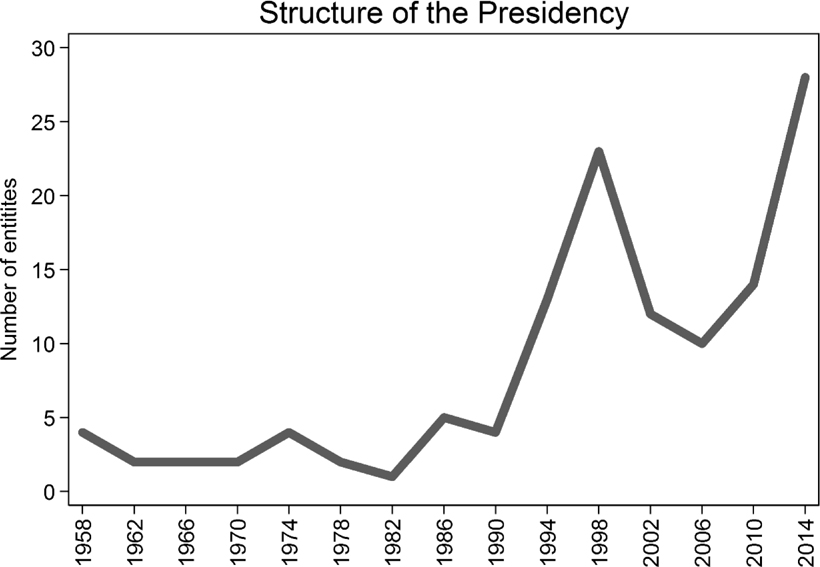
Figure 1 shows the evolution of the internal structure of DAPRE, measured by its number of units. From 1958 until 1991, this arrangement remained relatively stable. However, after 1991, the administrative department began acquiring a more dynamic structure, increasing the number of entities.
Internal Structure of DAPRE, 1958–2015

The internal structure of DAPRE has an average duration of 6.4 years, and persists for 2.5 presidential periods. This means that nearly every incoming president accommodates the internal structure of DAPRE to his needs.
Empirical Strategy
To test the hypotheses, we use an original dataset that contains information about the evolution of the presidential center in Colombia. We also assembled a dataset with information about the president’s cabinet composition. These exercises allowed us to create a time-series database for the 1967–2015 period that focuses in the transformations of agencies related to the executive office of the president, cabinet allocation, and legislative support. Our dataset contains 94 biannual observations. Given the structure of the data, we use time-series regression methods.
A time-series is a sequence of values of a variable measured along a temporal dimension. Time-series models are used when the purpose of the analysis is to understand the fundamental forces and structure that produced the observed data, to study the relationships among the current and past values of one variable over time, and to study dependence among a set of variables at different points in time. The last application provides the necessary elements to understand and explain the dependence between the explanatory variables (cabinet allocation and legislative support) and the dependent variables (the number of units under the umbrella of the executive office of the president and the decrees that assign functions to units in that office).
The underlying assumption for time-series data is that all series are stationary, which implies that the series have constant mean and variance for the entire period under observation. Nonstationary series are problematic in two ways. First, changing mean and variance make the regression results nongeneralizable to other periods of time. Second, the regression results may be spurious. A stationary series is said to be integrated of order zero, while a nonstationary series—or of unitary root—is integrated of order d, entailing that it needs to be differentiated d times to transform it into a stationary series (Gujarati Reference Gujarati2004).
Before estimating a model that allows us to test our hypotheses, we evaluated whether the variables (series) under analysis behaved under the stationary assumption or whether they were of unitary root. Visual inspection as well as formal tests let us find that the individual vectors, as well as the whole system of variables, are nonstationary.Footnote 5 These procedures also showed that, given that all the stochastic processes are integrated of order one I (1), the nonstationarity can be removed using first differences of all the variables in the regression model. Hence, the specification that will be used to test the hypotheses is
 ${y_t} = {\beta _0} + {\beta _1}{\rm{ cabinet allocatio}}{{\rm{n}}_t} + {\beta _2}{\rm{ }}legislativesuppor{t_t} + \delta C + {\xi _t}$
where yt is each one of the dependent variables on semester t, explained by the variables cabinet allocation and legislative support, and C is a set of controls that includes a dummy for the new constitution, a dummy for the first period of a new government, and the operational budget of the executive office of the president.Footnote 6 All variables are taken as first differences in order to avoid spurious regression problems (Gujarati Reference Gujarati2004).
Dependent Variables
To test our hypotheses, we use two different dependent variables that try to capture internal variation of the presidential center in two distinct ways.
Agencies ascribed to the executive office of the president (agencies). This variable is defined as the number of units, namely Presidential High Advisory Offices, Presidential Advisory Offices, Presidential Programs, and Presidential Directions, all under the umbrella of the presidential office at any given time t.
Decrees that assign functions to units within the executive office of the presidency (decrees). This variable is defined as the number of presidential decrees that assign specific functions to units in the presidential office to monitor or control ministries. Specifically, we considered decrees that gave said units the power to monitor, oversee, or coordinate the activities performed by ministries. We built this new variable by reviewing presidential decrees that increased monitoring functions of units in the executive office of the president. Presidents use these rules to constrain the flexibility of the ministries and reduce the potential information asymmetries between them and the ministers.Footnote 7
Explanatory Variables
Following the theory of coalitions previously described, the president makes a partisan-based allocation of the cabinet in response to the legislative support received through coalitions made with other parties. However, this allocation may entail information costs and asymmetries to the president because of the loyalty and party discipline of the ministers aligned with their own party’s priorities and agenda rather than the president’s. The cabinet database was used to create the explanatory variable cabinet allocation as a proxy to measure information asymmetries. This variable measures the percentage of ministers at time t affiliated with other parties. We understand as “other parties” any party different from the president’s party, whether or not it belongs to the formal government coalition. As stated, given that cabinet allocation implicitly captures agency risks due to partisanship, it is expected to have a positive relationship with the two dependent variables. That is, politically heterogeneous cabinets are expected to produce more changes to the structure of the presidential center.
Using historical results of congressional elections, it was possible to calculate the president’s contingent in both chambers for the periods studied. Thus, the independent variable legislative support represents the percentage of seats held by the president’s party in the lower chamber of Congress. As explained, we suggest that other studies that find positive effects of legislative support may be biased because of the omission of a third covariate: agency risk in the president’s cabinet. Therefore we would expect that any effect of this variable will be reduced and disappear after including cabinet allocation in the model.
Three control variables were included. A dummy variable 1991 Constitution was created to identify the periods before and after the 1991 Constitution. This constitutional change drastically modified the structure of the Colombian state, granting the presidential office greater involvement in social and public issues and consequently increasing the functions of the presidential center. The executive office of the president is thus expected to have a more robust structure after the 1991 Constitution was implemented.
The second control variable, new government, is included to account for the effect of the reformist impetus of incoming presidents. This dummy variable takes the value of 1 for the inaugural semester of each president, and 0 otherwise. When presidents take office, they unfold their government plan and reveal priorities that will mark the public policy agenda during their tenure. The plan must be executed in coordination with all other state agencies, so it is not surprising to see the structure of the executive office of the president change in accordance with the governmental plan unfurled at the beginning of each presidential term.
We also include the control for the budget allocated to the bureaucracy. This variable allows us to control for whether or not the executive office of the president grows as a result of patronage. The budget allocated to public organizations in Colombia simultaneously contemplates two major lines: investment and operations. The investment budget corresponds to the expenses concerned with the generation of public policy, while the operating budget comprises the expenditures required to keep the public organizations working. A typical operational budget includes salaries and labor costs, utilities, rents, and so on. An increase in operating expenditure over investment spending could indicate that the organization is prioritizing bureaucratic patronage rather than the implementation of public policy. Henceforth, for analytical purposes, operational budget will be presented as the percentage of the total budget of the executive office of the president that corresponds to operation. By including this variable, we intend to control for any effect produced by mere thickening of the payroll—due to patronage—and utilities costs.
Results
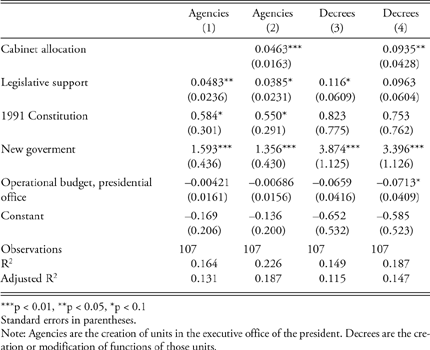
Table 1 presents the results of the models estimated on both dependent variables, number of offices in the presidential center (agencies) and number of decrees that grant oversight functions to DAPRE’s units (decrees). We stated earlier that studies that focus exclusively on legislative support may bias their estimations because they omit the agency problem. To determine if legislative support is a robust predictor of modifications of the presidential center, we estimate separate models with and without our main variable of interest (cabinet allocation). Thus, table 1 presents the results of four models, two for each dependent variable; one with cabinet allocation and the other without.
Regression Models

*** p < 0.01
** p < 0.05
* p < 0.1
Standard errors in parentheses.
Note: Agencies are the creation of units in the executive office of the president. Decrees are the creation or modification of functions of those units.
All models display a similar behavior: both the cabinet allocation and the first semester of government are significant for the creation of offices and the creation or modification of functions of different presidential offices. The magnitude of the effects of these variables is quite considerable. For instance, considering cabinet allocation, the model suggests that a 25 percent increase in the appointment of ministers from parties different from the president’s is related to the creation of a little more than one additional office in the executive office of the president.Footnote 8 Twenty-five percent of the cabinet is about four portfolios, given that the average cabinet size for the entire period is 13.5 portfolios. This result confirms the central hypothesis of this study: having ministers with partisan agendas different from the president’s encourages the creation of new offices and new structures in the presidential center, so as to appoint loyal and trustworthy advisers to counter the information asymmetries and challenges the president may face. In other words, the size of the executive office of the president expands as a means to control the possible agency drift of cabinet ministers who belong to other political parties.
Similarly, a 25 percent increase in the number of ministers affiliated with parties different from the president’s leads to the production of 2.3 new decrees to monitor or control ministries.Footnote 9 Therefore, presidents not only protect themselves from potential agency drift by creating additional agencies, they also issue decrees that grant them greater power to curtail the ability of ministers to guide policy decisions. This result provides further evidence in favor of our hypothesis that the percentage of ministers from other parties is positively related to the president’s changes in the structure of the executive office.
Our strategy of estimating models with and without cabinet allocation pays off, as can be observed by the behavior of the variable that measures legislative support. Overall, the models that include cabinet allocation fit the data better. The adjusted R2 increases by about 3 to 5 percentage points in both models, which suggests a better model specification. Furthermore, in the models that estimate the creation of agencies (columns 1 and 2), the significance level for the legislative support estimator decreases from 5 percent to 10 percent when the agency risk proxy is included. In the models that estimate the production of decrees (columns 3 and 4), the variable legislative support loses statistical significance with the inclusion of cabinet allocation. These results offer evidence in favor of our argument about omitted variable bias in estimations that rely exclusively on legislative support. Thus, our evidence suggests that legislative support is not a robust predictor of changes to the executive office of the president.
In terms of our control variables, the dummy for the post-1991 period is statistically significant for the models that explain the creation of agencies in the presidential office. Thus, the model suggests that in the period following the 1991 constitutional reform, presidents created, on average, 0.5 additional offices, compared to presidents during the preceding era. As expected, the presidential office appears to be more robust as a result of the new constitution. However, for the models explaining the use of decrees to monitor ministers, this variable is not statistically significant.
The models also show that the first semester of each government is significant for the creation of offices and the production of decrees to control ministries. The variable new government is statistically significant in all models and has a notable impact on both dependent variables, agencies and decrees. The results suggest that in the first semester of a given government, presidents are expected to create an additional 1.3 new agencies in the presidential center. Likewise, presidents are expected to produce 3.4 new decrees to monitor or control ministers during their first semester in office.Footnote 10
Furthermore, the models suggest that the transformations to the executive office of the president do not respond to the pressures of an increased bureaucracy. The variable for the operational budget of the presidential office is not statistically significant in three of the four models and achieves statistical significance—albeit at the 10 percent level—only in the model that explains the creation or modification of presidential offices’ functions (column 4), which includes our measure of cabinet allocation. Substantively, the effect is small and negative, suggesting that bureaucratic pressure is not related to increases in the presidential office. The data seem to suggest, weakly, the opposite, as a larger operational budget appears related to a decrease in the number of transformations in the presidential office. Our dataset therefore does not let us find any clear relation between the behavior of the president’s office and bureaucratic expansion.
Conclusions
This article has tackled the question of the relation between the presidential center and the agency risks the president takes when appointing ministers from other parties. The empirical strategy suggests that coalitional cabinets entail high dangers of bureaucratic drift, which force the executive not only to enlarge the presidential center but to create and modify the functions of its related agencies.
For the case studied, the analysis of the decrees that alter these functions shows that the presidency explicitly asks its bureaucrats to supervise, and in many cases intervene in, the ministers’ work. Additionally, the regression analysis shows that legislative support does not seem to be a robust predictor of the president’s decisions related to the organization of the executive office of the president. At the same time, our statistical model suggests that bureaucratic enlargements—observed through the operational expenditure—do not explain the variation in the number of agencies in the presidential center or the number of functions to control ministers.
This work is a first approach to the understudied behavior of Latin American presidential offices, as well as the organizational strategies used by the executive to mitigate risks produced by information asymmetries. We assert that the Colombian presidential center presents itself as a valuable case for study, given the country’s long democratic history and the large variation in the structure of the executive office of the president and the party system in the last 50 years. Further research is necessary to disentangle the specific mechanisms presidents use to monitor and control their ministers in the presence of the danger of ideological or partisan drift.
As Polga-Hecimovich and Trelles (Reference Polga-Hecimovich and Trelles2016) highlight, there are few studies with valuable information on the development and evolution of public agencies and the role that political actors have in the agencies’ administrative reorganizations. This article has contributed to testing how theory in bureaucratic politics applies to Latin America, and specifically to understand how the Office of the President in Colombia has historically undergone transformations in its internal structure as a result of a rational decision by the president.