




No CrossRef data available.
Alliances, Imperfect Markets, and Major-Power Trade
Published online by Cambridge University Press: 01 October 2004
Abstract
The “new” trade theory and standard trade theory make different predictions about the composition and distribution of trade flows. Empirical evidence suggests that an increasing share of international trade consists of differentiated products, a consequence of increasing returns to scale. Nonetheless, the existing political science literature typically assumes that the conditions of standard theory hold. As such, the literature ignores the dynamic-inconsistency problem that imperfect markets can create. In doing so, it also ignores the fact that imperfect markets can shift the political prerequisites of open international markets. In this article we examine these shifts. We argue that alliances can support an optimal level of trade when scale economies rather than differences in relative factor endowments motivate it. Our empirical results support this argument, indicating that alliances exert a stronger influence on trade in goods produced under conditions of increasing rather than constant returns to scale.Earlier versions of this article were presented at the 2002 Annual Meeting of the American Political Science Association, Boston; the 2002 Annual Convention of the International Studies Association, New Orleans; and seminars at the University of Chicago (PIPES), the University of Colorado, Cornell University, Dartmouth College, New York University, the University of Pennsylvania, and Yale University. For helpful comments and suggestions, we are grateful to participants in these seminars and to Regina Baker, Bruce Bueno de Mesquita, William Clark, Benjamin Cohen, Christina Davis, Eric Fisher, Avery Goldstein, Stephen Kobrin, Lisa Martin, Patrick McDonald, Helen Milner, Robert Powell, Dan Reiter, Anne Sartori, Branislav Slantchev, and Beth Yarbrough. We are also grateful to Regina Baker and Patrick McDonald for research assistance.
Information
- Type
- Research Article
- Information
- Copyright
- © 2004 The IO Foundation and Cambridge University Press
To explain recent trends in both the composition and distribution of trade, economists have increasingly turned to what has come to be called the “new” trade theory. As it assumes that production exhibits scale economies, this theory also assumes that imperfect markets exist. In contrast, standard trade theory assumes that constant returns to scale characterize production and that markets are perfectly competitive. Despite the increasing salience of the new trade theory, almost all studies of the political foundations of international trade remain premised on standard theory.1
For a notable exception, see Yarbrough and Yarbrough 1992.
See, for example, Conybeare 1984 and 1987; Gowa and Mansfield 1993; Gowa 1994; Keohane 1982 and 1984; and Pahre 1999.
When the conditions of the new trade theory hold, however, an efficient level of trade can require the resolution of both a PD game and a dynamic-inconsistency problem. When production exhibits scale economies, a firm's ex ante and ex post incentives to produce for export may diverge. Ex ante, a firm can realize larger profits if it produces for export than if it produces exclusively for domestic consumption. If doing so locks the firm into a bilateral monopoly, however, the firm becomes vulnerable to ex post attempts to renegotiate the division of the surplus. Thus, absent some mechanism to resolve the time-inconsistency problem, the level of international trade will be suboptimal.
In this article, we argue that alliances can help to achieve an efficient level of trade. Alliances raise the salience of a small set of relatively homogenous markets, enabling firms to coordinate their exports on these markets. The impact of these exports on national welfare can be large enough to attract the attention of both home and destination governments. If the latter are allies, their stake in joint-welfare maximization endows them with an interest in deterring efforts to renegotiate the surplus that bilateral monopolies create.3
See Gowa and Mansfield 1993; and Gowa 1994. It is important to note, however, that alliances are not the only means of solving this coordination problem. As we discuss below, some preferential trading arrangements (PTAs) can also do so.
This argument generates three hypotheses that we test in the second half of this article: (1) alliances promote trade; (2) the impact of alliances increases with the share of trade that scale economies motivate; and (3) alliances have a more pronounced influence on trade in goods subject to increasing returns to scale (IRS) than on trade in constant-returns-to-scale (CRS) goods. To test the first two hypotheses, we use data on aggregate bilateral trade flows between the major powers from 1907 to 1991.4
As we explain below, both the availability of data and existing scholarship dictate an analysis of major-power trade flows.
To test whether alliances exert a larger impact on trade in IRS products than on trade in CRS goods, we use industry-level data compiled by the United Nations Conference on Trade and Development (UNCTAD). To our knowledge, this is the first study to use these data to examine the political determinants of international trade. In combination with recent work that distinguishes industries on the basis of whether their production processes exhibit scale economies, the UNCTAD data allow us to analyze trade in IRS and CRS goods separately. Doing so makes clear that alliances exert a stronger effect on trade in IRS than in CRS goods.
Immediately below, we explain the new trade theory, the changing composition and distribution of trade, and the dynamic-inconsistency problem. Next, we explain the role that alliances can play in resolving this problem. Finally, we examine the data and present our findings.
The New Trade Theory
Standard trade theory assumes that constant returns to scale characterize production processes—that is, unit costs do not change with output. As such, market entry is free, a prerequisite of perfect competition. Given this market structure, standard theory predicts that cross-national differences will drive trade. In its Heckscher-Ohlin variant, gains from trade exist because both the factor intensities of goods and the relative factor endowments of countries differ. In the nineteenth century, for example, the United States was, relative to Great Britain, land abundant and capital scarce. As a result, the United States exported cotton to Britain and Britain exported textiles to the United States.
The assumptions of standard theory have several implications for the distribution and composition of trade. First, they imply that trade will increase with the divergence between relative factor endowments, which cross-national differences in per capita incomes reflect. Second, because factor intensities vary more widely across than within industries, countries will engage in inter-industry trade—that is, they will exchange the products of different industries. Thus, for example, Germany will sell widgets to and buy cocoa beans from the Ivory Coast.
Different predictions emerge from what has come to be called the new trade theory.5
It assumes that rising incomes generate a demand for product diversity. It also assumes that production processes exhibit increasing returns to scale—that is, the average cost of production drops as output expands.6Hummels and Levinsohn 1993, 445. Scale economies can exert large effects on production costs. Some studies find that a 1 percent increase in output leads to a 0.15 to 0.20 percent fall in unit production costs. Helpman 1999, 140. As Antweiler and Trefler point out, if costs decrease by 0.13 percent for every 1 percent increase in output, a firm operating at 10 percent of the output level of a U.S. firm would face 55 percent higher average costs. Antweiler and Trefler 2002, 107.
As such, the new trade theory makes very different predictions about the composition and distribution of trade than does the Heckscher-Ohlin model. Because firms within the same industry produce different products, the factor content of goods need not vary as a function of the country of origin. Consequently, trade can flourish between countries with relatively similar factor endowments. Moreover, trade can occur within rather than across industries.7
For example, China might export low-end cars to the United States and import luxury cars from it. In addition, this theory suggests that states with high per capita incomes will trade extensively, because differentiated products tend to be both luxury goods and capital intensive in production.8For a more extended discussion of these assumptions, see Bergstrand 1990.
The new trade theory developed in part to explain shifts in trade patterns across time. During the nineteenth century, most trade conformed to the predictions of the Heckscher-Ohlin model. Studies of global trade during the 1800s find that relatively capital-abundant countries exported manufactured goods and imported primary products.9
Kenwood and Lougheed 1992, 91, 213–14.
See Crafts and Thomas 1986; and Wright 1986 (both of which are cited in O'Rourke and Williamson 1999, 66).
O'Rourke and Williamson 1999, 4.
The advent of World War I disrupted international trade, as did the Great Depression that followed. World War II did so as well, precipitating large shifts in domestic resource allocations and attempts to embargo the trade of belligerent countries. Trade in manufactured goods dropped from about 11 percent of world output in 1913 to about 8 percent in 1950 but had declined even further at points in the interwar period.12
Nelson and Wright 1992.
Milward 1992, 129. Milward also observes that there exists no other period of “similar length in European history” where purchasing power grew as rapidly as it did in these years. Ibid., 11.
The robust income growth that occurred during the early postwar period created strong incentives for private investment in research and development.14
Foreman-Peck 1983, 292.
See Maizels 1963, 45; and Tussie 1987, 143. In the case of high-technology goods, it can be difficult to separate out empirically the effects on cost of scale economies and process innovations, given the association between innovation and plant size. See Antweiler and Trefler 2002, 27.
Maizels 1963.
The result, as Milward observed of Western Europe, was that trade “increasingly took the form of train loads of manufactures destined for one national market passing train loads of exports of almost identical products going in the reverse direction.”17
Milward 1992, 124.
Grubel and Lloyd 1975, 41.
Helpman 1998, 581, 573.
It is precisely because standard trade theory cannot explain large flows of trade between countries with similar factor endowments that the new trade theory emerged.20
It is important to note that differences in relative factor endowments can also generate intra-industry trade, as factor intensities can vary widely not only across but also within industries. Nonetheless, differences in factor proportions can explain increases in intra-industry trade only if the factor endowments that characterize the principal trading countries have become more disparate across time. As Deardorff points out, however, this seems to be exactly the opposite of what has occurred in the postwar period. Deardorff 1984, 502.
See, for example, Brown 1995.
Scale Economies, Sunk Costs, and Free Trade
Increasing returns to scale often arise as a consequence of fixed costs—that is, the costs, independent of output, which a firm must bear to operate.22
Tirole 1988, 307.
Scale economies that are external to the plant but internal to the industry can also exist. In this case, markets remain perfectly competitive. Thus, we limit our analysis to cases in which IRS arise at the firm level. In these cases, large firms produce more efficiently than small firms, creating imperfectly competitive markets. Krugman and Obstfeld 2000, 121–22.
Dixit 1992, 108. In practice, the period of time in which costs are sunk varies, so irreversibility endures for the period in “which the cost of being freed from the commitment … is sufficiently high that it does not pay to be freed.” Tirole 1988, 308.
Irreversible investments are commonly made to support international trade.25
Freund and McLaren 1999, 19.
Ibid.
Yarbrough and Yarbrough 1992, 71.
While exporting can allow firms to realize scale economies in production that they could not otherwise achieve, exploiting this option can also be risky. Ex ante, a firm has a wide array of alternative investment and production opportunities available to it. Ex post, however, the firm locks itself into a bilateral monopoly whenever its investment is to some degree “specific to an export destination, in the sense that the investment could not realize its full value if access to that export market was removed.”28
McLaren 1997, 402.
A bilateral monopoly, of course, also endows the exporter with the ability to renegotiate. The reservation points of each firm will determine the bargaining outcome. What matters here is that the prospect of renegotiation lowers the incentive of a firm to invest in exporting.
It is possible for the firms themselves to create some mechanism to deter ex post opportunism. Indeed, one reason that multinational corporations exist is to internalize transactions that cannot be efficiently executed at arms length. Short of cross-border integration, firms can also post bonds or create hostages to insure themselves against holdup attempts. Both attempts to forestall renegotiation create a risk of moral hazard, however.30
In addition, they raise the cost of producing for export. As a result, decentralized markets will generate a suboptimal domestic resource allocation and a Pareto-inferior level of international trade.If firms can coordinate their decisions to produce for export, they may be able to resolve this dynamic-inconsistency problem. Because firms produce differentiated products, coordination need not adversely affect their expected profits but can enhance their ability to secure them. When a large number of domestic firms make sunk-cost investments to export to another market, their aggregate profits can be sizeable enough to have a noticeable effect on the welfare of their home country. Because their exports also benefit the importing country, the same is true of its government. Coordinating on the markets of allied countries can be especially appealing to firms, we argue below, as it permits them to reduce the costs of contract enforcement.31
Our focus on this coordination problem distinguishes our work from that of Yarbrough and Yarbrough, who examine why different institutions are required to support different types of trade. Yarbrough and Yarbrough 1992, 35.
Alliances, Scale Economies, and Free Trade
Any mechanism that allows firms to coordinate their decisions has to make salient a small set of relatively homogenous foreign markets. Intra-industry trade occurs among countries with relatively similar factor endowments and relatively high levels of per capita income. As such, the countries that any mechanism distinguishes must be relatively wealthy, and their capital-labor ratios must be relatively similar. We argue that some, but not all, political-military alliances can single out a set of countries that is highly conducive to the flow of intra-industry trade.
Among all possible alliances, those that involve major powers seem to satisfy these conditions particularly well. By definition, the number of major powers in any international system is small. Any alliance among them will, therefore, involve even fewer members. In addition, major powers, by definition, tend to be relatively abundant in capital and, as a result, to have relatively high levels of per capita income. Major-power alliances, therefore, satisfy the constraints on both size and homogeneity that are necessary to allow firms to coordinate on particular export markets.
Whether or not limited to major powers, alliances also reduce the risks associated with sinking costs into export production. Because the potential military strength of any alliance increases with the aggregate economic resources of its members, the welfare of each state depends directly on the real income of its allies. As a result, the governments of allied countries have strong incentives to sustain an efficient level of trade between them. This, in turn, generates a mutual interest in precipitating and sustaining the trade that results from sunk-cost investments.
In other situations, countries can have exactly the opposite incentives. When a conflict of interest arises between states, the threatened or actual abrogation of the trade that bilateral monopolies create can be especially appealing. Disrupting this trade is sometimes the only way either government can impose potentially significant trade-related costs on the other, although doing so also inflicts costs on domestic producers. When the United States embargoed wheat exports to the former Soviet Union in 1980, for example, the U.S.S.R. turned to other supply sources. The Soviets had no recourse, however, when the U.S. government broke existing contracts in other areas. After granting Ingersoll-Rand an export license to produce an assembly line specifically for the Soviet Kama River Truck Plant, for example, the U.S. government embargoed its export less than a week before its ship date. Similarly, a U.S. embargo on phosphate exports to the Soviet Union left Occidental without a comparable market for the output of a $400 million facility it had built specifically to meet Soviet demand for super phosphoric acid.32
Goldstein 1984, 183, 190.
During the Cold War, for example, the U.S. government imposed a series of controls on exports to Warsaw Pact countries and passed a series of legislative acts that were intended to coerce conformity to the controls. Among these were the Export Control Act of 1949, Section 117(d) of the Marshall Plan, and the Mutual Defense Assistance Control Act of 1951, all of which threatened to impose economic sanctions on U.S. allies that violated these controls. DeSouza 1984–85, 96–97.
Thus, governmental incentives to protect or exploit relation-specific contracts vary with their political ties to other countries. In the case of adversaries, governments themselves can have stronger political incentives to abrogate than to secure contracts. This, of course, increases the risk that firms face when they contemplate sinking costs into production for export. In the case of allies, however, both the political and economic interests of governments typically drive them to reduce the gap between the ex ante and ex post incentives of prospective exporters. Thus, we expect alliances to foster trade between their members, as we have argued previously.34
For the reasons detailed above, we also expect these political-military coalitions to have a stronger impact on IRS trade than on CRS trade.We recognize, of course, that other international organizations, especially preferential trade arrangements (PTAs), can, in principle, also facilitate intra-industry trade. Yet, as in the case of alliances, not all commercial arrangements can do so. For example, the objective of both the World Trade Organization (WTO) and its predecessor, the General Agreement on Tariffs and Trade (GATT) was to maximize the number of members, guaranteeing heterogeneity among them.35
Yarbrough and Yarbrough make a somewhat different argument about the need for a relatively small group to enforce a trade agreement involving sunk-cost investments. They argue that the incentive-compatibility constraints that allow the group to function must apply to every country pair and that the “balancing of costs and benefits” this requires “may be difficult to accomplish with large numbers of participants.” Yarbrough and Yarbrough 1992, 75. They add that punishment in a multilateral organization is very costly, because it necessarily precipitates the renegotiation of the entire agreement in the event of any deviation from it.
Testing the Argument
We have argued that alliances promote the aggregate flow of trade between states. Because open trade increases the real income and thus the potential military strength of each participant, states are likely to trade more freely with their allies than with actual or potential adversaries. Moreover, we expect alliances to exert a stronger impact on IRS trade than on CRS trade. Unlike their counterparts in CRS industries, firms in IRS industries face a dynamic-inconsistency problem. Because alliances help to resolve this problem by providing a coordinating mechanism and a favorable political climate for investment, they should exert a particularly strong effect on trade motivated by scale economies.
To test our argument, we conduct three sets of analyses. Building on recent studies of the political economy of major-power trade during the twentieth century, we first estimate the impact of alliances on commerce and examine whether alliances exert a stronger effect on trade after World War II—when IRS trade became more prevalent—than before it—when countries exchanged mostly CRS goods. Second, we consider whether the effect of alliances on trade increases with the share of intra-industry trade in total trade. Finally, we compare the impact of alliances on IRS and CRS trade, using a data set covering much of the post-1945 period.
In each of these analyses, we seek to explain bilateral trade flows between states that were major powers during some part of the twentieth century. We focus on trade relations among major powers for three reasons. First and most important, reliable economic data simply do not exist for many other states, especially before World War II. Second, because several studies of the relationship between alliances and trade include only major powers, analyzing a sample composed of these states facilitates a direct comparison of our findings to those in the literature. Finally, major-power alliances should be particularly conducive to sunk-cost trade for reasons we outlined above.
In our initial analysis, we examine aggregate bilateral trade flows to assess whether alliances exert a positive effect on trade and whether that effect increases after World War II. To do so, we rely on the gravity model, the workhorse for empirical research on bilateral trade. The standard version of this model includes the gross national product (GNP) and population of both the importing and exporting country, as well as the geographic distance between them. The theoretical foundations of the model predict that trade will be directly related to GNP and inversely related to both population and distance.36
Anderson 1979; Bergstrand 1985 and 1989; and Deardorff 1998 have shown that the gravity model is consistent with a variety of different theories of international trade.
See, for example, Bliss and Russett 1998; Duffield 2002; Gowa 1994; Gowa and Mansfield 1993; Kim 1998, chap. 8; Mansfield, Milner, and Rosendorff 2000; and Morrow, Siverson, and Taberes 1998 and 1999.
Because the underlying form of the gravity model is multiplicative, it is estimated after taking the natural logarithm of each variable.38
The gravity model's multiplicative form has been justified in a number of ways. One intuitively appealing rationale is that as the national income or population of either i or j approaches zero, so should the amount of trade between them. Deardorff 1998.

The dependent variable—log exportij—is the natural logarithm of the value of exports from state i to state j in year t, expressed in constant U.S. dollars.39
In light of our argument, it would be useful to exclude trade in military goods. However, data limitations make this impossible. Nonetheless, there are data on the total amount of trade in military goods between most country pairs in our sample for four periods covered here: 1967–76, 1976–80, 1981–85, and 1987–91. See U.S. Arms Control and Development Agency 1983, 1994, and 1999. On average, military trade was only about 1 percent of total dyadic trade during these periods; only rarely did it approach 5 percent. Thus, little reason exists to believe that trade in military goods accounts for the results we report below.
In addition, we include log pre-wwii allyij and log post-wwii allyij to test whether alliances exert a stronger impact on trade when the share of intra-industry trade in total bilateral trade increases.40
For some recent studies of the role of scale economies in trade, see Antweiler and Trefler 2002; Davis and Weinstein 2001; and Helpman 1999.
Correlates of War Project 1993.
Next, log disputeij indicates whether i and j are engaged in a militarized dispute (MID) in year t−1. A MID exists when i or j threatens, displays, or uses force against the other. We code disputes using data taken from Jones, Bremer, and Singer and from Maoz.42
Further, log democracyij indicates whether both i and j are democracies in t−1. States are coded as democratic if they receive a score of six or higher on Gurr's index of institutionalized democracy, an 11-point scale ranging from zero (least democratic) to ten (most democratic).43 Note that each of the four dummy variables just described takes on values of 1 and 0; in antilogarithmic form they take on values of e (the base of the natural logarithms) and 1.As we explain further below, our analysis builds on a recent set of studies in which Morrow, Siverson, and Tabares analyze annual trade flows from 1907 to 1990 among France, Germany/West Germany, Great Britain, Italy, Japan, Russia/Soviet Union, and the United States.44
As in their work, we define similarityij as the taub correlation between the alliance portfolios of states i and j in year t−1. This variable can range from −1 to 1; but because its lowest observed value in our data is −0.475, we add 1.475 to similarityij so that its minimum value is 1 and the minimum value of log similarityij is zero. Further, Morrow, Siverson, and Tabares omit from their sample the periods when World Wars I and II were waged (that is, 1914–19 and 1939–47) on the grounds that little trade data are available for these years.45Morrow, Siverson, and Tabares 1998, 653.
Note that it is not possible to extend the analysis beyond 1991 because data on some of the independent variables analyzed here are unavailable.
In addition, we make three other changes to the model and data that Morrow, Siverson, and Tabares use. First, we correct various coding errors in their data set. Second, whenever possible, we replace missing data (described in the Appendix), markedly increasing the number of observations for which complete information exists. Third, Morrow, Siverson, and Tabares measure both log exportij and the independent variables described earlier in the same year, t. In contrast, we measure each independent variable (except log wwi and log wwii) in year t−1 to reduce the possibility of any simultaneity bias and to take into account the fact that trade patterns are unlikely to respond immediately to changes in political conditions.
Finally, Morrow, Siverson, and Tabares maintain that the Japanese-American Security Treaty is a unilateral rather than a mutual security guarantee. Thus, they do not consider it an alliance. A uniform application of this standard, however, would dictate the recoding of various other security agreements as well. For example, the North Atlantic Treaty Organization (NATO) was, for all practical purposes, a unilateral U.S. guarantee of European security throughout the Cold War. Moreover, the Japanese-American Security Treaty requires Japan to provide the United States with access to its bases in the event of a threat to East Asian security. Thus, it commits Japan to assist the United States whenever the latter believes such a threat exists.47
We are grateful to Christina L. Davis for pointing this out. The Japanese-American alliance includes the Japanese-U.S. Security Treaty (1951–60) and the subsequent Treaty of Mutual Cooperation and Security (1961–present).
Methods and Results
As noted earlier, our sample is made up of country-pairs that include France, Germany/West Germany, Great Britain, Italy, Japan, Russia/Soviet Union, and the United States. Each dyad, i and j, is measured twice in every year from 1907 to 1991, once where exports from i to j are evaluated, the other where exports from j to i are analyzed. The analysis of time-series cross-sectional data poses various well-known statistical problems. Particularly important is the danger that the error term (log εij) will be heteroskedastic as well as serially and contemporaneously correlated. Recent work suggests two ways to address serially correlated errors: either estimate the parameters using feasible generalized least squares (FGLS)—a technique that involves using ordinary least squares to estimate the coefficients and then purging the errors of serial correlation—or model dynamics in the data by including a lagged endogenous variable.48
Regardless of which approach is taken, researchers can generate “panel-corrected” standard errors that account for any heteroskedasticity and contemporaneous correlation of the errors across dyads.The available evidence indicates that there is generally no clear reason to privilege either approach.49
Beck and Katz 1996.
We have also examined whether our results are robust to our modeling decision. When we add to our model the value of log exportij in year t − 1, the effects of alliances are much the same as those based on FGLS. Thus, the effects of alliances do not depend on how we model dynamics in the data. However, including the lagged value of trade does change the effects of national income, population, and distance in unexpected ways. Similar problems have contributed to a general concern about using a lagged endogenous variable to model dynamics. Achen 2000. We return to this issue later.
It should also be noted that, as expected, the coefficient of variation based on FGLS tends to be much lower than that based on ordinary least squares (OLS) regression. Thus, whereas the adjusted R2 is .61 when our baseline model is estimated using OLS—a typical value for the gravity model—the adjusted R2s in Tables 1 and 2 are less than half that size.
Beck and Katz 1996, 14–15.
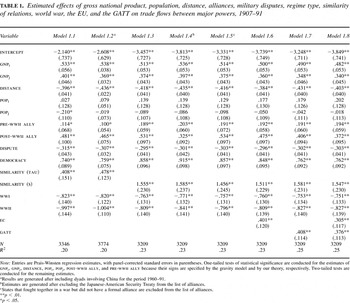
The FGLS estimates of equation (1), shown in the first column of Table 1, are consistent with our argument. Regardless of time period, the effects of alliances on trade are both positive and statistically significant.52
Note that one-tailed tests of statistical significance are conducted for the estimates of log gnpi, log gnpj, log distanceij, log popi, log popj, log post-wwii allyij, and log pre-wwii allyij since their signs are specified by the gravity model and by our theory, respectively. Two-tailed tests are conducted for the other estimates.
The quantitative effect of alliance membership after World War II, based on the estimates in the first column of Table 1, is given by eβ6 − 1β6 = e.481 − 1 = .62. The corresponding effect for alliances in the preceding era is eβ7 − 1β7 = e.114 − 1 = .12.
Estimated effects of gross national product, population, distance, alliances, military disputes, regime type, similarity of relations, world war, the EU, and the GATT on trade flows between major powers, 1907–91

Most of the other variables in our model also exert a strong impact on bilateral trade flows. As expected, trade is directly related to the national income of both states i and j; it is inversely related to the distance between them; and each of these relationships is statistically significant. As in Morrow, Siverson, and Taberes's studies, however, the effect of population is less consistent.54
Although the estimate of log popj is negative and statistically significant, the estimate of log popi is positive and insignificant.Further, we find considerable evidence that military disputes decrease trade, while democracy and similar alliance portfolios increase it. The estimate of log disputeij is negative; the estimates of log democracyij and log similarityij are positive; and all three are statistically significant. Finally, and not surprisingly, less trade occurred during the world wars than at other times. The effects of each world war on trade are negative, quantitatively large, and statistically significant.
It is important, of course, to assess the robustness of these results. First, some observers argue that, in addition to the seven countries included in our sample, China was also a major power during much of the twentieth century. Although reliable data on China's economy and trade patterns are in short supply prior to World War II, such data are available since 1960. We use this information to check whether our findings are robust to the inclusion of China as a major power. As the second column of Table 1 shows, including China has virtually no effect on the impact of alliances or any other variable in equation (1).
Second, we address whether our results are robust to the use of a different measure of foreign-policy similarity. Although Morrow, Siverson, and Taberes rely on the taub correlation between alliance portfolios to measure similarityij, students of international relations have recently begun to use a different measure of preference similarity, referred to as S.55
The third column of Table 1 presents the results when we replace taub with this index. In general, the results do not depend on which measure is used. It is worth noting, however, that the estimate of pre-1946 alliances is about two-thirds larger and much more highly significant in the third column than the first. Nonetheless, their impact continues to be significantly smaller than that of postwar alliances. In the remainder of this article, we use S rather than taub because doing so improves the fit of our model somewhat, various studies argue persuasively that S is a more valid index of foreign policy similarity than taub, and S is replacing taub with increasing frequency in the empirical literature. Nonetheless, the results rarely depend much on the specific measure of similarityij that we analyze.Third, we examine the impact of coding as an alliance the Japanese-American Security Treaty or any set of states that fought together in a war. There is little indication that these coding decisions have any substantial effect on the results. As the fourth column of Table 1 shows, the coefficient of each alliance term remains positive and statistically significant even if we do not code the Japanese-American agreement as an alliance. In addition, alliances continue to have a larger impact on trade after World War II than before, although omitting this agreement clearly reduces the magnitude of the effect of postwar alliances. Similarly, the fifth column of Table 1 indicates that the results are largely unaffected if we no longer regard states that fought together in a war as allies.
Fourth, we analyze whether the results are robust with respect to the inclusion of a number of variables that are omitted from equation (1). For example, many PTAs strongly influence trade flows.56
To ensure that the effect of alliances on trade is not an artifact of PTA membership, we add a dummy variable that indicates whether both states i and j are European Community (EC) members in year t−1. The EC is the only PTA relevant to the states in our sample, and including this variable is especially important because its members are also allies. Further, we include a dummy variable indicating whether both i and j are parties to the GATT in year t−1, because students of international relations generally believe that this institution fostered open trade among its members, many of which were also allied.57An exception is Rose, who argues that the GATT's effect on world trade is statistically insignificant. However, he finds that the GATT has had a significant effect on the bilateral trade of industrial countries. See Rose 2004 and forthcoming.
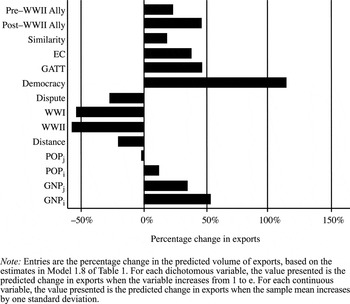
It is interesting that the effects on foreign commerce of both the EC and the GATT—institutions explicitly designed to promote trade among members—are no larger than the effects of alliances formed after World War II. Figure 1 shows the estimated impact of each independent variable in Model 1.8. For the dichotomous variables, we present the predicted change in exports when the variable increases from 1 to e. For the continuous variables, we report the predicted change when the sample mean increases by one standard deviation. Both post–World War II era alliances and GATT membership yield about a 45 percent increase in the predicted value of exports, whereas EC membership produces about a 35 percent rise in this value. In fact, while our argument does not depend on the magnitude of the effect of alliances relative to the control variables in our model, Figure 1 indicates that only democracy has a much larger influence on trade than post-World War II alliances. Even the effect of pre–World War II alliances—which, at 20 percent, continues to be noticeably smaller than that of alliances formed after World War II—is about the same size as distance, widely regarded as one of the most important determinants of bilateral trade flows.58

Estimated effects of political and economic factors on bilateral trade flows
Next, it is useful to ensure that the observed relationship between alliances and trade is not an artifact of any secular trend in both trade flows and the propensity of major powers to ally with each other. There is no evidence that our results are attributable to the effects of time. Including a trend in the model has very little effect on the signs, sizes, or significance levels of the coefficients in equation (1), and the estimate of this variable is not statistically significant.
In addition, for each country in our sample, we have included all available data from 1907 to 1991. However, the COW data set does not code occupied Germany (1946–54), Japan (1946–51), or France (1943) as members of the interstate system.59
To determine if foreign occupation influences our results, we introduce a dummy variable that equals 1 if either state i or state j is occupied in year t, and 0 otherwise. The estimate of this variable is neither statistically significant nor sizeable. Moreover, including it has no bearing on the other coefficients in the model.Finally, it is important to ensure that our results do not reflect the effects of trade flows on alliances. We therefore estimate a logistic regression in which the observed value of the dependent variable equals 1 if states i and j are allies in year t, and 0 otherwise. We regress this variable on log exportij, log gnpi, log gnpj, log popi, log popj, log distanceij, and log democracyij—all of which are measured in year t—as well as a natural spline function (with three knots) of the length of time since i and j were last allied to account for any temporal dependence in the data.60
Beck, Katz, and Tucker 1998.
See, for example, Mansfield and Bronson 1997a.
See, in contrast, Morrow, Siverson, and Taberes 1998.
Refining the Tests of Alliances and IRS Trade
Having generated some initial estimates of our model, we now adapt it slightly to increase its consistency with the empirical implications of our argument and to distinguish our predictions and results from those of earlier work on the relationship between alliances and trade. More precisely, we replace the two separate GNP terms with the log of the product of state i's GNP and state j's GNP. We also substitute for the separate population terms the log of the product of the per capita incomes of states i and j, expressed in constant U.S. dollars. Including per capita income instead of population in the gravity model yields functionally equivalent results and many previous studies have specified the gravity model this way.63
Frankel, Stein, and Wei 1997. Our earlier results are virtually identical when we estimate equation (1) using this specification.
Underlying our previous statistical analysis—based on equation (1)—was the argument that countries engaged in IRS trade to a much greater extent after World War II than beforehand. However, we now specify the gravity model as follows to provide a more direct test of our argument:

In equation (2), log allyij is a dummy variable that equals 1 if states i and j are allies in year t−1, regardless of whether that year is before or after 1946, and 0 otherwise. We include log allyij × log(per cap gnpi × per cap gnpj) to assess our claim that intra-industry trade is more extensive between allies than between other states.65
Note that this hypothesis implies that the coefficient of log allyij × log(per cap gnpi × per cap gnpj) should be positive.
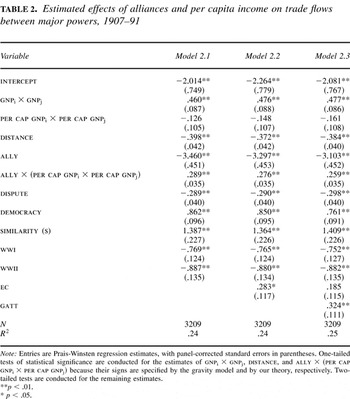
To test this hypothesis, we estimate equation (2) using FGLS. The results, shown in the first column of Table 2, indicate that each variable in the model except log(per cap gnpi × per cap gnpj) has a statistically significant effect on trade. In contrast to our earlier analysis, here we attach little importance to the estimate of log allyij. By itself, this variable indicates the effect of alliances when the logarithm of the product of the trading partners' per capita incomes equals zero, a highly implausible situation that does not exist in our sample. The results in column 1 of Table 2 also provide considerable support for our argument that allies trade significantly more with each other as the product of their per capita incomes increases.
Estimated effects of alliances and per capita income on trade flows between major powers, 1907–91

To more fully interpret these results, it is useful to compare the influence of alliances on the predicted volume of foreign commerce, varying the per capita incomes of states i and j. We begin by expressing equation (2) in antilogarithmic form:

where

For the purposes of this analysis, C can be treated as a constant. We use equation (3) and the estimates of β2, β4, and β5 in the first column of Table 2 to generate predicted values of exportij.
Our principal interest is in evaluating the effect of alliances as the per capita incomes of their members rise, promoting greater intra-industry trade. Initially, we assume that states i and j are allies. We therefore set allyij to e (and log allyij to 1) and compute the predicted value of exportij when the product of the per capita incomes of i and j is at its mean and again after increasing the mean of this variable by one standard deviation. Next, we assume that i and j are not allied. We set allyij to 1 (and log allyij to 0) and, as before, evaluate per cap gnpi × per cap gnpj at its mean value and then again at one standard deviation above its mean. The results indicate that the predicted volume of trade is about 120 percent higher between allies than between other states if the per capita income of the trading partners is set to the mean, a figure that jumps to almost 200 percent when per capita income rises by a standard deviation. Furthermore, increasing the per capita incomes of allies by a standard deviation increases the predicted value of commerce by about one-third, whereas the same rise in income for states that are not allies yields virtually no change in trade. Since the share of IRS trade in the total amount of trade a dyad conducts tends to increase with the per capita income of each of its members, these results are consistent with our argument that alliances exert a more powerful effect on IRS trade than on other types of foreign commerce.
We also address whether these results are robust to the inclusion of dummy variables for EC and GATT membership, because our earlier analysis indicated that these factors have an important influence on trade. As shown in the second and third columns of Table 2, both factors continue to promote overseas commerce, although the EC's impact on trade is no longer statistically significant once we account for GATT membership. Regardless, the effects of alliances and per capita income (as well as the other independent variables) are much the same, whether or not the EC and the GATT are included in the model.
While these analyses are quite suggestive, they rely on proxy measures of IRS trade. More precise measures are very difficult to find, given the dearth of reliable data on different types of trade spanning the entire twentieth century. However, UNCTAD has compiled bilateral trade data by three-digit Standard Industrial Code (SIC) between 1962 and 1991 that we can use to generate more direct evidence on the relationship between alliances and IRS trade.
To code industries included in UNCTAD's data set as IRS or CRS, we rely on estimates of scale elasticity computed by Antweiler and Trefler. In an analysis covering seventy-one countries between 1972 and 1992, they estimated the elasticity of scale for thirty-four industries that make up “virtually the entire tradable or goods-producing sector.”
66Antweiler and Trefler 2002, 95.
The IRS industries are petroleum and coal products, pharmaceuticals, electric and electronic machinery, petroleum refineries, iron and steel basic industries, instruments, machinery (nonelectrical), forestry, livestock, crude petroleum and natural gas, and coal mining. The CRS industries are apparel, leather, footwear, food, liquors, sawmill products, fishing, agricultural crops, textiles, and electricity. The indeterminate industries are vehicles, basic chemicals, pulp and paper, printing and publishing, plastic products, nonferrous metal products, metal products, rubber products, clay and cement products, glass products, pottery and china, furniture and fixtures, and tobacco. Antweiler and Trefler 2002, 105.


The dependent variable in equation (4) is the natural logarithm of the value of exports in IRS industries from state i to state j in year t, expressed in constant U.S. dollars. The dependent variable in equation (5) is the natural logarithm of the value of exports from i to j in CRS industries, also expressed in constant U.S. dollars. We define the independent variables in the same way as our earlier analyses.
Thus far, we have estimated the statistical models in this article using FGLS. However, Beck and Katz find that there are some statistical advantages to modeling dynamics in the data using a lagged endogenous variable as the sample size decreases.68
Beck and Katz 1996, 14–15.
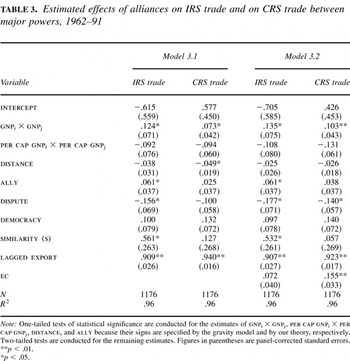
The results of these analyses are presented in the first and second columns of Table 3. With the exception of per capita income, the coefficients take on the expected signs, although some of the estimated effects are a bit weaker than in our previous analyses. Nonetheless, the results of these analyses provide considerable support for our argument. Alliances promote both IRS and CRS trade. The estimate of log allyij is positive in both models. However, the effect of alliances is larger in the case of IRS than CRS trade, and it is statistically significant only in the case of IRS trade.69
As before, we conduct a one-tailed test of the effect of alliances on trade because our model stipulates that the coefficient of log allyij should be positive.
Estimated effects of alliances on IRS trade and on CRS trade between major powers, 1962–91

It is important to recognize that the estimates of log allyij in Table 3 are not directly comparable to the estimated effects of alliances in Table 1 and 2. Unlike our earlier analyses, we have modeled dynamics in the data using a lagged endogenous variable in equations (4) and (5). Thus, the exogenous variables in these equations reflect the effects of current economic and political conditions on trade, while the lagged endogenous variables capture the effects of longer-term historical processes. Because trade flows are likely to be driven by both contemporary and historical forces, it is entirely appropriate to use this modeling strategy.70
Eichengreen and Irwin 1998.
Because the total effect of alliances in the present analysis can be viewed as the sum of an infinite series, it is given by β4/(1 − β8), which equals about 0.67 in the case of IRS trade and about 0.42 in the case of CRS trade.71
Consequently, allies conduct roughly 95 percent (e.67 − 1) more IRS trade than nonallies, but only about 50 percent (e.42 − 1) more CRS trade, a sizeable difference.72Note that, as expected, the size of these effects is essentially identical when we replace log(gnpi × gnpj) with log gnpi and log gnpj, and log(per cap gnpi × per cap gnpj) with log popi and log popj in equations (4) and (5).
We do not include a variable for GATT membership because, in our sample, it is perfectly collinear with democracy during the period from 1962 to 1991. Further, it should be noted that we also estimated equations (4) and (5) as a set of seemingly unrelated regressions. The results are very similar to those in Table 3.
These results should, of course, be interpreted cautiously, because they cover a limited period of time and depend on a particular assessment of industry structure.74
Antweiler and Trefler 2002.
Conclusions
The existing literature on the political foundations of international trade relies overwhelmingly on standard trade theory. In doing so, it ignores the implications of the new trade theory. Yet, the latter developed in part because of changes in trade patterns over time, especially the growth of intra-industry trade after World War II. While the microeconomic foundations of this trend are now well-established, relatively little is known about its political prerequisites and implications. In this article, we begin to redress this gap.
As we noted, scale-economy based trade can create a dynamic-inconsistency problem that does not arise when the conditions of standard trade theory hold. As a result, it calls into question the accuracy of the canonical representation of the free-trade problem as a PD game. Achieving a welfare-maximizing level of trade can require not only the elimination of formal trade barriers but also a solution to the time-inconsistency problem that arises when sunk cost investments create the risk of ex post contract renegotiation. We have argued that political-military alliances can help to secure the foundations of trade in a scale-economy based world, and our empirical analyses provide strong support for this claim.
Although our results are based on major-power trade flows, the implications of our argument are more general. For example, the increasing share of IRS in total trade may explain some of the recent trend toward bilateral trade agreements. It also may have led to a secular break in the relationship between trade and political-military conflict, a topic of continuing controversy. Most empirical studies assume that this relationship has been uniform across time. However, because trade disruptions are more costly when sunk-cost investments are at stake, trade may have had a stronger deterrent effect on conflict and conflict a weaker effect on trade after 1945 than earlier in the century, particularly in the case of wealthy countries. In short, good reasons exist for students of both international political economy and international security to take the new trade theory explicitly into account.
Appendix
The purpose of this Appendix is to describe the data on trade, national income, population, and distance used in our analyses. For each of these variables, we began with Morrow, Siverson, and Taberes's data, which are described in the appendix to their article.75
Morrow, Siverson, and Taberes 1998.
First, French exports to Japan from 1907–08 and from 1914–21 were taken from Japan's Department of Finance.77
Japan Department of Finance 1918 and 1924.
Clarke and Matko 1983.
See Japan Department of Finance 1918, 1924, and 1939; and Supreme Commander for the Allied Powers 1948.
Japan Department of Finance 1918, 1924, and 1939.
See Japan Department of Finance 1918, 1924, and 1939; Clarke and Matko 1983; U.S. Department of Commerce 1942; and U.S. Department of Commerce, Monthly Summary of Foreign Commerce of the United States.
Supreme Commander for the Allied Powers 1948–53.
See Japan Department of Finance 1918, 1924, and 1939; U.S. Department of Commerce 1942; and Clarke and Matko 1983.
U.S. Department of Commerce 1950.
Note that in cases where exports from state i to state j were not available but j's imports from i were available, the latter figure was used. In all cases, trade data denominated in foreign currencies were first converted into current U.S. dollars. The primary source for exchange rates was the U.S. Bureau of the Census.89
U.S. Bureau of the Census 1924, 1934, and 1947.
Bidwell 1970.
U.S. Bureau of the Census 1947.
See U.S. Bureau of the Census 1962 and 1996; and Liesner 1989.
To fill in data on national income, we relied primarily on Maddison.94
Maddison 1995.
To fill in data on national population, we again relied on Maddison.96
Maddison 1995.
Gregory 1982.
Clarke and Matko 1983.
Morrow, Siverson, and Taberes measure the distance between capital cities. When filling in missing observations, we rely on the values they report, except in the case of Germany. Berlin was treated as its capital from 1907 to 1948 and from 1990 to 1991. Bonn was treated as its capital from 1949 to 1989.
Finally, all of the data we added to Morrow, Siverson, and Taberes's data set on alliances and the similarity of states' foreign policy preferences (both taub and S) were taken from Eugene v2.001.100
Bennett and Stam 2000.
Maoz 2001.
References
REFERENCES
Achen, Christopher H.
2000.
Why Lagged Dependent Variables Can Suppress the Explanatory Power of
Other Independent Variables.
Paper presented at the Annual Meeting of the Political Methodology
Section of the American Political Science Association, July, Los Angeles,
Calif.
Anderson, James E.
1979.
A Theoretical Foundation for the Gravity Equation.
American Economic Review
69 (1):106–16.Google Scholar
Antweiler, Werner, and
Daniel Trefler.
2002.
Increasing Returns and All That: A View from Trade.
American Economic Review
92 (1):93–119.Google Scholar
Beck, Nathaniel, and
Jonathan N. Katz.
1995.
What to Do (and Not to Do) with Time-Series-Cross-Section Data.
American Political Science Review
89 (3):634–47.Google Scholar
Beck, Nathaniel, and
Jonathan N. Katz.
1996.
Nuisance vs. Substance: Specifying and Estimating
Time-Series-Cross-Section Models.
Political Analysis
6:1–36.Google Scholar
Beck, Nathaniel,
Jonathan N. Katz, and
Richard Tucker.
1998.
Taking Time Seriously: Time-Series-Cross-Section Analysis with a
Binary Dependent Variable.
American Journal of Political Science
42 (4):1260–88.Google Scholar
Bennett, D. Scott, and
Allan Stam.
2000.
EUGene: A Conceptual Manual.
International Interactions
26 (2):179–204.Google Scholar
Bergstrand, Jeffrey H.
1985.
The Gravity Equation in International Trade: Some Microeconomic
Foundations and Empirical Evidence.
Review of Economics and Statistics
67 (3):474–81.Google Scholar
Bergstrand, Jeffrey H.
1989.
The Generalized Gravity Equation, Monopolistic Competition, and
Factor-Proportions Theory in International Trade.
Review of Economics and Statistics
71 (1):143–53.Google Scholar
Bergstrand, Jeffrey H.
1990.
The Heckscher-Ohlin-Samuelson Model, the Linder Hypothesis, and the
Determinants of Bilateral Intra-industry Trade.
Economic Journal
100 (403):1216–29.Google Scholar
Bidwell, R. L.
1970.
Currency Conversion Tables: A Hundred Years of Change.
London:
Rex Collings.
Bliss, Harry, and
Bruce Russett.
1998.
Democratic Trading Partners: The Liberal Connection,
1962–1989.
Journal of Politics
60 (4):1126–47.Google Scholar
Brown, John C.
1995.
Imperfect Competition and Anglo-German Trade Rivalry: Markets for
Cotton Textiles before 1914.
The Journal of Economic History
55 (3):494–527.Google Scholar
Clarke, Roger A., and
Dubravko J. I. Matko.
1983.
Soviet Economic Facts, 1917–81.
2d ed. New York:
St. Martin's Press.
Conybeare, John A. C.
1984.
Public Goods, Prisoners' Dilemmas, and the International
Political Economy.
International Studies Quarterly
28 (1):5–22.Google Scholar
Conybeare, John A. C.
1987.
Trade Wars: The Theory and Practice of International Commercial
Rivalry.
New York:
Columbia University Press.
Correlates of War Project.
1993.
Alliances Data.
Unpublished data set,
University of Michigan,
Ann Arbor.
Crafts, N. F. R., and
Mark Thomas.
1986.
Comparative Advantage in UK Manufacturing Trade, 1910–1935.
Economic Journal
96 (383):629–45.Google Scholar
Davis, Donald R., and
David E. Weinstein.
2001.
What Role for Empirics in International Trade?
Working Paper 8543.
Cambridge, Mass.:
National Bureau of Economic Research.
Deardorff, Alan V.
1984.
Testing Trade Theories and Predicting Trade Flows. In
Handbook of International Economics, Vol. 1, edited by
Ronald W. Jones and
Peter B. Kenen,
467–517.
Amsterdam:
North Holland.
Deardorff, Alan V.
1998.
Determinants of Bilateral Trade: Does Gravity Work in a
Neoclassical World? In
The Regionalization of the World Economy, edited by
Jeffrey A. Frankel,
7–22.
Chicago:
University of Chicago Press.
DeSouza, Patrick J.
1984–85.
The Soviet Gas Pipeline Incident: Extension of Collective Security
Responsibilities to Peacetime Commercial Trade.
Yale Journal of International Law
10 (1):92–117.Google Scholar
Dixit, Avinash.
1992.
Investment and Hysteresis.
The Journal of Economic Perspectives
6 (1):107–32.Google Scholar
Duffield, John S.
2002.
International Institutions and Interstate Trade: Reassessing the
Effects of Alliances and Preferential Trading Arrangements.
International Politics
39 (3):271–91.Google Scholar
Eichengreen, Barry, and
Jeffrey A. Frankel.
1995.
Economic Regionalism: Evidence from Two 20th Century Episodes.
North American Journal of Economics and Finance
6 (2):89–106.Google Scholar
Eichengreen, Barry, and
Douglas A. Irwin.
1995.
Trade Blocs, Currency Blocs, and the Reorientation of World Trade
in the 1930s.
Journal of International Economics
38 (1–2):1–24.Google Scholar
Eichengreen, Barry, and
Douglas A. Irwin.
1998.
The Role of History in Bilateral Trade Flows. In
The Regionalization of the World Economy, edited by
Jeffrey A. Frankel,
33–57.
Chicago:
University of Chicago Press.
Foreman-Peck, James.
1983.
A History of the World Economy: International Economic Relations
Since 1850.
Totowa, N.J.:
Barnes & Noble.
France.
1919, 1924.
Statistique Generale de La France, Annuaire Statistique.
Paris:
Imprimerie Nationale.
Frankel, Jeffrey,
Ernesto Stein, and
Shang-Jin Wei.
1997.
Regional Trading Blocs in the World Economic System.
Washington, D.C.:
Institute for International Economics.
Freund, Caroline, and
John McLaren.
1999.
On the Dynamics of Trade Diversion: Evidence from Four Trade Blocs.
International Finance Discussion Paper 637.
Washington, D.C.:
Federal Reserve Board.
Gartzke, Erik.
1998.
Kant We All Just Get Along? Opportunity, Willingness, and the
Origins of the Democratic Peace.
American Journal of Political Science
42 (1):1–27.Google Scholar
Gartzke, Erik.
2000.
Preferences and the Democratic Peace.
International Studies Quarterly
44 (2):191–212.Google Scholar
Goldstein, Donald J.
1984.
East-West Trade, Technology Transfer, and Western Security. In
The Politics of East-West Trade, edited by
Gordon B. Smith,
159–74.
Boulder, Colo.:
Westview Press.
Gowa, Joanne.
1994.
Allies, Adversaries, and International Trade.
Princeton, N.J.:
Princeton University Press.
Gowa, Joanne, and
Edward D. Mansfield.
1993.
Power Politics and International Trade.
American Political Science Review
87 (2):408–20.Google Scholar
Greene, William H.
1993.
Econometric Analysis.
2d ed. Englewood Cliffs, N.J.:
Prentice Hall.
Gregory, Paul R.
1982.
Russian National Income, 1885–1913.
New York:
Cambridge University Press.
Grubel, Herbert G., and
P. J. Lloyd.
1975.
Intra-Industry Trade: The Theory and Measurement of International
Trade in Differentiated Products.
New York:
John Wiley.
Gurr, Ted Robert,
Keith Jaggers, and
Will H. Moore.
1989.
Polity II: Political Structures and Regime Change, 1800–1986.
[computer file] (study no. 9263).
Ann Arbor, Mich.:
Inter-university Consortium for Political and Social Research.
〈www.icpsr.umich.edu〉.
Helpman, Elhanan.
1998.
The Structure of Foreign Trade.
Working Paper 6752.
Cambridge, Mass.:
National Bureau of Economic Research.
Helpman, Elhanan.
1999.
The Structure of Foreign Trade.
The Journal of Economic Perspectives
13 (2):121–44.Google Scholar
Helpman, Elhanan, and
Paul R. Krugman.
1985.
Market Structure and Foreign Trade: Increasing Returns, Imperfect
Competition, and the International Economy.
Cambridge, Mass.:
MIT Press.
Hummels, David, and
James Levinsohn.
1993.
Product Differentiation as a Source of Comparative Advantage?
American Economic Review
83 (2):445–49.Google Scholar
Italy Central Office of Statistics (Ufficio Centrale de
Statistica).
1916.
Annuario Statistico Italiano, Seconda Serie.
Vol. VI. Roma:
Tip. Elzeviriana.
Jaggers, Keith, and
Ted Robert Gurr.
1995.
Tracking Democracy's Third Wave with the Polity III Data.
Journal of Peace Research
32 (4):469–82.Google Scholar
Japan Department of Finance.
1918, 1924, 1939.
Financial and Economic Annual of Japan.
Tokyo:
Government Printing Office.
Jones, Daniel M.,
Stuart A. Bremer, and
J. David Singer.
1996.
Militarized Interstate Disputes, 1816–1992: Rationale, Coding
Rules, and Empirical Patterns.
Conflict Management and Peace Science
15 (2):163–213.Google Scholar
Judge, George G.,
et al.
1985.
The Theory and Practice of Econometrics.
2d ed. New York:
John Wiley.
Kenwood, A. G., and
A. L. Lougheed.
1992.
The Growth of the International Economy, 1820–1990.
3d ed. New York:
Routledge.
Keohane, Robert O.
1982.
The Demand for International Regimes.
International Organization
36 (2):325–55.Google Scholar
Keohane, Robert O.
1984.
After Hegemony: Cooperation and Discord in the World Political
Economy.
Princeton, N.J.:
Princeton University Press.
Kim, Soo Yeon.
1998.
Ties That Bind: The Role of Trade in International Conflict
Processes,
1950–1992.
Ph.D. diss.,
Yale University,
New Haven, Conn.
King, Gary.
1989.
Unifying Political Methodology: The Likelihood Theory of
Statistical Inference.
New York:
Cambridge University Press.
Krugman, Paul.
1980.
Scale Economies, Product Differentiation, and the Pattern of Trade.
American Economic Review
70 (5):950–59.Google Scholar
Krugman, Paul, and
Maurice Obstfeld.
2000.
International Economics: Theory and Policy.
5th ed.
Reading, Mass.:
Addison Wesley.
Liesner, Thelma.
1989.
One Hundred Years of Economic Statistics.
New York:
Facts on File.
McLaren, John.
1997.
Size, Sunk Costs, and Judge Bowker's Objection to Free Trade.
American Economic Review
87 (3):400–20.Google Scholar
Maddison, Angus.
1991.
Dynamic Forces in Capitalist Development: A Long-Run Comparative
View.
Oxford:
Oxford University Press.
Maddison, Angus.
1995.
Monitoring the World Economy, 1820–1992.
Paris:
Organization for Economic Cooperation and Development.
Maizels, Alfred.
1963.
Industrial Growth and World Trade.
Cambridge:
Cambridge University Press.
Mansfield, Edward D., and
Rachel Bronson.
1997a.
Alliances, Preferential Trading Arrangements, and International
Trade.
American Political Science Review
91 (1):94–107.Google Scholar
Mansfield, Edward D., and
Rachel Bronson.
1997b.
The Political Economy of Major-Power Trade Flows. In
The Political Economy of Regionalism, edited by
Edward D. Mansfield and
Helen V. Milner,
188–208.
New York:
Columbia University Press.
Mansfield, Edward D.,
Helen V. Milner, and
B. Peter Rosendorff.
2000.
Free to Trade: Democracies, Autocracies, and International Trade.
American Political Science Review
94 (2):305–21.Google Scholar
Maoz, Zeev.
2001.
Dyadic Militarized Interstate Disputes (DYMID 1.1) Data Set.
Available at
〈http://spirit.tau.ac.il/poli/faculty/maoz/dyadmid〉.
Accessed 15 July 2004.
Milward, Alan S.
1992.
The European Rescue of the Nation-State.
London:
Routledge.
Mitchell, Brian R.
1992.
International Historical Statistics: Europe, 1750–1988.
3d ed. New York:
Stockton Press.
Mitchell, Brian R.
1995.
International Historical Statistics: Africa, Asia, and Oceania,
1750–1988.
2d ed. New York:
Stockton Press.
Morrow, James D.,
Randolph M. Siverson, and
Tressa E. Taberes.
1998.
The Political Determinants of International Trade: The Major
Powers, 1907–1990.
American Political Science Review
92 (3):649–61.Google Scholar
Morrow, James D.,
Randolph M. Siverson, and
Tressa E. Taberes.
1999.
Correction to “The Political Determinants of International
Trade.”
American Political Science Review
93 (4):931–33.Google Scholar
Nelson, Richard, and
Gavin Wright.
1992.
The Rise and Fall of American Technological Leadership: The Postwar
Era in Historical Perspective.
Journal of Economic Literature
30 (4):1931–64.Google Scholar
Nolde, Baron Boris E.
1928.
Russia in the Economic War.
New Haven, Conn.:
Yale University Press.
O'Rourke, Kevin H., and
Jeffrey G. Williamson.
1999.
Globalization and History: The Evolution of a Nineteenth-Century
Atlantic Economy.
Cambridge, Mass.:
MIT Press.
Pahre, Robert.
1999.
Leading Questions: How Hegemony Affects the International Political
Economy.
Ann Arbor:
University of Michigan Press.
Rose, Andrew.
2004.
Do We Really Know That the WTO Increases Trade?
American Economic Review
94 (1):98–114.Google Scholar
Rose, Andrew.
Forthcoming.
Which International Institutions Promote International Trade?
Review of International Economics.
Signorino, Curtis S., and
Jeffrey M. Ritter.
1999.
Tau-b or Not Tau-b: Measuring the Similarity of Foreign Policy
Positions.
International Studies Quarterly
43 (1):115–44.Google Scholar
Singer, J. David, and
Melvin Small.
1994.
Correlates of War Project: International and Civil War Data,
1816–1992.
[computer file] (study no. 9905).
Ann Arbor, Mich.:
Inter-university Consortium for Political and Social Research.
〈www.icpsr.umich.edu〉.
Small, Melvin, and
David J. Singer.
1982.
Resort to Arms: International and Civil Wars, 1816–1980.
Beverly Hills, Calif.:
Sage.
Supreme Commander for the Allied Powers.
1948–53.
Japanese Economic Statistics.
Tokyo:
Japanese Economic Planning Agency.
Tirole, Jean.
1988.
The Theory of Industrial Organization.
Cambridge, Mass.:
MIT Press.
Tussie, Diane.
1987.
The Less Developed Countries and the World Trading System: A
Challenge to the GATT.
London:
Frances Pinter.
United Nations.
1951.
Yearbook of International Trade Statistics, 1950.
New York:
Statistical Office of the United Nations.
U.S. Arms Control and Development Agency.
1983, 1994, 1999.
World Military Expenditures and Arms Transfers.
Washington, D.C.:
Government Printing Office.
U.S. Bureau of the Census.
1924, 1934, 1947, 1962, 1996.
Statistical Abstract of the United States.
Washington, D.C.:
Government Printing Office.
U.S. Department of Commerce.
1942.
Foreign Commerce Yearbook, 1939.
Washington, D.C.:
Government Printing Office.
U.S. Department of Commerce.
1950.
Foreign Commerce Yearbook, 1948.
Washington, D.C.:
Government Printing Office.
U.S. Department of Commerce.
Various years.
Monthly Summary of Foreign Commerce of the United States.
Washington, D.C.:
Government Printing Office.
World Bank.
Various years.
World Development Indicators.
Washington, D.C.:
World Bank.
Wright, Gavin.
1986.
Old South, New South: Revolutions in the Southern Economy Since the
Civil War.
New York:
Basic Books.
Yarbrough, Beth V., and
Robert M. Yarbrough.
1986.
Reciprocity, Bilateralism, and Economic “Hostages”:
Self-Enforcing Agreements in International Trade.
International Studies Quarterly
30 (1):7–21.Google Scholar
Yarbrough, Beth V., and
Robert M. Yarbrough.
1992.
Cooperation and Governance in International Trade: The Strategic
Organizational Approach.
Princeton, N.J.:
Princeton University Press.
Estimated effects of gross national product, population, distance, alliances, military disputes, regime type, similarity of relations, world war, the EU, and the GATT on trade flows between major powers, 1907–91
Estimated effects of political and economic factors on bilateral trade flows
Estimated effects of alliances and per capita income on trade flows between major powers, 1907–91
Estimated effects of alliances on IRS trade and on CRS trade between major powers, 1962–91
 You have
Access
- 78
- Cited by