Introduction
The inability to regulate and coordinate thoughts, actions, and perceptions has long been recognized as one of the hallmark characteristics of schizophrenia. More recently, researchers have begun to investigate the relationship between top-down and bottom-up information processing during cognitive control tasks (e.g., Green et al., Reference Green, Butler, Chen, Geyer, Silverstein, Wynn and Zemon2009; Hugdahl, Reference Hugdahl2009). For example, studies investigating dichotic listening have found that patients’ deficiencies in higher order cognition, such as attention and executive function, modulate a bottom-up driven bias in perceptual responses (for a review, see O'Leary, Reference O'Leary2003). These data highlight the interactive nature of deficiencies in bottom-up and top-down cognitive processing in schizophrenia (Hugdahl, Reference Hugdahl2009; Hugdahl et al., Reference Hugdahl, Løberg, Jørgensen, Lundervold, Lund, Green and Rund2008).
Nevertheless, there remains a paucity of literature on direct measures of patients’ ability to control their cognitive states. One principal reason is that it continued to be difficult for researchers and clinicians to quantify cognitive control in schizophrenia patients: During most assessments, the role of cognitive control is confounded by variations in the sensory features of conventional stimuli, which provide additional bottom-up information. For example, while guided search tasks evaluate top-down attentional control, they typically measure subject performance by altering the number and salience of distracters in an array (Nuechterlein, Luck, Lustig, & Sarter, Reference Nuechterlein, Luck, Lustig and Sarter2009).
When viewed passively, images such as the Necker cube induce ambiguous (bistable) percepts. Previous studies have found that observers can exert a degree of volitional control over their perceptual interpretation of the Necker cube (e.g., Peterson & Hochberg, Reference Peterson and Hochberg1983). The visual ambiguity created by the Necker cube may thus provide a platform for allowing volitional control to play a central modulatory role in perception.
Independence of visual modulation during assessment of cognitive control in schizophrenia is critical, as patients exhibit deficiencies on a wide range of visual perception tasks (e.g., Butler & Javitt, Reference Butler and Javitt2005; Chen, Bidwell, & Norton, 2006; Green et al., Reference Green, Butler, Chen, Geyer, Silverstein, Wynn and Zemon2009). At the same time, and because of these perceptual deficiencies, it is equally important to assess the role that bottom-up processing plays during cognitive control. Independent manipulations of top-down and bottom-up factors in a perceptual paradigm can, therefore, offer a unique opportunity for studying the mechanisms of cognitive control in schizophrenia.
The present study investigated perception of a Necker cube under conditions in which volitional control (top-down modulation) as well as visual stimulation (bottom-up modulation) facilitated one perceptual interpretation over another. We hypothesized that the ability to intentionally form and maintain a specific perceptual interpretation of the Necker cube would be compromised in patients. We also hypothesized that additional visual signals might differentially compensate for patients’ reduced ability, given that bottom-up visual information has previously been shown to offset patients’ underperformance on a visual search task (Gold, Fuller, Robinson, Braun, & Luck, Reference Gold, Fuller, Robinson, Braun and Luck2007).
Methods
Participants
Twenty individuals diagnosed with schizophrenia or schizoaffective disorder, as well as 20 healthy controls, participated. Clinical diagnoses were made by independent clinicians who were blind to the purposes of the study, using the SCID-IV (First, Spitzer, Gibbon, & Williams, Reference First, Spitzer, Gibbon and Williams2002). Inclusion criteria for both groups were: age 18–70, visual acuity of 20/40 or better, no recent history of drug or alcohol abuse, no neurological problems, and IQ > 70 as measured by the verbal subscales of the WAIS-R (Wechsler, Reference Wechsler1981). Groups were similar in terms of age and level of education: The average age of patients was 40.7 years (standard deviation [SD] = 16) and 40.3 years (SD = 10.5) for controls. The average education was 14.0 years for patients (SD = 2.4) and 15.5 years (SD = 2.4) for controls. Clinical status of patients was assessed using the Positive and Negative Syndrome Scale (PANSS) (Kay, Fiszbein, & Opler, Reference Kay, Fiszbein and Opler1987). All patients were receiving antipsychotic medication at the time of the study, the mean chlorpromazine equivalent equaling 443 mg (SD = 289 mg). Healthy controls were screened for absence of Axis-I psychiatric disorder using the SCID-IV. All human data included in this manuscript were obtained in compliance with IRB regulations of McLean Hospital.
Task and Procedures
Subjects viewed a Necker cube presented on a computer monitor. Before the test, subjects were asked to view the cube passively until the two possible perceptual interpretations of the Necker cube were recognized (i.e., until the bottom-left plane was perceived as being in the front, and also in the back). All subjects reported spontaneous reversals in this practice condition.
During each testing session, subjects verbally reported perceptual reversals—that is, when their perceptual interpretation of the stimulus switched—by saying “back” when the bottom-left plane perceptually reversed to the back of the cube and “front” when the bottom-left plane perceptually reversed to the front of the cube. To minimize the involvement of eye movement, which is aberrant in schizophrenia (e.g., Chen, Levy, et al., Reference Chen, Levy, Nakayama, Matthysse, Palafox and Holzman1999), subjects were instructed to focus on the fixation cross at the center of the image throughout the duration of each testing session.
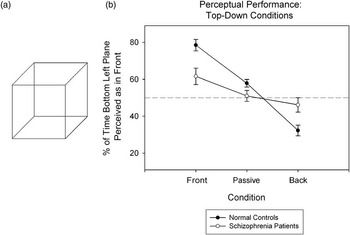
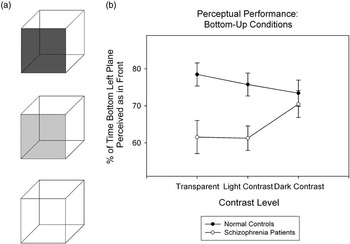
In total, the experiment comprised five testing sessions, each lasting 60 s with a 60-s resting period in between. For the baseline session, subjects were asked to passively view a transparent Necker cube (Figure 1A) and orally report when perceptual reversals occurred. For the two condition sessions comprising the “top-down” component of the experiment, subjects again viewed the transparent Necker cube and were instructed to keep a designated plane (the bottom-left plane) at the front or back of the cube as much as possible, and to report any perceptual reversals. Lastly, for the two additional sessions comprising the “bottom-up” component of the experiment, subjects viewed a variation of the Necker cube in which the bottom-left plane was shaded at two different luminance levels—lightly shaded and darkly shaded—and were instructed to keep this plane at the front of the cube as consistently as possible and to report any perceptual reversals (Figure 2A). Stimulus conditions were presented in a counterbalanced order across subjects.
Stimulus and results from top-down experimental conditions. A: Necker cube image used as the stimulus for the top-down component of the experiment. Subjects were asked to focus on a fixation cross and report whether the bottom-left plane appeared to be at the front or back of the cube. B: Results from the three conditions: (1) keeping the bottom-left plane at the front of the cube as long as possible, (2) passive viewing, and (3) keeping the bottom-left plane at the back of the cube as long as possible. The x-axis denotes the condition, while the y-axis represents the percentage of the time that the bottom-left plane was perceived as being at the front of the cube. Error bars represent ±1 standard error; the horizontal line demarcates chance level performance (50%).

Stimulus and results from bottom-up experimental conditions. A: Necker cube images used as stimuli for the bottom-up component of the experiment. Subjects were instructed to keep the bottom-left plane at the front of the cube as long as possible, and they were instructed to report whether the bottom-left plane appeared to be at the front or back of the cube. B: Results from the three conditions. The x-axis denotes the condition, while the y-axis represents the percentage of the time that the bottom-left plane was perceived as being at the front of the cube. Error bars represent ± 1 standard error.

Performance Measures
Three complementary measurements were used to assess subject performance on the task. The first of these—duration of dominance—was defined as the proportion of time that individuals perceived the bottom-left plane as being at the front of the cube during a given testing session. For the purposes of correlational analysis, an overall index of subjects’ success in maintaining the target percept (i.e., proportion of time subjects kept the bottom-left plane “at the back” of the cube when this was the task, and “at the front” of the cube when this was the task) was also calculated and was averaged across the conditions. Lastly, as a secondary measure of performance, alternation rate—defined as the number of perceptual reversals during a session divided by the total duration of the testing session (60 s)—was assessed. These indices measures were compared with assessments of general intelligence (IQ and years of education), clinical symptomatology and medication levels to evaluate potential theoretical relationships among these variables.
Results
Top-down Component of Experiment
A two-way mixed-model analysis of variance (ANOVA) was performed, with group (healthy controls versus schizophrenia patients) entered as the between-subjects variable and condition (a, keep the bottom-left plane “at the front” of the cube; b, keep the bottom-left plane “at the back” of the cube; c, passive viewing condition) as the within-subjects variable. The dependent performance measure here was duration of dominance. The main effect for condition was significant (F 2,117 = 43.33; p < .001; ηp2 = .54), indicating that the proportion of time that the designated plane was perceived as being “at the front” of the cube depended upon whether individuals were trying to keep this plane at the front or back of the cube, or were simply passively viewing the figure.
There was also a significant interaction between group and condition (F 2,117 = 11.21; p < .001; ηp2 = .23). This interaction was decomposed by condition, using two-sample t tests to clarify this result: In both of the active conditions, controls performed better than patients. When instructed to keep the bottom left plane at the front of the cube, the duration during which the bottom left plane was perceived in the front (connoting success at maintaining the intended percept) was greater for controls (t 38 = 3.05; p = .004; d = .92). When instructed to keep this plane at the back of the cube, the duration at which the bottom left plane was perceived in the front (connoting failure to maintain the intended percept) was greater for patients (t 38 = −2.82; p = .008; d = .54). On the passive viewing condition, the proportion of the time the designated plane was perceived at the front was similar in both groups (see Figure 1B).
For the secondary analysis, a two-way mixed-model ANOVA was run (group as the between-subjects factor and condition as the within-subjects factor), with the dependent measure set as the alternation rate. Neither the main effect for group nor for condition was significant, nor was the interaction between the two. These results indicate that alternation rate in a given condition did not differ significantly between patients and controls and that the task conditions did not have a differential effect on alternation rate in either group.
Bottom-Up Component of the Experiment
Another two-way mixed-model ANOVA was performed, with group as the between-subjects variable and condition (a, transparent bottom-left plane; b, light contrast bottom-left plane; c, dark contrast bottom-left plane) as the within-subjects variable. With duration of dominance as the dependent measure, there was a main effect observed for group (F 1,38 = 8.60; p = .006; ηp2 = .25), indicating that controls were more successful at keeping the bottom-left plane at the front of the cube. The main effect for condition was nonsignificant (p = .48; ηp2 = .02).
There was also an interaction between group and condition (F 2,117 = 3.45; p = .04; ηp2 = .09). Two-sample t tests revealed that controls outperformed patients when the designated plane was not shaded (t 38 = 3.05; p = .004; d = .96) and lightly shaded (t 38 = 3.17; p = .003; d = 1.13), but not when this plane was darkly shaded (t 38 = .57; p > .05; d = .20). Bonferroni-corrected post hoc paired t tests were also used to clarify how groups’ performance changed across the three conditions. Controls’ performance did not change significantly when moving from the transparent to the lightly shaded (p > .05; d = .20) or darkly shaded stimuli (p > .05; d = .16). Among patients, however, performance was significantly better with the darkly shaded stimulus as compared to the lightly shaded stimulus (t 19 = 2.68; p = .03; d = .61) (see Figure 2B).
A two-way mixed-model ANOVA, with the dependent measure set as alternation rate, showed no significant main effects for group or condition, and no interaction between the two.
Relationship Between Task Performance and Other Variables
Patients’ performance was not strongly associated with level of education, antipsychotic medication levels or negative symptomatology; however, on the bottom-up component of the experiment, there was a significant positive association between WAIS-R scores and task performance (r = .53; p = .02; R 2 = .289). In terms of clinical measures, associations between performance on the bottom-up component of the experiment and severity of positive and general symptomatology were nonsignificant at the 0.05 alpha-level; however, effect sizes were relatively large (R 2 = .168 and .176, respectively) and suggestive of negative associations.
Healthy controls’ performance was not significantly associated with their prior level of education, measured as number of years of schooling. For the bottom-up component of the experiment, the association between WAIS-R scores and performance was nonsignificant (r = .51; p = .06), although the effect size (R 2 = .26) is suggestive of a possible relationship.
Discussion
This study found that the ability to volitionally control the perceptual interpretation of a visually bistable image is compromised in schizophrenia, as indicated by a significantly reduced capacity to maintain the target percept (i.e., keep the bottom-left plane at the front vs. at the back). The results further suggest that this deficiency may be compensated for by additional bottom-up visual information.
Top-Down Component
When asked to keep a designated plane at the front or the back of the transparent Necker cube, patients on average were able to do so only 58% of the time, while controls could do so 73% of the time. This result is consistent with previous studies in which cognitive control in schizophrenia was found to be deficient, as assessed by visual attention (Nuechterlein et al., Reference Nuechterlein, Luck, Lustig and Sarter2009), cognitive inhibition (Henik & Salo, Reference Henik and Salo2004), and attentional set-shifting (Joyce et al., Reference Joyce, Hutton, Mutsatsa, Gibbins, Webb, Paul and Barnes2002). The top-down component of the experiment presented a novel and effective approach with robust results: This method allowed for inference as to patients’ capacity to execute top-down cognitive control without depending on manipulations in perceptual content, which often present experimental confounds.
Top-down cognitive control is associated with activation in the prefrontal cortex (PFC) (Kim et al., Reference Kim, Park, Jung, Chun, Kim, Seok and Lee2009) as well as posterior parietal cortex (PPC) (Slotnick & Yantis, Reference Slotnick and Yantis2005). These areas are part of the frontoparietal attentional control network, and are thought to play an important role in the pathophysiology of patients with schizophrenia (Danckert, Saoud, & Maruff, Reference Danckert, Saoud and Maruff2004). A global assessment of the frontoparietal attentional control network in schizophrenia, and the role of the prefrontal cortex (PFC) in particular, could be conducted with an fMRI or PET procedure similar to that used by Kim and colleagues (2009); application of the behavioral paradigm of the present study would be useful insofar as the neutrally valenced, ambiguous stimuli of our procedure would assess lower-level processing mechanisms which potentially underpin the higher level social cognitive deficits investigated by Kim et al. (Reference Kim, Park, Jung, Chun, Kim, Seok and Lee2009).
With specific reference to the role of the parietal cortex in cognitive control, Danckert and colleagues have hypothesized that, in schizophrenia, the right and left parietal cortices may be hyper- and hypo-active, respectively. One way to test the functional correlates of this theory would be to apply the approach developed in the current study, presenting the Necker cube stimulus such that its front and back planes were located in the left and right visual fields. Hyperactivation of the right PPC would predict increased dominance of the left plane, and hypoactivation in the left PPC would predict decreased front-dominance of the portion of the stimulus presented to the right hemifield.
Of interest, patients’ performance on the top-down component of the task was unrelated to PANSS scores or medication levels, a result consistent with other findings that deficient cognitive control may be representative of a trait rather than a state characteristic of schizophrenia (e.g., Sereno & Holzman, Reference Sereno and Holzman1996). Deregulation of top-down cognitive control is similarly thought to be a trait marker associated with bipolar disorder (Barrett, Mulholland, Cooper, & Rushe, Reference Barrett, Mulholland, Cooper and Rushe2009), supporting the idea that this deficiency may be a characteristic common among these two mental illnesses. Applying the paradigm used by this study in a sample with bipolar disorder could offer confirmation along these lines.
Bottom-Up Component
Our preliminary findings from the bottom-up component of this study indicate that, while controls outperformed patients overall, patient performance significantly improved when the bottom left plane of the Necker cube was darkly shaded (see Figure 2B). In addition to deficits in basic visual processing (Butler et al., Reference Butler, Schechter, Zemon, Schwartz, Greenstein, Gordon and Javitts2001; Chen, Nakayama, Levy, Matthysse, & Holzman, Reference Chen, Nakayama, Levy, Matthysse and Holzman1999; Chen, Palafox, et al., Reference Chen, Palafox, Nakayama, Levy, Matthysse and Holzman1999), previous findings similarly show abnormal modulations in performance among patients on tasks evaluating the bottom-up role of visual processing in cognitive dysfunction (e.g., Chen, Norton, & McBain, Reference Chen, Norton and McBain2008; McBain, Norton, & Chen, Reference McBain, Norton and Chen2010).
Our results might also be considered alongside auditory paradigms using forced-attention dichotic listening (e.g., Hugdahl et al., Reference Hugdahl, Løberg, Jørgensen, Lundervold, Lund, Green and Rund2008). There, a natural bias in processing specific bottom-up perceptual information is placed in competition with top-down information which is presumably generated through the instructions of task requirements. Schizophrenia patients significantly under-perform on this task, and it has been speculated that this deficit may underpin auditory hallucinations (Hugdahl et al., Reference Hugdahl, Rund, Lund, Asbjornsen, Egeland, Landro and Sundet2003; Hugdahl, Reference Hugdahl2009). In the same way that patients’ inability to control auditory perception may relate to auditory hallucinations, future research might investigate the relationship between patients’ inability to control visual perceptions—like the Necker cube stimulus—and visual hallucinations.
It is likely the case that additional bottom-up visual information acted to facilitate patients’ performance on the cognitive control task. As such, these results suggest the potential utility of perceptually based bottom-up approaches to cognitive remediation therapy in schizophrenia (e.g., Fisher, Holland, Merzenich, & Vinogradov, Reference Fisher, Holland, Merzenich and Vinogradov2009). An experimental framework, in which contrast level is gradually increased as patients’ performance levels improve over an extended series of trials, might serve as a tractable approach to strengthening cognitive control in schizophrenia.
The present study contains a few limitations that should be acknowledged. First, the sample size was relatively small and this study should, therefore, serve as a foundation on which future research can be developed. Along these lines, the nonsignificance of several correlations, as well as decline in controls’ performance with increasing contrast of the stimulus, may have been driven by lack of statistical power. Second, the usage of a fixation cross throughout the duration of trials was intended to limit the effects of eye movement in this study. However, it is possible that some participants disregarded instructions. To ensure all subjects fixated throughout the experiment, eye-tracking equipment would required.
Conclusion
In summary, this study presents a novel method for assessing top-down cognitive control in schizophrenia, as well as for assessing the role of bottom-up information in this capacity. By using an ambiguous visual stimulus along with systematic manipulations of bottom-up characteristics, this approach hopes to offer a more robust characterization of the cognitive and functional mechanisms of cognitive control underlying this psychiatric illness.
Acknowledgments
The authors identify no conflicts of interest. We thank Allyson Hodgkins for her assistance with data analysis and manuscript preparation. We also thank three anonymous reviewers for helpful comments on an earlier version of the paper. Funding for this study was provided in part by a grant from the National Institutes of Health (R01 MH 61824).