INTRODUCTION
For the past 15 years, Ngamba Island Chimpanzee Sanctuary (NICS) has been home to up to 44 wild-borne, semi-captive chimpanzees (Pan troglodytes). These animals were either rescued or confiscated by operations of the Uganda Wildlife Authority (UWA) or have been internationally transferred across the pan-African Sanctuary Alliance (PASA) network (Stothard et al. Reference Stothard, Mugisha and Standley2012). Despite being an attractive and convenient forested setting with natural aquatic boundaries, Ngamba Island is set within a sector of Lake Victoria where intestinal schistosomiasis is hyper-endemic and the animals are now considered at-risk of this human disease (Standley et al. Reference Standley, Adriko, Alinaitwe, Kazibwe, Kabatereine and Stothard2009; Clements et al. Reference Clements, Deville, Ndayishimiye, Brooker and Fenwick2010; Standley et al. Reference Standley, Kabatereine, Lange, Lwambo and Stothard2010). Beginning most likely as an anthropozoonosis, intestinal schistosomiasis is now a nascent zoonosis as a shifting balance between chimpanzee- and human-snail transmission as local cycles play out (Stothard et al. Reference Stothard, Mugisha and Standley2012). Evidence to this end was gathered by genotyping schistosomes collected from local people, chimpanzees and snails by DNA barcoding where the sequence identity and diversity within the mitochondrial cytochome oxidase subunit I gene is compared (Standley et al. Reference Standley, Mugisha, Verweij, Adriko, Arinaitwe, Rowell, Atuhaire, Betson, Hobbs, Tulleken, Kane, Lieshout, Ajarova, Kabatereine and Stothard2011).
This changing appraisal first began after malacological surveys on Ngamba revealed the presence of infected intermediate snail hosts, Biomphalaria choanomphala, which were found shedding Schistosoma mansoni cercariae (Standley and Stothard, 2010; Standley et al. Reference Standley, Kabatereine, Lange, Lwambo and Stothard2010). Subsequently, this species of snail could be found along almost the entirety of the island's shoreline where the chimpanzees were free to roam (Standley et al. Reference Standley, Vounatsou, Gosoniu, Mckeon, Adriko, Kabatereine and Stothard2012b). Indeed, it was later documented that just over 90% of examined chimpanzees have antibodies against schistosome soluble egg antigen (SEA) and active excretion of viable schistosome eggs was confirmed in several animals (Standley et al. Reference Standley, Mugisha, Verweij, Adriko, Arinaitwe, Rowell, Atuhaire, Betson, Hobbs, Tulleken, Kane, Lieshout, Ajarova, Kabatereine and Stothard2011). In an attempt to abate the disease, annual blanket-treatment with praziquantel (PZQ) at 40 mg/kg dosing within animals’ food has taken place since in early 2009 but is known not be optimal because it is difficult to supervise directly the intake of food and medications by each animal. As a consequence perhaps, certain animals can be consistently found to remain egg-patent, suggestive of either poor administration and (or) performance of treatment, active re-infection or even a combination of both.
Morbidity attributable to intestinal schistosomiasis, at least in man, is typically a chronic progression associated with the accumulation of granulomata around tissue-trapped eggs (King et al. Reference King, Magak, Salam, Ouma, Kariuki and Blanton2003). Among the many signs and symptoms, hepatomegaly and liver fibrosis are the most well known and can vary, often on a case-by-case basis, from mild to advanced, the latter being life-threatening owing to an increased risk of abdominal haemorrhage (Balen et al. Reference Balen, Stothard, Kabatereine, Tukahebwa, Kazibwe, Whawell, Webster, Utzinger and Fenwick2006). In the context of animal welfare on NICS, it is not known how developed, or potentially serious, the morbidity associated with this disease actually is. Gathering such information is therefore fundamental in the development of a disease control strategy and action plan for NICS where optimal dosing methods with PZQ need to be explored.
This paper presents the results of 3 related surveys. The first was an attempt to shed light on the levels of disease in key animals using portable ultrasonography, when animals were anaesthetized during their annual health check. The second hoped to reveal more precisely the patterns of schistosome diversity and transmission within chimpanzees by taking a DNA barcoding approach. The third aimed to assess the efficacy of treatment as administered by oral gavage with a stepped-up dosing of PZQ at 60 mg/kg which is recommended by the WHO in the treatment of recalcitrant infections with S. mansoni (Stothard et al. Reference Stothard, Mugisha and Standley2012).
MATERIALS AND METHODS
Study site and inclusion of earlier surveys
The study presented here was a follow-up of a comprehensive parasitological survey of chimpanzees and staff that took place in February 2010 (Standley et al. Reference Standley, Mugisha, Verweij, Adriko, Arinaitwe, Rowell, Atuhaire, Betson, Hobbs, Tulleken, Kane, Lieshout, Ajarova, Kabatereine and Stothard2011). This paper presents the results of 3 subsequent follow-up surveys with a combination of opportunistic and targeted animal sampling. The first of these follow-up surveys took place in November 2010 and focused on the collection and analysis of fecal material and urine from a subset of chimpanzees, the second was carried out in March 2011 involving a more detailed clinical examination of animals under general anaesthesia, alongside previously attempted fecal and urine sample examinations, as well as administration of stepped-up PZQ treatment at 60 mg/kg by oral gavage. The diagnostic procedures used included ultrasonography for detection of putative liver fibrosis and rectal snip biopsy for detection of calcified schistosome eggs. The third survey was conducted in June 2012 and was a parasitological follow-up of the 8 animals treated by oral gavage with standard fecal and urine sampling. Across the 3 surveys, a subset of 8 chimpanzees was examined in greatest detail and the age and sex of the animals are shown in Table 1.
Summary of the diagnostic test results performed on 8 Ngamba Island chimpanzees in March 2011 and then in the June 2012 follow-up

* This animal, a dominant male, has a known history of confirmed hepatitis, which might have contributed to the US findings.
Parasitological methods
Fecal and urine samples were collected opportunistically by staff members while the animals remained in their overnight accommodation pens. Collected urine specimens were tested on site with lateral flow dipsticks (Rapid Medical Diagnostics, Pretoria, South Africa) that capture schistosome circulating cathodic antigen (CCA) excreted in the animal's urine. Test results were read by eye as ‘negative’, ‘trace’ (considered borderline positive), ‘single positive’, ‘double positive’ and ‘triple positive’, based on the strength of the test band relative to the control measure. All reads were cross-checked by a second independent observer.
Stool samples were examined by double Kato-Katz thick smears and inspected at 100X magnification (Katz et al. Reference Katz, Chaves and Pellegrino1972). The numbers of eggs per gramme (EPG) of feces were obtained to give a semi-quantitive estimation of infection intensity. As a qualitative alternative and format to collect eggs for hatching of miracidia, a Pitchford funnel was used to filter 5 g of freshly collected stool into a glass Petri dish with 50 ml of bottled mineral water. Post-hatching, miracidia were individually collected in 3 μl of water using a pipette and transferred to a Whatman Indicating FTA® card (Whatman plc, Maidstone, UK). Filter papers were then processed according to manufacturer's instructions to extract S. mansoni DNA and PCR amplicons were sequenced, as per the methodology in the following section. In contrast to the survey in February 2010 as many miracidia as possible from infected chimpanzees were collected, in order to better determine genetic diversity within each animal's schistosome infection. When observed, miracidia were also picked from infected animal stool in the June 2012 follow-up.
Ultrasound examination and rectal snip biopsy
When secured within a holding cage, each animal was anaesthetized, first by intramuscular injection of anaesthetic drugs using a combination of Ketamine (5 mg/kg) and Meditomidine (0·05 mg/kg) and, once relaxed, was transferred to the veterinary clinic, weighed with a hanging sling, and then placed on the examination table. The administered drugs for general anaesthesia were sufficient in most cases throughout examination procedures (i.e. within a 30-min period). In only a few cases when examinations were longer, a supplemental dose of the same combination, at half the original dose, was administered intravenously under the supervision of NICS veterinarians.
For ultrasonography, the abdominal hair of each animal was clipped to expose a 10 × 10 cm2 square of skin on both the left and right ventral sides of the lower ribs exposing the intercostal muscle area for application of the ultrasound probe. The machine used was a portable ultrasound machine with a 3·5 mHz convex probe/transducer (SSD-500, Aloka, Tokyo, Japan), as has been used previously during general disease surveillance and monitoring in Uganda. The observed liver patterns were recorded as a hard-copy print out, which was discussed, and then scored according to standardized methods for schistosomiasis liver pathology, the Niamey grading system (King et al. Reference King, Magak, Salam, Ouma, Kariuki and Blanton2003).
Rectal snips were performed using a plastic proctoscope and biopsy spoon. Rectal snips, albeit not directly quantifiable, are a qualitative measure for detection of calcified eggs that have become lodged in the rectal mucosa, indicative of the progress of bowel disease. Tissue snips (4–5 mm) of rectal mucosa were taken, fixed in a 1% solution of malachite green in 50% glycerol and firmly pressed between 2 glass slides and then examined directly at 100X magnification (Khalil et al. Reference Khalil, Abdel-Baki, Saleh, Abbas and Amir1993).
Molecular methods and DNA barcoding
DNA was extracted from individual miracidia based on published methods (Gower et al. Reference Gower, Shrivastava, Lamerton, Rollinson, Webster, Emery, Kabatereine and Webster2007). A 396 base-pair fragment of the mitochondrial cytochrome oxidase subunit 1, or cox1 DNA barcode, was then amplified using the ASMIT 1 and ASMIT 2 primers (Stothard et al. Reference Stothard, Webster, Weber, Nyakaana, Webster, Kazibwe, Kabatereine and Rollinson2009), between 1 and 10 ng of gDNA template and Ready-To-Go PCR beads (GE Healthcare, Chalfont St Giles, UK) in a 25 μl total reaction volume, and under standard thermal cycling conditions (Stothard and Rollinson, Reference Stothard and Rollinson1997). Then 5 μl of each PCR product was visualized on a 1% ethidium bromide agarose gel, and amplified samples were purified using a QIAQuick PCR Purification Kit (QIAGEN Ltd, Crawley, UK). Product concentration was quantified on a Nanodrop ND-1000 Spectrophotometer (Nanodrop Technologies Inc., Willington, USA), and sequencing reactions were performed on each purified PCR product using an Applied Biosystems Big Dye Kit (version 1.1) and run on an Applied Biosystems 3730 DNA Analyzer (Applied Biosystems, Carlsbad, USA).
Sequences were compared to the existing dataset of S. mansoni barcodes, from Lake Victoria and Lake Albert (Standley et al. Reference Standley, Kabatereine, Lange, Lwambo and Stothard2010). Novel barcodes were sequentially numbered and submitted to GenBank (http://www.ncbi.nlm.nih.gov/genbank). The unique barcodes from the November 2010 survey were combined into a TCS minimum-spanning step-wise network (http://darwin.uvigo.es/software/tcs.html). These were then added to the larger database of ASMIT barcodes from earlier trips to Ngamba Island, including miracidia from chimpanzee feces, cercariae isolated from local snails, miracidia from Ngamba Island staff members and miracidia from children on neighbouring Kimi Island. These data were used to build a Neighbour-joining distance tree of the overall Ngamba-area S. mansoni haplotype diversity, using a maximum composite likelihood model of nucleotide substitution and a gamma shape parameter of 0·30. Model testing and tree-building was done using MEGA 5 (Tamura et al. Reference Tamura, Peterson, Peterson, Stecher, Nei and Kumar2011).
Treatment with praziquantel
After the survey in November 2010, all the chimps were treated in a semi-supervised manner with 40 mg/kg of praziquantel tablets, orally administered in their daily provided feed, porridge and fruits. Earlier treatments had also been delivered in this fashion, in February 2009 and February 2010. To record more precisely and closely supervise treatment of the 8 animals, crushed PZQ tablets (60 mg/kg) were suspended in 100 ml of bottled water and administered to each animal by gastric tube while the animals were anaesthetized in the March 2011 survey. To assess the parasitological performance of this dosing regime, the stool and urine of these animals were re-examined in June 2012 using diagnostic methods as described above.
Ethical considerations
Ethical clearance to survey and to take samples from the chimpanzees was granted by the Uganda Wildlife Authority and the Uganda National Council for Science and Technology (UNCST). All stool and urine samples were collected by keepers who were known to the animals, thus causing a minimum of disturbance to the animals' daily routines. The chief NICS veterinarian assisted and supervised all procedures undertaken on chimpanzees.
RESULTS
Parasitological surveys in November 2010
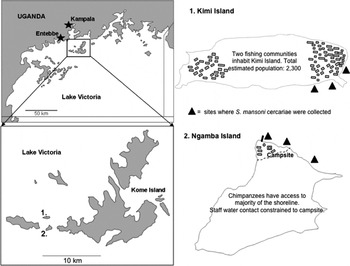
The November 2010 survey focused on collecting fecal and urine samples from chimpanzees on Ngamba Island with known prior schistosomiasis infection, based on earlier surveys (Standley et al. Reference Standley, Mugisha, Verweij, Adriko, Arinaitwe, Rowell, Atuhaire, Betson, Hobbs, Tulleken, Kane, Lieshout, Ajarova, Kabatereine and Stothard2011). Figure 1 shows collection sites for cercariae, as well as the location maps of Ngamba and its neighbouring island Kimi where further schistosome sampling took place.
Map of Ngamba Island and schistosome collection sites. Kimi Island is separated from Ngamba Island by a strait of approximately 1 kilometer, and several NICS staff commute daily between islands. Both islands have been visited as part of on-going Uganda-wide schistosomiasis monitoring and control activities since 2008.

Urine samples were collected from 16 chimpanzees (9 individuals were tested on multiple days), with 5 testing positive for infection upon circulating cathodic antigen (CCA) rapid lateral flow tests. This corresponds to a prevalence of 31·25% (95% confidence intervals (CIs) = 11·0–58·7). A fecal sample was collected from 12 animals and S. mansoni eggs were observed in Kato-Katz double thick smears in 4 of these samples, indicating a prevalence of 33·3% (95% CIs = 9·9–65·1). All infections were of ‘light’ egg intensity (i.e. <100 epg). Of the stool egg-positive samples, 3 were from chimpanzees that had been found to be positive in earlier surveys (Sunday, Kidogo and Rutoto). The fourth egg-positive chimpanzee, named Surprise, had not been previously surveyed. One animal, Kalema, which beforehand was egg-positive, was now found both egg and CCA-negative.
Schistosome eggs from the fecal samples were isolated and concentrated, from stool samples of 4 chimpanzees, all of whom had tested as egg-positive in both this and in earlier surveys: Kidogo, Rutoto, Sunday and Surprise. Approximately 20 miracidia were gathered from each of the chimpanzee's stool samples and placed on Whatman FTA Indicating® cards for later DNA analysis.
Ultrasound examination and rectal snip biopsy in March 2011
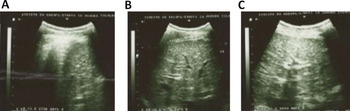
Targeted fecal sampling obtained specimens from 8 animals, including the 4 egg-positive individuals from November 2010. These 4 animals had again received semi-supervised praziquantel treatment in their food. Kidogo, Sunday and Rutoto again presented with S. mansoni eggs in their stool; these 3 chimpanzees were also strongly CCA-positive. Surprise was egg-negative, although strongly CCA-positive. Of the 4 other chimpanzees surveyed at this time (which included Kalema, a previously infected chimpanzee), only 1 female (Connie) was egg-positive, though she had a negative CCA test (Fig. 2).
Examples of chimpanzee liver patterns, as shown by ultrasound. Image A shows mild fibrosis, indicative of a ‘B’ pattern; Image B shows the beginning of pipe-stem formation, indicative of a ‘C’ pattern of pathology and Image C shows pipe-stem formation as well as occluding fibrosis, indicative of ‘D’ level pathology.

In total, 8 animals were available for examination by portable ultrasonography and using rectal snip biopsy. Although 2 of the chimpanzees had normal liver patterns, analysis of the ultrasound images revealed a spectrum of liver disease: 2 animals had mild fibrosis, 3 animals had moderate fibrosis and 1 animal presented with severe fibrosis. These patterns are indicative of active infection progressing towards chronic morbidity. In terms of rectal snip biopsy, eggs of S. mansoni were recovered from 5 animals, including an animal that was previously considered infection-negative by stool and urine examinations. Table 1 is a summary of these findings for these 8 animals examined.
DNA barcoding schistosome diversity
Schistosoma mansoni sequences from earlier surveys to the Ngamba Island area were included in the overall analysis of genetic diversity in an attempt to match parasite to definitive hosts. This included DNA barcodes from schistosomes retrieved from NICS staff as well as from infected children on the neighbouring Kimi Island. In addition, DNA barcodes from schistosome cercariae harvested from infected snails that were collected from the shoreline of both islands were available for comparisons (see Fig. 1). These surveys included an initial snail collection in March 2008 (Standley et al. Reference Standley, Adriko, Alinaitwe, Kazibwe, Kabatereine and Stothard2009, Reference Standley, Kabatereine, Lange, Lwambo and Stothard2010), as well as the DNA barcodes obtained from a parasitological survey of animals in February 2010.
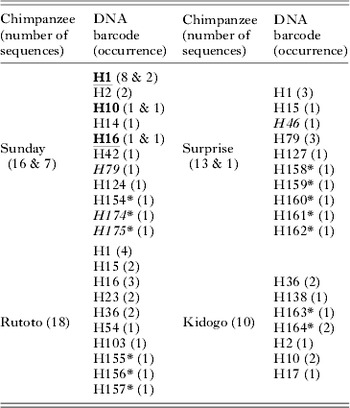
Overall, after the November 2010 survey, 57 DNA barcodes (cox1 sequences of the ASMIT fragment) were successfully produced from miracidia hatched from the 4 chimpanzee stools. Of these, 16 sequences were from Sunday, 18 sequences were from Rutoto, 13 sequences were from Surprise and 10 sequences were from Kidogo. In total, these DNA barcodes corresponded to 27 unique types, i.e. 16 of these matched already identified DNA barcodes in Uganda while the remaining 11 were novel barcodes and had not been encountered previously. These were labelled H154-H164 and submitted to GenBank (Accession numbers JF508491-JF508501). Of the individual chimps, the distribution of DNA barcodes by chimpanzee was complex and individual-specific; 10 different DNA barcodes were identified within Rutoto, 8 within Sunday, 9 within Surprise and 7 within Kidogo. Notably, certain DNA barcodes had been previously encountered within Sunday and 2 of these (H1 and H16) were recovered in this survey. A summary of the DNA barcodes by chimpanzee is shown in Table 2.
List and identity of Schistosoma mansoni DNA barcodes found in 4 infected chimpanzees in November 2010 and then in June 2012

* Novel DNA barcodes first encountered in these surveys; underlining indicates DNA barcodes that had previously been found in that individual during earlier surveys. Barcodes in plain text were found only in November 2010; barcodes in italics were found only in June 2012 and barcodes in bold were found in both surveys.
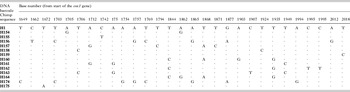
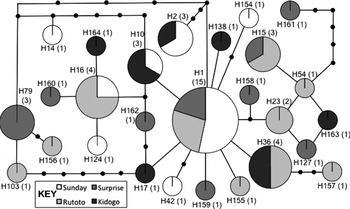
The novel barcodes differentiated from H1, the most common barcode, by a maximum of 8 base changes (corresponding to a 1·2% difference) and a minimum of 1 base change (Table 3). Barcode H1 was encountered in Sunday, Surprise and Rutoto but appeared absent in Kidogo. It is of particular note that no DNA barcode obtained from Kidogo was encountered in any of the other 3 animals. A total of 6 DNA barcodes (H1, H2, H15, H16 and H36) were common to one or more animals while the remaining 21 DNA barcodes were animal-specific.
Nucleotide base changes in novel DNA barcodes recovered from chimpanzees in November 2010 and June 2012

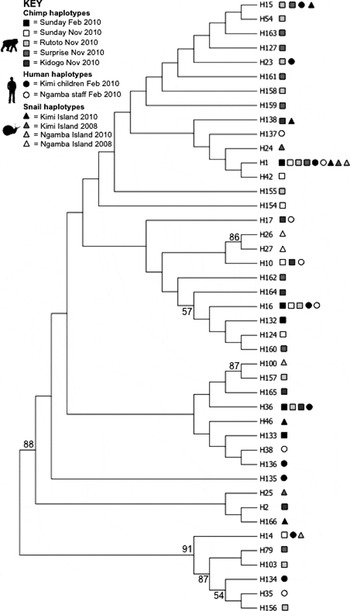
The relationship between the sequence variation between DNA barcodes found in these 4 chimpanzees was examined using a step-wise minimum spanning TCS network (Fig. 3). The network revealed H1, the most abundant barcode, as one of the central nodes, with the majority of the other barcodes related by only one or two step-wise base changes. The only lineage which appeared to be more divergent was H79; this was supported by the Neighbour-joining tree (with branch support given by 1000 bootstrap replicates) which indicated low differentiation across most of the Ngamba-Kimi region barcodes, apart from the group containing H79 which had strongly supported divergence (Fig. 4). Parasites with DNA barcodes representing this group have been encountered in both humans and chimpanzees as miracidia and in snails as cercariae; H14 was actually found in all 3 hosts at various stages of 2010, indicating spatial and temporal sympatry. Other sequences, namely H1 and H15, were also found in snails, humans and chimpanzees, sometimes during the same survey.
Minimum-spanning step-wise network of DNA barcodes of Schistosoma mansoni recovered from chimpanzees. The total abundance of each DNA barcode is indicated by the number in parenthesis after the DNA barcode number. The proportion of each DNA barcode recovered from each of the four infected chimpanzees is given by the colour of the pie slice, as per the key.

Neighbour-joining distance-based tree of all Ngamba Island and Kimi Island DNA barcodes of Schistosoma mansoni. Schistosome sequences were collected from miracidia (from chimpanzees and human staff members on Ngamba Island, and school-aged children on Kimi Island) and cercariae from shedding Biomphalaria on both islands, between 2008 and 2010. The time of collection and host is given by the shape and colour of the polygon next to the DNA barcode, as per the key.

Performance of PZQ treatment at 60 mg/kg
In an attempt to better administer stepped-up dosing of PZQ at 60 mg/kg of bodyweight, oral gavage was used and allowed direct administration of this drug to all 8 chimpanzees, without incident, in the March 2011 survey. The animals were monitored post-anaesthesia for recovery. Abnormal watery diarrhoea, although not uncommon following recovery from anaesthesia, was observed in Rutoto, and post-recovery vomiting of a small amount of treatment by Kalema was observed but not considered an ineffective treatment administration. In June 2012 the stool and urine from these animals were examined using Kato-Katz and urine CCA dipsticks. Only 1 animal, Kalema, appeared to be free from infection, see Table 1. The egg counts of all infected animals were less than 100 epg. Miracidia, harvested from Sunday and Surprise, were subjected to DNA barcoding with the resultant genotypes reported in Table 2. Haplotype 16 has been continuously found within Sunday upon all parasitological samplings. However, 2 new DNA barcodes, H174 and H175, were encountered from Sunday and have also been submitted to GenBank (Accession numbers JX845583 and JX845584).
DISCUSSION
The results of these surveys showed that not only are chimpanzees capable of being infected with a diversity of schistosomes comparable to that of human infections, they also appear to suffer from similar clinical manifestations as witnessed in the classification of liver fibrosis along the Niamey image classification key. As far as we are aware, these are the first fully documented cases of progressive disease attributable to intestinal schistosomiasis within a colony of chimpanzees, albeit set within this semi-natural environment of the NICS. The results from the ultrasound, although a first snapshot, are indicative of varying stages of the chronic disease progression typical of active S. mansoni infection(s). Despite a few individuals appearing to have some inconsistencies in diagnosis between methods or time points, Table 1 clearly affirms that the disease is engrained in several of these animals, even more so when diagnostic results from the June 2012 are considered. The most severely afflicted individual, Rutoto had a liver fibrosis pattern consistent with advanced morbidity despite being the youngest animal examined. This would also point towards this animal having hepato-portal hypertension and likely abdominal varices, the latter are especially difficult to detect without recourse to more advanced imaging techniques.
The detection of advanced morbidity is a crucial finding, since to the authors' knowledge, the significance of naturally-acquired infections in a colony of chimpanzees has never been documented. Within the setting of experimental schistosomiasis, progressive liver disease is known and can become severe in chimpanzees (Eberl et al. Reference Eberl, Langermans, Frost, Vervenne, van Dam, Dellder, Thomas, Coulson and Wilson2001). In this sanctuary setting, however, clearly recording the level of disease in NICS animals is a fundamental starting point in developing a disease management strategy for their welfare. With the firm intention of averting further morbidity in all animals, a key assumption, of course, is that future PZQ treatment(s) will give an effective worm kill. Presently the performance of this drug is becoming more contentious; further evidence of engrained infection within the colony was that urine samples from a further 25 NICS chimpanzees were spot-checked in the June 2012 by CCA dipsticks survey finding 15 to be positive.
Prior to the March 2011 treatment, the poorer performance of PZQ is most likely to be due to a suboptimal dosing within its previously semi-supervised manner when administered in food. In search of better administration methods, to explore this further it would seem that administration of PZQ (in suspension) via a gastric tube would be the preferred option but can only be attempted under general anaesthesia. Foremost is that this method of administration is directly supervised and that the mass of the animal is accurately measured, immediately before treatment, so precise bodyweight dosing can be given. In terms of long-term parasitological cure, there is little to be optimistic about the results of the June 2012 survey presented in Table 1. If more sensitive diagnostics tools such as real-time PCR detection of schistosome DNA in stool (Standley et al. Reference Standley, Mugisha, Verweij, Adriko, Arinaitwe, Rowell, Atuhaire, Betson, Hobbs, Tulleken, Kane, Lieshout, Ajarova, Kabatereine and Stothard2011) had been used, infection may have also been observed in Kalema. A future of drawback of this mode of administration of treatment under anaesthesia is that it can only be undertaken during the annual health check but higher dosings of PZQ could be easily explored in the search of increasing performance. Given that nearly all animals were found excreting eggs in the June 2012 follow-up, conducting an exploratory trial using PZQ at 80 mg/kg, with a non-invasive parasitological follow-up at 1 month, would be immediately sensible before recourse to alternative drugs such as oxamniquine (which is presently very difficult to obtain).
Diversity of schistosome infections
The DNA barcoding has revealed that the genetic diversity of the schistosomes in the 4 chimpanzees included in this survey was high, especially given the relatively low egg counts and few samples that were able to be sequenced. This result is, however, comparable to the situation as found in human communities, particularly in highly endemic areas for the disease (Balen et al. Reference Balen, Stothard, Kabatereine, Tukahebwa, Kazibwe, Whawell, Webster, Utzinger and Fenwick2006; Standley et al. Reference Standley, Kabatereine, Lange, Lwambo and Stothard2010). What is perhaps most surprising, is that infection has persisted at such high diversities despite the frequent treatment with PZQ that has been administered to these animals since the first survey in 2009. There are 3 possible explanations for the maintenance of within-host parasite genetic diversity in the face of PZQ treatment. First is that treatment was successful, but re-exposure to genetically diverse cercariae, emerging from snails around the shoreline of the island, has resulted in the re-establishment of a highly diverse infection. Second, but related to this, is that exposure could be on-going and so although treatment was successful, immature worms of different DNA barcodes were still developing and helping to contribute to the observed diversity upon post-treatment follow-up. To clarify this, a longitudinal survey of egg diversity, closely centered around the weeks before and after treatment with PZQ, might be able to distinguish between these two hypotheses, alongside intensive malacological surveys aimed to identify snails shedding cercariae. Third, PZQ treatment(s) may have failed and allowed the diversity of the original infection to remain relatively undisturbed. Evidence to this end was the common occurrence of DNA barcode H1 and especially H16 in Sunday between all inspection time-points. In future more advanced DNA profiling with other molecular markers, such as microsatellites, might hope to investigate these schistosome subtypes with greater discrimination and better assess the impact of PZQ treatment (Steinauer et al. Reference Steinauer, Blouin and Criscione2010; Criscione and Blouin, Reference Criscione and Blouin2005).
Another important finding, which was initially remarked upon after the February 2010 survey (Standley et al. Reference Standley, Mugisha, Verweij, Adriko, Arinaitwe, Rowell, Atuhaire, Betson, Hobbs, Tulleken, Kane, Lieshout, Ajarova, Kabatereine and Stothard2011) and can be elaborated on with the additional samples provided here, was the co-occurrence and observation of phylogenetic overlap between DNA barcodes found in cercariae from local snails and eggs/hatched miracidia from humans. This suggests conjoined transmission cycles through both humans and chimpanzees, rather than separate ones for several DNA barcodes (H1, H2, H10, H14, H15, H16, H17, H23 and H26), which might result in diverging groups of parasites found between the species. Similarly, there was no geographical separation of DNA barcodes as obtained between retrieved schistosomes from Kimi and Ngamba Islands; this is consistent with earlier reports of high levels of genetic mixing and low geographically defined population structure among S. mansoni in Lake Victoria as a whole (Standley et al. Reference Standley, Kabatereine, Lange, Lwambo and Stothard2010).
Significant sequence divergence was exhibited by the presence of a well-supported group (see Fig. 4 inclusive of the group containing H14 and H156 barcodes), found in the form of cercariae in snails as well as miracidia in both chimpanzees and human terminal hosts. This group contains some abundant DNA barcodes as well as rarely observed ones, and sequences from this group have been found throughout Lake Victoria (Stothard et al. Reference Stothard, Webster, Weber, Nyakaana, Webster, Kazibwe, Kabatereine and Rollinson2009; Standley et al. Reference Standley, Kabatereine, Lange, Lwambo and Stothard2010). It has been previously hypothesized that this corresponds to a separate ‘lineage’ of S. mansoni, as defined by Morgan and colleagues (Morgan et al. Reference Morgan, Dejong, Adeoye, Ansa, Barbosa, Bremond, Cesari, Charbonnel, Correa, Coulibaly, D'Andrea, De Souza, Doenhoff, File, Idris, Incani, Jarne, Karanja, Kazibwe, Kpikpi, Lwambo, Mabaye, Magalhaes, Makundi, Mone, Mouahid, Muchemi, Mungai, Sene, Southgate, Tchuente, Theron, Yousif, Magalhaes, Mkoji and Loker2005) and corroborated by Stothard et al. (Reference Stothard, Webster, Weber, Nyakaana, Webster, Kazibwe, Kabatereine and Rollinson2009) and Webster et al. (Reference Webster, Webster, Gouvras, Garba, Lamine, Diaw, Seye, Tuchuem-Tchuente, Mulbila, Mwanga, Lwambo, Kabatereine, Lange, Kariuki, Mkoji, Rollinson and Stothard2012), but without a re-analysis of a different fragment of the cox1 gene (which would require additional sampling), this cannot be comprehensively determined. If it is indeed a separate lineage, then it is worth noting that certain individuals, for example Sunday, Surprise and Rutoto (intriguingly not Kidogo) appear to be infected with multiple lineages of S. mansoni. If this is the case, then it offers up the question of how such divergence can be maintained in the face of geographical as well as intra-host mixing; such questions warrant further investigation especially in the light of DNA barcodes H154-H164, H174 and H175 which have only been encountered, as yet, within chimpanzees. This would suggest that an animal's exposure and infection ‘window’ to schistosome cercariae, albeit inferred by subsequent analysis of eggs, is highly variable even on this small island setting. This was clearly evidenced in that no one DNA barcode type was common to all animals which may have some bearing on the diversity and evolution of host morbidity. Taken as a whole, if further disease progression is to be averted, a long-term disease management strategy is required which, for selected animals, should combine more active case-detection, with parasite genotyping, alongside a closely monitored morbidity-reduction action plan.
In conclusion, intestinal schistosomiasis in NICS is a significant present and future threat to the welfare of these chimpanzees. The local epidemiology of the disease appears to be a shifting balance between anthropozoonotic and zoonotic cycles which may have some bearing on the progression of individual host-morbidity for which overt disease has been clearly documented, i.e. liver fibrosis. Indeed, the schistosome population within each of the examined chimpanzees has a complex structure of parasite DNA barcodes with either human-like or chimp-like signatures. Whilst better administration of PZQ can be achieved by delivery of drug by gastric tube, such procedures are restricted to the annual health check cycle on NICS and do not appear to eliminate infections upon a 15-month parasitological follow-up after a prior and closely supervised 60 mg/kg treatment.
ACKNOWLEDGEMENTS
Many thanks to the Wolfson Wellcome Biomedical Laboratories, The Natural History Museum, and especially the DNA Sequencing Facility, for all the support and assistance that was provided for the molecular aspects of the study. The ultrasound machine used in this study was kindly provided by Vector Control Division, Ministry of Health as originally purchased by Schistosomiasis Control Initiative (SCI), Imperial College London therefore with thanks to Professor Alan Fenwick for allowing its use. We are grateful to the assistance of Dr James LaCourse, Ms Gillian Allison and Ms Rosie Townsend during the June 2012 surveys. Permission for the research was granted by the Uganda Wildlife Authority and UNCST; umbrella funding was generously provided by the Wellcome Trust (SIMI project) and the Global Network for Neglected Tropical Diseases (www.globalnetwork.org). This research could not have been completed without full and generous support from all the staff on NICS.