Introduction
An essential premise in the upper echelons theory is that organizational outcomes, such as strategic decisions and performance, reflect the values, experiences, and cognitive bases of top executives (Hambrick & Mason, Reference Hambrick and Mason1984). While extensive research in this domain has scrutinized observable characteristics such as age, education, and gender (e.g., Fabrizi, Mallin, & Michelon, Reference Fabrizi, Mallin and Michelon2014; McCarthy, Oliver, & Song, Reference McCarthy, Oliver and Song2017; Rego & Polónia, Reference Rego and Polónia2017), more recent attention has turned to CEOs’ personal hobbies and leisure activities that may signal deeper, less observable traits relevant for leadership and decision-making (e.g., Biggerstaff, Cicero, & Puckett, Reference Biggerstaff, Cicero and Puckett2017; Cain & McKeon, Reference Cain and McKeon2016; Davidson, Dey, & Smith, Reference Davidson, Dey and Smith2015; Ouyang, Tang, Wang, & Zhou, Reference Ouyang, Tang, Wang and Zhou2022; Sunder, Sunder, & Zhang, Reference Sunder, Sunder and Zhang2017). Among these traits, empathy, which refers to the capacity to understand and resonate with others’ experiences, is increasingly recognized as a critical driver of prosocial behavior and ethical leadership (Muss, Tüxen, & Fürstenau, Reference Muss, Tüxen and Fürstenau2026; Vallette d’Osia & Meier, Reference Vallette d’Osia and Meier2024). However, empathy remains difficult to observe and measure using archival data, limiting our understanding of this executive characteristic.
This study investigates a specific, unobtrusive off-the-job activity by CEOs: fiction-reading. We propose that fiction-reading serves as a useful behavioral signal of a CEO’s empathic orientation. Psychological research suggests that engagement with narrative fiction is a formative practice that sustains and reinforces empathic capacity. Through ‘narrative transportation’ (Green & Brock, Reference Green and Brock2000) and the simulation of complex social worlds (Mar & Oatley, Reference Mar and Oatley2008), readers practice stepping outside their own egocentric viewpoints. This process deepens and consolidates a multidimensional yet integrated empathic capacity that bridges both cognitive understanding (perspective-taking) and affective resonance (emotional concern). Anchoring our study in the Empathy–Altruism Hypothesis (Batson, Reference Batson2008), we argue that this empathic orientation generates an intrinsic motivation to alleviate the needs of others, leading to increased corporate philanthropy.
We manually collected a dataset of CEOs from non-state-owned enterprises (non-SOEs) listed in China’s A-share market from 2001 to 2018. We identify fiction-reading habits through a rigorous multi-stage data collection process that combines automated web searches with manual verification. To ensure classification reliability, we identify a CEO as a fiction reader only when their interest in narrative literature is confirmed by at least two independent and credible sources, such as media interviews, official company websites, or autobiographies. To address potential selection bias in the disclosure of personal hobbies, we employ a 1:1 propensity-score matching (PSM) approach, resulting in a final sample of 2,914 firm-year observations.
Our analysis yields several key findings. First, firms led by fiction-reading CEOs engage more in corporate philanthropy. Second and crucially, our analysis confirms that CEO empathy statistically mediates the above relationship, validating our core theoretical mechanism. Third, to address endogeneity concerns (i.e., whether empathic individuals simply select into reading fiction), we conduct a difference-in-differences (DiD) analysis with CEO transition data. We find philanthropy levels rise significantly only after the appointment of fiction-reading CEOs, providing temporal evidence consistent with a behavioral reinforcement interpretation. Finally, we show that this prosocial orientation extends beyond philanthropy: fiction-reading CEOs are associated with smaller executive–employee pay gaps, enhanced workplace safety, and fewer financial restatements.
This study makes several important contributions. First, and primarily, this study extends upper echelons theory by identifying empathy as the psychological micro-foundation linking CEO personal characteristics to corporate social responsibility (CSR) outcomes. Existing research has largely relied on demographic attributes as broad proxies for cognitive frames, often stopping short of identifying the specific psychological processes at play. By focusing on a specific off-the-job habit, this study isolates empathy as a distinct, behaviorally reinforced trait that shapes decision-making in ethically salient contexts. We show that corporate philanthropy is not merely a function of strategic calculation or resource availability, but is significantly driven by the CEO’s intrinsic capacity to resonate with stakeholder needs. This finding enriches the upper echelons perspective by highlighting how seemingly minor personal interests can reflect deep-seated dispositions that systematically influence firm-level prosocial behavior.
Second, this study advances the methodological toolkit of upper echelons research by introducing fiction-reading as a novel, unobtrusive, and verifiable behavioral proxy for CEO empathy. While empathy is widely recognized as central to prosocial leadership, it remains difficult to observe and measure in large-scale archival studies. We developed a rigorous hybrid data collection method that combines automated identification of fiction-reading behavior with manual validation using CEO interviews, official company sources, and autobiographical materials. Crucially, we use the mediation analysis to empirically substantiate the underlying psychological mechanism: the positive effect of fiction-reading on corporate philanthropy is statistically transmitted through the CEO’s expressed empathy, as captured by textual analysis of annual reports. This approach offers future scholars a replicable strategy for tracing latent prosocial dispositions through publicly observable behavioral signals.
Third, this study bridges psychology and management by grounding the analysis in the Empathy–Altruism Hypothesis. While much of the CSR literature focuses on instrumental motives such as reputational risk management or political legitimacy, our framework offers a coherent psychological explanation for the voluntary and moral basis of corporate giving. We posit that fiction-reading sustains and deepens an empathic capacity, which in turn activates a genuine, intrinsic motivation to improve the welfare of others. By articulating this empathy-driven pathway, we provide a richer, theoretically grounded account of why certain leaders are motivated to engage in social good, moving beyond the traditional dichotomy of agency costs versus strategic value.
Theoretical Background and Hypotheses Development
Upper Echelons and the Psychological Roots of Philanthropy
Upper echelons theory posits that organizational outcomes, such as strategic choices and performance levels, are partially predicted by managerial background characteristics (Hambrick & Mason, Reference Hambrick and Mason1984). The central premise is that executives engage in personalized interpretations of the strategic situations they face, filtering complex information through their own cognitive bases and values (Hambrick, Reference Hambrick2007; Hambrick & Mason, Reference Hambrick and Mason1984). While early research relied heavily on observable demographic proxies, such as age (Fabrizi et al., Reference Fabrizi, Mallin and Michelon2014), tenure (Miller, Reference Miller1991), and education (Rego & Polónia, Reference Rego and Polónia2017) to infer these psychological traits, recent scholarship calls for more direct behavioral indicators that reveal executives’ underlying dispositions (Neely, Lovelace, Cowen, & Hiller, Reference Neely, Lovelace, Cowen and Hiller2020; Wowak, Mannor, Arrfelt, & McNamara, Reference Wowak, Mannor, Arrfelt and McNamara2016).
Corporate philanthropy acts as a highly discretionary strategic decision. It is particularly susceptible to the influence of a CEO’s personal values and psychological orientation (Chin, Hambrick, & Treviño, Reference Chin, Hambrick and Treviño2013). Unlike routine operational decisions constrained by market dictates, philanthropic allocations often reflect the CEO’s moral compass and intrinsic concern for social welfare (Muller & Kräussl, Reference Muller and Kräussl2011). In this study, we propose that a CEO’s off-the-job habit of reading fiction serves as a powerful behavioral signal of empathy, which acts as a fundamental and multi-faceted psychological capacity that drives prosocial organizational behaviors.
Fiction-Reading and the Reinforcement of Empathy
We contend that fiction-reading goes beyond a leisure activity and serves as a psychologically formative practice that sustains and reinforces empathic capacity. Empathy is broadly defined as the capacity to understand and share the feelings of others (Decety & Jackson, Reference Decety and Jackson2004). While psychology traditionally distinguishes between cognitive empathy (perspective-taking) and affective empathy (emotional resonance), recent organizational scholarship argues that effective prosocial leadership relies on a multidimensional yet integrated empathic capacity (Muss et al., Reference Muss, Tüxen and Fürstenau2026; Vallette d’Osia & Meier, Reference Vallette d’Osia and Meier2024). We posit that fiction-reading uniquely sustains and deepens this holistic competency.
Unlike non-fiction, which typically presents expository arguments or factual information, narrative fiction requires the reader to simulate the social worlds of characters (Mar & Oatley, Reference Mar and Oatley2008). This process, known as narrative transportation, immerses readers in the internal lives of others. It compels them to simultaneously interpret characters’ complex mental states and resonate with their emotional journeys. This bridges the gap between ‘understanding’ and ‘feeling’ (Bal & Veltkamp, Reference Bal and Veltkamp2013; Green & Brock, Reference Green and Brock2000). Crucially, this dual activation occurs in tandem. Readers cannot fully comprehend a narrative without engaging both their analytical theory of mind and their emotional sensitivity (Mar, Oatley, & Peterson, Reference Mar, Oatley and Peterson2009). Through this ‘moral laboratory’ (Hakemulder, Reference Hakemulder2000), readers practice stepping outside their own egocentric viewpoints. Experimental evidence supports this association. Kidd and Castano (Reference Kidd and Castano2013) demonstrated that reading literary fiction leads to immediate improvements in Theory of Mind. Similarly, neuroscientific studies reveal that processing narrative fiction recruits the same brain networks involved in understanding real-world social interactions (Tamir, Bricker, Dodell-Feder, & Mitchell, Reference Tamir, Bricker, Dodell-Feder and Mitchell2016). For CEOs, who often face insulated professional environments, the habit of reading fiction serves as a continuous exercise in empathic expansion. It maintains their sensitivity to the human condition beyond the boardroom.
Importantly, we conceptualize the relationship between fiction-reading and empathy not as a unidirectional causal arrow, but as a reinforcement model of leadership traits. We acknowledge that empathy has dispositional roots: individuals with higher baseline empathy may naturally select into reading fiction. However, upper echelons attributes are not static and are dynamic capacities that require maintenance (Hambrick, Reference Hambrick2007). Fiction-reading acts as a ‘cognitive simulator’ (Mar & Oatley, Reference Mar and Oatley2008) that provides continuous practice in perspective-taking and emotional resonance. Without such behavioral reinforcement, the empathic capacity required to navigate complex stakeholder demands may atrophy. Therefore, we argue that the habit of reading fiction serves to actively sustain and deepen the CEO’s empathic orientation. This creates a cumulative effect that shapes organizational outcomes.
CEO Fiction-Reading and Corporate Philanthropy
Building on the premise that fiction-reading sustains and reinforces an empathic orientation, we draw on the Empathy–Altruism Hypothesis (Batson, Reference Batson1987, Reference Batson2011) to explain its effect on corporate philanthropy. This theory asserts that empathic concern, an other-oriented emotional response elicited by perceiving another’s need, produces altruistic motivation, or a drive to improve the other’s welfare (Batson, Batson, Slingsby, Harrell, Peekna, & Todd, Reference Batson, Batson, Slingsby, Harrell, Peekna and Todd1991).
When CEOs possess heightened empathy derived from their engagement with fiction, they are more attuned to the needs of societal stakeholders. According to the Empathy–Altruism framework, this sensitivity generates a genuine motivation to alleviate social ills, independent of strategic calculations or profit maximization. Because their empathy is holistic, integrating both the cognitive understanding of stakeholder hardship and the affective desire to help, these CEOs are uniquely positioned to translate observation into action. Consequently, fiction-reading CEOs are likely to view corporate resources not solely as instruments for financial return but as means to effect positive social change.
This empathy-driven motivation is operationally supported by the activation of moral identity and intrinsic prosocial focus. In Moral Identity Theory, the empathic orientation reinforced by fiction-reading increases the chronic accessibility of moral schemas, making ‘being moral’ central to the CEO’s self-definition (Aquino & Reed, Reference Aquino and Reed2002). Furthermore, consistent with Prosocial Motivation Theory, this heightened sensitivity transforms the CEO’s effort from distinct strategic calculations into an intrinsic desire to benefit others (Grant, Reference Grant2008). Thus, fiction-reading sustains a robust, internally driven prosocial orientation that naturally manifests in corporate philanthropy.
Therefore, the habit of reading fiction serves as an observable indicator of a CEO’s prosocial orientation. CEOs who engage in this practice are more likely to direct their firms toward socially responsible behaviors, specifically manifested in higher levels of corporate philanthropy.
Hypothesis 1 (H1): Firms led by CEOs who enjoy reading fiction will make more philanthropic donations.
The Mediating Role of Empathy
Central to our theoretical framework is the argument that empathy is the specific psychological mechanism transmitting the effect of fiction-reading to corporate philanthropy. While fiction-reading is the observable antecedent, empathy is the latent construct that translates this habit into organizational action.
This mediation operates through two sequential steps. First, the sustained practice of reading fiction enhances the CEO’s capacity for empathy by repeatedly engaging the neural and psychological systems responsible for social simulation and emotional resonance (Kidd & Castano, Reference Kidd and Castano2013; Mar et al., Reference Mar, Oatley, Hirsh, DeLa Paz and Peterson2006). Second, this heightened empathy influences decision-making by altering how the CEO processes information about stakeholder needs. Empathic leaders are less likely to ignore social distress and more likely to experience the ‘altruistic motivation’ described by Batson (Reference Batson2011).
In the context of corporate philanthropy, this implies that the relationship between a CEO’s reading habits and the firm’s donations is not merely a direct behavioral transfer. Rather, it operates through the enhancement of the CEO’s empathic orientation. Specifically, the ‘black box’ of executive decision-making is unlocked by this psychological trait: fiction-reading reinforces the CEO’s empathic orientation, which in turn motivates the allocation of corporate resources toward philanthropic causes (Hambrick, Reference Hambrick2007). Therefore, we posit that empathy acts as the conduit through which the personal habit of fiction-reading shapes public corporate behavior.
Hypothesis 2 (H2): CEO empathy mediates the positive relationship between CEO fiction-reading and corporate philanthropy.
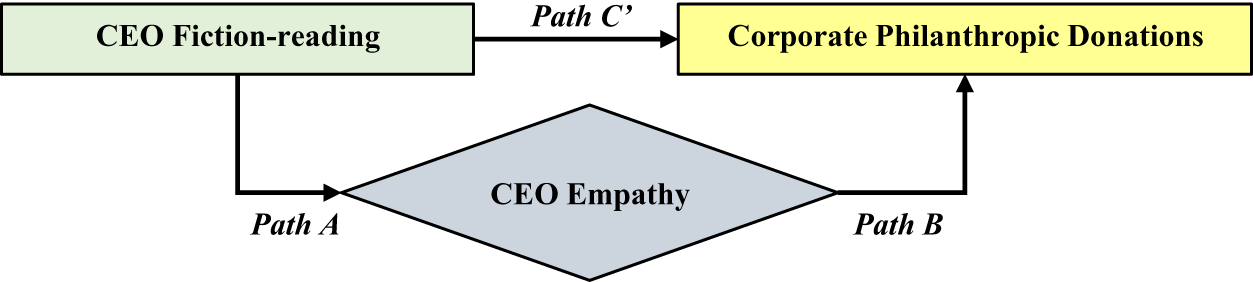
Figure 1 illustrates our theoretical framework linking CEO fiction-reading to corporate philanthropic donations via the mediating role of CEO empathy.
Mediation model

Methods
Data
Our initial sample includes all non-SOEs listed in the China A-share market between 2001 and 2018, sourced from the CSMAR database. We exclude SOEs from the sample due to the dominant influence of political connections and state ownership interests in their decision-making processes for corporate philanthropic donations (e.g., Sánchez, Reference Sánchez2000; Su & He, Reference Su and He2010). These factors often overshadow the personal influence of CEOs on corporate decisions, including philanthropic activities. Consequently, the impact of CEOs’ hobbies, such as fiction-reading, on corporate donations is likely to be minimal for SOEs, making non-SOEs a more suitable context for our analysis.
To identify CEOs with a hobby of reading fiction, we employed a two-step data collection process. First, we developed an algorithm in Python to search for relevant keywords, such as ‘CEO name + hobby + company name + fiction’, on the Baidu search engine. The predefined search criteria were designed to capture information specifically related to fiction-reading, while filtering out irrelevant or generic mentions of reading habits. Second, we manually analyzed the detailed descriptions of the CEOs’ hobbies from the search results to verify their relevance and authenticity. To classify a CEO as having a fiction-reading hobby, we required at least two independent and verified mentions of fiction-reading from credible sources, including interviews in reputable media outlets, official company websites, or autobiographical publications.Footnote 1 Detailed descriptions of the keyword dictionaries and the full data collection procedure are provided in Online Appendix 1. We label the presence of a CEO with a hobby of reading fiction as FictionRead.
We obtain data about corporate philanthropic donations and financial information from the CSMAR and data on CEO characteristics from the CNRDS and the RESSET Financial Research. We exclude observations for (i) firms from the financial and insurance industries because of their different balance sheet structuresFootnote 2; (ii) firms with negative net assets; (iii) ST (special-treatment) firms because they face various trading and financial restrictions; (iv) firms with missing data on CEOs’ hobby of reading fiction and other necessary control variables. We find 1,457 firm-year observations with data on CEOs’ hobbies, of which 321 firm-years have fiction-reading CEOs. To alleviate concerns about selection bias, we conduct PSM to select control firms. Specifically, for each firm-year, we first regress a dummy variable indicating the presence of a fiction-reading CEO of the firm on several firm- and CEO-level characteristics and estimate the propensity score.Footnote 3 Then, we identify the matched control firm with the closest propensity score in the same industry and year for each firm-year observation in the treatment group. The final sample comprises 2,914 firm-year observations for 1,076 firms for 2001–2018.
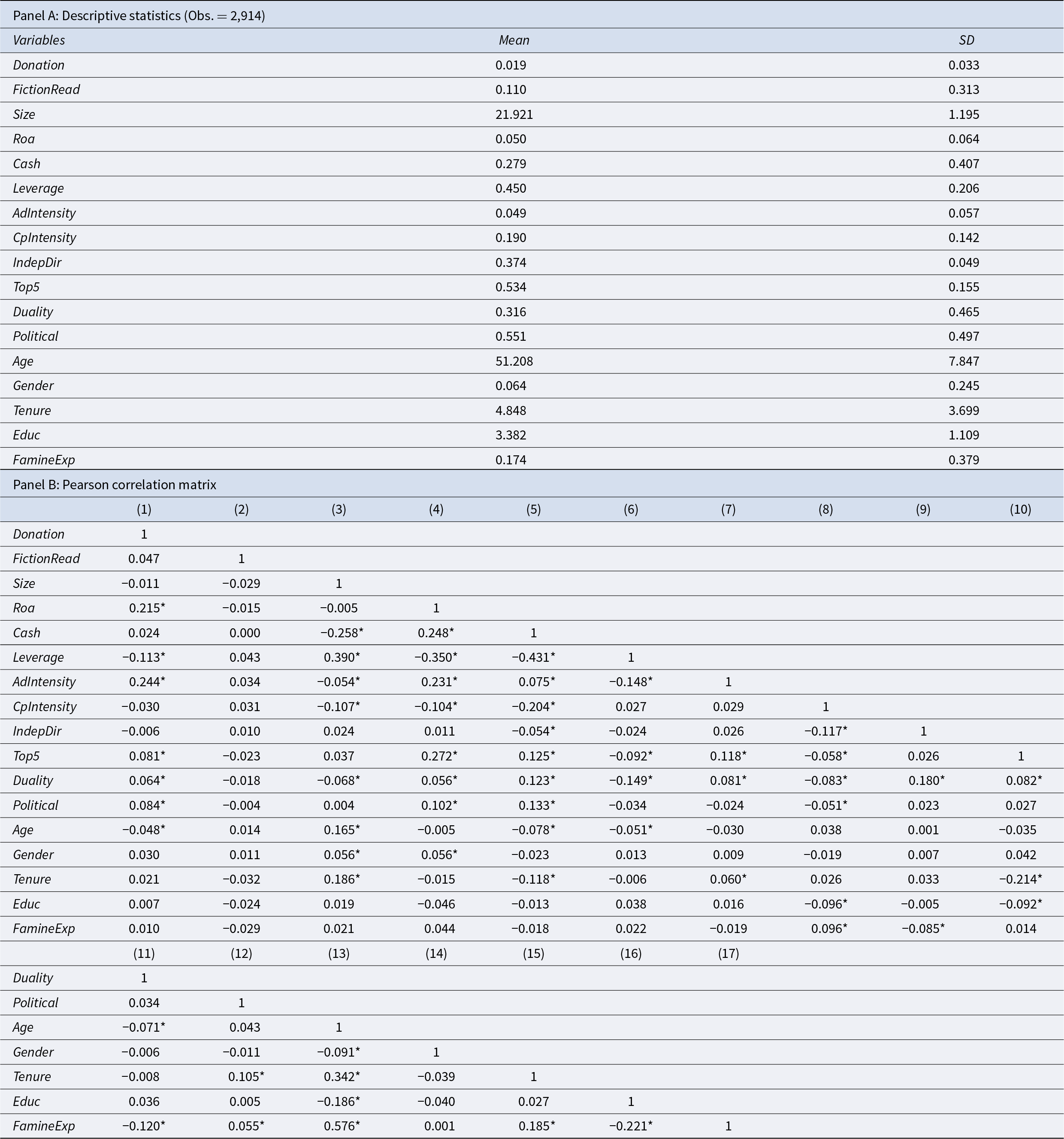
Panel A of Table 1 provides sample descriptive statistics. The distributions of our variables are generally consistent with prior literature (Brammer & Millington, Reference Brammer and Millington2005; Zhang, Zhu, Yue, & Zhu, Reference Zhang, Zhu, Yue and Zhu2010). A further investigation of variance inflation factors suggests that multicollinearity is unlikely to affect our results. The sample mean of corporate philanthropic donations, denoted by Donation, indicates that on average, philanthropic donations represent about 0.02% of corporate total assets. Panel B reports the Pearson correlations between various firms’ characteristics. The presence of a CEO with a hobby of reading fiction (FictionRead) is significantly and positively correlated with Donation ( $\beta $ = 0.047, p < 0.05), giving preliminary support to H1 that firms with empathic CEOs who enjoy reading fiction make more philanthropic donations than those without such CEOs.
Summary statistics

Table 1 Long description
Panel A reports descriptive statistics for 2,914 observations, listing each variable with its mean and SD. Donation has a mean of 0.019 and SD of 0.033, and FictionRead has a mean of 0.110 and SD of 0.313. Size has a mean of 21.921 and SD of 1.195. Roa averages 0.050 with SD 0.064, Cash averages 0.279 with SD 0.407, and Leverage averages 0.450 with SD 0.206. AdIntensity has a mean of 0.049 and SD 0.057, CpIntensity has a mean of 0.190 and SD 0.142, and IndepDir has a mean of 0.374 and SD 0.049. Top5 has a mean of 0.534 and SD 0.155, Duality has a mean of 0.316 and SD 0.465, and Political has a mean of 0.551 and SD 0.497. Age has a mean of 51.208 and SD of 7.847, Gender has a mean of 0.064 and SD 0.245, Tenure has a mean of 4.848 and SD 3.699, Educ has a mean of 3.382 and SD 1.109, and FamineExp has a mean of 0.174 and SD 0.379.
Notes: This table reports the summary statistics and correlation coefficients for the main variables used in our base analysis. The sample consists of 2,914 firm-year observations for 1,076 unique firms from 2001 to 2018. Detailed variable definitions can be found in Appendix A. All continuous variables are winsorized at the 1% and 99%. * indicates the significant level of 1%.
Model Specification
To examine the effect of the presence of a fiction-reading CEO on corporate philanthropy donations (H1), we estimate the following OLS model:
 \begin{equation}Donatio{n_{i,t}} = {\beta _0} + {\beta _1}FictionRea{d_{i,t}} + \gamma {X_{i,t}} + {\text{ }}Industry{\text{ }}FE{\text{ }} + {\text{ }}Year{\text{ }}FE{\text{ }} + {\varepsilon _{i,t}}\end{equation}
Model (1) is conducted at the firm-year level. The dependent variable Donation is defined as the ratio of corporate philanthropy donations (including both cash and in-kind giving) to the year-end total assets, multiplied by 100 (e.g., Chang, Jo, & Li, Reference Chang, Jo and Li2018).Footnote 4 FictionRead is an indicator variable set to one if the CEO has a hobby of reading fiction, and zero otherwise. A CEO’s hobby of reading fiction is interpreted as an indication of relatively high ‘empathy’.
Control Variables
We control for various firm-, CEO-, and industry-level variables that likely influence corporate philanthropic decisions. At the firm level, we include firm size (Size), profitability (Roa), cash resources (Cash), and financial leverage (Leverage). Larger firms tend to donate more due to greater unused resources, economies of scale in CSR activities, lower CSR valuation risks, and fewer attractive investment alternatives (Udayasankar, Reference Udayasankar2008). Profitability and cash resources positively impact donations (Crampton & Patten, Reference Crampton and Patten2008), while higher leverage negatively affects donations due to reduced available resources (Brammer & Millington, Reference Brammer and Millington2005). We also control for advertising intensity (AdIntensity) and capital intensity (CpIntensity) since firms with higher advertising expenditures and more tangible assets tend to donate more (Godfrey, Reference Godfrey2005; Zhang et al., Reference Zhang, Zhu, Yue and Zhu2010). We include corporate governance variables (IndepDir, Top5, Duality) to account for the influence of governance changes on CEOs’ incentives and discretion in philanthropy (Masulis & Reza, Reference Masulis and Reza2015). We also control for political connections (Political), as they significantly shape Chinese firms’ philanthropic choices (Sánchez, Reference Sánchez2000; Su & He, Reference Su and He2010).
For CEO characteristics, we include age (Age), gender (Gender), tenure (Tenure), education level (Educ), and early-life famine experience (FamineExp). Older CEOs and female CEOs are generally more inclined toward corporate social responsiveness and philanthropy (O’Neill, Saunders, & McCarthy, Reference O’Neill, Saunders and McCarthy1989; Williams, Reference Williams2003). Long-tenured CEOs are more likely to engage in donations for personal and firm benefit (Fabrizi et al., Reference Fabrizi, Mallin and Michelon2014). Education level and type also affect corporate philanthropy (Wei, Ouyang, & Chen, Reference Wei, Ouyang and Chen2018). Last, we include CEOs’ experience of famine in early-life (FamineExp) as a CEO with experience of famine donates more than those without such experience (Han, Chi, & Zhou, Reference Han, Chi and Zhou2022).
We include industry-fixed effects to control for industry-specific influences (Brammer & Millington, Reference Brammer and Millington2005; Zhang et al., Reference Zhang, Zhu, Yue and Zhu2010) and year dummies to control for time-varying macroeconomic conditions.Footnote 5 Standard errors are clustered by firm to adjust for heteroskedasticity and autocorrelations. All continuous variables are winsorized at the 1% and 99% levels. Definitions of all variables are provided in Appendix A.
Results
Baseline Results
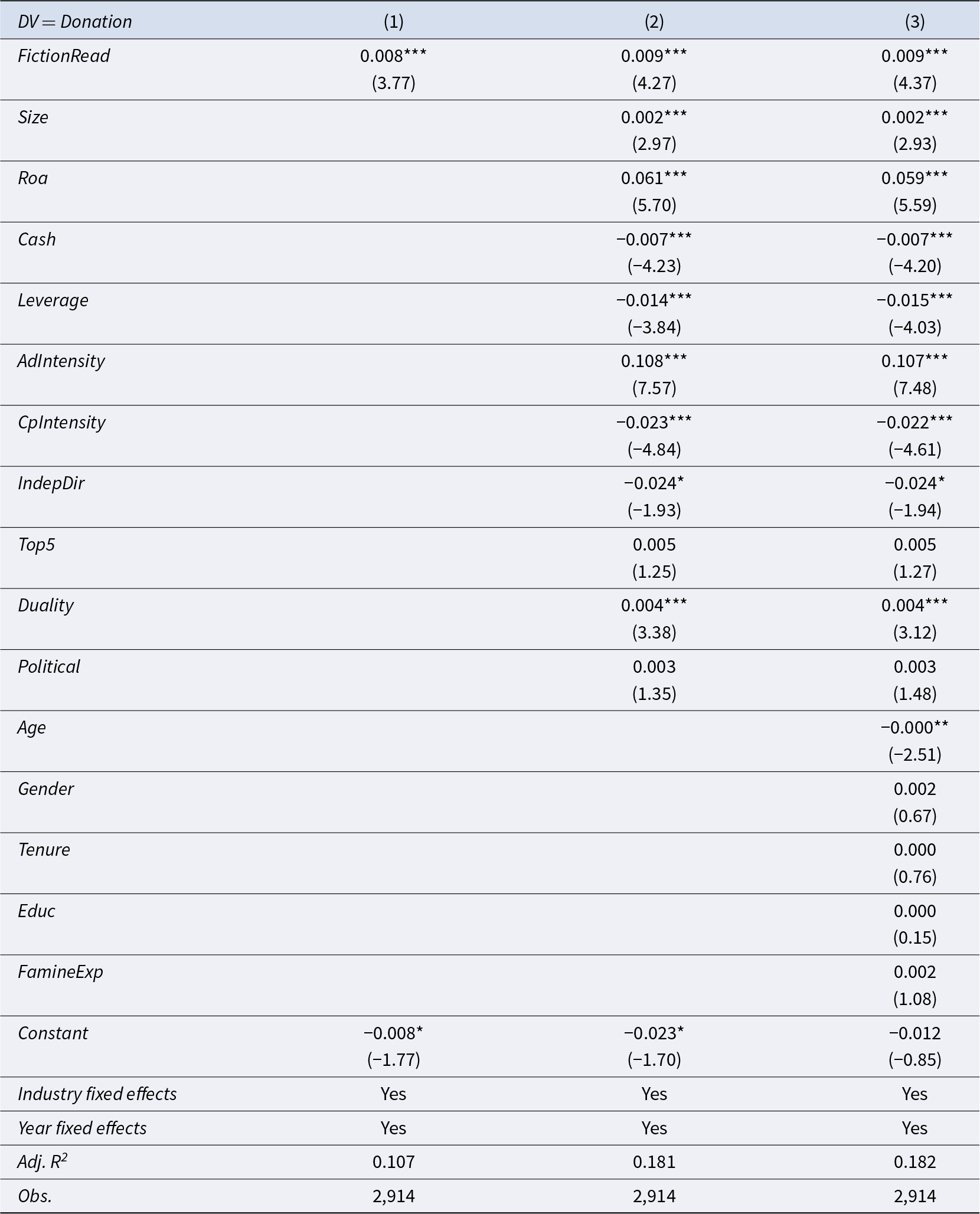
Table 2 reports the coefficient estimates of model (1). Across all model specifications, we find that the coefficients of FictionRead are positive and significant at the 1% level. The economic magnitude of the effect is also significant. For example, in Column (3), the coefficient of FictionRead is 0.009 (p < 0.01) without control variables, implying that the amount of corporate philanthropic donations increases by 0.009 for firms with fiction-reading CEOs over that of firms without such CEOs. Given that the sample mean of Donation is 0.019, our finding indicates that the effect of the CEO’s fiction-reading hobby is economically significant. We find similar results in Columns (2) and (3) with additional firm-level and CEO-level control variables. Overall, we interpret these results as support for H1 that firms with CEOs who enjoy reading fiction make more philanthropic donations. The coefficients of the control variables are mostly consistent with prior literature.Footnote 6 For example, the positive coefficient of ROA indicates that profitable firms donate more to charities (e.g., Crampton & Patten, Reference Crampton and Patten2008). The positive coefficient of AdIntensity is consistent with Zhang et al. (Reference Zhang, Zhu, Yue and Zhu2010) that firms with larger advertising expenditures donate more. In addition, the negative coefficient of IndepDir and the positive coefficient of Duality taken together imply that efficient corporate governance decreases corporate philanthropic donations, which is consistent with the findings of Tan, Tan, and Chan (Reference Tan, Tan and Chan2021).
CEO fiction-reading and corporate philanthropy

Table 2 Long description
Regression results use Donation as the dependent variable across three models labeled 1, 2, and 3. Model 1 reports FictionRead at 0.008 with three stars and a t statistic of 3.77, and the constant at minus 0.008 with one star and a t statistic of minus 1.77. Model 2 adds Size 0.002 with three stars, Roa 0.061 with three stars, Cash minus 0.007 with three stars, Leverage minus 0.014 with three stars, AdIntensity 0.108 with three stars, CpIntensity minus 0.023 with three stars, IndepDir minus 0.024 with one star, Top5 0.005 with no stars, Duality 0.004 with three stars, Political 0.003 with no stars, and a constant of minus 0.023 with one star. Model 3 keeps the model 2 controls with similar values and adds Age minus 0.000 with two stars, Gender 0.002 with no stars, Tenure 0.000 with no stars, Educ 0.000 with no stars, and FamineExp 0.002 with no stars, with the constant at minus 0.012 with no stars. Industry fixed effects and year fixed effects are Yes in all three models. Adjusted R2 is 0.107 in model 1, 0.181 in model 2, and 0.182 in model 3, with 2,914 observations in each model.
Notes: This table presents regression results for the effect of CEO’s fiction-reading hobby on corporate philanthropic donations. Detailed variable definitions can be found in Appendix A. t-statistics are reported in brackets. Standard errors are clustered by firm and year. *, **, and *** indicate the significance level at 10%, 5%, and 1%, respectively.
Mediation Analysis
To validate H2, we conducted a mediation analysis using textual analysis of annual reports. Building on research showing that empathic individuals use distinctively affiliative language (Pennebaker, Mehl, & Niederhoffer, Reference Pennebaker, Mehl and Niederhoffer2003; Tausczik & Pennebaker, Reference Tausczik and Pennebaker2010), we analyze narrative sections like the MD&A to capture CEOs’ psychological dispositions (Craig & Amernic, Reference Craig and Amernic2004). This approach is particularly valid in China, where CEOs exert significant personal influence over corporate messaging (Fan, Wong, & Zhang, Reference Fan, Wong and Zhang2013). Specifically, we develop a custom dictionary based on the LIWC framework (Pennebaker et al., Reference Pennebaker, Mehl and Niederhoffer2003; Tausczik & Pennebaker, Reference Tausczik and Pennebaker2010). With this dictionary, we construct two measures to quantify empathic expression in annual reports: EmpathyWord% is defined as the percentage of empathy-related words to total words, and Ln(EmpathyWord) is defined as the natural log-transformed total count of empathy-related words.Footnote 7 Representative words from the empathy dictionary are provided in Online Appendix 3. We next employ the causal-steps approach (Baron & Kenny, Reference Baron and Kenny1986; Zhao, Lynch, & Chen, Reference Zhao, Lynch and Chen2010) and estimated the following regression models:
 \begin{equation}Empath{y_{i,t}} = {\beta _0} + {\beta _1}FictionRea{d_{i,t}} + \gamma {X_{i,t}} + Industry{\text{ }}FE + Year{\text{ }}FE + {\varepsilon _{i,t}}\end{equation}
 \begin{equation}Donatio{n_{i,t}} = {\mu _0} + {\mu _1}FictionRea{d_{i,t}} + \mu 2Empath{y_{i,t}} + \gamma {X_{i,t}} + Industry{\text{ }}FE + Year{\text{ }}FE + {\varepsilon _{i,t}}_{}\end{equation}
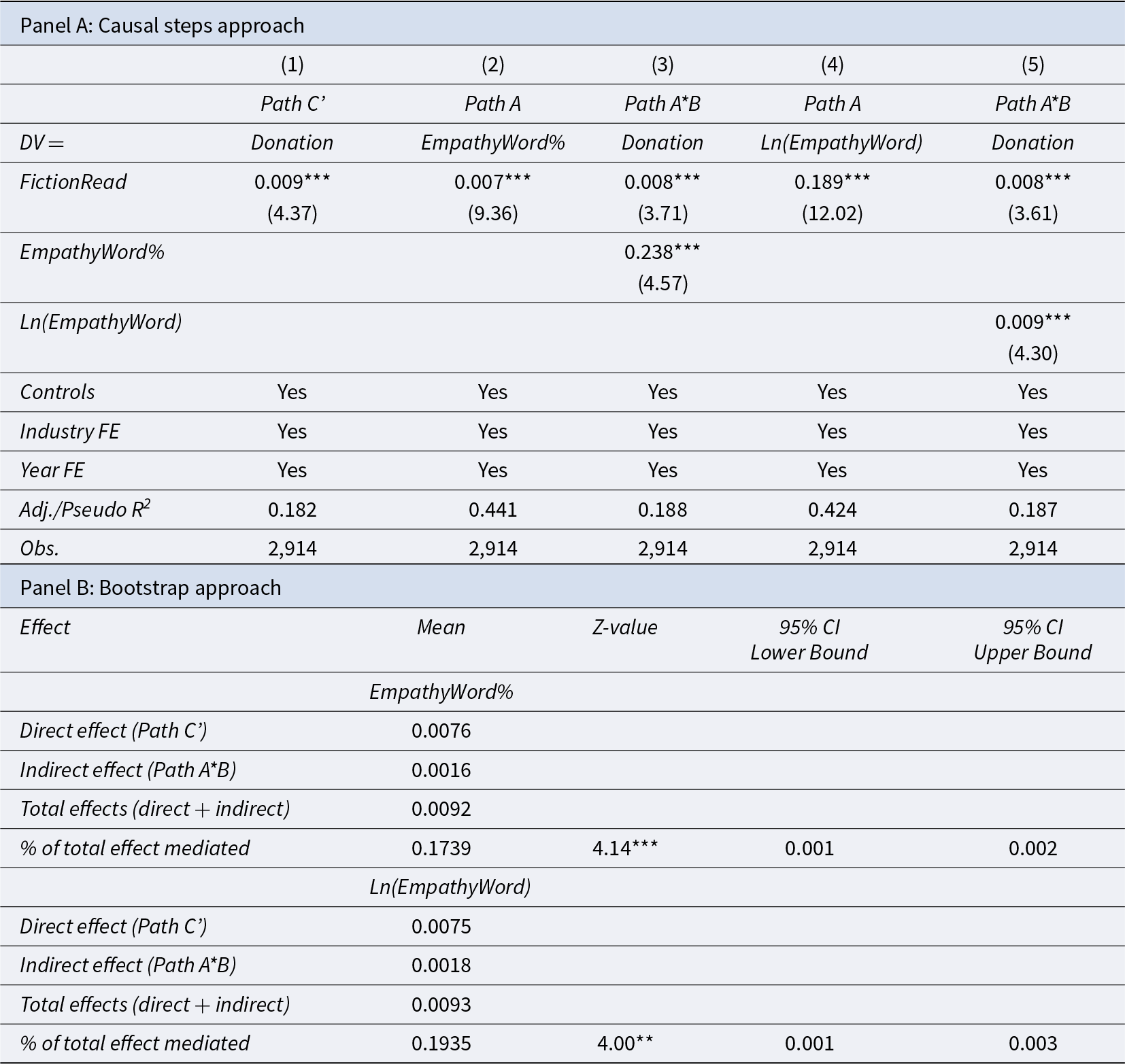
where Empathy is the mediator variable and represents the empathic orientation as measured by either EmpathyWord% or Ln(EmpathyWord). We focus on the significance of β1 and µ2. If both coefficients were significant, with the magnitude of µ1 smaller than the total effect in Model (1), we consider there to be a mediating effect. The results are presented in Panel A of Table 3. As shown in Column (1), FictionRead has a positive and significant total effect on Donation (β = 0.009, p < 0.01). In Column (2), FictionRead significantly predicts EmpathyWord% (β = 0.007, p < 0.01), supporting the argument that fiction-reading fosters empathy. In Column (3), EmpathyWord% significantly predicts Donation (β = 0.238, p < 0.01), validating the link between empathy and prosocial behavior. Importantly, while FictionRead remains significant, its coefficient decreases in magnitude (β = 0.008) relative to the total effect (β = 0.009 in Table 2), consistent with partial mediation. The results remain statistically unchanged in Columns (4) and (5) when Ln(EmpathyWord) is used as the empathy proxy.
Mediation analysis

Table 3 Long description
Panel A reports five regressions with dependent variables Donation, EmpathyWord%, and Ln(EmpathyWord), labeled Path C prime, Path A, and Path A star B. Column 1, DV Donation, lists FictionRead coefficient 0.009 with t statistic 4.37. Column 2, DV EmpathyWord%, lists FictionRead 0.007 with t statistic 9.36. Column 3, DV Donation, lists FictionRead 0.008 with t statistic 3.71 and EmpathyWord% 0.238 with t statistic 4.57. Column 4, DV Ln(EmpathyWord), lists FictionRead 0.189 with t statistic 12.02. Column 5, DV Donation, lists FictionRead 0.008 with t statistic 3.61 and Ln(EmpathyWord) 0.009 with t statistic 4.30. Controls, Industry FE, and Year FE are Yes in all columns; adjusted or pseudo R2 values are 0.182, 0.441, 0.188, 0.424, and 0.187, with 2,914 observations in each model.
Notes: This table presents the results of the mediation analysis testing whether CEO empathy mediates the relationship between fiction-reading and corporate philanthropic donations. Panel A reports the regression results based on the causal-steps approach. EmpathyWord% is defined as the percentage of empathy-related words to total words in the firm’s annual report; Ln(EmpathyWord) is defined as the natural logarithm of the total count of empathy-related words. Panel B reports the indirect effects and bias-corrected 95% CIs based on 1,000 bootstrap resamples. The % of the total effect mediated is calculated as the ratio of the indirect effect to the total effect. Control variables are identical to those used in the baseline model. t-statistics based on robust standard errors clustered by firm and year are reported in parentheses. Coefficients are reported to four decimal places to display the precision of the mediation estimates. *, **, and *** indicate significance at the 10%, 5%, and 1% levels, respectively.
Second, to robustly verify the mediation effect without relying on distributional assumptions, we utilize the bootstrapping method with 1,000 resamples (Preacher & Hayes, Reference Preacher and Hayes2004; Zhao et al., Reference Zhao, Lynch and Chen2010). This approach allows us to estimate the indirect effect directly and construct bias-corrected 95% confidence intervals (CIs). The results are reported in Panel B of Table 3. The results show that the indirect effects via CEO empathy are statistically significant at the 1% level. Furthermore, the proportion of the total effect mediated exceeds 15% for both measures. These findings provide robust evidence that fiction-reading sustains and reinforces empathic orientation, which in turn drives philanthropic behavior, thereby validating fiction-reading as a meaningful behavioral proxy for CEO empathy in predicting prosocial corporate outcomes.
Endogeneity Concerns
To ensure the robustness of our main findings and to mitigate concerns regarding reverse causality and potential endogeneity, we conducted rigorous empirical tests. In this section, we specifically present the CEO transition analysis and an examination of the intensity of fiction-reading engagement.
CEO transition analysis
One challenge to causal inference in our study is the potential for endogeneity, particularly regarding reverse causality. This concern manifests in two distinct ways. First, empathic individuals may naturally self-select into fiction-reading, suggesting that pre-existing traits rather than the reading habit drive the outcome. Second, firms with a long-standing tradition of high philanthropy may simply prefer to hire CEOs with specific interests, such as fiction-reading. If either of these selection effects dominates, the observed relationship would reflect stable traits or firm preferences rather than the active influence of the CEO’s habit. To address these concerns, we focus on the temporal sequence of events. We aim to identify a ‘proposal effect’, where the arrival of a new CEO leads to a subsequent change in corporate behavior. Specifically, if fiction-reading reinforces empathic orientation and drives prosocial behavior, we should observe a distinct increase in donations only after a fiction-reading CEO takes office.
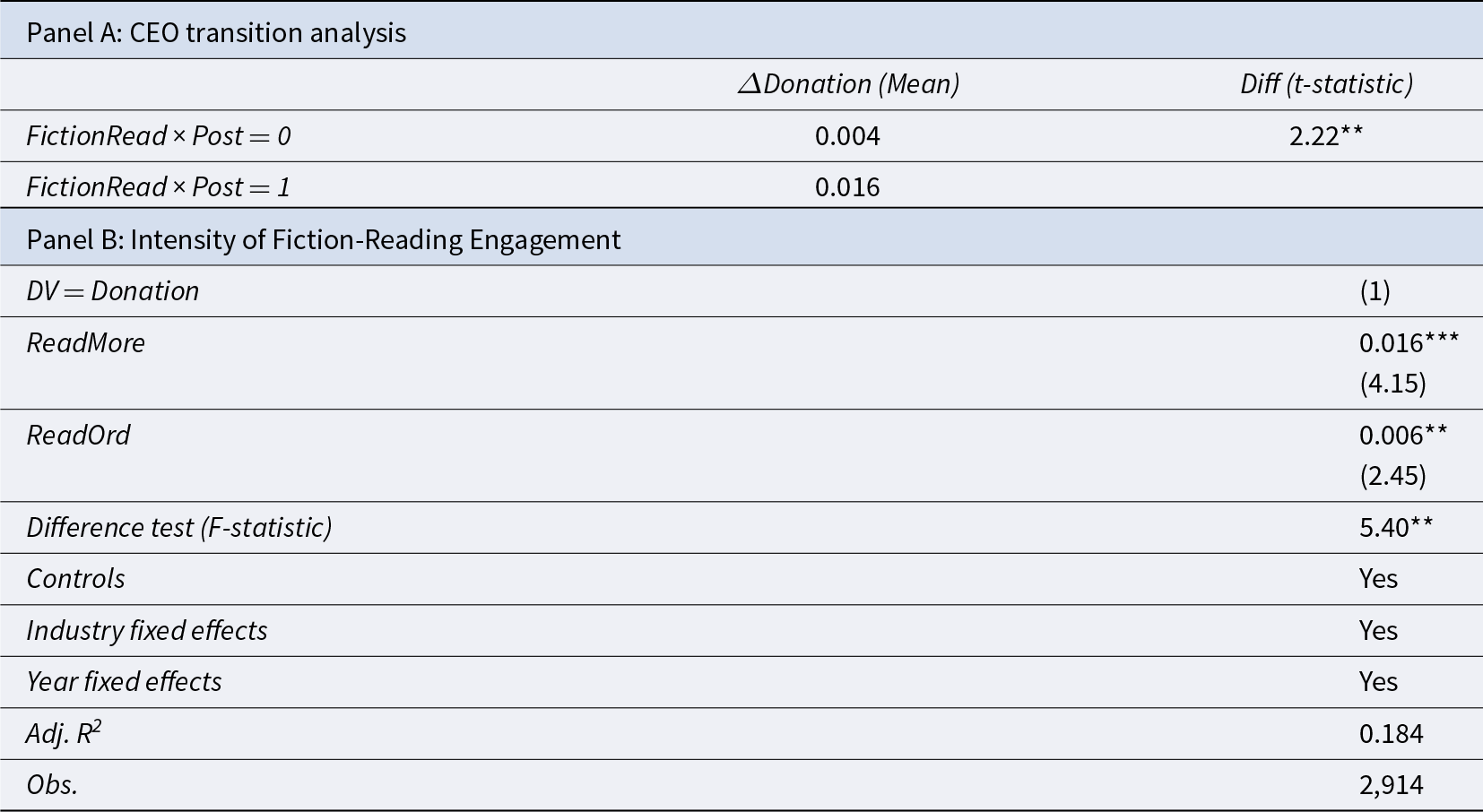
Among the 1,076 distinct non-state-owned firms and 1,210 unique CEOs in our dataset (2001–2018), approximately 86.4% (1,046 CEOs) remained in office for the entire duration of their firm’s presence in the sample. This high degree of CEO-firm stability limits the feasibility of a standard DiD design. Hence, we adopt an event-oriented approach to test the behavioral change surrounding CEO turnover. Specifically, we calculated the average donation levels for the transition year (Post = 1) and the pre-transition year (Post = 0). We then compared the average change in the donation level (ΔDonation) between firms appointing a fiction-reading successor and those appointing a non-fiction-reading successor by interacting Post with FictionRead. As shown in Panel A of Table 4, firms appointing a fiction-reading CEO exhibited a statistically significant increase in corporate donations (ΔDonation = 0.016) following the transition. In contrast, firms appointing a non-fiction-reading CEO showed only a negligible change (ΔDonation = 0.004). The difference between these two groups is statistically significant (t-statistic = 2.22). This temporal evidence confirms that a distinct rise in philanthropy occurs after the arrival of a fiction-reading CEO and provides support for the causal ‘proposal effect’.
Endogeneity concerns

Table 4 Long description
Panel A reports mean change in corporate philanthropic donations, labeled DeltaDonation, for two rows labeled FictionRead times Post 0 and FictionRead times Post 1. Columns are DeltaDonation Mean and Diff t-statistic. For FictionRead times Post 0, the DeltaDonation mean is 0.004 and the Diff t-statistic is 2.22 with two asterisks. For FictionRead times Post 1, the DeltaDonation mean is 0.016 and the Diff t-statistic cell is blank.
Notes: This table presents the results of endogeneity and robustness tests. Panel A presents the results of an event-oriented analysis on CEO transitions. The sample is restricted to the subset of firms that experienced a CEO turnover event. We calculate the change in corporate philanthropic donations (ΔDonation) as the difference between the average donation level in the transition year (Post = 1) and the year immediately prior (Post = 0). The table compares the average (mean) ΔDonation for firms appointing a fiction-reading successor (FictionRead = 1) versus those appointing a non-fiction-reading successor (FictionRead = 0). The reported t-statistic tests the significance of the difference in means between these two groups. Panel B presents regression results examining the impact of varying levels of CEO fiction-reading engagement on corporate philanthropic donations. ReadMore is an indicator variable equal to one for a fiction-reading CEO who has a long daily reading time or emphasizes the importance of reading, and zero otherwise. ReadOrd is an indicator equal to one for a fiction-reading CEO who mentions neither his/her daily reading time nor the importance of reading, and zero otherwise. Detailed variable definitions are provided in Appendix A. t-statistics are reported in brackets. Standard errors are clustered by firm and year. *, **, and *** indicate significance at the 10%, 5%, and 1% levels, respectively.
To further address the firm-level selection concern, we conducted a systematic review of the timing of fiction-reading disclosures across all 200 identified fiction-reading CEOs in our dataset. This review yields two clear findings. First, there is not a single instance in which a CEO’s fiction-reading interest was described as having formed or emerged after their appointment at the focal firm. Second, 134 cases (67%) explicitly document that the fiction-reading habit predates the CEO’s current tenure, with sources describing the interest as originating in youth, adolescence, or early adulthood. The remaining 66 cases do not specify the exact timing of hobby formation but contain no evidence suggesting post-appointment emergence. This evidence directly addresses the concern about strategic disclosure: it is implausible that CEOs began disclosing fiction-reading interests as a reputational signal aligned with a philanthropic firm’s identity, given that most of the disclosures document habits formed well before their current tenure.
Intensity of fiction-reading engagement
To further substantiate the causal mechanism linking fiction-reading to corporate philanthropy, we examined whether the depth of engagement matters. Psychological research suggests that the empathy-enhancing effects of fiction are not binary but cumulative. According to the simulation theory of fiction, the development of empathy relies on ‘narrative transportation’, a process in which readers become emotionally immersed in the story and simulate the social experiences of characters. This psychological process requires sustained attention and deep cognitive engagement rather than superficial exposure. If fiction-reading actively cultivates empathy instead of merely reflecting a fixed personality trait or lifestyle choice, we should observe a ‘dose-response’ relationship. Specifically, CEOs who engage in fiction-reading with greater intensity and frequency should exhibit stronger empathic orientations and, consequently, higher levels of prosocial behavior.
To test this, we differentiate between CEOs based on their reported reading intensity. We construct a high-intensity indicator, ReadMore, for CEOs who explicitly emphasize the importance of reading or report long daily reading durations in their public profiles. Conversely, we categorize those who mention fiction-reading as a hobby without indicating deep engagement as ReadOrd (ordinary readers). As shown in Panel B of Table 4, CEOs in the ReadMore group are associated with significantly higher levels of corporate donations compared to those in the ReadOrd group. This finding supports a reinforcement model, suggesting that the observed effect is driven by meaningful, sustained engagement with fiction. It therefore helps rule out the alternative explanation that the result is driven by superficial personal interests.
Other Robustness Tests
To ensure the robustness of our main findings and further mitigate concerns about endogeneity and sample selection, we conducted a battery of robustness checks below, all of which are reported in Online Appendix 2.
Instrumental variable (IV) analysis
To mitigate potential endogeneity bias where unobserved factors might drive both reading habits and philanthropy, we employ an IV approach. We utilize the literary environment of the CEO’s hometown as an exogenous instrument, measured by the density of public libraries and the number of nationally recognized writers in the CEO’s birth city. These instruments are theoretically grounded in research showing that early-life exposure to a literacy-rich environment strongly predicts lifelong reading habits, yet they are unlikely to directly influence the current philanthropic decisions of the CEO’s firm. The IV regression results confirm that the relationship between fiction-reading and corporate donations remains positive and statistically significant after addressing endogeneity.
Impact threshold for a confounding variable (ITCV) analysis
We further assess the sensitivity of our results to unobserved confounding using the ITCV method. This analysis estimates the magnitude of correlation an omitted variable would need to have with both the independent and dependent variables to invalidate the observed effect. Our results indicate that to nullify the statistical significance of the fiction-reading effect, approximately 62.36% of the sample observations would need to be replaced with cases showing no effect. Furthermore, to invalidate our core finding in the unconditional model, an omitted confounding variable would need to have an impact approximately 4.76 times stronger than that of the strongest control variable. In the conditional model, this threshold increases significantly, implying that an omitted confounder would require an impact approximately 5.78 times stronger than the strongest control to overturn our causal inference. This suggests that it is highly unlikely for an unobserved confounder to exist that is strong enough to invalidate our main findings.
Heckman two-stage model
To address potential sample selection bias arising from the fact that our classification relies on publicly disclosed hobbies, we employed a Heckman two-stage model. In the first stage, we model the likelihood of hobby disclosure using media exposure and local broadband infrastructure as predictors. In the second stage, we include the inverse Mills ratio to correct for selection bias. While the significant inverse Mills ratio indicates the presence of non-random selection, our core finding remains robust after this correction.
Alternative explanations
We conduct additional tests to rule out alternative mechanisms. To distinguish the unique effect of fiction-reading from other empathy-inducing factors, we control for CEOs’ early-life poverty experience (PovertyExp), childhood disaster exposure (DisasterExp), and local Confucian cultural influence (Confucian). We also control for CEO structural power (Power) to account for managerial discretion. The effect of fiction-reading remains robust. Second, we examine strategic motives by testing interactions with political connections and corporate misconduct (Violation). We find no evidence that fiction-reading donations are driven by political signaling. Conversely, the positive relationship weakens during reputational crises, implying that these donations are less likely to be deployed as strategic ‘insurance’. Finally, our results hold when excluding artistic industries.
Additional Tests
CEO empathy and organizational philanthropy
In this section, we extend our analysis by examining whether CEOs’ empathic orientation, as fostered by their fiction-reading hobby, has broader implications beyond prosocial activities and influences outcomes related to employees and shareholders. Prior research suggests that empathic leaders are more likely to demonstrate people-oriented behaviors that reflect concern for employee welfare (Dietz & Kleinlogel, Reference Dietz and Kleinlogel2014; Fleishman & Salter, Reference Fleishman and Salter1963). For example, Dietz and Kleinlogel (Reference Dietz and Kleinlogel2014) show that empathic CEOs are less likely to comply with directives that involve cutting employee wages during adverse conditions. Similarly, Berson, Oreg, and Dvir (Reference Berson, Oreg and Dvir2008) report a positive association between empathic leadership and the development of supportive organizational cultures. In line with this literature, we investigate three dimensions of employee welfare: pay dispersion, workplace safety, and financial support in the form of employee subsidies.
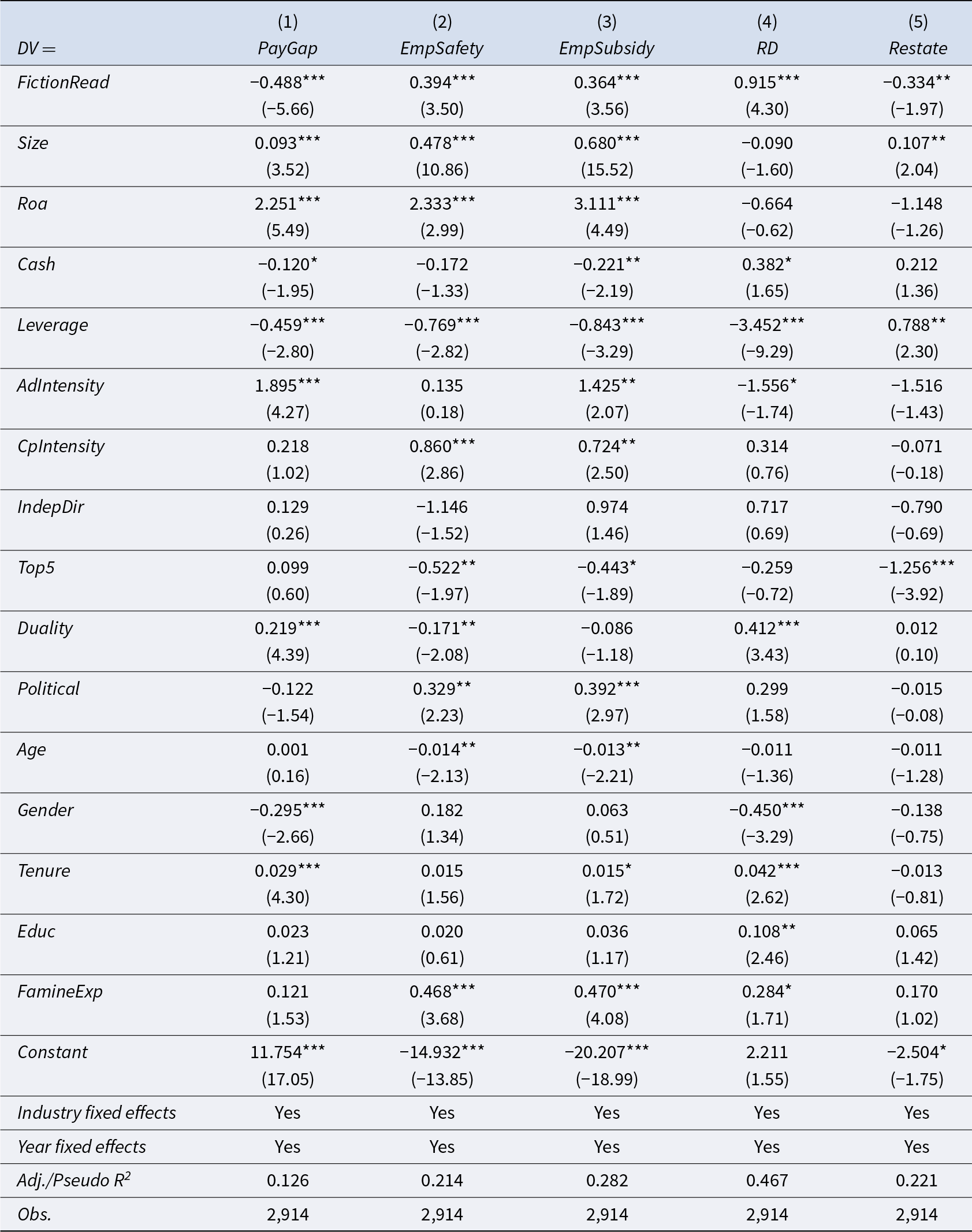
First, we examine whether empathic CEOs help reduce the wage gap between executives and rank-and-file employees. Prior work argues that large pay disparities are perceived as unfair and may contribute to reduced morale and social alienation in the workplace (Galperin, Bennett, & Aquino, Reference Galperin, Bennett and Aquino2011; Lazear, Reference Lazear1989). If empathic CEOs are sensitive to such perceptions, they may seek to narrow these compensation gaps. We define PayGap as the natural logarithm of the difference between the average compensation of the top three executives and that of all other employees. Using PayGap as the dependent variable, Column (1) of Table 5 shows that the coefficient of FictionRead is −0.488 (p < 0.01), indicating that firms led by fiction-reading CEOs exhibit significantly lower levels of executive-employee pay dispersion.
CEO fiction-reading and organizational philanthropy practices

Table 5 Long description
Five regression models report coefficients and t statistics for outcomes PayGap, EmpSafety, EmpSubsidy, RD, and Restate, each with 2,914 observations, plus industry and year fixed effects. For FictionRead, coefficients are minus 0.488 with t minus 5.66 for PayGap, 0.394 with t 3.50 for EmpSafety, 0.364 with t 3.56 for EmpSubsidy, 0.915 with t 4.30 for RD, and minus 0.334 with t minus 1.97 for Restate. Size is 0.093 with t 3.52 for PayGap, 0.478 with t 10.86 for EmpSafety, 0.680 with t 15.52 for EmpSubsidy, minus 0.090 with t minus 1.60 for RD, and 0.107 with t 2.04 for Restate. Leverage is negative in the first four models at minus 0.459, minus 0.769, minus 0.843, and minus 3.452, with t values minus 2.80, minus 2.82, minus 3.29, and minus 9.29, and positive for Restate at 0.788 with t 2.30. Duality is 0.219 with t 4.39 for PayGap, minus 0.171 with t minus 2.08 for EmpSafety, minus 0.086 with t minus 1.18 for EmpSubsidy, 0.412 with t 3.43 for RD, and 0.012 with t 0.10 for Restate. Top5 is 0.099 with t 0.60 for PayGap, minus 0.522 with t minus 1.97 for EmpSafety, minus 0.443 with t minus 1.89 for EmpSubsidy, minus 0.259 with t minus 0.72 for RD, and minus 1.256 with t minus 3.92 for Restate. Adjusted or pseudo R squared values are 0.126 for PayGap, 0.214 for EmpSafety, 0.282 for EmpSubsidy, 0.467 for RD, and 0.221 for Restate.
Notes: This table reports regression results on the effect of CEOs’ fiction-reading hobby on organizational philanthropy practices, including within-firm pay dispersion, employee safety programs, employee welfare, R&D investment intensity, and financial restatement. Pro-employee practices are captured by PayGap, EmpSafety, and EmpSubsidy. PayGap is the natural logarithm of the compensation gap between employees and the top three executives. EmpSafety is an indicator variable equal to one if the firm has a safety-production management system in place in a year, and zero otherwise. EmpSubsidy is an indicator variable equal to one if the firm provides employee benefits as defined by the CNRDS criteria, such as retirement plans, housing subsidies, and other welfare programs, and zero otherwise. Shareholder-oriented managerial practices are measured by RD and Restate. RD is the ratio of R&D investment to total operating revenue. Restate is an indicator variable equal to one if a financial restatement occurred during the year, and zero otherwise. Detailed definitions of control variables are provided in Appendix A. t-statistics are reported in brackets. Standard errors are clustered by firm and year. *, **, and *** indicate significance at the 10%, 5%, and 1% levels, respectively.
Second, we explore whether empathic CEOs are more attentive to workplace safety. Prior studies in organizational climate demonstrate that ethical managerial behavior or leadership is a critical antecedent of ethical climates (e.g., Mayer, Kuenzi, Greenbaum, & Bardes, Reference Mayer, Kuenzi, Greenbaum and Bardes2009; Shin, Reference Shin2012), which plays an important role in determining the level of safety within the organization (Parboteeah & Kapp, Reference Parboteeah and Kapp2008). CEOs with heightened empathy may prioritize safety not only as a compliance issue but also as a matter of employee well-being. We define EmpSafety as an indicator variable equal to one if the firm has a formal safety-production management system in place in a given year, and zero otherwise. As reported in Column (2) of Table 5, FictionRead is positively associated with EmpSafety (β = 0.394, p < 0.01), suggesting that fiction-reading CEOs are more likely to promote and maintain institutional mechanisms that enhance workplace safety.
Third, we examine whether empathic CEOs are more likely to provide direct financial support to employees in the form of subsidies. Financial supportive programs such as housing, medical, retirement, and hardship subsidies reflect a firm’s commitment to employee welfare and are particularly relevant in regions where formal social safety nets are limited. Prior research suggests that leaders with stronger prosocial motivations are more likely to respond to employees’ material needs, especially under conditions of financial insecurity (Grant & Berg, Reference Grant, Berg, Spreitzer and Cameron2011). Moreover, organizations led by empathic leaders often adopt policies that go beyond regulatory compliance and aim to foster a more supportive and inclusive work environment (Cameron, Mora, Leutscher, & Calarco, Reference Cameron, Mora, Leutscher and Calarco2011). We define EmpSubsidy as an indicator variable equal to one if the firm provides employee benefits as defined by the CNRDS criteria, such as retirement plans, housing subsidies, and other welfare programs, and zero otherwise. Column (3) of Table 5 shows a positive and statistically significant relationship between FictionRead and EmpSubsidy (β = 0.364, p < 0.01), suggesting that fiction-reading CEOs are more likely to provide financial support for employees. This finding further underscores the idea that empathic CEOs engage in management practices that reflect attentiveness to the everyday needs and well-being of their workforce.
The framework proposed by König, Graf-Vlachy, Bundy, and Little (Reference König, Graf-Vlachy, Bundy and Little2020) characterizes prosocial CEOs as leaders who combine moral concern with responsible, future-oriented decision-making. Based on their conceptualization, we perform two additional tests. First, we examine whether fiction-reading CEOs are more likely to promote innovation investment through higher R&D intensity. As highlighted by König et al. (Reference König, Graf-Vlachy, Bundy and Little2020), innovation serves both societal advancement and shareholder interests by positioning the firm for future growth and development. The result is shown in Column (4) of Table 5. Our analysis confirms that firms led by fiction-reading CEOs allocate a higher proportion of sales to R&D, suggesting that empathic leaders may also prioritize innovation and sustainable value creation. Second, we analyse financial restatements as a proxy for ethical and transparent managerial behavior. A lower frequency of restatements is associated with stronger internal governance and greater accounting integrity (Baber, Liang, & Zhu, Reference Baber, Liang and Zhu2012). The result, as shown in Column (5) of Table 5, implies that firms with fiction-reading CEOs are significantly less likely to issue financial restatements, further supporting the view that empathy may underpin stronger ethical governance and transparency.
Discussion
This study investigates how CEOs’ empathy, reinforced and signaled by the personal habit of reading fiction, influences corporate philanthropic decisions. Bridging upper echelons theory with psychological research on narrative impact, we argue that fiction-reading is not merely a leisure activity but a formative practice that deepens and consolidates a multidimensional, integrated empathic capacity. Anchoring our model in the Empathy–Altruism Hypothesis, we posit that this heightened empathy motivates CEOs to view corporate resources as a means to effect positive social change, independent of purely strategic calculations.
Our empirical results strongly support this framework. We find a robust positive association between CEO fiction-reading and corporate philanthropy. Critically, we move beyond simple association to validate the underlying mechanism: a formal mediation analysis confirms that the effect of fiction-reading on donations is transmitted through the CEO’s empathic orientation, as captured by textual analysis of annual reports. Furthermore, our CEO transition analysis provides temporal evidence of a ‘proposal effect’, mitigating concerns about reverse causality and consistent with the view that fiction-reading reinforces prosocial orientations that shape organizational outcomes. Supplementary analyses reveal that this prosocial orientation is pervasive, influencing employee welfare and ethical governance practices.
Theoretical Implications
Our findings suggest three significant shifts for research on upper echelons, leadership, and CSR. First, this study demonstrates the viability of using off-the-job habits to unlock the ‘black box’ of executive psychology. While upper echelons research has long sought to measure psychological traits, it has often been constrained by the limitations of demographic proxies or the difficulty of accessing elites for surveys (Hambrick, Reference Hambrick2007; Neely et al., Reference Neely, Lovelace, Cowen and Hiller2020). By validating fiction-reading as a robust behavioral proxy, we show that latent dispositions like empathy leave observable footprints in the private lives of executives. This implies that future research need not be limited to coarse measures like age or tenure. Instead, scholars can effectively trace psychological micro-foundations through unobtrusive lifestyle signals, providing a more granular understanding of how executive personality shapes firm outcomes (Wowak et al., Reference Wowak, Mannor, Arrfelt and McNamara2016).
Second, we refine the application of upper echelons theory by proposing a ‘reinforcement model’ of leadership traits. Traditional studies often treat executive characteristics as static markers. In contrast, our findings regarding the intensity of fiction-reading suggest that traits like empathy are dynamic capacities maintained through behavioral practices (Mar & Oatley, Reference Mar and Oatley2008). This challenges the view of the CEO as a fixed entity. It suggests that the boundary between the private self and professional stewardship is permeable. Therefore, upper echelons models should increasingly account for how formative leisure activities actively sustain the capabilities required for leadership, rather than viewing personal time as separate from professional performance.
Third, our application of the Empathy–Altruism Hypothesis challenges the dominant instrumental view of corporate philanthropy. Much of the existing CSR literature frames giving primarily as a strategic tool for reputation management or political legitimacy (Godfrey, Reference Godfrey2005; Su & He, Reference Su and He2010). Our results, however, highlight the predictive power of intrinsic moral motivation. To fully understand corporate social behavior, scholars must look beyond external pressures and consider the voluntary, moral impulses of leaders (Batson et al., Reference Batson, Batson, Slingsby, Harrell, Peekna and Todd1991; Grant, Reference Grant2008). This suggests that corporate benevolence is often a reflection of the leader’s genuine human concern, necessitating a more psychologically nuanced approach to CSR research.
Practical Implications
Our findings carry several practical implications, though these should be interpreted cautiously given the observational nature of the study. First, and most importantly, our results draw attention to the broader importance of empathy-related developmental experiences in leadership. Rather than prescribing any specific hiring criterion, we suggest that organizations benefit from creating conditions that support and sustain leaders’ empathic capacities. This may include professional development programs that emphasize perspective-taking and stakeholder sensitivity, mentoring relationships that expose leaders to diverse human experiences, or organizational cultures that value and reward empathy-driven decision-making. These practices address the psychological roots of prosocial behavior more directly and sustainably than any single biographical marker could.
Second, this study highlights a methodological insight relevant to those who evaluate executive leadership. The finding that unobtrusive behavioral signals, such as disclosed leisure activities, can serve as valid proxies for latent psychological traits suggests that stakeholder assessments of leadership quality need not rely solely on conventional performance metrics or formal credentials. Boards, investors, and governance analysts can develop more nuanced evaluation frameworks by attending to behavioral signals that reveal a leader’s empathic orientation. Crucially, however, this insight concerns the informational value of such signals, not their prescriptive use: the goal is to better understand and assess a leader’s existing prosocial disposition, not to screen candidates based on specific hobbies or lifestyle choices.
Limitations and Future Research Directions
This study has several limitations that suggest avenues for future research. First, while we validate fiction-reading as a robust behavioral proxy for empathy, we acknowledge that empathy is a multidimensional construct that can be measured through alternative methods. Although our textual analysis of annual reports lends support to the empathy interpretation, future research could explore complementary proxies, such as engagement in volunteering or caregiving, or employ large-scale survey instruments to directly capture managerial empathy in organizational contexts.
Second, our study is subject to important limitations regarding causal inference between fiction-reading and empathy. Three interpretations of the observed association remain plausible and cannot be fully disentangled with observational data: (1) dispositional empathy may predispose individuals toward fiction-reading, such that pre-existing traits rather than the reading habit drive the outcome; (2) fiction-reading may reinforce and amplify empathic capacity through repeated narrative engagement, as our reinforcement model proposes; or (3) the two may operate in a reciprocal, mutually reinforcing dynamic over time. While our IV and CEO transition analyses help mitigate endogeneity concerns to some degree, it is important to note that the CEO transition evidence supports behavioral change at the firm level but does not fully disentangle pre-existing CEO traits from reading-induced reinforcement. We therefore interpret our findings as consistent with the reinforcement interpretation, while acknowledging that dispositional selection and reciprocal dynamics cannot be ruled out. Future studies leveraging longitudinal designs, natural experiments, or panel data on CEO reading behavior over time would help isolate the specific reinforcement effect of fiction on executive empathy.
Third, our identification relies on publicly available sources, which may introduce measurement error if some CEOs choose not to disclose their hobbies. Although we employ a Heckman two-stage model to correct for potential selection bias in disclosure, we cannot completely rule out strategic reporting. While fiction-reading is less likely to be used for impression management than explicit CSR statements, future research could utilize digital footprints or richer biographical data to further distinguish genuine interests from reputational signaling.
On a final note, our study focuses on non-SOEs in China, a context where executive discretion is high. Future research should examine whether these empathy-driven mechanisms hold in different institutional environments where corporate governance structures may more strictly constrain individual CEO influence.
Supplementary material
The supplementary material for this article can be found at https://doi.org/10.1017/mor.2026.10141.
Data availability statement
The data supporting the findings of this study are openly available in the Open Science Framework at https://osf.io/wazcb/?view_only=3f41f022c62b43129485eae6b7d456f4
Acknowledgements
We sincerely thank the Editor, Professor Xiaomeng Zhang, and the three anonymous reviewers for their constructive and insightful comments, which have greatly improved this manuscript. All authors contributed equally to this work, and authorship is listed in alphabetical order. We gratefully acknowledge financial support from the National Natural Science Foundation of China (Grant No. 72232010) and the Hong Kong Research Grants Council General Research Fund (Grant No. 17504423).
Appendix A. Variable Definitions

Zhi Jin (09001-jz@163.com) is a tenured professor at the School of Accounting, Southwest University of Finance and Economics. His research focuses on financial accounting, corporate finance, and corporate governance. He studies firm behavior and financial reporting, with particular emphasis on governance mechanisms and their impact on corporate performance and transparency.
Yi Tang (msytang@hku.hk) is a tenured associate professor of management and strategy at the Faculty of Business and Economics, The University of Hong Kong. His research focuses on strategic leadership, corporate innovation, and corporate social responsibility, particularly how executives’ cognition shapes firm decision-making and organizational performance.
Yinan Yang (yyn@swufe.edu.cn) is a tenured associate professor at the School of Accounting, Southwest University of Finance and Economics. Her research interests include accounting and corporate finance, with a focus on empirical studies of firm behavior and financial decision-making. Her work examines financial reporting, governance structures, and capital market outcomes.
Xinrui Zhang (zxr_1003@163.com) is a lecturer at the Business School of Liaoning University. Her research focuses on institutional change, accounting, and auditing. She studies how evolving institutional environments shape accounting practices and audit quality, particularly within regulatory and governance contexts. Her work contributes to research on the interaction between institutional development and financial reporting.