Introduction
Older people's participation in productive activities has often been regarded as a way to address some of the concerns associated with population ageing (Gonzales, Matz-Costa and Morrow-Howell Reference Gonzales, Matz-Costa and Morrow-Howell2015). In particular, civic participation has received considerable attention from gerontologists and policy makers for its potential to promote a so-called ‘win–win’ scenario. Previous research has shown that older people's civic participation not only creates economic and social benefits for the community (Neill, Morrow-Howell and Wilson Reference Neill, Morrow-Howell, Wilson, Settersten and Angel2011), but also has a positive impact on elders' health and wellbeing (e.g. Anderson et al. Reference Anderson, Kroger, Dawson, Binns, Caspi, Damianakis, Wagner, Bernstein and Cook2014). Further, engagement in civic activities such as volunteering or political participation may be positively associated with current participation in other types of productive activities (Burr et al. Reference Burr, Choi, Mutchler and Caro2005; Serrat, Villar and Celdrán Reference Serrat, Villar and Celdrán2015), or be a pathway for future engagement in them (Morrow-Howell et al. Reference Morrow-Howell, Lee, Mccrary and Mcbride2014).
The concept of civic participation, however, is a problematic one with little agreement on what activities are included under this label. While some scholars have used the concept to refer to specific activities such as formal volunteering (e.g. Cutler, Hendricks and O'Neill, Reference Cutler, Hendricks, O'Neill, Binstock and George2011) or political participation (e.g. Burr, Caro and Moorhead Reference Burr, Caro and Moorhead2002), others (e.g. Putnam Reference Putnam2000) have proposed a broad definition of the term to include the large range of social and political activities that generate social capital. The multi-faceted character of the concept of civic participation could certainly account for the lack of consensus between researchers (Neill, Morrow-Howell and Wilson Reference Neill, Morrow-Howell, Wilson, Settersten and Angel2011). Indeed, it could be argued that the concept has been used with so many different meanings that it has lost much of its precision. As Berger (Reference Berger2009: 335) suggests, ‘the stakes go beyond mere semantics … when our words yield vague, amorphous conceptualizations rather than widely accessible concepts, we cannot easily study, operationalize or discuss the social and political phenomena that surround us’.
In an attempt to provide greater clarity, some authors have proposed to differentiate two main spheres within the concept (Adler and Goggin Reference Adler and Goggin2005; Berger Reference Berger2009; Mcbride, Sherraden and Pritzker Reference Mcbride, Sherraden and Pritzker2006): social participation and political participation. Social participation is related to actions that connect individuals to others, such as care-giving or volunteering, while political participation refers to actions aimed at influencing political outcomes. While there is a growing number of studies on older people's social participation, particularly volunteering (for a review, see Petriwskyj and Warburton Reference Petriwskyj and Warburton2007), research on political participation is still at an early stage (Nygard and Jakobsson Reference Nygard and Jakobsson2013a , Reference Nygard and Jakobsson2013b ). Understanding and promoting older citizens' engagement in political activities, however, is very important if we are to sustain and build representative democracies, particularly in the current context of ageing populations.
However, understanding how to promote the political participation of older citizens is further complicated by the multi-dimensional nature of political participation itself. Verba, Scholzman and Brady (Reference Verba, Scholzman and Brady1995) classify political acts as low- and high-investment activities, taking into account the effort they require from the individual, and Kaase (Reference Kaase1999) differentiates between institutionalised and non-institutionalised forms of political participation. Although previous studies have addressed older people's voting behaviour or a combination of a few types of transitory political activities, such as boycotting, demonstrating, contacting politicians or signing petitions (e.g. Binstock Reference Binstock2000; Kam et al. Reference Kam, Cheung, Chan and Leung1999; Melo and Stockemer Reference Melo and Stockemer2014; Nygard and Jakobsson Reference Nygard and Jakobsson2013a , Reference Nygard and Jakobsson2013b ), other types of political acts, such as high-investment and institutionally channelled activities, have gone largely unexplored. However, these kinds of activities are not necessarily comparable to other types of political behaviour because they require a higher level of effort from individuals (Verba, Scholzman and Brady Reference Verba, Scholzman and Brady1995), and are more likely to be stable across time (Goerres Reference Goerres2009). It is these activities that are the focus of this article.
To date, the majority of literature focusing on older people's political participation has explored factors that predict participation (e.g. Nygard and Jakobsson Reference Nygard and Jakobsson2013a , Reference Nygard and Jakobsson2013b ; Serrat, Villar and Celdrán Reference Serrat, Villar and Celdrán2015), or has compared their participatory characteristics to those of younger generations (e.g. Goerres Reference Goerres2009; Melo and Stockemer Reference Melo and Stockemer2014; Quintelier Reference Quintelier2007). Barriers to older people's engagement in political activities have been far less often the focus of research, in the same way as in the broader civic participation literature, particularly volunteering, which much more commonly focuses on motivation. Yet understanding hindrances to older people's participation is essential to address recruitment and retention issues and consequently to maximise the benefits and minimise the costs associated with political participation. Further, this is critical not only for the individuals involved but also for their organisations (Gonzales, Matz-Costa and Morrow-Howell Reference Gonzales, Matz-Costa and Morrow-Howell2015; Warburton, Paynter and Petriwskyj Reference Warburton, Paynter and Petriwskyj2007).
Barriers to the recruitment and retention of older people by civic organisations
Although there is very little evidence specifically relating to barriers to political participation, there are a few studies that have identified different types of barriers to recruitment and retention of older people in other aspects of civic participation. These can be explored using the civic voluntarism model (Verba, Scholzman and Brady Reference Verba, Scholzman and Brady1995), which explains civic participation as a result of resources, psychological engagement and recruitment networks. Table 1 utilises this framework to provide an overview of the barriers identified in previous studies of older people's civic activities, specifically means-related, motives-related and opportunity context-related barriers.
Means-related, motives-related and opportunity context-related barriers to older people's civic participation: overview of previous findings

Following the model by Verba, Scholzman and Brady (Reference Verba, Scholzman and Brady1995), means-related barriers refer to the lack of individual resources that are considered necessary for participation, such as health, civic skills, income or available time. As noted in Table 1, this dimension is by far the most frequently identified type of barrier in existing literature. Motives-related barriers have to do with older people's unwillingness to participate or disengagement from participation, due to factors such as lack of interest, disillusionment and disaffection, or a fear of a too demanding involvement. Finally, opportunity context-related barriers are related to socio-cultural and organisational factors that act as impediments to older people's civic participation. In this vein, ageist attitudes, lack of information about opportunities or organisational problems have been identified as impediments for participation (see Table 1).
Although research on barriers to older people's civic participation has been quite extensive, there are some aspects that need further development. First, most studies on barriers to older people's civic participation address a diversity of activities, without differentiating between them, therefore disregarding the specific barriers that may arise when undertaking different types of activity (e.g. Davis et al. Reference Davis, Crothers, Grant, Young and Smith2012; Kruse and Schmitt Reference Kruse and Schmitt2015). While some studies have focused on specific activities, such as formal volunteering (e.g. Warburton, Paynter and Petriwskyj Reference Warburton, Paynter and Petriwskyj2007), engagement in local governance (e.g. Petriwskyj et al. Reference Petriwskyj, Warburton, Everingham and Cuthill2012), participation in community policy and planning (e.g. Chau Reference Chau2007) or involvement in social movement organisations or social action (e.g. Hutchinson and Wexler Reference Hutchinson and Wexler2007), very limited research could be identified addressing barriers to participation in political organisations specifically. Yet there may be specific barriers that are unique to this form of participation, and which are not comparable to other forms of participation.
Second, previous research on barriers to older people's civic participation has largely been carried out with samples of people not already participating in these activities (e.g. Gele and Harsløf Reference Gele and Harsløf2012), or mixed samples of participants and non-participants (e.g. Postle, Wright and Beresford Reference Postle, Wright and Beresford2005). Therefore, previous findings have mainly addressed barriers that prevent older people from participation, that is, barriers to recruitment. Much less is known about barriers that could stop people from continued participation once they have started, that is, barriers to retention. This is particularly interesting when one considers the active members of the organisations, who may act as members of boards and committees, and as such, play a key role in helping organisations to achieve their goals while benefiting from remaining engaged in meaningful roles in later life. Evidence regarding what causes those members to cut down or even cease their active participation is essential if the aim is to extend the benefits of this productive activity for longer.
Third, some of the literature suggests that specific individual characteristics, such as age, disability, and migrant or indigenous status (e.g. Gele and Harsløf Reference Gele and Harsløf2012; Kruse and Schmitt Reference Kruse and Schmitt2015; Petriwskyj et al. Reference Petriwskyj, Warburton, Everingham and Cuthill2012), or some organisational characteristics, such as ageist policies (Warburton, Paynter and Petriwskyj Reference Warburton, Paynter and Petriwskyj2007), might be associated with the type of barriers that impede involvement. Again, while less is known about the influence of individual or organisational characteristics on the barriers to continued involvement, there are some studies that explore this dimension. Celdrán and Villar (Reference Celdrán and Villar2007), for example, showed that the type of organisation and some socio-demographic characteristics, such as volunteers' age and income, had a significant influence on older volunteers' perceptions of drawbacks associated with participation. A study by Tang, Morrow-Howell and Choi (Reference Tang, Morrow-Howell and Choi2010) found that income, health and some characteristics of the volunteer programme, such as the activity type or the duration of the involvement, were significant in predicting volunteers' turnover. Finally, Harré, Tepavac and Bullen (Reference Harré, Tepavac and Bullen2009) found that participants' perceived efficacy, described as a sense of personal effectiveness, played a key role in political activists' ongoing motivation. In view of these findings, it is reasonable to expect that these characteristics might also be important in understanding ongoing participation in political organisations, and provide more tailored evidence to assist organisations in addressing the barriers to continued involvement.
Finally, most research to date has been carried out in English-speaking countries, and much less is known about barriers to participation in other geographical and cultural contexts. It has been argued, however, that patterns of political participation among older adults are highly dependent on the socio-historical context (Goerres Reference Goerres2009). The case of Spain, where this research was conducted, is particularly interesting. Spanish participants in this study lived a great part of their lives under Franco's dictatorship. They experienced severe limitations to their liberties and rights, and were prohibited from any kind of political expression. This situation reversed in the mid-1970s, when the transition to democracy allowed and legalised political activities and organisations. People over 65 remain the cohort with the lowest levels of political engagement (Instituto de Mayores y Servicios Sociales 2008). Nevertheless, in the last general elections in November 2011, people over 65 accounted for 23 per cent of the electorate (Centro de Investigaciones Sociológicas 2011) and, due to population ageing, this percentage will continue to increase in the future. It is estimated that over the next 40 years the proportion of people aged over 65 will represent more than a third of the Spanish population (Instituto de Mayores y Servicios Sociales 2014). This means that the older age group will increasingly play a key role in the political scene, both as a central focus of government policies and as a crucial political grouping having a say in political affairs. To date, however, there is virtually no research exploring older people's political participation in the unique socio-political context of Spain. Results from other contexts such as the United States of America, Australia and the United Kingdom, where most research into civic participation is conducted, may have limited applicability to the Spanish context.
This study is focused on addressing a number of these gaps. The specific aims of the study are to explore the perceived barriers to retention among Spanish older people actively engaged in political organisations; and, further, to explore the possible association of these barriers with other variables such as the type of organisation, socio-demographic variables and participatory characteristics. In this way, the study seeks to identify not only what barriers are reported by those participating in political organisations, but what individual and organisational factors may influence these barriers. This will provide a more nuanced understanding of the barriers experienced or perceived by older people to their continued participation than that offered in the existing literature.
Methods
Participants
The study was conducted by the first and third authors during 2014 in the autonomous Spanish region of Catalonia. Participants were recruited through political organisations. While there has been a considerable debate around the definitions of political participation and political organisations, this paper adopts the definition of political organisations proposed by Morales:
formally organized groups who seek collective goods … and which have as their main goal to influence political decision-making processes, either by trying to influence the selection of governmental personnel or their activities, include issues on the agenda or change the values and preferences which guide the decision-making process. (Reference Morales2004: 24)
Organisations in this study were selected from across Catalonia. Both the level (national versus local) and breadth (broad or single-issue) of focus were considered, resulting in selection of three types of organisation relevant in this context:
-
• A total of nine political parties and trade unions (combined as a high proportion of participants belonged to both types of organisation simultaneously), which operate at the national level and have a broad focus. Unlike single-issue organisations, which have a narrower set of concerns, political parties advocate and take a position across a wide range of issues, including, but not limited to, policies on health, education, work and retirement, and pensions.
-
• A total of 28 neighbourhood associations, which operate at the local level and are issue-focused. This type of organisation focuses its efforts on improving neighbourhoods through citizen involvement, and advocates for causes such as having better public services or new facilities in their neighbourhood. As these organisations are highly influenced by the specific local context in which they operate, we have included organisations from diverse socio-economic areas to ensure variability.
-
• A total of nine single-issue organisations, which operate at the national level and focus their action on specific political issues. Five were focused on advocacy for older people's rights, two on independence for Catalonia, one on supporting people affected by the subprime mortgage crisis, one on human rights and one on feminist issues.
The final sample included 192 participants from across these organisations: 56 from political parties or trade unions, 95 from neighbourhood associations and 41 from single-issue organisations. Participants reported involvement in their organisations for between one and 50 hours per week (mean = 10.5, standard deviation (SD) = 10.1) and for a period of between one and 66 years (mean = 16.4, SD = 15.1).
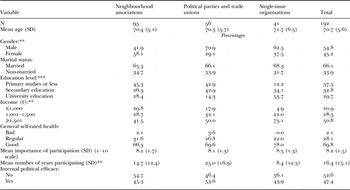
The participants ranged in age from 65 to 86 years (mean = 70.7, SD = 5.6) and were reasonably evenly balanced in terms of gender (54.8% male, 45.2% female). The sample was also fairly evenly split in terms of educational attainment, with close to a third reporting primary studies (37.5%), secondary studies (32.8%) and university degrees (29.7%). Full socio-demographic characteristics of the sample are shown in Table 2.
Comparative profile of older people engaged with political organisations, by type of organisation

Note: SD: standard deviation.
Significance levels: ** p < 0.01, *** p < 0.001 (p-values are based on the chi-square statistic).
Instruments
A questionnaire was designed by the first and third authors for the purposes of the study. After pilot testing with a sample of six older people participating in political organisations, the final version of the questionnaire was administered to a sample with no previous experience of the survey. The questionnaire included both closed and open-ended questions and incorporated standardised scales and purpose-designed items. The survey therefore contained a number of sections:
-
1. Socio-demographic items (gender, age, marital status, education, income and self-rated health).
-
2. Participatory characteristics (number of years participating and average hours spent participating per week).
-
3. Importance of participation (‘On a scale where 1 means “not important at all” and 10 means “very important”, how important is it for you to participate in your organisation?’).
-
4. Internal political efficacy (‘Do you believe that your participation will result in changes in policies?’ with response categories ‘yes’, ‘no’, ‘I am not sure’).
-
5. Barriers to continued or future participation (‘If at some point in the future you decided to stop participating in your organisation, what could be the reason for this?’).
The study was designed to provide a multi-faceted analysis of barriers to continued participation in political organisations. An exploratory approach was utilised given the lack of existing evidence related to this context. Specifically, an open-ended question was included to enable barriers to continued participation to be identified using respondents' own words rather than a pre-determined set of responses. The open-ended responses were analysed through the quantification of responses and the use of logistic regression to explore the reporting of these barriers according to the characteristics of both organisations and individuals. This study therefore explores not only what barriers to continued participation in political organisations are reported by older people – that is, barriers to retention – but also how reporting of these barriers relates to the individual and organisational context.
Procedure
Political organisations were approached by the first author and invited to take part in the study via an e-mail to identified organisations, followed up with a face-to-face meeting with the board members of the organisations during which study objectives and procedures for data collection were explained in detail. Organisations that agreed to participate designated a person responsible for distributing the survey to all members who could potentially meet the inclusion criteria and who expressed willingness to participate. To be eligible for participation in the survey, individuals were required to (a) be aged 65 or over, (b) be a member of the board or a committee within the organisation, (c) have participated in the organisation for at least one year, and (d) devote at least one hour per week to their involvement. These criteria were used to ensure that respondents were not simply members of organisations, but were actively involved in political activity through their organisations. These inclusion criteria, and the purpose of the study and information about data collection, instructions to answer the survey, contact details for the research team, confidentiality, and clear statements of the right to withdraw information at any time and to decline to answer any of the questions, were explained through an information sheet attached to the survey. Study participants completed an informed consent form before filling in the survey at home and returning it to the organisation's nominated representative for collection by the researchers. This process ensured that all questionnaires were anonymous with no identifying information collected. The study was approved by the Ethics Committee of the Faculty of Psychology of the University of Barcelona.
Data analysis
Content analysis
First, responses to the open-ended questions underwent content analysis, with the particular purpose of identifying both the themes within responses but also their frequency (Vaismoradi, Turunen and Bondas Reference Vaismoradi, Turunen and Bondas2013). A multiple-step process of analysis was employed, with the help of ATLAS.ti 7 qualitative analysis software. The process involved inductive identification of areas of meaning within responses, creation of categories based on similarity of meaning by two independent raters, comparison of categories by the raters, and consensus on category definition and re-assignment of responses to the established category system by both raters (Krippendorff Reference Krippendorff2013). A third rater then categorised a random selection of 30 per cent of responses, with a kappa reliability index of 0.93 indicating very good reliability (Landis and Koch Reference Landis and Koch1977). Three categories were identified through this analysis of barriers: means-related, motive-related and opportunity context-related barriers. These are discussed in detail later in the paper.
Logistic regression
A series of binary logistic regression analyses was conducted to test the associations between the three categories identified in the content analysis and the type of organisation, socio-demographic variables, participatory characteristics, political efficacy and importance of participation. The dichotomous outcome variables were the three categories identified in the analysis of potential barriers (means, motives and opportunities), with mention of a theme included in that category coded as 1, and not mentioning a theme included in that category coded as 0. Variables used as independent variables in the analysis were gender (male; female), age, marital status (married or de facto; widowed, single or divorced), education (primary education or less; secondary education; university education), income (⩽€1,000; €1,001–1,500; ⩾€1,501 per month), self-rated health (bad or regular; good), type of organisation (political party or trade union; neighbourhood association; single-issue), importance of participation, years participating, and internal political efficacy (yes; no or not sure). Education and income were grouped according to the distribution of frequencies.
Results
Content analysis
Analysis of the perceived future barriers to continued participation in political organisations inductively identified three overarching categories or themes: means-related, motive-related and opportunity context-related barriers. Some participants mentioned more than one type of barrier, so their answers were coded in more than one superordinate category. Within each of these categories, a number of sub-themes were also identified.
Means-related barriers
Resources across three key thematic areas – health, age and time – were viewed as critical for respondents, who proposed that a change in these would influence their future commitment. Thus, for some participants, future age-related health problems would impact their ongoing involvement:
In the first place, my age, and in the second, that my health doesn't allow me to continue. (Man, 81, neighbourhood association)
Age was also identified as a future concern by others:
I have turned 80 this year and I need to start looking after myself a bit more. (Woman, 80, neighbourhood association)
Further, some participants identified the need to take care of family as a higher priority which would affect their ability to give time to their organisation:
If my children or my grandchildren need me. (Woman, 69, neighbourhood association)
All of these were identified as decreasing the means or resources individuals have in terms of time, health or other age-related influences on their capacity for continued participation.
Motive-related barriers
Three themes were identified which related to motives for continued participation. For some participants, ceasing their participation seemed unlikely unless they lost interest in the organisation or in contributing to its mission:
It would be difficult to give up my participation in the short/middle term. If that happened, it would be for personal reasons (getting bored of participating) or considering that I have nothing to contribute. (Man, 70, neighbourhood association)
Others felt that they may stop participating in future if their priorities were to change and they wished to focus on other activities:
The most likely would be to dedicate time to other activities. (Man, 74, single-issue organisation)
For some, achieving what they had set out to do through their participation was a potential reason to move on:
The reason would be having achieved the goals of the organisation. (Man, 67, single-issue organisation)
Thus, participants were able to identify that a change in their motivation for any of these reasons would prevent them continuing in their roles.
Opportunity context-related barriers
The context of participation was also important, with three further themes identified here. More specifically, this relates to externally driven factors that may decrease opportunities to be active, or to contribute in the way the individual intended. For some respondents, for example, the continuation of the organisation's mission or philosophy was important to their own continued involvement:
I think I would never give up … As far as the principles/ideals of the organisation remain the same. (Man, 66, neighbourhood association)
For others, it was the need for, or recognition of, their contribution that was important, suggesting that if they felt they were no longer necessary, or considered important, by the organisation, this may prompt them to move on:
If my contribution became no longer socially recognised. (Man, 76, neighbourhood association)
If the organisation did not require my contribution. (Man, 68, political party/trade union)
In a related theme, some respondents felt that they may need to move on in order to allow others to take on their role and ‘renew’ the board or committee:
I don't know. The most likely would be to make room for other people. (Man, 66, political party/trade union)
Each of these themes related in different ways to contextual changes or pressures that may influence their participation.
No intention to stop participating
It should also be noted that some respondents did not identify potential barriers, instead stating that they did not intend to ever stop participating in their organisation. For example, for one respondent the possibility of leaving their organisation was unimaginable:
I do not consider that possibility. It would be such a strong reason that I cannot even imagine it. (Man, 81, political party/trade union)
Similarly, another reported that they identified too strongly with their participation to be able to stop:
That is just not possible. You cannot get out of yourself. (Man, 65, political party/trade union)
However, overall, there were a number of reasons identified by the respondents for potential future disengagement. These related to means or resources of different types, a change or decrease in motivations, and a change in the context such as the philosophical fit or need for their contribution.
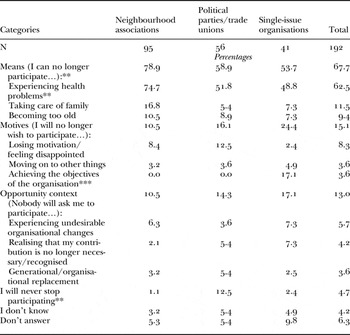
In order to explore further patterns among these themes, each theme and overarching category were analysed for the frequency with which they were mentioned by respondents. Of particular interest was the potential relationship between the type of organisation to which participants belonged and the barriers they identified. Frequencies and chi-square values for the themes according to type of organisation are presented in Table 3.
Responses to ‘If at some point in the future you decide to stop participating in your organisation, what could be the reason for this?’

Note: The sum of subordinate category values may sometimes be greater than the corresponding superordinate category value because some participants' answers included more than one barrier and, therefore, were coded into more than one subordinate category. Similarly, one specific response may include means-, motives- and opportunity context-related barriers.
Significance levels: ** p < 0.01, *** p < 0.001 (p-values are based on the chi-square statistic).
The most frequently mentioned type of barrier related to means or resources, reported by close to 70 per cent of respondents. In particular, potential health problems were mentioned by over 60 per cent of participants. Motive-related barriers were mentioned by over 15 per cent of respondents and opportunity context-related barriers by 13 per cent. Chi-square tests showed significant differences between types of organisation in relation to the barriers identified. Means-related barriers were more likely to be mentioned by those in neighbourhood associations (χ2 = 12.11, p < 0.01). Further, within the motive-related barriers category, those belonging to single-issue organisations were more likely to identify having achieved the objectives of the organisation as a reason to stop participating (χ2 = 26.76, p < 0.001).
Logistic regression
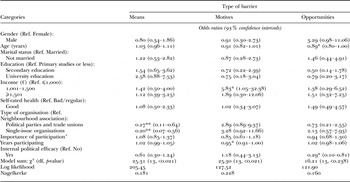
Following the content analysis and analysis of frequency of responses, logistic regression analyses were conducted to test the association between the three categories identified in the content analysis and the type of organisation, socio-demographic variables, participatory characteristics, political efficacy and importance of participation. The results of this analysis are presented in Table 4. Analysis revealed a number of significant relationships. Those belonging to trade unions or political parties were significantly less likely than those in neighbourhood associations to identify means-related barriers to future participation (odds ratio (OR) = 0.27, p < 0.01). Those in single-issue organisations were even less likely to do so (OR = 0.20, p < 0.01). Those in the middle income category, earning between €1,001 and 1,500 per month, were almost six times more likely to identify motive-related barriers than those in the lower income category (OR = 5.83, p < 0.05). The number of years participating in the organisation was associated with a decreased likelihood of identifying motive-related barriers (OR = 0.95, p < 0.05). Participants were less likely to identify opportunity context-related barriers with increasing age (OR = 0.89, p < 0.05). Finally, those with a sense of internal political efficacy were also less likely to identify opportunity context-related barriers (OR = 0.29, p < 0.05).
Logistic regression models predicting barriers to participate in a political organisation

Notes: N = 192. 1. Scale 1–10, higher scores indicate higher importance of participation. Ref.: reference category. df: degrees of freedom.
Significance levels: * p < 0.05, ** p < 0.01.
Discussion
The aims of this study were to explore the perceived barriers to retention among older people engaged in political organisations; and to explore the possible association of these barriers with other variables such as the type of organisation, and socio-demographic variables and participatory characteristics. The study therefore focused on two aspects of political participation that have been researched little to date, and, furthermore, explored these in the under-researched but politically unique context of Spain. The study adopted an innovative approach using both qualitative and quantitative techniques in order to explore not only what perceived barriers to continued participation could be identified, but how these might relate to organisational context and individual characteristics.
There was a range of reasons identified by the respondents for potential future disengagement, relating to the availability of means or resources, a change or decrease in motivation, and a change in the opportunities available in the organisation. It is noteworthy that these themes reflect the categories identified in Verba, Scholzman and Brady's (Reference Verba, Scholzman and Brady1995) civic voluntarism model. While this model has not traditionally been used to explore barriers to continued participation in civic activities, these findings suggest that it may have broader applicability and provide a useful framework to understand what causes people to cease participating.
Barriers related to a decrease in means to participate, including future health issues, age and time availability, match those identified by previous research addressing barriers to the recruitment of participants (e.g. Davis et al. Reference Davis, Crothers, Grant, Young and Smith2012; Martinez et al. Reference Martinez, Crooks, Kim and Tanner2011; Vegeris et al. Reference Vegeris, Barnes, Campbell-Barr, Mackinnon and Taylor2007). In addition, this kind of barrier has been identified in studies covering a diversity of civic activities (e.g. Martinez et al. Reference Martinez, Crooks, Kim and Tanner2011) or specific forms of it, such as engagement in local governance (e.g. Vegeris et al. Reference Vegeris, Barnes, Campbell-Barr, Mackinnon and Taylor2007). Means-related barriers of this kind therefore could act as a common impediment both for the recruitment and the retention of older participants and may not be specific to any particular form of participation but rather a basic impediment that older people need to overcome to take part in civic life.
Regarding motives-related barriers, our results differ from previous findings which identified factors such as lack of interest in either the specific issues addressed by the organisation or participation more generally, distrust in politics, low expectations and fear of a too demanding involvement as important motivational barriers (e.g. Gele and Harsløf Reference Gele and Harsløf2012; Petriwskyj et al. Reference Petriwskyj, Warburton, Everingham and Cuthill2012; Postle, Wright and Beresford Reference Postle, Wright and Beresford2005). Participants in our study, in contrast, highlighted reasons as losing interest in the organisation or in contributing to its mission, a change in priorities and a desire to focus on other activities, and having achieved what they had set out to do. This contrast may be explained by the fact that most previous research has been carried out with samples of people not already participating in civic activities (e.g. Gele and Harsløf Reference Gele and Harsløf2012) or mixed samples of participants and non-participants (e.g. Postle, Wright and Beresford Reference Postle, Wright and Beresford2005). These studies, therefore, addressed motivational barriers to recruitment which, as our results suggest, may not apply in the case of retention. Interestingly, studies addressing barriers to retention in other types of civic activities, such as social movement organisations (e.g. Hutchinson and Wexler Reference Hutchinson and Wexler2007) or participation in community policy and planning (e.g. Chau Reference Chau2007), did not report any barriers relating to participants' unwillingness to continue.
Similar differences may be seen among the opportunity context-related barriers. While previous research has identified such impediments as lack of opportunities or lack of information about available opportunities (e.g. Davis et al. Reference Davis, Crothers, Grant, Young and Smith2012), ageist attitudes (e.g. Dewar, Jones and O'May Reference Dewar, Jones and O'May2004) or other forms of discrimination (particularly towards specific populations, e.g. Balandin et al. Reference Balandin, Llewellyn, Dew, Ballin and Schneider2006; Chau Reference Chau2007), these factors were not identified in this study and, indeed, may be less relevant for the case of retention. Moreover, some opportunity context-related barriers identified in samples made up of people already participating in civic activities, such as the perception of tokenism (e.g. Chau Reference Chau2007; Vegeris et al. Reference Vegeris, Barnes, Campbell-Barr, Mackinnon and Taylor2007), were not mentioned by our participants. Interestingly, experiencing organisational problems, a barrier that appeared to be important to volunteers (Warburton, Paynter and Petriwskyj Reference Warburton, Paynter and Petriwskyj2007) and people engaged with local governance (Vegeris et al. Reference Vegeris, Barnes, Campbell-Barr, Mackinnon and Taylor2007), was a barrier also mentioned by our participants. However, in our sample this type of barrier reflected concerns related to the fit with the organisation if it changes its mission or philosophy, rather than practical issues, such as poor management or lack of flexibility. Finally, we identified two additional themes related to potential future barriers to participation: a perception that their contribution was no longer necessary, or considered important, and a perception that they should move on in order to allow others to take on their role and ‘renew’ the board or committee. These factors all suggest a concern on the part of participants to maintain their usefulness as they age, perhaps providing some evidence of self-directed ageism.
When these qualitative data were quantified and descriptive analysis was undertaken, a number of patterns could be identified. Means-related barriers were the most frequently identified type of barrier, reported by more than two-thirds of respondents. In particular, experiencing health problems was one of the strongest impediments for future participation among participants in this study. This may reflect a strong commitment to participation which means that changes outside the individual's control which may make it too difficult – including physically – to participate are the only foreseeable reasons to stop. Alternatively, however, this pattern may reflect a response bias such that only compelling and uncontrollable factors are seen as socially acceptable reasons to stop participating, or may be easier to articulate than motivational reasons. Motives-related barriers were mentioned by about one in six participants in the sample, with losing interest in the organisation or in contributing to its mission the most commonly reported of these. Opportunity context-related barriers were least common, and were fairly evenly reported; however, undesirable changes in the organisation, reflecting issues of philosophical fit, were more commonly reported than the other barrier themes.
Chi-square analysis suggested that the type of organisation in which the respondents were involved was important for the barriers that were identified. Among the means-related barriers, people belonging to neighbourhood associations more frequently identified health problems as a future impediment for participation. This may be a reflection of the particular nature of this kind of participation in Spain, which is highly local, entrenched in participants' daily life, and strongly linked to social networks and leisure. People participating in neighbourhood associations, therefore, may be more likely to see such compelling and less controllable reasons (e.g. health) to stop participating as the likely reason for themselves compared with those in other types of organisation. Among the motives-related barriers, people belonging to single-issue organisations more frequently mentioned achieving the objectives of the organisation as a potential reason to stop participating. This suggests that those who become involved with single-issue organisations may be focused on specific achievable outcomes, and may see their desired outcomes as likely to be reached, compared with those in other types of organisation. These findings suggest that even within the category of ‘political organisations’, the type of organisation impacts on the reasons individuals may choose to stop participating. Thus, in summary, the impact of these perceived barriers is much more nuanced than studies exploring participation as an overarching category have suggested. It is noteworthy that no significant differences between organisation types were found for opportunity context-related barriers. This may suggest that this type of barrier does not differ between organisations, or may be an artefact of the lower overall rate at which these barriers were identified.
Further analysis was conducted to explore in more detail the influence of the type of organisation, as well as the potential influence of individual characteristics, on the identification of barriers. A number of significant findings were identified in these logistic regression analyses. As suggested by the chi-square analysis, those belonging to neighbourhood associations were found to be more likely to identify a lack of means or resources as a barrier to continued participation than those in other organisations. The relationship between membership of single-issue organisations and motive-related barriers, however, was not found in the logistic regression analysis. This may suggest that other characteristics may have a stronger influence on the reporting of motive-related barriers.
Analysis of barriers in relation to socio-demographic characteristics further suggests some important differences. For example, those who had participated in their organisation for longer were less likely to report motive-related barriers. It is possible that this reflects a reinforcing cycle of participation such that those who have spent more time participating are less likely to lose their willingness to continue to engage, perhaps perceiving the activity as an important part of their identity. There is considerable evidence showing that continued engagement in social and political action fosters the development of an ‘activist’ identity (e.g. Colby and Damon Reference Colby and Damon1992; Kiecolt Reference Kiecolt, Stryker, Owens and White2000), and that role identity is an important factor predicting continued participation (e.g. Grube and Piliavin Reference Grube and Piliavin2000). This then counters perceptions about ageing and inability to continue to participate usefully. There was also a relationship with income indicating that those on middle incomes were more likely to mention motives-related barriers than those on lower incomes. This finding is somewhat more difficult to explain; while this may indicate a relationship between income and a sense of empowerment or control over participation, further research is needed to explore this in more detail.
Barriers relating to the opportunity context of participation also differed by individual characteristics. For example, an increase in the age of the respondent was associated with decreased likelihood of reporting this type of barrier. It is possible that younger participants, closer to retirement, may be less sure about the continued opportunities to participate as they age, may expect that the organisation might cease to value their contribution in the future possibly due to their workforce experience, or see greater potential for the organisation to change over time in such a way as to become philosophically incompatible with their own beliefs. Older respondents, on the other hand, may have a more realistic view based on change over time. Further, those who felt that their participation had an impact on policy were less likely to report these context-related barriers. It is reasonable to expect that those with a sense of political efficacy would feel empowered to participate, that their contribution was valued and important, and that it fits with the organisation's mission and values. These individuals may therefore be less likely to anticipate that this will change and that opportunities will cease to be available to them. Harré, Tepavac and Bullen (Reference Harré, Tepavac and Bullen2009), for instance, found that efficacy, described as a sense of personal effectiveness (including particular skills or a general sense of power), played a key role in political activists' ongoing motivation.
Limitations of the study and implications for future research
The study reported here was exploratory, and its design has some implications for interpretation of the findings, and for future research, which should be noted. In particular, the restriction to specific types of organisation within one specific cultural and geographic context limits the generalisability of the findings. Future studies involving other types of organisation or contexts would add useful comparative data. In particular, the ability to compare these data with findings relating to other types of civic organisations, controlling for differences such as a focus on retention and the socio-political influences of the context, would be valuable. Further, given the limited amount of research with a similar focus to the present study, research providing comparative data from other socio-political and geographic contexts would help to identify the potential influence of context on participation.
The purposive sample of participants also limits the generalisability of our findings. For instance, the use of gatekeepers to gain access to participants always implies a risk of bias (e.g. recruiting the most eager or positive members). Moreover, due to the difficulty of identifying elders who have dropped out from political organisations, our results are exclusively based on a cross-sectional sample of people who were actively involved in political organisations at the time of the survey. Further, their focus is on future-oriented barriers, which may differ from actual reasons for leaving. Thus, a longitudinal follow-up study comparing those who have continued participating to those who have dropped out from their organisations may help to confirm our results and deepen our understanding of barriers to retention. Further studies may also address paths through participation that go beyond stopping altogether or remaining in active roles within the organisation (e.g. some people may choose to cut down their level of engagement or quit the organisation while retaining their membership).
Conclusions and policy implications
While it is difficult to determine without additional studies whether the different findings identified here relate to the focus on retention of existing participants, the focus on political organisations or the cultural context of Spain, it is clear that the reasons longer-term participants may choose to stop are more nuanced than suggested by the broad approach to civic participation often adopted in the literature. It is possible that political participation may be different from other activities in this regard, or that issues for retention may be different from those for recruitment of new members. In either case, it is clear that a critical lens is essential when considering the applicability of evidence about participation to the development of retention strategies for these organisations. Strategies based on evidence relating to social welfare volunteering, for example, or relating to recruitment of organisational members more generally, may have little relevance to retention of active contributors to the political activities of organisations.
Other patterns identified highlight further complexity to be considered in these strategies. Differences in the prevalence of barriers according to the type of political organisation show that the context of the organisation and its function are important factors in understanding why people choose to stay or go. Differences in barriers according to socio-demographic characteristics further suggest that in addition to the type of organisation, the individual's characteristics impact on the barriers they report. Understanding how to retain active members in the organisation's activities therefore requires organisations to have a nuanced understanding of their own particular context and the nature of their active older members. These findings have highlighted some important differences between organisations and between older individuals which organisations now need to consider in ensuring that long-standing active members are retained.
Therefore, organisations need to consider the characteristics of their members and the relationship these characteristics have to what they might need in order to stay active within the organisation. In particular, some of these findings highlight perceptions among some older people that they may no longer be useful as they age, suggesting they feel that they should be replaced by younger people or their health will not be good enough. These considerations all suggest that organisations need to minimise these potential barriers in order to ensure that older members are encouraged to feel that they can still contribute as they age. Diverse political organisations may also need to consider rewards or incentives that might help build retention of their particular members. In particular, the importance of feeling valued, feeling engaged with the philosophy or mission of the organisation and with the specific action they are undertaking were highlighted as important incentives. Overall, the influence of socio-demographic characteristics and the variation in perceived barriers that may therefore exist among members of a diverse organisation suggests that a multi-faceted approach to retention is required; that is, attention needs to be paid to the match between the type of organisation, the characteristics of their active members and the potential barriers to retention faced by older people. Long-term commitment by active members is a valuable asset to all non-profit organisations, and building strategies for retention is a critical component for future organisational sustainability.
Acknowledgements
The authors wish to thank the participants who generously offered their time during the course of this research. This work was supported by Spain's Ministry of Economy and Competitiveness (reference PSI2013-43706-P). The first author of this manuscript was supported by an Endeavour Research Fellowship (Department of Education and Training, Australian Government, reference 4329_2015). The study was approved by the Ethics Committee of the Faculty of Psychology of the University of Barcelona.