Upon first encounter, flipping through Coco Fusco's The Bodies That Were Not Ours, I am drawn to a pair of ghostly photos. Only the head and arms of the woman captured in each is illuminated by the unnatural glow of lights that frame her. In the left photo the woman seems to levitate above a grave, while in the right her lower body appears to have been erased. Now I am looking at captions and titles, realizing these are performance photos of Fusco in Cuba. I am hooked. As the daughter of a Cuban exile, I have been imagining for years what return might look like. The only partially articulated lines of these female figures hovering in incandescent light enlarges the rim of what I can envision . . .
The notion of return haunts the Cuban exile community in uncanny ways. Yet neither the desire to erase the last half-century of revolutionary change, nor uncritical support of the revolutionary regime – the two poles of Cuban exile politics as shaped by the nationalist forces of both the right and the left – can account for the radical instability of the Cuban project in our neoliberal era. Neither hallucinations of the innocence of the pre-Castro days, nor feverish endorsements of la lucha, can account for Cuba's transformation into a tourist-based economy within the neoliberal world order – certain features of which bear a conspicuous resemblance to the notorious excesses of the Batista years. For sectors of the Cuban-American community, the US embargo has encouraged the easy vilification of the Castro government while obscuring the island's material reality within the global economy. In this paper, I will explore how the Cuban-American performance artist Coco Fusco reframes Cuban exile politics through her stagings of dissensus, in the context of two clandestine performances executed in Havana in 1997 and 2000.
David Harvey argues that as a result of the radical socio-economic shifts of the last three decades, neoliberalism has fundamentally altered our experience of time and space.Footnote 2 (Though positioning itself in opposition to this neoliberal order, Cuba has similarly undergone a dramatic change in the experience of time and space; this has occurred as a result of the pressures exerted upon it by a rapidly changing world economy.) According to Harvey, the pursuit of the free-market logic of privatization, deregulation and liberalization, which has defined the formation and consolidation of a global neocolonial order, also functions as a ‘hegemonic . . . mode of discourse’ that limits our ability to imagine alternative modes of being.Footnote 3 However, performance as an embodied practice enables artists to disrupt this neoliberal consensus by reshaping the ways in which we experience time and space. Thereby, it counters the affect-flattening and amnesia-inducing effects of speed-up and spatial collapse associated with our current epoch of time–space compression. This disruption can be likened to what Jacques Rancière theorizes as dissensus: ‘a division put in the “common sense”: a dispute about what is given, about the frame within which we see something as given’.Footnote 4 Rancière draws on the language of performance to theorize the process of becoming a political subject as ‘a capacity for staging scenes of dissensus’.Footnote 5 Rancière's theory offers performance studies a conceptual vocabulary for examining the reframing gesture that is necessary to resist the neoliberal ‘common sense’ that Harvey identifies. It is through the ‘[re-]distribution of the sensible’, which Rancière defines as the ‘delimitation of spaces and times, of the visible and the invisible, of speech and noise, that simultaneously determines the place and the stakes of politics as a form of experience’,Footnote 6 that performance intervenes as politics here.
Staging the exclusions of exile in Cuban spaces, Fusco counters immobility with politics in her underground performances. Following in the wake of her collaborations with border artist Guillermo Gómez-Peña, Fusco's unofficial Havana performances spotlight the policing of human movement across borders in an era defined by the free movement of capital. Yet these performances are complicated by Cuba's unique position in the global economy during its ‘Special Period’, which commenced with the loss of Soviet financial backing at the end of the Cold War.Footnote 7 While the US embargo (which dates back to 1960) thrust the island into an antagonistic relationship with the reigning neoliberal order to the north,Footnote 8 the policing of human movement across borders remains a two-sided affair. Nevertheless, Cuba's embattled stance vis-à-vis the United States simultaneously positions it as a vocal disruptor (and silent follower) of the neoliberal consensus on the world stage.Footnote 9
As a Cuban-American performance artist, Fusco enters this contested space to challenge what Jose Muñoz has termed ‘the inside/outside Cuba binary that has become so central since the revolution’.Footnote 10 Fusco's participation in underground events during the 1997 and 2000 Havana Biennials was made possible by the Cuban artists who opened their homes and performance spaces to her. As Fusco explained in a radio piece following her first Cuban performance, ‘By exhibiting work by Cubans in the US, [these independent gallery spaces] are breaking with what was, until very recently, an official policy of denying access to visual arts venues to exiles and their children’.Footnote 11 By engaging with the exile community, Fusco's Cuban collaborators set the stage for the kind of disjuncture in which Rancière locates the possibility for politics. Rancière suggests that dissensus requires ‘putting two worlds in one and the same world’.Footnote 12 With their decision to perform in joint spaces, Fusco and her fellow artists defy the Cuban state's policing of borders, intended to separate the gusanos (literally ‘worms’, the name given to exiles) from the revolutionaries, and capitalize on the clashing notions of time and space that these collaborations invite.
Fusco ‘force[s] open the matrix of reality to introduce unsuspected possibilities’ by accessing multiple temporalities and geographies in these performances.Footnote 13 In both El Ultimo Deseo (The Last Wish) (1997) and El Evento Suspendido (The Postponed Event) (2000), Fusco contests the denial of mobility to Cuban citizens and exiles alike. In this way, she refuses to privilege the status of either group and challenges the state policies that seek to discipline their movements within and outside the island nation. According to Fusco, the immobility that many Cubans suffer induces an indeterminate feeling of suffocation: ‘I have often heard Cubans in the throes of despair speak of their existence as being buried alive. There are many there and here who have been forced at one time or another to inhabit a liminal state between existing and living.’Footnote 14 Exploring this space of liminality in her performances, Fusco, with her Cuban collaborators, co-creates models of time and space unbounded by the frames of either the revolutionary or the neoliberal state. The political work of dissensus (in contrast to the depoliticizing work of consensus) entails disrupting the distribution of the sensible to introduce what has previously been excluded – in Fusco's case, the exile within the revolutionary nation.
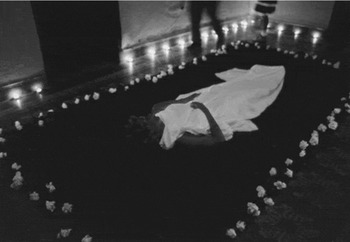
In El Ultimo Deseo, Fusco realigns time and space outside the limiting frame of Cuba–US relations, performing ‘a wake in the name of those who could not die in their country’ (Fig. 1).Footnote 15 She posts a sign titled ‘The Last Wish’ at the threshold to the room in which she explores her dead grandmother's unfulfilled wish to be buried in Cuba. Fusco's immobile body invokes a generation of exiles, many of who fled Cuba in the early 1960s and were unable to return to their native country to die. She describes the performance space in the following manner:
I held the wake in a home in Old Havana, and laid myself out as the cadaver, wrapped in a white sheet on the floor of one of the parlors. Radio Reloj, the Cuban radio station that marks the passage of time with continuous reports of all the historic events that have occurred on any given day, was playing in the background. At the entrance to the room was a sign . . .Footnote 16
Elsewhere she refers to ‘the style of a traditional Catholic wake . . . lit only by rows of tiny candles and a single black light’.Footnote 17 Fusco's overlapping of past and present, life and death in her citation of a Catholic ritual that seems to be occurring both in and out of a bygone and future Cuba all at once is vertiginous in its temporal displacements.
In El Ultimo Deseo (The Last Wish) (1997), Fusco re-enacts her grandmother's wake in Havana, in order to stage the ‘wrong’ of exile's exclusion. The contrast between the white sheet draping the body glowing in black light and the opaque floor creates an illusion of suspension. Photo by Eduardo Aparicio, courtesy of Coco Fusco.

By imaginatively inhabiting her grandmother's deterritorialized body, Fusco enacts the ‘wrong’ which Rancière identifies as the universal gesture of politics. Unable to return to Cuba to die, Fusco's posted sign reports, her grandmother
boarded a plane, flew to Barcelona to meet distant cousins, checked into a hotel, lay down, and died in the night. When I arrived at the hotel three days later, I discovered she had left not a suitcase behind, only her glasses and a small purse.Footnote 18
The unsettling manner in which Fusco suggests her grandmother was able to hold onto life just long enough to check herself into a hotel room to die (since she packed no suitcase) disturbs the Cold War narrative of the Cuban exile eternally grateful to the United States for granting her the political refugee status denied to so many other immigrant groups.Footnote 19 Through performance, Fusco transforms the strange details of her grandmother's death into an opportunity for dissensus – breaking the frame that assumes that the crassness of exile politics is excluded from the realm of natural death. As in Rancière's formulation, the articulation of the wrong (the denial of the body's repatriation) blurs ‘the border separating bare life and political life’.Footnote 20 By resurrecting her grandmother's last act – instead of letting it rest as an eccentric gesture of senility – Fusco politicizes her grandmother's detour.
In the black-and-white performance photo that Fusco reproduces in The Bodies That Were Not Ours, our vision is drawn first to the white sheet loosely draped over the woman, whose bare arms and head blend into her surroundings so that the black light makes it impossible to tell if she is lying on the floor or suspended in space. She is surrounded by a perimeter of white roses, which are themselves framed by tea lights, whose effusive glow is bisected by the blurred and darkened legs of an onlooker in movement. The darkened abyss, above which the woman's body seems impossibly to float in the photo, creates an uncanny effect.
Freud's description of the uncanny as ‘something that was long familiar to the psyche and was estranged from it only through being repressed’ resonates with the alienating condition of exile.Footnote 21 Severed from her national community, the exile is made a stranger to her place of origin, and thus estranged from an essential part of herself. The re-enactment of Fusco's grandmother's wake – but now in Old Havana – evokes the return of this repressed content for both the exile and the citizen. By blurring the line between life and death, Fusco precisely stages an encounter that incites both fear and attraction. Fusco's testimony of a little boy's response to her performance suggests the creation of a scene intended to induce this response: ‘As I lay there, one little boy from the neighborhood genuflects before asking someone if I might actually be dead.’Footnote 22 According to Freud, an ‘uncanny effect often arises when the boundary between fantasy and reality is blurred, when we are faced with the reality of something that we have until now considered imaginary’.Footnote 23 Performing her dead grandmother's wish for repatriation, Fusco brings into visibility the nation's excluded by materializing the psychic reality of exile.
In a gesture similar to Jameson's notion of cognitive mapping,Footnote 24 and in a language reminiscent of Adorno's essay on ‘Commitment’,Footnote 25 Rancière locates the destabilizing potential of the uncanny for an aesthetics of resistance: ‘political art would ensure, at one and the same time, the production of a double effect: the readability of a political signification and a sensible or perceptual shock caused, conversely, by the uncanny, by that which resists signification’.Footnote 26 Rancière's statement suggests that the work of the uncanny is to ‘shock’ us out of the discursive frames in which we have settled. For Fusco, the blurring of reality and fantasy (which creates an uncanny effect) negates the boundary between politics and art, urging us to rethink how we do both.
By playing dead, Fusco defies the time–space constraints of Cuban exile politics. She disrupts the static quality of official revolutionary time in order to signal the coexistence of multiple temporalities and geographies within the performance space. Faintly coming into contact with the performance space, Radio Reloj (literally ‘Radio Clock’) plays in the background. Accompanied by a faint ticking, which marks the seconds as they pass, Radio Reloj interrupts its constant news flow to announce the time every minute on the minute, structuring the march of time as the material of inevitable revolutionary progress.Footnote 27 The background static of Radio Reloj suggests both the official noise that aims to drown out alternative voices, and a warped conception of time. In this piece, Fusco opposes the undisciplined structure of historical memory to the ceaseless onslaught of official time and news. The radio station's endless broadcasts juxtaposed against the performer's immobile body, the pathos of the exile's situation is unexpectedly registered from the margins of the performance space. As part of an ‘underground counter-bienal’,Footnote 28 Fusco's clandestine work resists the disciplining of time that is a key element of the policing of borders in the Cuban context. By taking on the static of history, Fusco's performance makes a reality (if a fleeting one) of the exile's wish to be buried in her homeland. This act of transgression urges a different future by making the seemingly impossible happen – and this in spite of the radio's steady ticking.
Instead of the static of official history, it is Radio Bemba (the Cuban term for ‘word of mouth’) upon which Fusco focuses in her radio piece on the Sixth Havana Biennial for NPR's Latino USA.Footnote 29 Unlike Radio Reloj – which annihilates the present by immediately declaring it to be history – Radio Bemba is about inhabiting the present. ‘We didn't have to make posters or invitations – people started knocking on our door hours before our opening,’ Fusco explains, describing what is in fact the undisciplined temporality of lived history, which continues to throb beneath the radar of official channels.Footnote 30
Similarly poised to provoke an uncanny encounter with Cuban history, the performance by Havana-based artist Tania Bruguera that same evening in 1997 was no less ‘shocking’ in its disturbance of settled accounts of history. Bruguera's and Fusco's pieces served to ‘inaugurate [Bruguera's] new home-gallery’.Footnote 31 As Fusco recounts it, Bruguera's performance implicitly refused the logic of revolutionary progress by returning to the scene of an overwritten past:
Then a neighbor showed up to behead the lamb Tania was planning to drape over herself as a shield. As a crowd begins to form in the patio, Tania takes her place before an enormous Cuban flag that she made of human hair, and began to feed herself handfuls of dirt. The power of her act came in part from the fact that in Spanish, the phrase to be swallowed by the earth also means to be overwhelmed by it or to vanish from it.Footnote 32
Jose Muñoz discusses Bruguera's piece, El peso de la culpa (The Burden of Guilt), in terms of its performance of cultural guilt, citing an interview with Bruguera in which she links the act of eating dirt ‘to the collective suicide of indigenous Cuban people during the Spanish occupation’.Footnote 33 As Muñoz argues, ‘Bruguera's work offers an expanded timeline of cubanía’,Footnote 34 which begins with the genocidal act of Spanish colonization and unsettles all subsequent claims to ‘pure’ Cuban identity (as there are no pure descendents of the island's original natives). This narrative of origins ‘displaces the 1959 revolution's central and organizing position, offering a more productive mapping of Greater Cuba’, according to Muñoz.Footnote 35 The beheaded lamb, a symbol of Afro-Cuban religion, serves as a reminder of the Spaniards’ turn to the African slave trade as a response to indigenous resistance.Footnote 36
It is possible to imagine the productive dissonance created for the audience between the act of witnessing Bruguera's dirt-eating rite and the experience of entering Fusco's candlelit room, as Bruguera's implicit account of national origins ironizes the refusal of Cuban earth to ‘those who could not die in their country’ (the ones to which Fusco dedicates her performance). Fusco's performance invokes the desire for return as a site of interrogation: the original colonial encounter to which Bruguera's piece testifies complicates the desire for return that defines the experience of exile. Performing within the same house, Fusco and Bruguera stage a politics outside the frame of the machismo nationalism that seeks to limit positionality to the binary of the revolutionaries who stayed and the counterrevolutionaries who fled.
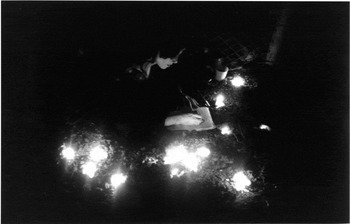
Embodying the deferral of her title, Fusco returned to Havana in 2000 with El Evento Suspendido (The Postponed Event) for another unofficial biennial performance in which she inhabited the deferred space of repatriation (Fig. 2). She performed at the Espacio Aglutinador, an independent gallery run out of artist Sandra Ceballos's home. While inside the gallery there was an exhibition of ‘fetishes and memorabilia’ from private collections,Footnote 37 Fusco performed outside:
I was buried in a vertical position up to my chest in Cuban soil in the yard outside the gallery for three hours, beginning at dusk. During that time I wrote the same letter (in Spanish) over and over, leaving the copies out for members of the audience to take if they wished.Footnote 38
Invoking the dirt of Bruguera's performance as well as the soil that was denied her grandmother, Fusco's half-buried body transmits the psychic displacement of exile. Titling her work El Evento Suspendido, Fusco inhabits the sense of belatedness that possesses the exiled. Fusco explains,
Like many other children of exiles, I am haunted by not literally being part of that soil. But most of all, I sought to find a means of evoking that sense of always communicating with another part of the self one knows but cannot see.Footnote 39
The photograph that Fusco published of the performance is cast in a ghostly light that radiates from the earth and highlights her writing hand and face (half-hidden behind the hair falling in her eyes). The compulsive repetition of her act suggests both the trauma of a divided self and the enactment of a communal dilemma.
Fusco appears half-buried outside an independent Havana gallery space in El Evento Suspendido (The Postponed Event) (2000). The candles scattered like constellations on the ground surrounding her illuminate the writing wrist that counters the body's immobility. Photo by Juan Carlos Alom, courtesy of Coco Fusco.

The letter Fusco writes ‘over and over’ is ‘adapted from a passage in The Incredible Disappearing Woman’.Footnote 40 A one-act play written by Fusco, The Incredible Disappearing Woman is about a Chilean woman who ‘disappeared’ off the streets of Santiago in 1975, and who had to ‘play dead’ in order to escape her torturers. When the play opens, she is working as a security guard in an art museum in southern California many years later. The letter that Fusco modifies for her Cuban performance is the one the disappeared woman writes to her parents years after her escape, to let them know she is, in fact, alive:
My dear ones,
I am writing this letter to tell you that I am alive. For many years I feared that if I told the truth you would suffer at the hands of those who buried another woman in my name. I can no longer stand not being able to tell you that I exist. Not a day has passed without my dreaming of you. Fortunately I can say that I recovered from the ordeal that resulted in my departure. I will send more news soon.
With love, C.Footnote 41The translation of this letter into the Cuban context suggests the promise of reunion, of which the exile dreams. Burying herself in the soil, however, Fusco complicates the notion of return by enacting the desire of the exile as linked to the condition of burial for the Cuban national. The romantic dream of the reunited national body (‘communicating with another part of the self one knows but cannot see’), which is mapped onto the exile's psyche, occurs in the final space of immobility, the grave. By enacting the ‘wrong’ of a divided national body, while half-buried in Cuban soil, Fusco locates mobility in the writing wrist that defies the rootedness of the body. In this gesture, she negates the notion of a prelapsarian return, while still capturing the uncanny allure of return's psychic structure.
The complex temporality of the piece resides in the idea of postponement, which extends beyond the burial site from which Fusco writes and permeates the entire exhibition space. Inside the gallery, the exhibit by the Permanecer Colectivo also draws on the notion of postponement to present an unofficial history of Cuban art. The ‘permanence’ of the group show's name (permanecer, as in ‘to remain’ or ‘to stay’) is ironized by the ephemeral nature of its holdings. The collection catalogue announces,
These are objects, projects, drafts, invitations, cards, gifts, obligations, charms, fragments of installations. Modest and unusual works made without calculation or high standards. Mysterious constructions, informally fabricated by a group of artists, living or already passed away, old, young, Cubans (at home or abroad) and foreigners – meticulously compiled by ardent collectors of fetishes and memorabilia.Footnote 42
If we assume that the collectors are the members of the Collective, then this description enacts the inclusion of the exiled community into the art community that has been defined by its staying, thus playfully breaking down the exclusive ‘permanence’ of its self-definition. The fragmented nature of the exhibit is an eloquent testimony to the vicissitudes of Cuba's social experiment: at times requiring clandestine operations, and always with limited resources. The catalogue description encapsulates the unfinished and ongoing nature of this work, marking a scene of dissensus by its inclusion of the excluded. The inclusion of work by Cuban exiles (exemplified by Fusco's haunting presence outside) stretches the notion of permanecer to delimit a psychic, rather than physically bounded, geography.
Thus reframing Cuban exile politics through her enactments of the deadening effects of nationalist discourse, Fusco poses new possibilities for exilic mobility. During her 1997 visit, Fusco interviewed another Cuban-American artist, Ernesto Pujol, about the site-specificity of his work for the official biennial. Pujol responds,
I think that my work here says something about fragmentation, about cultural fragmentation, that outside just gets washed into the whole multicultural presentation and means something totally different. Here it is very much about revolution, it's very much about separation. It is very much about escape, and about returning. It's about a dynamic that is very specific to a specific cultural, political experience.Footnote 43
Fusco's Cuban performances similarly depend on their interaction with a Cuban audience in order to register as politics. According to Rancière's translator, ‘The essence of politics [for Rancière] consists in interrupting the distribution of the sensible by supplementing it with those who have no part in the perceptual coordinates of the community, thereby modifying the very aesthetico-political field of possibility.’Footnote 44 By inserting herself into the Cuban frame, Fusco asserts her belonging as exile, thereby altering the ‘field of possibility’. Enabled by Cuban collaborators making work on the fringes of the official art scene, Fusco enters a dynamic zone in which movement is made possible by the countering of static with performance – that is, by playing dead to make the ‘unsuspected possibilities’ come alive.