Introduction
This article reports on research into the types and frequency of sexualised content shown in music videos broadcast on Australian free-to-air television in time periods accessible to primary school aged children. Sexualised content refers to dress, dance, movement or props that signify adult sexuality. This article first explores children's access to music media and current Australian music video regulation, before presenting the implied effects of exposure to sexualised music media on children's healthy development. The findings will be presented, followed by recommendations to manage risks and generate positive change to prevent potential harms. Because Anglo-Western cultures have access to similar music media (Frazer, Sheehan, & Patti, Reference Frazer, Sheehan and Patti2002), the literature review draws on research from Anglo-Western cultures including Australia.
Sexual Signification in Music Media
‘There is little doubt that sexual content is woven into the media fabric of our cultural landscape’ (Reichert, Reference Reichert2003, p. 3). Researchers identify that the explicitness and frequency of sexualised content in Western contemporary music has increased, and that most popular music artists incorporate sexuality into their persona, lyrics and videos (Andsager & Roe, Reference Andsager and Roe2003; Arnett, Reference Arnett, Brown, Steele and Walsh-Childers2004; Bosacki, Francis-Murray, Pollon, & Elliott, Reference Bosacki, Francis-Murray, Pollon and Elliott2006; Gale, Reference Gale2010; Greeson & Williams, Reference Greeson and Williams1986; Hamilton, Reference Hamilton2009; Hogan et al., Reference Hogan, Bar-on, Beard, Corrigan, Holroyd, Sherry and Strasburger1996; Kelton, Reference Kelton2010; Papadopoulos, Reference Papadopoulos2010; Rush & La. Nauze, Reference Rush and La. Nauze2006a, Reference Rush and La. Nauze2006b; Villani, Reference Villani2001; Walter, Reference Walter2010). The levels of sexualised content identified in music media have varied depending on how the content was categorised, but all the studies found high levels of sexualised content.
Baxter, De Riemer, Landini, Leslie and Singletary's (Reference Baxter, De Riemer, Landini, Leslie and Singletary1985) analysis of visual aspects of music videos found that 60 percent of the 62 music videos analysed portrayed sexual feelings or impulses. Sherman and Dominick (Reference Sherman and Dominick1986) coded the presence, frequency and explicitness of sexualised content in visual elements of music video, identifying that more than 75 percent of videos contained sexually signified behaviour, with an average of 4.78 sexualised acts per video. In these videos, half of the women characters were dressed provocatively.
Greeson and Williams (Reference Greeson and Williams1986) analysed six hours of Music Television (MTV) and found that 47 percent of music videos contained sexualised themes. Seidman's (Reference Seidman1992) analysis of 182 music videos explored the portrayal of gender-role stereotypes. He found that videos overwhelmingly reinforced sexualised gender-role stereotypes; women more frequently appeared in revealing clothing compared to men. Somers-Flanagan, Somers-Flanagan and Davis's (Reference Somers-Flanagan, Somers-Flanagan and Davis1993) findings were similar. They found that women engaged significantly more in sexualised behaviour than men, and were often portrayed as an object of men's sexual aggression. Of the 40 videos they analysed, they found the following: 89 percent included sexually alluring movements such as long lip-licking, pelvic thrusts and self-stroking; 37 percent included scantily dressed women; 26 percent of women were either being sexually pursued or pursuing, compared to 9 percent of males; and 4 percent of music videos included sexually explicit acts.
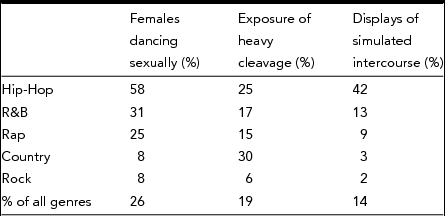
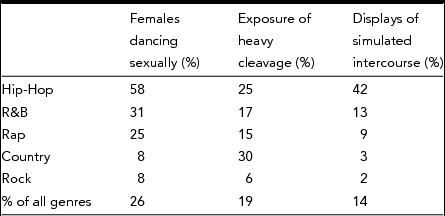
Pardun and McKee's (Reference Pardun and McKee1995) analysis of MTV videos found that 63 percent contained sexualised imagery. The National Institute on Media's research in 1999 found that all of the top-ten selling CDs included at least one song with sexualised content, with 42 percent containing very explicit sexual content (Gonzalez de Rivas et al., Reference Gonzalez de Rivas, Fuld, Mulligan, Altmann, Brown, Christakis and Wilocox2009). A more recent study by Strasburger (Reference Strasburger2005), analysing sexual signifiers in music-video genres, found that just over one in four featured women dancing sexually, around one in five featured heavy cleavage exposures and 14 percent displayed simulated intercourse. Hip-Hop featured as the most sexualised genre in the categories examined by Strasburger (Reference Strasburger2005). The study did not include the pop genre, which has dominated music lists in Western countries for some time.
Percentage frequency of sexual signifiers by music-video genre (Strasburger, Reference Strasburger2005).
The American Psychological Association (APA) cites many music-video content analysis studies, concluding that between 44 and 81 percent contained sexualised imagery (Zurbriggen et al., Reference Zurbriggen, Collins, Lamb, Roberts, Tolman, Ward and Blake2007). Walter (Reference Walter2010) refers to research showing that 84 percent of music videos viewed contained sexualised imagery and dance, and 71 percent of women in the videos presented sexually, compared to 35 percent of males. Papadopoulos (Reference Papadopoulos2010) claims that over 75 percent of contemporary music videos show visual presentations with sexual overtones. Finally, an analysis of popular US music-video programmes found adult themes, such as sexually explicit images and language, violence, drugs and criminal activity, with at least one of these themes appearing every 38 seconds (Urie, Reference Urie2008).
According to Gonzalez de Rivas et al. (Reference Gonzalez de Rivas, Fuld, Mulligan, Altmann, Brown, Christakis and Wilocox2009), contemporary music lyrics have been found to ‘revolve around topics such as sexual promiscuity, death, homicide, suicide and substance abuse’ (p. 1489). A recent study of sexualised lyrics by Hall, West and Hill (Reference Hall, West and Hill2011) showed an increase of degrading or sexualised lyrics from 11 percent in 1999 to 27 percent in 2009. Rap lyrics were commonly identified as demonstrative of these topics.
Together, these studies show that Westernised music videos have high levels of sexualised content, and many portray adverse sexual stereotypes of women. Given the continuing high levels of sexualised content in contemporary music media, there have been rising concerns about children's music media consumption and the influence of sexualised content on young viewers.
Media Consumption by Children
Children's media consumption has been increasing over time, particularly with the rise of new technologies. In 2003, 98 percent of Australian children aged 5–14 years spent an average of 11 hours per week viewing television (Australian Bureau of Statistics, 2003). In 2007, Australian children aged 8–17 years spent 4 hours and 49 minutes per day consuming media; 2 hours and 26 minutes was devoted to visual media, including television, DVDs and downloaded visual content (Australian Communications and Media Authority, 2010). Television was the medium most accessed by Australian children (Australian Bureau of Statistics, 2003; Australian Communications and Media Authority, 2007, 2010; Cupitt & Stockbridge, Reference Cupitt and Stockbridge1996). Linn (Reference Linn2012) found that children aged 8–18 engage in screen media for approximately 7 hours and 11 minutes per day, including when they are multitasking.
The rise of new media platforms has expanded the ways in which children interact with media. A 2007 study by Media and Communications in Australian Families found that while 78 percent of Australian children mainly consumed traditional media platforms, such as live broadcast television, they were beginning to explore new media technologies, such as the Internet and personal mobile devices (Australian Communications and Media Authority, 2010). The United States Kaiser Family Foundation's Generation M2 2009 study showed that American children use a broad variety of technologies to watch television: 59 percent viewed live broadcast, and 41 percent consumed television in diverse ways, including online services, DVDs, mobile phone/iPod and digital recording technologies (Australian Communications and Media Authority, 2010). Findings from both reports indicated that children and young people will continue to embrace new ways to access television content (Australian Communications and Media Authority, 2010).
The most popular media children use to access music are the newer technologies, such as iPods, iPhones, MP3 players, computers and the Internet, alongside the more traditional ways, such as radio, television and CD players (Australian Communications and Media Authority, 2007; deVries, Reference deVries2010). The Children's Participation in Cultural and Leisure Activities study, reported that in 2009, 61 percent of 5- to 11-year-old children had listened to, or downloaded, music from the Internet; of these, 18 percent of children were aged 5–8 years and 43 percent were aged 9–11 years (Australian Communications and Media Authority, 2010). This suggests that children are increasingly accessing music media over a broader variety of media.
Research around children's engagement with music videos demonstrates that children interact heavily with music media. Christenson's (Reference Christenson1992) study with 100 fourth- to sixth-grade children found that: 75 percent watched music videos; 60 percent described the frequency of their viewing as ‘pretty much’ or ‘a lot’; and of these, 63 percent watched music videos either ‘most days’ or ‘every day’. Kaestle, Halpern and Brown (Reference Kaestle, Halpern and Brown2007) found that, on average, 12- to 15-year-old children watched some music videos 4.3 days a week. In Australia, children aged 8–17 years reported watching music videos on the Internet for approximately 7 minutes per day (Australian Communications and Media Authority, 2010). These studies suggest that, globally, children and young people interact heavily with music videos. Given that research identifies that music media are highly sexualised, children are likely to be exposed to sexualised content.
Music Media Regulations in Australia
The music industry in Australia is governed by several media regulations due to its diverse means of broadcasting. Codes and regulations involving music media developed under the Broadcasting Services Act 1992 include: Commercial Television Industry Code of Practice; Children's Television Standards; Internet Industry Codes of Practice; and the Commercial Radio Australia Codes of Practice. These codes of practice ‘are all subject to content regulations’ by the Australian Communications and Media Authority (ACMA) (Arts Law Centre of Australia, 2006, p. 1). ACMA registers the codes once it considers that broadcasters have adequately consulted community interests (Australian Communications and Media Authority, 2009).
Programme content is governed by the codes of practice developed by the industry groups representing each broadcasting sector. Thus, broadcasters ‘have the primary responsibility for ensuring that the material they broadcast reflects community standards’ (Australian Communications and Media Authority, 2009, unpaginated). Consequently, the media is primarily self-regulated unless a formal complaint is lodged. ACMA only investigates complaints when the broadcaster has not been able to resolve the complaint (Rush & La. Nauze, Reference Rush and La. Nauze2006b). Where ACMA finds a breach of a code of practice, it may enforce future compliance (Australian Communications and Media Authority, 2009).
Codes of practice relating to music developed under the Classification (Film, Publications and Computer Games) Act 1995 (Cth) include the Labelling Code of Practice for Recorded Music (Arts Law Centre of Australia, 2006). This is only enforced for audio recordings (Office of Film and Literature Classification, 2005). ‘There is no formal classification system applicable to the performing- or visual-arts (except where these involve multimedia content or are included in a publication)’ (Arts Law Centre of Australia, 2006 unpaginated). In the latter case, the classifications would fall under that industry's code of practice. Performing arts include live concerts and musical performance, which is defined as ‘a film wholly comprising of musical presentation’ (Office of Parliamentary Counsel, 2013, unpaginated). Since live performances and music presentation fall under section 5B of the Classification (Film, Publications and Computers Games) Act 1995 (Cth), ‘exempt films and exempt computer games’ classification, music videos are not required to apply for classification (Office of Parliamentary Counsel, 2013).
Musical presentation (music DVD) and live performances are not directly governed by the regulations of the 1995 Act. Instead, they are regulated by ‘a system of voluntary labelling guidelines for audio tapes, records and CDs developed by the Australian Record Industry Association (ARIA) and the Australian Music Retailers Association (AMRA)’ (Arts Law Centre of Australia, 2006 unpaginated). Yet, according to ARIA and AMRA, music videos are classified by the Office of Film and Literature (ARIA/AMRA, 2003). Consequently, in Australia, there are no media regulators that specifically classify music videos.
Implied Effects of Exposure to Sexualised Music Media on Children
Many academics claim that sexually signified media is a persistent contributor toward the premature sexualisation of children (Papadopoulos, Reference Papadopoulos2010; Rush & La. Nauze, Reference Rush and La. Nauze2006a; Starr & Ferguson, Reference Starr and Ferguson2012; Zurbriggen et al., Reference Zurbriggen, Collins, Lamb, Roberts, Tolman, Ward and Blake2007). The release of Australian, American and British reports on the sexualisation of children over the past few years has led to significant attention to the issue (Bailey, Reference Bailey2011; Buckingham, Willett, Bragg, & Russell, Reference Buckingham, Willett, Bragg and Russell2010; Papadopoulos, Reference Papadopoulos2010; Rush & La. Nauze, Reference Rush and La. Nauze2006a, Reference Rush and La. Nauze2006b; Zurbriggen et al., Reference Zurbriggen, Collins, Lamb, Roberts, Tolman, Ward and Blake2007). Much of the content presented in these studies relates to the influence of advertising and the media in sexualising children; however, they also identify products such as clothing and toys (Bailey, Reference Bailey2011; Buckingham et al., Reference Buckingham, Willett, Bragg and Russell2010; Papadopoulos, Reference Papadopoulos2010; Rush & La. Nauze, Reference Rush and La. Nauze2006a, Reference Rush and La. Nauze2006b; Zurbriggen et al., Reference Zurbriggen, Collins, Lamb, Roberts, Tolman, Ward and Blake2007). Since the media is identified as a cultural influence (Sanson et al., Reference Sanson, Duck, Cupit, Ungerer, Scuderi and Sutton2000), media characters are recognised as role models (Zimmerman, Christakis, & Meltzoff, Reference Zimmerman, Christakis and Meltzoff2007) and music media, in particular, is documented as highly sexualised (Andsager & Roe, Reference Andsager and Roe2003; Baxter et al., Reference Baxter, De Riemer, Landini, Leslie and Singletary1985; Cummins, Reference Cummins2007; Gonzalez de Rivas et al., Reference Gonzalez de Rivas, Fuld, Mulligan, Altmann, Brown, Christakis and Wilocox2009; Papadopoulos, Reference Papadopoulos2010; Seidman, Reference Seidman1992; Sherman & Dominick, Reference Sherman and Dominick1986; Somers-Flanagan et al., Reference Somers-Flanagan, Somers-Flanagan and Davis1993; Walter, Reference Walter2010; Zurbriggen et al., Reference Zurbriggen, Collins, Lamb, Roberts, Tolman, Ward and Blake2007), it is argued that media is part of the popular culture which exposes children to gender stereotyped, sexually explicit imagery with the potential to harm their healthy development – particularly their social and sexual development (Coy, Reference Coy2009).
Specific concerns raised by researchers and advocates include implications for children's perception of self, attitudes toward one's own and the opposite sex, gender stereotyping and shaping values (Andsager & Roe, Reference Andsager and Roe2003; Brand, Reference Brand1995; Department for Children Schools and Families, 2009; Levin & Kilbourne, Reference Levin and Kilbourne2008; Papadopoulos, Reference Papadopoulos2010). Other apprehensions include children's imitation of sexualised display, leading to a premature interest in sex, self-objectification, and psychological problems, such as body image dissatisfaction, eating disorders, depression, anxiety and low self-esteem (Tucci, as cited in Betts & Rowlands, Reference Betts and Rowlands2011; Department for Children Schools and Families, 2009; Doherty, Reference Doherty2011; Greeson & Williams, Reference Greeson and Williams1986; Hamilton, Reference Hamilton2009; Levin & Kilbourne, Reference Levin and Kilbourne2008; McManus, Reference McManus2009; Papadopoulos, Reference Papadopoulos2010; Rush, Reference Rush and Tankard-Reist2009; Rush & La. Nauze, Reference Rush and La. Nauze2006b; Silmalis, Reference Silmalis2010; Villani, Reference Villani2001).
Hamilton (Reference Hamilton2009) and Levin and Kilbourne (Reference Levin and Kilbourne2008) state that early childhood teachers report that preschool and junior primary children are increasingly emulating sexualised music artists’ dress, jewellery and dance moves, using sexually signified language, acting out sexually and objectifying themselves. While Hamilton (Reference Hamilton2009) claims that children are commonly naive about what they are saying or doing, Levin and Kilbourne (Reference Levin and Kilbourne2008) argue that children who present sexually become popular, which drives this behaviour. The latter claim is supported by Starr and Ferguson's (Reference Starr and Ferguson2012) research, which found that young girls conflate sexualised dress with popularity. Hamilton (Reference Hamilton2009) and Levin and Kilbourne (Reference Levin and Kilbourne2008) argue that such influences encourage girls to present themselves as sexual objects, and view the world through this lens.
Hamilton (Reference Hamilton2010) claims that the mixed messages society sends to children are confusing for them. She highlights that society sends clear messages that they do not want children to act in ways that signify adult sexuality, yet the same society allows the marketing of sexualised products to children and their exposure to sexualised images, often resulting in children being reprimanded for imitating popular culture. The following references suggest that children do not understand the sexual innuendo to which they are exposed, yet are imitating the sexualised behaviours. Freeman-Greene (Reference Freeman-Greene2010) writes about a 12-year-old girl who was suspended from her school for posting a ‘pornographic poem’ on the school's intranet. The girl claimed she was trying to write a top-40-style song and was confused, stating “what I wrote didn't seem so bad when everyone else writes and talks like that”. Levin and Kilbourne (Reference Levin and Kilbourne2008) reported that, in the US, schoolchildren are engaging in sexualised dance, such as boys and girls grinding against one another, simulating sexual intercourse, and girl's dancing ‘between two boys who press their bodies up against her front and back’ (p. 83). Freeman-Greene (Reference Freeman-Greene2010) claimed that sexualised material in popular culture exposes children to adult sexuality at an age when they are developmentally ill-equipped to understand the implications. She suggests that many parents believe that much of the sexual innuendo in popular culture is not consciously apprehended by them. However, Freeman-Greene contends that ‘there is a disjunction between what is deemed as acceptable in mainstream pop and the standards of behaviour required of children’ (Freeman-Greene, Reference Freeman-Greene2010 unpaginated).
In consideration of research demonstrating high levels of sexualised content in music media, children's engagement with music media and the effects of sexualised media on young children's development, it is necessary to explore whether music media featuring highly sexual imagery and lyrics is readily available to children.
The Research
This study sought to identify the extent of sexualised content in music media classified as suitable for Australian children and broadcast on free-to-air television.
Design
The quantitative study sampled music videos screened on weekend mornings and used content analysis to identify the frequency, type and duration of sexualised imagery and lyrics across music genres.
Data Collection Process
Video Hits (Channel 10) and Rage (ABC 1) were chosen as the programmes to record for music videos because they were PG or G rated and were screened on free-to-air channels (Free TV Australia, 2010). According to Cupitt and Stockbridge (Reference Cupitt and Stockbridge1996), 100 percent of Australian families in their study owned a television, which suggests that the majority of Australian children have access to free-to-air programmes. Seven Video Hits programmes were recorded between 5 February and 6 July 2011 (10 a.m. to 12 p.m.; PG rated), and seven Rage programmes were recorded between 1 April and 25 June 25 2011 (8 a.m. to 10.30 a.m.; this begins as G rated and spills over into PG). A total of 405 individual music videos were collected from the two programmes.
Apparatus
A DVD recorder was used to record music video programmes and a 50-inch digital television was used to view recorded music videos. Two stopwatch devices were used: one to record the length of each video and the other to record duration of sexualised display in each video. A content analysis proforma was adapted from Baxter et al. (Reference Baxter, De Riemer, Landini, Leslie and Singletary1985).
Data Analysis of Music Videos
Data were analysed quantitatively using descriptive statistical analysis. The content was coded using qualitative description to explicate the ways in which imagery and lyrics were categorised.
Data Coding
A video was coded as sexualised if any sexualised content was identified. Sexualised content was analysed by quantifying the frequency and duration of selected textual codes signifying sex. The selected textual codes, adapted from research by Baxter et al. (Reference Baxter, De Riemer, Landini, Leslie and Singletary1985), were costume, dance and movement, lyrics, equipment and props, and male domination. These were measured by types of dress/costume: micro-mini skirts or shorts, bra tops, corsets, lingerie-style short body-suits, G-strings, unbuttoned shirts, high-heeled long boots, shiny vinyl clothing, excessively tight clothing, gaping neckline or midriff tops, near-nakedness and make-up drawing attention to the lips or eyes (identified as signifiers of sexual allure); dance movement: movements drawing attention to sexuality, including crotch or chests thrusts, bumping and grinding against other bodies, gyrating hips, spreading legs apart or rotating shoulders slowly; non-dance movement: sexually suggestive movements including stroking self, crotch- or breast-grabbing, licking lips slowly, opening mouth not to sing, or seductively touching hair; lyrics: sexually suggestive lyrics such as ‘Let's go all the way tonight’ (Perry, Reference Perry2010) (in the context of Katy Perry's song, ‘Teenage Dream’, losing her virginity is signified); apparatus/props: sexually suggestive props including phallic symbols, display of sexualised images or words, bondage equipment such as whips, chains, handcuffs, collars, scolds-bridle, or people being tied up; and male dominating female: women in subordinate roles, women presenting as sexually available to men, placing men as the centre of attention, men fully clothed while women are scantily dressed, aggressive behaviours toward women, such as pulling, pushing or hitting, or verbal put-downs, such as ‘ho’.
Sexualised content was recorded each time a new costume, behaviour or prop was observed. The frequency of sexualised display was tallied. The duration of any sexualised display and the duration of the whole video was timed. Explanatory notes were recorded on the same proforma for each event for further clarification of viewed behaviours, dress and/or props (Johnson & Christensen, Reference Johnson and Christensen2004). Lyrics were downloaded from the Internet (Lyrics.com, 2011) to cross-check words. Song genre was obtained from iTunes.com (2011) once all the videos had been viewed. Wikipedia.com (2011) was used to source songs unobtainable through iTunes.
Frequency Counts
Frequency counts were only applied to new visuals rather than including repeated costumes. For example, Lady Gaga's ‘Edge of Glory’ video shows Lady Gaga dressed scantily throughout the whole clip with three changes of costume. Consequently, the costume tally was recorded as three. This method also applied to frequency counts of behaviours and props. Lyrics were counted per song line, including repeated lines such as the chorus. Counting each lyrical line that contained sexual signifiers, when dress and movement were only counted for each new costume or movement, may have over-inflated the number of sexualised lyrics compared to other categories. This method was chosen because, according to Yue (Reference Yue2011), much like jingles, song choruses are repetitive and ‘get stuck in one's head’, which aids the likelihood of retention and recall. It was also perceived that if each sexually signified word was counted separately, numbers would have been similar. Lyrics such as ‘who run this mutha (pause) world’ was counted as sexualised because although ‘muthafucker’ was not sung in full, some children would be able to reconstruct the distorted lyric. If children were to repeat the word, it would be culturally signified as children speaking sexually.
Measuring Duration
Because frequency counts of sexualised content counted the number of new instances of content, such as a costume change, the frequencies did not always offer a true indication of the saturation level of sexualised content displayed. For example, Beyoncé's ‘Single Ladies’ clip showed Beyoncé and her back-up dancers scantily dressed on screen throughout the whole video. Because Beyoncé and the dancers did not change their costumes, it was recorded as two counts only of sexualised costume. This was compensated by also measuring duration in which Beyoncé's clip scored 100 percent. Since visual images can be flashed on screen for less than 1 second, it was impossible to allocate duration of individual displays. Therefore, this study measured duration of sexualised content collectively.
Limitations
There is no universal agreement on what is considered too sexualised for child consumption. Therefore, analysis of music videos for sexualised themes, behaviours and attitudes required creating operational definitions drawing on semiotic theory. ‘Semiotics is concerned with everything that can be taken as a sign’ (Eco, Reference Eco1976, p. 7), leading to interpretation. Analysing signs and what is signified has, to some degree, limitations of individual subjectivity; however, semiotics allows for detailed analysis of signs with shared meanings within a broad cultural context of English-speaking capitalist-consumer culture (Chandler, Reference Chandler2007; Eco, Reference Eco1976).
Music videos analysed were obtained from PG (Parental Guidance Recommended) and G (General Viewing) time periods on Australian free-to-air television. This eliminated music videos that were not subject to broadcasting restrictions, such as music videos broadcast on the Internet. Therefore, music videos that are likely to contain greater levels of sexualised content were not analysed. This may underestimate the actual amount of sexualised content seen in contemporary music videos accessed by Australian children by means of media platforms other than television.
Before the publication of this study Video Hits was discontinued. Rather than being an end to the broadcasting of this content, Channel 10 shifted this material to Channel 11 on a program called The Loop. This change reflects a branding change rather than a discontinuation of the broadcasting of this content.
Results
Sexualised Content in Music Videos Broadcast on PG/G-rated Television
Fifty-five percent (217) of the 405 music videos broadcast on PG/G-rated television contained sexual signifiers.
Genre Analysis
Genre analysis was used to identify the degree of sexualised content in those genres which are most popular with children. A separate study of children's music preferences, undertaken as part of this research, identified that the pop genre was the most preferred genre for 6- and 10-year-old boys and girls (Ey, Reference Ey2014). Genres with fewer than five samples were excluded from separate genre comparisons. Genres removed were: Blues (1) song, Country (3), Jazz (1), a parody (categorised as Other) (1), Reggae (2) and Singer-songwriter (1). This reduced the video analysis from 405 videos to 396.
Frequency Counts of Sexualised Content
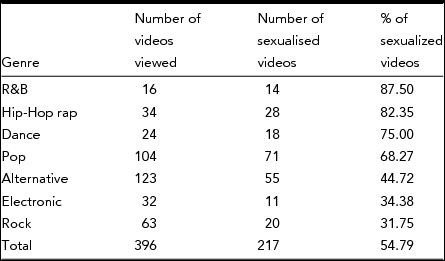
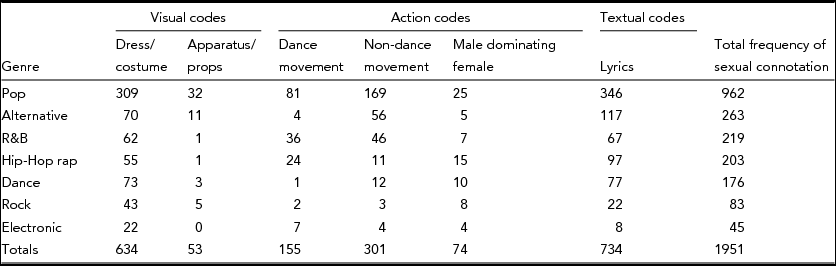
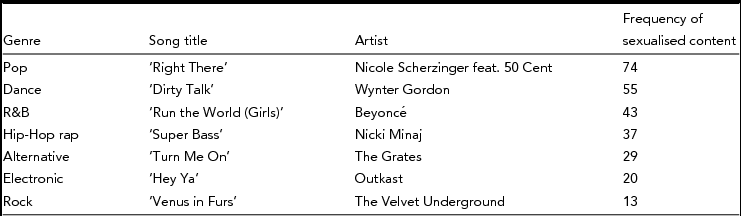
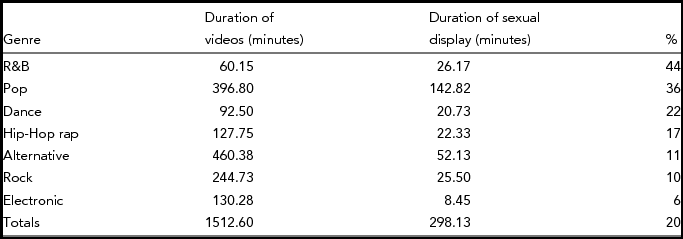
The genre analysis is organised into four sections. The first section presents the number of sexualised videos per genre (Table 2); the second gives the types and frequency of sexualised content per genre (Table 3); and the third shows highest-scoring single video per genre (Table 4). Table 5 shows a comparison of total duration and sexualised duration of music video per genre.
Number and percentage of sexualised videos broadcast on PG/G-rated television per genre.
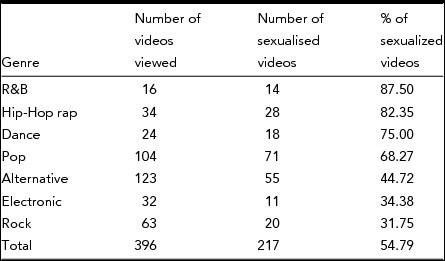
n = 396
Frequency of sexualised content per genre.
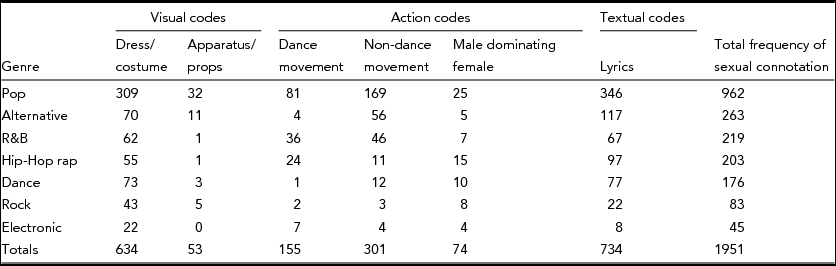
n = 217
Song with the highest frequency of sexualised content per genre.
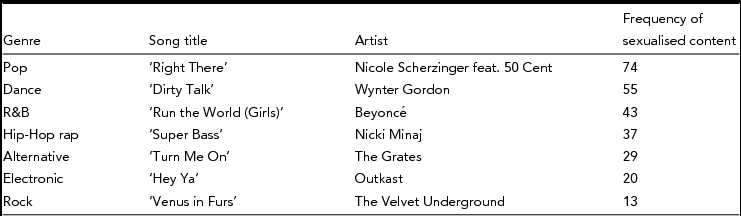
n = 7
Total duration of music video and duration of sexualised display per genre.
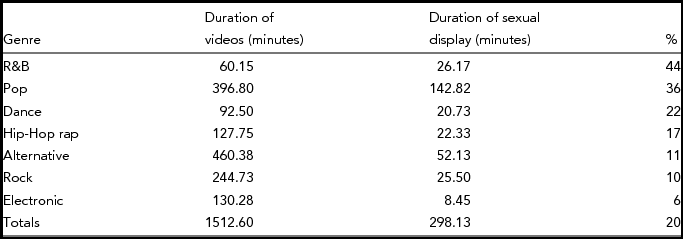
n = 396
Table 2 presents data on the number of videos viewed per genre and the proportion of these that contained any sexualised content. Some genres consistently displayed high numbers of videos with sexual signifiers. Rhythm and Blues (R&B), Hip-Hop and Dance had the highest percentages, while Rock had the lowest.
When frequency counts of sexualised content were applied to the 217 videos identified as having any sexualised content, Pop genre had the highest frequency of sexualised content across all codes. Although there were a number of Pop videos that did not contain any sexual signifiers, Pop accounted for 49 percent of the total incidence of sexualised connotations displayed, showing over 36 percent more incidents than the second-highest-scoring genre. Lyrics were the highest type of sexualised demonstration followed by dress, non-dance movement and dance movement (Table 3).
There was a consistency between the highest-scoring genres and those that had the highest incidence of sexual signifiers per single video (Table 4).
Duration of Sexualised Content
When the duration of sexualised content was applied to the 396 videos, R&B was found to have the longest proportionate duration of sexualised display. Overall, 20 percent of music-video composition on PG/G-rated television contained sexualised material (Table 5).
Overtly Sexualised Display in Music Videos Broadcast on PG/G-rated Television
Videos by women music artists exhibited the highest levels of sexualised content, expressions and allusions in their music videos. Highly sexualised costumes were mostly seen on women. Some women artists wore costumes and used apparatus identified with the pornography industry. Some examples are detailed below.
In her ‘Born This Way’ video, Lady Gaga wears a sex-industry-inspired see-through body-stocking with crotch- and nipple-zip access (Mariano Vivanco/IPC Magazine, 2011). In her ‘Edge of Glory’ video Lady Gaga wears a leather dominatrix costume with a deep neckline, and studded collar and gloves (NCI/WENN.com, 2011). Beyoncé wears a gold metallic dominatrix costume (Rodriguez, Reference Rodriguez2011) with metallic arm sheaths and stainless-steel bondage nails (Alexandra, 2011) in her ‘Sweet Dreams’ video. In her ‘Run the World’ video Beyoncé wears suspenders, lingerie and collar (Barraza, Reference Barraza2011). Gwen Stefani presents herself splayed backwards over a chair with her breasts thrusting upwards, wearing a shirt, tights and fetish heels (fanpop, 2011a) in her ‘What You Waiting For’ video. The dance crew and Miley Cyrus are presented in a cage dance scenario in skimpy outfits, fishnet stockings and heavy make-up in her ‘Can't Be Tamed’ video (fanpop, 2011).
Discussion
This study confirmed that music media accessible to children on weekend morning television is highly sexualised. It also established that music media references signifiers of pornography. Given that these music videos allegedly meet the classification criteria of PG/G-rated television, there are questions about whether these music programmes are conforming to the Australian Commercial Television Industry Code (ACTIC) and whether the current guidelines effectively protect children from sexualised material.
Although there are broadcasting regulations providing classification of content to protect children, these codes and regulations are written vaguely and are open to interpretation, and the industry is self-regulated (Arts Law Centre of Australia, 2006; Olfman, Reference Olfman and Olfman2009). These codes could be improved by providing clearer definitions. For example, current language used in these regulations includes ‘mild in impact’ and ‘low level coarse language’ (Free TV Australia, 2010, p. 48). It is unclear to the wider populace what these descriptions mean without distinct operational definitions. Current media codes and regulation need to be reviewed and amended to provide unambiguous language and operational definitions to facilitate a collective understanding.
With diverse media platforms, it is reasonable to claim that children are being exposed to more frequent and more explicit sexualised content through unregulated media, such as the Internet. Music artists who are aspiring to market themselves (Shuker, Reference Shuker2005; Wall, Reference Wall2003) use sex and shock tactics to stand out in a competitive industry (Andsager & Roe, Reference Andsager and Roe2003; Cummins, Reference Cummins2007; Hall-Hansen & Hansen, Reference Hall-Hansen and Hansen1990; Shuker, Reference Shuker2005). The music industry is a business that deploys marketing strategies proven to be successful, targeting the groups most likely to purchase their product. ‘Without the need to conform to television constraints, artists can push the boundaries of sexuality’ (Andsager & Roe, Reference Andsager and Roe2003, p. 81). This diversity also affects parents’ abilities to monitor and control children's access to media they may consider inappropriate for children's viewing. Because music media is accessible through diverse technologies, it is important to establish a regulatory body that has classification systems for all music media rather than music media falling under the umbrella of other codes of practice, which has proven to be ineffective in protecting children from sexualised content. Currently, visual recordings are only regulated under the broadcasting service through which they are aired and do not carry a separate classification. Live performances, such as concerts, are also not classified or regulated (Office of Film and Literature Classification, 2005; Office of Parliamentary Counsel, 2013). Classifying music videos and concerts beyond the current voluntary classification structure would allow children and adults to make informed choices about which music media children view.
Industry interests lie in growing sales, which may be affected by regulatory requirements. Therefore regulations and codes of practice should not be self-regulated within the respective industries. Establishing an independent regulatory body, that manages all media, including music videos, which currently largely escape regulation, would allow more effective regulation. Government intervention is recommended to regulate industries where children are potential or intended consumers. Regulations need to be enforced with children's welfare as paramount.
The implications of this study are situated in children's homes and the wider society. Although parents are the first regulators of children's exposure to media, the omnipresence of music media requires a collaborative societal approach. As identified above, the rise of technology decreases parents’ ability to monitor and control children's access to music media. The wider community can prioritise children's development when structuring media codes and regulations, carefully considering the potential impacts sexualised media may have on children. By recognising how children develop within their cultural milieu and the significant influence media has on children's learning and development, change can be fostered to embark on proactively supporting children's optimal development.
A difficulty in regulating content in music media is that normative values are socially constructed and there are wide-ranging views about what is too sexualised for children's consumption. What some adults perceive as inappropriate content for child viewing, others do not. This was demonstrated in this study, with high levels of sexualised content screened on PG- and G-rated television.
This article has thus far explored the significance of the findings of this research and the implications for reform. This section explores the potential consequences, based on current trends, if these phenomena continue to be ignored.
Although media is only one of the many variables which influence children's learning and development, it is a pervasive daily presence in family life. Based on recent and current trends from the data and literature, it is likely that sexualised content in media will increase in frequency and become more explicit. The incorporation of pornographic iconography in music media will likely continue. With the advance of modern technology, children will have more platforms for access to music media and other media (Gutnick, Robb, Takeuchi, & Kotler, Reference Gutnick, Robb, Takeuchi and Kotler2011) and parents’ ability to control or monitor children's media access will decrease further (Australian Communications and Media Authority, 2007).
This places children at risk of adopting the sexualised behaviours, dress and attitudes displayed in music media as normal. It is widely accepted that children imitate as a way of learning (Hall et al., Reference Hall, West and Hill2011; Papadopoulos, Reference Papadopoulos2010; Richert, Robb, & Smith, Reference Richert, Robb and Smith2011; Zurbriggen et al., Reference Zurbriggen, Collins, Lamb, Roberts, Tolman, Ward and Blake2007) and media characters are influential role models (Zurbriggen et al., Reference Zurbriggen, Collins, Lamb, Roberts, Tolman, Ward and Blake2007). Children will learn to conform to the gender identity and performance of sexualised media role models at an ever decreasing age. Contemporary marketing, including marketing of music artists, contribute to the construction of identities, which means that children's gender role and self-identity will be increasingly shaped by a sexualised environment. The intensifying use of sexualised display by media establishes the concept that ‘sexiness’ is the cultural imperative. Those who cannot achieve the ‘sexy’ ideal can experience sexual identity performance anxiety. Such anxiety generates vulnerabilities to healthy development, such as body dissatisfaction, constant body surveillance, eating disorders, depression, low self-esteem and self-objectification (Buckingham et al., Reference Buckingham, Willett, Bragg and Russell2010; Collins, Reference Collins1991; Gill, Reference Gill and Attwood2009; Jung & Peterson, Reference Jung and Peterson2007; Maine, Reference Maine and Olfman2009; Miller, Lurye, Zosuls, & Ruble, Reference Miller, Lurye, Zosuls and Ruble2009; Papadopoulos, Reference Papadopoulos2010; Zurbriggen et al., Reference Zurbriggen, Collins, Lamb, Roberts, Tolman, Ward and Blake2007). Exposure to highly sexualised images of women music artists presents powerful scripts for young girls and boys which may influence children's gender-role and self-identity development, and normalise an expectation that females who present sexually become socially popular. When children are faced with cultural pressures to conform to an unhealthy sexual identity, negative impacts are inevitable. Considering the importance of childhood as the foundation of learning and development, we cannot afford to take such risks.
Conclusion
In conclusion, there is no simple solution to address children's exposure to sexualised music media and there is no single entity responsible for change. A collaborative approach would begin the processes toward reform to manage risks and protect children from the potential harms from being exposed to material that they are not developmentally capable of decoding and understanding. Addressing current media codes and regulations to prevent children's exposure to sexualised media is a starting point.