Introduction
Many persons with schizophrenia have impaired metacognitive capacity; i.e. a limited ability to reflect on thoughts and feelings and to integrate these reflections into detailed representations of oneself and others (Frith, Reference Frith1992; Lysaker et al. Reference Lysaker2011c, Reference Lysaker2014; Hamm et al. Reference Hamm2012). Metacognition can be divided into four semi-independent domains: Self-Reflectivity, Understanding the Other's Mind, Decentration – the ability to understand that one is not at the center of all meaningful activity, and Mastery – the ability to use metacognitive information to deal with stressors (Semerari et al. Reference Semerari2003; Lysaker et al. Reference Lysaker2011a).
Metacognitive dysfunction is associated with problems in daily life functioning of people with schizophrenia in several ways. Lower levels of metacognition have been correlated with lower levels of functional competence (Lysaker et al. Reference Lysaker2011b), less subjectively experienced recovery (Kukla et al. Reference Kukla, Lysaker and Salyers2013), more severe negative symptoms (Lysaker et al. Reference Lysaker2005a; Hamm et al. Reference Hamm2012; Nicolò et al. Reference Nicolò2012; Macbeth et al. Reference Macbeth2014), and lower quality of the therapeutic alliance between patient and therapist (Davis et al. Reference Davis, Eicher and Lysaker2011). Further; social cognition and insight have been positively associated with metacognitive mastery (Lysaker et al. Reference Lysaker2011a). Furthermore, metacognition has been found to mediate the impact of neurocognitive deficits on social function, even after controlling for symptoms (Lysaker et al. Reference Lysaker2010b).
Several forms of individual therapy have successfully improved metacognition in patients with various mental disorders other than psychosis (Fonagy et al. Reference Fonagy, Gergely and Jurist2002; Dimaggio et al. Reference Dimaggio2007; Choi-Kain & Gunderson, Reference Choi-Kain and Gunderson2008). Lysaker et al. (Reference Lysaker2011d) proposed a manualized procedure to improve metacognition in people with schizophrenia, which is based on eight processes which the therapist attempts to introduce each session: (1) paying attention to the client's agenda as the focus of the session, (2) sharing the therapist's thoughts with the client, (3) eliciting a narrative to serve as a basis for metacognitive reflection, (4) naming and defining a psychological problem, (5) discussing the interpersonal processes that occur during the session, and (6) evaluating progress during the session. These first six elements then serve as a basis to stimulate self-reflectivity and thought about others (7) as well as metacognitive mastery (8) by offering reflections or asking questions at the metacognitive level the client is currently functioning on. To illustrate, if a participant is discussing how noisy the grocery store was, a therapist could offer the reflection: ‘You couldn't think with all that noise’ to a client who is struggling to identify his thoughts as his own, or: ‘You felt scared or overwhelmed?’ for a participant who is working on the recognition of emotions. In many ways, Metacognitive Reflection and Insight Therapy (MERIT) is similar to mentalization-based therapy (Bateman et al. Reference Bateman, Fonagy, Allen and Gabbard2009); the primary difference is that MERIT does not stem from a psychodynamic framework.
Several case studies (Buck & Lysaker, Reference Buck and Lysaker2009; Lysaker et al. Reference Lysaker2009, Reference Lysaker2005b, Reference Lysaker, Buck and Ringer2007; Bargenquast et al. Reference Bargenquast, Schweitzer and Drake2015; Hillis et al. Reference Hillis2015; Buck & George, Reference Buck and George2016; de Jong et al. Reference de Jong2016b; Dubreucq et al. Reference Dubreucq, Delorme and Roure2016; Hamm & Firmin, Reference Hamm and Firmin2016; Leonhardt et al. Reference Leonhardt2016a; van Donkersgoed et al. Reference van Donkersgoed, de Jong and Pijnenborg2016) and two pilot studies (Bargenquast & Schweitzer, Reference Bargenquast and Schweitzer2014; de Jong et al. Reference de Jong2016a) have reported improvement of metacognition after individual therapy in people with psychosis.
The current paper presents the results of the first randomized controlled trial investigating the effectiveness of MERIT. The protocol was previously described (van Donkersgoed et al. Reference van Donkersgoed2014) and developed after conducting a pilot study (de Jong et al. Reference de Jong2016a).
Based on the pilot studies and case studies mentioned above, we expected that participants would gain improvements in metacognition as measured by the Metacognition Assessment Scale - A (MAS-A). As a primary outcome, we expected to see these improvements on metacognitive Self-Reflectivity and Mastery, as these have been shown to improve before gains are observed in Understanding the Other's Mind and Decentration. A similar pattern to case studies in psychosis (e.g. Lysaker et al. Reference Lysaker, Buck and Ringer2007) has been found in patients suffering from Major Depressive Disorder, where gains on self-reflectivity precede changes in understanding others (Ladegaard et al. Reference Ladegaard2016), implying this to perhaps be the natural pattern of growth of these abilities. However, given the length of therapy (40 sessions) we certainly considered improvements on those two scales to be possible as well.
Based on known correlations between scores on metacognition and outcome measures, a test-battery was constructed to measure whether changes in metacognition would also, as secondary outcomes, improve scores on measures of psychotic symptomatology, cognitive insight, Theory of Mind, depression, self-stigma, quality of life, social functioning, and work readiness. Finally, we included two self-report questionnaires to measure empathy [Interpersonal Reactivity Index (IRI) and Questionnaire of Cognitive and Affective Empathy (QCAE)] as well as an Empathic Accuracy Task (EAT; aan het Rot & Hogenelst, Reference aan het Rot and Hogenelst2014). As it is debatable whether self-report questionnaires can fully capture the dynamic process of real-life empathy (Ickes, Reference Ickes1997), the EAT was included to account for this problem. This computer task measures empathy by asking participants to continually judge the emotions experienced by another person who is recounting autobiographical events on video. Previous studies have shown that patients with schizophrenia perform relatively poorly on the EAT compared with controls (Lee et al. Reference Lee2011).
Several short measures of neurocognition were also administered, to control for the possible influence of neurocognitive deficits, in our statistical analyses. Our main hypothesis was that we would observe improvements on metacognition (particularly Self-Reflectivity and Mastery).
Methods
The protocol for this study was registered (ISRCTN16659871) and published (van Donkersgoed et al. Reference van Donkersgoed2014) and approved by the Medical-Ethics Committee of the University Medical Centre Groningen (METc2013.124). All research was conducted in accordance to the principles of the Declaration of Helsinki.
The study is a multicenter randomized controlled trial with a treatment condition in which participants received MERIT and a control condition in which participants received treatment as usual (TAU). Patients in the control group and in the MERIT group met once a month on average with their psychiatrist for medication monitoring and received practical guidance (for example with finances or work-related problems) from a social worker. Two out of 35 participants in the control group met with a psychologist during the period between pre and post measurements. Four participants met with a psychologist in the period between the post and follow-up measurements. Patients in the treatment group did not receive any additional psychosocial interventions apart from the MERIT therapy. Participants and their psychiatrists were asked to keep medication changes limited to only crucial adjustments until study end. Data were collected at baseline (T0), post-treatment (T1) and after 6 months at follow-up (T2). Participants received €20 for each completed assessment.
Therapy
MERIT aims to stimulate the four elements of metacognition: Self-Reflectivity, Understanding the Other's Mind, Decentration, and Mastery (Lysaker & Dimaggio, Reference Lysaker and Dimaggio2014). The treatment protocol is not a step-by-step program but is guided by the level of metacognition demonstrated by the patient during the session. The therapist elicits a personal story of the patient. In this narrative, the therapist looks for signs of metacognition. Is the patient aware of his/her thoughts? Can she/he reflect on those thoughts and on the thoughts of others? Does she/he identify and frame psychological distress? The scales of the MAS-A (see materials) are used to classify the level of metacognitive functioning. The therapist adjusts his or her interventions according to the level of metacognition of the patient and stimulates the patient to perform more complex metacognitive tasks, using eight specific treatment elements (T-MAS, see Appendix A). The therapy consists of forty individual therapy sessions. The treatment protocol was translated into Dutch by the research team.
Treatment as usual (TAU) consisted of the continuation of antipsychotic medication from a multidisciplinary team and according to Dutch guidelines. Where a different therapy (such as cognitive behavioral therapy) was already underway, that course of treatment was continued until the end. Support staff was asked not to begin any new interventions for 40 weeks. This design closely mimics the treatment reality in the Netherlands: despite Cognitive Behavioral Therapy (CBT) being a guideline treatment in the Netherlands, unfortunately, far from every patient has access to this (or other psychosocial) intervention.
Therapists
Thirteen therapists across seven mental healthcare institutes in the Netherlands were recruited. All therapists had at least a master degree in Clinical Psychology and practical experience in the field, and 85% held the post-master health-care-license required for clinical practice in the Netherlands. Therapists received a 3-day training program in MERIT, delivered by its first author, P.H. Lysaker. Once every 2 weeks a group supervision session by Lysaker was organized for all therapists via internet telephony, in which the therapists received feedback on how they applied the method.
Participants
Patients in the participating treatment facilities were screened on metacognitive difficulties using four screening questions, developed based on the four domains of metacognition mentioned above (e.g. ‘To what extent is the patient able to think about his/her own thoughts?’). Answers were given on a Likert scale 0–10, with a higher score reflecting a higher estimate of metacognitive functioning. These questions were completed by the case manager or by the staff member most familiar with the patient. Intended only as the first, coarse screening of caseloads, these questions were kept simple so as to ensure no training of case managers would be required. Patients who scored <6 on two or more of the screening questions were subsequently approached in person and received basic information and an information letter regarding the study.
Inclusion criteria
• Impaired metacognitive abilities (determined using the MAS-A, see instruments),
• Diagnosis of Schizophrenia or Schizoaffective Disorder according to DSM-IV-TR [Mini-International Neuropsychiatric Interview (MINI)-PLUS],
• Being able to give informed consent,
• 18 years or older,
• No change in medication in the 30 days before the first assessment.
Exclusion criteria
• Acute psychosis at the moment of assessment [Positive and Negative Syndrome Scale (PANSS) positive symptoms >4],
• Co-morbid neurological disorder in the patient file,
• Diagnosis of severe substance dependence, but not abuse,
• Impaired intellectual functioning (IQ < 70) (patient file).
Interested participants were administered a baseline assessment composed of two meetings with a research assistant. In the first meeting, the inclusion and exclusion criteria were verified with the MINI-Plus, Indiana Psychiatric Illness Interview (IPII), MAS-A, and PANSS interview (for materials see below). After inclusion, participants were administered the remainder of the test battery in a second meeting. To ensure blind randomization, an independent third party performed block randomization procedures (Kazdin, Reference Kazdin2010) to ensure groups equivalent in size. See Fig. 1 for a CONSORT diagram detailing participant flow.
CONSORT diagram of participant flow.

Assessment
All research assistants held at least a bachelor's degree in psychology were enrolled in a master's program in clinical psychology and were blinded to participant condition. Assessment occurred at three moments: T0 (baseline), T1 (directly following treatment), and T2 (6-month follow-up).
Primary outcome: metacognition
Metacognition Assessment Scale-A (MAS-A; Lysaker et al. Reference Lysaker2005a). To assess metacognitive functioning, the Indiana Psychiatric Illness Interview (see below) was conducted and transcribed. Three raters blind to condition and trained in the MAS-A during a 4-h training, scored this transcript on metacognitive capacity along four axes: Self-Reflectivity [scores 0 (low) – 9 (high)], Understanding the Other's Mind [scores 0 (low) −7 (high)], Decentration [scores 0 (low) − 3 (high)], and Mastery [scores 0 (low) − 9 (high)]. During consensus meetings, final scores on each of the four domains were established. Total scores are analyzed, followed by analyses to determine on which specific domains improvements were found.
Indiana Psychiatric Illness Interview (Lysaker et al. Reference Lysaker2005a). The IPII is a semi-structured interview developed to elicit a speech sample during which participants can demonstrate metacognitive capacity. Interviews last between 20 and 60 min, and consist of five sections: life narrative, illness narrative, experience of mental illness, the influence of illness on one's life, and the future. The interview is converted into a transcript, which is used to score the level of metacognition of the participant using the MAS-A (see above).
Secondary outcomes
Beck Cognitive Insight Scale (BCIS; Beck et al. Reference Beck2004). This 15-item questionnaire measures cognitive insight along the subscales of self-reflectiveness (nine items) and certainty (six items) using a four-point Likert scale. A total score is obtained by subtracting the Self Certainty score from the Self-Reflectiveness score, resulting in an Index of cognitive insight (with higher scores indicating better insight), which has demonstrated promising psychometric qualities, including convergent and criterion validity (Riggs et al. Reference Riggs2012).
Clinical Global Impression (CGI; Haro et al. Reference Haro2003). This rating scale allows for the assessment of the participant's current functioning, along with the domains of positive symptoms, negative symptoms and general symptoms using 7 anchor points per scale, ranging from ‘Not ill’ to ‘Among the most severely ill’.
Empathic Accuracy Task (aan het Rot & Hogenelst, Reference aan het Rot and Hogenelst2014). To measure empathic accuracy we used a Dutch language task. A shorter version was used, this was necessary to keep the total assessment battery under 2 h. The original task was shortened by selecting four out of the ten original videos. Participants were required to continuously rate the valence (positive–negative) of the videos in which a target tells a personal story, using a dial. Scores of the participants are correlated with the target's own ratings (provided during task development), leading to an index of empathic accuracy. Level of expressivity of the targets is based on their score on the Berkeley Expressivity Questionnaire (BEQ; Gross & John, Reference Gross and John1995). Correlations underwent a Fisher z-transformation for statistical purposes.
Faux-Pas Test (FPT; Baron-Cohen et al. Reference Baron-Cohen1999). During this test of Theory of Mind, ten stories are read aloud to the participant, who can read along using a printed-out version of the story. The participant is asked whether a socially undesirable action was taken by one of the participants, or not, and how the participant in the story must have felt, resulting in 2 scores: the number of faux pas correctly identified (min 0–max. 5) and empathy questions (‘How does person X in the story feel’) answered correctly (min 0–max. 5).
Interpersonal Reactivity Index (IRI; Davis, Reference Davis1983). Using 28 items to be answered on a six-point Likert scale, this questionnaire measures subjective empathy, with a higher score indicating greater self-reported empathy.
Internalized Stigma of Mental Illness Scale (ISMIS; Boyd Ritsher et al. Reference Boyd Ritsher, Otilingam and Grajales2003). The ISMIS measures self-reported internalized stigma of mental illness using 29-items on a four-point Likert scale. Higher scores are indicative of a greater experience of self-stigma.
Mini-International Neuropsychiatric Interview (MINI; Sheehan et al. Reference Sheehan1998). This well-validated structured interview is designed to measure the presence of neuropsychiatric disorders. Sections A through D (mood disorders), K through L (substance abuse), and M (psychotic disorders) were administered to verify in- and exclusion criteria for the study.
Positive and Negative Syndrome Scale (PANSS; Kay et al. Reference Kay, Fiszbein and Opler1987). This semi-structured interview was employed by trained raters to indicate the severity of 30 symptoms of psychosis on three scales: positive symptoms (e.g. hallucinations, delusions), negative symptoms (e.g. blunted affect, emotional withdrawal) and general psychopathology (e.g. anxiety, depression) using a seven-point Likert scale, ranging from ‘Absent’ to ‘Extreme’, resulting in a total score between 30 and 210, with higher scores indicating more severe symptomatology.
Personal and Social Performance Scale (PSP; Nasrallah et al. Reference Nasrallah, Morosini and Gagnon2008). Using this rating scale, interviewers rate the impact of the disorder on four domains of social functioning on a six-point Likert scale ranging from ‘absent’ to ‘very severe’. Results are converted in a 1–100 score of severity, with higher scores indicating the more severe impact of the disorder on functioning.
Questionnaire of Cognitive and Affective Empathy (QCAE; Reniers et al. Reference Reniers2011). Based on factor analysis of several common self-report measures (including the IRI), the QCAE measures self-reported empathy. It consists of 31 items, answered on a four-point Likert scale, with higher scores indicating greater self-reported empathy.
Quick Inventory of Depressive Symptomatology-Self Report (QIDS-SR; Rush et al. Reference Rush2003). The QIDS-SR measures depressive symptoms during the last week, using 16-items based on the DSM-IV-TR criteria for Major Depressive Disorder, answered on a four-point Likert scale. A higher total score indicates greater severity of depressive symptoms.
Self-Rated Manchester Short Assessment of Quality of Life (MANSA; Priebe et al. Reference Priebe1999). Using 12 subjective and four objective questions answered on a seven-point Likert scale, this questionnaire allows the participant to indicate general life satisfaction along several domains, with higher scores indicating greater satisfaction.
Work Readiness Questionnaire (WorQ; Potkin et al. Reference Potkin2012). Using this rating scale, interviewers can indicate the patient's readiness to work on seven items, followed by an eighth dichotomous work readiness judgment. Only the sum score of the seven non-dichotomous items are used in analyses.
Cognition measures
Dutch Adult Reading Test (DART; Schmand et al. Reference Schmand1991). The DART tests the pronunciation of irregularly spelled words and is used to estimate premorbid intelligence.
Trailmaking test A&B (TMT; Reitan & Wolfson, Reference Reitan and Wolfson1985). The TMT provides information on the visual search, scanning, mental flexibility speed of processing and executive functions. It is part of the Halstead–Reitan battery. The TMT consists of two parts. Part A requires an individual to draw lines sequentially connecting 25 encircled numbers distributed on a sheet of paper. Task requirements are similar for part B except the person must alternate between numbers and letters (e.g. 1, A, 2, B, 3, C, etc.). The final score is determined by subtracting the time to complete task A from the time it took to complete task B, with higher scores indicating poorer neurocognition (Tombaugh, Reference Tombaugh2004).
Digit Symbol Test (part of the Wechsler Adult Intelligence Scale; Wechsler, Reference Wechsler1995). This test evaluates the recognition and recoding of visual information, resulting in a score of information processing speed (McGurk & Mueser, Reference McGurk and Mueser2006). The test consists of several rows of paired boxes with a digit in the top box and an empty space in the box below. At the top of the page is shown which symbols are paired to the digits. The participant has to fill in as many symbols in the empty boxes within 90 s. The final score consists of the amount of symbols that is filled in correctly within the time, with a higher score indicating better cognition.
Most measures demonstrated good internal consistency, with Cronbach's alphas at baseline: ISMI (0.90), PANSS (0.87), QCAE (0.84), PSP (0.74), MANSA (0.74), QIDS-SR (0.73), WorQ (0.78), CGI (0.73). Internal consistency for the MAS-A was questionable (0.63), and IRI subscales ranged from questionable to fair (PT 0.61; FS 0.70; EC 0.67; PD 0.74). The BCIS ranged from poor (0.54, Self-Certainty) to questionable (0.65, Self-Reflectiveness). Post-therapy, the MAS-A demonstrated good internal consistency (0.77) and the IRI subscales ranged from questionable to good (PT 0.69; FS 0.76; EC; 0.60; PD 0.84). The BCIS subscales ranged from poor (0.54, Self-Certainty) to questionable (0.67, Self-Reflectiveness).
Statistical analyses
Demographic differences between groups were tested using SPSS Statistics 24 with independent-samples t tests (age, age at onset of first psychosis, number of psychotic episodes, duration of illness, estimated premorbid IQ, cognition, and symptoms) or Pearson's chi-square (χ2) test (gender, diagnosis, education level). These were conducted two-tailed, with significance level set at α = 0.05.
The effects of the treatment on outcome measures were assessed with multilevel analysis, using MLWiN (Charlton et al. Reference Charlton2017). A separate three-level model was constructed for each of the outcome variables: Therapists were modeled at level 3, participants at level 2, and time of assessment at level 1. The following predictors were entered as fixed effects: (a) dummy variables representing time (T0, T1, T2); and (b) the interactions T1*condition and T2*condition. The random effects were the intercepts at levels 2 and 3, and residual at level 1. To assess whether the MERIT group had improved more than the control group at T1 and T2, significance testing was conducted using deviance tests (e.g. Snijders & Bosker, Reference Snijders and Bosker2000) between the models with the interaction between the time of assessment under investigation (T1 or T2) and condition (MERIT/TAU), and a model without the interaction terms, with significance level set at α = 0.05. The deviance test is based on the difference between the deviance statistics (defined as −2 ln likelihood function value) of two nested models, which has a χ2 distribution with degrees of freedom equal to the difference in the number of parameters estimated in the models being compared. An intention-to-treat analysis was conducted on the entire sample, followed by a completers analysis in which only the results were modeled of those participants who had completed the therapy.
Results
Demographics
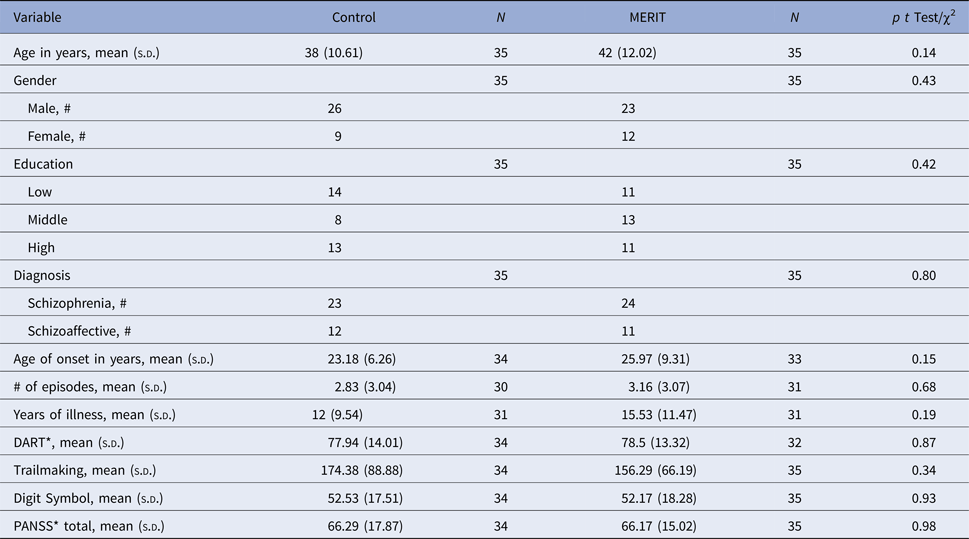
In total, 70 participants were included in the study (Fig. 1), distributed evenly among the two conditions. None of the demographic variables differed significantly between the groups (Table 1). As reported in Table 1, none of the demographic variables demonstrated statistically significant differences between the groups, and as such none were entered into subsequent analyses. Antipsychotic medication changes between pre- and post-measures as reported by the patient indicate no differences between the groups: in both groups, one participant quit antipsychotic medication with permission from the psychiatrist. In the control condition, five patients reduced their antipsychotic medication with any amount, two in the MERIT condition. In both conditions, one participant received an increase in antipsychotic medication. In the control condition, one participant quit antipsychotic medication without permission from the psychiatrist. No change in medication was observed in 27/35 (77%) in control, 31/35 (89%) in MERIT.
Comparison of demographic variables between the control and MERIT conditions

*DART, Dutch Adult Reading Test; PANSS, Positive and Negative Syndrome Scale.
Drop-out
Participants were invited for post-measurement and follow-up assessments irrespective of completing all forty sessions of therapy or not. Drop-out in the control condition, as defined by a refusal to take part in the post-measurement and/or follow-up measurement, was 9/35, compared with 11/35 in the MERIT condition for post-treatment, and 12/35 compared with 22/35 in the MERIT condition for follow-up.
Therapy completion
The study had a relatively high attrition rate of 51% (17/35). However, four participants dropped out before receiving even the first session of therapy, and another five participants did not complete therapy due to therapist attrition (e.g. maternity leave). As such, only eight out of 35 participants (23%) possibly dropped out of the study due to the method under investigation, although none of the participants themselves reported this as the reason for dropping out. No significant differences between drop-out and completers were found on either primary measures or secondary measures.
Primary outcome
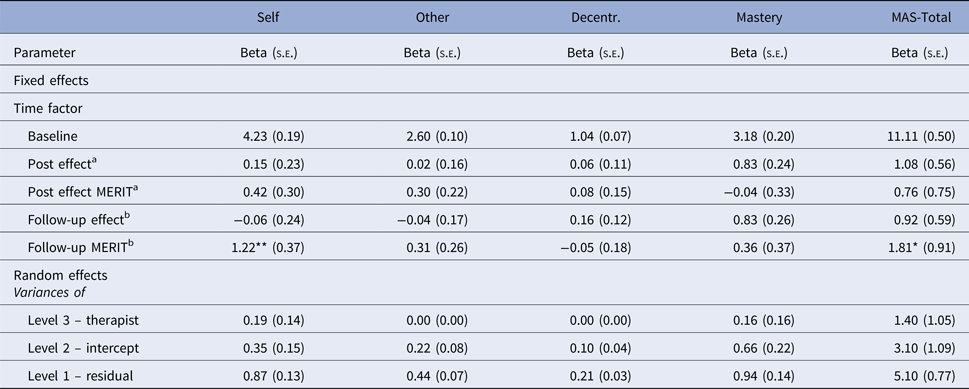
Intention-to-treat analysis (Table 2) revealed that in both groups metacognition total scores had improved from baseline to post-treatment. Directly after treatment, differences in growth of metacognition were non-significant between the two groups, with the deviance test between a model with and a model without the time (pre-post)*condition (MERIT–TAU) interaction yielding χ2 (1) = 0.435, p = 0.51. While the total metacognition scores in the control condition dipped back down between post-treatment and 6-month follow-up, the MERIT group continued to improve. At follow-up, differences between the two groups were significant for the MAS-A total score. The addition of the interaction term of time (follow-up)*condition (MERIT/TAU) led to a significant improvement of the model, with deviance tests yielding χ2 (1) = 3.763, p = 0.05. Analyses using the MAS-A subscales as outcome revealed that gains were only significant on the subscale self-reflectivity, with the deviance test yielding χ2 (1) = 10.295, p = 0.001.
Fixed and random effects on the subscales of the Metacognition Assessment Scale – intention to treat

** = significant at p < 0.01, one-tailed.
* = significant at p < 0.05, one-tailed.
a Post effect: difference between T0 and T1 (TAU is reference category).
b Follow-up effect: difference between T0 and T2 (TAU is reference category).
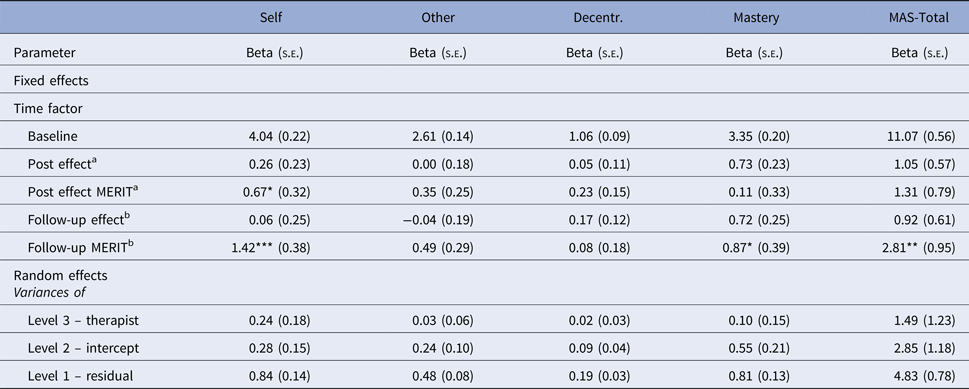
Completers analyses (Table 3) support the findings. When only taking into account those who had completed all 40 sessions of the therapy, differences between the groups in improvements on Metacognitive Self-Reflectivity (MAS-A) were significant at post-measurement, with the deviance test between a model with and a model without the time (pre-post)*condition (MERIT–TAU) interaction yielding χ2 (1) = 4.219, p = 0.04. At follow-up, differences between groups were significant for the MAS Total score, as the addition of the interaction term of time (follow-up)*condition (MERIT–TAU) led to a significant improvement of the model, with the deviance test yielding χ2 (1) = 8.182, p = 0.004. Analyses using the subscales of the MAS-A indicated that scores on self-reflectivity χ2 (1) = 12.784, p < 0.01 and Mastery χ2 (1) = 4.793, p = 0.02 had improved at follow-up more for the MERIT group than the TAU group.
Fixed and random effects on the subscales of the Metacognition Assessment Scale – sensitivity analysis

*** = significant at p < 0.001, one-tailed.
** = significant at p < 0.01, one-tailed.
* = significant at p < 0.05, one-tailed.
a Post effect: difference between T0 and T1 (TAU is reference category).
b Follow-up effect: difference between T0 and T2 (TAU is reference category).
Secondary outcomes
No sustaining significant differences were found on the secondary outcome measures. In the MERIT condition, at post-measurement, symptoms significantly increased, with deviance tests yielding χ2 (1) = 4.278, p = 0.04, but returned to baseline at follow-up, χ2 (1) = 0.025, p = 0.87. Tables presenting these results are included as supplemental materials (online Supplementary Tables S4 and S5).
Therapist effect
Multilevel analysis did not reveal a significant contribution of the therapist variable as a level to the model, indicating no significant differences between therapists regarding the improvement of metacognition.
Discussion
The current multicenter randomized controlled trial investigated the effectivity of MERIT in improving metacognition. Intention-to-treat analyses indicated an improvement in metacognition in both groups, with no significant differences between groups directly post-treatment. Differences between the groups did become evident at follow-up; however, with the MERIT group demonstrating a continued improvement on Metacognitive Self-Reflectivity, whereas the control condition dipped back down. Completers analyses, which only included the patients that finished the therapy, demonstrated significant differences on self-reflection between groups already at post-treatment, with better scores in the treatment condition.
Self-Reflectivity is an important element of metacognition as it is correlated with daily life factors such as a subjective sense of recovery (Kukla et al. Reference Kukla, Lysaker and Salyers2013) and work performance (Lysaker et al. Reference Lysaker2010a). Group averages indicate that patients at baseline were able to recognize and distinguish between their different thoughts and emotions, but did not perceive their thoughts are subjective and changeable. In other words: thoughts were accepted as facts. After MERIT, group average scores indicated having moved past being able to recognize that the ideas about oneself and the world are subjective and changeable. This is particularly relevant in light of CBT, a widely used treatment in people with a psychotic disorder, which focuses on the modification of maladaptive cognitions (Wykes et al. Reference Wykes2008). Some patients may not have the necessary level of self-reflection to be able to engage in CBT techniques. Challenging or changing your thoughts is difficult when you are not aware of them or when you are not aware that they can change over time. MERIT may be useful for patients that do not respond (well) to CBT. It can serve as a way to improve self-reflection after which the patient might be able to benefit from CBT methods. Future studies are needed to verify this hypothesis.
Completers analyses, which only included the patients that finished the therapy, additionally found significant improvements on Mastery at 6 months follow-up. At baseline patients’ scores indicated that patients in both conditions on average responded to psychological challenges through gross avoidance and passive activities, such as following other's directions. At follow-up, in the MERIT condition, patients’ scores indicated that 9/11 (82%) of participants who completed therapy were able to respond to psychological challenges by actively choosing and engaging in specific activities and behaviors such as medication use, or seeking therapeutic interventions, compared with 2/18 (11%) at baseline. In the control condition, some participants had also improved to this level (from 3/27 = 11% at baseline to 8/22 = 36% at follow-up), but most only reached a level where avoidance behaviors were either more specific (i.e. avoiding supermarkets instead of staying indoors completely) or seeking social support, 4/22 = 18%). Again it must be noted that this represents the average group score. There was considerable variance between participants, some patients in the MERIT group still were not able to actively choose solutions for their psychological problems after therapy, whereas others were not only able to change their thoughts to deal with problems but were also able to use knowledge about their own and others cognitions and emotions to come to solutions. General group scores may suggest that MERIT empowered patients to face their challenges in a more active manner, which may make them less dependent on people around them and may allow them to take a more active role in their treatment.
Difference between conditions only became evident at follow-up in the intention-to-treat analyses. One explanation for this effect is that metacognitive gains take some time to develop, even after therapy has been concluded. Such findings are not uncommon; a meta-analysis of cognitive therapy (Gould et al. Reference Gould2001) has shown continued improvements after therapy was concluded. Improvements in the control condition are not likely to be caused by psychological interventions in this group, as at post-assessment two out of 35 patients in the control condition indicated having had any contact with a psychologist. Between post- and follow-up, this number increased to four. It is therefore unlikely that interventions in the control group had significant effects on our findings. Possibly, the finding of the control group's raised performance at post measurement reflects a natural fluctuation in metacognitive capacity.
Understanding the Other's Mind and Decentration, two other components of metacognition, appeared less sensitive to change, as no significant effects on these scales were found. This is consistent with results from our pilot study (de Jong et al. Reference de Jong2016a) and from long-term case studies in psychosis (Lysaker et al. Reference Lysaker, Buck and Ringer2007) and major depressive disorder (Ladegaard et al. Reference Ladegaard2016). It is possible that it is necessary to be able to think about your own thoughts and feelings before you can understand and think about what is occurring in the others mind (Dimaggio et al. Reference Dimaggio2008). Meta-analyses of fMRI findings support this, having found that perception of the self and others share higher order neural pathways in which these processes are combined (van der Meer et al. Reference van der Meer2010; van Veluw & Chance, Reference van Veluw and Chance2014). From a clinical perspective, it seems logical that Self-Reflection has to improve before someone can start to reflect on the mind of others. When someone is not aware of his own thoughts and feelings, how can he understand those of others? One long-term case study has found the first improvements to Understanding the Other's Mind to occur after about 16 months (Lysaker et al. Reference Lysaker, Buck and Ringer2007). In designing future studies, it would be recommended to consider the possibility of more than 40 sessions.
A significant increase of symptoms between baseline and post measurement was found in the MERIT group. This difference was no longer present at follow-up. This is likely not due to drop-out at follow-up, as no significant differences were found on post treatment symptoms between follow-up drop-outs and follow-up completers. It is possible that increased self-reflectivity at post-measurement allowed participants to report more symptomatology (thus reflecting greater insight into illness), although the inverse is just as likely: increased symptoms at post-treatment may have obfuscated metacognitive gains. Alternatively, perhaps medications were suboptimal, or the (metacognitive) demands put on patients during an intensive course of psychotherapy may elicit symptomatology to increase. One qualitative study into precursors of psychotic content in 48 therapy sessions revealed that particular themes of conversation could be identified before psychotic content emerged (Leonhardt et al. Reference Leonhardt2016b) which were all related to some form of metacognitive strain. Firm conclusions are precluded given the lack of significant changes on measures of cognitive insight or illness insight in the current study. Future should studies address this question. Particularly in the context of a recent intersubjective model of psychotherapy in psychotic disorders, any links between metacognition, insight into illness and the therapeutic relationship could prove highly informative (Hasson-Ohayon et al. Reference Hasson-Ohayon, Kravetz and Lysaker2017).
No other significant group differences on secondary outcomes were found. This is puzzling, as scores of metacognition on the MAS-A have frequently shown to be correlated to functioning on, for instance, depression (Lysaker et al. Reference Lysaker2013). The Beck Cognitive Insight Scale, on which no significant changes were observed as a result of therapy, is sometimes even labeled as measuring metacognition (Lysaker et al. Reference Lysaker2011c). Similarly, while metacognitive mastery improved, other measures which are related to functioning (such as the Personal and Social Performance scale) showed no significant improvement. We see three possible explanations for this contradiction. First, prior work has generally been correlational, and that the causal relationship may be inverse (with, for instance, depression influencing metacognition rather than vice versa). It is also possible that an improvement in metacognition has no effect on the other variables. However, as multiple studies have shown relationships between metacognition and our secondary outcomes (e.g. Lysaker et al. Reference Lysaker2010b; Hamm et al. Reference Hamm2012; Macbeth et al. Reference Macbeth2014), including self-reflectivity specifically (Nicolò et al. Reference Nicolò2012), another explanation may entail that more time needs to pass for improved metacognition to positively impact secondary outcomes. For example, it may take a while for someone with improved self-reflection to slowly adjust stigmatic views of oneself to a less stigmatic one. It also may take a while for someone with improved Mastery to find a better job or get to know more friends. Another viable explanation is that our sample had demonstrated impaired metacognitive capacity but had relatively modest scores of, for instance, symptomatology, and as such there was little room for improvement. Some participants dropped out of MERIT on the argument of ‘too busy with work’ (n = 4) or ‘doing too well’ (n = 3). While we find this encouraging, we are hesitant to count this as therapy success, as no other measures of functioning indicated improvements and we cannot rule out that participants supplied this reason out of social desirability.
Only about half of patients completed all forty sessions of MERIT. No significant differences on the four scales of metacognition were found between the drop-out group and the group that completed the therapy. The long duration of the therapy played a role particularly in study attrition, with several therapists finding other work or going on maternity leave, causing attrition of five participants. Four more participants dropped out before receiving even a single session of therapy. Eight participants actually dropped out from the study during therapy, giving reasons such as ‘no connection with the therapist’ and being too busy with work. As such, it is possible that the therapy was not acceptable to them (23%).
In post-treatment interviews conducted with the patients who completed the therapy, all respondents indicated that they had found the therapy useful (‘My wife also noticed I was doing better’, ‘More good things about yourself come to the surface. It is not just your bad sides. I learned to see myself more positively’), and would recommend it to others. The only negative effect mentioned was the intensive nature of the therapy (‘After sessions, I often needed rest’), by two out of fifteen participants (13%). As no significant contribution of the therapist variable as a level in the multilevel model was found, improvement of metacognition does not seem to depend on specific therapist characteristics.
Our study has several limitations. We investigated the effect of precisely 40 sessions of psychotherapy. A psychosocial intervention such as the one used in this study may not lend itself well for studies with a fixed amount of sessions. Namely, several of our participants indicated their motivation for drop-out as ‘doing too well’, an observation supported by their therapist. In a clinical setting, ending therapy this way is obviously appropriate and may improve results. Future studies could account for this issue by setting a minimum and maximum amount of sessions. Furthermore, while an effect was found, power analysis for our study indicated a required 120 participants. However, only 70 could be included (see Fig. 1). Future studies with larger sample sizes should be conducted to support or reject our findings. Additionally, the BCIS demonstrated very low internal consistency and results on this measure should be interpreted with caution; future studies may wish to consider an alternative measure for cognitive insight. Also, in our use of the MAS-A, we opted to ensure the highest accuracy of ratings on metacognition by using three-person consensus groups. Future studies should be conducted in which individual raters’ scores are obtained and used to serve the additional benefit of providing a measure of interrater reliability. Finally, the control condition in the current study received treatment as usual. Future studies should compare metacognitive therapy with other active treatments to determine the efficacy of MERIT vis a vis extant interventions.
Conclusion
MERIT did not improve metacognition immediately post-treatment. At follow-up, however, self-reflection of participants was improved significantly more in the MERIT condition than in the control condition. That is, participants (on average) changed from seeing their thoughts as facts to recognizing their thoughts as subjective and changeable. MERIT might, therefore, be a useful treatment approach for patients whose self-reflection is too limited to benefit from other therapies such as CBT.
Completers’ analyses also showed improvement of Mastery at follow-up, suggesting that MERIT may potentially empower patients to face their challenges in a more active manner, which will ultimately give them more control over problems in daily life. These outcomes warrant further research into the efficacy of the method.
Supplementary material
The supplementary material for this article can be found at https://doi.org/10.1017/S0033291718000855
Acknowledgements
The authors would like to express their gratitude to all clients who have participated in the study, and their therapists Rahja König, Els Luijten, Dimitri van Wonderen, Maarten Vos, Lia Elenbaas, Henriëtte Horlings, Sanne Swart, Suzanne van den Bosch, Ilona van den Berg and Inez Oosterholt – Ogink. Similarly, we would like to thank management and staff of all participating MHI: GGZ Drenthe, GGZ Friesland, Lentis, Parnassia, Dimence, and Yulius. Furthermore, we would like to thank Ymie Bakker, Daniëlle Bandsma, Suzanne de Vries, Kim Doodeman, Ann-Katrin Dresemann, Rianne Hiemstra, Jelle Koehoorn, Christin Koopmann, Saskia Rehrmann, Anne Rupert, Bernice Smit, Hilde Span, Maaike Stumpel, Meike van Dam, Michelle van Dam, Rozemarijn van Kleef and Merel Wattel for their limitless efforts as research assistants. We gratefully acknowledge Selwyn B. Renard for his assistance in the randomization procedures. A final word of thanks to Fonds NutsOhra, who subsidized the study. Study conducted on a research grant from Fonds NutsOhra. This body played no role in study design; the collection, analysis and interpretation of data, in the writing of the report; and in the decision to submit the paper for publication.
Appendix A T-MAS
(1) Openness to the patient's agenda at the session outset and throughout the session.
1……2……3……4……5
(2) Offer of the therapist's thoughts/perceptions regarding the patient's behavior in the session.
1……2……3……4……5
(3) Details of a narrative episode are elicited.
1……2……3……4……5
(4) A psychological problem or dilemma is framed as something to be discussed
1……2……3……4……5
(5) Reflection on the interpersonal processes during the session is elicited.
1……2……3……4……5
(6) Reflection on progress/ course of the session is elicited at various times during the session or at session's end.
1……2……3……4……5
(7) The patient is stimulated to engage in metacognitive acts with interventions that are appropriate to patient's capacity for self-reflectivity and/or awareness of the mind of the other.
1……2……3……4……5
(8) The patient is stimulated to engage in metacognitive acts with interventions that are appropriate to patients’ capacity for metacognitive mastery.
1……2……3……4……5
Total score: ___________
Key: 1. absent; 2. intermittant moments in which basic competency is present; 3. fully adequate or competent throughout; 4. fully adequate with some periods of exceptional performance; 5. consistently exceptional performance