

Kostёnki-Borshchëvo & Streletskian assemblages
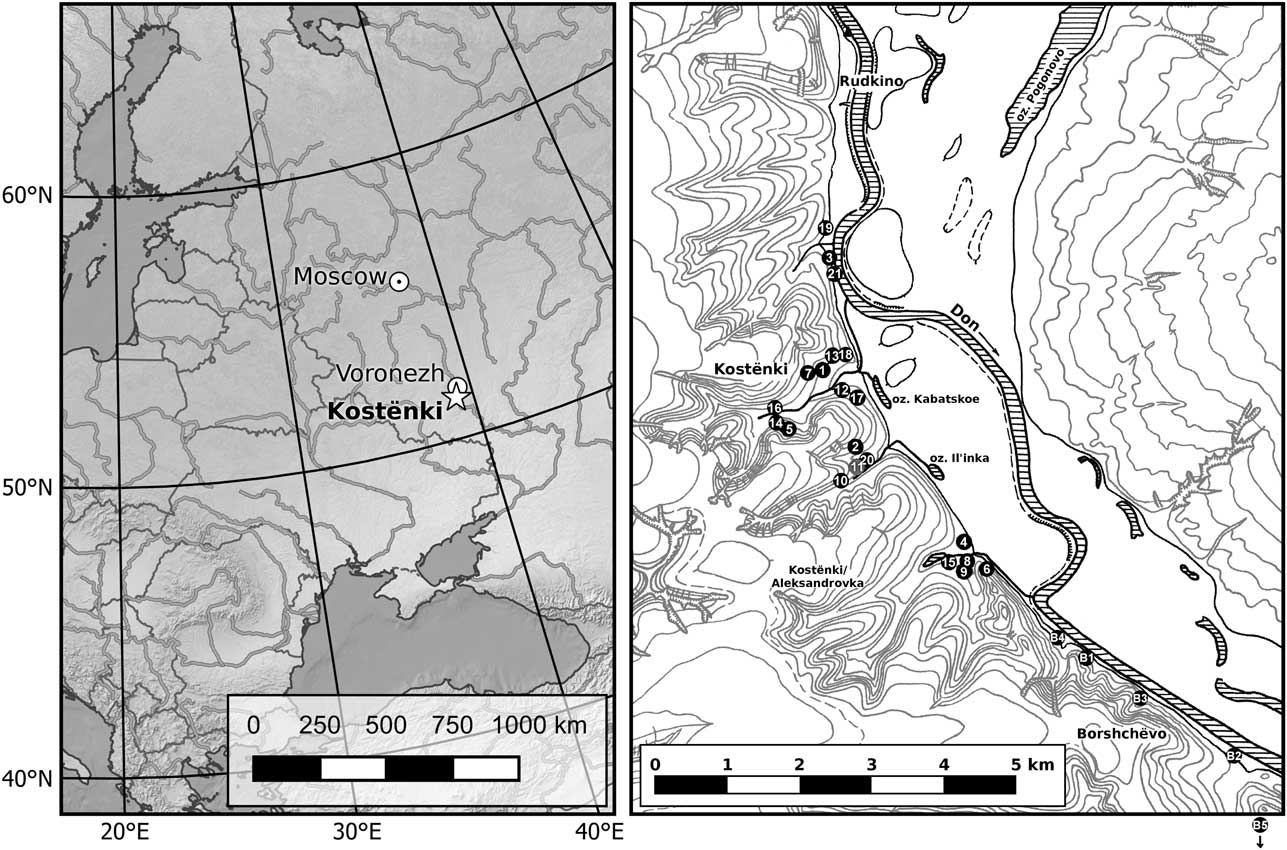
Close to 40 km south of Voronezh in south-western Russia (Voronezh Oblast) an exceptional complex of 26 open-air Upper Palaeolithic sites is situated around the villages of Kostёnki and Borshchëvo. The archaeological sites are located near the Don river, positioned above and within a series of ravines that cut the chalk plateau meeting the Don’s floodplain (Fig. 1). As well as being individually named, each site is referred to by a number: Kostёnki 1–21 and Borshchëvo 1–5. Many of the sites have yielded rich assemblages of worked flint, worked bone/ivory and items of personal ornamentation, as well as sometimes large faunal assemblages (Rogachёv Reference Rogachëv1957; Boriskovskii Reference Boriskovskii1963; Klein Reference Klein1969; Praslov & Rogachёv Reference Praslov and Rogachёv1982). Several burials have been found at Kostёnki, including the earliest known modern human burial in Europe at Kostёnki 14 (Debets Reference Debets1955; Rogachёv Reference Rogachëv1955; Sinitsyn Reference Sinitsyn2004; Marom et al. Reference Marom, McCullagh, Higham, Sinitsyn and Hedges2012). The more recent layers at some of the sites contain evidence for large bone constructions, historically thought of as dwellings (Rogachёv Reference Rogachёv1970; Sinitsyn Reference Sinitsyn2015).
The location of Kostënki within Eastern Europe and the location of Kostёnki 11 within the Kostёnki-Borshchëvo complex

Around half of the 26 Kostёnki-Borshchëvo sites contain multiple archaeological layers (Praslov & Rogachёv Reference Praslov and Rogachёv1982). As a result, the complex has facilitated construction of long Early/Mid-Upper Palaeolithic culture histories, which have then served as the basis from which the wider record of European Russia has been understood. Assemblages at Kostёnki-Borshchëvo have been attributed to a variety of archaeological cultures, some of which are familiar to archaeologists working on western European material (eg, Aurignacian, Gravettian) and others that are without parallel in the west (eg, Streletskian, Spitsynian, Gorodtsovian).
Kostёnki’s Streletskian record is particularly important, as some assemblages have been argued to date to the very beginning of the Upper Palaeolithic, potentially left behind by some of Eastern Europe’s earliest modern human occupants (see for instance, Vishnyatsky & Nehoroshev Reference Vishnyatsky and Nehoroshev2004; Anikovich et al. Reference Anikovich, Sinitsyn, Hoffecker, Holliday, Popov, Lisitsyn, Forman, Levkovskaya, Pospelova, Kuz’mina, Burova, Goldberg, Macphail, Giaccio and Praslov2007; Bosinski Reference Bosinski2013; Otte Reference Otte2014, 2589). The techno-typological composition of Streletskian lithic assemblages is decidedly variable. They show preference for either flake- or blade-based blank production, but commonly contain small, rounded end-scrapers and artefacts that historically have been classified as side-scrapers. All Streletskian assemblages, however, share one defining lithic marker: the bifacially-worked, triangular, concave-base ‘Streletskian point’(Anikovich Reference Anikovich1977; Praslov &Rogachёv Reference Praslov and Rogachёv1982; Bradley et al. Reference Bradley, Anikovich and Giria1995). Assemblages that include Streletskian points have been recovered from Kostёnki 1 (Layer V), Kostёnki 6, Kostёnki 11 (Layers V & III), and Kostёnki 12 (Layers III & Ia) (Praslov & Rogachёv Reference Praslov and Rogachёv1982). Elsewhere in Russia they have been found at Sungir’Footnote 1 (Bader Reference Bader1978), Biriuch’ia Balka 2 (Matyukhin & Sapelko Reference Matyukhin [Matiukhin] and Sapelko2009; Matiukhin Reference Matiukhin2012), and Garchi 1 (Pavlov & Indrelid Reference Pavlov and Indrelid2000, 166; Svendsen et al. Reference Svendsen, Heggen, Hufthammer, Mangerud, Pavlov and Roebroeks2010), and beyond Russia at Vys’ in Ukraine (Zaliznyak et al. Reference Zaliznyak, Belenko and Ozerov2008; Reference Zaliznyak, Belenko and Ozerov2013).
Some of Kostёnki’s Streletskian assemblages – Kostёnki 6, Kostёnki 12 Layer III, and Kostёnki 1 Layer V – are currently thought to pre-date 40,000 cal bp (Praslov & Rogachёv Reference Praslov and Rogachёv1982; Damblon et al. Reference Damblon, Haesaerts and Plicht1996; Sinitsyn Reference Sinitsyn1996; Sinitsyn et al. Reference Sinitsyn, Praslov, Svezhentsev and Sulerzhitskii1997; also Haesaerts et al. Reference Haesaerts, Sinitsyn, Damblon, Plicht and Nigst2013; but see Anikovich et al. Reference Anikovich, Popov, Anisyutkin, Hoffecker, Holliday, Forman, Carter, Lovlie, Dudin, Kuz’mina, Platonova and Makarov2006). However, other sites and layers yielding Streletskian points, both within and beyond Kostёnki, are thought to be younger, sometimes significantly so. This is notably the case at Sungir’ (Pettitt & Bader Reference Pettitt and Bader2000; Kuzmin et al. Reference Kuzmin, Burr, Jull and Sulerzhitsky2004; Dobrovolskaya et al. Reference Dobrovolskaya, Richards and Trinkaus2012; Marom et al. Reference Marom, McCullagh, Higham, Sinitsyn and Hedges2012; but see Bosinski Reference Bosinski2013), and within the Kostёnki complex at Kostёnki 11.
Kostёnki 11: excavations, geology, archaeological sequence
Kostёnki 11 (Anosovka II) (Fig. 1) was discovered in 1951, and the main excavation of the site was undertaken by A.N. Rogachёv during the 1950s, ’60s and ’70s (Vekilova Reference Vekilova1977). Construction of the Kostёnki Museum around one of the site’s famous mammoth bone structures was completed in 1979 (Rogachёv & Popov Reference Rogachёv and Popov1982). Following Rogachёv’s work, smaller-scale excavations were directed by N.D. Praslov (1978–9 & 1981) and V.V. Popov (2003–4, 2013) (Praslov Reference Praslov1979; Reference Praslov1981; Praslov et al. Reference Praslov, Rogachёv, Ivanova and Popov1978; Popov et al. Reference Popov, Anikovich, Hoffecker, Dudin, Pustovalov and Chernyshev2004). Recent excavations (2014–15) on the western side of the site have been directed by one of us (AD) and I.V. Fediunin (Fediunin Reference Fediunin2015; Reference Fediunin2016).
The site’s geological sequence is typical of the Kostёnki sites, although at Kostënki 11 the full sequence was observed only in some test-pits and not in the main excavation area. At the base of the excavated sequence are two humic beds (the Lower Humic Bed and the Upper Humic Bed), which are overlain by thick deposits of loess-like loam containing more weakly expressed humic horizons (Rogachёv & Popov Reference Rogachёv and Popov1982; Haesaerts et al. Reference Haesaerts, Damblon, Sinitsyn and Plicht2004; Holliday et al. Reference Holliday, Hoffecker, Goldberg, Macphail, Forman, Anikovich and Sinitsyn2007; Lazukov Reference Lazukov1982; Sedov et al. Reference Sedov, Khokhlova, Sinitsyn, Korkka, Rusakov, Ortega, Solleiro, Rozanova, Kuznetsova and Kazdym2010). As at other Kostënki sites, the Upper and Lower Humic Beds are separated by a loamy deposit containing lenses of volcanic ash, which has been identified as the Y5 tephra (Campanian Ignimbrite), currently thought to date to 39–40,000 years ago (Fedele et al. Reference Fedele, Giaccio and Hajdas2008; Giaccio et al. Reference Giaccio, Isaia, Fedele, Dicanzio, Hoffecker, Ronchitelli, Sinitsyn, Anikovich, Lisitsyn and Popov2008; Hoffecker et al. Reference Hoffecker, Holliday, Anikovich, Sinitsyn, Popov, Lisitsyn, Levkovskaya, Pospelova, Forman and Giaccio2008; Pyle et al. Reference Pyle, Ricketts, Margari, Andel, Sinitsyn, Praslov and Lisitsyn2006; d’Errico & Banks Reference D’Errico and Banks2015).
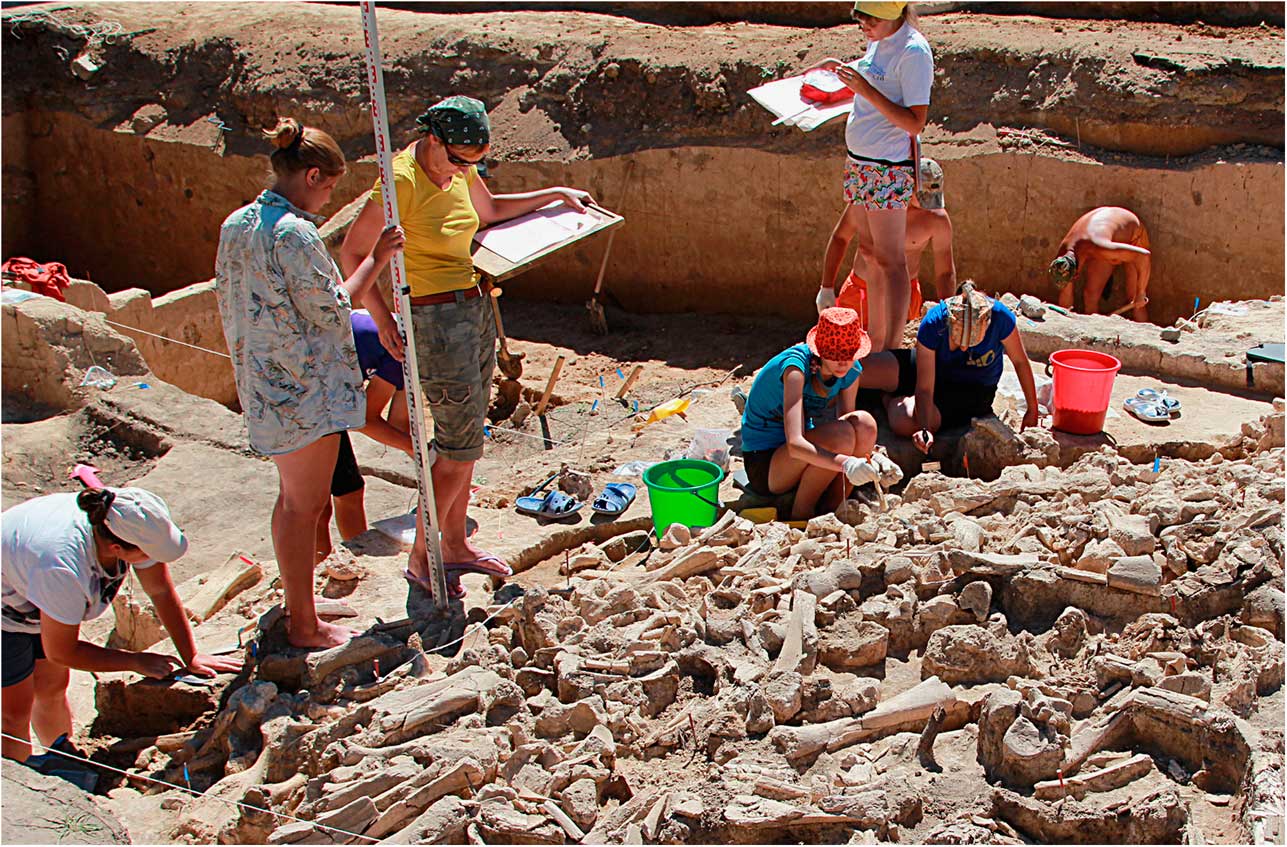
A total of seven, or possibly eight, archaeological layers have been identified within the Kostënki 11 sequence, although the number found in different excavation areas is not consistent and stratigraphic uncertainties remain (Rogachёv & Popov Reference Rogachёv and Popov1982; Popov et al. Reference Popov, Anikovich, Hoffecker, Dudin, Pustovalov and Chernyshev2004; see also below and Fig. 8). Found stratigraphically highest, directly below the Holocene chernozem soil, were Layers Ia and Ib, with the former containing the large mammoth bone accumulation now preserved within the museum pavilion (Iakovleva Reference Iakovleva2015; Fig. 2). From Layer Ia Rogachёv recovered a worked stone industry totaling c. 17,000 pieces, including cores, small blades and bladelets, splintered pieces, burins, and endscrapers (Rogachёv & Popov Reference Rogachёv and Popov1982; Popov Reference Popov1989). The assemblage is often attributed to the Zamiatnin Culture (along with Kostёnki 2, Kostёnki 3, and Kostёnki 19), which is thought to be the youngest manifestation of the Upper Palaeolithic at Kostёnki, and has no analogy outside the Kostёnki-Borshchëvo area (Rogachёv & Anikovich Reference Rogachёv and Anikovich1984; Popov Reference Popov1989; Anikovich et al. Reference Anikovich, Popov and Platonova2008; Bessudnov Reference Bessudnov2013; Rodionov Reference Rodionov2016).
Excavation of the upper part of the Kostenki 11 sequence, July 2014

Layer II, a dense concentration of archaeological material (worked stone, bone fragments, burned bones, etc) was found within a dark humic loam underlying Layers Ia and Ib (Rogachёv Reference Rogachёv1961). Due to the presence of backed lithics, including a particular type of backed point, the assemblage has been compared to those from Pushkari, Klyusy, and Layer III of Kostënki 21 (Sinitsyn Reference Sinitsyn2013). The layer is also notable for a series of small animal figurines (Abramova Reference Abramova1995).
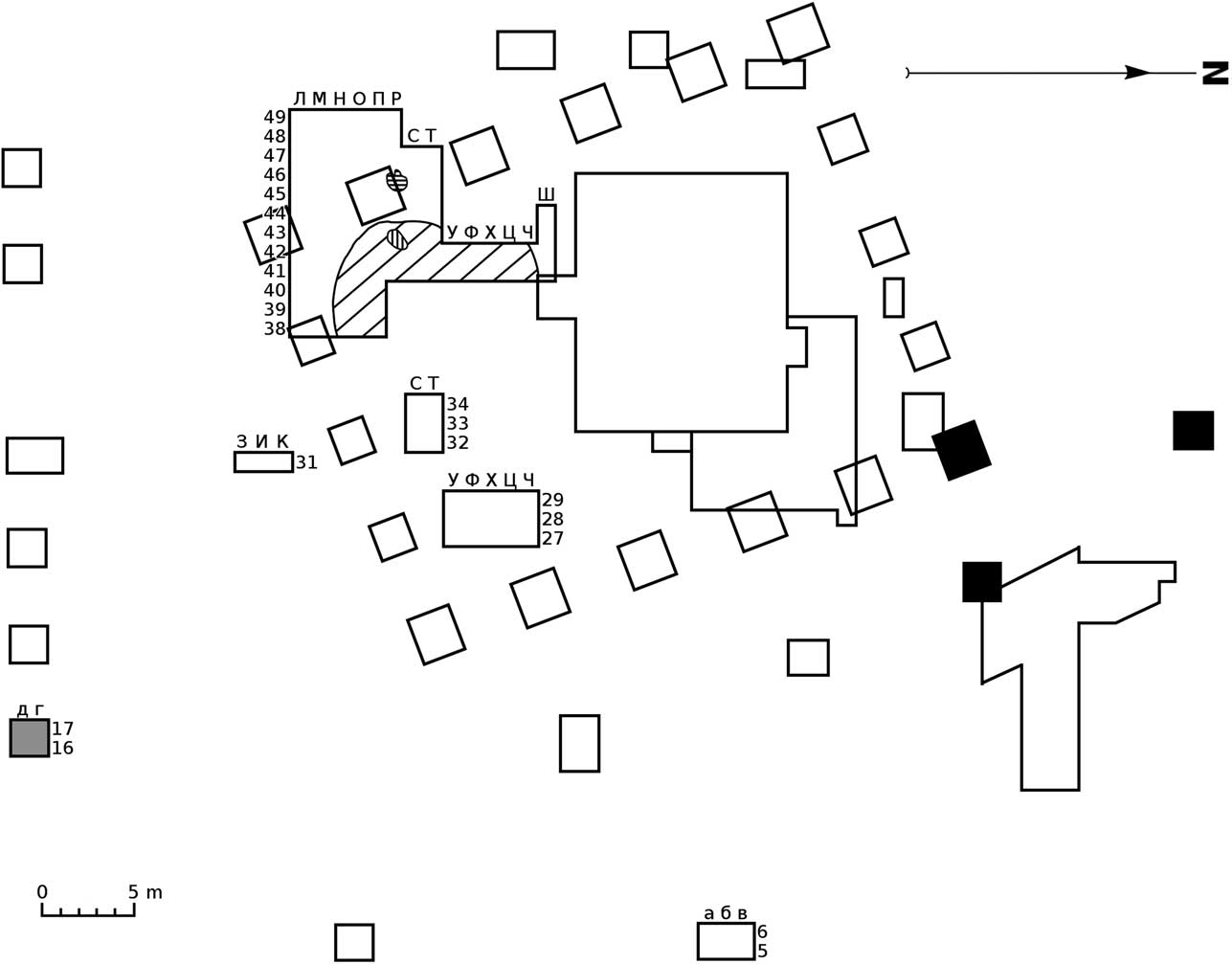
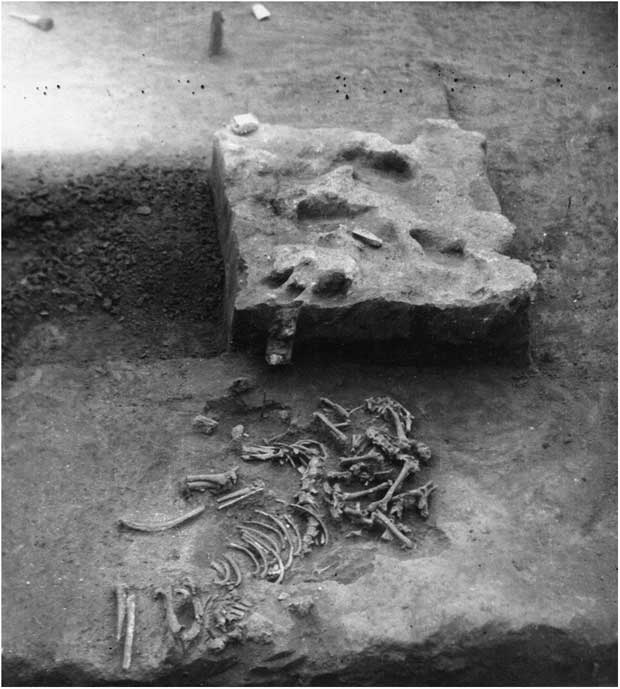
Positioned in a brown loess-like loam above the Upper Humic Bed (Rogachёv & Popov Reference Rogachёv and Popov1982; Popov & Dudin Reference Popov and Dudin2004; Anikovich et al. Reference Anikovich, Popov and Platonova2008), Layer III was found at a depth of 2.65–2.80 m from the modern-day surface. Its uppermost part was generally 20–30 cm lower than the base of Layer II (Rogachёv Reference Rogachёv1961; Rogachёv & Popov Reference Rogachёv and Popov1982, 128); the two layers were separated by an archaeologically sterile loam layer, which gave Rogachёv (Reference Rogachёv1956b) confidence in the attribution of most material to these respective layers. Layer III was first discovered in 1956, and was excavated during that year in the main excavation area (squares Л–Ш–38-49). Most material was found in squares М–Ч–38-43, although it was clear that Layer III material extended north and east beyond the limits of the excavation area (Rogachёv Reference Rogachёv1956b; Rogachёv & Popov Reference Rogachёv and Popov1982, 128) (Fig. 3). In this area the layer was generally 15–20 cm thick, and yielded worked stone, charcoal fragments, ochre, and bones (Rogachёv & Popov Reference Rogachёv and Popov1982). The remains of a hearth (squares Р–45-46) were found close to an oval, flat-bottomed pit containing the remains of two adult and two juvenile wolves (squares Р–42-43), suggested by Rogachёv (Reference Rogachёv1956b) and later by Anikovich et al. (Reference Anikovich, Popov and Platonova2008) to represent ritual burial or to be associated with early attempts at wolf domestication (Figs 3 & 4). Both of these features were peripheral to the part of Layer III that was richest in finds (Fig. 3). Rogachёv (Reference Rogachёv1956b) argued on stratigraphic grounds that the deposition of the wolves related to Layer III, rather than being intrusive from Layer II, emphasising that the archaeologically-sterile loam found overlying Layer III elsewhere was also found above the depression that contained the wolves. The depth measurements given by Rogachёv (Reference Rogachёv1956b) for the lowermost remains of Layer II and the uppermost recorded part of the pit with wolf bones are consistent with his stratigraphic interpretation. As discussed below, later test-pits away from the main excavation area also yielded material attributed by Rogachёv to Layer III.
Plan of excavations at Kostënki 11 carried out prior to 2003, showing: the extent of Layer III in Rogachёv’s main excavation area (squares Л-Ш–38-49) (diagonally striped area); the location of Layer V in three test-pits (shaded black); the location of test-pit д-г–16-17 (shaded grey); the location of test-pit С-Т–32-34 and the locations of the wolf burial (vertically striped area) and hearth structure (horizontally striped area) in Layer III. (Modified from Rogachёv Reference Rogachёv1956a and Popov & Dudin Reference Popov and Dudin2004, 9)

Wolf remains from squares Р–42-43, associated with Layer III (see text). Photo: Archive of IHMC RAS, No. O.2051-54

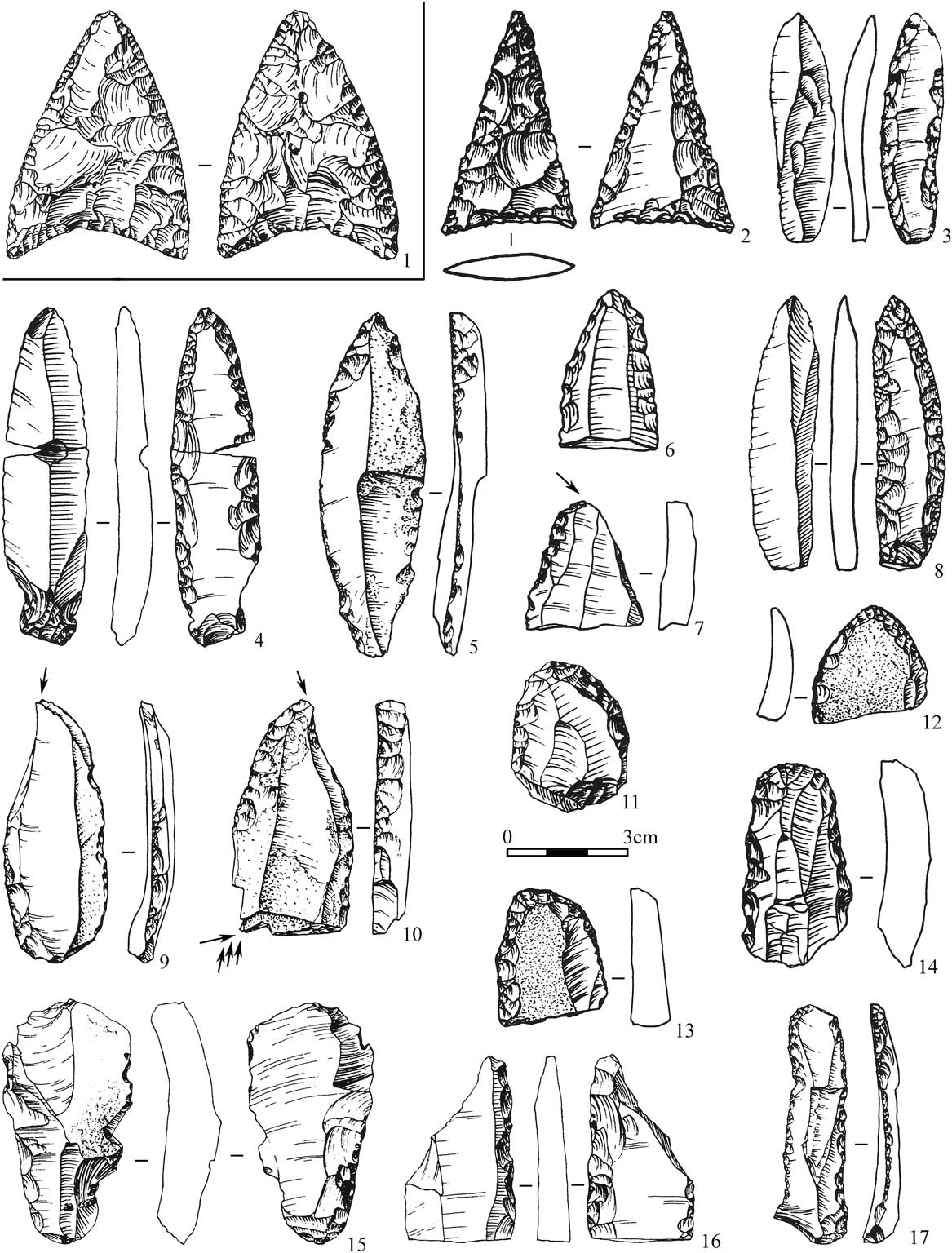
In the most complete study of the Layer III lithic assemblage Popov (Reference Popov1989; Popov & Dudin Reference Popov and Dudin2004) recorded 622 lithic pieces, of which 142 are retouched artefacts or fragments thereof. (These counts exclude material attributed to ‘Layer IIIa’ – see discussion, below.) The assemblage includes typically Upper Palaeolithic types such as end-scrapers, burins, and splintered pieces (Fig. 5), and is dominated by good quality flint that has facilitated the production of large and often pointed blades. Some of these pointed blades have been shaped ventrally (eg, Fig. 5, nos 3, 4, & 8). Due to a shared presence of ventrally shaped blades and lack of backed pieces, as well as perceived raw material similarities, some have compared the assemblage to Layer I of Kostёnki 8 (Tel’manskaya) (see below), grouping them together in the ‘Anosovka-Tel’manskaya Culture’, within which the smaller assemblage from Layer II of Kostёnki 5 is sometimes also included (see Rogachёv Reference Rogachёv1961; Rogachёv et al. Reference Rogachёv, Anikovich and Dmitrieva1982;Popov Reference Popov1989; Anikovich Reference Anikovich2005a; Anikovich et al. Reference Anikovich, Popov and Platonova2008). However, due to the presence of a single Streletskian point (Fig. 5, no. 2) the assemblage has also sometimes been classified as Streletskian/Sungirian (see for instance Debrosse & Kozlowski Reference Debrosse and Kozlowski1988, 48 cited in Flas Reference Flas2015, 56; Djindjian et al. Reference Djindjian, Kozlowski and Otte1999, 149, 430; Noiret Reference Noiret2004, 441; Sinitsyn Reference Sinitsyn2010; also see Popov Reference Popov1989), despite the lack of other artefact types also usually considered characteristic of Streletskian assemblages.
Lithic artefacts from Layer V (1) and Layer III (2–17) of Kostёnki 11, including Streletskian points (1, 2) and ventrally shaped blades (3, 4, 8). Illustrations from Popov (Reference Popov1989)

Layer IV has been discovered in 11 test-pits in different parts of the promontory. It is represented by lithic artefacts, bone fragments, and charcoal pieces found in the lower part of the loess-like loam, which overlies the Upper Humic Bed, and lenses of the Upper Humic Bed itself (Rogachёv Reference Rogachёv1961; Popov 1989). In the opinion of Popov (Reference Popov1989) the layer was redeposited. Layer IV’s lithic assemblage totals 175 pieces, of which 25 are retouched, including burins, splintered pieces, end-scrapers, side-scrapers, and a backed bladelet; the collection is insufficient to attribute it to a particular archaeological culture (Rogachёv & Popov Reference Rogachёv and Popov1982; Popov 1989; Popov et al. Reference Popov, Anikovich, Hoffecker, Dudin, Pustovalov and Chernyshev2004).
Archaeological material allocated to the ‘Northern Point’ (= ‘severnyi punkt’) has been found on the northern side of the promontory, close to the base of a ravine. The stratigraphic position of the Northern Point assemblage remains unclear: according to Rogachёv and Popov (Reference Rogachёv and Popov1982) it lay in the loess-like loam, but for Popov et al. (Reference Popov, Anikovich, Hoffecker, Dudin, Pustovalov and Chernyshev2004) it was associated with the upper part of the Upper Humic Bed. Of about 1800 lithics 261 are retouched, including end-scrapers, burins, splintered pieces, and a series of backed bladelets and points. For Rogachёv and Popov (Reference Rogachёv and Popov1982) the stratigraphic position of the lithic assemblage was broadly comparable to that of Layer IV, although some techno-typological characteristics of the lithic industry were closer to those of Layer Ia. The stratigraphic and cultural attribution of the Northern Point material clearly requires further clarification.
Layer V, the lowermost layer, has been identified only in small test-pits in the north-eastern part of the promontory (Fig. 3), positioned in the lower part of the Upper Humic Bed (Rogachёv Reference Rogachёv1968; Anikovich Reference Anikovich1977; Reference Anikovich2005b; Lazukov Reference Lazukov1982; Rogachёv & Popov Reference Rogachёv and Popov1982; Popov Reference Popov1989; Popov et al. Reference Popov, Anikovich, Hoffecker, Dudin, Pustovalov and Chernyshev2004; although Velichko & Rogachëv Reference Velichko and Rogachëv1969 instead placed Layer V in the Lower Humic Bed). Layer V is generally referred to as Streletskian (eg, by Anikovich Reference Anikovich1977; Reference Anikovich2005b; Bradley et al. Reference Bradley, Anikovich and Giria1995; Anikovich et al. Reference Anikovich, Popov and Platonova2008; Sinitsyn Reference Sinitsyn2010; Djindjian et al. Reference Djindjian, Kozlowski and Otte1999; but see Matiukhin Reference Matiukhin2012, 216) on the basis of one complete and one broken Streletskian point (Fig. 5, no. 1). However, the meagre size of the archaeological assemblage – 40 pieces, of which only five are retouched (Popov Reference Popov1989; Popov et al. Reference Popov, Anikovich, Hoffecker, Dudin, Pustovalov and Chernyshev2004) – makes further characterisation of the assemblage difficult.
KOSTЁNKI 8 LAYER I & THE ‘ANOSOVKA-TEL’MANSKAYA CULTURE’
Kostënki 8 is located in a small ravine (Aleksandrovskii Log) c. 2 km south-east of Kostënki 11 (Fig. 1). The site was discovered by A.N. Rogachëv in 1936 and excavated in 1937, 1949–52, 1958–9, 1962–4, 1976, and 1979 (Vekilova Reference Vekilova1977; Rogachëv et al. Reference Rogachёv, Anikovich and Dmitrieva1982). More recent excavations (2005–13) were led by V.V. Popov, A.Iu. Pustovalov and one of us (AD) (Anikovich et al. Reference Anikovich, Lisitsyn, Platonova, Dudin, Pustovalov, Zheltova and Popov2015; Dudin et al. Reference Dudin, Pustovalov and Platonova2016).
Five archaeological layers have been identified at Kostënki 8, numbered from top to bottom I, Ia, II, III, and IV (Rogachëv et al. Reference Rogachёv, Anikovich and Dmitrieva1982). Rogachëv’s Layer I lithic collection comprises c. 6000 pieces, including burins (especially dihedral types), retouched blades, pointed blades, bifacially-shaped blades and points, endscrapers, and sidescrapers (Rogachëv et al. Reference Rogachёv, Anikovich and Dmitrieva1982; Flas Reference Flas2015). While acknowledging some differences, Rogachëv et al. (Reference Rogachёv, Anikovich and Dmitrieva1982, 99) described perceived similarities between the Kostënki 8 Layer I and Kostënki 11 Layer III lithic assemblages that, in their view, warranted their classification together as the ‘Anosovka-Tel’manskaya Culture’. These included a predominance of semi-abrupt retouch, an absence of abrupt retouch (and therefore of backed pieces), the presence of similar points and end-scrapers, comparable ratios of different burin types and the presence at both sites of points reworked into burins.
A much smaller lithic assemblage of c. 100 pieces was found in the underlying Layer Ia, including at least one backed piece (Rogachëv et al. Reference Rogachёv, Anikovich and Dmitrieva1982). In contrast, Layer II has yielded a large collection of more than 25,000 lithic artefacts (including material from the most recent excavations), which recent radiocarbon dating has confirmed as the only early Gravettian assemblage known in Russia (Rogachëv et al. Reference Rogachёv, Anikovich and Dmitrieva1982; Reynolds et al. Reference Reynolds, Lisitsyn, Sablin, Barton and Higham2015; Dudin et al. Reference Dudin, Pustovalov and Platonova2016). The lowermost Layers III and IV provided only small assemblages of uncertain cultural affiliation, containing c. 500 and c. 30 lithic artefacts respectively (Rogachëv et al. Reference Rogachёv, Anikovich and Dmitrieva1982).
Radiocarbon chronology
Kostёnki 11 Layer III
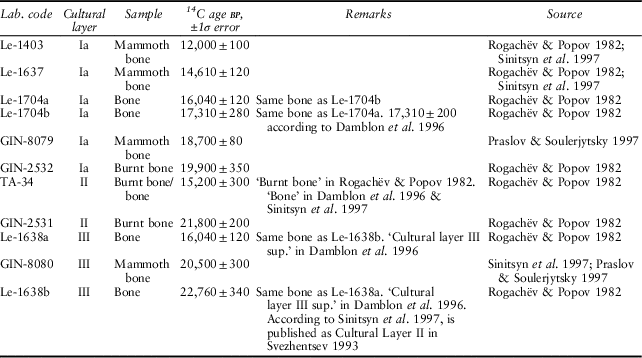
The corpus of previously published radiocarbon dates for Kostёnki 11 (Table 1) is problematic. Three dates have been published for Layer III; all are in poor agreement, despite the fact that two were produced from the same bone. The oldest of the three (Le-1638b: 22,760±340 bp) has generally been seen as more reliable, particularly given the existence of a date of 21,800±200 bp (GIN-2531) for the overlying Layer II. Based on the overall chrono-stratigraphy of the site, most have considered Layer III to date to c. 24,000–22,500 bp (ie, c. 28,500–26,500 cal bp) (eg, Popov & Dudin Reference Popov and Dudin2004; Anikovich Reference Anikovich2005a, 83; Anikovich et al. Reference Anikovich, Popov and Platonova2008), although due to its poor radiocarbon chronology and stratigraphic uncertainties, some have suggested that the layer may be older (eg, Sinitsyn Reference Sinitsyn2010).
previously published radiocarbon dates for kostёnki 11

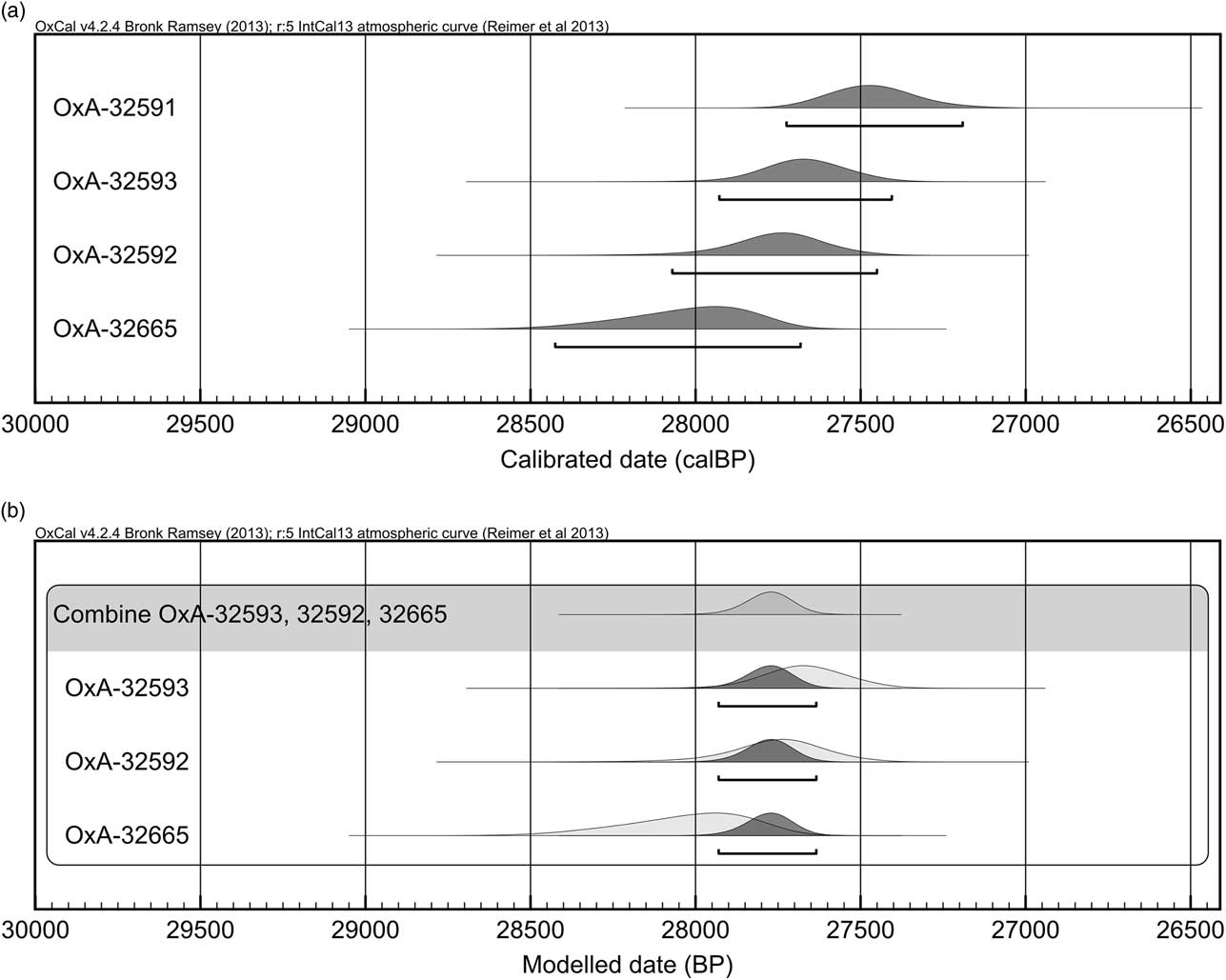
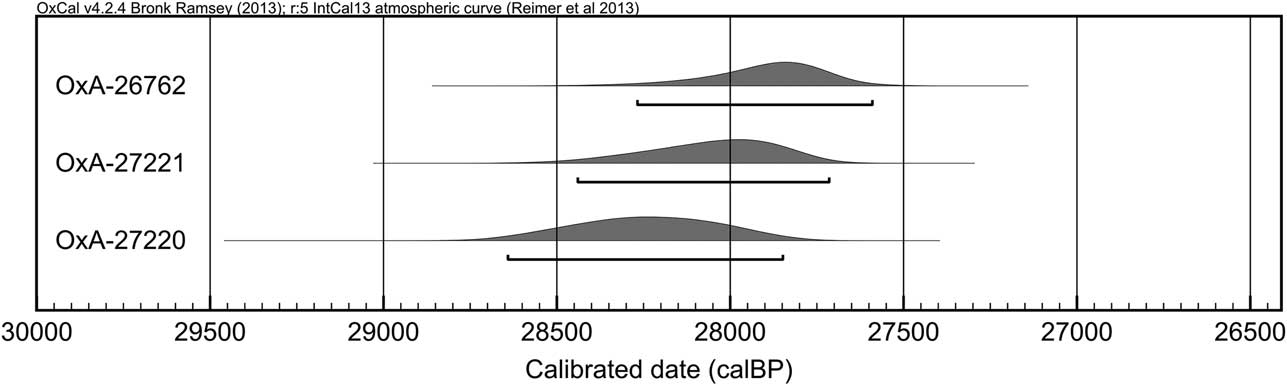
The right humeri of the four wolves found in a pit associated with Layer III (Figs 2 & 3, see above) were identified in collections held at the Zoological Institute (Russian Academy of Sciences), Saint Petersburg, and sampled for radiocarbon dating. Radiocarbon dates were produced using current methods at ORAU (University of Oxford), including ultrafiltration (Brock et al. Reference Brock, Higham, Ditchfield and Bronk Ramsey2010). The results (Table 2) were calibrated against the IntCal13 curve using OxCal version 4.2 (Bronk Ramsey Reference Bronk Ramsey2009; Reimer et al. Reference Reimer, Bard, Bayliss, Beck, Blackwell, Bronk Ramsey, Buck, Cheng, Edwards, Friedrich, Grootes, Guilderson, Haflidason, Hajdas, Hatté, Heaton, Hoffmann, Hogg, Hughen, Kaiser, Kromer, Manning, Niu, Reimer, Richards, Scott, Southon, Staff, Turney and Plicht2013). Probability distributions for the four calibrated dates are given in Figure 6a.
Modelled ages for the new radiocarbon dates from Kostënki 11 Layer III given in Table 2: a) all four dates calibrated separately; b) the three oldest dates calibrated and modelled as a single event using OxCal’s Combine function. All results were calibrated against the IntCal13 curve using OxCal version 4.2 (Bronk Ramsey Reference Bronk Ramsey2009; Reimer et al. Reference Reimer, Bard, Bayliss, Beck, Blackwell, Bronk Ramsey, Buck, Cheng, Edwards, Friedrich, Grootes, Guilderson, Haflidason, Hajdas, Hatté, Heaton, Hoffmann, Hogg, Hughen, Kaiser, Kromer, Manning, Niu, Reimer, Richards, Scott, Southon, Staff, Turney and Plicht2013). Brackets below plots indicate 95.4% probability ranges

new radiocarbon dates for the wolf remains associated with layer iii of kostёnki 11

1 AF* refers to solvent extraction (here, sequential extraction in acetone, methanol and chloroform) followed by routine ABA pretreatment and ultrafiltration (Brock et al. Reference Brock, Higham, Ditchfield and Bronk Ramsey2010).
2 Starting mass of bone sample used.
3 Mass of gelatin extracted.
4 Mass of gelatin extracted as percentage of starting mass of sample.
5 Percentage mass of carbon in combusted sample.
6 C isotopic ratio relative to VPDB.
7 C:N atomic weight ratio of combusted sample.
8 Calibrated age ranges as calculated against the IntCal13 curve using OxCal version 4.2 (Bronk Ramsey Reference Bronk Ramsey2009; Reimer et al. Reference Reimer, Bard, Bayliss, Beck, Blackwell, Bronk Ramsey, Buck, Cheng, Edwards, Friedrich, Grootes, Guilderson, Haflidason, Hajdas, Hatté, Heaton, Hoffmann, Hogg, Hughen, Kaiser, Kromer, Manning, Niu, Reimer, Richards, Scott, Southon, Staff, Turney and Plicht2013).
The archaeological context of the dated wolves from Kostёnki 11 allows the conclusion that they represent a simultaneous (anthropogenic) burial event. We therefore attempted to model the four results as a single event using the Combine function in OxCal 4.2, which flagged both the oldest and youngest dates as having poor agreement values (A=34.4% and 33.9% respectively). Presuming that the youngest age obtained is the most likely to be inaccurate (as tends to be the case for samples from the earlier part of the Upper Palaeolithic: Higham Reference Higham2011), we removed OxA-32591 from the series and re-ran the Combine function. This time the data passed the test of agreement, producing a modelled age of 27,850–27,700 cal bp (68.2% probability) or 27,930–27,630 cal bp (95.4% probability) (Acomb=91.9%) (Fig. 6b). (It can be noted that the test is also not failed if the oldest date, OxA-32665, is omitted instead.)
Kostёnki 8 Layer I
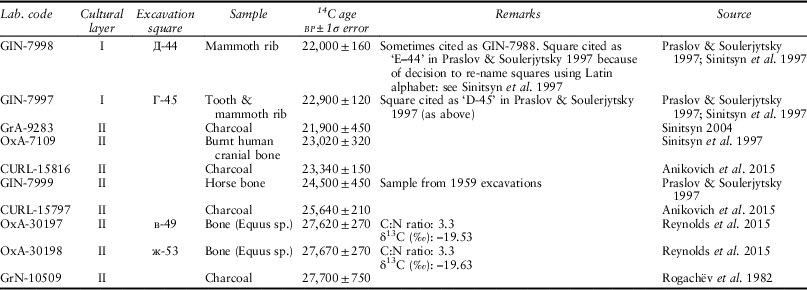
Previously published radiocarbon dates for Kostënki 8 Layer I (Table 3) are similar to the more ancient dates already published for Kostenki 11 Layer III (Table 1), supporting perceived similarities between their lithic assemblages (see above).
previously published radiocarbon dates for kostёnki 8

Three new radiocarbon dates (Table 4; Fig. 7) were produced from certainly or possibly humanly-modified bones from Layer I of Kostёnki 8, housed at the Peter the Great Museum of Anthropology and Ethnography (Kunstkamera; Russian Academy of Sciences), Saint Petersburg. The dates were obtained using ORAU’s current methods (Brock et al. Reference Brock, Higham, Ditchfield and Bronk Ramsey2010). The similarity of the new results from Kostёnki 8 Layer I and Kostёnki 11 Layer III (Tables 2 & 4) is consistent with the proposed link between the two archaeological layers; however, as explained below, further work is needed before this chronological similarity can be considered to more conclusively support a cultural link.
Calibrated ages for the new radiocarbon dates from Kostënki 8 Layer I given in Table 4, as calibrated against the IntCal13 curve using OxCal version 4.2 (Bronk Ramsey Reference Bronk Ramsey2009; Reimer et al. Reference Reimer, Bard, Bayliss, Beck, Blackwell, Bronk Ramsey, Buck, Cheng, Edwards, Friedrich, Grootes, Guilderson, Haflidason, Hajdas, Hatté, Heaton, Hoffmann, Hogg, Hughen, Kaiser, Kromer, Manning, Niu, Reimer, Richards, Scott, Southon, Staff, Turney and Plicht2013). Brackets below plots indicate 95.4% probability ranges

new radiocarbon dates from kostënki 8 layer i

1 AF refers to routine ABA pre-treatment and ultrafiltration; AF* refers to solvent extraction (here, sequential extraction in acetone, methanol and chloroform) followed by routine ABA pre-treatment and ultrafiltration (Brock et al. Reference Brock, Higham, Ditchfield and Bronk Ramsey2010).
2 Starting mass of bone sample used.
3 Mass of gelatin extracted.
4 Mass of gelatin extracted as % of starting mass of sample.
5 % mass of carbon in combusted sample.
6 C isotopic ratio relative to VPDB.
7 C:N atomic weight ratio of combusted sample.
8 Calibrated age ranges as calculated against the IntCal13 curve using OxCal version 4.2 (Bronk Ramsey Reference Bronk Ramsey2009; Reimer et al. Reference Reimer, Bard, Bayliss, Beck, Blackwell, Bronk Ramsey, Buck, Cheng, Edwards, Friedrich, Grootes, Guilderson, Haflidason, Hajdas, Hatté, Heaton, Hoffmann, Hogg, Hughen, Kaiser, Kromer, Manning, Niu, Reimer, Richards, Scott, Southon, Staff, Turney and Plicht2013)
Discussion
Kostёnki 11 Layer III and Kostёnki 8 Layer I in the Kostёnki-Borshchëvo sequence
Our results place both the Kostёnki 11 Layer III wolf burial and the assemblage from Layer I at Kostёnki 8 at c. 24–23,000 bp (=c. 28,500–27,000 cal bp). Both are therefore significantly younger than Kostёnki’s Spitsynian, Aurignacian, and Gorodtsovian occupations (eg, Kostёnki 17 Layer II, Kostёnki 14 Layer in Volcanic Ash and Layer II, Kostёnki 1 Layer III, Kostёnki 15) as well as the Gravettian assemblages from Kostёnki 8 Layer II, Kostёnki 4, and Borshchëvo 5 Layer I (Praslov & Rogachёv Reference Praslov and Rogachёv1982; Damblon et al. Reference Damblon, Haesaerts and Plicht1996; Sinitsyn et al. Reference Sinitsyn, Praslov, Svezhentsev and Sulerzhitskii1997; Reynolds et al. Reference Reynolds, Lisitsyn, Sablin, Barton and Higham2015; Sinitsyn Reference Sinitsyn2015). The dates are instead closer to the age of the Kostёnki-Avdeevo Culture (=Late Gravettian ‘Kostenkian’) sites of Kostёnki 1 (Layer I), Kostёnki 18, and Kostёnki 14 (Layer I) (Praslov & Rogachëv Reference Praslov and Rogachёv1982; Sinitsyn et al. Reference Sinitsyn, Praslov, Svezhentsev and Sulerzhitskii1997; Sinitsyn Reference Sinitsyn2015; Damblon et al. Reference Damblon, Haesaerts and Plicht1996; Amirkhanov Reference Amirkhanov2000; Abramova et al. Reference Abramova, Grigorieva and Zaitseva2001; RD, unpublished data), placing the assemblages in Sinitsyn’s (Reference Sinitsyn2015, 165) chronological group IV.
The dates for Kostёnki 11 Layer III and Kostёnki 8 Layer I are similar, appearing to support the proposed cultural link between them. However, we prefer to reserve judgement about the similarity of these assemblages. The lithic industries from the two layers have largely been linked on typological grounds, with some similarities unlikely to be culturally informative (eg, the perceived similarity of technologically simple burins). A more thorough technological assessment of Kostёnki 11 Layer III is needed – comparable to the recent study of Kostёnki 8 Layer I by Flas (Reference Flas2015) – before the relationship between the assemblages can be properly understood. Flas (Reference Flas2015) remained non-committal over their connection for similar reasons, but did raise the possibility that Kostёnki 8 Layer I, Kostёnki 11 Layer III, and the Kostёnki-Avdeevo Culture assemblages may all be connected. Future work could usefully focus on comparing blade production and the techno-typology of ventrally retouched blades in these broadly synchronous assemblages.
As noted above, Kostёnki 11 Layer III has also been described as Streletskian/Sungirian, or has been seen as culturally linked to other Streletskian sites, due to the presence of a Streletskian point (Fig. 5. no. 2) (eg, Debrosse & Kozlowski Reference Debrosse and Kozlowski1988, 48, cited in Flas Reference Flas2015, 56; Anikovich Reference Anikovich2005b; Anikovich et al. Reference Anikovich, Bredli [Bradley] and Giria1997, 161; Djindjian et al. Reference Djindjian, Kozlowski and Otte1999, 149, 430; Noiret Reference Noiret2004, 441; Sinitsyn Reference Sinitsyn2010; see also Rogachёv & Anikovich Reference Rogachёv and Anikovich1984; Popov Reference Popov1989). The layer’s apparently more recent age than assemblages with Streletskian points reported from the Lower Humic Bed (Kostёnki 1 Layer V, Kostёnki 6, Kostёnki 12 Layer III) and Upper Humic Bed (Kostёnki 11 Layer V, Kostёnki 12 Layer Ia) means that it has sometimes been viewed as the last manifestation of the Streletskian at Kostёnki; or, alternatively, that the Kostёnki 11 Layer III and Kostёnki 8 Layer I assemblages, while not themselves satisfactorily described as Streletskian, may have arisen out of Streletskian cultural traditions (see for instance Rogachёv & Anikovich Reference Rogachёv and Anikovich1984; Anikovich Reference Anikovich2005b; Anikovich et al. Reference Anikovich, Popov and Platonova2008). Even those preferring not to argue for a cultural relationship with other Streletskian sites understandably saw the presence of the Streletskian point in the Layer III assemblage as necessitating discussion (eg, Anikovich Reference Anikovich1977, 12–15; Rogachёv & Popov Reference Rogachёv and Popov1982, 130; Lisitsyn Reference Lisitsyn2014, 92).
Kostёnki 11 Layer III: stratigraphic issues
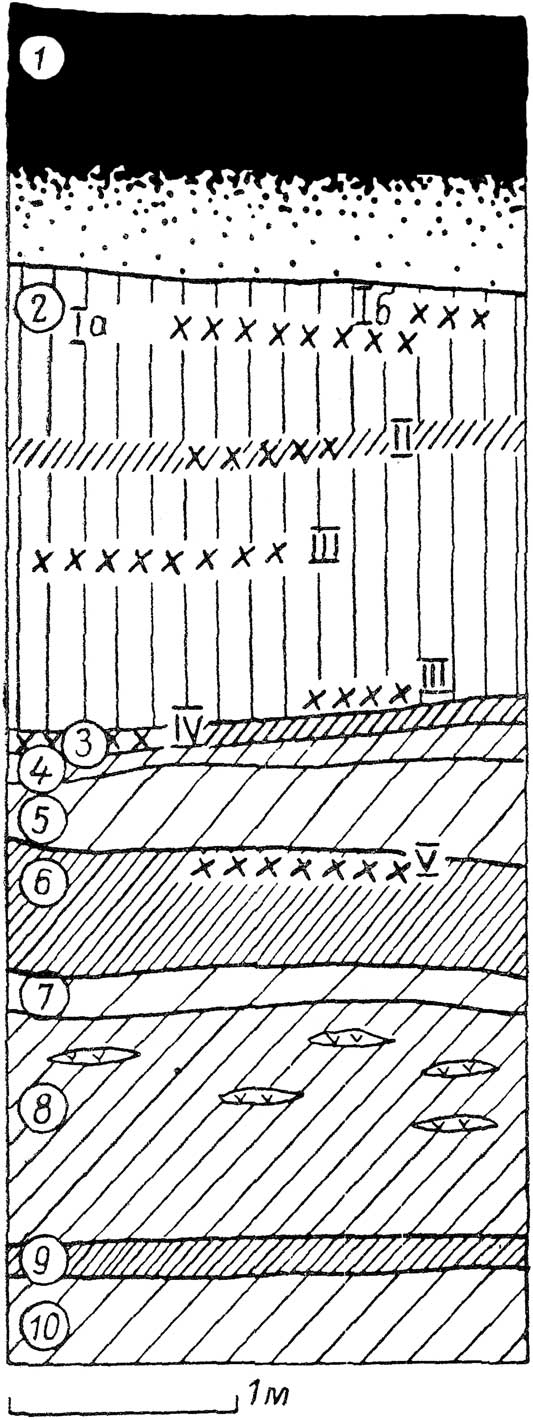
The radiocarbon age of the wolf burial in Rogachёv’s main excavation area (ie, squares Л–Ш–38-49; see Fig. 3) is consistent with a young age for Layer III relative to Streletskian assemblages elsewhere. However, stratigraphic uncertainties exist in relation to Layer III as found more widely across the site. Rogachёv and Popov (Reference Rogachёv and Popov1982, 118) were explicit about the problematic stratigraphy of Kostёnki 11 overall, recognising the impact of solifluction and slope processes (see also Anikovich et al. Reference Anikovich, Popov and Platonova2008). In particular they highlighted the problem of securely correlating different excavation areas (Rogachёv & Popov Reference Rogachёv and Popov1982, 128), and it is noteworthy that ‘Layer III’ was marked at two different stratigraphic positions in their schematic section (Fig. 8; Rogachёv & Popov Reference Rogachёv and Popov1982, 118, fig. 37-Б). Popov (Reference Popov1989; Popov et al. Reference Popov, Anikovich, Hoffecker, Dudin, Pustovalov and Chernyshev2004) used stratigraphic and techno-typological evidence to isolate the ‘Layer III’ material from test-pit д–г–16-17 (see Fig. 3), which was found at the lower part of the loess-like loam (ie, above the Upper Humic Bed) and partly in lenses of the Upper Humic Bed itself. Popov (Reference Popov1989; Popov et al. Reference Popov, Anikovich, Hoffecker, Dudin, Pustovalov and Chernyshev2004) allocated the д–г–16-17 assemblage to ‘Layer IIIa’, along with material from other test-pits thought to be stratigraphically problematic, in order to distinguish it from the Layer III lithic industry of Rogachёv’s main excavation area.
Schematic section of Kostenki 11 (Rogachev & Popov Reference Rogachёv and Popov1982, 118). The numbers in circles are geological descriptions: 1. modern soil; 2. grey-brown loess-like loam; 3, 6, 9. humic loam; 4. marl loam; 5. whitish loam; 7. brown loam; 8. layered loam with lenses of volcanic ash; 10. layered loam. Roman numerals denote archaeological layers (see text)

Layer III in Rogachёv’s main excavation area (ie, squares Л–Ш–38-49) was stratigraphically thin, and the wolf remains shown in Figure 4 are good evidence that this area had not been heavily affected by post-depositional deformation. However, Layer III was not similarly coherent across the whole of Kostёnki 11. In test-pit C–T–32-34, to the east of the main excavation area (see Fig. 3), the cultural layer was thicker (c. 50 cm) (Rogachёv Reference Rogachёv1956a; Reference Rogachёv1956b; Reference Rogachёv1965). Recent excavations to the west of the Rogachёv’s main excavation area have demonstrated a similar situation, with a stratigraphically thick Layer III occupying two lithological horizons, in some places up to 80 cm thick, and with some evidence for post-depositional movement of artefacts (Fediunin Reference Fediunin2015; Reference Fediunin2016). Although these excavations failed to firmly establish a separate Layer IIIa within Layer III sensu lato, some typo-technological and raw material patterning of lithic artefacts between the top and bottom parts of the layer was observed (ibid.).
Evidently, the stratigraphy and coherence of Layer III sensu lato are still incompletely understood, and we would caution against concluding that the radiocarbon dates presented here date lithic material from all parts of Kostёnki 11 previously attributed to this layer. These issues are obviously of particular importance when assessing the significance of the Streletskian point ostensibly from Layer III.
The Kostёnki 11 Layer III Streletskian point as part of the ‘Layer III’ assemblage
The Streletskian point was found in square С-33, during excavation of test-pit С–Т–32-34 in 1965 (Rogachёv Reference Rogachёv1965), and not from the main excavation area (see Fig. 3). Given the known stratigraphic uncertainties outwith Rogachёv’s main excavation area, the Streletskian point’s allocation to ‘Layer III’ is therefore probably insufficient on its own to conclude that it belongs with the remainder of the Layer III assemblage. Instead it is necessary to consider whether the artefact is consistent with the assemblage’s overall technological profile.
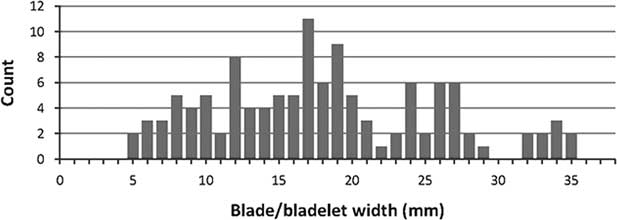
Like the majority of the Kostёnki 11 Layer III lithic assemblage, the Streletskian point is made on good quality Cretaceous flint. There is therefore no obvious reason to separate it from the other Layer III lithics on the basis of raw material (Rogachёv Reference Rogachёv1965; Popov & Dudin Reference Popov and Dudin2004). Popov and Dudin (Reference Popov and Dudin2004) suggested that the large, wide blade or thin flake blank selected for its manufacture is consistent with blanks produced in the Layer III assemblage. The Cretaceous flint in Layer III was clearly used for blade production (Popov Reference Popov1989) and, as Figure 9 shows, some of the blades produced were large. However, no blade in the Layer III collection would have been large enough to produce the Streletskian point which, even after shaping, retains a maximum width of 37 mm (see also Fig. 5). It is more likely that a large, thin flake was used to manufacture the point, as was seemingly the case at other Kostёnki Streletskian sites (eg, Kostёnki 1 Layer V, Kostёnki 6: see Bradley et al. Reference Bradley, Anikovich and Giria1995). Excluding cores and core fragments, only one piece in the Layer III lithic assemblage (n=1 of 522 [excludes material from test-pit д–г–16-17; see text]) has a length and width greater than the Streletskian point (ie, >58 mm and >37 mm), and this is a large flake of quartzite, a material which makes up only 1% of the lithic assemblage (n=6 of 536 [excludes material from test-pit д–г–16-17; see text]). It is therefore difficult to consider the point’s blank as typical of the Layer III assemblage. Anikovich et al. (Reference Anikovich, Bredli [Bradley] and Giria1997; Reference Anikovich, Bradley and Giria1998; also Bradley et al. Reference Bradley, Anikovich and Giria1995; Popov & Dudin Reference Popov and Dudin2004) concluded that the Kostёnki 11 Layer III Streletskian point was shaped using the same secondary thinning technique used for Streletskian points at other Kostёnki sites, but this technique is not apparent on any of the other artefacts previously classified as points in the Kostёnki 11 Layer III assemblage (Anikovich et al. Reference Anikovich, Bredli [Bradley] and Giria1997; Reference Anikovich, Bradley and Giria1998; Popov & Dudin Reference Popov and Dudin2004). Furthermore, characteristic thinning flakes found in other Streletskian point assemblages have not been found in the Kostёnki 11 Layer III assemblage (Anikovich et al. Reference Anikovich, Bredli [Bradley] and Giria1997; Reference Anikovich, Bradley and Giria1998; also Bradley et al. Reference Bradley, Anikovich and Giria1995), leading Anikovich et al. (Reference Anikovich, Bredli [Bradley] and Giria1997; Reference Anikovich, Bradley and Giria1998) to propose either that these flakes exist in an unexcavated area of the site, or that the point was manufactured elsewhere. Rogachёv and Anikovich (Reference Rogachёv and Anikovich1984) even suggested that the Streletskian point may have been found, collected, and transported to the site. There is precedent for such behaviour at Kostёnki; indeed, at Kostёnki 11 itself the occupants of Layer Ia collected wide blades from Layer II to create bladelet cores (Popov Reference Popov1989; Rodionov Reference Rodionov2016). Although we remain open-minded about the similarity of the Kostёnki 11 Layer III lithic industry to that from Kostёnki 8 Layer I (see above), we can note that the latter also contains no evidence for Streletskian points or their manufacture (Rogachёv et al. Reference Rogachёv, Anikovich and Dmitrieva1982; Anikovich et al. Reference Anikovich, Popov and Platonova2008, 153).
Width measurements to the nearest millimetre for blades and bladelets from Kostënki 11 Layer III (n=119) (material from test-pit д-г–16-17 is not included: see text)

There is therefore no technological feature that helps to tie the Kostёnki 11 Layer III Streletskian point to the rest of the layer’s lithic assemblage. Of course, one can easily imagine a scenario whereby a Streletskian point created elsewhere was discarded at Kostёnki 11; nevertheless, when considered alongside Layer III’s unresolved stratigraphic issues, particularly beyond Rogachёv’s main Layer III excavation area, the point’s association with other material from the layer should presently be treated as undemonstrated. As this single Streletskian point is the sole reason for comparison of Layer III with Streletskian assemblages elsewhere at Kostёnki and beyond, it follows that invoking cultural connections with these other assemblages is injudicious.
Conclusions
New radiocarbon dates of 24–23,000 bp (=c. 28,500–27,000 cal bp) for a wolf burial associated with Layer III of Kostёnki 11 demonstrate its association with Sinitsyn’s (Reference Sinitsyn2015, 165) chronological group IV, hence confirming its recent age relative to Kostёnki-Borshchëvo’s Spitsynian, Aurignacian, Early Gravettian, and Gorodtsovian sites and layers. The dates are instead similar to new dates for Kostёnki 8 Layer I, with which the Kostёnki 11 Layer III lithic assemblage has previously been grouped as the ‘Anosovka-Tel’manskaya Culture’. These two assemblages are also chronologically close to Late Gravettian Kostёnki-Avdeevo Culture sites such as Kostёnki 1 Layer I and Kostёnki 18. A new study of the Kostёnki 11 Layer III lithic assemblage would enable meaningful comparison with Kostёnki 8 Layer I, and assessment of blade production at all of these sites should help to elucidate the relationships between them.
A single Streletskian point from Layer III at Kostёnki 11 has previously been used to propose a cultural link with Streletskian sites and assemblages at Kostёnki and beyond. However, there is reason to question the association of this Streletskian point with other lithic material from Layer III. Stratigraphic uncertainties relating to Layer III remain unresolved, including those in the test-pit that yielded the Streletskian point. There is also currently no technological context for the Streletskian point in the remainder of the Kostёnki 11 Layer III lithic assemblage. The blank from which it was made is unusual for the layer, the secondary thinning technique used for its manufacture is not evident on any of the layer’s other artefacts, and no characteristic thinning flakes have been found, despite their presence at other Streletskian sites at Kostënki. These issues make it unwise to place too much significance on this single artefact, and therefore unwarranted to describe Kostënki 11 Layer III as Streletskian or to evoke a cultural link with Streletskian sites elsewhere.
Acknowledgements: We are grateful to Maria Medvedeva and Natalia Lazarevskaya for their generous help with the IHMC RAS archive material.We are also thankful to several colleagues who commented on an earlier draft of this paper. Radiocarbon dates for Kostënki 8 are courtesy of the ‘Ancient Human Occupation of Britain’ project. AB’s work is supported by the RFBR grants 14-06-31134_mol-a and 17-06-00319a. NR is supported by a Postdoctoral Study Grant from the Fondation Fyssen, and also thanks the ‘PalaeoChron’ project (ERC grant 324139 awarded to TH) for time spent undertaking this research. AS acknowledges grant RFBR 17-06-00319a, and the participation of ZIN RAS (state assignment No.АААА-А17-117022810195-3) to this research is also duly acknowledged. RD is grateful for the support of the Leverhulme Trust. This publication is a contribution to the Leverhulme Trust project RPG-2012-800.