The United States’ infrastructure, including highways, bridges, public transit, and rail transportation, suffered from deterioration over the past two decades and by 2015 earned an overall grade of D+ from the American Society of Civil Engineers. Footnote 1 The problem was not that lawmakers had revoked the laws that established it, but rather that they neglected to maintain them adequately, and in so doing, they failed to maintain the infrastructure itself. As a result, one in five of the nation’s roads was deemed to be in poor condition and one in four of its bridges was “structurally deficient or functionally obsolete.” Footnote 2 The failure to maintain the transportation system hinders the nation’s economy, and it harms ordinary citizens by increasing wear and tear on vehicles, spurring traffic delays, raising gas mileage, and not least, increasing the chance of accidents and auto fatalities. Footnote 3
In 1956, President Dwight D. Eisenhower signed into law the Federal Aid Highway Act, creating the interstate highway system, along with a trust fund financed by gas taxes to support its upkeep. For decades, the reauthorization of the transportation bill amounted to a routine legislative activity. Since the 1990s, however, the process became increasingly fraught, subject to myriad short-term, last minutes fixes that cobbled together funds to extend current levels for as little as a few months at a time, depriving states and localities of the chance to engage in longer-term planning. Footnote 4 In 2015, with both parties motivated to demonstrate their governing capacity in anticipation of the presidential election, Congress finally managed to enact a five-year bill, but it still failed to update the trust fund, relying instead on short-term financing. Lawmakers have not raised the gas tax since 1993, leaving it fixed at 18.4 cents per gallon, an amount that has diminished in value with inflation and the rise of fuel-efficient vehicles. The new bill, furthermore, provides funds for basic repairs but does little to adjust to changing needs resulting from emerging population patterns and technological innovation. Footnote 5
The problem of deferred maintenance has beset policies in numerous other issue areas as well in recent years. The reauthorization of existing laws, an activity that occurred routinely and with bipartisan cooperation in prior decades, is now long overdue for policies ranging from the Clean Air Act to the Juvenile Justice and Delinquency Prevention Act. Congress has also fallen behind on updating several laws that do not require formal reauthorization, but that are public priorities that received regular legislative attention in earlier decades. Examples include tax policy and immigration policy. The lack of policy maintenance undermines laws’ ability to achieve the purposes for which they were created. In some instances, such neglect leads to highly visible government failures, as when Hurricane Katrina breached the levees in New Orleans in 2005 or when 13 people were killed and 90 injured when an interstate highway bridge collapsed in Minnesota in 2007. Footnote 6 Other crises unfold far more slowly and less dramatically but extract an enormous human toll nonetheless, such as the nation’s unimpressive progress in raising college graduation rates among low- to middle-income students, which undermines opportunity and deprives American society of much-needed human capital.
American government today is infused by a paradox. On the one hand, it is pervasive in its presence, as evidenced through the existence of a multitude of federal policies that govern wide-ranging aspects of everyday life. On the other hand, many of these policies are deteriorating and fail to function well. This pairing of size and scope with weakness and incapacity leaves ordinary Americans in many ways deprived of effective governance. Landmark laws created in the past constitute what might be termed a “public trust”: citizens likely assume them to be safeguarded by those in public office. The failure to maintain adequately these existing policies, particularly those that align with policy priorities held by majorities of Americans across party lines, may be promoting the decay of democratic governance itself. To the extent that Americans observe government-in-action but perceive it to be functioning poorly, its legitimacy may suffer.
I highlight this conundrum through a four-fold argument that points toward a research agenda for scholars. First, I put forward a new concept, the “policyscape,” to explain the centrality of public policy to contemporary governance and politics; second, I argue that existing policies, in part due to processes they themselves set into motion, evolve in dynamic ways over time leading to diverse outcomes including entrenchment, deterioration, and derailment; third, I explain that as a result of such accumulated policy development, policy maintenance constitutes a central task of public officials in the contemporary polity; and fourth, I show that the capacity of the political system to support policy maintenance varies with time as the political context changes.
To begin, I advance the concept of the “policyscape” to describe the political landscape in which we now dwell: one that is densely cluttered with public policies that were established by lawmakers at earlier points in time, particularly in the 1930s through the 1970s, which now structure the political order. To understand American politics today, it is not enough to study only the formal branches of federal government and the arrangements of federalism; the mass of existing policies themselves function as institutions that reshape politics. This “policyscape” includes the proliferation of federal regulations as well as statutes that bestow public funds; indeed, the percentage of GDP spent by the U.S. federal government has increased from 3.6 percent in 1930 to 20 percent in 2014. Footnote 7 It encompasses policies administered directly by federal administrative agencies as well as those that grant authority to the states. It also includes policies channeled through the tax code and subsidies to employers or other nonstate organizations, whether non-profit or for-profit organizations, delivery mechanisms that I have previously termed the “submerged state” inasmuch as they obscure government’s role to ordinary citizens. Footnote 8
The policyscape redefines American politics in myriad ways: it imposes substantial resource commitments and constraints, configures governing capacity and standard operating procedures, and establishes norms regarding the appropriate domain of governmental activity. It influences the agenda of lawmakers by filling in the domain of “old business” that requires attention, and by framing policy alternatives according to precedents established by already-existing policies. Footnote 9 It shapes the activities, priorities and even the existence of interest groups, as well as the demands, expectations, and participation of ordinary citizens.
The policyscape concept builds on the work of scholars who have already noted that public policies play a central role in shaping the contemporary political order. Footnote 10 But whereas Stephen Skowronek depicts what he terms the “policy state” as highly volatile, involving constant political choices because everything in government is negotiable, Footnote 11 the policyscape draws attention to policies’ role as established institutions that themselves shape policymakers’ choices and often operate independently of them. The concept overlaps with what Jacob Hacker and Paul Pierson call “policy as terrain,” but whereas they seek to demonstrate why control over policy has become the “prize” over which political actors struggle in the electoral area, I focus on policies themselves, specifically on their internal development and upkeep over time and how those matter for how well or poorly government functions and responds to citizens. Footnote 12
Second, I argue that while the policyscape is not unpredictable, neither is it static: rather, it is a dynamic environment in which policies evolve and change over time. Some view policy development as inevitably leading to inertia and entrenchment. Footnote 13 I agree with those who expect a wider array of possibilities, including deterioration or derailment, such that policies cease functioning as intended. Footnote 14 Certainly scholars of implementation have long pointed out that policy development can go awry, but their explanations highlight problems inherent to bureaucracy or the complexities of coordinating across multiple levels of government and layers of organizations. Footnote 15 The argument I put forth stresses instead the impact of policies’ own pathways of development and lawmakers’ responses to them. In a similar vein, Hacker has pointed out that policies may fail to function as they once did due to “drift,” meaning that as external circumstances change—for instance due to social or economic transitions—lawmakers neglect to update policies accordingly. Footnote 16 I showcase still another set of mechanisms, these emanating from dynamics internal to policies themselves, which can make them develop differently than intended over time.
I contend that policies’ own intrinsic characteristics and tendencies can explain why some eventually flourish while others underperform or otherwise fail to function as intended. If we return to the example of the infrastructure, for example, certainly changing external circumstances may make highways constructed in the past become inadequate with time: the growth of population may lead to more traffic and congestion, requiring the addition of more lanes; changes in technology may create demand for updating, such as to accommodate driverless cars; or concern about the externalities of fuel consumption may necessitate the establishment of more bike paths. Yet even aside from these external transformations or dynamics of “drift,” highways and bridges—like any aspect of the built environment—by necessity decay with time and use and require basic maintenance. Such deterioration emanates from internal characteristics of infrastructure.
I illuminate three types of policy effects that emanate from policies themselves: policy design effects, as particular features affect whether they become more easily sustainable or more prone to languish; unintended consequences, as policies provide incentives to third parties that profit from their existence and which in turn influence their development in ways that may take them off course; and lateral effects, as a policy’s own development is affected by that of another policy, for example by influencing its access to resources or attention from public officials.
Third, I argue that the emergence of the policyscape makes policy maintenance, meaning the long-term care and upkeep of policies, a fundamental task of governing. Policy maintenance is required to ensure that policies continue to function well, by addressing problems that ensue from their internal development as well as adjusting them to account for changes in the external environment. Policy maintenance is a necessity of modern political life in developed nations, emanating logically from the accretion of policies. The accumulation of policies will inevitably lead to greater complexity and conflicts between them, owing to the kinds of internal effects described above. It implies that lawmakers’ roles need to be transformed so that they can devote themselves more fully to tasks befitting those of policy superintendents. Yet these altered expectations present challenges to lawmakers, given the scarcity of their time and attention, limited public resources, and possibly a dearth of incentives to redirect their energies in such ways.
Fourth, I reason that the capacity of the political system to achieve policy maintenance varies over time with political and institutional circumstances, specifically as they affect lawmakers’ willingness and capacity to serve as stewards of existing policies. Certainly administrative agencies influence policy maintenance, as bureaucrats within them write regulations, put pressure on lawmakers to enact laws, and exert discretion in policy implementation. Footnote 17 The argument here focuses instead on how elected officials—after policy enactment has occurred—may strengthen or weaken the policy accomplishments of their predecessors, whether through direct action or neglect. Footnote 18 Also, unlike scholars of policy sustainability who focus on the early years of implementation and whether policies actually succeed in becoming established in the first place, I turn attention to policy development many years later, investigating the care of policies that did take hold and perhaps even thrived for decades, but which subsequently became subject to decay, deterioration, or derailment.
Certainly policy maintenance is easiest when the same political party that enacted particular laws continues to wield large majorities, as was the case for the Democrats for most of the middle decades of the twentieth century. Footnote 19 But even after elections grew more competitive in the 1980s and the gap between the political parties began to widen, lawmakers continued for another fifteen years to engage in policy maintenance with moderate success. Footnote 20 They regularly reauthorized laws ranging from Head Start to the transportation bill and updated key laws that do not formally require reauthorization. More recently, however, the greater escalation of partisan polarization and the responsiveness of lawmakers to moneyed interests have long delayed or impeded such efforts.
A cursory examination suggests that over the past decade, policymakers have failed to maintain the majority of existing laws that are most closely related to the American public’s top 20 policy priorities, as measured by the Pew Research Center. Sixty-seven percent of Americans mention education as a top priority, but the Higher Education Act is long overdue for reauthorization; fifty-two percent cite immigration, but despite the presence of the issue of the policy agenda, a bill has yet to emerge from both chambers of Congress; fifty-one percent mention the environment, but the Clean Air Act has not been reauthorized since 1990, and so on. The priority issues that Congress neglects include some mentioned by larger percentages of Republicans, such as tax reform, and others that are stressed by larger percentages of Democrats, such as “dealing with problems of [the] poor and needy.” Footnote 21 Reauthorization or routine action by Congress, furthermore, is only the most obvious—and possibly superficial—indicator of maintenance; other measures and more in-depth analysis may reveal that serious underlying problems persist and remain unaddressed even if such nominal maintenance is accomplished. Such neglect calls into question the functioning of representative democracy. Not all policy issues are subject to deferred maintenance, however, as today’s political environment proves more conducive to the upkeep of some than of others.
The rare exceptions to the rule, the policies that do continue to be updated, indicate that policy maintenance is not an apolitical development. Certainly termination of a policy may be appropriate if the circumstances that prompted its creation no longer exist, or if it was designed so poorly that dismantling it makes more sense. In any period, the determination of which laws should be repaired and renovated versus terminated involves decisions on which lawmakers of different stripes may reach very different conclusions. What is striking, however, is the large number of laws that until recently received regular maintenance through bipartisan efforts and which today fail to receive such attention. The task is to understand why lawmakers exhibit greater incentives, capacity, and willingness to perform such tasks in some periods than in others.
To clarify, by contrast to the “submerged state” concept, the “policyscape” concept applies to the full array of existing policies, most of which exist in plain sight, and seeks to explain why many of them exhibit characteristics of decay and mismanagement. While the two concepts highlight different problems, broadly speaking they both seek to unravel a larger puzzle: how can government be so widespread, yet so unpopular? Both concepts illuminate ways in which existing policies undercut Americans’ appreciation of government, undermine mechanisms for accountability of elected officials to citizens, and through other means harm the functioning of democracy. Footnote 22
In the remainder of this article, first I advance the concept of the policyscape by drawing on relevant literature on American political development and public policy. Next I explain why existing policies may become subject to internally-generated “policy effects” that take them off course, and I illustrate these with examples from higher-education policy. I then argue that these developments make policy maintenance a necessity but that the capacity of the political system to engage in it varies with political circumstances. I illustrate this across several policy areas and discuss exceptions to the rule. Finally, I put forward criteria that scholars could use to conduct more comprehensive studies of the extent to which lawmakers engage in policy maintenance.
The Policyscape: A Concept and Its Origins
The concept of the policyscape, meaning a dense array of existing policies that structure the political order, draws attention in part to the historical contingency of politics: it highlights features of the political environment created in the past and how they have reconfigured contemporary politics. Footnote 23 When the victors in elections attempt to govern, they find not a tabula rasa but already-ensconced institutional arrangements, party organizations, and interest groups that constrain and channel their efforts. Today, public policies loom large among the set of arrangements and practices that public officials and political reformers and activists inherit. Richard Rose and Philip L. Davies devoted an entire book to this subject, observing that policymakers are “heirs before they are choosers,” who “spend far more time living with the consequences of inherited commitments than with making choices that reflect their own initiatives.” Footnote 24 Certainly American lawmakers even in the early years of the Republic had to negotiate pre-existing policies, but since the mid-twentieth century their density at the federal level has increased by several orders of magnitude. This transformation limits public officials’ opportunities to act as policy pioneers who introduce new innovations, it shapes their efforts when they do so, and it expands their role as superintendents of existing policies.
The policyscape also showcases the role of policies as institutions, which is to say that once established, they themselves become entities that “participate actively in politics: they shape interests and motives, configure social and economic relationships, [and] promote as well as inhibit political change.” Footnote 25 In prior periods of American political development, other institutions structured the political order. The nineteenth century featured what Skowronek termed a “state of courts and parties,” with those institutions providing the “working rules of behavior” that guided “the actions of those in office.” Footnote 26 Throughout the latter twentieth century up through the present, by contrast, existing policies replaced patronage-style arrangements as the institutional context in and through which public officials must govern. As Paul Pierson explained in his study of the formidable challenges facing welfare-state retrenchment advocates in the Reagan and Thatcher administrations, “policies inherited from the past” fundamentally condition the political environment, fostering constituencies mobilized to defend them and shaping the political strategies available to reform proponents and opponents alike. Footnote 27
These observations echo the dictum that “new policies create a new politics,” first articulated 80 years ago by E.E. Schattschneider, expanded upon by Theodore Lowi and James Q. Wilson, and which in the past 25 years has become the subject of an extensive literature on policy feedback. Footnote 28 The dense array of existing public policies not only promote effects related to their basic purposes (e.g., access to education, clear air, income security, etc.), but also, acting like institutions, they often generate second-order effects that reshape politics. Theda Skocpol was among the first scholars to identify these effects as “policy feedback,” meaning that “policy, once enacted, restructures subsequent political processes.” Footnote 29 Pierson specified mechanisms—both resource effects and informational and learning effects—through which policies affect the political involvement and demands of both interest groups and individuals. Footnote 30 Several scholars have tested these claims empirically across a growing number of policy areas, and identified mechanisms through which policies may or may not spur greater political participation or support for public programs. Footnote 31
Such feedback effects and other political dynamics can combine to influence policies’ own sustainability and their future development, for example by generating supportive constituencies or failing to do so. Footnote 32 In his book Reforms at Risk, Eric Patashnik elucidates the factors that affect whether policies become firmly established, how long they last, and whether their capacity fades or grows with time. He argues that policies tend to endure if they stimulate political dynamics that engender support for them, for example through the development of supportive legal and administrative structures and market forces, but shows that reforms can be tenuous if such conditions fail to emerge. Footnote 33
In sum, the policyscape is a dynamic landscape. Although it does not offer the same hallmarks of “order, predictability, and continuity to governmental activity” inherent in the state of courts and parties of the early-to-mid-nineteenth century, Footnote 34 as we will see it does generate identifiable patterns and characteristics, albeit in a varied, multi-faceted manner. It has an internal rationality of its own, generating distinct trajectories of development that reappear across policy areas. These patterns fluctuate, however, depending on the broader political context of governance.
The Dynamic Policyscape: Development and Decay
Among those who consider public policy to be central to the contemporary state, some suggest that once policies are established, inertia sets in, making inevitable either the status quo or steady expansion and “lock-in.” Footnote 35 Francis Fukuyama faults the “Madisonian system of checks and balances” in the United States with making the development of the American welfare state complicated at the outset, and he explains that “it means that reform of the system—cutting it down in size and making it work more effectively—is also much more difficult.” Footnote 36 Innovative work by Clayton Nall and his collaborators shows how the malapportionment that existed at the time that the U.S. highway system was constructed fostered enduring inequality in the distribution of these public goods, which in turn fostered greater geographic partisan polarization. Footnote 37 In these studies, it is policies’ stability and entrenchment that appears most problematic, not their deterioration or derailment.
Others have shown substantial variation in durability across policy areas, illuminating how some policies can deteriorate or grow weaker even in the absence of deliberate action by policymakers to terminate them or to make major changes in their structure. In addition to Hacker, who highlighted the concept of “drift,” Wolfgang Streeck and Kathleen Thelen argue that political institutions may undergo “incremental processes of change” that add up to transformative results over time. Eric Schickler reveals how the “layering” of new elements to existing entities can change their status and structure. Footnote 38 Eric Patashnik and Julian Zelizer argue that the “capacity of public politics to remake politics” in ways that solidify reforms is “continent, conditional, and contested,” and they point to the challenges encountered by the Affordable Care Act (ACA) and Dodd-Frank Wall Street Reform in the years since enactment. Footnote 39
I turn attention to another set of developmental processes that also affect public policies over time, but which emanate particularly from characteristics and possibilities intrinsic to policies themselves, rather than from the external environment alone. These dynamics, over long periods of time, can alter how public policies operate and their impact.
Policy Effects
Policy design effects occur as features of policies—financing arrangements, eligibility rules, administrative procedures, and so forth—foster their growth and sustainability or, conversely, make them susceptible to deterioration or contraction. As these tendencies develop, policies may evolve quite differently than their creators intended, becoming stronger and possibly more enlarged and entrenched than they anticipated, or growing weaker and less effective than they planned.
It is well known that public policies may generate unintended consequences, meaning outcomes that their creators did not intend or foresee, and these may include not only economic or social effects but political ones as well. Footnote 40 Such effects may be neutral, salutary, or perverse in their impact on policy goals. They may appear among policy recipients themselves, such as heightened civic engagement among those who use educational policies or depressed political participation among those who have been incarcerated, or they take the form of ripple effects among beneficiaries’ relatives, communities, or society at large. Footnote 41 They may create opportunities for entrepreneurs, such as defense contractors, agribusiness, or oil companies, for example, to profit from government spending by producing more or different goods or services than they would otherwise. Subsequently, such economic side-effects may lead to political ones, or “rent-seeking.” This occurs if the industries or individuals that benefit from policies mobilize politically to promote their own interests and to increase their profits. As such developments ensue, policies may increasingly favor the interests of third-parties or industries more than those of the public.
Lateral effects occur when one policy’s development is affected by that of some other unrelated policy. My point here is akin to that of Aaron Wildavsky, who argued that over time “policy becomes more and more its own cause,” in part because “as large programs proliferate, they begin to exert strong effects on each other, increasing reciprocal relations and mutual causation; policy A affects B, B has its effect on C, and C back on A and B.” Footnote 42 As the interdependence between policies grows, so do the consequences of those relationships.
For instance, policies may compete with each other for resources, or the coverage or eligibility rules of one may affect the size or composition of the beneficiary pool of another. A policy may be influenced by others if the same agency oversees both and consequently deals with them differently than it would otherwise. A vivid example of lateral effects in contemporary politics involves the rise of federal entitlement spending, which puts fiscal pressure on discretionary spending programs.
In short, the policyscape embodies a complex and dynamic array of developmental processes, spurred by both environmental changes and those generated by policies themselves. They can accumulate over time and take policies in different directions than lawmakers intended, potentially weakening or undermining their impact for the general public.
Decay and Derailment in Higher Education Policy
Now I will illustrate these policy effects with examples from U.S. higher-education policy as it relates to student aid. I choose this area because Americans routinely mention education generally as a top issue priority: it was named as such by 67 percent of the public in 2015, ranking third among issues identified by the Pew Research Center (following terrorism and economy, and tied with jobs). Footnote 43 Although the United States has substantially increased the amount it spends to assist students in affording college, college graduation rates of young Americans who grew up in the bottom half of the income spectrum have increased only by a few percentage points over the past 40 years, while those among those from the top income quartile have soared. Footnote 44 At first glance, drift—resulting from changes in the external environment—might alone appear to explain these circumstances, given that college tuition has increased much faster than inflation. Closer inspection, however, reveals that changes endogenous to public policy have also played a crucial role in altering the extent to which government subsidizes the cost of higher education, with implications for educational opportunity.
Policy design effects have prompted the nation’s two major federal student aid policies in Title IV of the Higher Education Act to evolve very differently from one another over time, in ways that shed light on why opportunity in college-going has stagnated and borrowing has grown. Pell grants, the major form of student aid for low-income college students, lack mandatory cost-of-living adjustments, the feature that enables Social Security benefits to retain their value over time as inflation occurs. As a result, Pell grants necessarily diminish in value unless majorities in Congress agree to raise benefits, and manage to do so through the complex, multi-stage, and contentious budget appropriations process. As a result, Pell grants deteriorated from covering nearly 80 percent of the cost of tuition fees, room, and board at the average four-year public university in the 1970s to covering only 31 percent in 2012–2013. Footnote 45 Student loans, by contrast, grow easily because they only require lawmakers to agree to permit more students to borrow more money. As Pell grants lost value, students made up the difference by borrowing more, and as of 2010, the average student graduating from a four-year public university had taken on debt of $22,011, up from $12,157 in 1992, in 2010 dollars. Footnote 46
Unintended policy consequences have also emerged from federal student aid policies, derailing them from their original purposes. The Johnson administration and members of Congress fashioned the bank-based student loan program in the Higher Education Act of 1965 in order to encourage banks to lend to students, whom they otherwise viewed as too much of a risk. At the outset banks were wary of the governmental regulations that would accompany such arrangements and they opposed the plans. Lawmakers won them over by agreeing to provide them with federal subsidies for making loans, and by making government responsible for defaulted loans. Over time, student lending grew into a lucrative business from which lenders benefitted substantially, until it was terminated in 2010 in the wake of the credit crisis. Similarly, federal student aid inadvertently encouraged the emergence of for-profit colleges (previously known as trade schools) ever since the enactment of the G.I. Bill of 1944. Today one out of four federal student aid dollars allocated under Title IV are accrued by these schools, despite the fact that they enroll only one in ten students. Footnote 47 Students and taxpayers fare poorly, with graduation rates at 22 percent and student loan debt at $33,000 for the average graduate. Footnote 48 In order to make their voices heard on Capitol Hill, both the student lenders and the for-profits since the 1990s invested in lobbying, campaign contributions, and networking, and lawmakers proved responsive to many of their demands.
Lateral policy effects explain much of the decline over the past quarter century in state level support for public universities and colleges, along with the accompanying surge in tuition. Spending on public universities and colleges represents the largest discretionary item in state budgets, and in the past two decades it has faced growing competition from several forms of mandatory spending: Medicaid, K–12 education, and incarceration costs. Footnote 49 As a result, states have sharply reduced their higher-education spending. Public universities and colleges have made up the difference by raising tuition and by reducing academic support services, providing less in terms of student support, shifting many classes to a cheaper on-line format, and increasing the faculty-student ratio. These changes, in turn, harm graduation rates particularly among low- and middle-income students. Footnote 50
In sum, forty years ago the nation’s higher-education policies helped to mitigate inequality in college-going. Today, these policies still exist but several policy effects have combined to undermine the extent to which they advance opportunity. Meanwhile, with the exception of terminating bank-based student loans and making some increases to Pell grants, lawmakers have not succeeded in addressing these matters. Now we turn to examining the centrality of policy maintenance to the modern polity, and then seek to explain why upkeep has not occurred as regularly in many policy areas in recent decades as it did in the past.
Policy Maintenance and the Political Context
The tendency of policies to go awry and to grow outdated makes policy maintenance a fundamental task of contemporary governance. Institutions generally, explain Streeck and Thelen, “require active maintenance; to remain what they are they need to be reset and refocused, or sometimes more fundamentally recalibrated and renegotiated.” Footnote 51 This applies to public policies: unless they are actively managed, monitored, and updated, they will likely underperform or deviate from their purposes. In fact, more than some other governing institutions, such as Congress and the courts, policies appear to be prone to acquiring greater complexity over time. Footnote 52 Given the proliferation of policies in affluent, developed countries, the necessity to engage in policy maintenance is likely to confront public officials across nations.
The growing need for policy maintenance means that the policyscape requires a different approach to governance than did political orders of the past. In the realm of higher-education policy, for example, President Abraham Lincoln could sign the Morrill Act establishing the land-grant institutions, and Lyndon Johnson, the Higher Education Act. Today’s lawmakers, by contrast, dwell in a context powerfully configured by those laws, and their role as visionaries cannot be severed from their responsibilities as policy superintendents. Residents of old houses must install new wiring, remove asbestos, and make repairs just to keep their homes functioning well, and renovation may be required for them to meet current needs. Similarly, public policies require maintenance and updating if they are continue to function well. Yet these tasks confront public officials who may have little time and attention to devote to them, and the political system may fail to provide necessary incentives for them to divert their energies toward such goals.
The extent to which policy maintenance occurs, moreover, depends on the historical period and its political circumstances. Scholars have already noted that political factors influence which policy features become most developed and the degree of support they garner. Footnote 53 In order to understand whether elected officials possess the capacity for policy maintenance and upkeep, we need to assess the relationship or “fit” between the needs of the policyscape, on the one hand, and the governing context at that historical moment, on the other. Footnote 54 In some periods, political-institutional arrangements prove conducive to the demands imposed by the policyscape, but in others they may be mismatched, with capacity in the political system in short supply relative to the requirements for maintenance. Footnote 55 In the case of the latter circumstances, policies will be left unmanaged, veering off course, and some will veer off course and perform less well to meet current needs.
Which factors prove conducive to policy maintenance and upkeep? First, a modicum of political support for existing policies is required, meaning that at least a majority of lawmakers—and in contemporary times, a filibuster-proof majority in the Senate—accept the basic purposes of existing policies. The American political system is characterized by an unusually high number of “veto points,” and these make it more rigid and hard to change. Footnote 56 Policy maintenance is likely, therefore, only if broad governing coalitions exist, whether large cohesive majorities of one party or sufficient numbers of moderates who are willing to work across the aisle to forge bipartisan reform efforts.
Second, governing expertise is necessary. Broad ideas and values that are supportive of public policies are a necessary but not a sufficient condition to ensure policy maintenance: lawmakers also need to gain expertise in the details of policy design, administrative arrangements, and policy effects, and to cultivate long-term staff who possess in-depth knowledge. Such expertise requires governing and electoral arrangements that promote it by making available the necessary time and resources, and by providing incentives to pursue it.
The extent to which these characteristics are present at any point in time will influence whether the policyscape receives routine maintenance, or conversely, is neglected or utilized for ulterior goals. Many landmark laws existing today were created during the long mid-twentieth period of relatively low levels of partisan polarization in Congress. How have changes in the political context affected the capacity to maintain and update those laws?
How the Contemporary Political Context Deters Policy Maintenance
A voluminous literature focuses on how divided partisan control of institutions and the extent of polarization affect the rate of enactment of new laws. Footnote 57 We know that partisan polarization has escalated sharply in the U.S. Congress over the past several decades, as voting records of members within each party have grown more internally homogenous and distinct from those of the other party. Footnote 58 This polarization bears an asymmetric quality, as the average Republican has shifted further away from the center than has the average Democrat. Footnote 59 Yet while scholars have examined the manifestation of these developments in congressional voting, mass politics, and electoral politics, to date they have done little to analyze the impact on public policies, particularly those that already exist. Footnote 60
An exception is found in the work of Frances Lee, whose analysis offers considerable insight into the implications for governance. Lee attributes the rise of partisanship to the sharply increased competition between the two parties, since 1980, for control of both chambers of Congress. The altered electoral environment has prompted elected officials to adopt a stronger sense of party loyalty and to direct their energies to distinguishing their party from the other in order to gain an advantage at the polls. This transformation has led not only to partisan polarization along ideological lines but also to a strident “teamsmanship” even on non-ideological votes. Footnote 61 Elected officials increasingly engage in “message votes” on bills which they neither expect nor necessarily intend to become law, simply for the purpose of communicating a distinct party agenda. A stark tradeoff exists, however, between party messaging and legislating, because the latter—particularly in a political system laden with veto points—requires conciliatory efforts. The contemporary political environment in Congress is akin to a “perpetual campaign,” in which officials take strident, simplistic positions on issues and aren’t required to engage in the more complicated tasks of finding workable solutions. As one aide remarked to Lee, “governing is a hell of a lot harder.” Footnote 62
Several attributes of the competitive electoral environment and partisan polarization likely imperil political support and capacity for policy maintenance, just as they hinder the enactment of new laws. Lawmakers today appear increasingly unwilling or unable to cooperate in a bipartisan manner not only in roll-call voting but also in holding hearings, planning the mark-up of bills, and sponsoring laws. Footnote 63 Possibilities for bipartisan cooperation are undermined by the decline of GOP moderates who provided crucial leadership on policy maintenance in the late 1980s and early 1990s, and the increase in Tea Party-affiliated or Freedom Caucus members who eschew government. When people who are willing to use the system’s multiple veto points for obstruction are in a position to govern, the result is what Daniel Carpenter calls “institutional strangulation” or the quiet death of reform possibilities and even incremental change. Footnote 64 It is reasonable to expect that such developments are likely to impede policy maintenance. Footnote 65
The contemporary political environment also appears detrimental to governing expertise, compounding the difficulties of policy maintenance. The capacity of the political system to promote information gathering, to an extent sufficient to deal with complex problems, vacillates over time. Footnote 66 Congressional hearings are now held less often than in the past, and those that do occur feature fewer witnesses, are more one-sided, and are oriented less around problem-solving. Footnote 67 The change may be due to the increased pressure to raise campaign funds and reduced incentives to act as legislative workhorses, which means that lawmakers now spend less time in Washington, DC. The increase in GOP members who are hostile to government, furthermore, may have weakened an institutional culture that put value on policy expertise. Several rule changes made by party leaders, particularly after 1995, appear to have centralized power in the appropriations committee and diminished that of authorizing committees. Footnote 68 Lee observes that congressional staff allocations have shifted away from committee staff with policy expertise and toward leadership staff engaged in public relations to communicate the party brand. Footnote 69 Whatever the precise mechanisms, the role of congressional committees in information processing has diminished, and brinkmanship dealmaking and stopgap lawmaking have been on the rise. Footnote 70 These trends imperil the likelihood of timely and thorough policy reauthorization, oversight, and other forms of upkeep. Paul C. Light shows that insufficient oversight, and well as in many instances faulty governmental operations, have led to an increase in government failures from 1.6 per year when Reagan was president to nearly double that rate during the George W. Bush and Obama administrations. Footnote 71
In addition, the rising political influence of wealthy and powerful interests relative to that of ordinary Americans—in short, “plutocracy”—may be undermining political capacity for policy maintenance. Certainly the role of money and economic power in politics is nothing new: those with more resources have typically participated more in politics, and historical examples of “rent-seeking” abound. Nonetheless, contemporary trends may intensify these phenomena leading to what Fukuyama calls “elite capture” or “repatrimonialization.” Footnote 72 Rising economic inequality means that income is more concentrated among a narrow group than in the past, making the well-off more poised to invest in politics relative to other Americans. Scholars find that public officials’ votes on many issues mirror especially the preferences of their wealthy constituents, and they take their cues on various issues particularly from elites and organized interests. Footnote 73 This occurs on both sides of the aisle and ironically can foster bipartisanship on some issues even in this polarized age. The rising cost of running political campaigns in the past two decades may make politicians more responsive to those with the resources to aid them. Footnote 74 Organizations’ spending on lobbying has also soared over the same period. Footnote 75 The rise of plutocracy could hinder policy maintenance in two ways: (1) by distracting public officials from the policy priorities of majorities of Americans, such that they represent the concerns of the wealthy and neglect to maintain laws that benefit broad publics, and 2) by permitting greater political leverage for narrow interests that stand to benefit from the unintended consequences of policies, and which therefore would resist policy maintenance.
From Upkeep to Neglect in Higher-Education Policy
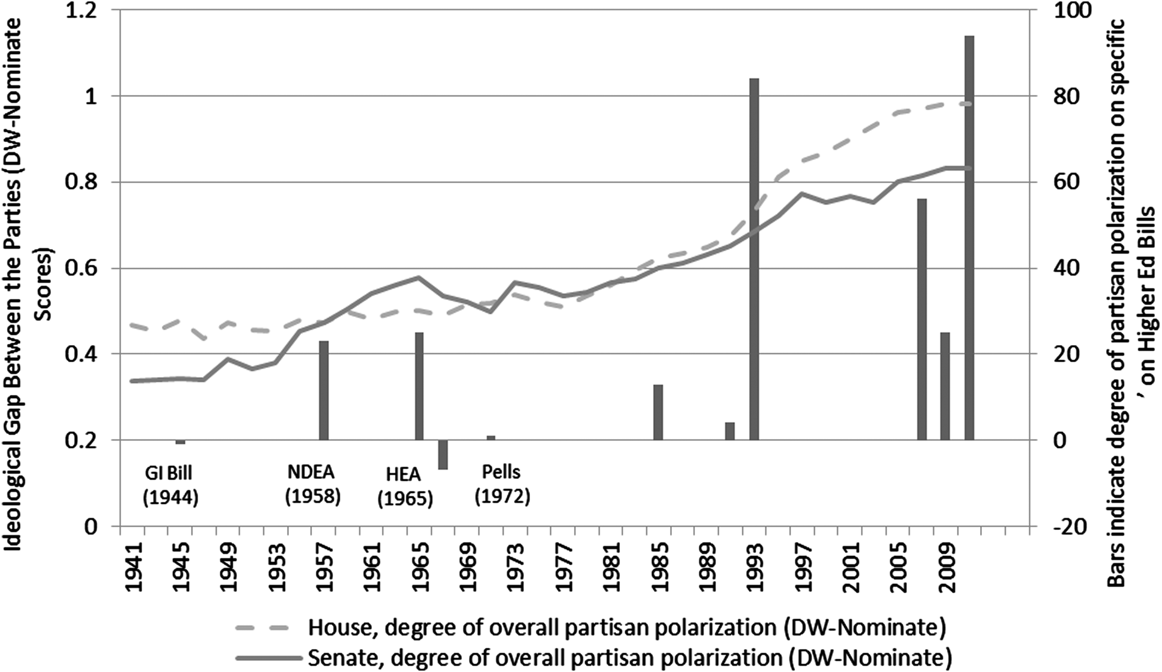
In higher-education policy, the election of President Ronald Reagan and the new Republican majority in the Senate signaled the end of decades of Democratic issue dominance. Meanwhile, partisan polarization began to escalate and it proved detrimental to policy innovation. This is indicated by figure 1, which shows that the landmark higher-education laws, from the first G.I. Bill through the Pell grants, were each created when Congress exhibited considerably lower levels of polarization, and that such sweeping new policy developments ceased once the gap between the parties widened.
Rising polarization and the demise of lawmaking for federal student aid: Ideological gap between parties in U.S. House and Senate, and partisan gap in support for major higher education bills in U.S. House, 1941–2009
Source: Voteview.com; authors’ analysis of roll call votes on 12 major higher education bills to assess difference in percentage of Democrats supporting and Republicans supporting. No such difference existed for the Montgomery GI Bill (1987), so it is not indicated by a bar.

While the age of landmark lawmaking had ended, the routine demands of policy maintenance only intensified. After some years in the early 1980s when lawmakers were at an impasse over higher-education policy, in the latter years of the Reagan administration and during the presidency of George H.W. Bush they indicated a new willingness to work together to repair and update policies. They began to devise bipartisan reform plans to address problems in student lending and fraudulent activities by “trade schools,” the precursors to for-profit colleges. Just as scholars have found that divided government does not, in and of itself, necessarily hinder policy creation, this era suggests that neither does it make policy maintenance untenable.
From the mid-1990s to the present, however, as partisan polarization grew all the wider and teamsmanship intensified, a severe mismatch emerged between the political institutional context and the demands of the policyscape. During this period, even votes on reauthorizations to the Higher Education Act (HEA) and related bills, indicated by the bars on the right-hand side of figure 1, became subject to much larger gaps in partisan support than were the landmark laws created in earlier decades. Bipartisanship on policy maintenance efforts all but vanished. Footnote 76 Figure 2 shows that partisan gaps on higher-education votes have increased over time in both chambers even on amendments to the reauthorizations and other bills. Owing to such challenges, the reauthorization of the HEA occurred at intervals of every four to six years until after 1998, after which 10 years lapsed until the next reauthorization in 2008, and since 2013 it has been overdue again. The contemporary political environment, in effect, has permitted policy effects to ensue largely unchecked by regular policy maintenance.
Growing partisan gaps in support for amendments to higher education laws, 1971–2008
Source: Author’s congressional roll call vote analysis of all amendments to reauthorizations of Higher Education Act of 1965 and other major higher education bills to assess difference in percentage of Democrats supporting and Republicans supporting. N=65 amendments in House; 26 in Senate.

In addition, the rise of plutocracy amplifies unintended consequences, taking policies further off course. This has occurred, for example, with respect to policies governing for-profit colleges’ use of federal student aid. As recently as the 1980s and early 1990s, some members of both parties pressed for reform to deter abuses of aid. Fiscal conservatives saw spending on the trade schools as a waste of government funds; Reagan’s Secretary of Education William Bennett and GOP Senators Bob Dole and Phil Gramm were vocal advocates of reform. In 1992, Democrats and Republicans united to engage in policy maintenance, enacting regulations to restrict the industry from taking advantage of unsuspecting students and federal funds. Footnote 77
Yet by the late 1990s, Republican leaders transformed themselves into staunch advocates of the for-profit schools, and even in the midst of widening partisan polarization, on this issue they joined ranks with Democrats who had long defended the schools for reaching out to poor and minority students. This new bipartisan support for the industry emerged as it increased its campaign contributions, created its first political action committees, improved its organizational capacity in Washington, DC, elevated its spending on lobbying, and used social networks strategically to cultivate loyal supporters. The pay-offs for these investments in political capacity became quickly evident. In 1992, reformers in Congress had won a rule limiting the amount a for-profit school could receive from the HEA’s Title IV funds to no more than 85 percent of its total revenues; in 1998, this “85–15 rule” was watered down to become the “90–10 rule,” requiring such schools to raise only 10 percent of their funds from elsewhere, including other federal policies. Reformers in 1992 had also achieved a requirement that colleges receiving federal student aid must offer at least 50 percent of their classes on campus; in 2006, Congress terminated the rule, permitting 100 percent on-line programs to flourish. The 14 largest for-profits enjoyed soaring enrollments, and flush with cash from one in four federal student aid dollars, became traded on Wall Street, and their profits ballooned. Footnote 78 Yet student outcomes suffered as the largely unmonitored schools lured low-income students to enroll and to borrow substantial federal student loans to do so. Before long the sector, though enrolling only one in ten students, accounted for 44 percent of all student loan defaults. Footnote 79
Compared to policy enactment, policy maintenance need not be so difficult, yet the higher education cases suggest that at least in this domain it currently eludes the capacity of U.S. government. As a result, the rise in American college graduation rates has been sluggish, particularly among low- to middle-income students, and some students—particularly those attending the for-profits—have ended up worse off after enrolling in college than if they had never attempted it. Footnote 80 The American system of checks and balances makes the policy process inherently challenging, and the current mismatch between the demands of the policyscape and the political circumstances of polarization and plutocracy, at least in the realm of higher-education policy, make matters far worse.
Broadening the Investigation across Policy Areas: A Research Agenda
This discussion of one policy area begs the question whether the central argument here, that contemporary political circumstances deter maintenance and upkeep of existing policies, applies more broadly. I hypothesize that the rise of polarization, teamsmanship, and plutocratic governance has deterred policy maintenance generally, with exceptions in particular issue areas based on political contingencies. In order to assess this, ideally we would possess substantial and comprehensive data about a large number of policies, indicating their maintenance records. Then we could compare the frequency of policy maintenance across issue areas and periods, relative to the degree of polarization and other factors.
The first and most basic indicator of policy maintenance such a dataset would include is whether Congress has in a timely manner revisited existing legislation, either through the formal, regular reauthorization process or through updating of laws that do not contain sunset provisions. Second, it should indicate whether regular oversight of particular policies has been conducted by Congress by considering the number of relevant hearings that have been held, the number of witnesses at each, and the diversity of views represented. Third, it should contain measures of budgetary resources, relative to past spending and changing costs, enabling scholars to evaluate whether Congress appropriates enough to make the policy operational. No dataset currently makes such analysis possible up to the present time, and creating it would represent a major undertaking, given that even identifying whether laws were reauthorized or not requires human coders. Footnote 81
Beyond these quantifiable measures, moreover, we need more in-depth understanding of developments within particular policy areas. Scholars should probe the internal policy dynamics that have emerged and investigate whether lawmakers have made improvements to correct for them. In addition, they should explore whether external circumstances and new opportunities require alterations to the policy so that it can continue to meet the needs for which it was created, and whether public officials have addressed such disjunctures. Examination of these criteria would require fine-grained, case study-style analysis of particular policy areas. Researchers ought to investigate the adequacy of staffing to administer policies, in terms of numbers, levels, and types of expertise; whether resources, including up-to-date technology, are being used effectively for policy implementation; how well policies are achieving their primary goals; and how policy success is affected by interaction with other policies, third-party interests, and industry.
A few excellent studies have examined the first criteria just given, identifying whether laws with sunset provisions have been reauthorized in a timely manner. Thad Hall explains that the requirement for some laws to be reauthorized emerged particularly in response to the 1946 Legislative Reorganization Act and its 1971 Amendments, as Congress sought to reassert power and to engage in greater oversight of the growing executive branch. First the practice was applied to defense-related policies, and increasingly, by the 1960s, Congress attached sunset provisions to nearly all complex new domestic policies, setting them to expire unless reauthorized. It offered individual members the opportunity to achieve reelection goals in the making of good policy, sometimes with special benefits for their district, and to engage in credit claiming and position taking. Footnote 82 E. Scott Adler and John D. Wilkerson examine how polarization has influenced lawmaking by including the reauthorization of existing laws in their scope. They discover that a large share of Congress’s attention in recent decades has been given to these bills with expiring provisions that needed to be updated, and therefore despite seeming dysfunctional in other respects, nonetheless the institution accomplished a considerable amount during this period. Footnote 83 Adler and Wilkerson’s findings, however, are based on data from 1980 to 1998, a period during which, as we have seen above, lawmakers managed to engage in some policy maintenance. Hall and James Cox each detect a decline by the late 1990s in Congress’s ability to complete reauthorizations. This occurred as conflict between the parties made the necessary legislative coalitions harder to create, and when reauthorizing committees increasingly lost authority to the budget appropriators in Congress, which typically continue funding through continuing resolutions. Footnote 84 The data on which they rely, however, also omits the 2000s. This raises the question about what has ensued in the intervening years, as political conditions have changed.
As an initial effort to consider this question across a small set of policies, I have selected issues identified by Americans in 2015 as their 20 highest policy priorities, as reported by the Pew Research Center. The policy priorities are listed in the first column of table 1, using Pew’s language, and in the second column appears the percentage of Americans identifying each issue area as a top priority for the president and Congress. In the third column, I list some of the most closely-related still-existing major federal policies, those that might be said to constitute the “policyscape.” The fourth column indicates when each of those laws was most recently reauthorized or overhauled, and the fifth column summarizes its status in one term: either “up-to-date,” “overdue” if reauthorization is behind schedule, or “out-of-date” if reform of policies that lack sunset provisions has not yet occurred in a time period that exceeds the intervals between past reforms. The assessments offered come from my perusal of a vast number of sources, primarily from the Congressional Research Service and from congressional committee and federal agency websites.
Current Status of Existing Legislation Addressing Americans’ Top 20 Policy Priorities

Note: Status is indicated as “overdue” if reauthorization is behind schedule, “out-of-date” if the law lacks sunset provisions but reform has not occurred over a period that exceeds the intervals between previous major updates.
*Has sunset provisions/requires formal renewal.
I have approached the task by including major legislation in each area and by counting as reforms major efforts to update and maintain laws for the next several years. Before discussing the findings, this task—aimed to promote a research agenda, not to provide definitive evidence—should be put in perspective. Certainly it contains several limitations, for instance that the fit between Americans’ stated priorities and specific pieces of legislation may vary, being closely related for some (e.g., “Social Security”) but less obvious for others (e.g., “economy”). Some of the terms used by Pew are so broad that several laws might pertain (“poor and needy”) or have an ambiguous relationship to federal legislation (“moral breakdown”). Arguably additional policies should be included for each area.
Notwithstanding those limitations, the task is nonetheless instructive in several respects. Cursory investigation into these policy areas reveals that in the majority of cases, policy reauthorization or major updating occurred on a regular basis in the decades of the mid-twentieth century and up through the 1980s and early 1990s, but its frequency has slowed since that time. Several policies have become subject to repeated stop-gap, short-term fixes and extensions and in some instances, brinksmanship. Not all policies are subject to these problems, however, and the exceptions are illuminating as well.
On a small number of policies, Congress has managed to muster enough bipartisan agreement to stay on track with reauthorizations, even if those processes do not necessarily involve careful oversight of policies and efforts to improve how they function. The clearest examples involve matters of national security pertaining to both terrorism and the military. In 1998, the Department of Defense budget had reached its lowest levels in real terms since the Korean War, but it rebounded in the wake of the 9/11 attacks on the United States. Spending in recent years had declined slightly from the 2010 peak of $700 billion, but still the United States contributes 37 percent of all military spending in the world, 3.5 percent of its GDP, and in dollars dwarfs spending by China, the next closest spender, by a multiple of three. Footnote 85 Some suggest that the proliferation of military spending indicates not meaningful maintenance but retrenchment, with uncontrollable, unmonitored growth. Footnote 86 Others counter this view, pointing to particular aspects of the military, such as the weapons acquisition process, that are well managed. Footnote 87 Nonetheless, although the two parties hold more divergent views about national security today than they did in the Cold War era, this policy area is characterized by more normal and timely procedures relative to other areas. In a similar vein, the financial crisis of 2008 and a sluggish economy helps explain the successful bipartisan effort to reauthorize the Workforce Investment Act, though its aims were quite modest and not far-reaching.
While on most issues partisan polarization leads to stalemate, it can also force some issues onto the agenda. After some six decades of efforts to create health coverage for working-age adults, Democrats made that issue their priority after President Barack Obama was elected and the party claimed majorities in both chambers. They succeeded not least because polarization helped fuel greater unity in the party than existed in previous eras. In the midst of that effort, Medicare and Medicaid were both overhauled and steps taken to address health care costs. Footnote 88 Certainly many believe that more action is needed on some or all such issues, but given this major recent reform, I have termed them “up-to-date.”
The priority placed on holding down discretionary spending likely emanates from both partisan polarization, as both parties use it to discredit their opponents (particularly when the other party controls the presidency), and plutocracy, to the extent that both parties are more responsive to the affluent and businesses, the primary advocates for reduced taxes. Legislation addressing this emerged only after a series of stop-gap measures and brinksmanship over the debt ceiling. The law that became enacted included “sequestration” rules that limited spending across issue areas and thus the policy itself contributed directly to the problems of maintenance of the policyscape. Footnote 89
Civil rights and voting rights legislation both possess the attributes of “superstatutes,” of laws that bear a “semi-constitutional” status and are generally treated as such. Footnote 90 One component of the Voting Rights Act, Section 4, was invalidated by the 2013 Shelby County v. Holder decision, and Congress has yet to rewrite that provision, which has led some observers to claim that the law has lost its “superstatute” status. Footnote 91 In other respects, however, federal policies in this area are up-to-date.
As this overview suggests, the contemporary political environment has not stymied the reauthorization process or policy updating across the board, and yet in table 1 there are many more policies that bear the status of “overdue” or “out-of-date” than there are “up-to-date” ones. Even more strikingly, the policies subject to deferred maintenance in recent years include those that involved Congress in its most typical day-to-day governing activity for several decades of the latter-twentieth century: the reauthorization of bills such as the Federal-Aid Highway Act and Head Start, for example, constituted basic routine matters of governance. That these policies languished for much of the more recent period suggests a significant shift toward dysfunctionality of the political system. An assessment of developments in each of the policies listed in table 1 lies beyond the scope of this article, but I will now briefly consider a pair of them here.
Elementary and Secondary Education
The Elementary and Secondary Education Act of 1965 (ESEA) is an established part of the policyscape, governing K–12 education. Congress enacted numerous amendments to the law in the first 15 years after its enactment, and after that reauthorized it at regular intervals in 1981, 1988, 1994, and 2002, just 7, 6, 8, and 8 years apart, respectively. Footnote 92 After that, it took Congress fully 13 years to reauthorize the law once again, a full seven years after the expiration of the previous version, which had established in “No Child Left Behind” (NCLB). The failure of Congress to act sooner was surprising, given that K–12 education has long elicited greater bipartisan cooperation than many policy areas, and because both Democratic and Republican governors have called for reform ever since the early years of NCLB implementation, owing to policy design effects that required correction. Yet contemporary political circumstances put reauthorization in “limbo.” Footnote 93
In the absence of law, presidents routinely turn to the power of the administrative state, and K-12 education has been no exception. President Barack Obama used the “Race to the Top” competition in his first term to spur states to make policy improvements in the absence of laws requiring them to do so. During his second term, the Department of Education granted several states waivers from NCLB guidelines, a trend that reformers consider problematic. Meanwhile, in the absence of reauthorization, the Common Core State Standards Initiative, created by the National Governors Association and state school officers, was adopted by nearly all states, and prompted strong popular disapproval. Jack Jennings, president of Center on Education Policy, a national independent advocate for public schools, said that ESEA reauthorization would “bring greater stability. Educators would know the rules for a specific period of time.” Footnote 94 Yet only late in 2015, with the pressure of a presidential election looming, did Congress finally summon the political will to update this policy that constitutes a major priority to the majority of Americans of both parties.
Environmental Policy
Environmental policy also provides evidence of the enduring presence of the policyscape and the drag on maintenance imposed by contemporary politics. This is exemplified by the Clean Air Act, created in 1963, one of the longest-standing environmental policies. The most significant revisions occurred in 1970, 1977, and 1990, at intervals of 7 years, 7 years, and 13 years, respectively. The last reauthorization was enacted in 1990, 25 years ago, and it expired in 1998. Meanwhile, concerns about climate change—a development external to existing law—have escalated considerably.
Political transformation has undermined efforts to maintain and update the environmental policyscape. David Vogel’s recent book, The Politics of Precaution, grapples with the puzzle that in the decades leading up to 1990, the United States led the way in enacting environmental regulations as well as other health and safety regulations, whereas since that time, European countries have done so. Footnote 95 In the 1970s, the Nixon Administration took a leading role on environmental policy issues, and GOP moderates continued to promote them throughout the 1980s. In 1990 George H.W. Bush signed into law stricter air pollution controls geared to controlling acid rain. That legislation enjoyed the support of 89 Senators and 401 House members, with mostly Democrats from coal-producing states opposing it. As the Republican Party moved to the right since that time, however, the ideological distance between the two parties on environmental issues has become especially pronounced, in both public opinion and congressional voting. Footnote 96
When President Barack Obama was elected in 2008, many thought that sufficient support existed to pass legislation aimed at promoting a clean-energy economy. Such a bill passed the Democrat-controlled House in 2009, but never emerged from the Senate. There Republican Senator Lindsey Graham abandoned his initial promise as a co-sponsor, and supporters lacked the 60 votes needed to withstand a filibuster. Here again, in the absence of legislation, the president turned to the administrative state, with the Environmental Protection Agency taking steps to curb greenhouse gases through its implementation of the Clean Air Act. These actions angered conservatives. Footnote 97 Environmental policy has now become deeply polarized along party lines, and the maintenance and updating of existing policies hangs in the balance.
In sum, this cursory analysis points to the existence of the policyscape, its regular maintenance in the early period, followed by considerably less maintenance over the past quarter-century. I encourage scholars to investigate these relationships in greater depth and across policy areas, so that we can better generalize about the functioning of the modern state and how it shapes the political order, and when and why it exhibits stronger and weaker governing capacity and responsiveness to citizens.
Deferred Maintenance, Diminished Democracy
Today we live in a political environment laden with policies created in the past that require maintenance if they are to continue to function effectively. In the absence of upkeep, policies fail to keep pace with external changes and they themselves can generate internal dynamics that derail them from achieving their basic purposes. The capacity of elected officials to oversee policies and to modify them accordingly varies, however, with time. In numerous policy areas, maintenance has been delayed recently, and the dynamics of polarization and plutocracy appear to be related to these outcomes. The result is that many existing laws fail to perform as they should. In short, the policyscape, paired with contemporary politics, amount to a mismatch that undermines effective governance.
This trend threatens to undermine democracy in numerous ways. Citizens likely assume that major laws that address widely perceived public priorities will continue to be maintained so that they continue to function as intended. By analogy, citizens have every reason to assume that bridges and roads that are part of the interstate highway system are maintained regularly such that it is safe to drive on them, and that levees are monitored so that they prevent massive flooding. If such upkeep fails to occur, public goals fail to be achieved, taxpayers’ dollars are wasted, and citizens themselves are put at risk. This applies not only to policies that ensure public safety and protection from natural disasters, but equally to other laws, including those that safeguard citizens’ health, economic security, and educational opportunity, or promote human capital investments for purposes of economic growth.
If laws are not functioning as they should, it may exacerbate citizens’ sense that government is failing them, even if they do not know why. For example, citizens may be aware that the federal government aims to promote educational opportunity, but also that many students leave college with high student loan debt and without degrees. In turn, this may engender a sense that government is largely ineffective in this domain and that tax dollars devoted to it are wasted. Certainly trust in government appears to be deeply entangled with partisanship and other attitudes and its decline predates the crisis of policy maintenance, but the emergence of the latter may well reinforce such sentiments among younger generations of Americans. In short, the deferred maintenance of the policyscape may weaken the bonds between citizens and government.
This inquiry raises troubling questions about the current capacity of the political system to engage in the tasks of governance. It raises doubts about how well Congress is able to perform today as an institution of representative government, engaging in oversight and maintaining existing policies. Its seeming inability to do so, furthermore, expands the authority of the administrative state, a domain severed from clear channels of accountability to citizens. Complicating matters further, the task of policy maintenance requires public officials to grapple with decisions such as whether to restore policies so that they function as they did in the past, or whether it is more appropriate to update them to deal with changing needs and circumstances and goals. Such questions can only be resolved through the democratic process, with input from citizens.
Critics will argue that policy “maintenance is not a vision,” and point to far more ambitious plans that they believe the nation should pursue in various policy areas. Footnote 98 In our current political circumstances, however, the political capacity to engage in large-scale policy innovation is in short supply. Lawmakers stand a much better chance of building alliances to maintain existing laws, particularly those addressing broadly-perceived public needs. Perhaps by repairing and renovating the policyscape, public officials can grope toward new ways of working together effectively, finding the means to pursue a more ambitious agenda in the future. In the meanwhile, they can make government function more effectively today.