



1. Introduction
Ferrofluids are superparamagnetic suspensions comprised of nanometric magnetic particles in a water- or oil-based liquid. A surfactant is used to prevent the agglomeration of particles. Given the nanometric size of the particles, ferrofluids can be considered as a single liquid phase. Due to the ability to control them with magnetic fields, ferrofluids are of interest in various flows such as liquid jets. During jet atomisation, cylindrical ligament structures are observed. Thus, it is interesting to study the stability of a ferrofluid cylinder under a magnetic field. Few experiments have been conducted on ferrofluid cylinders as of now, nevertheless data have been collected. Arkhipenko et al. (Reference Arkhipenko, Barkov, Bashtovoi and Krakov1981) studied the stability of a ferrofluid cylinder in glycerine subjected to an azimuthal magnetic field created by a cylindrical conductor inside the ferrofluid. The cylinder was initially stabilised with a high magnetic field intensity and then destabilised by decreasing this intensity. The growth rate and the wavelength of the fastest growing mode at different magnetic field intensities were measured. Bourdin, Bacri & Falcon (Reference Bourdin, Bacri and Falcon2010) performed a similar experiment using Freon instead of glycerine as the surrounding fluid. Contrary to Arkhipenko et al. (Reference Arkhipenko, Barkov, Bashtovoi and Krakov1981), their measurements were only made at high magnetic field intensities when the cylinder was stable. The perturbation frequency was imposed at one location and the associated wavenumber was measured. The theoretical models based on a linear stability analysis developed to date tend to overpredict the experimental data. Considering an inviscid ferrofluid with an inviscid surrounding fluid (Arkhipenko et al. Reference Arkhipenko, Barkov, Bashtovoi and Krakov1981), the predicted growth rate is between  $3$ and
 $15$ times higher than that observed in experiments. By considering the ferrofluid viscosity, but neglecting the surrounding fluid (Canu & Renoult Reference Canu and Renoult2021), this error decreases, although the growth rate is still
 $2$ to
 $7$ times higher than the experimental data. Regarding the difference with the experimental data of Bourdin et al. (Reference Bourdin, Bacri and Falcon2010), the inviscid theory used by the authors (theory of Arkhipenko et al. (Reference Arkhipenko, Barkov, Bashtovoi and Krakov1981) but without considering the radius of the cylindrical conductor and the density of the surrounding fluid) has a relative error of around 40 %–50 %, whereas that of the viscous theory without surrounding fluid (Canu & Renoult Reference Canu and Renoult2021) is around 20 %–30 %. In the case of these two experiments the difference may be explained by the viscosity of the surrounding fluid, which is not negligible, especially for the case of the Arkhipenko et al. (Reference Arkhipenko, Barkov, Bashtovoi and Krakov1981) experiments. Therefore, there is a need to consider the surrounding fluid viscosity in stability analysis. This addition will bring us closer to experimental conditions that can be encountered in medicine, for example, where a ferrofluid can be injected into a viscous biological liquid for drug targeting applications.
In the literature, several studies have theoretically considered a viscous fluid surrounded by another viscous fluid in a non-magnetic case. The first linear stability analysis was conducted by Tomotika (Reference Tomotika1935). He considered a cylinder of a viscous Newtonian fluid surrounded by an infinite Newtonian fluid. He obtained a general dispersion relation under the form of a determinant and solved it by considering a negligible inertia compared with the viscous effects. In another study, Tomotika (Reference Tomotika1936) investigated the same configuration but with the cylinder placed in an extending velocity field where the radial and axial components are respectively proportional to the radial and axial coordinates. In this type of field, the cylinder remains cylindrical until it breaks up into small drops once it becomes very thin. Studies on cylinders placed in extending velocity fields were also conducted by Mikami, Cox & Mason (Reference Mikami, Cox and Mason1975), who performed experimental measurements in addition to theoretical analyses, and by Khakhar & Ottino (Reference Khakhar and Ottino1987). Kinoshita, Teng & Masutani (Reference Kinoshita, Teng and Masutani1994) analysed the same case as Tomotika (Reference Tomotika1935). Similarly, they ignored inertia and considered Stokes flows but, contrary to Tomotika (Reference Tomotika1935), they obtained an explicit dispersion relation. They also obtained simplified dispersion relations for limiting cases and found that the density ratio, the viscosity ratio (density and viscosity of the outer fluid compared with the inner fluid) and the Ohnesorge number tend to stabilise the jet when they are large. Furthermore, they observed that the density ratio is only significant for gases surrounded by liquids. Stone & Brenner (Reference Stone and Brenner1996) also simplified the dispersion relation for the case in which both fluids have the same viscosity and then generalised the results for several concentric fluids. In previous studies, velocity has been expressed with a Stokes streamfunction. Funada & Joseph (Reference Funada and Joseph2002) compared three methods: velocity expressed with a Stokes streamfunction while considering viscosity; velocity expressed with a potential while considering viscosity; and velocity expressed with a potential while ignoring viscosity. The authors found that the three methods converge for sufficiently high Reynolds numbers and that the second method gives intermediate results for low Reynolds numbers. Gunawan, Molenaar & van de Ven (Reference Gunawan, Molenaar and van de Ven2002) explored the stability of two proximate cylinders immersed in another fluid. In this case, the breakup of the cylinders accelerates when the viscosity ratio is high and the distance between the cylinders is short. Furthermore, according to the values of the viscosity ratio and the distance between the cylinders, the deformations of the cylinders will occur in or out of phase. In the literature, other kinds of viscous fluids were also studied. Gadkari & Thaokar (Reference Gadkari and Thaokar2013) regarded conductive fluids placed in an axial or radial electric field as well as the influence of this field on asymmetric modes of the perturbation. Finally, Patrascu & Balan (Reference Patrascu and Balan2018) analysed the stability of viscoelastic fluids immersed in another viscoelastic fluid and compared them with the limiting cases in which the fluids are Newtonian.
Regarding the magnetic case, there is the work of Korovin in which a ferrofluid cylinder is surrounded by another ferrofluid with different magnetic permeability and same density. In Korovin (Reference Korovin2001), an axial magnetic field is applied and the two ferrofluids have a different viscosity. For this case, an explicit dispersion relation was obtained for the particular case where the viscous forces are dominant. Then, the case in which both ferrofluids have the same viscosity was treated (Korovin Reference Korovin2002; Kazhan & Korovin Reference Kazhan and Korovin2003). This time, the dispersion relation was obtained using a single equation of motion valid for both ferrofluids and at the interface. The same methodology was used in Korovin (Reference Korovin2004) but for the case of an azimuthal magnetic field created by a cylindrical conductor placed at the centre of the inner ferrofluid. Again, both ferrofluids have the same density and viscosity. In a recent paper (Korovin Reference Korovin2020), for the case of an inviscid ferrofluid without surrounding fluid, a Langevin law for the magnetisation of the ferrofluid was considered instead of a linear magnetisation usually assumed.
In this work, we will perform a linear stability analysis of a Newtonian ferrofluid surrounded by a Newtonian non-magnetic fluid in an azimuthal magnetic field, for the general case where the two fluids have different densities and viscosities. After formulating this problem with different assumptions, we will derive the bulk equations for both fluids and the jump conditions across the interface between them. A general dispersion relation in explicit form will then be obtained, providing another formulation of this relation compared with previous studies. Its solutions will finally be compared with the experimental data (Arkhipenko et al. Reference Arkhipenko, Barkov, Bashtovoi and Krakov1981; Bourdin et al. Reference Bourdin, Bacri and Falcon2010).
2. Formulation
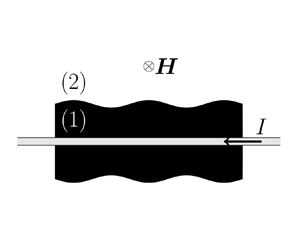
We consider an incompressible Newtonian ferrofluid cylinder of infinite length surrounded by a Newtonian non-magnetic fluid. The system is placed in a steady axisymmetric azimuthal magnetic field. Isothermal conditions are also assumed and gravity is ignored. According to Canu & Renoult (Reference Canu and Renoult2021), under these assumptions, the azimuthal magnetic field should be in the form  $\boldsymbol {H}=B/r \boldsymbol {e}_{\boldsymbol {\theta }}$ with
 $B$ a constant,
 $r$ the radial distance and
 $e_{\theta}$ the azimuthal unit vector. A wire with radius
 $R_w$ is used at the centre of the ferrofluid cylinder to create this magnetic field by passing an electric current of intensity
 $I$ through it. A representation of this configuration is shown in figure 1. Considering an infinite length wire and a uniform electrical current inside it, the created magnetic field is such that
 $B=I/2{\rm \pi}$. In the basic state, both fluids are considered at rest. This state is perturbed by imposing a small-amplitude axisymmetric disturbance. Linear stability analysis is then performed to investigate whether the flow is stable or unstable with respect to this disturbance. The governing equations of this flow are described below.
Representation of a Newtonian ferrofluid cylinder around a wire and surrounded by a Newtonian non-magnetic fluid.

3. Governing equations
The equations, valid for both the ferrofluid and the surrounding fluid, are presented below. The mass and momentum balance equations can be expressed as follows:
 $$\begin{gather} \boldsymbol{\nabla} \boldsymbol{\cdot} \boldsymbol{U}_{\boldsymbol{i}}=0{,} \end{gather}$$
 $$\begin{gather}\rho_i\left(\frac{\partial \boldsymbol{U}_{\boldsymbol{i}}}{\partial t}+\boldsymbol{U}_{\boldsymbol{i}} \boldsymbol{\cdot} \boldsymbol{\nabla} \boldsymbol{U}_{\boldsymbol{i}}\right)={-}\boldsymbol{\nabla}\varPi_i+\boldsymbol{\nabla} \boldsymbol{\cdot } {\tau}_{\boldsymbol{\mathsf{i}}}{,} \end{gather}$$
with  $\boldsymbol{U}_{\boldsymbol{i}}$ the velocity,
 $\rho _i$ the density,
 ${\tau }_{\boldsymbol{\mathsf{i}}}=\eta _i(\boldsymbol {\nabla } \boldsymbol {U}_{\boldsymbol {i}}+\boldsymbol {\nabla } \boldsymbol {U}_{\boldsymbol {i}}^{\boldsymbol {t}})$ the viscous stress tensor,
 $\eta _i$ the dynamic viscosity and
 $\varPi _i$ defined by
 $\varPi _i=P_i+P_{si}$, where
 $P_i$ refers to thermodynamic pressure and
 $P_{si}=\mu _0 \int _0^H \upsilon _i (\partial M_i/\partial \upsilon _i )\,\textrm {d}H$ to magnetostrictive pressure. In this last term,
 $\mu _0$ is the permeability of free space,
 $\upsilon _i$ the specific volume, and
 $M_i$ the magnetisation. The subscript
 $i$ takes the value
 $1$ for the ferrofluid and
 $2$ for the surrounding fluid. In particular,
 $M_2=0$ and
 $\varPi _2=P_2$.
As neither fluid is electrically conductive, Maxwell's equations are thus
 $$\begin{gather} \boldsymbol{\nabla} \boldsymbol{\cdot} \boldsymbol{B}_{\boldsymbol{i}}=0{,} \end{gather}$$
 $$\begin{gather}\boldsymbol{\nabla}\times\boldsymbol{H}_{\boldsymbol{i}}=\boldsymbol{0}{,} \end{gather}$$
with  $\boldsymbol {B}_{\boldsymbol {i}}$ the magnetic induction field, which can be expressed as
 \begin{equation} \boldsymbol{B}_{\boldsymbol{i}}=\mu_0\left(\boldsymbol{H}_{\boldsymbol{i}}+\boldsymbol{M}_{\boldsymbol{i}} \right)=\mu_i \boldsymbol{H}_{\boldsymbol{i}}{,} \end{equation}
with  $\mu _i$ the magnetic permeability of the fluid. For a ferrofluid, the magnetisation follows a Langevin law (see e.g. Korovin Reference Korovin2020). Nevertheless, for sufficiently weak magnetic fields, the response of the ferrofluid can be considered as linear, homogeneous and isotropic. The magnetic field intensities encountered in this paper satisfy this condition. The magnetic permeability of the ferrofluid
 $\mu _1$ can therefore be assumed constant. For the non-magnetic surrounding fluid,
 $\mu _2=\mu _0$.
For the jump conditions across the interface, the unit normal vector is introduced. It is defined at a point on the interface, pointing from the ferrofluid to the surrounding fluid, and is given by  $\boldsymbol {n}=\boldsymbol {\nabla }S/||\boldsymbol {\nabla }S||=1/\sqrt {1+(\partial r_s/\partial z)^2}\boldsymbol {e}_{\boldsymbol {r}}-(\partial r_s/\partial z)/\sqrt {1+(\partial r_s/\partial z)^2}\boldsymbol {e}_{\boldsymbol {z}}$, where
 $S=r-r_s$ is introduced to localise the position of the interface
 $S=0$. The first jump condition is obtained by writing the mass balance equation at the interface without mass exchange between the two phases
 \begin{equation} \boldsymbol{U}_{\boldsymbol{i}} \boldsymbol{\cdot} \boldsymbol{n}={-}\frac{1}{||\boldsymbol{\nabla}S||} \frac{\partial S}{\partial t}\quad\text{at}\ r=r_s{.} \end{equation}
Moreover, the same assumption as in Tomotika (Reference Tomotika1935) is considered, namely no slip at the interface leading to
 \begin{equation} \left[ \boldsymbol{U}\times\boldsymbol{n}\right]=\boldsymbol{0}\quad\text{at}\ r=r_s{,} \end{equation}
with the convention  $[A]=A_2-A_1$. Both (3.6) and (3.7) lead to the continuity of the velocity components across the interface. Regarding the jump conditions for momentum, there is continuity in the tangential component of the stress acting on the interface
 \begin{equation} \left[\left(\boldsymbol{n}\boldsymbol{\cdot} \boldsymbol{\mathsf{T}}\right)\times\boldsymbol{n}\right]=\boldsymbol{0}\quad \text{at}\ r=r_s{,} \end{equation}
with  $\boldsymbol{\mathsf{T}}$ the stress tensor such that
 $\boldsymbol{\mathsf{T}}_{\boldsymbol{\mathsf{i}}}=-(P_i^*+( 1/2 )\mu _0 H_i^2)\boldsymbol{\mathsf{I}}+\boldsymbol {B}_{\boldsymbol {i}} \boldsymbol {H}_{\boldsymbol {i}}+\tau _{\boldsymbol{\mathsf{i}}}$,
 $\boldsymbol{\mathsf{I}}$ the identity matrix,
 $P_i^*=\varPi _i+P_{mi}$ and
 $P_{mi}=\mu _0\int _0^H M_i\,\textrm {d}H$ the magnetic pressure. The jump of the normal component of the stress acting on the interface involves surface tension
 \begin{equation} \left[\left(\boldsymbol{n}\boldsymbol{\cdot } \boldsymbol{\mathsf{T}}\right)\boldsymbol{\cdot} \boldsymbol{n}\right]=\sigma\kappa\quad\text{at}\ r=r_s{,} \end{equation}
with  $\kappa =\boldsymbol {\nabla } \boldsymbol {\cdot } \boldsymbol {n}$ the curvature which is twice the mean curvature.
The jump conditions for the magnetic field imply the continuity of the normal component of  $\boldsymbol {B}$ and the tangential component of
 $\boldsymbol {H}$ across the interface. Replacing
 $\boldsymbol {B}$ by expression (3.5), one finds
 $$\begin{gather} \mu_1 \boldsymbol{H}_{\boldsymbol{1}} \boldsymbol{\cdot} \boldsymbol{n}=\mu_0 \boldsymbol{H}_{\boldsymbol{2}} \boldsymbol{\cdot} \boldsymbol{n}\quad\text{at}\ r=r_s{,} \end{gather}$$
 $$\begin{gather}\boldsymbol{H}_{\boldsymbol{1}}\times\boldsymbol{n}=\boldsymbol{H}_{\boldsymbol{2}}\times\boldsymbol{n}\quad \text{at}\ r=r_s{.} \end{gather}$$
By using  $\boldsymbol {n} \boldsymbol {\cdot } \boldsymbol{\mathsf{I}}\times \boldsymbol {n}=\boldsymbol {0}$ as well as (3.5), (3.10) and (3.11), (3.8) and (3.9) are thus reduced to
 $$\begin{gather} \left(\boldsymbol{n}\boldsymbol{\cdot}{\tau_{\boldsymbol{\mathsf{1}}}}\right)\times\boldsymbol{n}-\left(\boldsymbol{n} \boldsymbol{\cdot}\tau_{\boldsymbol{\mathsf{2}}}\right)\times\boldsymbol{n}=\boldsymbol{0}\quad \text{at}\ r=r_s{,} \end{gather}$$
 $$\begin{gather}P_1^*+P_n-\left(\boldsymbol{n}\boldsymbol{\cdot} \tau_{\boldsymbol{\mathsf{1}}}\right)\boldsymbol{\cdot} \boldsymbol{n}=P_{2}-\left(\boldsymbol{n}\boldsymbol{\cdot}\tau_{\boldsymbol{\mathsf{2}}}\right) \boldsymbol{\cdot}\boldsymbol{n}+\sigma\boldsymbol{\nabla} \boldsymbol{\cdot}\boldsymbol{n}\quad \text{at}\ r=r_s{,} \end{gather}$$
with  $P_n=(1/2)\mu _0M_{1n}^2$; the
 $n$ index refers to the normal component.
The bulk equations (3.1)–(3.2) as well as the jump conditions across the interface (3.6), (3.10)–(3.13) are made dimensionless using the Rayleigh time  $\sqrt {\rho _1 R_0^3/\sigma }$,
 $R_0$,
 $\sigma /R_0$, an arbitrary magnetic field intensity
 $H_0$ and
 $\mu _0$ as the characteristic time, length, pressure, magnetic field and magnetic permeability, respectively. The characteristic scales of the Rayleigh problem are chosen to enable the comparison of solutions with a magnetic field to those of the non-magnetic problem.
The basic state, denoted by subscript  $0$ such that
 $\varPi _{0i}$ is the basic state of
 $\varPi _i$ for example, is obtained by taking
 $\boldsymbol {H}_{\boldsymbol {01}}=1/r \boldsymbol {e}_{\boldsymbol {\theta }}$ and
 $\boldsymbol {U}_{\boldsymbol {0i}}=\boldsymbol {0}$ in the equations. It is found that
 $\varPi _{01}$ and
 $P_{02}$ are constants that are linked in the following way:
 \begin{equation} \varPi_{01}+\tfrac{1}{2}N_{Bo,m}=P_{02}+1\quad\text{at}\ r=1{,} \end{equation}
with  $N_{Bo,m}=\mu _0 (\mu _r-1)H_0^2 R_0/\sigma$ the magnetic Bond number, and
 $\mu _r=\mu _1 /\mu _0$ the relative permeability;
 $N_{Bo,m}$ can be expressed as the product of two numbers
 $(\mu _r-1)$ and
 $\varGamma _m=\mu _0 H_0^2 R_0/\sigma$, with
 $\varGamma _m$ a magnetic parameter that does not depend on
 $\mu _r$.
The induced flow is decomposed around the basic state, as follows:  $\boldsymbol {U}_{\boldsymbol {i}}=\boldsymbol {u}_{\boldsymbol {i}}$,
 $\varPi _i=\varPi _{0i}+{\rm \pi} _i$,
 $\boldsymbol {H}_{\boldsymbol {i}}=\boldsymbol {H}_{\boldsymbol {0i}}+\boldsymbol {h}_{\boldsymbol {i}}$ and
 $r_s=1+\zeta$ with
 $\boldsymbol {u}_{\boldsymbol {i}}$,
 ${\rm \pi} _i$,
 $\boldsymbol {h}_{\boldsymbol {i}}$ the perturbed quantities in phase
 $i$ and
 $\zeta$ the surface perturbation. The dimensionless equations are linearised, and we thus obtain the equations for the perturbed quantities
 $$\begin{gather} \frac{1}{r}\frac{\partial r u_{ir}}{\partial r}+\frac{\partial u_{iz}}{\partial z}=0{,} \end{gather}$$
 $$\begin{gather}\frac{\partial u_{1r}}{\partial t}+\frac{\partial {\rm \pi}_1}{\partial r}-Oh_1\left(\frac{1}{r}\frac{\partial^2 r u_{1r}}{\partial r^2}-\frac{1}{r^2}\frac{\partial r u_{1r}}{\partial r}+\frac{\partial^2 u_{1r}}{\partial z^2}\right)=0{,} \end{gather}$$
 $$\begin{gather}\rho_r\frac{\partial u_{2r}}{\partial t}+\frac{\partial P_2}{\partial r}-Oh_1 \eta_r\left(\frac{1}{r}\frac{\partial^2 r u_{2r}}{\partial r^2}-\frac{1}{r^2}\frac{\partial r u_{2r}}{\partial r}+\frac{\partial^2 u_{2r}}{\partial z^2}\right)=0{,} \end{gather}$$
 $$\begin{gather}\frac{\partial u_{1z}}{\partial t}+\frac{\partial {\rm \pi}_1}{\partial z}-Oh_1\left(\frac{1}{r}\frac{\partial r\dfrac{\partial u_{1z}}{\partial r}}{\partial r}+\frac{\partial^2 u_{1z}}{\partial z^2}\right)=0{,} \end{gather}$$
 $$\begin{gather}\rho_r\frac{\partial u_{2z}}{\partial t}+\frac{\partial P_2}{\partial z}-Oh_1\eta_r\left(\frac{1}{r}\dfrac{\partial r\dfrac{\partial u_{2z}}{\partial r}}{\partial r}+\frac{\partial^2 u_{2z}}{\partial z^2}\right)=0{,} \end{gather}$$
 $$\begin{gather}u_{ir}-\frac{\partial \zeta}{\partial t}=0\quad\text{at}\ r=1{,} \end{gather}$$
 $$\begin{gather} \frac{\partial u_{1r}}{\partial z}+\frac{\partial u_{1z}}{\partial r}-\eta_r\left( \frac{\partial u_{2r}}{\partial z}+\frac{\partial u_{2z}}{\partial r} \right)=0\quad \text{at}\ r=1{,} \end{gather}$$
 $$\begin{gather}{\rm \pi}_1-N_{Bo,m}\zeta-2Oh_1\frac{\partial u_{1r}}{\partial r}+2Oh_1\eta_r\frac{\partial u_{2r}}{\partial r}-p_2+\zeta+\frac{\partial^2 \zeta}{\partial z^2}=0\quad\text{at}\ r=1{,} \end{gather}$$
 $$\begin{gather}\mu_r h_{1r}-h_{2r}=0\quad\text{at}\ r=1{,} \end{gather}$$
 $$\begin{gather}h_{1z}-h_{2z}=0\quad\text{at}\ r=1{,} \end{gather}$$
 $$\begin{gather}h_{1\theta}-h_{2\theta}=0\quad\text{at}\ r=1{,} \end{gather}$$
with  $Oh_1=\eta _1/\sqrt {\rho _1 \sigma R_0}$, the Ohnesorge number of the ferrofluid,
 $\rho _r=\rho _2/\rho _1$ the density ratio and
 $\eta _r=\eta _2/\eta _1$ the dynamic viscosity ratio. Furthermore, due to (3.3) and (3.4), the perturbation of the magnetic fields
 $\boldsymbol {h}_{\boldsymbol {i}}$ are curl- and divergence-free.
The system of equations is linear with respect to  $t$ and
 $z$, and nonlinear with respect to
 $r$. Hence, we seek solutions in the form
 $A(r)\exp ({\textrm {i}kz+\alpha t})$, where
 $A(r)$ is an unknown function of
 $r$. Since this study explores temporal stability, we take
 $k$ to be real, and
 $\alpha =\alpha _r + \textrm {i} \alpha _i$ to be complex, such that
 $k$,
 $\alpha _r$ and
 $\alpha _i$ are respectively the wavenumber, growth rate and oscillation frequency of the perturbation. Due to the azimuthal shape of the magnetic field, the perturbation
 $\boldsymbol {h}_{\boldsymbol {i}}$ is decoupled from the other equations. Equations (3.23)–(3.25) are therefore not required to obtain the dispersion relation.
4. Dispersion relation
Due to the incompressibility assumptions, the velocity in each fluid can be expressed using a Stokes streamfunction  $\psi$ such that
 $u_{ir}=-( 1/r)( \partial \psi _i /\partial z)$ and
 $u_{iz}=( 1/r)( \partial \psi _i /\partial r)$. Moreover, the magnetic field is curl-free inside each fluid and can be written as a gradient of a magnetic scalar potential
 $\phi$ such that
 $\boldsymbol {h}_{\boldsymbol {i}}=-\boldsymbol {\nabla }\phi _i$. Because the perturbation of the magnetic field is also divergence-free in each fluid, we have
 \begin{equation} \Delta \phi_i=0{.} \end{equation}
No slip and no penetration are considered at the wire surface and there is no perturbation of the magnetic field at this location. These boundary conditions are expressed by
 $$\begin{gather} -\frac{1}{r}\frac{\partial \psi_1}{\partial z}=0\quad\text{and}\quad \frac{1}{r}\frac{\partial \psi_1}{\partial r}=0\quad\text{at}\ r=\delta_w{,} \end{gather}$$
 $$\begin{gather}\phi_1=0\quad\text{at}\ r=\delta_w{,} \end{gather}$$
with  $\delta _w=R_w/R_0$ the dimensionless wire radius. Equations (3.23)–(3.25) and (4.1) lead to
 $\phi _i=0$ showing that, for an azimuthal magnetic field, there is no axisymmetric perturbation of the magnetic field. The previous system of (3.15)–(3.22) is solved using the same method as in Canu & Renoult (Reference Canu and Renoult2021), with the following dispersion relation being obtained:
 \begin{align} &\alpha^2 +\alpha^2
\rho_r\frac{\hat{b}_2 K_0(k)}{I_0(k)-\hat{b}_1 K_0(k)}+
2Oh_1 \alpha k\nonumber\\ &\quad \left[ \frac{kI_0(k)\,{-}\,I_1(k)\,{+}\,\check{a}_1 \left( l_1
I_0(l_1)\,{-}\,I_1(l_1)\right)\,{-}\,\hat{b}_1 \left(k K_0(k)\,{+}\,K_1(k)\right)\,{-}\,\check{b}_1 \left( l_1
K_0(l_1)\,{+}\,K_1(l_1)\right)}{I_0(k)\,{-}\,\hat{b}_1 K_0(k)}\right.\nonumber\\ &\quad
\left.+\eta_r\frac{\hat{b}_2 \left( k
K_0(k)+K_1(k)\right)+\check{b}_2 \left( l_2
K_0(l_2)+K_1(l_2)\right)}{I_0(k)-\hat{b}_1
K_0(k)}\right]\nonumber\\ &\quad -k\left(
1-k^2-N_{Bo,m}\right)\left[ \frac{I_1(k)+\check{a}_1
I_1(l_1)+\hat{b}_1 K_1(k)+\check{b}_1
K_1(l_1)}{I_0(k)-\hat{b}_1 K_0(k)}\right]=0{.}
\end{align}
In this relation,  $I_0$,
 $I_1$,
 $K_0$ and
 $K_1$ are the modified Bessel functions of the first and second kinds at the orders
 $0$ and
 $1$,
 $l_i$ is a modified wavenumber for fluid
 $i$ such that
 $l_1^2=k^2+(\alpha /Oh_1)$ and
 $l_2^2=k^2+(\alpha \rho _r/Oh_1\eta _r)$. The other quantities
 $\check {a}_1$,
 $\hat {b}_1$,
 $\check {b}_1$,
 $\hat {b}_2$ and
 $\check {b}_2$ are coefficients defined in Appendix A and are explicitly dependent on
 $k$,
 $l_1$,
 $l_2$,
 $\eta _r$ and
 $\delta _w$. Here, the dispersion relation has a general explicit form. It tends towards the non-magnetic case of Tomotika (Reference Tomotika1935), obtained under a determinant form, for
 $N_{Bo,m}=0$ and
 $\delta _w \rightarrow 0$. We also retrieve the dispersion relation of Korovin (Reference Korovin2004) by taking
 $\rho _r=1$,
 $\eta _r=1$ and considering a non-magnetic surrounding fluid. As with the azimuthal case in Canu & Renoult (Reference Canu and Renoult2021), the cutoff wavenumber only depends on
 $N_{Bo,m}$, with the cylinder being stable for all wavenumbers when
 $N_{Bo,m}>1$. This relation is solved and compared below with experimental results taken from the literature.
5. Comparison with experimental data
The dispersion relation (4.4) is a transcendental equation due to the modified Bessel functions that depend on  $\alpha$ through
 $l_1$ and
 $l_2$. To solve this equation, the method of Luck, Zdaniuk & Cho (Reference Luck, Zdaniuk and Cho2015) is used. The resulting solutions are then compared with experimental data and previous theoretical studies. In figure 2, the wavelength (divided by
 $2{\rm \pi}$)
 $\varLambda ^*=1/k^*$ and the growth rate
 $\alpha _r^*$ of the most unstable mode are plotted as a function of
 $N_{Bo,m}$ and compared with the experiment of Arkhipenko et al. (Reference Arkhipenko, Barkov, Bashtovoi and Krakov1981). Note that
 $\alpha _r^*$ is dimensionless here contrary to the data given in Arkhipenko et al. (Reference Arkhipenko, Barkov, Bashtovoi and Krakov1981). In their experiment, a ferrofluid cylinder is around a cylindrical conductor and is surrounded by glycerine. The conductor has a fixed radius (
 $R_w=1\ \textrm {mm}$) whereas the one of the ferrofluid cylinder varies. Arkhipenko et al. (Reference Arkhipenko, Barkov, Bashtovoi and Krakov1981) realised the wavelength measurements for two conductor lengths (
 $18$ and
 $50\ \textrm {cm}$) without indication on the radius of the ferrofluid cylinder. For the growth rate measurements, two data sets are provided for two cylinder radii (
 $R_0=2.1$ and
 $R_0=2.8\ \textrm {mm}$). In their paper, two ferrofluids are mentioned. However, for both measurements, no indication is provided on the ferrofluid used. Ferrofluid properties are shown in table 1 and
 $\rho _r=1$ and
 $\eta _r=28.3$ are chosen here for the density and viscosity of the surrounding fluid (glycerine) compared with those of the ferrofluid, as indicated in Arkhipenko et al. (Reference Arkhipenko, Barkov, Bashtovoi and Krakov1981). In a previous study (Canu & Renoult Reference Canu and Renoult2021), we showed that taking into account the ferrofluid viscosity without the surrounding fluid better predicts the growth rate compared with the inviscid theory of Arkhipenko et al. (Reference Arkhipenko, Barkov, Bashtovoi and Krakov1981). However, the difference with the experimental data was still significant, probably due to the viscosity of the surrounding fluid being ignored. Indeed, the latter is approximately
 $30$ times higher than those of the ferrofluid, and thus its effect cannot be ignored. With the present theory, the predicted growth rate is very close to the experimental data, especially for larger values of
 $N_{Bo,m}$. For the case with
 $R_0=2.1\ \textrm {mm}$, the relative error is between
 $2.7\,\%$ and
 $47\,\%$ with a mean of approximately
 $28\,\%$. For
 $R_0=2.8\ \textrm {mm}$, the relative error is between
 $0.3\,\%$ and
 $88\,\%$ with a mean varying from
 $31\,\%$ to
 $51\,\%$ depending on the ferrofluid used. The uncertainty regarding the ferrofluid used in the experiment does not lead to a better estimation of the error. Indeed, to make dimensionless the experimental values of Arkhipenko et al. (Reference Arkhipenko, Barkov, Bashtovoi and Krakov1981), the Rayleigh time is used. This time depends on the density and the surface tension which are different for the ferrofluid FF1 and FF2 (table 1). This uncertainty is represented by error bars in figure 2. The range of relative error given above corresponds to the extremum values between the relative errors calculated for FF1 and FF2 for all experimental data points. By contrast, the prediction for
 $R_0=2.1\ \textrm {mm}$ seems to better correspond to the experimental data for
 $R_0=2.8\ \textrm {mm}$. On this point, the experimental data do not follow the theoretical prediction of all the models (inviscid theory, viscous theory without surrounding fluid and viscous theory with surrounding fluid) about the decrease in the growth rate for thinner layer of fluid (Canu & Renoult Reference Canu and Renoult2021). The possibility of a typographical error in the figure legend of Arkhipenko et al. (Reference Arkhipenko, Barkov, Bashtovoi and Krakov1981) cannot be discounted but further experimental data are necessary to confirm that. In this case, the relative errors would be lower than those given above. Better predictions are also observed for the most unstable wavelength. The curves for the inviscid theory and the viscous theory without surrounding fluid are almost overlapped whereas the one for the present viscous theory deviates clearly from the others. This observation shows that, for this experiment, the effect of the surrounding fluid viscosity is more significant than the one of the ferrofluid viscosity which is coherent with the fact that the surrounding fluid is almost
 $30$ times more viscous than the ferrofluid. Furthermore, the difference between the various models is greater for lower values of
 $N_{Bo,m}$, because for
 $N_{Bo,m}$ close to
 $1$, the unstable regime is restricted to very small wavenumbers. For these values, the effect of viscosity is indeed less visible. Another issue concerns the finite length of the ferrofluid cylinder. Side effects should occur with greater importance for the smaller cylinder producing thus a slight difference with the theoretical predictions. Moreover, the finite length of the cylinder implies that an integer number of wavelengths appears leading to the same value of wavelength for different magnetic Bond numbers and, therefore, a step profile for the experimental data instead of a continuous evolution.
Comparison with the experimental data of Arkhipenko et al. (Reference Arkhipenko, Barkov, Bashtovoi and Krakov1981) in an azimuthal magnetic field. (a) Value of  $\varLambda ^{*}$ as a function of
 $N_{Bo,m}$:
 $\square$, experimental data with a column of
 $18\ \textrm {cm}$;
 $\bigcirc$, experimental data with a column of
 $50\ \textrm {cm}$. (b) Value of
 $\alpha _{r}^{*}$ as a function of
 $N_{Bo,m}$; error bars correspond to the experimental data and derive from a lack of information regarding the ferrofluids used. Both: dotted lines correspond to the inviscid theory of Arkhipenko et al. (Reference Arkhipenko, Barkov, Bashtovoi and Krakov1981); dashed lines to the viscous theory without surrounding fluid of Canu & Renoult (Reference Canu and Renoult2021); and solid lines to the present viscous theory with surrounding fluid. Black corresponds to
 $R_0=2.1\ \textrm {mm}$ and grey to
 $R_0=2.8\ \textrm {mm}$. Identical lines are plotted for two ferrofluids FF1 and FF2 from table 1.

Ferrofluid properties under standard laboratory conditions taken from Arkhipenko et al. (Reference Arkhipenko, Barkov, Bashtovoi and Krakov1981) (for FF1 and FF2) and Bourdin et al. (Reference Bourdin, Bacri and Falcon2010) (for FF3).

The present theory is also compared with the experimental results of Bourdin et al. (Reference Bourdin, Bacri and Falcon2010) in figure 3. The same experiment as in Arkhipenko et al. (Reference Arkhipenko, Barkov, Bashtovoi and Krakov1981) is performed but with Freon ( $C_2Cl_3F_3$) as the surrounding fluid instead of glycerine and with another ferrofluid (FF3 in table 1). The characteristics are
 $\rho _r=1.031$ and
 $\eta _r=0.5$. For the viscosity of Freon, a common value is chosen because this viscosity is not provided by Bourdin et al. (Reference Bourdin, Bacri and Falcon2010). The cylindrical conductor and the initial ferrofluid cylinder have respectively a radius of
 $R_w=1.5$ and
 $R_0=3.8\ \textrm {mm}$. Here, the cylinder is stable (
 $N_{Bo,m}>1$). Therefore, the oscillation frequency of the perturbation is considered. For the theoretical predictions, only the case
 $N_{Bo,m}=6.51$ is plotted, as the other cases are nearly overlapping. The present viscous theory seems to improve the prediction of the experimental data for small values of
 $k$ (
 $k<1$). However, for larger
 $k$ values, a divergence seems to appear. The difference between the theoretical predictions with and without surrounding fluid is mainly due to the value of
 $\rho _r$. Indeed, we can see in figure 4 that, for
 $\rho _r \ll 1$ and fixed
 $\eta _r$, the results tend towards those without surrounding fluid, whereas for
 $\rho _r=1.031$ and
 $\eta _r\ll 1$, the results are barely modified. Therefore, the effect of
 $\rho _r$ seems to be more significant than the one of
 $\eta _r$ in this experiment. However, the value of
 $\rho _r$ is known in the experiment and this observation cannot explain the discrepancy between the theoretical prediction and the experimental data for large
 $k$ values. New experiments would be useful to identify the source of this discrepancy.
Comparison with the experimental data of Bourdin et al. (Reference Bourdin, Bacri and Falcon2010) in an azimuthal magnetic field. Circles correspond to experimental data for different  $N_{Bo,m}$ from
 $1.85$ to
 $11.57$; the dotted line to the inviscid theoretical prediction made by Bourdin et al. (Reference Bourdin, Bacri and Falcon2010) (wire ignored); the dashed line to the viscous theory without surrounding fluid of Canu & Renoult (Reference Canu and Renoult2021); and solid line to the present viscous theory with surrounding fluid plotted for the ferrofluid FF3 from table 1 and
 $N_{Bo,m}=6.51$.

Comparison with the experimental data of Bourdin et al. (Reference Bourdin, Bacri and Falcon2010) in an azimuthal magnetic field. Circles correspond to experimental data for different  $N_{Bo,m}$ from
 $1.85$ to
 $11.57$; the dotted line to the inviscid theoretical prediction made by Bourdin et al. (Reference Bourdin, Bacri and Falcon2010) (wire ignored); the dashed line to the viscous theory without surrounding fluid of Canu & Renoult (Reference Canu and Renoult2021); and solid lines to the present viscous theory with surrounding fluid plotted for
 $N_{Bo,m}=6.51$: (a)
 $\eta _r=0.5$ and, from the darkest to the lightest,
 $\rho _r=1.031$,
 $\rho _r=0.5$,
 $\rho _r=0.1$ and
 $\rho _r=0.01$; (b)
 $\rho _r=1.031$ and, from the darkest to the lightest,
 $\eta _r=0.5$,
 $\eta _r=0.25$ and
 $\eta _r=0.01$.

6. Conclusions
We performed a linear stability analysis of a Newtonian ferrofluid cylinder surrounded by a Newtonian non-magnetic fluid in an azimuthal magnetic field. The cylinder was perturbed by a small-amplitude axisymmetric disturbance. We linearised the bulk equations and jump conditions and obtained a dispersion relation depending on six dimensionless parameters: the dimensionless wavenumber  $k$, the Ohnesorge number of the ferrofluid
 $Oh_1$, the magnetic Bond number
 $N_{Bo,m}$, the dimensionless wire radius
 $\delta _w$, the density ratio
 $\rho _r$ and the viscosity ratio
 $\eta _r$. Solutions to this dispersion relation were compared with two experiments: the first concerns the growth rate and the wavenumber of the fastest growing mode in the unstable regime, and the second the wavenumber of an imposed perturbation frequency in the stable regime. A good agreement is observed with the experimental data of Arkhipenko et al. (Reference Arkhipenko, Barkov, Bashtovoi and Krakov1981), as the consideration of the viscosity of both the ferrofluid and the surrounding fluid is important for this case. Regarding the comparison with the experimental data of Bourdin et al. (Reference Bourdin, Bacri and Falcon2010), we found a good agreement for small
 $k$ (
 $k<1$). For larger
 $k$, a discrepancy is observed that remains for now unexplained. New experiments are thus needed to understand the cause of this discrepancy. Future studies should examine nonlinearities to predict the formation of satellite drops which are undesirable, for example, in printing field where magnetic inks can be used, and well visible in the experiments of Arkhipenko et al. (Reference Arkhipenko, Barkov, Bashtovoi and Krakov1981) in their figure 3.
Acknowledgements
The authors would like to thank Professor I. Mutabazi for initiating this interlaboratory project and contributing to useful discussions on its two parts.
Funding
This work was supported by LabEx EMC3 through the INFEMA (INstabilities of FErrofluid flows in MAgnetic fields) project, jointly conducted by LOMC (Normandie Univ, UNIHAVRE, CNRS) and CORIA laboratories.
Declaration of interests
The authors report no conflict of interest.
Appendix A
The dispersion relation obtained in this work is provided in a simplified form to facilitate the reading. All the notations introduced are developed below:
 \begin{equation*} \begin{gathered}
a=kI_0(k\delta_w)K_1(l_1 \delta_w)+l_1
I_1(k\delta_w)K_0(l_1 \delta_w)\\ b=l_1 I_0(l_1
\delta_w)K_1(l_1 \delta_w)+l_1 I_1(l_1 \delta_w)K_0(l_1
\delta_w)\\ c=k K_0(k \delta_w)K_1(l_1 \delta_w)-l_1 K_1(k
\delta_w)K_0(l_1 \delta_w)\\ d=l_2 I_1(k)K_1(l_1
\delta_w)-l_2 I_1(k \delta_w)K_1(l_1)\\ e=l_2 K_1(k)K_1(l_1
\delta_w)-l_2 K_1(k \delta_w)K_1(l_1)\\ f=l_2
I_1(l_1)K_1(l_1 \delta_w)-l_2 I_1(l_1 \delta_w)K_1(l_1)\\
g=k I_0(k)K_1(l_1 \delta_w)+l_1 I_1(k \delta_w)K_0(l_1)\\
h=l_1 K_1(k \delta_w)K_0(l_1)-k K_1(l_1 \delta_w)K_0(k)\\
j=l_1 I_0(l_1)K_1(l_1 \delta_w)+l_1 I_1(l_1
\delta_w)K_0(l_1)\\ m=l_2 K_0(l_2)K_1(k)-k K_1(l_2)K_0(k)\\
q=2k^2 I_1(k)K_1(l_1 \delta_w)-\left( k^2+l_1^2\right)
I_1(k \delta_w)K_1(l_1)\\ w=2k^2 K_1(k)K_1(l_1
\delta_w)-\left( k^2+l_1^2\right) K_1(k \delta_w)K_1(l_1)\\
x=\left( k^2+l_1^2\right) I_1(l_1)K_1(l_1 \delta_w)-\left(
k^2+l_1^2\right) I_1(l_1 \delta_w)K_1(l_1)\\
\gamma_1\,{=}\left( k^2-l_2^2\right) K_1(k)\left(
K_1(l_2)\left( cg+ah\right) +K_0(l_2)\left(
cd+ae\right)\right) l_2+\left( k^2+l_2^2\right) m\left(
cd+ae\right)\\ \gamma_2\,{=}\left( k^2-l_2^2\right)
K_1(k)\left( K_1(l_2)\left( cj+bh\right) +K_0(l_2)\left(
cf+be\right)\right) l_2+\left( k^2+l_2^2\right) m\left(
cf+be\right)\\ \check{a}_1={-}\frac{\left(
cq+aw\right)ml_2-\eta_r\gamma_1}{\left(
cx+bw\right)ml_2-\eta_r\gamma_2}\\
\hat{b}_1=\frac{a+\check{a}_1 b}{c}\\
\check{b}_1={-}\frac{cI_1(k\delta_w)+aK_1(k\delta_w)+\check{a}_1
\left( cI_1(l_1 \delta_w)+bK_1(k\delta_w)\right)}{cK_1(l_1
\delta_w)}\\ \hat{b}_2 =\frac{K_1(l_2)\left( cg+ah\right)
+K_0(l_2)\left( cd+ae\right)+\check{a}_1 \left[
K_1(l_2)\left( cj+bh\right) +K_0(l_2)\left(
cf+be\right)\right]}{cmK_1(l_1 \delta_w)}\\ \check{b}_2
=\frac{\left( cd+ae\right) m-\left[ K_1(l_2)\left(
cg+ah\right) +K_0(l_2)\left( cd+ae\right)\right]
K_1(k)l_2}{cml_2 K_1(l_2)K_1(l_1 \delta_w)}\\ \quad
+\check{a}_1 \frac{\left[\left( cf+be\right) m-\left[
K_1(l_2)\left( cj+bh\right) +K_0(l_2)\left(
cf+be\right)\right]K_1(k)l_2\right]}{cml_2 K_1(l_2)K_1(l_1
\delta_w)}. \end{gathered}
\end{equation*}



