





Introduction
Timothy is a cool-season, shallow-rooted perennial grass species native to most of Europe and is commonly grown as a forage crop in Nordic countries, Russia, Japan, and northern regions of North America (Berg et al. Reference Berg, McElroy, Kunelius, Moser, Buxton and Casler1996). Timothy is an important forage plant due to its cold-hardiness traits, high palatability for livestock, and its ability to persist in fine-textured soils with a wide range of soil pH (Ogle et al. Reference Ogle, John and Tilley2011). Timothy is the most commonly grown forage grass crop in Norway, where it is used mostly for hay and silage production. Consequently, it is also the most widely grown grass seed crop in Norway, and there is demand for the seeds of domestic varieties that can be adapted to various regions of the country. In recent years, nearly 887,000 kg of timothy seed was produced annually on approximately 1,160 ha (Aamlid et al. Reference Aamlid, Havstad and Anderson2026).
Seed production in cool-season grasses is biologically inefficient because although the plants produce a high number of inflorescences, seed production does not reach its maximum potential due to insufficient pollination, inadequate fertilization, poor seed filling, and seed losses caused by abortion and shattering. One of the primary reasons for these shortfalls is crop lodging, which is known to reduce seed yield in cool-season grasses (Hebblethwaite et al. Reference Hebblethwaite, Burbidge and Wright1978). Stem elongation that leads to lodging is promoted by gibberellic acid (GA), but this elongation can be reduced by the application of plant growth regulators (PGRs) that inhibit GA biosynthesis (Rademacher Reference Rademacher2015). Several different groups of GA-inhibiting PGRs exist. One group blocks GA metabolism by inhibiting cyclase activities in the early stages of GA biosynthesis (onium compounds), while another works in late stages of GA biosynthesis by inhibiting dioxygenase reaction in blocking 2-oxoglutaric acid as a catalyst (acylcyclohexanedione). One widely used example of onium-type compound PGRs is chlormequat chloride (CCC), and the most widely used acylcyclohexanedione PGR is trinexapac-ethyl (TE).
Both CCC and TE have been extensively adopted for use as PGRs for lodging control and seed yield enhancement in cool-season forage grass seed production (Anderson et al Reference Anderson, Morad and Chastain2024; Bhattarai et al. Reference Bhattarai, Poudel, Anderson and Yoder2025; Borm and van den Berg, 2008; Chastain et al, Reference Chastain, Young, Garbacik and Silberstein2015; Hampton Reference Hampton1986; Rolston et al. Reference Rolston, Chynoweth, Kelly, McCloy and Trethewey2014; Zapiola et al. Reference Zapiola, Chastain, Garbacik, Silberstein and Young2006). When PGRs were used in those previous studies, researchers observed an increase in maximum seed yield that range from 38% in strong creeping red fescue (Festuca rubra L. subsp. rubra) to 45% in perennial ryegrass (Lolium perenne L.). Recent studies in Canada report timothy seed yield increases of 55% and 45% when CCC and TE were applied at stem elongation (growth stage BBCH 32), respectively (Bhattarai et al Reference Bhattarai, Poudel, Anderson and Yoder2025). (See below for an explanation of BBCH.) Previous studies carried out in Norway reported similar responses from application of PGRs with up to 52% seed yield increases with use of CCC and TE (Aamlid Reference Aamlid2003).
In addition to achieving high seed yields, controlling weeds is critically necessary for grass seed crops because strict requirements for seed purity must be met before seed can be sold. In the seed-growing regions of Norway, scentless chamomile is the most problematic dicot weed species. The plant is commonly found in many commercial production fields, especially during the first seed production year. Historically, one of the most common herbicide combinations used in the spring to manage scentless chamomile and other dicot weeds was a premix of fluroxypyr + florasulam. More recently, premixes of florasulam + diflufenican and aminopyralid + 2,4-D + florasulam have become available on the market and are being applied by timothy seed growers. Fluroxypyr + florasulam and florasulam + diflufenican are labeled for use on grass crops. However, aminopyralid + 2,4-D + florasulam has a minor use label, meaning that applying it is at a grower’s own risk because aminopyralid may have a residual carry-over effect that could affect future crops planted in the same field.
Historically, timothy seed growers in Norway were advised to apply spring herbicides at least 2 wk before applying PGRs. However, herbicide product labels recommend that applications be delayed until both the dicot weeds and crop have started to grow, the mean diurnal temperatures are >5 C, and there are no night frosts. Meanwhile, the optimal timing of PGRs to obtain seed yield increases is the start of stem elongation (BBCH stages 31–32). In countries like Norway where the growing season is short and day length increases rapidly in late spring, the timing of herbicide and PGR applications can coincide. A delay in applying herbicides due to cool temperatures, night frosts, or rain can also increase the chances that the application timings of both products will overlap. No previous studies have evaluated the crop safety of tank-mixing PGRs and herbicides, thus seed growers typically forgo weed control or delay their PGR application, resulting in a lost opportunity for substantial seed yield increases. Very little information exists in the literature about crop safety and seed yield when herbicides and PGRs are combined into a single tank-mixed application versus split into separate applications. One previous study in Norway showed good crop safety from tank-mixing florasulam with CCC or TE PGRs (Aamlid et al. Reference Aamlid, Øverland, Leidal, Elem and Tørrensen2007). However, that product as a single active ingredient is no longer available and has been replaced with premixed products that contain two or three active ingredients.
The ability to tank-mix multiple agrichemical products allow growers to address plant growth regulation and weed issues in an efficient manner by reducing the number of herbicides applied in a given season (Akins Reference Akins2023). However, pesticide labels usually provide little or no information regarding compatibility of herbicides with PGRs, leaving growers uncertain as to any potential antagonistic or synergistic effects. There is a risk that such combinations may reduce the effectiveness of one or both components or increase crop injury (Hernández et al. Reference Hernández, Gil and Lacasaña2017). This gap in knowledge is critically important in understanding the possibility of integrating plant growth regulation and weed management into a single program. Thus, the objective of this study was to determine whether CCC and TE PGRs can be safely tank-mixed with commonly used herbicides without compromising crop safety or seed yield. We hypothesized that tank-mixed applications would perform similarly to sequential applications while providing a more efficient management strategy.
Materials and Methods
Field experiments were established in 2022 and 2023 at the Norwegian Institute of Bioeconomy Research, Landvik Research Center (58.2035 N, 8.3144 E) and in commercial fields in Rakkestad (59.4255 N, 11.3432 E). The soil types were sandy loam (2022) and silt loam (2023) at Landvik and silty clay loam in both years at Rakkestad. Experimental plots were 3 m long by 8 m wide. Spring nitrogen was applied to all sites at a rate of 80 to 100 kg ha−1. The experimental design was a randomized complete block incorporating 12 plant growth regulator and herbicide treatments with two spray application methods. Each treatment was replicated three times. Development stages of timothy in relation to management practice, experimental treatments, and the timing of sampling were characterized by using the BBCH (Biologische Bundesanstalt, Bundessortenamt und Chemische Industrie) scale (Lancashire et al. Reference Lancashire, Bleiholder, Boom, Langelüddeke, Stauss, Weber and Witzenberger1991).
All four experimental sites were planted with the variety ‘Grinstad’ timothy, but the stand age varied at each site. In 2022, the stands were in their third and second year of seed production in Landvik and Rakkestad, respectively. Stands at both experimental sites were in their first year of seed production in 2023. In both years, two spray application methods were deployed including 1) a split application with herbicides applied at BBCH 25 and PGRs applied at BBCH 35, and 2) a tank-mix application with herbicides plus PGRs sprayed together at BBCH 30 to 35. The two PGR treatments included 1,500 g ai ha−1 of CCC and 150 g ai ha−1 of TE (Table 1). Both PGR products were applied in combination, either separately (i.e., split) or in a tank-mixture, with the following three herbicide treatments: fluroxypyr (150 g ae ha−1) + florasulam (3.75 g ai ha−1), florasulam (5 g ai ha−1) + diflufenican (50 g ai ha−1), and aminopyralid (10 g ae ha−1) + 2,4-D (180 g ae ha−1) + florasulam (5 g ai ha−1). Treatments that contained CCC included a spray-grade surfactant (alcohol ethoxylate propoxylate, 100 g ai ha−1), except in 2022, when CCC was included in tank-mixed spray applications.
Sources and rates of herbicides, plant growth regulators, and adjuvants used in all experiments.

Table 1. Long description
A table with three columns and seven rows, detailing the active ingredients, trade names, and application rates of various herbicides, plant growth regulators, and adjuvants used in experiments. The columns are labeled ‘Active ingredient’, ‘Trade name’, and ‘Rate’. The rows list the following information: Row 1: Active ingredient: Fluroxypyr plus florasulam; Trade name: Starane XL; Rate: 150 g ae ha inverse plus 3.75 g ai ha inverse. Row 2: Active ingredient: Florasulam plus diflufenican; Trade name: Saracen; Rate: 5 g ai ha inverse plus 50 g ai ha inverse. Row 3: Active ingredient: Aminopyralid plus 2,4-D plus florasulam; Trade name: Mustang; Rate: 10 g ae ha inverse plus 180 g ai ha inverse plus 5 g ai ha inverse. Row 4: Active ingredient: Chlormequat chloride; Trade name: CCC Nufarm 750; Rate: 1500 g ai ha inverse. Row 5: Active ingredient: Trinexapac-ethyl; Trade name: Moddus Start; Rate: 150 g ai ha inverse. Row 6: Active ingredient: Alcohol ethoxylate propoxylate; Trade name: Biowet; Rate: 100 g ai ha inverse.
a Starane XL and Mustang Forte are manufactured by Corteva Agriscience, Indianapolis, IN; Saracen Delta and CCC Nufarm 750 are manufactured by Nufarm Deutschland GmbH, Köln, Germany; Moddus Start is manufactured by Syngenta, Basel, Switzerland; Biowet is manufactured by Tergent AB, Helsingborg, Sweden.
All treatments were applied using a compressed backpack sprayer calibrated to deliver 250 L ha−1 at a pressure of 200 kPa and a height of 0.4 m above the crop canopy. Chemicals were applied with a 2.0-m boom that contained five Hypro Ultra Low Drift 120 02 nozzles (Pentair, London, UK).
Crop injury (chlorosis) was rated on a scale from 1 (no injury) to 5 (all leaves yellow) at BBCH 30 to 35 in plots that were sprayed with herbicides at BBCH 25, and at BBCH 49 (early heading) in all plots. Lodging severity was determined at seed harvest on a scale of 0% to 100%.
Timothy seed harvest was conducted by direct combining, which is customary in Norway. The crop was harvested with a small-plot combine (Wintersteiger Holding AG, Ried im Innkreis, Austria) from the center 1.5 m of each plot and 20 cm above crown level, when seed moisture content reached approximately 25%. A 5-g sample was taken from each harvest bag immediately after harvest, and the seed moisture content was determined after sieving and drying according to methods described by ISTA (2025). The remaining harvested seeds from each plot were dried with ambient air until seed moisture content reached 12% and then weighed to determine seed dirt weight (i.e., the weight of the harvested crop prior to seed cleaning). The seed was then cleaned using an LALS air-screen cleaner (Westrup ApS, Slagelse, Denmark). The percentage of plot seed dirt weight and plot clean seed weight were used to calculate percent seed cleanout and overall seed yield.
Thousand seed weight and percent germination were determined from a 0.5-g subsample of clean seed from each plot. To determine the thousand-seed weight, 100 seeds were hand counted, weighed, and the weight was multiplied by 10. Seed germination was determined after 7 d and 10 d, according to methods described by ISTA (2025).
Data were analyzed using the GLM procedure in SAS software (v. 9.4, SAS Institute Inc., Cary, NC). Results of Bartlett χ 2 tests revealed that error variances were not homogeneous across trials; therefore, each trial’s results were analyzed separately. Analysis of variance was conducted to test PGR, herbicide, and application method treatment effects and their interaction on weed control, seed yield, and other characteristics for each trial. In the ANOVA model, PGR, herbicide, application method, and their interactions were fixed effects, while the error was considered a random effect. Data were not transformed before or after analysis. Treatment means were separated with a Fisher protected LSD test and values at a 5% level of significance.
Results and Discussion
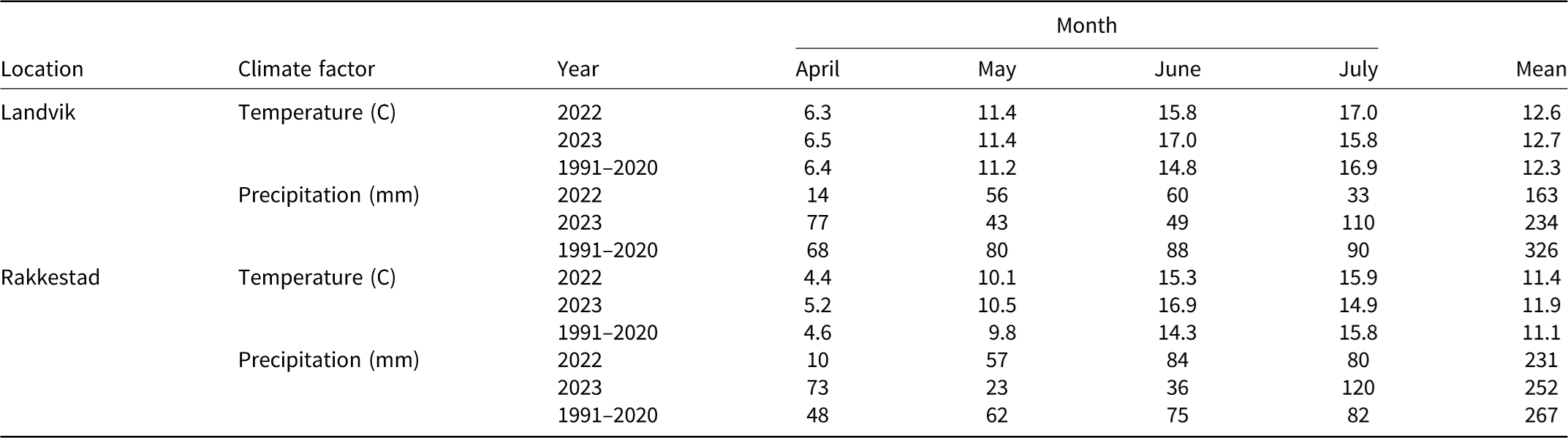
Spring and summer weather conditions are important for reproductive development and seed production in cool-season forage grasses (Aamlid et al. Reference Aamlid, Heide, Christie, McGraw, Fairey and Hampton1997; Hill Reference Hill and Hebblethwaite1980). Having moderate temperatures and adequate precipitation reduces plant stress following spring herbicide and PGR applications. Air temperatures during the study period were slightly above long-term averages at both locations, in both years (Table 2). However, seasonal precipitation was below the long-term average in both years at both locations, with 2022 being drier than 2023. In 2022, Landvik received 50% of the 30-yr average rainfall. The variation in the distribution of the precipitation was especially evident at both locations, especially in April, but also in May, which were the months when herbicide and PGRs were applied.
Temperature and rainfall during April–July compared with the 30-yr normal (mean 1991–2020) at experimental sites in Landvik and Rakkestad, Norway.

Table 2. Long description
A table comparing temperature and precipitation data for Landvik and Rakkestad. The table has 12 rows and 7 columns. Columns are labeled Location, Climate factor, Year, and Month with sub-columns April, May, June, July, and Mean. Row 1: Landvik, Temperature (C), 2022, 6.3, 11.4, 15.8, 17.0, 12.6. Row 2: Landvik, Temperature (C), 2023, 6.5, 11.4, 17.0, 15.8, 12.7. Row 3: Landvik, Temperature (C), 1991-2020, 6.4, 11.2, 14.8, 16.9, 12.3. Row 4: Landvik, Precipitation (mm), 2022, 14, 56, 60, 33, 163. Row 5: Landvik, Precipitation (mm), 2023, 77, 43, 49, 110, 234. Row 6: Landvik, Precipitation (mm), 1991-2020, 68, 80, 88, 90, 326. Row 7: Rakkestad, Temperature (C), 2022, 4.4, 10.1, 15.3, 15.9, 11.4. Row 8: Rakkestad, Temperature (C), 2023, 5.2, 10.5, 16.9, 14.9, 11.9. Row 9: Rakkestad, Temperature (C), 1991-2020, 4.6, 9.8, 14.3, 15.8, 11.1. Row 10: Rakkestad, Precipitation (mm), 2022, 10, 57, 84, 80, 231. Row 11: Rakkestad, Precipitation (mm), 2023, 73, 23, 36, 120, 252. Row 12: Rakkestad, Precipitation (mm), 1991-2020, 48, 62, 75, 82, 267.
Seed Yield and Quality
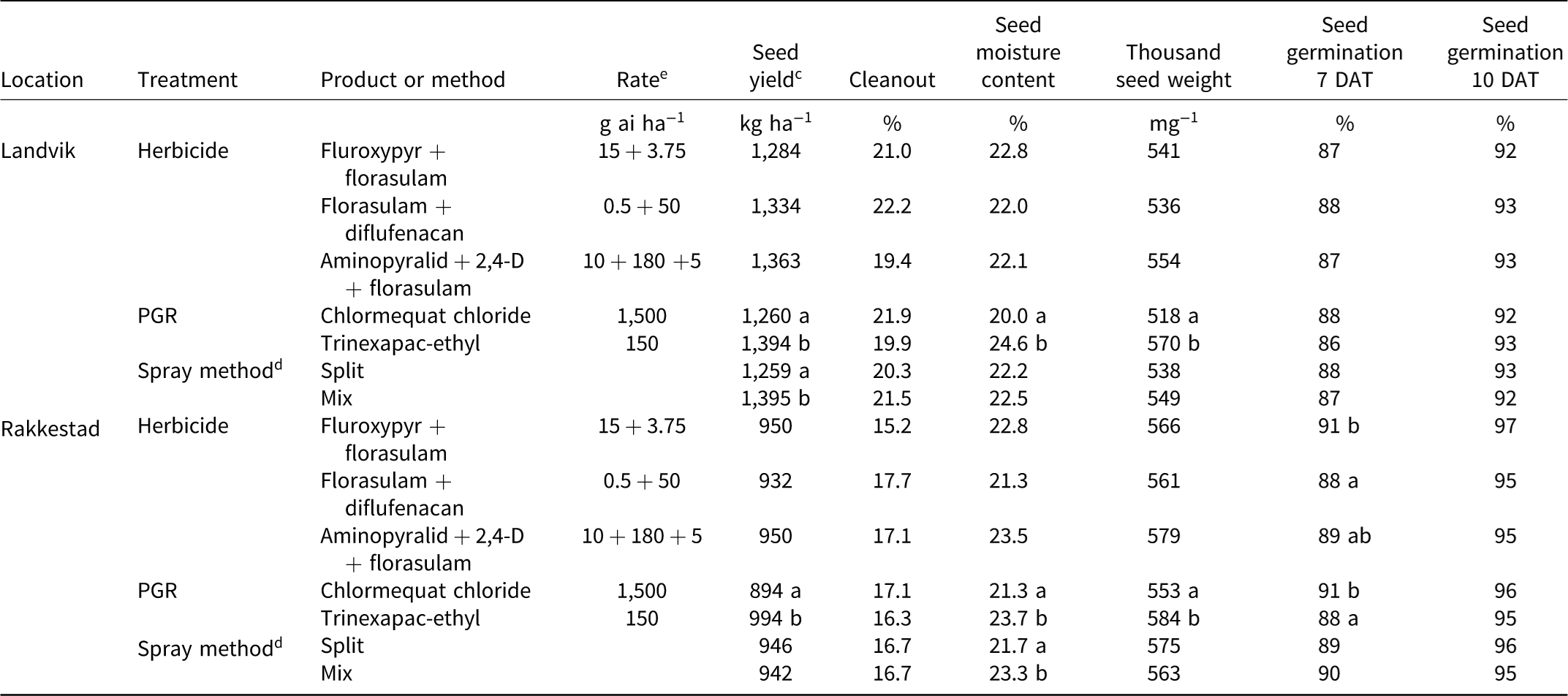
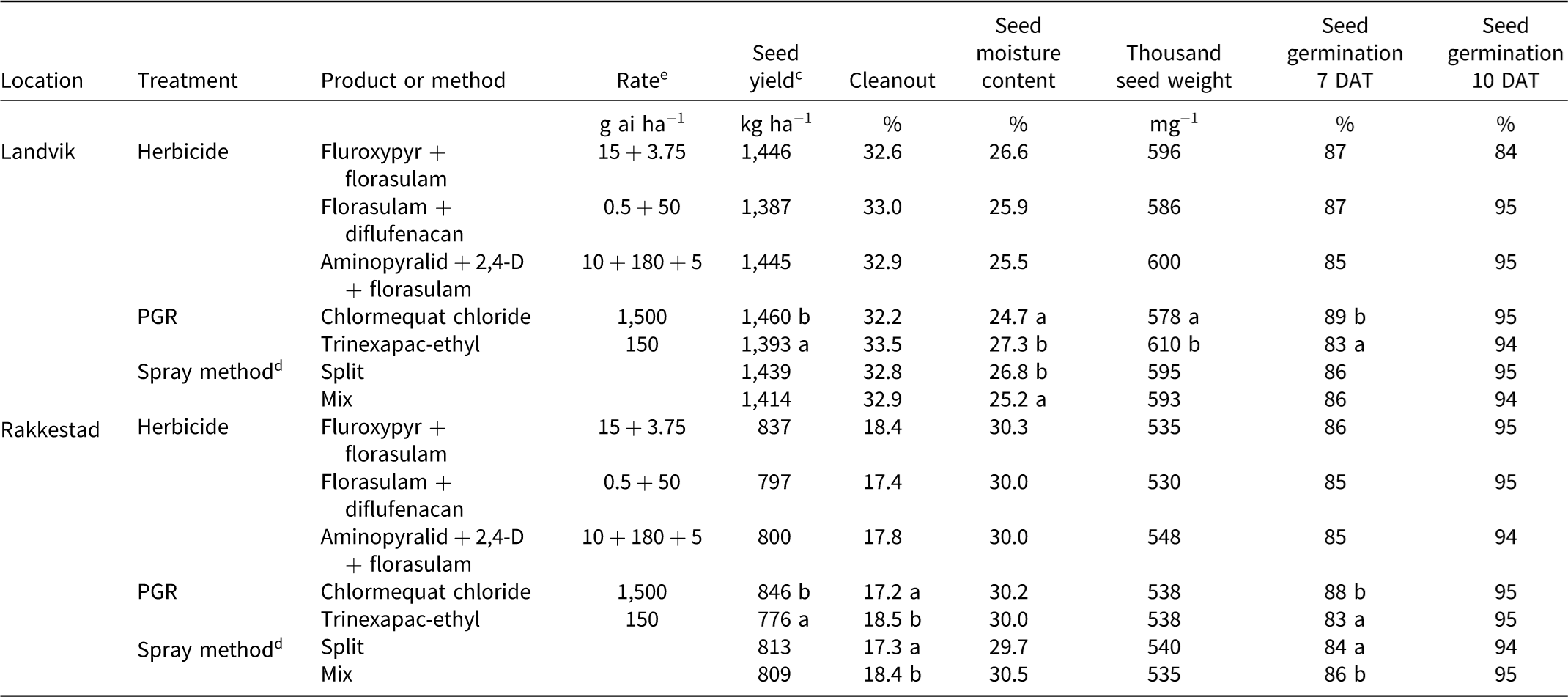
Results of the ANOVA revealed no interactions between herbicides and PGRs in any of the trials. In all four trials, timothy seed yield was affected by PGRs (P ≤ 0.05), but not by herbicides (Tables 3 and 4). In 2022, 10.6% to 11.2% greater seed yield was recorded after TE treatment, whereas in contrast, in 2023, 4.9% to 9.0% greater seed yield was recorded after CCC treatment. This result is expected because timothy crops in their first year of seed production are known to respond better to CCC than to TE, which is more effective on older timothy seed crops that have more biomass and undergo aggressive spring growth (Aamlid Reference Aamlid2004). The spray method affected seed yield only at Landvik in 2022, with the tank-mixed application yielding 10.8% more than the split application. While it is unclear why the tank-mix resulted in higher seed yield at this site, it is overall promising that there were no yield reductions from tank mixing in any of the trials.
Timothy seed yield, cleanout, seed moisture content, thousand-seed weight, and seed germination as influenced by herbicide, plant growth regulator, and spray method treatment in 2022.a,b

Table 3. Long description
The table presents data on the effects of various treatments on timothy seed yield, cleanout, seed moisture content, thousand-seed weight, and seed germination. It includes two locations, Landvik and Rakkestad, with different treatments such as herbicides, plant growth regulators (PGRs), and spray methods. The table has 12 rows and 10 columns. Column headers are Location, Treatment, Product or method, Rate, Seed Yield, Cleanout, Seed moisture content, Thousand seed weight, Seed germination 7 DAT, and Seed germination 10 DAT. Row labels include different treatments and their respective products or methods. The table provides specific values for each treatment’s impact on the measured parameters. For example, in Landvik, the herbicide treatment with Fluroxypyr + florasulam resulted in a seed yield of 1,284 kg ha^-1, a cleanout of 21.0 percent, a seed moisture content of 22.8 percent, a thousand-seed weight of 541 mg, and seed germination rates of 87 percent at 7 days after treatment (DAT) and 92 percent at 10 DAT. Similar detailed data is provided for other treatments and locations.
a Abbreviation: DAT, days after treatment; PGR, plant growth regulator.
b Means followed by the same letter within a column are not different based on a Fisher protected LSD test (α = 0.05).
c Adjusted to 100% purity and 12% seed moisture content.
d Split indicates that herbicides and PGRs were applied separately; mix means the products were combined in a tank mixture.
e Where applicable rates are reported in g ae ha−1. See Table 1.
Timothy seed yield, cleanout, seed moisture content, thousand seed weight, and seed germination as influenced by herbicide, plant growth regulator, and spray method treatments in 2023.a,b

Table 4. Long description
A table with 14 rows and 10 columns comparing timothy seed yield, cleanout, seed moisture content, thousand seed weight, and seed germination under different treatments. The columns are Location, Treatment, Product or method, Rate, Seed Yield, Cleanout, Seed moisture content, Thousand seed weight, Seed germination 7 DAT, and Seed germination 10 DAT. The table includes data for two locations, Landvik and Rakkestad, with various treatments such as herbicides, plant growth regulators, and spray methods. Each row provides specific values for each treatment’s impact on the measured variables. Notable trends include variations in seed yield and germination rates depending on the treatment applied.
a Abbreviations: DAT, days after treatment; PGR, plant growth regulator.
b Means followed by the same letter within a column are not different based on a Fisher protected LSD test (α = 0.05).
c Adjusted to 100% purity and 12% seed water content.
d Split indicates that herbicides and PGRs were applied separately; mix means the products were combined in a tank mixture.
e Where applicable rates are reported in g ae ha−1. See Table 1.
As expected from the overall low weed pressure in all of the trials, herbicides had no effect on cleanout in any of the trials (Tables 3 and 4). In 2023 at Rakkestad, both PGR (P ≤ 0.01) and spray method (P ≤ 0.001) affected cleanout. Application of TE resulted in 7.6% more cleanout than CCC, and the cleanout was 6.4% higher when herbicides were applied as a tank mix versus split.
Seed moisture content at harvest was affected by PGRs at all sites, except at Rakkestad in 2023. In the other three trials, seed moisture content was 11% to 23% higher when TE was applied compared to CCC. This is not surprising as previous work in Norway has also shown that TE may delay seed maturity to a greater degree than CCC (Aamlid and Øverland Reference Aamlid and Øverland2017). Spray method had mixed effects on seed moisture content. There were no effects in 2022 at Landvik or in 2023 at Rakkestad. However, the seed moisture content was 7.3% higher with the tank-mixed method at Rakkestad in 2022 and 6.4% higher with the split method at Landvik in the same year.
Herbicides and spray method had no effect on thousand seed weight in any of the trials, whereas PGRs had an effect in all trials except at Rakkestad in 2023 (Tables 3 and 4). Thousand seed weight was 5.5% to 10% greater with TE than with CCC. Other studies have demonstrated mixed effects from CCC and TE on timothy seed weight, with neither consistently resulting in a higher or lower seed weight than the other, or untreated controls (Aamlid Reference Aamlid2003; Bhattari et al. Reference Bhattarai, Poudel, Anderson and Yoder2025).
There were mixed effects on seed germination 7 d after the start of germination tests (Tables 3 and 4). Seed germination was 3% lower after treatments with florasulam + diflufenican compared with germination after fluroxypyr + florasulam treatments at Rakkestad in 2022, but there were no effects from herbicides at any of the other sites. Meanwhile, seed germination was 3% to 6% lower after TE treatments than CCC treatments at all sites except Landvik in 2023. These three trials are the same one that produced lower rates of seed germination after TE treatments but also had higher seed moisture content at harvest. Thus, it is likely that TE delayed seed maturity, which increased the time in which seeds from TE-treated plots would germinate. This should not be considered a major concern because there were no effects on seed germination from any treatments when assessed at 10 d after the start of the seed germination tests.
Crop Injury, Plant Height, and Lodging
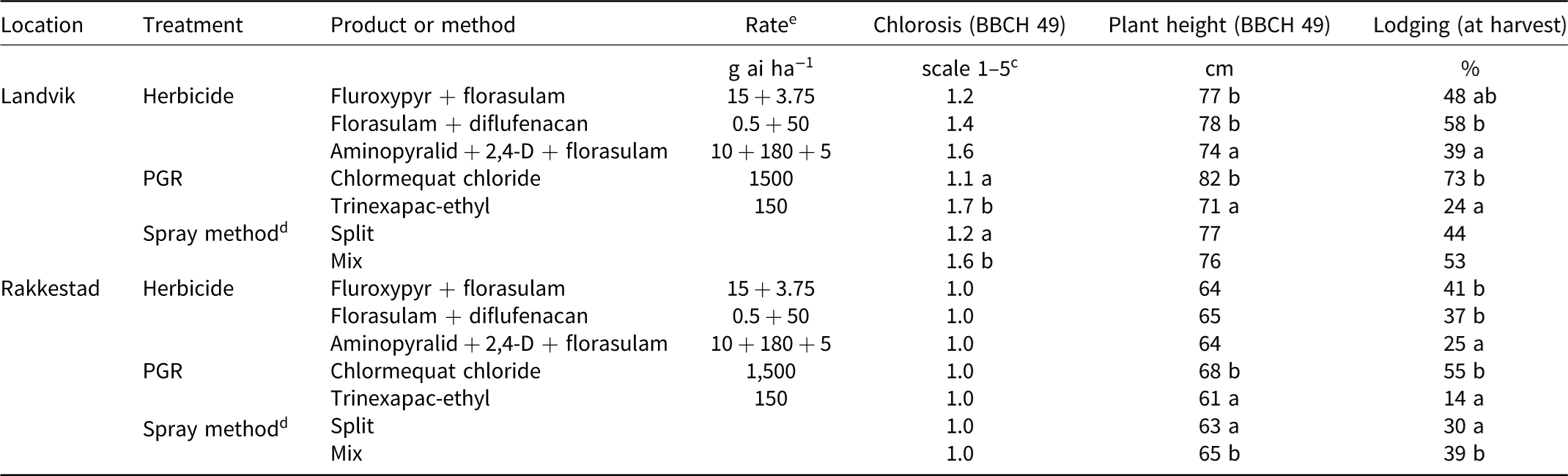
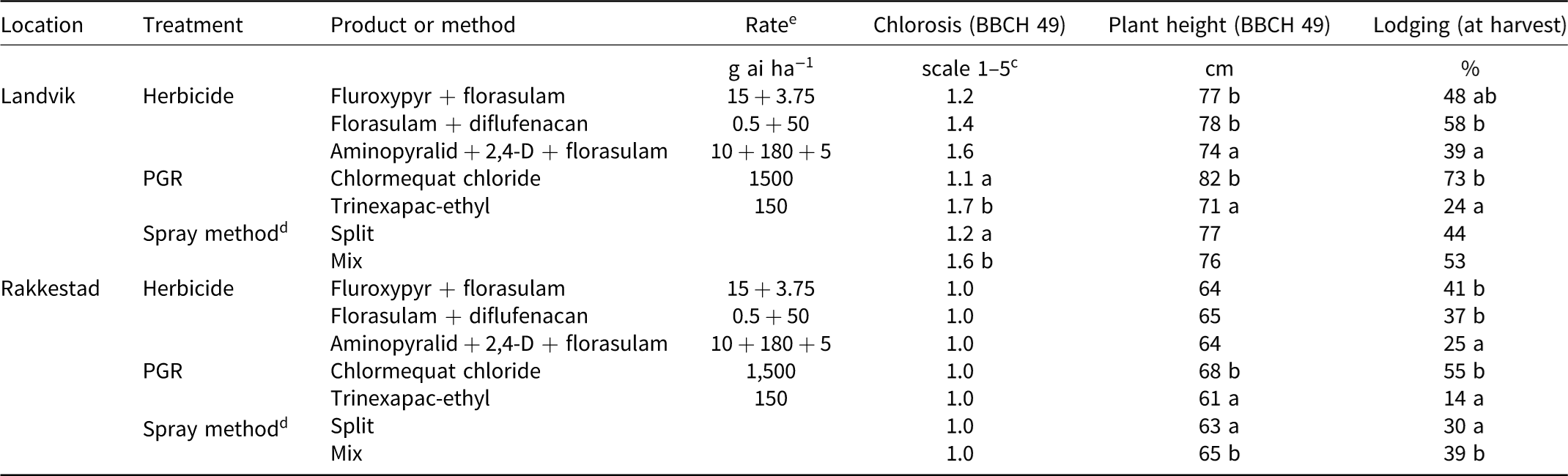
Overall, crop injury at the four trial sites was low (Tables 5 and 6). In the split application, chlorosis after herbicide application at BBCH 25 was not observed at Rakkestad in either year but it was detected at Landvik in both years (mean score 1.7) (data not shown). However, at this early growth stage the differences among herbicide treatments were not different. At stage BBCH 49, there was more chlorosis after application of TE than of CCC, and more chlorosis when PGRs were applied in a tank mix with herbicides than when they were applied separately at Landvik in 2022 (Table 5). No chlorosis was visible in 2023 (Table 6). At Rakkestad in 2023, the only chlorosis observed at BBCH 49 occurred in a plot where florasulam + diflufenican had been mixed with TE and applied at BBCH 31–35 in 2023 (mean score 3.0), resulting in interactions of both herbicides, PGRs, and spray method (Table 6). Transient chlorotic effects have been previously reported after tank-mixing diflufenican with other herbicides (Gitsopoulos et al. Reference Gitsopoulos, Georgoulas, Vazanelli and Botsoglou2024). Our results show that this may also occur when tank-mixing diflufenican with TE.
Timothy dicot weed coverage, chlorosis, plant height, and lodging as influenced by herbicide, plant growth regulator, and spray method treatments in 2022.a,b

Table 5. Long description
The table presents data on the effects of various treatments on plant chlorosis, height, and lodging at two locations, Landvik and Rakkestad. It includes columns for location, treatment, product or method, rate, chlorosis (BBCH 49), plant height (BBCH 49), and lodging (at harvest). The table has 14 rows and 7 columns. Row 1: Landvik, Herbicide, Fluroxypyr + florasulam, 15 + 3.75, 1.2, 77 b, 48 ab. Row 2: Landvik, Herbicide, Florasulam + diflufenacan, 0.5 + 50, 1.4, 78 b, 58 b. Row 3: Landvik, Herbicide, Aminopyralid + 2,4-D + florasulam, 10 + 180 + 5, 1.6, 74 a, 39 a. Row 4: Landvik, PGR, Chlormequat chloride, 1500, 1.1 a, 82 b, 73 b. Row 5: Landvik, PGR, Trinexapac-ethyl, 150, 1.7 b, 71 a, 24 a. Row 6: Landvik, Spray method, Split,, 1.2 a, 77 b, 44 ab. Row 7: Landvik, Spray method, Mix,, 1.6 b, 76 b, 53 b. Row 8: Rakkestad, Herbicide, Fluroxypyr + florasulam, 15 + 3.75, 1.0, 64 b, 41 b. Row 9: Rakkestad, Herbicide, Florasulam + diflufenacan, 0.5 + 50, 1.0, 65 b, 37 b. Row 10: Rakkestad, Herbicide, Aminopyralid + 2,4-D + florasulam, 10 + 180 + 5, 1.0, 64 b, 25 a. Row 11: Rakkestad, PGR, Chlormequat chloride, 1500, 1.0, 68 b, 55 b. Row 12: Rakkestad, PGR, Trinexapac-ethyl, 150, 1.0, 61 a, 14 a. Row 13: Rakkestad, Spray method, Split,, 1.0, 63 a, 30 a. Row 14: Rakkestad, Spray method, Mix,, 1.0, 65 b, 39 b.
a Abbreviations: BBCH, Biologische Bundesanstalt, Bundessortenamt und Chemische Industrie (a scale used to identify the phenological development stage of plants); DAT, days after treatment; PGR, plant growth regulator.
b Means followed by the same letter within a column are not different based on a Fisher protected LSD test (α = 0.05).
c Chlorosis of timothy was rated on a scale from 1 to 5, where 1 = no injury and 5 = all leaves are yellow.
d Split indicates that herbicides and PGRs were applied separately; mix means the products were combined in a tank mixture.
e Where applicable rates are reported in g ae ha−1. See Table 1.
Timothy chlorosis, dicot weed coverage, plant height, and lodging as influenced by herbicide, plant growth regulator, and spray method treatment in 2023.a,b

Table 6. Long description
A table comparing the effects of different treatments on plant chlorosis, height, and lodging. The table has 12 rows and 6 columns. Columns are labeled Location, Treatment, Product or method, Rate, Chlorosis (BBCH 49), Plant height (BBCH 49), and Lodging (at harvest). Row 1: Location, Landvik; Treatment, Herbicide; Product or method, Fluroxypyr + florasulam; Rate, 15 + 3.75 g ai ha^-1; Chlorosis (BBCH 49), 0; Plant height (BBCH 49), 96 cm; Lodging (at harvest), 44 percent. Row 2: Location, Landvik; Treatment, Herbicide; Product or method, Florasulam + diflufenacan; Rate, 0.5 + 50 g ai ha^-1; Chlorosis (BBCH 49), 0; Plant height (BBCH 49), 97 cm; Lodging (at harvest), 59 percent. Row 3: Location, Landvik; Treatment, Herbicide; Product or method, Aminopyralid + 2,4-D + florasulam; Rate, 10 + 180 + 5 g ai ha^-1; Chlorosis (BBCH 49), 0; Plant height (BBCH 49), 95 cm; Lodging (at harvest), 29 percent. Row 4: Location, Landvik; Treatment, PGR; Product or method, Chlormequat chloride; Rate, 1,500 g ai ha^-1; Chlorosis (BBCH 49), 0; Plant height (BBCH 49), 98 cm; Lodging (at harvest), 51 percent. Row 5: Location, Landvik; Treatment, PGR; Product or method, Trinexapac-ethyl; Rate, 150 g ai ha^-1; Chlorosis (BBCH 49), 0; Plant height (BBCH 49), 94 cm; Lodging (at harvest), 37 percent. Row 6: Location, Landvik; Treatment, Spray method; Product or method, Split; Rate, 0 g ai ha^-1; Chlorosis (BBCH 49), 0; Plant height (BBCH 49), 96 cm; Lodging (at harvest), 43 percent. Row 7: Location, Landvik; Treatment, Spray method; Product or method, Mix; Rate, 0 g ai ha^-1; Chlorosis (BBCH 49), 0; Plant height (BBCH 49), 96 cm; Lodging (at harvest), 45 percent. Row 8: Location, Rakkestad; Treatment, Herbicide; Product or method, Fluroxypyr + florasulam; Rate, 15 + 3.75 g ai ha^-1; Chlorosis (BBCH 49), 1.0; Plant height (BBCH 49), 60 cm; Lodging (at harvest), 1 percent. Row 9: Location, Rakkestad; Treatment, Herbicide; Product or method, Florasulam + diflufenacan; Rate, 0.5 + 5 g ai ha^-1; Chlorosis (BBCH 49), 1.5; Plant height (BBCH 49), 60 cm; Lodging (at harvest), 1 percent. Row 10: Location, Rakkestad; Treatment, Herbicide; Product or method, Aminopyralid + 2,4-D + florasulam; Rate, 10 + 180 + 5 g ai ha^-1; Chlorosis (BBCH 49), 1.0; Plant height (BBCH 49), 59 cm; Lodging (at harvest), 2 percent. Row 11: Location, Rakkestad; Treatment, PGR; Product or method, Chlormequat chloride; Rate, 1,500 g ai ha^-1; Chlorosis (BBCH 49), 1.0; Plant height (BBCH 49), 61 cm; Lodging (at harvest), 2 percent. Row 12: Location, Rakkestad; Treatment, PGR; Product or method, Trinexapac-ethyl; Rate, 150 g ai ha^-1; Chlorosis (BBCH 49), 1.3; Plant height (BBCH 49), 58 cm; Lodging (at harvest), 1 percent.
a Abbreviations: BBCH, Biologische Bundesanstalt, Bundessortenamt und Chemische Industrie (a scale used to identify the phenological development stage of plants); DAT, days after treatment; PGR, plant growth regulator.
b Means followed by the same letter within a column are not different based on a Fisher protected LSD test (α = 0.05).
c Chlorosis of timothy was rated on a scale from 1 to 5, where 1 = no injury and 5 = all leaves are yellow.
d Split indicates that herbicides and PGRs were applied separately; mix means the products were combined in a tank mixture.
e Where applicable rates are reported in g ae ha−1. See Table 1.
Timothy plant height at BBCH 49 was affected by PGRs in all four trials, by herbicide at Landvik in 2023, and by spray method at Rakkestad in 2023 (Tables 5 and 6). However, there were no interactions among any of these factors. At Landvik in 2022, compared to the other herbicide treatments, plant height was decreased by 3 to 4 cm after aminopyralid + 2,4-D + florasulam was applied. In all four trials, plants after TE treatments were shorter than they were after CCC treatments. This finding agrees with results reported in previous trials of PGR effects on timothy (Aamlid Reference Aamlid2003; Bhattarai et al. Reference Bhattarai, Poudel, Anderson and Yoder2025).
There was generally less crop lodging when timothy plants were shorter, and more lodging when timothy plants were taller (Tables 5 and 6). However, there was less lodging after treatments with aminopyralid + 2,4-D + florasulam compared with the other herbicide treatments, even when there was not a reduction in plant height. This result must be dependent on an effect from 2,4-D or aminopyralid, or the combination of the two, because the same effect was not observed after the other treatments that contained florasulam. This effect is not documented in the literature and should be the focus of future research. In all four trials, lodging was less with TE than with CCC. The only time when the spray method affected lodging was at Rakkestad in 2022, which is not surprising because that was the same site-year in which the split application resulted in a smaller crop height than the tank mix.
The practice of combining these two important crop management practices has been previously avoided because the risk for crop injury and seed yield reduction was believed to be too high. However, the results of this study indicate that mixing TE or CCC PGRs with the three herbicide products used on timothy crops did not result in a reduction in seed yield or quality. Future studies are needed to evaluate whether mixing PGRs with herbicides that are active on grass weeds would provide different results.
Practical Implications
Adding PGRs to commonly used herbicides will most likely not negatively affect timothy seed yield or quality. Combining the two agrichemicals may result in some temporary chlorosis on the timothy crop, but this is considered a short-term effect that has no implications for seed yield or quality. Although we are unaware of research to have examined the effects of PGR and herbicide combinations on weed control in other grass seed crop species, a variety of other research has investigated the effects of tank-mixed application of herbicides and fertilizers, insecticides, or biostimulants on weed control in turf and other crops (Bernards et al. Reference Bernards, Thelen and Penner2005; Daramola et al. Reference Daramola, MacDonald, Kanissery and Devkota2023; Haguewood et al. Reference Haguewood, Song, Smeda, Moss and Xiong2013; Katsenios et al. Reference Katsenios, Panagiotis, Vitsa, Leonidakis and Efthimiadou2023). In most instances, these combinations have rarely affected herbicide performance or crop yield, which is similar to the response we report here with regard to tank-mix applications of PGRs and herbicides.
Overall, the use of both herbicides and PGRs is essential for achieving optimal weed control and high seed yield in timothy seed crops. While a cautious approach of splitting these two important crop management practices into two separate applications is preferred, results from these experiments indicated relative safety if weather or other crop management factors result in the need to combine the two chemicals into a single spray mixture. This is considered optimal over not applying one or the other because the benefits outweigh any potential risks. Further studies are needed to determine whether the same level of safety can be achieved when mixing PGRs with herbicides that have grass weed control activity.
Acknowledgments
Technical assistance from the staff at NIBIO Landvik Research Center and the Norwegian Agricultural Extension Service, Eastern branch (NLR Øst) is gratefully acknowledged. We thank Carol Mallory-Smith for constructive criticism of the manuscript.
Funding
This research was funded by the Norwegian Seed Growers Association and by Mr. Tollef Grindstad, owner of the Grindstad variety of timothy.
Competing Interests
The authors declare they have no conflicts of interest.


 Open access

