Introduction
Children with symptoms of attention-deficit/hyperactivity disorder (ADHD) are at increased risk for becoming obese adolescents (Cortese et al. Reference Cortese, Angriman, Maffeis, Isnard, Konofal, Lecendreux, Purper-Ouakil, Vincenzi, Bernardina and Mouren2008; Khalife et al. Reference Khalife, Kantomaa, Glover, Tammelin, Laitinen, Ebeling, Hurtig, Jarvelin and Rodriguez2014). While the mechanism underlying the association between ADHD and obesity is poorly understood, higher than expected rates of eating pathology have been implicated. Eating pathology is a term broadly used to describe several overlapping, dimensional constructs including overeating (eating an objectively large among of food), binge eating (overeating accompanied by a loss of control), and subthreshold or full-criteria bulimia nervosa (binge eating accompanied by a compensatory behavior). Overeating (Davis et al. Reference Davis, Levitan, Smith, Tweed and Curtis2006), binge eating (Cortese et al. Reference Cortese, Bernardina and Mouren2007; Nazar et al. Reference Nazar, Suwwan, De Sousa Pinna, Duchesne, Freitas, Sergeant and Mattos2014) and bulimia nervosa (Surman et al. Reference Surman, Randall and Biederman2006; Seitz et al. Reference Seitz, Kahraman-Lanzerath, Legenbauer, Sarrar, Herpertz, Salbach-Andrae, Konrad and Herpertz-Dahlmann2013) all occur at higher rates in adults with ADHD. Compared with healthy adolescents, girls with ADHD are more likely to meet criteria for bulimia nervosa (Biederman et al. Reference Biederman, Ball, Monuteaux, Surman, Johnson and Zeitlin2007) and both boys and girls with ADHD are significantly more likely to binge eat (Neumark-Sztainer et al. Reference Neumark-Sztainer, Story, Resnick, Garwick and Blum1995). Findings from retrospective (Seitz et al. Reference Seitz, Kahraman-Lanzerath, Legenbauer, Sarrar, Herpertz, Salbach-Andrae, Konrad and Herpertz-Dahlmann2013) and prospective (Mikami et al. Reference Mikami, Hinshaw, Patterson and Lee2008; Mikami et al. Reference Mikami, Hinshaw, Arnold, Hoza, Hechtman, Newcorn and Abikoff2010) studies reveal that children with ADHD symptoms are at elevated risk of bulimia nervosa later in life.
Prospective studies of children (Tanofsky-Kraff et al. Reference Tanofsky-Kraff, Yanovski, Schvey, Olsen, Gustafson and Yanovski2009) and adolescents (Stice et al. Reference Stice, Presnell and Spangler2002; Field et al. Reference Field, Austin, Taylor, Malspeis, Rosner, Rockett, Gillman and Colditz2003; Haines et al. Reference Haines, Neumark-Sztainer, Wall and Story2007; Neumark-Sztainer et al. Reference Neumark-Sztainer, Wall, Haines, Story and Eisenberg2007; Sonneville et al. Reference Sonneville, Horton, Micali, Crosby, Swanson, Solmi and Field2013) find that binge eating predicts excess weight gain and the onset of obesity. Impulsivity and inattention, features of ADHD, may foster abnormal eating behaviors such as binge eating (Cortese et al. Reference Cortese, Isnard, Frelut, Michel, Quantin, Guedeney, Falissard, Acquaviva, Dalla Bernardina and Mouren2006, Reference Cortese, Angriman, Maffeis, Isnard, Konofal, Lecendreux, Purper-Ouakil, Vincenzi, Bernardina and Mouren2008, 2013; Wilhelm et al. Reference Wilhelm, Marx, Konrad, Willmes, Holtkamp, Vloet and Herpertz-Dahlmann2011; Cortese & Vincenzi, Reference Cortese, Vincenzi, Stanford and Tannock2012), particularly in females (Van Egmond-Fröhlich et al. Reference Van Egmond-Fröhlich, Widhalm and De Zwaan2012; Cortese et al. Reference Cortese, Faraone, Bernardi, Wang and Blanco2013). For example, individuals with ADHD may use binge eating to cope with the frustration associated with attentional and organizational difficulties (Cortese et al. Reference Cortese, Angriman, Maffeis, Isnard, Konofal, Lecendreux, Purper-Ouakil, Vincenzi, Bernardina and Mouren2008). Because developmental features present early in life have a strong influence on the later development of psychopathology (Caspi et al. Reference Caspi, Harrington, Milne, Amell, Theodore and Moffitt2003), longitudinal studies are critical in helping to assess the impact of childhood characteristics on the development and maintenance of binge eating (Hartmann et al. Reference Hartmann, Czaja, Rief and Hilbert2010). Specifically, studies of early-appearing behaviors and characteristics of children who engage in binge eating are needed. While several well-done longitudinal studies of binge eating exist (Stice et al. Reference Stice, Presnell and Spangler2002; Allen et al. Reference Allen, Byrne, La Puma, McLean and Davis2008; Field et al. Reference Field, Javaras, Aneja, Kitos, Camargo, Taylor and Laird2008; Hartmann et al. Reference Hartmann, Czaja, Rief and Hilbert2010), few have included prodromal eating pathology and most do not include childhood psychopathology and behavioral characteristics as possible predictors of binge eating.
To prevent excess weight gain among youth, cases of binge eating, and their related sequelae, childhood predictors of binge eating and underlying mechanisms through which the behavior develops must be identified. The aim of this study was to explore pathways that could increase risk for binge eating in adolescence, specifically childhood eating disturbances and traits of ADHD (hyperactivity/inattention). We used available measures of childhood eating disturbances during mid-childhood, late childhood, and early adolescence and measures of hyperactivity/inattention during mid- and late childhood reported by both parents and teachers and adolescent-reported binge eating to investigate these relationships using structural equation modeling (SEM).
Method
Participants
Our sample consists of male and female participants in the Avon Longitudinal Study of Parents and Children (ALSPAC), a longitudinal, population-based, prospective study of women and their children designed to investigate the health and development of children (Boyd et al. Reference Boyd, Golding, Macleod, Lawlor, Fraser, Henderson, Molloy, Ness, Ring and Davey Smith2013; Fraser et al. Reference Fraser, Macdonald-Wallis, Tilling, Boyd, Golding, Davey Smith, Henderson, Macleod, Molloy, Ness, Ring, Nelson and Lawlor2013). All pregnant women living in the geographical area of Avon, UK who were expected to deliver their baby between 1 April 1991 and 31 December 1992 were invited to take part in the study. Women enrolled represented approximately 85% of the eligible population and all gave informed and written consent. Women and their children have been subsequently followed up, with data collections via questionnaires and face-to-face examinations. The eligible sample for analysis includes a total of 7884 parents who responded to questionnaire items about their child's eating habits during mid-childhood (70% of those who were sent the survey). Participants with available data on the measures of interest collected during mid-childhood, late childhood, early adolescence and mid-adolescence were included in the analyses. Ethical approval for the study was obtained from the ALSPAC Ethics and Law Committee and the Local Research Ethics Committees.
Measures
Mid-childhood overeating
Parents answered questions about their child's eating habits at mean child age 7.5 years. Items on eating habits included a question on whether the child had overeaten in the previous year. Reponses to this variable were ‘no’, ‘yes, but it did not worry me’ and ‘yes, and it worried me somewhat or greatly’. The variable was dichotomized (‘no’ v. either ‘yes’ response) for the present analysis. The question was adapted for the ALSPAC study (Butler & Golding, Reference Butler and Golding1986) and was extensively piloted prior to the study. Our sample includes children of the 7884 parents who answered these questions. Parents who completed this survey had higher maternal education and higher socio-economic status (SES) than non-responders (Boyd et al. Reference Boyd, Golding, Macleod, Lawlor, Fraser, Henderson, Molloy, Ness, Ring and Davey Smith2013).
Late-childhood overeating
At the mean age of 11.7 years, 4869 children (61.8%) attended a face-to-face assessment visit (Boyd et al. Reference Boyd, Golding, Macleod, Lawlor, Fraser, Henderson, Molloy, Ness, Ring and Davey Smith2013). Children were asked ‘Did you have times where you ate so much food that you were in a lot of pain or had to force yourself to throw up?’ as part of a semi-structured interview assessing borderline personality features (the Childhood Interview for DSM-IV Borderline Personality Disorder: UK Version; CI-BPD-UK), which is based on the borderline module of the Diagnostic Interview for DSM-IV Personality Disorders (DIPD-IV) (Zanarini et al. Reference Zanarini, Frakenburg, Sickel and Yong1996; Wolke et al. Reference Wolke, Schreier, Zanarini and Winsper2012). Although this question assesses eating behavior, it is part of the ‘impulsivity domain’ of the interview, therefore indexing overeating within an impulsivity context.
Early-adolescent strong desire for food
When the mean age of the ALSPAC children was 12.8 years, parents were sent questionnaires including questions on eating disorder behaviors and cognitions from the eating disorder section of the Developmental and Well-being Assessment (DAWBA; Goodman et al. Reference Goodman, Heiervang, Collishaw and Goodman2011), a semi-structured interview that can be used to generate a range of psychiatric diagnoses in children and adolescents based on DSM-IV (APA, 1994) and International Classification of Diseases (ICD)-10 (World Health Organization, 1993) criteria (House et al. Reference House, Eisler, Simic and Micali2008). For the purpose of this study, we used answers to the question: ‘Sometimes people say that they have such a strong desire for food, and that this desire is so hard to resist, that it is like an addict feels about drugs or alcohol. Does this apply to your study teenager?’ A total of 5617 parents (71.2%) returned the questionnaire.
Hyperactivity/inattention during mid- and late childhood
Teachers completed the Strengths and Difficulties Questionnaire (SDQ) (Goodman & Scott, Reference Goodman and Scott1999) at the mean child ages of 8.4 and 11.2 years. Mothers reported on their child's behavior using the SDQ at the child ages of 8.1 and 11.6 years. The SDQ is a widely used instrument to screen for childhood psychopathology, it has been translated into more than 40 languages, and has been validated against several other well-established instruments for childhood psychopathology (Goodman, Reference Goodman1999). The SDQ includes four problem subscales: emotional, conduct, hyperactivity/inattention, and peer problems. Each subscale has established associations with clinical levels of disturbance (Goodman, Reference Goodman1999) and all SDQ subscales have good internal consistency in this sample (all Cronbach's α's > 0.62). Scores from the hyperactivity/inattention subscale were used in the present analysis. Teacher-rated hyperactivity/inattention was available on 3850 children (48.8%) during mid-childhood and 4346 children (55.1%) during late childhood. Parent-rated hyperactivity/inattention was available on 6457 children (81.9%) during mid-childhood and 5944 children (75.4%) during late childhood.
Mid-adolescent binge eating
Binge eating was assessed at the ages of 14 and 16 years using a two-part question. Participants were first asked how often during the past year they had eaten a very large amount of food. Participants who reported eating a very large amount of food at least occasionally were asked a follow-up question about whether they felt out of control (yes/no) during these episodes, like they could not stop eating even if they wanted to stop. We defined binge eating as at least weekly episodes of eating a large amount of food with loss of control. A total of 5408 adolescents (68.6%) answered the binge eating questions at the age of 14 years and/or at the age of 16 years.
Analyses
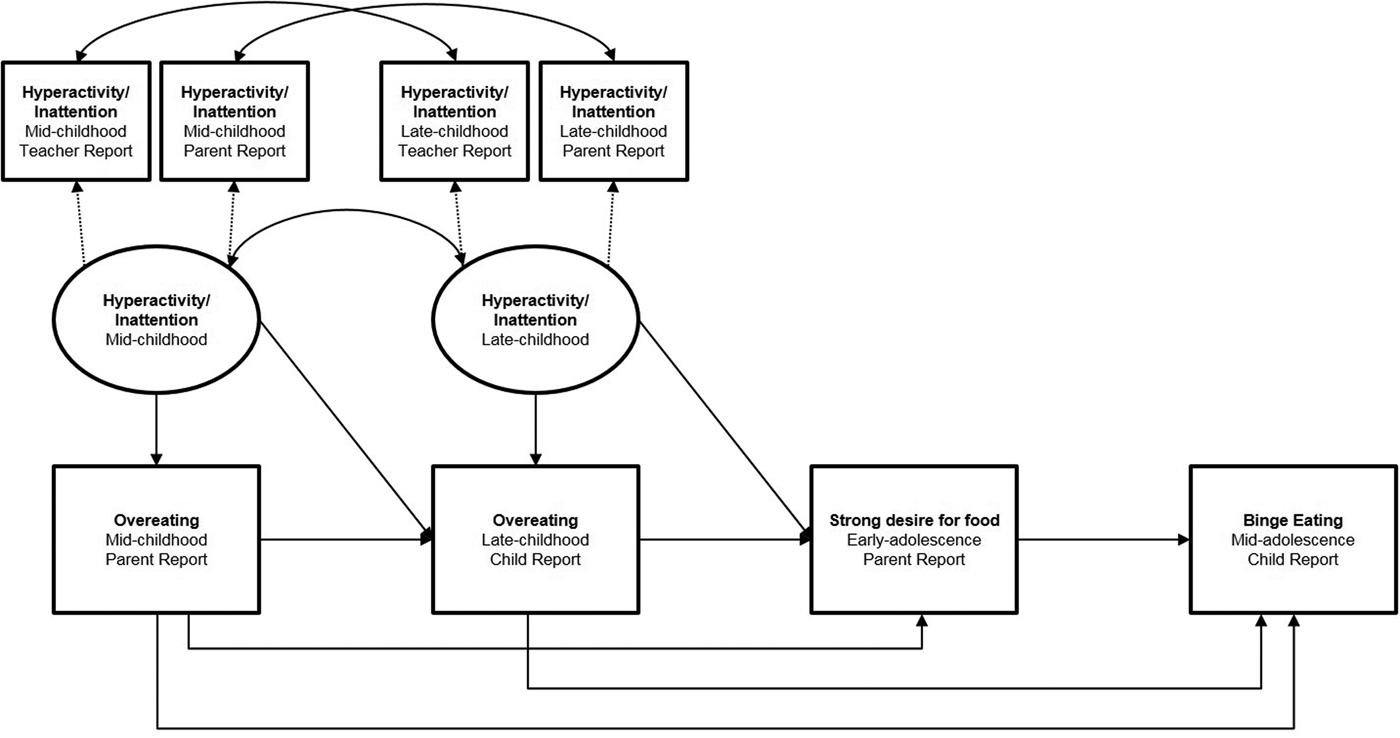
We examined measures of internal consistency and performed descriptive statistics on all model variables. We used SEM techniques to examine the relationship between variables in the hypothesized conceptual model (Fig. 1). Given that the teacher-rated and parent-rated SDQ hyperactivity/inattention scores were highly correlated, two latent variables were estimated, one at each time point representing hyperactivity/inattention in mid- and late childhood. SEM is a method to describe, assess and test hypothesized relationships between observed variables (measures of child eating disturbance throughout childhood and adolescence) and unobserved, latent variables (hyperactivity/inattention during mid- and late childhood). In Fig. 1, observed variables are enclosed by rectangles and latent variables by circles; straight lines with single-headed arrows represent hypothesized direct associations, while curved lines are used to denote correlational relationships that were accounted for in model building. The relationships between constructs were tested using path analytic procedures. Specifically, we used weighted least-squares means and variance-adjusted estimation to jointly model the relationship of three predictor variables related to childhood eating disturbances (parental report of overeating during mid-childhood, child report of overeating to the point of wanting to throw up during late childhood, and parental report of the child having a strong desire for food during early adolescence) and measure of hyperactivity/inattention at the ages of 8 and 11 years to the outcome of binge eating during mid-adolescence.
Hypothesized model to be tested using structural equation modeling.

Because of the well-established link between overeating and binge eating and obesity (Sonneville et al. Reference Sonneville, Horton, Micali, Crosby, Swanson, Solmi and Field2013) and the co-morbidity between obesity and ADHD (Cortese et al. Reference Cortese, Angriman, Maffeis, Isnard, Konofal, Lecendreux, Purper-Ouakil, Vincenzi, Bernardina and Mouren2008; Cortese & Vincenzi, Reference Cortese, Vincenzi, Stanford and Tannock2012), we adjusted for concurrent body mass index (BMI) measured during mid- and late childhood in all model associations tested. BMI was calculated from measured height and weight collected at clinic visits (‘Children in focus@7’ and ‘Focus@10’) at the mean ages of 7.5 and 11.7 years. Maternal report of height and weight was used for children who did not have measured height and weight at these visits; the correlation between measured and maternally reported BMI in the sample was high (correlation during mid-childhood = 0.74; correlation during late childhood = 0.90). All models also controlled for sex and maternal education. Maternal education was included as a proxy for SES, which has been found to be associated with eating disorder risk (Thomas et al. Reference Thomas, James and Bachmann2002; Ahrén-Moonga et al. Reference Ahrén-Moonga, Silverwood, Klinteberg and Koupil2009). Maternal highest educational qualification was obtained via self-report at 32 weeks’ gestation and was classified as either up to high school equivalent (General Certificate of Secondary Education, GCSE certificate) versus post-secondary education (A level and above, in the UK system). This information was available on 7120 mothers (90.3%).
We assessed model fit using the root mean square of approximation (RMSEA, a parsimony-adjusted index), comparative fit index (CFI) and the Tucker–Lewis index (TLI). We report standardized coefficients in the final model for direct and indirect effects, which measure the effect of one variable on another while adjusting for all other variables prior in the model. Descriptive statistics were computed using IBM SPSS Statistics 19 (USA); SEM was fit using Mplus version 6 (USA).
Results
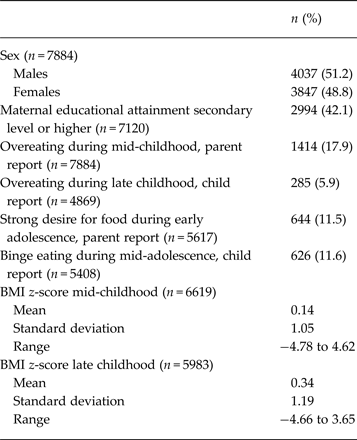
Select participant characteristics, means and standard deviations, and frequencies of all variables are displayed in Table 1. Our sample was 48.8% female and 51.2% male and 42.1% of participants had a mother who had secondary-level education or higher. Prevalence of early-adolescent strong desire for food reported by parent (11.5%) was similar to participant-reported binge eating during mid-adolescence (11.6%). Parent report of mid-childhood overeating was the most prevalent eating disturbance (17.9%), whereas child report of late-childhood overeating was the least prevalent (5.9%). Hyperactivity/inattention scores ranged from 0 to 10. Mean hyperactivity/inattention scores were: 2.38 (s.d. = 2.55) for teacher-reported hyperactivity/inattention during mid-childhood; 3.27 (s.d. = 2.43) for parent-reported hyperactivity/inattention during mid-childhood; 1.97 (s.d. = 2.50) for teacher-reported hyperactivity/inattention during late childhood; and 2.72 (s.d. = 2.20) for parent-reported hyperactivity/inattention during late childhood.
Sample characteristics

BMI, Body mass index.
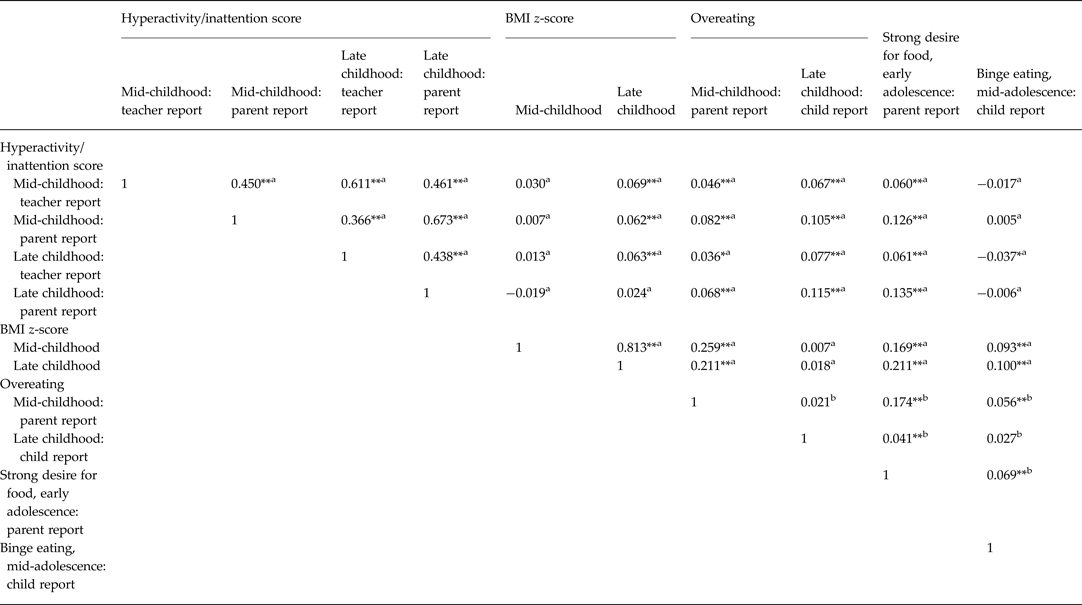
Correlations between model variables are reported in Table 2. Binge eating during mid-adolescence was positively associated with overeating during mid-childhood (p < 0.001) and a strong desire for food during early adolescence (p < 0.001). Binge eating during mid-adolescence was also associated with covariates: BMI z-score at the ages of 7 and 11 years (both p's < 0.001) and sex (p < 0.001). There was a significant negative association between teacher-reported hyperactivity/inattention score at the age of 11 years and binge eating during mid-adolescence, whereas associations between all other eating disturbances and measures of hyperactivity/inattention were significant and positive (all p's < 0.02).
Correlations between model variables

BMI, Body mass index.
a Pearson correlation.
b Kendall's τ B .
Correlation is significant: * p < 0.05, ** p < 0.01 (two-tailed).
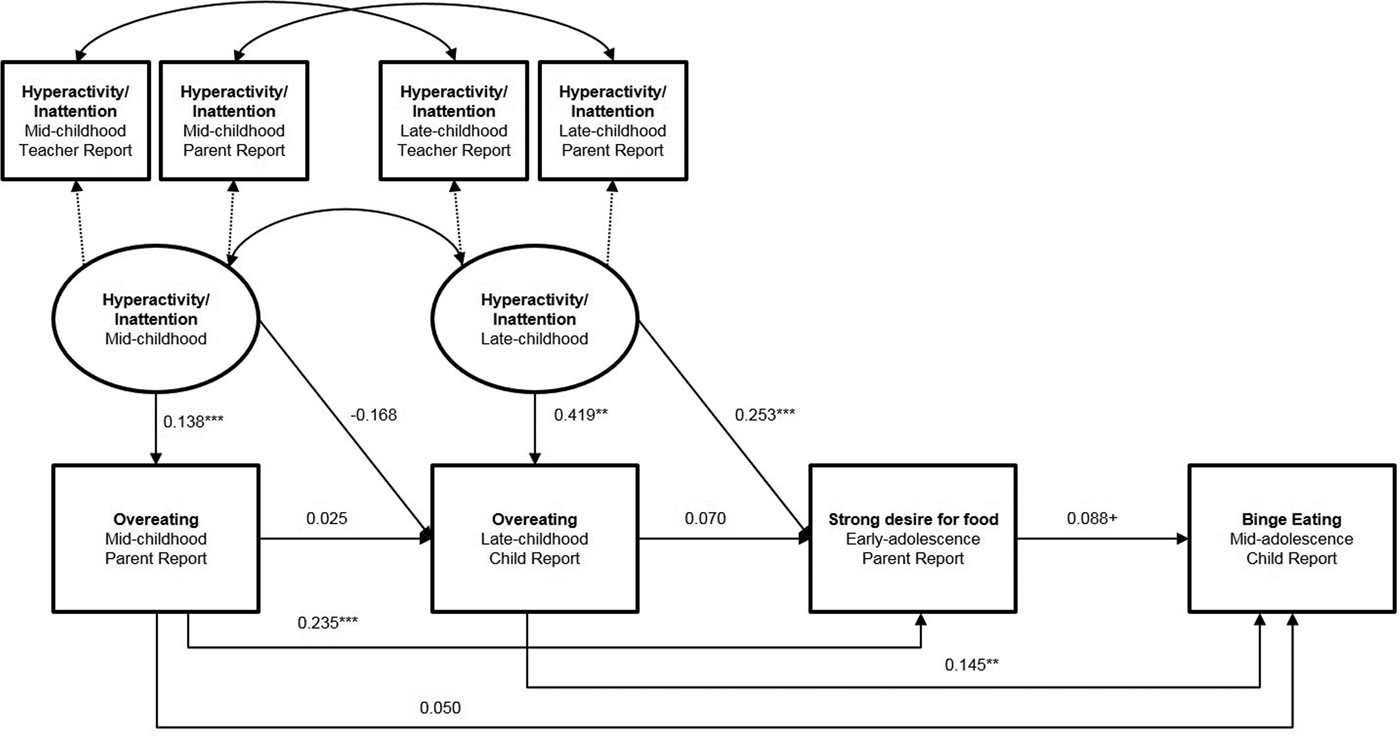
The final model SEM, which adjusts for BMI during mid- and late childhood, sex and maternal education, is shown in Fig. 2. Of the 7884 parents who answered questions about their child's eating habits during mid-childhood, 7120 (90.4%) partially or fully observed participants were retained in the final model. The model indices suggest good fit (RMSEA = 0.03, CFI = 0.98, TLI = 0.96).
Results of structural equation modeling. Significance of standardized estimates: + p < 0.10, ** p < 0.01, *** p < 0.001.

Hyperactivity/inattention during mid-childhood were directly associated with concurrent overeating [standardized estimate 0.138, 95% confidence interval (CI) 0.048–0.170, p < 0.001]. Hyperactivity/inattention during late childhood were also associated with concurrent overeating (standardized estimate 0.419, 95% CI 0.021–0.628, p = 0.04) and prospectively with early-adolescent strong desire for food (standardized estimate 0.253, 95% CI 0.151–0.271, p < 0.001). There was evidence of tracking of eating disturbances throughout childhood and adolescence as demonstrated by the association between mid-childhood overeating and early-adolescent strong desire for food (standardized estimate 0.235, 95% CI 0.182–0.314, p < 0.001). This relationship was further demonstrated by the associations between late-childhood overeating (standardized estimate 0.145, 95% CI 0.038–0.259, p < 0.01) and early-adolescent strong desire for food (standardized estimate 0.088, 95% CI −0.002 to 0.169, p = 0.05) with binge eating during mid-adolescence. Although not directly associated with binge eating during mid-adolescence, hyperactivity/inattention during late childhood indirectly predicted binge eating during mid-adolescence (standardized estimate 0.085, 95% CI 0.007–0.128, p = 0.03) via late-childhood overeating and early-adolescent strong desire for food.
Discussion
We observed both cross-sectional and prospective associations between hyperactivity/inattention and eating disturbances during childhood and adolescence. Hyperactivity/inattention during both mid- and late childhood were cross-sectionally associated with measures of child overeating. Hyperactivity/inattention symptoms during late childhood were directly associated with eating disturbances in early adolescence and indirectly associated with binge eating during mid-adolescence. As expected, we observed continuity of eating disturbances throughout childhood and into mid-adolescence.
Our findings indicate that early-appearing hyperactivity/inattention is a risk factor for adolescent binge eating and add to the literature which has identified other risk factors including childhood risk factors such as dietary restraint and emotional eating (Allen et al. Reference Allen, Byrne, La Puma, McLean and Davis2008), and adolescent risk factors such as frequent dieting, pressure to be thin, modeling of eating disturbances, appearance overvaluation, body dissatisfaction, emotional eating and low self-esteem (Stice et al. Reference Stice, Presnell and Spangler2002; Field et al. Reference Field, Javaras, Aneja, Kitos, Camargo, Taylor and Laird2008). Although the incidence of binge eating is low until adolescence (Tanofsky-Kraff, Reference Tanofsky-Kraff, Jelalian and Steele2008; Swanson et al. Reference Swanson, Crow, Le Grange, Swendsen and Merikangas2011; Field et al. Reference Field, Sonneville, Micali, Crosby, Swanson, Laird, Treasure, Solmi and Horton2012), our findings suggest that reports of hyperactivity/inattention in preadolescence may indicate an increased risk of becoming eating disordered later in life. Our findings align with other studies which find an association between impulsivity and binge eating (Wonderlich et al. Reference Wonderlich, Connolly and Stice2004; Hartmann et al. Reference Hartmann, Czaja, Rief and Hilbert2010) and those which find higher than expected rates of binge eating (with or without a compensatory mechanism) among individuals with ADHD (Neumark-Sztainer et al. Reference Neumark-Sztainer, Story, Resnick, Garwick and Blum1995; Davis et al. Reference Davis, Levitan, Smith, Tweed and Curtis2006; Surman et al. Reference Surman, Randall and Biederman2006; Cortese et al. Reference Cortese, Bernardina and Mouren2007; Seitz et al. Reference Seitz, Kahraman-Lanzerath, Legenbauer, Sarrar, Herpertz, Salbach-Andrae, Konrad and Herpertz-Dahlmann2013). Our findings are supported by other research which suggests that hyperactivity/inattention, particularly among females, may signal greater risk for later eating pathology (Van Egmond-Fröhlich et al. Reference Van Egmond-Fröhlich, Widhalm and De Zwaan2012; Cortese et al. Reference Cortese, Faraone, Bernardi, Wang and Blanco2013). Our findings are also supported by a case–control study of personality features of children aged 8–13 years which found that those with binge eating exhibit higher impulsivity, lower self-directedness, lower cooperativeness and greater novelty seeking (Hartmann et al. Reference Hartmann, Czaja, Rief and Hilbert2010). A recent prospective study did not find that ADHD symptoms in childhood were associated with later binge eating in adolescent; however, the measure of binge eating used in this study did not assess loss of control during eating, a core feature of a binge-eating episode (Khalife et al. Reference Khalife, Kantomaa, Glover, Tammelin, Laitinen, Ebeling, Hurtig, Jarvelin and Rodriguez2014).
Although BMI was not associated with measures of hyperactivity/inattention during mid-childhood in our sample, BMI was associated with most measures of hyperactivity/inattention during late childhood. This finding is supported research that has shown that symptoms of ADHD earlier in life are associated with behavioral risk factors for later obesity (McWilliams et al. Reference McWilliams, Sayal and Glazebrook2013), but not current weight status, or may be associated with only slightly elevated weight status (Hanć et al. Reference Hanć, Słopień, Wolańczyk, Dmitrzak-Węglarz, Szwed, Czapla, Durda, Ratajczak and Cieślik2015).
Binge eating is associated with several adverse outcomes, including both weight-related outcomes such as excess weight gain (Field et al. Reference Field, Austin, Taylor, Malspeis, Rosner, Rockett, Gillman and Colditz2003; Neumark-Sztainer et al. Reference Neumark-Sztainer, Wall, Haines, Story and Eisenberg2007) and obesity (Stice et al. Reference Stice, Presnell and Spangler2002; Haines et al. Reference Haines, Neumark-Sztainer, Wall and Story2007; Sonneville et al. Reference Sonneville, Horton, Micali, Crosby, Swanson, Solmi and Field2013) and non-weight-related outcomes such as starting to use marijuana and other drugs (Sonneville et al. Reference Sonneville, Horton, Micali, Crosby, Swanson, Solmi and Field2013) and developing high depressive symptoms (Stice et al. Reference Stice, Hayward, Cameron, Killen and Taylor2000; Sonneville et al. Reference Sonneville, Horton, Micali, Crosby, Swanson, Solmi and Field2013). As such, additional research must be dedicated to understanding how to identify youth at risk and how best to intervene. Future research should work to elucidate the mechanisms driving the relationship between hyperactivity/inattention, childhood eating disturbances and later binge eating. It is possible that individuals with ADHD phenotypes may be relatively inattentive to internal signs of hunger and satiety (Cortese et al. Reference Cortese, Bernardina and Mouren2007). Alternatively, hyperactivity/inattention may contribute to abnormal eating behaviors and binge eating by way of deficient inhibitory control, which manifests as poor planning and difficulty with effective behavior monitoring (Davis et al. Reference Davis, Levitan, Smith, Tweed and Curtis2006; Cortese et al. Reference Cortese, Bernardina and Mouren2007). Alternatively, ADHD and binge eating might share common neuropsychological characteristics such as low cognitive control and high impulsivity. We cannot rule out that the association between hyperactivity/inattention and binge eating observed may be mediated by common psychopathological factors, such as depression (Cortese et al. Reference Cortese, Bernardina and Mouren2007).
While we were only able to explore traits of ADHD and eating disorders, not clinical conditions, this study is the only large prospective study of hyperactivity/inattention and binge eating among children and adolescents. This study also includes assessment of eating pathology at several stages of childhood, thereby making it ideal for exploring predictors of binge eating in adolescence. Our measures of eating pathology differed at each wave and some measures of eating disturbances among children and adolescents were self-reported. Assessment of eating disturbances by self-report in youth is subject to limitations related to the ambiguity of the terms and concepts of interest (Fairburn & Beglin, Reference Fairburn and Beglin1994; Goldschmidt et al. Reference Goldschmidt, Doyle and Wilfley2007). This may explain why the prevalence of overeating during late childhood, which was child-reported, was lower than other measures of child eating disturbances. An important limitation of our study is that the clinical significance of our measure of child eating disturbance has not been established and we speculate that the degree of clinical significance of our measures is variable across measurement periods. For example, overeating in late childhood captured an extreme type of overeating (reflecting impulsivity characteristics) and, therefore, it might have only captured children at a severe end of the overeating spectrum. This form of overeating may be more correlated with hyperactivity/inattention, as evidenced by the strength of the relationship between measures of overeating and hyperactivity/inattention during late childhood. Measures that capture children with behaviors on the broader overeating spectrum could result in higher estimates. Regardless of the clinical significance of these symptoms in their present state, however, they may represent legitimate candidates for preventive efforts. Another limitation of our study is that our sample is more than 90% white and includes only children living in the UK; thus it is unclear if our results are generalizable to racial/ethnic minorities or youth outside of the UK.
Nevertheless, there are several unique strengths to our study. First, our study included longitudinal assessment and thereby allowed us to establish the temporal precedence of risk factors and mediators in relation to behavior. Second, we had information collected from multiple reporters, including the child, parents and teachers, at several time points, which is the ideal when studying behavioral constructs and may be the optimal design for preadolescents. As recently shown by our research group, parental and child reports of overeating/binge eating might capture specific facets of an underlying eating disturbance (Swanson et al. Reference Swanson, Aloisio, Horton, Sonneville, Crosby, Eddy, Field and Micali2014). It is well known that teachers’ report of hyperactivity/inattention may be superior to parental report since these children may require special attention in class. In addition, 7-year-old children may not be accurate reporters of events occurring over a long time-frame, thus parents may be better reporters of overeating at the age of 7 years. A sensitivity analysis using ALSPAC data (Micali et al. Reference Micali, Stahl, Treasure and Simonoff2014) showed that parental report of binge eating at the age of 13 years was highly predictive of adolescent report of binge eating at the ages of 14 and 16 years. Prevalence estimates of eating disturbances throughout childhood and adolescence in our sample should be interpreted with caution because it cannot be determined whether estimates reflect true age-related prevalence differences or are a function of the reporter providing the response or assessment tool used.
Our findings support a role of hyperactivity/inattention in the development of binge eating. Accordingly, future research should examine whether efforts to prevent the latter could include measurement of eating disturbances and hyperactivity/inattention by healthcare providers or in schools to help identify children at higher risk. Moreover, for secondary prevention, it may be advisable to assess symptoms of hyperactivity/inattention in patients with binge eating (Cortese et al. Reference Cortese, Bernardina and Mouren2007). If hyperactivity/inattention does in fact contribute to binge eating among females, then the treatment of the symptoms might improve eating patterns in patients with binge eating (Cortese et al. Reference Cortese, Bernardina and Mouren2007). As the neurobiological and psychopathological mechanisms underlying hyperactivity/inattention and binge eating are further understood, advances can be made in identifying common and potentially effective therapeutic strategies for these two conditions, alone and in combination. Because many individuals who binge eat experience shame over their behaviors (Sanftner & Crowther, Reference Sanftner and Crowther1998; Jambekar et al. Reference Jambekar, Masheb and Grilo2003), understanding how hyperactivity/inattention makes an impact on eating behaviors can help reduce self-blame and facilitate the process of regaining control over eating (Cortese et al. Reference Cortese, Bernardina and Mouren2007). Future studies should also explore treatment implications for co-occurring binge eating and ADHD.
Acknowledgements
We are extremely grateful to all the families who took part in this study, the midwives for their help in recruiting them, and the whole ALSPAC team, which includes interviewers, computer and laboratory technicians, clerical workers, research scientists, volunteers, managers, receptionists and nurses. The UK Medical Research Council and the Wellcome Trust (grant reference 092731) and the University of Bristol provide core support for ALSPAC. This research was funded by R01-MH087786 (A.E.F.) from the National Institutes of Health (NIH), a National Institute of Health Research-UK (NIHR) clinician scientist award to N.M. (DHCS/08/08/012) and K01-DA034753 (J.P.C.) from the NIH. The views expressed in this paper are those of the author(s) and not necessarily those of the National Health Service, the National Institute for Health Research or the Department of Health.
Declaration of Interest
None.