Introduction
The genus Ornithoboea C.B. Clarke, in subfamily Didymocarpoideae, tribe Trichosporeae, subtribe Loxocarpinae, is one of the more instantly recognisable in Thai Gesneriaceae owing to its characteristic and complex corolla shape with the so-called circlet around the mouth of the corolla tube (see Fig. 1 in Scott & Middleton, Reference Scott and Middleton2014). It was only recently revised (Scott & Middleton, Reference Scott and Middleton2014) and 16 species were recognised, of which 11 occur in Thailand. On a collecting trip to north-western Thailand in October 2014, specimens of Ornithoboea were collected in Mae Hong Son and Tak provinces that appeared to belong to two taxa not included in Scott & Middleton (Reference Scott and Middleton2014). This paper clarifies the status of this material, resulting in the description of one new species and one new variety, Ornithoboea grandiflora D.J.Middleton and Ornithoboea maxwellii var. minutiflora D.J. Middleton.
Material and Methods
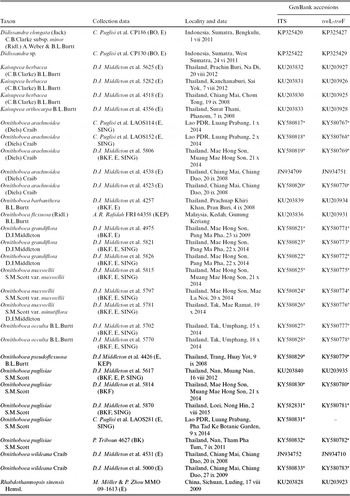
The newly collected herbarium material was morphologically compared with material of existing species in BKF, E, K, and SING (Thiers, continuously updated), and to the species concepts in Scott & Middleton (Reference Scott and Middleton2014). Fresh leaf fragments that had been dried and preserved in silica gel were also collected. The collection details and the herbaria where the vouchers are deposited are listed in Table 1.
Accessions used in this study

ITS, internal transcribed spacer.
*Sequences newly published in this study. The other data were generated by the authors for earlier studies and previously uploaded on GenBank.
The laboratory work was carried out at the Royal Botanic Garden Edinburgh and Singapore Botanic Gardens. Total genomic DNA extractions were made either following the cetyltrimethyl ammonium bromide method of Doyle & Doyle (Reference Doyle and Doyle1987) without further purification, or by using the innuPREP Plant DNA Kit (Analytik Jena, Jena, Germany) according to the manufacturer's instructions. The markers used in our analyses were the nuclear internal transcribed spacer (ITS), sequenced from the primer pairs 5P–8P (both Möller & Cronk, Reference Möller and Cronk1997) or ITS1–ITS4 (both White et al., Reference White, Bruns, Lee, Taylor, Innis, Gelfand, Sninsky and White1990), and the plastid trnL-trnF (i.e. trnL intron and trnL-trnF spacer), from the primer pair C–F (both Taberlet et al., Reference Taberlet, Gielly, Pautou and Bouvet1991). These are the regions that have been sequenced in other recent studies of Asian Gesneriaceae (Middleton et al., Reference Middleton, Nishii, Puglisi, Forrest and Möller2015; Möller et al., Reference Möller, Nishii, Atkins, Kong, Kang, Wei, Wen, Hong and Middleton2016; Puglisi et al., Reference Puglisi, Yao, Milne, Möller and Middleton2016).
The PCRs followed two main 25-μL recipes: (1) 2.5 μL of 2 mM dNTPs, 2.5 μL of 10 × NH4 buffer, 1.25 μL of 25 mM MgCl2, 0.75 μL each of 10 μM forward and reverse primer, 0.8 μL of 0.4% bovine serum albumin, 0.2 μL of Biotaq polymerase (Bioline, London, UK), 1 μL of DNA template and 15.25 μL of dH2O; and (2) 12.5 μL of GoTaq Green Master Mix (Promega, Madison, Wisconsin, USA), adding 1 μL each of 10 μM forward and reverse primer, 1 μL of DNA and 9.5 μL of dH2O. The PCR thermocycles used were: (1, for some ITS) 94°C for 3′, 30 × [94°C for 1′, 55°C for 1′, 72°C for 1.5′], 72°C for 5′, 10°C forever; (2, for some trnL-trnF) 94°C for 4′, 35 × [94°C for 45′′, 55°C for 45′′, 72°C for 3′], 72°C for 10′, 10°C forever; and (3, for some ITS and trnL-trnF) 95°C for 3′, 35 × [95°C for 1′, 50°C for 1′, 72°C for 1′], 72°C for 5′, 4°C forever. The PCR products were purified with either ExoSAP-IT (Affymetrix, Santa Clara, California, USA), or QIAquick PCR Purification Kit (Qiagen, Redwood City, California, USA), from gel or directly from PCR product. All sequencing reactions used BigDye Terminator (Applied Biosystems, Thermo Fisher Scientific, Waltham, Massachusetts, USA) technology, and were sequenced by GenePool (University of Edinburgh, UK) or by AITbiotech (Singapore) on an ABI3730 DNA Analyser (Applied Biosystems). The use of different protocols and thermocycles was a practical choice based on the ready availability of chemicals in different laboratories, and not a form of troubleshooting. The sequences were edited in Sequencher version 4.7 (Gene Codes Corporation, Ann Arbor, Michigan, USA), manually aligned in Mesquite version 2.75 (Maddison & Maddison, Reference Maddison and Maddison2011), and analysed in MrBayes version 3.2.2 (Ronquist & Huelsenbeck, Reference Ronquist and Huelsenbeck2003; Ronquist et al., Reference Ronquist, Huelsenbeck and Teslenko2011). The consensus trees were edited in FigTree version 1.3.1 (Rambaut & Drummond, Reference Rambaut and Drummond2009).
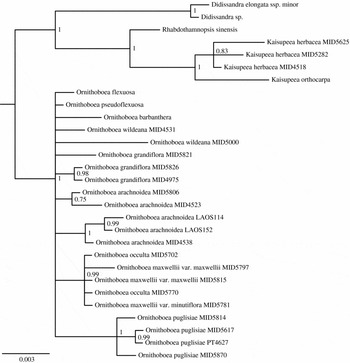
The outgroup was chosen to include Kaisupeea B.L.Burtt and Rhabdothamnopsis Hemsl., from the sister clade to Ornithoboea (Puglisi et al., Reference Puglisi, Yao, Milne, Möller and Middleton2016), and accessions of Didissandra C.B.Clarke, which is part of Didissandrinae, the sister subtribe to the Loxocarpinae (Weber et al., Reference Weber, Clark and Möller2013). The ingroup includes samples of 8 of the 16 species recognised by Scott & Middleton (Reference Scott and Middleton2014), plus the two putative new taxa (Table 1). All but one accession have full sequences of both DNA regions included; an accession of Ornithoboea puglisiae is represented only by the nuclear ITS and is therefore absent from the trnL-trnF consensus tree presented, although it is included in the combined analyses of the two markers.
The Bayesian analyses were run over 1,000,000 generations or longer at increments of 250,000 generations, until the standard deviation of the split sequences reached values lower than 0.01. Thus, the ITS Bayesian inference took 1,250,000 generations to reach a standard deviation of 0.009559, the trnL-trnF took 1,500,000 generations to reach a standard deviation of 0.009080, and the combined dataset reached a standard deviation of 0.008579 after 1,000,000 generations. The other parameters used were constant for all the analyses. The heat was set at 0.05, because the default setting of 0.1 did not allow for satisfactory swaps between chains; the substitution model used was a GTR with gamma-distributed rate variation across sites, allowing for a proportion of invariable sites; and the burn-in was arbitrarily set to discard 25% of the trees. The output trees were summarised in 50% majority rule consensus trees.
Results
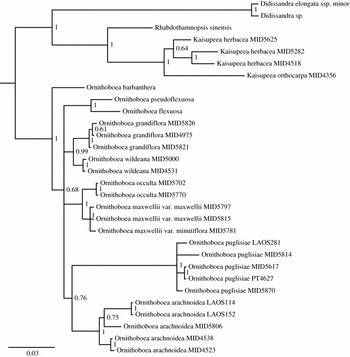
The phylogenetic trees (Figs 1–3) present a strongly supported (posterior probability, PP = 1) monophyletic Ornithoboea, with the ingroup accessions placed along a basal polytomy. As expected, given the low taxonomic level being investigated in this study, the trnL-trnF provided little insight into the relationships between species (Fig. 1). In the ITS tree, Ornithoboea barbanthera is sister to the rest of the genus (PP = 1), and the other accessions form four clades arranged in a polytomy. One of them sees Ornithoboea pseudoflexuosa as sister to O. flexuosa, with PP = 1. A second clade includes Ornithoboea occulta, O. maxwellii and the newly described O. maxwellii var. minutiflora. Support for the clade is high (PP = 1), as is the support for the monophyly of each species (PP = 1). A third clade includes Ornithoboea wildeana and the second putative new taxon, O. grandiflora; again, the clade and the monophyly of each of the two taxa receive very high support (PP = 0.99 and PP = 1, respectively). The last clade, supported by PP = 0.76, consists of the species Ornithoboea puglisiae and O. arachnoidea, both monophyletic with PP = 1 (Fig. 2).
The 50% majority rule consensus tree resulting from the Bayesian inference of the trnL-trnF data. Statistical support is expressed as posterior probabilities, which are shown by the nodes.

The 50% majority rule consensus tree resulting from the Bayesian inference of the internal transcribed spacer data. Statistical support is expressed as posterior probabilities, which are shown by the nodes.

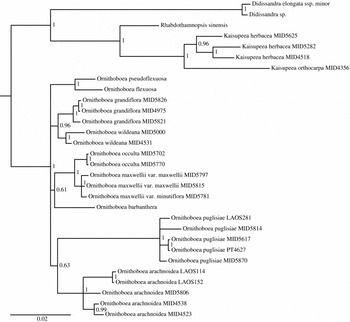
The 50% majority rule consensus tree resulting from the Bayesian inference of a dataset combining internal transcribed spacer and trnL-trnF sequences. Statistical support is expressed as posterior probabilities, which are shown by the nodes.

Given the lack of topological conflict between the trnL-trnF and ITS tree, the datasets were also analysed together, under the same models but as distinct partitions, in order to allow for overall different mutation rates across the regions. The resulting consensus tree (Fig. 3) presents one topological difference from the ITS tree, specifically in the position of Ornithoboea barbanthera, which is no longer sister to the whole genus, but rather is weakly associated with O. occulta and O. maxwellii, with PP = 0.61. The rest of the tree is otherwise topologically identical. The posterior probabilities of the nodes subtending Ornithoboea wildeana and O. grandiflora on one clade, and O. puglisiae and O. arachnoidea on another, are slightly lower (0.96 and 0.63, respectively), and some resolution is lost within O. arachnoidea.
Discussion
The three accessions of the new species Ornithoboea grandiflora, identified on morphological grounds as distinct from O. wildeana and included in the molecular phylogenetic study, were found to form a monophyletic group sister to O. wildeana. Ornithoboea maxwellii var. minutiflora, identified on morphological grounds, was initially thought distinct enough to be described as a new species, but on reflection and with the molecular phylogenetic study unable to distinguish it from O. maxwellii var. maxwellii, it was decided to describe it as a new variety. It should be noted, however, that the distinction of these new taxa was made primarily on morphological grounds, and that the molecular data do not refute these delimitations. Unfortunately, there was insufficient resolution to clarify the relationships between the species, which means it is not possible to test whether there are separate northern and southern clades, as found in Paraboea (Puglisi et al., Reference Puglisi, Yao, Milne, Möller and Middleton2016).
New Taxa
Ornithoboea grandiflora D.J.Middleton, sp. nov.
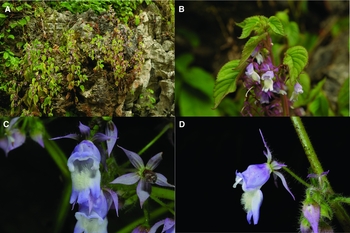
Most similar to Ornithoboea wildeana Craib and Ornithoboea lacei Craib in the large flowers, but differing from both in the geniculate filaments with no projection (large projection in O. wildeana and O. lacei); additionally differing from O. wildeana in the much denser pubescence in the palatal beard and circlet, and in the retuse corolla lobes; and differing from O. lacei in having smaller flowers. – Type: Thailand, Mae Hong Son, Pang Ma Pha, Tham Lod Cave area, 640 m, 22 x 2014, D.J. Middleton, C. Hemrat, P. Karaket, C. Puglisi & S. Suddee 5826 (holo BKF; iso E, QBG, SING [plus spirit]). Fig. 4 .
Ornithoboea grandiflora D.J.Middleton. A, Habitat on limestone rocks; B, shoot and inflorescence; C, flower from the front; D, flower from the side. (A and B, photographs of D.J. Middleton et al. 5821 by Preecha Karaket; C and D, photographs of D.J. Middleton et al. 5826 by Preecha Karaket.)

Herb on limestone rocks; base of stem without persistent leaf bases; stems sparsely covered with long gland-tipped hairs, leaf internodes 4–6 cm. Leaves opposite; petioles densely short glandular pubescent and with scattered long gland-tipped hairs, (2.2–)5–11.3 cm long; blade ovate, (3.5–)6.8–23 × (1.6–)2.8–11.5 cm, 1.4–2.6 times as long as wide, base cordate, apex acuminate, margin finely to coarsely crenate to dentate, 7–12 pairs of secondary veins, sparsely covered in a mixture of glandular hairs of various lengths above and beneath. Inflorescences cymose, axillary, 3.5–8 cm long, 4- to 14-flowered, densely pubescent throughout with a mixture of shorter and longer glandular hairs; peduncle 1.2–2.8 cm long; bracts linear, 9–16 mm long; pedicels 8–19 mm long. Calyx of 5 lobes free to base, narrowly ovate, pinkish purple, 9–12 × 2.7–3.4 mm, apex acuminate, sparsely to densely covered in short and long gland-tipped hairs. Corolla 16–19 mm long, tube, upper lip and tips of lobes on lower lip pale lilac to violet, rest of corolla cream-coloured, outside glabrous, inside densely pubescent on the circlet and at base of upper lip and lower lip (palatal beard), palatal beard pale yellow, hairs on circlet white, sessile glands dorsally in tube; tube 6.8–7.5 mm long; upper lip 2-lobed, 1–3 mm long, each lobe 3–4 mm wide; lower lip 3-lobed, not reflexed, 9.2–11.5 mm long, with distinct palatal beard inside at base, lateral lobes 2.2–4.5 × 3.7–4.6 mm, mid lobe 3.1–5.2 × 3.7–4.5 mm, all lobes oblong, apices retuse. Stamens inserted at c.3 mm from corolla base; filaments thin at base, thicker higher, thickened at bend but without large projection, strongly geniculate, densely pubescent at bend, c.5 mm long; anthers 1.5–1.8 × 2–2.6 mm, densely pubescent at base, fused at tips; lateral staminodes 2.5–2.8 mm long, strongly curled downwards, medial staminode c.0.4 mm. Ovary 2.5–3.2 mm long, densely covered in sessile to short-stalked glands; style 9–11 mm long, sparsely to densely covered in subsessile to short-stalked glands, glabrous towards apex. Stigma truncate. Fruit unknown.
Distribution
Northern Thailand (known only from Mae Hong Son Province but close to the Myanmar border).
Habitat and ecology
In fissures in karst limestone rocks in full sun in dry evergreen forest.
Etymology
Named after the particularly large flowers. In the genus, only Ornithoboea lacei has larger flowers.
Proposed IUCN conservation assessment
Endangered (EN B1ab(ii,iii),B2ab(ii,iii)) under IUCN Standards and Petitions Subcommittee (2016) guidelines. The known extent of occurrence and area of occupancy, both less than 2 km2, place this in the Critically Endangered range owing to disturbance from human activity, especially where they occur along the road and as a result of construction of shrines. However, there is extensive limestone in the area, and the distribution could be greater than known. Also, at least two populations are known with no evidence of fragmentation, thereby qualifying the species as Endangered rather than Critically Endangered.
Additional specimens examined. Thailand. Mae Hong Son: Pang Ma Pha, Road between Pai and Pang Ma Pha, 632 m alt., dry evergreen forest on limestone, 22 x 2014, D.J. Middleton, C. Hemrat, P. Karaket, C. Puglisi & S. Suddee 5821 (BKF, E, SING); Pang Ma Pha, Just outside entrance to Tham Lot cave area, 700 m alt., on large karst limestone boulder, 23 ix 2009, D.J. Middleton, S. Lindsay & P. Suksathan 4975 (BKF, E, QBG).
The large range in the lengths of the lobes in the lower lip of the corolla is a reflection of the degree of fusion of the central lobe to the lateral lobes, with shorter lobes corresponding to a longer fused part of the lower lip. It is highly variable even within a single plant.
Scott & Middleton (Reference Scott and Middleton2014) included Middleton et al. 4975 in Ornithoboea wildeana, which is a widespread and variable species. The two species are superficially similar and can usually be distinguished by the slightly retuse corolla lobes in Ornithoboea grandiflora. Ornithoboea grandiflora has a denser pubescence in the palatal beard and circlet, but in the absence of plants of each species to compare directly, this is rather difficult to quantify for identification. The character that is most reliable to distinguish them is the lack of the filament projection in Ornithoboea grandiflora (a very pronounced filament projection in O. wildeana), but this requires dissection of a flower to see.
Ornithoboea maxwellii S.M.Scott var. minutiflora D.J.Middleton, var. nov.
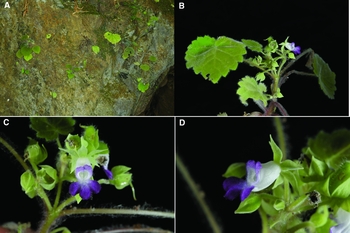
Similar to Ornithoboea maxwellii S.M.Scott var. maxwellii but differing in the purple corolla lobes with purple hairs (white corolla lobes with white hairs or with very few purple hairs at base of lower lip in O. maxwellii var. maxwellii), and the uniformly minute hairs on the calyx (mixture of minute hairs and sparse long arachnoid hairs in O. maxwellii var. maxwellii). – Type: Thailand, Tak, Mae Ramat District, Road to Mae Sariang, 181 m alt., 19 x 2014, D.J. Middleton, C. Hemrat, P. Karaket, C. Puglisi & S. Suddee 5781 (holo BKF; iso E, QBG, SING [plus spirit]). Fig. 5 .
Ornithoboea maxwellii var. minutiflora D.J.Middleton. A, Habitat on limestone rocks; B, whole plant; C, flower from the front; D, flower from the side. (Photographs of D.J. Middleton et al. 5781 by Preecha Karaket.)

Herb on limestone rocks; base of stems with persistent leaf bases; stems densely arachnoid pubescent (i.e. with long, twisting and matted hairs). Leaves opposite, crowded; petioles densely arachnoid pubescent, 2.7–11 cm long; blade ovate or orbicular, 2.5–8.8 × 2.2–7.8 cm, 0.8–1.3 times as long as wide, base cordate, apex obtuse to rounded, margin coarsely crenate to dentate, 4–6 pairs of secondary veins, mixture of hairs of various lengths all over above, including sparse arachnoid hairs, similar beneath but more confined to venation so appearing sparser. Inflorescences cymose, 3- to 10-flowered, densely pubescent throughout with a mixture of shorter and longer glandular hairs and occasional much longer arachnoid hairs; peduncle 3.8–9 mm long; pedicels 5.5–10 mm long. Calyx of 5 lobes free to base, narrowly to broadly elliptic, 3–4 × 0.9–3.4 mm, enlarging slightly and persistent in fruit, apex acute to acuminate, densely minutely puberulent. Corolla c.9.2 mm long, tube white, lobes purple, tube minutely and sparsely glandular puberulent, lobes with longer glandular hairs inside and outside, more densely so inside; tube c.3.8 mm long; upper lip 2-lobed, each lobe 1.8 × 2.2 mm, apices rounded, densely pubescent with purple hairs on upper lobes and in ring around throat; lower lip 3-lobed, not reflexed, c.5.4 mm long, lobes densely pubescent with purple hairs, without distinct palatal beard, lateral lobes c.2.8 × 2.6 mm, mid lobe c.3.2 × 2.5 mm, all lobes obovate, slightly overlapping, apices rounded. Stamens inserted at c.0.7 mm from corolla base; filaments thin at base, thickened higher, without pronounced sterile projection, geniculate, glabrous, c.2.2 mm long; anthers c.1 × 1.2 mm, glabrous, fused at the tips; staminodes 3, laterals c.1.5 mm long, medial c.0.1 mm long. Ovary c.1.5 mm long, densely glandular puberulent; style c.3 mm long, densely glandular puberulent. Stigma truncate. Fruit 7–8 mm long, 2–2.5 mm wide, densely long hairy, style persistent.
Distribution
Known only from the type locality.
Habitat and ecology
Limestone rocks and cliffs in mixed deciduous forest by road at 181 m altitude.
Etymology
Named after the small flowers, so far the smallest known in the genus.
Proposed IUCN conservation assessment
Data Deficient (DD) under IUCN Standards and Petitions Subcommittee (2016) guidelines. This species is currently known only from the type locality, which is not in a protected area. It is, however, in an area of extensive limestone that is not yet sufficiently explored and is also close to the border with Myanmar, which is even less well explored and where Ornithoboea maxwellii var. minutiflora could also occur.
This variety is similar to the recently described Ornithoboea maxwellii S.M.Scott var. maxwellii (Scott & Middleton, Reference Scott and Middleton2014), differing in the characters noted above and additionally, but rather more tentatively, in the corolla circlet being less hairy, the lower lip rather less uniformly hairy, and the lower lobes shorter and wider. It should be noted for these latter characters, however, that Ornithoboea maxwellii var. maxwellii is known from only four collections and O. maxwellii var. minutiflora from only one. They are most easily distinguishable by the very obvious difference of Ornithoboea maxwellii var. maxwellii having white flowers, with an occasional purple hair at the base of the lower lip, and O. maxwellii var. minutiflora having the corolla limb purple, both in corolla tissue and hairs. In fruit, they can be distinguished by the indumentum on the persistent calyx, as noted above.
DNA sequence data show the two varieties to be almost identical for the two genes sequenced. Recognising that they are very close, but rather distinct from each other in the absence of any known intermediate morphologies, we describe this plant as a variety of Ornithoboea maxwellii.
Acknowledgements
We thank Chandee Hemrat and Preecha Karaket for their assistance in the field and Preecha Karaket additionally for the excellent photos.