On September 9, 2017, Hurricane Irma made landfall in Florida, causing an estimated $50 billion in damages. 1 The hurricane also caused power outages for 6.7 million (64%) Florida customers throughout the state, with some locations lacking power for 2 weeks. 2 Reports of the deaths of nursing home residents due to heat exposure in the days after the hurricane prompted Governor Scott to issue an emergency order requiring all nursing homes (NHs) and assisted living facilities (ALFs) to have a secondary power source in the event of primary power loss, which was later codified by the Florida legislature in May 2018. The law requires these locations to have a secondary power source that can keep ambient air temperature below 81° F within specified areas of the facilities to ensure the safety, health, and well-being of residents. Reference Bowers3 The law created an implementation deadline for January 1, 2019, and noncompliance of the law includes deficiency citations during surveys and possible fines.
The new law also raised concerns over the financial burdens imposed on Florida’s long-term care (LTC) providers. Indeed, it was estimated that the total cost to implement the rule would be $186 million for NHs and $240 million for ALFs. 4,Reference Bowers5 Additional concerns related to the differences between NHs and ALFs were raised. NHs are LTC facilities that provide 24-hour a day nursing care, while ALFs are designed to provide personal care services in a home-like environment. 6 Generally, NHs care for older residents with higher care needs than ALFs, indicating care practices and models are different, although both settings serve residents with care needs that make them vulnerable to heat exposure. Reference Harris-Kojetin, Sengupta and Lendon7,Reference Street, Burge and Quadagno8
There is little research on the effect of new regulations on LTC facilities and their ability to comply. A national study on NH compliance with overall safety and quality regulations, using total deficiency citations as a measure of noncompliance, found larger, for-profit, and chain-affiliated NHs were more likely to comply with regulations. Reference Castle9 Concerning ALFs, one study used total deficiency citations to measure ALF compliance with all Florida regulations, finding that compliance was associated with having a specialty license (eg, to provide nursing services) and regional location. Reference June, Meng and Dobbs10
The research aims of this study are to determine whether certain characteristics of NHs and ALFs were associated with compliance with the emergency power rule by Florida NHs and ALFs. Based on previous research, the hypotheses of this study are NHs and ALFs that are larger, part of a chain, and for-profit will be more likely to be compliant with the regulation.
Methods
Data Source
Data are from the Florida Agency for Health Care Administration (AHCA) facility finder website (floridahealthfinder.gov) and the 2017 version of the Online Survey and Reporting (OSCAR) system from the Centers for Medicare and Medicaid Services. The AHCA data were used to create the entire sample of ALFs and NHs and for ALF characteristic data, while the OSCAR data provided NH characteristic data.
Sample
The full dataset had 681 NHs and 3115 ALFs in operation in September 2017. There were 1 NH and 175 ALFs that closed before January 1, 2019, and these were removed from the analyses. ALFs that closed were smaller and did not have a memory care unit. In total, the final sample included 680 NHs and 2940 ALFs.
Dependent Variable
The dependent variable was emergency power plan implementation by January 1, 2019. For the analysis, implementation dates on or before January 1, 2019, were categorized as 1, while implementation dates after January 1, 2019, or missing implementation dates were categorized as 0.
Independent Variables
Independent variables included organizational and resident characteristics. For NHs, organizational characteristics of interest included bed count, chain membership, profit status, having an Alzheimer’s Disease and Related Dementia (ADRD) unit, and rural location. Resident characteristics included Medicaid residents. Bed count is a dichotomous variable with groups for less than or equal to 100 beds (0) and greater than 100 beds (1). Chain membership, profit status, ADRD unit, and rural location are dichotomous variables (yes/for-profit/rural = 1, no/not-for-profit/urban = 0). Medicaid residents is a dichotomous variable for whether an NH has 50% of their resident population covered by Medicaid (≥50% Medicaid residents = 1; <50% Medicaid residents = 0).
For ALFs, organizational characteristics included bed count, specialty licenses, memory care unit, profit status, Medicaid acceptance, and rural location. Bed count is a dichotomous variable with groups for less than or equal to 16 beds (0) and greater than 16 beds (1). These groups were based on language in the final law that separated ALFs by bed count for minimum fuel amounts that needed to be stored on site. Reference Harris-Kojetin, Sengupta and Lendon7 Specialty licenses is a categorical variable with no specialty licenses (0), nursing care specialty license (1), and mental health specialty license (2). ALFs with licenses to provide nursing services (Extended Congregate Care and Limited Nursing Services) serve individuals whose care needs are similar to nursing home residents. Mental health licensed ALFs (Limited Mental Health) care for younger adults with behavioral issues. Reference Street, Burge and Quadagno8 The presence of a memory care unit, profit status, Medicaid acceptance, and rural location are dichotomous variables (yes/for-profit/rural = 1; no/not-for-profit/urban = 0).
Statistical Analysis
This study used a bivariate descriptive analysis of independent variables by dependent variable groups. For full analyses, this study used 2 logistic regressions, 1 for NHs and 1 for ALFs, to examine the effect of organizational and resident characteristics on the odds of emergency power plan implementation.
Results
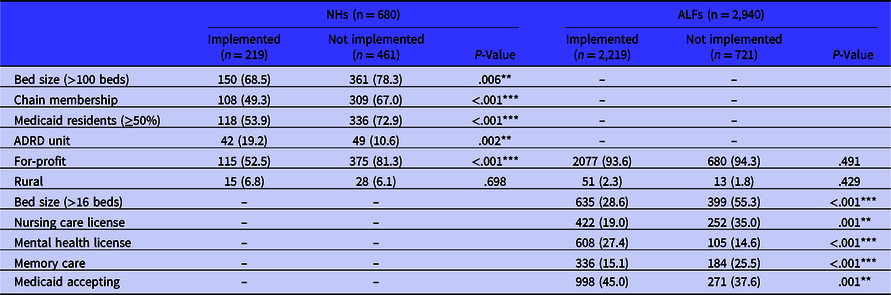
By January 1, 2019, a total of 219 (32.9%) NHs and 2219 (75.5%) ALFs had implemented their emergency power plans. Descriptive characteristics of NHs and ALFs by emergency power plan implementation are presented in Table 1. NHs in compliance were smaller, not part of a chain, relied less on Medicaid payments, and were not-for-profit. ALFs in compliance were smaller, had a mental health license, did not offer memory care services, and accepted Medicaid payments.
Characteristics of NHs and ALFs by plan implementation (N = 3,620)

Abbreviation: ADRD = Alzheimer’s Disease and Related Dementias.
* P < 0.05.
** P < 0.01.
*** P < 0.001.
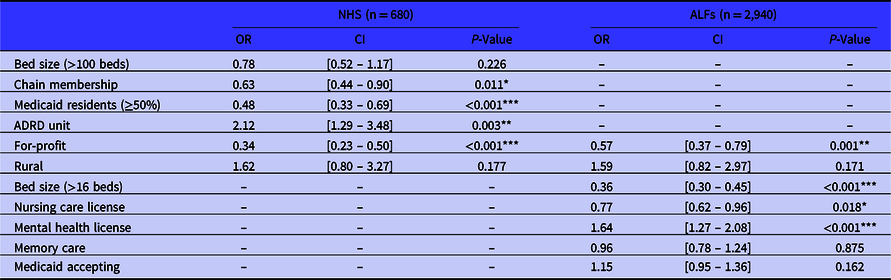
Table 2 presents odds ratios (ORs) and 95% confidence intervals (CIs) for the logistic regression between NH and ALF characteristics and compliance with the emergency power rule. For NHs, chain-affiliation had a 27% lower odds of implementation (OR = 0.63; 95% CI = 0.44-0.90), for-profit status was associated with a 66% lower odds of implementation (OR = 0.34; 95% CI = 0.23-0.50), a majority Medicaid resident population had a 52% lower odds of implementation (OR = 0.48; 95% CI = 0.33-0.69), and having an ADRD unit was associated with a 112% higher odds of implementation (OR = 2.12; 95% CI = 1.29-3.48). For ALFs, for-profit status was associated with a 43% lower odds of implementation (OR = 0.57; 95% CI = 0.37-0.79), a capacity more than 16 beds was associated with a 64% lower odds of implementation (OR = 0.36; 95% CI = 0.30-0.45), a nursing care specialty license had a 23% lower odds of implementation (OR = 0.77; 95% CI = 0.62-0.96), and a mental health specialty license was associated with a 64% higher odds of implementation (OR = 1.64; 95% CI = 1.27-2.08).
Results of logistic regression of NHs and ALFs characteristics by plan implementation (N = 3,620)

Abbreviation: ADRD, Alzheimer’s Disease and Related Dementias.
* P < 0.05.
** P < 0.01.
*** P < 0.001.
Discussion
This study examined the relationship between NH and ALF characteristics and their timely implementation of a new emergency power rule. Results from this study suggest ALFs were in compliance with the new law at a higher rate than NHs, although different characteristics for each affected compliance. The trends for overall safety compliance differ somewhat from the trends observed concerning emergency preparedness compliance. This may be because of the high priority the state placed on emergency preparedness compliance after the heat-related NH deaths from Hurricane Irma. The hypotheses for the study were partially supported. NHs that were for-profit, were part of a chain, or relied on Medicaid for more than 50% of payments were less likely to implement their plan on time, while NHs with an ADRD unit were more likely to implement their plan. Also, ALFs that were for-profit or had a specialty license to provide nursing services were less likely to implement their plan in time, while ALFs that had fewer beds and a license to provide mental health care were more likely to implement their plan.
Although for-profit, chain-affiliated NHs may have additional resources for the type of expenditure the new rule required, these NHs were less likely to have an emergency power plan implemented before the deadline. One explanation may be that there is a large capital cost associated with chain-affiliated NHs, compared with a single NH. Additionally, because each location requires a unique plan that fits its needs, working concurrently on multiple plans may increase the time needed to complete and implement each plan. Nursing homes with an ADRD unit were more likely to have a plan implemented in time. This may be due to these NHs recognizing the need for a secondary power source to ensure the health and safety of residents with ADRD. This includes locking systems that reduce the chance of a resident wandering out of the facility during an event causing a loss of power.
For-profit, large ALFs also were less likely to implement their emergency power plans in time. Similar to for-profit, chain affiliated NHs, the complexity of the needed alternative power plan may have caused delays in implementation by the deadline. Larger ALFs also may have had more difficulty implementing their plan, compared with smaller ALFs, because of the size of alternative power supplies needed. Smaller ALFs may have been able to meet the requirement with a more readily available mobile generator, while larger ALFs would have needed large, custom-built generator units that take additional time to build and cost more.
Additionally, compared with ALFs with no specialty licenses, ALFs with a nursing care specialty license were less likely to implement their emergency power plan in time, while those with a mental health specialty license were more likely to meet the deadline. The effect for a nursing care specialty license may be due to the additional care requirements for residents of these ALFs, who can be similar to nursing home residents. The high care needs for these residents may have forced these ALFs to focus their capital on equipment for health care, rather than an alternative power source. For the mental health specialty license, the increased odds of implementation may be because many of these ALFs are small residential homes. These buildings typically can use small, portable generators as an alternative power source, which are cheaper and easier to purchase than custom made generators.
Limitations
First, there are no financial data available for NHs and ALFs. Having these data would provide more information about the facilities’ resources to purchase an alternative power source. Additionally, there may have been other reasons beyond the control of the NHs and ALFs that caused their plans to be delayed. The first is the ability of the market to supply generators to so many facilities at once. Also, some facilities were required to obtain approvals from local agencies (eg, to meet local noise ordinances), which may have created additional delays. Finally, it is unknown whether the closure of the 175 ALFs excluded from the analytic sample was due to the new power rule and the financial burden placed on the ALFs.
Conclusions
This study examined the ability for Florida NHs’ and ALFs’ ability to implement a new emergency power rule. These results show the difficulty faced by NHs and ALFs to implement a new law that had high capital costs within a limited timeframe. Although the law imposed a large financial burden on a diverse industry, its intended effect was to save lives in the event of future disasters. Future research is needed to examine the financial abilities of NHs and ALFs to comply with the new regulation, and the effect of additional burdens imposed by local regulations on compliance. Additionally, AHCA could collect data on the financial burden the emergency power rule imposed on LTC facilities, and whether the rule caused any additional closures in the LTC industry. Policy-makers in other states considering similar regulations can use these findings to understand the impact of emergency preparedness regulations on the LTC industry.