1. Description
The physical distancing imposed by COVID-19 pandemic measures has led to a spectacular increase in interest in networked music performances due to events, such as festivals and conferences, moving online. Artists are looking for a medium that offers alternatives to ‘In Real Life’ (IRL).Footnote 1
Through the extensive experience of collective and same-time music practice IRL, we have acquired the necessary skills and reflexes that enable us to adapt to the particularities of this context. Yet, many intangible and tangible aspects related to music practice need to be overcome in a non-IRL approach. The former include the social dynamics of ensemble playing, performer/audience interactions or funding models of artistic works, and the latter relate to physical spaces, their shapes and objects or instruments that are recognisable as constituting a given musical culture.
The sociologist Pierre Bourdieu introduced the concept called habitus (Bourdieu Reference Bourdieu1972) as an aid to understanding the social dynamics inside specific groups. A habitus is characterised by specific socially ingrained habits, skills and dispositions. As stated by Bourdieu, it is the host of social reproduction and constitutes a guarantee that the aspirations of all are adjusted to the probability that each is able to realise their hopes (Bourdieu and Passeron Reference Bourdieu and Passeron2018). In the following, we are interested in the relationship of habitus and music performances, with the goal of informing our contributions to a non-IRL one. Most of the existing musical habitus are faced with the following paradoxical situation: a shared musical culture allows one to almost effortlessly create and practice collectively to have a significant impact on the performance, and possibly a better sense of engagement with the ensemble.
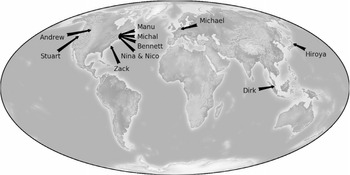
Location of Kaon’CPT members during the Perripplayear performance at the Audio Art Festival 2020.

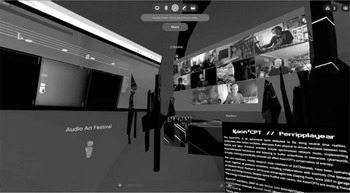
First-person view of the 3D performance space during our Audio Art Festival 2020 comprovisation. The foreground shows a panel indicating details of the performance. The background shows two giant panels, both visible for all audience members. The one on the left displays the dynamic score through screen sharing by one of the performers, and the one on the right displays the video mosaic of all the performers together. Some avatars can be seen on this, being a mix of the audience (Audio Art Festival & diB) and performers (NinaNico & Z Konatay). The rest of the space is composed of 3D black–grey–white objects creating anamorphic effects. This image is a screenshot taken from the firefox Web browser (fir 2021), extracted from Movie Example 1.

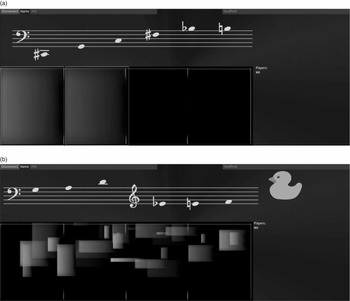
Two ‘pages’ of the score as seen by a musician. The score staff indicates the scale to use and the four-tile timeline indicates how sound activity should be distributed by performers. Note that musicians are not necessarily exposed to the same scale and activity indication at the same time. (a) The timeline in this score indicates activity at first and second iteration, but silence on the third and fourth iteration. (b) The chaos and shape of rectangles in the timeline indicates a tempo-free period of activity. The duck indicates that performers should unmute the microphone control in the 3D performance space, and therefore introduces an extra desynchronised layer of sound from the audience perspective.

2. How far from IRL?
Bringing a non-IRL dimension to music practice has its particular set of challenges. Some adaptations are necessary, and the transition to non-IRL will be easier if we can identify at least some essential corresponding elements.
2.1. Qualification of IRL music performance
In order to discuss the relationship between our approach and IRL music performance, we consider the following characteristics of IRL music performance:
-
Bodies. Joint emotional expression is essential in an ensemble music performance. One of the ways to convey the expressive intention is through body movement and sway (Chang, Kragness, Livingstone, Bosnyak and Trainor Reference Chang, Kragness, Livingstone, Bosnyak and Trainor2019). It permits synchronising musical events and communicating expressive parameters such as dynamics and tempo modulations. This expression extends beyond the musicians and influences the audience’s appreciation of the musical performance.
-
Space and time. Mutual perception and interaction between performers and the audience are a driving force of musical expression. It extends to social and cultural contexts and influences the perceptive quality of musical performance (Juchniewicz Reference Juchniewicz2008). The physical presence and relative closeness enable the feeling of being part of the experience. Visual cues are within eye’s reach and require only small head movements, accommodating limitations in the field of view. The feeling of sharing this same space is also supported by the illusion of sharing the same time, in which musical events can be consistently ordered and even perceived as simultaneous among performers. There are also many non-tangible factors: the way the people on stage behave, how they move, what they say, what they wear and, particularly, their eye contact with the audience (Antonietti, Cocomazzi and Iannello Reference Antonietti, Cocomazzi and Iannello2009).
-
Musical culture. The stage: the musical interactions are tagged with several cultural habits (Small Reference Small1999). This shared culture among performers is built through a common knowledge, sometimes specific to given musical styles: scales in jazz improvisation, chord progressions and form in blues, positions of musicians on stage, use of notation, walking choreography of a marching band and so on. As we describe it, musical culture is composed of all this accumulated knowledge that was acquired by training, listening or unconscious assimilation. While it limits a given musical practice only to the initiated, it allows almost spontaneous creation of musical ensembles with diverse and advanced collective abilities.
-
Social process. Starting even before its ideation stage, a performance is composed of several steps that draw the path to its presentation to an audience. Composing, learning, discussing, sound checking, rehearsing, designing performance space and scheduling are a few examples of auxiliary activities that shape the collective engagement and individual reflexes.
2.2. Comparison with non-IRL
Most IRL concerts comprise the preceding outlined qualities with adjustments to diverse culturally defined expectations from the public, the artists and show organisers point of views. There are expectations as to the format of the event, its evolution and its outcome. The intangible exchange of energy between the audience and the performers is stimulated by several dispositions: them facing each other, the behavioural ‘code’ of respect and expression of appreciation or dismay. All these dispositions are suddenly challenged when an IRL-type event is to be presented online. While in many online events the audience sees the performers, the audience itself is invisible. It is reduced to a number that may not even be seen to the performing musicians (but will become a part of statistics that will influence future online engagements).
The body representation is commonly addressed using body capture displayed with others in some sort of virtual space. The use of cameras and video mixing is probably the most common mutual presence in state of the art networked musical performances. It has the advantage of being a hands-free body capture. It offers an opportunity for performers to furnish their individual performance space with instruments, light and a reasonably controlled aesthetic presence. Videoconferencing approaches such as mosaics offer the performer a quick glance at others and access to their posture, activity and facial expressions. However, the lack of relative sense of position among performers and audience is limiting even in simple spatial choreography. Moreover, the single point of view of the performer’s camera defeats the possibility of one-to-one eye contact (Courchesne, Durand and Roy Reference Courchesne, Durand and Roy2014), further contributing to the feeling of disorientation. Today’s Western culture is dominated by many forms of highly developed video representations, and most musicians who perform from home are also challenged in their ability to produce elaborated live video with reasonably controlled video scenography, including background arrangement and lighting.
An alternative, or a complement, to the video mosaic is the use of 3D space with performers and audience incarnations as avatars, each provided with a first-person view of the same consistent space. This moving ability not only enables some sort of eye contact (Courchesne et al. Reference Courchesne, Durand and Roy2014) but also requires control of avatar posture and movement. One of our earlier experiments, called Waterfall music (wat 2021) included live photorealistic body capture of remote performers. It yielded interesting results at the cost of requiring extensive capture equipment and the necessity that the performers remain relatively static. Another approach is to use body capture with gestures mapped to the avatar, as was done by Jean-Michel Jarre in his Alone Together (alo 2021), a live VR performance during the French Fête de la Musique on 21 June 2020.
Beyond the strict body representation as support of group communication, Lauren Hayes and Christos Michalakos state that in the field of electronic music, and more particularly laptop performance, it becomes more difficult to rely on physical gesture to convey, for example, the onset of one’s sound to an audience, or to communicate with other performers. It may be unclear how a sound has been produced, or indeed who has made it (Hayes and Michalakos Reference Hayes and Michalakos2012). In such cases, some communication signals can be provided through the use of a cueing system transmitted through haptic feedback (Bhagwati et al. Reference Bhagwati, Basanta, Stein, Browne, Bachmayer and Tredici2016), which may solve the problem partially for performing musicians, but unfortunately not for the audience.
The sharing of time during IRL performance, with or without a strictly specified timing in the performance, constitutes a ‘time-bubble’ in which two musical events perceived simultaneously by one will also be perceived simultaneously by the others. It will most likely not be the case when musical events are transmitted through a computer network, since sound propagation delays are significantly increased compared to actual latency caused by speed of the sound. These high latencies produce inconsistent timing among musicians, making it difficult to share musical events and tempo (Shuett Reference Shuett2002).
In order to overcome this temporal issue, a popular approach in NMP consists of learning to play despite arbitrary latency, resulting in desynchronised audio streams, but intentionally included in the musical interaction. In turn, when delays remain sufficiently short, the effect of latency is hidden. This is a strategy employed by several network music collectives such as the access grid initiative (acc 2021) and most of the JackTrip (Cáceres and Chafe Reference Cáceres and Chafe2010) audio performances, including the recent ‘quarantine sessions’, a Distributed Electroacoustic Network Improvisation hosted by CCRMA (ccr 2021) and the Auksalaq telematic opera (Burtner, Kemper and Topper Reference Burtner, Kemper and Topper2012).
Another approach aims at providing performers with the illusion of a simultaneous clock. This temporal context is called ‘perceptive consistency’(Bouillot and Gressier-Soudan Reference Bouillot and Gressier-Soudan2004) and its most basic definition states that if two events are perceived (displayed) simultaneously by a performer, then these two events must be perceived simultaneously by others. As a consequence, this temporal consistency, if achieved, provides performers a simulacrum from which performers may use the same-time nature of many musical objects that can be involved in the performance, or not. For instance, David Ogborn uses a pulse-based composition for the networked orchestra (Ogborn Reference Ogborn2012), and Ian Whalley describes the inclusion of a metronome in GNMIS, a scoring system for Internet2 electroacoustic music (Whalley Reference Whalley2014).
In our previous Waterfall Music piece (2013), we employed a synchronisation strategy based on a conductor/performer that avoids the need to add extra latency into the streams, but requires that some performers, possibly including the conductor, hear only a subset of the mix. This synchronisation is described in a previous work (Bouillot Reference Bouillot2004). Another synchronisation strategy consists of adding delay to each received audio to achieve a constant delay for all, but matching a musical unit in a given tempo, for instance six times at 120 bpm. This strategy was studied and subsequently described (Bouillot Reference Bouillot2007), where it was demonstrated as enabling musicians to play several types of rhythmic music without the need for specific training. Additionally, it was demonstrated that such approach is limited in several cases, and particularly for musical performance based on a score with very rigid formal structure, such as a vocal song with accompaniment or music with varying metre.
Regarding social process, the online context suffers from another layer of complexity not observed in IRL interactions. The logistics needed for a successful NMP include asynchronous and synchronous textual communications (emails and chat), videoconferencing for planning and discussions, calendar management across different time zones and some additional technical adjustments such as instrument set-up for optimal audio streaming and local monitoring, in some cases 3D space navigation for the audience and performers, voice communication channels (clear-com, but remote). Furthermore, other aspects come into play. The performing musician must negotiate the ergonomics of their environment to accommodate both artistic presence and easy manipulation of technological devices. It will often be the performer’s responsibility to provide at least partial audio/video documentation, and live-streaming to the others. Some more specific technical challenges are described in section 4. Building a collective requires a process that includes detailed documentation and simplification, in order to minimise coordination and learning while maximising the time and attention spent on rehearsing and performing. This will be further developed in section 3, where we describe the building of a specific music culture.
The score plays a central role in the social process (Cascone Reference Cascone2003). It structures the group interactions and frames the performance towards a common outcome. Kathleen Coarsens considers that a score facilitate can not only the realisation of a performance but also the expectations of a community (Coessens Reference Coessens, de Assis, Brooks and Coessens2013), indicating that the research related to the score provides a social framework that facilitates cohesion and communication. This research is particularly active in electroacoustic music and networked musical performance (see section 3 for more discussions about scores). Accordingly, we see the design of a specific score or score system as a medium that may facilitate the cognitive exchange between the public and artists. It can be crafted to be useful not only to the performing artists but also to the audience and, at the same time, to be aesthetically fitting to the type of show and its subculture and to contribute to the exchange of energy between the audience and the performers, as well as the accompanying behavioural ‘code’ of musical performance.
3. Building the Kaon’CPT collective musical culture
Skills learned from IRL practice is one of the concept keys to bring people together and overcome the technological kludge of using a computer to accomplish everything that is related to communication with performance spaces.
Ian Cross tells us that music ‘is a fundamental part of human communicative toolkit’ and engagement in music-making manifests itself in different ways across different cultures (Cross Reference Cross2005: 114). There is also some evidence that music-making in groups has a positive impact on the development of our social skills and overall well-being (Eldridge, Hughes and Kiefer Reference Eldridge, Hughes and Kiefer2016). It is not surprising that humans want to engage in music -making together, even when they cannot be in the same physical location, be it by choice or forced by the circumstances.
Therefore, we do not adhere to any specific style or genre of improvisation, whether it is, as Bailey describes, ‘non-idiomatic’ (Bailey Reference Bailey1993), but rather propose a structure that gives a performer the space for contributing one’s own aesthetic, with the freedom to reuse hard-won skills in the structured context of a composition. Comprovisation (Bhagwati Reference Bhagwati2013) is an appropriate approach to balance a planned intention and freedom of expression in a group of improvising agents spread across many time zones. A set of a few simple rules and a score for everyone to follow can keep the communication constraints simple enough for musicians of all levels, yet sufficiently ‘open’ to individual creative explorations while helping everyone head in the same direction. A similar approach has been undertaken in electroacoustic music effectively through Internet2, using a directed dramaturgy approach (Dudas Reference Dudas2010; Whalley Reference Whalley2014), in which the scoring problems are also addressed.
As mentioned earlier, the score system, and its design, is considered here as the main source of structure in the communication. A score used for comprovisation does not have the same goal as a traditional music score. The assumption in this context is that the musicians are free to improvise (to any extent) and in this case we can encourage them to make their own interpretation, potentially within some constraints that will lead to a more or less predictable result. With this in mind, we are not seeking any specific outcome, rather we rely on the individual strengths, weaknesses and imagination of participating musicians to create together in the moment, enjoy each-other’s company and, possibly, be surprised by the result. To this regard, graphic notation has been extensively experimented, from John Zorn with his Cobra piece (van der Schyff Reference van der Schyff2013) to Cat Hope (Reference Hope2020: 188) who describes graphical and dynamic notations as follows: ‘the openness of graphic notations invites possibilities for a composition style that no longer holds emphasis on chord structures and melody, but instead focuses on the actual sound produced, rather than pitch organisation, as can be found in much electronic music. This attention to sound encourages a collaborative approach across different instruments, styles and forms that can be enabled by dynamic graphic notations.’
Our score, a combination of traditional pitch notation and graphics, was conceived to allow for alternation of sonic texture with fragments of melodies, chords, grooves and other sounds, encouraging a tapestry of many individual approaches. We see this as particularly critical for accommodating a great variety of instrumentation, music literacy levels and sight-reading abilities. Our use of a minimal subset of traditional music notation allows for hybrid interpretations, either verbatim (notes representing written pitches) or as an abstract set of symbols that could represent an arbitrary sonic event (or the mixture of the two). We have employed simple graphical notation to express rhythms and some expressive directions (such as dynamics). Another aspect to consider in the score is the handling of the parallel timings induced by network latency and geographical distance separating the performers. Again, we propose the score system to be inclusive and to be able to indicate some sort of sequences ranging from ad lib. to rhythmic, or providing some cue in time indicating action or silence in a coordinated manner. It implicitly requires a shared tempo, built on top of a metronome system that provides temporal ‘perceptive consistency’ among performers.
In the case of Perripplayear, many aspects of the score were controlled manually by the designated conductor, who was in charge of the progress of the piece. The conductor makes some decisions affecting mostly the macro level of the comprovisation and the overall harmonic/spectral rhythm. The individual comprovising agents provide the micro events that constitute the fabric of the overall texture.
A dynamic graphic score with a shared tempo provides a partial solution to smooth out, to a certain extent, the passage from IRL to non-IRL music performance. First, it benefits from most of the same-time musical effect learned from IRL, reducing the implication of time issues. Second, it opens the door to a different take on social process and musical culture issues by shifting focus from established IRL practices to exploration of diversification of musical ensembles through facing new realities and access to technology, often ubiquitous by now, at least in some contexts. It is also instrument agnostic, easily accommodating different families of instruments, acoustic and electronic alike. The shift to a take on scoring music in a way that allows for a looser interpretation and facilitating participation across the globe without discriminating among cultures, yet inevitably incorporating technology, shines a new light on potential musical cultures in the making. Emphasising the contribution of improvising agents led us to explore interesting musical complexity while reducing the intricacy of music notation and blurring the line between (un)pitched and (un)timed gestures. This approach resonates well with the findings of Ian Whalley when he describes his experience with networked music performance: ‘A metronome system was … needed for tempo that could also be altered, and a scrolling system needed to keep all participants located. Furthermore, the system needed to include a “conductor” to count in both performances and rehearsal cues’ (Whalley Reference Whalley2014: 245).
Finally, the performance space and the body issues can be partially solved using a browser enabled multiuser VR space, in which a video mosaic of performers is displayed, as well as with a performer avatar propagating its own sound from its particular position in the virtual world. Accordingly, navigation in the VR space allows for opportunistic meetings not only with other performers but also with the audience. There are certainly new opportunities for developing musical culture around a virtual performance space and body and emerging new social processes.
4. Perripplayear: a conducted live comprovisation
The COVID-19 pandemic, in conjunction with democratisation of technological tools brought by computing and networking, provided a unique context in which we would perhaps not even think about joining forces in a project unless there was an opportunity to be together physically. However, the pandemic has separated everyone and shifted focus towards online activities, and suddenly the internet became an important way to express oneself and to interact with other people. Perripplayear is a result of this context and brought together individuals who may not have collaborated together otherwise. Ever. Some members of the collective have prior experience with distributed performances, including performances that use virtual environments, and casual music jams.
When an opportunity to participate in the Network Music Festival (NMF) manifested itself, we wanted to transpose the social dynamic as good as IRL into our undertaking. By the time of this first Perripplayear performance, videoconferencing software was already ubiquitous and in daily use and exploration by most people, including amateur and professional musicians. Apart from the many criticisms of such software use for music performances, many of them relevant (e.g., sound quality, latency, difficult to convey the social aspect), it can be a fun and useful way to share a common passion.
Perripplayear addresses most of the challenges imposed by the distance between performers and the use of an internet connection. This piece still requires fairly strong technical knowledge, but adapts well to different musical skill levels with no specific need for musical training. We also designed the performance to be composed and loosely controlled aesthetically, while supporting the freedom of diverse instrumentation from performance to performance. In other words, the essence of our musical activities focuses more on taking part in the performance itself, in the social (inter)action, in musicking (Small Reference Small1999) rather than in the musical work itself. The logistics, especially pertaining to rehearsals, is central to the social process: when one is dealing with the complexity of trying to schedule rehearsals with busy local musicians, we can imagine how much more difficult it becomes when those musicians span 12 time zones (see Figure 1). Each of those musicians needs to ‘arrive’ at the rehearsal not only with their instrument but also with a computer and some means of getting the instrument’s signal into the appropriate software. The performer then has to balance the local mix of the ensemble, find comfortable settings for all the various software parameters, set the right levels of their individual sound feed and so on. Each participant has to be their own computer technician, sound engineer and potentially even a lighting designer. While we are talking here about Perripplayear specifically, we think that the approach described here is viable for any future works within the collective (or exported to others). The bases for this piece are manifold and include ‘comprovisation’ (Bhagwati Reference Bhagwati, de Assis, Brooks and Coessens2014) supported by a real-time score which can be applied to any instrument. The software ecosystem provides virtual body co-presence of an audience and performers in a shared and accessible 3D performance space, an audio synchronisation streaming tool that provides ‘perceptively consistent’ time events and a set of tools for the management of the performance process (see Figure 2 and Movie Example 1 for a first-person view of the Perripplayear performance space (per 2021)).
On a formal level, the piece is based on oscillations between rigid order and creative chaos. Marking moments of musical togetherness and wandering off into different directions became an important trope of the piece and did not require any complex rules. The basis for the piece was to playfully explore the different manifestations of time when engaged in music-making, amplified by the fact that the activity is distributed across many time zones (as illustrated in our case with Figure 1).
The aim of the score (Figure 3) is to carry pertinent information simply, thus avoiding cognitive overload. The basis of the score is to respect each improvising agent’s ability to improvise and make decisions on the spot that are consistent with the current musicking context. Our score can be qualified as both ‘generative’ and ‘transformative’, in the sense used by Cat Hope (Hope and Vickery Reference Hope and Vickery2011). There are three kinds of information provided to the musicians: pitches, rhythms and dynamic hints. These elements are no different from those conveyed by a conventional music score, but in this instance they were presented in a slightly different form. The departure from conventions in music notation in Perripplayear’s score stems from the unspecified instrumentation and focus on improvising musicians. The instruments employed in this comprovisation could be pitched or unpitched, have limited range, and come from different instrument families, as is the case of Kaon’CPT, in which at least two instruments are digital musical instruments (DMIs). Reading music is a developed skill and some musicians can sight-read extremely well, but there are limits to what a performer can interpret without prior knowledge (Eigenfeldt Reference Eigenfeldt2014). It is not uncommon that composers decide what elements they wish to specify precisely, how much fidelity is required and how much potential is desirable (Hope Reference Hope2020). In this case, we opted for pitch notation to be interpreted either as literal pitch (in its register) or associated with an arbitrary sound event. In that sense, the ‘pitch’ collections form unique structural elements, not unlike chord progressions in traditional music. The approach is inspired by Witold Lutosławski’s use of ‘chord aggregates’ (Rae Reference Rae1992). His own use of 12-note chords was a departure from traditional harmony, but we are taking them a step further and not limiting them to traditional instruments but allowing the use of arbitrary sounds (samples, prepared instruments, synthesised sounds) as part of the ‘chord’. The score divides the group into two subgroups, each allocated with a set of notes from the aggregate in order to produce two distinct sets with a null intersection and offers the musicians a lot of freedom of choice and order of the currently displayed notes.
The website (kao 2021) describes the interpretation of the score in detail, but we want to draw attention to a few key elements. The pitches are presented as traditional noteheads on a staff. Each player may choose to play any number, in any order, of the pitches on a given ‘page’. The rhythms and dynamics are represented by the blocks below the staff and provide a flexible way of indicating the oscillation between rigid rhythms and ad lib. rhythmic moments.
4.1. Technical set-up
Among the challenges was the necessity that the musicians have a certain level of computer literacy in order to be able to carry out the piece. Those who have some experience in dealing with streaming, server configuration, etc. have taken on the task of making the infrastructure work. However, every participant needs to rely on his or her own skills to troubleshoot problems with their local technical set-up. This kind of ‘detail’ can put a fair amount of pressure on the participants: dealing with a technological pipeline consisting of five more or less related tools is not something that musicians are accustomed to in their everyday life. In fact, this aspect of the piece is a potential impediment in finding more interested performers. Even if finding technologically savvy musicians is easy in the twenty-first century, those who are willing to deal with technological complexity, while playing, are few.
There are many tools that exist for musical collaborations online: JackTrip (jac 2021), NinJam (nin 2021), Sonobus (son 2021), Scenic (sce 2021) and Jamulus (jam 2021) to mention just a few that cater specifically to musical collaborations over networks. More are actually being developed since the beginning of the pandemic that address different needs and use cases. Few of those tools address the extra-musical aspects of musical performance such as visual cues and gestures, and exchange of data that is meaningful for the performance. Regardless of the choice of the tool, other tools needed to be selected to fill in those gaps. We ended up with a cocktail of software that enabled us to communicate between ourselves, act as a troubleshooting back channel, display a score, stream audio and video content, and host a virtual space for the performance.
We chose NinJam, but the choice was very subjective. Some of us had played with it already, it is multiplatform, and it fits certain musical approaches well. NinJam also provides an interesting constraint. It relies on a fairly long delay that is a multiple of an arbitrary musical unit. The side effect of this approach is that each musician improvises with the others’ contributions to the previous musical unit. However, the technique allows for a very precise synchronisation of musical time. The advantages and constraints of this technique had a powerful influence on the nature of the comprovisation.
NinJam substitutes the uncontrollable latency caused by software and hardware pipeline in the network between musicians by a controllable latency, much longer, measured in musical time units. The NinJam website explains the concept in detail, but what is relevant to our approach is this ability to synchronise everyone on a common click track when necessary. Perripplayear plays with this idea, oscillating between tightly timed and ad lib. moments.
The score was implemented using the Godot game engine (god 2021). It fulfilled two important requirements: 1) it is a tool that we are familiar with; and 2) it is a tool that can enable us to easily implement a ‘multiplayer’ ability that can deliver synchronised cues to distributed performers.
As mentioned earlier, the venue in which a musical work is presented influences the mood and appreciation of the event. We chose Mozilla Hubs (hub 2021) because it offered a platform that was easily accessible, visually customisable, open source, free to use and free to attend. We were not surprised to see that in the NMF, other artists and collectives also used Mozilla Hubs as their performance venue.
For videoconferencing discussion, we used BigBlueButton (bbb 2021) for meetings as well as gathering real-time video of performers to be sent into the performance space. Matrix (mat 2021) was employed for back textual channel, green room and troubleshooting needs.
5. Discussion
We presented an analysis of IRL musical performance and its intrinsic alterations when musical performance is achieved online; for example, not-IRL. Based on this analysis, we draw a model of what we think could be a socially effective collective for non-IRL comprovisation, mostly rooted in a balance between technical solutions that facilitate communication specifics and a composition strategy that structures musical (in)actions. In our work, special attention is paid to including and uniting performers with different musical cultures and knowledge, in which all contribute significantly to the comprovisation. This musical culture is informed by both IRL music practice and previous works of Networked Musical Performance by members of the collective.
We composed Perripplayear, a non-IRL piece that conforms to this online musical culture. It includes several communication strategies with a strong emphasis on a dynamic and distributed score, displayed on each performer’s screen and controlled by one or several of the performers, who became conductor(s) of the comprovisation. While the initial technical set-up required each member to learn the Kaon’CPT approach, this was almost the only learning effort necessary before becoming involved in the musical process. We documented the technical stack in the Kaon’CPT website, which was subsequently reused by Kaon’CPT members for other related activities such as education, concert series, jams and rehearsals.
We performed Perripplayear on several occasions, including the NMF (nmf 2021) and at the Audio Art Festival 2021 (aaf 2021). While the second performance included an additional performer, the respawn of the performance, as well as its adaptation to the Festival format, was spontaneous and hassle-free and demonstrated an increase in social engagement and adaptability of the piece to varying conditions.
Towards our goal of constructing a musical culture that evolves and adapts to NMP, we see some opportunity to increase the possible information provided by our dynamic score, and its ability to display static and dynamic content produced a priori by comprovisers in order to explore various approaches to structuring social and musical communication channels.
Our approach is also rooted in the dissemination of the documentation, both conceptual and technical. It is currently provided through the Kaon’CPT website and via other forms, with the objective to enable learning, and possibly adaptation and modification of our approach. In other words, we hope to inspire reproduction or building other derivative approaches, and learn, ourselves from those.
Acknowledgements
We would like to thank all the artists involved in Kaon’CPT’s Perripplayear: Bennett Smith, Emmanuel Durand, Nina Ripoll, Zack Settel, Stuart McLeod, Hiroya Miura, D. Andrew Stewart, Dirk Stromberg and Michael Edwards. We are grateful to Organised Sound reviewers and Bennett Smith for their constructive comments that helped us to significantly improve the present article.