





Long-acting injectable (LAI) antipsychotics are uniquely valuable interventions within schizophrenia management. Reference Keepers, Fochtmann, Anzia, Benjamin, Lyness and Mojtabai1 Among adults with schizophrenia, treatment delivered via an LAI formulation, compared with oral treatment with the same antipsychotic, is associated with improved medication adherence, greater reductions in time to and risk of relapse and associated hospital admission, and reduced risk of premature death. Reference Leucht, Tardy, Komossa, Heres, Kissling and Salanti2–Reference Wei, Yan, Kang, Wong, Castle and Gao4 In addition, by facilitating continued antipsychotic treatment, LAI antipsychotic use can support a diagnosis of schizophrenia resistant to standard antipsychotic treatment, thereby promoting optimised treatment with clozapine, while improving convenience for patients and caregivers. Reference Patel, Bent-Ennakhil, Sapin, di Nicola, Loze and Nylander5 Despite recognition that use of LAI formulations increases the effectiveness and clinical utility of antipsychotic treatment, significant disparities exist in the prevalence of LAI antipsychotic prescribing globally. Reference McKee, Crocker, Dikaios, Otter, Bardell and Roy6–Reference Barnes, Shingleton-Smith and Paton8 Consequently, the role of these formulations in clinical practice remains suboptimal, with utilisation typically occurring following poor or uncertain adherence to oral treatment. Reference Kishimoto, Sanghani, Russ, Marsh, Morris and Basu9 Even after relapse secondary to non-adherence, LAI antipsychotics continue to be markedly underused. Reference Barnes, Shingleton-Smith and Paton8,Reference Kishimoto, Sanghani, Russ, Marsh, Morris and Basu9
Many barriers to use of LAI antipsychotics have been reported. Among patients, a lack of sufficient awareness of LAI formulations, concern regarding the need for injections, and negative beliefs associated with schizophrenia and receiving injectable forms of antipsychotics are common. Reference Aprile, Rodolico, Di Francesco, Varrasi, Bighelli and Castellano10 Among clinicians, gaps in knowledge pertaining to LAI antipsychotic formulations, ideological positions regarding LAI antipsychotic formulations as restrictive or punitive, and lack of availability of methods to effectively increase patient engagement in resource-finite services are commonly stated barriers. Reference Kane, Agid, Castle, Citrome, Fagiolini and Kishimoto11 Organisational and institutional factors, including variation in service delivery models and a lack of dedicated implementation supports, represent further barriers to LAI antipsychotic prescribing. Reference Kane, Agid, Castle, Citrome, Fagiolini and Kishimoto11,Reference Correll12 In 2025, consensus recommendations were developed by experts in schizophrenia management with the aim of encouraging increased prescribing of LAI antipsychotics in in-patient and out-patient settings. Reference Kane, Agid, Castle, Citrome, Fagiolini and Kishimoto11 Key recommendations included offering an LAI form of antipsychotic treatment to all individuals diagnosed with schizophrenia and prescribing as early as possible after a diagnosis. Reference Kane, Agid, Castle, Citrome, Fagiolini and Kishimoto11 In addition, harmonised international guidance for schizophrenia management (INTEGRATE) published in 2025 recommended that LAI antipsychotic formulations should be considered part of routine management of first-episode schizophrenia, following establishment of efficacy and tolerability of oral therapy. Reference McCutcheon, Pillinger, Varvari, Halstead, Ayinde and Crossley13
To facilitate effective uptake of these recommendations in practice, targeted implementation supports are essential. Such supports should be designed on the basis of what is known to be effective in changing prescribing behaviours relating to LAI antipsychotics in real-world practice. Reference Fitzgerald, Sahm, Maidment, Wallace, Zisman-Ilani and Højlund14 However, there is a lack of knowledge about what works in terms of changing these behaviours, and regarding when to increase LAI antipsychotic prescribing. Reference Fitzgerald, Howe, Maidment, Wallace, Zisman-Ilani and Højlund15 Purposeful study of healthcare systems with comparatively high rates of LAI antipsychotic prescribing could provide such knowledge; this could in turn be used to facilitate scale-up of effective strategies in other settings. Reference Fitzgerald, Sahm, Maidment, Wallace, Zisman-Ilani and Højlund14 In 2024, Ireland ranked 12th of 75 countries with respect to the rate of clozapine prescribing. Reference Fitzgerald, O’Dwyer, Dhubhlaing, Gee, Sahm and Wheeler16 Whether Ireland also has comparatively high prescribing rates of other underprescribed psychotropics, including LAI antipsychotic formulations, has not previously been studied. The present study aimed to:
-
(a) determine the annual prevalence of LAI antipsychotic prescribing among adults in the Republic of Ireland (ROI) between 2014 and 2024;
-
(b) examine temporal trends in the annual prevalence of LAI antipsychotic prescribing from 2014 to 2024; and
-
(c) explore the impact of (i) age, (ii) sex, (iii) socioeconomic status and (iv) antipsychotic medication choice on trends in LAI antipsychotic prescribing.
Method
Study design
This was a secondary data analysis using routinely collected dispensing data in the ROI. Hereafter, ‘Ireland’ refers to the ROI only. To obtain population-level data on the prevalence of LAI antipsychotic prescribing, data from 2014 to 2024 (inclusive) were requested from the Health Service Executive Primary Care Reimbursement Services (HSE-PCRS). 17 The HSE-PCRS is responsible for making payments to pharmacists for medications provided to the public. Reference Parkin, Bennett, Mc Nicholas and Hayden18 For the STrengthening the Reporting of OBservational studies in Epidemiology Checklist, see the Supplementary Material available at https://doi.org/10.1192/bjo.2026.12133.
Data source
Information held in the HSE-PCRS database reflects national claims made by pharmacies for dispensed medications. ‘Pharmacies’ here refers to retail pharmacy businesses, i.e. community and hospital pharmacies providing medications within out-patient services. Information in the HSE-PCRS database represents the best available data-set in the ROI from which information on LAI antipsychotic prescribing trends nationally can be extrapolated from dispensing data. This has been done in several studies aiming to establish medication prescribing rates in the ROI. Reference Parkin, Bennett, Mc Nicholas and Hayden18,Reference Mattsson, Flood, Wallace, Boland and Moriarty19 Use of this database also more accurately accounts for primary non-adherence among people with schizophrenia, as evidence of dispensing following issuing of a prescription is inherent.
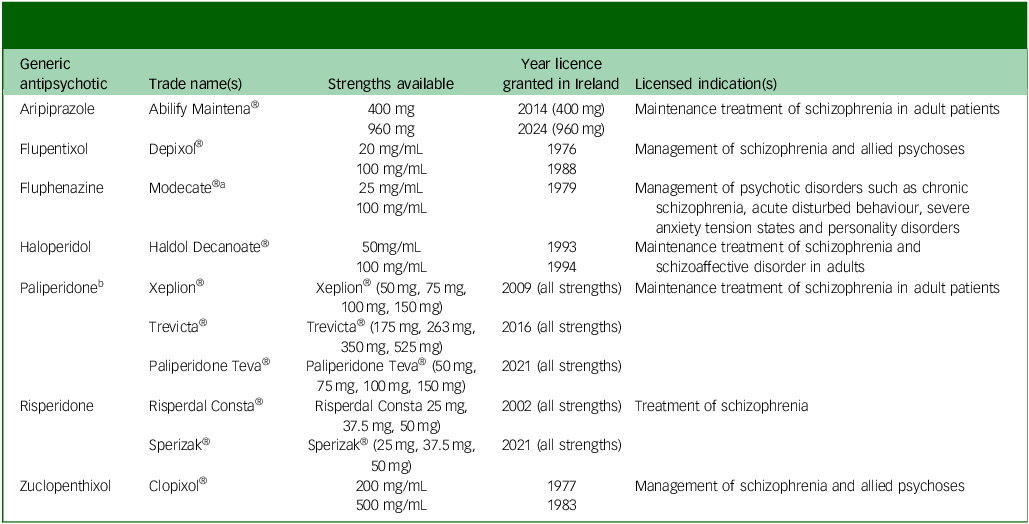
Reimbursement by the HSE-PCRS is provided through two main schemes: (a) the General Medical Scheme (GMS) and (b) the Drug Payment Scheme (DPS). Qualification for the GMS is based on income-related means-testing. The remainder of the population can receive government-funded subsidised prescription medications through the DPS. For the cost of a medication to be reimbursed by the HSE-PCRS, the medication must appear on an centralised list of approved items. Reference Sinnott, Bennett and Cahir20 With the exception of olanzapine LAI, all antipsychotics licensed in Ireland are eligible for reimbursement. 21 Owing to unique monitoring requirements for post-injection syndrome with olanzapine LAI and associated costs, 22 olanzapine LAI is not eligible for reimbursement by the HSE-PCRS. 21 Therefore, results presented in this study do not include rates of olanzapine LAI prescribing. Antipsychotics available in Ireland as an LAI formulation, and for which data on prescribing rates were requested, are outlined in Table 1.
Antipsychotics available in the Republic of Ireland as a long-acting injectable formulation and eligible for reimbursement by the Health Service Executive Primary Care Reimbursement Services

Table 1 Long description
The table outlines various generic antipsychotic medications, their trade names, available strengths, the year the license was granted in Ireland, and their licensed indications. The table has 10 rows and 5 columns. Column headers are Generic antipsychotic, Trade name(s), Strengths available, Year licence granted in Ireland, and Licensed indication(s). Row 1: Aripiprazole, Abilify, 400 mg, 2014 (400 mg), Maintenance treatment of schizophrenia in adult patients. Row 2: Aripiprazole, Maintena®, 960 mg, 2024 (960 mg), Maintenance treatment of schizophrenia in adult patients. Row 3: Flupentixol, Depixol®, 20 mg/mL, 1976, Management of schizophrenia and allied psychoses. Row 4: Flupentixol, Depixol®, 100 mg/mL, 1988, Management of schizophrenia and allied psychoses. Row 5: Fluphenazine, Modecate®, 25 mg/mL, 1979, Management of psychotic disorders such as chronic schizophrenia, older adults with disturbed behaviour, severe anxiety tension states and personality disorders. Row 6: Haloperidol, Haldol, 100 mg/mL, 1994, Maintenance treatment of schizophrenia and schizoaffective disorder in adults. Row 7: Haloperidol, Decanoate®, 50 mg/mL, 1993, Maintenance treatment of schizophrenia and schizoaffective disorder in adults. Row 8: Paliperidone, Xepion®, 50 mg, 75 mg, 100 mg, 150 mg, 2009 (all strengths), Maintenance treatment of schizophrenia in adult patients. Row 9: Paliperidone, Trevicta®, 175 mg, 263 mg, 350 mg, 525 mg, 2016 (all strengths), Maintenance treatment of schizophrenia in adult patients. Row 10: Paliperidone, Paliperidone Teva®, 50 mg, 75 mg, 100 mg, 150 mg, 2021 (all strengths), Maintenance treatment of schizophrenia in adult patients. Row 11: Risperidone, Risperdal, 50 mg, 2002 (all strengths), Treatment of schizophrenia. Row 12: Risperidone, Consta®, Risperdal Consta 25 mg, 37.5 mg, 50 mg, 2002 (all strengths), Treatment of schizophrenia. Row 13: Risperidone, Sizenix®, 25 mg, 37.5 mg, 50 mg, 2021 (all strengths), Treatment of schizophrenia. Row 14: Zuclopenthixol, Clopixol®, 200 mg/mL, 1977, Management of schizophrenia and allied psychoses. Row 15: Zuclopenthixol, Clopixol®, 500 mg/mL, 1983, Management of schizophrenia and allied psychoses.
a. Modecate® preparation was discontinued in Ireland in 2018.
b. Paliperidone 6-monthly preparation is not eligible for reimbursement in the Republic of Ireland.
Data held in the HSE-PCRS database are freely accessible with the necessary confidentiality agreements. Reference Sinnott, Bennett and Cahir20 The database contains basic demographic information (e.g., sex, age) and details of dispensed medications for each individual. Information on diagnostic indication is not available. 21 A data access request was submitted for the number of unique individuals aged 15–69 years for whom at least one LAI antipsychotic preparation had been dispensed within the GMS or DPS annually between 2014 and 2024. Stratified results according to year, age, sex, individual antipsychotic and drug scheme were requested. The proportions of individuals with onset of schizophrenia before the ages of 14, 18 and 25 years were estimated to be 3, 12.3 and 47.8%, respectively, with a median age at onset of 25 years. Reference Solmi, Radua, Olivola, Croce, Soardo and Salazar de Pablo23 The upper age limit of 69 years accounted for the premature mortality rate among people with schizophrenia, Reference Firth, Siddiqi, Koyanagi, Siskind, Rosenbaum and Galletly24 as schizophrenia has been associated with an average of 14.5 [95% CI 11.2, 17.8] years of potential life lost. Reference Hjorthøj, Stürup, McGrath and Nordentoft25 Although we considered an upper age limit of 65 years, 69 was chosen to account for the variation in reported estimates of the mortality gap and potential differences between male and female people (the average age of mortality among male individuals has been demonstrated to be considerably lower than that of their female counterparts). Reference Hjorthøj, Stürup, McGrath and Nordentoft25 Socioeconomic status was approximated using attribution to either medication reimbursement scheme. Receipt of LAI antipsychotic treatment within either the GMS or the DPS was utilised as a proxy for socioeconomic status, with individuals qualifying for reimbursement under the GMS presumed to represent, on average, a lower socioeconomic class than those claiming reimbursement under the DPS. Reference Parkin, Bennett, Mc Nicholas and Hayden18 As the data requested were fully anonymised and provided at aggregate level, no formal ethical approval from a research ethics committee before access was required by the data controller.
Data analysis
Estimation of prevalence of LAI antipsychotic prescribing (2014–2024)
The prevalence of LAI antipsychotic prescribing was defined as the number of unique individuals in receipt of ≥1 dispensings of a prescription for an LAI antipsychotic formulation per 1000 eligible population. The eligible population was defined as the number of individuals aged 15–69 years in Ireland estimated as having a diagnosis of schizophrenia. Thus, for each calendar year between 2014 and 2024, the annual prevalence of LAI antipsychotic prescribing/1000 was calculated as follows:
 $$\small{{\left( {{\rm{Total \,number \,of \,unique \,individuals \,dispensed \,LAI \,antipsychotics}} \times 1000} \right)} \over {\left( {{\rm{Total \,eligible \,population \,aged}}\,\!15 \!\!- \!69 \!\times \!{\rm{age}}\, \!-\! \,{\rm{standardised \,schizophrenia \,prevalence}}} \right)}}$$
The number of people in Ireland each calendar year aged 15–69 years was obtained from the Central Statistics Office. 26 As no national schizophrenia register exists, the annual prevalence of schizophrenia was estimated. The age-adjusted prevalence of schizophrenia in Ireland was obtained from the Institute of Health Metrics and Evaluation, Global Burden of Disease – Mental Health Prevalence data-set. 27 Information on schizophrenia prevalence in Ireland was available from 2014 to 2021, and prevalence estimates ranged from 0.32 to 0.34%. 27 For years 2022–2024, prevalence estimates were calculated via linear extrapolation using trend data from previous years. To examine the impact of age on prescribing trends, the prevalence of LAI antipsychotic prescribing was calculated for age bands 15–24, 25–34, 35–44, 45–54, 55–64 and 65–69 years. To account for differences in the prevalence of schizophrenia throughout the life course, Reference Solmi, Radua, Olivola, Croce, Soardo and Salazar de Pablo23 age-adjusted estimates of schizophrenia prevalence from the Global Burden of Disease – Mental Health Prevalence data-set were used alongside corresponding population figures from the Central Statistics Office. 26,27 All figures were rounded to the nearest whole number.
Impact of time, age, sex, socioeconomic status and antipsychotic medication on LAI antipsychotic prescribing
Trends in LAI antipsychotic prescribing were examined using log-linear regression. The dependent variable was the annual prevalence of LAI antipsychotic prescribing between 2014 and 2024. The dependent variable was log-transformed to better meet model assumptions, including a linear relationship between LAI prescribing prevalence and time, as the analysis aimed to estimate proportional change over time. Reference Schieber, Guy, Seth, Young, Mattson and Mikosz28,Reference Stacherl, Renner and Weber29 One model was fitted separately in the case of year, age band, socioeconomic class (GMS/DPS) and antipsychotic medication. Reference Scannell, Burton and Kearney30 The male-to-female ratio for LAI antipsychotic prescribing was examined across each year and within age bands and socioeconomic classes; temporal trends for each prescribing ratio were also assessed using log-linear regression, with the natural logarithm of the ratio as the dependent variable and calendar year as the independent variable, and analyses were performed separately for each age band and socioeconomic class. Regarding the effect of antipsychotic medication on prevalence trends, as data for fluphenazine were available for 2014–2018 only, a small constant (0.1) was added before logarithmic transformation to account for zero values in the dependent variable from 2019 to 2024. This constant was selected to be negligible relative to the scale of the outcome and to minimise distortion of non-zero values. Confidence intervals (95%) and P-values were reported for all statistical tests with alpha = 0.05. For all results of log-linear analyses, the average annual percentage change in LAI antipsychotic prescribing was calculated as follows: [exp(coefficient of the year variable) – 1] × 100%. Reference Schieber, Guy, Seth, Young, Mattson and Mikosz28–Reference Scannell, Burton and Kearney30 Correspondingly, results of statistical tests presented in the Results section represent the constant proportional (percentage) change per year, rather than a constant absolute change. Results before exponentiation of coefficients are presented in the Supplementary Material. Data analysis was performed using SPSS (version 29.0.2.0 for mac OS; IBM Corp., Armonk, New York, USA; https://www.ibm.com/products/spss-statistics).
Results
Annual prevalence of LAI prescribing (2014–2024)
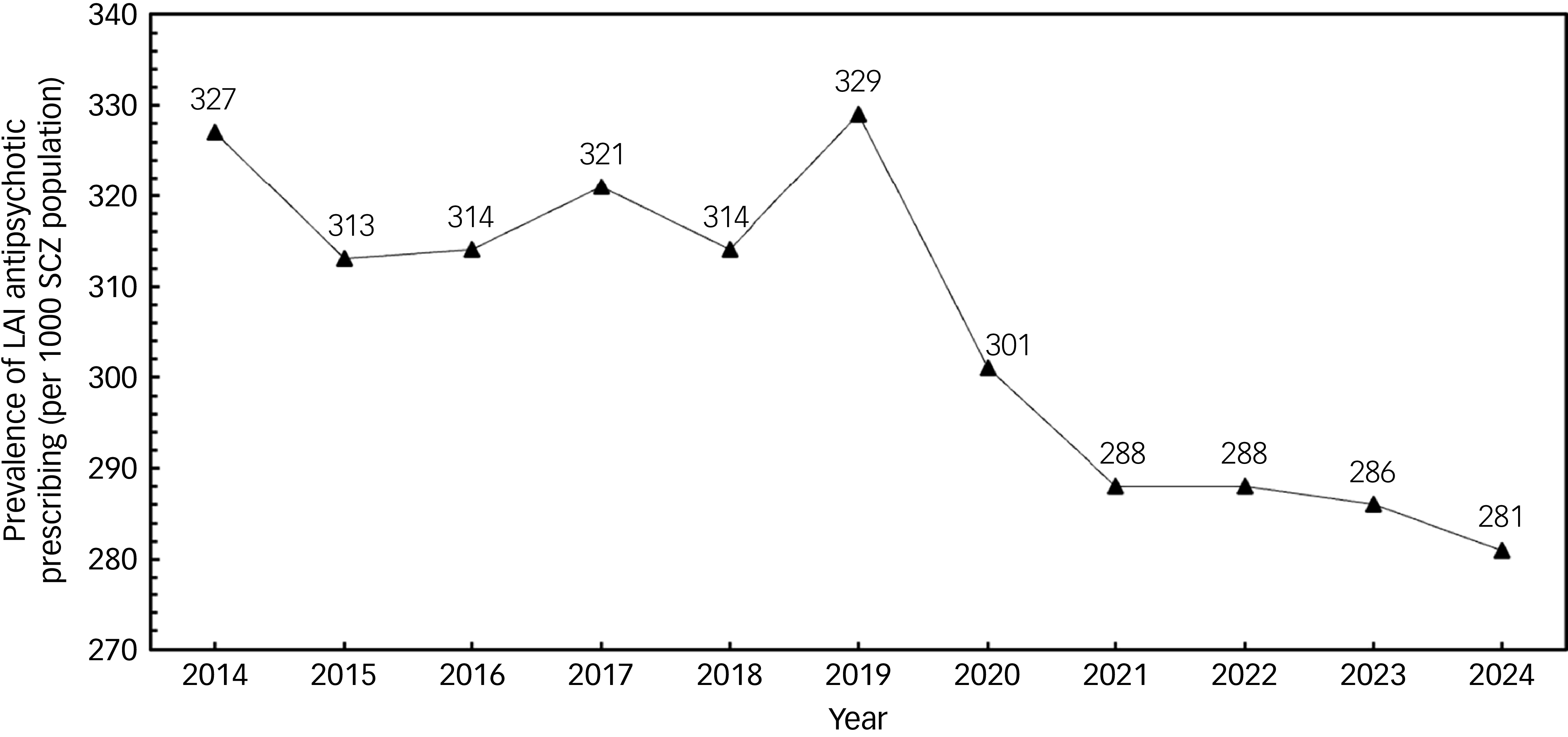
The prevalence of LAI antipsychotic prescribing decreased from 327/1000 individuals with schizophrenia in 2014 to 281/1000 in 2024. The average annual change in rate of prescribing was estimated to be −1.49% [95% CI −1.98, −0.79]. Figure 1 provides an overview of the annual prevalence of LAI antipsychotic prescribing annually between 2014 and 2024.
Annual prevalence estimates of long-acting injectable antipsychotic use in the Republic of Ireland among individuals aged 15–69 years with schizophrenia between 2014 and 2024, inclusive. LAI, long-acting injectable; SCZ, schizophrenia.

Variation in LAI antipsychotic prescribing according to antipsychotic medication
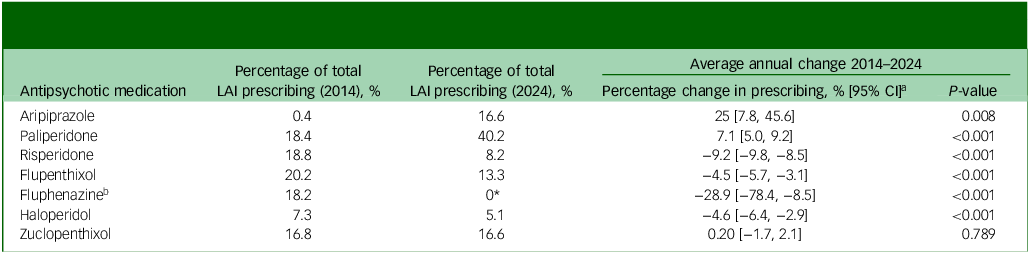
In 2014, LAI preparations containing first-generation antipsychotics (FGA) were the most frequently prescribed formulations, accounting for 62.4% of total prescriptions. In 2024, LAI preparations containing second-generation antipsychotics (SGA) accounted for 65% of total prescriptions. Prescribing rates of all FGA decreased significantly between 2014 and 2024, with the exception of zuclopenthixol, for which rates did not change significantly. Figure 2 provides an overview of the trend of LAI antipsychotic prescribing according to antipsychotic medication.
Trends in long-acting injectable (LAI) antipsychotic prescribing according to antipsychotic medication.

Although paliperidone LAIs were the most frequently prescribed formulations in 2024, aripiprazole LAIs had the largest significant increase in prescribing rate over the study period (+25% [95% CI 7.8, 45.6]). Further details of changes in LAI antipsychotic prescribing rates according to antipsychotic medication and class are outlined in Table 2. The proportions of total prescribing attributable to individual LAI antipsychotic formulations for each year studied are presented in the Supplementary Material.
Rates of long-acting injectable (LAI) antipsychotic prescribing in 2014 and 2024 and average annual percentage change in prescribing over this period, according to antipsychotic medication and class

Table 2 Long description
The table presents data on the percentage of total LAI prescribing for different antipsychotic medications in 2014 and 2024, as well as the average annual change in prescribing rates over this period. The table has 8 rows and 4 columns. The columns are labeled ‘Antipsychotic medication’, ‘Percentage of total LAI prescribing (2014)’, ‘Percentage of total LAI prescribing (2024)’, and ‘Average annual change 2014-2024’. The ‘Average annual change 2014-2024’ column includes sub-columns for ‘Percentage change in prescribing (95% CI)’ and ‘P-value’. Row 1: Aripiprazole, 0.4 percent, 16.6 percent, 25 percent [7.8, 45.6], 0.008. Row 2: Paliperidone, 18.4 percent, 40.2 percent, 7.1 percent [5.0, 9.2], less than 0.001. Row 3: Risperidone, 18.8 percent, 8.2 percent, -9.2 percent [-9.8, -8.5], less than 0.001. Row 4: Fluphenixol, 20.2 percent, 13.3 percent, -4.5 percent [-5.7, -3.1], less than 0.001. Row 5: Flupentixol, 18.2 percent, 0 percent, -28.9 percent [-78.4, -8.5], less than 0.001. Row 6: Haloperidol, 7.3 percent, 5.1 percent, -4.6 percent [-6.4, -2.9], less than 0.001. Row 7: Zuclopenthixol, 16.8 percent, 16.6 percent, 0.2 percent [-1.7, 2.1], 0.789.
a. The average annual change in utilisation was calculated using a linear regression model, with log-transformed usage rate as the dependent variable and year as the only independent variable. The average annual change was expressed as the average annual percentage change, calculated as [exp(the coefficient of the year variable) − 1] × 100%. Correspondingly, results of statistical tests represent the constant proportional (percentage) change per year, rather than a constant absolute change.
b. Fluphenazine was discontinued in Ireland in 2018, although evidence of continued prescribing of available stocks was observed until 2020 within the data-set.
Variation in LAI antipsychotic prescribing according to age
Across all age bands and within each year over the study period, the highest rate of LAI prescribing was seen among those aged 65–69 years, whereas the lowest rate was consistently seen among those aged 15–24 years. Figure 3 provides further details of the rate of LAI antipsychotic prescribing within each age band.
Rate of long-acting injectable prescribing each year between 2014 and 2024 according to age band (in years). LAI, long-acting injectable; SCZ, schizophrenia.

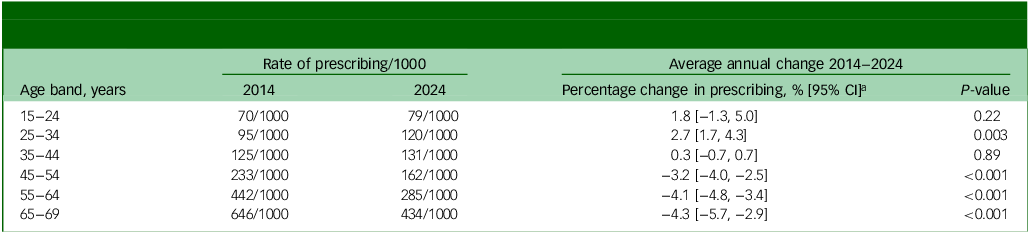
Between 2014 and 2024, significant changes in the average annual prescribing rate were observed within some age bands. Whereas the prescribing rate did not change significantly among those aged 15–24 years, there was an increase of 2.7% [95% CI 1.7, 4.3] in the average annual prescribing rate among those aged 25–34 years. A significant decrease in prescribing rates occurred among all age bands between the ages of 45 and 69 years, with the largest absolute decrease occurring among those aged 65–69 years (−4.3% [95% CI −5.7, −2.9]). Further details of changes in prescribing rates according to age are provided in Table 3. Prescribing rates within each age band for each year studied are contained in the Supplementary Material.
Rate of long-acting injectable (LAI) antipsychotic prescribing in 2014 and 2024, and the average annual percentage change in prescribing over this period, according to age

Table 3 Long description
A table comparing the rate of LAI antipsychotic prescribing per 1,000 people across different age bands for the years 2014 and 2024, along with the average annual percentage change in prescribing rates over this period. The table has 6 rows and 5 columns. Column headers are: Rate of prescribing/1,000, Age band, years, 2014, 2024, Average annual change 2014-2024, Percentage change in prescribing [95% CI], and P-value. Row labels are: 15-24, 25-34, 35-44, 45-54, 55-64, 65-69. Row 1: 15-24, 70/1000, 79/1000, 1.8% [-1.3, 5.0], 0.22. Row 2: 25-34, 95/1000, 120/1000, 2.7% [1.7, 4.3], 0.003. Row 3: 35-44, 125/1000, 131/1000, 0.3% [-0.7, 0.7], 0.89. Row 4: 45-54, 233/1000, 162/1000, -3.2% [-4.0, -2.5], <0.001. Row 5: 55-64, 442/1000, 285/1000, -4.1% [-4.8, -3.4], <0.001. Row 6: 65-69, 646/1000, 434/1000, -4.3% [-5.7, -2.9], <0.001.
a. The average annual change in utilisation was calculated using a linear regression model, with log-transformed usage rate as the dependent variable and year as the only independent variable. The average annual change is expressed as the average annual percentage change, calculated as [exp(coefficient of the year variable) − 1] × 100%. Correspondingly, results of statistical tests represent the constant proportional (percentage) change per year, rather than a constant absolute change.
We hypothesised that high rates of LAI antipsychotic prescribing among those aged 65–69 years could be explained to some extent by other factors. For instance, we considered whether prescribing for alternative diagnoses, such as behavioural and psychological symptoms in dementia, may have been an explanatory factor related to age-specific prescribing practices among older adults, given that this practice is increasing in relation to use of oral antipsychotics in many settings. Reference Aigbogun, Cloutier, Gauthier-Loiselle, Guerin, Ladouceur and Baker31 Other factors considered included increasing mortality rates among those aged 65–69 years, related to the mortality gap among those with schizophrenia, which would falsely inflate rates of LAI antipsychotic prescribing prevalence among this subgroup compared with other age groups by consistently decreasing the denominator in annual age-standardised calculations. To explore the potential effects of these factors on the accuracy of the overall study results, we recalculated annual prevalence estimates between 2014 and 2024 and the average annual percentage change in prescribing rate including only those aged 15–64 years. Following recalculation, the annual prevalence rates of LAI antipsychotic prescribing in 2014 and 2024 were reduced to 298/1000 and 252/1000, respectively. The average percentage change in prescribing rate over this time showed a similar trend (−1.39 [95% CI −2.0, −0.8]). The full results of this analysis are provided in the Supplementary Material.
Differences in LAI prescribing according to socioeconomic class
Among individuals with a lower socioeconomic status, the average annual percentage increase in prescribing was 11.4% [95% CI 9.9, 12.9]. Among those assigned to a higher socioeconomic class, the corresponding percentage increase was 18.2% [95% CI 14.0, 22.5].
Differences in LAI prescribing according to sex
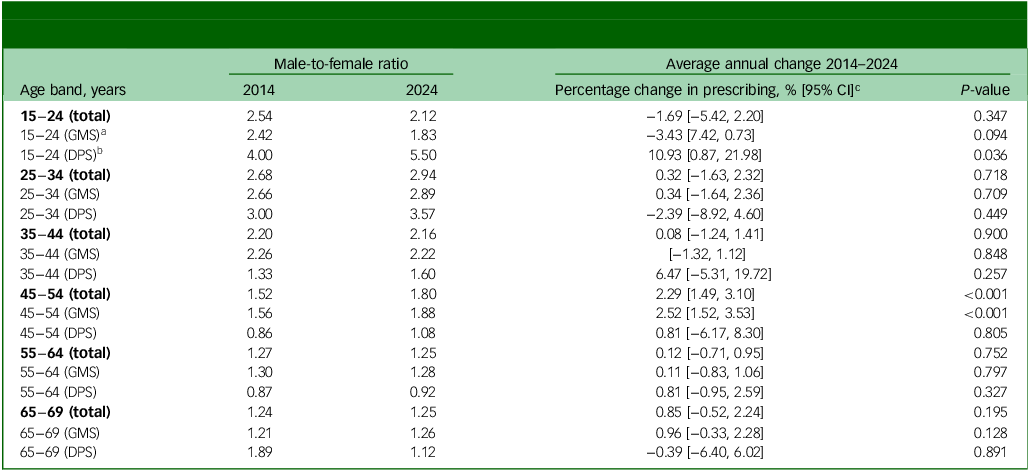
Male individuals were prescribed LAI antipsychotics at higher rates than female individuals in every year studied. In 2024, the male-to-female prescribing ratio was 1.69. In 2014, this ratio was 1.58. When results were stratified further by age, male patients were found to be prescribed LAI antipsychotics at higher rates than female patients among all age bands. The largest difference occurred among those aged 25–34 years (2.94). When the impact of sex and socioeconomic class was accounted for, the male-to-female prescribing ratio was higher among those assigned to a higher socioeconomic class (DPS) only in the 15–34 age group. Table 4 provides male-to-female prescribing ratios within each age band and socioeconomic class in 2014 and 2024 and the average rate of change over this period. Further details are available in the Supplementary Material.
Comparison of rates of long-acting injectable (LAI) prescribing among male versus female patients according to age category and socioeconomic status

Table 4 Long description
The table has 12 rows and 6 columns. The columns are labeled Age band, years; Male-to-female ratio 2014; Male-to-female ratio 2024; Average annual change 2014-2024; Percentage change in prescribing [95% CI]; and P-value. The rows are labeled with age bands: 15-24 (total), 15-24 (GMS), 15-24 (DPS), 25-34 (total), 25-34 (GMS), 25-34 (DPS), 35-44 (total), 35-44 (GMS), 35-44 (DPS), 45-54 (total), 45-54 (GMS), 45-54 (DPS), 55-64 (total), 55-64 (GMS), 55-64 (DPS), 65-69 (total), 65-69 (GMS), and 65-69 (DPS). Each row provides the male-to-female ratio for the respective age band and socioeconomic class in 2014 and 2024, along with the average annual change, percentage change in prescribing, and P-value.
a. Qualification for the General Medical Scheme (GMS) is based on income-related means-testing. Under the GMS, eligible individuals pay a set co-payment for prescription medications.
b. The remainder of the population (those not eligible for the GMS) can receive government-funded subsidised prescription medications through the Drug Payment Scheme (DPS).
c. The average annual change in prescribing was calculated using a linear regression model, with log-transformed usage rate as the dependent variable and year as the only independent variable. The average annual change was expressed as the average annual percentage change, calculated as [exp (coefficient of the year variable) − 1] × 100%. Correspondingly, results of statistical tests represent the constant proportional (percentage) change per year, rather than a constant absolute change.
Discussion
This nationwide study provides the first description of contemporary rates and trends of LAI antipsychotic prescribing in Ireland over an 11-year period. Study strengths include the use of population-based data and the longitudinal study design, which facilitated exploration of significant trend changes over time. Key findings included the following: (a) in 2024, an estimated 28% of Irish individuals with schizophrenia were in receipt of antipsychotic treatment in an LAI formulation; (b) SGA accounted for the majority (65%) of LAI antipsychotic prescriptions; (c) across the population, the prevalence of LAI antipsychotic prescribing decreased significantly since 2014; (d) modest increases in LAI antipsychotic prescribing occurred among those aged 25–34 years; (e) males were more likely to be prescribed an LAI antipsychotic than females, independent of age, with the impact of socioeconomic class on the ratio of male-to-female prescribing depending on the age band studied; and (f) the rate of LAI antipsychotic prescribing increased at a slower rate among individuals within a lower socioeconomic class.
From a national perspective, the significant decrease in LAI antipsychotic prescribing over the preceding decade is a cause for concern. The modest increases in prescribing observed among those aged 25–34 years, an age group in which the likelihood of a diagnosis of schizophrenia is increased, suggests increased use of LAI antipsychotics earlier in the course of treatment. However, given the relapse and remission rates of schizophrenia, the absence of any significant increase in the other age groups studied suggests that targeted and policy-level intervention is required by those responsible for designing and funding Irish mental health services to equitably increase patient access to LAI antipsychotics. Although we found that LAI antipsychotic prescribing prevalence increased with age in every year studied, which may partly reflect long-term continuation of LAI antipsychotic treatment among patients in whom such treatment was initiated earlier in the course of illness, the repeated cross-sectional design precluded inference regarding individual treatment trajectories. Alternative explanations include longer duration of illness, cumulative relapse burden, differential prescribing practices across the illness course and greater clinical recognition of adherence difficulties in older patients. Longitudinal studies linking treatment initiation, persistence and discontinuation are required to better understand the mechanisms underlying these age-related prescribing patterns.
From an international perspective, the finding that approximately one in four Irish adults with schizophrenia were prescribed an LAI antipsychotic compared favourably to national prevalence estimates reported in other countries. Reference Barnes, Shingleton-Smith and Paton8,Reference Akindele and De Alwis32–Reference Fang, Lau, Chan, Wong and Chang34 For example, a Canadian study of 16 300 adults with schizophrenia reported that 6.5% of the studied population were prescribed an LAI antipsychotic. Reference Agid, Remington, Fung, Nightingale, Duclos and Anger33 In Hong Kong, a study of 62 607 adults with schizophrenia reported a decrease in LAI antipsychotic prescribing from 23.7% in 2006 to 18.8% in 2016. Reference Fang, Lau, Chan, Wong and Chang34 The reasons for the higher prescribing rates of LAI antipsychotics in Ireland observed in this study are not clear, and exploration of these should be a priority for future large-scale studies examining international rates of LAI antipsychotic prescribing. Increasing empirical evidence of the benefits of LAI formulations beyond relapse prevention indicates that knowledge alone is insufficient to substantially influence prescribing practices and/or improve dissemination efforts. Reference Fitzgerald, Howe, Maidment, Wallace, Zisman-Ilani and Højlund15,Reference Fitzgerald, O’Dwyer, Dhubhlaing, Gee, Sahm and Wheeler16 Studies of systems of medicines management in countries with the highest rates of prescribing of underutilised psychotropics will be essential, so that recommendations advising earlier and broader use of LAI antipsychotic formulations in schizophrenia management can be realised in real-world settings. Reference McCutcheon, Pillinger, Varvari, Halstead, Ayinde and Crossley13
The predominance of SGA LAI antipsychotic prescribing found in this study was consistent with evidence demonstrating similar prescribing trends related to oral antipsychotics in schizophrenia management. Reference Roberts, Neasham, Lambrinudi and Khan35,Reference Ying, Chew, Wang and Sim36 Our findings suggest that the availability of LAI antipsychotics with extended administration intervals (known as ultra-long-acting injectable antipsychotics) should be considered as part of initial prescribing decisions in acute schizophrenia management, given that not all antipsychotics are available as LAI preparations, to facilitate transition from oral treatment. Other than a study of clozapine in treatment-resistant schizophrenia (TRS), meta-analyses assessing the comparative efficacy of FGA versus SGA have not demonstrated clinically significant differences in average efficacy estimates. Reference Huhn, Nikolakopoulou, Schneider-Thoma, Krause, Samara and Peter37 The availability of ultra-long-acting injectable antipsychotics is likely to have an important influence on trends in LAI antipsychotic prescribing. Paliperidone was the most commonly prescribed LAI formulation, followed by aripiprazole. There were also considerable reductions in prescribing rates of the more frequently administered LAI antipsychotics, including risperidone bi-weekly preparations. In Ireland, paliperidone 3-monthly LAI and (as of 2024) aripiprazole 2-monthly LAI are reimbursed within national drug reimbursement schemes. There are potential benefits of increasing prescribing rates of LAI antipsychotics with extended administration intervals, in addition to the reduced administrative burden. Reference Pappa and Emsley38 For example, the paliperidone 3-monthly preparation has been shown to have similar efficacy rates to the once-monthly preparation in schizophrenia management, Reference Fernández-Miranda, Díaz-Fernández, De Berardis and López-Muñoz39 with improved patient adherence and satisfaction with treatment. Reference Fernández-Miranda, Díaz-Fernández, De Berardis and López-Muñoz39,Reference Pai, McGeachie, Puig, Huang and Brahmbhatt40 The reduced administration burden may be more important in terms of patient and prescriber engagement than initial concerns associated with ultra-long-acting antipsychotics regarding reduced frequency of patient contact.
We that found male patients of all ages were more likely to be prescribed an LAI antipsychotic formulation. The largest sex difference was observed among male patients aged 25–34 years, who were approximately three times more likely to be prescribed an LAI antipsychotic. Differences in disease incidence over the life course and relapse rates between sexes does not adequately explain the higher prevalence of LAI antipsychotic prescribing among male individuals observed in our study. Although the lifetime prevalence of schizophrenia is similar between the sexes, the clinical course of the disorder diverges. Reference Moniem and Kafetzopoulos41 This divergence includes differences in incidence rates in different age bands. Reference Moniem and Kafetzopoulos41,Reference Ochoa, Usall, Cobo, Labad and Kulkarni42 Male patients are often diagnosed earlier than their female counterparts, with a peak incidence among male patients of approximately 22 years of age. The onset of schizophrenia in female patients has been estimated to occur 3.2–4.1 years later. Reference Sommer, Tiihonen, van Mourik, Tanskanen and Taipale43 A secondary mid-life peak between the ages of 40–44 years has also been reported among female patients; this has been hypothesised to be mediated by declining levels of oestrogen, which has protective antidopaminergic effects, Reference Sommer, Tiihonen, van Mourik, Tanskanen and Taipale43 and psychosocial factors related to perimenopause and menopause, including isolation and lack of social support. Reference Moniem and Kafetzopoulos41–Reference Sommer, Tiihonen, van Mourik, Tanskanen and Taipale43
Divergence in relapse risk between sexes has also been reported. Reference Rubio, Taipale, Tanskanen, Correll, Kane and Tiihonen44 Female sex has previously been reported to be associated with a higher risk of relapse among individuals with first-episode psychosis, potentially owing to be related to females being more likely to discontinue antipsychotic treatment; Reference Sommer, Tiihonen, van Mourik, Tanskanen and Taipale43 however, among individuals maintained on LAI antipsychotic treatment, male sex has been found to be associated with increased relapse risk, (hazard ratio: 1.19 [95% CI 1.03, 1.39]). Reference Rubio, Schoretsanitis, John, Tiihonen, Taipale and Guinart45 These findings could be explained by prior research showing that certain patient characteristics, independent of psychiatric diagnoses, seem to be associated with increased LAI antipsychotic prescribing. Higher prescribing rates among younger male individuals has been identified previously. Reference Barnes, Shingleton-Smith and Paton8,Reference Agid, Remington, Fung, Nightingale, Duclos and Anger33 Suggested reasons for the higher prescribing prevalence among male individuals, particularly those who are younger, include clinician concerns regarding non-adherence and the impact of increased prevalence of substance use on illness severity and relapse risk. Reference Barnes, Shingleton-Smith and Paton8,Reference Agid, Remington, Fung, Nightingale, Duclos and Anger33 A greater understanding of the reasons underlying variance in prescribing practices among patient subgroups is required, so that recommendations for increased and earlier prescribing of LAI antipsychotics in schizophrenia management can consider measures needed to increase equitable patient access.
The results of the study should be considered in the context of several limitations. First, given the absence of a national register in Ireland recording contemporary rates of mental health diagnoses, the number of people with schizophrenia had to be estimated to enable us to calculate the prevalence of LAI antipsychotic prescribing. A proportion of these individuals will have TRS, for which clozapine treatment should be prioritised. Reference Fitzgerald, O’Dwyer, Dhubhlaing, Gee, Sahm and Wheeler16 We could not account for the number of people prescribed clozapine, as Irish funding mechanisms are outside the HSE-PCRS database and not accessible to researchers. We chose not to account for the estimated proportion of people with TRS (i.e. 30–40%) Reference Diniz, Fonseca, Rocha, Trevizol, Cerqueira and Ortiz46 in our eligible population calculation, as (a) research in 2024 demonstrated rates of clozapine prescribing among individuals in Ireland with TRS to be <50%; Reference Fitzgerald, O’Dwyer, Dhubhlaing, Gee, Sahm and Wheeler16 and (b) not all individuals with TRS are eligible for or respond to clozapine. Reference Siskind, Siskind and Kisely47 Thus, we concluded that we could not reliably account for the population treated with clozapine in our prevalence calculations. Second, rates of olanzapine LAI prescribing were not reflected in the prevalence estimates. Although there was no way to accurately determine the impact of this on the results, the absence of centralised funding for olanzapine LAI and mandatory European-wide monitoring for post-injection syndrome led us to conclude that rates of olanzapine LAI prescribing in Ireland are likely to be minimal. This conclusion is supported by low rates of olanzapine LAI antipsychotic prescribing identified in studies in other countries. Reference Bunting, Chalmers, Yohanna and Lee48 The proprietary brand of fluphenazine was also discontinued in Ireland in 2018, although we found evidence of fluphenazine prescribing until 2020. Given that our aim was to determine annual prevalence estimates between 2014 and 2024, and prescribers may have transitioned patients to alternative LAI antipsychotics, it would not have been appropriate to explore the results without inclusion of fluphenazine. Instead, we have presented results for prevalence rates according to antipsychotic class and medication, so that the impact of these factors on overall prescribing estimates can be considered by the reader.
Third, annual dispensing rates of LAI antipsychotics represented the best available proxy for estimation of prescribing prevalence in Ireland. Prescriptions paid for in full by patients, or never filled, are not represented in the study results. This limitation probably had a minimal impact on the prevalence estimates, as most people with schizophrenia are likely to be eligible to have the cost of medications covered by means-tested drug reimbursement schemes. Prior research has estimated rates of paid employment among people with schizophrenia in high-income countries to be approximately 10%. Reference Evensen, Wisløff, Lystad, Bull, Ueland and Falkum49 Fourth, the HSE-PCRS database does not provide information on prescribing indication. Although all LAI antipsychotics are licensed in Ireland only for use in schizophrenia management, it is possible that they are prescribed for indications not covered within licensing agreements (‘off-label’ prescribing). No Irish data on off-label prescribing practices were available, so we could not estimate the impact of such practices on the accuracy of the reported estimates. We attempted to account for high rates of LAI antipsychotic prescribing among those aged 65–69 years potentially being attributable to use outside schizophrenia management, including behavioural and psychological symptoms in dementia, given the increasing practice of antipsychotic prescribing in this contexts. Reference Aigbogun, Cloutier, Gauthier-Loiselle, Guerin, Ladouceur and Baker31 High prescribing rates within this age band should be considered with this caveat in mind. Finally, to examine the impact of SES on prescribing trends, we used medication reimbursement status as the best available proxy in Ireland. Although we observed a slower rate of increased prescribing over the study period among those within a lower SES, use of this proxy limited the conclusions that could be drawn regarding the rates of LAI antipsychotic prescribing among those with schizophrenia in different socioeconomic classes.
Given our finding that LAI antipsychotics remain chronically underutilised nationally, with a modest increase in prescribing only among those aged 25–34 years, future research should prioritise identification of strategies that can effectively increasing both prescriber and patient engagement with LAI antipsychotics. The higher prevalence of prescribing associated with certain patient characteristics suggests that such research should also consider how to improving equitable patient access to LAI antipsychotics.
Supplementary material
The supplementary material is available online at https://doi.org/10.1192/bjo.2026.12133
Data availability
The data-sets analysed within the current study are not publicly available, as such availability was not covered by the Data Exchange Agreement between St Patrick’s Mental Health Services and the HSE-PCRS. Data can be requested freely from the HSE-PCRS via an information request, as completed in this study. Further information can be found at https://www.hse.ie/eng/staff/pcrs/pcrs-publications/. Full aggregate-level results based on all analyses conducted by the research group are contained within the paper or the Supplementary Material.
Acknowledgement
We thank the HSE-PCRS for the provision of data used in this study. The authors confirm that AI tools were not used at any stage of the research or in the preparation of the article.
Author contributions
I.F. conceptualised the study, with input from L.J.S., E.B. and S.N. The study design was informed by I.F., L.J.S. and E.B. All authors had access to the data-sets in their raw form. I.F. and E.B. were responsible for data analysis and presentation. All authors were involved in interpretation and presentation of results. I.F. wrote the original draft of the manuscript, and it was subsequently critically reviewed by I.F., S.N., E.B., C.N.D., S.O. and L.J.S. during draft revisions. All authors approved the submission of the manuscript.
Funding
This research received no specific grant from any funding agency in the public, commercial or not-for-profit sectors.
Declaration of interest
I.F. has received honoraria for consultancy from Teva UK and Ireland.




 Open access


eLetters
No eLetters have been published for this article.