Substantial research indicates that offspring of depressed mothers are at increased risk for psychological and social maladjustment (Goodman et al., Reference Goodman, Rouse, Connell, Broth, Hall and Heyward2011; for reviews, see Beardslee, Versage, & Gladstone, Reference Beardslee, Versage and Gladstone1998; Goodman & Gotlib, Reference Goodman and Gotlib1999). Although the intergenerational transmission of depression from mothers to children has consistently been demonstrated, there are individual differences in youth vulnerability, with some offspring of depressed mothers developing clinical levels of depression and others maintaining healthy functioning. Thus, a key endeavor is to identify youth characteristics that heighten or dampen vulnerability to the effects of maternal depression. This research tested the hypothesis that youth responses to interpersonal stress may contribute to risk and resilience by examining the joint contribution of maternal depression and youth stress responses to trajectories of youth depression across adolescence.
Risk for Depression in Children of Depressed Mothers
Offspring of depressed mothers are at increased risk for internalizing symptoms throughout development (Goodman et al., Reference Goodman, Rouse, Connell, Broth, Hall and Heyward2011). During preschool and elementary school, maternal depression predicts heightened internalizing symptoms among children (Barker, Jaffee, Uher, & Maughen, Reference Barker, Jaffee, Uher and Maughan2011; Gravener et al., Reference Gravener, Rogosh, Oshri, Narayan, Cicchetti and Toth2012). During adolescence, maternal depression is associated with higher concurrent levels of youth depression (Brenning, Soenens, Braet, & Bal, Reference Brenning, Soenens, Braet and Bal2012) and increases in symptoms among girls over time (Gershon, Schraedley-Desmond, Rudolph, Booster, & Gotlib, Reference Gershon, Schraedley-Desmond, Rudolph, Booster and Gotlib2011; Jenkins & Curwen, Reference Jenkins and Curwen2008). Of note, offspring of depressed mothers continue to display internalizing symptoms even after mothers have recovered (Lee & Gotlib, Reference Lee and Gotlib1991), and they experience more chronic and severe depression than offspring of nondepressed mothers (Rhode, Lewinsohn, Klein, & Seely, Reference Rhode, Lewinsohn, Klein and Seeley2005).
Individual Differences in Offspring Risk for Depression
Although maternal depression heightens risk for depression in youth, there are individual differences in the extent to which offspring of depressed mothers develop depression. According to a developmental psychopathology perspective, a key research objective is to elucidate factors that lead to positive adaptation versus maladjustment among youth exposed to adverse conditions (Cicchetti & Rogosch, Reference Cicchetti and Rogosch2002; Cicchetti & Toth, Reference Cicchetti, Toth, Nolen-Hoeksema and Hilt2009). Varied outcomes among offspring of depressed mothers may emerge in two ways. First, maternal depression and other factors may contribute in an additive manner to offspring depression. In such a model, youth with dual risks (i.e., maternal depression and another risk factor) would develop the highest level of depression, youth with one risk would develop intermediate levels of depression, and youth with no risk would develop low levels of depression. Second, maternal depression and other factors may contribute in an interactive manner to youth depression. In such a model, maternal depression would more strongly predict offspring depression in youth with high levels of other risk factors or low levels of other protective factors.
Prior research has identified a number of factors associated with risk and resilience in offspring of depressed mothers. Particularly relevant to the proposed research are the roles of peer relationships and stress responses, as well as regulatory capacities that support adaptive stress responses. A few studies have identified factors that buffer or amplify the effect of maternal depression on youth depression. These studies indicate that emotional and biological regulatory capacities (i.e., emotion regulation in a laboratory mood induction and parasympathetic nervous system [PNS] functioning) moderate the effect of maternal depression (Silk, Shaw, Forbes, Lane, & Kovacs, Reference Silk, Shaw, Forbes, Lane and Kovacs2006; Wetter & El-Sheikh, Reference Wetter and El-Sheikh2012). A second set of studies has examined whether certain risk/protective factors are similarly predictive of depression in offspring of depressed and nondepressed mothers, or especially predictive of depression in youth at risk. This research reveals that adaptive peer relationships predict resilience in offspring of depressed and nondepressed mothers (Pargas, Brennan, Hammen, & LeBrocque, Reference Pargas, Brennan, Hammen and LaBrocque2010). In contrast, biological self-regulation (i.e., PNS functioning) is especially predictive of depression in youth of depressed mothers (Shanahan, Calkins, Keane, Kelleher, & Suffness, Reference Shanahan, Calkins, Keane, Kelleher and Suffness2014). Finally, other research has explored factors associated with youth depression within offspring of depressed mothers. For example, adaptive responses to stress predict lower depression among these youth (Garber & Little, Reference Garber and Little1999; Jaser et al., Reference Jaser, Langrock, Keller, Merchang, Benson, Reeslund, Champion and Compas2005, Reference Jaser, Champion, Reeslund, Keller, Merchant, Benson and Compas2007; Langrock, Compas, Keller, Merchant, & Copeland, Reference Langrock, Compas, Keller, Merchant and Copeland2002). It is unclear if these within-group effects result from additive or interactive effects of maternal depression and responses to stress, and therefore it cannot be determined if the transmission of depression is modified by responses to stress.
Despite the substantial research on risk for depression in offspring of depressed mothers, very few studies (for exceptions, see Chang, Halpern, & Kaufman, Reference Chang, Halpern and Kaufman2007; Wetter & El-Sheikh, Reference Wetter and El-Sheikh2012) have tested whether risk and protective factors moderate the effect of maternal depression on trajectories of youth depression over time, and studies focusing on adolescence are more scarce. Determining factors that amplify or attenuate the intergenerational transmission of depression is critical for efforts to identify youth at particular risk as well as to isolate potential targets for efforts to prevent this transmission. Moreover, investigating trajectories of adolescent depression is critical for elucidating pathways toward adaptive and maladaptive functioning during a pivotal developmental transition when rates of depression sharply increase (Avenevoli, Swendsen, He, Burstein, & Merikangas, Reference Avenevoli, Swendsen, He, Burstein and Merikangas2015). In particular, research is needed to determine (a) whether youth stress responses can alter the intergenerational transmission of depression across adolescence and (b) whether responses to stress outside of the family play a role in this process. Therefore, the present research examined the contribution of maternal depression to trajectories of adolescent depression, exploring whether youth responses to peer stress contribute to risk and resilience in either an additive or an interactive manner.
Conceptualizing Responses to Stress
We drew from a well-validated framework of responses to stress (Compas, Connor-Smith, Saltzman, Thomsen, & Wadsworth, Reference Compas, Connor-Smith, Saltzman, Thomsen and Wadsworth2001; Connor-Smith, Compas, Wadsworth, Thomsen, & Saltzman, Reference Connor-Smith, Compas, Wadsworth, Thomsen and Saltzman2000), which conceptualizes stress responses along two orthogonal dimensions: effortful versus involuntary, and engagement versus disengagement. Effortful responses are voluntary, purposeful attempts to deal with stress, whereas involuntary responses are automatic or uncontrolled emotional or behavioral reactions. Engagement responses are directed toward the source of stress and stress-related emotions, whereas disengagement responses are directed away from stress and stress-related emotions. These two dimensions yield four subtypes of responses to stress: effortful engagement, effortful disengagement, involuntary engagement, and involuntary disengagement. Effortful engagement includes controlled coping responses such as problem solving, emotion regulation and expression, cognitive restructuring, and positive thinking. Effortful disengagement includes coping responses that attempt to avoid stress, such as denial, avoidance, or wishful thinking. Involuntary engagement includes responses to stress characterized by intrusive thoughts or emotions, such as rumination and physiological or emotional arousal. Involuntary disengagement involves uncontrolled avoidance of the source of stress or stress-related emotions, such as unregulated escape behaviors and emotional numbing.
Effortful engagement responses to stress are considered effective responses to stress, and are associated with fewer internalizing symptoms. In contrast, effortful disengagement, involuntary engagement, and involuntary disengagement responses are considered maladaptive responses to stress, and are associated with more internalizing symptoms (Connor-Smith et al., Reference Connor-Smith, Compas, Wadsworth, Thomsen and Saltzman2000; Wadsworth, Raviv, Compas, & Connor-Smith, Reference Wadsworth, Raviv, Compas and Connor-Smith2005; for a review, see Compas et al., Reference Compas, Connor-Smith, Saltzman, Thomsen and Wadsworth2001). Furthermore, low levels of effortful engagement and high levels of effortful disengagement, involuntary engagement, and involuntary disengagement contribute to more interpersonal stress over time during adolescence (Flynn & Rudolph, Reference Flynn and Rudolph2011).
Youth Responses to Stress and Vulnerability to Depression
How youth respond to stress may contribute to risk and resilience among offspring of depressed mothers. When children face stress, mothers can serve as a resource, helping children respond to stress and manage their emotional reactions (Abaied & Rudolph, Reference Abaied and Rudolph2010). However, depressed mothers may be less effective in this role. Maternal depression is associated with less responsive parenting behavior (Brenning et al., Reference Brenning, Soenens, Braet and Bal2012) and more disengagement from children (for reviews, see Cummings & Davies, Reference Cummings and Davies1994; Hammen, Reference Hammen2009; Lovejoy, Graczyk, O'Hare, & Neuman, Reference Lovejoy, Graczyk, O'Hare and Neuman2000). Relative to nondepressed mothers, depressed mothers also are more likely to respond to their children's negative emotions in unsupportive ways (e.g., punishing or neglecting; Silk et al., Reference Silk, Shaw, Prout, O'Rourke, Lane and Kovacs2011), and are less likely to suggest adaptive coping strategies in times of stress (Monti, Rudolph, & Abaied, Reference Monti, Rudolph and Abaied2014). Therefore, being able to independently and effectively manage stress and associated emotions may be particularly important for the offspring of depressed mothers. Consistent with this idea, impaired social functioning is more strongly associated with youth depression in the offspring of depressed than nondepressed mothers (Hammen, Shih, Altman, & Brennan, Reference Hammen, Shih, Altman and Brennan2003), and social competence is especially predictive of lower levels of psychopathology in the offspring of depressed compared to nondepressed mothers (Conrad & Hammen, Reference Conrad and Hammen1993).
We therefore explored whether youth maladaptive responses to social stress amplify the intergenerational transmission of depression and whether youth adaptive responses to social stress attenuate the intergenerational transmission of depression. We focused in particular on how youth responded to stress within the peer group. Peer group stress increases during adolescence, particularly among girls (Rudolph, Reference Rudolph2002; Rudolph & Hammen, Reference Rudolph and Hammen1999), thereby placing high demands on youth's coping resources; moreover, maintaining supportive peer relationships may be helpful for the offspring of depressed mothers as these relationships can serve as a buffer against depression when family support is low (Barrera & Garrison-Jones, Reference Barrera and Garrison-Jones1992).
In particular, we hypothesized that effortful engagement responses to peer stress may lower risk for depression. Using effortful engagement responses (e.g., problem solving, emotion regulation, and positive thinking) may allow youth to resolve peer stress and to regulate their emotional and behavioral responses, thereby contributing to resilience. In contrast, effortful disengagement, involuntary engagement, or involuntary disengagement responses may heighten risk. When youth respond to peer stress through denial or avoidance (i.e., effortful disengagement) or through involuntary emotional numbing or inaction (i.e., involuntary disengagement), they may fail to resolve stress and experience dysregulated emotions. When youth respond to peer stress through uncontrolled engagement, such as overarousal or rumination (i.e., involuntary engagement), they may not only fail to resolve stress but also intensify negative emotions, heightening vulnerability.
In support of these hypotheses, several prior studies have documented associations between responses to stress and depression among youth of depressed parents. The majority of these studies have focused on youth responses to parental depression. Among adolescents with a depressed parent, effortful engagement responses to parental depression are associated with less depression whereas involuntary engagement and involuntary disengagement responses are associated with more depression (Jaser et al., Reference Jaser, Langrock, Keller, Merchang, Benson, Reeslund, Champion and Compas2005; Langrock et al., Reference Langrock, Compas, Keller, Merchant and Copeland2002). In an intervention for families of depressed parents, increases in youth secondary control coping (a component of effortful engagement) with parental depression predicted improvements in youth internalizing symptoms over time (Compas et al., Reference Compas, Champion, Forehand, Cole, Reeslund, Fear and Roberts2010). Although these findings are consistent with the idea that responses to stress can help determine risk or resilience in offspring of depressed parents, the role of responses to peer stress remains largely unexamined. One concurrent investigation of effortful coping among offspring of depressed mothers revealed that primary control coping (a component of effortful engagement) with peer stress was associated with less depression (Jaser et al., Reference Jaser, Champion, Reeslund, Keller, Merchant, Benson and Compas2007). Building on this initial research, we examined the independent (i.e., additive) and interactive contributions of maternal depression and youth responses to peer stress to trajectories of youth depression across adolescence.
Moderating Effect of Gender
We also explored whether gender moderated the effects of maternal depression and youth responses to stress on youth depression. During adolescence, rates of depression increase to a greater extent among girls than boys such that girls have significantly higher rates of depression than boys by middle adolescence (for a review, see Nolen-Hoeksema & Girgus, Reference Nolen-Hoeksema and Girgus1994). Beyond these main effects, girls may be particularly vulnerable to the effects of maternal depression. A meta-analysis by Goodman et al. (Reference Goodman, Rouse, Connell, Broth, Hall and Heyward2011) revealed that the association between maternal depression and youth depression, collapsing across stages of development, was significantly larger for girls than for boys (cf. Hammen, Brennan, & Keenan-Miller, Reference Hammen, Brennan and Keenan-Miller2008). Prior research also indicates that responses to peer stress are especially predictive of depression in girls compared to boys (Agoston & Rudolph, Reference Agoston and Rudolph2011). Thus, we anticipated that the independent and interactive effects of maternal depression and responses to stress on youth depression would be stronger among girls than among boys.
Alternative Moderating and Explanatory Variables
Due to developmental trends as youth enter and progress through adolescence, the degree to which maternal depression and responses to stress predict initial levels and changes in youth depression may depend on stage of development (e.g., early vs. late adolescence). Prevalence rates of depression are higher among adolescents than among children (Kessler, Avenevoli, & Merikangas, Reference Kessler, Avenevoli and Merikangas2001), increasing substantially in early to middle adolescence (i.e., age 13–15), especially among girls (Avenevoli et al., Reference Avenevoli, Swendsen, He, Burstein and Merikangas2015; Hankin et al., Reference Hankin, Abramson, Moffitt, McGee, Silva and Angell1998; for a review, see Nolen-Hoeksema & Girgus, Reference Nolen-Hoeksema and Girgus1994). The average age of depression onset also falls earlier in adolescence among offspring of depressed versus nondepressed mothers (Weissman et al., Reference Weissman, Gammon, John, Merikangas, Warner, Prusoff and Sholomskas1987). Thus, vulnerability to depressive symptoms, as well as differences in depression between youth of depressed and nondepressed mothers, may depend on age. In addition, adolescence is a time when youth become increasingly focused on peer relationships (Hergovich, Sirsch, & Felinger, Reference Hergovich, Sirsch and Felinger2002; Steinberg & Silverberg, Reference Steinberg and Silverberg1986) and develop greater coping and emotion regulation capabilities (Troop-Gordon, Sugimura, & Rudolph, Reference Troop-Gordon, Sugimura and Rudolphin press; for reviews, see Compas et al., Reference Compas, Connor-Smith, Saltzman, Thomsen and Wadsworth2001; Zeman, Cassano, Perry-Parrish, & Stegall, Reference Zeman, Cassano, Perry-Parrish and Stegall2006). Consequently, youth responses to peer stress may have more important implications for depression among older than younger adolescents. Based on these developmental trends, we examined whether the independent and interactive effects of maternal depression and youth responses to stress were moderated by age.
We also considered that associations between maternal depression, responses to stress, and youth depression may be accounted for by other factors. First, the amount of peer stress youth experience may contribute to both maladaptive stress responses (Troop-Gordon, Rudolph, Sugimura, & Little, Reference Troop-Gordon, Rudolph, Sugimura and Little2015) and heightened depression (Carter & Garber, Reference Carter and Garber2011; Rudolph, Flynn, Abaied, Groot, & Thompson, Reference Rudolph, Flynn, Abaied, Groot and Thompson2009). Second, low socioeconomic status may contribute to depression in mothers and youth, as well as to maladaptive stress responses in youth (Wadsworth et al., Reference Wadsworth, Raviv, Compas and Connor-Smith2005). Therefore, we conducted supplemental analyses adjusting for these factors.
Study Overview
This research sought to examine the contribution of maternal depression to initial levels and trajectories of adolescent depression, and to investigate the role of youth responses to stress in risk and resilience. Data were drawn from a sample of adolescents and their mothers participating in a 4-year longitudinal study. At the initial wave of the study, diagnostic interviews assessing depression were conducted with youths and their mothers, and youths provided reports of their responses to peer stress. Three annual follow-up interviews assessing youth depression were conducted to capture depression across adolescence. To examine the independent and interactive contributions of maternal depression and responses to stress to youth depression, maternal depression and responses to stress at the first wave of the study were tested as predictors of youths’ initial levels and trajectories of depression across the four waves of the study. The moderating effect of youth gender also was examined. Supplemental analyses were conducted to explore the moderating role of youth age, and to determine if results were accounted for by peer stress or socioeconomic status.
Method
Participants and procedures
Youth participants at Wave 1 (W1) included 165 (85 girls, 80 boys) fourth to eighth graders (M age = 12.43, SD = 1.18). The majority of youth participants were White (78.2%; 12.1% African American, 4.2% biracial, 2.4% Asian, 3.1% other). Female caregivers included 146 (88.5%) biological mothers, 3 (1.8%) stepmothers, 7 (4.2%) adoptive mothers, and 9 (5.5%) other caregivers. Participants were recruited from several Midwestern towns and represented a range of family income levels (16.9% below $30,000, 49.4% between $30,000 and $59,999, 20.6% between $60,000 and $89,999, 13.1% over $90,000) and maternal education levels (38% earned a high school degree, 49.7% earned a college or university degree, and 12.3% earned an advanced degree).
Participants were drawn from a sample of 167 youths who were selected for the longitudinal study based on school-wide screenings with the Children's Depression Inventory (CDI; Kovacs, Reference Kovacs1992). Participants with a range of CDI scores were recruited, oversampling slightly for youths with severe symptoms (15.8% of the screening sample, 20.3% of targeted youths, and 24.1% of recruited youths had scores >18). In addition to CDI scores, recruitment was based on having an English-speaking maternal caregiver in the home and proximity to the university. Families were recruited through phone calls to the maternal caregivers. Caregivers provided written informed consent, and youths provided written assent. Youths whose families consented to participate did not differ from those who did not consent in sex, χ2 (1) = 0.39, p = .54, race (White vs. minority), χ2 (1) = 0.02, p = .88, or CDI scores, t (429) = 1.31, p = .19. However, participants (M = 12.41, SD = 1.19) were slightly younger than nonparticipants (M = 12.65, SD = 0.89), t (454) = –2.45, p = .01.
Participating families completed a 3- to 4-hr assessment during which youths and their caregivers were interviewed separately and completed questionnaires. Three annual follow-up interviews were completed. At each assessment, caregivers were provided with monetary reimbursement, and youths were given a gift certificate as compensation for their time. Of the original sample of 167 youths, 165 youths were included in the present study based on the availability of W1 responses to stress data; all youths had W1 maternal and youth depression data available. Of the 165 youths with complete W1 data, 149 (90.3%) had depression data available for all three follow-up assessments. Youths with depression data available for all four assessments did not differ from youths missing one or more follow-up depression assessments in sex, χ2 (1) = 1.39, p = .24, race (White vs. minority), χ2 (1) = 0.92, p = .34, W1 depression, t (163) = –0.24, p = .81, or maternal depression, t (163) = 1.62, p = .11. As described in the results, participants missing one or more follow-up depression assessments were included in analyses.
Measures
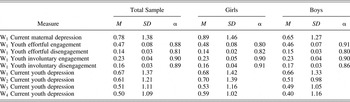
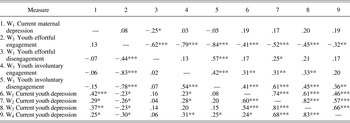
Table 1 presents descriptive statistics, and Table 2 provides intercorrelations among the study variables.
Descriptive statistics

Note: W1–W4, Waves 1–4.
Intercorrelations

Note: Intercorrelations above the diagonal are for girls and below the diagonal are for boys. W1–W4, Waves 1–4.
*p < .05. **p < .01. ***p < .001.
Youth depression
To assess youth depression, interviewers administered the Schedule for Affective Disorders and Schizophrenia for School-Age Children—Epidemiologic Version 5 (Orvaschel, Reference Orvaschel1995) to youths and their caregivers at W1 to Wave 4 (W4). Consensual diagnoses were assigned using a best estimate approach (Klein, Ouimette, Kelly, Ferro, & Riso, Reference Klein, Ouimette, Kelly, Ferro and Riso1994) to integrate information from youth and caregiver reports. In accordance with the best estimate approach, discrepancies between informants were resolved following specific guidelines for weighting information based on its presumed validity (e.g., information supported by clear, convincing examples was weighted more heavily than information supported by vague or no examples). Interviewers used the Diagnostic and Statistical Manual of Mental Disorders (DSM; American Psychiatric Association, 2000) criteria to assign ratings of depression on a 5-point scale (0 = no symptoms, 1 = mild symptoms, 2 = moderate symptoms, 3 = diagnosis with mild to moderate impairment, and 4 = diagnosis with severe impairment). These ratings are based on the number, severity, frequency, duration, and resulting impairment of reported symptoms. Separate ratings were assigned for each type of depression (e.g., major depression and dysthymia). At each wave, continuous depression scores were computed by summing the ratings occurring within the past month. Higher scores thus reflected more severe symptoms within a single period and/or multiple types of depression (for similar rating approaches see, Conley & Rudolph, Reference Conley and Rudolph2009; Hammen et al., Reference Hammen, Shih, Altman and Brennan2003; Hammen, Shih, & Brennan, Reference Hammen, Shih and Brennan2004; Rudolph et al., Reference Rudolph, Hammen, Burge, Lindberg, Herzberg and Daley2000, Reference Rudolph, Flynn, Abaied, Groot and Thompson2009), and included indices of several different markers of depression severity. The use of continuous scores of depression is in line with taxometric analyses suggesting that depression is best conceptualized as a dimensional continuum rather than a discrete category (Fergusson, Horwood, Ridder, & Beautrais, Reference Fergusson, Horwood, Ridder and Beautrais2005; Hankin, Fraley, Lahey, & Waldman, Reference Hankin, Fraley, Lahey and Waldman2005; Shih, Eberhart, Hammen, & Brennan, Reference Shih, Eberhart, Hammen and Brennan2006). Strong interrater reliability was found (one-way random-effects intraclass correlation coefficient [ICC] = 0.97), and scores on this measure were significantly associated with children's self-reports of depression on several measures, including the Child Depression Inventory (Kovacs, Reference Kovacs1992), Youth Depression Inventory (Rudolph, Reference Rudolph2002), and Mood and Anxiety Symptoms Questionnaire anhedonia subcale (Watson et al., Reference Watson, Clark, Weber, Assenheimer, Strauss and McCormick1995; rs = .38–.60, ps < .001).
At W1, 10.9% of youths met diagnostic criteria for clinical depression (a rating of 3 or 4 for at least one type of depression), and 14.5% experienced subclinical depressive symptoms (a rating of 1 or 2 for at least one type of depression). Of the participants with data available at subsequent waves, at W2, 8.9% met diagnostic criteria for clinical depression and 18.4% experienced subclinical symptoms. At W3, 6.4% met diagnostic criteria for clinical depression and 17.2% experienced subclinical symptoms. At W4, 7.3% met diagnostic criteria for clinical depression and 16.7% experienced subclinical symptoms.
Maternal depression
To assess maternal depression, interviewers administered the nonpatient version of the Structured Clinical Interview for the DSM (First, Spitzer, Gibbon, & Williams, Reference First, Spitzer, Gibbon and Williams1996) to female caregivers at W1. Each type of depression was coded using the same procedures as used for the Schedule for Affective Disorders and Schizophrenia for School-Age Children. Continuous depression scores were computed by summing the ratings occurring within the past month at the W1 assessment. Strong interrater reliability was found for these ratings (one-way random-effects ICC = 0.94). The depression summary scores significantly correlate with self-report measures of depressive symptoms, including the Beck Depression Inventory (Beck, Rush, Shaw, & Emery, Reference Beck, Rush, Shaw and Emery1979) and Mood and Anxiety Symptoms Questionnaire anhedonia subscale (Watson et al., Reference Watson, Clark, Weber, Assenheimer, Strauss and McCormick1995; rs = .34–.37, p < .001). Of the 165 maternal caregivers, 13.9% met diagnostic criteria for clinical depression and 13.3% experienced subclinical depressive symptoms at W1.
Responses to stress
To assess responses to interpersonal stress, youths completed the peer version of the Responses to Stress Questionnaire (Connor-Smith et al., Reference Connor-Smith, Compas, Wadsworth, Thomsen and Saltzman2000) at W1. This measure distinguishes between voluntary and involuntary responses to stress, and between engagement with and disengagement from stressors, yielding four subscales: effortful engagement (21 items), which includes primary control coping (e.g., problem solving) and secondary control coping (e.g., cognitive restructuring and positive thinking); effortful disengagement (9 items; e.g., denial and avoidance); involuntary engagement (15 items; e.g., rumination and physiological arousal); and involuntary disengagement (12 items; e.g., emotional numbing). Youths were prompted to think about interpersonal stressors with peers (e.g., having problems with a friend, fighting with other kids, or being left out or rejected) and rated how often they engaged in each response to these stressors by checking a box on a 4-point scale (not at all to very much). Confirmatory factor analyses support the distinctions between voluntary engagement and disengagement and involuntary engagement and disengagement, and indicate that the two subfactors of effortful engagement (i.e., primary and secondary control coping) comprise a higher order latent variable, supporting the use of a composite effortful engagement subscale. Convergent validity and test–retest reliability have been established for the subscales (Connor-Smith et al., Reference Connor-Smith, Compas, Wadsworth, Thomsen and Saltzman2000). To correct for base-rate differences in the endorsement of responses to stress (Compas et al., Reference Compas, Connor-Smith, Saltzman, Thomsen and Wadsworth2001), proportion scores were computed by dividing the total score for each subscale by the total score on the measure. Higher scores reflect higher levels of each type of response to stress. The subscales showed strong reliability (Table 1).
Peer stress
For the purpose of supplemental analyses, peer stress was assessed through the Youth Life Stress Interview (Rudolph & Flynn, Reference Rudolph and Flynn2007) at W1. This semistructured interview, administered separately to youths and their mothers, assessed the type and severity of episodic stress experienced by youths in the past year. An open-ended question and specific follow-up prompts were used to elicit information regarding the occurrence of, and circumstances surrounding, stressful life events (e.g., argument with a friend, and problems with classmates or other children). Interviewers presented a narrative summary of each event to a team of coders with no knowledge of the youths’ diagnostic status or subjective response to the event. Integrating information from youths and caregivers, the coding team rated the stressfulness of the event for a typical youth in those circumstances, from 1 (no negative stress) to 5 (severe negative stress). The objective stress ratings for each peer event with a stress rating above 1 (M = 3.81, SD = 4.00) were summed. High reliability between independent coding teams was found for ratings of objective stress (ICC = 0.90) and for the categorization of events (Cohen ĸ = 0.92).
Results
Predicting trajectories of youth depression
Hierarchical linear modeling analyses were conducted with HLM 7 (Raudenbush & Bryk, Reference Raudenbush and Bryk2002). Initial levels of youth depression as well as trajectories of youth depression across time were estimated for each participant. Youth depression was examined across four waves, with depression centered at W1. Thus, the intercept reflected initial levels of depression, and the slope reflected changes in youth depression from W1 through W4. Because HLM can accommodate an unbalanced number of measurement occasions across participants, participants missing one or more follow-up depression assessments were included in analyses.
Preliminary model
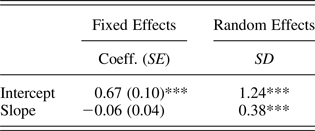
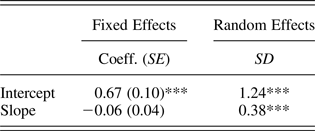
An unconditional model was examined to determine if there was sufficient between-person variability in initial levels and trajectories of youth depression to warrant examination of between-person predictors. This model indicated that there was significant variation for the intercept and slope of youth depression (Table 3). Thus, hypotheses were examined by adding between-person (Level 2) predictors to the model.
Unconditional growth curve model for child depression
*p < .05. **p < .01. ***p < .001.
Contribution of maternal depression and responses to stress to youth depression
To examine the independent and interactive effects of maternal depression and youth responses to stress on initial levels and trajectories of youth depression, W1 maternal depression, W1 youth responses to stress, and the Maternal Depression × Responses to Stress interaction were entered simultaneously as predictors of the intercept and slope. The maternal depression and responses to stress variables were mean-centered by standardizing them, and the interaction was computed as the product of the standardized maternal depression and responses to stress variables. Separate models were examined for each dimension of responses to stress. For each model, moderation by gender was examined by adding gender (–1 = boys, 1 = girls), the two-way interactions with gender (Maternal Depression × Gender, Responses to Stress × Gender), and the three-way interaction with gender (Maternal Depression × Responses to Stress × Gender) to the model. When three-way interactions with gender were significant, Maternal Depression × Responses to Stress interactions were examined in girls and boys by rerunning the model with gender centered at values corresponding to girls or boys.
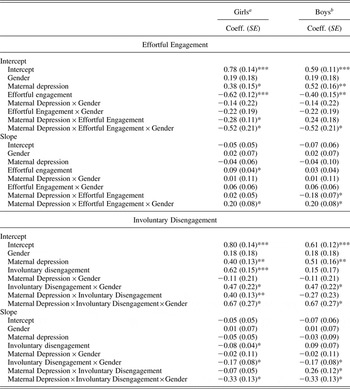
Tables 4 and 5 present the results of the HLM models. Table 4 presents results from models in which three-way interactions with gender were significant. To compare main effects of maternal depression and responses to stress and the Maternal Depression × Responses to Stress interactions for girls versus boys, results are presented from the models with gender centered at values corresponding to girls or boys. Specifically, in the first column of Table 4, we report model results when gender is coded as girls = 0 and boys = –1; in the second column of Table 4, we report model results when gender is coded as boys = 0 and girls = 1. Note that the main effect of gender and interactions with gender are identical across these two sets of results. In cases where there was not moderation by gender, gender and the interactions with gender were removed from the model, and results from the simplified model are presented in Table 5.
Hierarchical linear models predicting youth depression: Effortful engagement and involuntary disengagement

a Gender was centered as girls = 0 in the models.
b Gender was centered as boys = 0 in the models.
*p < .05. **p < .01. ***p < .001.
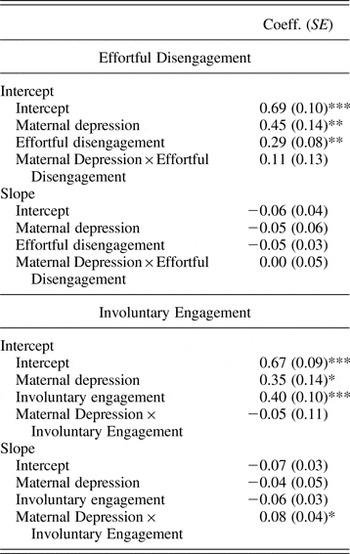
Hierarchical linear models predicting youth depression: Effortful disengagement and involuntary engagement

*p < .05. **p < .01. ***p < .001.
To decompose significant Maternal Depression × Responses to Stress interactions, the HLM models were rerun with maternal depression and responses to stress centered at values of theoretical interest. Specifically, significant interactions were probed at scores reflecting exposure to maternal depression (i.e., maternal depression scores 1 SD above the mean, corresponding to moderate to diagnosable symptoms) or no exposure to maternal depression (i.e., no depressive symptoms), and at high (i.e., 1 SD above the mean) and low (i.e., 1 SD below the mean) levels of responses to stress.
Effortful engagement
The first analysis examined the independent and interactive contributions of W1 maternal depression, W1 effortful engagement, and gender to initial levels (i.e., the intercept) and trajectories (i.e., the slope) of youth depression. For the intercept, this model revealed significant effects of maternal depression (b = 0.45, SE = 0.11, p = .00), effortful engagement (b = –0.51, SE = 0.10, p = .00), and a significant Maternal Depression × Effortful Engagement × Gender interaction (b = –0.26, SE = 0.10, p = .01). For the slope, this model revealed a significant effect of effortful engagement (b = 0.06, SE = 0.03, p = .04) and a significant Maternal Depression × Effortful Engagement × Gender interaction (b = 0.10, SE = 0.04, p = .02). Thus, the Maternal Depression × Effortful Engagement interaction was examined in girls and boys by recentering gender (see Table 4).
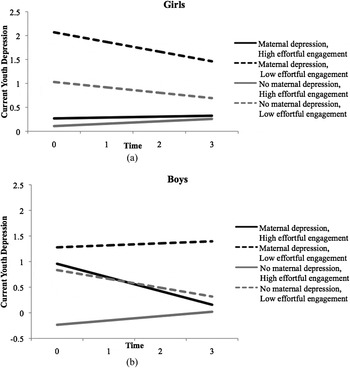
In girls, there was a significant positive effect of maternal depression, a significant negative effect of effortful engagement, and a significant Maternal Depression × Effortful Engagement interaction predicting the intercept, as well as a significant, positive effect of effortful engagement predicting the slope (Figure 1a). Decomposition of the interaction indicated that maternal depression predicted higher initial levels of depression when girls used low effortful engagement (b = 0.67, SE = 0.25, p = .01), but not when girls used high effortful engagement (b = 0.10, SE = 0.09, p = .24). In contrast to hypotheses, low levels of effortful engagement predicted decreases in depression over time. Because this decline was counter to hypotheses and did not appear to change relative levels of depression between groups, we conducted a post hoc analysis to examine whether the moderating effect of effortful engagement was maintained through the final wave of the study by recentering time so the intercept reflected depression at W4. This analysis revealed a significant Maternal Depression × Effortful Engagement interaction predicting W4 depression (b = –0.23, SE = 0.10, p = .03). Decomposition of the interaction revealed that, as for W1 depression, maternal depression predicted higher W4 depression when girls used low effortful engagement (b = 0.49, SE = 0.21, p = .02) but not when girls used high effortful engagement (b = 0.04, SE = 0.07, p = .57), suggesting that the moderating effect of effortful engagement was maintained over time.
Independent and interactive contributions of maternal depression and effortful engagement to depression in (a) girls and (b) boys.

In boys, there was a significant positive effect of maternal depression and a significant negative effect of effortful engagement on the intercept. There was a significant Maternal Depression × Effortful Engagement interaction predicting the slope (Figure 1b). Decomposition of the interaction revealed that although boys exposed to maternal depression showed higher initial levels of depression than those not exposed to maternal depression, boys exposed to maternal depression who used high effortful engagement decreased in depression over time (b = –0.27, SE = 0.11, p = .02), whereas those who used low effortful engagement maintained elevated depression over time (b = 0.04, SE = 0.21, p = .85). Boys not exposed to maternal depression who used low effortful engagement had elevated initial levels of depression but declined in depression over time (b = –0.17, SE = 0.08, p = .03). Boys not exposed to maternal depression who used high effortful engagement maintained particularly low levels of depression over time (b = 0.08, SE = 0.05, p = .11).
In sum, analyses examining the contribution of maternal depression and effortful engagement to youth depression revealed that effortful engagement moderated the effect of maternal depression for the intercept in girls and the slope in boys. In girls, high effortful engagement mitigated the association between maternal depression and initial levels of depression, an effect that was maintained over time. In boys, high effortful engagement buffered the effect of maternal depression on trajectories of depression.
Effortful disengagement
The second analysis examined the independent and interactive contributions of W1 maternal depression, W1 effortful disengagement, and gender to initial levels and trajectories of youth depression. For the intercept, this model revealed nonsignificant Maternal Depression × Gender (b = 0.01, SE = 0.15, p = .96), Effortful Disengagement × Gender (b = 0.11, SE = 0.09, p = .24), and Maternal Depression × Effortful Disengagement × Gender (b = 0.23, SE = 0.12, p = .07) interactions. For the slope, the model similarly revealed nonsignificant maternal Depression × Gender (b = 0.00, SE = 0.06, p = .95), Effortful Disengagement × Gender (b = 0.00, SE = 0.03, p = .95), and Maternal Depression × Effortful Disengagement × Gender (b = –0.06, SE = 0.04, p = .20) interactions.
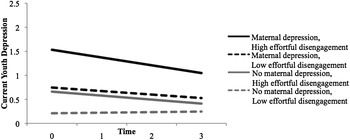
Because there was no evidence for moderation by gender, gender and the interactions with gender were removed from the model, and the independent and interactive contributions of W1 maternal depression and W1 effortful disengagement to initial levels and trajectories of youth depression were examined (see Table 5). For the intercept, this model revealed significant positive effects of maternal depression and effortful disengagement, suggesting additive rather than interactive effects on youth depression (Figure 2). Youths exposed to maternal depression had higher initial depression than youths not exposed to maternal depression, and youths who used high effortful disengagement had higher initial depression than youths who used low effortful disengagement. For the slope, this model revealed nonsignificant effects of maternal depression, effortful disengagement, and the Maternal Depression × Effortful Disengagement interaction.
Independent contributions of maternal depression and effortful disengagement to youth depression.

In sum, analyses examining the contribution of maternal depression and effortful disengagement to youth depression revealed additive contributions of the risk factors to initial levels of depression, such that youths with dual risk (i.e., maternal depression and high effortful disengagement) had the highest initial depression and youths with no risk had the lowest initial depression, whereas youths with one risk (i.e., maternal depression or high effortful disengagement) had intermediate levels of depression. There were no significant predictors of the slope, suggesting that these effects were maintained over time. There was no evidence of moderation by gender.
Involuntary engagement
The third analysis examined the independent and interactive contributions of W1 maternal depression, W1 involuntary engagement, and gender to initial levels and trajectories of youth depression. For the intercept, this model revealed nonsignificant Maternal Depression × Gender (b = –0.14, SE = 0.12, p = .23), Involuntary Engagement × Gender (b = 0.06, SE = 0.11, p = .58), and Maternal Depression × Involuntary Engagement × Gender (b = 0.09, SE = 0.13, p = .50) interactions. For the slope, this model similarly revealed nonsignificant Maternal Depression × Gender (b = 0.01, SE = 0.05, p = .81), Involuntary Engagement × Gender (b = –0.04, SE = 0.03, p = .28), and Maternal Depression × Involuntary Engagement × Gender (b = –0.07, SE = 0.05, p = .15) interactions.
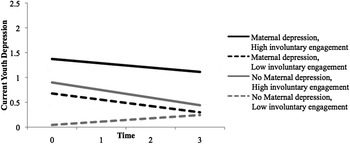
Because there was no evidence for moderation by gender, gender and the interactions with gender were removed from the model, and the independent and interactive contributions of W1 maternal depression and W1 involuntary engagement to initial levels and trajectories of youth depression were examined (see Table 5). For the intercept, this model revealed significant positive effects of maternal depression and involuntary engagement, suggesting additive effects. For the slope, this model revealed a significant Maternal Depression × Involuntary Engagement interaction (Figure 3). The additive effects for the intercept and decomposition of the interaction for the slope together revealed that among youths exposed to maternal depression, those who showed high involuntary engagement had higher initial levels of depression than those who showed low involuntary engagement, and both groups maintained these levels over time (b = –0.09, SE = 0.10, p = .36 and b = –0.13, SE = 0.08, p = .14, respectively). Among youths not exposed to maternal depression, those who showed high involuntary engagement had higher initial levels of depression than those who showed low involuntary engagement, but they declined in depression over time (b = –0.15, SE = 0.06, p = .01); those who showed low involuntary engagement maintained very low levels of depression over time (b = 0.07, SE = 0.04, p = .12).
Independent and interactive contributions of maternal depression and involuntary engagement to youth depression.

In sum, analyses examining the contribution of maternal depression and involuntary engagement to youth depression revealed additive contributions of the risk factors to initial levels of depression, such that youths with dual risk had the highest initial depression and youths with no risk had the lowest initial depression, whereas youths with one risk had intermediate levels of depression. Initial levels of depression were maintained over time, with the exception that youths not exposed to maternal depression who showed high involuntary engagement did not maintain elevated depression. There was no evidence of moderation by gender.
Involuntary disengagement
The fourth analysis examined the independent and interactive contributions of W1 maternal depression, W1 involuntary disengagement, and gender to initial levels and trajectories of youth depression. For the intercept, this model revealed significant effects of maternal depression (b = 0.45, SE = 0.10, p = .00) and involuntary disengagement (b = 0.38, SE = 0.11, p = .00), a significant Involuntary Disengagement × Gender interaction (b = 0.23, SE = 0.11, p = .04), and a significant Maternal Depression × Involuntary Disengagement × Gender interaction (b = 0.33, SE = 0.13, p = .01). For the slope, this model revealed a significant Involuntary Disengagement × Gender interaction (b = –0.08, SE = 0.04, p = .03) and a significant Maternal Depression × Involuntary Disengagement × Gender interaction (b = –0.17, SE = 0.06, p = .01). Thus, the Maternal Depression × Involuntary Disengagement interaction was examined in girls and boys by recentering gender (see Table 4).
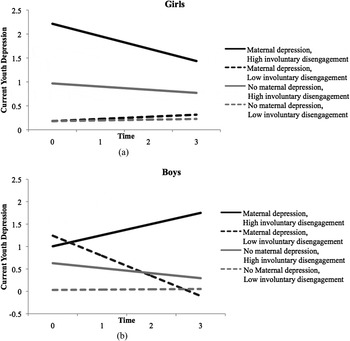
In girls, there were significant positive effects of maternal depression and involuntary disengagement and a significant Maternal Depression × Involuntary Disengagement interaction predicting the intercept. There was a significant negative effect of involuntary disengagement predicting the slope (Figure 4a). Decomposition of the interaction revealed that maternal depression predicted higher initial levels of depression when girls showed high involuntary disengagement (b = 0.80, SE = 0.25, p = .00), but not when girls showed low involuntary disengagement (b = 0.00, SE = 0.09, p = .99). In contrast to hypotheses, involuntary disengagement predicted decreases in depression over time. As in the analyses examining effortful engagement, because this decline was counter to hypotheses and did not appear to change relative levels of depression between groups, we conducted a post hoc analysis to examine whether involuntary disengagement continued to moderate the effect of maternal depression at the final wave of the study. The Maternal Depression × Involuntary Disengagement interaction was examined, recentering time so the intercept reflected depression at W4. This analysis revealed a significant Maternal Depression × Involuntary Disengagement interaction predicting W4 depression (b = 0.18, SE = 0.09, p = .04). Decomposition of the interaction revealed that, as for W1 depression, maternal depression predicted higher W4 depression when girls showed high involuntary disengagement (b = 0.43, SE = 0.19, p = .03) but not when girls showed low involuntary disengagement (b = 0.06, SE = 0.07, p = .42), suggesting that the moderating effect of involuntary disengagement was maintained over time.
Independent and interactive contributions of maternal depression and involuntary disengagement to depression in (a) girls and (b) boys.

In boys, there was a significant positive effect of maternal depression on the intercept, and a significant Maternal Depression × Involuntary Disengagement interaction predicting the slope (Figure 4b). Decomposition of the interaction revealed that although boys exposed to maternal depression showed higher initial levels of depression than those not exposed to maternal depression, those who showed high involuntary disengagement maintained elevated depression over time (b = 0.25, SE = 0.29, p = .40), whereas those who showed low involuntary disengagement declined in depression over time (b = –0.45, SE = 0.12, p = .00). Among boys not exposed to maternal depression, those who showed high involuntary disengagement had higher initial levels of depression than those who showed low levels of involuntary disengagement, and both groups maintained these initial levels over time (b = –0.11, SE = 0.07, p = .09 and b = 0.01, SE = 0.05, p = .90, respectively).
In sum, analyses examining the contribution of maternal depression and involuntary disengagement to youth depression revealed that involuntary disengagement moderated the effect of maternal depression for the intercept in girls and the slope in boys. In girls, low involuntary disengagement mitigated the association between maternal depression and initial levels of depression. In boys, low involuntary disengagement buffered the effect of maternal depression on trajectories of depression.
Supplemental analyses
Supplemental analyses were conducted to examine if the independent and interactive effects of maternal depression and responses to stress were moderated by age (see online-only supplementary Table S.1). Moderation by age was examined by rerunning the analyses adding age, the two-way interactions with age (Maternal Depression × Age, Responses to Stress × Age), and the three-way interaction with age (Maternal Depression × Responses to Stress × Age) to the models. Across the models, the main effect of age (bs = –0.06 to 0.01, SEs = 0.02–0.09, ps = .44–.97), the Maternal Depression × Age interaction (bs = –0.04–0.07, SEs = 0.03–0.10, ps = .14–.85), and the Responses to Stress × Age interaction (bs = –0.04 to 0.06, SEs = 0.02–0.09, ps = .08–.96) were nonsignificant for the intercepts and slopes. The Maternal Depression × Responses to Stress × Age interactions for the intercepts and slopes were also nonsignificant across models (bs = –0.03 to 0.04, SEs = 0.02–0.07, ps = .28–.79), with the exception of a significant Maternal Depression × Involuntary Engagement × Age interaction predicting the intercept of child depression (b = –0.15, SE = 0.07, p = .03). To decompose this interaction, the Maternal Depression × Involuntary Engagement interaction for the intercept was examined, recentering age at 1 SD below and above the mean sample age. The Maternal Depression × Involuntary Engagement interaction was not significant for younger (b = 0.15, SE = 0.10, p = .15) or older (b = –0.21, SE = 0.15, p = .16) youths. Together, these analyses suggested there was neither a main effect of age nor meaningful moderation by age.
To examine whether the results of the central analyses were accounted for by the amount of peer stress youths experienced, the central analyses were repeated adjusting for peer stress. Across the models, peer stress significantly predicted higher initial levels of depression (bs = 0.08–0.11, SEs = 0.03, ps < .01) and declining trajectories of depression (bs = –0.03 to –0.02, SEs = 0.01, ps < .05). Analyses across the four responses to stress yielded the same main effects, and two- and three-way interaction effects of maternal depression, responses to stress, and gender as the central analyses except that the effects of effortful engagement and involuntary disengagement on the slope in girls, which were counter to hypotheses, were no longer significant, and there was no longer a significant effect of effortful engagement for the intercept in boys (see online-only supplementary Tables S.2 and S.3). Next, to examine whether the results of the central analyses were accounted for by socioeconomic status, the central analyses were repeated adjusting for family income. Across the models, income did not significantly predict initial levels (bs = –0.09 to –0.06, SEs = 0.06, ps = .12–.32) or trajectories (bs = 0.00–0.01, SEs = 0.02, ps = .72–.97) of depression. Analyses across the four responses to stress yielded the same main effects, and two- and three-way interaction effects of maternal depression, responses to stress, and gender as the central analyses (see see online-only supplementary Tables S.4 and S.5). Overall, analyses examining peer stress and income as covariates indicated that these variables did not account for the effects of maternal depression and responses to stress evident in the central analyses.
Discussion
This study sought to determine if responses to peer stress contribute to risk or resilience in youths exposed to maternal depression. Maternal depression and youth responses to peer stress made independent and interactive contributions to youth depression over the course of adolescence. In some cases, adaptive responses to stress mitigated the association between maternal depression and initial levels and trajectories of youth depression, with the timing of this moderating role differing for girls and boys. In other cases, maternal depression and youth responses to stress contributed additive risks such that youths displayed the highest initial levels of depression when they were exposed to maternal depression and used maladaptive responses to stress.
Effects of effortful engagement and involuntary disengagement
The association between maternal depression and youth depression was moderated by youth effortful engagement and involuntary disengagement responses to peer stress, and the timing of these effects differed for girls and for boys. Among girls, the association between maternal depression and initial levels of depression was dampened in the context of adaptive responses to stress (i.e., high effortful engagement and low involuntary disengagement). Girls of depressed mothers who used few active coping strategies aimed at resolving peer problems or negative emotions or who showed many dysregulated withdrawal responses displayed moderate depressive symptoms, whereas those who showed adaptive responses displayed essentially no initial depressive symptoms. Although maladaptive responses were associated with decreases in depression over time, the buffering role of adaptive responses to stress was maintained as girls progressed through adolescence.
Among boys, these same adaptive responses to peer stress buffered the contribution of maternal depression to trajectories of youth depression. Boys of depressed mothers displayed initial levels of depression corresponding to mild symptoms. Those who used active coping strategies directed toward resolving peer stress and negative emotions or who showed few dysregulated withdrawal responses declined in depression as they progressed through adolescence. In contrast, those who used maladaptive responses maintained mild depressive symptoms over time.
These results suggest that adaptive responses to peer stress may attenuate youth vulnerability to depression, whereas maladaptive responses may amplify youth vulnerability. Effortful engagement responses encompass addressing stress directly (e.g., problem solving), regulating emotions, and reframing thoughts about stress (e.g., positive thinking). When offspring of depressed mothers respond to peer stress with these strategies, they may directly ameliorate problems and effectively manage their emotional and cognitive responses, thereby bolstering their peer relationships and mitigating their vulnerability to depression. In contrast, involuntary disengagement responses involve dysregulated emotional and cognitive withdrawal (e.g., emotional numbing or mind going blank) as well as automatic escape and avoidance behaviors (e.g., experiencing an impulse to get away or freezing). When youth of depressed mothers display these uncontrolled responses, they may fail to resolve or even intensify peer stress. They also may fail to manage their negative emotions, potentially exacerbating the impact of peer stress on their well-being. Thus, youth of depressed mothers may be especially vulnerable to depression when they respond to peer stress with involuntary disengagement but be protected against depression when they do not respond in these maladaptive ways.
These results also suggest that effortful engagement responses to peer stress may be particularly meaningful for youth of depressed mothers. Boys who used low effortful engagement initially displayed mild depressive symptoms regardless of exposure to maternal depression, but only boys who were also exposed to maternal depression maintained mild depression over time. Similarly, effortful engagement was more predictive of depression among girls exposed to maternal depression than those not exposed to maternal depression. Because interpersonal impairment is more strongly associated with depression among offspring of depressed than nondepressed mothers (Hammen & Brennan, Reference Hammen and Brennan2001; Hammen et al., Reference Hammen, Shih, Altman and Brennan2003), failing to respond in adaptive ways to interpersonal stress may be especially detrimental for these youth. Having trouble managing relationships outside of the family also may have greater consequences for youth of depressed mothers because they are less likely to have a supportive mother–child relationship (Lovejoy et al., Reference Lovejoy, Graczyk, O'Hare and Neuman2000).
Effects of effortful disengagement and involuntary engagement
Effortful disengagement and involuntary engagement responses to peer stress were each independently and positively associated with initial levels of youth depression. Rather than moderating the effect of maternal depression, these maladaptive responses to stress presented additive risks. Youths with dual risk (i.e., maternal depression and maladaptive responses to stress) had the highest initial levels of depression, displaying symptoms of mild to moderate severity. Youths who had one risk factor (i.e., maternal depression or maladaptive responses to stress) had mild initial depressive symptoms. Youths with neither risk factor had the lowest initial levels of depression, displaying essentially no depressive symptoms.
These results are consistent with the idea that when mothers are depressed, youth's use of avoidance-oriented coping or experiences of overarousal following peer stress confers additional risk that contributes to meaningful individual differences in depressive symptoms. Cognitive and behavioral avoidance responses (i.e., effortful disengagement) may prevent youth from resolving peer problems or regulating their emotions, thereby increasing vulnerability to depression. Experiencing physiological arousal or intrusive thoughts and emotions (i.e., involuntary engagement) following stress may heighten negative emotions and directly contribute to depressive symptoms.
The additive contributions of maternal depression and effortful disengagement to initial levels of depression were maintained as youths progressed through adolescence. However, maternal depression and involuntary engagement interacted in the prediction of trajectories of youth depression. Although youths who experienced physiological arousal and intrusive thoughts and emotions following stress initially displayed elevated depression, only youths who were also exposed to maternal depression maintained these elevated levels over time. Because maternal depression predicts depression chronicity in youth (Rhode et al., Reference Rhode, Lewinsohn, Klein and Seeley2005), this result may reflect greater difficulty among offspring of depressed mothers in recovering from depression over time. It is also possible that overarousal following stress has more enduring negative effects for offspring of depressed mothers because depressed mothers are less available or effective in helping youth manage this arousal compared to nondepressed mothers (Monti et al., Reference Monti, Rudolph and Abaied2014; Silk et al., Reference Silk, Shaw, Prout, O'Rourke, Lane and Kovacs2011).
Moderation by gender
The timing of the moderating role of effortful engagement and involuntary disengagement responses to peer stress differed for girls and for boys. For girls, high effortful engagement and low involuntary disengagement mitigated the association between maternal depression and initial levels of depression. For boys, high effortful engagement and low involuntary disengagement mitigated the effect of maternal depression on trajectories of depression.
Compared to boys, girls are more focused on peer relationships, experience more closeness and nurturance in their friendships (for a review, see Rose & Rudolph, Reference Rose and Rudolph2006), and are more reactive to peer stress (Hankin, Mermelstein, & Roesch, Reference Hankin, Mermelstein and Roesch2007; Rudolph, Reference Rudolph2002). In contrast, boys are more concerned with dominance and social status (for a review, see Rose & Rudolph, Reference Rose and Rudolph2006). Managing peer stress effectively may immediately benefit girls’ emotional well-being because they are highly attuned to peer relationships and may receive emotional support on an everyday basis through their friendships. Managing peer stress effectively may not impact the emotional support boys receive on an everyday basis, but instead contribute over time to their acceptance by peers and the quality of their relationships. There also is some evidence that boys’ coping efforts are more effective in buffering the effects of stress during adolescence than during preadolescence (Hoffman, Levy-Shiff, Sohlberg, & Zarziki, Reference Hoffman, Levy-Shiff, Sohlberg and Zarizki1992). The mitigating role of adaptive responses to stress for boys’ trajectories of depression may be due to boys’ continuing use of these responses across a period when coping efforts are becoming increasingly effective.
Additional sex differences emerged in the severity of youths’ initial depressive symptoms. Although girls and boys did not differ on average in their initial levels of depression, the most at-risk girls showed higher levels of depression than the most at-risk boys. Specifically, girls exposed to maternal depression who showed low effortful engagement or high involuntary disengagement displayed moderate depressive symptoms, whereas their male counterparts displayed mild depressive symptoms. Because both maternal depression (Goodman et al., Reference Goodman, Rouse, Connell, Broth, Hall and Heyward2011) and responses to interpersonal stress (Agoston & Rudolph, Reference Agoston and Rudolph2011) have a larger effect on girls’ depression, girls may be especially vulnerable to the interactive effects of these risk factors.
Implications for theory and research
This study is one of a very limited number of investigations to examine individual differences in trajectories of depression among offspring of depressed mothers. The results extend prior research on maternal depression by demonstrating that its association with youth depression is moderated by youth responses to stress. This study builds on Hammen et al.’s (2004) interpersonal stress model of the intergenerational transmission of depression, which posits that interpersonal impairment and stress play a key role in the transmission of depression from mothers to their offspring. Extending research indicating that offspring of depressed mothers are at greater risk for depression due to interpersonal impairment and stress (Hammen et al., Reference Hammen, Shih and Brennan2004; Hammen, Hazel, Brennan, & Najman, Reference Hammen, Hazel, Brennan and Najman2012), the current results are consistent with the idea that adaptive responses to interpersonal stress (i.e., high levels of effortful engagement and low levels of involuntary disengagement) can mitigate risk. The results of this study also suggest that maternal depression and responses to interpersonal stress (effortful disengagement and involuntary engagement) can confer additive risks, such that responses to stress explain variability in depressive symptoms among youth of depressed and nondepressed mothers.
Strengths, limitations, and future directions
Major strengths of the current research include the use of diagnostic interviews to assess maternal and youth depression and annual follow-up interviews to capture youth depression across adolescence. Using these assessments, we examined the contribution of initial levels of maternal depression to trajectories of adolescent depression. We adopted this approach to address our goal of examining the prospective effect of exposure to maternal depression early in adolescence on subsequent youth depression. However, it will be interesting for future research to examine whether past maternal depression that has desisted or changes in maternal depression (e.g., a new onset or fluctuations in severity) during adolescence contribute to trajectories of youth depression alone and in combination with responses to stress.
By examining youth responses to peer stress, this study addressed an important gap in research on the intergenerational transmission of depression. Because offspring of depressed mothers face heightened peer stress (e.g., Adrian & Hammen, Reference Adrian and Hammen1993) and often lack supportive family relationships (Lovejoy et al., Reference Lovejoy, Graczyk, O'Hare and Neuman2000), managing or failing to manage peer stress may be impactful for their well-being. However, we cannot determine whether the present results are driven specifically by responses to peer stress. Youth reports of their responses to peer stress may reflect their responses to a range of interpersonal (or even noninterpersonal) stressors, which also contribute to vulnerability to depression. Given prior research linking responses to parental depression with youth internalizing symptoms (Compas et al., Reference Compas, Champion, Forehand, Cole, Reeslund, Fear and Roberts2010; Langrock et al., Reference Langrock, Compas, Keller, Merchant and Copeland2002), future research should examine whether responses to family stress also play a role in youth risk and resilience and test whether the pattern of findings generalizes to responses to noninterpersonal stress. It would also be interesting for future research to consider whether heterogeneity in the functioning of depressed mothers contributes to the results of this study. Some depressed mothers may maintain positive family relationships and model effective interpersonal skills, contributing to both better coping with interpersonal stress and lower depression among offspring.
This research relied on youths’ self-reports of multiple responses to peer stress. Although the Responses to Stress Questionnaire is scored to correct for base-rate differences in endorsement of responses to stress (Compas et al., Reference Compas, Connor-Smith, Saltzman, Thomsen and Wadsworth2001), the measure subscales are correlated, which may have contributed to a similar pattern of results for effortful engagement and involuntary disengagement. It will be important for future research to test the unique effects of each type of response, as well as the effects of multiple responses acting in concert. The use of self-reports of responses to stress is advantageous in that it provides insight into responses (e.g., denial, rumination, and emotional numbing) that may be otherwise unobservable; however, there may be stress responses outside the scope of self-reports that contribute to risk for depression. For example, the PNS is responsible for physiological regulatory processes and is thought to enable adaptive responses to stress (Porges, Reference Porges2007). PNS functioning interacts with gender and maternal depression to predict trajectories of youth depression (Wetter & El-Sheikh, 2002). It may be beneficial for future research to incorporate both self-reports of responses to stress and direct measurements of physiological regulation to examine whether physiological regulation operates in conjunction with involuntary engagement (e.g., physiological arousal) or other responses to stress to influence depression.
Additional limitations relevant to data analyses and inferences also should be considered. First, although this study used a prospective design to examine changes in youth depression over time, we cannot draw conclusions about causal associations, particularly when predicting initial levels of youth depression. It is possible, for example, that youth with a genetic predisposition for less severe or chronic depression are also inclined toward adaptive responses to stress, or that less severe emotional distress leads youth to engage in more adaptive responses to stress. Additional research is needed to rule out confounding variables other than those investigated in this study and to test alternative and bidirectional effects among maternal and youth depression and youth responses to stress. Second, high levels of depression in mothers and children were naturally infrequent; this resulted in skewed distributions of the depression variables, which have the potential to bias significance tests. In addition, the sample size was relatively small, which may have limited our ability to detect interaction effects. Moreover, interaction effects detected in small sample sizes may be less robust to replication. Thus, it will be important for future research to replicate these results.
Implications for prevention and intervention
This study suggests that youth responses to peer stress are a potential target for efforts to promote resilience in offspring of depressed mothers. Specifically, increasing effortful engagement responses and reducing effortful disengagement, involuntary disengagement, and involuntary engagement responses may dampen risk for depression. It is promising that in this study youth responses to stress were generally unrelated to maternal depression, suggesting that youth of depressed mothers may not differ from youth of nondepressed mothers in their capacity to engage in adaptive responses. Prior research indicates that mothers’ coping suggestions (i.e., encouraging effortful engagement) can contribute to decreases in youth's involuntary engagement and disengagement responses over time (Abaied & Rudolph, Reference Abaied and Rudolph2011), suggesting that these responses are a malleable target for intervention. Moreover, Compas et al. (Reference Compas, Champion, Forehand, Cole, Reeslund, Fear and Roberts2010) have demonstrated that effortful coping responses to parental depression can be effectively targeted through a cognitive behavioral intervention. Thus, responses to stress may be feasible points of intervention with the potential to benefit psychological functioning among youth at risk due to maternal depression.
Supplementary Material
To view the supplementary material for this article, please visit https://doi.org/10.1017/S0954579417000359.