

I. Introduction
The craft brew revolution has been transforming the beer industry. Although mass-produced brews still account for the vast majority of beer sales, sales of craft beers have also grown steadily for many years. Total U.S. beer sales reached $107.6 billion in 2016 which represented a 12.7% increase from total sales in 2011 (Brewers Association, 2012, 2017a). Although total beer sales have experienced only a small growth in recent years, there have been significant changes in the composition of the industry. The craft beer market has been rapidly growing in the U.S. accounting for nearly 12.3% of the total U.S. beer market by volume and 21.8% of U.S. retail dollar value in 2016. That is a large increase of 156.3% in retail value in dollars for the same five-year period (Brewers Association, 2012, 2017a).
The growth of the craft beer market also positively impacted demand for U.S. hops. Currently, the United States is the second biggest producer of hops in the world (Barth-Haas Group, Reference Group2016). U.S. hop acreage has increased from 30,000 to 51,000 acres or by 77.7% from 2011 to 2016 (Hop Growers of America, 2012; United States Department of Agriculture: National Agricultural Statistics Service, 2016). While more states have recently entered into the hops market, most of the production still comes from Washington, Oregon, and Idaho, with a respective share of 73.63%, 15.27%, and 11.11% in terms of harvested area (United States Department of Agriculture: National Agricultural Statistics Service, 2016).
Fertilizer application is used in hops production, and increased fertilizer usage is associated with higher production costs and concerns regarding environmentally friendly production (Davidson, Reference Davidson2009; Tilman et al., Reference Tilman, Balzer, Hill and Befort2011; Vitousek et al., Reference Vitousek, Aber, Howarth, Likens, Matson, Schindler, Schlesinger and Tilman1997). Hop producers are motivated to maximize profits, which depend on both the quality of the hops and the costs. Therefore, the ramifications of fertilized regimes for hops on consumer preferences of beer are unknown and are still important empirical questions to investigate.
The primary objectives of this study are: (1) to analyze the impact of under-fertilized treatments on perceived hops quality of beer and its impact on consumers’ willingness to pay (WTP) for beer; (2) to evaluate the impact of different intrinsic characteristics, including taste, hoppiness,Footnote 1 aroma, and appearance, on the WTP for beer; and (3) to examine the relationship between sociodemographic variables, beer purchase habits, and beer consumption variables and WTP for beer. We employ the double-bounded contingent valuation (CV) method together with the sensory analysis. We analyze the impact of the nitrogen fertilizer treatments on the perceived quality of hops and the impact of hoppiness and other sensory attributes on the WPT of consumers for beer by employing a double-bounded CV method.
II. Background
The number of craft brewers has increased from two in 1970 to 5,234 in 2016 (Brewers Association, 2017b; Tremblay and Tremblay, Reference Tremblay and Tremblay2005). This number includes 1,916 brewpubs, 3,132 microbreweries, and 186 regional craft breweries. Changes in the beer market should be attributed to changes in supply and demand (Poelmans and Swinnen, Reference Poelmans and Swinnen2011). The demand for craft beers has been increasing in recent years, mainly due to the changes in consumer preferences (Donadini and Porretta, Reference Donadini and Porretta2017; Gómez-Corona et al., Reference Gómez-Corona, Escalona-Buendía, García, Chollet and Valentin2016; Reid, McLaughlin, and Moore, Reference Reid, McLaughlin and Moore2014). The evidence also suggests that consumers’ WTP is higher for craft beer if there is a harmony between consumer preferences and the taste of beer. Gabrielyan et al. (Reference Gabrielyan, McCluskey, Marsh and Ross2014) estimated that consumers are willing to pay 44 and 11 cents more for the six-pack of beer (given an average price of $6.99) that they liked the most based on the overall taste/flavor and hoppiness, respectively.
The supply side of the market has also undergone changes. The large number of varieties of craft beers allows consumers to choose the beer that best suits their tastes and preferences. The ability to change old varieties and introduce new products is one of the main drivers for producers to enter the market (Murray and O'Neill, Reference Murray and O'Neill2012). Others argued that market concentration facilitated the growth of the craft beer market (Carroll and Swaminathan, Reference Carroll and Swaminathan2000; Swaminathan, Reference Swaminathan1998). The availability of funds to start a new business was another reason for the revival of the craft beer market (Kleban and Nickerson, Reference Kleban and Nickerson2011). Similarly, market structure and the availability and accessibility of capital equipment also made it easier for new players to enter the market without the need for extensive technical knowledge (Elzinga, Reference Elzinga2011; Elzinga, Tremblay, and Tremblay, Reference Elzinga, Tremblay and Tremblay2015).
Numerous extrinsic and intrinsic characteristics play a role in consumers’ liking of craft beers. Gabrielyan et al. (Reference Gabrielyan, McCluskey, Marsh and Ross2014) suggest targeting consumers who drink beer relatively frequently and socially, and influence the consumption habits of their peers in order to introduce new beers to the market. In addition, Aquilani et al. (Reference Aquilani, Laureti, Poponi and Secondi2015) argue that frequent beer drinkers represent the most frequent consumers of craft beer. After being exposed to a new beer, sensory attributes can play an important role in formation of quality expectations that can trigger a repeat purchase by the same consumers (Grunert, Reference Grunert2002). However, there might be other extrinsic attributes that impact consumer preferences without being directly related to taste, including factors such as being organic or having environmentally-friendly production.
One of the commonly used tools by craft beer producers to differentiate their product is the use of various types and levels of hops in their products. Hops are one of the four main ingredients (along with yeast, malt, and water) used to produce beer. Hop oil (within the lupulin gland) provides the main flavor and aroma associated with hops. Then, the variety and intensity of the hops gives the beers the specific flavor and aroma.
However, there is no specific methodology to define the type or concentration of hops to use during the production of beer to produce a specific type of beer. Other substances and technologies, such as Sierra Nevada's “Hop Torpedo”—a dry-hopping device, used during the brewing process also have an impact on the final product (Sierra Nevada Brewing Co., 2016). According to Schönberger and Kostelecky (Reference Schönberger and Kostelecky2011), many brewers use sensory evaluation to select specific hops to make a beer with the specific characteristics they want. Similarly, when consumers taste a beer, they experience the perception of hoppiness.
Previous literature shows that consumers can identify and differentiate hoppy flavor from other flavor ingredients (Reinbach et al., Reference Reinbach, Giacalone, Ribeiro, Bredie and Frøst2014). However, consumers perceive various attributes differently. As a result, each individual subjectively tastes and appreciates the same beer in a different way, making perceived hoppiness a horizontal attribute. We hypothesize that perceived hoppiness is an attribute that is observed by consumers and affects their WTP.
Hop growers use nitrogen fertilizer to provide sufficient nutrients for optimal plant growth. Different fertilizer regimes have an impact on the growth of plants, as well as on the chemical composition of the plants. Therefore, it can be expected that different regimes will affect the quality of hop and, subsequently, the perception of the quality of the hops and the consumers’ WTP for the beer that was produced with the hops. In fact, research shows that different fertilizer levels affect growth of trees, fruit, and vegetable quality (Aminifard et al., Reference Aminifard, Aroiee, Ameri and Fatemi2012; Huijuan, Hirano, and Okamoto, Reference Huijuan, Hirano and Okamoto1999; Kuscu et al., Reference Kuscu, Turhan, Ozmen, Aydinol and Demir2014).
Although it has been shown that the style of irrigation and the amount of fertilizer affects the quality and yield of hops (Takle and Cochran, Reference Takle and Cochran2017; Wample and Farrar, Reference Wample and Farrar1983), there is limited research on consumers’ assessment of the final product — beer. The costs of fertilizer are some of the main variable costs associated with hop production (Galinato and Tozer, Reference Galinato and Tozer2016). Therefore, decreasing the amount of applied fertilizer will reduce the production costs. We hypothesize that different fertilizer treatments affect the hop essential oil composition, and consequently, affect the consumers’ perception of these sensory attributes. Nitrogen is the main fertilizer applied to hop plants together with phosphorus, potassium, and other chemicals (Gingrich, Hart, and Christensen, Reference Gingrich, Hart and Christensen1994; Post et al., Reference Post, Calderwood, Cummings, Lewins, Monahan and Ziegler2015).
As a method of product differentiation, producers may consider the use of hops that were produced using environmentally friendly-methods. While decreasing the amount of nitrogen fertilizer does not necessarily mean organic production, a lower application of nitrogen could give the hop growers some advantages. Caporale and Monteleone (Reference Caporale and Monteleone2004) show that manufacturing technology (GMO, organic, and traditional) impacts consumers’ perceived quality. This could give farmers the opportunity to charge higher prices, which will compensate for the difference in yield as a result of incorporating environmentally friendly practices. However, others did not find a strong relationship between organic label of beer and the consumers’ WTP (Poelmans and Rousseau, Reference Poelmans and Rousseau2017). The practice of applying less nitrogen fertilizer also reduces the damage to the environment by reducing the nitrogen leakage to water system (Randall and Mulla, Reference Randall and Mulla2001).
Fertilizer application rates can also be used to manipulate crop yields (Lipecki and Berbeć, Reference Lipecki and Berbeć1997; Tilman et al., Reference Tilman, Cassman, Matson, Naylor and Polasky2002). In this instance, parallels can be drawn between wine and beer. It has been argued for a long time that controlling yield targets through various techniques (e.g., cluster thinning) can improve grape and wine quality (Petrie and Clingeleffer, Reference Petrie and Clingeleffer2006; Reynolds et al., Reference Reynolds, Edwards, Wardle, Webster and Dever1994; Wolf et al., Reference Wolf, Dry, Iland, Botting, Dick, Kennedy and Ristic2003). The long-standing theory, however, has received significant criticism in recent years (Franson, Reference Franson2016; Matthews, Reference Matthews2015; Reeve et al., Reference Reeve, Skinkis, Vance, McLaughlin, Tomasino, Lee and Tarara2018; Uzes and Skinkis, Reference Uzes and Skinkis2016; for more detailed information see Chapter 1 of Matthews, Reference Matthews2015).
In this study, we focus on the effect that different nitrogen regimes have on the perceived quality of hops and its impact on WTP. The model allows us to identify the relationships among sensory characteristics, various sociodemographic characteristics and beer consumption habits on WTP for beer. The findings help us to understand the impact that nitrogen fertilizer treatments have on the quantity and quality of hops, the consumers’ acceptance and valuation of these attributes and their WTP for different beer samples. The findings also help hop growers identify the optimal amount of nitrogen fertilizer regimen and brewers to identify the potential impacts of sensory attributes in consumers’ WTP and the premium amount they can charge for the final quality of their product. The methodology of the models, data description, results/discussions, and conclusions follow.
III. Methodology
While the hedonic price analysis studies the effect of extrinsic and demographic characteristics on equilibrium prices in a market, WTP analyzes the value consumers place on characteristics expressed as the maximum amount. When analyzing the sensory characteristics, the objective is to examine the WTP for the product in question and identify how its sensory properties influence that amount. The CV methodology is commonly used to estimate consumers’ WTP (Hanemann, Loomis, and Kanninen, Reference Hanemann, Loomis and Kanninen1991).
CV is a stated preference (SP) approach. The main criticism of SP techniques is the hypothetical nature of the approach, which can lead to a hypothetical bias (HB). HB refers to situations in which the WTP elicited from hypothetical formats diverge from the WTP elicited from non-hypothetical formats. It is recognized in the SP literature that it is difficult to construct incentive compatible valuation surveys even for private goods, such as beer, for value estimates and potentially for marginal value estimates (Carson and Groves, Reference Carson and Groves2007).
Some researchers try to avoid HB in the assessment of SP through the inclusion of “cheap talk” scripts (Cummings and Taylor, Reference Cummings and Taylor1999). However, as Vossler (Reference Vossler2016) discusses, the use of cheap-talk scripts can actually exacerbate the problem of HB. The argument is that a cheap talk script can “emphasize excessively that choices and policies are simply hypothetical, [which] dampens the already weak incentives for truthfulness with likely undesirable effects” (Vossler, Reference Vossler2016, p. 39). Therefore, we do not use a cheap-talk script for the current article.
There are typically two types of CV models: the single-bounded model and the double-bounded model. In the single-bounded model, the consumer is asked one question about whether he or she would be paying to pay a specific price (bid) for the item in question. While the double-bounded CV model asks consumers to respond to a second bid that is contingent on the response to the first bid. There is disagreement about the best number of iterations to include in the bidding procedures in the CV method. The double-bounded model is more efficient, but may exhibit an anchoring bias based on the first bid. Hanemann, Loomis, and Kanninen (Reference Hanemann, Loomis and Kanninen1991) conclude that the gain in efficiency largely prevails over the loss by bias, which tends to be moderate.
Watson and Ryan (Reference Watson and Ryan2007) argue that follow-up questions in double-bounded CV alter the true preferences of the respondents. Others argue that the starting point might bias consumers’ response in valuating health benefits of environmental interventions (Chien, Huang, and Shaw, Reference Chien, Huang and Shaw2005). SP choice experiments offer a timely and low-cost method to obtain information on consumer preferences for food products. We emphasize that no single valuation method is perfect; CV can provide useful information for decision makers.
In our survey, we included a double-bounded question sequence. In a double-bounded approach, each participant is presented with the two bids. The amount of the second bid is contingent on the participant's response to the first bid. If the individual is willing to pay the amount of the initial bid (B I), the second bid presented is a “premium” (higher) bid (B P). If the individual is not willing to pay the amount of the initial bid, the second amount presented is a discounted (lower) bid (B D).
Since WTP is a latent variable, the sequential questions serve to place upper and lower bounds in the participant's true WTP. The variable WTP can then be divided into four intervals depending on the answers to the double-bounded bidding questions: (1) (–∞, B D)—the respondent's WTP is less than the offered discounted price, B D, when both bids are rejected; (2) [B D, B I)—the respondent's WTP is between the low bid, B D, and the initial bid, B I, when the initial bid is rejected and the lower bid is accepted; (3) [B I, B P)—the respondent's WTP exceeds the initial bid but is less than the high bid, B P, when the initial bid is accepted and the higher bid is rejected; and (4) [B P, +∞)—the respondent's WTP exceeds the premium price when both bids are accepted.
Let WTP i denote individual i’s true WTP. The discrete outcomes of the bidding process are
 $$Y = \left\{ \matrix{1{\rm} \quad {\rm if} \,{\rm} WTP_i \lt B_D{\rm} \hfill \cr 2{\rm} \quad {\rm if} \,{\rm} B_D \le WTP_i \lt B_I \hfill \cr 3{\rm} \quad {\rm if} \,{\rm} B_I \le WTP_i \lt B_P \hfill \cr 4{\rm} \quad {\rm if} \,{\rm} WTP_i \ge B_P \hfill} \right..$$
The bid function for individual i is specified as
 $$Y_i = \alpha - \rho B_i + \lambda ^{\prime}z_i + \varepsilon _i,{\rm} \quad \hbox{for} \,\,i = \hbox{1,}\,...{\rm,} n{\rm,} $$
where B i is the initial bid presented to an individual i and zi is a vector of explanatory variables that includes sociodemographic variables, beer purchases, beer consumption, drinking behavior, and the intensity of hops. The coefficients α, ρ, and λ are parameters to be estimated. The error term, ε i, captures potential unobservable factors and characteristics that could affect the decision. The distribution of the error term is assumed to follow a cumulative logistic distribution with a mean of zero and variance of σ 2; in other words, ε ~ G(0, σ2). In implementing the model empirically, we define G(·) as having a standard logistic distribution having a mean of zero and standard deviation of  $\sigma = \pi /\sqrt 3. $
The dependent variable in equation (1) can be expressed as the choice probability for individual i:
 $$\eqalign{& \Pr (Y_i = j) \cr & \quad \quad = \left\{ \matrix{ = \Pr (WTP \lt B_D) = G(\alpha - \rho B_D + \lambda^{\prime}z_i) \hfill \cr = \displaystyle{{e^{\alpha - \rho B_D + \lambda^{\prime}z_i}} \over {1 + e^{\alpha - \rho B_D + \lambda^{\prime}z_i}}} \hfill \cr = \Pr (B_D \le WTP \lt B_I) = G(\alpha - \rho B_I + \lambda^{\prime}z_i) \hfill \cr \quad - G(\alpha - \rho B_D + \lambda^{\prime}z_i) = \displaystyle{{e^{\alpha - \rho B_I + \lambda^{\prime}z_i}} \over {1 + e^{\alpha - \rho B_I + \lambda^{\prime}z_i}}} - \displaystyle{{e^{\alpha - \rho B_D + \lambda^{\prime}z_i}} \over {1 + e^{\alpha - \rho B_D + \lambda^{\prime}z_i}}} \hfill \cr = \Pr (B_I \le WTP \lt B_P) = G(\alpha - \rho B_P + \lambda^{\prime}z_i) \hfill \cr \quad - G(\alpha - \rho B_I + \lambda^{\prime}z_i) = \displaystyle{{e^{\alpha - \rho B_P + \lambda^{\prime}z_i}} \over {1 + e^{\alpha - \rho B_P + \lambda^{\prime}z_i}}} - \displaystyle{{e^{\alpha - \rho B_I + \lambda^{\prime}z_i}} \over {1 + e^{\alpha - \rho B_I + \lambda^{\prime}z_i}}} \hfill \cr = \Pr (WTP \ge B_P) = 1 - G(\alpha - \rho B_P + \lambda^{\prime}z_i) \hfill \cr \quad = 1 - \displaystyle{{e^{\alpha - \rho B_P + \lambda^{\prime}z_i}} \over {1 + e^{\alpha - \rho B_P + \lambda^{\prime}z_i}}} \hfill} \right. \qquad{\rm for} \; j = \left \{ {\matrix{ 1 \cr {} \cr 2 \cr {} \cr 3 \cr {} \cr 4 \cr}} \right\}.}$$
The log-likelihood function is
 $$\openup4pt L = \sum\nolimits_i {\left\{ \matrix{I_{Y_i = 1} \,\,{\rm ln} G(\alpha - \rho B_D + \lambda^{\prime}z_i) \hfill \cr + I_{Y_i = 2} \,\, {\rm ln} [G(\alpha - \rho B_I + \lambda^{\prime}z_i) - G(\alpha - \rho B_D + \lambda^{\prime}z_i)] \hfill \cr + I_{Y_i = 3} \,\, {\rm ln} [G(\alpha - \rho B_P + \lambda^{\prime}z_i) - G(\alpha - \rho B_I + \lambda^{\prime}z_i)] \hfill \cr + I_{Y_i = 4} \,\, {\rm ln} [1 - G(\alpha - \rho B_P + \lambda^{\prime}z_i)] \hfill} \right.}, $$
where  $I_{Y_i = j}$ is an indicator function for individual i choosing the jth alternative. We use maximum likelihood to estimate the model.
IV. Data
In the present study, various fertilizer regimes were applied to Cascade hops during the growing season at the Prosser, Washington research and extension facility of Washington State University to evaluate the impact of the regime on the plant growth, as well as on the chemical composition of the plants. Three different batches of American India Pale Ale (IPA) beer were brewed from hops that had three different fertilization treatments.Footnote 2 Table 1 presents the information on the nitrogen treatments, yields per acre, and cutoff days of the treatments. Treatment 3 had the standard amount of nitrogen (240 pounds per acre) used by the industry. Treatments 1 and 2 were under-fertilized with 50 and 25% nitrogen deficiencies, respectively (120 and 180 pounds N/acre). Thus, treatments 1 and 2 were deficient in nitrogen, that is, they were under-fertilized. Nitrogen was applied by chemigation, a fertilizer-application technique by injection of nitrogen into irrigation water.
Nitrogen Treatment Information

* – This fertilizer regime is considered the standard treatment among all the fertilizer treatments detailed above.
** – treatment mean is less than standard treatment at p < 0.01.
In May 2014, a consumer panel was held with blind tastings at the Washington State University sensory evaluation facility. One hundred and fifty untrained participants were recruited for the project and received a small non-monetary compensation.Footnote 3 Each panelist signed an informed consent form, and the project was approved for the participation of a human subject by an institutional review board of the university. All the panelists were 21 years old or older. The beers were kept at 4 to 7 °C during storage. The panelists were presented all three samples of beer in random order served in tulip-shaped glasses of the International Standards Organization (ISO), covered with a petri dish at ambient temperature (approximately 23 °C). The glasses had 3-digit codes for differentiation purposes. Each panelist evaluated the samples with a mandatory 45-second break between the samples. They were given unsalted crackers and water for cleansing and rinsing their palates between each sample.
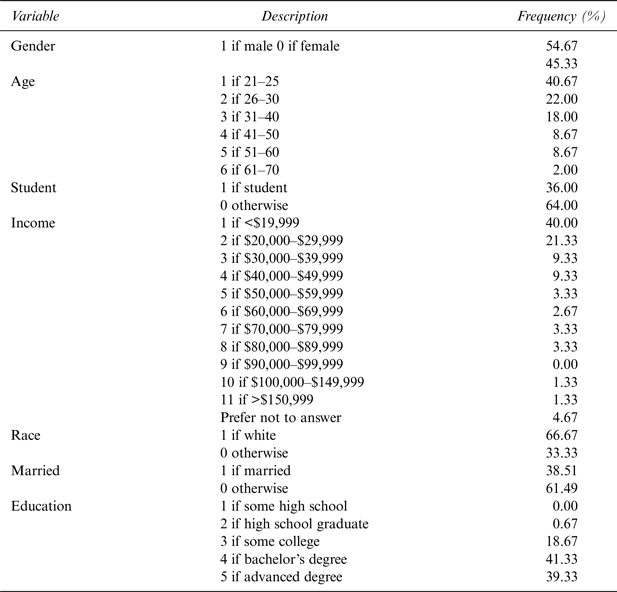
The panelists were asked about their demographic, socioeconomic characteristics, and beer consumption and drinking behavior after completing the tastings. The summary statistics for the demographic variables are presented in Table 2. Thirty-eight percent of the panelists reported being married, and the mode response for age was between 26 and 30 years old. Fifty-five percent of them were male. The mode response for income was in the range of $20,000 to $29,999. The majority (more than 80%) of consumers had at least a bachelor's degree. These statistics are not surprising given that the data collection was done at the university. Thirty-six percent of the panelists were students. Therefore, the results cannot be extrapolated to the general population. There are many factors that can alter the results.
Definitions and Summary Statistics of Demographic Variables

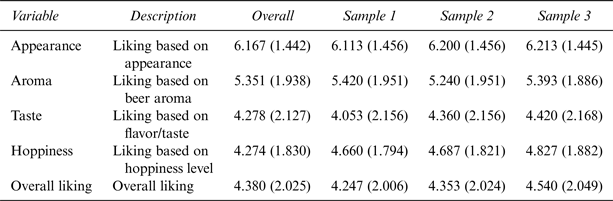
We collected data on consumer preferences and perceptions of sensory attributes of the sampled beers through blind tastings. The panelists were asked questions about five different sensory attributes after tasting each sample. The sensory attributes were appearance, aroma, taste/flavor, hoppiness,Footnote 4 and overall liking. They were given a scale that ranged from 1 (strongly disliked) to 9 (strongly liked). The results of the tasting are provided in Table 3. Treatment 3 (with the standard nitrogen level) was the most liked sample among all the categories except for aroma. In that category, treatment 1 was the most liked sample.
Summary Statistics of Sensory Attributes

Note: All variables are based on a 9-point Likert Scale, where “1” is extremely dislike to “9” is extremely like. Means are presented with standard deviations in parentheses.
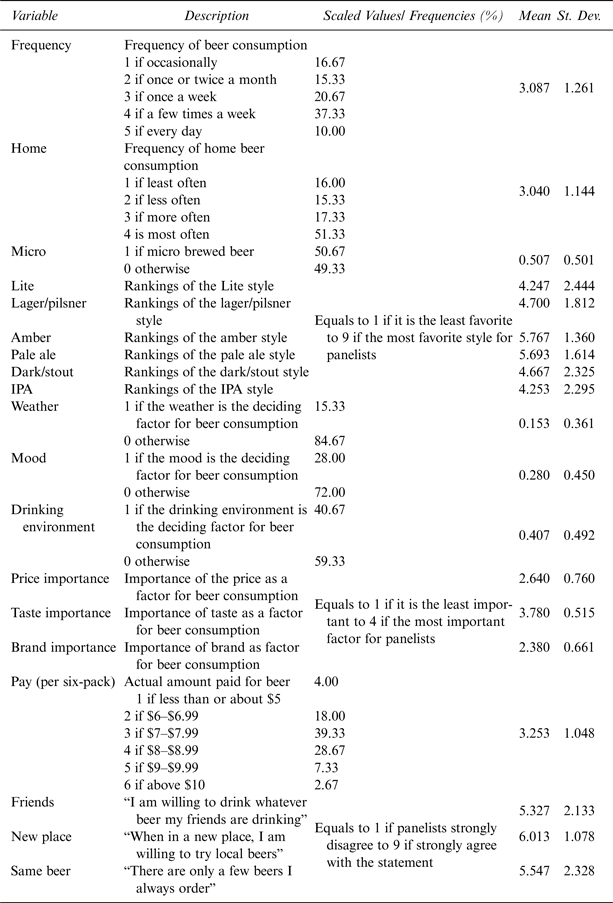
Consumers were also asked about their beer purchasing behavior, drinking behavior, and consumption habits (Table 4). On average, panelists drank beer at least once a week (68%), with 47.33% drinking a beer more than a few times a week. The panelists, on average, had at least two servings each time. These numbers are comparable to the U.S. per capita consumption levels of three to four pints per week (Beer Institute, 2011).Footnote 5
Beer Consumption and Preferences

The most common place to drink beer was at home. Half of the panelists preferred microbrew or craft beers to macro or imported beers. The most liked style of beer was amber followed by pale ale, lager/pilsner, and dark/stout. Engaging with friends was the most important factor while consuming beer and this was followed by mood and weather. The question that captured the importance of extrinsic characteristics for beer consumption identified that the taste was the most important factor, followed by price and brand. The mode reported price for a six-pack of beer paid for by the panelists was in the range of $7 to $7.99.
Panelists were also asked about their level of agreement with several statements related to their beer consumption. The questions were categorical Likert scale variables of 9 points ranging from “1” to “9” if the panelist strongly disagrees with the statement to if the panelist strongly agrees with the statement, respectively. On average, the panelists were eager to try local beers when they were in a new place. However, the data showed that the panelists neither agree nor disagree that friends had any influence on their beer choice and that they usually consumed only a few beers. Descriptive statistics are presented in Tables 2 to 4.
After answering the sensory questions about each sample, the panelists were next asked CV questions. They were asked if they would be willing to buy a six-pack of the beer in question for $6.99, which was the average market price at the time of the study. If the panelist was willing to pay the initial amount, a second offer of the same beer was made for a higher price. If the panelist rejected the initial price, a second offer of the same beer was made for a discounted price.
To cover the distribution of consumers’ WTP, the premium offer was one of the four amounts randomly assigned to the participant: $7.49, $7.99, $8.49, or $8.99. Similarly, each participant who rejected the initial price was offered a randomly chosen discount price of $6.49, $5.99, $5.49, or $4.99. Therefore, each panelist received a second offer of a discounted or premium price based on his or her initial response. The price range was calibrated by a pre-test of the questionnaire with people who did not participate in the main data collection study.
V. Results/Discussions
A. Treatment Effects Model
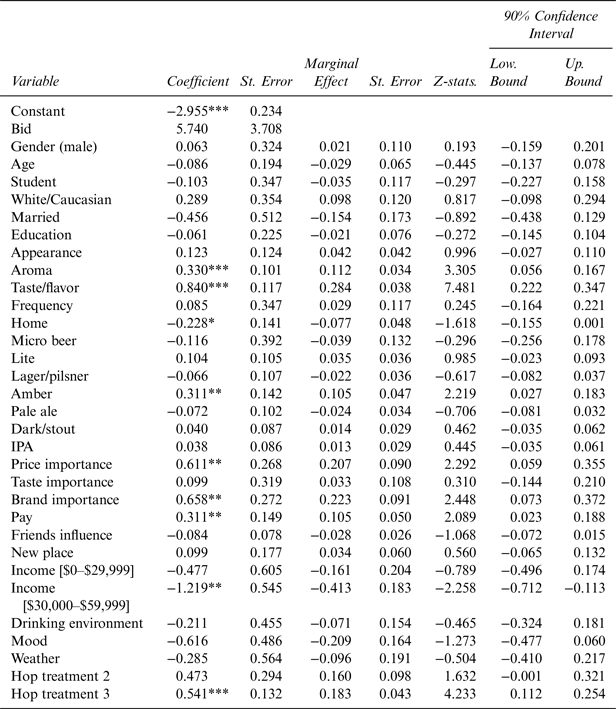
The estimates of the parameters of double-bounded CV analysis and the marginal effects of the variables with a 95% confidence interval are presented in Table 5. It is important to note that our study captures the impact of different fertilizer treatments on the WTP. Hop treatments are dummy variables representing the nitrogen fertilizer treatment in the analysis. We include the second and the third treatments in the model using the first treatment as a reference point. We note that the third treatment (the standard fertilization practice) has a positive and a significant impact on consumers’ WTP. Based on these results, we can conclude that under-fertilization of hops has a negative and statistically significant effect on consumers’ WTP.
Marginal Effects of the Model with Hop Treatments on WTP for Beer

* significant at 10% level, ** significant at 5% level, *** significant at 1% level.
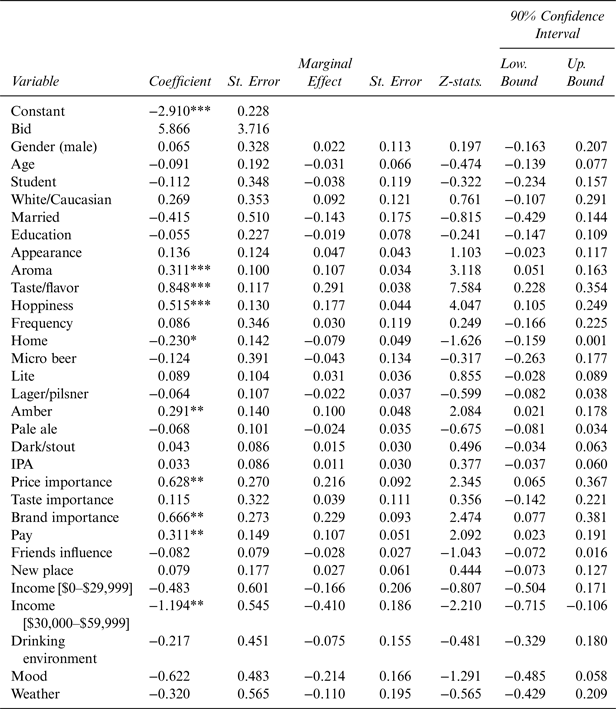
The model captures the impact of the variation of specific variables in consumers’ WTP. Three out of four intrinsic characteristics have a positive and significant impact on WTP at the 1% level. If the panelists like the taste of a specific sample beer and rate it one unit higher on the nine-point Likert scale, then they are willing to pay 28.4 cents more for a six-pack of the sample beer. Hence, the premium taste of a specific beer that consumers like positively impacts the WTP.
Microbrewers also differentiate their products through aroma and appearance of a beer. The aroma characteristic of beer has a positive and significant impact on the WTP at the 1% level. However, the effect is less than the effects of taste and hoppiness characteristics. If consumers like the aroma of a given sample by one unit on the nine-point scale, they are willing to pay 11 cents more for a six-pack of that beer. The appearance has no significant impact on the estimated WTP. Since all the samples were similar in terms of the style and color, it is possible that consumers did not perceive differences across the samples based on the appearance. The results could have been different if there had been a greater variation in appearance.
Consumers with an annual income ranging from $30,000 to $59,999 were willing to pay less by 41 cents for a six-pack of a beer compared to consumers with more than $60,000 annual income (at 5% significance level). Our data could not capture any significant difference between low income ($0–$29,999) and high income (more than $60,000) consumers. One possible explanation is that the relationship between income and WTP is not linear similar to other alcoholic beverages (Gustavsen and Rickertsen, Reference Gustavsen and Rickertsen2018; Tozer et al., Reference Tozer, Galinato, Ross, Miles and McCluskey2015).
There could also be other demographic factors that influence this outcome. Students who generally have a lower income while in college may already have beer and WTP preferences from higher-income families. Younger people may also be more open to new types of beer compared to older participants who already have built in preferences. Similarly, regional factors can also differentiate consumer preferences. For example, this study is conducted in the Pacific Northwest region, which is famous for the abundance of craft breweries (Brewers Association, 2018).
Drinking habits and consumers’ beer preferences also influence their WTP. Consumers who drink beer mainly at home are willing to pay less. This observation was not surprising since the beer for home consumption is purchased at a store where the prices are lower compared to the other relevant places where the beer can be consumed, for example, bars and restaurants. There is a positive and significant relationship (at the 5% level) among consumers who prefer amber styles and the WTP estimate. Consumers who prefer amber styles are willing to pay 10 cents more for a six-pack of the beers sampled. One possible explanation for this result is that there is a similarity of taste or appearance between sampled beers and amber-style beers.
There is also a positive and significant relationship (at the 5% significance level) between the variables of importance of the price and brand and the WTP. If the importance of a price or brand for beer consumption increases by one unit in a four-unit scale, then the WTP increases by 21 and 22 cents, respectively, for a six-pack of a beer. These results show that if a price or a brand are more important for a consumer while purchasing a beer, then they are willing to pay more compared to consumers who buy beer because of the other factors.
The variable that represents how much respondents usually pay for beer has a positive effect on the WTP and is significant at the 5% level. This result suggests that participants who generally pay higher prices for a six-pack of beer at a grocery store are willing to pay higher prices for the sampled beers.
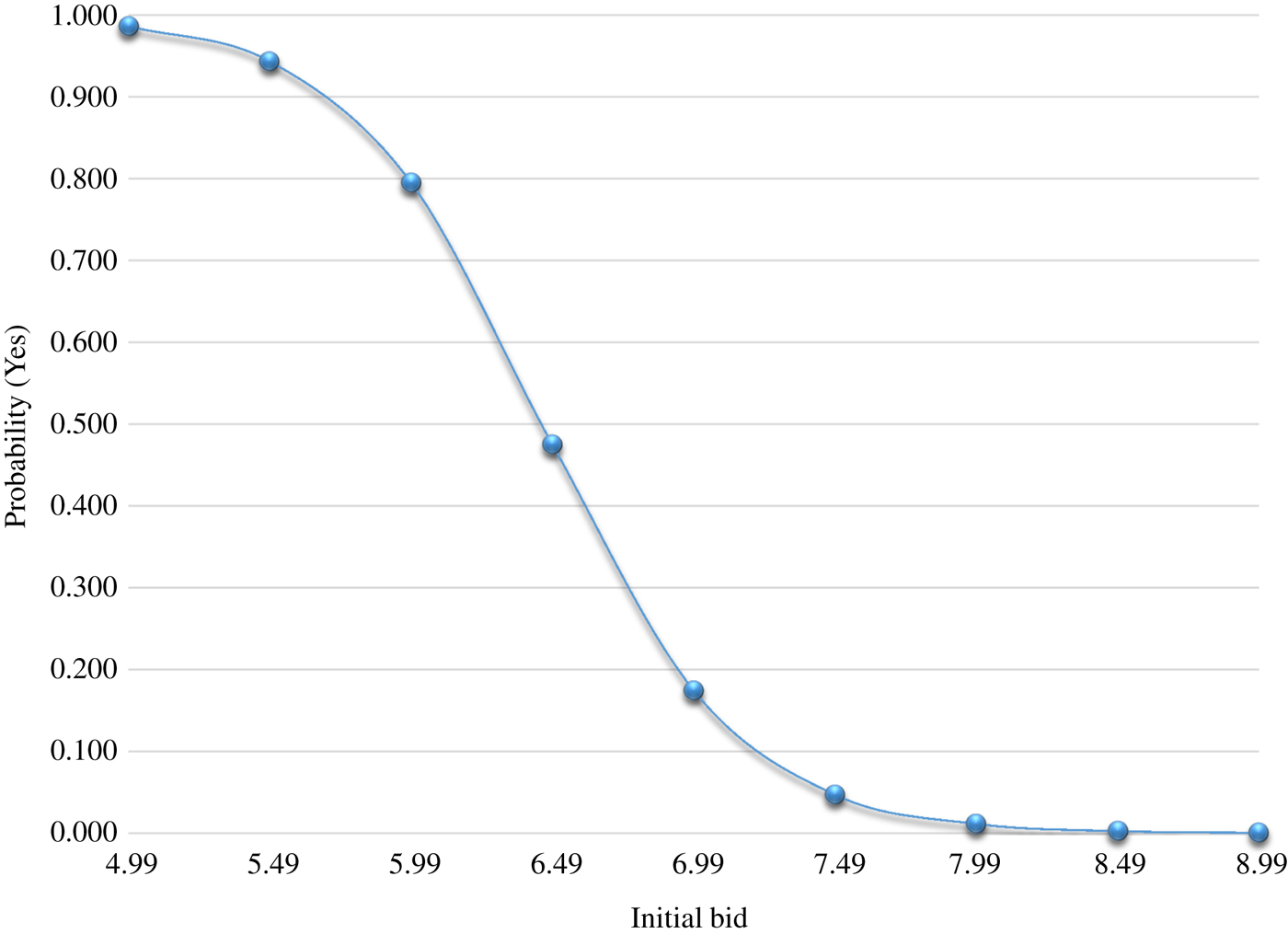
The bid coefficient is positive but not significant at 10% level of significance. Figure 1 shows the probability of saying “yes” to the offer to purchase beer with different bids.Footnote 6 We can see that the distribution of the probability of positive response is not normally distributed and it is skewed towards the lowest of the bids. This phenomenon is further demonstrated in the value of a mean WTP. We calculated overall mean WTP as  $\displaystyle{1 \over {\hat {\rho}}} \lpar {\hat {\alpha}} + {\hat{\lambda}}^{\prime}{\bar z}_i \rpar$ (Hanemann, Reference Hanemann1984) and a confidence interval using the delta method.
Probability of WTP as Bid Varies

The mean WTP for a six-pack of beer is $6.46 with a 95% confidence interval of $5.94 to $6.97. The point estimate is 53 cents lower than the initial price offered to consumers of $6.99 (based on the market price at the time). This result suggests that consumers, on average, are willing to a pay a lower price for the three beers offered in the study compared with what they would buy in stores. However, the same consumers are willing to pay higher premiums for the sampled beers when they like the intrinsic characteristics of the beers.
These results highlight the importance of providing a sufficient amount of fertilizer to hops to elicit high consumer likings. However, these results do not necessarily imply a linear relationship between fertilizer amounts and consumers’ perceived quality, that is, additional increases in fertilizer amounts will generate higher consumer liking of perceived quality. It is important to mention that standard fertilizer treatments are based on previous knowledge and experiments that provide the best results, in terms of quantity and quality. Other factors (e.g., environmental, agricultural) also have a significant impact on the optimum amount of fertilizer application that is accepted by the industry.
A similar point can be made about the yields in each treatment group (Table 1). The standard fertilizer application provides the best yield among all treatment groups. Under-fertilized treatments with a deficient nitrogen application of 25% and 50% on average generated 23% and 24.4% lower yields, respectively. Here, we used under-fertilization as a treatment effect compared to the standard amount. However, it is not clear, and we do not address, what would happen if the hops were grown with amounts higher than the standard rates of nitrogen fertilizer.
It is also important to note that the type of the beer and hops used in the analysis also affect the results. As noted earlier, we sampled American IPA using Cascade hops. Beers are brewed using different hops with varying intensities. This makes the process of explaining the relationship between hop varieties and their subsequent qualities on the final product that individuals consume challenging. It is possible that we could observe varying results with different styles of beer (e.g., stout, ale, lager).
B. Perceived Hoppiness Model
Different hop varieties and different levels of hop intensities give beer a specific taste that brewers use to differentiate their products from other producers. Hoppiness is assumed to be a “horizontal quality attribute.” This means that the hoppiness preferences vary across consumers and an individual consumer prefers the level of that attribute that is closest to his or her ideal.
As a robustness check and further investigation of “hoppiness,” we estimate a model with the hoppiness variable instead of hop treatments. The results of this model are presented in Table 6. The marginal effect of 17 cents for the third treatment is very close to the marginal effect of hoppiness of 18 cents in the first model. The results show that if consumers increase the ranking of a sample based on their perception of hoppiness by one unit on the nine-point scale, they are willing to pay 17 cents more for a six- pack of that beer. The hoppiness variable in our study is a perceived quality of hops in beer instead of the actual hops quality and intensity. Therefore, our results do not imply that the hoppier the beer, the more consumers are willing to pay.
Marginal Effects of the Explanatory Variables on Mean WTP for Beer

* significant at 10% level, ** significant at 5% level, *** significant at 1% level.
The statistical results also indicate that the fertilizer treatment impacts the level of hoppiness perceived by consumers. The paired t-tests compare the mean levels of hoppiness likings of three treatments and are presented in Table 7. We note that there is no significant difference between samples 1 and 2 at 10% level of significance, which are deficient in nitrogen. Treatment 3 has the standard nitrogen level. However, there is a significant difference between treatments 1 and 3 and treatments 2 and 3 at 1% level of significance. This underscores the importance of fertilizer treatment in hops quality perceived by consumers. We also noticed that the standard treatment with nitrogen fertilizer results in the highest yield among the three treatments (Table 1). Therefore, we conclude that a significant fertilizer treatment plays a vital role in both hops quantity (yield) and perceived quality (hoppiness).
Paired t-test Results

VI. Study Limitations
While the results show that a standard fertilizer application is required to obtain the best outcome in terms of consumer liking and WTP, it is important to note that there are some limitations in the study. One of the most important factors that affect the results is using a different hop variety or brewing a different style of beer that might change our results. It is also unclear how much hop variety and intensity is used to brew beer and the style of the beer affects the perceived quality of the beer.
The socioeconomic characteristics of consumers also play an important role in identifying the relationship between fertilizer applications and consumer WTP. The study is conducted on a college campus. For example, 36% of respondents were students and the income modes were $20,000–$29,999. Therefore, the sample data cannot be viewed as representative of all consumers in the country.
The study was done through blind tasting. In this sample, the panelists did not know details of beers and hops. Telling consumers about nitrogen fertilizer deficiencies in some of the treatments and highlighting positive environmental aspects of it can have a different impact on the consumers’ perception and the WTP of the samples presented.
VII. Conclusions
The beer market is the largest market for alcoholic beverages in the world, but few studies have analyzed the impact of sensory attributes and demographic characteristics on consumers WTP for beer. Our results show that consumers in a blind tasting can identify differences in beer made with hops grown with limited and complete fertilizer treatments. The findings indicate that beers brewed with under-fertilized hops negatively impact perceived hops quality. As a result, sufficient application of nitrogen fertilizer is required to deliver higher consumer liking and WTP. The taste and aroma also have a positive and significant impact on WTP. With limited sample variation on appearance, the appearance does not have a significant impact on the WTP.
The results also show that middle-income consumers are willing to pay less for sampled beers compared to consumers with higher income. Similarly, consumers who drink beer mainly at home are willing to pay less for a six-pack compared to consumers who mainly drink at bars, restaurants, and social gatherings. Consumers for whom the price or the brand are the deciding factors for beer consumption are willing to pay higher prices for a six-pack of beer. Likewise, consumers who prefer amber style are willing to pay more for sampled beers.
In the future it would be interesting to assess how consumer evaluations would change across different types of beers. In addition, depending on how information is presented on beer and hop production, consumer response could be different. That is, if a beer low in fertilizers is presented as being grown in more sustainable conditions.
The use of different varieties of hops and hop intensities gives microbreweries the opportunity to differentiate the taste of their products. Therefore, they can create a unique product that is different in the market and can charge a premium for their product. The findings give sufficient amount of evidence that hops need enough nitrogen nutrients to provide an optimum amount of yield for producers and a satisfactory taste for consumers.