INTRODUCTION
The advanced stage of incurable disease processes affects the perception or feeling of dignity that a patient holds about themselves (Chochinov, Reference Chochinov2007; Chochinov et al., Reference Chochinov, Hack and Hassard2002a ; Hack et al., Reference Hack, Chochinov and Hassard2004). There are some tools available to identify existential distress in such patients (Newell et al., Reference Newell, Sanson-Fisher and Savolainen2002; Alesi et al., Reference Alesi, Ford and Chen2015; Benito et al., Reference Benito, Oliver and Galiana2014). In recent years, new psychological interventions have been put forward for these patients, including methods of seeking meaning and reinforcing the patient's sense of dignity (Chochinov et al., Reference Chochinov, Hack and McClement2002b ; Breitbart et al., Reference Breitbart, Rosenfeld and Pessin2015).
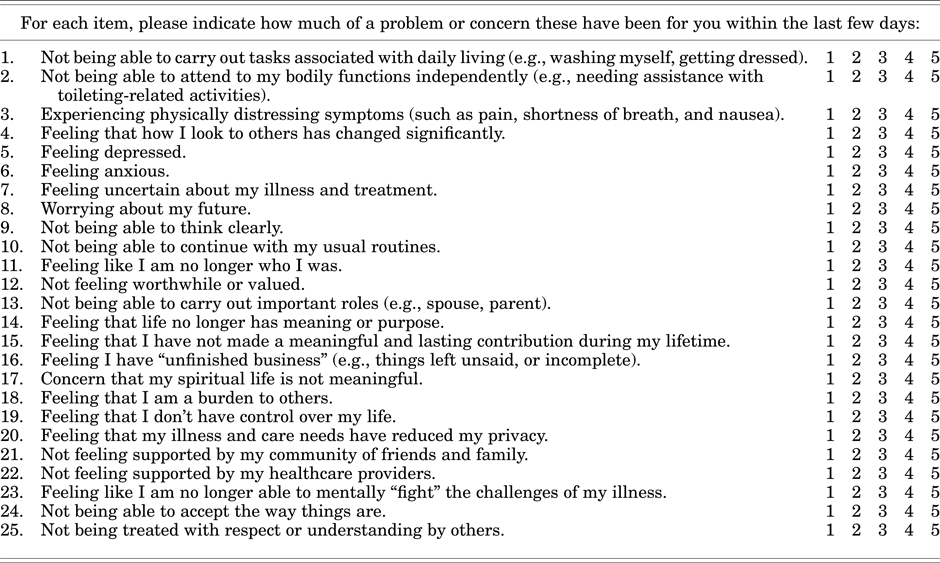
The Patient Dignity Inventory (PDI) was developed in 2008 by a Canadian psychiatrist, Dr. Harvey Chochinov, based on earlier research into the factors that affect the perception of dignity in illness, including dependence, symptomatic load, and a feeling of lack of purpose or meaning. The tool put forward by that author was made up of 25 items in 5 groups (Table 1): symptom distress, existential distress, dependency, peace of mind, and social support (Chochinov et al., Reference Chochinov, Hassard and McClement2008; Reference Chochinov, McClement and Hack2012). The original version of the PDI was written and validated in English. It was later translated to and validated in Italian, German, and Persian (Abbaszadeh et al., Reference Abbaszadeh, Borhani and Rabori2015; Ripamonti et al., Reference Ripamonti, Buonacorso and Maruelli2012; Sautier et al., Reference Sautier, Vehling and Mehnert2014).
Patient Dignity Inventory

1 = not a problem; 2 = a slight problem; 3 = a problem; 4 = a major problem; 5 = an overwhelming problem.
Our group conducted a study on the translation, cultural adaptation, and validation of the Spanish version of the PDI, which was published recently (Rullán et al., Reference Rullán, Carvajal and Núñez-Córdoba2015). The resulting version displayed excellent validity along with high internal consistency (Cronbach's α = 0.89). Moreover, in the sample studied, there was a high correlation between poor dignity perception and emotional distress (ρ = 0.8), measured on the Hospital Anxiety and Depression Scale (HADS). We also found a high correlation between high PDI scores and symptomatic load, measured using the Edmonton Symptom Assessment Scale (ESAS) (ρ = 0.7) (Carvajal et al., Reference Carvajal, Centeno and Watson2011). Nevertheless, there was a lower correlation between the PDI and existential well-being (ρ = –0.4) measured on the Spirituality Subscale of the Functional Assessment of Chronic Illness Therapy questionnaire (FACIT–Sp). Despite this, the data suggest a group of patients with a high degree of satisfaction as regards spiritual needs. It was concluded that the Spanish version was appropriate for evaluating dignity-related distress in our setting and especially useful in the initial evaluation prior to implementing measures in favor of emotional and existential support.
The validation process was conducted for a group of 124 advanced-stage outpatients and inpatients attended to at the Clinica Universidad de Navarra. The patients were given the opportunity to complete the PDI alone or with professional help (having questions read out loud). The majority asked to have the questions read to them (96%). When applying the PDI, evaluators noticed that it led to open conversations and that patients opened up to them about important and sensitive aspects of their lives, which they responded to, without necessarily intervening, using assertiveness and active listening techniques, as determined beforehand. Their only intervention was to take note of the remarks as they were made, but after seeing the consistency of similar reactions, a decision was made to carry out the study with the goal of generating a closer understanding of professional experiences when using the PDI, taking into account both the application of this new tool and the reaction it provoked, by asking direct questions related to dignity and to the way in which advanced-cancer patients dealt with their illness.
METHODS
Type of Study
An exploratory study based on the use of qualitative methods.
Research Context
Our study forms part of a larger project that includes translation and validation of the PDI (Rullán et al., Reference Rullán, Carvajal and Núñez-Córdoba2015) and that was approved by the research ethics committee at the University of Navarre. One month after finishing the PDI validation process, the experiences of healthcare professionals using the PDI were examined, this making up the central hub of this article. Professionals acquired experience in using the PDI, having applied it 155 times to 124 advanced-stage cancer patients.
Data Collection
To gain an insight into the experience of the professionals, a focus group was held, understanding this to be a small group discussion around topics that the interviewer raised (Morgan, Reference Morgan1998). It was conducted with the participation of four members of the palliative care team, within the context of the tool-validation study, who had previously used the PDI: a psychologist (MM), a physician (CC), a research nurse (AC), and a medical student (MR). All were invited to take part to discuss their experiences of applying the PDI.
The meeting was held following the guidelines set up earlier, with open questions on (1) practical issues with administering the questionnaire; (2) impressions about the reactions of patients and his or her caregivers, or family members, to items on the questionnaire; and (3) professional reflections on using the tool.
The focus group was carried out by someone from outside the team and lasted 110 minutes. An audiotape was made, and the group was held outside the hospital in a calm, relaxed atmosphere, in an attempt to give the meeting a more reflexive feel.
Analysis
A literal transcription of the focus group was taken, identifying participants using initials (M: student, P: psychologist, E: nurse, C: doctor). Two researchers then independently carried out a thematic analysis of the text, following Burnard et al.'s (Reference Burnard, Gill and Stewart2008) instructions. They did not follow predetermined categories, resulting in a basically inductive approach.
Rigor
Independent text analysis by two researchers meant that triangulation between researchers was an element of rigor in our study.
RESULTS
Three main principles were identified in our analysis: (1) the relevance of the process of introducing the evaluation; (2) the process of applying the PDI; and (3) the contribution of the format and way of applying the questionnaire and the repercussions of applying the PDI on the patient, on their relatives, on the researcher and other professionals.
The Relevance of the Process of Introducing the PDI
The professionals taking part identified two relevant aspects in their experience of introducing the tool to patients: the “challenges” involved in using the term “dignity” when introducing the tool and the professional's authentic attitude and communicative abilities from that initial moment. The professionals felt that using the PDI was a learning process, which led them away from the strict use of the term and toward the search for other forms of introducing the questionnaire. To be precise, the professionals mentioned a change in terms used when presenting the questionnaire to the patient. The scale was initially referred to as the “Patient Dignity Inventory,” with explicit use of the term “dignity.” On seeing that “dignity” was interpreted in an abstract and confused way, the professionals decided to explain the scale by saying that it was intended to discuss profound issues related to the illness and to the patient:
What we said was, let's not talk about dignity—not even Chochinov talks about dignity. We're going to speak about what effect the illness has had on important aspects of her life. (C) (all agree)
The professionals considered that when explaining and applying the PDI it is important to keep in mind that it involves many profound aspects and areas of the patient's life. They refer to the need for an authentic attitude and communicative skills in order to properly apply the PDI and for the patient to understand that the PDI discusses profound issues, and that they should feel comfortable:
I believe that until they actually do it [the PDI], they do not know what is being offered, and to do it they need a minimum standard of communication skills. Being prepared and with a minimum degree of confidence. (E)
I believe that it is what helped me most, being myself … not thinking about going into the room as an expert on this, going in as one is … the patient was more the center of attention and spoke more. (M)
The Process of Applying the PDI
From the point of view of the professionals, applying the PDI includes a learning process that starts with the discovery of key aspects in the structure and format of the PDI, to the point of assuming the role of therapist when using the tool.
As regards the content of the scale, although professionals were already acquainted with it, applying it made them conscious of the importance of the structure. They a priori had not placed importance on that fact, but the more they used it, they more they tended to positively evaluate the fact that the tool starts off by tackling lighter aspects related to physical aspects and then goes on to deal with issues of greater depth or transcendence, such as dignity-related distress. The scale of the depth of the issues raised was perceived positively. They also felt that the PDI gave a holistic evaluation of the patient:
I think that the questionnaire has its order. I had the feeling that at first it is more simple and that it starts preparing the patient for you, and later on, after 12 … I no longer feel that I am the person I used to be. Other questions begin which are more profound, aren't they? I feel that I am worthless. I feel such and such. (P)
On the other hand, when asking the seven questions from the questionnaire which appear in a negative form, professionals felt some misgivings when administering the PDI. Therefore, they tried to play down what was seen as a barrier, using a softer tone of voice and “prompts” to soften negative-sounding terms, helping the patient to reflect and not get stuck on the question at hand. However, they considered that this negative form was something helpful for patients:
Everything felt negative. I think that it could be different but … doing it like that also makes the patient think more, perhaps. That means, maybe it is more important because he has to make the effort […] If you ask him [whether] he feels that his life has no meaning, he has to make an effort to look and say, “Yes, it has.” (M)
The original idea, as planned, was for self-administration of the PDI, but the professionals discovered that most patients preferred to have it read to them. Only one patient wanted to fill it out himself, and that was a young man who said he wished do the PDI to “contribute to research.” The rest of the patients took the option of doing it as part of a conversation:
The profile of the patient who preferred to complete the questionnaire by themselves was a younger patient who preferred not to open up. He did it to contribute something to the research, probably with much less reflection than if you had asked him or her. (E)
They often said, “Can you read it to me?” … That meant we always asked … I did, except 3 or 4 young patients … a very specific profile. Most of them asked you to read it. (M)
The professionals realized that using the PDI was not only about giving numbers or scoring answers—that there was more to it than that. Although the inventory did not require an explanation of the answers, or any comments from the patients, the majority of them opened up and shared their experiences with the professional, displaying many emotions. This perception was unanimous among the professionals, who observed that the PDI unexpectedly became an intervention, as can be seen more clearly in the following on the repercussions of the PDI:
We had all read the questions, the translation, the back-translation. It's not that we did not know what we were going to ask. … I mean, I am a psychologist. But we did not know the impact it would have. (E)
The patient spoke out, and then we came to the end, well, and then what do we write? … You had to write a number. They had told you everything … because in itself the questionnaire is an intervention, but at the same time it needed a number. (P)
Instead of giving a number, patients expanded on their experiences. In fact, the professionals considered offering patients doing the PDI the possibility of receiving psychological counseling, feeling that they were opening up so much that they might need the dedication of a professional to bring closure to some topics. To begin with, the idea was that it would be an isolated intervention, but upon seeing how many patients shared experiences, the professionals thought it would be good to offer the possibility for ongoing conversations, above all from the perspective of what the patient needed from a professional. For example,
One patient opened up and said, “I think I need emotional support,” and we had just met, and we had said that if we saw patients, we would leave the choice for psychological support open to them. We could offer them help from the psychologist. Then he said he did not need anything. (E)
When we came to the question about him having outstanding issues, his wife was not there anymore. That was when he started to cry. He opened up and started to tell me a little about his experience. (M)
In general, the professionals felt that it was a positive experience but that it needed sufficient time. Thus, they noted two challenges to administering the tool: (1) applying it when there was insufficient time on the part of the patient or the professional, and (2) the doubt as to whether it would be beneficial to use it with a patient who we knew, beforehand, to be in the situation of having had a recent existential crisis:
It's a bit long. … In the clinical sense, I am not sure about doing it as a matter of routine. But if I have enough time, […] it is an excuse to speak with the patient about this at a given moment. (E)
Repercussion of the Application of the PDI for the Patient, Family, Researcher, and Other Professionals
Patients frequently expressed special gratitude for being able to discuss sensitive topics. For the professionals, just applying the PDI influenced many patients, and they perceived that the PDI had a therapeutic effect as it facilitated open discussion of key aspects related to the patients' illness:
The evolution is that, when you do it and you see that it has an effect on the patient, and an effect on the professionals, even on yourself, there are situations in which you feel uncomfortable or you do not feel uncomfortable. (P)
The patient's reaction was to cry and to say, “Thank you, because you have made me express things which I had never expressed before and more so, to someone I didn't know.” … The majority of the patients were grateful for having been asked. (E)
Relatives expressed some reservations as regards the proposal to do the PDI. The professionals explained that some relatives, perhaps in an attempt to protect their loved ones, answered on their behalf, despite the patient wanting to answer and take part. Nevertheless, on other occasions, the roles were reversed, and it was the patient who wanted to protect the family member with their explanations:
The family snapped: “You're not a burden.” … “Calm down, he's saying what he feels.” … At that moment, the family couldn't bear the patient saying that. (E)
I think that the patient did not want the family to suffer … Perhaps they had not talked about that … Both of them started crying and said, “It's just that we have not cried together.” (E) (the others, C and M, nod)
As regards the utility of the PDI, the researchers felt that the tool allowed them to get to know the patient better and to get closer to them. The idea of the viability of applying the PDI in day-to-day clinical practice was also discussed. The professionals thought that it was not necessary to use it on a habitual basis. Different professionals, with different training and backgrounds, saw different uses: as a script for a clinical interview or to screen patients for more specific therapies, such as those focusing on dignity or meaning, among other aspects.
There was a variety of perceptions on the effect on working with the PDI on the professionals themselves. Some said it was worthwhile discovering the value of dedicating time to speaking with the patient about possible sources of distress related to end-of-life dignity:
I get the impression that E has been able to see that it is worth being there and that M has discovered that one can do things on one's own … What are needed are people who are willing, who want to help, and who do not mind giving, offering themselves as a whole. (C) (E and M agree)
Realizing that a questionnaire can, at a given moment, help you, like a script, for being there. (P)
I may discover the patient's strengths and weaknesses … to use them later as the best way of talking to the patient on a normal visit. (E)
Other colleagues—those outside the palliative care team, involved in patient care (doctors, nurses)—expressed initial misgivings, or a fear of using the PDI due to the possible repercussions it might have for patients. In contrast, others mentioned their faith in the professionals who were applying it, as members of the palliative care team, and assumed that the interview would help patients:
It is as if, whoever is attending the patient, and then a palliative team or psychologist comes along … some are more receptive than others … It produces the same degree of uncertainty about how it will affect the patient. (P)
We spoke at length with the nurses … it was odd because they saw it as an intervention … In the day hospital, they saw the patient cry later … they thought you were there to help. (E)
DISCUSSION
When applying the PDI, healthcare professionals held the unanimous opinion that its administration was useful, that it was beneficial for the patient and may have even had a therapeutic effect. Thanks to the application of the questionnaire, patients shared aspects that went beyond the specific inventory questions and spoke of important, poignant matters that affected them. This is in line with the claim by the author of the PDI, who said that it may be a medium by which patients reveal and discuss specific issues causing them distress (Chochinov et al., Reference Chochinov, McClement and Hack2012).
As other results have shown, the PDI gives rise to conversations about aspects that in other circumstances might be difficult to bring up and evaluate. The professionals also saw it as a tool with which to help facilitate conversation, although at times, when an elevated level of distress was apparent, it might be appropriate to call for specific emotional support. In the group studied, however, this was not necessary, and emotional expression was managed suitably with assertiveness and listening skills.
The idea that an evaluation tool might have a therapeutic effect has been mentioned in connection other tools, such as the ESAS or the examination of the wish to die (Carvajal et al., Reference Carvajal, Centeno and Watson2011; Monforte-Royol et al., Reference Monforte-Royol, Villavicencio-Chávez and Tomás-Sábado2011). It seems that some tools promote professional–patient communication, but it is worth considering whether the therapeutic effect is an intrinsic quality of the PDI or whether it depends on applying it with an open, empathetic attitude (Carvajal et al., Reference Carvajal, Centeno and Watson2011). Our results suggest that the PDI requires an authentic attitude of listening and good communicative ability from the professional. It would seem that tools that evaluate psychological or existential aspects have a great therapeutic value if they are administered by a person who wishes to establish bonds with the patient. In this sense, the questions on the PDI have an inherent quality—existential and spiritual—and are, as it turns out, stimulating in all cases. In any event, the lingering feeling of the professionals who applied the PDI is that this provides a useful guideline for tackling the existential aspects of care. In the future, based on our experience, we would consider that second = person application in a conversation is desirable in order to obtain greater benefits.
With regard to the way in which the PDI is used, we feel that in the Spanish context it is more appropriate to apply it in a conversational manner. Suggestions have also been made that presenting the tool should be done without overstating its transcendence and that the term “dignity” is not absolutely necessary to be used, although an introduction should be made before application, as suggested by the author (Chochinov et al., Reference Chochinov, McClement and Hack2012). In this sense, although the instrument is designed to evaluate the efficacy of dignity therapy (DT), our results suggest that administering the PDI is a kind of intervention in itself whether DT is given, or not.
The patients' relatives in our study expressed some reservations regarding the proposal to complete the PDI. The professionals explained that some relatives and some patients interrupted the conversation in trying to protect their loved ones. However, an innovative protocol has been developed to use the PDI as an intervention for couples, and one of the main conclusions of this preliminary research suggests that the intervention enhanced their communication skills and potentially drew couples closer together (Mowll et al., Reference Mowll, Lobb and Lane2015). These changes in the presentation and the process of administrating the PDI to both patient and partner and then discussing it together could also have benefits for the participants in our context, despite the initial fears of the family. However, we consider that further studies about this are necessary.
Our study confirms Chochinov's proposals on the use of this tool, not only in evaluating the degree of distress, but also to look more closely into the relevant aspects for each patient's life, allowing the establishment of a relationship, along with varying degrees of care (Chochinov et al., Reference Chochinov, McClement and Hack2012). The considerations gathered also suggest that it might be easy to adapt this questionnaire to other contexts of advanced illness.
In another context, Di Lorenzo et al. (Reference Di Lorenzo, Cabri and Carretti2017) performed a validation study with the PDI among patients hospitalized in an acute psychiatric ward. They reported that application of the PDI was appreciated well by patients, probably because it was seen as a sign of professional interest in their problems, a consideration also noted in our study. Furthermore, they observed that the PDI could be useful in improving the therapeutic relationship and increasing patient adherence to treatment (Di Lorenzo et al., Reference Di Lorenzo, Cabri and Carretti2017).
One strong point of our study is that it transmits the viewpoints of different professions and professionals with different degrees of clinical experience. Nevertheless, the fact that all the professionals are part of a single team is a limitation in terms of drawing more definite implications.
In the future, in routine studies, it would be convenient to establish how much time is needed to apply the PDI as an intervention and whether there exists a specific profile for the kind of patient who might most benefit from its use. As in other studies related to the PDI, patient experience was not considered here, and this should also be an object of future lines of research.
CONCLUSIONS
The PDI may have its own inherent therapeutic value, and it is useful in practice for examining issues related to dignity and meaning in life in the context of advanced illness. There exists a need for studies to look at its efficacy and discuss patients' experiences using an interview based on the PDI.
CONFLICTS OF INTEREST
The authors of this study hereby declare that they no conflicts of interest to disclose.
ACKNOWLEDGMENTS
We would like to thank each and every one of the patients for sharing their feelings and experiences with us.