Introduction
What determines natives' attitudes toward immigration?Footnote 1 Social scientists have been increasing the attention they pay to immigration over the last decades because of the broad impacts it can have on host countries as it changes their demographics. In particular, scholars are interested in the determinants of anti-immigration views, because natives' attitudes toward immigration shape the context in which immigrants are integrated into the host country.
Social scientists have proposed two distinct explanations for anti-immigration attitudes. The first explanation is economic; it claims that natives' concerns about competition with immigrants in the labour market (Mayda, Reference Mayda2006; Scheve and Slaughter, Reference Scheve and Slaughter2001) and the fiscal burden of providing social welfare for immigrants (Facchini and Mayda, Reference Facchini and Mayda2009; Hanson et al., Reference Hanson, Scheve and Slaughter2007) lead to anti-immigration attitudes. In contrast, the second explanation suggests that socio-psychological factors such as prejudiced stereotypes of immigrants (Hainmueller and Hangartner, Reference Hainmueller and Hangartner2013), xenophobia (Hjerm, Reference Hjerm2001), ethnocentrism (Kinder and Kam, Reference Kinder and Kam2010) or cultural concerns (Malhotra et al., Reference Malhotra, Margalit and Mo2013) are responsible for resistance to immigration.
Contextual determinants of anti-immigration attitudes have also been studied. For example, Dancygier and Donnelly (Reference Dancygier and Donnelly2013) and Wilkes and colleagues (Reference Wilkes, Guppy and Farris2008) report that the state of sectoral and the national economies shapes attitudes toward immigration, a view which aligns with accounts that emphasize economic motives as determinants at the individual level. Meanwhile, a group of researchers including Hopkins (Reference Hopkins2010) and Fetzer (Reference Fetzer2000) find that the salience of sociopsychological motives hinges on the size of an immigrant population or residential proximity to immigrants.
Despite the vast literature, however, scant attention has been paid to the role of trust as a determinant of anti-immigration. A few studies, including Herreros and Criado (Reference Herreros and Criado2009) and Rustenbach (Reference Rustenbach2010), examine the impacts of trust measured by survey questions about trust in unspecified others in general (so-called generalized trust questions). In order to expand our understanding of the impacts of trust, this study examines as potential determinants of attitudes toward immigration two unexplored types of trust: interpersonal trust in a particular group and non-interpersonal trust in an institution. Specifically, we focus on trust in foreigners and trust in political institutions,Footnote 2 although other types of interpersonal and non-interpersonal trust may also matter.Footnote 3 Given that natives are likely to have positive attitudes toward immigration when they expect that immigrants will behave reliably as new community members and comply with customs and laws in the hosting country, the beliefs that foreigners are trustworthy and that political institutions will be able to effectively enforce regulations on interactions and exchanges among their constituentsFootnote 4 should lead to more positive attitudes toward immigration. In addition, economic development should moderate the impacts of trust in foreigners and trust in political institutions on attitudes toward immigration by providing natives with more opportunities to interact with foreigners and to observe the effective and legitimate implementation of political power, which in turn enhances the natives' confidence in their evaluation of the trustworthiness of foreigners and of political institutions.
Analyzing data from the fifth wave of the World Values Survey (hereafter WVS) 2005–2009, we find consistent evidence for the impact of trust in foreigners on attitudes toward immigration, regardless of whether the attitudes are measured as preference for a policy that increases the number of immigrants or one that provides equal employment opportunities to immigrants. Furthermore, the effect size of trust in foreigners appears to be biggest in models that include a variable for generalized trust and ones associated with economic or sociopsychological accounts of attitudes toward immigration. We also find economic development positively moderates the impact of trust in foreigners on attitudes toward immigration, regardless of the type of policy preference.
However, we find only mixed evidence regarding the impacts of trust in political institutions. When attitudes toward immigration are measured as preference for increasing the number of immigrants, trust in political institutions appears to have a positive effect, whereas the moderating effect of economic development on the positive effect of trust in political institutions appears to be insignificant. Meanwhile, when attitudes toward immigration are measured as preference for providing equal employment opportunities to immigrants, the positive effect of trust in political institutions becomes insignificant. However, economic development now appears to positively moderate the impact of trust in political institutions.
This study makes some notable contributions. First, our results suggest that future studies of attitudes toward immigration should address trust in foreigners, given its overwhelming impact. Furthermore, as studies have repeatedly found that a standard survey question about generalized trust is a poor yardstick for measuring trust toward people in general,Footnote 5 trust in foreigners would serve as a better measure of how interpersonal trust shapes attitudes toward immigration. Second, as far as we know, our study constitutes the first attempt to examine the impacts of trust in political institutions on attitudes toward immigration. Given that the effects of trust in foreigners, generalized trust and economic and sociopsychological motives remain robust to the two measures of attitudes toward immigration in our study, the observed discrepancy in the effects of trust in political institutions between the two measures suggests that changes in public attitudes toward immigration can be at least partially explained by the degree to which trust in political institutions mitigates concerns about a particular immigration issue. We see this as an avenue for future research. Finally, our study has a clear policy implication: providing natives with more opportunities to interact with foreigners and immigrants can counter anti-immigration attitudes.
In the next section, we propose hypotheses about why and how trust in foreigners and trust in political institutions should affect these attitudes toward immigration. The following two sections address the empirical strategy of the study and report results. The last section discusses our findings, including the mixed evidence on trust in political institutions, and suggests topics for future study.
Trust as a Predictor of Attitudes toward Immigration
Despite decades of interest in the determinants of attitudes toward immigration, previous studies have typically neglected the potential impact of trust (exceptions include Herreros and Criado, Reference Herreros and Criado2009, and Rustenbach, Reference Rustenbach2010). In fact, trust has been found to affect a diversity of issues, including economic development, governance quality, political participation, compliance with laws, support for social welfare and vote choice (Daniele and Geys, Reference Daniele and Geys2015; Marien and Hooghe, Reference Marien and Hooghe2011; Uslaner, Reference Uslaner2002). Given that trust “enables participants to act together more effectively to pursue shared objectives” (Putnam, Reference Putnam1995: 665), it might shape attitudes toward immigration because natives and immigrants must share in the task of maintaining and developing the host country.
In constructing our hypotheses about the effects of trust on attitudes toward immigration, we differentiate between two existing approaches to the study of trust. The first approach presumes that trust is normatively driven. It “is a general look on human nature and mostly does not depend on personal experiences or upon the assumption that others are trustworthy” (Uslaner, Reference Uslaner2002: 17). Rather, trust depends on believing that “most people share your fundamental moral values” or that “a wide range of people belong to your moral community” (Uslaner, Reference Uslaner2001: 4). Fukuyama argues that “trust arises when a community shares a set of moral values in such a way as to create regular expectations of regular and honest behavior” (Reference Fukuyama1995: 153).
The second approach, typically referred to as a rational approach to trust, also presumes that trust is dependent on expectations about others' behaviour, but it attributes such expectations not to commonly shared moral values but to interests or, more specifically, “encapsulated interests” (Hardin, Reference Hardin and Cook2001, Reference Hardin2002). “We trust you,” according to Cook and colleagues, “because we think you take our interests to heart and encapsulate our interests in your own” (Reference Cook, Hardin and Levi2005: 5). They elaborate: “For us to trust you requires both that we suppose you are competent to perform what we trust you to do and that we suppose your reason for doing so is not merely your immediate interest but also your concern with our interests and well-being” (6–7).
A rational approach emphasizes acquired rather than ascribed aspects of trust. When assessing others' trustworthiness in terms of their competence and motivation, an individual uses cultural stereotypes as cognitive shortcuts and these are more likely to be used in circumstances of cognitive overload. The individual also estimates similarities in observable characteristics between herself and the object of assessment, based on the belief that similarity is positively associated with the likelihood that the object shares her own interests. Individuals learn the specific meanings of cultural or personal traits with respect to trustworthiness through their direct and indirect experiences, and their decisions to trust or not trust others are an opportunity to modify or confirm the original meanings of those traits. Thus, in the rational approach, trust is path dependent, which makes it distinctive from the normative concept of trust in which trust is stable over time (Uslaner, Reference Uslaner2008).
In this paper, we adopt Hardin and his colleagues' rational approach because most empirical studies have used the normative approach, marginalizing the empirical examination of rational aspects of trust. In constructing hypotheses about the impact of trust, we consider both interpersonal trust and non-interpersonal trust. We expect that trust in foreigners and trust in political institutions both affect attitudes toward immigration, because immigration raises concerns about co-operation between immigrants and natives; natives may question immigrants' commitment to the development and maintenance of the host country. We hypothesize that natives are more likely to support immigration when they perceive immigrants to be sincere in their efforts to contribute to the host country, and this is more likely to be the case when the natives perceive that foreigners in general are trustworthy, as stated in Hypothesis 1.
Hypothesis 1.
Natives who perceive foreigners to be trustworthy are more likely to have positive attitudes toward immigration. Footnote 6
Next, trust in political institutions should also affect public attitudes toward immigration. That is, when government reliably acts as a third party, immigrants are guided to behave in ways that benefits the host country. Thus, as stated in Hypothesis 2, when natives perceive the government to be trustworthy, they are more likely to support immigration even when they regard foreigners as untrustworthy or are uncertain about foreigners' trustworthiness.
Hypothesis 2.
Natives who perceive political institutions to be trustworthy are more likely to have favourable attitudes toward immigration.
The effects of trust in foreigners on attitudes toward immigration may vary according to the context. In particular, economic development should moderate the effects of trust in foreigners because it affects interpersonal relationships. People in economically developed countries can afford travel abroad, which in turn increases opportunities to interact with locals in other countries (Nordström, Reference Nordström2005). Furthermore, given that economic development promotes political stability (Alesina et al., Reference Alesina, Özler, Roubini and Swagel1996; Londregan and Poole, Reference Londregan and Poole1990), it should also increase the inflow of foreign tourists (Eilat and Einav, Reference Eilat and Einav2004; Naudé and Saayman, Reference Naudé and Saayman2005) and, thereby, the interactions of natives with foreigners. That natives in economically developed countries have more opportunities for direct and indirect contact with foreigners should further enhance their confidence in their ability to evaluate the trustworthiness of foreigners.Footnote 7 As a consequence, the trustworthiness of foreigners should be more influential as a determinant of attitudes toward immigration among natives in economically developed countries than in economically developing countries.
Hypothesis 3.
Economic development increases the positive impact of trust in foreigners on favourable attitudes toward immigration.
Economic development may also moderate the effect of trust in political institutions on favourable attitudes toward immigration. Given that governments typically act to reduce corruption in order to facilitate economic development and that economic development is to some degree dependent on such effort (Bai et al., Reference Bai, Jayachandran, Malesky and Olken2014), natives in economically developed countries are more likely to directly observe that their governments exert political power in effective and legitimate ways, which in turn increases the natives' confidence in their evaluation of government trustworthiness. Furthermore, this increased confidence would lead natives to rely more on trust in political institutions as they form their attitudes about immigration. The following hypothesis predicts that economic development positively moderates the impact of trust in political institutions on attitudes toward immigration.
Hypothesis 4.
Economic development increases the positive impact of trust in political institutions on favourable attitudes toward immigration.
Data and Model
We use data from the fifth wave of the WVS, which include specific questions on trust in foreigners, trust in political institutions and attitudes toward immigration. We measure attitudes toward immigration using two variables. The first variable, Increase the number of immigrants, is constructed using the following question: “How about people from other countries coming here to work, which one of the following do you think the government should do?” The variable has four categories: (1) Prohibit people from coming, (2) Strict limits, (3) As long as jobs available, and (4) Let anyone come. The second dependent variable, Provide equal employment opportunity to immigrants, captures responses to the following statement: “When jobs are scarce, employers should give priority to [Native] people over immigrants.” The variable has three categories: (1) Agree, (2) Neither, and (3) Disagree. For each variable, a higher value indicates greater support for immigration.
It is worth emphasizing differences between the two variables in measuring attitudes toward immigration.Footnote 8 The first variable conforms to existing immigration studies that use survey questions asking whether or not the government should increase or decrease immigrants (Citrin et al., Reference Citrin, Green, Muste and Wong1997; Hainmueller and Hiscox, Reference Hainmueller and Hiscox2007). Meanwhile, we are not aware of any study that examines determinants of attitudes toward immigration using a survey question that explicitly asks about abolishing discrimination against immigrants in the labour market. Given that existing studies have recognized that concerns about competition in the labour market play an important role in determining attitudes toward immigration, the second variable is expected to test how robust previous findings from a survey question on attitudes toward governmental regulation of the number of immigrants are; the influence of sociopsychological factors may or may not disappear when a question about preference for the abolishing discrimination is asked directly. Furthermore, the two variables are theoretically distinctive in the sense that some natives may agree to increase the number of immigrants only when they believe that they are protected to a greater extent than the immigrants in the labour market. Therefore, the two variables allow for examining the robustness of the impact of trust in foreigners and trust in political institutions on attitudes toward immigration.
Scholars typically measure trust using a survey question that asks about trust in unspecified others, but this is likely to capture normatively driven trust (Cook et al., Reference Cook, Hardin and Levi2005; Nannestad, Reference Nannestad2008) and to be subject to the radius of daily interpersonal interaction (Delhey et al., Reference Delhey, Newton and Welzel2011; Sturgis and Smith, Reference Sturgis and Smith2010). Given that our hypotheses stress natives' evaluation of the trustworthiness of foreigners independently of their generalized trust, we create Trust in foreigners using a question about trust in “people of another nationality.”Footnote 9 The variable has four categories: (1) No trust at all, (2) Not very much, (3) Somewhat, and (4) Trust completely. The correlations of Trust in foreigners with Increase the number of immigrants and Provide equal employment opportunity to immigrants are 0.13 and 0.19, respectively.
Studies have employed diverse ways of measuring trust in political institutions. For example, Kim (Reference Kim2005) measures trust in political institutions in terms of trust in parliament, whereas Marien and Hooghe (Reference Marien and Hooghe2011) construct a composite measure relying on questions about trust in parliament, the justice system, the armed forces and the police. In addition, some scholars measure trust in political institutions in terms of the government's overall performance along multiple dimensions (for example, Hetherington, Reference Hetherington1998). In this paper, we construct a composite measure for Trust in political institutions, averaging responses to six questions on trust in a political institution such as the armed forces, police, government, parties, parliament and the judicial system. Each of the six offers four levels of response: (1) None at all, (2) Not very much, (3) Quite a lot, and (4) A great deal.Footnote 10
We also include a set of individual-level control variables in our statistical models in order to control for alternative accounts of attitudes toward immigration. First, to control for normative trust, we include a binary variable, Generalized trust, where 1 indicates that a respondent trusts most people.Footnote 11 Second, existing studies suggest that concerns about labour market competition and the fiscal burden of providing social welfare for immigrants induce, respectively, low- and high-skilled workers to be less supportive of immigration (Facchini and Mayda, Reference Facchini and Mayda2009; Scheve and Slaughter, Reference Scheve and Slaughter2001). To address the influence of economic motivations, we derive a skill level from two questions that ask whether the respondent's job is a) manual or cognitive and b) routine or creative; each question has the value of 1 for mostly manual (routine) tasks and 10 for mostly cognitive (creative) tasks. We construct an additive index based on the assumption that cognitive and creative tasks require more advanced skills.
Next, to control for psychological prejudice, we construct two variables using a factor analysis of nine surveyed items.Footnote 12 The first variable, Ethnocentrism, identifies whether or not a respondent could accept people with different race, religion and language as neighbours. The second variable, Social prejudice, indicates whether or not a respondent could accept as neighbours people they might consider socially undesirable, such as heavy drinkers, drug addicts, people with AIDS and homosexuals. We additionally construct National pride, which ranges from (1) Not at all proud to (4) Very proud, to control for psychological attachment to a national identity (Hjerm, Reference Hjerm1998).Footnote 13
We also control for standard demographic variables such as Male, Age, Income, Education,Footnote 14 Religious attendance, Importance of God, Marital status, and Employment status.Footnote 15 Note that a subset of questions is not administered in some countries and individual covariates have missing values, which affects the number of countries and the number of observations used in the analysis.
We also measure economic development using per capita GDP, a standard measure.Footnote 16 We take a natural log of the variable and rescale the variable, subtracting the mean from every value of the variable. Summary statistics are available in Table A in Online Appendix B. Table B in Online Appendix B provides the list of 41 countries and the number of observations used in the analysis.Footnote 17
We exploit a multilevel model—increasingly popular in political science—in order to address the fact that individual respondents are nested into countries; ignoring it could violate the assumption that observations are independent of each other, which is crucial for reliable statistical estimation, and increases the chance of Type I error. In particular, given that Hypotheses 3 and 4 concern interactions between individual- and country-level data, we believe that addressing the data structure in a proper manner is crucial for reliable analysis (Weldon Reference Weldon2006). Multilevel analysis also has an advantage in exploring causal heterogeneity and testing the generalizability of findings across countries (Steenbergen and Jones, Reference Steenbergen and Jones2002; Weldon Reference Weldon2006). We provide a more detailed model specification in Online Appendix A. We use the conventional level of 0.05 to indicate statistical significance.
Results
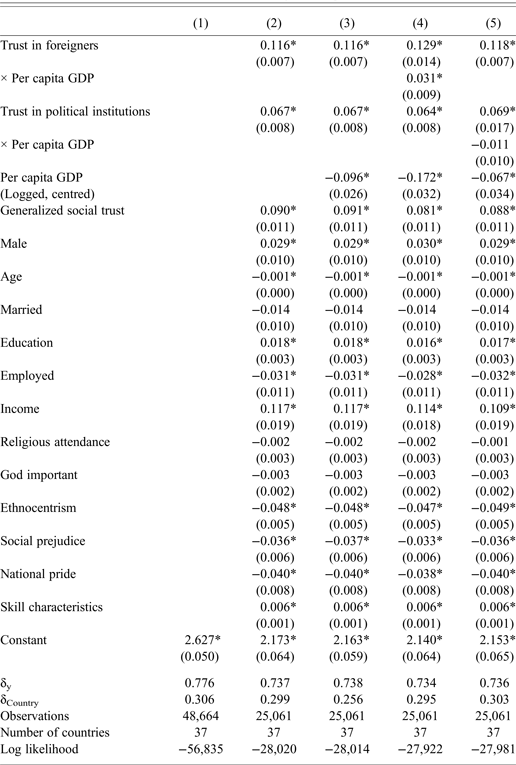
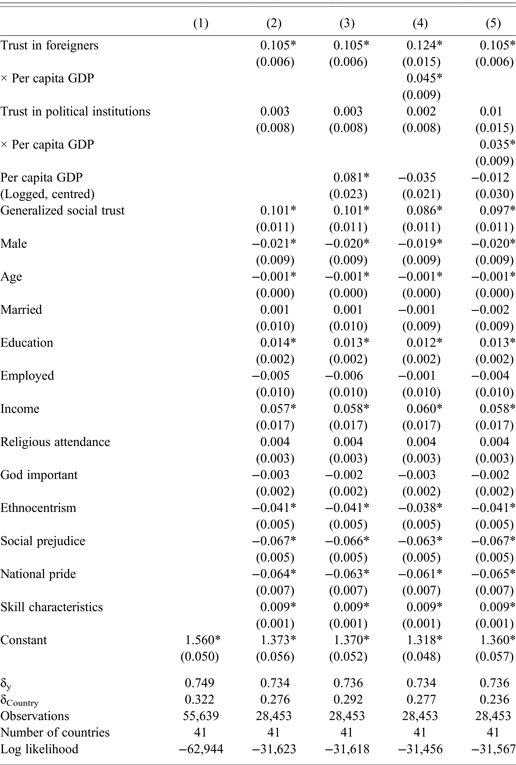
Tables 1 and 2 report results from multilevel models where attitudes toward immigration are measured as Increase the number of immigrants and Provide equal employment opportunity to immigrants, respectively. In each table, column 1 reports a result from a nul model without independent variables. The results show that public attitudes toward immigrants have significant variations across countries,Footnote 18 confirming that using multilevel analysis is appropriate in the current analysis.
Preference toward Increase the number of immigrants

Note. The dependent variable is Increase the number of immigrants. Columns 2 and 3 report results from random-intercept models. Columns 4 and 5 report results from random-intercept-random-slope models. *p < 0.05.
Preference toward Provide equal employment opportunity to immigrants

Note. The dependent variable is Provide equal employment opportunity to immigrants. Columns 2 and 3 report results from random-intercept models. Columns 4 and 5 report results from random-intercept-random-slope models. *p < 0.05.
Column 2 in Tables 1 and 2 tests Hypotheses 1 and 2. We expected Trust in foreigners and Trust in political institutions to have positive effects on respondents' attitudes toward immigrants. Regardless of how attitudes toward immigration are measured, Trust in foreigners consistently appears to have a positive impact, and statistically significant. In contrast, the effects of Trust in political institutions appear to be mixed. When attitudes toward immigration are measured using the survey question on increasing the number of immigrants (in Table 1), Trust in political institutions has a positive and significant effect on attitudes toward immigration. However, when attitudes toward immigration are measured as preference for a policy providing equal employment opportunity to immigrants (in Table 2), the coefficient on Trust in political institutions is insignificant.Footnote 19
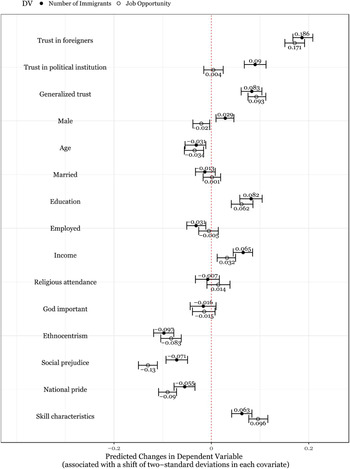
To better understand the effects of Trust in foreigners and Trust in political institutions on policy preferences with regard to immigration, we compare them with effects of other individual-level variables. Given that each independent variable has a different range, we compute how a shift of two standard deviations in each covariate changes the value of a dependent variable. In doing so, we use post-estimation simulation to capture uncertainty in the predicted value of the dependent variable. Specifically, we draw 1,000 sets of coefficients using the results reported in column 2 in Tables 1 and 2, and calculate the mean of predicted changes in the dependent variable and its 95 per cent range. Figure 1 graphically presents these results.
Comparison of Effect Sizes

In Figure 1, the X-axis denotes predicted changes in each dependent variable associated with a shift of two standard deviations in each covariate listed in the Y-axis. For example, an increase of two standard deviations in Trust in foreigners increases the support for increasing immigrants by about 0.183 and for job priority by about 0.167. Given that Increase the number of immigrants ranges between 1 and 4, the value of 0.183 approximates 6.1 per cent change (0.183/3 = 0.061). Provide equal employment opportunity to immigrants ranges between 1 and 3. The value of 0.167 approximates 8.4 per cent change (0.167/2 = 0.084). Note that the effect of Trust in foreigners is overwhelming, compared to Generalized trust, a two-standard deviation shift of which increases support for increasing the number of immigrants by about 2.7 per cent and support for equal opportunity by about 4.6 per cent. On the other hand, a shift of two standard deviations in Trust in political institutions induces support for increasing immigrants by about 3 per cent, but barely affects preference on job opportunity.
We also find that the effect of trust in foreigners is greater than factors that have typically been considered influential in shaping attitudes toward immigration. First, regardless of how attitudes toward immigration are measured, Skill characteristics and Education have significant effects, although their effect sizes are always smaller than the effect of trust in foreigners. A shift of two standard deviations in Skill characteristics and Education results in increasing (1) support for increasing the number of immigrants by 2.1 per cent and 2.6 per cent, respectively, and (2) one for giving immigrants equal job opportunity by 4.8 per cent and 3.1 per cent, respectively. Sociopsychological factors have stronger impacts on immigration attitude than economic factors, but less than those driven by trust in foreigners. A shift of two standard deviations in Ethnocentrism, Social prejudice and National pride decrease (1) support for increasing the number of immigrants by about 3.9 per cent, 2.5 per cent, and 1.8 per cent, respectively, and (2) one for giving immigrants equal job opportunity by about 5.1 per cent, 6.7 per cent, and 4.5 per cent, respectively.
Figure 1 also shows an interesting aspect of trust in political institutions. That is, while the effects of trust in foreigners and economic and sociopsychological motives remain largely robust between the two measures of attitudes toward immigration, the effects of trust in political institutions appear to be sensitive to the measures. Column 3 in Tables 1 and 2 reports results from a model that examines whether attitudes toward immigrants vary according to economic development measured as per capita GDP (logged). The coefficients on per capita GPD are significant in both tables, but they are negative in Table 1 and positive Table 2. In other words, respondents in developed countries demonstrate less support for increasing the number of immigrants but more for equalizing job opportunities between immigrants and natives, compared to respondents in developing countries. These findings suggest that respondents in developed countries are chary of the financial burden of providing immigrants with social welfare but more confident of the benefit of competition in the labour market.
Columns 4 and 5 in each table report results from models testing whether or not the variance in the effects of Trust in foreigners and Trust in political institutions can be explained by levels of economic development (Hypotheses 3 and 4, respectively). Note that per capita GDP is logged and centred at the mean.Footnote 20 Thus the coefficients on Trust in foreigners and Trust in political institutions in those columns indicate their marginal effects in a country with a mean level of economic development. In both tables, the coefficients on Trust in foreigners × per capita GDP are positive and statistically significant, which confirms Hypothesis 3: economic development strengthens the positive association between Trust in foreigners and support for immigrants regardless of whether that support is measured as preference for increasing the number of immigrants or for giving immigrants equal job opportunities.
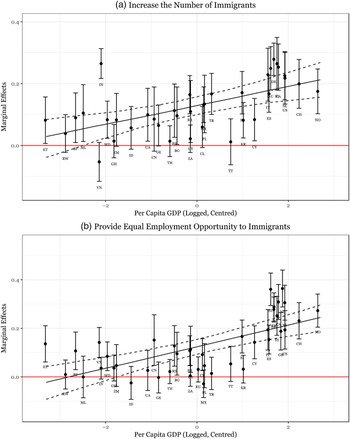
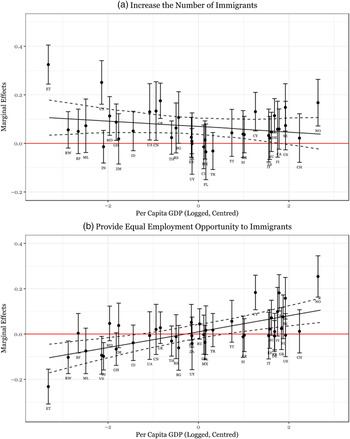
To better interpret these results, we provide Figure 2 based on the estimates from columns 4 and 5 in Tables 1 and 2; panels A and B in Figure 2 concern preferences for increasing the number of immigrants and giving immigrants equal job opportunities, respectively. In each panel, the Y-axis indicates the marginal effects of Trust in foreigners; the X-axis indicates economic development measured as a log of per capita GDP centred at mean. Note that multilevel modeling summarizes the distribution of country specific coefficients, which is the marginal effect of Trust in foreigners in the current context, in terms of two components: a part which is common across different countries (fixed coefficients) and a part which is allowed to vary from country to country (random coefficients). In each panel, a solid line and two dotted lines display changes in the common part of the marginal effect and its 95 per cent range associated with different levels of economic development. On the other hand, each dot and an error bar represent the country specific marginal effect of the variable and its 95 per cent significance interval.Footnote 21
Trust in Foreigners, Economic Development and Attitudes toward Immigrants

In both panels, the solid line shows that the marginal effects of Trust in foreigners increase with economic development; it becomes significant at about −2.5 (per capita GDP of $555) in panel A and at about −1.8 (per capita GDP of $1120) in panel B. At the individual country level, the marginal effects of Trust in foreigners become significant in all countries with per capita GDPs greater than that of Trinidad and Tobago ($14,000) in panel A and with per capita GDPs greater than that of South Korea ($18,000) in panel B.
Evidence for the moderating effect of economic development on Trust in political institutions is mixed; the coefficient on Trust in political institutions × per capita GDP is significant only when attitudes toward immigration are measured as preference for giving immigrants equal job opportunities (column 5 in Tables 1 and 2). In Figure 3, we graphically depict the marginal effects of Trust in political institutions among countries with different levels of economic development, using the same method as Figure 2. In panel A, the sign of the marginal effect at the country level is generally positive and changes little with different levels of economic development. In panel B, the moderating effect of economic development is positive and significant, which seems driven by the contrast between some of the poorest countries—Ethiopia, Rwanda, Vietnam, and India—and some of the richest—Norway, Sweden, and Canada. Among the richest countries, trust in government institutions translates into support for non-discriminatory provision of job opportunities to natives and immigrants.
Trust in Political Institutions, Economic Development and Attitudes toward Immigrants

Concluding Remarks
We have analyzed the impacts of trust in foreigners and trust in political institutions on attitudes toward immigration and the moderating effects of economic development on those impacts, using data from the fifth wave of the WVS. The statistical results consistently indicate that trust in foreigners promotes support for increasing immigration (Hypothesis 1), that its impact outweighs the effects of other factors such as generalized trust, economic incentives or sociopsychological motives, and that the positive effect of trust in foreigners strengthens as the national economy develops (Hypothesis 3).
However, we found only mixed evidence for the impacts of trust in political institutions on attitudes toward immigration. When attitudes are measured as preference for increasing the number of immigrants, the positive impact of trust in political institutions remains statistically significant, which corroborates Hypothesis 2. When attitudes are measured as preference for providing equal employment opportunity to immigrants, on the other hand, the effect of trust in political institutions is insignificant, which is inconsistent with Hypothesis 2. It is beyond the scope of this analysis to examine what produces this discrepancy, but some respondents may have found that reliable governments actually disadvantage them in the labour market because of their greater effectiveness compared to unreliable government in removing employment discrimination against immigrants.
We also found a difference in the moderating effects of economic development on the impacts of trust in political institutions according to the survey question used to measure attitudes toward immigration. When the attitudes are measured as preference for increasing the number of immigrants, the coefficient on the interaction term between trust in political institutions and economic development appears to be statistically insignificant, which is inconsistent with Hypothesis 4. Meanwhile, when the attitudes are measured as preference for equalizing employment opportunity, the coefficient on the same interaction term appears to be positive and statistically significant which is consistent with Hypothesis 4.
These mixed results may reflect the possibility that people in less developed countries might expect that the government should prioritize the interests of natives; people in developed countries may consider that it is important to eliminate discrimination against immigrants, possibly because of the better unemployment benefits available. Alternatively, the mixed results may have resulted from a failure to address the channels through which trust in political institutions shapes attitudes toward immigration. We expect future studies to address the mixed results with more sophisticated empirical strategies.
Supplementary materials
To view supplementary material for this article, please visit https://doi.org/10.1017/S0008423917001378.