The sudden cardiac death of a young individual is one of the most perplexing and devastating events a family may endure. Sudden death in the young is relatively uncommon, with an incidence of 1.3–8.5 per 100,000 patient-years.Reference Driscoll and Edwards 1 , Reference Liberthson 2 Yet, annually, 1000–5000 otherwise healthy individuals aged 1–35 years die suddenly in the United States of America. These rare yet tragic events are often attributed to the presence of a previously unrecognised underlying structural or electrical cardiovascular pathology.
Long QT syndrome, catecholaminergic polymorphic ventricular tachycardia, and Brugada syndrome are the three most common potentially lethal, heritable cardiac channelopathies associated with syncope, seizures, and cardiac arrest in the setting of a structurally normal heart, and may account for a significant number of sudden cardiac deaths. In addition, heritable cardiomyopathies, including hypertrophic cardiomyopathy, dilated cardiomyopathy, and arrhythmogenic cardiomyopathy, can display minimal to overt structural abnormalities that may underlie a significant portion of sudden cardiac deaths when the conventional autopsy is positive grossly and perhaps even when the macroscopic and microscopic autopsy appears equivocal.
The genetic basis for potentially lethal and heritable cardiomyopathies and cardiac channelopathies has been identified and is better understood. Significant genetic and clinical heterogeneity are hallmark features of these disorders, with multiple genes and mutations sub-serving the root cause. To date, thousands of gene mutations have been discovered for this group of unique cardiovascular disorders. Genetic testing for most of these heritable cardiomyopathies and channelopathies are now available commercially, with some having varying degrees of disease-specific diagnostic, prognostic, and therapeutic impact.Reference Tester and Ackerman 3
Now that clinical genetic testing is available more readily, it is important for the community of cardiologists to not only be familiar with the language of genomic medicine but to also be wiser users and even wiser interpreters of genetic testing so that wise decisions can be rendered for those patients and their families being evaluated with respect to the presence or absence of one of these potentially lethal yet highly treatable genetic disorders.
Benefits of genetic testing
Following are some benefits of post-mortem genetic testing: (1) establishing the root cause, thereby providing not only cause and manner of death but also closure for the family by providing the answer;(2) confirmation or exclusion of the presence of a disease-causing mutation in pre-symptomatic family members or relatives of the sudden death victim; and (3) personalised treatment recommendations and management of the mutation-positive surviving family members to prevent a subsequent sudden death by elucidation of the exact genotype.Reference Tester and Ackerman 4 , Reference Priori and Napolitano 5
Indications for genetic testing
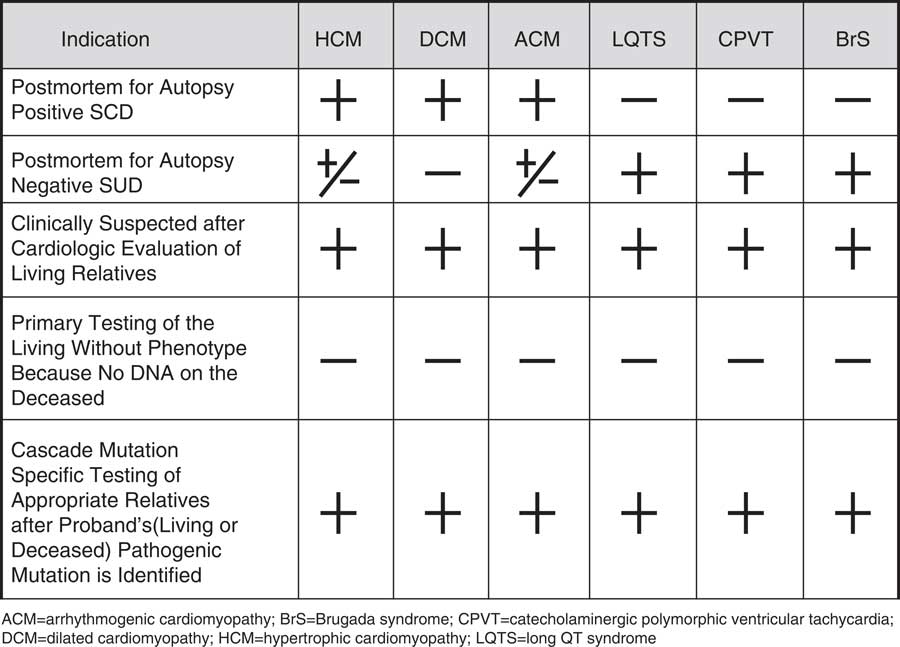
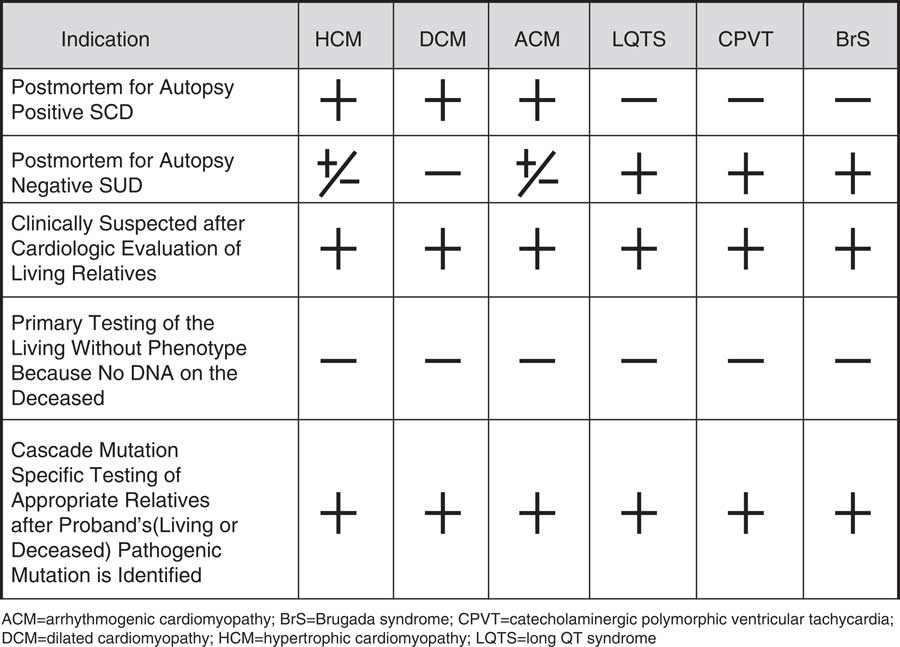
Although commercially available genetic testing exists for both living and deceased patients suspected of having long QT syndrome, catecholaminergic polymorphic ventricular tachycardia, Brugada syndrome, hypertrophic cardiomyopathy, dilated cardiomyopathy, arrhythmogenic cardiomyopathy, and virtually all of the other channelopathies and cardiomyopathies, clinical utility is perhaps the greatest currently for long QT syndrome, catecholaminergic polymorphic ventricular tachycardia, and hypertrophic cardiomyopathy.Reference Ackerman, Priori and Willems 6 Though it is commercially available, genetic testing for Brugada syndrome, dilated cardiomyopathy, and arrhythmogenic cardiomyopathy is handicapped currently by lower yields, unclear clinical impact apart from first-degree relative confirmatory mutation testing, and higher “background noise rates” that make their genetic test interpretations extremely difficult.Reference Ackerman, Priori and Willems 6 Because of the variable utility of genetic testing among these specific disorders, the recommended clinical indication for genetic testing of each disorder is distinct (Fig 1).
Indications for genetic testing. Provided is a table of possible indications for post-mortem and pre-mortem genetic testing for a variety of genetic heart diseases including hypertrophic cardiomyopathy (HCM), long QT syndrome (LQTS), catecholaminergic polymorphic ventricular tachycardia (CPVT), and Brugada syndrome (BrS). The + symbol represents a positive indication for genetic testing. The − symbol represents an indicator that does not warrant for genetic testing for the specific disorder. The +/− symbol represents an indicator that may or may not warrant genetic testing. ACM=arrhythmogenic cardiomyopathy; DCM=dilated cardiomyopathy; LVH=left ventricular hypertrophy, SCD=sudden cardiac death; SUD=sudden unexplained death.
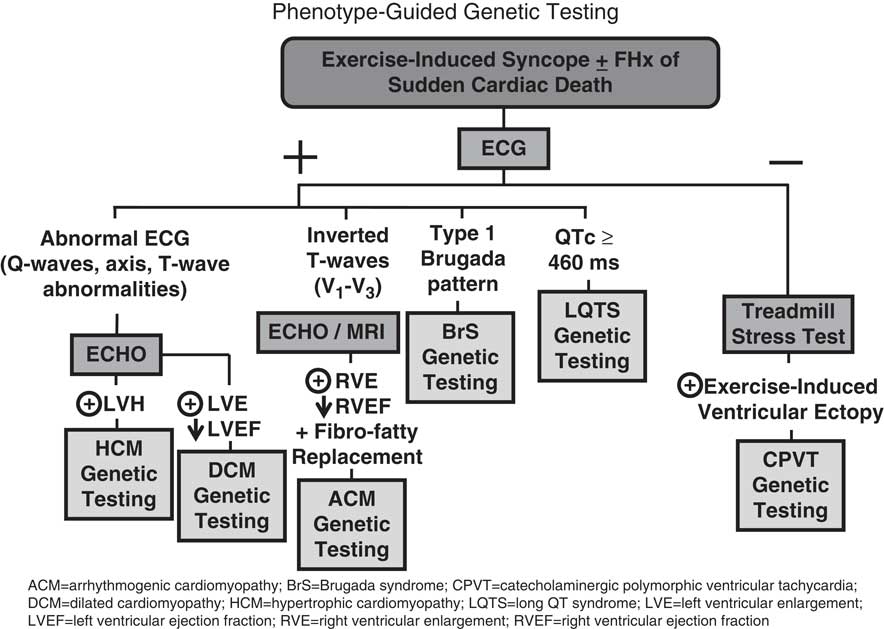
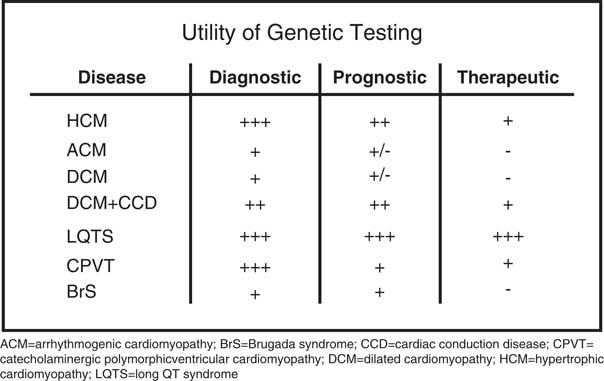
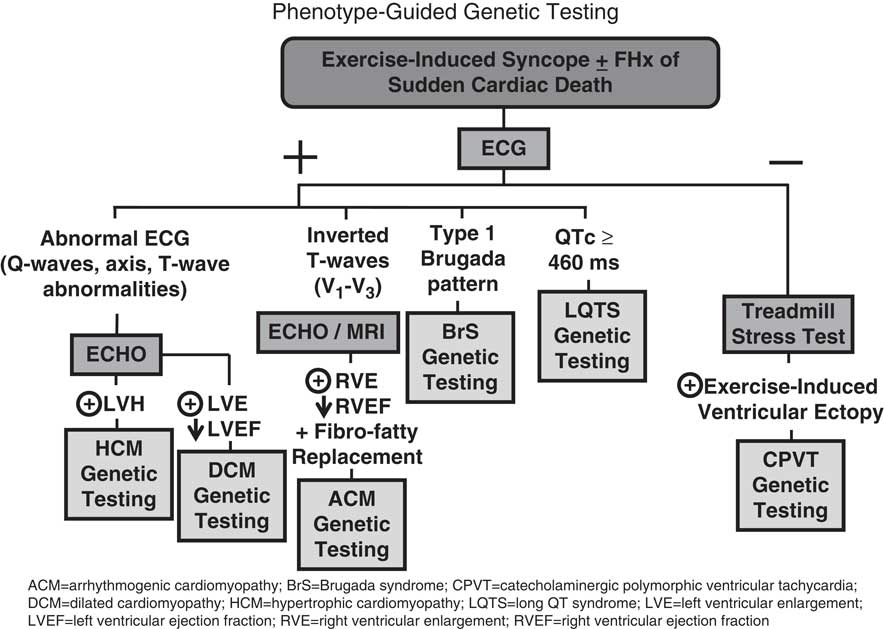
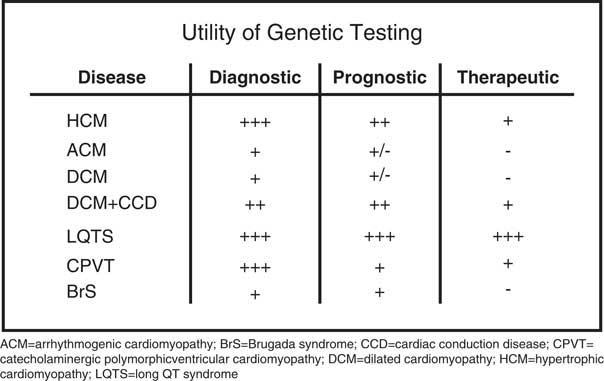
In 2011, two consensus documents, the Heart Rhythm Society/European Heart Rhythm Association Expert Consensus StatementReference Ackerman, Priori and Willems 6 and the Canadian Cardiovascular Society/Canadian Heart Rhythm Society joint position paper,Reference Gollob, Blier and Brugada 7 were published on the use of genetic testing in the clinical evaluation of cardiac channelopathies and cardiomyopathies. Importantly, rather than using shotgun-based genetic testing, clinical evaluation and patient phenotype should guide genetic testing and provide specific indicators for which genetic test(s) to order. Figure 2 provides an example of a possible decision tree for genetic testing when evaluating, for example, a decedent’s first-/second-degree relative whose own personal history includes exercise-induced syncope or cardiac arrest. Further, the extent to which genetic testing contributes to the diagnostic, prognostic, and therapeutic triad is also disease specific with long QT syndrome genetic testing contributing to the entire triad, whereas genetic testing for other disorders may only have diagnostic value for the patient and their relatives (Fig 3).Reference Bos, Towbin and Ackerman 8 – Reference Ruan, Liu, Napolitano and Priori 10
Possible genetic testing pathways in exercise-induced syncope with or without a positive family history of sudden cardiac death at a young age. Depicted for illustrative purposes is a work flow decision tree for indicating which genetic test would be appropriate to order based on the clinical evaluation of an individual manifesting with exercise-induced syncope with or without a positive family history of sudden death in the young. The blue boxes represent specific clinical evaluation tests. The yellow boxes represent specific genetic testing panels. The + symbol represents a positive evaluation and the − symbol represents a negative evaluation for the respective clinical test. . The key point is that genetic testing for these disorders should be phenotype-guided, NOT universal. Adapted from Tester and AckermanReference Tester and Ackerman 3 . ACM=arrhythmogenic cardiomyopathy; BrS=Brugada syndrome; CPVT=catecholaminergic polymorphic ventricular tachycardia; DCM=dilated cardiomyopathy; ECG=electrocardiogram, ECHO=echocardiogram; HCM=hypertrophic cardiomyopathy; LQTS=long QT syndrome; LVE=left ventricular enlargement; LVEF=left ventricular ejection fraction; RVE=right ventricular enlargement; RVEF=right ventricular ejection fraction.
Utility of genetic testing. Shown is the current diagnostic, prognostic, and therapeutic utility of genetic testing for hypertrophic cardiomyopathy (HCM), arrhythmogenic cardiomyopathy (ACM), dilated cardiomyopathy (DCM), cardiac conduction defect (CCD), long QT syndrome (LQTS), catecholaminergic polymorphic ventricular tachycardia (CPVT), and Brugada syndrome (BrS). The+symbol indicates the test has utility, the−symbol indicates no current measurable utility, and+/−indicates the test may have some utility. Adapted from Tester and AckermanReference Tester and Ackerman 3 .
Interpretation of genetic test results
Because the misdiagnosis and mismanagement of patients with these potentially lethal cardiac disorders has potentially colossal and devastating consequences, the clinical evaluation and management of a patient and their family suspected of having genetic heart disease should be conducted under the direction of a paediatric or adult cardiologist with specific expertise in heritable channelopathies/cardiomyopathies.Reference Tester and Ackerman 11 Because of the issues associated with incomplete penetrance and variable expressivity, the genetic test result must be interpreted cautiously and incorporated into the overall diagnostic evaluation for these disorders.
Importantly, genetic tests are probabilistic tests rather than deterministic ones. To illustrate this, in contrast to rare, pathogenic long QT syndrome-associated channel mutations present in <1 in 2500 persons (0.04%) and in 75% of clinically strong long QT syndrome cases, comprehensive genetic testing of the major long QT syndrome genes, KCNQ1 (long QT syndrome type 1), KCNH2 (long QT syndrome type 2), and SCN5A (long QT syndrome type 3), in over 1300 ostensibly healthy volunteers has shown that approximately 4% of Caucasians and up to 8% non-Caucasians host rare (<0.5% allelic frequency) non-synonymous (amino acid altering) genetic variants in these cardiac channel genes.Reference Kapa, Tester and Salisbury 12 In addition, comprehensive genetic analysis of nine hypertrophic cardiomyopathy susceptibility genes – such as MYBPC3, MYH7, TNNI3, TPM1, TNNT2, MYL2, ACTC1, TNNCI, and MYL3, ordered according to their prevalence in hypertrophic cardiomoypathy – in 427 unrelated ostensibly healthy controls yielded a rare non-synonymous (amino acid altering) genetic variant in 5% compared with a ~30% yield among hypertrophic cardiomyopathy patients.Reference Kapplinger, Landstrom, Bos, Salisbury, Callis and Ackerman 13
Strikingly, among the five most common arrhythmogenic cardiomyopathy susceptibility genes – namely, PKP2, DSP, DSG2, DSC2, and TMEM43 – 16% of ostensibly healthy controls had an amino acid-altering mutation compared with 58% of patients with arrhythmogenic cardiomyopathy.Reference Kapplinger, Landstrom and Salisbury 14 This produces several challenges in arrhythmogenic cardiomyopathy genetic testing, as one in six healthy individuals would be identified with a genetic variant leading to a “positive” genetic test result for arrhythmogenic cardiomyopathy.Reference Kapplinger, Landstrom and Salisbury 14 Although some of the variants identified in this healthy population may be sub-clinical disease modifiers, the vast majority must represent benign background “genetic noise”. As such, even in the setting of a clinically robust diagnosis of arrhythmogenic cardiomyopathy, one-third of the so-called “positive” genetic test results may be false positives.
Refinement of variant annotation has advanced the most for long QT syndrome genetic testing. A research-based case–control mutational analysis of the properties and localisation of long QT syndrome case-associated mutations compared with the compendium of presumably innocuous variants has been performed to assist in distinguishing pathogenic mutations from an otherwise rare variant of uncertain/unknown significance.Reference Kapa, Tester and Salisbury 12 Here, algorithms based on mutation location may allow for the assignment of an estimated probability of pathogenicity of each novel mutation identified within a specific long QT syndrome gene.Reference Kapa, Tester and Salisbury 12 For example, transmembrane spanning/pore domains localising missense mutations of the long QT syndrome type 1- and long QT syndrome type 2-associated potassium channels are high probability disease mutations, whereas a similarly rare missense mutation that localises to the domain I-II linker of the long QT syndrome type 3-associated sodium channel is absolutely uncertain. In fact, without co-segregation or functional data, such a mutation has a point estimate for probability of pathogenicity of <50% that necessitates extreme caution when interpreting the genetic test. Similar efforts to distinguish disease-causing mutations from “background” genetic noise have also been used for hypertrophic cardiomyopathy and arrhythmogenic cardiomyopathysusceptibility genes.Reference Kapplinger, Landstrom, Bos, Salisbury, Callis and Ackerman 13 , Reference Kapplinger, Landstrom and Salisbury 14
Even when a genetic variant has been published previously as a putative pathogenic mutation, designation of a specific genetic variant as a true disease-causing mutation still requires vigilant scrutiny.Reference Tester, Valdivia and Harris-Kerr 15 This is an extremely important concept to understand. Unfortunately, some variants have been reported as being disease causing simply on the basis of absence in 50–200 controls and having been previously reported in the literature, despite having insufficient data – that is, never functionally characterised or shown to co-segregate with disease in a sufficiently large pedigree – to support the variant as being truly pathogenic.
Genetic testing companies have attempted to help in the interpretation of genetic findings by reporting variants on the basis of their level of evidence for pathogenicity using nomenclature such as “deleterious”, “pathogenic”, “mutation positive”, “class I mutation”, or “variant, likely pathogenic” to indicate that the identified variant is likely the disease-causing mutation. However, each genetic testing company may have their own set of rules to determine the level of pathogenicity to assign to a given variant. Again, the physician should use vigilant scrutiny when reviewing the genetic test results and do their own proper vetting of the identified variant and the classification strategy that was used by the testing company to assign the variant as pathogenic. The term “variants of unknown/uncertain significance” is used to indicate that the identified variant might be the disease-causing mutation, but there is insufficient evidence to conclude with certainty that the identified variant is indeed the underlying genetic basis for disease.
Currently, whether in the context of the arrhythmogenic cardiomyopathy gene test or the other disease-specific genetic test panels, potential false positives are captured under the ambiguous and clinically non-actionable designation of a variant of unknown/uncertain significance. Unfortunately, rather than realising that a variant of unknown/uncertain significance is not actionable until much more scrutiny is applied and that the clinician and the patient/family are stuck in genetic purgatory,Reference Ackerman 16 many clinicians operationalise a variant of unknown/uncertain significance as the possible cause and proceed with the living as if this is “it”. This same approach is taken all too often with the decedent’s family with respect to post-mortem genetic testing – that is, molecular autopsy. Here, the well-intentioned physician may not realise that the result has placed his/her patient, whether living or deceased, there – in genetic purgatory – as they all too often appear to assume that the variant of uncertain significance represents the underlying cause for his/her patient’s disorder. This is a dangerous assumption that has caused egregious miscues. Importantly, just because a rare variant in a channelopathy-/cardiomyopathy-associated gene has been found in a deceased person, this does not automatically elevate the identified variant to the monogenic cause of the person’s sudden death. In addition, using a living relative with no symptoms and normal cardiac tests as the “surrogate” for genetic testing of that person’s deceased relative is a colossal mistake. Again, genetic testing MUST be phenotype-guided. Further, genetic testing that should have been done on the deceased should NOT be done on the deceased relatives just because they are related.Reference Ackerman 16
Because of these complex issues, genetic testing must not be regarded as a simple blood test.Reference Ackerman, Priori and Willems 6 Rather, genetic testing for potentially lethal cardiomyopathies/channelopathies should be managed as one component of a comprehensive cardio-genetic evaluation in which the (1) certitude and expertise of the patient diagnosis, (2) the probabilistic nature of the genetic test and need for pre-test counselling to inform the patient of the inherent uncertainties of genetic testing, and (3) the need to obtain a well-characterised family history to appraise the sense of penetrance and expressivity are considered with great care.Reference Ackerman, Priori and Willems 6
Genetic counselling
If the ordering cardiologist, heart rhythm specialist, or cardiomyopathy/channelopathy sub-specialist lacks genetic expertise with regard to the specific disorder being considered, it is advantageous to have a masters-trained board-certified genetic counsellor on the team to be involved in the communication process with the patient concerning the implications of genetic testing and genetic test results.Reference Tester and Ackerman 3 Preferably the counsellor would have specialised training in cardiovascular genetics. A genetic counsellor may be helpful in (1) gathering a family history comprising at least three or four generations, (2) providing information relevant to the clinical presentation of the disorder, mode of inheritance, and implications in family planning, (3) explaining the benefits, limitations, risk, availability, costs, and potential results of genetic testing, and (4) discussing the possible psychosocial impact of these potentially lethal disorders with the patient and their family.Reference Charron 17 , Reference Hershberger, Cowan, Morales and Siegfried 18
Ethical and societal implications
Although benefits such as diagnostic certainty and enhanced awareness of prophylactic treatment and risk stratification may be acquired, genetic testing may also contribute to depression, anxiety, guilt, stigmatisation, discrimination, family conflict, and unnecessary or inappropriate use of risk-reducing strategies.Reference Van Riper 19 Therefore, it is essential that patients are well informed on genetic testing implications and must not be pressured into providing a sample for genetic analysis. Full disclosure must be provided as to the clinical objective of the genetic test, the results of the analysis, and who will have access to the results.Reference Tester and Ackerman 11
Genetic testing should be considered both an individual and a family experience.Reference Van Riper 19 Although genetic testing is performed on an individual’s sample, both the individual’s decision to pursue genetic testing and that individual’s test results may have significant ramifications for other family members, especially in sudden cardiac death-related disorders. However, under the principles of autonomy, currently only the individual being tested or the legal guardian, if a minor, has to be informed of their genetic test results. The decision or responsibility to inform unsuspecting relatives of the potential for genetic predisposition for sudden cardiac death resides completely on that informed patient.Reference Tester and Ackerman 11 In the setting of the molecular autopsy, the decedent’s post-mortem genetic test results are communicated to either the next-of-kin who authorised the genetic test or to the medical examiner/coroner’s office directly if such next-of-kin authorisation is not required for the medical examiner/coroner to vet fully the cause and manner of the death.Reference Tester and Ackerman 20
Importantly, the expected yield from genetic testing is disease-specific, ranging from a low of 25–30% for Brugada syndrome genetic testing to a 75% yield for long QT syndrome genetic testing. As such, patients with a clear, obvious clinical phenotype for their respective disorder who have a “negative” genetic test should be informed of ongoing research efforts and directed towards research centres specialising in the study of their specific disorder. Continued research-based genetic analysis of well-phenotyped patient populations will provide for new gene discovery and continued enhancement, expansion, and refinement of genetic testing in clinical practice.
Conclusions
Genomic advances have propelled cardiologists into the age of personalised genomic medicine and clinical genetic testing. As new genes are elucidated, the compendium of available genetic tests will continue to increase. With clinical genetic testing now readily available as diagnostic, prognostic, and sometimes therapeutic directive tests, it is essential that cardiologists immerse themselves into the language of genomic medicine and to better understand the utility of genetic testing and how to interpret genetic testing results for these potentially lethal yet highly treatable disorders so that wise decisions can be bestowed on the families being evaluated with respect to the presence or absence of one of these highly treatable genetic conditions that if left undetected could have the potential to take the life of an unsuspecting individual.
Acknowledgements
None.
Financial Support
This work is supported by the Mayo Clinic Windland Smith Rice Comprehensive Sudden Cardiac Death Research Program.
Conflicts of Interest
M.J.A. is a consultant for Boston Scientific, Gilead Sciences, Medtronic, and St. Jude Medical. MJA, DJT, and Mayo Clinic receive royalties from Transgenomic for their FAMILION-LQTS and FAMILION-CPVT genetic tests. However, none of these entities provided financial support for this review. The other authors have no conflicts of interest to disclose.
Ethical Standards
The authors assert that all referenced work contributing to this review complies with the ethical standards of biomedical or medicolegal investigation.