Introduction
Several species of locusts and grasshoppers have caused huge losses to crops in Brazil in the past years. Seasonal outbreaks of species in the genera Rhammatocerus and Schistocerca (Orthoptera: Acrididae), usually influenced by favourable environmental conditions, were observed during the 1980s and 1990s invading large areas (Barrientos, Reference Barrientos1995). More recently, increasing populations of other orthopteran species have been reported in native savanna and crop areas in the central regions of the country (Guerra et al., Reference Dias-Guerra, Oliveira and Barrientos-Lozano2010). In this study, we describe the occurrence of Tropidacris collaris (Stoll) (Romaleidae: Romaleinae), Cornops frenatum frenatum (Marschall) (Acrididae: Leptysminae) and Parascopas obesus (Giglio-Tos) (Acrididae: Melanoplinae) in three different Brazilian biomes. We identified large populations of these three orthopteran species in 2012 and 2013 causing severe damage in commercial crops and subsistence farming areas. Identification of non-chemical alternatives for control of these pests is considered important, due to the proximity of the infested areas to ecological preservation biomes and family settlements. The use of microbial products based on the fungus Metarhizium against orthopteran pests has been reported in Africa, Australia, China and also in Brazil, in response to environmental concerns over the heavy use of chemical insecticides (Magalhães et al., Reference Magalhães, Lecoq, Faria, Schmidt and Guerra2000; Hunter et al., Reference Hunter, Milner and Spurgin2001; Lomer et al., Reference Lomer, Bateman, Johnson, Langewald and Thomas2001; Faria et al., Reference Faria, Magalhães, Alves, Schmidt, Silva and Frazão2002; Long and Hunter, Reference Long and Hunter2005; Peng et al., Reference Peng, Wang, Yin, Zeng and Xia2008). The goal of the present study was to evaluate the biocontrol potential of an indigenous strain of Metarhizium acridum (Driver & Milner) Bischoff, Rehner & Humber (Hypocreales: Clavicipitaceae) against these species, by host susceptibility bioassays under laboratory conditions.
Materials and Methods
Specimens of T. collaris, C. f. frenatum and P. obesus were collected feeding on rubber tree, banana and maize, respectively, using an entomological net or by hand in 2012 and 2013. Groups of between 30 and 50 individuals were kept for 30 days in cages and fed on their respective host plants until used in experiments. During the quarantine period, dead and weak insects were removed periodically, and natural infection by other microorganisms and parasitism by parasitoids was evaluated.
The indigenous strain of M. acridum CG423, originally isolated from Schistocerca pallens, was used in the susceptibility bioassays. It has been tested in field trials and shown to be effective against Rhammatocerus schistocercoides (Rehn) (Orthoptera: Acrididae) (Magalhães et al., Reference Magalhães, Faria, Lecoq, Schmidt, Silva, Frazão, Balança and Foucart2001). The fungus was grown on potato dextrose agar medium (PDA, Difco®) for 10 days at 25 ± 0.5 °C and 12 h photophase. Fresh conidia were suspended in soybean oil at a concentration of 1 × 10⁸ conidia/ml. Conidial viability in stock suspension was determined as >92% at the time of the bioassays. Conidia were applied topically with a glass microsyringe using doses between 1 × 10⁴ and 1 × 10⁵ conidia/insect. Insect inoculation, experimental units (two groups of 15–20 insects) and materials were similar among the tested species, with slight variations. Cornops f. frenatum adults were inoculated on the abdominal sternal region (1 µl drop with 2 × 10⁴ conidia/insect) and fed on banana and heliconia leaves. For P. obsesus inoculation and drop volume were the same as those used for C. f. frenatum; however, fourth instar nymphs were used, and two doses (1 and 2 × 10⁴ conidia/insect) were tested, because of the abundance of the nymphal stage in the collected samples. Parascopas obsesus nymphs were fed on grass leaves. For T. collaris adults were treated on the left thoracic sternal region, between the second and third legs, and fed on cashew tree leaves. A higher dose (5 µl drop with 1 × 10⁵ conidia/insect) was used in this case, because of the low efficacy of the fungus in preliminary tests using lower doses. For each test, a control group of insects was treated with a drop of soybean oil (1 or 5 µl) without conidia on the same body region. Insects were kept in cages at room temperature (25 ± 2 °C) and checked every 2 or 3 days. Dead insects were removed and placed into a moistened chamber for confirmation of infection by the fungus. Survival analysis was used to estimate the time to 50% insect mortality (ST50) and Log-rank testing with 5% probability was applied for comparisons between survival curves (R Statistical Software).
Results and Discussion
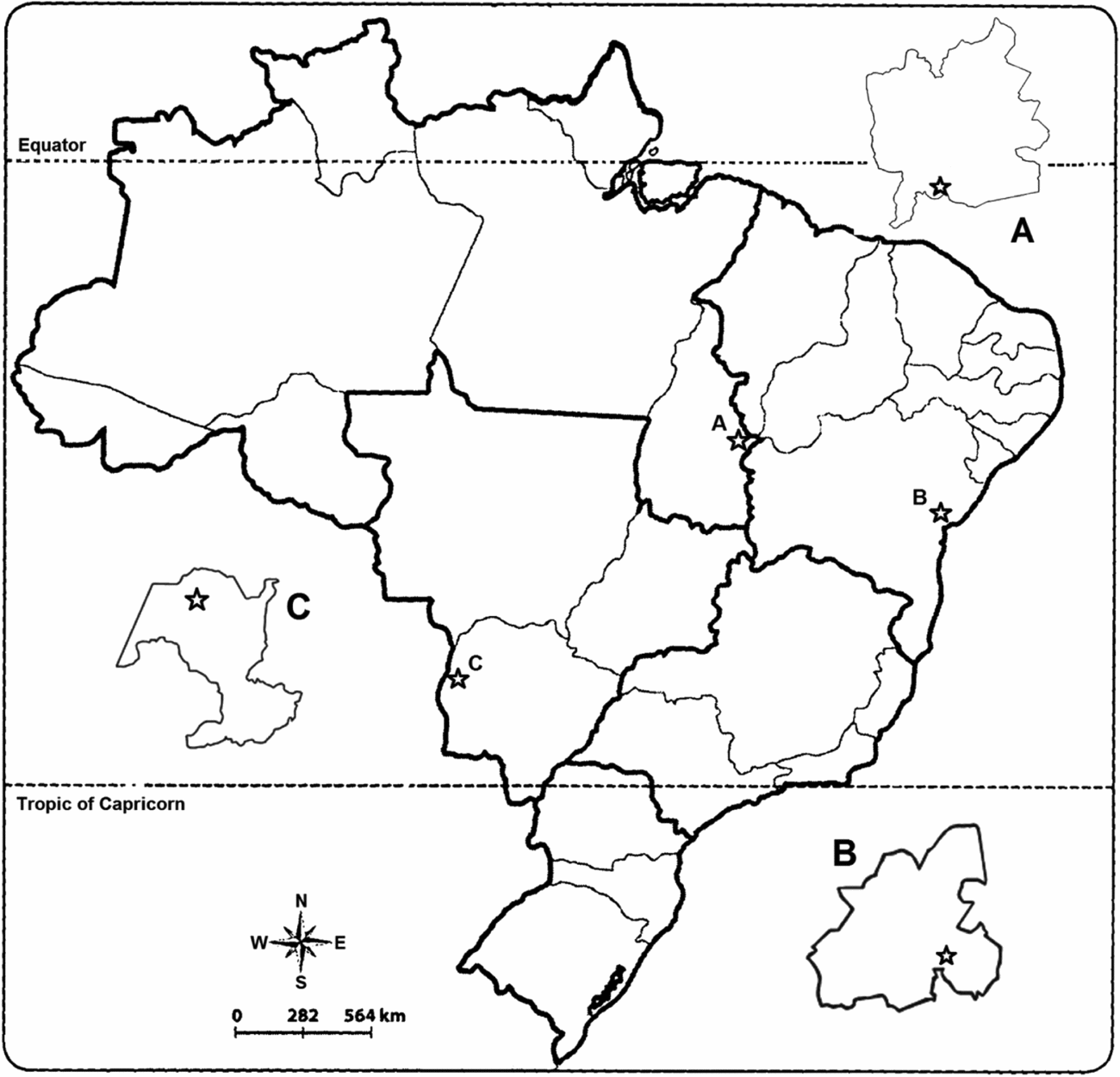
Adults and nymphs of the orthopteran species were observed in the Brazilian biomes of Caatinga, Cerrado (savanna) and Pantanal (west border of Paraguay River), infesting and causing damage to crops and/or undisturbed native areas. The regions where the insects were collected are shown in Fig. 1. Insect infestations occurred in 2012 and 2013 during the summer period, which is characterized by high temperatures (28–35 °C) and high humidity (>60%).
Map of Brazil showing locations of Tropidacris collaris, Cornops frenatum frenatum and Parascopas obesus occurrence during 2012 and 2013 in the regions near Jalapão reserve in the state of Tocantins (A); heliconia crop areas in the state of Bahia (B); and farms of subsistence crops in the state of Mato Grosso do Sul (C)

Tropidacris collaris adults and nymphs were found feeding on young rubber plants in a 200 ha plantation in the state of Tocantins, near an important environmentally protected unit (11°20′34″S/46°45′38″W). The area is part of the ecological corridor that connects important conservation units of the region of Jalapão. The large size and voracious feeding behaviour of the species caused a complete defoliation of young trees in some plots. At night and early mornings, because of the lower temperatures, adults were observed grouped on native tree branches near to the commercial crop. This is a typical behaviour of some orthopteran species seeking the sunlight to increase their activity.
Cultivated areas of heliconia flowers in a region known as “Portal do Sertão” (12°21′14″S / 38°48′16″W) have suffered economically important losses from C. f. frenatum since 2012. The region, located between the biomes of Caatinga and Mata Atlântica in the Northeast of Bahia state, covers almost 116,000 km² and is an important new area of ornamental plant production. The species is also a voracious defoliator of heliconia and first became a serious problem of this tropical flower in cultivated areas of the Brazilian Amazon (Braga et al., Reference Braga, Nunes and Adis2007; Lemos et al., Reference Lemos, Ribeiro, Lhano, Silva and Zanuncio2010; Ribeiro et al., Reference Ribeiro, Lemos, Poderoso, Pikart and Zanuncio2013). Infestation of new regions, as observed in Bahia, was probably due to the introduction of plants from infested areas, favoured by the endophytic oviposition behaviour of the females.
A large number of nymphs of Parascopas spp. were observed infesting an area of almost 10 ha of a family settlement of a Brazilian governmental programme, nearby the Pantanal biome (19°05′37″S/57°41′59″W). Subsistence crops, mainly maize and pasture, of around 3 ha each spread over a larger native area, were harmed by seasonal insect infestations in 2012 and 2013, decreasing grain production and limiting cattle and dairy expansion. The main species occurring in the area was identified as P. obesus, although the species P. dubius was also collected in lower numbers.
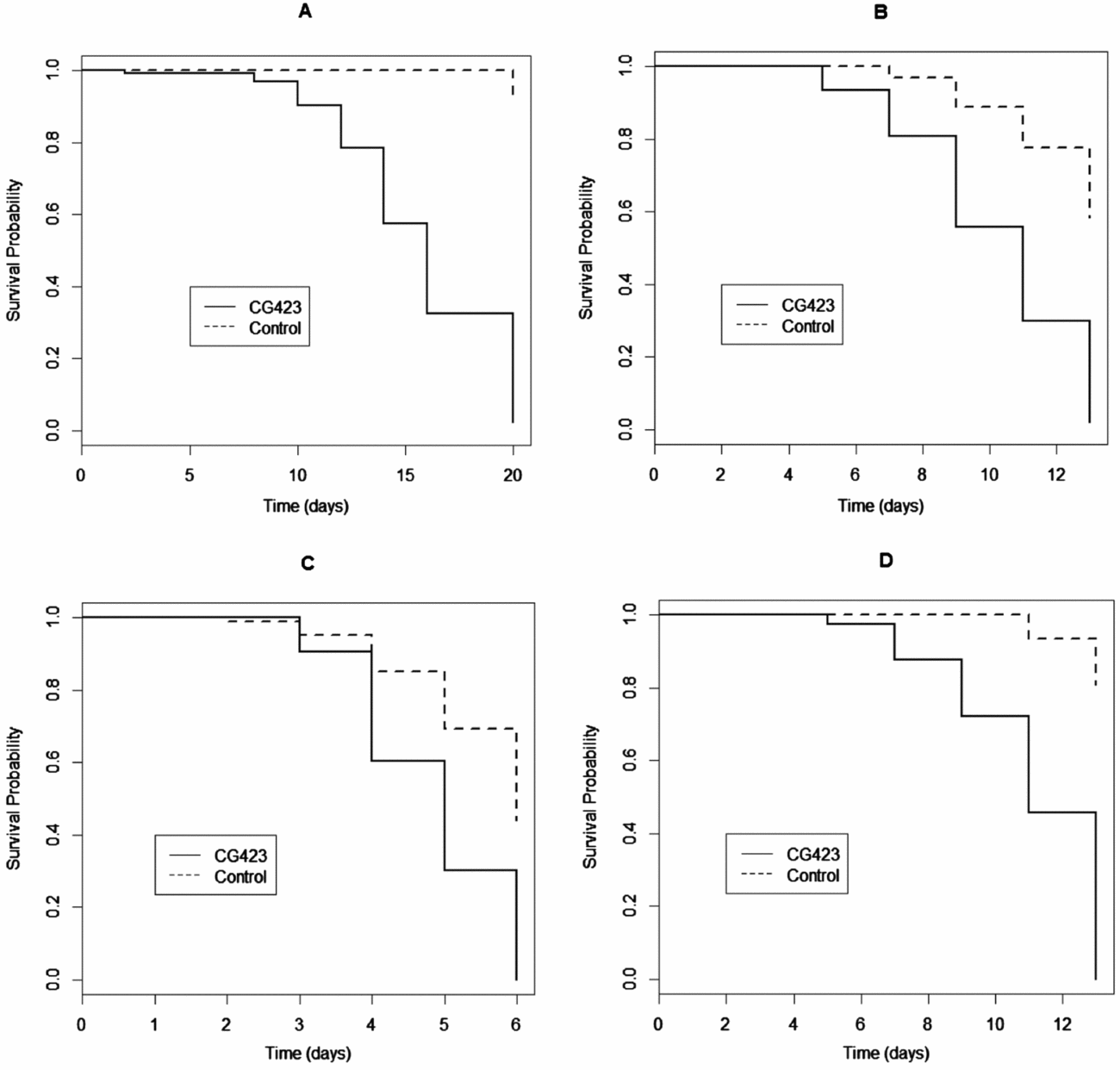
Natural parasitism by insects or microorganisms was undetected in any of the collected samples of the three species maintained in quarantine in the laboratory. Metarhizium acridum was found to be pathogenic to all tested Acridoidea species, with insect survival decreasing with time after inoculation (Fig. 2). Significant differences in survival curves between fungus-treated and untreated insects were observed for T. collares (χ 2 = 66.2, df = 1, P < 0.0001), C. f. frenatum (χ 2 = 43.6, df = 1, P < 0.0001) and P. obesus in both doses (χ 2 = 37.7, df = 1, P < 0.0001 and χ 2 = 26.7, df = 1, P<0.0001). Although mortality reached more than 90% at the end of the experimental period, the speed of insect kill varied among species. The larger species (T. collaris) took longer to reach 50% mortality (ST50 = 15.7 days (15.3–16.1 days)), than the smaller C. f. frenatum (ST50 = 11.1 days (10.8–11.4 days)) (Fig. 2A and D). Soybean oil showed some lethal effects, especially on nymphs of P. obesus, interfering with the normal moulting process. Although insect mortality in the control treatments (oil without conidia) was high, the increase of the dose led to a decrease of the survival time for P. obesus nymphs (ST50 = 10.2 days (9.9–10.5 days) and ST50 = 4.8 days (4.7–4.9 days) for 1 and 2 × 10⁴ conidia/insect, respectively) (Fig. 2B and C). Dead insects showed the typical symptoms of M. acridum infection, represented first by pink-red coloured integument followed by green-olive conidiation on inter-segmental regions of the body, mainly on the legs and thorax. Interestingly, abundant conidiation was unseen on T. collaris cadavers. Probably, the thick and rigid tegument of this species hindered fungal reproduction on the cadaver surface. However, a huge number of conidial clusters were observed inside thoracic cavities of mummified cadavers after dissection.
Survival probability of insects treated with an oil-based formulation of Metarhizium acridum (CG423) under laboratory conditions. Tropidacris collaris: 1 × 10⁵ conidia per adult (A); Parascopas obesus: 1 × 10⁴ conidia per nymph (B); 2 × 10⁴ conidia per nymph (C); and Cornops frenatum frenatum: 2 × 10⁴ conidia per adult (D).

Studies have reported the susceptibility of acridids to Metarhizium under laboratory conditions (Magalhães et al., Reference Magalhães, Faria, Lecoq, Schmidt, Silva, Frazão, Balança and Foucart2001; Hernández-Velázquez et al., Reference Hernández-Velázquez, Hunter, Barrientos-Lozano, Lezama-Gutiérrez and Reyes-Villanueva2003; Tounou et al., Reference Tounou, Kooyman, Douro-Kpindou and Poehling2008). Estimated mean survival time varied from a few days to almost a week, depending on the insect species and developmental stage, concentration and inoculation method, experimental conditions, fungal strain and formulation. Although our results confirmed the susceptibility of all three orthopteran species to M. acridum, differences on the susceptibility level among these species are difficult to determine, due to methodological variation. Despite the voracity of these species and the absence of the ‘knock down’ effect of the fungus, we observed that insects are affected by infection and their feeding and mobility behaviour differed from healthy insects, as also reported in previous studies (Faria et al., Reference Faria, Almeida and Magalhães1999; Magalhães et al., Reference Magalhães, Faria, Lecoq, Schmidt, Silva, Frazão, Balança and Foucart2001). The consumption of plant leaves by the infected groups before death was less than observed in the control groups. The susceptibility of the three orthopteran species to M. acridum reported here provides important information for the future development of an environmentally safe control alternative against these pests in Brazil.