Introduction
Studies show that 7 to 8 hr of sleep per night may be the optimal amount of sleep to derive the maximum health benefits (Kripke, Reference Kripke2004). However, insufficient sleep is a common feature of contemporary society, with an increasing proportion of individuals experiencing 7 or fewer hours of daily sleep. Sleep reductions maybe caused by several factors. Lifestyle or occupational factors, such as shift-work, stress, caffeine and alcohol use, lead to decreased sleep length, and affect up to 30–40% of individuals in the general population (Ban & Lee, Reference Ban and Lee2001; Hublin, Kaprio, Partinen, & Koskenvuo, Reference Hublin, Kaprio, Partinen and Koskenvuo2001; Krueger & Friedman, Reference Krueger and Friedman2009). Sleep disorders are also a cause of sleep loss. As many as 10% of the population has a chronic sleep disorder (Partinen & Hublin, Reference Partinen and Hublin2005), although this figure might be an underestimation given that sleep problems are commonly ignored or overlooked by individuals and society in general, and, therefore, remain under-reported and untreated. Finally, sleep loss may be due to a general medical, psychiatric or neurologic condition. Sleep dysfunctions are invariably linked to disorders and diseases of the brain because of the common brain circuitry and neurotransmitter systems that support normal brain function and sleep regulation.
The topic's importance is amplified by findings showing that abnormal sleep duration has a substantial impact on health and mortality, and also cognition and mood. Such information is particularly relevant for neuropsychologists and cognitive psychologists: first, because poor sleep impacts on the validity of the interpretation of neuropsychological findings in otherwise healthy people, and second, because difficulties sleeping are intrinsically tied to neuropsychological disorders which are typically seen in the clinic. Thus, sleep is a key issue that merits consideration by clinicians and researchers working in the field of neuropsychology. In clinical practice, however, sleep is rarely evaluated routinely during neuropsychological assessments, nor is it commonly considered as a major contributing factor in cognitive performance.
The aim of the current study is to present a review and synthesis regarding the impact of insufficient sleep on cognition and to highlight key issues for consideration by cognitive professionals. In section 2, we present an overview of the most common sleep disorders, and of the impact of poor sleep on health, public safety and mood. In section 3, we outline common methodological approaches in studies of sleep and cognition. Section 4 shows research findings regarding the effects of insufficient sleep (also termed “sleep loss”) on cognition in the general, non-clinical, population. Findings are outlined for each cognitive domain, and brain imaging evidence is presented showing the neural effects of sleep loss on neurobiological processing. The fifth section presents causal models advanced to account for the effects of sleep loss on cognition. Section 6 outlines the relationship between sleep and neurocognitive disorders. In the final section, the clinical significance and applications of this information for neuropsychologists are discussed. Studies addressing time-dependent memory consolidation are not included in this review, given their focus on the benefits of sleep.
Sleep loss, and impact on health, public safety, and mood
Sleep loss typically arises from disturbances in the quantity, quality or timing of sleep. Common sleep disorders include the following: Circadian or sleep-wake rhythm disorders are linked to a misalignment between the person's sleep patterns with societal norms, the symptoms of which include difficulties initiating or maintaining sleep (including insomnia); Disorders associated with abnormal sleep architecture (such as REM sleep), which produce multiple awakenings in sleep resulting in insufficient sleep and daytime sleepiness; Respiratory-related sleep disorders such as obstructive and central sleep apnoea that are characterized by cessation of breathing during sleep and multiple awakenings; and movement-related sleep disorders (such as Restless Leg Syndrome) that involve involuntary movements during sleep, that result in awakenings at night and fragmented sleep. Common characteristics of all sleep disorders include shortened duration of quality sleep, daytime sleepiness and a lack of refreshing sleep.
The health consequences of sleep disturbances include vascular, metabolic and neuropsychiatric outcomes, including hypertension, heart disease, arrhythmia, stroke, heart failure, insulin resistance and type-2 diabetes (Kripke, Reference Kripke2004; Taheri, Lin, Austin Young, & Mignot, Reference Taheri, Lin, Austin, Young and Mignot2004). Poor sleep also reduces well-being, productivity in the work place, and public safety (Banks & Dinges, Reference Banks and Dinges2007; Kyle, Morgan, & Espie, Reference Kyle, Morgan and Espie2010). For example, 20% of car accidents are attributed to sleepiness as the main, or contributing, cause (Mittler et al., Reference Mittler, Carskadon, Czeisler, Dement, Dinges and Graeber1988).
Sleep also impacts critically on negative mood. Insomnia, for example, is co-morbid with depression and anxiety (Baglioni, Spiegelhalder, Lombardo, & Riemann, Reference Baglioni, Spiegelhalder, Lombardo and Riemann2010), and insufficient sleep impacts on emotion regulation and the subjective evaluation of emotional stimuli (Pilcher & Huffcutt, Reference Pilcher and Huffcutt1996; Tempesta et al., Reference Tempesta, Couyoumdjian, Curcio, Moroni, Marzano, DeGennaro and Ferrara2010). The relationship between negative mood states and poor sleep appears to be bi-directional, since epidemiological estimates suggest that up to 90% of individuals with depression complain of sleep impairments (Jansson-Frojmark & Lindblom, Reference Jansson-Frojmark and Lindblom2008). Such findings demonstrate that negative mood and poor sleep are intrinsically linked, and point to the possibility that poor sleep or negative mood initiate a negative spiral which makes further depressed mood and poor sleep more likely. Psychological explanations for the association between poor sleep and negative mood suggest a role for enhanced cortical arousal that leads to ruminations and difficulty sleeping (Riemann et al., Reference Riemann, Spiegelhalder, Feige, Voderholzer, Berger, Perlis and Nissen2010). Neurobiological explanations, by contrast, propose a dysregulation of the endogenous circadian pacemaker in the suprachiasmatic nucleus (SCN) in the hypothalamus, which in turn leads to neurobiological dysfunctions with a particular focus in the prefrontal cortex (Monteleone & Maj, Reference Monteleone and Maj2008). These frontal regions are critical for modulating sleep processes, and for the regulation of mood and brain outputs from the amygdala, thus providing a plausible brain-system explanation for the link between poor sleep and negative mood.
Methods in studies of sleep and cognition in healthy people
Studies of sleep loss on cognition in otherwise healthy individuals have used three main methodological approaches. Epidemiologic studies have characterized and quantified the association between sleep duration in community individuals and cognitive abilities. A strength of this approach is that it provides a naturalistic “snapshot” of sleep habits, with the added benefit of large sample sizes and greater statistical power. Limitations however, include an increased reliance on subjective self-reports regarding sleep and cognition.
Cognitive studies, by contrast, have used objective measurements of sleep and cognition. Unfortunately, few methodologically rigorous studies exist comparing the cognitive profile of “good sleepers” compared to “poor sleepers”, so that the impact of different sleep patterns occurring naturally in community settings remains poorly understood. One reason for the small number of studies may be the difficulty in recruiting “poor sleepers” who do not suffer from a clinical or medical condition.
Most of the evidence comes from experimental studies that have manipulated the duration, quality, or timing of sleep using sleep deprivation paradigms. A range of paradigms has been used. In total sleep deprivation studies, participants are kept continuously awake for a prolonged period of time (24 to 48 hr, or longer). During the study period, tasks are repeated periodically to examine changes in performance associated with increasing time awake. Performance is then typically compared against baseline, or against that of control participants who were allowed to sleep as usual. With partial sleep deprivation, participants experience chronic reductions in sleep hours (typically 3–6 hr), as compared to their usual sleep duration. Sleep restrictions are imposed for several, consecutive nights, even weeks, to produce an accumulation of “sleep debt.” Increasingly, studies add “recovery time” for participants at the end of the study period, the purpose of which is to examine whether performance stabilizes back to baseline after several nights of “normal” sleep. Based on currently available studies, however, no strong evidence exists that different sleep paradigms produce vastly different findings on cognition, thus they will not be differentiated in the next section.
The consequences of sleep loss on cognition in healthy populations
Below is a review of the consequences of poor sleep on cognition in the domains of speed of responding, attention and vigilance, short-term memory, mental arithmetic, executive functions (mental flexibility, divided attention, working memory, inhibition, verbal fluency, problem solving), memory, language, motor performance, visual-spatial skills, and social cognition. This ordering follows the amount of research which has been conducted on these domains, from largest to smallest. Appendix 1 shows the sample size and the demographics for the studies reviewed here.
Speed of Responding
The first report of a decrease in response time (RT) following sleep deprivation was provided by Patrick and Gilbert (Reference Patrick and Gilbert1896), and practically every study since then has replicated this finding, regardless of variations in the RT task. Studies show that shortened sleep produces decrements in speed on both simple RT and more complex (choice) RT tasks (Buysse, Monk, Carrier, & Begley, Reference Buysse, Monk, Carrier and Begley2005; Frey, Badia, & Wright, Reference Frey, Badia and Wright2004; Glenville, Broughton, Wing, & Wilkinson, Reference Glenville, Broughton, Wing and Wilkinson1978; Stenuit & Kerkhofs, Reference Stenuit and Kerkhofs2008; Tilley & Wilkinson, Reference Tilley and Wilkinson1984). RT reductions are also reported on tasks of executive functions such as the Digit Symbol Modality Test and Trail Making Test (Martin, Engleman, Deary, & Douglas, Reference Martin, Engleman, Deary and Douglas1996; Williamson & Feyer, Reference Williamson and Feyer2000). Errors of omission and commission are commonly observed in choice RT tasks (Glenville et al., Reference Glenville, Broughton, Wing and Wilkinson1978; Smulders, Kenemans, Jonkman, & Kok, Reference Smulders, Kenemans, Jonkman and Kok1997) and are linked to increased task duration or complexity (Bartel, Offermeier, Smith, & Becker, Reference Bartel, Offermeier, Smith and Becker2004). A meta-analysis comprising 27 studies, however, reported that speed was more affected by sleep deprivation than accuracy (Koslowsky & Babkoff, Reference Koslowsky and Babkoff1992).
Attention and Vigilance
One theoretical framework proposes that vigilance is “the fundamental process affected by sleep loss” (Lim & Dinges, Reference Lim and Dinges2008). A commonly-used task is the Psychomotor Vigilance Test (PVT; Dinges & Powell, Reference Dinges and Powell1985), in which individuals press a button in response to a light appearing at random intervals. The impact of insufficient sleep on the PVT includes overall slowing of responses, and increased “lapses” in attention for lengthy periods (Blatter et al., Reference Blatter, Graw, Munch, Knoblauch, Wirz-Justice and Cajochen2006; Doran et al., Reference Doran, Van Dongen and Dinges2001; Drake et al., Reference Drake, Roehrs, Burduvali, Bonahoom, Rosekind and Roth2001; Pilcher et al., Reference Pilcher, McClelland, Moore, Haarmann, Baron, Wallsten and McCubbin2007; Van Dongen, Maislin, Mullington, & Dinges, Reference Van Dongen, Maislin, Mullington and Dinges2003). Interestingly, performance on the PVT worsens with increasing time awake (Belenky et al., Reference Belenky, Wesensten, Thorne, Thomas, Sing, Redmond and Balkin2003) but is reversed after one sleep period lasting at least 8 hr or more (Drummond, Paulus, & Tapert, Reference Drummond, Paulus and Tapert2006).
Performance decrements after sleep deprivation have also been demonstrated on tasks of auditory and visual attention (Glenville et al., Reference Glenville, Broughton, Wing and Wilkinson1978; Wimmer, Hoffmann, Bonato, & Moffitt, Reference Wimmer, Hoffmann, Bonato and Moffitt1992). Often, performance is characterized by increased response time rather than increased errors. Timed-tasks also show more impairment than self-paced tasks, suggesting a speed-accuracy trade-off.
The neural correlates of these cognitive changes have been explored with functional Magnetic Resonance Imaging (fMRI; Drummond, Bischoff-Grethe et al., Reference Drummond, Bischoff-Grethe, Dinges, Ayalon, Mednick and Meloy2005; Thomas et al., Reference Thomas, Sing, Belenky, Holcomb, Mayberg, Dannals and Redmond2000; Tomasi et al., Reference Tomasi, Wang, Telang, Boronikolas, Jayne, Wang and Volkow2009). Studies show that the brain regions activated during cognitive task performance after sleep loss differ from those activated in individuals who sleep normally. Tomasi et al. (Reference Tomasi, Wang, Telang, Boronikolas, Jayne, Wang and Volkow2009) asked participants to perform an attention task, and showed abnormal activation in the parietal cortex, prefrontal cortex and thalamus in sleep-deprived individuals. Given the role of the cortico-thalamic network on the attentional system, these findings provide one explanation for decreased performance on attention tasks.
Short-Term Memory
Findings regarding accuracy of performance on auditory, visual or spatial short-term memory tasks after sleep deprivation have been mixed. Impaired digit recall performance has been reported in one study (Frey et al., Reference Frey, Badia and Wright2004), but not others (Glenville et al., Reference Glenville, Broughton, Wing and Wilkinson1978; Linde & Bergstrom, Reference Linde and Bergstrom1992; Quigley, Green, Morgan, Idzikowski, & King, Reference Quigley, Green, Morgan, Idzikowski and King2000). Decrements in spatial memory performance were quantified as a loss of 5–10% (Williamson & Feyer, Reference Williamson and Feyer2000), but these positive findings were not replicated by Ferri et al. (Reference Ferri, Drago, Arico, Bruni, Remington, Stamatakis and Punjabi2001) on a test of complex spatial attention.
Whereas behavioral findings show mixed findings, neuroimaging investigations have revealed clearer results (Chee & Chuah, Reference Chee and Chuah2007; Lim, Choo, & Chee, Reference Lim, Choo and Chee2007). In one study, Chee and Chuah (Reference Chee and Chuah2007) observed that sleep deprivation produced a measurable impact on neural functions associated with a task of visual short-term memory. Reductions in intraparietal sulcus activity were observed that were linked to a reduction in memory capacity, and which were attributed to general degradation in short-term memory.
Altogether, sleep loss appears to produce some changes in short-term memory capacity, although these effects are not always detected using cognitive measures. Neuroimaging findings, by contrast, have revealed biological changes in response to sleep loss, and appear to be sensitive to the negative effects of poor sleep on short-term memory.
Mental Arithmetic
Sleep loss impacts on mental arithmetic abilities, with findings showing slower performance and increased errors (Frey et al., Reference Frey, Badia and Wright2004). Performance decrements also accumulate as a function of the length of time awake (Stenuit & Kerkhofs, Reference Stenuit and Kerkhofs2008; Van Dongen et al., Reference Van Dongen, Maislin, Mullington and Dinges2003). In one such study, Van Dongen et al. (Reference Van Dongen, Maislin, Mullington and Dinges2003) demonstrated that partial sleep deprivation for 14 days produced linear decreases in performance over time; furthermore, 6 hr or fewer per night resulted in severe impairments which were equivalent to up to 2 nights of total sleep deprivation, suggesting that even small decreases in sleep can severely impact on performance. Neuroimaging studies provide a neurobiological explanation for the consequences of sleep loss on mental arithmetic. fMRI scans, conducted during a serial subtraction task, revealed bilateral decreases in the prefrontal cortex (PFC) and abnormal activation in the parietal lobe (Drummond et al., Reference Drummond, Brown, Stricker, Buxton, Wong and Gillin1999) in sleep-deprived participants, compared to rested individuals.
Executive Functions
One dominant model proposes that sleep loss specifically impacts on frontal lobe functioning (Harrison & Horne, Reference Harrison and Horne1998, Reference Harrison and Horne2000; Horne, Reference Horne1993), and several domains of executive functions have been investigated to test this proposal.
Mental flexibility and switching
The effects of shortened sleep on mental flexibility and switching have been assessed on the Trail-Making and Symbol Digit Modality tests, with studies showing reductions in performance speed (Stenuit & Kerkhofs, Reference Stenuit and Kerkhofs2008; Von Dongen et al., 2003; Wimmer et al., Reference Wimmer, Hoffmann, Bonato and Moffitt1992).
Divided attention
A recent meta-analysis comprising 70 studies commented that divided attention might be less affected by sleep loss when compared with simple attention (Lim & Dinges, Reference Lim and Dinges2010). Study results have been largely inconsistent (Drake et al., Reference Drake, Roehrs, Burduvali, Bonahoom, Rosekind and Roth2001; Frey et al., Reference Frey, Badia and Wright2004; Stenuit & Kerkhofs, Reference Stenuit and Kerkhofs2008; Williamson & Feyer, Reference Williamson and Feyer2000). Challenges in evaluating these results lie in the fact that tasks vary in complexity and cognitive demands, and that different age groups have been used in such studies (Appendix 1).
While cognitive findings have been mixed, neuroimaging studies point to neurobiological abnormalities in prefrontal cortex and parietal lobe activation, as measured on a task of divided attention requiring verbal learning and arithmetic (Drummond, Gillin, & Brown, Reference Drummond, Gillin and Brown2001). Altogether, the findings point to activation reductions during divided attention task performance under sleep deprivation conditions. Such disturbances however, are not necessarily linked to poor performance on cognitive tasks, with behavioral results appearing to depend on factors such as task complexity and sample demographics.
Working memory
The type of task used to assess working memory has played a critical role in study findings. Studies using simple working memory tasks have reported decreased response times and, to a lesser extent, reduced response accuracy, after sleep deprivation (Bartel et al., Reference Bartel, Offermeier, Smith and Becker2004; Choo et al., Reference Choo, Lee, Venkatraman, Sheu and Chee2005; Frey et al., Reference Frey, Badia and Wright2004; Pilcher et al., Reference Pilcher, McClelland, Moore, Haarmann, Baron, Wallsten and McCubbin2007; Polzella, Reference Polzella1975), with decrement characterized as a 38% drop in performance (Turner, Drummond, Salamat, & Brown, Reference Turner, Drummond, Salamat and Brown2007). A recent epidemiological study replicated the finding of an association between sleep length and working memory performance. Gradisar, Terrill, Johnston, and Douglas (Reference Gradisar, Terrill, Johnston and Douglas2008) used online questionnaires to show that young individuals with insufficient sleep had worse performance on both the Number Sequencing and Operation Span tasks.
Negative findings come from more complex and demanding tasks such as the n-back task (Beebe, Difrancesco, Tlustos, McNally, & Holland, Reference Beebe, Difrancesco, Tlustos, McNally and Holland2009; Binks, Waters, & Hurry, Reference Binks, Waters and Hurry1999; Tucker, Whitney, Belenky, Hinson, & Van Dongen, Reference Tucker, Whitney, Belenky, Hinson and Van Dongen2010; Wimmer et al., Reference Wimmer, Hoffmann, Bonato and Moffitt1992). One explanation for these negative findings, as proposed by Turner et al. (Reference Turner, Drummond, Salamat and Brown2007), is that sleep loss has a greater impact on attention than executive components. Since simple working memory tasks are more fundamentally reliant on attention, and complex working memory tasks on executive components, shortened sleep may have greater measurable impact on simple working memory tasks. These findings point to the need to consider task complexity when measuring working memory. Neuroimaging studies provide evidence for this proposal. Stricker, Brown, Wetherell, and Drummond (Reference Stricker, Brown, Wetherell and Drummond2006) demonstrated that sleep deprivation and task complexity caused differential and complex effects on brain activation, as well as an interaction during behavioral performance, highlighting the need for carefully controlled studies of task difficulty.
Inhibition
With regard to behavioral inhibition, studies show an impact of sleep deprivation on the Go–No Go task which measures the ability to inhibit a pre-potent response (Stenuit & Kerkofs, 2008). Errors of omission and commission increase with the number of hours awake (Drummond et al., Reference Drummond, Paulus and Tapert2006; Harrison, Jones, & Waterhouse, Reference Harrison, Jones and Waterhouse2007), and show recovery after one night of normal sleep (Drummond et al., Reference Drummond, Paulus and Tapert2006). Neural imaging during performance on the Go–No Go task after sleep loss also shows abnormal modulation of prefrontal and anterior cingulate gyrus activity (Drummond et al., Reference Drummond, Paulus and Tapert2006). Behavioral inhibition deficits after sleep loss, however, have not been replicated in a more complex response-choice task (Jennings, Monk, & van der Molen, Reference Jennings, Monk and van der Molen2003).
With regard to cognitive inhibition, sleep deprivation produces enhanced interference on the Negative Priming task (Harrison & Espelid, Reference Harrison and Espelid2004; Stenuit & Kerkohfs, 2008), and increased errors and latency on the Hayling Sentence Completion Test (HSCT; Harrison & Horne, Reference Harrison and Horne1998). Negative findings, however, were reported on the Stroop (Binks et al., Reference Binks, Waters and Hurry1999; Sagaspe et al., Reference Sagaspe, Sanchez-Ortuno, Charles, Taillard, Valtat, Bioulac and Philip2006). This points, perhaps, to selective effects on intentional and controlled aspects of inhibition (Negative Priming, HSCT), but not on automatic aspects of inhibitory control (as measured by the Stroop). In a recent study comprising 391 university students, Schmidt, Gay, and Ghisletta (Reference Schmidt, Gay and Ghisletta2010) also showed that poor sleep was associated with impulsivity, worry, and intrusive and unwanted thoughts, providing further support for the hypothesis that sleep reduction impacts on cognitive control.
Verbal fluency
Deficits in verbal fluency are a common finding after sleep loss, with reports of fewer words, and perseveration of incorrect responses, on tasks of semantic (Patrick & Gilbert, Reference Patrick and Gilbert1896) and phonemic fluency (Harrison & Horne, Reference Harrison and Horne1997, Reference Harrison and Horne1998; Horne, Reference Horne1988). These findings, however, were not replicated in a recent study (Tucker et al., 2010). The reason for different findings in such standardized tasks is not entirely clear, especially given that the demographics characteristics of participants are similar (Appendix 1). Another explanation proposes individual differences as explained below (section 5).
Problem solving, creative thinking, planning
Longer response times have been reported on The Tower of London test, together with an increase in number of moves to complete the task (Killgore et al., Reference Killgore, Kahn-Greene, Lipizzi, Newman, Kamimori and Balkin2008). Nilsson et al. (Reference Nilsson, Soderstrom, Karlsson, Lekander, Akerstedt, Lindroth and Axelsson2005) reported that one night of sleep loss resulted in impaired performance on the Modified 6-Element Test, with rule breaking, and deficits in monitoring and planning. Deficits on the Torrance Test, which requires thinking up novel uses for objects or new ways to combine shapes (Horne, Reference Horne1988; Wimmer et al., Reference Wimmer, Hoffmann, Bonato and Moffitt1992) have also been reported, in addition to perseveration on incorrect responses.
Overall, there is evidence that sleep loss leads to deficits on tests of executive functions, although task complexity, and outcome variables recorded (accuracy, speed of responding, perseveration), appear to play a key role in the findings. Neuroimaging studies are more consistent in finding neurobiological abnormalities on executive tasks due to sleep deprivation, localized in the frontal lobes and particularly the anterior cingulate cortex. Epidemiological studies also support the link between insufficient sleep and behavioral indices of frontal lobe functioning.
Memory
There is increasing evidence that sleep is important for learning and memory, particularly for the consolidation of newly learnt words and skills. It, therefore, follows that sleep reductions before, and during, learning, should impact on memory processing. In support, studies show that people who are sleep deprived perform less well on memory tasks than those who sleep normally. Campos-Morales, Valencia-Flores, Castaño-Meneses, Castañeda-Figueiras, and Martínez-Guerrero (Reference Campos-Morales, Valencia-Flores, Castaño-Meneses, Castañeda-Figueiras and Martínez-Guerrero2005) reported that participants who rated themselves as “sleepy” (inferring lower amount/quality of sleep) had lower performance, and recalled fewer words, on the RAVLT, compared to “non-sleepy” participants. Similar findings were reported using sleep deprivation paradigms in list-learning, prose learning, paired-associate learning, and semantic memory (Drake et al., Reference Drake, Roehrs, Burduvali, Bonahoom, Rosekind and Roth2001; Drummond et al., Reference Drummond, Brown, Gillian, Stricker, Wong and Buxton2000; Falleti, Maruff, Collie, Darby, & McStephen, Reference Falleti, Maruff, Collie, Darby and McStephen2003; Fluck et al., Reference Fluck, File, Springett, Kopelman, Rees and Orgill1998; Roehrs, Burduvale, Bonahoom, Drake, & Roth, 2003). Drake et al. (Reference Drake, Roehrs, Burduvali, Bonahoom, Rosekind and Roth2001) further reported that the effects on delayed memory were dose-dependent on the length of time awake. These results were not replicated by Forest and Godbout (Reference Forest and Godbout2000), although their sample size was smaller.
Context (or associative) memory also shows sensitivity to sleep loss, as assessed in the temporal (Harrison & Horne, Reference Harrison and Horne2000), and spatial, memory domains (Habeck et al., Reference Habeck, Rakitin, Moeller, Scarmeas, Zarahn, Brown and Stern2004; Hagewood et al., 2010; Plihal & Born, Reference Plihal and Born1999). Similarly, procedural learning is impacted by disrupted sleep. Overnight improvements in visuo-motor procedural memory observed in people who are allowed to sleep normally (Gais et al., Reference Gais, Koster, Sprenger, Bethke, Heide and Kimmig2008), are negated with sleep deprivation which disrupts the curve of learning improvements. These results have been interpreted as showing that poor sleep has a significant negative impact on encoding and consolidation of material in memory (Alvarenga et al., Reference Alvarenga, Patti, Andersen, Silva, Calzavara, Lopez and Tufik2008; Rauchs, Desgranges, Foret, & Eustache, Reference Rauchs, Desgranges, Foret and Eustache2005).
Biological changes from sleep loss have been proposed to explain these effects on memory. Yoo, Hu, Gujar, Jolesz, and Walker (Reference Yoo, Hu, Gujar, Jolesz and Walker2007) examined brain responses during learning of picture slides after participants underwent sleep deprivation. A dysfunction in hippocampal activity during memory encoding was recorded, explaining later behavioral difficulties with delayed recall. They concluded that poor sleep “critically compromises the neural and behavioral capacity for committing new experiences to memory” (p. 385). Drummond et al. (Reference Drummond, Brown, Gillian, Stricker, Wong and Buxton2000) too, found abnormal prefrontal cortex and parietal lobe activation, and reduced temporal lobe activity during a verbal learning task after sleep loss.
Language-Based and Speech Tasks
Studies show that performance on tasks assessing crystallized abilities, that rely on the retrieval of acquired knowledge, is largely intact after sleep disruptions. Performance on sentence completion and reading comprehension tasks is typically unimpaired loss (Pilcher et al., Reference Pilcher, McClelland, Moore, Haarmann, Baron, Wallsten and McCubbin2007; Quigley et al., Reference Quigley, Green, Morgan, Idzikowski and King2000), as is performance on logical reasoning tasks such as Raven's Matrices and Grammatical Reasoning (Blagrove, Alexander, & Horne, Reference Blagrove, Alexander and Horne1995; Drummond, Brown, Salamat, & Gillin, Reference Drummond, Brown, Salamat and Gillin2004; Pilcher et al., Reference Pilcher, McClelland, Moore, Haarmann, Baron, Wallsten and McCubbin2007; Quigley et al., Reference Quigley, Green, Morgan, Idzikowski and King2000).
By contrast, expressive language appears sensitive to sleep loss. Observations include a reduction in the number of words spontaneously produced, reduced clarity, and a change in prosody and intonation. Increased slurring and flat affect with an attenuation in loudness and pitch have also been reported (Harrison & Horne, Reference Harrison and Horne1998; Morris, Williams, & Lubin, Reference Morris, Williams and Lubin1960). Perseveration and reduced language spontaneity in a word fluency task were also noted by Harrison and Horne (Reference Harrison and Horne1997).
Motor Performance, and Visual-spatial Skills
Studies of psychomotor performance and hand-eye coordination are consistent in showing performance decrements, estimated as a reduction of up to 30% in speed and accuracy (Williamson & Feyer, Reference Williamson and Feyer2000). Deficits after sleep loss have been reported on the Purdue Pegboard (Buysse et al., Reference Buysse, Monk, Carrier and Begley2005), a visual search task (De Gennaro, Ferrara, Curciao, & Bertini, 2001), and a maze-tracing task (Blater et al., 2005). Deficits in saccadic movements and smooth eye pursuit have also been reported after sleep loss (Kowslowsky & Babkoff, 1992; Quigley et al., Reference Quigley, Green, Morgan, Idzikowski and King2000), which were linked to accidents in a simulated driving task (Russo et al., Reference Russo, Thomas, Thorne, Sing, Redmond, Rowland and Balkin2003). Fewer studies have examined spatial skills, but these are consistent in showing difficulties with mental rotation and a 3-D navigation task (Strangman, Thompson, Strauss, Marshburn, & Sutton, Reference Strangman, Thompson, Strauss, Marshburn and Sutton2005).
Social Cognition
Social cognition, the role that cognitive processes play in social behavior, also appears to be impacted by sleep. Killgore and colleagues conducted a series of studies which examined multiple aspects of social cognition, all of which were impaired after prolonged awakeness. Domains affected included emotional decision making (Killgore, Balkin, & Wesensten, Reference Killgore, Balkin and Wesensten2006), social and interpersonal functioning (Killgore et al., Reference Killgore, Kahn-Greene, Lipizzi, Newman, Kamimori and Balkin2008), and moral judgment (Killgore et al., Reference Killgore, Killgore, Day, Li, Kamimori and Balkin2007). Clearly, independent replication is needed in this area, although the association between sleep and social cognition is interesting given its links with childhood developmental stages, emotions, quality of life, and well being.
Synthesis
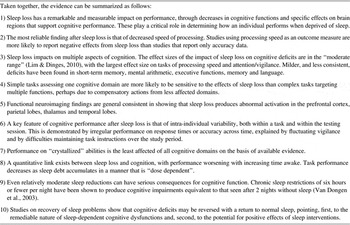
A summary and synthesis of the literature is presented in Table 1.
Summary of findings regarding the impact of sleep loss on cognition in healthy people

Cognitive models of the impact of sleep loss on cognitive performance
Several explanations have been proposed to explain the impact of sleep loss on cognition. One early explanation posited that sleep loss generally reduces the motivation to perform (Wilkinson, Reference Wilkinson1961). However, sleep deficits were found on high novelty tasks, arguing against the idea that interest is a contributor to performance (Harrison & Horne, Reference Harrison and Horne2000). The vigilance hypothesis (Doran et al., Reference Doran, Van Dongen and Dinges2001; Williams, Reference Williams1959) by contrast, proposes that the interaction between the need for sleep and circadian factors causes fluctuating levels of arousal, which “destabilize” neural and cognitive performance. Moment-to-moment variability of attention hence cause mental “lapses” during which participants show variable patterns of cognitive performance over time. Durmer and Dinges (Reference Durmer and Dinges2005), and Lim and Dinges (Reference Lim and Dinges2010) further argue that broad deficits in cognition can be explained by the central function of sustained attention in many higher order cognitive tasks. One problem for this theory, however, comes from mixed findings on short-term memory tasks. Another explanation proposes that sleep loss uniquely affects the prefrontal cortex (PFC) (Beebe & Gozal, Reference Beebe and Gozal2002; Harrison & Horne, Reference Harrison and Horne2000; Harrison et al., Reference Harrison, Horne and Rothwell2000; Horne, 1993). This “frontal lobe” hypothesis suggests that sleep loss selectively impacts on the efficiency of PFC functioning, and produces temporary changes in cerebral metabolism which, in turn, lead to changes in cognition, emotion and behavior consistent with mild prefrontal lobe dysfunction (Killgore et al., Reference Killgore, Kahn-Greene, Lipizzi, Newman, Kamimori and Balkin2008). One criticism is that fMRI studies show changes in activation after sleep deprivation that involve several brain regions in addition to the frontal lobes (Chee & Choo, Reference Chee and Choo2004; Mu et al., Reference Mu, Nahas, Johnson, Yamanaka, Mishory, Koola and George2005). In addition, preserved performance on executive tasks has been observed on moderately complex tasks after sleep deprivation (Chee & Choo, Reference Chee and Choo2004; Tucker et al., Reference Tucker, Whitney, Belenky, Hinson and Van Dongen2010), suggesting an interplay between sleep loss and task difficulty. To explain these paradoxical effects, some authors have proposed that the brain undertakes compensatory activity in response to increasing task difficulty (compensatory adaptation hypothesis; Chee & Chee, 2004; Choo et al., Reference Choo, Lee, Venkatraman, Sheu and Chee2005; Drummond et al., 2000; Drummond, Meloy, Yanagi, Orff, & Brown, 2005). This explanation arises primarily on the basis of observations of global, rather than specific, brain changes after sleep loss (Thomas et al., Reference Thomas, Sing, Belenky, Holcomb, Mayberg, Dannals and Redmond2000), particularly in the parietal lobes and thalamus. Since these regions are associated with the attentional network, one possibility is that this activation plays a compensatory role during low arousal, so that increased task complexity has the effect of temporarily increasing arousal or sustained attention. This model is nevertheless insufficient on its own to explain the cognitive and biological effects of sleep deficits, and must be viewed as complementary to other accounts.
Theoretical explanations regarding the effects of sleep on memory have been developed independently from the above models, and show that sleep impacts on the formation of memories requiring hippocampal functions. This work is particularly developed in animal studies, where sleep deprivation was demonstrated to impact on hippocampus-dependent functions (Hagewoud et al., Reference Hagewoud, Havekes, Novati, Keijser, Van der Zee and Meerlo2010; Ruskin, Liu, Dunn, Bazan, & LaHoste, Reference Ruskin, Liu, Dunn, Bazan and LaHoste2004). Given the importance of the hippocampal region and synaptic plasticity for encoding and stabilizing memories, this hypothesis proposes that selective abnormalities in this region would affect later recall on memory tasks. Fewer studies have been conducted in humans, although studies show that one night of sleep loss before acquisition of new material attenuates hippocampal activation and subsequent memory recall (Chen, Hardy, Zhang, LaHoste, & Bazan, Reference Chen, Hardy, Zhang, LaHoste and Bazan2006; Van der Werf et al., Reference Van der Werf, Altena, Schoonheim, Sanz-Arigita, Vis, De Rijke and Van Someren2009).
Overall, while several models have been proposed to explain the impact of sleep loss on cognition, there is currently a lack of an integrated theory which incorporates findings across multiple domains of cognition. There is a particular need for a cohesive theoretical account incorporating findings regarding the impact of sleep deprivation on hippocampal, frontal, and parietal lobe functions.
Limitations of Current Research
The primary limitation of the above research is the rarity of naturalistic studies examining participants’ usual sleep habits. Sleep deprivation studies have been criticized on the grounds that imposing sleep restrictions is stressful to participants, providing a potential confound in the interpretation of results. It is helpful to remember, however, that stress is a biological consequence of sleep loss. Consequently its effects on cognition through its action on the hypothalamo-pituitary-adrenal axis (HPA) cannot easily be differentiated from the direct effects of reduced sleep. In addition, sleep deprivation paradigms have yielded valuable insights into the role of sleep loss on cognition, and have shown largely consistent results in cognitive domains such as processing speed and attention. Clearly, more studies outside the laboratory are now needed.
One issue of interest concerns individual differences. Cognitive deterioration following sleep loss appears to be more marked in some people than in others (Doran et al., Reference Doran, Van Dongen and Dinges2001; Drummond et al., Reference Drummond, Gillin and Brown2001; Frey et al., Reference Frey, Badia and Wright2004; Thomas & Kwong, Reference Thomas and Kwong2006; Van Dongen, 2005). In addition, genetic research suggests individual differences in vulnerability to cognitive problems following sleep disruptions (Goel, Banks, Mignot, & Dinges, Reference Goel, Banks, Mignot and Dinges2009; Viola et al., Reference Viola, Archer, James, Groeger, Lo, Skene and Dijk2007). This raises interesting questions regarding vulnerabilities and protective factors, and the notion of “cognitive reserve” is being considered as a protective marker against adverse effects of poor sleep (Chee et al., Reference Chee, Chuah, Venkatraman, Chan, Philip and Dinges2006; Killgore et al., Reference Killgore, Grugle, Reichardt, Killgore and Balkin2009).
Another issue which is a potential confound is the effect of age, given that attention and response times are different in younger and older adults. Unfortunately, findings from sleep studies are complex and difficult to interpret. Results suggest that such sleep-dependent cognitive domains remain similarly affected after sleep loss in both age groups. Philip et al. (Reference Philip, Taillard, Sagaspe, Valtat, Sanchez-Ortuno, Moore and Bioulac2004) suggested that greater age-related effects on cognition may be cancelled out by a greater resistance to sleep deprivation as people age (Philip et al., Reference Philip, Taillard, Sagaspe, Valtat, Sanchez-Ortuno, Moore and Bioulac2004).
Sleep disorders in neuropsychologic condition
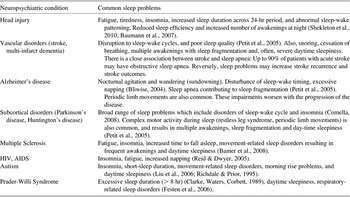
Medical, neurologic and psychiatric conditions produce marked sleep disturbances. Table 2 presents the type of sleep problems associated with common neuropsychologic conditions. This listing is not intended to be exhaustive, but rather it includes those disorders most commonly seen in the clinic, and which are associated with sleep symptoms.
Behavioural sleep problems in disorders in which neuropsychological dysfunction is common

The evidence reviewed here highlights complex issues when clinicians must differentiate the primary effects of pathology from secondary effects of sleep dysfunction. However, sleep problems and neuropsychological disorders can rarely be separated since the two are inter-related. As explained above, lesions in brain circuitry and neurotransmitter systems interfere with downstream sleep regulation processes so that the symptoms cannot be teased apart. A proportion of deficits seen in neuropsychological disorders are therefore intrinsically tied to sleep-related factors. Notwithstanding common neurobiological causes, sleep problems may also contribute to, and exacerbate, pre-existing cognitive deficits so that the neuropsychological performance actually shows the synergistic contributions of both factors. Again, in this situation, the relative contribution of pathology and sleep deficits is difficult to separate, but it clearly highlights the importance of early identification of sleep problems. Poor sleep may be improved with appropriate interventions. Even minor changes in sleep may lead to improvements in cognition and quality of life, and prevention of further deterioration. Furthermore, sleep interventions may decrease the velocity of the spiral which ties together depressed mood, low-self esteem and insomnia.
We are not aware of studies which document the impact of undiagnosed sleep problems on cognitive performance, or which delineate the relative weighting of pathology and poor sleep on cognition across different disorders, so much research remains to be done. However, studies in healthy individuals point to a critical impact of poor sleep on response speed, attention, vigilance, and performance variability over time, suggesting to these measures as potentially important in flagging sleep problems in individuals with cognitive disorders.
Implications for clinical neuropsychologists
Overall, this literature review shows that sleep has measurable consequences on cognitive performance, and that sleep problems are intrinsically tied to common neuropsychological conditions. Given that clinical neuropsychologists are concerned with the causes of cognitive dysfunction, these findings are pertinent to neuropsychological assessments and interventions. Neuropsychologists must become more aware of the consequences of sleep loss if they are to help individuals who are referred for cognitive evaluation or rehabilitation.
Consequence of Undervaluing the Impact of Poor Sleep on Cognition
We first consider the impact of overlooking the significance of poor sleep on cognition.
First, sleep problems may impact on the validity of the interpretation of neuropsychological findings. An abnormal cognitive profile may be mistakenly attributed to an organic or psychological cause, when it is in fact mediated by poor sleep. Alternatively, the impact of a co-morbid problem may be overestimated, and irregular performance may be attributed to poor motivation, poor effort, or anxiety issues. To our knowledge, no information exists regarding how often this type of mistake happens. Simple studies to test this proposal would be to repeat a cognitive assessment after a sleep intervention. A change in performance would indicate that poor sleep contributed in a significant way to the initial cognitive profile.
Second, sleep problems can interfere with rehabilitation outcomes. The failure to resolve sleep issues will impact on rehabilitation, as interventions are less likely to be effective. In support, a recent study suggests that pre-existing sleep problems might impact on the degree to which individuals with traumatic brain injury benefit from cognitive rehabilitation (Castriotta et al., Reference Castriotta, Atanasov, Wilde, Masel, Lai and Kuna2009). Other evidence shows that sleep difficulties impact on use of medical therapies, such as HIV medications (Phillips, Sowell, Boyd, Dudgeon, & Hand, Reference Phillips, Sowell, Boyd, Dudgeon and Hand2005). Sleep problems must become targets in their own right or risk becoming barriers to rehabilitation. The benefits of knowledge about sleep difficulties include better decision-making regarding treatment (see Recommendations).
Third, sleep problems impact on the validity of assessments because the normative data against which clients are compared may, themselves, be compromised by the high number of undiagnosed sleep disorders in normative samples. Up to 40% of the general population have significant sleep issues, and over 85% of those with moderate to severe sleep apnoea remain undiagnosed (Young, Evans, Finn, & Palta, Reference Young, Evans, Finn and Palta1997). This leads to the possibility that our normative expectations will be reduced by the high number of undiagnosed sleep problems, and this is particularly true in populations most at risk of sleep difficulties – such as children (Ravid, Afek, Suraiya, Shahar, & Pillar, Reference Ravid, Afek, Suraiya, Shahar and Pillar2009), adolescents (Gregory, Caspi, Moffitt, & Poulton, Reference Gregory, Caspi, Moffitt and Poulton2009), and older adults (Bloom et al., Reference Bloom, Ahmed, Alessi, Ancoli-Israel, Buysse, Kryger and Zee2009).
Finally, sleep problems may cause complications if they remain undiagnosed. Physical health is at risk given the link between sleep problems and increased morbidity and mortality. Sleep disorders also have a detrimental effect on neurological disorders by increasing the risk of stroke occurrence and outcomes. Finally, poor sleep degrade the quality of life of vulnerable populations and may hasten progression of neurological diseases (Petit, Montplaisir, & Boeve, Reference Petit, Montplaisir and Boeve2005). Such findings are particularly meaningful when one considers childhood disorders, such as attention deficit hyperactivity. As many as 1 in 4 such children may have undiagnosed sleep problems. Sleep problems may contribute significantly to their attention deficits, leading such children to experience further increased risk of attention deficit hyperactivity disorder (Chervin et al., Reference Chervin, Dillon, Bassetti, Ganoczy and Pituch1997).
Recommendations
Sleep is rarely routinely considered as a cause in its own right of cognitive compromise in clinical or research settings. So, what can be done?
Become better informed
The first goal is to improve the identification of sleep problems. Neuropsychologists may not be aware that their clients have a sleep disorder that impacts on performance during testing. Even if clients do have a diagnosed sleep disorder, however, and the neuropsychologist learns of this during assessment, there is currently a low level of understanding regarding the adverse effects of sleep loss on cognition. As a profession we need to get to grips with the psychological and biological pathways through which sleep affects cognition, by acquiring an up-to-date understanding of models of sleep loss, of sleep disorders, and their relationship to cognition.
Screen for sleep problems during the cognitive assessment
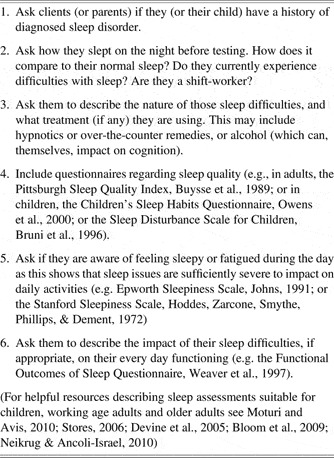
In our view it is essential that neuropsychologists begin to identify sleep problems during the assessment. To do this, we recommend that practitioners and researchers consider routinely screening for sleep difficulties so as to begin this process (See Table 3). Unfortunately, choosing the “right” screening tool is likely to be challenging. Given the very large number of sleep disorders, plus the very individual nature of clients’ sleep habits (their preferences, shift work patterns etc), no single sleep screening tool will be suitable for assessing all clients. The challenge for researchers will be to develop a sleep screening protocol which assists clinicians in efficiently and sensitively identifying those clients whose sleep problems may be contributing to, or causing, neuropsychological deficits. A further challenge is to produce such assessments for children, adolescents, working age and older adults.
Recommendations for sleep screening in neuropsychological settings

Refer to sleep clinic, and provide information on sleep hygiene
Many studies showing a quantitative link between sleep debt and cognitive performance also show that cognitive deficits may be reversed with a return to normal sleep. This points to the remediable nature of sleep-dependent cognitive deficits. Sleep problems must, therefore, become an urgent target for interventions in both healthy and clinical populations. While sleep is closely tied to neuropsychologic disorders, even mild changes in sleep may be beneficial for cognition, health, and well-being. Many sleep problems are compounded by activities that are inconsistent with the maintenance of healthy sleep. These include excessive napping, irregular sleep timing, failure to regulate morning light, as well as caffeine, alcohol, cigarettes, stress, and excitement before the sleep period. Such issues can be addressed directly without further consultation with sleep specialists, and relatively simple (but effective) sleep medicine protocols may be incorporated in the rehabilitation plan. More severe disturbances however must be referred to specialists for a comprehensive assessment if they are to be treated appropriately. Different sleep disorders require different types of treatment. A common treatment for respiratory-related sleep disorders involves opening the airways with continuous airway pressure (CPAP), whereas a treatment for circadian rhythm disorders might include bright light therapy or medicines such as melatonin.
Provide training
Clinical neuropsychology training must provide adequate expertise on the effects of sleep deprivation and/or sleep disorders on cognition. This must also be guided by our peak body representatives. Currently, the Australian Psychological Society writes that “Neuropsychologists are trained to understand the cognitive, emotional and behavioral effects of a wide range of conditions, including: Developmental, Degenerative, Demyelinating, Infectious, Vascular, Immunological, Inflammatory, Nutritional, Endocrine, Metabolic, Drug/alcohol, Toxic, Epileptic, Structural, Psychiatric, and Traumatic” (APS, 7th November, 2010), however sleep disorders are not mentioned. Furthermore, with few exceptions (Tarter, Butters, & Beers, Reference Tarter, Butters and Beers2001), few neuropsychology texts contain much information about the neuropsychological consequences of sleep difficulties. Even Lezak et al. (Reference Lezak, Howieson and Loring2004), makes only passing reference to sleep, and that in the context of hypoxia associated with chronic obstructive pulmonary disease and apnea (p. 282). As this review has shown, sleep disorders not associated with breathing difficulties produce wide ranging cognitive deficits. Changes must occur at the levels of peak body representatives, funding bodies, policy makers, universities, research institutions and in the clinic.
Concluding comments
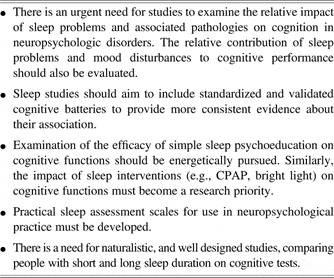
Overall, our understanding of how sleep problems contribute to the causes of neuropsychological dysfunction is rapidly advancing. Clinicians must be sensitive to these changes and develop skills to improve patient services if our profession is to advance. There is a pressing need to develop the capacity of clinical neuropsychologists to detect how sleep-related factors influence a patient's neuropsychological test performance, and subjective experience of their functioning. Whereas research in this field is slowing developing, there must be greater effort to integrate these findings and conduct research into the clinic. Recommendations for future research are presented in Table 4. Sleep problems account for a significant amount of the variance in cognitive performance, and merit serious consideration by neuropsychologists.
Recommendations for future research

Acknowledgements
There are no financial or other relationships that could be interpreted as a conflict of interest.
Appendix 1
Sample size and demographics of sleep studies on cognition in humans

Note. —= data not provided.