

%20--%3e%3c!DOCTYPE%20svg%20PUBLIC%20'-//W3C//DTD%20SVG%201.0//EN'%20'http://www.w3.org/TR/2001/REC-SVG-20010904/DTD/svg10.dtd'%3e%3csvg%20version='1.0'%20id='Layer_1'%20xmlns='http://www.w3.org/2000/svg'%20xmlns:xlink='http://www.w3.org/1999/xlink'%20x='0px'%20y='0px'%20width='64px'%20height='64px'%20viewBox='5.5%20-3.5%2064%2064'%20enable-background='new%205.5%20-3.5%2064%2064'%20xml:space='preserve'%3e%3cg%3e%3ccircle%20fill='%23FFFFFF'%20fill-opacity='0'%20cx='37.785'%20cy='28.501'%20r='28.836'/%3e%3cpath%20fill='%23595959'%20d='M37.441-3.5c8.951,0,16.572,3.125,22.857,9.372c3.008,3.009,5.295,6.448,6.857,10.314%20c1.561,3.867,2.344,7.971,2.344,12.314c0,4.381-0.773,8.486-2.314,12.313c-1.543,3.828-3.82,7.21-6.828,10.143%20c-3.123,3.085-6.666,5.448-10.629,7.086c-3.961,1.638-8.057,2.457-12.285,2.457s-8.276-0.808-12.143-2.429%20c-3.866-1.618-7.333-3.961-10.4-7.027c-3.067-3.066-5.4-6.524-7-10.372S5.5,32.767,5.5,28.5c0-4.229,0.809-8.295,2.428-12.2%20c1.619-3.905,3.972-7.4,7.057-10.486C21.08-0.394,28.565-3.5,37.441-3.5z%20M37.557,2.272c-7.314,0-13.467,2.553-18.458,7.657%20c-2.515,2.553-4.448,5.419-5.8,8.6c-1.354,3.181-2.029,6.505-2.029,9.972c0,3.429,0.675,6.734,2.029,9.913%20c1.353,3.183,3.285,6.021,5.8,8.516c2.514,2.496,5.351,4.399,8.515,5.715c3.161,1.314,6.476,1.971,9.943,1.971%20c3.428,0,6.75-0.665,9.973-1.999c3.219-1.335,6.121-3.257,8.713-5.771c4.99-4.876,7.484-10.99,7.484-18.344%20c0-3.543-0.648-6.895-1.943-10.057c-1.293-3.162-3.18-5.98-5.654-8.458C50.984,4.844,44.795,2.272,37.557,2.272z%20M37.156,23.187%20l-4.287,2.229c-0.458-0.951-1.019-1.619-1.685-2c-0.667-0.38-1.286-0.571-1.858-0.571c-2.856,0-4.286,1.885-4.286,5.657%20c0,1.714,0.362,3.084,1.085,4.113c0.724,1.029,1.791,1.544,3.201,1.544c1.867,0,3.181-0.915,3.944-2.743l3.942,2%20c-0.838,1.563-2,2.791-3.486,3.686c-1.484,0.896-3.123,1.343-4.914,1.343c-2.857,0-5.163-0.875-6.915-2.629%20c-1.752-1.752-2.628-4.19-2.628-7.313c0-3.048,0.886-5.466,2.657-7.257c1.771-1.79,4.009-2.686,6.715-2.686%20C32.604,18.558,35.441,20.101,37.156,23.187z%20M55.613,23.187l-4.229,2.229c-0.457-0.951-1.02-1.619-1.686-2%20c-0.668-0.38-1.307-0.571-1.914-0.571c-2.857,0-4.287,1.885-4.287,5.657c0,1.714,0.363,3.084,1.086,4.113%20c0.723,1.029,1.789,1.544,3.201,1.544c1.865,0,3.18-0.915,3.941-2.743l4,2c-0.875,1.563-2.057,2.791-3.541,3.686%20c-1.486,0.896-3.105,1.343-4.857,1.343c-2.896,0-5.209-0.875-6.941-2.629c-1.736-1.752-2.602-4.19-2.602-7.313%20c0-3.048,0.885-5.466,2.658-7.257c1.77-1.79,4.008-2.686,6.713-2.686C51.117,18.558,53.938,20.101,55.613,23.187z'/%3e%3c/g%3e%3c/svg%3e)
%20--%3e%3c!DOCTYPE%20svg%20PUBLIC%20'-//W3C//DTD%20SVG%201.0//EN'%20'http://www.w3.org/TR/2001/REC-SVG-20010904/DTD/svg10.dtd'%3e%3csvg%20version='1.0'%20id='Layer_1'%20xmlns='http://www.w3.org/2000/svg'%20xmlns:xlink='http://www.w3.org/1999/xlink'%20x='0px'%20y='0px'%20width='64px'%20height='64px'%20viewBox='5.5%20-3.5%2064%2064'%20enable-background='new%205.5%20-3.5%2064%2064'%20xml:space='preserve'%3e%3cg%3e%3ccircle%20fill='%23FFFFFF'%20fill-opacity='0'%20cx='37.637'%20cy='28.806'%20r='28.276'/%3e%3cg%3e%3cpath%20fill='%23595959'%20d='M37.443-3.5c8.988,0,16.57,3.085,22.742,9.257C66.393,11.967,69.5,19.548,69.5,28.5c0,8.991-3.049,16.476-9.145,22.456%20C53.879,57.319,46.242,60.5,37.443,60.5c-8.649,0-16.153-3.144-22.514-9.43C8.644,44.784,5.5,37.262,5.5,28.5%20c0-8.761,3.144-16.342,9.429-22.742C21.101-0.415,28.604-3.5,37.443-3.5z%20M37.557,2.272c-7.276,0-13.428,2.553-18.457,7.657%20c-5.22,5.334-7.829,11.525-7.829,18.572c0,7.086,2.59,13.22,7.77,18.398c5.181,5.182,11.352,7.771,18.514,7.771%20c7.123,0,13.334-2.607,18.629-7.828c5.029-4.838,7.543-10.952,7.543-18.343c0-7.276-2.553-13.465-7.656-18.571%20C50.967,4.824,44.795,2.272,37.557,2.272z%20M46.129,20.557v13.085h-3.656v15.542h-9.944V33.643h-3.656V20.557%20c0-0.572,0.2-1.057,0.599-1.457c0.401-0.399,0.887-0.6,1.457-0.6h13.144c0.533,0,1.01,0.2,1.428,0.6%20C45.918,19.5,46.129,19.986,46.129,20.557z%20M33.042,12.329c0-3.008,1.485-4.514,4.458-4.514s4.457,1.504,4.457,4.514%20c0,2.971-1.486,4.457-4.457,4.457S33.042,15.3,33.042,12.329z'/%3e%3c/g%3e%3c/g%3e%3c/svg%3e)
%20--%3e%3c!DOCTYPE%20svg%20PUBLIC%20'-//W3C//DTD%20SVG%201.0//EN'%20'http://www.w3.org/TR/2001/REC-SVG-20010904/DTD/svg10.dtd'%3e%3csvg%20version='1.0'%20id='Layer_1'%20xmlns='http://www.w3.org/2000/svg'%20xmlns:xlink='http://www.w3.org/1999/xlink'%20x='0px'%20y='0px'%20width='64px'%20height='64px'%20viewBox='5.5%20-3.5%2064%2064'%20enable-background='new%205.5%20-3.5%2064%2064'%20xml:space='preserve'%3e%3cg%3e%3ccircle%20fill='%23FFFFFF'%20fill-opacity='0'%20cx='36.924'%20cy='28.403'%20r='28.895'/%3e%3cpath%20fill='%23595959'%20d='M37.442-3.5c8.99,0,16.571,3.085,22.743,9.256C66.393,11.928,69.5,19.509,69.5,28.5c0,8.992-3.048,16.476-9.145,22.458%20C53.88,57.32,46.241,60.5,37.442,60.5c-8.686,0-16.19-3.162-22.513-9.485C8.644,44.728,5.5,37.225,5.5,28.5%20c0-8.762,3.144-16.343,9.429-22.743C21.1-0.414,28.604-3.5,37.442-3.5z%20M12.7,19.872c-0.952,2.628-1.429,5.505-1.429,8.629%20c0,7.086,2.59,13.22,7.77,18.4c5.219,5.144,11.391,7.715,18.514,7.715c7.201,0,13.409-2.608,18.63-7.829%20c1.867-1.79,3.332-3.657,4.398-5.602l-12.056-5.371c-0.421,2.02-1.439,3.667-3.057,4.942c-1.622,1.276-3.535,2.011-5.744,2.2%20v4.915h-3.714v-4.915c-3.543-0.036-6.782-1.312-9.714-3.827l4.4-4.457c2.094,1.942,4.476,2.913,7.143,2.913%20c1.104,0,2.048-0.246,2.83-0.743c0.78-0.494,1.172-1.312,1.172-2.457c0-0.801-0.287-1.448-0.858-1.943l-3.085-1.315l-3.771-1.715%20l-5.086-2.229L12.7,19.872z%20M37.557,2.214c-7.276,0-13.428,2.571-18.457,7.714c-1.258,1.258-2.439,2.686-3.543,4.287L27.786,19.7%20c0.533-1.676,1.542-3.019,3.029-4.028c1.484-1.009,3.218-1.571,5.2-1.686V9.071h3.715v4.915c2.934,0.153,5.6,1.143,8,2.971%20l-4.172,4.286c-1.793-1.257-3.619-1.885-5.486-1.885c-0.991,0-1.876,0.191-2.656,0.571c-0.781,0.381-1.172,1.029-1.172,1.943%20c0,0.267,0.095,0.533,0.285,0.8l4.057,1.83l2.8,1.257l5.144,2.285l16.397,7.314c0.535-2.248,0.801-4.533,0.801-6.857%20c0-7.353-2.552-13.543-7.656-18.573C51.005,4.785,44.831,2.214,37.557,2.214z'/%3e%3c/g%3e%3c/svg%3e)
The hope of quickly realizing secularist aims through state power at the outset of the Weimar Republic passed with the waning of the revolutionary period. Yet, the stabilization of the republic set the stage for the growth of socialist secularism as a popular movement. In the political realm, the Proletarian Freethinkers, whose membership had topped half a million by around 1926, stepped up their anticlerical activities. This fed into conservative fears of “godlessness” and contributed to the political polarization of the late 1920s, a development that will concern us in the final chapter. Red secularism also reached a high point in the realm of culture, where, as this chapter explores, it helped shape the workers’ culture movements of Weimar Germany.
As part of the blossoming of modern associational life within the pillarized social order of nineteenth-century Germany, socialists had formed their own soccer and bicycle clubs, their own choirs, theater companies and libraries. Although some offered socialist content, the cultural forms practiced by the socialist associations were roughly analogous to those found in the Christian milieus. During the Weimar Republic a marked change occurred. New demands were made in the name of Kultur and experiments were launched with the hope of ushering in the coming socialist society. This was the message of the 1924 Leipzig Workers’ Culture Week, sponsored by the SPD. It began with the performance of Ernst Toller’s “Transformation” (Wandlung), a “mass festival drama,” in which nearly 1,000 performers took part.Footnote 1 Leading socialist politicians and well-known secularists addressed the crowds and a new journal was launched with the Nietzschean title Kulturwille (Will to Culture).Footnote 2
Under the luminous goal of creating an experimental field for a future civilization, the various life reform movements of the Wilhelmine era, such as nudism, vegetarianism and rhythmic gymnastics, were recast. Expressionist playwrights, such as Toller, gave bold accents to novel forms of performance, such as the Sprechchor (speaking choir), in which lay actors declaimed revolutionary texts and engaged in dance movement that was meant to bring to life the revolutionary community. As they formulated plans for emancipation in “the future relationship of people and work, the relationship of the body and health and the democratization of knowledge and education,” Weimar-era cultural activists also argued for a specific role of Kultur in revolutionary social transformation.Footnote 3 In new journals, intellectuals forged and debated theoretical frameworks for what became known as “cultural socialism” or Kultursozialismus. In an issue of Kulturwille on “workers’ culture,” Richard Weimann, the secretary of the National Committee for Socialist Education (Reichsausschusses für sozialistische Bildungsarbeit), issued demands in the name of this new “Kultur movement.” He criticized prewar socialist education for being politically marginal and suffering from “spiritual narrowness and doctrinaire one-sidedness.” Now that it was recognized that “Socialism has always been viewed by its adherents, even if perhaps unconsciously, as worldview, as a higher ethical idea, yes, as a religion,” it was possible “to penetrate everything with new spirit, with new conviction” and to win the masses for the democratic idea and for a “new national community [Volksgemeinschaft]”Footnote 4 To achieve this aim, Weimann demanded a “socialist culture and education movement” that was “no longer, as in the past, an appendage or ‘institution’ of the party or unions” but which stood “on par” with them. The same demand was made at the Leipzig Culture Week by leading SPD politician Heinrich Schulze, who wanted the cultural movement to act as the “third column” of socialism.Footnote 5 The active participation of monist intellectuals, the hypertrophic claims made in the name of Kultur, the idea of a “third column” all point to a strong secularist contribution to cultural socialism, yet this has not been investigated in the historical literature.
German Kultursozialismus was connected to the cultural experiments of interwar “Red Vienna” and the Soviet avant-garde, which have attracted scholarly attention because of their efforts to harness culture and art to the utopian project of creating a socialist “New Man.” According to historian Anson Rabinbach, Viennese socialists focused on culture and education as a pragmatic response to the contradictory position they occupied in interwar Austria. Given that the party had little hope of convincing the pious, conservative voters in the country’s hinterland to vote for them, the focus on culture, education and secularism became a way of solidifying the urban milieu against reactionary encirclement, while sustaining hope for a positive turn in the future.Footnote 6 In the case of the early Soviet Union, the grand cultural experiments of the 1920s have been linked to the unfolding dynamics of revolutionary transformation in the short decade between the end of the Civil War and the establishment of Stalinist cultural forms in the early 1930s.Footnote 7 Some historians have, following the lead of Antonio Gramsci, interpreted culture as a key political arena in interwar Europe, precisely in post-revolutionary situations, when the “war of movement” gave way to a “war of position.”Footnote 8 By contrast, historian Dieter Langewiesche arrived at a more pessimistic reading of Kultursozialismus as marginal to interwar socialism. He argued that its educational theories did not meaningfully challenge the “connection to reality and pragmatism” manifested by the SPD and unions.Footnote 9 Kultursozialismus remained a compensation for the “loss of Utopia” experienced by socialists on the factory floor and in parliamentary democracy.Footnote 10 Without discounting the role of revolutionary hope and or its disappointment as drivers of cultural innovation, I pursue another explanation in this chapter, namely that Kultursozialismus was, in part, a further expression of monism as a form of knowledge connected to social dissent. Rather than seeking to influence socialism from the outside, as they had prior before the war, with the Revolution of 1918 monist intellectuals entered the socialist milieu in order to realize their long-standing cultural visions. The relevance of this group was not lost on church observers, such as the Catholic apologist Desiderius Breitenstein, who noted in 1930 that: “First the rich influx that socialism experienced as a consequence of the political collapse of liberal freethinking circles brought revisionism to more speculative territory. Freethought, which had always sympathized with socialism, is gaining ever more influence in the socialist movement, which will certainly also impact the educational movement.”Footnote 11 In this chapter, I take up Breitenstein’s thesis. Rather than paint a broad portrait of the influence of freethinkers as a whole, I propose to examine instead the actions of a discrete group of formerly liberal, monist intellectuals, former liberals who took key positions in the organization, practice and theory of Kultursozialismus.
As we saw in our investigations of Leipzig and Berlin, monism had made significant inroads into prewar worker education. Autobiographies revealed that many workers converted to the worldview of materialistic monism, and some of the leading theorists of prewar international socialism, whether the “worker philosopher” Joseph Dietzgen or Russian Georgi Plekhanov, have been associated with monism.Footnote 12 Yet, I will argue that it was in the Weimar Republic that monism made its most significant contribution to socialist culture. Accounting for this requires a revision not only of existing accounts of Kultursozialismus, but also of the history of monism. Most accounts effectively end with the eclipse of the Monist League during the First World War.Footnote 13 Yet, as I have argued elsewhere, the historical impact of monism was of greater duration and lasted from the 1840s to the 1940s.Footnote 14 This longer time line is suggested in an autobiographical sketch of 1957 by the Leipzig monist Robert Riemann, who wrote of his pride that the “numerically weak” Monist League of the Wilhelmine era was able to grow to serve a “million-strong” secularist movement in the Weimar Republic.Footnote 15 Riemann was a Gymnasium teacher and prewar liberal, who joined the SPD in 1923.
This chapter writes a history of monism within Weimar-era socialism, examining how a set of intellectuals translated, transformed and propagated their ideals in a new context. After first giving a short account of the career trajectories of these intellectuals, it investigates how they brought their monist theories of culture to bear on the intense discussions over the role of culture in Marxist theory. In the second half, the chapter selects a number of case studies to explore how monism entered into key branches of the workers’ culture movement: sex reform, body culture, ritual culture and educational reform.
The Monist Generation of 1918
The monist socialists of the Weimar Republic represent the second generation of socialist intellectuals surveyed in this book, the first being the generation of speakers of the Berlin Free Religious Congregation who stepped onto the public stage around 1890. Following their brief flirtation with plebeian socialism, Bruno Wille and Wilhelm Bölsche placed their hopes in monism and helped found first the Giordano Bruno League in 1900 and then the German Monist League (DMB) in 1906. Aside from the quixotic figure of Heinrich Peus, there was little crossover between the “aristocrats of the spirit” in the Monist League and the prewar SPD. This changed markedly during the First World War. As we saw in the last chapter, only a minority of the DMB, including its leaders Haeckel and Ostwald, abandoned pacifism for nationalism. Key chapters, including those in Berlin, Hamburg and Vienna, hewed to the pacifist cause with Berlin Monists forming the core of the Bund Neues Vaterland (BNV).Footnote 16 As the revolution unfolded, these left-wing monists moved in three directions. Some remained autonomous radical liberals; a few found their way to the fledgling communist movement; but most entered the two socialist parties SPD and USPD.
Representing the first option were figures such as sex reformer and leading feminist Helene Stöcker and the pacifist Otto Lehmann-Rüßbüldt. Both cooperated openly with socialists but remained affiliated with the radical Democratic movement.Footnote 17 In April 1919, amidst the revolution in Berlin, Stöcker reiterated the elitist vision of Wilhelmine monism, when she wrote that only “a vanguard minority, gathered at the highest level of understanding and intent, could lead the way to a democratic future.” Six months later she asserted the primacy of cultural and psychological over economic factors in social transformation: “Changes in relations of ownership will remain superficial concerns that cannot change the true essence of the matter – people – unless we succeed in changing the very souls of people themselves.”Footnote 18 Another representative of this group was Carl von Ossietzky, who went on to become one of Weimar’s leading left-wing intellectuals as the editor of the Weltbühne. He is today remembered less for his monism than for his pacifism and his biting commentary on National Socialism, which earned him a Nobel Peace Prize but led to his imprisonment in a concentration camp and ultimately cost him his life.Footnote 19 In 1921, he penned the commentary on “World Peace” for the fourth plank of the draft program of the German Monist League. War was “an atavism left over from an earlier animal phase of the development of our species” and he stated that monists “confess to a scientific pacifism and internationalism and propose a league of peoples that unites all nations in an equal community of culture [Kulturgemeinschaft].”Footnote 20 Despite its lofty ambitions, by the mid-1920s the Monist League had shrunk to a small association.Footnote 21
Among the monists who joined the communist movement was Ernst Reuter, who as a trainee teacher had taken part in the monist campaign for church-leaving in 1913 and engaged in antiwar action in the BNV. Returning from Russian exile, where he had served the Bolsheviks, he rose quickly in the new German Communist Party, becoming General Secretary in 1921, only to be purged later that year. He joined the SPD and, as an ardent anticommunist, later achieved fame as mayor of West Berlin during the Berlin Airlift.Footnote 22 Viktor Stern, a German-speaking Czech Jew, who had asked “Can monism replace religion?” in the Monistische Jahrhundert in 1914, formed a long-lasting relationship to the communist movement, and went from being the leader of the Czech freethinkers in the interwar period to being an important functionary in the GDR after the war.Footnote 23 The Hamburg schoolteachers Heinrich Meyer and Hans Kippenberger combined monism and communism. The son of a Leipzig Free Religious preacher, Kippenberger had moved from the USPD to the KPD in 1920, while at the same time playing a leading role in the monist youth movement “Sun.” Hermann Remmele, a member of the KPD Central Committee, wrote a biting report to Stalin about these “intellectuals and half-intellectuals, who stemmed from the bourgeois monist movement in Hamburg.” Remmele, himself a working-class graduate of the prewar Party Institute (Parteihochschule) in Berlin, looked down on the derivative education of this group: “At a time when young workers and also young intellectuals studied Marx, Engels and party literature, these intellectuals studied Nietzsche, [Ernst] Mach, Kant, Hegel. From each of these, however, only what can be read in the ‘Dictionary of Philosophy’.”Footnote 24 Despite their differences, Meyer, Kippenberger and Remmele enjoyed successful careers in the KPD, including election to the Reichstag, but were caught up in the purges during their Moscow exile and executed in 1937 and 1939.Footnote 25
By far the largest group of left-wing monists became and remained Social Democrats. The following list of monist socialists is not exhaustive, rather it names nineteen individuals of this category, who were prominent or appear elsewhere in this book. The criteria for selection are (a) membership in monist organizations or authorship of articles in monist journals between 1906 and 1930 and (b) close cooperation with or membership in one of the socialist parties during the Weimar Republic. Short biographies can be found in Appendix 3.Footnote 26 Most members of this group had been active in monist circles prior to the war and were “November socialists,” who joined the USPD or SPD just before or during the outbreak of revolution in November 1918. This included the former schoolteachers Dr. Kurt Löwenstein, Fritz Gansberg, Maria Krische, Dr. Robert Riemann, Max Zelck and Prof. Theodor Hartwig, as well as three active researchers: sexologist Dr. Magnus Hirschfeld, biologist Prof. Julius Schaxel and biologist Dr. Paul Kammerer. It also included two professionals: chemist Dr. Paul Krische and engineer Alexander Futran.
A smaller group of monists had joined the SPD prior to the war, including the schoolteachers Dr. Max Hermann Baege and Otto Jenssen, lawyer Dr. Hermann Heimerich, and the newspaper editors Heinrich Peus and Georg Engelbert Graf. Finally, this group includes a number of writers who first appeared in monist and socialist circles during the Weimar Republic: such as physician Dr. Max Hodann and the schoolteachers Dr. Anna Siemsen and Adolf Koch.
A comparison of this group with the generation of 1890 reveals strong continuities. Confessionally, all or nearly all monist socialists officially left their confessions of birth and become dissidents. As in 1890, the bulk were of Protestant background (twelve), but again with a significant number of former Jews (five).Footnote 27 Continuities are also found in gender, education and profession. These self-defined intellectuals were mostly men (seventeen of nineteen), whose principal claim to leadership in the socialist movement was advanced knowledge, generally garnered from universities or teacher-training institutions. Professionally, only two socialist monists were active scientists, while several more came from the “free professions” (two physicians, an engineer and a chemist). Above all, they were schoolteachers. As noted in Chapter 3, schoolteachers occupied intermediate positions within a bureaucratic hierarchy in which they were subject to domination from above (by professors, as well as by church and state officials) but used to exerting leadership within the milieus of the children they taught. War and revolution produced a structural crisis of the bureaucracy that prompted and enabled teachers to break free of their hierarchies. The chairman of the national Social Democratic Teachers’ Association, Kurt Löwenstein, compared the revolution to a storm that had left many teachers bewildered, like “lightly freighted boats” that were vulnerable to the temptation to sail into the “seemingly secure harbor of [political] reaction.” But for those teachers who already internally rejected the “intellectual and religious domination of the old regime,” the collapse of authority brought liberation. Löwenstein claimed that socialist teachers “today stand in the middle of the ranks of the workers, and the union with the working-class movement has become so intimate for them, that they have already achieved leadership positions of lasting significance.”Footnote 28
Löwenstein’s allegory of teachers as boats threatened by storms and seeking protective harbors is an apt image for understanding the novel situation after 1918 for secularist intellectuals within the socialist movement. In our examination of the situation of 1890, we saw that the price “bourgeois” intellectuals paid for accepting a position in the SPD or its organizations was the abandonment of the hope of future state employment. Fritz Kunert, Carl Pinn and Bruno Wille all recognized that they would not be able to work as primary or Gymnasium teachers after taking that step. The Revolution of 1918 decisively changed this. During the Revolution some monist intellectuals were vaulted into the state administration.Footnote 29 Even as the socialists lost their controlling position on the national level, the USPD and SPD maintained control over many communal and state governments, which funded schools, theaters and other cultural institutions. In Berlin, for example, where the USPD gained 38 percent and the SPD 17 percent of the votes in the city council elections in 1920, it was possible, for the first time, to imagine implementing elements of the socialist educational policy. New secular (weltliche) schools were founded that offered leadership possibilities to left-wing teachers, and the socialization of parts of health care provided careers for physicians, such as Max Hodann, who worked in sex counseling via municipal agencies. Monist intellectuals pushed for the “communalization” of previously church-run or private services.Footnote 30 The unions, which by 1927 employed an estimated 200,000 persons, offered numerous employment opportunities to left-wing intellectuals, such as Georg Engelbert Graf, who directed the Central Educational Office of the Metalworkers’ Union.Footnote 31 Secularist intellectuals also found welcoming audiences and opportunities for paid work in the many workers’ culture associations, whose membership peaked during the Weimar Republic.Footnote 32 By around 1928 there were roughly 1,200,000 members of the socialist sports clubs, 320,000 participants in the workers’ choirs, 600,000 subscribers to the People’s Theaters (Volksbühnen), 100,000 members of the Friends of Nature outdoors club (Naturfreunde) and over half a million members of the various socialist Freethought associations. W. L. Guttsman estimated that membership in these clubs outstripped party membership by at least two to one.Footnote 33
In short, socialism offered a bustling harbor for former monist liberals, most of whom engaged at multiple sites in the parties, unions, cultural organizations and municipal bureaucracies. A good example is provided by Löwenstein, who was probably the politically most successful member of the cohort under examination. Following a socially and emotionally unstable childhood, Löwenstein abandoned studies at a rabbinical seminary in Berlin around 1908 and began to lecture and write for secularist organizations, such as the Ethical Culture Society and Monist League. Radicalized during wartime military service, he joined the USPD in 1918, where he quickly rose to become a chief party official for educational policy. He was nominated by the socialist parties to the highest post in Berlin’s school system (Oberstadtschulrat) in 1920, but his confirmation faltered due to sharp protests from conservatives and church leaders. As the commissioner (Stadtrat) for education in the proletarian district of Neukölln, he spearheaded the campaign to create secular (weltliche) schools.Footnote 34 His successful political career (from 1920 to 1933 he sat in the Reichstag) ran alongside his secularist activities. Both merged in his leadership of educational reform and the socialist children’s movements (Kinderfreunde). Löwenstein was a frequent contributor to party publications, such as Marxistische Tribüne and Sozialistische Jugend (edited by G. E. Graf), educational reform publications, such as Die Neue Erziehung (founded by Baege), as well secularist journals, such as Der Atheist and Monistische Monatshefte.
Another wide-ranging monist was the biologist Julius Schaxel, a loyal student of Ernst Haeckel, who found his way to the socialist movement during the war. Following a socialist victory in Thuringian state elections, Schaxel was appointed to a key position in university reform in February 1923, earning him the animus of many nationalist professors. With the fall of the government a year later, he was forced from office. As his political and reform activities led to increasing alienation from the university environment, Schaxel threw himself into socialist education. He launched Urania as a socialist competitor to Kosmos, Germany’s most famous popular science journal. Between 1924 and its forced closure in 1933, Urania booklets were regularly printed in runs of 25,000 copies.Footnote 35 Historian Nick Hopwood called his contributors “leading cultural producers”; in fact, they were to a great extent monists, including Paul Kammerer, Heinrich Schmidt, Max Hermann Baege, Theodor Hartwig, Georg Engelbert Graf, Max Hodann and Anna Siemsen. Like Schaxel, the socialist culture movement gave them a practical arena in which they could undertake large-scale experiments to fuse monist worldview with new forms of community, experiments that had remained largely confined to the drawing board of their imagination prior to 1918.
Culture and Revolution: Neo-Kantianism Versus monism
To implement their grand visions of cultural transformation within the socialist milieu, the monists required a fundamental rethinking of the place ascribed to culture and consciousness in Marxist revolutionary theory. As we saw in Chapter 5, some prewar secularists, such as Wilhelm Ostwald, had been eager for monism to replace Marxism. After the war and the failed Hungarian revolution, Karl Polanyi, once a glowing admirer of Ostwald’s monism and leading Budapest freethinker, declared that Marxism had lost any connection to reality. The revolutionary parties were using “dead Marx,” like the cadaver of a sultan strapped to his horse to keep up the spirits of his warriors during battle.Footnote 36 Such arguments had already cropped up in the revisionism controversy in the prewar SPD. Privately, many leading socialists had come to doubt the predictive value of Marxism, but stuck with the dogmatic truths of Marx as interpreted by Karl Kautsky, because they provided a glue to keep the party together. War and revolution burst this consensus and ushered in a crisis of Kautskianism and economic determinism. Communists followed Vladimir Lenin’s lead and subjected Kautsky to a withering critique for the passivity implicit in his strategy of “revolutionary waiting.” For the Majority socialists, revisionism had been proven correct, and democracy had established the foundation for a peaceful transition to a more egalitarian society. At both extremes and in between, room was opened for new theories about how education and culture could develop the revolutionary will needed for the transition to socialism.Footnote 37
Two philosophical schools were prominent in Weimar Kultursozialismus: neo-Kantianism and monism. Rather than repudiating Marx and Kautsky outright, as Polanyi had done, each of these schools sought to position itself as the inheritor to Karl Kautsky and from there to make its revisions of Kautskianism, such as occurred in two Festschriften that appeared on the occasion of his seventieth birthday in 1924. In a special issue of the party journal Die Gesellschaft, the party’s foremost neo-Kantian Karl Vorländer recalled that Kautsky had written that Marxism would become an “empty conceptual exercise” if it were forgotten that “the human will” was the root of economic activity and that intellectuals, in particular, could only be won to the movement through idealism and an emphasis on “the end goal” (Endziel).Footnote 38 Vorländer himself espoused the view that socialist transformation had no economic necessity, but lay in an ethical choice that could be cultivated through education. In a programmatic text written to set the party’s course for the Görlitz program of 1921, Vorländer argued socialism should no longer be viewed as a historical mission of the proletariat, endowed by the unfolding of the world spirit, but was the “community of free-willing people” (Gemeinschaft frei wollender Menschen).Footnote 39 The jurist Gustav Radbruch, another leading MSPD intellectual and neo-Kantian, predicted that the cultivation of ethical idealism through socialist education would be a “coming religious wave.” “It will be,” he envisioned, “a religion of the here and now [Diesseitsreligion], not a religion that looks at the earth as an antechamber of the beyond [Jenseits].”Footnote 40 Although his praise for the Diesseitsreligion was vaguely secularist, Radbruch polemicized in the same speech against the dogma of the “priests of atheism” and he would later apply the same ethical idealism to support the religious socialists and claim that socialism was, in essence, a “rethinking of the Christian ethics of love.”Footnote 41
Neo-Kantianism also had radical variations that appealed to left-wing socialists. The charismatic philosopher Leonard Nelson attracted a cohort of fervent university students in Göttingen and launched the International Youth League (IJB). After the war, he proposed that the League pursue a path of “revolutionary revisionism” and led it into close association with the USPD. Organized in tightly disciplined local cells, the League required personal ethical development through life reform practices (vegetarianism and abstinence) and mandatory church exit. Increasingly Nelson’s group entered into cooperation with the Proletarian Freethinkers, and its anticlerical agitation led to the group’s expulsion from the SPD in 1925. In 1926, the group was refounded as the International Socialist Fighting League (ISK).Footnote 42 The compatibility of neo-Kantian idealism with positivistic monism and anticlericalism was also evidenced in the work and reception of Max Adler, a leading theoretician of Austrian Social Democracy, who inspired German Kultursozialisten. Adler was a product of the unique intellectual culture of turn-of-the-century Vienna, in which the monist philosophy of Ernst Mach played a central role. By giving monism a deeper level of epistemological reflection, Mach helped Adler’s generation envisage a unity of science, in which socialist theory and naturalism could find their place.Footnote 43 In his Festschrift article on “Sociology in Marxism,” Adler recast Marxism as a science with its own domain of explanation. “For us,” he wrote, “Marxism is thus identical with sociology, and is named for its foundational nineteenth-century thinker, just as one names nineteenth-century physics Newtonianism or the theory of the development of animal species Darwinism.”Footnote 44
Adler also contributed to the second Festschrift dedicated to Kautsky in 1924, Living Marxism, which was edited by Otto Jenssen and whose other authors were largely socialist monists. Their articles provide a snapshot of the monist attempt to rethink culture in revolutionary theory. They set out from a common diagnosis of the failure of the German working class to take power once the moment of system crisis predicted by Marx and Kautsky had finally arrived in autumn 1918. The problem was not lack of organization or discipline, given that Germany had large, well-organized socialist parties. Rather the revolution failed because the working class lacked revolutionary will and consciousness. In her essay on the “Psychological Preconditions of Socialism,” school reformer Anna Siemsen wrote that it was “largely the immaturity of the proletariat” that was to blame for “our continuing political defeats.”Footnote 45 The answer, according to Max Hodann, was the cultivation of “the proletarian ideology,” which he described not as class consciousness based in Marxism but as the “inner constitution of our class comrades.” Although eliminating class society depended on seizing political power, whether this victory could be sustained depended on the timely implementation of “logical cultural policy” to educate the masses. Jenssen, in his contribution, painted a paradoxical picture of the state of play in 1924. On the one hand, he saw the period as characterized by the “extraordinary extension of the field of battle” in which the reaction had the upper hand, yet, on the other, he believed that the period was witnessing “the construction of a socialist culture, the foundations of which we are attempting to lay today.”Footnote 46
In short, these monists shared with Vorländer and Adler the conviction that consciousness was one of the most pressing political concerns of the day. From this proceeded demands for a new arm of the socialist movement dedicated to consciousness and culture. In 1920, Kurt Löwenstein argued that alongside the existing national “Economic Council” overseeing the hoped-for socialization of the economy, Germany needed a “Culture Council” (Kulturrat) that would centralize all cultural efforts.Footnote 47 Four years later, after it was clear that the revolution had failed, Löwenstein argued more dialectically that the new culture was being born within the old, that “the capitalist economic chaos and bourgeois society are so far advanced in their decomposition that one can recognize the great tendencies under which the evolution of the new society is taking place.”Footnote 48 The role of culture and education was to give the workers the subjective abilities to fulfill their objective mission: “In this way the struggle for socialism is not just a question of social existence, but of social consciousness. Thus, the economic and political task extends to an educational task. Heads must be revolutionized, so that they can become the pioneers of the coming generation out of knowledge and conviction.” Monists believed that this revolutionizing of heads meant not just education in the correct worldview, but also education within new social forms of integrated communities.
Monism as “Extended Marxism”: Paul and Maria Krische
Having sketched out the space that monists created for a new understanding of consciousness within Marxist revolutionary theory, we need to examine how they filled it. For this, we draw on the work of Paul and Maria Krische, who, although they were not the most influential monists in the socialist movement, best exemplify the effort to fuse monism and Marxism on a theoretical level through their writing and on a practical level through their life reform experiments. Married in 1904, chemist Paul and schoolteacher Maria styled their relationship as a democratic community of equals. Paul edited the Monist League’s youth supplement The Sun and founded Asgard, a “cultural union for social-ethical work and spiritual progress.” This intentional community peaked in 1913 with 169 members, of whom 110 lived in Berlin. Fitting its goal of the “radical equality of man and woman,” Asgard showed a nearly even balance of the sexes. It attracted young urbanites of limited educational qualification from the professions of the “old” (handworkers, merchants) and “new” (technical assistants, shop assistants, telephone operators) middle and lower-middle classes. Fitting his commitment to secularism and eugenics, Krische maintained statistical information on both the members’ religion (107 Protestants, 46 dissidents, 9 Jews and 7 Catholics) and race (155 “Germanic,” 12 “Semites” and 2 “Slavs”).Footnote 49 In an eponymous publication of 1918 he advocated “young marriage” (Jugendehe) to counteract the shrinking birth rate that was alarming eugenically minded freethinkers at war’s end. In 1917 Krische published Heimat! (Home) a book aimed at deepening the geographical rooting of the German people in a “community [Gemeinschaft] of land and person.” Despite such völkisch tones, Paul’s involvement in eugenics and race theory was entirely typical of his generation of left-wing monist intellectuals.Footnote 50
Paul became a board member of the DMB Berlin chapter in 1916, and the Krisches became active in the Free Religious Congregation. The day after the war ended, on November 12, 1918, Paul Krische transformed Asgard into the Association for Cultural Politics (Bund für Kulturpolitik), which hosted lectures by leading USPD politicians and left liberals, including Eduard Bernstein, Heinrich Ströbel and Helene Stöcker. After joining the USPD in December 1918 or January 1919, Paul and Maria Krische entered the party’s Central Education Commission and published extensively in USPD journals.Footnote 51 At the same time, they ramped up their work in the burgeoning socialist Freethought movement.
The Krisches used these positions to propagate their vision of how monism and life reform could be integrated into Marxism. We can enter this effort via Maria Krische’s reflection on the ethical instruction or, as she called it, “science of community” (Gemeinschaftskunde) that she had been providing to Free Religious children in Berlin, and had by 1921 expanded to include 17 Berlin schools, each with an average of 150 pupils. Against proposals made by “bourgeois” monists for a single lesson plan for all secularist organizations, Krische declared that the transformation of economic relations was the necessary precondition for the ethical project of creating “the collective person” (Gemeinschaftsmensch). Yet rather than abandon monist ideals, Krische placed them on the back of political revolution and economic socialization. In fact, her lesson plan revealed an essential continuity with her prewar monism. It was built upon an evolutionary ladder leading from natural science to anthropology, from Naturvölker to Kulturvölker, from “forms of work” to “forms of community.” All of these tendencies merged at the future endpoint of development: “the socialist age: religion without God, pure experience of community [Gemeinschaftserlebnis].”Footnote 52
As we saw in Chapter 4, some prewar socialist education experts had proposed a division of responsibilities between natural-scientific and historical materialism, whereby Darwin explained biological and Marx social evolution. For monists of the Weimar Republic this division could not stand, because it limited their ambitions in the realm of culture. Paul Krische began to make a case for the fusion of historical and scientific materialism in a series of articles in the USPD journal Der Sozialist that were subsequently published as a book by the Central Association of Proletarian Freethinkers (ZpF) in 1921 under the title Socialism and Religion. Although he claimed to be building a theory of religion “on the ground of Marxism,” it was, in fact, a revision of Marx on the ground of monism. Touting advances “in the disciplines of sociology, anthropology, mental science (psychology), life science (biology),” Krische claimed that “we today understand the essence of religion more clearly than Ludwig Feuerbach and those influenced by him (Marx, Bebel) were able to 70 years ago.”Footnote 53 Against the old, or “orthodox” Marxist position, Krische argued for an “expanded” Marxism that saw “the primary and determinate [factor] not in the means of production, but rather in that which first generates the production, in the structures [Anlagen] of a person, in his drives.” In other words, the more fundamental ground of “expanded” Marxism was not economics, but biology. Importantly, this required a rethinking of the politics of religion, because religion was not epiphenomenal, but rather a historically formed response to a basic psycho-biological drive.Footnote 54 In a review of new theoretical books by Russian communists in 1926, Krische attacked rising party leader Joseph Stalin and theorist Yevgeni Preobrazhensky for neglecting psychological science and subordinating questions of ethics and sex to the needs of the state. Sigmund Freud and Alfred Adler, he argued, had proven that the sexual drives were fundamental to human motivation. By ignoring this, Soviet experiments at social engineering were courting disaster.Footnote 55
Although Krische sought to fuse Marx and Freud (the title of another of his books), his was a willfully one-sided reading of these authors, which removed the dialectical aspects of their thought. Instead, he sought to incorporate aspects of their theories into the evolutionary sociology of Franz Müller-Lyer, who had been the president of the Monist League from 1915 until his accidental death in 1916. Müller-Lyer is largely forgotten today, but his work on the “phases of culture” was enormously influential among Weimar-era monists. It proposed to unite all branches of science and hence all of human existence into a single evolutionary continuum, thereby extending the reach of Haeckel’s evolutionary theory into the realm of consciousness and culture, and laying a path for future stages of social progress. “Like no other creature,” Müller-Lyer wrote,
in his mental [geistiger] aspect, man is a soft fungible wax in the hands of the milieu … and above all he is a product of his stage of culture. And this mutability and malleability is the necessary precondition for his nearly limitless capacity for adaptation, which renders him suitable for nearly every perfection [Vervollkommung], but also for the most hideous forms of degeneration.Footnote 56
Weimar-era monists took Müller-Lyer’s phases of culture and grafted onto them the Marxian stages of economic organization. Paul Krische replaced economic determinism with a biological determinism, rooted in psychological and sexual drives.
Müller-Lyer also provided monist socialists with a blueprint for the future. The aim of the stages of culture was to reach the point where humanity, as the crown of nature, would achieve self-consciousness. Whereas Feuerbach had argued seventy-five years earlier that religion and philosophy would be the site of the emergence of “species consciousness,” Müller-Lyer had claimed that “with the rise of sociology”
a new hour has struck on the great clock of the world. It announces the emergence of man out of the twilight of instinctive life into the clear daylight of consciousness, the awakening of the slumbering giant now conscious of his aim, to the purposeful struggle to labor. … As humanity by means of natural science has been able to have dominion over nature, so will it learn by means of the science of culture to control the strange creation of culture which it has blindly brought into being, and become lord over it for its own purpose.Footnote 57
Krische took this vision and called the conscious self-organization of culture in science simply “socialism.”
Following Müller-Lyer, left-wing monists of the Weimar era believed that given the mutability of human culture in response to its environment, once humans gained control over their own environment, they could render war obsolete. Like Krische, Carl von Ossietsky interpreted the wartime struggle between pacifists and nationalists in the Monist League as a reflection of the contest between Müller-Lyer’s sociology and Haeckel’s biology. Whereas the followers of Haeckel saw the war as a Darwinian “struggle for existence,” Ossietsky claimed that “precisely because we are convinced of the phase theory, war appears to us as something completely anachronistic.”Footnote 58 More importantly, the followers of Müller-Lyer generally believed that violent class struggle would also become obsolete. In an essay from 1927 on changes in worker consciousness in the transition from the age of coal to the age of electricity, Krische argued: “The more differentiated and complicated technology becomes in an age of electricity, the more positive [development] can only be achieved through continually increased forms of collective labor by qualified people … who no longer fully reject the apparatus of production in which they stand, but rather view it as a structure, in [which] they must themselves become active.”Footnote 59 Krische’s viewpoint was not outside the party mainstream. Rudolf Hilferding suggested in his 1927 keynote speech to the Kiel Party Congress that there could be a smooth transition between highly developed capitalist modes of production and the socialist planned economy in the context of a democratic republic.Footnote 60
In summation, Müller-Lyer delivered the vision for a “science of culture” that could transform unconscious society and its agonistic contradictions into a self-conscious and harmonious community made up of biologically, psychologically and intellectually self-fashioning individuals. The task of the socialist culture organizations was, according to Paul Krische, to translate these insights into practice by helping workers educate themselves in pioneer communities. Religion was central to this effort. In a speech at the National Working Group of Secularist Organizations (Reichsarbeitsgemeinschaft freigeistiger Verbände RAG) in 1924, he laid out his plan for a “science of community” (Gemeinschaftskunde) and described the history of religion as the history of humanity’s unconscious striving for Gemeinschaft. Having now achieved “scientific insight into the wonderful action of the universe,” humanity could begin the process of transforming society from a “loose living aside one another” to Gemeinschaft or a “society of solidarity.” The creation of this “all-encompassing formation of a new humanity” required the transformation of the individuals comprising it, but not simply by installing a new economic system, which Krische called the view of “dogmatic Marxism.” Rather the aim was the “transformation of the disposition of people’s deepest natural drives.”Footnote 61 To overcome the pathological development of the drives under capitalism, which had produced egotistical individualism on the one hand and church-fostered obedience to authority on the other, socialist culture organizations would create communities joined in mutual aid. These communities would reinforce the individual’s monistic experience of “connection with one’s fellow man and with the entire limitless world, in which he vibrates as a tiny grain.”
Driven by the desire for salvation born of doubts about life, he is thrilled by the delight of participating in the complete life of all, he is seized to his innermost feeling by that glorious word of the American poet Whitman – ‘Camerado!’ As a comrade belonging to all things in existence, he sings his hymn to life, and in the intoxication of the great joy of being he lays aside all heroic postures, glory and desire for domination, finally content that he is a true comrade.Footnote 62
Because the transition from unconscious class society to the conscious “society of solidarity” depended on the transition from religious myth to scientific secularism, Krische argued that Gemeinschaftskunde should lay aside the word “religion” and, in fact, fight contemporary religions: “we must destroy the feeling of dependence in us root and branch.” He had already pushed hard to insert secularism and anticlericalism into the program of the USPD. In 1921, Krische proposed that the party reject the traditional policy of that “religion is a private matter” and demand instead the “liberation of religious forces and ethical action from unscientific thinking, dependency and the illusory bourgeois ideology of the past religious confessions.”Footnote 63
The USPD leadership, however, grew increasingly deaf to such calls for religious revolution, and Paul Krische was even rebuked by fellow monist Kurt Löwenstein, who rejected him for a teaching post of the Volkshochschule of Greater Berlin. Although Löwenstein himself wrote of “phases of culture,” he found that Krische hewed too closely to Müller-Lyer and had thereby left the foundation of historical materialism.Footnote 64 The cold shoulder that Krische received from the party leadership likely strengthened his resolve to develop his Gemeinschaftskunde in the Proletarian Freethought movement, where he and his fellow monists were very successful. A sign of their intellectual hegemony over the freethinkers was the decision to rename Germany’s largest Freethought association from Central Office (Zentralstelle) of Proletarian Freethinkers (ZpF) to Community (Gemeinschaft) of Proletarian Freethinkers (GpF) in 1922. Krische helped draft a new organizational program and developed a close working relationship with Arthur Wolf, who had replaced Konrad Beisswanger as publisher of Der Atheist, the leading secularist newspaper in Germany. In 1922 he opened a Freethinkers’ Volkshochschule in Berlin, which during its winter semester 1924/25 offered a thirty-two-evening course of general secularist education.Footnote 65
In April 1924 Krische called for the formation of a new movement of experimental “socialist life communities” (sozialistische Lebensgemeinschaften or SOL) to forge proletarian life forms and a new culture. These communes were to include not more than five to six families so that the individual would not drown “in the mass.” Members were to donate 10 percent of their income to the community. The essential content of their cultural work was life reform, including “body culture (nudism and gymnastics), practical, natural diet (vegetarianism, liberation from all intoxicants), formation of a healthy natural sex life.” Krische noted: “One will recognize the new men also on apparently external aspects (clothing and housing design),” and recommended functional wooden construction (Flachbau) for communal living quarters with small vegetable gardens “in order to satisfy the raw foods afficionados.”Footnote 66 Given the silence around the SOL movement in the socialist and Freethought press after its first year, it is safe to assume that the movement drew few adherents.Footnote 67
The Gemeinschaftskunde developed by the Krisches is a useful starting point for situating the projects for cultural transformation propagated by better-known monist intellectuals. All of these projects partook of the “Gemeinschaft” discourse that had been cultivated within the secularist scene since the 1880s. Sociologist Ferdinand Tönnies, one of the co-founders of the German Ethical Culture Society, had advanced a theory of secularization in his book Society and Community of 1887, which hinged on the transition from a premodern integrated social order (Gemeinschaft) to a modern, anonymous social order (Gesellschaft). This work is now taken as a classic of sociological theory. Usually overlooked is its claim that unchecked secularization would lead to social disintegration unless new types of ethical communities arose to supplant the waning traditional forms. The challenge, according to Tönnies, was to build a new culture of community in time to correct the inevitable turn to socialism, for once “the multitude achieved consciousness” and strode from “class consciousness to class struggle” it would “destroy society and the state, which it wants to transform.” The task was to “nurture the essence and idea of the Gemeinschaft” and secretly grow “a new culture underneath the declining one.”Footnote 68 Since that time, secularists promoted life reform communities, as islands within modern society, in which the future “new culture” would be prepared. Secularists imagined that these new forms of life would act as magnets and attract followers, or as they often put it, form new “organs” within the social body. Building new forms of community began with reformation of the dyad of the couple and the family. For example, when Kurt Löwenstein and Maria Kerwel, the daughter of a Prussian military civil servant he had met while lecturing at the Free Religious Congregation Hannover, signed a marriage contract based on “equal rights and obligations” in 1911, they chose the “community name” Kerlöw, which was a composite of their two family names, to be used as long as their voluntary union lasted.Footnote 69
To explore how monist projects of experimental community formation entered into and influenced Weimar-era Kultursozialismus, the following section dives into four areas of activity: sexual reform, body culture, festival culture and educational reform. In each case, we focus on specific monist intellectuals who were also movement leaders. This biographical approach helps identify clear lines of influence from Wilhelmine monism to Weimar Kultursozialismus. It allows us to explore how monist theorizing was integrated into the specific discourse of each of these reform movements. Together these case studies offer a somewhat impressionistic, but nonetheless concrete point of entry into the wide and, as yet, relatively uncharted terrain of Weimar monism. They also provide new perspectives on the relationship of the workers’ culture movement to the longer history of German secularism.
Monism, Socialism and Sex Reform: Magnus Hirschfeld
One of the main targets of the Wilhelmine life reform movements was the human body, and many viewed its regeneration as the key to triggering a transformation of society as a whole. As a philosophy based on the integration of mind and body, monism lent itself to reformers who preached the spiritualization of the body or the incarnation of the spirit. There was a particularly strong connection between monism and sexual reformers, who viewed the sex act itself as a form of community that united two bodies and minds. In his well-known survey of the erotic life of animals and humans, Love-Life in Nature (1898), Wilhelm Bölsche argued that through physical “love” men and women “grow physically and mentally beyond themselves” and experience spiritual community with nature, with other individuals and with “humanity as Gemeinschaft, as a higher organism.”Footnote 70
The naturopathic physician Magnus Hirschfeld was a contemporary of Bölsche’s, a fellow monist who is today remembered as a pioneering sexologist and one of the most important activists for homosexual rights in the first half of the twentieth century. He achieved his greatest fame during the Weimar Republic, when he did most to try to bring sexual reform into the socialist culture movement. Often referred to as “Comrade Dr. Hirschfeld” in the socialist press,Footnote 71 Hirschfeld declared interest in socialism in numerous ways. In 1919, he had demanded the socialization of the medical system as fulfillment of the Erfurt Program and later joined the Association of Socialist Doctors. He published in Vorwärts, and proudly announced in 1922 that he had been a subscriber for three decades. Yet his biographers have not found any proof of an actual membership in the SPD. One came to the apt conclusion that he was “an outsider in his political home, the SPD.”Footnote 72 Hirschfeld’s ambivalent relationship to socialism corresponded to his social habitus as an educated professional. However, it also reflected his differences with the party over the significance of life reform, which were already clearly expressed in an article on “Natural Healing and Social Democracy” published in March 1897 by the then thirty-year-old physician:
How often have we encountered at workers’ associations that, following a lecture on natural living and health methods, a Social Democrat objects that it all has no purpose as long as the economic conditions are miserable, [but that] in the state of the future all will be different. No and again no, workers should know that the source of their misery does not lie alone in the unfavorableness of the economic conditions, but also in their own weaknesses and imperfection; telling them this is the holiest obligation of every friend of the people. Not just reform of the state or society is needed, but rather also a reform of lifestyle and character. … Self-education is the foundation of all reform of life.”Footnote 73
As an enthusiastic supporter of the new state of Weimar and its Social Democratic leadership, Hirschfeld lodged his claims on the revolution in the name of holistic health reform. His vision for a new socialist state had a strongly technocratic flair. At a public rally on February 1, 1919 entitled “On the Doorstep of the New Era” and presided over by the SPD Minister of Culture Konrad Haenisch, Hirschfeld demanded a new ministry for public health. Whereas the old regime had used police action to cut out the infections of the national body (Volkskörper), the new principles of public health, “in the spirit of socialism,” demanded that they be healed from within. He called for a cadre of physicians, natural scientists and others, “who feel themselves to be inseparably connected to the public body [Volksorganismus], as organs that are just as necessary for its maintenance as is the state,” and who lead the ministry in the “spirit of the new age, the spirit of belonging and order, i.e. not subordination as in the past.”Footnote 74 Hirschfeld provided a secularist rationale for the nationalization of healthcare, stating that “it is no accident that the same socialist state that has established as a principle the separation of church and state should also strive for a closer cooperation of state and health care. Natural science has taken the place of theology, modern hygiene has replaced decrepit morality.”Footnote 75 Hirschfeld failed to get his ministry of health, but the new republic did create favorable conditions for an institutionalization of his work in sexology and sex reform. In 1919 Hirschfeld purchased a building in Berlin to house his Institute for Sexual Research.Footnote 76
One would be hard pressed to find a more complete summation of monism written for a popular audience than the first volume of Hirschfeld’s Sexual Science (Geschlechtskunde) of 1926. The book opens with a credo to sexuality as the linchpin of a monist understanding of the natural world:
precisely in the sexual realm, nature is ruled not only by an infinite multiplicity in detail but by a very far-reaching concordance on the higher level. While this is no clear proof, it is nonetheless a remarkable indication of the unitary origin and identity of everything that lives and loves on earth. All beings are materially related to us. In all operate the same forces as in us.Footnote 77
In swelling, lyrical prose, Hirschfeld described sex as the ongoing division and reunification of unitary life on multiple parallel levels. Animal desire and pairing mirrored the attraction and fusion of male and female germ cells, out of which emerged one being “that lives on with heightened energy.” Sexuality was for Hirschfeld “the spring of all life, the originary force that is continually at work in unending creation.” Sexual rhythms were woven into the patterns of life and death and the changing of the seasons, making nature, indeed the entire cosmos, appear as an expression of “pansexuality” (Allgeschlechtlichkeit).Footnote 78 Like Wilhelm Bölsche and Ernst Haeckel, to whom Hirschfeld had dedicated an earlier book, Hirschfeld was a master of the popular science genre, which literary critic Kurt Tucholsky disdained as “a rather nasty mixture of kitschy sentimentality, false romanticism and pseudo-science.”Footnote 79
Like Marx, Hirschfeld operated with a tripartite model of historical development in which humanity moved past unconscious unity to present alienation to a future return to unity in a redeemed, conscious form. But whereas Marx saw the economic organization of society as the key, Hirschfeld focused on its sexual organization. Primitive humanity, like all animal life, had had an essentially healthy, albeit unconscious sexuality. This had been followed by the unhealthy, dualistic sexuality of the “ascetic worldview,” based on a false understanding of the relationship of mind and body. This phase was now closing with the rise of a new monist worldview based on the embrace of the “body-soul” (Körperseele) as the key to true happiness and correct science. Hirschfeld laid blame for the two-thousand-year rule of the ascetic worldview at the doorstep of Christianity. Although he believed that churches were the clearest enemy of healthy sexuality, he understood the antagonism between religion and sexuality to be part of a larger interconnected evolution, based on the “transformation and reorientation of sexual into religious drives, their reciprocal substitution, irrespective of whether the sexual extreme leads to the ascetic [extreme] or runs in the contrary direction.” The substitution was “only possible due to a certain affinity that exists between religious and sexual ecstasies.”Footnote 80 The misrecognition and misuse of sexual drives, once overcome, would serve a higher purpose. Just as Hegel and Feuerbach had once argued that the invention of a personal God located in the beyond was a useful illusion because it allowed for the growth of human self-consciousness, Hirschfeld argued that the ascetic worldview developed by Buddha, Paul and Augustine had led to the overvaluation of mind against body. Once overcome, this overvaluation would revert, bringing consciousness back into the body and leading to the healing of the “body-soul.”
Because Hirschfeld, like Paul Krische, believed that biological drives underpinned all mental phenomena, he could not accept the basic premises of Freudian psychology. First, Freud’s notion that human subjectivity developed though the psycho-sexual experiences of infants and young children, in which the frustration of desire at that age was a necessary step in the formation of adult identity, contradicted Hirschfeld’s utopian view of human sexuality. Like his contemporary, the sexologist Wilhelm Reich, and like the New Left advocates of sexual liberation of the 1960s, Hirschfeld argued that sexual neuroses had to be overcome through a return to healthy sexuality. Second, whereas Freud explained human subjectivity out of interaction, Hirschfeld looked to biology. He accepted Freud’s proposition that “mental life is rooted in sexual life,” but insisted, in a further step, that “sexual life is rooted in glandular life.” “Psychoanalysis digs deep,” he wrote, “but not deep enough, otherwise it would not stop at childhood, but descend deeper … to the maternal womb … penetrate into the Ur-foundation of the spirit-cells and the fountainhead of the cell-soul, out of which all later [manifestations] pour like the rays and waves out of a radium molecule.”Footnote 81 Third, Freud’s theory contradicted Hirschfeld’s original contribution to the monist theory of sexuality, namely the biological rather than social explanation of homosexuality. Sexuality depended on “sexual glands and their chemistry and has nearly nothing to do with psychic causes, complexes, and infant experiences.” By insisting on the biological grounding of homosexuality, Hirschfeld naturalized it and made it the centerpiece of his monistic theory of gender. “The human is not man or woman, but man and woman.”Footnote 82 Just as the embryo conjoined male and female germ cells, humans were comprised of both male and female biological and sexual attributes in different combinations. Hirschfeld placed homosexuality within a series of “intermediary sexual stages” that gave it a natural and therefore legitimate place within the totality of human sexuality. Already in the prewar Monist League, Hirschfeld had pushed fellow monists to accept homosexual rights as a central plank of their movement, arguing that anyone committed to overcoming “oppositions like force and matter, God and nature, one and all, body and soul” also had to abandon the “dualism of the sexes.” For the sexes existed in an “eternally present fusion of both in one… already the male sperm and the female egg are male-female hermaphroditic formations, this monism of the sexes is the center of the origin and essence of personality.”Footnote 83
Although Hirschfeld grounded his theory of sexuality in biology, he did not believe it was fixed. To sustain a neo-Lamarckian argument for sexual mutability, he relied on experimental evidence of the inheritance of acquired characteristics that was being produced in laboratory experiments by Richard Semon and Paul Kammerer, who like Hirschfeld were closely associated with Haeckel. Kammerer was outspoken about the progressive political valence of his neo-Lamarckism. Because the rival genetic theories of Gregor Mendel and August Weissmann saw inheritance as unchanging, Kammerer called them “reactionary” positions that favored racism and class prejudice. The theory of environmental adaptation, by contrast, meant “that we are not exclusively slaves of the past – slaves helplessly endeavoring to free ourselves of our shackles – but rather captains of our future, who in the course of time will be able to rid ourselves, to a certain extent, of our heavy burdens and ascend into higher and ever higher strata of development.”Footnote 84
Hirschfeld was a strong supporter of eugenics as the “art of raising people,” noting that “if science had concerned itself as much with human breeding as with animal and plant breeding, humanity would be in a better place.”Footnote 85 Like most left-wing monists, he took an environmental approach towards eugenics, which focused on the protection of the genetic material from harmful environmental influences rather than on selection. As Kammerer wrote in 1913, “the possibility of perfecting the entire race through the improvement of life conditions and education places serious obligations on city government: high investment in schools, adult education, research, improvement of working and living conditions, lowering the price of foodstuffs, rejection of sources of revenue that come from poisonous luxury goods.”Footnote 86 Opposition to the latter was crucial to Hirschfeld, who since the 1890s had promoted abstinence based on the belief that alcohol damaged the germ cells and that the damages to the protoplasm could be passed on to the offspring. This meant that epileptics born of alcoholic parents would be more likely to bear epileptics, leading in this way to what Swiss monist and sexologist August Forel called the “alcoholic degeneration of the race.”Footnote 87
In the first volume of Geschlechtskunde, Hirschfeld relied on the recent theories of Kammerer and Eugen Steinach, who argued that human development, sexuality and longevity were steered by the hormonal glands. Steinach claimed that an operation (vasoligature) could rejuvenate animals and the transplantation of testicles could switch their sexual orientation. Kammerer took this claim further and argued that vasoligature might rejuvenate humanity and help usher in the socialist New Man.Footnote 88 He propagated this view in the Austrian Social Democratic Party and found support among Soviet scientists, who offered him a chair at a research institute in Russia. Yet despite its popularity amongst socialists and secularists,Footnote 89 neo-Lamarckism was far from accepted wisdom among contemporary biologists. In 1926, a leading US scientist accused Kammerer of falsifying his research by injecting ink into amphibians, in order to prove that skin adaptations caused by environmental changes were being passed on to offspring. Shortly thereafter, the Austrian biologist committed suicide.Footnote 90 Kammerer’s death and mounting challenges to Steinach’s theories robbed Hirschfeld of his evidentiary support for neo-Lamarckism. He retreated towards the Weismannian paradigm, and in 1927 he claimed that intersexuality was caused by a gene and not influenced by environmental conditions.Footnote 91
Hirschfeld always combined his theoretical work on sexuality with advocacy of applied monism, in the form of hygienic body practices. He advocated physical exercise and a vitamin-rich diet, praised the beneficial effects of sunlight and fresh air, and promoted nudism and “above all hiking” in nature. He opposed the use of “nerve poisons” (alcohol, narcotics) to create artificial equivalents for “the natural ecstasy [Rausch]” of sex. Yet, he recognized that sexual pleasure remained a complicated contemporary problem and devoted much attention to the “sexual crisis” (Sexualnot) affecting young people in Germany. He opposed both wild sexuality and masturbation as solutions. A similar totalizing approach to sex was promulgated by Helene Stöcker, the other great sex reform pioneer of Wilhelmine monism who enjoyed wide reception in Weimar Kultursozialismus. She promoted a “New Ethics” of sexuality that reconciled the “highest eroticism with deepest altruism,” and promised to usher in improvements in women’s rights, motherhood and family life, to further develop the race, and even to pacify international relations.Footnote 92
Hirschfeld lectured and showed his informational films in socialist associations, whose members were drawn to his combination of emancipatory life reform, popular science and the racy topic of sexuality.Footnote 93 Hirschfeld found particularly strong support in secularist associations across the political spectrum. In Berlin, he lectured frequently to the Association for Freethought and Cremation (VfFF) and at the Freethinkers’Volkshochschule. The mutual attraction between Hirschfeld and the radical freethinkers lay in the perceived connection between anticlericalism and sex reform. A Freethought newspaper reported in 1927 on Hirschfeld’s recent speeches, in which he blasted the church, “which at all times has seized control of the regulation of sexual life, indeed which has made a business out of the guilty consciences of its faithful.”Footnote 94
The Institute for Sexual Research sheltered and gave employment to a number of younger sexual reformers, who went further than Hirschfeld and attempted to fuse monistic sex reform with Marxism. The expressionist author Bruno Vogel provides one such example. Upon his return from the trenches of the First World War, Vogel entered into conflict with his parents over his homosexuality and left the church. In 1922, he formed a homosexual organization in Leipzig called Community “We” (Gemeinschaft Wir), which, according to an ad placed in gay newsletters, welcomed “earnest introverts as well as gentlemen with an objective interest in the introverts’ movement,” thereby echoing Hirschfeld’s combination of activism and science.Footnote 95 Vogel published a hard-hitting attack on German militarism Long Live War! (Es Lebe der Krieg!), a book that was serialized in 1925 in Proletarischen Heimstunden by editor Arthur Wolf. The book caused a scandal because of its obscenity and its repeated attacks on the Christian churches, and both Vogel and Wolf were tried for blasphemy. Vogel later found refuge within the Institute for Sexual Research in Berlin. Vogel joined the SPD in 1926 but, as a committed pacifist, quit two years later, when the party backed a spending bill that included new battleship construction.Footnote 96 Another socialist sex reformer with closer ties to monism was physician Max Hodann, who from 1926 to 1929 headed up the sexual counseling and the “eugenic department for mother and child” of the Institute for Sexual Research. Together with his wife Maria (later called Mary Saran), Max Hodann was the Berlin leader of Leonard Nelson’s ISK.Footnote 97 Hodann actively combined sexual reform, socialism and secularism in a wide-ranging program of public agitation. He gave sexual advice in a monist youth journal, for example about female orgasm, and argued against the confessional organization of public welfare in a socialist conference.Footnote 98
Maria Krische was another monist sex reformer. Together with Hirschfeld, she co-edited the popular-scientific sex reform journal The Enlightenment (Die Aufklärung), which fell victim to obscenity laws shortly after its launch in 1928.Footnote 99 Maria Krische’s work shows the close connection between sexual reform, biology and the struggle for female emancipation. Nature, she argued, had burdened women with the main tasks of reproductive labor, producing a position of dependence. Women naturally clung to the churches as the only social instance that upheld the ethics of familial responsibility. To break free of clerical domination, women had to be given greater control of reproduction through free access to birth control and abortion and greater economic independence through a state-provided pension for mothers. Women’s liberation would challenge received ideas about the nature and the gender of the divine, because in an era of equality “there is no room for a deity that only represents the male principle.”Footnote 100 The Krisches believed that society had gone through a matriarchal phase akin to primitive communism, which had been overthrown through patriarchal domination and capitalism.Footnote 101 The religion of the future would not return to that phase, nor would it “bring back a polytheistic conception of God.” Maria Krische concluded that “the future will thus lead to a godless conception, in which the religious feeling will express itself as community consciousness [Gemeinschaftsbewußtsein] and, as such, religion in its traditional sense will become superfluous.”Footnote 102
Nudism, Gymnastics and Socialism: Adolf Koch
A photo taken at Motzen Lake outside of Berlin shows five naked adults, including Magnus Hirschfeld and Paul and Maria Krische (Figure 8.1). It appeared in a journal edited by Adolf Koch, the foremost popularizer in the socialist milieu of a movement of physical exercise and nudism known in German as “free body culture” (Freikörperkultur or FKK).Footnote 103 This section takes up Koch’s activities to explore the intellectual contribution of monism to this movement.
Seated figures, left to right: Magnus Hirschfeld, Maria Krische, Paul Krische, Motzen Lake.

Born in 1897 and thus three decades younger than Hirschfeld, Koch had entered a training program to become a primary school teacher soon after his confirmation in the Protestant Church in 1911. To escape the confines of this church-run teachers’ college, he signed on with the military at the outbreak of the war and served until 1918 as a combat medic. Upon returning to Berlin in 1919, he joined the SPD and matriculated in the Berlin University, where he heard lectures on social and sexual hygiene, and encountered Magnus Hirschfeld at the Institute for Sexual Science. During his education, Koch developed a monistic understanding of human psychology. In 1920 he obtained his teacher certification with a final essay on the role of “Individual Education in the Formation of the Will in Each Sex.” In it, Koch argued that the human will develop out of dialectical interaction of physical experience and consciousness. Women’s experience of the vulnerability of the female body had led them to have a weaker will, while the male will had been strengthened through men’s more active role in the sexual act. To remedy this imbalance of wills, which Koch believed was “inherited through the centuries,” individual education of each sex was required. However, because individual education of the will “cannot cultivate the sense of community [Gemeinschaftssinn],” it needed to be accompanied by “education of the will in the community.”Footnote 104 Koch’s essay reveals the persistent attraction of the Romantic-monist synthesis of sex, experience and intellect to a next generation of secularists coming of age around the First World War.Footnote 105
When Koch entered school service in the proletarian Kreuzberg district of Berlin in autumn 1920, he was posted to one of the city’s new secular (weltlich) primary schools. Surveying his pupils, he diagnosed a state of physical and psychological misery. The mechanization of life had turned them into “machine people” who had lost the “inner unity of body and spirit.” Because schools focused too much on mental training, they were in fact deepening this division. To counteract this, Koch argued for a novel pedagogy that would renew the body starting from the activities of “daily life” and “seize people from below and inject new life forces into the sick social body [Volkskörper].” He appointed one pupil to act as “cleaning commissar” and check hands and fingernails, and directed her classmates to undertake a daily regime of rubbing and washing the entire body. The core practice, however, was physical exercise.Footnote 106
Koch’s belief that physical exercise could form the foundation of a social reform program was not uncommon after the First World War, when Germany was gripped by a widespread anxiety about the physical state of the defeated nation. Bringing physical education into schools was seen as a patriotic task by participants of the Reich School Conference of 1920, and, as one observer noted, those gymnastics associations “that used to lead their existence in a dreamy corner of public life, have now moved into the center of public interest.”Footnote 107 Yet, Koch was not satisfied with traditional forms of exercise. He considered team sports competitive and hence capitalistic, and found the drills practiced in workers’ gymnastics associations (Turnvereine) too external, mechanistic and authoritarian. Instead, he embraced “rhythmic gymnastics,” which proposed that rhythm, originating in breath and circulation, was the core experience of life. Its advocates argued that through rhythmic exercises, a modern alienated individual could reconnect to his or her organism and restore the natural unity of spirit, body and subconscious. As historian Edward Ross Dickinson has shown, there was a deep engagement with the monism of Ernst Haeckel among the gymnastics and dance circles of Wilhelmine and Weimar Germany, which widely believed that rhythmic action could bridge the conscious and unconscious and lead to reciprocal improvement of body and spirit.Footnote 108 The Swiss theorist Émile Jaques-Dalcroze claimed that the practice of rhythmic exercises to set music could develop a physical “muscle memory,” which could be expanded to provide the practitioner with a new experience of self, rooted in physical proprioception or “muscle sense.” His method was opposed by Rudolf Bode, who, following the philosophy of life (Lebensphilosophie) of Ludwig Klages, rejected exercises according to “musical tact” as too mechanical and aimed solely at the faculty of reason. Rhythm was, for Bode, cloaked “in the colors of the unconscious” and rooted in the “irrational foundation of the world.”Footnote 109 Koch agreed with Bode that rhythm had to be generated from the inner impulses of the individual and extended to the entire body. He developed a system of expressive exercises rooted in the individual’s physical experience with the aim of rebuilding bodies damaged by modern life. What set Koch’s approach apart from better-known theorists was the connection he established to socialism and to secularism.
As Koch developed his exercise method, he began to explore nudism as well. Through pupils’ families he established connections to a working-class socialist nudist association that had a youth section called “Sun-Land.” It was here that Koch was first able to teach his exercises to naked children. Following his transfer to a different secular school, Koch set up an afterschool gymnastics program. The secular school context was a critical factor in the development of his movement, as it meant that the parents had chosen a form of schooling that had close structural ties to secularism and socialism. In a manifesto published in June 1923 to announce the formation of a Parents’ Organization for Free Body Culture, Koch connected socialism and secularism to nudism and gymnastics. To overcome the neglect of the body caused by monotonous work and Christian morality, the organization aimed to enable “the new, religious person to create out of his own experience” by restoring to him a healthy body through “natural nakedness” and “education to a liberated body feeling.” Koch praised the parents, who in leaving their Christian beliefs behind, placed greater value on their bodies and opened themselves to a new dimension of religion.Footnote 110
In late 1923, Koch organized a private demonstration of free body culture to win over teachers and parents to allow naked training in school. After witnessing such a performance, Magnus Hirschfeld provided an expert testimony praising Koch’s efforts in achieving “a harmony between intellectual, physical and spiritual development” and complimented the children on having demonstrated that “the naked human presents the natural figure in a higher, purer form.”Footnote 111 With forty-three boys and forty-two girls taking part in early 1924, Koch’s modest enterprise prompted a scandal after a Christian parents’ association protested the “naked dancing” at the “religionless” school. Accompanied by extensive press coverage, the matter was debated in the city council. The socialist councilor Hermann Weyl (like Hirschfeld a Jewish naturopathic physician) insisted that naked gymnastics were not immoral and that “for the pure [person] everything is pure and for the swine everything is swinish,” while a conservative nationalist councilor depicted Koch’s effort as a “sign of decline that is nothing else but a consequence of the Jewish subversion of our national character [Volkstum]… a Jewish pigsty [Schweinewirtschaft].”Footnote 112
The “naked dancing” scandal led to Koch’s temporary suspension from school service; however, it provided him the opportunity to assume the role of the prophet of a “revolutionization of the body” in the wider socialist milieu. He milked scandal for publicity. He held political rallies and opened his own nudist school in the district of Neukölln with a summer camp on a piece of land on Motzen Lake donated by the city council. In June 1924, he organized a new proletarian FKK organization, the Bund freier Menschen (League of Free People) which set up chapters in the centers of the socialist culture movement in Saxony, Thuringia, Westphalia, Rhineland, and developed its own journal: The Naked Human (Der nackte Mensch).Footnote 113
Although Koch shared core monist assumptions about how FKK would overcome the alienation of the spirit from the body, his increasing appeal to theories of revolution and class struggle set him apart from most other life reformers, who couched their projects in an anti-civilizational Kulturkritik. In a 1925 publication, he blamed the failure of the Revolution of 1918/19 on the alienation of workers from their own bodies due to capitalist exploitation, commercial culture, alcohol and superficial eroticism. To redress this, consciousness had to be restored to the body, not principally by way of the intellect but through physical education and nudity. The “new will” would originate in the “penetration of families by the idea of body culture.” This inner revolution would precede the outer revolution.Footnote 114
As he shifted his focus from the world of secular schooling to the wider public sphere, Koch also increased the secularist embedding of his message. He spoke of “a new religion” rooted in “the recognition that we belong to the earth, which we must prepare for ourselves.” He moved more clearly into the associational universe of the secularist movement and began to publish in the journals of the Kultursozialisten. His school found a temporary home in the Ernst Haeckel auditorium in Hirschfeld’s Institute for Sexual Science (Figure 8.2). He associated his new organizations with Paul Krische’s SOL movement and asked members to donate 5 percent of their net earnings to the FKK school.Footnote 115
Body Culture School Adolf Koch, Kulturwille, 1926, 86.
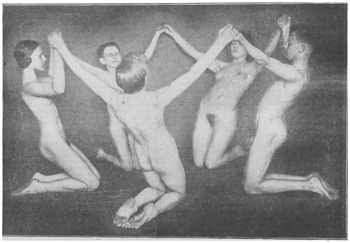
Although initially subordinated to the practice of rhythmic gymnastics, nudity itself became increasingly portrayed as a revolutionary act: “Being naked requires the overcoming of inner inhibitions, for many it is a small inner revolution … a struggle against the familiar environment … For thinking and striving people this automatically results in the struggle against feelings of shame and all factors that seek to prevent this first necessary, true affirmation of the body.”Footnote 116 Koch sought to distance his movement from the “philistine” middle-class nudists. His book Wir sind nackt und nennen uns Du! (1932) contains a number of vignettes from the life of his school, which show his young followers as examples of a rough, new proletarian type. Written in Berlin dialect, their dialogues are confident and proclaim the equality of the sexes, also in questions of sexuality. One girl, whose father was “still” in the church and wanted her to remain a virgin, stated: “I used to think that was right, too, but since we joined the FKK school and have realized how ignorant and dumb our parents left us, I got rid of the old prejudices myself.”Footnote 117 Koch assured the reader that naked culture does not raise petty-bourgeois prudes, as nudists were sometimes portrayed.Footnote 118 “All members know about their bodies. They know how to protect themselves from the consequences of sexual encounters. They also know that they have to act responsibly in sexual matters. Every member has a special health file and is regularly called to sexual responsibility.”Footnote 119 The regular medical examination of the young members alluded to here was carried out with eugenic purposes in mind by Dr. Hans Graaz, who, like his mentor Magnus Hirschfeld, believed that alcohol and incorrect living were leading to a degeneration of the German physical stock.Footnote 120 Koch also argued for a direct eugenic benefit of nudism. He proposed that men and women meet naked prior to marriage to ensure future sexual compatibility and improve their offspring, presumably because aesthetic attraction was considered a spiritual precondition of monist unity.Footnote 121
Koch had trouble finding entry for his association in the larger socialist umbrella organization for sports clubs (Zentralkommission für Arbeitersport und Körperpflege). Instead, he approached the socialist association of naturopathic medical associations, the Association for People’s Health (Verband Volksgesundheit), which was centered principally in Saxony and East Thuringia and encompassed roughly 12,000 members in 1925. Yet, there too he experienced friction and subsequently founded his own organization, the Circle for Free Body Culture (Freie Körperkulturkreis) in April 1926. Following further feuds within the national FKK scene, Koch focused instead on his school, which had thirteen chapters and reached a reported enrollment of between 700 and 4,000 in Berlin alone. The estimated number of organized FKK activists in the socialist milieu was roughly 60,000 in 1929, thus more than organized in the “bourgeois” organizations (30,000).Footnote 122
Although traditional working-class sports organizations and party officials often maintained their distance, FKK formed a staple element in the journals of Kultursozialismus. Urania issued a regular supplement called Der Leib (the Body) and Kulturwille made body culture the topic of special issues.Footnote 123 In a 1927 Urania article on “physical exercise and culture,” the chairman of the national Socialist Workers’ Youth association (SAJ), Heinrich Hoffmann, argued for an insertion of monistic “body culture” into the enormous workers’ sports movement. Based on Müller-Lyer’s concept of culture as “humanization” or “the highest perfection of people and their social organization,” Hoffmann argued that physical exercise could “lift man to his fullest physical perfection, training his organs for greatest performance, and thus also create the conditions for the mental perfection of man.” In line with the monist lessons he likely heard as a student at the adult education boarding school in Tinz, Hoffmann stated that although the sublimation of animal drives could only be achieved once a classless society has been established, the struggle for perfection through sport could deliver important weapons needed to wage class struggle: “It raises the culture consciousness of the worker, counteracts the physical and mental crippling of the modern industrial proletariat, acts upon the will and emotional state of the worker and develops the ethical drives.”Footnote 124 Another leader of the socialist body culture movement similarly argued that “the social must be accompanied by a personal revolution – the work on oneself, on one’s own body.” Instead of going dancing or drinking, workers needed to train their bodies. He gave concrete suggestions that even the poor proletarian could follow. After examining oneself naked every day – “objectively, joyfully, but with an earnest critical eye” – one should take a sponge bath and practice deep breathing, followed by self-massage, especially of the trunk. This would help “return to our body the capacities for development and creativity that it has lost through our social condition.”Footnote 125
The heyday of the socialist body culture organizations was between 1925 and 1930. The Vatican observed this development with a wary eye. In 1930 the papal nuncio to Germany wrote the Cardinal Secretary of State Eugenio Pacelli that nudism had experienced slow growth in prewar life reform and youth circles, but that “the last brakes of modesty had been removed publicly only in 1918/19, during that revolutionary orgy that raged in Germany, and particularly in Berlin, immediately after the war.” The nuncio concluded on an optimistic note that fortunately rule of law had now been restored and the civil authorities were taking steps to curtail the “collective insanity.”Footnote 126 Archival evidence bears this out. State intervention combined with the impact of the economic depression on working-class incomes crippled the nudist movement in the period 1930 to 1933. Two of the three socialist nudist organizations found in the Leipzig area in those years had essentially collapsed prior to the Nazi seizure of power.Footnote 127 Koch’s schools were shut down by the police in late December 1932.Footnote 128
Ritual and Theater: Max Zelck
The third area of monistic activity to be investigated in this chapter is socialist festival culture, which some historians have treated as the quintessence of Kultursozialismus, in part because of the originality of new forms of performance, such as the Sprechchor. Drawing on the older festival forms of the chorus and the tableaux vivants, Sprechchor was a Gesamtkunstwerk of theater, choir and poetry that was louder, more provocative and militant, and far greater in scope than its Wilhelmine predecessors. A writer for Kulturwille painted a vision of the upcoming Festival of Proletarian Body Culture in Nuremberg in 1929, at which he expected “15,000 young people or more, who in a festival performance of [the Sprechchor, T. W.] ‘Free Yourself!’ and a torch parade through the city will embody the fire of excitement for a new era, for the ideal of socialism.”Footnote 129 In preparation for the 1931 Socialist Culture Week, Hamburg city councilor Max Zelck claimed that the purpose of socialist celebrations was to connect the “inner impulses” of individuals in a collective social experience that would give form to a new “shared, spiritual ethical-worldview foundation.”Footnote 130
Scholars have framed such novel modes of performance within the history of theater, of the expressionistic avant-garde, and of Soviet festival culture, yet their evaluations have ranged widely. Some have depicted the new socialist rituals as manifestations of the revolutionary spirit of interwar socialism, while others have termed them a “holiday façade” that offered a weak compensation for the failure of revolution.Footnote 131 Yet, there are good reasons to consider this one of the key areas of monist influence on Weimar-era Kultursozialismus. We can begin with Zelck, who was born in 1878 to a master saddle maker and trained and worked as a primary school teacher. After moving to Hamburg, he became a self-acknowledged monist activist and pacifist which brought him into association with Carl von Ossietsky. Zelck joined the USPD in 1918 and served on the Hamburg City Council from 1919 to 1933, first for the USPD and later for the SPD. He became a leading figure in school reform and from 1923 until 1933 he was district school councilor.Footnote 132
In his 1931 brochure The Cultural Will of Socialism, Zelck provided a monistic framework for socialist celebration. His starting point was “the new category of secularity [Weltlichkeit],” the “sign under which art, pedagogy, morality and the new worldview are formed,” because secularity directed human attention to the existing connections in the here-and-now: “what we know of the individual and the world, of the thousand threads that bind man to man and man to world, of the great monism of all life!” Socialist rituals must thus be centered on “man in his earthboundedness and secularity” and on the mass in its striving for self-salvation. The “extrasensory and transcendental” are excluded: “it is about the enthronement of the human.” Secular experiences of transcendence in ritual form could only take place in collective experience, for, as Zelck put it, “secularity and community [Gemeinschaft] [are] two words [with] one meaning!” Zelck argued that the form best suited to generating the experience of Gemeinschaft was the “speaking and movement choir” (Sprech- und Bewegungschor) because it could generate “the will to be a mass, speak to the mass and … evoke the mass.” In order to create a “path to active joint experience and participation by those who now just sit and listen, … the new mass celebrations should be an experience of the mass for the mass. The performers and the mere audience should come physically closer to one another.” The mass rhythm exercises of the movement choir raise up the “long despised human body”; their development forms “one of the most important tasks for the realization of socialist worldview.”Footnote 133
Zelck’s manifesto identified three forms of dualism or division that he hoped to overcome through pioneering forms of theater and ritual: the duality of the beyond and the here-and-now; the duality of representation and reality; and the division between individuals. The aims were also characteristic of developments in the young Soviet Union. Richard Stites and others have described large-scale artistic experiments, such as one in which an entire city was treated as a stage for musical performance utilizing factory whistles as instruments.Footnote 134 In 1926, Wilhelm Spohr, who in the 1890s had been an active member of the Jungen and the Friedrichshagen naturalists, hailed the “new Russian festival policy” for having torn down the “silken wall” between the spectators and actors and having created “ecstasy [Rausch] and an unchaining without [creating] masses.”Footnote 135 This relationship between Soviet avant-garde culture and Kultursozialismus was not a one-way street. As historian Igor Polianski has shown, German and Austrian prewar monism was an intellectual wellspring of the key architects of Soviet culture policy after the Revolution. The Minister of Enlightenment Anatoly Lunacharsky had studied “biopsychology” with Ferdinand Avenarius in Zurich in the late 1890s, and together with physician Alexei Bogdanov he came under fire from Lenin in 1908 for the philosophy of “empirio-monism” and the desire to turn socialism into new religious forms of “god-building.”Footnote 136 During and after the Civil War, these men achieved positions of some power, which allowed them to bring elements of monism into Soviet cultural policy. Bogdanov wrote a programmatic essay for the growing Proletkult movement on “paths to proletarian creativity” centered on “monism and conscious collectivism.” He defined communist art policy as a practical form of monism: “the striving to meld art and work, to make art into a tool for the active, aesthetic transformation of life in all dimensions.” Its aim was to take “initially spontaneous and unconscious” expressions of collectivism and make them conscious. Collectivism he defined not just as an expression of “human life, but also the life of nature; nature as a field of collective labor and its unity and harmony.” Speaking in tones very similar to the Krisches, he concluded that “the essential difference between the new and the earlier creativity lies in the fact that for the first time creativity understands itself and its role in life.”Footnote 137 Art, in other words, became a key site for producing biological-social collective consciousness.
The Russians engaged in ongoing exchange with German and Austrian socialist freethinkers. Proletarische Heimstunden published Bogdanov’s essays and Proletkult was represented in the exploratory meeting convened in 1922, which led to the formation of the International of Proletarian Freethought. The Soviet Union offered refuge to monist biologists Julius Schaxel and Paul Kammerer when their work in Germany and Austria became untenable. After Kammerer’s suicide in 1926, Lunacharsky took his story and wrote a screenplay for the film Salamander, which depicted Kammerer as the innocent socialist victim of a plot hatched between a priest and a prince.Footnote 138 The Soviet Union continued to support Kammerer’s theories, which culminated in the backing Stalin gave to the neo-Lamarckian Trofim Lysenko, whose innovations in agronomy proved disastrous for Soviet and later East German agriculture.Footnote 139
By the mid-1920s, Sprechchor performances became a standard part of many socialist events. Bruno Schoenlank, Jr., who alongside Ernst Toller was one of the best-known lyricists of Sprechchor, wrote a special piece for performance at Jugendweihe.Footnote 140 Through the Jugendweihe, secularists made their most obvious contribution to socialist ritual culture. Participation in the Jugendweihe increased dramatically after 1920; in Leipzig, the center of the postwar workers’ culture movement, it reached 30 percent of the primary school graduates in 1924. The Berlin Free Religious Congregations remained the main provider of the preparatory ethical instruction for socialists in Berlin until the mid-1920s,Footnote 141 when this task was increasingly taken over by the rapidly expanding Proletarian Freethinkers for Cremation (VFF) and the socialist parties themselves.Footnote 142 Many monist intellectuals officiated at Jugendweihe ceremonies in the Weimar Republic, and Siemsen, Schaxel, Graf and Zelck each edited special Jugendweihe books in conjunction with local socialist party offices.Footnote 143 These books were handed to each of the young participants during the ritual of confirmation, a symbolic gift of the new worldview. Following the format developed by nineteenth-century Free Religious Congregations, the books combined brief and inspiring excerpts from a variety of genres: citations by leading socialists, poems by classic and naturalist writers, snippets of Sprechchor texts, secularist declarations and short popular-scientific texts showing the upward path of nature through evolution. For example, the Jugendweihe book commissioned by the USPD in 1920 was published in the Freiheit under the direction of Ernst Däumig and edited by Georg Engelbert Graf. Graf chose fire as a running theme to connect pieces, from Goethe’s poem “Prometheus” to an excerpt from a Jack London story Before Adam, in which a modern man follows a biological memory and dreams of an encounter between primitive cave dwellers and more advanced “fire people,” in which the cave dwellers fail to harness the power of fire and flee into the woods.Footnote 144
Education Reform: Fritz Gansberg and Kurt Löwenstein
The majority of our cohort of Weimar monists were schoolteachers, and it was in the domain of pedagogical theory and practice that monism arguably had its greatest influence on socialist culture. Monists, like other secularists, pursued apparently contradictory aims in school reform. They fought to secularize schools by removing clerical oversight, and at the same time sought to replace religious instruction with courses on ethics that were based on their monist worldview. This apparent contradiction was shaped by the nature of the confessional field, in which schools formed one of the key sites of contention. Among the leaders of the movement advocating for “secular” (weltliche) schools in the nineteenth century were Free Religious preachers, such as Berlin preacher G. S. Schaefer, who simultaneously taught ethics to prepare children for the Jugendweihe. Schaefer’s successor at the Humanist Congregation, Rudolf Penzig, became one of Germany’s leading theorists of secular ethics, which became known as “science of life” or Lebenskunde.Footnote 145
Some of the school reform efforts of liberal Wilhelmine monists reappeared in socialist guise in the Weimar Republic, as was the case in the Hanseatic city of Bremen. There a circle of radical schoolteachers had formed around the dissident Protestant minister Albert Kalthoff, who in 1906 became the founding chairman of the German Monist League. In 1905, members of this circle, including the left liberal Fritz Gansberg, submitted a petition to the city council on behalf of Bremen’s largest teachers’ association, in which they called for removal of biblical instruction from the schools. Not only did they argue that the “separation of church and state in the school system lies in the development of the age,” but went on to assert that “Advances in philosophical and scientific education … have led to the conviction [held by] the modern-thinking person that the principle, which preserves and directs the world, is a unitary and internally generated (immanent) one that operates according to eternal laws (natural laws). … In short, one understands the world monistically.”Footnote 146 The petition sparked the “Bremen School Dispute” which reached national attention and continued for several years, but without achieving the school secularization desired by the monists. During the Revolution, Gansberg joined the USPD and entered into school reform efforts. In 1919, the new school curriculum proposed by the SPD was nearly identical to the curriculum Gansberg had developed in 1905.Footnote 147
Gansberg was not the only example of how the Revolution lifted a monist educator up to a position of greater influence. As an elected official of the Reichstag and the Berlin City Council, Kurt Löwenstein was one of the most important school reformers of Weimar Germany. His starting point was the conviction that traditional schooling had alienated children from their biological, psychological and social being. The necessary correction would come from the harmonization of methods and contents with the lived reality of children, according to the maxim: “We should learn not only for, but also like life.” In his notes for a series of lectures to the Berlin Monist League in January 1920, Löwenstein defined education as “the development of all capab[ilities and] dispositions of a grow[ing] person, to the extent that the development and use of these d[ispositions] is held to be valuable.”Footnote 148 In his most important work, The Child as Bearer of the Coming Society from 1924, Löwenstein argued that the educational process had to follow the growth of the child, which, like human evolution, proceeded in stages. Yet, Löwenstein rejected the notion that children required religious instruction simply because they needed to go through the stage of religious belief to reach the stage of secular consciousness. Instead, with a nod to the Marxist belief that “social being determines social consciousness,” he argued that modern production and urban living had destroyed the earlier unity of life to which traditional religion corresponded.Footnote 149 The task of educators was not to return to the past, but to reharmonize the individual with modern life through lessons that were oriented on practical tasks in the workplace.
Thus, like Sprechchor pieces that broke down the divisions between performer and audience and between representation and reality, monist educators tried to overcome the division between classroom and world. Another monist schoolteacher, Max Hermann Baege, had praised precisely this aspect of the new “production school” being developed by the Russian Proletkult. Unlike traditional schools, it was “not a self-enclosed miniature society, a type of small state within the state, rather it is in every way an organ that stands in closest interaction with other organs in the entire social organism.”Footnote 150 German socialists built this principle into the workers’ boarding school in the rural town of Tinz, which had been founded following USPD domination of the local state government in the elections of 1919. According to Otto Jenssen, the Tinz school sought to teach young adult learners not what to do but rather how to do: “This is not the famous ‘praxis’ that stands in the same dualistic relationship to ‘theory’ as dear God to the party central committee.”Footnote 151 Tinz was conceived of as a worldview institute, at which, in addition to Jenssen, also Georg Engelbert Graf and Anna Siemsen taught. As an important training centers for union organizers and socialist party officials in the Weimar Republic, its classes aimed to integrate a critical understanding of society in a unified worldview based on the “totality principle” of Marxism.Footnote 152 This holistic approach to pedagogy also entailed collective forms of learning to stimulate changes in social consciousness. At Tinz, “the democratization of mental work is naturally attempted in the form of a working collective [Arbeitsgemeinschaft],” wrote Jenssen. Although the inbred obedience of workers towards authority made it difficult, some successes had been achieved on the “basis of democratic self-government.” His co-teacher Anna Siemsen – stated that socialist education had to live according to its ultimate aim, which was to help young people form “communities” (Gemeinschaften) that “exclude domination, violence and compulsion.”Footnote 153 This also required reform of school discipline. In his lectures to the Berlin monists, Löwenstein insisted that “retribution punishment” be replaced by “community protection” under student jurisprudence. Acknowledging the importance of environment, Löwenstein called for “hygienically ideal community spaces (sleeping, eating, work and recreational rooms)” to create social cohesion and individual responsibility.Footnote 154
Socialist control of local and regional governments and the associational matrix of the socialist milieu offered monist educational reformers multiple sites to promulgate their message and to influence curricula. Löwenstein founded some of the first secular schools in Berlin and became the leader of the largest socialist teachers’ organization and the parents’ association. He is perhaps best known, however, for his development of the socialist children’s movement, the Kinderfreunde, which was launched in November 1923 by the General German Union Federation, the Workers’ Welfare Association (Arbeiterwohlfahrt), Socialist Workers’ Youth and the SPD. The movement grew rapidly from 70 chapters in 1924 to 400 in 1928.Footnote 155 The Kinderfreunde organized summer camps called “Kinderrepubliken,” in which children were given a taste of the socialist future with experiences of equality and democracy (Figure 8.3).Footnote 156 The Vatican, by contrast, saw in the Kinderfreunde a “very dangerous organization of the German socialist movement for de-Christianizing the young.”Footnote 157
Kurt Löwenstein at a Kinderrepublik, 1932.

Conclusion
In the Kölnische Volkszeitung in February 1931, the chief apologist of the Catholic Church in Germany, Father Konrad Algermissen, argued that monism had become more dangerous as it passed from the educated middle classes of the Wilhelmine period to the working class of his day:
In our universities today there is not a single scholar of even moderate significance who dares to promote the flat Monism of the second half the nineteenth century. By contrast, however, the broadest masses of the working population have been infected by this Monism through the decade-long “enlightenment work” of socialism … The most important philosophical [weltanschaulich] branches on the tree of Marxism today are the Kinderfreunde and the proletarian Freethought movements […] both led by the desire to make the god-free monistic worldview of Marxism fruitful for the renewal of today’s life communities [Lebensgemeinschaften].Footnote 158
This chapter has substantiated Algermissen’s claim, and, in so doing, it has challenged existing historical accounts that have placed monism within the context of the technocratic fantasies of middle-class supporters of antipolitical Kultur in late Wilhelmine Germany.Footnote 159 It has argued, instead, that it was in the Weimar workers’ culture movement that monism achieved its widest practical dispersal. It has traced the journey of a group of left liberals, who were pushed to embrace socialism by their opposition to war and monarchy, but also lured by the promise of wide fields of influence opened by the Revolution in local government, union educational institutions and the expanding universe of socialist cultural associations. Several clustered around the secular schools, that were made possible by the restructured confessional system that emerged out of the compromises of the Weimar Constitution.
This chapter has also opened a window on the utopian dimension of Weimar political discourse, in which the terms “Gemeinschaft” and “Weltanschauung” were mobilized by actors across the party spectrum to give form to their future ideals. Monists had played a central role in the rise of these concepts in the mid-to-late nineteenth century, and after the First World War they used them to articulate proposals for cultural reform in the movement of Kultursozialismus. They had concrete ideas about how to overcome body-soul dualism and make possible the “New Man” and “New Woman.” Ultimately, the socialist monists lost the struggle for control of the terms, and after 1933 the National Socialists were able to exert a monopoly over their public use. Yet already before Hitler’s appointment to chancellor, the monist socialist visions of “Gemeinschaft” and “Weltanschauung” had begun to lose their luster, and not merely as a result of economic crisis and the increase in police repression that followed the installation of the presidential regime in 1930. The eclipse of socialist monism also reflected transformations in the cultures of socialism and secularism that had begun in the mid-1920s and that became readily apparent by 1930. The resultant shift in red secularism concerns us in the next chapter.
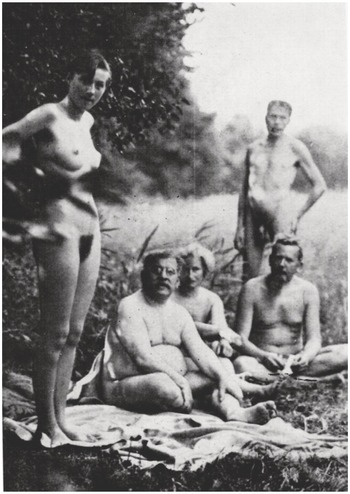

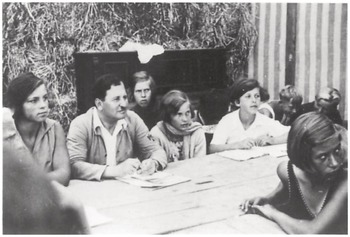

 Open access