Introduction
The UK pension system is a mixture of insurance-based state provision in the form of a basic state pension and state second pension, means-tested benefits in the form of ‘pension credit’ and other income-related benefits, and state support via tax relief for private pension investments made during the working life. Occupational schemes and individuals have the option to opt out of some elements of state provision, with national insurance rebates paid into pension schemes for those who do. Private investment can take the form of occupational provision from employers, individual savings in specially designed vehicles, rebate-only schemes or combinations.
The current level of pension system complexity in the UK has arisen through a series of incremental reforms that have taken place since the middle of the last century, each with legacy issues, transitional arrangements and layers of detail and sophistication (Pemberton, Reference Pemberton, Pemberton, Thane and Whiteside2006). Some reforms have had unintended consequences. Thatcherite policy encouraged private provision but resulted in widespread pension mis-selling by (incentivised) providers, contributing to a reduction in public trust in pensions. Her erosion of the value of the basic state pension (by linking increments to prices instead of earnings) contributed to rises in pensioner poverty. Blair's government in turn has concentrated resources on the poorest, leading to a rapid expansion of means testing among pensioners, so that currently half of pensioners are entitled to means-tested benefitsFootnote 1 and the proportions are set to grow. Without reform, up to three quarters of retired people will be entitled to means-tested benefits by 2050, creating disincentives to save for those currently of working age, moral hazard and potentially increasing future poverty rates among pensioners. Meanwhile, the ageing population and imminent retirement of ‘baby-boomer’ cohorts have caused concern that the current mix of state and private provision is unsustainable in the long term. There is widespread consensus that individuals of working age are not saving enough to provide an adequate income for themselves in old age without substantial social transfers from government (Pensions Commission, 2004).
Reform of the pension system has therefore been perceived as pressing by all political parties. Concerns centre generally on system design and fiscal sustainability, but there is increasing focus on substantial gender inequalities in financial provision in later life (Arber and Ginn, Reference Arber and Ginn2004; Bellamy and Rake, Reference Bellamy and Rake2005; DWP, 2005; Evandrou and Glaser, Reference Evandrou and Glaser2003; Falkingham and Rake, Reference Falkingham, Rake, Ginn, Street and Arber2001; Ginn, Reference Ginn2003; Harris, Reference Harris, Pemberton, Thane and Whiteside2006; Rake et al., Reference Rake, Falkingham and Evans2000; Warren, Reference Warren2003). These inequalities are the result of gendered differences in the life course. Women are much more likely than men to undertake care work and housework within the household, are more likely to work part-time and for low pay, are more likely to have interrupted histories of paid work, and are less likely to be in the paid workforce as they approach state pension age. Pension reforms that do not account sufficiently for social, cultural and labour force differences will do little to reduce gender inequalities, even if other aims, such as fiscal sustainability, are achieved.
Within this debate, there is increasing recognition of the need for women to have their own independent income in retirement (EOC, 2005). First, most married women will become widows in later life. About half of all women over 65 are widows, rising to almost 80 per cent of women over 80 (Arber and Ginn, Reference Arber and Ginn2004). Widows have always experienced an increased risk of poverty after bereavement due to loss of financial support from their partner. Changes from defined benefit to defined contribution pension schemes are likely to lead to fewer widows inheriting occupational and private pensions, as about 70 per cent of annuity purchases are for single-life annuities (DWP, 2005: 105). Second, there are doubts about the extent to which money is in fact shared within couples (Burgoyne, Reference Burgoyne1990; Pahl, Reference Pahl1989, Reference Pahl, Sykes, Bochel and Ellison2001; Vogler, Reference Vogler2005; Vogler and Pahl, Reference Vogler and Pahl1994). Third, social changes make gender issues of financial independence in later life more salient. Legal marriage provided some protection in terms of derived social security, pension and widow's benefits, but the growth of partnering outside legal marriage, increases in those living alone and rises in the incidence of separation and divorce make it increasingly important, in personal and policy terms, for women to be able to provide for their own futures.
Advocates of gender equality and a reduction in income poverty experienced by older womenFootnote 2 have argued for a reformed system where pensions are accrued universally regardless of participation in paid labour (often called a ‘citizen's pension’), are paid at a rate that provides at least a poverty-line income, and increase once in payment in line with national average earnings (PPI, 2006a).
The Pensions Commission and the White Paper
In December 2002, the Labour government established the Pensions Commission, chaired by Lord Turner, to investigate a new pension settlement for the twenty-first century. The Pensions Commission has produced three reports (Pensions Commission, 2004, 2005, 2006). The reports recommend a restructuring of certain elements of state pension schemes, a gradual extension of retirement age and the creation of a nationwide private pension savings system in addition to the state pensions into which all eligible employees will be automatically enrolled (with the ability to opt out). This national scheme, if eligible employees do not opt out, will attract a compulsory employer's contribution and tax relief at marginal rates. The Pensions Commission recommended that it is reasonable to debate future public expenditure of between 7.5 and 8 per cent of GDP on pensions (Pensions Commission, 2005).
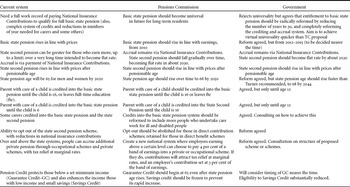
The government has responded to the Pensions Commission with a White Paper, Security in Retirement: Towards a New Pension System, published in May 2006 and heralding primary legislation on these issues in 2007. The Pensions Commission framework has been largely accepted, with some minor differences. Table 1 represents a comparison between the current system, the Pension Commission proposals and the government's proposals.

Both the Pensions Commission and the government propose that we should continue with two separate tiers of state pension, supplemented by private savings and, where appropriate, means-tested benefits.Footnote 3 Incentives to private savings will continue via two mechanisms: tax relief at marginal rates (a regressive tax, which benefits mostly well-off men) (Agulnik and Le Grand, Reference Agulnik and Le Grand1998) and a compulsory employer contribution to a pension for employees who elect to remain in the new national pension scheme.
Table 1 illustrates two main points. First, the reforms proposed are once again incremental, and as such will leave a very complex system. The many basic components of the pension system are all retained, and a new national savings scheme is introduced as a further option for pension savings. For each component, there are different accrual rates and increment rates, credits and tax reliefs. This means that outcomes in individual cases are difficult to predict.
Second, the government has more or less accepted the main tenets of the Pensions Commission proposals. The Pensions Commission recommended that accrual of the basic state pension be universal in the future to long-term residents. The government is proposing to link accrual to contributions or credits, but to so relax these requirements that virtual universality in the basic state pension is achieved in future in any event (PPI, 2006b). The idea that the basic state pension should be near universalFootnote 4 is accepted. Both government and the Pensions Commission recommend reductions in the maximum value of the state second pension, and this pension becoming flat rate. Pension credit eligibility will be reduced by restricting benefits that currently go to those who have small savings. Improvements to credits into the basic state pension and the state second pension for unpaid care work are also common features.
In a few respects, the government is proposing reforms less generous than the Pensions Commission. The Pensions Commission recommended that the basic state pension be linked to earnings from 2010. The government will re-establish this link but only at some point between 2012 and 2015, by which time the relative value of the basic state pension will have fallen to only 14 or 13 per cent of average earnings, from its current levels of about 15.5 per cent (IFS, 2006). The Pensions Commission recommended extension of state second pension accrual to parents with care of a child under 16. The government has accepted extension in the state second pension for care of a child, but only until age 12, and has at the same time cut back credits for the basic state pension so that the same age limit applies.
Will the reforms deliver greater equality and less poverty for women?
The White Paper claims to provide more fairly for women in the future, through better entitlement to state pensions and better credits into both tiers of the state pensions for those who care for children, or sick or disabled adults. The proposals have been generally welcomed by lobby groups as helping women currently of working age or younger to avoid the poverty and income disadvantages of current generations of older women (Age Concern, 2006; EOC, 2006; Fawcett, 2006; Help the Aged, 2006).
The Pensions Commission reports and the White Paper are dense policy documents, comprehensively reviewing and making recommendations about the state pensions and private pensions. Amidst all of the data and analysis produced, it is difficult to work out whether improvements are because of changes in design, or whether they depend on women in future participating more in paid labour, and for higher wages. If improvements are based on design, then we can expect reduction in gender inequalities in later life without changes in patterns of women's participation in paid labour. If improvements are based on assumptions of substantial changes in patterns of caring and work for women, then we need to be more cautious in asserting how much better off financially future cohorts of women will be.
Future patterns of care and paid work in the UK
It is usually assumed that younger cohorts of women will spend much more time in the paid labour market over their lifecourse, but the issue is socially complex. Increases in rates of divorce and relationship breakdown will lead to more women spending periods of time as single mothers (Ermisch and Francesconi, Reference Ermisch and Francesconi2000), who face many barriers to full-time work in the UK. Greater age differences between men and women in second marriages and relationships (Hancock et al., Reference Hancock, Stuchbury and Tomassini2003) may lead to many working-age women caring for older partners in mid-life. Extensions to life expectancy at later ages will lead to increased caring responsibilities in mid-life, as older parents, in-laws and grandparents survive into their 80s, 90s and 100s in increasing numbers. With lower fertility rates in recent decades, there will be fewer adult siblings with whom to share caring as parents and in-laws age. Care of grandchildren may increasingly be a social expectation and norm, supporting the intermediate generation in undertaking paid work. Care work tends to fall on women, who often disrupt paid work to facilitate and undertake these social responsibilities.
The experiences of younger women and their interactions with paid labour are indeed different to the experiences of their mothers’ generation. Woods et al. (Reference Woods, Makepeace, Joshi, Dolton, Ferri, Bynner and Wadsworth2003) used longitudinal data about three cohorts of women – born in 1946, 1958 and 1970 – to compare their labour market participation at around age 30 (for all three cohorts) and 40 (for the older two cohorts). The researchers found that where a 30 year old mother had a child under five at home, 35 per cent of the 1946 cohort were in paid work, 52 per cent of the 1958 cohort and 58 per cent of those women born in 1970. The rates of full-time work had increased too. Only 6 per cent of those born in 1946 had a full-time job at 30 if they had a child under five; this had increased to 16 per cent among the 1958 cohort, and 20 per cent among those born in 1970.
However, where mothers had a school-age child, there was little difference between the cohorts. For example, at age 30, for mothers with a child aged between five and seventeen, 67 per cent of the 1946 cohort and 70 per cent of the 1970 cohort undertook paid work, with 41 per cent working part-time among those born in 1946, and 37 per cent working part-time among those born in 1970. Similarly, when comparing mothers of school-age children at age 40, the proportions in paid work for those born in 1946 and those born in 1958 are virtually the same: 39 per cent among the older and 38 per cent among the younger groups worked full-time with a school-age child, and 42 per cent part-time in each cohort. Participation in paid labour had decreased over time if they had a very young child at home. Sixty-seven per cent of women aged 43 in 1989 with a child under the age of five worked outside the home, but only 62 per cent of those women who were aged 42 in the year 2000.
The stability of some of these patterns for women can also be seen in research on gendered working time (Grimshaw and Rubery, Reference Grimshaw and Rubery2001). The proportion of female employees who work part-time remained stable at around 44 per cent throughout the 1990s and early 2000s, while the proportion of male employees who work part-time increased from 5 to 8 per cent. The change in male part-time working is probably associated with continuing segmentation of the labour market, but the resilience of the pattern for female part-time working is probably because of the way women are expected to take on family care and care of the home in the UK.
It is not possible to say, with any confidence, that current and future cohorts of working-age women will have patterns of work and paid care that are materially different, over the working life course, to those of women who are currently near retirement.
Aims and methods
This article aims to assess the extent to which the proposed pension reforms will deliver differences in outcome for women currently of working age, if they continue to have working and caring lives that result in full-time employment being disrupted during the life course. This will test the extent to which expected improvements for women are as a result of improvements in the design of the pension system, or as a result of changed expectations of women's involvement with paid labour over the life course. Because of the increasing importance of individual incomes for women in later life outlined above, pension outcomes are assessed here on an individual basis. If the women shown are married or living with a partner, then their incomes would be combined with their partner's to assess eligibility for means-tested benefits. Most married women with personal incomes below the poverty line are therefore not eligible for means-tested benefits. It is important to remember, though, that in later life most women are not married or cohabiting.
In order to consider outcomes of their recommendations, the Pensions Commission in collaboration with the Department for Work and Pensions ran computer simulations of state and private pension entitlement for a number of hypothetical individuals who were assumed to have varying degrees of involvement with paid labour. The simulator known as Pensim2 operates through dynamic micro-simulation of the lifecourse, attempting to mimic the evolution of private and state pension accumulation and decumulation between now and 2050. It estimates the income of every member of a representative sample of future pensioners by simulating at the individual level job changes, marriages, births of children, retirement and death, and the pension that would be accumulated in each state. The base data for the simulations come from a number of sources (Pensions Commission, 2005: Appendix F). The simulations for a set of ‘stylised individuals’ were then chosen to give an insight into how different paths and savings levels impact on retirement incomes. Each stylised individual has a career history and an earnings history that have been created from empirical data. While some of these simulations were published (Pensions Commission, 2005), the Commission produced numerous unpublished simulations in the form of Excel files of simulation outputs, which are available on request. It is some of these data that are analysed in the remainder of this article.
Because of the similarities between the Pensions Commission proposals and the government White Paper shown in Table 1, outcomes for the stylised individuals stand as a reasonable proxy for outcomes of the government's proposals. If anything, these outcomes are too generous. This is because (i) both the Pensions Commission and the government propose near-universal accrual of the basic state pension, but (ii) the government's proposals for the basic state pension are less generous and cheaper than the Pensions Commission's proposals. In other respects, as modelled here, Pensions Commission and government proposals are the same, save that the government proposes that slightly younger people will have an extended retirement age.
The Pensions Commission simulated the impact of their proposals and two alternatives for the foreseeable future. The alternatives shown are:
• the current scheme, assumed unchanged into the future;
• their proposals (referred to here as the ‘two-tier system’ referring to the retention of both a basic state pension and a state second pension) and
• an Enhanced State Pension (ESP) – essentially a ‘citizen's pension’. This is a unified state pension system where the basic state pension increases to approximately the ‘poverty line’ – the value of the Guarantee Credit – by 2030 (that is, faster than earnings) when it will provide a replacement rate of 25 per cent of median earnings at retirement. Accrual of State Second Pension ceases in 2010. Under this scenario we would have just one state pension system, providing income eventually with near-universal coverage above the poverty line that once in payment increases in line with earnings. Means testing would virtually disappear from the elderly population.
The ESP as modelled produces expenditure outside the Pensions Commission suggested range for debate for public pension expenditure, with a rise to 7 per cent of GDP by about 2020, and from 8–9 per cent of GDP after about 2030, starting to fall again only as we approach 2050 (that is, as mortality among the baby boomers begins to affect population distributions). The implication in the Pensions Commission producing a ‘range for debate’ is that, in the view of the Commission, expenditure outside that range is not politically achievable in the UK. Greater proportions of GDP are, however, spent on pensions in many other developed countries (Pensions Commission, 2004: Appendices, Figure D8 and Table D2).
Stylised individuals
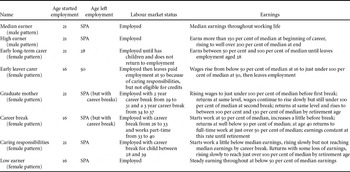
In the following analysis, comparisons will be made between eight stylised individuals, two of whom are assumed to approximate men's working lives, and six of whom are assumed to approximate women's working lives. The analysis is necessarily restricted to stylised individuals that the Pensions Commission chose to simulate. None of the lifecourses illustrated shows intermittent periods of breaks and part-time work (for example, first to care for children, and then to care in mid-life) (Evandrou and Glaser, Reference Evandrou and Glaser2003; Henz, Reference Henz2004, Reference Henz2006), which is perhaps surprising, given the prevalence of part-time work for women in the UK. The earnings and labour force histories of the eight stylised individuals are set out in Table 2.
The assumed work history and earnings of the stylised individuals shown in this paper

Source: Pensions Commission (2005: Appendix F).
The models are better used to compare individuals than to predict a future reality, since there are a large number of assumptions in the models that are subject to uncertainty in the future. However, because these assumptions are the same for everyone, effects as between individuals can be compared. Conclusions are drawn at the end of this article.
Assumptions in the model
The model shows state pension income from accruals and credits (for example, Home Responsibilities Protection), and income from private saving. Private pension saving is assumed to be into a defined contribution pension, all of which is annuitised on retirement into an index-linked single-life annuity. Where savings are modelled, these are assumed to begin at age 30, and constitute a proportion of income above £5,000 per annum (in 2004 earnings terms). A non-saver saves nothing, a medium saver saves 8 per cent of income over £5,000, and a high saver saves 16 per cent of income over £5,000; savings are into a pension. The State Pension Age (SPA) is assumed to rise to 68 by 2050.
In the Pensions Commission and government proposals, the medium saver is the target for Personal Accounts – the new nationwide pension savings scheme: an employee contribution of 4 per cent of earnings over £5,000 (to a limit of £33,000) will be matched by employer contributions of 3 per cent and government contributions in the form of tax relief of 1 per cent.Footnote 5 The medium saver therefore saves 8 per cent of earnings in the designated band. For most employees, since they do not earn above the upper limit, this will be 8 per cent of all earnings above £5,000.
Analysis
In this analysis, a number of scenarios will be presented to draw out some of the gendered implications of the Pensions Commission recommendations. The analysis will present the ‘medium saver’ by showing what percentage of median earnings this person will receive by way of income at state pension age, and at age 75. To put this into some perspective, in 2005 median earnings in the UK were £350 per week.Footnote 6 A person who received 40 per cent of median earnings in 2005 would have income of £140 per week, and a person with 30 per cent of median earnings would have income of £105 per week.
The ‘medium saver’ is being presented here, because this is clearly the government's and the Pensions Commission's normative case; that is, how they believe people ought to be behaving. The position of the ‘medium saver’ is presented according to whether they are now 60, 40 or 20 years old as it would be at State Pension Age. The position of the ‘medium saver’ is then presented for these three age cohorts (currently 60, 40 or 20) as it would be when they are 75 years old; that is, part of the way into their retirement.
More data are available than are presented here. In particular, many more profiles have been simulated; those not shown here tend to represent ‘male-pattern’ working lives. The positions at 85 and for non-savers and high savers have also been simulated by the Pensions Commission. High saving (16 per cent of earnings over £5,000) is less likely for most women, while non-saving is quite likely. Because this article is intended to evaluate the government's claimed outcomes for women, the analysis focuses on those women who take part in all aspects of the government's proposed reforms.
The medium saver at state pension age
Age 60 in 2005
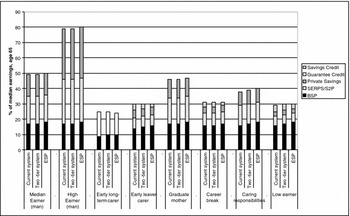
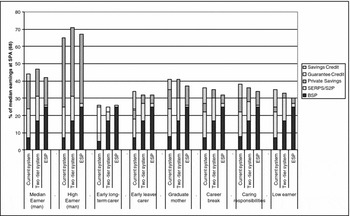
Figure 1 shows the position for a medium saver, aged 60 in 2005 and 65 in 2010, with a State Pension Age of 65. Since the reforms only start to bite in 2010, there are only minor differences between the three scenarios for this person.
Person aged 65 in 2010, now aged 60, medium saver (position at age 65).
Source: Author's analysis of Pension Commission simulations using Pensim2.

Figure 1 shows the marked discrepancies that already exist at State Pension Age for people with different work histories, even if they were moderate savers throughout their working lives. It is only the graduate mother (assumed to work full-time apart from two short breaks) who approximates the accumulation of the median earner. The high earner (with a high probability of being a man) has an income well in excess of the women's profiles. Apart from the graduate mother and the ‘caring responsibilities’ model, who also has a full-time work profile apart from a nine-year career break, all women are entitled to Pension Credit at State Pension Age under all three scenarios based on their own income.
Age 40 in 2005
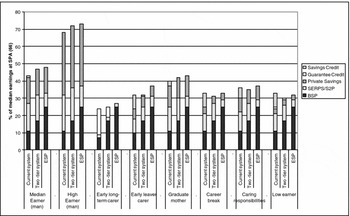
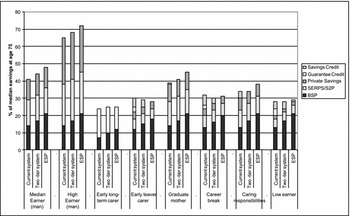
Figure 2 shows the effects of the proposed changes for those who are now aged 40, who will reach SPA, which is simulated here to be 66, in 2031. It is important to note a number of things. The high earner and constant median earner (both male profiles) have improved retirement positions under both alternative scenarios. This is not the case for any of the typical women's profiles, apart from the graduate mother. The graduate mother does better from the two-tier system, and even better from the ESP system. For all other women it is a more complex story.
Person aged 65 in 2030, now aged 40, medium saver (position at age 66).
Source: Author's analysis of Pension Commission simulations using Pensim2.

The ‘early long-term carer’ is marginally better off (25 per cent compared with 24 per cent) under the two-tier system than under the current system – under both systems she needs to claim Guarantee Credit, but is less dependent on this in the two-tier system. For the remaining four ‘women's profiles’, provided that women claim the guarantee and savings credit, their replacement rates are higher under the current system than they will be under the proposed two-tier system. For women who do not claim or are not entitled to the credit (for example, because they have a partner), the two-tier system is better, with far less reliance on means testing. The result of the proposed reforms for these women is less reliance on means testing but lower income in retirement on an individual basis if they are entitled to and claim their benefits.
This assumes that the current indexing and withdrawal arrangements would continue indefinitely into the future, without political intervention, under the first scenario. The two-tier system is possibly subject to less political risk than the current system.
For most women's profiles, when thinking about women now aged 40, the ESP is clearly the best option. Apart from the low earner, who is better off under the current system, these women accumulate highest retirement income under the ESP, and it is not means tested. Figure 2 clearly shows that the State Second Pension remains an important source of the wide distribution in income as between men and women in the two-tier system, and as among women with different work profiles. This is shown by the different amounts of diamond check in the graph, which represents State Second Pension. If the State Second Pension plays a diminished role relative to a much improved Basic State Pension, as in the ESP accumulation, then women are better off.
In essence under the proposed two-tier system, for those now aged 40, high and median earners and the graduate mother will be better off than now, but on the basis that they are entitled to and do claim means-tested benefits, the other ‘women's profiles’ will all be worse off. Under the ESP almost all profiles will be better off than now.
Age 20 in 2005
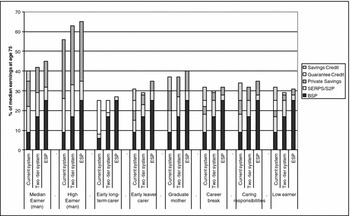
Figure 3 shows the simulated position for the stylised individuals assuming that they are now aged 20; that is, they will accumulate full Basic State Pensions through the ‘universal’ accrual proposals under the two-tier system. This cohort is also shown to accrue maximum Basic State Pension under the ESP proposal; this is because future accruals are assumed to be universal.
Person aged 65 in 2050, now aged 20, medium saver (position at age 68).
Source: Author's analysis of Pension Commission simulations using Pensim2.

In 2053, it is anticipated that under the two-tier system and under ESP there will be almost no reliance on means testing for any of the profiled individuals. The exception is the ‘early long-term carer’ under the two-tier system, who will still need to claim Guarantee Credit even in 2053 under the Pensions Commission's proposed system. Savings credit will no longer be relevant.
In these scenarios, the stylised high earner does worst out of the current system; all of the six ‘women's’ profiles do best out of the current system provided that it does not change and that they are entitled to and do claim Pension Credit. As between the ‘two-tier’ and the ‘ESP’ options, the ‘early long-term carer’ does marginally better from the ESP option (26 per cent rather than 25 per cent). All other profiled individuals do better out of the two-tier option at State Pension Age, which for these cohorts is assumed to be 68. This is because of differences in the proposed indexation arrangements for the two options, as well as the high probability estimated for these young cohorts (now 20) of obtaining a full State Second Pension through contributions or credits.
The differences in the indexation arrangements between the two proposals are complex. The ESP is assumed to reach current Guarantee Credit limits by 2030, and then stay constant in relative terms by indexation to earnings. This will be about 25 per cent of median earnings at State Pension Age. With the two-tier proposal, the BSP and S2P together at the maximum proposed flat rate are higher – about 31 per cent of median earnings at State Pension Age. As more people become entitled to the maximum BSP and near maximum S2P, the ‘base entitlement’ is thus better than the proposed ‘base entitlement’ under the simulated ESP.
As stated above, though, the ESP option produces state expenditure that is outside the Pensions Commission's ‘range for debate’; that is, it is more expensive at a national level than the two-tier option. This may seem strange if the two-tier option is delivering higher pension income. The reason that paying for the two-tier option remains cheaper than the ESP option, even at this point in 2053 when it looks as if the two-tier option will provide higher income, is because the older cohorts are worse off with the two-tier option, and the retired population is heavily populated by older cohorts.
There is a crossover of advantage as between the two-tier proposal and the ESP proposal for most of the ‘women's profiles’ simulated. For those currently 40, when they reach SPA, the ESP proposal is better. For those currently 20, when they reach SPA, the two-tier proposal is better. The two-tier is more ‘affordable’ than the ESP because it keeps older cohorts with ‘women's’ profiles poorer in relative terms.
What happens at 75?
The position of the ‘medium saver’ at age 75 will now be considered. The indexing arrangements become more important. Since in the two-tier option the State Second Pension is indexed to prices once it is in payment, and it is assumed that earnings rise faster than prices, the greater the role of the State Second Pension, the less the relative income for an individual over time.
Age 60 in 2005
The position in fifteen years time is set out in Figure 4. Provided that individuals are entitled to Pension Credit and it is claimed, the current system and the two-tier system deliver fairly similar results for this cohort. In contrast to the position at 65, however, the lesser means testing of the two-tier system is starting to show: this is better for women in couples, and for women who do not claim their entitlements. Means testing still plays an important role in the incomes of four of our six stylised individual women, however. Here, the ESP is clearly much better for women. Not only does it deliver higher levels of income to almost all profiles, but the role of means testing is substantially reduced, featuring only for the ‘early long-term carer’ and the ‘low earner’.
Person aged 65 in 2010 (now aged 60), medium saver (position at age 75).
Source: Author's analysis of Pension Commission simulations using Pensim2.

Age 40 in 2005
The way the pension systems develop by age 75 for individuals now aged 40 who are medium savers is shown in Figure 5. It needs to be remembered that for many of the profiles in this cohort at age 66 (SPA) the reforms bring no gain relative to the current system for women living alone (assuming the system is left unchanged). This is because under the current system, as entitlement to the State Second Pension increases for low earners they are entitled to more Savings Credit. Figure 5 shows that this effect continues to a large extent at age 75, with the current system proving the best option for the ‘low earner’, the ‘career break’, and the ‘caring responsibilities’ profiles. For 40 year olds in these four categories, and also if they are ‘early leaver long-term carers’, they gain in less reliance on means testing, but if they were single and to claim their means-tested benefits they would have been better off under the current system. Means testing still plays a role in four out of the six ‘women's’ profiles at age 75 under the two-tier option (although Guarantee Credit is only relevant for the ‘early long-term carer’).
Person 65 in 2030, now aged 40, medium saver (position at age 75).
Source: Author's analysis of Pension Commission simulations using Pensim2.

As between the two-tier and the ESP option, the latter is clearly much better for women who are medium savers. Here, at age 75 (in 2040) the ESP provides no means testing, and more money for all six women's profiles. There are, however, continuing marked inequalities between the stylised men's profiles (constant high and median earners) and the profiles of women, including graduate mothers.
It is also useful to compare the position of our stylised individuals when they were aged 66 (Figure 2) with their position aged 75 under the two-tier and ESP systems. In both scenarios, they are losing relative ground in income as they age; that is, they are becoming poorer relative to the population. Under the two-tier system, however, they are becoming poorer faster and this is because of the increased role for the State Second Pension, which is indexed to prices under this system. In these simulations, it is also assumed that private income is indexed to prices. The two-tier system creates greater income inequalities in society as people age. It also creates greater inequality than the ESP among older people; this is because the greater role for the Basic State Pension (which is indexed to earnings) under the ESP acts as a leveller.
Age 20 in 2005
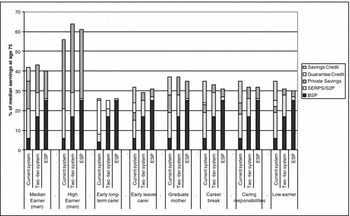
Figure 6 shows the position age 75 for a medium saver who is currently aged 20 (that is, in 2060). Despite marginally higher replacement rates, the current system is heavily means tested with the women profiled here having little individual entitlement to income in later life. In contrast, the two-tier and ESP options virtually eradicate means testing, with means-tested benefits only featuring for the ‘early long-term carer’ under the two-tier system.
Person aged 65 in 2050, now aged 20, medium saver. Position at age 75.
Source: Author's analysis of Pension Commission simulations using Pensim2

At age 75, the apparent advantages that the two-tier system held for the women profiled here (Figure 3) have all but disappeared. This is because the ESP would be wholly earnings linked once in payment, but with the two-tier system this is not so. Only the basic state pension will be earnings linked; the state second pension will be linked to prices once in payment. At age 75 there are few differences between the two-tier and the ESP systems; indeed, under the ESP system two of the stylised women are now better off, and there is little difference for those remaining. This is just seven years after retirement, which is assumed to be at age 68.
The high and median earner and the graduate mother do better under the two-tier system than the ESP at age 75. This is because the ‘base state pension’ for a person with 100 per cent accrual in the two-tier system is 31 per cent at State Pension Age, compared with 25 per cent for the ESP (see Figure 3). Although the State Second Pension and private pension rise only with prices, these individuals started from comparatively high levels of entitlement to these pensions; that is, there was more variation among our six stylised women in state pension entitlement at 65 under the two-tier system than under ESP.
Discussion
This analysis has looked in detail at the position of a ‘medium saver’ – the government's normative case – at the Pensions Commission's proposed State Pension Age and at age 75 for three cohorts. The analysis presents simulations from the Pensions Commissions unpublished data for three policy alternatives: the current system unchanged, the Pensions Commission's proposed two-tier system (which acts as a useful proxy for the White Paper proposals) and their ESP base case. Six profiles that are believed to represent the lives of women in the UK, and two closely representing the lives of men, have been presented. It is not known how common or prevalent these stylised individuals’ lives are now, nor how likely they are to exist in the future. It is assumed here (as in the Pensions Commission report) that they are fairly representative of many women in the UK.
Reduction in means testing
Taking this assumption, the main advantage for women of the proposed two-tier system is a reduction in means testing. This will benefit women who in later life would individually be entitled to means-tested benefits but are not entitled because of their partner's income – this applies to most married and cohabiting women. It will also benefit the significant minority of older people, disproportionately women, who are entitled to but do not claim benefits.
Means testing is reduced most by the ESP proposal. For women currently aged 60, means testing is a feature of all proposals, but by age 75 under ESP this has mostly disappeared, while it is still a feature for many 75 year old women under the two-tier system. For cohorts currently aged 40, the ESP option eradicates means testing by State Pension Age (assumed to be 66) for all the stylised individuals, whereas it is still a feature for three profiles under the two-tier option. This difference still remains at 75. Even for women now aged 20, means testing remains for one of the lifecourse profiles – that of the ‘early long-term carer’ – although for 20 year olds it is otherwise eradicated under both systems.
Income in retirement
The benefits of reform for unpartnered women who do claim their entitlements to Pension Credit are far less clear. Even saving 8 per cent of earnings over £5,000 throughout their working lives, the assumption with all the models in this article, women generally do not do materially better under either of the proposed new systems than under the current system. Inequalities based on working lives remain high under all three systems.
For women (medium savers) currently aged 60, there are few differences at 65 and at 75 as between the current system and the two-tier system. The ESP, though, provides a clearly improved income for this cohort at age 75. This is because of the higher value of the Basic State Pension, and its earnings link.
For medium-saving women currently aged 40, at State Pension Age (66) the current system, because of the interaction between the State Second Pension and the Savings Credit, serves those shown here particularly well. As between the two-tier and the ESP, the ESP delivers higher replacement rates. This is again because of the higher value of the Basic State Pension and its earnings link.
Those aged 20 who are medium savers will accumulate almost all of their pension under proposed new arrangements. This cohort is projected to retire at 68. For this cohort for most ‘women's’ stylised individual profiles, at 68 the two-tier system delivers a marginally higher pension income than the ESP (but a lower pension income than the current system would deliver if unchanged). However, by 75, this disadvantage has generally been lost, with the ESP delivering a better or equal income. This is because of the proposed indexing of the State Second Pension to prices rather than earnings in retirement.
For women from all three cohorts, the two-tier system will gradually cause older people to become poorer relative to the population as they age, at a faster rate than the ESP. The older old, mostly women, will become the most disadvantaged.
A reduction in means testing is an important and necessary step for the improvement of the financial condition of women in old age, but for women without partners, the proposed changes will not on the whole deliver higher incomes if they have these lifecourse profiles. The incomes even of ‘medium savers’ shown here will be lower for a number of stylised female profiles than under the current system, and inequalities will remain widespread.
Conclusions
None of the women's profiles here reaches an income equivalent to 45 per cent of median earnings in retirement; even fewer would reach 45 per cent of national average earnings, which is the government target for the replacement rate of the median earner. The reforms change the source of income, but do little to change the amounts of income that women with these lifecourse profiles will receive when living alone in later life. This can be seen at a glance in Figures 1–6, and the gender disparities – if men remain more likely than women to be median and high earners – remain for decades to come. Women with their lower disposable incomes and lower life-time earnings will probably remain more likely not to be saving in pensions at all, meaning that the gender differences are accentuated. Under the reformed pension system, paid-work histories will continue to play a large part in the accumulation of individual income in later life. The weaker position of women in the paid labour market will continue to affect their incomes profoundly in later life.
The adverse effects of means testing will remain under the reformed system, and will continue to affect women disproportionately. As many women's lobby groups have argued for a long time, the best option for women's improved position is an increase in the Basic State Pension (as with the proposed ESP) and a linking of that pension to earnings. The ESP as modelled by the Pensions Commission is suggested as unaffordable, but it is only under this kind of model that noticeable improvements occur in the incomes of women if their lifecourse profiles remain similar to today's, even over the 50-plus year timescales being considered here.
Two questions arise from a detailed examination of the outcomes of the reformed system. First, why have women's lobby groups welcomed the proposals and, second, why have a two-tier rather than a single-tier system. The answers are linked. By retaining a system where the outcomes are so complex, it is easier to focus on specific incremental reforms and evaluate whether they are an improvement or not, than it is to evaluate outcomes. Making the basic state pension more universal is of unquestionable benefit to women, as are measures such as improving carers’ credits into the system, making the crediting system simpler and fairer, and linking the basic state pension to earnings. These measures have been hard fought for and won, by persistent lobbying over many years. Lobbying for incremental change has resulted in incremental change. This will improve the financial situation for many women, but it does not present paradigmatic reform of a kind that will have a substantial impact on gendered outcomes in later life for unpartnered women (single, widowed, separated and divorced – the majority of older women) who claim means-tested benefits. The complexity of the system makes evaluating these wider impacts difficult.
The second question is why retain the complexity of a two-tier system with means testing, which makes financial decision making during the working life very complex, and outcomes difficult to evaluate. Such a system is not transparent – few people understand it – and it is therefore very vulnerable to political risk. Elements of the system can be easily tweaked and changed by future governments, in the form of subtle changes to accrual rates, earnings limits and indexation arrangements. History has shown that changes such as these are not generally subject to much democratic control. Yet it is this very vulnerability to political risk that makes this settlement attractive to political parties, and has allowed parliamentary consensus to form around these proposals. The consensus outside of Parliament is that simplicity is one of the most important elements in any pension design; that people must be able to plan for their retirement rationally; that individual pensions must be predictable; and that changes should be transparent and comprehensible. Neither the Pensions Commission nor government proposals achieves this.
By proposing a complex system that retains means testing to prevent poverty in old age and relies heavily on income in retirement linked to income during the working life for replacement rates in old age, gender inequality in income in later life will continue to reflect the large disparities in men's and women's incomes during the working life.
Acknowledgements
I am grateful to the Pensions Commission for supplying the data used in this analysis, and for permission to analyse the data.