Introduction
Older prisoners represent the fastest growing group in British prisons. In England and Wales the number of male prisoners rose by 25.8% between 2000 and 2009, but the number of male prisoners aged 60 years and over rose by 109% to a total of 2381, including 509 over the age of 70 (Councell and Olagundoye, Reference Councell and Olagundoye2001; Her Majesty's Inspectorate of Prisons (HMIP), 2004: Prison Reform Trust (PRT), 2009). The number of female prisoners aged 50 years and over rose by 173% over the same period, compared to an increase of 14.9% in the total number of female prisoners. This is not due to an increase in the number of older adults committing offences but rather to the introduction of mandatory sentencing, changes in sentencing practice and increasing reluctance to release older prisoners on license or parole (Yorston and Taylor, Reference Yorston and Taylor2006). In general, research into the mental health needs of prisoners has focused on younger prisoners or on the prison population as a whole (Singleton et al., Reference Singleton, Meltzer and Gatward1998; Birmingham, Reference Birmingham2003; Rickford and Edgar, Reference Rickford and Edgar2005). Almost a decade ago, Fazel et al. (Reference Fazel, Hope, O'Donnell and Jacoby2001) carried out the first major study of older sentenced prisoners in the UK and found that 31.5% had a diagnosable psychiatric disorder, the most common being depressive disorder which was often severe in nature with psychotic features, and which was thought to require treatment in hospital. Only 12% of the sample, however, were prescribed psychotropic medication. More recently, in a study of 121 male prisoners serving life sentences aged 55 years and over, just over half scored above the diagnostic threshold for mild depression (Murdoch et al., Reference Murdoch, Morris and Holmes2008), and a strong association with pre-existing physical ill-health was found. Surprisingly, few studies of sentenced prisoners to date have examined the prevalence of dementia, perhaps because in the earlier study only one case was found in the sample of 203. Dementia has been shown to be more common in remand prisoners, however (Taylor and Parrott, Reference Taylor and Parrott1988; Lewis et al., Reference Lewis, Fields and Rainey2006), and anecdotal evidence from prison staff working with older prisoners suggests it may be more common in life-sentenced prisoners. In the decade since the study by Fazel and colleagues, interest in older prisoners has grown enormously. A joint group of the Department of Health and National Offender Management System, with representatives from older adult and prison reform charities, now meets regularly to commission research, formulate policy and disseminate innovative ideas and good practice. Older prisoner forums have been established in many prisons and training packages for prison staff on the needs of older prisoners are now widely available. What is not yet clear is whether these initiatives have paid off in terms of greater recognition of the mental health problems faced by older adults in prison.
Methods
The aim of this study was to determine the prevalence of psychiatric disorders, including dementia, in prisoners aged 50 years and over and to see whether detection and treatment rates have improved over the past decade.
In 2005 the governors of prisons holding adult male prisoners within South Western Staffordshire Primary Care Trust and surrounding area were invited to take part in the research study. The following four prisons agreed to take part: Her Majesty's Prison (HMP) Dovegate, HMP Featherstone, HMP Shrewsbury and HMP Stafford.
All sentenced prisoners aged 50 years and over (N = 237) were approached in writing and informed that the research was voluntary and confidential. Written consent to the interview and to access the respondent's medical and sentence data was obtained before the interview. Interviews were conducted between 1 October 2008 and 18 March 2009 by experienced researchers (NLM and LH), with a background in mental health services and who had received training in the use of the research instruments. Interviewers were blind to respondents’ medical history or sentence data before the interview. The project was approved by South Staffordshire Local Research Ethics Committee, West Midlands Area Psychology on behalf of Her Majesty's Prison Service, Staffordshire University Ethics Committee and South Staffordshire PCT Research Governance Committee.
Instruments
The following standardized instruments were used.
1. The Geriatric Mental State Examination (GMSE). Since its development in 1976 the GMSE has become one of the most widely used mental health assessment tools for older people in the community (Copeland et al. Reference Copeland, Prince, Wilson, Dewey, Payne and Gurland2002). It supports diagnosis and has high reliability and inter-rater reliability, and can be used by trained assessors with or without clinical training. It is supported by software (AGECAT: Automated Geriatric Examination for Computer Assisted Taxonomy), a diagnostic algorithm based on clinical principles which produces eight syndrome clusters for each subject: organicity, schizophrenia and related paranoia, mania, depression, hypochondriasis, phobias, obsessional and anxiety neurosis.
Both researchers attended a three-day training course on the use of GMSE at Liverpool University, which included experiential use of the tool with patients.
2. The Mini-Mental State Examination (MMSE). The MMSE (Folstein et al., Reference Folstein, Folstein and McHugh1975) is a widely used short standardized form for testing cognitive functioning in a wide variety of patients in community and hospital settings.
3. The Short-Form 12 (SF-12). The SF-12 (Ware et al. Reference Ware, Kosinski and Keller1996) measures health-related quality of life on the basis of responses to 12 questions across eight subscales. Scores can be aggregated to give single physical and mental state scores. It has been widely used in a range of settings and with a variety of populations; it is quick and easy to administer and has good inter-rater reliability.
The instruments were amalgamated into a single interview schedule for ease of administration. Interviews lasted between 30 and 90 minutes and were conducted in private by NLM or LH in the prisoner's cell or in a private room on the wing or education block.
After the interview, each consenting respondent's medical records and reception health screening data were studied for details of major illnesses and current medication. Data on the respondent's sentence were taken from the prison database. Data on self-reported health problems, previous contact with mental health services and qualitative data on the experience of prison life and prison health care were recorded as hand-written notes in the course of the interview.
Statistical analysis
Data were entered into the statistical package for the Social Sciences (SPSS version 17). Descriptive data (means and standard deviations), cross-tabulations and odds ratios are reported. The data were normally distributed and therefore amenable to parametric analysis.
Results
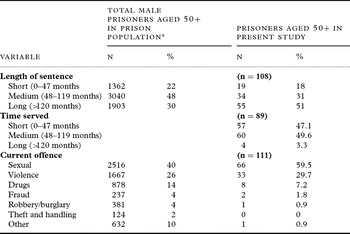
A total of 237 men aged 50 years and over were identified in the four prisons, of which 121 (51.05%) agreed to participate in the study. Of these, 74 were aged between 50 and 59 years, 40 between 60 and 69 years, and seven aged 70 years and above. The age range was 50–78 years, with a mean of 58.4 years and SD of 6.3. This represents 4.7% of the total male prison population aged 50 years or over in England and Wales.
Over 80% of the prisoners were serving sentences longer than four years, with 51% serving life or IPP (imprisonment for public protection) sentences. Despite this, the majority (62%) had served less than four years of their sentence and only 4% had been in prison for over ten years. The majority (59.5%) of older male prisoners were serving sentences for sexual offences (Table 1).
Comparison of study sample to total older prisoner population

aBased on a total prison population of 6305 in England and Wales of men aged 50+ on 31 March 2009 (NOMS data).
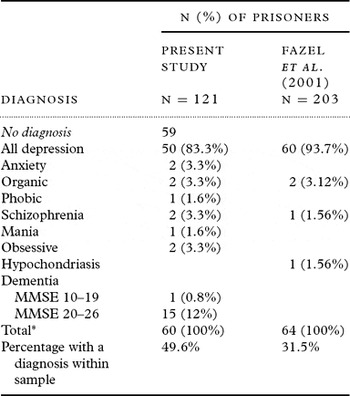
Psychiatric illness was diagnosable by GMS-AGECAT in 60 (49.6%) of the older prisoners, with the most common diagnosis being depressive disorder, which accounted for 50 (83%) of the 60 diagnoses. The prevalence of depression is taken at the diagnostic level in AGECAT – i.e. that of “a case”, where we adopted the advice from the GMS-AGECAT manual that states that “case levels correspond to diagnoses with a level of 3 or above” (Copeland and Dewy, Reference Copeland and Dewy1999).
The self-reports of the prisoners themselves gave a figure of 51 (42.1%) with a mental health problem. Cross-tabulation showed that 48 (80%) of the prisoners diagnosed by GMS-AGECAT correctly self-reported a psychiatric disorder, with only three individuals (4.9%) self-reporting a mental health problem which was not backed up by a GMS-AGECAT diagnosis.
The GMS-AGECAT program gave a diagnosis of dementia in only two prisoners, though MMSE data showed one prisoner with a score in the 10–19 range and 15 (12.5%) in the 20–26 range (Table 2).
Prevalence of psychiatric morbidity in populations (GMS-AGECAT and MMSE)

*This is a percentage of the total prison population with a diagnosable condition using GMS-AGECAT; the MMSE cases are not included in the total.
GMS-AGECAT = Geriatric Mental State: Automated Geriatric Examination for Computer Assisted Taxonomy; MMSE = Mini-Mental State Examination.
Risk factors for depression
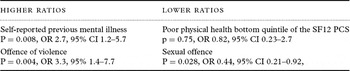
The risk of being diagnosed with depression at interview was greater for those with a self-reported past history of mental illness (OR 2.7, 95% CI 1.28–5.7, P = 0.008) with 54 prisoners self-reporting previous mental illness of which 32 (59.3%) had depression. Depression was also higher amongst prisoners with offences of violence, with 22 of the 33 violent offenders (66.7%) being diagnosed with depression (OR 3.3, 95% CI 1.4–7.7, P = 0.004). However, prisoners serving sentences for sex offences were less likely to be diagnosed as depressed, with 42 of the 66 sex offenders (63.6%) having no diagnosis of depression (OR 0.44, 95% CI 0.21–0.92, P = 0.028) (see Table 4). Prisoners over the age of 65 years were significantly more likely to be depressed than those under 65 (75% v 50.5%, P = 0.004). Depression was not associated with poor physical health using the lowest quartile of the SF-12 (P = 0.49).
Use of psychiatric medication
A total of 21 (17.8%) prisoners stated they were prescribed psychiatric medication. However, only 12 (10%) prisoners had psychiatric medication noted on their Inmate Medical Record (IMR). All of these had a diagnosis of depression, but only nine were taking antidepressants, with a further two taking hypnotics and one other taking a benzodiazepine. Thus, of the 50 inmates diagnosable with depression by GMS-AGECAT, only nine (18%) were prescribed medication from the appropriate class.
Physical health
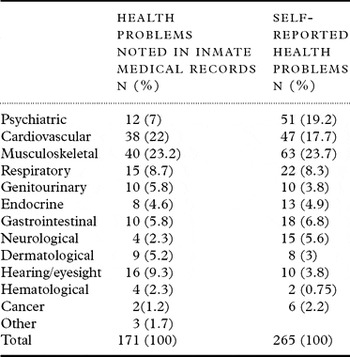
IMRs recorded a total of 53 (43.8%) prisoners who had been prescribed at least one type of medication for physical health problems. The IMRs recorded a total of 171 physical health problems from 93 IMR records with a mean of 1.8, compared to self-reports of 265 health problems from 117 prisoners giving information, resulting in a mean of 2.26 per prisoner.
Discussion
Principal findings
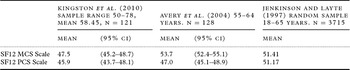
This study showed high levels of psychiatric morbidity in a sample of sentenced male prisoners aged 50 years and over in a range of prison types all but one of which were located in the geographical catchment area of a single UK National Health Service Primary Care Trust. A mental disorder was diagnosed by the GMS-AGECAT program in 49.6% of those assessed. The commonest diagnosis was depression, with 50 cases (83.3%) being detected. Two cases of anxiety, two cases of schizophrenia, two OCD, one mania and two cases of dementia were diagnosed by GMS-AGECAT, but 16 (13%) scored 26 or less on the MMSE. Physical health problems were also common, with an average self-report of 2.26 problems per prisoner. The physical and psychological health of this prison population was poorer than that of community-based peers (Avery et al., Reference Avery, Dal Grande and Taylor2004) (see Table 3).
Comparisons of SF-12 against normative data

SF-12 MCS Scale = Short Form, mental component summary scale; SF-12 PCS Scale = Short Form, physical component summary scale.
There were major discrepancies in the self-reporting of physical and mental health problems and diagnoses recorded on inmate medical records. The discrepancies were greater for psychiatric problems than for physical health problems (see Table 5).
Odd ratios (OR) for depression

Health problems in inmate records and self-reported health problems

Note: Prisoners were asked to self-report multiple health problems, should they have more than one.
Few inmates were recognized as having a mental disorder or prescribed any form of psychotropic medication and only 18% of those diagnosed by GMS-AGECAT as suffering from depression were prescribed an antidepressant.
Strengths and weaknesses
A strength of this study is that it used more than one assessment tool for psychiatric disorder, allowing some conclusions to be drawn about the relative merits of each as a screening instrument for clinical use. Using the SF-12 would detect 80% of psychiatric disorders in this age group, with a sensitivity of 83% and specificity of 95%, assuming the GMS-AGECAT diagnoses to be true. The main weakness of the present study is the low participation rate of 51%. The reasons for this are not clear, but it may reflect the types of prisons included in the study, one of which had a therapeutic prison wing for men with personality disorder. The sample also contained a higher than average number of sex offenders, but this group had a lower than average risk of depression, suggesting that a more typical sample of older prisoners might have had even higher rates of depression. The majority (59.5%) of older male prisoners were serving sentences for sexual offences.
The current study adopted similar methodology to that of Fazel et al. (Reference Fazel, Hope, O'Donnell and Jacoby2001) to facilitate comparisons. We found higher levels of psychiatric morbidity overall, in 49.6% compared to 31.5% of prisoners, with depression the commonest diagnosis, at a prevalence similar to that found in a more recent study of older life-sentenced prisoners (Murdoch et al., Reference Murdoch, Morris and Holmes2008). Both of these studies achieved higher response rates of 87% and 100%, respectively, reflecting differences in initial approach.
Meaning and explanations and implications for clinicians and policy-makers
Understanding the mental health needs of older prisoners within the criminal justice system remains under-researched. This lack of knowledge limits the ability of statutory agencies to assign resources to diagnose and treat mental disorders in prison and manage the safe release of older offenders back into the community. This challenge is set to become a significant issue for prison authorities and community resettlement agencies as the population of older prisoners continues to increase. Prison in-reach mental health services tend to focus on younger prisoners and their resources are already stretched. It has been suggested that over the next five years a new strategy for this aging population will need to be developed by the Home Office, and it may be necessary to follow the US model of specific prisons within prisons for older prisoners. Mental health services for older adults will need to develop in-reach services, perhaps on a regional basis, to ensure the needs of older prisoners are not neglected. Perhaps the finding of most interest to policy-makers wishing to improve the recognition of psychiatric disorder in older prisoners is the reasonably high correlation between GMS-AGECAT diagnosable conditions and self-reported psychiatric problems using the SF-12. If adopted as a simple screening measure, perhaps as part of an over-50s check by the prison primary care staff, the SF-12 would detect 83% of genuine cases with a small number of false positives.
This study was carried out in four prisons, three of which were in a single primary care trust (PCT). Since 2006 the NHS has been responsible for health care in prisons. There are currently 152 PCTs in England and 138 prisons, some PCTs have no prisons, but some, such as South Staffordshire, have several and need to make appropriate arrangements to meet the needs of older offenders with high levels of psychiatric and physical morbidity. After-release agencies will also need to rethink resettlement strategies as there are currently few options for accommodating older offenders with a history of serious sexual or violent crimes.
Unanswered questions and future research
The rate of dementia diagnosed by GMS-AGECAT, at 1.6%, is slightly higher than would be expected in community-living peers of the same age (Ferri et al., Reference Ferri, Prince, Brayne and Brodarty2005), but it is still lower than anecdotal evidence and clinical experience suggests. If a score of 26 or below on the MMSE is used as a cut-off, a much higher figure of 13% is found. Though the MMSE has been used in a number of prison studies (Rigonatti et al., Reference Rigonatti, Serafim, Caires, Filho and Arboleda-Florez2006; Grill et al., Reference Grill, Gerard and Telmon2007), it is not clear if it is a valid measure in prison and underprivileged populations, and what cut-off scores should be used. There is research evidence that long-term imprisonment itself leads to cognitive impairment (Lapornik et al., Reference Lapornik1996), and clinical experience suggests that many prisoners transferred from prison to hospital with a putative diagnosis of dementia show an increase in MMSE score in the first few months. Dementia often goes unnoticed in prison settings for a considerable length of time, and the best way of detecting this at an earlier stage remains unclear. One obvious experiment would be to use outreach services to assess older prisoners, perhaps with screening tools but also to assess activities of daily living and functional performance. A major area for future research is the mental health of older women prisoners. Although their numbers are small in absolute terms, no research looking at their mental health needs has been carried out with this group and their numbers are growing at the same rate as older male prisoners.
The issue of dementia recognition will become a serious challenge for both the prison and health services as this aging prison population grows and ages.
Conflict of interest declaration
Professor G. Yorston is employed by a non-profit making organization that offers secure inpatient services for older offenders.
Description of authors' roles
P. Kingston was the main author, with support from N. Le Mesurier. G. Yorston commented on clinical aspects of the paper, and S. Wardle and L. Heath commented on policy from the perspective of the Primary Care Trust and public health. All authors assisted in reading and checking the final version.
Acknowledgment
The Research was funded by the National Institute of Health Research (NIHR) in the UK under the Research for Patient Benefit Programme (RfPB) grant number PB-PG-0706-10015 entitled “A Critical Analysis of the Mental Health Needs of Older Prisoners”.