Introduction
The whitefly Bemisia tabaci (Gennadius; Hemiptera: Aleyrodidae) has become one of the most important agricultural pests worldwide. It feeds on more than 700 host plant species within 86 botanical families (Greathead, Reference Greathead and Cock1986). In addition, B. tabaci is the vector of numerous plant viruses.
Cotton leaf curl virus disease (CLCuD) is believed to be caused by a CLCuV belonging to the genus Begomovirus (Family Geminiviridae). The virus is transmitted by B. tabaci in a circulative, persistent manner, and can be retained in the vector for durations ranging from a few days to the entire lifespan of the whitefly (Liu et al., Reference Liu, Robinson and Harrison1998; Mansoor et al., Reference Mansoor, Khan, Bashir, Saeed, Zafar, Malik, Briddon, Stanley and Markham1999; Mann and Singh, Reference Mann and Singh2004a).
Now a major threat to the cotton industry in Pakistan (Briddon and Markham, Reference Briddon and Markham2000), CLCuD has spread to India (Briddon et al., Reference Briddon, Bull and Bedford2006), resulting in severe crop losses there and on the entire Indian subcontinent (Briddon et al., Reference Briddon, Mansoor, Bedford, Pinner, Saunders, Stanley, Zafar, Malik and Markham2001).
Bemisia tabaci is the only vector of Begomovirus spp., and the two form one of the most important arthropod vector–plant virus complexes in agriculture. Increased populations of B. tabaci are often associated with CLCuD epidemics. However, the vector–virus–plant interactions at play are not well understood (Colvin et al., Reference Colvin, Omongo, Govindappa, Stevenson and Maruthi2006).
Our previous studies on virus–vector interactions in the spread of CLCuV found that virus-carrying whiteflies laid fewer eggs on CLCuV-resistant plants (Sidhu et al., Reference Sidhu, Mann and Butter2009) than did non-virus-carrying whiteflies. Furthermore, whiteflies reared on 20- and 35-day-old cotton plants infected with the virus laid fewer eggs and had shorter longevity and total developmental period than those reared on healthy plants of the same age (Mann et al., Reference Mann, Sidhu, Butter, Sohi and Sekhon2008).
For the study reported here, we hypothesized that B. tabaci can discriminate between CLCuV-infected and healthy cotton plants, as a response to the negative effects of the virus on the plant. The work has sought to examine the settling preference of B. tabaci adults on CLCuV-infected versus healthy cotton plants under choice conditions.
Materials and methods
Whiteflies
Adult B. tabaci were collected from insecticide-free plants of the cotton Gossypium arboreum, which is resistant to CLCuV (Nateshan et al., Reference Nateshan, Muniyappa, Swanson and Harrison1996; Briddon et al., Reference Briddon, Mansoor, Bedford, Pinner, Saunders, Stanley, Zafar, Malik and Markham2001; Rahman et al., Reference Rahman, Hussain and Zafar2002). The adults were transferred to American cotton (Gossypium hirsutum) plants in insect-rearing cages for oviposition, and then removed after 3 days to retain only their eggs that were allowed to develop until adult emergence. The newly emerged whitefly adults were released and maintained on fresh cotton plants and allowed to breed.
Whitefly adults were also obtained from puparia on leaves of field-collected G. arboreum. These adults were released on healthy cotton plants, and adults from plants with no symptoms of viral infection after 40 days were considered non-viruliferous. These were reared on G. hirsutum plants in separate insect-rearing cages for further studies.
Virus source
Plants of cotton G. hirsutum CV F846 (CLCuV susceptible) exhibiting typical symptoms of cotton leaf curl disease (CLCuD) described by Kapur et al. (Reference Kapur, Singh, Chopra, Sohi, Rewal and Narang1994) and Kang et al. (Reference Kang, Athar and Cheema2003) were obtained from the field and transplanted into clay pots containing a mixture of loam soil and farmyard manure in a 1:1 ratio. Another set of cotton plants was raised and infected with CLCuV through whitefly-mediated transmission as follows: whiteflies were exposed for 24 h to the virus source (infected plants), and then transferred onto healthy plants for 8 h. The infected plants were maintained in 1.2 × 1.2 × 1.2 m cages and used as a virus source following the appearance of typical CLCuD symptoms.
Experimental plants
Cotton, G. hirsutum CV F846, was planted in clay pots (30 × 23 cm) at three to four seeds per pot. The plants were raised in separate cages following standard procedures. Twenty-day-old healthy plants were infected by inoculating them through whitefly-mediated transmission, as described above. Uninfected healthy plants with no CLCuD symptoms were maintained in separate rearing cages.
Choice experiments were conducted on 20-day-old plants at 5, 20 and 35 days post-inoculation (DPI). The three post-inoculation periods represented CLCuV-infected cotton plants with no symptoms, initiation of CLCuD symptoms and well-defined CLCuD symptoms, respectively. Transmission of CLCuV is very efficient, with inoculation periods as low as 10 min (Nateshan et al., Reference Nateshan, Muniyappa, Swanson and Harrison1996; Mann and Singh, Reference Mann and Singh2004b). Therefore, we assumed that infection of all plants occurred soon after the viruliferous B. tabaci were released on them.
Settling preference of viruliferous whiteflies on CLCuV-infected and healthy plants
Five healthy and five CLCuV-infected cotton plants of the same age (25, 40 and 55 days old) were placed randomly in a 1.2 × 1.2 × 1.2 m cage. Two hundred viruliferous B. tabaci adults were released at the centre of the cage and at least 15 cm above the plants, to avoid positional effects.
Whiteflies that settled on each cotton plant were counted after 10 min and 1, 2, 8, 24 and 48 h after release. Whiteflies on the top leaf surfaces were counted visually, while those on the underside of leaves were counted using a glass mirror. There were three cages per experiment, with each cage representing one replication. The experiments were conducted separately on plants at 5, 20 and 35 DPI. The plants were maintained for up to 40 days and observed for symptoms of CLCuV infection. By the end of the experiments, all plants showed symptoms of the viral infection.
Data analysis
Bartlett's test of homogeneity indicated heterogeneity of variances within the three separate experiments with plants at 5, 20 and 35 DPI. Therefore, the data were analysed separately for each post-inoculation period. The data were subjected to multifactor repeated-measure ANOVA, following √n+1-transformation to meet assumptions of normality. When F-values were significant, the means were compared using Tukey's mean separation test with α = 0.05. Statistical analysis was carried out using SAS software version 9.1 (SAS Institute, 2003).
Results and Discussion
No significant differences were detected among replications for the numbers of whiteflies settling per cotton plant at 5, 20 and 35 DPI.
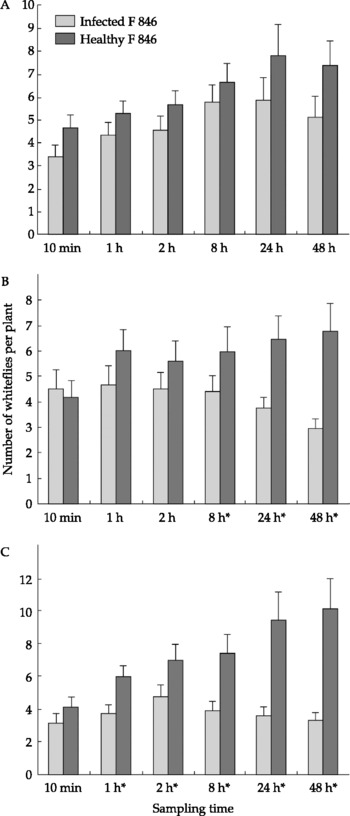
Neither CLCuV infection status nor sampling time affected whitefly settling on plants at 5 DPI; the average number of whiteflies settling on healthy plants was not significantly different from that settling on uninfected plants for any of the sampling times (Fig. 1A).
Settling preference of Bemisia tabaci adults on healthy versus infected cotton G. hirsutum (CV F846) plants at (A) 5 DPI, (B) 20 DPI and (C) 35 DPI. Error bars represent the standard error of mean. *Significant at P < 0.05.

Repeated-measure ANOVA showed significant interaction effects between sampling time and CLCuV infection status for 20 DPI plants (F 5,130 = 2.49; P = 0.03). Whiteflies preferentially settled on healthy plants at 8 h (P = 0.04), 24 h (P = 0.03) and 48 h (P < 0.01; Fig. 1B) post-release. However, whiteflies showed no significant preference at 10 min, 1 h and 2 h post-release.
For 35 DPI plants, significant interaction effects were also noted between the sampling time and CLCuV infection status (F 5,130 = 8.07; P < 0.01). Whitefly numbers on healthy plants were significantly greater than those on infected plants at 1 h (P = 0.05), 2 h (P = 0.01), 8 h (P < 0.01), 24 h (P < 0.01) and 48 h (P < 0.01; Fig. 1C).
The settling preference of virus-carrying whiteflies for uninfected plants indicates that whiteflies were able to discriminate between the two. Our previous studies showed similar results, where whiteflies preferred healthy plants over CLCuV-infected plants for oviposition (Mann et al., Reference Mann, Sidhu, Butter, Sohi and Sekhon2008). The preference for healthy plants may be due to the capability of the whiteflies to recognize the altered nutritional or morphological status of virus-infected plants. CLCuV infection produces changes in peroxidase activity, and levels of catechol, phenols, carotenoids, proteins, total sugars, chlorophyll, oil and lipase enzyme in cotton plants (Kaur et al., Reference Kaur, Sohal, Singh and Bajaj1998; Kang et al., Reference Kang, Athar and Cheema2003; Ashraf et al., Reference Ashraf, Mahmood, Sarwar, Ashraf, Naeem and Zafar2004), which are deterrent to whitefly colonization (Ilyas et al. Reference Ilyas, Puri and Rote1991; Butter et al., Reference Butter, Vir, Kaur, Singh and Raheja1992; Hasan et al., Reference Hasan, Ahmad and Wakeel2000; Selvanarayanan and Muthukumaran, Reference Selvanarayanan and Muthukumaran2005; Ravi et al., Reference Ravi, Dhandapani, Sathiah and Murugan2006). The disease also causes several morphological changes, such as pronounced vein and veinlet thickening, a roughing of the surface and curling of upper leaves (Kapur et al., Reference Kapur, Singh, Chopra, Sohi, Rewal and Narang1994; Kang et al., Reference Kang, Athar and Cheema2003). This may discourage whitefly adults from settling on infected plants.
The settling preferences were not significantly different for plants at 5 DPI. This may be due to the absence of sufficient virus activity in these plants, and hence generally undetectable chemical or morphological changes.
Whiteflies' preference for healthy plants initiated at 8 and 1 h of release on 20 and 35 DPI plants, respectively. Therefore, it appears that whiteflies were able to discriminate between the plants only after they landed on and probed them. Blua and Perring (Reference Blua and Perring1992) and Sisterson (Reference Sisterson2008) stated that feeding may be required for insects to differentiate between healthy and infected plants.
The decline in numbers of whiteflies on infected plants and their concomitant increase on healthy plants over time indicated whitefly movement from infected to healthy plants. Such movement would lead to increased spread of virus, as whiteflies can acquire and inoculate CLCuV in 60 and 30 min, respectively (Nateshan et al., Reference Nateshan, Muniyappa, Swanson and Harrison1996; Mann and Singh, Reference Mann and Singh2004b). Sisterson (Reference Sisterson2008) suggested that the spread of virus in the field depends more upon the magnitude of insect movement than on a preference for healthy plants.
A proportion of the released whiteflies settled on cage walls before settling on the plants. Therefore the numbers continued to increase on virus-infected as well as healthy plants for up to 2 h.
Harrison et al. (Reference Harrison, Zhou, Otim-Nape, Liu and Robinson1997) and Colvin et al. (Reference Colvin, Otim-Nape, Holt, Omongo, Seal, Tevenson, Gibson, Cooter and Thresh1999) positively correlated the symptom severity of the Eastern African cassava mosaic virus (CMV) and a Ugandan variant of CMV to whitefly density, respectively. Jiu et al. (Reference Jiu, Zhou, Tong, Yang, Wan and Liu2007), however, reported higher population densities of the ‘B’ biotype of B. tabaci on plants infected with tobacco curly shoot virus and tomato yellow leaf curl China virus; an indigenous species of the whitefly did not discriminate between healthy and virus-infected plants.
Our results suggest that whiteflies' preference for healthy plants compared with diseased plants can lead to higher virus spread in the field, and thus higher crop losses, particularly since the viruses are often transmitted rapidly and efficiently.