
Introduction
There is extensive evidence for intentional and accidental mutilation of the human cranium in both past and modern societies. Archaeological traces of specific, pre-meditated injuries include decapitation (either pre-, peri- or post-mortem), modification of the teeth and trepanation, while unforeseen trauma can result from accidents and interpersonal violence (Mays Reference Mays1996; Stuckert & Kricun Reference Stuckert and Kricun2011; Geldof Reference Geldof, Tracy and deVries2015; Nikolić et al. Reference Nikolić, Savić, Antunović, Marinković, Andrieux and Tomić2017). This evidence covers a long timespan, from Dynastic Egypt to modern times, with locations spanning the Far East, Asia, North and South America, the Middle East, Africa and Europe (Sperati Reference Sperati2009, with qualifying comments from van der Graaf Reference van de Graaf2009). Sperati (Reference Sperati2009) notes that while mutilation was commonly applied to the limb extremities and the head, the face served as a brutally obvious medium for marking out certain individuals. The human face is not only defined by the morphology of underlying bone, muscle and fat, but also by soft tissues, such as those forming the ears, nose and lips. These all serve to make each face distinct, facilitating social communication and allowing the expression of emotions.
The widespread and long-established practice of facial mutilation is also evidenced by early attempts at plastic surgery. Damage to the nose by whatever means—punishment, fighting, duelling or by accident—led to early attempts at both aesthetic and total reconstruction to try to restore the appearance of the face (Mazzolo & Marcus Reference Mazzolo and Marcus1983; Lupo Reference Lupo1997; for a comprehensive review, see Arora et al. Reference Arora, Mohan, Bhardwaj, Sadhna and Srivastava2017). Documentary evidence suggests that the earliest such operations seem to have taken place in India (Brain Reference Brain1988; Tewari & Shukla Reference Tewari and Shukla2005), where, following the ideas of Sushruta recorded c. 600 BC, surgeons used flaps of cheek and forehead skin to reconstruct the nose. The success of the operation must have been variable, given the opportunity for infection. The first published account of the operation in the West—in 1794 in the Gentleman's Magazine—was accompanied by an illustration of a patient whose nose had been successfully restored (BL 1794).
While there is some archaeological evidence for the intentional mutilation of limbs (Brothwell & Møller-Christensen Reference Brothwell and Møller-Christensen1963; Fernandes et al. Reference Fernandes, Liberato, Marques and Cunha2017), there is limited evidence for facial mutilation probably because it may have only affected soft tissues without leaving traces on the skeleton. Early twentieth-century excavations of a Romano-British site at Lowbury Hill in Berkshire (Atkinson Reference Atkinson1916) revealed an individual with supposedly mutilated facial bones. This interpretation should, however, be treated with caution, as the taphonomic effects on skeletal material were not fully understood at this time. Possible evidence of scalping has been reported at the Romano-British sites of Wroxeter and St Albans (Barker Reference Barker1981; Mays & Steele Reference Mays and Steele1996). Although the former may be a potential example of frontal scalping, the latter is now considered to have resulted from post-mortem defleshing due to the large number (>90) of presumed cut marks over the surface of the skull (Niblett Reference Niblett1999).
Anglo-Saxon examples of skulls with cuts to the head and face are also known; for example, from Eccles in Kent and Maiden Castle in Dorset. The random nature of these injuries, however, is best explained as the result of fighting with edged weapons, or as the result of an attack on a defenceless person (Brothwell Reference Brothwell1971; Wenham Reference Wenham and Hawkes1989).
A post-AD 1600 mutilated skull from Eustace Street in Dublin exhibits probable traumatic loss of the nose (Carty Reference Carty2015), but it appears to have been cleaved in more than one plane, and thus the example fits better into a ‘non-specific’ category of mutilation (Carty Reference Carty2015: 3 & 11). Evidence for removal of the external ear is less forthcoming, probably because the pinnae could readily be removed by a sharp knife blade without leaving traces on the underlying bone. Although one example is reported in skeleton 171 from the Late Anglo-Saxon cemetery at North Elmham in Norfolk (Wade-Martins Reference Wade-Martins1980: 365–67), the event seems to have comprised more than a simple ear removal by a sharp, bladed weapon, as part of the temporal bone had also been removed. This action would probably have been fatal due to damage to the middle meningeal blood vessels and exposure of brain tissue. Another putative case is reported at medieval Jewbury in York, in which multiple unhealed cuts using a heavy, sharp-bladed weapon are reported on the skull of a young female. The ears may have been cut through, but probably not through prime intent, as the location and distribution of the wounds suggest attempted decapitation (Lilley et al. Reference Lilley, Stroud, Brothwell and Williamson1994; McComish Reference McComish2000). In contrast, this article considers the case of a human cranium that exhibits evidence for specific and intentional facial mutilation in the form of total removal of the nose and partial removal of the upper lip, along with possible frontal scalping.
The Oakridge cranium: archaeological context and dating
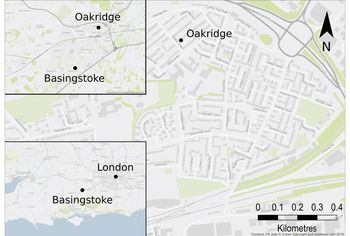
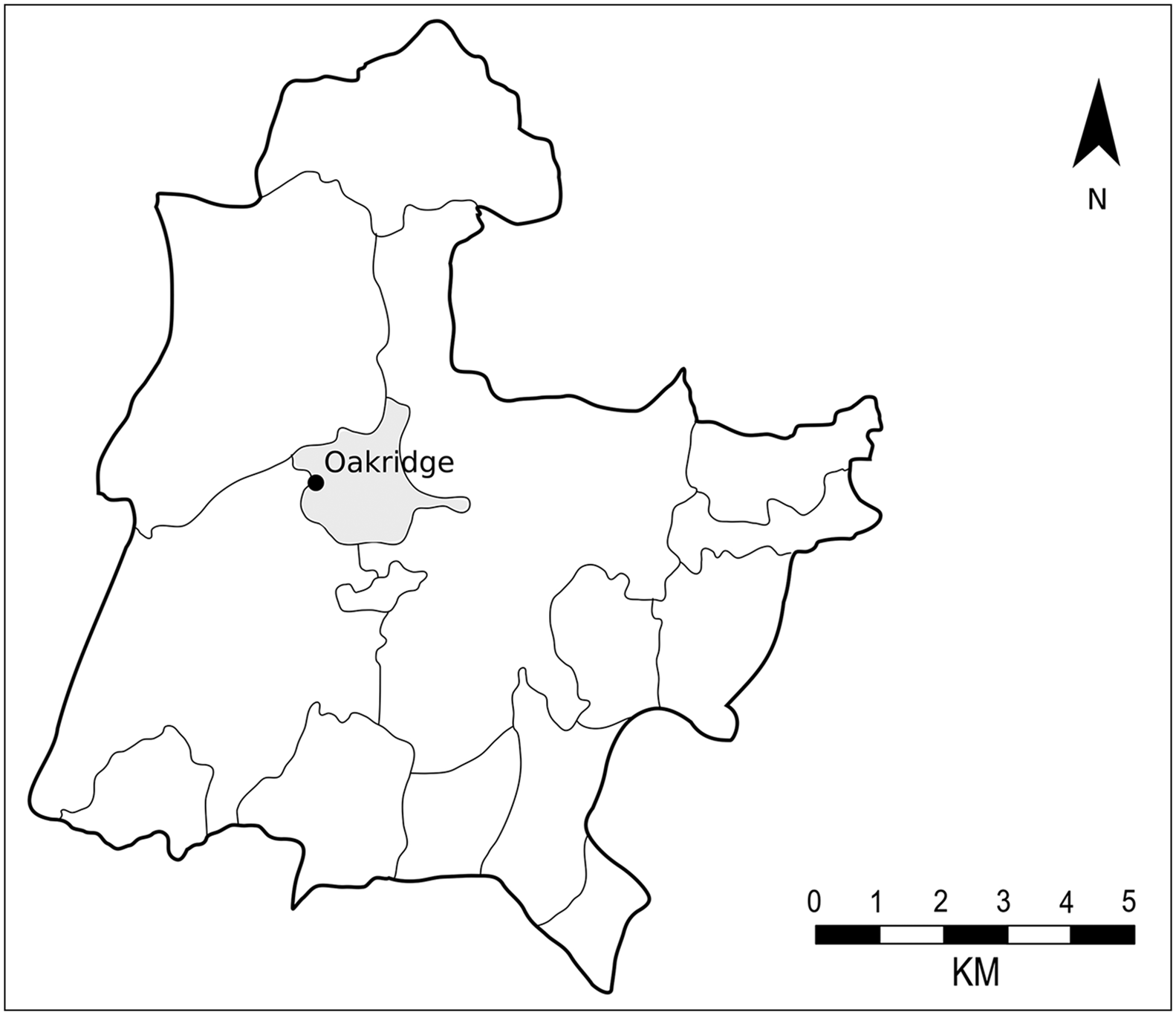
The cranium under investigation was recovered in the 1960s during rescue excavations prior to housing development at Oakridge, in Basingstoke, England (Figure 1). Restricted archaeological intervention was permitted, with limited recording of archaeological features and the incomplete recovery of finds, with the exception of a carefully excavated well and a Romano-British burial. The presence of Iron Age pottery sherds and features consistent with hut circles suggest an extended period of occupation (Oliver Reference Oliver1993). The burial was discovered by accident during mechanical excavation of a drainage inspection pit. An additional cranium—our Oakridge individual—was recovered from the spoil, but was not analysed at the time. The unprovenanced nature of the cranium means that we do not know whether it derived from a complete body, or whether the head had been removed, perhaps for purposes of display prior to burial.
Location of Oakridge at Basingstoke, Hampshire, England (figure by G. Cole).

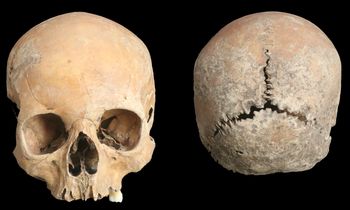
Examination of the cranium for the present article showed that it had not been cleaned, and its interior, orbits, nasal cavity and tooth sockets were filled with a distinctive fine, dark brown sandy silt, free of chalk or flint inclusions. This allowed the cranium to be associated with a specific feature exposed on the east side of the drainage pit. The parent chalk geology, with a thin rendzina soil cover, resulted in variable-sized chalk flecks/lumps in all other feature fills at the site (Oliver Reference Oliver1993), and Mary Oliver, the original excavator and site supervisor, is confident that the cranium derived from this feature (M. Oliver pers. comm.). Figure 2 shows the cleaned cranium. Radiocarbon dating of the cranium provides an uncalibrated date of 1173±24 years BP at 95.4 per cent confidence (OxA-26646: AD 776–899 (87.3 per cent confidence) and AD 920–946 (8.1 per cent confidence); for full details, see the online supplementary material (OSM)), dating the individual to the Middle to Late Anglo-Saxon period.
Views of the cleaned cranium showing the well-preserved anterior aspect and the degraded posterior aspect (photograph by G. Cole).

Osteological assessment: age at death, biological sex and evidence of trauma
Osteological analysis provides the following results (for full details, see the OSM). The cranium is generally well preserved, with the exception of the ectocranial surface of the occipital bone and both surfaces of the left and right parietals in close proximity to the parieto-occipital suture. Here, there is widespread surface degradation, suggesting that this part of the cranium had been affected by different taphonomic conditions, possibly including water flow (Knüsel & Carr Reference Knüsel and Carr1995).
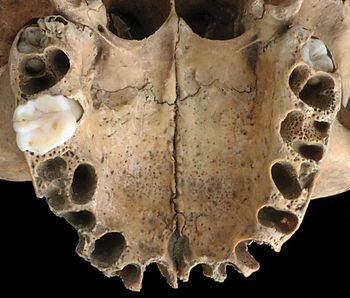
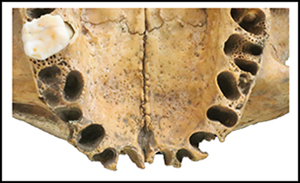
The cranium is clearly that of a young person (Figure 3). The only in situ erupted tooth is a left first maxillary molar, which was lightly worn. The third molars are visible in the maxilla, partially erupting from their crypts; all other sockets are present, but with their associated teeth lost post-mortem. The baso-sphenoid suture was just starting to fuse, but the temporo-occipital and parieto-occipital sutures were completely unfused. In combination, these features indicate a developmental age of around 15–18 years (Al Qahtani et al. Reference Al Qahtani, Hector and Liversidge2014; Alhazmi et al. Reference Alhazmi, Vargas, Palomo, Hans, Latimer and Simpson2017).
Occlusal view of the maxilla, showing the erupted left first molar; the third molars are visible in their crypts (photograph by G. Cole).

The cranium has rounded features, with prominent frontal bossing, a gracile zygomatic arch and a sharply defined supra-orbital margin. Although these characteristics are typical of females, young males may also exhibit such features prior to full expression of sexually dimorphic traits. Given the young age of the individual, and the absence of the pelvis, it was not possible to estimate with confidence the sex of the individual based on morphological traits (Ferembach et al. Reference Ferembach, Schwindezky and Stoukal1980; Buikstra & Ubelaker Reference Buikstra and Ubelaker1994). Rather, ancient DNA analysis of the cranium reveals that the individual was female (see the OSM). Isotopic ratios of strontium (87Sr/86Sr) and oxygen (18O/16O) have become a widely used tool in archaeological and forensic sciences for provenancing skeletal tissues (Chenery et al. Reference Chenery, Müldner, Evans, Eckardt and Lewis2010; Makarewicz & Sealy Reference Makarewicz and Sealy2015). Strontium and oxygen isotope analysis of the tooth enamel, along with carbon and nitrogen isotopic analysis of dentine collagen, suggests that the woman was non-local, although it was not possible to identify a probable region of origin (see the OSM).
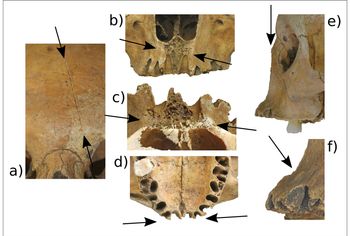
The cranium exhibits clear evidence of peri-mortem trauma (Figure 2) in the facial region. First, there is a linear cut on the medial left frontal bone with a V-shaped profile, oriented obliquely to the right when facing the cranium. Second, the removal of sediment revealed exposed trabecular bone at the base of the nasal aperture, cutting through the cortical bone in front of the maxillary central incisor sockets. The anterior nasal spine is also missing. The trabecular zone is surrounded by a margin of sharply defined cortical bone, especially at the base of the nasal aperture. The lower left and right lateral margins of the nasal aperture are also truncated. Overall, there appear to be one or more straight cuts through the nasal margin from midway up the nasal aperture through the anterior nasal spine to the prosthion—evidence consistent with slicing cuts from a knife (Lewis Reference Lewis2008). Close examination of the lateral aspect revealed a sharp, V-shaped nick on the left side of the nasal aperture. The cut through the lips was made at a slightly different angle to that through the nasal margins. This suggests that at least two cuts were made to inflict the injuries (Figure 4), indicating intent, rather than an accidental blow, and restraint while the injuries were inflicted.
Close-up views of the facial trauma: a) the oblique frontal cut; the obliquely angled cuts through the lower margin of the nasal aperture: b) from the front; c) from above; d) the anterior of the maxilla; e) the linear cut through the lateral margin of the nasal aperture; f) the sharp nick on the right side. The cuts and nicks are marked by arrows (photographs by G. Cole).

There can be little doubt that the victim died at the time of—or soon after—the traumatic event. The edges of the wound are sharp with no signs of remodelling that would indicate survival for even a few days afterwards. The injury to the individual's nose could have been sufficient to cause her death, as the wound would probably have damaged the network of arteries in the back of her nose. Two plexuses of arteries supply the nose with blood (Pope & Hobbs Reference Pope and Hobbs2005). The anterior one, known as Kiesselbach's plexus, is responsible for the majority of nose-bleeds, with bleeding easily controlled by applying pressure. Injury to the posterior (Woodruff's) plexus tends to cause bleeding down the throat, and can only be controlled by packing the rear of the nasal structures above the soft palate—a procedure unlikely to have been known to Anglo-Saxon practitioners. In the present case, the nasal wound probably caused profuse bleeding from the posterior plexus, leading to death by choking. Whether her death resulted directly from the mutilation or from other injuries, however, is unknowable in the absence of the post-cranial skeleton. Alternatively, the wounds may have been inflicted during the interval between the victim's death and final deposition, while the bone was still in fresh condition.
The cut observed across the forehead may be related to the formal removal of the nose, to scalping, or to removal of the individual's hair. Elsewhere, archaeological evidence for scalping has been observed in the form of multiple small cuts circling the cranium (Axtell & Sturtevant Reference Axtell and Sturtevant1980), but both the skill of the person performing the operation and the nature of the blade used probably contribute to the presence, or otherwise, of skeletal traces. A long, narrow iron blade, for example, will likely leave a different trace to a shorter, broader flint blade (Greenfield Reference Greenfield and Mathieu2002). Scalping may also be partial rather than complete.
In summary, the cranium presented here belongs to a young female of around 18 years of age, possibly of non-local origin. She exhibits a sharp force wound cut obliquely across her forehead—possibly caused by a knife—and two mutilating cuts on her face: one through the upper and lower parts of the bony nasal aperture, and the other through the alveolar bone anterior to the upper central incisors. The lateral and posterior aspects of the cranium have been damaged by post-depositional changes.
Landscape context
The Oakridge cranium was located approximately 80m south of the boundary between a detached part of the parish of Basing in the Hundred (an Anglo-Saxon supra-local territory) of Basingstoke and the tithing of Chineham. The latter was itself a detached part of the parish of Monk Sherborne, which, as of 1831, was in the neighbouring Hundred of Chuteley (Page Reference Page1911: 113) (Figure 5). In the Domesday Survey of 1086 (DB Hampshire 23: 10; Williams & Martin Reference Williams and Martin2002: 107), Chineham was an estate in its own right, and originally part of the Hundred of Basingstoke. Chineham's location in the centre of that district inspires confidence in the antiquity of the boundaries within.
The territorial context of the Oakridge burial: the site is located on the western boundary of the Anglo-Saxon estate of Chineham (highlighted in light grey) in Basingstoke Hundred (figure by G. Cole based on data provided by A. Reynolds).

Basing and Basingstoke were significant places by the time the Oakridge mutilation occurred, evidenced by the element common to both place-names. Basing is a name of so-called ‘-ingas’ type, meaning ‘people of Basa’ (Ekwall Reference Ekwall1960: 30). It is possible, using such evidence, to identify ‘tribal’ groupings and territories dating to at least the seventh or eighth century AD, if not earlier, particularly in this part of central southern England (Eagles Reference Eagles2018: 167–69). Such groups were probably headed by families who, by a process of competition and allegiance, formed the basis for the kingdom of Wessex (Yorke Reference Yorke1995). The important sixth- and seventh-century AD Anglo-Saxon elite centre at Cowdery's Down (Millett & James Reference Millett and James1983) was situated only two kilometres to the south-east of Oakridge, also within Basingstoke Hundred. By at least the tenth century, Basing itself had become a royal manor. It featured in the will of King Eadred (AD 946–955), who bequeathed it to his mother, Queen Eadgifu (Tollerton Reference Tollerton2011: 92). It is only by AD 1086, that Basingstoke appears to have succeeded Basing as the key settlement in the district (Hinton Reference Hinton1986: 162).
If the Oakridge Iron Age site was visible as an earthwork during the Anglo-Saxon period, then its use as a point of reference for setting out a local boundary can easily be envisaged—a phenomenon that has been commonly observed elsewhere. The placing of the cranium, if indeed it relates to the boundary, suggests that the boundary is of at least ninth- or tenth-century AD date, possibly earlier. This aspect broadly aligns with a series of boundary burials recorded elsewhere (Reynolds Reference Reynolds2009a) that suggest the presence of defined local territories from the seventh and eighth centuries AD onwards, and offers an alternative view to that which considers local land units as being predominantly tenth- and eleventh-century formations (Hooke Reference Hooke1998: 68). We can be sure, on the basis of this evidence combined, that the Oakridge cranium lay very close to an ancient boundary.
An Anglo-Saxon outcast?
The Oakridge cranium is perhaps best explained by considering the nature of the injuries sustained by the victim in combination with the topographical setting of the find. Although the radiocarbon date range encompasses a documented battle at Basing between Vikings and Anglo-Saxons in AD 871, there is nothing to suggest that this isolated cranium relates to that event.
Isolated human interment forms a recognised category of burial in Anglo-Saxon England, and is a particular feature of the Christian period from the seventh century AD onwards. While pre-Christian (fifth to seventh centuries AD) communities in England appear to have buried individuals marked out by ‘deviant’ mortuary rites at the edges of their community cemeteries (Reynolds Reference Reynolds2009b), it later became common practice to bury certain individuals in isolated locations away from ‘normal’ community cemeteries. This practice drew partly upon extant notions of liminal places as suitable repositories for social outcasts, but recognising the Christian binary notions of ‘good’ and ‘evil’ that were subsequently realised in a landscape setting. Large-scale execution cemeteries also emerge during the later seventh and eighth centuries AD (Reynolds Reference Reynolds2009a), continuing into the twelfth century AD and indeed later (Walker et al. Reference Walker, Clough and Clutterbuck2020). These sites therefore suggest that isolated burials are the result of local, rather than supra-local, community actions.
Written descriptions of boundary markers (charters) and archaeological evidence both attest the practice of placing certain individuals on the boundaries of local land units. While textual sources allude to a tenth-century AD horizon for individual burials in England, radiocarbon dating of excavated examples suggests a late sixth- or seventh-century AD origin for the practice (Reynolds Reference Reynolds2009b: 209–18). Written descriptions of boundaries, however, only proliferate from the tenth century AD onwards.
It is notable that isolated burials are a long-lived phenomenon, with explicitly documented examples regarding suicides and other social outcasts in particular known from as late as the early modern period (Reynolds Reference Reynolds2009b: 217). Although instances of the practice are widespread, two local examples illustrate the point. Approximately 10km south-east of Oakridge, an Anglo-Saxon charter from AD 1046 for an estate at Hoddington (Sawyer Reference Sawyer1968: cat. no. 1013) records a ‘heathen burial’ as one of its boundary markers. An earlier (AD 973–974) charter for an estate at Crondall, 20km east of Oakridge, explicitly refers to the burial of a person marking the boundary, noting “where Ælfstan lieth in a heathen [i.e. outcast] burial” (Sawyer Reference Sawyer1968: cat. no. 820). The Oakridge cranium is particularly significant as it uniquely exhibits evidence for formal trauma inflicted upon an individual, in combination with a liminal setting. Given that only the cranium was recovered, it may be that the head had been removed from the body as part of the punishment, perhaps for the purposes of display—as evidenced elsewhere in Anglo-Saxon England (Reynolds Reference Reynolds2009b: 273–74).
Mutilation in the Anglo-Saxon legal context
Anglo-Saxon written sources provide insights into the range of mutilations encountered in a judicial/punitive setting and, in some instances, their motivations. The removal of the hands and feet on account of theft is first noted in the seventh-century AD law code of King Ine of Wessex (AD 688–725) (I 18 and 37; Attenborough Reference Attenborough1922). Amputation of the hand for theft, this time from the church, also appears in King Alfred's (AD 871–899) law code (Alf 6; Attenborough Reference Attenborough1922), while the same code states that castration was the punishment for a slave who rapes another slave (Alf 25.1; Attenborough Reference Attenborough1922). The second law code of Athelstan (AD 924–939) prescribed cutting off a moneyer's hand should he mint base or light coins (II Ath 14.1; Robertson Reference Robertson1925). The sources become more relevant to the Oakridge find, however, with King Edmund's (AD 921–946) third law code, which lists scourging, removal of the scalp and mutilation of the little finger in combination as the penalty for thieving slaves (III Edm 4; Robertson Reference Robertson1925). King Edgar's (AD 959–975) third law code lists removal of the tongue for making false accusations (III Edg 4; Robertson Reference Robertson1925). In relating the miracles of St Swithun of Winchester, the tenth- and eleventh-century AD writer Lantfred, however, recalls an otherwise unattested law of King Edgar for thieves, which required that the transgressor be
tortured at length by having his eyes put out, his hands cut off, his ears torn off, his nostrils carved open and his feet removed; and finally, with the skin and hair of his head shaved off, he would be abandoned in the open fields (Wormald Reference Wormald1999: 25).
The Laws of Edward and Guthrum (of probable late tenth-century AD date) refer to unspecified mutilating and maiming of a criminal (E&G 10; Robertson Reference Robertson1925). King Aethelred's (AD 978–1016) first law code dictates branding for slaves found guilty at judicial ordeal (I Ath 2; Robertson Reference Robertson1925). His fourth code provides a further instance of hand amputation for striking false coins (IV Ath 5.3; Robertson Reference Robertson1925), as does King Cnut's (AD 1016–1035) second law code (II C 8.1; Robertson Reference Robertson1925), which also decrees the cutting out of the tongue for false accusation (II C 16; Robertson Reference Robertson1925), and removal of the hands or feet for theft (II C 30.4; Robertson Reference Robertson1925). Of particular relevance is a further clause in Cnut's second code that prescribes the removal of the eyes, nose, ears, upper lip and scalp for a ‘greater crime’ than theft (II C 30.5; Robertson Reference Robertson1925). Clause 32.1 goes on to decree branding for a slave guilty at trial by ordeal; clause 36 requires the removal of a hand for swearing a false oath, while clause 53 stipulates the removal of the nose and ears in the case of a woman accused of adultery. With specific regard to the types of injury found on the Oakridge cranium, the legal corpus indicates that mutilation of the head was a particular punishment limited to slaves, adulteresses and those committing particularly heinous offences.
Concluding remarks
Violent punishment is a gruesome means by which societies exercise power over their citizens (Amussen Reference Amussen1995), and ritual mutilation, like execution, has been a feature of many societies for millennia (Skinner Reference Skinner2014). Mutilation was intended not to kill, but rather to humiliate or disable, and was meted out as punishment for crimes that did not warrant the death penalty. Mutilation can involve amputation of a limb or cutting off parts of the face, the ears or the nose (Sperati Reference Sperati2009; Mavroforou et al. Reference Mavroforou, Malizos, Karachialos, Chatzitheofilou and Giannoukas2014). In the latter case, the victim would literally ‘lose face’ (Groebner Reference Groebner1995). In some cultures, mutilation of the nose was reserved for females as this destroyed their beauty (Skinner Reference Skinner and Yoshikawa2015); when practised on men, as an alternative to genital mutilation, it was seen as especially debasing (van Eickels Reference van Eickels2004), although many may have preferred it to the alternative. There are even hagiographic reports of self-mutilation—usually by nuns—as a means of preventing sexual assault by invaders (Sperati Reference Sperati2009).
The nose itself is particularly significant, as it is the most prominent facial feature. When the nose is deliberately mutilated, or when social difficulties arise for people affected by diseases such as leishmaniasis, tumours and other conditions that may modify or destroy the normal appearance of the nose, concepts of dehumanisation or divine punishment may have been invoked (Ashmead Reference Ashmead1903; Friedman Reference Friedman1972). The importance of the nose to human faces is reflected in the long-established practice of physically removing them from statues of people no longer in favour or power (Amussen Reference Amussen1995; Kyle Reference Kyle1998; Varner Reference Varner2001, Reference Varner2004). The significance of normal facial appearance is also reflected in ancient codes of law, which introduced many forms of bodily mutilation as punishment for various crimes, including amputation of one or both hands and the slicing or removal of noses, ears and lips.
The young woman whose remains were found at Oakridge was probably not born or raised locally, but we can say no more about her place of origin, or how she came to be in this part of southern England. Although the skeletal evidence taken in isolation permits multiple possible explanations for the trauma, the combined strands of evidence discussed above lead us to conclude that this is a case of deliberate facial mutilation, with possible scalping or, more probably, removal of the hair. The specificity of the wounds strongly suggests that her mutilation was punitive, either at the hands of a local mob marking her perceived offence by established custom, or by local administrators applying legal prescription. In either scenario, the woman—or at least her head—was then outcast to the limit of the local territory. As noted above, the isolated nature of the cranium perhaps indicates punishment at the most local level.
In conclusion, this article presents new and early evidence for Anglo-Saxon facial mutilation. While injuries of the kind exhibited on the Oakridge cranium only appear in the written record in the tenth century AD, the case reported here suggests that the practice may have emerged a century earlier. Irrespective of the circumstances behind the incident, this case appears to be the first archaeological example of this particularly brutal form of facial disfigurement known from Anglo-Saxon England.
Acknowledgements
Funding was provided by The Leverhulme Trust via a Doctoral Scholarship Scheme entitled ‘Genetic Journeys into History: the Next Generation’ and grant RPG-388, and by the John Fell OUP Research Fund (112/247). The genetic research was funded by the NBAF Pilot Scheme (grant NBAF685), awarded to the Research Laboratory for Archaeology, University of Oxford.
The authors would like to thank David Allen, Curator of Archaeology, Hampshire Cultural Trust, for permitting destructive analysis of the specimen; Mary Oliver for discussing the original excavation; Tom Higham, University of Oxford, for assistance with the radiocarbon sampling; and the AEON EarthLAB, University of Cape Town, South Africa, for strontium analysis. The authors would also like to thank the two anonymous reviewers for their helpful and constructive comments.
The authors would also like to acknowledge the contribution of Stuart Laidlaw, departmental photographer and lecturer at the UCL Institute of Archaeology. Sadly, Stuart passed away in November 2019, having been a member of staff there since 1979.
Supplementary material
To view supplementary material for this article, please visit https://doi.org/10.15184/aqy.2020.176