Introduction
Diagnosing and treating iron deficiency, the most common nutritional deficiency affecting children, Reference Mattiello, Schmugge, Hengartner, von der Weid and Renella1 has become an increasingly important aspect of acute and chronic heart failure management. Nearly half of adults with heart failure have comorbid iron deficiency, Reference Beavers, Ambrosy and Butler2–Reference Klip, Comin-Colet and Voors4 and the presence of iron deficiency, independent of the presence of anaemia, has been correlated with heart failure severity and risk of death. Reference Klip, Comin-Colet and Voors4–Reference Okonko, Mandal, Missouris and Poole-Wilson6 Given challenges regarding tolerability and efficacy of enteral iron therapy, Reference Lewis, Malhotra and Hernandez7 intravenous administration of iron has been associated with improvement in patient-reported symptoms, exercise function, and hospitalisations in adults with heart failure with reduced ejection fraction. Reference Beavers, Ambrosy and Butler2,Reference Kalra, Cleland and Petrie8–Reference Ponikowski, Kirwan and Anker11
Iron deficiency is common in children with heart failure, with single-centre study estimates ranging from 56 to 81%. Reference Mueller, Schlueter, Arndt, Dodge-Khatami, Weil and Mir12–Reference Phillips, Richmond, Neunert, Jin and Brittenham15 For children with acute heart failure and dilated cardiomyopathy, both anaemia and iron deficiency have been associated with worse heart failure severity and mortality. Reference Luxford, Casey, Roberts and Irving13–Reference Higgins, Otero and Jefferis Kirk18 Despite the high prevalence of iron deficiency in children with heart failure and its association with worse outcomes, there are little data on the impact of iron repletion in children. Puri et al., however, reported poor efficacy with oral iron replacement in children with heart failure Reference Puri, Spinner and Powers19 — similar to prior experience in larger adult trials. Reference Beavers, Ambrosy and Butler2,Reference Lewis, Malhotra and Hernandez7
While there has been expanded use of intravenous iron in paediatric heart failure based on adult data, there has been little reported on the experience of intravenous iron therapy for children with heart failure. Thus, we sought to examine our heart centre’s use of iron sucrose, a common intravenous iron formulation, prescribed primarily as a treatment for heart failure. In addition to describing safety and infusion-related adverse events, we report changes in haematologic and iron parameters with intravenous repletion.
Materials and methods
We performed a retrospective review of hospitalised patients ≤ 21 years of age with a primary cardiac diagnosis who received at least one intravenous iron sucrose infusion between January 1, 2020, and December 31, 2022, at Boston Children’s Hospital. The study was approved and granted a consent waiver by the Boston Children’s Hospital Institutional Review Board (IRB#P00045795). Patients were included if they met the following criteria: (1) primary cardiac diagnosis defined as CHD, cardiomyopathy, or status post heart transplantation; (2) inpatient status at time of intravenous iron sucrose administration; and (3) intravenous iron sucrose prescribed by a cardiology provider.
Hospital pharmacy records were reviewed to generate a list of all infusions that met the above criteria. For patients who received multiple infusions, demographic and clinical data at the time of initial infusion were utilised. The Advanced Cardiac Therapies team, which guides most of our heart centre’s intravenous iron use, defines iron deficiency as serum ferritin <100 ng/mL or serum ferritin 100–200 ng/mL with transferrin saturation <20%. Reference Beavers, Ambrosy and Butler2,Reference Klip, Comin-Colet and Voors4,Reference Lewis, Malhotra and Hernandez7,Reference Anker, Comin Colet and Filippatos9 With regard to dosing, some providers prescribed a standard 5–7 mg/kg/dose; others used the Ganzoni equation to calculate iron deficit and infusion dosage: total iron deficit (mg) = [body weight (kg) x (target haemoglobin - actual haemoglobin) x 2.4] + depot iron (assuming target haemoglobin value = 15 g/dL for body weight >35 kg, 13 g/dL for body weight ≤ 35 kg; depot iron = 15 mg/kg [max 500 mg]). Reference Haehling, Ebner, Evertz, Ponikowski and Anker20 The total intravenous iron sucrose replacement dose was administered over multiple days (timing at the clinician’s discretion), with a max daily aliquot dose of 300 mg. Thus, each intravenous iron sucrose infusion dose series may have included multiple aliquots. Iron sucrose doses ≤ 100 mg were infused over 30 minutes, 101–200 mg over 60 minutes, and 201–300 mg over 90 minutes. Premedication was not standardised; some patients received no premedication, and others received histamine –2 receptor antagonists and/or antihistamines; steroids were not routinely ordered.
To assess for infusion-related adverse events, patients’ electronic medical records were reviewed during and for 24 hours after each infusion to assess for predefined reactions: vital sign changes (fever, tachycardia, tachypnoea, and hypotension) or hypersensitivity reactions, including itching, flushing, urticaria, myalgias, arthralgias, nausea, vomiting, dizziness, wheezing, loss of consciousness, and shock. Fever, tachycardia, and tachypnoea were determined based on deviation from age-based normative values. Given many patients were on medications that impact blood pressure, hypotension was defined as systolic blood pressure less than the 5th percentile for age and/or a 10 mmHg decrease in systolic blood pressure from measurement immediately prior to infusion. For patients with fever, we did not consider mild expected vital signs perturbations, such as mild tachycardia, to be independent adverse events. To evaluate adverse event severity, patients’ electronic medical records were reviewed for clinical intervention and outcome. Baseline haematologic data including complete blood count and iron profile (ferritin, transferrin saturation, transferrin, total iron binding capacity, and plasma iron) were recorded for each patient prior to the first intravenous iron sucrose aliquot per dose series. Follow-up, post-administration haematologic parameters were recorded for patients who had complete blood counts and iron profiles measured one to six weeks after the final aliquot of each dose series.
Data were summarised using medians [25th, 75th percentiles] or ranges for continuous variables and frequencies and percentages for categorical variables. To compare pre- and post-infusion laboratory data, we used the Wilcoxon signed-rank test. Analyses were performed using Stata v17.
Results
Patient characteristics
Between January 1, 2020, and December 31, 2022, 91 cardiac inpatients received at least one intravenous iron sucrose infusion. At initial infusion, 33 patients (36%) had biventricular CHD, 30 patients (33%) had univentricular CHD, 16 patients (18%) had cardiomyopathy, and 12 patients (13%) had undergone heart transplants (Table 1). Seventy patients (77%) were being managed by the advanced cardiac therapy team for heart failure, 32 patients (35%) were on inotropic support, and 5 patients (6%) were supported with a ventricular assist device (Table 1).
Patient characteristics at first iron sucrose infusion

Values shown are number (%) for categorical variables and median [25th, 75th percentiles] for continuous variables. CHD indicates congenital heart disease.
Iron infusion data
Ninety-one patients received 339 iron sucrose infusions. Most patients received multiple aliquots to complete a dose series. In total, the cohort received 167 dose series. The median iron sucrose single aliquot dose was 6.5 mg/kg [5.1 mg/kg, 7.0 mg/kg], and the median number of aliquots per series was two, with a range of one to four infusions per dose series; the median repletion dose per dose series was 210 mg [128 mg, 330 mg]. The median number of dose series per patient was one, with a range of one to nine series.
Infusion-related adverse events
Of the 339 total infusions, 20 infusions (6%) were associated with 27 possible infusion-related adverse events in 15 patients (Figure 1, Table 2). There were no episodes of anaphylaxis. The most frequently reported adverse event was hypotension, comprising 12 of 27 adverse events (44%), with a rate of 3.5 occurrences per 100 infusions. Among those who experienced hypotension, the median decrease in systolic blood pressure from infusion initiation to nadir was 31 mmHg (range 19–48 mmHg). The second most frequently reported adverse event was fever, comprising five of 27 adverse events (18%), with a rate of 1.5 occurrences per 100 infusions. Four of the five fever adverse events occurred in a single patient over a daily, four-aliquot infusion series while the patient was simultaneously being treated for primary Epstein-Barr virus infection post-heart transplant. The other reported adverse events were tachycardia and nausea, each comprising three of 27 adverse events (11%), with a rate of 0.9 occurrences per 100 infusions, as well as tachypnoea, rash, headache, and desaturation, each reported once (4% of total reactions), with a rate of 0.3 occurrences per 100 infusions (Figure 1).
Infusion-related adverse events. Twenty of the 339 infusions (6%) administered over the study period were associated with 27 infusion-related adverse events.

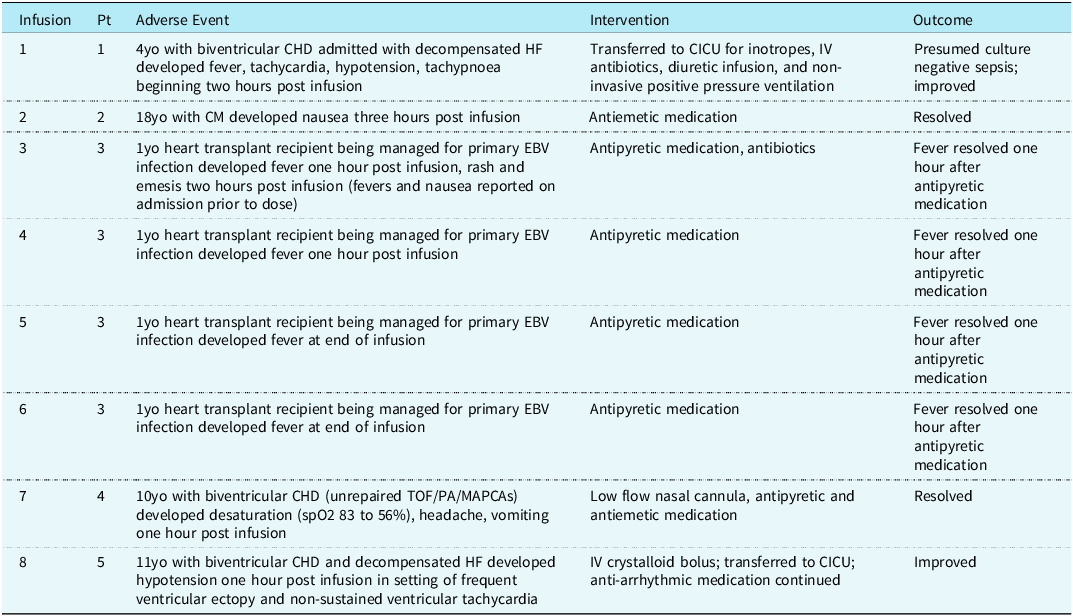
Infusions requiring intervention

Pt indicates patient; yo= year-old; HF= heart failure; IV= intravenous; CM= cardiomyopathy; EBV= Epstein-Barr virus; TOF/PA/MAPCAs= tetralogy of Fallot with pulmonary atresia and major aortopulmonary collateral arteries.
Eight of the 20 infusions associated with adverse events required intervention (Table 2). Six events were managed on the cardiology floor; interventions included supplemental oxygen, antipyretic medication, and/or antiemetic medications, and the reactions resolved within one hour. Two events were associated with an escalation in a patient’s level of care from the cardiology floor to the cardiac ICU. In the first event, an 11 year old, with biventricular CHD admitted with acute-on-chronic systolic and diastolic heart failure and severe biventricular dysfunction, was transferred to the cardiac ICU for hypotension after his blood pressure dropped from 85/50 mmHg to 69/51 mmHg. The hypotension began one hour after completion of the infusion, and the patient’s telemetry demonstrated increased ventricular ectopy from baseline including bigeminy, couplets, triplets, and multiple five-to-eight beat runs of non-sustained ventricular tachycardia. Notably, he had increasing ventricular ectopy and non-sustained ventricular tachycardia throughout the admission and had been started on oral amiodarone a few hours prior to intravenous iron sucrose administration. He received a 5 mL/kg intravenous crystalloid bolus for acute hypotension and continued his amiodarone load with subsequent improvement in ventricular ectopy. In the second event, a 4-year-old with biventricular CHD admitted with acute-on-chronic decompensated systolic and diastolic heart failure requiring milrinone infusion was transferred to the cardiac ICU in the setting of fever, tachycardia, hypotension, and respiratory distress beginning two hours after completion of intravenous iron infusion. There was no wheezing or rash reported on exam, and no documented nausea or vomiting. The patient was started on an inotropic infusion for hypotension, non-invasive positive pressure ventilation for respiratory distress, a diuretic infusion for fluid overload, and broad-spectrum antibiotics; ultimately, he was diagnosed with and completed treatment for culture-negative sepsis.
Impact on iron parameters
The median pre-administration serum ferritin was 152 ng/mL [41 ng/mL, 310 ng/mL], and the median pre-administration transferrin saturation was 11% [8, 14%] (Supplementary Table S1). The median pre-administration haemoglobin was 11.1 g/dL [10.2 g/dL, 13.2 g/dL], the median corpuscular volume was normocytic at 86.9 fL [81.5 fL, 91.4 fL], and the median serum iron level was 41 mcg/dL [30 mcg/dL, 51 mcg/dL] (Supplementary Table S1). Sixty-one patients had haemoglobin <11 g/dL.
Post-infusion laboratory data were available for 57 of 167 dose series and collected a median of 23 days [14 days, 32 days] after administration of the final aliquot. Following iron sucrose administration, there was a statistically significant increase in serum iron, ferritin, transferrin saturation, and haemoglobin; however, there was no significant change in total iron binding capacity or haematocrit (Supplementary Table S1).
Discussion
Intravenous iron sucrose repletion in children hospitalised with cardiac disease is safe. Of the 339 infusions administered over the two-year study period, 20 infusions (6%) were associated with 27 possible infusion-related adverse events in 15 patients. The most frequently observed adverse reactions were hypotension and fever, accounting for more than 60% of all adverse events, with four fever events occurring in a single heart transplant recipient being managed for Epstein-Barr virus viremia. There were no episodes of anaphylaxis or life-threatening events directly attributable to intravenous iron infusion. Two patients required escalation in the level of care following infusion. However, the aetiology of both patients’ escalation was confounded by coincident pathologies—haemodynamically significant arrhythmia in a patient with a history of arrhythmia and sepsis—and the association with the iron sucrose infusion is not clear.
Evidence continues to mount that iron deficiency is associated with worse outcomes among paediatric and adult patients with heart failure, including death, Reference Beavers, Ambrosy and Butler2,Reference Klip, Comin-Colet and Voors4,Reference Cleland, Zhang and Pellicori5,Reference Puri, Price and Spinner14,Reference Higgins, Otero and Jefferis Kirk18,Reference Luxford, Casey, Roberts and Irving13 need for mechanical circulatory support, Reference Luxford, Casey, Roberts and Irving13 and/or transplantation. Reference Luxford, Casey, Roberts and Irving13 Given the challenges with enteral iron absorption, which is exacerbated in patients with heart failure due to increased intestinal wall oedema and upregulated hepcidin levels from chronic inflammation, Reference Beavers, Ambrosy and Butler2,Reference Puri, Spinner and Powers19 and evidence that intravenous iron repletion improves outcomes and functional capacity for adults with heart failure, Reference Beavers, Ambrosy and Butler2,Reference Anker, Comin Colet and Filippatos9–Reference Ponikowski, Kirwan and Anker11,Reference Kalra, Cleland and Petrie8,Reference Lewis, Malhotra and Hernandez7 intravenous iron utilisation has rapidly expanded in paediatric heart failure management. Despite this, herein we present what is, to our knowledge, the first study examining the safety of a commonly utilised formulation of intravenous iron for children with heart failure.
Our data complement prior paediatric reports that intravenous iron sucrose is safe, with mostly minor reported adverse events including rare instances of rashes, tachycardia, and nausea. Reference Boucher, Pfeiffer, Bedel, Young and McGann21 Boucher et al., for example, reviewed 1088 intravenous iron infusions administered to 194 patients at a tertiary paediatric hospital and observed only 20 minor adverse events, despite only 10.3% of infusions being premedicated. Reference Boucher, Pfeiffer, Bedel, Young and McGann21 These observed reactions are hypothesised to reflect labile iron causing direct mast cell activation and subsequent histamine release rather than IgE-mediated hypersensitivity reactions. Reference Boucher, Pfeiffer, Bedel, Young and McGann21 The rate of adverse events was low among our cohort, with only 6% of infusions associated with a potential adverse event.
Hypotension, the most frequently observed adverse event among our cohort, occurred at a higher incidence than previously reported. However, most of the observed hypotension self-resolved; only two of 12 (16%) hypotension events required intervention. This increased observed incidence may reflect differences in retrospective review methodologies, with others performing symptom-based reviews while we performed direct review of vital sign flowsheets. It is also possible that what other studies report as “lightheadedness” or “dizziness” may have correlated with hypotension or considering the majority of episodes of hypotension self-resolved, others did not classify such changes as adverse events. Reference Boucher, Pfeiffer, Bedel, Young and McGann21 Additionally, our study population included only children with cardiac disease, the majority of whom were admitted for heart failure management and prescribed other medications that may cause hypotension (e.g., milrinone, angiotensin-converting enzyme inhibitors, and/or beta blockers). Prior reports did not include patients with haemodynamically significant cardiac disease. For example, in the cohort Boucher and colleagues described, 94% of analysed doses were prescribed by gastroenterology, haematology, or hospital medicine. Thus, with a haemodynamically vulnerable population, typically on multiple medications with vasodilatory and potentially negative chronotropic/inotropic effects, the association of iron sucrose and hypotension is not clear.
Noteworthy in the management of patients with heart failure were the observed, albeit rare, episodes of tachypnoea and desaturation, which required interventions such as oxygen supplementation, non-invasive positive pressure ventilation, and/or increased diuretics. As opposed to “infusion- or medication-related” adverse events, these episodes may reflect the sensitivity of patients with heart failure to volume administration and risk for left atrial hypertension and pulmonary oedema. As with hypotension, given the retrospective nature of this analysis and low event rate, confounding factors contributing to these respiratory effects must be considered. Nonetheless, thoughtful fluid management is critical for children with heart failure, weighing the risk and potential haemodynamic impact of an additional volume load with the benefits of intravenous iron therapy. With this in mind, it may be prudent in some particularly fluid-sensitive patients to administer additional diuretic after iron infusions.
Most prior reports on iron deficiency in paediatric heart failure focused on the association between iron deficiency and worse outcomes. Reference Luxford, Casey, Roberts and Irving13–Reference Phillips, Richmond, Neunert, Jin and Brittenham15 There is a paucity of literature describing the impact of iron repletion on haematologic parameters. Although post-infusion data were limited, available for only 34% of dose series, the available data suggest that intravenous iron sucrose repletion improves iron stores as evidenced by increases in serum iron, serum ferritin, and transferrin saturation. Despite these increases, based on iron parameters following infusion series, determining optimal dosing of intravenous iron sucrose, particularly for children with iron deficiency without anaemia or those with chronic cyanosis and secondary polycythaemia, remains an important area for investigation.
As treatment of iron deficiency has been associated with improved outcomes for adults with heart failure, Reference Beavers, Ambrosy and Butler2,Reference Kalra, Cleland and Petrie8–Reference Ponikowski, Kirwan and Anker11 our study demonstrates that intravenous iron sucrose is safe for paediatric cardiac patients. Future research should investigate the impact of intravenous iron repletion on outcomes for paediatric patients with heart failure.
Limitations
This study is a retrospective review of a single-centre experience with inherent limitations. The sample size is relatively small, and the patient population is heterogeneous with regard to heart failure aetiology and comorbidities, which may represent important confounders. The analysis does not analyse or account for the impact of packed red blood cell transfusion, cardiopulmonary bypass, or oral iron supplementation. Additionally, this study did not exclude patients with significant renal comorbidities and thus does not control for the possible impact renal impairment may have on the haematopoietic system. Post-infusion data were available for a minority of the cohort, limiting the power of these analyses.
Conclusions
Intravenous iron sucrose is safe and well tolerated in hospitalised paediatric patients with heart failure; there were no episodes of anaphylaxis or life-threatening, infusion-related adverse events. Given the relative safety profile of iron sucrose and the benefits intravenous iron has demonstrated in adult patients with heart failure, Reference Beavers, Ambrosy and Butler2,Reference Kalra, Cleland and Petrie8 –Reference Ponikowski, Kirwan and Anker11 there is a need for further investigation of the impact of intravenous iron on outcomes for paediatric patients with heart failure.
Supplementary material
The supplementary material for this article can be found at https://doi.org/10.1017/S1047951125101133.
Acknowledgements
We would like to acknowledge support from the Minogue family Heart Recovery Fund for their contributions to this work.
Financial support
This research received no specific grant from any funding agency, commercial, or not-for-profit sectors.
Competing interests
None.
Ethical standards
The authors assert that all procedures contributing to this work comply with the ethical standards of the relevant national guidelines on human experimentation (United States of America) and with the Helsinki Declaration of 1975, as revised in 2008, and have been approved by the institutional committees (Boston Children’s Hospital Institutional Review Board, IRB#P00045795).