By the late nineteenth century, Harrods no longer belonged to the Harrod family, but rather to a group of stockholders. A devastating 1883 fire burned the business to the ground, and when it arose from the ashes, it transcended its early origins as a grocery store and became a huge department store. Then Charles Henry Harrod's son, Charles Digby Harrod, sold the business to a corporation in 1889. The name remained, Harrods expanded, and became known worldwide. As Deborah Cohen, a prize-winning historian of patterns of British consumption put it, “Its telegraphic message read ‘Everything, London.’ Harrods’ interior . . . the richly plastered ceilings, parquet floors, and stained-glass windows, along with the first escalator in Britain in 1898 drew visitors eager to see the new sensation.”Footnote 1 Thereafter, stockholders began to buy up shares of other department stores in Great Britain when original owners turned the companies into corporations. The age of corporate department stores had begun and Harrods was the emblematic department store. Harrods and the other department stores did very well for many years because they knew British consumer desires. The question remained whether Harrods and other British stores would do so well in other countries and regions in the world, without much knowledge of the markets and before the age of commercial marketing.Footnote 2
It is little known that Buenos Aires became the home of the only named branch of the Harrods, the renowned British enterprise, and its history gives us a chance to explore how businesses operated in different cultural environments.Footnote 3 Buenos Aires had its own Harrods, just as magnificently furnished as the original, which gradually expanded, opened new departments, and finally consisted of several floors, a restaurant and food court, alteration workshops, and several factories scattered around the city. A smaller seasonal branch opened in the beachfront city of Mar del Plata.
The ultimate question became what to sell and what to produce. The consumer desires of female shoppers became the most important and the most complicated. And when the managers and stockholders read sales reports, they didn't always believe that female consumer desires were responsible for the poor sales, and they didn't know how to fix the problem. This situation enables us to understand how gender and business practices intertwined at the onset of international commercial empires.
Before the age of marketing, Richard Burbidge was quoted in a 1913 article in the Journal of the Royal Society of Arts. In reply to a question regarding the “grouping of the departments in a large store,” Burbidge suggested keeping all the departments within easy access of particular groups such as women so that their shopping experiences would be short. When he showed his plan to an unidentified woman because he supposed that “women are responsible for 90 per cent of the retail purchasing throughout the world,” she replied:
How like a man! . . . Your store is designed to sell as little as possible, to discourage people from buying a single thing more than they absolutely need, and to look as if the trade is only half its real value instead of double. Your idea of getting people in and out as quickly as possible is quite wrong; what you have to do is to keep them as long as possible and not let them get away until they have seen everything that by the remotest possibility they can want.Footnote 4
Burbidge went on to comment that he had no idea how to reconcile his ideas with hers. His actions after that date show that he began to think about merchandising, because he modified the Buenos Aires store between 1912 and 1914. To his credit, he eventually moved the women's department to the first floor (the men's department was placed in the ground floor), and the popular restaurant was on the third floor. But if he couldn't figure out how to canvas British women, how could he know Argentine women's taste? As it turned out, the anonymous woman correctly predicted the sales dilemma facing Harrods Buenos Aires in a major focus of the new store: readymade dresses. She did not envision, however, another dilemma: what to produce in the two porteño factories established by Harrods at the same time the store expanded. These two issues led to too many dresses being manufactured and sold, and the blame being placed on the workshops rather than consumer desires.
Burbidge maintained his positive views of female shoppers, but negative ones abounded. Derogatory views of female shoppers and shop girls took the model of Emile Zola's classic 1883 novel Au Bonheur des Dames, the tale of a fictional Parisian department store based on Le Bon Marché, which, not incidentally, became the architectural model for a store in Buenos Aires. Zola found women totally unable to resist shopping. Georg Simmel's 1904 essay “Fashion” explored how consumerism and shopping could help reinforce class identities, while at the same time promoting individualism. He identified women as being particularly susceptible because “the relation and the weakness of her social position . . . explains her strict regard for custom, for the generally accepted and approved forms of life, for all that is proper . . . . Fashion furnished this very combination in the happiest manner.” Fashion became the “valve through which women's craving for some measure of conspicuousness and individual prominence finds vent.”Footnote 5
The history of department store consumption in Latin America focuses principally on the history of fashion and the use of advertisements to lure shoppers. Steven Bunker, however, explored the new significance of department stores in Mexico during the Porfirian period. He linked consumerism to the rise of a middle class in Mexico, principally men. Women there were drawn into the consumer economy by meeting the shopping needs of their families. He tracked the development of department stores in Mexico City, mostly from the perspective of the French entrepreneurs who went there. Kevin Chrisman studied gender and sexuality through Sanborns, the Mexican drugstore that evolved into a department store.Footnote 6 Nevertheless, much work, particularly relating to marketing, needs to be explored.
When Burbidge decided to build a store in Buenos Aires around 1910, he neither asked for nor received help from the British government, which placed its efforts, both diplomatic and commercial, on the import and export of food staples and products related to coal, iron, and steel. He did have the example of the French department store Le Bon Marché. It had purchased land in 1910 on fashionable Florida Street in downtown Buenos Aires, but never opened a store there. Instead, smaller stores on the property eventually became the Galería Pacífico, now home to trendy stores, mostly foreign. Meanwhile the Maples furniture company and other British entities opened their doors in the capital city. They were all attracted to Buenos Aires because of the number of wealthy Argentines who went to London to shop and purchased large quantities of goods. They believed the saying “to be as rich as an Argentine” applied to all Argentines.
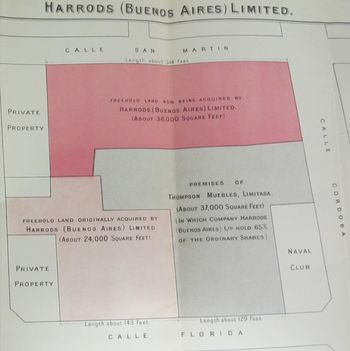
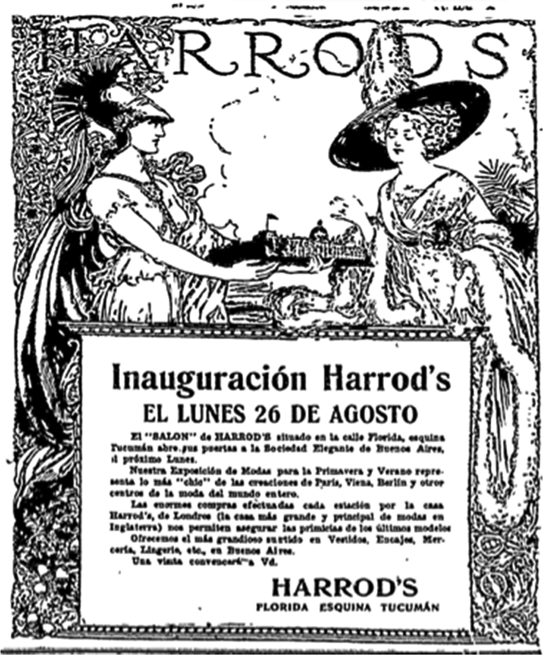
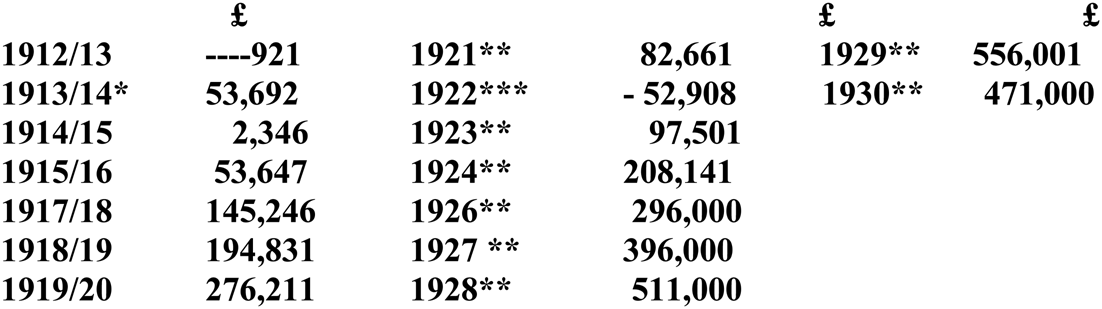
Burbidge relied on his son Woodman to find the ideal spot and to talk to upper-class Argentine businessmen about the feasibility of opening a new store. The decision to locate on Florida Street came from conversations with Enrique “Henry” Thompson, who persuaded Woodman that linking up with his furniture store would be profitable. Harrods moved next door to Thompson Muebles and eventually bought 65 percent of Thompson's shares, which never offered a dividend. For funding, Burbidge relied on the members of the Harrods board of directors who approved of the project, and after 1912, sold the idea to other members of the board by offering them access to preferred shares in the enterprise. Over the years, members of the Burbidge family in positions of authority carried out the dreams of Richard Burbidge (see Figures 1–3).
Building layout, Harrods Buenos Aires, 1913 prospectus, London Times

Opening ad, Harrods

Harrods Buenos Aires Profits, 1912–1930

The first Buenos Aires store opened on Florida Street in 1912 by Burbidge and his friends heeded the gendered observations about women and shopping. The new store focused on female shoppers and dresses, and did not pay attention to male fashions until it began its expansion in 1914. Two factories opened to produce women's fashions similar to those in London, and hired women to produce them. By 1920, the purchase of the local Gath & Chaves department store chain by Harrods Buenos Aires made the combined factories and stores in the Argentine and Chilean capital cities into the first department store empire in the Americas and one of the largest employers of women in Buenos Aires. Burbidge's son Woodman proposed great expansion into other Latin American countries in 1919.Footnote 7 And, in 1920, Harrods Buenos Aires purchased Gath & Chaves and expanded into the Argentine interior and Uruguay.
How successful was Harrods Buenos Aires? In a letter dated November 5, 1914, Woodman commented on the poor sales for that year. He blamed that principally on the outbreak of the war, and bad weather. Still presuming that wealthy women comprised the store's main clientele, he claimed they would not leave their homes on inclement days. More likely was his second explanation—poor choices by buyers:
When making their first purchases all our buyers did not understand clearly the class of clientele we would have. Consequently, some of the goods were not very appropriate, and we had to keep them in our reserve and endeavor to clear them off at the sale. . . . We reckoned in having larger sales than we than we did have, and, therefore, all fashion goods . . . were marked at exceedingly low prices so as to avoid still greater loss.Footnote 8
As for ready-to-wear dresses, the situation was drastic. Buyers had purchased goods of very low quality at high prices. Even with sales, no one wanted to buy. Furthermore, expenses at the workshops were very high because the styles were unfamiliar to the seamstresses. What the report did not mention was that middle- and upper-class women simply didn't want to buy the dresses.
True to the anonymous woman's prediction, Harrods Buenos Aires had a hard time selling its dresses. Affected by World War I, Harrods had to depend on local production for much of its stock. Furthermore, the rich women who went to London did not become the principal clients of the store. Before and after the war, these women preferred to shop in London, and the war affected their buying power, which was based mostly on commerce in cattle products and cereals. Middle-class women shopped at Harrods Buenos Aires, but their buying power was much more limited. Harrods soon turned to its female employees to purchase post-season goods at bargain prices.
Another reason women bought few dresses was because it was very inexpensive to have modern dress designs created by seamstresses and dressmakers (modistas). And, while shoppers purchased fabrics, especially during sales, they could also get ideas on the latest fashions. Ads from Harrods and other stores also inspired women to special-order dresses from their own dressmakers. Similarly, men preferred to have their suits hand-made, and poor men purchased suits secondhand and then took them to tailors to repair and alter them.Footnote 9 So the problem was not due to sexism, but rather to the lack of market knowledge.
Harrods had so many reduced-price sales that a 1914 article in La Razón, a local newspaper, claimed that the store depended on the sales of the previous year's models to make a profit. Harrods responded vigorously, on April 3, 1914, that only current-year models were sold there. This meant that the store had to find another outlet for the unsold dresses. The fact is that unsold stock became a mainstay of Harrods’ inventory.Footnote 10 To get rid of this stock, a store dedicated to employees of both Harrods and Gath & Chaves, which Harrods had recently purchased, opened in August 1919 to sell existing surplus stocks. By November, it was estimated that workers—a far cry from upper-class women—purchased 42 percent of all goods. Yet even this failed to end the problem of surplus merchandise.Footnote 11
There is no evidence that Burbidge and his associates consulted the various census figures published in Argentina. If they had, they would have noticed that in 1914, one of Buenos Aires’ principal textile “industries” consisted of seamstresses, modistas, and tailors who made dresses and suits by hand, just as they did all over Argentina. Indeed, it wasn't until the 1940s that store managers again began to emphasize the sale of ready-to-wear dresses. In the Harrods (London) archives, no copies exist of a 1918 US report titled Wearing Apparel in Argentina, compiled by reports from the US consulate and comparing Harrods to other stores.Footnote 12 But Harrods Buenos Aires managers watched the sales reports carefully. Consequently, Harrods Buenos Aires ads flooded the porteño newspapers with a new campaign. Instead of focusing on dresses and men's suits, they advertised women's underwear, men's haberdashery, furniture, and children's clothing, from newborn to school-age.
A 1935 industrial census identified 2,782 textile factories with 53,323 employees. The industry in Buenos Aires had expanded greatly despite the world recession. These numbers did not include the men and women working at home by the piece.Footnote 13 In fact, there were so many “modistas” that in the extensive report on sales in 1937, the buyer for children's dresses complained that “competition was daily getting keener and more audacious, for a great many little specialist shops had sprung up, whose modelists as well as other private dress-makers came personally to the shop-windows of our Store [in Buenos Aires] and very often to the interior of the department itself and, pencil in hand, ostensibly copied the designs of whatever models were to their liking.”Footnote 14 No attempt was ever made to verify if this happened in other departments, but it indicates the challenge facing Harrods Buenos Aires.
Burbidge remained as general manager of the London and Buenos Aires stores until his death in 1917, shortly after having been knighted and made a baron for his efforts during World War I. In 1921, Woodman took over as chairman of Harrods Buenos Aires’ board of directors. Regardless of which stockholder, member of the Burbidge family, or local manager was in charge of the Buenos Aires store, they couldn't always figure out what women wanted. Yet close attention to the 1914 sales report showed what women they wanted.
The report covered January 1, 1914, to August 31 of that year, and was addressed to Woodman Burbidge. While women's dresses “could hardly be poorer,” fabrics did well, along with blouses and skirts, corsets, linen, shoes, layettes, men's perfumes, and boys’ suits. The tea room did very well, along with candy. This shows that consumers wanted fabrics to take to their modistas, small pieces of women's clothing including underwear, presents for babies and men, and shoes. Foods to eat inside and outside the store gained thorough approval.Footnote 15
By 1937, there were more than 60 departments in the store, but most had not presented spectacular sales. Profits came from hiking the prices in most departments, instead of relying on sales. This meant that the amount of unsold stock increased in each department. One bright light came from the perfume department, because it began to stock Elizabeth Arden cosmetics. Fancy soaps had become a favorite purchase. Once again, dresses were not as important as the purchase of blouses, corsets, gloves, and similar items. The greatest increases came in the sale of foods and chocolates, while a new department would be created for layettes. While some departments such as the tea room were given a rank (it was number 10), most were not. What can be gleaned from the 1937 report is that women enjoyed socializing in the tea room and purchasing small items of clothing for themselves and for children. Layettes were ideal presents for the newborn. For dresses, they purchased fabric and took it to dressmakers. This picture suggests both rationality and careful shopping by the women, who after enjoying their searches went upstairs for lunch or tea.Footnote 16 It also demonstrates how analysis of female consumer patterns helped managers and the board of directors assess sales.
Harrods Buenos Aires created profits by constantly enlarging its premises and introducing new goods. This also meant increased indebtedness and limited dividends to common shareholders, while stockholders on the board of directors almost always got dividends from their preferred shares. Women dictated the future of the company, but it is clear that neither a suggestion box nor survey was used to find out what women or men wanted. Instead women made choices that emphasized social patterns, gifts, small items, and economic ability to consume advertised goods, while managers focused on sales reports.
We can congratulate Richard and Woodman Burbidge for figuring out what women wanted, and the women of Buenos Aires for buying based on need as well as desire. Perhaps we can call the incident of the unwanted dresses the beginning of modern merchandising in Argentine department stores and the bringing of British commercial imperialism to Latin America.