1. Introduction
Any account of the *amn't gap is concerned with the realisation of negation. Negation in English is chiefly encoded in three ways: not-negation, as in We should not be doing this; negative polarity items (NPI), as in Nobody was available for comment; and affixation, as in We are unable to agree to this (cf. Tottie Reference Tottie1991, Yaeger-Dror, Hall-Lew & Deckert Reference Yaeger-Dror, Hall-Lew and Deckert2002). Of these methods, not-negation is the most common (Tottie Reference Tottie1991), but not-negation can itself be realised in three ways: as a full form, (1a), as an aux-contraction, (1b), or as a not-contraction, (1c).Footnote 2
- (1)
(a) I cannot believe it. We will not be long. She is not responsible.
(b) — We'll not be long. She's not responsible.Footnote 3
(c) I can't believe it. We won't be long. She isn't responsible.
The full form is described as being typical of formal writing; in academic papers, for example, a not-contracted form such as can't is often regarded as stylistically poor. In speech the full form may encode formality, but it may equally be used to signal emphasis. Contracted forms are much more common in speech (Yaeger-Dror et al. Reference Yaeger-Dror, Hall-Lew and Deckert2002) and written dialogue includes more contractions to reflect this. An aux-contracted form can be characterised as a phonologically reduced auxiliary which has been cliticised to the subject. But, as Anderwald (Reference Anderwald2002, Reference Anderwald and Kortmann2004) points out, not all auxiliaries can contract. Do, must, need, might, may, could and ought do not permit aux-contraction. A not-contracted form can be characterised as having a phonologically reduced n't which is cliticised to the preceding auxiliary ([nɑt]>[nt]>[ɪznt]). The precise nature of not-contracted forms will be scrutinised closely in section 4 of the paper.
Any study of the *amn't gap is primarily concerned with not-negation. This can be illustrated by the data in (2).
- (2)
(a) I am hungry.
(b) I am not hungry.
(c) I'm not hungry.
(d) *I amn't hungry.
(e) I am hungry, aren't I? *I am hungry, amn't I?
The examples in (2) set up a contrast between the positive form in (2a) and negative forms in (2b–e). When forming the negative of the first person singular present tense, it is possible to use the full form (2b) or the aux-contracted from (2c), but it is not possible to use the not-contracted form (2d) in a declarative structure in many varieties of English. If the not-contracted form is used in an interrogative (2e), then aren't I is written rather than amn't I. In other words, the claim is that most varieties of English do not behave as would be expected when it comes to the negative form of the first person singular of be. If the forms in (2) are compared with those in (3), it is clear that this problem is not encountered in any other form of be.
- (3)
(a) She is hungry.
(b) She is not hungry.
(c) She's not hungry.
(d) She isn't hungry.
(e) She is hungry, isn't she?
If the present tense negative forms are set out paradigmatically for both declarative and interrogative, the gap is very striking:
- (4)
DeclarativeInterrogative
— we aren't aren't I aren't we
you aren't you aren't aren't you aren't you
he/she/it isn't they aren't isn't he/she/it aren't they
Hence the claim is that for many varieties of English there is a gap in the paradigm caused by the fact that *I amn't is not grammatical. It is crucial to note, however, that the argument sketched above turns on an orthographic representation of the paradigm and, as we shall see shortly, it is precisely this focus on the orthographic form that has obscured the issue in some varieties of English and led to claims that there is an *amn't gap.
A number of accounts in the recent literature have set out to explore why this gap has arisen in standard varieties of English: Hudson (Reference Hudson2000) and Anderwald (Reference Anderwald2002)Footnote 4 for Standard British English (SBE), and Bresnan (Reference Bresnan, Baltin and Collins2001) and Frampton (Reference Frampton2001) for Standard American English. These accounts are couched within frameworks as diverse as Word Grammar, Lexical Functional Grammar (LFG) and Optimality Theory (OT), but, despite this, they share three common assumptions. First, and central to all of them, is the fact that be is the only verb in English to have a distinctive first person singular present tense form. Secondly, they are essentially concerned with standard forms of English.Footnote 5 Thirdly, and of most importance to the present paper, they assume that the *amn't gap arises in the grammar. In contrast, the present paper questions all these assumptions. First of all, the main focus of this paper is on not-contracted forms in one specific non-standard variety of British English: West Yorkshire (WY). This variety presents an interesting case because not-contraction has to be further subdivided.Footnote 6 Petyt (Reference Petyt and Trudgill1978) characterised this as a division between primary contracted forms such as shouldn't [ʃʊd t] and can't [kaːnt], and secondary contracted forms [ʃʊnt] and [kaːt] respectively.Footnote 7 As far as I amn't is concerned, West Yorkshire can use [aːnt] or [aːt]Footnote 8 for both declaratives and interrogatives. So the examples in (2) will be subtly different for WY:
- (5)
(a) I am hungry.
(b) I am not hungry.
(c) I'm not hungry.
(d) I [aːnt]/[aːt] hungry.
(e) I am hungry, [aːnt]/[aːt] I?
Note that (5d) avoids the usual convention of representing the relevant form as I aren't hungry. This is the standard orthographic form assigned to this non-standard structure, but one thrust of the present paper is to argue that forms such as that in (5d) should be written as amn't rather than aren't. I shall argue in section 4 below that it is through the application of secondary contraction to amn't that these forms have been produced. Therefore, it is irrelevant that be is the only verb with a distinct first person singular present tense form, because all common auxn't forms have been treated in exactly the same way. Historical and contemporary data will be used to trace the history of not-contraction over the past hundred years or so in WY. This will allow us to pursue a morphophonological approach to the *amn't gap in which, as a result of secondary contraction, amn't and aren't become homophones realised as [aːnt] or [aːt]. On this basis, I will argue that there is no *amn't gap in WY and it would appear that there never has been a gap. Once this has been explored, I will consider the implications of this discussion for the *amn't gap in Standard British English. More specifically, I shall argue that Standard British English (SBE) appears to have taken a similar path to WY, but at a much earlier date. The benefit of setting SBE against the WY backdrop is that WY provides a much clearer picture of what has happened simply because data demonstrating the sequence of events is available. As we will see, one consequence of this comparison is that we can see that where one can still argue for an *amn't gap, it is not grammatical in nature.
The paper is structured as follows. In section 2, I briefly consider recent accounts of the *amn't gap for SBE: Hudson (Reference Hudson2000) and Anderwald (Reference Anderwald2002). Section 3 provides a brief overview of Usage-Based Phonology, since this is the framework in which the analysis will be set. Section 4 sets out the WY data and considers what is meant by contraction. It further considers whether forms such as didn't, shouldn't, etc. can be assumed to be contractions at all, and looks at the alternative: that n't is an inflectional suffix. This section concludes by investigating the role of so-called secondary contraction in the *amn't gap. Section 5 concludes the paper by considering the implications of the analysis developed in this study for the *amn't gap in Standard British English.
2. Recent accounts of the *amn't gap
2.1 Hudson (Reference Hudson2000)
Hudson (Reference Hudson2000) takes a morphological approach to the *amn't gap and assumes that central to this gap is the fact that be is the only verb in English to have a special first person singular form. At the heart of his analysis is what he calls a ‘Nixon diamond’ conflict:Footnote 9 that because of this fact about be, an unresolvable conflict arises between first person singular am and the default negative form aren't. In standard forms of English, when someone wishes to produce a first person singular form of be which is also negative, this conflict produces a gap in declarative sentences, because neither am nor aren't is exactly what is required. In interrogatives where aren't I is used, this is the result of stipulation.
Hudson assumes that negative forms are built from scratch by rules, and he follows Zwicky & Pullum (Reference Zwicky and Pullum1983) in assuming that n't is an inflectional suffix. (I will consider Zwicky & Pullum's claims in detail in section 4.2.2 below.) For Hudson, negative verbs are formed by taking the Positive form, or pos-form, and adding n't. For example, is is a pos-form which contains the stem i plus the -s of 3rd person singular; together this produces the s-form: is. Hudson (Reference Hudson2000: 305) provides a functional analysis of isn't or <be, tensed, 3.sg, neg>:
- (6)
(a) The stem of <be, tensed, 3.sg, neg>is i.
(b) The s-form of <be, tensed, 3.sg, neg>is i+s.
(c) The pos-form of <be, tensed, 3.sg, neg>is i+s.
(d) The whole of <be, tensed, 3.sg, neg>is i+s+n't. (Hudson Reference Hudson2000: 305)
Hudson states that what is crucial here is that the positive form is defined by another function: the s-form. For aren't the analysis is set out below in (7).
- (7)
(a) The stem of <be, tensed>is ɑ.
(b) The pos-form of <be, tensed>is its re-form.
(c) The re-form of <be, tensed>is the stem+re.
(d) The whole of <be, tensed, neg>is ɑ+ re+n't. (Hudson Reference Hudson2000: 306)
Am is not an s-form, but is described by Hudson (Reference Hudson2000: 306) as a whole. Because it is not an s-form it cannot be the pos-form and hence cannot take the suffix n't.
(8) The whole of <be, tensed, 1.sg> am
When creating the first person singular present tense negative form, am is required for the first person singular present tense, but because it is a whole it cannot take n't. Aren't encodes negative and present tense, but it crucially lacks first person singular information. This is why, Hudson claims, an unresolvable conflict arises and this results in the *amn't gap in standard and many other varieties of English. The gap is not particularly problematic for declarative constructions, because as the data in (9) illustrates, there is an alternative.
- (9)
(a) I am not your friend.
(b) I'm not your friend.
(c) *I amn't your friend. (Hudson Reference Hudson2000: 308)
(9c) is not a possibility for the reasons set out above. (9a) is one possibility, but could be overly formal or overly emphatic. (9b) is available and is informal. It may be emphatic, but it does not have to be. So (9c) can easily be avoided. However, in interrogative forms the gap has to be plugged by stipulation because there is no alternative.
- (10)
(a) Am I not your friend?
(b) *’m I not your friend. (Hudson Reference Hudson2000: 309)
In the interrogative, the only choice available is between a full form and a not-contracted form, since the aux-contracted form cannot offer an alternative. Hudson (Reference Hudson2000) claims that the *amn't gap has to be plugged somehow in order to achieve the appropriate level of (in)formality and, as a result, aren't is stipulated.
Varieties which use amn't, aren't or ain't in the declarative are said to have ‘plugged the gap’. Hudson (Reference Hudson2000) assumes that amn't and aren't varieties have essentially the same grammar as standard English. In other words, the same unresolvable conflict arises but is resolved by selecting a different form: amn't or the default aren't. Some varieties have adopted ain't and generalised its usage, thereby plugging the gap. (In section 5, I shall briefly consider the relationship between ain't, amn't and aren't.)
Before concluding this brief overview of Hudson's analysis, it is worth considering a comment that he makes about the amn't form: ‘we don't know how to pronounce (or write) the word, and we can't use it’ (Hudson Reference Hudson2000: 302). This is very revealing and Hudson is not the only commentator to make this kind of remark about amn't. This form should be an easy and reasonably common form to use and the fact that it generates such feelings of anxiety suggests that prescriptive forces are undermining grammatical reality. I will revisit the significance of this kind of comment in section 5 below.
To conclude, Hudson (Reference Hudson2000) provides an excellent illustration of the way in which the *amn't gap is created by the grammar. It also demonstrates the problem caused by the fact that be is the only verb to have a first person singular present tense form, and it focuses primarily on Standard British English.
2.2 Anderwald (Reference Anderwald2002)
Anderwald (Reference Anderwald2002: 89) criticises Hudson (Reference Hudson2000) for ignoring the importance of aux-contracted forms. For Anderwald, I'm not ‘is more than a stylistic alternative’ and the use of aux-contracted forms is central to explaining why the *amn't gap arises.Footnote 10 The main source of Anderwald's data is the British National Corpus (Anderwald Reference Anderwald2002: 7).Footnote 11 Anderwald (Reference Anderwald2002, Reference Anderwald and Kortmann2004) claims that a hierarchy reversal lies behind the *amn't gap. For be (present tense) the preferred strategy is said to be aux-contraction rather than not-contraction – I'm not, he's not, we're not are preferred to I amn't, he isn't, we aren't.Footnote 12 The reverse is true for all other auxiliary forms. Anderwald (Reference Anderwald2002: 80) represents this as follows:
- (11)
(1) Hierarchy for be (present tense)
aux-contraction>not-contraction
(2) Hierarchy for all other auxiliaries (except be)
not-contraction>aux-contraction
If one adopts the hierarchy-reversal account, then any variety which avoids a not-contracted form of am is preferred to one which selects one, because such a variety is taking the unmarked option. However, it is not clear why isn't and aren't should be assumed to be as marked as amn't. If there is an *amn't gap, then we might expect isn't and aren't to have such a gap as well, and yet the data in (4) above show that the *amn't gap cannot be extended to isn't. By the same token, we must ask if aux-contracted forms are really marked for all other auxiliaries. Clearly the response depends on the definition of markedness. Anderwald seems to be equating markedness with frequency of occurrence, but in doing so, she is taking some forms as marked, e.g aren't, which others adopt as the unmarked/default (cf. Hudson Reference Hudson2000).Footnote 13 Finally, to what extent is it useful to talk about a preference for not-contraction over the more ‘marked’ aux-contraction, when for many auxiliaries, as Anderwald herself notes (2004: 51), aux-contraction is not available at all? Clearly, invoking markedness is not particularly helpful. There is, however, one respect in which Anderwald's discussion is both important and revealing: her corpus based studies suggest that there is indeed a preference for aux-contraction rather than not-contraction for present tense be. Even if this preference does not create a gap, it may perhaps play a role in making the gap largely irrelevant (a point we will return to in section 5).
There is one final aspect of Anderwald's (Reference Anderwald2002) discussion which is pertinent here: the possibility that the unpronounceability of [mn] might lie at the heart of the *amn't gap (see also Francis Reference Francis and Viereck1985).Footnote 14 Anderwald ultimately rejects this as a solution, because in words like damn, solemn and column it is the /n/ that is deleted, not the /m/. However, such data do not provide a helpful comparison. First of all, the /n/ in such forms surfaces when it can be syllabified in a distinct syllable: dam.na.tion, dam.na.ble, co.lum.nar, so.lem.ni.ty. The /n/ is only deleted in cases where it would have to occupy the coda together with /m/. Secondly, placing the focus on such data also places the focus on the special first person singular form of be. One thrust of this paper is to claim that other auxiliary verbs have also been subject to the same phonological process and, we shall see, for reasons of sound phonological parsing. So it would seem that focusing specifically on the /mn/ sequence obscures the true nature of the phenomenon.
This brief overview of some recent accounts of the *amn't gap should illustrate that for such researchers the gap is assumed to be a grammatical one. We have also seen that because of the focus on the importance of the first person singular present tense form, phonological considerations are never fully explored, but are dismissed too quickly. In what follows, I shall look at the realisation of not-contraction in contemporary WY, followed by a consideration of not-contraction in the 19th century. Once these are compared, it will become clear that WY does not have an *amn't gap and never has had one. It will also become clear that WY over the past 130 years or so demonstrates three distinct pronunciations for amn't.
Much of the discussion that follows could be couched in derivational phonology or within a constraint-based approach such as Optimality Theory. However, a Usage-Based approach to morphology/phonology such as that proposed by Bybee (Reference Bybee2001, etc.) provides a useful framework within which to set the overall discussion and analysis, for reasons that should become clear as we proceed. Therefore, the next section will provide a brief introduction to some of the main ideas behind Bybee's Usage-Based Phonology.
3. Usage-Based Phonology
The discussion that follows will draw upon certain key notions of Usage-Based Phonology. Central to Usage-Based Phonology is the idea that frequency of use is an important factor that should inform any phonological account. If a structure occurs frequently, then the probability that it, rather than some other structure, will occur forms part of the speaker's linguistic experience. Pierrehumbert (Reference Pierrehumbert2001a) points out that language acquisition must involve some encoding of probability and argues that throughout life speakers are able to update probability based on their experience. Bybee (Reference Bybee2001, Reference Bybee2002), Blevins (Reference Blevins2004) and Hume (in press), amongst others, argue that frequency of use contributes to language change. Bybee (Reference Bybee2001: 1) claims that:
[T]he frequency with which individual words or sequences of words are used and the frequency with which certain patterns recur in a language affects the nature of mental representation and in some cases the actual phonetic shape of words.
Of particular relevance to the present paper is the fact that much of Bybee's discussion is concerned with the precise nature of the stored unit: morpheme, word or phrase. She takes the view that what is stored are not individual morphemes but rather chunks comprising frequent collocations. Bybee & Scheibman (Reference Bybee and Scheibman1999) and Bybee (Reference Bybee2001) give auxiliary verb+negative, e.g. don't, can't, etc., and forms such as I don't know and last year as examples of collocations. She assumes that if a word or phrase is repeated regularly, then this will make the lexical representation of that word or phrase stronger. A strong lexical representation will be more easily accessed, and novel forms will be easier to pronounce if they closely match a form with lexical strength.
Bybee (Reference Bybee2001, etc.) employs an exemplar-based approach to model Usage-Based Phonology. In such an approach all perceived utterances are stored and instances of the same phenomenon form exemplar clouds/clusters. However, it is not just phonetic information that is stored: information about the phonetic context, morphological context, social context, etc. is stored as well. Bybee (Reference Bybee2001: 52) suggests that an exemplar model allows one to say that frequently used tokens will have lexical strength, whereas relatively infrequent tokens will quickly be lost from the memory. Since exemplar clouds/clusters encode all the information perceived, they will also, over time, accommodate change (Pierrehumbert Reference Pierrehumbert, Bybee and Hopper2001b, Bybee Reference Bybee, Restle and Zaefferer2003). Bybee (Reference Bybee2001: 7) argues that:
[G]eneralizations over forms are not separate from the stored representation of forms but emerge directly from them. In Langacker's terms, there is no ‘rule/list separation’. … Generalizations over forms are expressed as relations among forms based on phonetic and/or semantic similarities. New forms can be produced by reference to existing forms, but most multimorphemic words are stored whole in the lexicon.
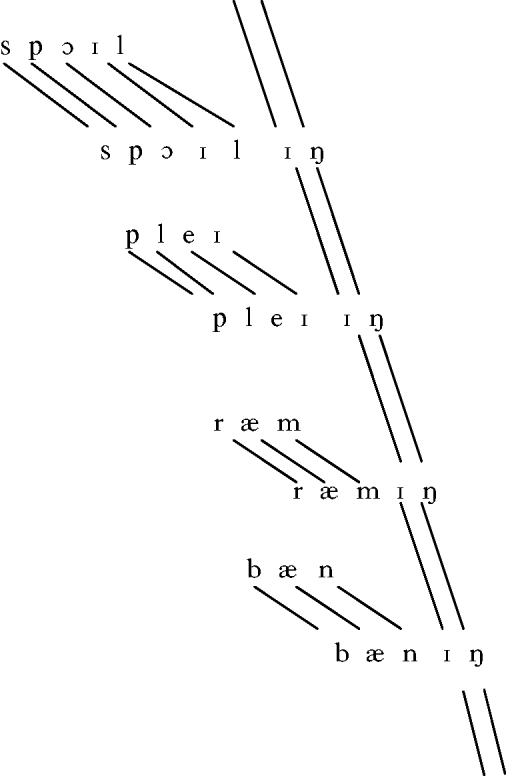
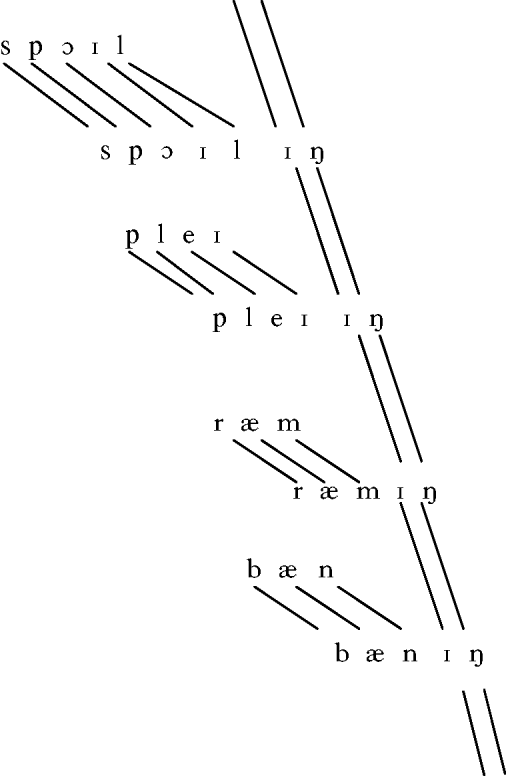
Bybee (Reference Bybee, Restle and Zaefferer2003: 70) argues that generalisations arise from these exemplar clouds/clusters. Generalisations are reflected by schemas like that in figure 1 above. Alternatively, this can be represented schematically as in (12).
(12) [[VERB] ɪŋ] progressive participle
Bybee's point is that although we can extract this generalisation from the material stored, it does not follow that people actively construct the progressive participle every time they use it. As the forms are used they reinforce the structures, and the more often something is used the greater its lexical strength.
Schema representing the connections between verb base and progressive participle forms (Bybee Reference Bybee2001: 24).
The main reasons why the Usage-Based approach is being employed here is that first of all, it embodies an approach to morphology which many assume: structures are not necessarily constructed from scratch each time they are used. Bybee addresses the question of precisely what is stored. Secondly, Bybee assumes that with use comes reduction. She assumes that frequent collocations become stored and are then very likely to undergo phonological reduction processes. With this in mind, the following sections will look at auxn't forms in West Yorkshire and consider whether such structures are created from scratch each time they are used, or rather are stored as wholes. Furthermore, we will find that Bybee's approach allows us to account for contemporary WY forms in a way that other approaches cannot.
4. West Yorkshire not-contraction and the *amn't gap
In addition to using the aux-contracted form I'm not in declaratives, West Yorkshire speakers may use I [aːnt] or [aːt] (written orthographically, though inappropriately, as I aren't), where [aːt] is derived from [aːnt]. These forms can be used for both declaratives and interrogatives.
- (13)
(a) I [aːnt]/[aːt] doing that.
(b) I [aːnt]/[aːt] that hungry at the moment.
(c) I am doing that, [aːnt]/[aːt] I?
In Hudson's terms, then, WY appears to be an example of a variety where the *amn't gap has been ‘plugged’ by the default: aren't. There is an alternative analysis, however, which does not assume that I [aːnt]/[aːt] is a manifestation of the default, but rather that [aːnt]/[aːt] are in reality manifestations of amn't. In what follows, I shall argue that just as [aːt] is the secondary contracted form of [aːnt], so [aːnt] is itself a secondary contraction of amn't.
The remainder of this section will be structured as follows. I will begin by looking more closely at secondary contraction as characterised by Petyt (Reference Petyt and Trudgill1978), examining how this affects auxn't forms in contemporary WY speech. I will then look more closely at what is meant by contraction and consider the relationship between contraction and secondary contraction. In so doing, I will consider whether or not contemporary auxn't forms are truly examples of contraction. Two alternative analyses will be considered here: n't as an inflectional suffix (Zwicky & Pullum Reference Zwicky and Pullum1983, Hudson Reference Hudson2000, Anderson Reference Anderson2005), and auxn't forms as lexicalised portmanteaus. Having established precisely what secondary contraction is and how contemporary auxn't forms should be analysed morphologically, I will turn my attention to Wright's 19th-century data to determine how not-contraction manifested itself in the past and whether or not this supports the claim that /amnt/>[aːnt] >[aːt] is ‘derived’ by the same phenomenon. I will conclude the section by considering the implications of the discussion for the *amn't gap in WY. This discussion sets up the possibility, explored in the final section of the paper, that the precursors of SBE, and closely related varieties, may have developed alternative manifestations of amn't in much the same way, but at a much earlier stage than WY. Indeed, Jespersen (Reference Jespersen1917) toyed with exactly this kind of solution, but lacked the WY detail. The importance of the West Yorkshire data, therefore, is that the development of not-contraction involving secondary contraction is visible, whereas in Standard English it is not.
4.1 Contemporary West Yorkshire auxn't forms: Petyt (Reference Petyt and Trudgill1978) and beyond
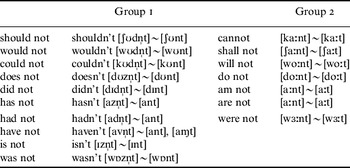
West Yorkshire English is well-known for its treatment of not-contracted forms whereby shouldn't /ʃʊdt/ becomes [ʃʊnʔ], wouldn't /wʊdt/ becomes [wʊnʔ] and couldn't becomes [kʊnʔ] (see e.g. Petyt Reference Petyt and Trudgill1978, Reference Petyt1985; Anderwald Reference Anderwald2002; Wales Reference Wales2006). Petyt (Reference Petyt and Trudgill1978, Reference Petyt1985) describes this phenomenon as secondary contraction, whereby auxiliary+not contractions appear to undergo a further, or ‘secondary’, contraction. However, as the data in table 1 reveals, the process is one of phonological deletion rather than contraction.Footnote 15, Footnote 16
Examples of primary and secondary contraction following Petyt's (1978) classification.

The examples in table 1 follow Petyt's classification of auxn't forms into two groups. Group 1 forms lose the final consonant of the auxiliary during secondary contraction, whereas Group 2 forms appear to lose the /n/ of the negative n't. Petyt captured the generalisation using the rewrite rule in (14):
(14) C→Ø/V _ C12 (Petyt Reference Petyt and Trudgill1978: 92)
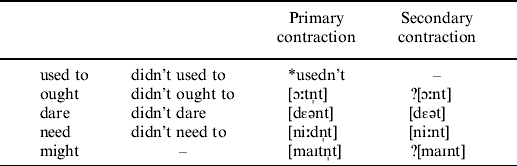
Auxiliaries such as used to, ought, dare, need and might are missing from table 1, since, with the exception of might, these auxiliaries can form the negative in the same way that main verbs do: don't dare, don't need, didn't ought, didn't used to. Indeed, Petyt (Reference Petyt and Trudgill1978) notes that used to can only form its negative in this way. In contemporary WY this seems also to be increasingly true of ought. Although Petyt (Reference Petyt and Trudgill1978) records [ɔːnt], as the secondary contracted form of oughtn't, I have no data to suggest that [ɔːnt] is still used. Although I am reluctant to rule it out completely, as a native speaker of this variety I use the construction didn't ought, and find [ɔːnt] distinctly odd. Table 2 summarises not-contraction for these auxiliaries.
Treatment of miscellaneous auxiliary+n't.
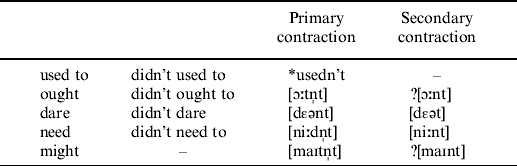
Mustn't has not been included in either Table 1 or Table 2 because it is complex in two respects. First of all, WY had two positive forms for must historically: mun (which has a weak form [mən]) and must (Wright Reference Wright1892: 151–152). Wright doesn't record a negative form for must, but does record a negative for mun.Footnote 17 This old form and its negative are increasingly rare in contemporary WY, but speakers who use them also use must and its negative. This sufficiently complicates the picture that we cannot be sure whether [mʊnt] is a secondary contraction of [mʊst], as Petyt (Reference Petyt and Trudgill1978) suggests, or a form of negative mun. (We will return to consider mun and not-contraction in 19th-century West Yorkshire speech below.) Secondly, for those speakers who do not use mun or [mʊnt] (the author included), [mʊst] cannot be treated as a secondary contraction of [mʊstt]. [mʊst] is used in many other British English varieties, and it seems plausible to assume that [mʊst] has been derived from [mʊstt] by t-elision. Clearly the picture is complex in this case, so mustn't has not been included here.
It is interesting to note that secondary contraction creates homophones (i.e. [ant]) for haven't, hasn't and hadn't. Probably because these forms maintain a distinct orthography, this homophony does not excite condemnation. If the application of secondary contraction can remove the final consonant of the auxiliary and if it can give rise to homophones, then we must consider the possibility that [aːnt] has been derived from /amnt/ by secondary contraction. In other words, the claim is that secondary contraction could be responsible for amn't being pronounced [aːnt]/ [aːt]. This in turn means that secondary contraction would have resulted in the creation of homophones for amn't and aren't.
Now that we have considered the auxn't data in some detail, a second issue arises from the present discussion: secondary contraction is not an accurate label for what appears to be a straightforward consonant deletion process. It may be that Petyt used it to capture the fact that not appears to be contracting further into the auxiliary, in the sense that the auxiliary and the n't appear to be blending. If this is what he intended, then it is quite an insightful label. Below I will explore what is meant by contraction in order to offer a proposal for why ‘secondary contraction’ applies at all and ultimately to demonstrate its role in the *amn't gap.
4.2 What is secondary contraction?
Perhaps the best way to address this question is to start by asking, what is contraction? Radford (Reference Radford2004: 331) defines contraction as ‘a process by which two different words are combined into a single word, with either or both words being reduced in form. For example, want to >wanna, going to >gonna, he is >he's, did not >didn't’. Harley (Reference Harley2004: 283) defines contraction as ‘a single phonological word that is created when a listeme that can be pronounced as an independent phonological word is reduced and attached to another independent word, as in can't, I'm, it's’. These definitions suggest that contraction involves both a morphological and a phonological component. The morphological part of contraction is cliticisation. Indeed, Harley (Reference Harley2004: 238) incorporates the definition of ‘clitic’ within her definition of contraction. The phonological part of contraction is a reduction which can be a vowel reduction/loss or a consonant loss. The not-contracted forms appearing in both Radford's and Harley's definitions suggest that phonological reduction affects the negative element only, since this is a reduced form of not [nɑt] >[nət] >[nt]. However, given the WY cases, where the host can also undergo phonological reduction, it might at first seem plausible to argue that so-called secondary contraction is simply part of the phonological component of contraction. This seems particularly plausible for Group 1 forms such as shouldn't and didn't where the final consonant of the auxiliary is affected (/ʃʊdnt/>[ʃunt], /dɪdnt/ >[dɪnt]); but this would not explain the disappearance of what would appear to be the first consonant of the n't in Group 2 forms such as don't /doːnt/ >[doːt], shan't /ʃaːnt/ >[ʃaːt], etc. This lack of selectivity suggests that it is neither the ‘host’ nor the ‘clitic’ per se that is subject to reduction during secondary contraction; rather, it is a consonant in a particular position within the word, as Petyt's phonological rule, given in (14) above, suggests (Petyt Reference Petyt and Trudgill1978).
However, this raises a rather different issue: are auxn't forms synchronically contractions (i.e. cliticisations with reduction), as they were characterised in the introduction to the present paper, or do they have a different morphological structure? In their definitions of contraction, Radford and Harley suggest that their examples of contraction are synchronic. However, of the examples given, wanna, gonna, didn't and can't are not generally regarded by linguists as cases of synchronic contraction for contemporary varieties of English (Bybee & Scheibman Reference Bybee and Scheibman1999; Anderson Reference Anderson2005). Of the forms given above, only the aux-contractions he's, I'm and it's are regarded as cases of cliticisation and therefore of contraction (Anderson Reference Anderson2005). Wanna and gonna, first of all, are described by Anderson (Reference Anderson2005: 73) as ‘lexicalised portmanteaus’; he compares them to the forms a+le >au and de+le >du in French. In other words, wanna and gonna have been reanalysed as lexical items that convey more than one piece of morphological information. On this approach, these forms can only be accurately described as contractions diachronically. Indeed, Zwicky & Pullum (Reference Zwicky and Pullum1983) assume that although n't may have been a clitic diachronically, in contemporary varieties of English it is now an inflectional suffix.Footnote 18 Since their analysis has gained widespread acceptance and draws upon the *amn't gap as part of its justification, I will explore their analysis of synchronic auxn't forms here.
Zwicky & Pullum (Reference Zwicky and Pullum1983) set out six criteria for distinguishing clitics from affixes. First of all, affixes are very selective about the host they attach to, whereas clitics are much less selective. Thus, for example, an aux-contraction can occur with a pronoun as in he's singing in a choir, or a noun as in John's singing in a choir, or our neighbour's singing in a choir. (Notice that this is not true for am, which is restricted to contracting with the pronoun I.) Selectivity is relative, since the contraction involves the last word of the subject noun phrase regardless of whether that is a pronoun, common noun or proper noun. Based on this argument, n't could be classified as a suffix, because it appears to be very selective synchronically: n't only attaches to an auxiliary host or, in the case of be, a verbal host. So, in terms of criterion 1, n't looks like an affix rather than a clitic in contemporary varieties of English including WY.
The second criterion concerns the fact that affixes are much more likely to exhibit ‘accidental gaps’ in the paradigm than clitics. Zwicky & Pullum (Reference Zwicky and Pullum1983) point out that the absence of mayn't and amn't illustrates ‘accidental gaps’ for n't and claim that this further supports analysing n't as a suffix. Criterion 3 concerns the fact that affixed forms are more likely to have idiosyncratic morphophonology than cliticised forms are. Will ~ won't, shall ~ shan't, do ~ don't, must ~ mustn't are held up as examples of idiosyncratic shapes which thereby support classifying n't as a suffix. Criterion 4 states that affixed forms are more likely to have idiosyncratic semantics than cliticised forms. Criterion 5 states that syntactic rules affect affixed words but not clitics.
- (15)
(a) I've done it again. *’ve I done it again?
(b) I can't play it again. Can't I play it again?
Subject–auxiliary inversion can invert the aux+n't (i.e. can't) and the subject in (15b), but it cannot invert the aux clitic (‘ve) and the subject in (15a). This is therefore taken to suggest that can't is an affixed word rather than a host+clitic. The final criterion 6 notes that clitics can attach to other clitics. So I'd've for I would have is acceptable, but *I'dn't is not possible (Zwicky & Pullum Reference Zwicky and Pullum1983).
These arguments have proved to be extremely persuasive; this is why Hudson (Reference Hudson2000) and Anderson (Reference Anderson2005), for example, assume that n't is an inflectional suffix rather than a clitic. If one accepts these arguments, then synchronically auxn't forms are base+suffix. However, many contemporary linguists debate to what extent such structures are built in real time and to what extent they are stored (see e.g. Baayen Reference Baayen, Booij and van Marle1992; Bybee Reference Bybee2001, etc.; Jackendoff Reference Jackendoff2003). I agree with Zwicky & Pullum (Reference Zwicky and Pullum1983) and Anderson (Reference Anderson2005) that auxn't forms are not examples of synchronic contraction. However, an alternative morphological structure will also explain the behaviour attributed to auxn't forms without reference to either clitics or affixes. Once this alternative is explored, we can then look at the relationship between so-called secondary contraction and both the synchronic and diachronic morphological structure.
If, following Bybee, we assume that usage affects storage, then the most common forms of aux+n't may well have been reanalysed as lexicalised portmanteaus in contemporary varieties of English. This would explain the behaviour of the central group of auxiliaries (those set out in table 1 above) versus the more marginal cases such as ought, for example. Indeed Bybee & Scheibman (Reference Bybee and Scheibman1999) assume lexicalisation for didn't in American English. They further assume that the domain of phonology is the word, and so phonological reduction phenomena affecting didn't demonstrate that it is lexicalised. If we go further than Bybee & Scheibman (Reference Bybee and Scheibman1999) and assume that the common auxn't forms are lexicalised, then this alternative structure would render criteria 1, 4, 5 and 6 irrelevant. n't cannot be ‘selective’ if it is part of a lexicalised form. This also explains why auxn't forms move as one unit during subject–auxiliary inversion (criterion 5): they are one. It explains the fact that n't cannot attach to ‘another’ clitic (6), because it is no longer a clitic; it is part of a single word and therefore not free to do so. Criterion 2 is challenged by the present paper itself, which argues against a grammatical *amn't gap; if one is persuaded by this paper, then there are no accidental gaps. A gap might appear to arise in that some forms seem to behave like main verbs whereas others behave like auxiliary verbs. However, this would appear to have more to do with frequency of use, in that the forms that behave like main verbs are the less common auxiliary verbs. This is especially noticeable for used to and ought. Criterion 2 thus becomes irrelevant. Criterion 3, the presence of irregular morphophonology, will also be undermined by the account developed here, though not until we have examined the diachronic morphological analysis of aux+n't. For now, one of the examples of idiosyncratic morphophonology can be explained away. Mustn't is the simplest instance to dispense with, since English employs t-elision in cases where clusters of coronal consonants arise. Therefore, the only true idiosyncrasy would be if the medial /t/ of mustn't remained. So this example of morphophonological idiosyncrasy is arguably the most straightforward of all the forms and behaves with complete regularity.
The assumption being made in the present paper is that for contemporary WY, shouldn't, can't, won't, and [aːnt] are lexicalised portmanteaus and as a result, they are not formed through suffixation or cliticisation, but are stored as single units. If they are not constructed using cliticisation, then they are not cases of contraction. If shouldn't, etc. are not cases of primary contraction, then [ʃʊnt] is not a case of secondary contraction sensu stricto. Although we have now established that secondary contraction is not an accurate or helpful label, I will continue to use it simply because it is well-established and it distinguishes the phenomenon from other forms of phonological reduction, and because there is a sense in which its effect has been to further blend the two forms into one.
The argument developed here suggests that secondary contraction is not part of the initial diachronic contraction process, but operates once the contracted form has been lexicalised. This prompts the question, why should lexicalised auxn't forms exhibit secondary contraction? Before we address this question, we should first of all look at the 19th-century morphological structure of aux+n't forms and determine whether or not these are genuine contractions.
4.3 Nineteenth-century not-contraction in West Yorkshire
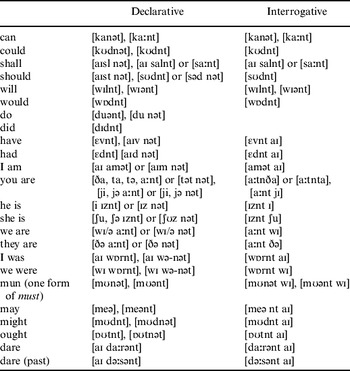
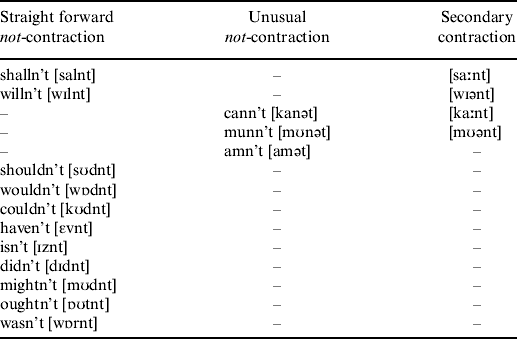
Wright (Reference Wright1892) sets out the positive and negative paradigms for various auxiliary verbs in both the declarative and the interrogative. This is illustrated in table 3 below.Footnote 19
19th-century treatment of aux+not forms. Data from Wright (Reference Wright1892).

It is clear from examples such as [aim nət] I'm not, [aiv nət] I've not, [ʃuz nət] she's not (from she is not), on the one hand, and [sʊdnt] shouldn't, [evnt] haven't, on the other, that both aux-contraction and not-contraction were strategies used in 19th-century WY. It is also clear that the distribution of 19th-century aux-contraction is very different from the distribution of contemporary aux-contraction (e.g. [aist nət]] I should not). It is interesting to note that mayn't is recorded as a possible form for this time, though usedn't is not mentioned. However, of far more relevance to the present discussion is the fact that an obvious form of amn't did indeed occur, namely [amət], and this form was permissible in both declaratives and interrogatives. Thus, in 19th-century WY speech an *amn't gap did not exist.
Following Hudson (Reference Hudson2000) the assumption would have to be that over the course of the last century, WY ceased to realise amn't as [amət]; this would have given rise to the *amn't gap, which would then have been systematically plugged by aren't. There is an alternative, however: WY did not cease to realise amn't but rather started to employ a different realisation of it, namely [aːnt]. On this approach, there was no *amn't gap in the 19th century and there is still no *amn't gap today. The difference between 19th- and 21st-century WY is in the manifestation of amn't. The issue now is, what caused the change in the realisation of amn't? To begin our exploration of this question, consider table 4 above, which sets out Wright's data according to how aux+n't forms were realised.
A classification of 19th-century aux+n't forms.

Table 4 sets out most of the auxiliaries and demonstrates that three basic patterns exist: straightforward not-contraction, where the n't appears to have been cliticised to the auxiliary; unusual not-contraction where an unexpected alternation occurs; and, apparently, secondary contracted forms. The forms in columns 1 and 2 suggest that not-contraction was ‘active’ at this stage.Footnote 20 In other words, not cliticised to the auxiliary host and phonological reduction took place. When amn't [amət], cann't [kanət] and munn't [mʊnət] are compared with forms such as shouldn't [sʊdnt], wouldn't [wɑdnt], haven't [εvnt] and didn't [dɪdnt],Footnote 21 it would appear that phonological reduction in 19th-century not-contraction affected only the clitic, though the precise form of the phonological reduction varies from consonant loss for the former group (e.g. amn't [amət]) to vowel loss for the latter group (shouldn't [sʊdnt]). Indeed for amn't, cann't and munn't it would appear that it was preferable to maintain the clitic's vowel [ə] but to remove its initial nasal [n]. This data further supports the claim that n't was a clitic at this stage.
Unlike amn't, however, cann't and munn't also patterned with shalln't and willn't in that these aux+n't forms appear to have manifested a form of secondary contraction (column 3). On the basis of this evidence, it would appear that secondary contraction began to affect WY aux+n't constructions much earlier than Petyt assumed in his work.Footnote 22 Forms such as salnt/, /wɪlnt/, /kannt/ and /mʊnnt/ meet the generalisation captured in the secondary contraction rule set out in (14) above. So it would seem that secondary contraction did arise in 19th-century WY and began by affecting the aux+not pairs shall, will, can and mun+not.Footnote 23 Since secondary contracted forms such as [saːnt] eventually came to replace [salnt], etc., and since can't and mun't exhibit an alternation exhibited by amn't, a natural assumption for a Usage-Based approach to take would be that amn't would become [aːnt]. Given the close lexical connections between can, mun and am, once the secondary contracted forms [kaːnt] and [mʊənt] became the established forms, /amnt/ would be treated in the same way as these forms. An illustration of some of these lexical connections is given in (16).
- (16)
(a)

(b)

(16) sets out partial schemas, positing a stage at which cliticisation was active. (16a) demonstrates that not only are the relevant forms connected by virtue of being auxiliary verbs, they are also connected by phonological shape. We could extend (16a) to include did, does, have, had, has and is, which are also obstruent-final auxiliaries. However, these auxiliaries have less in common phonologically with the auxiliaries mentioned in (16a). (16b) presents the unusual contraction exhibited by can, mun and am thereby showing that these auxiliaries would have had a strong lexical connection by virtue of this distinctive manner of contraction realisation. In other words, am and its negative form had close lexical connections with two of the auxiliaries that were amongst the first to lexicalise.
However, this is not the only respect in which am would have been closely connected to can and mun. All the auxiliaries exhibiting secondary contraction in 19th-century WY had sonorant-final consonants: will, shall, can and mun all end with [coronal, sonorant] consonants, whereas am ends with a [labial, sonorant] consonant. This relation (indicated by the broken line in (16b)) would have further strengthened the already-close lexical connections between am on the one hand, and can, will, shall and mun on the other. It is the kind of lexical connections illustrated in (16a, b), then, that would have been instrumental in the change of usage from [amət] to [aːnt]. Precisely because the generalisation falls out from the representation in Usage-Based Phonology, as [saːnt] and [kaːnt], etc. became established, so the use of [aːnt] for amn't would be triggered.
Hence, secondary contraction would have applied to delete the /m/ of amn't rather than the /n/. Once amn't was subject to secondary contraction, a form would be produced which would be homophonous with aren't, namely [aːnt]. If we follow this argument through, then we can claim that within WY, when successive generations came to replace [amət] with [aːnt], they were simply replacing one form of amn't with another. They were not creating an amn't gap and then plugging it with a default. Arguably, the discussion about amn't not being pronounceable or the /mn/ sequence being difficult/impossible to pronounce is, at least for WY speakers, a red herring, because the driving force that led to [aːnt] was not restricted to amn't; it was a more general process.
I have proposed above that secondary contraction comes into play when the form is lexicalised. Wright's data suggests that lexicalisation was under way at the end of the 19th century, as evidenced by the fact that can, shall, mun, and will yielded negative forms in two ways: by ‘active’ cliticisation resulting in [salnt], [wilnt], etc., or by selection of the lexicalised form /salnt/, /wilnt/ ~ [saːnt], [wɪənt], etc. We can represent the difference schematically as in (17)–(18).
(17) syntactic construction: [[aux]##n't]
(18) lexicalised portmanteau: [auxn't]
Frequent use led (17) to eventually be replaced by (18) for some of the more common aux+n't collocations. Once lexicalised, the question of parsing such phonological words becomes an issue: do these forms receive a monosyllabic or a bisyllabic parse? A cursory glance at contemporary secondary contracted forms reveals that monosyllabic forms are the desired end result. This suggests that the drive for a monosyllabic parse provided the motivation for the onset of secondary contraction. When lexicalisation began in the late 19th century, both mono- and bisyllabic parses were possible for salnt and wilnt, but not for cannt and munnt. There is an obvious factor exerting pressure to produce a monosyllabic parse for these latter forms: the potential for a geminate /n/. It may well be that although a bisyllabic parse was in principle possible for salnt and wilnt, the pressure exerted by the change affecting cann't and munn't may have been sufficient to force a monosyllabic parse of salnt and wilnt. The proposal is, then, that in order to facilitate a monosyllabic parse for these [auxn't] forms, the consonantal material closest to the nucleus was ‘lost’.
(19)
As the diagram in (19) reveals, if the lexicalised form /salnt/ were to receive a monosyllabic parse, this would result in a superheavy coda. It would appear, then, that the role of secondary contraction here is to reduce the complexity of the coda. However, we also have to account for the vowel change that occurs when the coda is reduced, as in (20).
(20)
Since loss of consonantal material is accompanied by vowel lengthening, we might assume that the consonantal position closest to the nucleus is reinterpreted as nuclear and for this reason the consonantal information is lost. In one sense, segmental information is redistributed in the rhyme, rather than being erased. Of course, it could be that WY speakers interpreted [salnt] as [saːnt] and that as the latter form was used more, it gained lexical strength and so became the dominant form. It would go beyond the scope of this paper to do other than suggest this here. However, the claim being made is that there appears to have been pressure for a monosyllabic parse of the newly lexicalised forms and as a result forms which can be described as having undergone secondary contraction were produced. If willn't and munn't behaved in the same way, then why did they become [wɪənt] and [mʊənt] rather than [wɪːnt] and [mʊːnt]? The transcriptions provide the answer: we do not have long [ɪː] or long [ʊː] in English, hence diphthongisation is the only alternative and to prevent these ill-formed long vowels.
As lexicalisation increased the number of auxn't forms, and as such forms increased in usage, so the post-lexically created forms, i.e. the cliticised or contracted forms, would cease to arise. Since amn't has close lexical ties with can't and mun't, as established in table 4 and illustrated in (16b) above, it also has close lexical ties with shan't and won't. It is therefore not surprising that [amət] gave way to a form which demonstrates the same generalisation as can't.Footnote 24 Presumably this is why [aːnt] came about and also why it replaced [amət] A comparison of (19) and (20) with (21) and (22) below reveals that amn't would be treated in exactly the same way as [salnt]~[saːnt]:
(21)
(22) [aːnt]
Although we do not know why the sonorant-final auxiliaries were the first to undergo lexicalisation, as sonorant consonants are closely related to vowels, we can assume that they were more readily open to reinterpretation. Perhaps the pressure of being a frequently occurring auxn't combination, linked with reanalysed forms such as [saːnt], [kaːnt] etc, was sufficient to cause secondary contraction to be extended to other forms.
Wright's (Reference Wright1892) data suggests that forms such as wouldn't, didn't, classified by Petyt as Group 1, did not initially undergo secondary contraction. However, by the time that Petyt was carrying out his research in the 1970s, the pressure for a monosyllabic parse was starting to affect Group 1 forms too. There are some very striking differences between the clusters targeted by the initial pass of secondary contraction in the 19th century and the clusters targeted in the 20th century: sonorant+n't (19th century) vs. obstruent+n't (20th century). The sonorant is much more easily reconciled with the nucleus, which is why vowel lengthening/diphthongisation was possible. An obstruent, on the other hand, cannot be reconciled with a nuclear position, which is presumably why 20th-century secondary contraction is not accompanied by vowel change. In contemporary WY a monosyllabic parse would result in an ‘ill-formed’ coda with /dnt/, /znt/, etc. A comparison of a bisyllabic (23) and monosyllabic (24) parse for wouldn't is very revealing:
(23)
A monosyllabic parse is not possible for this sequence of sounds, since /dnt/ cannot form a well-formed coda, so the structure in (24) is straightforwardly ungrammatical.
(24)
Such sequences violate the Sonority Sequencing Constraint (SSC). It is not surprising that it is the obstruent closest to the nucleus which has to be removed, since this is the source of the SSC violation; remove this and the SSC is satisfied.
The proposal being made here offers some explanation for why 19th-century secondary contraction arose and why it might have triggered vowel change. It also offers an explanation for why 20th-century secondary contraction applied to Group 1 forms: but this does not explain why Group 2 auxiliaries exhibit a further secondary contraction today. Again, the Usage-Based approach has something to offer here. I suggest that this explanation has to do with the way in which the material is stored. If [amət] was replaced by [aːnt] because of the close lexical connections between can't, shan't and amn't, then perhaps the reason secondary contraction applies to such forms today is because of their close and strong lexical associations with wouldn't, shouldn't, etc. In other words, Bybee's Usage-Based approach assumes that the generalisation falls out from the representation. If /wʊdnt/ >[wʊnt], and if this information is part of a schema with [aːnt], etc. (recall (16a, b)), then it can only be the relationship between the two forms that brings about the reduction of [aːnt] to [aːt], since here there is no pressure for a monosyllabic parse: the forms are all monosyllabic, and there is no potentially problematic cluster to deal with. Plausibly, then, it is as a result of the similarity with those forms that undergo secondary contraction for a structural reason that secondary contraction arises in Group 2 forms, too.
In sum, in this section I have argued that contemporary auxn't forms are not synchronic contractions, nor are they instances of base+suffix. I have assumed that contemporary auxn't forms, like wanna and gonna, are lexicalised portmanteaus. The 19th-century data provided by Wright (Reference Wright1892) suggests a system which had both active cliticisation and the beginning of lexicalisation/lexicalised forms for certain auxn't pairs. I have argued that secondary contraction is not a contraction, but rather a phonological reduction process which applies to the auxn't forms once they have become lexicalised. It evidently functions in these cases as a repair strategy when there is pressure for a monosyllabic parse. In the contemporary forms which Petyt labels Group 1, secondary contraction functions in much the same way: to avoid a serious violation of the sonority sequencing constraint in cases where there is pressure for a monosyllabic parse. Group 2 forms pattern analogously, by lexical association.
One consequence of this comparison of the morphological structure of the 19th-century and the contemporary aux+n't forms is that we can offer an explanation for why [amət] was replaced by [aːnt]; but more importantly, we can provide an explanation for why [aːnt] should be regarded as a form of amn't rather than a form of aren't. In other words, if [aːnt] is created from amn't by secondary contraction, then there is no *amn't gap, at least in WY. We should now consider the possibility that this analysis can be extended to other varieties of English such as Standard British English.
5. Implications for the *amn't gap in Standard British English
I have argued so far that there is no *amn't gap in WY English and there is no evidence of there having been such a gap over the past 130 years or so. There is, however, evidence to suggest that many aux+n't collocations have become lexicalised. One apparent consequence of lexicalisation is that phonological repair has been triggered and, as a result of this repair process, one form of amn't [amət] was replaced by another [aːnt]/[aːt]. It would seem that [amnt] is the expected/prescribed pronunciation; accordingly, when some other pronunciation is used instead, the result is a failure to recognise this alternative form as a legitimate realisation of amn't. This is perhaps surprising given that English is a language famous for its lack of correspondence between the spoken and written form. Arguably, it is essential to consider whether the form of pronunciation used is a potential pronunciation of amn't. The paper so far has demonstrated that together with [amnt] and [amət], [aːnt] and [aːt] should also be regarded as pronunciations of amn't. A comparison of accepted amn't forms (i.e. [amnt] and [amət]), with those that are not recognised as such (i.e. [aːnt] and [aːt]) suggests that recognition of amn't status requires the presence of [m] in the pronunciation. However, the present paper has provided an explanation for the absence of [m] in [aːnt] and [aːt] which brings the first person singular present tense negative form in line with all other auxn't forms.
With this in mind, we can now consider the extent to which the above proposal can be extended from WY to Standard British English. Essentially, the suggestion is that as a result of lexicalisation of certain auxn't forms, amn't does not receive the pronunciation we might expect.
Indeed, the literature contains evidence which, when placed alongside the WY data, strongly suggests that the assumptions made above for lexicalisation of certain auxn't forms also hold true for standard varieties, but at a much earlier date than in WY. According to Jespersen (Reference Jespersen1917), examples of not-contraction started to appear in speech in around 1600 and in written forms around 1660. The period when not-contracted forms appeared in writing is easy to verify: both Jespersen (Reference Jespersen1917) and Brainerd (Reference Brainerd1989) draw on the writings of Congreve, Farqhuar, Elphinstone, Defoe, Swift and many others to chart the emergence of not-contracted forms in written English, as illustrated in (25).
(25) Swift: I a'n't well
I a'n't vexed.
I a'n't sleepy
Defoe: I an't to be a tradesman; I am to be a gentleman: I an't to go to school.
Congreve: I an't deaf
I an't calf enough
(Jespersen Reference Jespersen1917: 118–119)
According to Brainerd (Reference Brainerd1989) it would appear that be, have, do, can, shall, will and may were the first written forms to indicate contraction, with couldn't and wouldn't following some time after. Of particular interest here, however, is the dating of the appearance of an't/a'nt to represent I amn't in plays written between 1673 and 1690. Brainerd (Reference Brainerd1989) notes an't for amn't and arn't for aren't. In other words, at one stage a distinction in the written form of these two words was recorded. However, by the early 1700s, he notes that an't/a'nt was being used for both am not and are not (Brainerd Reference Brainerd1989: 186). The erosion of aren't appears to be too early to be attributed to loss of rhoticity. Instead I would suggest that even though arn't appeared in writing first, amn't underwent lexicalisation first because of its connections to can't and shan't. This explains why, when an't appears for amn't, it has already undergone secondary contraction. Aren't is lexicalised shortly afterwards, and as a consequence of secondary contraction, begins to appear as an't. Arguably, this suggests the same pronunciation for both a'n't/an't (amn't) and an't (aren't), namely [aːnt].
Although neither Jespersen nor Brainerd is concerned with the *amn't gap, Jespersen's (Reference Jespersen1917: 118) comment on an't/a'nt suggests that he believes that m-deletion triggered vowel lengthening:
I take it that am not has become [a'nt] with lengthening of the vowel and dropping of [m]. This may have been the actual pronunciation meant by the spelling an't (cf. can't, shan't).
Although this comment is programmatic at best, it would appear that on the basis of his review of n't use, Jespersen is sketching a version of the same story developed in this paper, in that he relates the change of amn't to [aːnt] to the change that brought about shan't, can't, etc. We have to be cautious, however, about the precise interpretation of a'nt, a'n't. Indeed Jespersen's caution is evident when he remarks that ‘Elphinstone 1765 (1.134) mentions an't for am not with “sinking” of m and o, but does not specify the vowel sound’ (Jespersen Reference Jespersen1917: 119). Whilst Jespersen (Reference Jespersen1917: 120) comments that ‘it is probable that some at least of the 19th-century quotations above for an't I are meant as [eint ai]’, his other comment above suggests that he assumes [aːnt] was the initial pronunciation of an't (amn't), which eventually gave rise to [eɪnt] ain't for some speakers. So although some of the data suggests a series of events resulting in [aːnt], other data should be taken to indicate [eɪnt]. There is nothing inconsistent between this interpretation and the story developed here. On the contrary, there is no reason why all developments of a given vowel should be the same, not least given the time span involved. The point is that whatever the manifestation of amn't turned out to be, it was produced by lexicalisation with concomitant phonological repair in the form of secondary contraction and vowel change (whether by lengthening or diphthongisation).Footnote 25
Thus, the literature would indeed appear to offer some support for the idea that amn't underwent changes identical to shalln't>shan't historically and there is some suggestion that this happened in varieties of English (notably precursors of SBE) prior to WY. The literature also demonstrates that some linguists (e.g. Jespersen Reference Jespersen1917) have toyed with the idea that [aːnt] and [eɪnt] have derived from amn't by consonant deletion and vowel change.Footnote 26 However, if SBE underwent lexicalisation and secondary contraction whereby amn't and aren't became homophonous in speech some time prior to the 18th century, then it seems possible that this would be picked up on by prescriptivists. Jones (Reference Jones2006: 10) observes that pronunciation did not excite prescriptivist comment in the first half of the 18th century to the extent that it did from the second half of the 18th century onwards; orthoepists were concerned with describing pronunciation rather than prescribing it. So we are unlikely to find a prescription against [aːnt] (or indeed [eɪnt]) as a pronunciation of amn't in early 18th-century texts. However, since prescription of grammar and pronunciation became very popular in the 19th century, we would expect to find some commentary, though it is likely to be aimed at [eɪnt] rather than [aːnt]. Once again, the literature supports this. For example, in the 3rd edition of his Common blunders made in speaking and writing, corrected on the authority of the best grammarians, Charles W. Smith notes that ‘“I ayn't” should be “I am not – ayn't” is a contraction of are not’ (Smith Reference Smith1855: 8). In other words, a form of amn't is being mistaken for aren't. Interestingly, contractions seem to come in for criticism as a whole in the 19th century, as suggested by the following comment from The vulgarities of speech corrected; with elegant expressions for provincial and vulgar English, Scots and Irish, for the use of those who are unacquainted with grammar:
[W]hen you have mastered this easy lesson, you may then proceed to the other form of contractions, which are by no means as bad as this vulgar a'n't, which I may remark is made worse by sounding, as is usual, the a long and open, like the word ‘faint’, rather than short, like the word ‘and’, as it ought to be when contracted for ‘am not’ and ‘are not’. (Anon 1826: 23–24)
Although the vowel is described here as ‘long and open’, which might lead us to posit [ɑː], the writer is not a trained linguist. It is far more likely that since the author refers to the word faint, it is the diphthong [eɪ] that is intended instead. Of further relevance here is the author's comment that isn't ‘is not quite as bad as a'n't’ (Anon 1826: 24). So it would seem that contractions of amn't did excite prescriptivist comment in the 19th century. With censure such as this, pressure would be exerted to avoid using any form of amn't that lacked [m] in the pronunciation. This could explain the sense of unease expressed by Hudson (Reference Hudson2000) when he considers using the first person singular negative (recall section 2.1).
Turning now to contemporary forms of SBE, the fact that interrogatives still maintain [ɑːnt aɪ] need not be assumed to be the default form of BE, as Hudson has argued, they are perfectly regular. In other words, when a SBE speaker uses ‘[ɑːnt] I?’, they are using a contemporary form of amn't manifested in many British English varieties. The main difference between WY and SBE is that the former uses a form of amn't in declaratives too, whilst the latter uses the aux-contracted form [aɪm nɑt] instead. So, although the gap for SBE has now been significantly reduced, there is still a gap in the paradigm nevertheless.
Arguably, any residual gap is no longer a particularly big issue. Studies such as Tagliamonte & Smith (Reference Tagliamonte and Smith2002) have suggested that first person singular negative forms are not as common as, for example, third person singular forms. So frequency of use will be one factor shaping the SBE system. Secondly – a point ignored by all linguists who have contrasted aux- and not-contraction usage – in positive sentences forms of be tend to contract with the subject (e.g. I'm happy to do that, She's unable to come to the phone). For example, in one nine-minute extract of transcribed speech (South Elmsall, Wakefield, recorded on 23 October 1998; British Library Sound Archive, www.sounds.bl.uk), there are 20 instances of BE (main verb) 3rd person singular present tense. Of these 20 instances, 15 are contracted ('s) and 5 are full forms (is). This clearly needs further investigation, but it seems plausible that the frequency of contraction of be (both aux and main verb) in positive sentences could have a major impact on the shape of negative forms. Although this will explain why [aːnt] is not very common, it does not explain why it appears to be absent in declarative structures in SBE. The gap may have been eroded still further for SBE, but there is still undeniably a gap. However, we can now conclude that the *amn't gap in SBE arose when lexicalisation with concomitant secondary contraction produced forms of amn't that were wrongly interpreted as aren't. Therefore, the *amn't gap is not grammatical; prescription has played a significant role.
6. Conclusion
In this paper, I have set out to argue that the West Yorkshire variety of British English has no *amn't gap and has never had one. This paper has argued that common auxiliary negative forms such as shouldn't, didn't, can't, shan't and [aːnt], etc. have become lexicalised. As lexicalisation has progressed, a phonological reduction process (evidently a kind of repair strategy) known as secondary contraction has been responsible for the creation of [aːnt] from amn't. Crucially, however, this process has affected all lexicalised auxn't forms, not just amn't. Thus shouldn't can be pronounced [ʃʊnt] and didn't [dɪnt], etc. In other words, it is not the fact that be is the only verb to have its own distinct first person singular present tense form that lies at the heart of this change; rather, it is the application of a phonological reduction to lexicalised forms which has affected all auxn't structures. The comparison of 19th- and 21st-century data suggests that lexicalisation (+ secondary contraction) began with a small group of sonorant-final auxiliaries: shall, will, can and mun. However, over the course of the 20th century, lexicalisation (+ secondary contraction) extended to all commonly occurring auxn't forms. I have argued that secondary contraction can produce homophones and that unfortunately, people have wrongly interpreted [aːnt] as a form of aren't rather than as a form of amn't. In pursuing this analysis, I have also reviewed Zwicky & Pullum's (Reference Zwicky and Pullum1983) claim that n't is an inflectional suffix. I have argued that all the criteria said to distinguish clitics from affixes which were used by Zwicky & Pullum to argue that n't is a suffix, also support the lexicalised portmanteau analysis.
Having concluded that auxn't forms in WY are lexicalised portmanteaus, I then looked at SBE and considered whether precursors of SBE might not have undergone a similar process to a more limited extent and at a much earlier date. Sources such as Jespersen (Reference Jespersen1917) and Brainerd (Reference Brainerd1989), set alongside the WY data, can be taken to indicate, as Jespersen suggests, that certain auxn't forms in precursors of SBE and related varieties also appear to have undergone lexicalisation (+ secondary contraction). If secondary contraction follows lexicalisation, this would suggest that certain auxn't forms lexicalised and underwent secondary contraction in the 17th century. It can be argued, and indeed Jespersen did argue, that in SBE amn't gave rise to [aːnt], just as in WY. However, some speakers came to realise [aːnt] as [eɪnt]. I have noted that there are in fact a number of different manifestations of amn't, ranging from the more obvious [amnt] and [amət] to the results of secondary contraction: [aːnt]/[aːt] and [eɪnt]. So it would seem that secondary contraction produced alternative manifestations of amn't in SBE long before this happened in WY. It just so happens that for WY, thanks to the careful records of Wright (Reference Wright1892), we are able to put the pieces together. Such detail is not available for Standard British English and this is why the phonological story hinted at by Jespersen (cf. Dixon Reference Dixon1982) has never gained widespread acceptance. Once [ɑːnt]/[aːnt] came to be written as aren't it is easy to see why I aren't hungry would become stigmatised. Fortunately, a form is at hand which allows SBE speakers to avoid censure: I'm not. However, it is clear that there is no genuine *amn't gap. The whole debate has arisen because of the failure to recognise [ɑːnt]/[aːnt] (and also [eɪnt]) as a form of amn't, with the consequence that the most appropriate written form has been replaced by an inappropriate form: aren't.
In sum, the purpose of this paper has been to argue that, as far as the grammar goes, the first person singular present tense negative form has been treated in exactly the same manner as any other auxn't form. The paper has suggested why this change has come about, but the point is that where any *amn't gap can be said to remain it is not a matter of grammar. Commentators have imposed a particular interpretation on the pronunciation based on the English spelling system. As a result the drive for many speakers of English has been to avoid n't-contracted forms for be. The grammar hasn't driven this avoidance; prescriptivists have done that. The grammar has simply responded to usage and social pressure.