INTRODUCTION
Traumatic brain injury (TBI) in athletes is a major and increasingly recognized public health problem. Soccer is the most popular and fastest-growing sport worldwide (Rodrigues, Lasmar, & Caramelli, Reference Rodrigues, Lasmar and Caramelli2016). A contact sport, soccer carries risk of brain injury from head impacts. Unintentional head impacts (e.g., head to goal post, head to head) are the most common causes of recognized, overt concussive events, which typically involve an alteration in mental status that may or may not include loss of consciousness (Echemendia & Julian, Reference Echemendia and Julian2001). Unique to soccer, players commonly use their head to intentionally and actively deflect the ball during play, a practice termed “heading” the ball. Heading entails repeated typically low magnitude impacts leading to linear and angular acceleration-deceleration of the brain (Spiotta, Bartsch, & Benzel, Reference Spiotta, Bartsch and Benzel2012). Preliminary studies show that amateur recreational league soccer players head the ball with a broad range of frequency (Lipton et al., Reference Lipton, Kim, Zimmerman, Kim, Stewart, Branch and Lipton2013). Heading is widely regarded as a form of “subconcussive” impact and an uncommon cause of concussion (Comstock, Currie, Pierpoint, Grubenhoff, & Fields, Reference Comstock, Currie, Pierpoint, Grubenhoff and Fields2015). Recent studies, however, have shown that purportedly “subconcussive” impacts that do not lead to diagnosed concussion may produce concussive symptoms (Stewart et al., Reference Stewart, Kim, Ifrah, Lipton, Bachrach, Zimmerman and Lipton2017). Thus, “subconcussive” is likely a misnomer.
Repetitive head impacts reported in soccer athletes have associations with neuropsychological impairment as well as abnormal white matter microstructure (Koerte, Ertl-Wagner, Reiser, Zafonte, & Shenton, Reference Koerte, Ertl-Wagner, Reiser, Zafonte and Shenton2012; Lipton et al., Reference Lipton, Kim, Zimmerman, Kim, Stewart, Branch and Lipton2013), structural brain changes (Adams, Adler, Jarvis, DelBello, & Strakowski, Reference Adams, Adler, Jarvis, DelBello and Strakowski2007; Sortland & Tysvaer, Reference Sortland and Tysvaer1989), and electrophysiological changes (Di Virgilio et al., Reference Di Virgilio, Hunter, Wilson, Stewart, Goodall, Howatson and Ietswaart2016). Of these studies, there is a suggestion that the types of neuropsychological function impacted may vary depending on the duration of the exposure. Long-term heading (LTH) exposure has most commonly been associated with significantly poorer neuropsychological function in the domains of memory, attention, and cognitive flexibility (Maher, Hutchison, Cusimano, Comper, & Schweizer, Reference Maher, Hutchison, Cusimano, Comper and Schweizer2014).
When compared to athletes in non-contact sports (e.g., swimming, track), professional (Downs & Abwender, Reference Downs and Abwender2002; Matser, Kessels, Jordan, Lezak, & Troost, Reference Matser, Kessels, Jordan, Lezak and Troost1998), college (Rutherford, Stephens, Potter, & Fernie, Reference Rutherford, Stephens, Potter and Fernie2005) and adult amateur (Matser, Kessels, Lezak, Jordan, & Troost, Reference Matser, Kessels, Lezak, Jordan and Troost1999) soccer athletes performed poorer in the above-mentioned domains. Higher frequency of play over the long-term, ranging from heading exposure during one season to estimated lifetime heading, was similarly associated with poorer memory, attention, and cognitive flexibility among professional (Matser, Kessels, Lezak, & Troost, Reference Matser, Kessels, Lezak and Troost2001; Tysvaer & Lochen, Reference Tysvaer and Lochen1991), college (Downs & Abwender, Reference Downs and Abwender2002; Rutherford, Stephens, Fernie, & Potter, Reference Rutherford, Stephens, Fernie and Potter2009), adult amateur (Lipton et al., Reference Lipton, Kim, Zimmerman, Kim, Stewart, Branch and Lipton2013), and high-school players (Witol & Webbe, Reference Witol and Webbe2003).
However, the effects of recent heading (RH) on neuropsychological function are less well understood. Some studies demonstrate transient changes in attention, psychomotor speed, and memory within 24 hours of heading (Di Virgilio et al., Reference Di Virgilio, Hunter, Wilson, Stewart, Goodall, Howatson and Ietswaart2016; Webbe & Ochs, Reference Webbe and Ochs2003) as well as concussive symptoms (i.e., dizziness, slight/moderate pain, feeling dazed) (Stewart et al., Reference Stewart, Kim, Ifrah, Lipton, Bachrach, Zimmerman and Lipton2017) following 2 weeks of soccer play including heading, while others find no effect of RH on neuropsychological function (Maher et al., Reference Maher, Hutchison, Cusimano, Comper and Schweizer2014; Putukian, Echemendia, & Mackin, Reference Putukian, Echemendia and Mackin2000). Of note, much of the research finding no effect has been in youth and high school players (Janda, Bir, & Cheney, Reference Janda, Bir and Cheney2002; Kaminski, Cousino, & Glutting, Reference Kaminski, Cousino and Glutting2008; Stephens, Rutherford, Potter, & Fernie, Reference Stephens, Rutherford, Potter and Fernie2005, Reference Stephens, Rutherford, Potter and Fernie2010); the impact of heading in adults is thus an important area for further study.
The cumulative effect of repeated head impacts over a longer-term may differentially affect underlying neural systems compared to recent impacts, which in turn may give rise to altered function on different neuropsychological domains. However, this divergence has not been directly explored. Thus, the purpose of this study was to be the first to investigate the unique contributions of both RH and LTH on neuropsychological functioning in a sample of adult amateur soccer players. Given the limited research on the effects of RH on neuropsychological function in adults, our hypothesis for RH was more exploratory in nature. We hypothesized that RH would be associated with neuropsychological changes, but did not specify in which domains (Hypothesis 1). Based on our previous findings in a smaller independent sample of similar soccer players (Lipton et al., Reference Lipton, Kim, Zimmerman, Kim, Stewart, Branch and Lipton2013), we hypothesized that LTH would be associated with changes in memory (Hypothesis 2). In addition, we sought to distinguish the effect of heading from that of lifetime recognized concussion.
METHODS
Study Participants
The Einstein Soccer Study is a multi-faceted longitudinal study of heading and its consequences in adult amateur players. The present study used data from the baseline study visit and subsequent visits that occurred every 3 to 6 months, depending upon study arm. Participants completed assessments of heading and a neuropsychological assessment in association with each visit. The Albert Einstein College of Medicine Institutional Review Board approved the study, and all study subjects provided written informed consent.
Adult amateur soccer players from New York City and surrounding areas were recruited. Inclusion criteria were: age 18–55 years; at least 5 years of active amateur soccer play; current active amateur soccer play; at least 6 months of amateur soccer play per year; and English language fluency. Exclusion criteria were: schizophrenia, bipolar disorder; known neurological disorder; prior moderate or severe TBI; pregnancy; and medical contraindication to MRI (relevant to a separate arm of the study).
Exposure Assessment
HeadCount is a structured, Web-based, self-administered questionnaire that has been described in detail previously (Catenaccio et al., Reference Catenaccio, Caccese, Wakschlag, Fleysher, Kim, Kim and Kaminski2016; Lipton et al., Reference Lipton, Kim, Zimmerman, Kim, Stewart, Branch and Lipton2013; Stewart et al., Reference Stewart, Kim, Ifrah, Lipton, Bachrach, Zimmerman and Lipton2017). This study used two versions of HeadCount: HeadCount-12m inquired about soccer activity during the prior 12 months and was completed during the baseline study visit only. HeadCount-2w inquired about soccer activity during the prior 2 weeks and was completed within 3 weeks of each study visit. The HeadCount questionnaires were developed based on a series of focus groups comprising soccer players who are representative of the participants in this study. The focus groups specifically addressed the terminology most salient among players for description of the exposures of interest and confirmed that the terms “heading” and “header” were common and representative to players enrolled in this study (Catenaccio et al., Reference Catenaccio, Caccese, Wakschlag, Fleysher, Kim, Kim and Kaminski2016).
In brief, HeadCount-12m was organized into four modules focused on outdoor practice, outdoor games, indoor practice, and indoor games. Identical questions were repeated for outdoor and indoor settings and included: (1) Number of months per year active in each setting; (2) Any practice sessions; (3) Average number of soccer practice days per week; (4) Average number of headings per practice. For indoor and outdoor competition, questions were asked about the: (1) Average number of competitive soccer games per week; (2) Positions played during games; and (3) Average number of headings per game. Questions were asked about lifetime history of concussion (associated with soccer play as well as other life events) and inventory of symptoms associated with concussion.
HeadCount-2w inquired along the same lines for a single 2-week timeframe and additionally included a fifth module on unintentional head impacts. For all soccer activities in the past 2 weeks, participants were asked how often they experienced unintentional head impacts from specific causes (e.g., ball hitting to the back of the head, head to goal post, head to head, etc).
Neuropsychological Outcome Variables
Cogstate
Neuropsychological assessment was completed at baseline using Cogstate, a valid and reliable computer-administered battery (Maruff et al., Reference Maruff, Thomas, Cysique, Brew, Collie, Snyder and Pietrzak2009). Tests were selected to assess five domains of neuropsychological function; verbal learning and memory, psychomotor speed, attention, working memory, and executive function. The International Shopping List—Immediate (ISL) and International Shopping List—Delayed Recall tasks (ISL, ISRL) measured verbal learning and memory abilities, respectively. Participants were asked to remember a list of 12 words on three consecutive learning trials and then to recall the list following a delay period. Number of correct responses was the primary outcome variable. Psychomotor speed was assessed with the Groton Maze Chase Test (GMCT), which measured how quickly and accurately (total number of correct moves per second) participants chased a target through a maze. Two tasks were used to evaluate attention: Identification (IDN) and One Back Test (ONB). Identification measured how quickly (log10 of reaction time) participants were able to correctly identify the color of a playing card, while the One Back Test measured how accurately (arcsine of square root of proportion of correct responses) participants were able to determine if a playing card was the same as the card shown previously. Working memory was assessed with the Two Back Test (TWOB), which measured how accurately (arcsine of square root of proportion of correct responses) participants were able to determine if a playing card was the same as the card shown two cards previously. Lastly, the Set Shifting task (SETS) was used to evaluate frontal/executive function. Participants were asked to guess whether playing cards were “correct” according to some dimension (a color or a number). When the participants made their way through a set of cards, the “correct” stimulus dimension changed (a set shift), and they had to re-learn the new target rule. There were multiple set-shifts that occurred within the task. Total number of errors made across five set-shifts was the primary outcome variable.
Procedure
Adult amateur soccer players were recruited by print and Internet advertisement and through soccer leagues, clubs, and colleges in New York City and surrounding areas between November, 2013 and August, 2016. Interested individuals were directed to an enrollment Web site, which, after informed consent, collected screening information. A research team member subsequently contacted qualifying individuals, confirmed eligibility and willingness to participate in the full longitudinal study, and invited enrollment.
The in-person enrollment baseline study visit included (in the following order) informed consent, a Web-based questionnaire to ascertain subject demographics, substance use and concussion history, a Web-based HeadCount-12m, the Wide Range Achievement Test (WRAT-4) Reading subtest to ascertain estimated level of intellectual functioning as a measure of premorbid intelligence (Orme, Johnstone, Hanks, & Novack, Reference Orme, Johnstone, Hanks and Novack2004; Wilkinson & Robertson, Reference Wilkinson and Robertson2006), and a battery of neuropsychological tasks (Cogstate). All study visits occurred in a designated testing room and were supervised by a trained research assistant. The Cogstate software was installed on the testing computer and un-normed scores were used in analyses.
Following the baseline visit, participants completed the Web-based HeadCount-2w within 7 days. A link to this Web-based questionnaire was emailed to the participants at the conclusion of the visit, and re-sent throughout the week until it was completed. The vast majority of baseline HeadCount-2w were completed within 7 days of the study visit (97.9%), though in some instances the questionnaire was completed a few days later. For the follow-up visits, which occurred every 3 to 6 months, a link to the Web-based HeadCount-2w was emailed to the participants 3 weeks before the scheduled visit. If the participants did not complete the questionnaire in advance, they completed it in the lab immediately before beginning the follow-up visit. Therefore, follow-up HeadCount-2w was completed within 21 days of the study visit.
Analysis
Analyses were completed using IBM SPSS Statistics (Version 19, Release 19.0.0., 2010. Chicago, IL: SPSS Inc.). Chi-square, t tests, and one-way analysis of variance analyses were used to examine relationships among demographic, neuropsychological, and soccer play variables (years of heading, lifetime number of concussions). Heading reported in HeadCount (both versions) was positively skewed. We, therefore, expressed exposure as ordered categorical variables of approximately equal size quartiles (Quartile 1, Quartile 2, etc.). Quartile 1 reflected participants with the lowest exposure to heading, while Quartile 4 reflected participants with the highest exposure to heading.
The baseline questionnaires were used to describe the relationship of participant characteristics to heading activity. Baseline HeadCount-12m questionnaires were included to assess the relationship of long-term heading exposure with neuropsychological functioning at each study visit. HeadCount-2w questionnaires from each study visit were included in the analyses to assess the relationship of recent heading exposure with recent neuropsychological functioning. Three separate regression models were constructed examining the effect on neuropsychological task performance of the following exposures: (1) recent-heading (Hypothesis 1, Model A), (2) long-term heading (Hypothesis 2, Model B), and (3) a model incorporating both recent- and long-term heading (Model C). Generalized estimating equations (GEE) were used as this method is ideal for longitudinal and clustered data; it computes robust variance estimates that take into account the within-subject correlations in repeated measures from the same subject (Hardin, Reference Hardin2005). To correct for multiple comparisons, while maximizing study power, we used the false discovery rate at p=.05 (Benjamini & Hochberg, Reference Benjamini and Hochberg1995).
RESULTS
Participant Characteristics
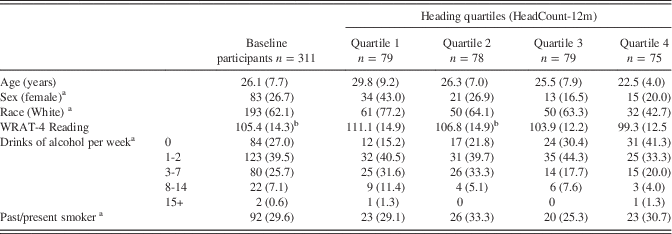
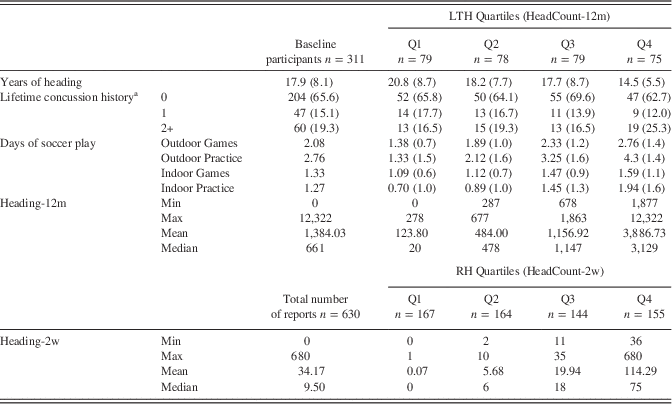
Demographic data are presented in Table 1 for the 311 individual participants who completed the baseline visit. Each of these individuals also completed a HeadCount-2w in association with the baseline visit; 75 participants completed two HeadCount-2w questionnaires, and 106 completed three or more HeadCount-2w questionnaires (maximum of five questionnaires), for a total of 630 reports of 2-week heading (RH). Eighty participants withdrew from the study following one or more study visits (40 lost to follow-up). The vast majority of participants (87.5%) completed HeadCount-2w online within 21 days of study visit. One hundred and fifty-six (24.8%) HeadCount-2w observations reported no heading activity over the prior 2-week period. Participants engaged in soccer play between 1 to 3 days per week, the number of days of activity was greatest for outdoor games (2.76 days/week) (Table 2). Players participated in in outdoor games on average during 7.84 months of the year. One hundred and seven (34.4%) participants reported a lifetime history of concussion, with 60 (19.3%) participants reporting two or more lifetime concussive events.
Demographic characteristics for the 311 baseline participants presented as mean (SD)

a Presented as N (%)
b One participant was missing the WRAT-4 Reading measurement.
Exposure variables for the baseline participants and total number of reports presented as mean (SD)

a Presented as N (%).
We retained covariates in the models that exhibited a bivariate association with heading (RH or LTH) or neuropsychological test score at a significance level p < .05. Participants in the upper two quartiles for heading were younger, male, non-Caucasian, drank less, and had lower premorbid intellectual abilities (Table 1). Age, sex, race (white vs. non-white), WRAT-4, alcoholic drinks per week and past/present cigarette use (yes/no) were associated with neuropsychological test scores. Thus, these variables were included as covariates in all subsequent analyses. Although not associated with heading or neuropsychological test score, lifetime number of concussions was also included as a covariate to account for its role, if any, in explaining exposure-outcome associations for heading.
Neuropsychological performance and RH (Hypothesis 1)
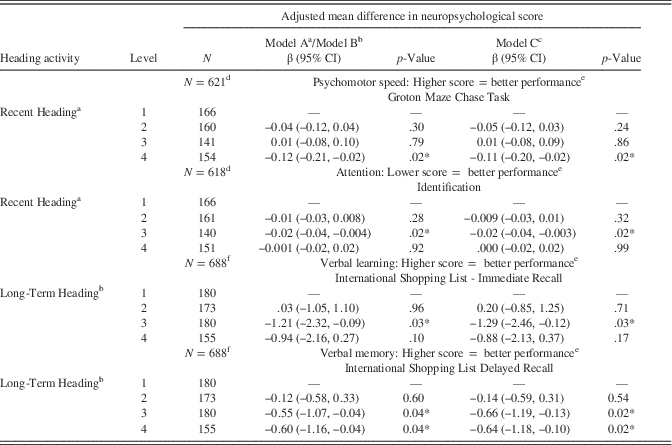
RH (HeadCount-2w) was related to neuropsychological function (Table 3, Model A). RH in the fourth quartile was associated with poorer performance on a task of psychomotor speed (GMCT; p=.02). RH in the third quartile was associated with better performance on a task of attention (IDN; p=.02), but not for the fourth quartile (p=.92). Lifetime number of concussions was not independently related to neuropsychological function and did not modify the association of heading and neuropsychological function. When the un-normed neuropsychological task scores (used in the analyses) were converted to Z-scores using norms from a dataset of age-matched healthy adults, all scores were normatively average and fell within ± 0.5 SD of the mean. Non-significant findings for the association of RH with performance on domains of verbal learning, verbal memory, working memory, and executive function are reported in Supplementary Material.
Generalized linear model mean differences in neuropsychological scores by long-term heading and recent-heading

a Separate model for recent heading.
b Separate model for long-term heading.
c A single model was run that included both long-term heading and recent-heading.
d Sample size for recent heading model.
e Covariates: gender, age, race, alcohol use, past/present smoker, WRAT-4, Lifetime Number of Concussions.
f Sample size for long-term heading model.
*Represents p < .05.
Neuropsychological performance and LTH (Hypothesis 2)
LTH (HeadCount-12m) was also significantly associated with neuropsychological function (Table 3, Model B). Overall, heading in the third quartile was associated with poorer performance on a task of verbal learning (ISL; p=.03) with a nonsignificant trend for the fourth quartile (p=.10). LTH in the third and fourth quartiles were associated with reduced performance on a task of verbal memory (ISRL; Q3, p=.04; Q4, p=.04). Lifetime number of concussions was not independently associated with neuropsychological function and did not modify the association of heading and neuropsychological function. When neuropsychological task scores were converted to Z-scores, all scores were normatively average and within ± 0.5 SDs of the mean. Non-significant findings for the association of LTH with performance on other neuropsychological domains are reported in Supplementary Materials.
Relative contributions of LTH and RH to neuropsychological function
When both LTH (HeadCount-12m) and RH (HeadCount-2w) were included in the model, the relationships between heading in the upper two quartiles and poorer neuropsychological function were preserved (Table 3, Model C). Thus, LTH in the third quartile was independently related to poorer verbal learning (ISL; p=.03) and LTH in the upper two quartiles was independently related to poorer verbal memory (ISRL; p=.02), and RH in the fourth quartile was independently related to poorer psychomotor speed (GMCT; p=.02). RH in the third quartile was independently related to better attention (IDN; p=.02), while RH in the fourth quartile was not (p=.92). No additional significant associations emerged from Model C.
DISCUSSION
We identified independent associations of LTH and RH with neuropsychological function in a large cohort of adult amateur soccer players. Heading was very common in our sample, with a median count of 661 headers/year and a minority (12 participants) reporting no heading in the prior year. Participants reporting greater amounts of RH and LTH exhibited statistically-significant worse neuropsychological function, but in different neuropsychological domains. These differences in neuropsychological task scores may represent transient phenomena and are not severe enough to indicate current clinical impairment. Nonetheless, the existence of even a transient subclinical effect of repeated heading on neuropsychological function provides a necessary, though not necessarily sufficient, substrate for cumulative functional decline over time. Since over 265 million active soccer players worldwide head the ball with a wide-range of frequency over their lifetime (FIFA, 2007), our findings should motivate additional research into risks of heading.
More frequent RH predicted reduced psychomotor speed, similar to previously reported findings in soccer (Webbe & Ochs, Reference Webbe and Ochs2003) and findings of short-term and transient changes in this domain in patients with concussion (Echemendia & Julian, Reference Echemendia and Julian2001). RH in the third quartile was associated with better attention, which may suggest that participants who head more have developed enhanced attention to the appearance of stimuli. Intriguingly, the absence of this advantage at the highest levels of heading (β=0; p=.99) may indicate that the processing speed deficit conferred by highest levels of heading countermands the attentional advantage of training.
Consistent with our hypothesis, greater LTH, on the other hand, was associated with poorer performance on a test of verbal episodic memory. Reduced verbal learning was associated with LTH in the third quartile, with a trend toward significance in the fourth quartile that may reflect limited power for detection of effects. Memory is a domain well known to be adversely impacted in chronic sports concussion (Belanger & Vanderploeg, Reference Belanger and Vanderploeg2005). However, it is also important to consider that list learning tasks of the type used in our study, as well as in other studies, are supported by a diverse array of neuropsychological functions (e.g., attention, executive function) (Davidson, Troyer, & Moscovitch, Reference Davidson, Troyer and Moscovitch2006; Lezak, Reference Lezak2004).
We previously reported, in a smaller independent sample of similar soccer players, an exposure-response relationship where an estimate of 1800 or more headers in a 12-month period was associated with poorer performance on the same verbal learning and memory tasks used in the present study (Lipton et al., Reference Lipton, Kim, Zimmerman, Kim, Stewart, Branch and Lipton2013). In the present study, we treated heading as an ordinal variable, because its distribution was highly positively skewed. This approach additionally provides some insight into the nature of the heading-neuropsychological function relationship; participants in the highest two quartiles, especially the highest quartile, for LTH were found to have poorer performance compared to those reporting very low heading, whereas participants in the second quartile did not exhibit a statistically significant poorer function. This pattern is consistent with the notion that the heading-neuropsychological function relationship entails a threshold effect, as suggested by our earlier findings (Lipton et al., Reference Lipton, Kim, Zimmerman, Kim, Stewart, Branch and Lipton2013).
Notwithstanding the much larger and entirely independent sample that is the subject of the present study, however, limited power for detection of effects in the lower exposure groups precludes confirmation of a threshold phenomenon. Further study of larger samples will be required to confirm or refute threshold effects of heading on neuropsychological function. In addition to the associations of longer-term exposure and cognition, which replicate those of our earlier study, we identify additional independent relationships of heading with neuropsychological function when exposure is considered over only the recent term. To our knowledge, the current study is the first to attempt to assess and disentangle associations of long-term versus recent heading with neuropsychological function in soccer players or any sport. Further study will be required to fully characterize exposure thresholds that can inform development of safety guidelines to mitigate risk for long-term functional sequelae.
A recent study reported transient electrophysiological and neuropsychological function changes directly following heading exposures (Di Virgilio et al., Reference Di Virgilio, Hunter, Wilson, Stewart, Goodall, Howatson and Ietswaart2016), which are consistent with brain network dyfunction as the basis for heading-associated neuropsychological alteration, a concept also consistent with our earlier findings (Lipton et al., Reference Lipton, Kim, Zimmerman, Kim, Stewart, Branch and Lipton2013) and the nature of TBI pathology in general (Johnson, Stewart, & Smith, Reference Johnson, Stewart and Smith2013; Sharp, Scott, & Leech, Reference Sharp, Scott and Leech2014). The relationships of RH versus LTH to disparate domains of neuropsychological function we report here may evidence a variety of underlying mechanisms. RH might lead to acute, but transient, changes. In this scenario, effects associated with LTH could arise from an entirely distinct mechanism or pattern of injury. Alternatively, effects of RH may produce alteration of brain networks, which accumulate to produce the memory dysfunction we detect in association with LTH. In this scenario, recent exposure would not suffice to elicit sufficient network dysfunction to impact memory function. Variability of exposure over time might account for the lack of association between LTH and psychomotor speed.
Our findings in amateur soccer players are consistent with previous studies of professional and collegiate soccer athletes, wherein long-term exposure to soccer play is associated with poorer neuropsychological function, with the most common impairments in the domains of memory and attention (Downs & Abwender, Reference Downs and Abwender2002; Maher et al., Reference Maher, Hutchison, Cusimano, Comper and Schweizer2014; Matser et al., Reference Matser, Kessels, Lezak, Jordan and Troost1999). Previous studies, however, did not distinguished the contribution of heading from effects of concussion on neuropsychological function (Maher et al., Reference Maher, Hutchison, Cusimano, Comper and Schweizer2014; Rutherford, Stephens, & Potter, Reference Rutherford, Stephens and Potter2003). Our findings associate heading with declines in specific domains of neuropsychological functioning, independent of concussion. A history of multiple concussions (two or more) did not modify exposure-outcome associations for heading in our exploratory analyses.
As an essentially cross-sectional analysis, our study cannot at this point impute causation. Notwithstanding this limitation, however, the robust association of heading with neuropsychological function, which was not diminished when accounting for recognized concussion, indicates that heading may account for the dominant share of cognitive impairment due to head injury in soccer and should be aggressively pursued in future studies. Notably, in severe head injury syndromes such as chronic traumatic encephalopathy, generally associated with multiple “concussions”, it remains unclear what portion of risk arises from recognized concussive injuries versus the numerous “subconcussive” impacts that occur in sports such as American football (Gavett, Stern, & McKee, Reference Gavett, Stern and McKee2011).
Several additional limitations of our study should be noted. We determine exposure (heading, etc.) based on self-report, which may be subject to recall bias. To maximize study feasibility and to increase participant compliance, the Web-based HeadCount questionnaires were completed in settings outside of the laboratory, which could also impact recall reliability. However, the instruments we use have demonstrated reliability and validity across settings (Catenaccio et al., Reference Catenaccio, Caccese, Wakschlag, Fleysher, Kim, Kim and Kaminski2016; Lipton et al., Reference Lipton, Kim, Zimmerman, Kim, Stewart, Branch and Lipton2013; Stewart et al., Reference Stewart, Kim, Ifrah, Lipton, Bachrach, Zimmerman and Lipton2017). While direct observation may be considered a gold standard, it too is subject to observer bias. Additionally, while observation may be feasible for short exposure periods, it is not practical to use over long periods of time in adult recreational settings, which account for the largest pool of soccer players. We estimated exposure over epochs of time and thus cannot inform with regard to individual impacts. Such biomechanical characterization was not a component of this study.
We studied adult amateur soccer players, with oversampling of female soccer players relative to their representation in the study population, from one region of the United States. As such, we cannot generalize our study to soccer play among other geographic and age (adolescent, children) groups, who may experience different patterns of exposure. However, the mean activity level of our study participants has been deemed comparable to that of amateur players worldwide (Lingsma & Maas, Reference Lingsma and Maas2017). All participants were fluent in English, yet English as a first language was not an enrollment requirement; 36% of our participant sample were non-native English speakers, which maximizes the representation of individuals in the population from which the sample was drawn. The potential impact of non-native language on neuropsychological task performance should be noted as a potential limitation.
In addition, we did not collect information regarding the causes of lifetime concussions or exclude participants with recent concussion and thus we cannot account for concussive injuries from soccer activity alone or the transient effects of incidental concussions. However, concussive injuries during the length of the study were quite uncommon; only 7.4% (23 of 311) participants sustained recognized concussive event(s) during the study.
Lastly, we did not exclude participants with attention deficit/hyperactivity disorder or learning disorders, which could potentially impact neuropsychological performance. Further research on the impact of neurobehavioral diagnoses on the associations between heading and neuropsychological function is necessary.
Decreases in neuropsychological function from RH and LTH that we have observed may be mediated by transient cellular or molecular changes to brain tissue. The scope of the current analysis did not include neuroimaging of the same individuals over time. Future studies, using neuroimaging and biomarkers, will be necessary to improve our understanding of the brain pathology underlying RH and LTH. The current study raises concerns over the neuropsychological consequences of heading in amateur soccer, independent of recognized concussion. Although repeated recent- and long-term heading was not related to overt clinical impairment in this sample, this does not preclude brain injury accumulating over the longer-term (Spiotta et al., Reference Spiotta, Bartsch and Benzel2012).
Furthermore, even if the neuropsychological impairment were to be mild, it would still present a major public health concern because of the large number of soccer players worldwide. Monitoring of exposure and neuropsychological performance for soccer players, especially those reporting very high levels of heading, can help to inform causal relationships and to identify a point at which a player’s heading should be curtailed for a recovery period. Further research is thus warranted to inform causal inferences and to develop evidence-based guidance for public health interventions to ensure safe soccer play.
ACKNOWLEDGMENTS
This work was supported by the National Institutes of Health (Grant R01NS082432; Principal Investigator: M.L.L) and The Dana Foundation. The authors report no disclosures relevant to the manuscript.
Supplementary material
To view supplementary material for this article, please visit https://doi.org/10.1017/S1355617717000790