Impulsivity plays a prominent role in a broad range of psychopathologies, especially those on the externalizing spectrum (e.g. drug and alcohol addiction, antisocial behavior; Young et al., Reference Young, Stallings, Corley, Krauter and Hewitt2000; Slutske et al., Reference Slutske, Heath, Madden, Bucholz, Statham and Martin2002; Dick et al., Reference Dick, Smith, Olausson, Mitchell, Leeman, O'Malley and Sher2010; Loeber et al., Reference Loeber, Menting, Lynam, Moffitt, Stouthamer-Loeber, Stallings, Farrington and Pardini2012; Wright and Simms, Reference Wright and Simms2015; Kotov et al., Reference Kotov, Krueger, Watson, Achenbach, Althoff, Bagby, Brown, Carpenter, Caspi, Clark and Eaton2017). Indeed, impulsivity is one of the most frequently occurring diagnostic criteria within the Diagnostic and Statistical Manual for Mental Disorders (Whiteside and Lynam, Reference Whiteside and Lynam2001; Smith et al., Reference Smith, Fischer, Cyders, Annus, Spillane and McCarthy2007; Johnson et al., Reference Johnson, Tharp, Peckham, Carver and Haase2017). Despite the importance of impulsivity to our understanding and diagnosis of various forms of psychopathology, and even after decades of debate in the psychological literature, there is still no clear consensus on what impulsivity is. Definitions of impulsivity vary greatly from study to study (Dick et al., Reference Dick, Smith, Olausson, Mitchell, Leeman, O'Malley and Sher2010; Cyders and Coskunpinar, Reference Cyders and Coskunpinar2011) and include traits such as sensation/novelty seeking, risk taking, rash action, boldness, adventuresomeness, boredom susceptibility, unreliability, and unorderliness (e.g. Eysenck and Eysenck, Reference Eysenck and Eysenck1985; Cloninger et al., Reference Cloninger, Przybeck and Svrakic1991; Costa and McCrae, Reference Costa and McCrae1992; Cloninger et al., Reference Cloninger, Svrakic and Przybeck1993; Carver and White, Reference Carver and White1994; Heath et al., Reference Heath, Cloninger and Martin1994; Zuckerman, Reference Zuckerman, Bates and Wachs1994; Depue and Collins, Reference Depue and Collins1999; Tellegen and Waller, Reference Tellegen, Waller, Boyle, Matthews and Saklofske2008).
A growing literature suggests that impulsivity is multidimensional in nature (Bari and Robbins, Reference Bari and Robbins2013; Sharma et al., Reference Sharma, Markon and Clark2014; VanderBroek-Stice et al., Reference VanderBroek-Stice, Stojek, Beach, vanDellen and MacKillop2017), and the dimensions are thought to vary across two methods of impulsivity assessment (i.e. self-report and laboratory behavioral tasks). Self-report assessments typically measure impulsive personality traits or dispositional tendencies toward impulsive behavior, broadly defined as disinhibition or behavioral undercontrol (Clark and Watson, Reference Clark, Watson, John, Robins and Perkvin2008) and lack of persistence and perseverance (Whiteside and Lynam, Reference Whiteside and Lynam2001). Because behavioral manifestations of impulsive traits are often affect driven (c.f. Patton, et al., Reference Patton, Stanford and Barratt1995), self-report assessments of positive and negative emotionality are also frequently administered alongside impulsivity measures (Sharma et al., Reference Sharma, Markon and Clark2014) or incorporated into facets of impulsivity (e.g. positive/negative urgency; Lynam et al., Reference Lynam, Smith, Whiteside and Cyders2006). In contrast, behavioral tasks tend to focus on in the moment ‘behavioral snapshots’ of underlying impulsivity traits (Cyders and Coskunpinar, Reference Cyders and Coskunpinar2011). These tasks typically assess three broad domains of impulsivity, including impulsive action (i.e. the inability to inhibit a dominant or automatic response) (e.g. Logan, Reference Logan, Dagenbach and Carr1994), impulsive choice or decision-making (i.e. the inability to delay gratification or the relative preference of smaller, immediate rewards over larger, delayed rewards) (e.g. Dougherty et al., Reference Dougherty, Mathias, Marsh and Jagar2005), and cognitive impulsivity (i.e. the inability to sustain attention when distractors are present, and the inability to shift mental sets when task demands change) (e.g. Miyake et al., Reference Miyake, Friedman, Emerson, Witzki and Howerter2000; Reynolds et al., Reference Reynolds, Ortengren, Richards and de Wit2006).
Despite the multifaceted nature of impulsivity (Nigg, Reference Nigg2000; Dougherty et al., Reference Dougherty, Mathias, Marsh and Jagar2005), relatively few studies have used multiple measurement techniques within the same sample. The consensus from this literature is that there are small relationships among impulsivity measures across each type of assessment technique, suggesting that there is ‘more variability in what is being assessed via self-report and lab tasks of impulsivity than there is overlapping content domain’ (Cyders and Coskunpinar, Reference Cyders and Coskunpinar2011, p. 979). One possibility is that self-reports and laboratory tasks of impulsivity and impulsivity-related traits (e.g. negative affect), regardless of their shared variance, are both related to externalizing behaviors (e.g. substance use, aggression).
Sharma et al. (Reference Sharma, Markon and Clark2014) recently tested this proposition in an extensive, three-step, meta-analytic principal components analysis. They first demonstrated that self-report measures of impulsivity and personality traits related to impulsivity (e.g. sensation seeking, negative affect) comprised three distinct factors that aligned with broad, higher order personality factors in the Big Three Model of personality structure (Eysenck and Eysenck, Reference Eysenck and Eysenck1977; Watson and Clark, Reference Watson, Clark, Wegner and Pennebaker1993; Patrick et al., Reference Patrick, Curtin and Tellegen2002) – Disinhibition v. Constraint/Conscientiousness (DvC/C), Neuroticism/Negative Emotionality (N/NE), and Extraversion/Positive Emotionality (see also Sharma et al., Reference Sharma, Kohl, Morgan and Clark2013). Next, using data from studies that included two or more behavioral tasks that purport to measure a construct similar to impulsivity (referred to hereafter as behavioral tasks of impulsivity), the authors discerned four higher order factors: Inattention (i.e. inability to selectively attend to a target stimulus when distractors are present), Inhibition (i.e. inability to inhibit pre-potent motor responses), Impulsive Decision-Making (i.e. preference for small, immediate rewards over larger, delayed rewards), and Shifting (i.e. cognitive flexibility to shift mental sets when task demands change). Finally, Sharma et al. (Reference Sharma, Markon and Clark2014) examined the correlations among self-report personality traits related to impulsivity, behavioral tasks of impulsivity, and externalizing behaviors (i.e. alcohol, drug, and cigarette use, aggression, delinquency, gambling, and risky sexual behaviors). Findings indicated that correlations among self-report factors were modest (N/NE correlated 0.32 and 0.22, respectively, with DvC/C and E/PE) to low (DvC/C correlated 0.08 with E/PE) (Sharma et al., Reference Sharma, Markon and Clark2014). Correlations among behavioral task factors were uniformly low, ranging from −0.03 (Inattention with Inhibition) to 0.13 (Inhibition with Impulsive Decision-Making and Shifting). Replicating prior work (e.g. Cyders and Coskunpinar, Reference Cyders and Coskunpinar2011), the majority of correlations across available self-report measures of impulsivity-related traits and behavioral tasks were low (with only 6 out of just over 100 correlations above r = |0.30|, and only one above r = |0.40|). Finally, findings indicated that both self-report scales and behavioral tasks showed mainly small to medium relations with externalizing behaviors with the great majority (approximately 75%) below r = 0.30.
One striking takeaway from the Sharma et al. (Reference Sharma, Markon and Clark2014) meta-analysis is the paucity of studies that included a battery of multiple self-report and laboratory task measures of impulsivity and related traits along with a variety of externalizing behaviors in the same sample. Indeed, the authors were forced to extrapolate hypothetical results from regression analyses relating higher order self-report and behavioral task factor scores to externalizing behaviors, demonstrating likely scenarios if such data existed. The authors concluded their paper highlighting the need for well-powered studies using a range of impulsivity-related measures and assessing several externalizing behaviors to clarify further the predictive validity of impulsivity-related assessments on important life outcomes. The present study does just that in a sample of 1295 midlife men and women using 54 scales (from seven measures commonly used to assess impulsivity and related personality traits), four behavioral tasks of impulsivity (that span the four higher order factors revealed in Sharma et al. Reference Sharma, Markon and Clark2014 analyses), and five externalizing behavioral outcomes (i.e. drug and alcohol dependence, months smoking cigarettes, verbal aggression, and physical aggression). We hypothesized that we would replicate Sharma et al. (Reference Sharma, Kohl, Morgan and Clark2013, Reference Sharma, Markon and Clark2014) three-factor structure of personality traits (i.e. disinhibition, negative affect, and positive affect), demonstrate similarly small correlations across self-report trait factors and behavioral tasks of impulsivity, and show similar small to medium associations of self-report factors and behavioral tasks of impulsivity with externalizing behaviors.
Participants
Participants were 1295 adults between the ages of 30 and 54 (52.7% female; mean age 44.6 years ± 6.7 s.d.; 83.5% non-Hispanic Caucasian, 16.5% African American) who participated in the University of Pittsburgh Adult Health and Behavior (AHAB) project. The AHAB project provides a registry of behavioral and biological phenotypes among community volunteers. Participants were recruited via mass-mail solicitation from communities of southwestern Pennsylvania (principally Allegheny County; see Halder et al., Reference Halder, Marsland, Cheong, Muldoon, Ferrell and Manuck2010). Data were collected between 2001 and 2005. Participants had no history of the atherosclerotic cardiovascular disease, chronic kidney or liver disease, cancer treatment within the preceding year, major neurologic disorders, schizophrenia, or other psychotic illness. Women who were pregnant were also ineligible. Data collection occurred over multiple sessions, and informed consent was obtained in accordance with the University of Pittsburgh IRB.
Measures
Trait scales
Participants completed a battery of self-report scales measuring impulsivity and related domains (i.e. positive and negative emotionality; see Sharma et al., Reference Sharma, Markon and Clark2014). All scales were scored such that higher values indicate greater levels of the measured construct. See Supplementary Material for detailed descriptions of each scale.
Barratt impulsiveness scale-10-R (BIS-10-R)
The BIS-10-R (Patton et al., Reference Patton, Stanford and Barratt1995) is a 30-item measure designed to assess an affect-free construct of impulsivity. It comprises the following three subscales: attentional, motor, and non-planning impulsivity.
Behavioral inhibition system/behavioral activation system (BIS/BAS)
The BIS/BAS (Carver and White, Reference Carver and White1994) contains 20 items measuring approach and avoidance motivation and comprises the following four subscales: behavioral inhibition system, drive, fun-seeking, and reward responsiveness.
Multidimensional personality questionnaire-brief form (MPQ-BF)
The MPQ-BF (Patrick et al., Reference Patrick, Curtin and Tellegen2002) contains 155 items measuring broad aspects of temperament and comprises the following four higher-order factors: positive emotionality, negative emotionality, constraint, and absorption. Based on study hypotheses, lower-order facets from three of the factors (i.e. positive emotionality, negative emotionality, and constraint) were included in the present study.Footnote †Footnote 1
NEO personality inventory-revised (NEO-PI-R)
The NEO-PI-R (Costa and McCrae, Reference Costa and McCrae1992) contains 240 items measuring the following five domains of personality: neuroticism, extraversion, openness, agreeableness, and conscientiousness. Based on study hypotheses, the six facets comprising neuroticism, extraversion, and conscientiousness were included.
Schedule for nonadaptive and adaptive personality edition (SNAP)
The SNAP (Clark, Reference Clark1993) is a factor analytically derived measure of personality pathology and contains 390 items that emphasize the extreme ends of personality traits. The SNAP assesses 15 trait dimensions in three broad domains (i.e. negative affectivity, positive affectivity, and disinhibition). Data are available for 930 participants, as this measure was introduced late in the studyFootnote 2.
Zuckerman sensation seeking scale (SSS)
The SSS (Zuckerman et al., Reference Zuckerman, Kolin, Price and Zoob1964) contains 40 items measuring one's willingness to take risks and seek out novel and intense experiences, and comprises the following four subscales: thrill and adventure seeking, experience seeking, boredom susceptibility, and disinhibition.
Temperament scales of the temperament and character inventory (TCI)
The TCI (Cloninger et al., Reference Cloninger, Svrakic and Przybeck1993) contains 240 items measuring broad aspects of temperament and comprises the following four subscales: novelty seeking, harm avoidance, reward dependence, and persistence. Based on study hypotheses, the novelty-seeking subscale is included in the present study, along with the four facets that define it, including exploratory excitability, extravagance, disorderliness, and impulsiveness.
Behavioral tasks
Delay discounting task (DDT)
The DDT is a computerized task that assesses preference for immediate smaller rewards over delayed larger rewards (see de Wit et al., Reference de Wit, Flory, Acheson, McCloskey and Manuck2007). Participants chose between a hypothetical monetary reward available the same day ($0.10 to $105.00) and $100 available after a delay (0, 7, 30, 90, 180, 365, or 1825 days). All combinations of delays and immediate rewards were presented in randomized order, and indifference points were calculated for each delay interval using the procedure described by Mitchell (Reference Mitchell1999). A hyperbolic function was then fit to these seven indifference points as described by de Wit et al. (Reference de Wit, Flory, Acheson, McCloskey and Manuck2007), which yields a free parameter, k, that reflects steepness of discounting. A larger k-value denotes steeper discounting (i.e. greater impulsivity), and the distribution of k-values was normalized by logarithmic transformation (Sweitzer et al., Reference Sweitzer, Donny, Dierker, Flory and Manuck2008). Data are available for 743 participants (see Sweitzer et al., Reference Sweitzer, Donny, Dierker, Flory and Manuck2008).
Iowa gambling test (IGT)
The IGT is a computerized task that assesses decision making under risk and uncertainty (see Bechara et al., Reference Bechara, Damasio, Damasio and Anderson1994; Bechara, Reference Bechara2007). Participants were asked to choose between four decks of cards that varied in how much money could be gained or lost. Participants were unaware that two decks were risky decks, which doled out large rewards with large penalties and led to negative overall outcomes in the long-term, and two were safe decks, which yielded greater cumulative earnings in the long-term. Participants received feedback on their gains and losses over several trials and, overtime, should have learned to avoid the risky decks. The primary dependent measure for this task was the difference in the number of cards selected from the advantageous v. the disadvantageous decks: [(C + D) − (A + B)], with lower payoff scores indicating lower inhibition (i.e. greater impulsivity). Data are available for 575 participants, as this measure was introduced late in the study.
Stroop color-word test
The Stroop color-word test (Golden, Reference Golden1978) measures cognitive interference or the inability to suppress pre-potent responses in favor of less automatic ones. The task requires participants to read aloud as quickly as possible from 3 pages of color word lists. Page 1 requires reading a list of color names (e.g. red, green, blue); page 2 requires naming the colors of the inks; and page 3 requires naming the color of the ink from a list of color names printed in incongruent colors (e.g. the word blue printed in yellow ink). An interference score was calculated as the dependent variable of interest, indicating the participant's susceptibility to interference (i.e. difficulty inhibiting a primary verbal response). This score is derived by first calculating: (no. items/45 s on page 2 × no. items/45 s on page 1)/(no. items/45 s on page 2 + no. items/45 s on page 1). This provides a predicted score for page 3, which is then subtracted from the actual score for page 3 (no. items/45 s). This difference score reflects the degree of interference, with higher scores reflecting less interference or better performance (see Marsland et al., Reference Marsland, Gianaros, Kuan, Sheu, Krajina and Manuck2015). Data are available for 1275 participants.
Wisconsin card sorting test (WCST)
The WCST is a computerized task that assesses the ability to display flexibility in the face of changing schedules of reinforcement (Heaton et al., Reference Heaton, Chelune, Talley, Kay and Curtiss1993). During the task, participants sorted 128 cards according to changing matching rules (i.e. color, shape, or number). Participants were required to learn the matching rule by trial and error as the computer provided feedback (correct/incorrect) to their responses. After ten consecutive correct responses, the sorting rule changed without the participant's knowledge, demanding a flexible shift in the set to identify the new sorting rule. Sorting continued until all cards were sorted or a maximum of six correct sorting criteria were reached. Data are available for 1249 participants. A latent variable was created that included the total number of perseverative errors (i.e. continuing to sort to an incorrect matching rule despite feedback) and non-perseverative errors (all other errors), with larger values indicating worse performance. Log-transformed values were used for both observed variables due to large skewness and kurtosis values.
Externalizing behaviors
Substance use
Drug and alcohol dependence
Information about lifetime drug (i.e. sedatives, cannabis, stimulants, opioids, cocaine, and/or hallucinogens) and alcohol dependence diagnoses (1 = present; 0 = absent) were collected with the Structured Clinical Interview for DSM-IV (First et al., Reference First, Spitzer, Gibbon and Williams2002). Interviews were conducted by master or doctoral level clinicians and consensus diagnoses were determined by a licensed clinical psychologist. Data are available for 1295 participants.
Cigarette use
A cumulative number of months smoking was calculated by asking participants (who reported current or past cigarette use) their age at which they began regular (i.e. daily) smoking, as well as any time periods when they cut down or quit smoking. This allowed us to include former smokers and provided a more precise estimate of smoking for smokers who quit or cut down on smoking over the years. Interviews were conducted using a time-line follow-back method to assess tobacco use. Data are available for 1295 participants.
Verbal and physical aggression
A latent variable of Verbal Aggression was defined by the following variables: the aggression subscale of the Inventory of Interpersonal Problems (Pilkonis et al., Reference Pilkonis, Kim, Proietti and Barkham1996), the anger out subscale of the State-Trait Anger Expression Inventory (Spielberger, Reference Spielberger1988), and the verbal aggression subscale of the Buss-Perry Aggression Questionnaire (Buss and Perry, Reference Buss and Perry1992). The Physical Aggression latent variable was defined by the physical aggression subscale of the Buss-Perry Aggression Questionnaire (Buss and Perry, Reference Buss and Perry1992) and the aggression subscale of the Life History of Aggression interview (Coccaro et al., Reference Coccaro, Berman and Kavoussi1997; Manuck et al., Reference Manuck, Flory, McCaffery, Matthews, Mann and Muldoon1998).
Data-analytic approach
Study hypotheses were tested using structural equation models (SEM) estimated with Mplus version 7 (Muthén and Muthén, Reference Muthén and Muthén1998–2012). To handle missing data, all models were estimated using the robust maximum likelihood (MLR) estimator, a full-information MLR estimation method featuring robust standard errors. When using MLR estimation with categorical variables (e.g. drug and alcohol dependence), traditional SEM fit statistics for absolute model fit evaluation are not available. Information theory indices like the Bayesian (BIC) and Akaike (AIC) information criteria are available for relative model fit comparisons.
We first ran a set of preliminary analyses. Specifically, using a quasi-confirmatory approach, we ran an exploratory factor analysis (EFA) with oblique rotation on the 54 trait scales. Our aim was to estimate a model that was comparable with the one presented in Sharma et al. (Reference Sharma, Markon and Clark2014). However, a 3-factor EFA model with 54 indicators could not be expected to provide a good fit by conventional fit criteria. Therefore, we assessed model fit by comparing our pattern of factor loadings to Sharma et al.’s by congruence coefficients. Estimated factor scores from this EFA were then entered as predictors into the SEMs described below. Next, we ran a confirmatory factor analysis model to estimate the following four first-order latent factors: WCST, verbal aggression, physical aggression, substances (with drug and alcohol dependence, and cumulative months smoking cigarettes as indicators), and a higher-order externalizing latent factor that included verbal aggression, physical aggression, and substances as indicators. All factors were allowed to freely correlate. In this model, we included the self-report factor scores from the EFA and the other behavioral tasks, and we controlled for the following covariates: sex, age, race, and education. All factor loadings were significant for the first-order factors and the higher-order factor at p < 0.001 (see Fig. 1 in Supplementary Material for a depiction of these factor loadings). These latent variables were subsequently estimated in the SEMs relating the self-report factors and behavioral tasks of impulsivity to externalizing behaviors. The predictor variables in these SEMs were the three self-report factors and the four behavioral tasksFootnote 3. We tested three hierarchical SEMs that varied the structure of the externalizing outcome variables. In Model 1, all of the externalizing behaviors were modeled as one higher-order latent externalizing variable. Model 2 included latent variables for substances, verbal aggression, and physical aggression. Model 3 included verbal and physical aggression and further broke down substances into the observed drug, alcohol, and cigarette variables. In all three of these models, (1) the observed variables were conditioned on the covariates of sex, age, race, and education, and (2) correlations were estimated among the individual self-report factors and behavioral tasks, as well as between measures across these two assessment domains. In other words, the regression paths from each domain to the externalizing outcomes in all three SEMs controlled for the above-listed covariates and the noted correlations. The predetermined alpha level adopted for interpreting the significance of path coefficients in these SEMs was 0.05, given theoretical predictions for all paths in the models. Finally, we compared the variance accounted for in externalizing outcomes across the three hierarchical SEMs by contrasting models that included both self-report and behavioral task predictors, with models that included only one predictor type (i.e. self-report or behavioral tasks).
Structural equation model relating self-report factors and behavioral tasks to daily-life impulsive behaviors. Note. DvC/C, disinhibition v. constraint/conscientiousness; E/PE, extraversion/positive emotionality; N/NE, neuroticism/negative emotionality; Stroop, Stroop interference; IGT, Iowa gambling task; DD, delay discounting task; WCST, Wisconsin card sorting task. Observed variables were conditioned on the following covariates: sex, age, race, and education. Non-significant paths are not depicted. Path coefficients and 95% confidence intervals for all paths (significant and non-significant) are presented in Table 4. Values for correlations between self-report factors and behavioral tasks are depicted in Table 1 in Supplementary Material.

Results
Preliminary analyses
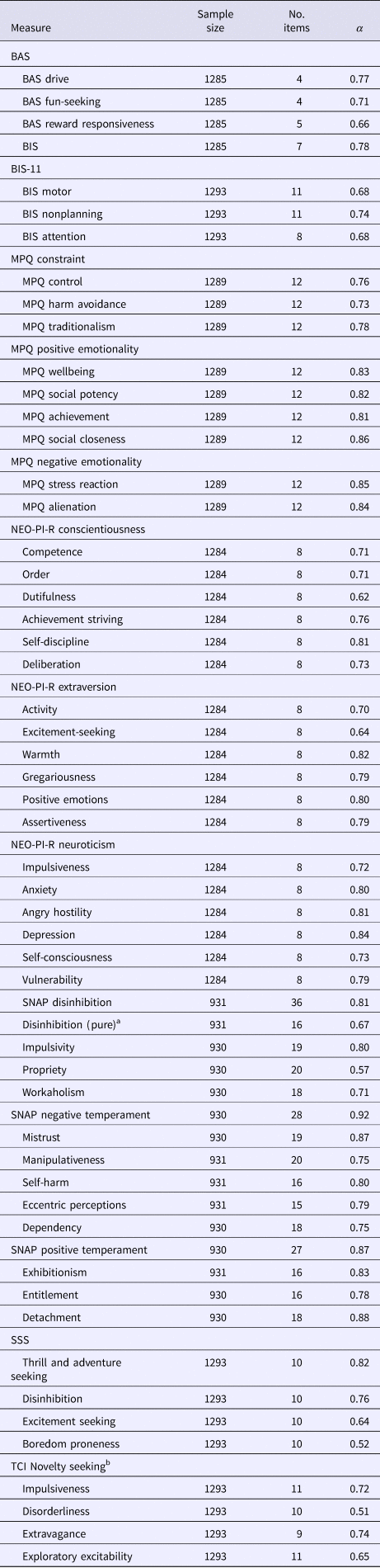
Table 1 presents psychometric properties of the self-report scales. With the exception of the TCI, all measures overlapped with those included in the Sharma et al. (Reference Sharma, Markon and Clark2014) meta-analysis. As shown, the majority of the scales’ Cronbach alpha values were greater than 0.75.
Psychometric properties of trait measures used in exploratory factor analysis

Note. BIS/BAS, behavioral inhibition system/behavioral activation system (Carver and White, Reference Carver and White1994); BIS-11, Barratt impulsiveness subscales, version 11 (Patton et al., Reference Patton, Stanford and Barratt1995); MPQ, multidimensional personality questionnaire-brief form (Patrick et al., Reference Patrick, Curtin and Tellegen2002); NEO-PI-R, NEO personality inventory-revised (Costa and McCrae, Reference Costa and McCrae1992); SNAP, schedule for nonadaptive and adaptive personality (Clark, Reference Clark1993); SSS, sensation seeking scale (Zuckerman et al., Reference Zuckerman, Kolin, Price and Zoob1964); TCI, temperament character inventory (Cloninger et al., Reference Cloninger, Przybeck and Svrakic1991). Data on the SNAP is available for 930 participants, as this measure was introduced late in the study.
a SNAP disinhibition (pure) does not include items that overlap with other SNAP scales.
b The TCI was not used in the Sharma et al. (Reference Sharma, Markon and Clark2014) meta-analysis.
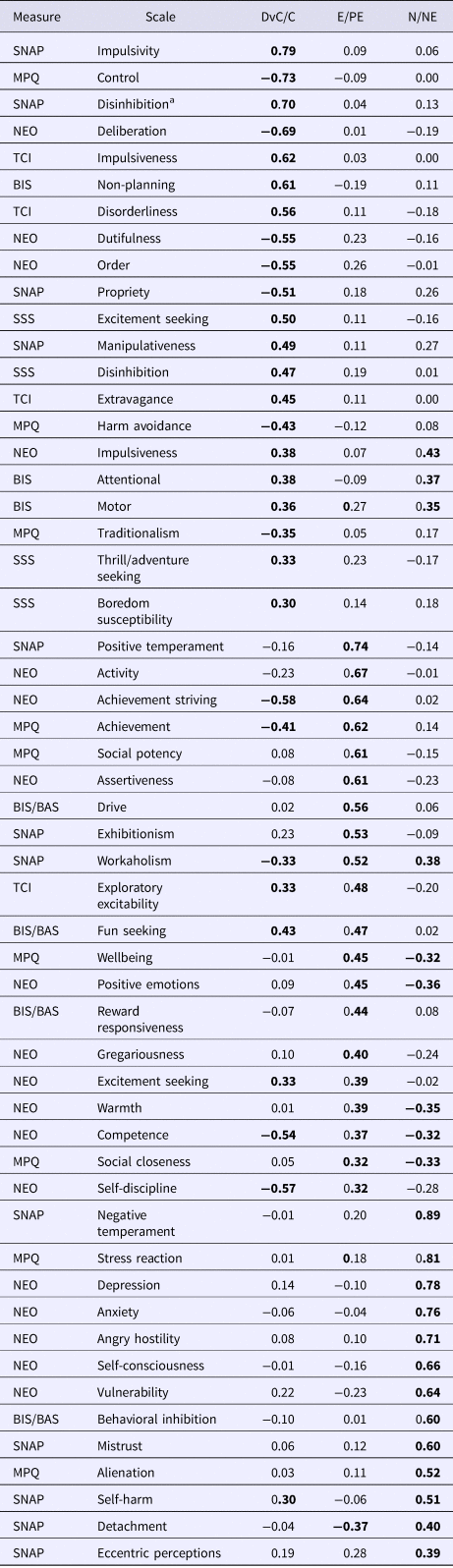
The EFA on the trait scales resulted in a three-factor solution that explained 44% of the total variance and 73% of the common variance (i.e. explained common variance; or the variance accounted for by the factors relative to the variable communalities or variance shared with other variables in the model) (see Table 2). Resulting factors were highly consistent with those reported in Sharma et al. (Reference Sharma, Markon and Clark2014) and thus we labeled them accordingly: Disinhibition (v. Constraint/Conscientiousness; DvC/C), Extraversion/Positive Emotionality (E/PE), and Neuroticism/Negative Emotionality (N/NE). Correlations between factor loadings for measures shared between this sample and Sharma et al. (Reference Sharma, Markon and Clark2014) (rs = 0.94, 0.89, and 0.68 for measures loading onto DvC/C, N/NE, and E/PE, respectively) demonstrate a high level of consistency across studies for the first two factors, and moderate consistency for the third.
Oblique-rotated exploratory factor analysis of self-report scales

Note. Boldface data indicate factor loadings above |0.30|. DvC/C, disinhibition v. constraint/conscientiousness; E/PE, extraversion/positive emotionality; N/NE, neuroticism/negative emotionality; BIS, Barratt impulsiveness subscales, version 11 (Patton et al., Reference Patton, Stanford and Barratt1995); BIS/BAS, behavioral inhibition system/behavioral activation system (Carver and White, Reference Carver and White1994); MPQ, multidimensional personality questionnaire-brief form (Patrick et al., Reference Patrick, Curtin and Tellegen2002); NEO, NEO personality inventory-revised (Costa and McCrae, Reference Costa and McCrae1992); SNAP, schedule for nonadaptive and adaptive personality (Clark, Reference Clark1993); SSS, sensation seeking scale (Zuckerman et al., Reference Zuckerman, Kolin, Price and Zoob1964); TCI, temperament character inventory (Cloninger et al., Reference Cloninger, Przybeck and Svrakic1991).
a The non-overlapping version of Disinhibition was used.
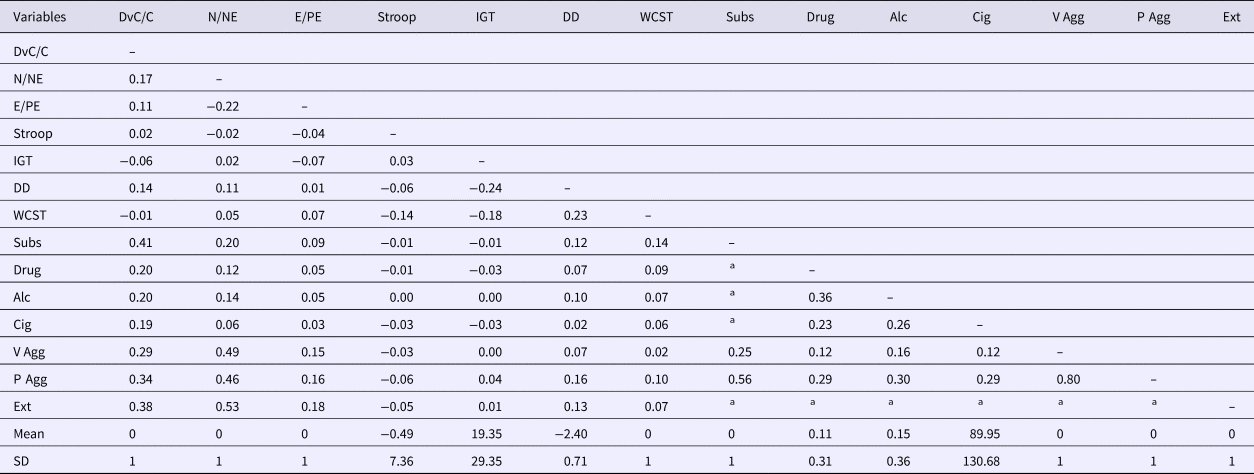
Table 3 depicts correlations among study variables. Correlation values were derived from fully saturated confirmatory factor analysis models that varied the structure of the outcome variables. As noted above, in Model 1, all of the externalizing behaviors were modeled as one higher-order latent externalizing variable. Model 2 included latent variables for substances, verbal aggression, and physical aggression. Model 3 included verbal and physical aggression and further broke down substances into drug, alcohol, and cigarette variables. As can be seen, correlations among measures within each type of assessment technique (i.e. self-report factors v. behavioral tasks) were generally small to medium, and they were all in the expected directions. Specifically, N/NE correlated modestly with DvC/C and E/PE, whereas the relationship between DvC/C and E/PE was small. There were small to medium correlations among many of the behavioral tasks, although Stroop was unrelated to both the IGT and the DDT. In contrast to the correlations among self-report factors and behavioral tasks, the correlations among the externalizing factors were medium to large (and all were positive), with a particularly high correlation between verbal and physical aggression. Correlations among the individual substances were medium in size.
Correlations among study variables

Note. All values of r > |0.07| were significant at p < 0.05. DvC/C, disinhibition v. constraint/conscientiousness; E/PE, extraversion/positive emotionality; N/NE, neuroticism/negative emotionality; Stroop, Stroop interference; IGT, Iowa gambling task; DD, delay discounting task; WCST, Wisconsin card sorting task; Subs, Substances; Drug, lifetime drug dependence; Alcohol, lifetime alcohol dependence; Cig, months smoking cigarettes; VAgg, verbal aggression; P Agg, physical aggression; Ext, externalizing behaviors. The following variables were controlled for in these analyses: sex, age, race, and education. The following variables are latent factors with fixed parameters: DvC/C, N/NE, E/PE, WCST, Subs, V Agg, P Agg, and Ext.
a Factor loadings not depicted.
Self-report factors and behavioral tasks were generally unrelated, with only two correlations reaching a small effect size (i.e. DDT with DvC/C and N/NE), both of which were in the predicted directions. Relationships between the self-report factors and externalizing factors varied, but all were in the expected directions. Correlations between DvC/C and all of the externalizing factors were medium in size. N/NE showed a small to medium correlation with the substances factor, and large correlations with verbal aggression, physical aggression, and the higher-order externalizing factor. E/PE showed small correlations with all of the externalizing factors. Further, DvC/C and N/NE showed generally small correlations with the individual substances, and E/PE was unrelated to any individual substance. Finally, relationships between the behavioral tasks and externalizing behaviors were either nonexistent or small, the latter of which were in the predicted directions. Correlations with Stroop and IGT were uniformly low, none of which reached a small effect size; correlations with DDT and WCST were generally nonexistent with only a few reaching a small effects size.
Primary analyses
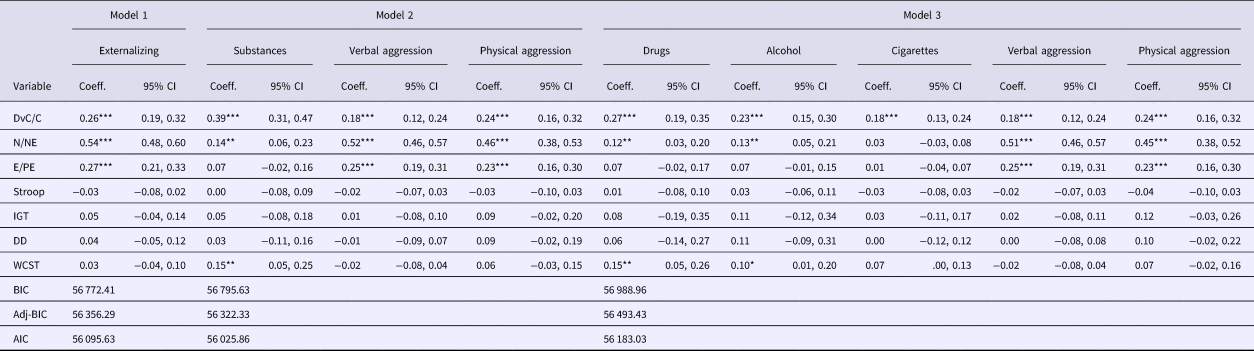
Table 4 displays the regression parameters and 95% confidence intervals for paths in the three hierarchical models for variables predicting the externalizing outcomes. Across models, observed variables were conditioned on the following demographic variables: sex, age, race, and education. As can be seen in Model 1, DvC/C and P/PE were uniquely positively associated with the higher-order externalizing factor with medium-sized effects. N/NE showed unique large association with the externalizing factor. None of the behavioral tasks were uniquely related to the higher-order externalizing factor. In Model 2, DvC/C showed a medium to large association with the substances factor, and small to medium associations with verbal and physical aggression. N/NE showed a small association with substances and large associations with verbal and physical aggression. P/PE was unrelated to substances and showed small to medium associations with verbal and physical aggression. Other than a small association between the WCST and substances, the behavioral tasks were unrelated to all three externalizing factors (see Fig. 1). In Model 3, which included each substance separately, DvC/C showed small to medium correlations with all three substances; N/NE showed small correlations with drug and alcohol dependence but was unrelated to cigarette use; P/PE was unrelated to all three substances; and none of the behavioral tasks were related to any of the substances. Fit indices indicated that models 1 and 2 were equivalent and better fitting models than Model 3.
Summary of regression parameters across three hierarchical models for variables predicting externalizing outcomes

Note: Coeff, standardized coefficient; CI, confidence interval. Drugs, lifetime drug dependence; Alcohol, lifetime alcohol dependence; Cigarettes, months smoking cigarettes; DvC/C, Disinhibition v. Constraint/Conscientiousness; E/PE, Extraversion/Positive Emotionality; N/NE, Neuroticism/Negative Emotionality; Stroop, Stroop interference; IGT, Iowa Gambling Task; DD, Delay Discounting Task; WCST, Wisconsin Card Sorting Task. Observed variables were conditioned on the following covariates: sex, age, race, and education.
**p < 0.01 ***p < 0.001.
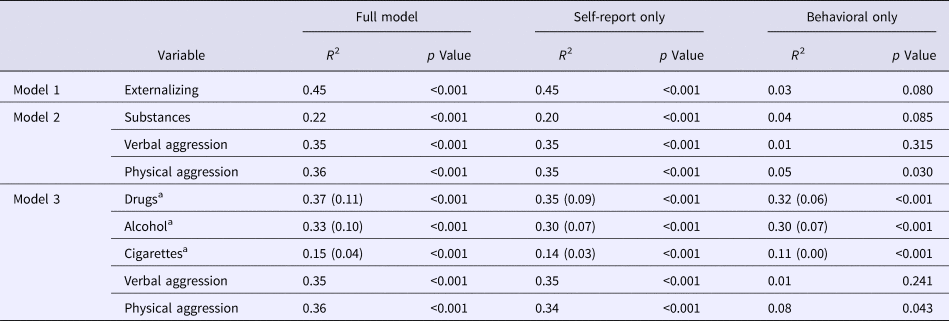
Table 5 depicts the variance accounted for in outcomes for the three hierarchical SEMs across the following models: a full model that included both self-report and behavioral task predictors, and models that included only one type of predictor (i.e. self-report or behavioral tasks). As can be seen across the three hierarchical models, significant proportions of variances in the externalizing outcomes were accounted for in the SEMs that included both self-report factors and behavioral task predictors. The amounts of variance explained in these full models were similar to the amounts of variance explained in models that only included self-report factors. In contrast, models that only included behavioral task predictors explained very little (and mostly non-significant) amounts of variance in externalizing outcomes.
Variance explained for externalizing outcomes across three hierarchical models

Note: Results for the ‘full model’ are from an SEM that included both self-report and behavioral predictors; the ‘self-report only’ model did not include behavioral predictors; the ‘behavioral only’ model did not include self-report predictors. In all models, observed variables were conditioned on the following covariates: sex, age, race, and education.
a Values in parentheses depict changes in R 2 values from a baseline model that only included the following covariates: sex, age, race, and education.
Discussion
The purpose of the current study was to replicate and extend Sharma et al. (Reference Sharma, Markon and Clark2014) meta-analysis findings by examining the interrelations of a broad battery of impulsivity-related assessments, as well as their associations with externalizing behaviors, in a large sample of community adults. Using 54 scales from seven common measures of impulsivity and related personality domains, six of which overlapped with the measures used in Sharma et al. (Reference Sharma, Markon and Clark2014), we replicated the Big Three Model of personality structure (Eysenck and Eysenck, Reference Eysenck and Eysenck1977; Watson and Clark, Reference Watson, Clark, Wegner and Pennebaker1993; Patrick et al., Reference Patrick, Curtin and Tellegen2002) that Sharma found – Disinhibition v. Constraint/Conscientiousness (DvC/C), Extraversion/Positive Emotionality (E/PE), and Neuroticism/Negative Emotionality) – and we accounted for a larger amount of the common variance (i.e. 73% v. 59%). In our study, as in Sharma et al. (Reference Sharma, Markon and Clark2014), Disinhibition (vC/C) and N/NE were modestly correlated (although the r value in the current study was smaller), which is consistent with other conceptualizations of impulsivity (e.g. DeYoung, Reference DeYoung, Vohs and Baumeister2010) and prior work on the hierarchical structure of personality (e.g. Markon et al., Reference Markon, Krueger and Watson2005; Wright and Simms, Reference Wright and Simms2014). Also consistent with Sharma et al. (Reference Sharma, Markon and Clark2014), E/PE was not related to DvC/C but correlated with N/NE at −0.22 (see also Sharma et al., Reference Sharma, Kohl, Morgan and Clark2013). Taken together, the results of the factor analysis on impulsivity-related personality traits in the current large sample of community adults mirror the results of the Sharma et al. (Reference Sharma, Markon and Clark2014) meta-analysis.
We next examined the bivariate correlations among the self-report factors, behavioral tasks of impulsivity, and externalizing behaviors. We had available to us one behavioral task indicator for each of the four latent factors revealed in the Sharma et al. (Reference Sharma, Markon and Clark2014) meta-analysis – specifically, we administered the Stroop, the IGT, the DDT, and the WCST. While the correlations among the latent behavioral task factors in Sharma et al. (Reference Sharma, Markon and Clark2014) were uniformly low (ranging from −0.03 to 0.13), we observed small to medium correlations among the four behavioral tasks used here, suggesting that the tasks share common variance and yet are separable. These results are consistent with studies examining the relationships among behavioral tasks used to assess executive function (e.g. Vaughan and Giovanello, Reference Vaughan and Giovanello2010; Friedman et al., Reference Friedman, Miyake, Robinson and Hewitt2011; Rose et al., Reference Rose, Feldman and Jankowski2011), many of which overlap with behavioral tasks to assess impulsivity (Sharma et al., Reference Sharma, Markon and Clark2014), a pattern of findings that has been described by Miyake et al. as the unity/diversity framework or the ‘task-impurity’ problem (Miyake et al., Reference Miyake, Friedman, Emerson, Witzki and Howerter2000; Miyake and Friedman, Reference Miyake and Friedman2012). Importantly, these behavioral tasks may very well be collectively tapping into a general factor of executive function/inhibitory-control (Young et al., Reference Young, Friedman, Miyake, Willcutt, Corley, Haberstick and Hewitt2009; Miyake and Friedman, Reference Miyake and Friedman2012), but we were unable to determine the extent to which their shared variance predicted the externalizing outcomes in the current study due to problems attributed to the latent behavioral task factor (see Footnote 3). Future studies are needed to further explore this question. Unsurprisingly, there were medium to large positive associations among the externalizing behaviors (i.e. drug and alcohol use, cigarette use, verbal aggression, and physical aggression), a clustering pattern that is typical of behaviors on the externalizing spectrum (e.g. Krueger et al., Reference Krueger, Hicks, Patrick, Carlson, Iacono and McGue2002; Grant et al., Reference Grant, Stinson, Dawson, Chou, Ruan and Pickering2006; Eaton et al., Reference Eaton, Krueger, Keyes, Skodol, Markon, Grant and Hasin2011; Jahng et al., Reference Jahng, Trull, Wood, Tragesser, Tomko, Grant, Bucholz and Sher2011).
Associations between self-report factors of personality traits related to impulsivity and laboratory behavioral tasks were small or nonexistent, replicating Sharma et al. (Reference Sharma, Markon and Clark2014) and many other prior studies (e.g. White et al., Reference White, Moffitt, Caspi, Bartusch, Needles and Stouthamer-Loeber1994; Crean et al., Reference Crean, de Wit and Richards2000; Reynolds et al., Reference Reynolds, Ortengren, Richards and de Wit2006; Cyders and Coskunpinar, Reference Cyders and Coskunpinar2011, Reference Cyders and Coskunpinar2012), and suggest very little overlap across these assessment modalities (but see below for other possible explanations for these results). As expected, DvC/C was positively associated with all of the externalizing outcomes, and the correlations were medium to large in magnitude, underscoring the important role of disinhibition in the manifestation of externalizing behaviors (e.g. Sher and Trull, Reference Sher and Trull1994; Flory et al., Reference Flory, Harvey, Mitropoulou, New, Silverman, Siever and Manuck2006; Sharma et al., Reference Sharma, Kohl, Morgan and Clark2013; Creswell et al., Reference Creswell, Bachrach, Wright, Pinto and Ansell2016). Consistent with the view that many impulsive behaviors are driven by affect (Whiteside and Lynam, Reference Whiteside and Lynam2001; Cyders et al., Reference Cyders, Smith, Spillane, Fischer, Annus and Peterson2007; Cyders and Smith, Reference Cyders and Smith2007), we observed correlations between both N/NE and E/PE and the externalizing behaviors. Notably, N/NE showed medium to large positive correlations with the externalizing factors, and with the exception of the substances factor, the magnitudes of the associations were larger than those for DvC/C. These findings underscore the importance of negative urgency in driving impulsive behaviors (Cyders and Smith, Reference Cyders and Smith2007; Smith et al., Reference Smith, Fischer, Cyders, Annus, Spillane and McCarthy2007). E/PE showed small positive correlations with the externalizing factors, consistent with prior results linking positive urgency to impulsive behaviors (Smith et al., Reference Smith, Fischer, Cyders, Annus, Spillane and McCarthy2007).
Of the four behavioral tasks of impulsivity, the DDT and WCST were most related to the externalizing outcomes, showing small positive correlations with the latent factors of substances and physical aggression, and DDT additionally showing a small relationship with the higher-order externalizing factor. These results are consistent with prior work demonstrating higher discounting rates and poorer decision making in drug-addicted individuals and those with high trait aggression (e.g. Beatty et al., Reference Beatty, Katzung, Moreland and Nixon1995; Rosselli and Ardila, Reference Rosselli and Ardila1996; Dougherty et al., Reference Dougherty, Bjork, Huckabee, Moeller and Swann1999; Kirby et al., Reference Kirby, Petry and Bickel1999; Coffey et al., Reference Coffey, Gudleski, Saladin and Brady2003; Hoffman et al., Reference Hoffman, Moore, Templin, McFarland, Hitzemann and Mitchell2006; Sweitzer et al., Reference Sweitzer, Donny, Dierker, Flory and Manuck2008; McCloskey et al., Reference McCloskey, New, Siever, Goodman, Koenigsberg, Flory and Coccaro2009). Inconsistent with previous findings linking the Stroop and IGT to externalizing outcomes like addictive behaviors (e.g. Cox et al., Reference Cox, Fadardi and Pothos2006; Harmsen et al., Reference Harmsen, Bischof, Brooks, Hohagen and Rumpf2006; Verdejo-García et al., Reference Verdejo-García, Perales and Pérez-García2007; Businelle et al., Reference Businelle, Kendzor, Rash, Patterson, Coffey and Copeland2009), we did not find evidence of these relationships in the current study.
This study extends previous bivariate correlation findings, including those reported by Sharma et al. meta-analysis (Reference Sharma, Markon and Clark2014), by relating self-report factors and behavioral tasks of impulsivity with externalizing behaviors using SEM, an analytic strategy that allowed for the simultaneous examination of the unique effects of self-report and behavioral assessments on the externalizing behavioral outcomes. We tested three hierarchical SEMs that varied how the externalizing outcomes were modeled. Mirroring our bivariate correlation findings, higher DvC/C scores predicted increased reports of all of the externalizing outcomes, although the sizes of the effects were attenuated. In the SEMs, E/PE was actually a stronger predictor of the higher-order externalizing factor and the two aggression factors compared with the bivariate relationships, and E/PE remained unassociated with the substances factor or any of the individual substances. Relationships between N/NE and the externalizing outcomes in the SEMs were similar to the relationships observed in the bivariate correlations; N/NE continued to show large associations with the higher-order externalizing factor, as well as verbal and physical aggression; and it showed small associations with the substances factor, driven mainly by its association with drug and alcohol dependence. It is also noteworthy that N/NE was a stronger predictor of the externalizing outcomes than was DvC/C, highlighting the important role of negative urgency in the manifestation of impulsive behaviors.Footnote 4 Further, while the DDT showed some small relationships with some of the outcomes (i.e. alcohol dependence, physical aggression, the higher-order externalizing factor) in the bivariate correlational analyses, the DDT was unrelated to any outcome in the SEMs. Finally, although poor performance on the WCST was not associated with the substances factor or any of the individual substances in the bivariate correlational analyses, the WCST showed a small relationship the substances factor in the SEM, which was driven primarily by its association with drug dependence.
Notably, the SEMs that included both self-report factors and behavioral tasks of impulsivity as predictors accounted for 15–45% of the variance in the externalizing outcomes. These R 2 values were virtually identical to models that included only self-report factors, indicating that any explained variance in the outcomes was completely driven by the personality trait factors related to impulsivity rather than the behavioral tasks. Models that only included behavioral tasks as predictors accounted for very little (and mostly non-significant) amounts of variance in the externalizing outcomes. In fact, even in the current bivariate correlational analyses, and counter to the findings reported by Sharma et al. (Reference Sharma, Markon and Clark2014), externalizing outcomes were generally not predicted by any of the behavioral tasks of impulsivity, except for small relationships between the DDT and the WCST and some of the externalizing outcomes, the former of which disappeared in the SEMs. Thus, the current findings stand in contrast to the Sharma et al. (Reference Sharma, Markon and Clark2014) hypothesis that these two types of measures both predict externalizing behaviors and do so more strongly when both are considered than either type of measure alone. However, it is important to note that the behavioral tasks were measured as single indicators, whereas the self-report factors were latent variables measured in a manner that eliminated error variance. Thus, the behavioral tasks were at a considerable disadvantage in predicting the externalizing behaviors relative to the self-report factors in this study.
Taken together, these findings further clarify the predictive validity of a battery of self-reported personality traits related to impulsivity and laboratory behavioral tasks on a range of externalizing behaviors. This study has limitations, though. Most importantly, we followed the approach taken by Sharma et al. (Reference Sharma, Markon and Clark2014) and framed this study around the construct of impulsivity as assessed from differing measurement domains (i.e. self-report and behavioral lab-task performance), but it is important to note the limited breadth of representation of impulsivity in both measure types used here, especially in the rating scales (e.g. absence of the UPPS Impulsive Behavior Scale; Whiteside and Lynam, Reference Whiteside and Lynam2001). Indeed, we refrained from interpreting the rating-scale factors in the current paper as being ‘impulsigenic’ traits (cf. Sharma et al., Reference Sharma, Markon and Clark2014), and refer rather to personality traits implicated in impulsive behaviors, as the self-report scales used here are largely broadband personality measures with only a few that are purpose-built measures of impulsivity and its facets. Further, we adopted an approach commonly taken in the literature and assume that single laboratory-task measures each index a construct similar to impulsivity (e.g. Stroop as a measure of inattentiveness; e.g. Sharma et al., Reference Sharma, Markon and Clark2014; Marsland et al., Reference Marsland, Gianaros, Kuan, Sheu, Krajina and Manuck2015), but this is likely problematic given that the construct validity of task measures is often unknown or assumed, particularly with regard to stable (trait-like) individual difference factors that these tasks index (see also Perkins et al., Reference Perkins, Yancey, Drislane, Venables, Balsis and Patrick2017). It is also unclear whether the behavioral tasks used here (and commonly in this literature) are pure laboratory-based measures of impulsivity rather than indicators of other more general neurocognitive processes (Young et al., Reference Young, Friedman, Miyake, Willcutt, Corley, Haberstick and Hewitt2009; Miyake and Friedman, Reference Miyake and Friedman2012). Beyond questionable construct validity of the behavioral tasks, we also lack information about these tasks’ psychometric properties. It is important to note that the low reliability of single laboratory-task measures may obfuscate the relationship between self-report and behavioral assessment modalities, as well as the predictive relationship between these tasks and impulsive behaviors.
Another limitation is that these analyses were based on cross-sectional data, and we thus cannot make claims about the temporal relationships among the impulsivity-related measures and externalizing behaviors. However, our model is consistent with longitudinal research demonstrating that individual differences in personality predict subsequent externalizing behaviors (Morey et al., Reference Morey, Hopwood, Markowitz, Gunderson, Grilo, McGlashan, Shea, Yen, Sanislow, Ansell and Skodol2012; Luyten and Blatt, Reference Luyten and Blatt2013; Creswell et al., Reference Creswell, Chung, Wright, Black, Clark and Martin2015). We also were not able to use a latent-variable approach to replicate the factor analysis of behavioral tasks conducted by Sharma et al. (Reference Sharma, Markon and Clark2014) and to alleviate the task-impurity problem observed here (Miyake et al., Reference Miyake, Friedman, Emerson, Witzki and Howerter2000). Further, we were limited to self-report and behavioral task measures in the current study, and future work would benefit from considering brain response indicators of impulsivity proneness to move toward a more biobehaviorally oriented framework (e.g. see Venables et al., Reference Venables, Foell, Yancey, Kane, Engle and Patrick2018). Finally, the scope of externalizing behavior assessed in the current study is a limitation. The inclusion of other psychiatric variables (e.g. Cluster B personality disorders, gambling, criminality, depression) would help to clarify how facets of impulsivity are related to different forms of psychopathology. Future well-powered studies using a battery of behavioral tasks and brain response indicators of impulsivity proneness, along with multiple self-report measures of impulsivity-related traits and a range of externalizing behaviors are indicated. Despite these shortcomings, the current study extends the meta-analysis findings reported by Sharma et al. (Reference Sharma, Markon and Clark2014) in a large sample of community adults and adds to the impulsivity literature by introducing a set of findings that are less influenced by the method or error variance.
Supplementary material
The supplementary material for this article can be found at https://doi.org/10.1017/S0033291718002295
Acknowledgements
This study was primarily supported by National Heart Lung Blood Institute Grants PO1 HL 040962 (Manuck) and RO1 HL065137 (Manuck), as well as grants R01 AA025936 (Creswell), L30 AA022509 (Creswell), and L30 MH101760 (Wright).