Introduction
The Russian Federation and the United States have made enormous progress in reducing the sizes of their Cold War nuclear arsenals over the last decades. Britain and France have also reduced their arsenals. The pace of reduction is slowing, however, and the arms control process has become less restrictive and has so far failed to produce limits on many categories of nuclear weapons.
Instead, the world's nine nuclear-armed States – the United States, the Russian Federation, China, France, the United Kingdom, India, Pakistan, Israel and North Korea – are each making significant investments in maintaining and modernizing their nuclear forces, in most cases increasing nuclear military capabilities and, in the case of China, Pakistan, India, and North Korea, even increasing the sizes of their arsenals. These modernization programmes effectively plan for the sustaining of large nuclear arsenals further into the future than the nuclear era has lasted so far.
In addition to reaffirming their intention to retain nuclear weapons, the nuclear-armed States and many of their allies frequently emphasize the importance of nuclear weapons to national and international security. To maintain and demonstrate this role, nuclear weapon systems are periodically test-launched and nuclear exercises are frequently conducted in order to practice offensive strike plans against potential adversaries. Russia and the United States have both increased the profile and operations of their nuclear-capable forces since the Ukraine crisis.
The technical capabilities of the nuclear arsenals – delivery vehicles such as aircraft and missiles, the nuclear warheads they can deliver, and the structure of nuclear forces – influence many aspects of nuclear deterrence and war-fighting strategies between countries today, as well as the forms that nuclear warfare could assume. More advanced arsenals stimulate development of more ambitious nuclear war-fighting strategies that go beyond basic deterrence.
Although a surprise nuclear first strike is viewed as highly unlikely, the United States, Russia, Britain and France keep large numbers of nuclear warheads on alert, capable of being launched on short notice. Maintaining nuclear forces on alert increases the risk of accidents and incidents and fuels adversarial and competitive policies and worst-case planning. Moreover, the highly alerted nuclear postures of the United States, Russia, Britain and France may help motivate smaller nuclear-armed States such as China, India and Pakistan to increase the readiness level of their nuclear forces as well, thereby significantly increasing nuclear risks for all.Footnote 1
Nuclear modernization programmes and operations are intended to maintain a State's ability to inflict massive destruction on an adversary. Despite the end of the Cold War more than two decades ago, the destructive potential of current nuclear arsenals remains at a very high level, capable of widespread and horrific devastation on a continental scale, with the potential to harm hundreds of millions of people directly from blast, fire and radioactive fallout, and billions more indirectly from climatic effects and famine.
Status of nuclear forces
Compared with the situation during the Cold War, the world has made substantial progress in reducing the number of nuclear weapons. The worldwide inventory of nuclear weapons (counting both warheads in military stockpiles and those that are retired, but still intact) peaked in 1986 at an estimated 70,300 warheads.Footnote 2 Since then, retirement and dismantlement of excess weapons have eliminated more than 50,000 warheads, reducing the remaining inventory to an estimated 15,400 warheads (see Figure 1).
Estimated global nuclear warhead inventories, 1945–2016. The global inventory (grey) of nuclear warheads (stockpiled plus those that are retired but still intact) has decreased significantly since the Cold War peak in 1986. The US stockpile (blue) peaked in 1967, while the Russian stockpile (red) peaked in 1986. As of early 2016, the world's nine nuclear-armed States possess an estimated 15,400 weapons. Source: Hans M. Kristensen and Robert S. Norris, “Status of World Nuclear Forces”, Federation of American Scientists (FAS), 26 May 2016, available at: http://fas.org/issues/nuclear-weapons/status-world-nuclear-forces/.

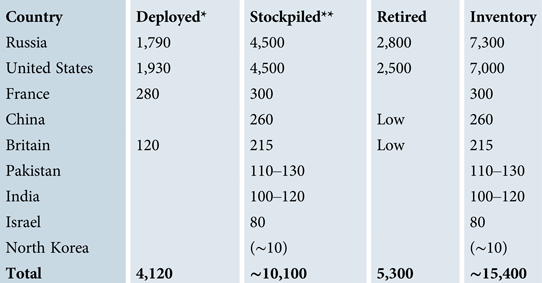
Of those 15,400 warheads, an estimated 10,100 are in military stockpiles and earmarked for potential use by a wide variety of delivery systems, including land- and sea-based long-range ballistic missiles, heavy bombers, fighter-bombers, air- and sea-launched cruise missiles, air- and missile-defence interceptors, torpedoes, and depth bombs. An estimated 4,000 warheads are deployed on or with operational delivery systems, and roughly 1,800 of those are ready for use at short notice (see Table 1).Footnote 3
Estimated worldwide nuclear warhead inventories, 2016
* A deployed warhead is defined as either deployed on a launcher or at a base with operational launchers.
** Stockpiled warheads are those in the custody of the military and available for use by launchers. The number includes spares, but not retired but still intact warheads awaiting dismantlement.
Source: Hans M. Kristensen and Robert S. Norris, “Status of World Nuclear Forces”, FAS, 1 March 2016, available at: http://fas.org/issues/nuclear-weapons/status-world-nuclear-forces/.
More than 90% of this current inventory of 15,400 nuclear warheads are in the possession of just two countries: Russia and the United States. These two countries each retain nuclear arsenals that are vastly bigger than any other nuclear-armed State is either capable of producing or considers necessary for national security; none of the world's seven other nuclear-armed States (Britain, China, France, India, Israel, North Korea and Pakistan) have more than a few hundred warheads.
The significant differences in the size and composition of the nuclear arsenals shown in Table 1 indicate that different nuclear-armed States have different plans for the potential use of nuclear weapons. Yet all nuclear arsenals are designed to inflict specific, calculated damage on potential adversaries. This ranges from the use of a few nuclear weapons against more vulnerable or “soft” targets such as a city to the simultaneous or highly orchestrated employment of many hundreds of weapons against military forces, including damage-resistant or “hardened” missile silos and underground command and control centres.
The use of just a single or a few nuclear weapons would decimate a city, with horrific humanitarian consequences, and a large-scale nuclear war using hundreds or even thousands of nuclear weapons would, even if the weapons were used only against military facilities, cause tens of millions of civilian casualties from blast effects, fires and radioactive fallout;Footnote 4 there is no such thing as acceptable or humanitarian use of nuclear weapons. Civilian suffering caused by longer-term climatic effects would be even greater.
A 2001 study by scientists from the United States and India concluded that the use of only ten nuclear weapons on five Indian and five Pakistani cities (airburst) would kill 2.9 million people, with an additional 1.5 million severely injured.Footnote 5 These were calculated as effects from airburst detonations over the cities, which create limited radioactive fallout. A follow-up study by the Natural Resources Defense Council (NRDC) on the effects of ground-burst detonations found that in addition to immediate deaths from blast effects and fires, the use of twenty-four ground-burst weapons on fifteen Indian and Pakistani cities would expose 22.1 million people to lethal radiation doses of 600 rem or more in the first two days after the attack. Another 8 million people would receive a radiation dose of 100 to 600 rem, causing severe radiation sickness and potentially death, especially for the very young, old or infirm.Footnote 6
Humanitarian effects would not be limited to blast effects, fires and radioactive fallout. A 2012 study by International Physicians for the Prevention of Nuclear War (IPPNW) found that detonation of as few as 100 nuclear weapons – less than 1% of the global nuclear weapons inventory – would disrupt the global climate and agricultural production so severely that the lives of more than 2 billion people would be in jeopardy.Footnote 7 A large-scale nuclear war would have long-lasting consequences on a global scale that make any talk of winning such a war meaningless.
Five of the nuclear-armed States (Britain, China, France, Russia and the United States) have committed themselves, under the nuclear Non-Proliferation Treaty (NPT), “to pursue negotiations in good faith on effective measures relating to cessation of the nuclear arms race at an early date and to nuclear disarmament, and on a treaty on general and complete disarmament under strict and effective international control”.Footnote 8 Negotiations resulting in arms control treaties have taken place intermittently since the NPT entered into force, but none are happening at time of writing. And while an arms race as it materialized during the Cold War is no longer taking place, a technological nuclear competition is in full swing.
None of the five nuclear weapons States party to the NPT, which combined possess 98% of the world's nuclear weapons, have presented plans for a treaty on general and complete disarmament or outlined how they plan to “get to zero”. Some of them argue that a step-by-step approach of gradual reductions is a better approach than a ban,Footnote 9 but the pace of reductions has slowed considerably compared with the 1990s. The long-term modernization plans and nuclear policies of all five nuclear weapons States party to the NPT indicate that they intend to keep sizeable nuclear arsenals for the foreseeable future.
Meanwhile, as discussed in further detail below, all nine nuclear-armed States have significant and expensive nuclear weapons modernization programmes under way and appear determined to retain nuclear weapons for the indefinite future. These modernization programmes continue to make nuclear weapons more capable and effective, and are accompanied by continuous refinement of strike plans for their potential use.
Evolution of nuclear capabilities
The posture and strategy behind the possession and potential use of nuclear weapons are greatly influenced by their capability, which has evolved significantly since the first nuclear weapons were deployed in the 1940s, although details may vary considerably from country to country.
The first nuclear weapons were delivered by large bombers, so strike planning involved lengthy preparation and long sorties from base to target. As ballistic missiles were added to the arsenals, the time required to deliver nuclear weapons to targets decreased from hours to minutes. Initial liquid-fuel missiles, which took hours to prepare for launch, were soon replaced with solid-fuel missiles that could be launched in a few minutes. The transition from slow to fast delivery systems shortened the fuse of nuclear war planning and prompted development of response plans that could launch weapons before they were destroyed by attacking nuclear weapons launched on missiles. Today, approximately 1,800 US, Russian, British and French nuclear warheads are still deployed and ready for use at short notice.Footnote 10
Early delivery systems had very poor accuracy, so planners compensated by using warheads with very large explosive yields to ensue destruction of the target. As accuracy improved and warhead designs became more compact and lighter in weight, each bomber aircraft was able to carry more weapons and each missile more warheads. This trend led to the vast build-up of deployed strategic nuclear warheads on fast-flying ballistic missiles that came to symbolize the Cold War arms race. By the end of the 1980s, the United States and Soviet Union each had more than 10,000 nuclear warheads deployed on ballistic missiles and heavy bombers.Footnote 11 By comparison, currently the United States, Russia, Britain and France combined deploy an estimated 3,440 warheads on ballistic missiles.Footnote 12
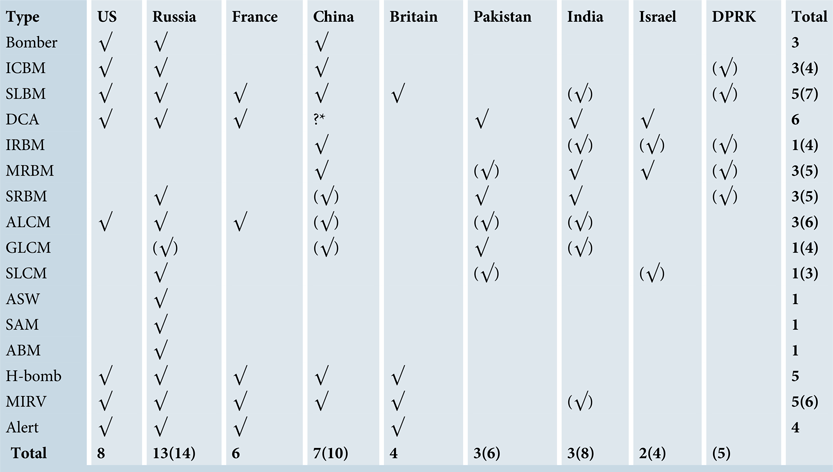
The nuclear arsenals of the nine nuclear-armed States today vary considerably depending on each State's history, strategy and technological capabilities (see Table 2). As a result, the dynamics between different nuclear-armed States can vary significantly, as can the ambition of nuclear planning and the potential consequences of nuclear use.
Comparing nuclear capabilities
Check marks in parenthesis indicate capabilities in development or uncertain status.
* The Chinese nuclear test conducted on January 7, 1972, involved a bomb delivered by a Q-5 dual-capable fighter-jet.
Key:
ABM: anti-ballistic missile
ALCM: air-launch cruise missile
Alert: warheads mounted on missiles configured to launch at short notice
ASW: anti-submarine warfare
DCA: dual-capable aircraft (fighter-bomber)
GLCM: ground-launched cruise missile
H-bomb: hydrogen (thermonuclear) warhead design
MRBM: medium-range ballistic missile
ICBM: intercontinental ballistic missile
IRBM: intermediate-range ballistic missile
MIRV: multiple independently targeted re-entry vehicle
MRBM: medium-range ballistic missile
SAM: surface-to-air missile
SLBM: sea-launched ballistic missile
SLCM: sea-launched cruise missile
SRBM: short-range ballistic missile
Source: data are derived from the FAS Nuclear Notebook series in the Bulletin of the Atomic Scientists, available at: http://bos.sagepub.com/cgi/collection/nuclearnotebook.
The United States and Russia have very large arsenals consisting of a “triad” of long-range strategic nuclear forces, meaning intercontinental ballistic missiles (ICBMs), sea-launched ballistic missiles and nuclear-capable aircraft, backed up by shorter-range tactical nuclear forces. China, France, India, Israel and Pakistan each have a “dyad”, meaning two out of three elements of a triad, of medium- and/or long-range forces. China and India (and possibly Pakistan) are transitioning to triads, and there are rumours that Israel may have a triad. Pakistan and India also have short-range weapons. North Korea appears to be focused on land-based missiles but is also developing a sea-based missile.Footnote 13
The original five nuclear-armed States (Britain, China, France, Russia and the United States) all have thermonuclear warheads with high yields of hundreds of kilotons that were developed in extensive live nuclear testing programmes before these countries ceased test explosions of nuclear weapons between 1990 and 1996.Footnote 14 The warheads of these countries have been miniaturized via these research and test programmes in order to allow missiles to carry multiple warheads that can be independently aimed at different targets.
The newer nuclear-armed States (India, Israel, North Korea and Pakistan) have simpler warhead designs with lower yields estimated to be in the range of a few kilotons to a few tens of kilotons.Footnote 15 These countries have each conducted only a handful of nuclear tests, which is probably insufficient to develop advanced thermonuclear warheads with higher yields, although they may have researched thermonuclear designs. Instead, they may have developed so-called boosted warhead designs that use a radioactive gas (tritium) to increase the yield of single-stage fission warhead designs. Their ballistic missiles can each carry a single and relatively heavy warhead, although deployment of nuclear-capable cruise missiles (in the case of Pakistan and possibly China and Israel) indicates success in miniaturizing warheads.
The United States, Russia, France and Britain all have nuclear weapons on alert, with ballistic missiles deployed and loaded with warheads and ready for use at short notice. This type of posture was created during the Cold War and puts high demands on the capability of command and control systems and the scope of strike plans. Countries with nuclear weapons on alert tend to have nuclear strategies focused on counterforce targeting, where nuclear weapons are used to hold at risk difficult and hardened targets such as other nuclear forces and command and control facilities. Counterforce strategy requires larger arsenals and more advanced weapons than other targeting strategies, and alert forces increase the risk of accidents and misunderstandings.Footnote 16
Counterforce strategy also requires nuclear weapons that are more accurate, in order to be able to destroy smaller or hardened targets. The Trident II D5 sea-launched ballistic missile, which is deployed by the United States and Britain, can from 10,000 kilometres away place a warhead within a circle with a diameter smaller than the length of an Ohio-class ballistic missile submarine (130–180 metres, possibly less).Footnote 17 The weapon is capable of holding at risk the full range of targets, including the most hardened. A nuclear cruise missile can have an accuracy of as little as 10–30 metres,Footnote 18 which can also provide hard-target kill capability with sufficient yield.
The remaining nuclear-armed States (China, India, Israel, North Korea and Pakistan) are thought to store nuclear warheads separate from delivery vehicles under normal circumstances. In a crisis, the warheads would first have to be mated with their delivery vehicles. In general, the lower readiness of these countries’ nuclear forces requires less capable nuclear command and control capabilities and less ambitious employment strategies. Countries with de-alerted nuclear forces tend to have nuclear strategies focused on countervalue targeting, where nuclear weapons are used to hold at risk enemy cities, large military bases, and industry. Such countervalue postures tend to require smaller arsenals and less advanced weapons, and are less prone to accidents and do not post a first-strike threat to other nuclear-armed States.
All nuclear-armed States have developed short- or medium-range nuclear weapons, which tend to represent one of the first stages of developing a nuclear arsenal. During the Cold War, short-range nuclear weapons were developed as battlefield weapons. Most of these weapons have been retired (Britain has entirely dismantled its tactical nuclear stockpile), but some have been retained. Russia has a large and diverse stockpile of tactical nuclear weapons for use by its navy, air defence, air force and army. The United States and France have tactical weapons for fighter-bombers, although France calls its short-range air-launched cruise missile (ALCM) a strategic weapon.Footnote 19
China conducted a nuclear test from a fighter-bomber in 1972, although it is unknown if nuclear bombs are currently available for Chinese dual-capable fighter-bomber aircraft. The US Central Intelligence Agency concluded in 1993 that China “almost certainly” had developed a warhead for the DF-15 short-range ballistic missile, and projected that deployment of “nuclear-armed” DF-15s would begin in 1994;Footnote 20 however, it is not known whether China ever produced and fielded the warhead. Pakistan is developing a short-range (60 kilometres) NASR missile which is intended for sub-strategic scenarios.
Continued modernization of nuclear forces
Some have recently warned that Russia and the United States are now on the brink of a new “arms race”.Footnote 21 Although an arms race similar to the one that characterized the Cold War – a race to build the most nuclear weapons – fortunately does not seem imminent, there is no doubt that the souring of East–West relations, growing military posturing and more or less overt threats, combined with the extensive nuclear modernization programmes discussed here, have the potential to create demands for more or new types of nuclear weapons.
What is in full swing, therefore, is a nuclear technological arms race. All the nuclear-armed States have extensive modernization programmes under way for their nuclear forces, and some of these programmes will further modify or enhance their nuclear targeting capabilities. And in South Asia, the nuclear modernization programmes of India and Pakistan do have worrisome signs of a regional nuclear arms race in the traditional sense.
Although bilateral US–Russian arms control treaties place limits on how many nuclear weapons can be deployed or, in the case of the 1987 Intermediate-Range Nuclear Forces Treaty, ban land-based missiles with certain ranges, these treaties do not limit modernization of nuclear forces in general. Arms control has traditionally focused on strategic stability in numbers but has ignored instability resulting from unconstrained modernization. Under the New START Treaty,Footnote 22 for example, both Russia and the United States can (and do) develop and deploy new and improved nuclear launchers and warheads as long as they do not exceed the treaty limits for launchers and deployed warheads. None of the other seven nuclear-armed States are restrained in their nuclear modernization programmes or postures by any arms control treaty.
The United States
President Barack Obama took office with a strong public commitment to reducing the number of nuclear weapons and the role they serve in US security strategy. After an energetic beginning with a Prague speech that re-energized the hopes and aspirations of the international arms control community by promising to “put an end to Cold War thinking”,Footnote 23 and the New START Treaty with Russia,Footnote 24 the Obama administration appears to have since shifted its focus to modernization of the entire nuclear arsenal and the infrastructure that supports it.Footnote 25
New presidential guidance issued in 2013 did order adjustments to nuclear weapons employment strategy,Footnote 26 and President Obama said the United States had “narrowed the range of contingencies under which [it] would ever use or threaten to use nuclear weapons”.Footnote 27 But since the military and defence contractors have largely succeeded in preventing significant changes to the nuclear force structure and the overall strategy continues to focus on holding at risk Russian and Chinese nuclear forces, these modifications appear to be modest in scope. Instead of significantly changing US nuclear strategy, the guidance retained the existing posture with a triad of strategic nuclear weapons backed up by non-strategic weapons, reaffirmed long-held planning principles such as counterforce targeting while rejecting less ambitious targeting strategies such as countervalue and minimum deterrence, and retained the existing readiness level with large numbers of nuclear weapons on alert.Footnote 28
As a result, after nearly eight years in office, the Obama administration has little to show in public that demonstrates that it has significantly reduced the number of nuclear weapons or curtailed the role they serve in US national security strategy. The Obama administration has achieved only a modest reduction of deployed strategic warheads and launchers under the New START Treaty, despite the fact that the administration has concluded that after New START is implemented in 2018, the military will still have up to one third more strategic nuclear warheads deployed than is needed for national and international security commitments.Footnote 29 Moreover, the administration has achieved the smallest stockpile reduction of any post-Cold War presidency (so far only a reduction of about 700 warheads).Footnote 30
The Obama administration also pledged that the United States “will not develop new nuclear warheads or pursue new military missions or new capabilities for nuclear weapons”,Footnote 31 yet some life-extension and modernization programmes will introduce improved or new military capabilities to these weapon systems. For example, the life-extension programme for the B61 gravity bomb will add a guided tail kit to one of the existing B61 types to increase its accuracy. The new type, known as the B61-12, will be able to strike targets more accurately with less explosive yield, thereby reducing the radioactive fallout from a nuclear attack. The enhanced B61-12 will be capable of covering all the missions of the existing nuclear gravity bombs, but instead of these capabilities being available only with certain weapons on certain aircraft, the B61-12 will make all capabilities available on all aircraft, regardless of whether they are considered strategic or non-strategic. Some of the B61-12s will be deployed in Europe with the stealthy new F-35A fighter-bomber, providing a significant enhancement of NATO's nuclear posture.Footnote 32
Similarly, nuclear warhead life-extension programmes currently under way will add new and improved fuses to re-entry vehicles on ballistic missiles that appear to increase the targeting efficiency of the weapon. The new Mk4A re-entry vehicle for the W76-1 warhead, for example, will make the weapon more capable, and a new fuse under development for the W87 warhead deployed on the US Air Force's Minuteman III ICBM may increase its performance as well.Footnote 33
The US National Nuclear Security Administration (NNSA) plans to develop a series of interoperable warheads that could be used on both land- and sea-based ballistic missiles.Footnote 34 Since the interoperable warheads use components from existing or previously tested designs, government officials insist that the interoperable warheads are not new. Yet there currently are no interoperable warheads in the stockpile, and the new types would significantly alter the design of existing nuclear warheads. The interoperable warheads would therefore be new.
To increase performance margins, the interoperable warheads will probably have reduced yields and require increased accuracy or enhanced fusing options to compensate. Although the components of interoperable warheads have all been tested, they have not all been tested together in the new design and could therefore potentially introduce uncertainties about reliability and performance into the stockpile. These uncertainties could, in turn, increase the risk that the United States would need to conduct a nuclear test explosion in the future and thus break the testing moratorium that has been in place for two decades. This would likely trigger a cascade of nuclear tests in other nuclear-armed countries.
Life-extended or new missiles are likely to have improved capabilities as well. The US Navy's Trident II D5 missile, for example, is undergoing an extensive upgrade to extend its service through the 2040s. The missile will get a new guidance system and a twin-star stellar sighting capability that are designed to “provide flexibility to support new missions” and make the missile “more accurate”, according to the US Navy and the defence contractor.Footnote 35 Similarly, the Air Force plans to replace its current air-launched cruise missile with a new and enhanced long-range standoff ALCM that provides improved military capabilitiesFootnote 36 and can be carried on more bomber types than the current ALCM.
Moreover, major new weapon systems such as the new long-range strike bomber and the next-generation ballistic missile submarine will have enhanced capabilities. The new bomber will be much more stealthy than the B-1 and B-52H bombers it replaces, and unlike the B-1 will be capable of carrying nuclear weapons. The new submarine will be equipped with a new electric drive propulsion system that will make it harder to detect.Footnote 37
According to the US Congressional Budget Office, the United States plans to spend approximately $348 billion over the next decade to maintain and modernize its nuclear arsenal,Footnote 38 an increase of $137 billion from the $213 billion the administration projected in 2011.Footnote 39 Over the next three decades, the total cost of the nuclear weapons enterprise might reach as much as $1 trillion,Footnote 40 although some programmes may be curtailed due to fiscal constraints.
These maintenance and modernization efforts will sustain and enhance the nuclear weapons capabilities that underpin the US counterforce targeting strategy as most recently reaffirmed by the Obama administration's nuclear weapons employment strategy from June 2013.Footnote 41
The Russian Federation
In February 2012, then prime minister (now president) Vladimir Putin stated that the military would receive “more than 400 advanced ground and sea-based intercontinental ballistic missiles” over the coming decade, or an average of forty missiles per year.Footnote 42 In his formal remarks to the Defence Ministry Board in late 2014, Putin declared that “the strategic nuclear forces will receive more than 50 intercontinental ballistic missiles” in 2015.Footnote 43
This missile production is part of a wider modernization programme that started two decades ago, aimed at replacing all Soviet-era strategic nuclear weapon systems with new ones – albeit at a lower overall force level for Russia. This transition has now reached its halfway point, and the last Soviet-era ICBMs are scheduled to be withdrawn from service around 2022.Footnote 44 To replace the Soviet-era SS-18, SS-19 and SS-25 ICBMs, Russia is deploying several versions of the SS-27 ICBM and developing a new “heavy” ICBM known as the RS-28 (Sarmat).Footnote 45
As part of this modernization programme, Russia is developing a new hypersonic payload that may be capable of manoeuvring to ensure penetration of US ballistic missile defence systems. The hypersonic vehicle, known as Project 4042 or Yu-71, has been test-flown several times on the SS-19 ICBM and is probably intended for deployment on the new RS-28.Footnote 46
Many have described the Russian modernization programme as a nuclear “build-up”, but that is not what is happening. The Russian ICBM force has already declined from 650 ICBMs in 2003 to just over 300 missiles in 2016, and will likely drop further to fewer than 300 missiles over the next decade (see Figure 2). This obviously depends on production and deployment performances, both of which are likely to be affected by Russia's current financial crisis.
Estimated Russian ICBM force levels, 2003–24. At the current modernization rate, all Soviet-era ICBMs are expected to be phased out by 2022 and replaced with three versions of the SS-27 and a new “heavy” ICBM known as the RS-28 (Sarmat). As a result, the Russian ICBM force might level out below 300 missiles. Source: Hans M. Kristensen and Robert S. Norris, “Russian Nuclear Forces, 2016”, FAS Nuclear Notebook, Bulletin of the Atomic Scientists, Vol. 72, No. 3, 2016, available at: www.tandfonline.com/doi/pdf/10.1080/00963402.2016.1170359.
The Russian nuclear modernization programme will have important implications for Russian strategy and US–Russian strategic stability. With 100 fewer ICBMs than the United States, Russian planners are appearing to try to maintain some level of nuclear parity with the United States by maximizing the warhead loading of the new ICBMs and deploying a greater share of the warheads on mobile-launcher missiles that are considered less vulnerable to a surprise attack. By the mid-2020s, multiple independently targeted re-entry vehicle (MIRV) missiles could make up 70% of the ICBM force, compared with 45% today. And while no mobile launchers carried MIRVs a decade ago, all will do so by 2024 (see Figure 3).
Estimated Russian ICBM warhead distribution. The future Russian ICBM force will have a greater portion of MIRVs deployed on road-mobile launchers compared with today. “RV” denotes a single re-entry vehicle for a missile.
With a greater Russian share of MIRVs based on mobile launchers in the future, the importance of the mobile ICBM force will increase because one attacking nuclear warhead could destroy multiple warheads mounted on one missile. Such MIRVed missiles will therefore be more important for Russia to protect and more important for Russia's potential adversaries to target; Russian planners would thus likely order Russia's mobile ICBMs to leave their garrisons earlier in a conflict in order to protect as many of them as possible from attack. This could increase instability and trigger escalation of the crisis if an adversary determined that the dispersal was preparation for an attack.
Russia's sea-based strategic force is also being modernized. After more than two decades of development, the first three of the new Borei (Dolgorukiy)-class sub-surface ballistic nuclear (SSBN) submarines have entered service with the new SS-N-32 (Bulava) sea-launched ballistic missile (SLBM). Eight Borei subs have been ordered, of which the last four will feature an improved design.Footnote 47
Because the Bulava SLBM can carry more warheads than the SS-N-18 and SS-N-23 SLBMs that it will be replacing, Russian SSBNs in the future will be able to hold significantly more targets at risk than today, and probably with greater accuracy. This additional capacity means that it will be more important for Russia to protect its SSBNs, and that potential adversaries will likely spend more effort trying to find these submarines in order to be able to hold them at risk in a war.Footnote 48
Nuclear-capable aircraft, the third leg of the Russian strategic nuclear triad, are also being modernized. Some of the existing Tu-160 Blackjack and Tu-95MS Bear bombers are receiving various upgrades to extend their service life through the 2020s. A new air-launched nuclear cruise, known as Kh-102, has been in development for quite some time and appears to have been deployed. It will probably replace the existing AS-15 Kent, which has been in service for more than thirty years.Footnote 49
A comparison of numbers of warheads and missiles on eight Delta SSBNs v. eight Borei SSBNs. Eight Borei-class SSBNs, each with sixteen Bulava SLBMs, will be able to carry 40% more warheads than the current fleet of eight Delta SSBNs. If the rumour about the fourth and subsequent subs each carrying twenty missiles is true, then the Borei fleet would be able to carry 46% more warheads.
Russia has announced that it intends to resume production of the 1980s-era Tu-160 bomber, an indication that it has encountered problems developing a new long-range bomber, known in Russia as the PAK-DA. Under current plans, the PAK-DA will begin to enter service in the early 2020s and will eventually replace all of Russia's current strategic bombers.Footnote 50 Overall, the heavy bomber fleet will likely decline, probably to around fifty aircraft.
Since Russia has already reduced its missile force to well below the New START Treaty limit of 700 deployed strategic launchers, the Russian strategic modernization plan is not constrained by the Treaty. Yet because of Russia's financial difficulties, the plan faces many challenges and uncertainties that are likely to reduce the scope of the next defence armament program. Nonetheless, the Russian government places great importance on funding modernization of its strategic nuclear forces, and if the current trend continues, the post-Cold War trend of a decline in Russian strategic nuclear forces may be coming to an end by the early 2020s.
In addition to its strategic weapons, Russia also maintains significant non-strategic nuclear forces. The Russian non-strategic forces are diverse, including naval cruise missiles, torpedoes, depth bombs for warships, submarines and maritime aviation, army short-range ballistic missiles, interceptors for air and ballistic missile defences, and bombs and cruise missiles for tactical air forces. The Russian military continues to attribute importance to non-strategic nuclear weapons, partly to compensate for Russia's conventional forces, which are seen by some as inferior to US and NATO conventional forces on the western borders of Russia, and to Chinese nuclear forces on Russia's Siberian and Far East borders.Footnote 51 Another effect of Russia's non-strategic nuclear arsenal is that it helps keep overall parity with the United States in terms of total nuclear warheads.
There is great uncertainty about just how many non-strategic nuclear weapons Russia has. In this article we estimate that Russia's non-strategic nuclear arsenal includes approximately 2,000 nuclear warheads earmarked for potential use by mainly dual-capable non-strategic forces. Unlike warheads for strategic forces, however, all non-strategic warheads are in central storage facilities normally, and are not deployed with their delivery vehicles.
Russia's non-strategic forces are also being modernized. This includes the SS-26 (Iskander-M) short-range missile replacing the SS-21 (Tochka), the Su-34 (Fullback) fighter-bomber replacing the Su-24M, and the SS-N-30A (Kalibr) land-attack cruise missile replacing the SS-N-21 (Samson) on select attack submarines. This effort is less comprehensive and more opaque than the strategic force modernization but essentially also involves phasing out Soviet-era weapons and replacing them on a less-than-one-for-one basis with newer but fewer weapons.Footnote 52
As non-nuclear tactical weapon systems become more effective, however, some Russian non-strategic nuclear weapons will likely be phased out in the foreseeable future. One example is the SS-N-19 (Granit) sea-launched cruise missile on the Oskar-class guided-missile submarines, the single Kuznetsov-class aircraft carrier, and the Kirov-class nuclear-powered cruisers. These and other vessels might be converted to carry non-nuclear weapons such as the SS-N-26 (Onyx), the SS-N-27 (Sizzler) and the conventional version of the SS-N-30 (Kalibr). In late 2015 and early 2016, Russia demonstrated the capability of its new long-range conventional cruise missile capability by launching several attacks against targets in Syria from bombers, submarines and surface ships.
One of the unique characteristics of most non-strategic nuclear forcesFootnote 53 is that they tend to be dual-capable – that is, they can be armed with either conventional or nuclear weapons. This raises important questions about intentional and unintentional signals and the risk that nuclear weapons may accidentally get pulled into a crisis and exacerbate the threat perception. This is to some extent already occurring in response to the unfolding Ukraine crisis, where Russian deployment of non-strategic nuclear-capable forces to Crimea has been noted by NATOFootnote 54 and where US rotational deployments of nuclear-capable, non-strategic aircraft to PolandFootnote 55 have been noted by Russia.Footnote 56
China
Modernization of China's nuclear forces is progressing at a slow pace. The effort has been under way for two decades and includes deployment of new land-, sea- and air-based nuclear delivery vehicles. China is the only one of the five NPT-declared nuclear weapons States that is increasing its nuclear arsenal, which is currently estimated at around 260 warheads.Footnote 57
The Chinese government attributes great significance to its nuclear forces as a deterrent and protector of Chinese security, but its nuclear strategy and doctrine are much less offensively oriented than those of United States and Russia. China officially ascribes to a minimum deterrence policy that includes a no-first-use policy, a pledge not to attack non-nuclear countries with nuclear weapons, and forces operating at a low readiness level with de-mated warheads in central storage.Footnote 58
Even so, China is deploying new nuclear weapon systems that are much more capable than the ones they replace, and there is a vibrant debate within the Chinese military community about the circumstances under which China might consider using nuclear weapons, including whether the no-first-use policy is valid.Footnote 59 So far there are no signs that these discussions have influenced the Chinese leadership's views on its nuclear use policy, but they may influence the future direction of Chinese nuclear policy and strategy.
China's long-range land-based missile force is slowly expanding with deployment of the solid-fuel, road-mobile DF-31 and DF-31A missiles. The older silo-based, liquid-fuel DF-5A is being upgraded. China currently has between fifty and seventy-five ICBM launchers,Footnote 60 including thirty to forty DF-31/31As and also about eighty nuclear DF-21 medium-range missiles. After several decades of rumours about China working on developing MIRV capability, the Pentagon reported in 2015 that China has equipped a portion of its DF-5 ICBMs to carry MIRV payloads. China is apparently also working to develop MIRV capability for a new mobile ICBM known as the DF-41.Footnote 61 The main motivation for enhancing the capability of the Chinese mobile ICBM force is to ensure that it can survive ever more capable US and Russian offensive nuclear and conventional forces, and the addition of MIRVs appears to be a response to the US deployment of new ballistic missile defence systems in the Pacific region.
China is also building a small fleet of Jin-class ballistic missile submarines equipped with the JL-2 SLBM. The new weapon system is a significant improvement in both range and accuracy over the old Xia/JL-1 weapons system, which never became fully operational.Footnote 62 The role of the emerging Chinese SSBN fleet is officially to provide a secure retaliatory nuclear strike capability in case all land-based missiles are destroyedFootnote 63 (this is how other nuclear-armed States operate their SSBNs), but that mission is only possible if the Jin fleet is stealthy enough to operate undetected and China has a nuclear command and control system that is capable of transmitting the launch order to the submarines. In a crisis, loss of communication between the SSBNs and the Chinese leadership could potentially be misinterpreted as loss of an SSBN to enemy action and result in mistaken escalation.
The Jin-class subs have noisy engines compared with US and Russian SSBNs, and given the geographical constraints and the superiority of US attack submarines, it would probably be a challenge for China to ensure survival of its SSBNs in a war.Footnote 64 Moreover, the Chinese leadership is thought to be reluctant to hand over control of nuclear warheads to the military, much less deploy them on delivery systems, except in a crisis. Unless the Chinese leadership changes this policy, which would be a significant development, the SSBNs would first have to be loaded with their missiles in port before they could sail out to sea in a crisis, which would expose them to enemy surveillance or destruction.
Chinese H-6 intermediate-range bombers do not have an active nuclear role, but we believe they have a secondary nuclear capability: Chinese bombers were used in at least twelve of China's nuclear tests in the 1960s and 1970s. A small number of the H-6 bombers probably have a secondary nuclear mission. More recently, the H-6 has been modified to carry air-launched cruise missiles, including the CJ-20 (DH-20), which US Air Force Global Strike Command in 2013 listed as a nuclear-capable weapon.Footnote 65
China has also deployed the DH-10 ground-launched cruise missile, which US Air Force intelligence describes as a “conventional or nuclear” weapon. This is the same designation that is used to describe the Russian nuclear-capable AS-4 ALCM, which is known to be capable of carrying a nuclear warhead.Footnote 66
Finally, China might also have developed nuclear capability for the DF-15 short-range ballistic missile. During the nuclear testing series in the 1990s, an internal US Central Intelligence Agency memorandum concluded that China “almost certainly” had developed a nuclear warhead for the DF-15 and deployment was expected soon.Footnote 67
Despite these official US intelligence sources, it should be emphasized that there is considerable uncertainty about whether China has fully developed and fielded warheads for its cruise missiles or short-range ballistic missiles. Chinese weapons designers could potentially have developed the design and capability to produce the warheads, but without the Chinese leadership having explicitly approved and ordered production and deployment of nuclear versions of the missiles. If China has fielded nuclear versions of these missiles, however, it would represent an important expansion of the Chinese nuclear posture, particularly in light of Beijing's stated adherence to a doctrine of minimum deterrence.Footnote 68
Policy aside, China's new ICBMs and SLBMs are likely significantly more accurate than the old systems they replace, such as the DF-4 and JL-1. The new capabilities inevitably must trigger considerations within the Chinese military about how to most appropriately or effectively plan the nuclear counter-strike mission that the Chinese leadership wants. Yet there is no official indication yet that China has formally abandoned its minimum deterrence doctrine or no-first-use policy because of the new weapons.
France
France is in the final phase of a comprehensive modernization of its nuclear forces that is intended to extend the arsenal into the 2050s. Most significant is the deployment during the 2010–18 span of the new M-51 SLBMs on the Triumphant-class submarines. The new missile has greater range, payload capacity and accuracy than its predecessor, the M-45. Moreover, in 2016 the current TN75 warhead will be replaced with the new TNO (Tête Nucléaire Océanique) warhead. The warhead loadout on some of the SLBMs on France's submarines has probably been reduced, in order to improve planning for potential limited strikes against regional adversaries.Footnote 69
The modernization of the sea-based leg of the arsenal follows the completion in 2011 of the deployment of the new 500-km-range ASMPA (Air-Sol Moyenne Portée Amélioré). The missile has been integrated onto two fighter-bomber squadrons: on Mirage 2000N K3 aircraft at Istres Air Base on the Mediterranean coast, and Rafale F3 aircraft at Saint Dizier Air Base northeast of Paris. By 2018, the Istre wing will also be upgraded to Rafale. Moreover, a naval version of the Rafale deployed on the Charles de Gaulle aircraft carrier has also been equipped with the ASMPA, although warheads are not deployed on the carrier in peacetime. The ASMPA carries the new TNA (Tête Nucléaire Aéroportée) warhead, and the military has already begun to research a future replacement for the missile.Footnote 70
The United Kingdom
Of all the nuclear-armed States, Britain has limited its nuclear arsenal the most and is probably the nuclear power that has most seriously considered whether to eliminate its nuclear weapons. Nonetheless, Britain is planning to build a new class of four ballistic missile submarines, scheduled to replace the current class of four Vanguard-class subs. The current stockpile of nearly 215 nuclear warheads is scheduled to decline to about 180 by the mid-2020s; the reduction is already under way.Footnote 71 Britain leases its Trident II D5 SLBMs from the United States, and the missiles are being equipped with a modified W76-1/Mk4A re-entry body (with a slightly British-modified nuclear explosive package), an enhanced nuclear payload with improved targeting capabilities.Footnote 72
India
India has entered an important new phase of its nuclear modernization that is focused on developing missiles with ranges longer than what is needed to target Pakistan and which appear intended to improve targeting of China. India's first nuclear-powered ballistic missile submarine has been launched and is undergoing sea trials. It is to be followed by two to four additional boats with a new 7,400-km-range SLBM. A longer-range SLBM is under development.Footnote 73
India's nuclear weapons production complex is undergoing important upgrades, including construction of a new plutonium production reactor as well as un-safeguarded fast-breeder reactors capable of generating more fissile fuel than the material they consume, which can increase India's stockpile of weapons-grade plutonium. Moreover, as an outcome of the US–India nuclear deal, eight of India's nuclear power plants are not under international safeguards. India's un-safeguarded reprocessing facilities are also being upgraded. India currently has 100–120 warheads in its nuclear stockpile.Footnote 74
Pakistan
Pakistan probably has the world's most rapidly growing nuclear stockpile, increasing at a slightly faster rate than India's inventory. New systems under development or deployment include the Shaheen III medium-range ballistic missile, Ra'ad air-launched cruise missile, Babur ground-launched cruise missile, NASR short-range rocket and Abdali short-range ballistic missile. Infrastructure upgrades include a fourth plutonium production reactor and upgrades to uranium enrichment and spent fuel reprocessing facilities. Pakistan's current arsenal is estimated at around 110–130 weapons.Footnote 75
The Shaheen II medium-range missile has been in the process of introduction with the Pakistan Army for some time, but slow progress might be a sign of technical difficulties. Moreover, in 2015 Pakistan announced it had test-launched a longer-range Shaheen known as the Shaheen III.Footnote 76 Although India has embarked on a ballistic missile submarine programme, there is – so far – no indication that Pakistan is following the same course. Instead, Pakistan is possibly developing a nuclear sea-launched cruise missile for its attack submarines.
Perhaps the most significant new development in the Pakistani nuclear arsenal is the NASR short-range missile, whose estimated range of only 60 kilometres makes it a tactical weapon system. The weapon appears intended for potential sub-strategic use in the early phases of a military conflict, a development that could lower the nuclear threshold in a Pakistan–India conflict and potentially reduce nuclear warning and crisis decision-making to a matter of minutes.Footnote 77
Israel
The Israeli government has never publicly confirmed that it has developed nuclear weapons, yet is widely assumed to have developed a nuclear arsenal while adhering to a policy that has been described as “nuclear opacity”.Footnote 78 This arsenal is estimated to include less than 100 bombs, possibly around eighty, for delivery by land-based Jericho ballistic missiles and F-16 and possibly F-15 aircraft. There are also persistent rumours that Israel may have converted a cruise missile to nuclear capability for deployment on its new Dolphin-class attack submarines, although the status of that weapon is unclear. Israeli warheads are not thought to be fully deployed or assembled under normal circumstances.Footnote 79
North Korea
North Korea continues to improve its missile force that could potentially be used to deliver nuclear warheads. Suspected nuclear-capable missiles include the Scud C and Nodong (Rodong) short-range missiles, the Musudan medium-range missile, and the Hwasong-13 (KH-08) and Taepo Dong long-range missiles. The Musudan suffered several spectacular failures in early 2016; the Taepo Dong has been successfully flown only as a space launch vehicle. Although North Korea has conducted four nuclear tests, there is no open-source evidence that it has test-flown a re-entry vehicle intended to deliver a nuclear warhead, or weaponized its nuclear test devices for delivery by a ballistic missile.Footnote 80
NATO
Although NATO is a nuclear alliance, it does not own or produce nuclear weapons. Instead it relies on the nuclear weapons possessed by its three nuclear-armed members: mainly the United States, Britain, and to some extent France. NATO's Strategic Concept, adopted in 2010, and the Deterrence and Defense Posture Review from 2012 reaffirmed that NATO as a nuclear alliance will continue to rely on nuclear weapons for as long as nuclear weapons exist.Footnote 81
Some non-nuclear weapons States in NATO are heavily involved in detailed nuclear planning and even equip their national aircraft to deliver US nuclear weapons.Footnote 82 Approximately 180 US nuclear B61 bombs are currently deployed at six bases in five European countries (Belgium, Germany, Italy, the Netherlands and Turkey). These weapons are all slated to be returned to the United States in the early 2020s and replaced with the new B61-12 guided standoff nuclear bomb. The B61-12 will initially be back-fitted onto existing F-15E, F-16 and Tornado NATO aircraft, but gradually the stealthy F-35A fighter-bomber is intended take over the non-strategic nuclear strike role in NATO.Footnote 83
About half of the bombs in Europe are earmarked for delivery by the national aircraft of five non-nuclear weapons States: Belgium, Germany, Italy, the Netherlands and possibly Turkey. Nevertheless, all of these non-nuclear weapons States are parties to the NPT and are therefore obliged “not to receive the transfer from any transferor whatsoever of nuclear weapons or other nuclear explosive devices or of control over such weapons or explosive devices directly, or indirectly”.Footnote 84 In peacetime the weapons at the national bases are under the control of a US Air Force munitions support squadron, but in wartime the United States would hand over control of the weapons to the national pilots who would deliver the weapons, and would at that moment effectively violate the NPT.
The combination of a B61-12 guided standoff nuclear bomb and an F-35A fifth-generation stealthy fighter-bomber will significantly enhance the military capability of NATO's nuclear posture in Europe. The upgrade contradicts the Obama administration's pledge that life-extension programmes “will not … pursue new military missions or new capabilities for nuclear weapons”,Footnote 85 and NATO's conclusion that “the Alliance's nuclear force posture currently meets the criteria for an effective deterrence and defence posture”Footnote 86 (emphasis added).
Nuclear war planning and operations
All the nuclear-armed States have developed strike plans for potentially employing nuclear weapons against adversaries and periodically conduct strike exercises to verify or improve these plans. Strike plans can vary significantly from country to country, depending on the size and capability of the nuclear arsenal and the policy for its potential use.
Planning for the potential employment of US nuclear weapons is dominated by Operations Plan (OPLAN) 8010-12, entitled Strategic Deterrence and Force Employment – the central strategic war plan of US Strategic Command (STRATCOM) – and a number of smaller strike plans for the regional commands (Central Command, European Command and Pacific Command). OPLAN 8010-12, which is now being updated to reflect the Obama administration's nuclear employment policy issued in 2013, is the nuclear combat employment portion of a larger plan that incorporates other non-nuclear aspects of national military power. Rather than a single strike plan, OPLAN 8010-12 is actually a family of plans, each of which consists of a variety of different strike options intended to achieve different objectives against different adversaries in different scenarios. The regional plans include various contingency plans that can be made fully operational if needed.Footnote 87
OPLAN 8010-12 is directed against six potential adversaries: Russia, China, North Korea, Iran, Syria (status unclear), and non-State actors threatening the United States with nuclear or other weapons of mass destruction. Part of a broader plan involving all aspects of national military power, OPLAN 8010-12 contains a range of strike options to provide the National Command Authority with responses that vary in size and objectives based on the circumstances. The nuclear options consist of emergency response options, selective attack options, basic attack options and directed/adaptive planning capability options. The size of the options ranges from hundreds of warheads, in pre-planned options that take months to modify, to a few warheads in adaptive options for crisis scenarios that can be drawn up or changed within a few hours. Not all of the plans are fully executable, but those that are not can be “worked up” to executable status if needed. The plan is currently under revision to absorb the changes directed by the Obama administration's nuclear weapons employment strategy guidance from June 2013.Footnote 88
The US military has long conducted exercises to practice execution of its nuclear strike plans. Since Russia's military intervention in Ukraine in 2014, however, these exercises and operations have been modified in response to deteriorating East–West relations. This includes an increased role and visibility of nuclear-capable bombers in Europe as part of “maintaining the US nuclear deterrent with NATO” in order to provide the “supreme guarantee of the security of the Allies”, according to US European Command (EUCOM).Footnote 89 Under Operation Atlantic Resolve, a new series of exercises established in response to a “revanchist Russia”, EUCOM says it has “forged a link between STRATCOM Bomber Assurance and Deterrence missions [and] NATO regional exercises”.Footnote 90
An early example of this change occurred in April 2015, when four nuclear-capable B-52H bombers took off from their bases in the United States and flew over the North Pole and North Sea on an exercise known as Operation Polar Growl.Footnote 91 The Air Force was vague about the purpose of the exercise at the time, but military officials later privately explained that it included a simulated nuclear attack against Russia and that the bombers proceeded to the launch points from which they would have fired the missiles in a war.Footnote 92 The B-52Hs were not carrying nuclear missiles on the exercise, but the four bombers could have delivered up to eighty highly accurate nuclear cruise missiles with a combined explosive yield equivalent to 1,000 Hiroshima bombs.
Polar Growl followed on the heels of STRATCOM's annual Global Lightning 15 nuclear command and control exercise, which for the first time was held in conjunction with EUCOM's exercise Austere Challenge 15.Footnote 93 And shortly after the B-52Hs returned from Polar Growl, they participated in Constant Vigilance at Minot Air Force Base, which involved loading of a dozen B-52Hs with their complement of nuclear cruise missiles.Footnote 94 Other nuclear operations at the time included the launch of two nuclear-capable Minuteman III intercontinental ballistic missiles in only four days, an unusually rapid pace, with one of the missiles travelling further than any other US ICBM ever tested. And in September 2015, the ballistic missile submarine USS Wyoming (SSBN-742) arrived at Faslane Submarine Base in Scotland in the first visit to a foreign port by a US ballistic missile submarine since 2003. The submarine was on a strategic deterrence patrol with nuclear-tipped missiles on board, and the visit was intended “to demonstrate [the United States’] capability, flexibility and continued commitment to [its] allies” – a subtle reminder to Russia, and apparently the first of more frequent SSBN visits to foreign ports in the future.Footnote 95
The subtle changes in US nuclear exercises and operations follow changes to Russian nuclear exercises over the past decade. Although nuclear exercises are a normal part of Russian military operations, the range, scope and frequency of such exercises have increased. The most visible change has been the resumption of long-range bomber exercises over northern European waters, the Mediterranean Sea, the western Atlantic Ocean, central and South America, and the Pacific Ocean.
Russian bomber operations often coincide with test launches of ICBMs or SLBMs, or exercises involving nuclear-capable fighter-bombers or short-range ballistic and cruise missiles near NATO countries.Footnote 96 In early February 2015, for example, more than thirty ICBM regiments from twelve regions participated in a large-scale exercise that involved both silo-based and road-mobile ICBMs.Footnote 97 During such exercises, the mobile launchers, each of which carries one nuclear-armed ICBM, will leave their garrisons at night to disperse and hide in Russia's vast forests. A regiment with nine launchers will operate for twenty to thirty days, during which it will set up camp for two to five days and then move to the next location at night to set up camp for another two to five days, repeating this pattern throughout its field deployment.
In an interview in 2012, the deputy commander of the Russian ICBM force, Lieutenant-General Valeriy Mazurov, explained the different missions of silo-based versus road-mobile missiles. The primary mission of a silo-based missile, he said, “is to act by way of launch-under-attack operations”, a high-alert posture intended to enable the missile to be launched before it can be destroyed in a surprise attack. A missile on a road-mobile launcher, in contrast, “moves around and is highly survivable”, so “it, together with our strategic nuclear forces’ other components [sea- and air-based weapons]”, conducts “the kind of operations that is the most unfavorable for us, namely retaliatory actions”.Footnote 98 ICBMs on mobile launchers would, at least in theory, survive a first strike so that they could be used to retaliate against the attacker at a later time.
Russia and the United States also have shorter-range, so-called non-strategic or tactical nuclear weapons that are intended for use in limited attacks without having to use strategic weapons.Footnote 99 By escalating to limited nuclear use, so the theory goes, a nuclear-armed State would hope to dissuade an adversary from escalating further. But any use of a nuclear weapon would be a highly strategic act, and it is by no means certain that it would prevent further escalation. The United States no longer considers non-strategic nuclear weapons as militarily necessary and has largely phased out its inventory of such weapons. Only a relatively small number of about 500 tactical gravity bombs remain for use by US and NATO fighter-bombers. That said, the distinction between tactical and strategic bombs will largely disappear over the next decade, as all tactical and strategic bombs are to be replaced with one multi-purpose bomb (the B61-12).
Russia, on the other hand, possesses a much larger and more diverse non-strategic nuclear arsenal that it feels is needed to offset the US/NATO superiority in conventional weaponry. Use of tactical nuclear weapons is occasionally simulated in Russian military exercises and could also be used to coerce an adversary in a limited conflict. Moreover, Russian officials have made several more or less explicit nuclear threats over the past several years, creating concern in NATO that the Russian leadership may have a lower threshold for potential nuclear weapons use. The threats have included statements that NATO missile defence facilities could be potential targets for nuclear weapons, and that nuclear weapons might be put on alert or even used if NATO were to use military force to return Crimea to Ukraine.Footnote 100 And in 2013, according to NATO, Russia conduced a simulated nuclear strike against Sweden using two nuclear-capable Tu-22M3 Backfire bombers,Footnote 101 possibly deploying from Shaykovka Air Base in western Russia.
The smaller nuclear-armed States also exercise their nuclear forces and carry out test launches of nuclear weapons in order to improve their capabilities and signal to potential adversaries that the weapons are operational and therefore constitute a credible deterrent. British SSBN operations are closely coordinated with those of the United States, which shares nuclear targeting data with Britain in support of NATO. French nuclear force operations include occasional bomber strike exercises and SLBM test launches.Footnote 102 China deploys its road-mobile missile launchers on exercises far from their garrisons, occasionally test-fires ballistic missiles, and has recently started deploying missile submarines at sea to develop and demonstrate operational procedures for its new SSBN force.Footnote 103
India and Pakistan also conduct test launches of nuclear-capable forces, and both countries have nuclear weapons that fall into the category of non-strategic nuclear weapons. Since the two countries officially went nuclear in 1998, each has called all of its nuclear weapons “strategic”, whether short, medium, or long range. Yet Pakistan has recently developed a missile with a very short range (only 60 kilometres) that is described as a weapon intended for use below the strategic level, apparently in an effort to counter India's conventional military superiority.Footnote 104
Humanitarian effects of hypothetical nuclear weapons use
The destructive power of nuclear weapons is beyond that of any other weapon created by human beings. Employment of just a few nuclear weapons, even against purely military targets, would cause widespread collateral damage and large numbers of civilian casualties. Curiously, it is fear of the same destructive power that motivates nuclear proponents to argue for nuclear weapons and nuclear opponents to argue against nuclear weapons.
Nuclear weapons have not been employed in battle since 1945, when two nuclear bombs were used to destroy two Japanese cities: Hiroshima and Nagasaki. Tens of thousands of people died instantly in those attacks, and tens of thousands died later as a result of heat and radiation effects and injuries from the nuclear blast waves.Footnote 105 Back then, few of the unique or long-term effects of nuclear weapons were known. Since World War II, knowledge about radiation health physics and the effects of nuclear weapons has increased significantly – as has the effectiveness of nuclear weapons and the ability to deliver them from a wide range of launchers.
Depending on the weapon characteristics, employment scenario and strategy of the nuclear-armed State in question, modern nuclear planning in the larger nuclear-armed States is thought to favour flexible capabilities that provide the national leadership with a wide range of strike options, spanning from a limited attack involving use of only one or a few nuclear weapons to progressively bigger attacks that involve hundreds or even thousands of nuclear warheads.Footnote 106 If deterrence fails, one strategy is to “turn up the heat” by threatening gradually increased damage until the aggressor realizes that the benefits of continuing to escalate are outweighed by the consequences.
An initial or limited attack could, hypothetically, be a ground-burst attack of a single 200-kiloton weapon used against the US Air Force base at Aviano in northeast Italy.Footnote 107 Although nuclear strike planners would consider such an attack limited, the collateral damage and humanitarian effects of even such a limited attack would be considerable. Modelling of the radioactive fallout from such a limited attack, using US Defense Department Hazard Prediction and Assessment Capability (HPAC) software, shows that the fallout would spread far and quickly. Local fallout doses could potentially force Austrians living in Vienna approximately 400 kilometres away to seek shelter from radiation exposure (see Figure 5).
Fallout contamination from 200-kiloton attack on Aviano Air Base, Italy. HPAC software calculations of local fallout from a hypothetical limited nuclear strike involving a 200-kiloton surface detonation at Aviano Air Base, with historical wind data for the month of November forty-eight hours after the nuclear detonation.
Climatic effects, primarily precipitation, would further exacerbate public exposure to radionuclides. Using flexible particle dispersion model (FLEXPART) software to calculate specific, detailed precipitation data for Europe from 9 to 11 October 2014, it was shown that a wall of intense rain spanned Europe from southwest to northeast during that period. This would have limited the westward extent of fallout from the Aviano attack, but FLEXPART also revealed the formation of Cesium-137 “hot spots” of radioactive fallout, which would be deposited in Slovakia and to a reduced extent in the Baltic States. These levels are much lower than those deposited from the Chernobyl reactor accident in 1986, but comparable levels would occur immediately downwind of Aviano Air Base (see Figure 6).
Cesium-137 disposition from 200-kiloton attack on Aviano Air Base, Italy. Precipitation data showing Cesium-137 deposition in Europe forty-eight hours after a simulated 200-kiloton nuclear ground-burst attack on Aviano Air Base in northern Italy, based on FLEXPART calculations.
If this initial and limited attack failed to convince an adversary to back down, the next level of a possible escalation of nuclear use could hypothetically involve the use of 200-kiloton ground-burst attacks against five NATO nuclear weapons bases in Western Europe. These attacks would spread radiation over large portions of central Europe. Using HPAC software to calculate the total effective dose equivalent shows that strikes on the three nuclear weapons bases in Belgium (Kleine Brogel Air Base), Germany (Büchel Air Base) and the Netherlands (Volkel Air Base) would force evacuation of large parts of central Germany. Strikes on the two bases in northern Italy (Aviano and Ghedi) would force evacuation of large parts of northern Italy and Austria. Similarly, using HPAC software to calculate the effects of hypothetical 200-kiloton ground-burst attacks on six Russian nuclear weapon storage sites shows that such attacks would force evacuation of large parts of downwind areas and would require the use of shelters in large stretches of western Russia (see Figure 7).
Simulated fallout from 200-kiloton attacks on eleven NATO and Russian facilities. Even limited nuclear strikes against half a dozen military targets in Western Europe or western Russia would cause widespread radioactive fallout of vast areas and force evacuation and sheltering of millions of civilians, according to HPAC calculations.
If these or similar tactical nuclear attacks still failed to dissuade an adversary, a nuclear-armed State might decide to escalate further, to strategic-level nuclear weapons. This would involve using long-range strategic nuclear forces to attack the adversary's central nuclear force structure. Doing so would significantly increase the stakes and intensity of the war and would immensely exacerbate collateral damage and human casualties. If there were to be an attack on all 450 Minuteman III ICBM silos in the United States, a pure counterforce attack that did not target civilians directly, this would cause intense radioactive fallout over large parts of the north-central United States and southern Canada and kill millions of civilians (see Figure 8).
Simulated fallout from 200-kiloton attacks on 450 US ICBM silos. Nuclear attacks on strategic forces would significantly increase the level of civilian casualties, even in a pure counterforce attack where civilians were not explicitly targeted. Calculations were performed using the HPAC computer model.
In the final phase of this hypothetical nuclear escalation in which a nuclear-armed State's land-based nuclear forces are being decimated and the survival of the State itself is at risk, the State could use its surviving nuclear forces to strike back at the attacker's unused nuclear forces and cities. At this more indiscriminate phase of escalation, the degree of civilian casualties would increase significantly. A single US Ohio-class ballistic missile submarine with twenty-four Trident II D5 sea-launched ballistic missiles, for example, carries enough firepower to destroy all major cities in western Russia and could destroy Russia as a functioning society. Russian missile submarines have a similar capability against US cities. In the scenario illustrated below, HPAC software was used to simulate the use of 192 475-kiloton W88 warheads in airburst attacks on as many Russian cities. The simulation showed that over a third of all Russians could be killed or severely injured by what is actually but a small fraction of today's arsenal (see Figure 9).Footnote 108
Simulated fallout from one Trident submarine attack on western Russian cities. A single Ohio-class ballistic missile submarine with twenty-four Trident II D5 SLBMs carries enough firepower to destroy all major cities in western Russia. These computer calculations employed HPAC fallout models. Source: Matthew G. McKinzie, Thomas B. Cochran, Robert S. Norris and William M. Arkin, The U.S. Nuclear War Plan: A Time For Change, Natural Resources Defense Council, June 2001, p. 122, available at: www.nrdc.org/nuclear/warplan/Index.asp.
In addition to these direct blast, heat and radiation effects from nuclear weapons use, several studies show that detonation of even a limited number of nuclear weapons would have significant secondary effects on climate and food production. Even the use of a few dozen or hundred nuclear weapons in a limited regional war could cause widespread famine and result in enormous civilian casualties.Footnote 109
Conclusions
The year 2015 marked the seventieth anniversary of the atomic bombings in Japan. The destruction of the two cities of Hiroshima and Nagasaki resulted in loss of life in the order of 100,000 casualties per nuclear warhead used by one nuclear-armed State. Although global nuclear arsenals have been reduced significantly compared with such arsenals during the Cold War, there are still approximately 15,400 nuclear warheads in the possession of nine nuclear-armed States, including roughly 1,800 that can be used at short notice.Footnote 110
The atomic bombs that inflicted the damage on the two Japanese cities had explosive yields in the 10- to 20-kiloton range; most nuclear weapons today have a yield ten or more times higher. If targeted at cities, these weapons could result in a greater loss of life than extrapolated from Hiroshima and Nagasaki due to higher population densities in cities today and due to the potentially widespread impact of radioactive fallout.
Even purely counterforce strategies, where nuclear weapons are only used to attack military facilities, would not prevent civilian casualties. As we have demonstrated in this article, radioactive fallout from even limited use of nuclear weapons would cause considerable collateral damage and civilian casualties and would force evacuation of large populated areas. Moreover, because many military targets are near or inside cities, even a pure counterforce strategy is no guard against civilian casualties. The suggestion that a counterforce strategy is more humane than a countervalue strategy is flawed; there is no such thing as a “clean” nuclear attack.
In addition to the primary and secondary blast, heat and radiation effects on human beings, new research in climate science has predicted that even a limited, regional nuclear war could impact the global climate, reducing temperatures, sunlight and crop growing seasons so as to cause famine and suffering on a global scale.
Despite seventy years of international appeals and efforts to reduce and eliminate nuclear weapons, the world's nuclear-armed States and their allies continue to attribute great value and importance to the possession of these weapons. In fact, despite progress in reducing Cold War nuclear force levels, all the nuclear-armed States are modernizing their remaining nuclear forces and plan to retain sizeable nuclear arsenals for the indefinite future.
With the slowing down of nuclear reductions, the stalling of nuclear arms control negotiations, continued nuclear modernizations, a deepening of the crisis between NATO and Russia, a full-fledged nuclear arms race in South Asia, and rising tension in Northeast Asia, it is clear that nuclear forces continue to pose an urgent and persistent threat to humanity that requires new arms control initiatives and global political leadership. What is missing is not ideas about how to limit nuclear forces and reliance on them, but the political will and leadership to make that happen.