Iconicity is generally defined as a resemblance between a linguistic form and its meaning (e.g., Klima & Bellugi, Reference Klima and Bellugi1979; Perniss & Vigliocco, Reference Perniss and Vigliocco2014), in which aspects of the form and aspects of the meaning are related by perceptual and/or motor analogies (Dingemanse, Blasi, Lupyan, Christiansen, & Monaghan, Reference Dingemanse, Blasi, Lupyan, Christiansen and Monaghan2015). The perception of iconicity is subjective and is mediated by an individual’s analysis of the mapping between a form and meaning (Taub, Reference Taub2001; Wilcox, Reference Wilcox2004). A sign is generally considered iconic if the motivation behind the form can be identified when the meaning is known (Hoemann, Reference Hoemann1975; Klima & Bellugi, Reference Klima and Bellugi1979; Occhino, Anible, Wilkinson, & Morford, Reference Occhino, Anible, Wilkinson and Morford2017). Subjective ratings of iconicity have served as a way to assess the degree of iconicity for words and signs. Iconicity ratings relate to the extent to which an individual can perceive a connection between the sign / word form and its meaning (when the meaning is either known or provided), and ratings supply a measure of the strength of the perceived connection on a scale. The average rating provides a holistic measure of iconicity for a given sign and represents a subjective measure of the strength of the form–meaning relationship that signers and non-signers construct when making these judgments. Here, we use the term ‘perceived iconicity’ to emphasize the subjectiveness of iconicity, i.e., there is no objective measure of iconicity (Occhino et al., Reference Occhino, Anible, Wilkinson and Morford2017; Taub, Reference Taub2001; Wilcox, Reference Wilcox2004).
In comparison, the transparency of signs has been defined in the literature as an individual’s ability to infer a sign’s correct meaning based on the sign form alone (Bellugi & Klima, Reference Bellugi and Klima1976; Klima & Bellugi, Reference Klima and Bellugi1979). We follow this definition and consider transparent signs as those whose meaning can be successfully identified by sign-naive individuals based on the form alone. Sign transparency is typically measured as the proportion of participants who correctly guessed the meaning of the sign. Here, we propose two new gauges of sign iconicity: perceived transparency and semantic potential. The perceived transparency of a sign is assessed by asking sign-naive participants to guess the meaning of a sign and then to rate how obvious their guessed meaning would be to others. This average rating provides a holistic measure of the sign’s potential to evoke a clear meaning, regardless of the conventional meaning of the sign (e.g., some signs may be guessed incorrectly, but with high confidence that the guessed meaning is clear to others). The diversity of the guesses provided by sign-naive participants (quantified by Shannon’s diversity H index) provides a measure of what we term the semantic potential of a sign.Footnote 1 A sign that has a high semantic potential elicits similar meaning guesses across sign-naive participants (a low diversity index), whereas a sign with a low semantic potential elicits many different guesses across participants (a large diversity index).
The ability to apprehend the iconic relationship between form and meaning depends on one’s linguistic, cultural, and sensory (e.g., auditory) experience and might further be mediated by properties of the signs or words themselves. Linguistic experience arises from the individual’s knowledge and use of the relevant language system which could shape the construal of the link between form and meaning in a given sign or word. In this study, we investigated (a) whether and how knowledge of American Sign Language (ASL) impacts iconicity judgments of ASL signs by deaf signers compared to judgments by hearing English speakers who do not know ASL (Experiment 1); and (b) the extent to which the correct meaning of a large set of ASL signs can be guessed by non-signers (the transparency of signs) (Experiment 2). In addition, in Experiment 2 we assessed the perceived transparency of the guessed meanings and the diversity of the guesses across participants (the sign’s semantic potential). The overall goals of this study were to examine the effect of ASL knowledge on perceived iconicity for signs that vary in lexical–semantic and phonological properties, to assess the extent to which the meaning of ASL signs can be accurately guessed by non-signers, and to clarify the relationship between iconicity and transparency as the two have often been conflated in the literature.
The ways in which iconic forms are created in signed and spoken languages has been theoretically captured in Taub’s (Reference Taub2001) analogue-building model of linguistic iconicity. Taub proposed that the resemblance between form and meaning is a result of the cognitive processes of an individual making a comparison between a schematized image of a real-world referent and a linguistic form (see also Wilcox, Reference Wilcox2004). This resemblance between form and meaning can be captured by a structured mapping between two representations – the mental representation of the referent (or referent part) and the mental representation of the linguistic form. The nature of this representational mapping can impact sign comprehension, production, and acquisition (e.g., Caselli & Pyers, Reference Caselli and Pyers2017; Emmorey, Reference Emmorey2014; Thompson, Vinson, & Vigliocco, Reference Thompson, Vinson and Vigliocco2009). The nature of the relationship between words/signs and real-world referents has inspired various theoretical accounts of iconicity. Dingemanse et al. (Reference Dingemanse, Blasi, Lupyan, Christiansen and Monaghan2015) have argued that iconicity, as a form of non-arbitrariness in language, involves aspects of the form and meaning of words/signs that are related by means of perceptuo-motor analogies. An example from spoken languages is onomatopoeia, although iconicity can go beyond the imitation of sound by recruiting other aspects of the speech signal (e.g., temporal unfolding, intensity, and articulatory dynamics) to depict aspects of meaning. Another view proposes that iconicity represents a bridge between language and sensorimotor experiences reducing a gap between linguistic form and conceptual representations (Perniss, Thompson, & Vigliocco, Reference Perniss, Thompson and Vigliocco2010; Perniss & Vigliocco, Reference Perniss and Vigliocco2014). For all accounts, a pertinent methodological issue is how to effectively and systematically capture the varying degrees of iconic mappings, and subjective human judgments of iconicity have provided an indirect, but highly useful measure.
Language-specific knowledge (e.g., familiarity with the phonology, morphology, and semantics of words/signs) may play a critical role in the perception of iconicity. For example, Occhino et al. (Reference Occhino, Anible, Wilkinson and Morford2017) asked deaf signers to judge the degree of similarity between form and meaning for signs in their native sign language (either ASL or German Sign Language – DGS) and in the unfamiliar foreign sign language (either ASL or DGS translations). The results revealed that signers rated signs from their own language higher for iconicity than signs from the unknown language. Further, this pattern held regardless of the degree of iconicity (i.e., high vs. low iconicity) or the visual similarity between signs (i.e., translations that were phonologically similar vs. dissimilar). Occhino et al. argued that this result indicates that, when signers assess the iconicity of a sign in their own language, they draw on a network of linguistic knowledge that is ancillary to the directly observable form–meaning mapping and which is unavailable to those who do not know the language. One possible source of knowledge that could increase iconicity ratings for native signers of their own language is knowledge of the folk (or historical) etymology of the iconic origins of signs. For example, the ASL sign GIRL is made by the thumb moving along the side of the chin, and this form is believed to be derived from tracing the strings of a bonnet. Hearing non-signers rated this sign as non-iconic (1.5 on a 1–7 scale) (Caselli, Sevcikova Sehyr, Cohen-Goldberg, & Emmorey, Reference Caselli, Sevcikova Sehyr, Cohen-Goldberg and Emmorey2017), but deaf ASL signers might rate this sign as more iconic given their knowledge of its possible iconic origin.
Although both deaf signers and hearing non-signers have experience with manual gestures, for hearing non-signers, this experience could increase the perceived iconicity of certain types of lexical signs (Ortega, Schiefner, & Özyürek, Reference Ortega, Schiefner, Özyürek, Gunzelmann, Howe and Tenbrink2017). For example, there are some iconic patterns that occur across lexical signs that are also present in gesture, but with a different distribution. Specifically, Padden, Meir, Hwang, Lepic, Seeger, and Sampson (Reference Padden, Meir, Hwang, Lepic, Seegers and Sampson2013) described two distinct iconic mapping strategies for signs and gestures that refer to hand-held tools: a handling strategy in which the hand represents how an agent handles or manipulates an object (more generally, a ‘hand-as-hand’ mapping) and an instrument strategy in which the hand represents the object or part of an object (more generally, a ‘hand-as-entity’ mapping). There are typological differences across sign languages with respect to which strategy is more prevalent. Padden et al. (Reference Padden, Meir, Hwang, Lepic, Seegers and Sampson2013) found that signers of New Zealand Sign Language preferred the handling over instrument strategy to describe manipulable objects, while signers of ASL and Al-Sayyid Bedouin Sign Language preferred the instrument strategy. In contrast, hearing silent gesturers from both the United States and Israel predominantly used handling gestures to depict manipulable objects. In addition, van Nispen, Mieke, van de Sandt-Koenderman, and Krahmer (Reference van Nispen, van de Sandt-Koenderman and Krahmer2017) replicated the pattern found in Padden et al. (Reference Padden, Meir, Hwang, Lepic, Seegers and Sampson2013) with hearing silent gesturers from the Netherlands. These hearing non-signers also showed a preference for the handling strategy to depict both tool and non-tool objects. Further, van Nispen et al. (Reference van Nispen, van de Sandt-Koenderman and Krahmer2017) reported that hearing non-signers were more accurate at interpreting handling gestures compared to gestures using other representational strategies, including the hand-as-entity strategy. Hearing non-signers have also been found to exhibit a propensity to produce and interpret gestures as action-based depictions (Ortega & Özyürek, Reference Ortega and Özyürek2019).
Thus, gesture experience and ASL knowledge might have distinct influences on perceived iconicity. We predicted that hearing non-signers would rate signs with a hand-as-hand iconic mapping strategy higher for iconicity compared to ASL signers, and that ASL signers might exhibit higher iconicity ratings for signs with a hand-as-entity mapping, due to the patterned iconicity within the ASL lexicon (Padden et al., Reference Padden, Meir, Hwang, Lepic, Seegers and Sampson2013). It is also possible that signers might exhibit no difference in iconicity ratings between these two iconic mapping strategies because both are possible in ASL.
Recent research examining iconicity in spoken languages (sound–meaning associations) has also begun to uncover language-specific patterns in iconic mappings, such as variations in ideophone systems (Dingemanse, Reference Dingemanse2012; Dingemanse, Schuerman, Reinisch, Tufvesson, & Mitterer, Reference Dingemanse, Schuerman, Reinisch, Tufvesson and Mitterer2016). For Indo-European languages, Perry, Perlman, and Lupyan (Reference Perry, Perlman and Lupyan2015) found differences between English and Spanish speakers with respect to iconicity ratings for different lexical categories. For both languages, native speakers rated nouns and function words relatively low for iconicity, but English speakers rated English verbs as more iconic than nouns while Spanish speakers rated Spanish nouns and verbs as equally iconic. Perry et al. argued that this difference corresponded to the distinct verb semantics of the two languages. English verbs incorporate information about the manner of motion directly into the semantics, such that this information could be expressed via sound–meaning associations (e.g., manner of motion is commonly expressed in ideophones; Dingemanse, Reference Dingemanse2012). Perry et al. (Reference Perry, Perlman and Lupyan2015) suggested that the difference between iconicity ratings for verbs in Spanish and English may arise because Spanish is a verb-framed language and manner of motion information is expressed in a satellite, rather than in the verb itself. Because ASL verbs often incorporate information about both manner and path, ASL verbs might also receive higher iconicity ratings than nouns.
In fact, using the iconicity ratings from the ASL-LEX database (Caselli et al., Reference Caselli, Sevcikova Sehyr, Cohen-Goldberg and Emmorey2017), Perlman, Little, Thompson, and Thompson (Reference Perlman, Little, Thompson and Thompson2018) recently found that hearing non-signers rated a set of ASL verbs (n = 41) as more iconic than ASL nouns (n = 132), and that iconicity ratings from deaf British Sign Language (BSL) signers for the corresponding set of BSL nouns and verbs exhibited the same pattern. In Experiment 1, we utilize a much larger set of ASL signs from ASL-LEX (591 nouns; 197 verbs) to directly compare iconicity ratings by hearing non-signers and deaf signers for the same sign forms. We expect than non-signers will rate verbs as more iconic than nouns, replicating the ASL results with non-signers from Perlman et al. (Reference Perlman, Little, Thompson and Thompson2018). Deaf ASL signers might pattern like BSL signers (and English speakers) and also rate verbs as more iconic than nouns. Our direct comparison of ASL signers and non-signers rating the same signs will reveal whether the bias to rate verbs as more iconic than nouns is stronger for non-signers or for signers (or is the same for both groups).
A potential overlapping conceptual domain between sign and gesture is the iconic expression of plurality. The semantic notion(s) of plurality has been argued to systematically map onto the handedness of signs (Börstell, Lepic, & Belsitzman, Reference Börstell, Lepic and Belsitzman2017; Lepic, Börstell, Belsitzman, & Sandler, Reference Lepic, Börstell, Belsitzman and Sandler2016). In the analysis conducted by Lepic et al. (Reference Lepic, Börstell, Belsitzman and Sandler2016), the notion of ‘plurality’ was argued to subsume four primary relationship types: interaction (e.g., ‘meet’), paired location (e.g., ‘stand’; two legs on a surface), dimension (e.g., ‘large’), and composition (e.g., ‘machine’). For example, in two-handed signs, the two hands can represent paired, interacting entities, the locations of referent entities (figure and ground), the boundaries or dimensions of an entity, or the component parts of an entity. Lepic et al. found that signs with meanings that encompass these relationships were more likely to be two-handed in ASL, Swedish Sign Language, and Israeli Sign Language. Börstell et al. (Reference Börstell, Lepic and Belsitzman2017) investigated the more specific notion of lexical plurality in three different categories: reciprocals (situations involving more than one participant, e.g., ‘argue’), collectives (e.g., ‘team’), and duals (gestalts consisting of two paired parts, e.g., ‘eyes’). The authors found a strong bias toward two-handed signs for these plural concepts across 10 different signed languages (including ASL). Thus the use of two hands can be motivated by semantic rather than purely phonological principles. This motivating factor might play a key role in the perceived iconicity of one-handed versus two-handed signs. The question is whether perceivers extract this mapping regardless of ASL knowledge. We hypothesized that the broad conceptual notion of plurality and the bias to map plural concepts onto plural articulators might increase signers’ iconicity ratings for two-handed signs compared to one-handed signs. If perceivers extract such bias regardless of ASL knowledge, then both signers and non-signers might rate two-handed signs as more iconic than one-handed signs.
Finally, iconicity has often been conflated with transparency either in definition or operationalization (Occhino et al., Reference Occhino, Anible, Wilkinson and Morford2017). The ability to guess the meanings of signs depends on (1) competence in identifying iconic-transparent features of signs, (2) cultural-specific factors, and (3) in the case of signers, knowledge of a sign language system (Occhino et al., Reference Occhino, Anible, Wilkinson and Morford2017). Several studies have demonstrated that only a small percentage of signs from well-established sign languages are transparent in meaning to sign-naive observers. For example, Hoemann (Reference Hoemann1975) randomly drew 100 items from a pool of 500 ASL signs and asked sign-naive college students to provide a meaning. He reported that 10–15% of signs were guessed correctly when a strict criterion was used to determine the transparency of ASL signs. Bellugi and Klima (Reference Bellugi and Klima1976) reported that only 9 signs out of 90 (10%) were correctly identified by hearing non-signers. Low transparency of signs has also been demonstrated for other sign languages. For example, Grosso (1993, cited in Pizzuto & Volterra, Reference Pizzuto, Volterra, Emmorey and Lane2000) reported that only 11% of signs in Italian Sign Language (LIS) could be reliably guessed by hearing Italian speakers who did not know sign. Ortega et al. (Reference Ortega, Schiefner, Özyürek, Gunzelmann, Howe and Tenbrink2017) reported that hearing non-signers correctly identified only 6.2% of signs in Sign Language of the Netherlands (NGT) (9 out of 146 signs tested).
Interestingly, Ortega et al. (Reference Ortega, Schiefner, Özyürek, Gunzelmann, Howe and Tenbrink2017) reported that the amount of overlap between NGT signs and gestures predicted the proportion of correct or related guesses. The proportion of correctly identified signs was higher for signs that had full or partial form overlap with the gestures that were produced by their participants in a gesture elicitation task compared to signs that had no form overlap with these gestures. Additionally, when signs shared properties with gesture, non-signers tended to rate them higher for iconicity. These findings indicate that non-signers’ experience with gesture can influence both iconicity judgments and how they guess the correct meaning of a sign.
In the present study, we examined how the ability of non-signers to perceive a link between sign form and meaning changes when the meaning must be inferred based on the sign form alone (Experiment 2) versus when it is provided (Experiment 1). As noted above, sign transparency is typically defined as the extent to which sign-naive individuals can guess the correct meaning. Previous research using this approach consistently revealed that non-signers are generally unsuccessful at identifying the correct meaning of most signs (e.g., Bellugi & Klima, Reference Bellugi and Klima1976). Thus, within our extended approach, participants’ guesses actually offer important insights into the semantic potential of a sign form, i.e., how easy (or hard) it is to assign a meaning to a given form and the types of meaning that are attributed to a particular form. In Experiment 2, we included two additional continuous measures of the iconicity of a sign form. First, after providing a guess for the meaning of a sign, participants rated how obvious this meaning would be to others (its perceived transparency). Second, we measured the diversity (or dispersion) of participants’ guesses using Shannon’s diversity index (H), which provides a gauge of the sign’s ability to evoke a consistent meaning (its semantic potential). Together these variables provide a measure of the extent to which a sign evokes a transparent and consistent semantic interpretation.
To sum up, in Experiment 1, we examined whether perceived iconicity varied as a function of deaf signers’ ASL knowledge in comparison with hearing non-signers who have no knowledge of ASL, and whether the perception of iconicity varied (for either group) as a function of the following lexical–semantic and phonological properties of ASL signs: lexical class (nouns vs. verbs), iconic mapping strategy (hand-as-hand vs. hand-as-entity), and sign type (one- vs. two-handed). In Experiment 2, we examined how the perception of iconicity changes when the sign meaning must be guessed versus when it is known. In addition, we assessed to what extent perceivers naive to sign language can correctly identify the meaning of a large set of ASL signs, how confident they are in their guessing, and the semantic potential of sign forms (i.e., the extent to which forms evoke a clear and consistent meaning, regardless of whether the guessed meaning was the conventional meaning of the sign).
1. Experiment 1: comparing iconicity ratings by deaf signers and hearing non-signers
1.1. method
1.1.1. Participants
Each of the 991 signs from the ASL-LEX database was rated for iconicity by a group of hearing non-signers and deaf ASL signers; the number of hearing participants rating each sign varied between 21 and 37 (Caselli et al., Reference Caselli, Sevcikova Sehyr, Cohen-Goldberg and Emmorey2017) and the number of deaf participants rating each sign varied between 26 and 31 (M age = 35, SD = 13, age range 20–58 years; 34 female). Deaf participants were either congenitally deaf or became deaf before age three years, except one participant (who acquired ASL from birth) who became deaf at age 10 years. All deaf participants indicated using ASL as their primary and preferred language of communication. Thirty-four deaf signers acquired ASL from their deaf signing parents or caretakers and the remaining 17 signers had hearing parents and were exposed to ASL prior to age seven years. All participants reported normal or corrected-to-normal vision.
1.1.2. Stimuli and procedure
Stimuli were 991 video clips of ASL signs from the ASL-LEX database. The design and procedure for collecting iconicity ratings from deaf ASL signers was identical to that reported in Caselli et al. (Reference Caselli, Sevcikova Sehyr, Cohen-Goldberg and Emmorey2017) for hearing non-signing participants, with the exception that the deaf participants in this study did not receive English glosses (translations) for the ASL signs. The signs were split across four surveys (S1: 243 signs, S2: 237 signs, S3: 252 signs, and S4: 259 signs), and each survey was administered separately. We included repeated trials in each survey to check for rating consistency across participants and surveys, but these trials were excluded from the analysis (see Caselli et al., Reference Caselli, Sevcikova Sehyr, Cohen-Goldberg and Emmorey2017). The signs in each survey were presented in a random but fixed order. The survey was conducted online using Survey Monkey (http://www.surveymonkey.com). A multivariate test of variance confirmed that iconicity ratings did not vary as a function of survey in either group (both Fs (3, 987) < 1, p ≥ .52); therefore, it was not necessary to include survey as a factor in the analyses reported below.
Instructions for the deaf participants were presented both in written English (see ‘Appendix A’) and in an ASL video at the start of each section within a survey, and the instructions included ASL examples from across the iconicity spectrum. Instructions for the hearing participants were published as an Appendix in Caselli et al. (Reference Caselli, Sevcikova Sehyr, Cohen-Goldberg and Emmorey2017). Each to-be-rated clip was presented individually, and the rating scale was located below the clip. All participants in each group rated each video on a 7-point scale for iconicity based on how much it looks like what it means (1 = not iconic at all, 7 = very iconic). If participants were unfamiliar with a sign, they were asked to check a box labeled ‘cannot rate because do not know the sign’. Hearing participants were provided with the meaning of each sign. Rating scores were standardized (Z-scores) for each participant and averaged across subjects for each sign, normalizing for differences in how individuals used the rating scale.
1.2. results
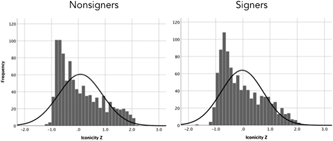
Iconicity ratings by deaf signers were distributed similarly to hearing non-signers’ ratings originally reported in Caselli et al. (Reference Caselli, Sevcikova Sehyr, Cohen-Goldberg and Emmorey2017), with both ratings skewed towards the lower end of the scale (Figure 1). A correlation analysis revealed that iconicity ratings by signers were highly correlated with non-signers’ ratings (r = .82, p < .001). However, signers’ iconicity ratings were lower than non-signers’ ratings overall (F (1, 1984) = 7.4, p = .004). For signers, the mean iconicity rating was 3.0 (Z score = –0.03), and for non-signers the mean iconicity score was 3.16 (Z score = 0.08). Native and early-exposed (non-native) signers did not differ significantly in their iconicity ratings (p = .849).
The distribution of iconicity ratings by non-signers and signers (Z-scores). The ratings were skewed to the low end of the iconicity rating scale, suggesting that both groups perceived most ASL signs relatively non-iconic.

1.2.1. Lexical class
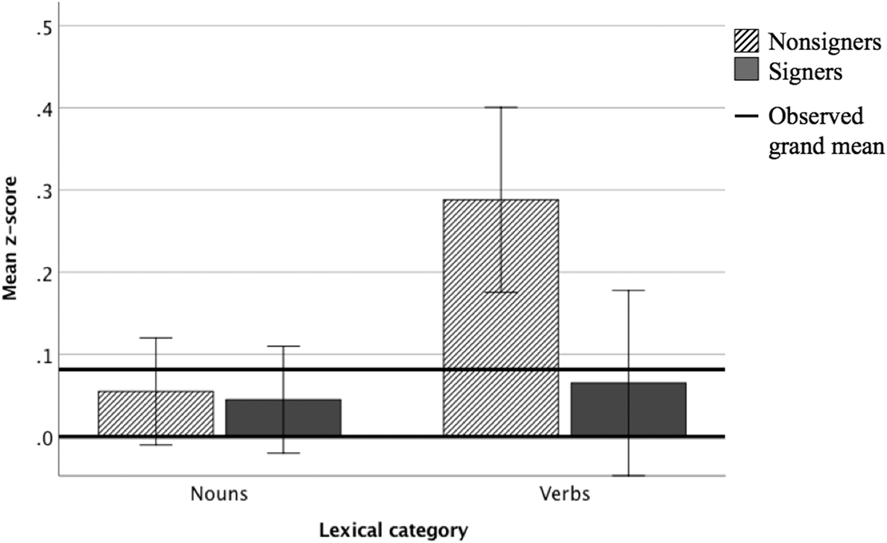
There were 591 nouns and 197 verbs in the ASL-LEX database. We examined whether perceived iconicity varied as a function of lexical category (noun/verb) and ASL knowledge (Group: signers/non-signers) in a 2 × 2 ANOVA. As in the overall results, non-signers exhibited higher iconicity ratings than signers (F (1, 1576) = 6.2, p = .013, partial η 2 = .04, α = .70). ASL verbs were rated significantly higher (Z score = .18) than nouns (.05) (F (1, 1576) = 7.3, p = .007, partial η 2 = .005, α = .77), and this main effect was modulated by an interaction between group and lexical category (F (1, 1576) = 23, p = .023, η 2 = .003, α = .62). As shown in Figure 2, non-signers rated verbs higher (.29) than nouns (.06) (F (1, 786) = 12, p = .001, η 2 = .02, α = .93), but the signers’ ratings for verbs (.07) and nouns (Z score = .05) did not differ (F (1, 787) < 1, p = .76). Planned paired comparisons revealed that non-signers rated verbs significantly higher for iconicity than did the signers (t (1181) = 2.8, p = .005), but the groups’ iconicity ratings did not differ for nouns (t (1181) < 1, p = .833).
Iconicity ratings (Z-score) by non-signers and signers as a function of lexical category; error bars indicate 95% CI.

1.2.2. Iconic mapping strategy
In ASL-LEX, there were 294 signs that could be unambiguously identified as either a ‘handling’ sign (using hand-as-hand iconic mapping; n = 104) or as an ‘entity’ sign (using hand-as-entity or hand-as-entity-part iconic mapping; n = 190). We excluded signs in which the iconic mapping involved a metaphorical extension, e.g., the ASL sign MEMORIZE in which the hand metaphorically grasps information from the head. We also excluded signs in which both mapping strategies were present (e.g., in BANANA, the entity is represented by the non-dominant hand, and the dominant hand depicts a peeling action). Three coders (two non-native fluent ASL signers and one native ASL signer) independently categorized the ASL signs. Agreement between two of the coders was 90% (Cohen’s κ = .92, p < .001; 86% agreement for handling and 92% for entity signs) and only signs that at least two of the coders agreed on were included in this analysis. The list of 294 signs coded for their type of iconic mapping is available through the Open Science Framework (OSF) (https://osf.io/2vnjt/).
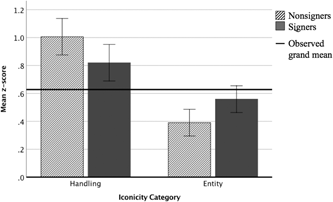
We examined whether perceived iconicity varied as a function of iconic mapping strategy (iconicity strategy: handling/entity) and ASL knowledge (group: signers/non-signers) in a 2 × 2 ANOVA. Overall, iconic mapping strategy influenced iconicity ratings, with handling signs receiving higher iconicity ratings (Z score = .91) than entity signs (.49),( F (1, 587) = 51, p < .001; η 2 = .08, α = 1). Signers and non-signers did not differ in their iconicity ratings for this subset of iconic signs (signers: .66; non-signers: .61) (F (1, 587) < 1, p = .99), but we found an interaction between iconic mapping strategy and group (F (1, 587) = 9.7, p = .002, η 2 = .02, α = .87) (see Figure 3). Non-signers rated handling signs as more iconic (1.00) than did signers (0.82) (t(103) = 4, p < .001), while signers rated entity signs as more iconic (0.58) than did non-signers (0.40) (t(189) = 4.7, p < .001).Footnote 2
Iconicity ratings (Z-scores) by non-signers and signers as function of iconic mapping strategy; error bars indicate 95% CI.

1.2.3. Sign handedness
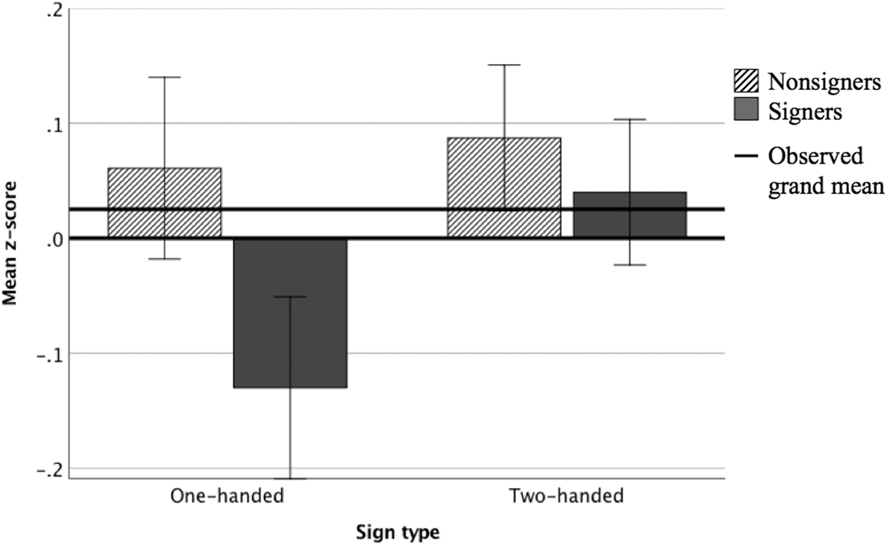
There were 388 one-handed and 603 two-handed signs in ASL-LEX. We examined if perceived iconicity varied as a function of sign handedness (sign type: one-handed/two-handed) and ASL knowledge (group: signers/non-signers) in a 2 × 2 ANOVA. Non-signers rated signs as more iconic than signers (F (1, 1983) = 10.6, p = .001, η 2 = .005, α = .90), and both groups rated two-handed signs (Z score = .06) as more iconic than one-handed signs (–.04) (F (1, 1983) = 7.2, p = .007, η 2 = .004, α = .77). However, the main effect of sign handedness was modulated by an interaction with group (F (1, 1983) = 3.9, p = .049, η 2 = .002, α = .50) (see Figure 4). Signers rated two-handed signs (.04) as more iconic than one-handed signs (–0.13) (F (1, 992) = 11.5, p = .001; η 2 = .01; α = .92), but non-signers rated one-handed (.06) and two-handed signs (.09) as similarly iconic (F (1, 990) < 1, p = .621). Further, signers rated one-handed signs as less iconic than did non-signers (t(769) = 3.1, p = .002), but the groups did not significantly differ in their iconicity ratings for two-handed signs (t(1206) = 1.1, p = .277).
Iconicity ratings (Z-scores) by non-signers and signers as a function of sign type; error bars indicate 95% CI.

1.3. interim discussion
Iconicity ratings of ASL signs by deaf signers and hearing non-signers were highly correlated (r = .82), and the distribution of iconic judgments was similar across groups (Figure 1). These results suggest that overall signers and non-signers exhibit a similar ability to perceive mappings between the form of signs and their meanings. Thus, sign language knowledge is not necessary to detect structural alignments between sign form and meaning at least to some extent, as long as the meaning is available to the participants (see Experiment 2). Similar iconicity ratings for deaf and hearing people may arise from their similar world knowledge, their overlapping experiences with human action (e.g., gesture, object manipulation) and the perceptual properties of objects, as well as similar abilities to appreciate structural analogies. The high correlation between deaf and hearing iconicity ratings also means that hearing non-signer ratings are a reasonable proxy if ratings from deaf signers are unavailable. Nonetheless, it remains unknown whether signers and non-signers in fact detect the same structural alignments, because non-signers are not privy to the lexical properties of signs across the ASL lexicon. For example, ASL signers know that when an F handshape (thumb and index finger make a circle; other fingers are extended) occurs in a lexical classifier form, the circle formed by the thumb and finger represents a small round referent (e.g., a button, a coin), but the extended fingers cannot represent long, straight objects (e.g., three lines). Although non-signers can perceive structural form–meaning mappings, these mappings could differ from signers, who have knowledge of the linguistic system to which those mappings belong. Iconicity ratings from non-signers provide insights into our human ability to make form–meaning connections, while differences between signers and non-signers provide insight into how knowledge of the sign language might impact the perception of these connections.
The degree of perceived iconicity for the 991 ASL signs varied as a function of group. ASL signers rated signs overall as less iconic (mean rating = 3.0) than non-signers (mean rating = 3.16). In contrast to our prediction, this result indicates that folk knowledge of the iconic motivation for signs (e.g., the form of GIRL depicts tracing a bonnet string on the cheek) does not increase the overall perceived iconicity of signs. However, we did not specifically assess the folk etymology of signs across the lexicon, nor determine whether participants were aware of the folk etymology of signs. Thus, it remains unclear if and how folk knowledge of the iconic origins of signs could influence the perceived iconicity of this subset of ASL signs.
On the surface, lower iconicity ratings for signers than non-signers appears to contrast with Occhino et al.’s (Reference Occhino, Anible, Wilkinson and Morford2017) finding that native signers rate signs from their own language as more iconic than signs with corresponding meanings in an unknown sign language. However, there are important differences between how signers and non-signers might interpret and rate the iconicity of signs. In particular, signers (unlike non-signers) know that some signs can have multiple or alternative meanings. For example, the same ASL sign is used to refer to ‘bone’, ‘skeleton,’ and ‘poison’; however, in each instance the nature of the mapping between the sign’s form and meaning differs. This polysemy might reduce signers’ judgments about the strength of the iconic mapping for polysemous signs, compared to non-signers, who were given a single meaning to rate (‘bone’ – the dominant English translation).
In addition, non-signers may attempt to map as many aspects of the sign form to the given meaning as possible, whereas signers might be more conservative in assigning meaning to a phonological feature because they (implicitly) know that some features may not be expected to carry meaning. For example, non-selected fingers do not participate in structural iconic mappings (see Emmorey, Reference Emmorey2014), and since all signs must contain movement to be well-formed (Brentari, Reference Brentari1998), movement need not always be involved in the iconic mapping for all signs. This implicit knowledge may have reduced signers’ overall iconicity ratings compared to hearing non-signers. In the Occhino et al. (Reference Occhino, Anible, Wilkinson and Morford2017) study, both groups of participants were signers with implicit knowledge about the phonological structure of signs, and therefore they might be less likely than hearing non-signers to attempt to attribute meaning to all aspects of a sign form. Deaf signers may have rated signs from their own language as more iconic than signs from an unknown sign language because, as suggested by Occhino et al., iconicity judgments of signs from their native language can be influenced by knowledge of how the sign is used, its frequency, and how it patterns with other signs in the lexicon.
Iconicity ratings varied as a function of lexical class, but only for the non-signers. Deaf signers did not differ in their iconicity ratings for nouns and verbs, and they also did not differ from hearing non-signers in rating the iconicity of ASL nouns. However, the non-signers rated verbs as much more iconic than nouns (replicating Perlman et al., Reference Perlman, Little, Thompson and Thompson2018, with a much larger set of ASL signs), and they also rated verbs as more iconic than the signers did (see Figure 4). This pattern of results also holds if we only include the subset of items that were used in the Perlman et al. study. The pattern for the ASL signers is similar to that observed for Spanish speakers who rated nouns and verbs as equally iconic, and contrasts with both English speakers who rated English verbs as more iconic than nouns, and with BSL signers who rated BSL verbs as more iconic than nouns (Perry et al., Reference Perry, Perlman and Lupyan2015). Thus, although ASL verbs may iconically depict manner of motion, the degree of iconicity in verbs is perceived as similar to that of nouns for ASL signers. It is possible that if a larger set of stimuli were used, BSL signers might pattern more like ASL signers.
The finding that non-signers rated ASL verbs as much more iconic than nouns may reflect the fact that non-signers are biased to interpret all signs as verbs. Emmorey and Pyers (Reference Emmorey and Pyers2017) found that, when hearing non-signers were given a forced choice between an object or an action picture, they were significantly more likely to select the action picture for both ASL nouns and verbs. In addition, when hearing people were asked to produce a silent gesture to depict an object, they were more likely to produce an action gesture than to use other depicting strategies, such as illustrating the object shape (Ortega & Özyürek, Reference Ortega, Özyürek, Papafragou, Grodner, Mirman and Trueswell2016; van Nispen et al., Reference van Nispen, van de Sandt-Koenderman and Krahmer2017). Further, a recently constructed database of silent gesture and iconicity norms revealed that non-signers exhibited a bias to interpret and produce gestures as action-based depictions (Ortega & Özyürek, Reference Ortega and Özyürek2019). Thus, non-signers may view action signs (ASL verbs) as more iconic because they are influenced by their preference to depict meaning using action gestures.
In line with this result, hearing non-signers rated handling signs, employing the hand-as-hand iconic mapping strategy, as more iconic than entity signs, which used the hand-as-entity mapping strategy. Although both groups rated handling signs as more iconic than entity signs, signers rated entity signs as more iconic than non-signers did (see Figure 3). For signers, we speculate that knowledge of the ASL classifier system might increase perceived iconicity when objects (or object parts) map to the handshape of the sign. That is, the systematic mapping of handshape to an object referent for both whole-entity and body-part classifiers may increase signers’ sensitivity to hand-as-entity iconicity within lexical signs. In addition, signers may simply be more sensitive to the structural mapping in which the hand is construed as representing an object or object part (Emmorey, Reference Emmorey2014; Wilcox, Reference Wilcox2004), which would increase iconicity ratings for these signs. Further research investigating signers’ and non-signers’ iconicity ratings for entity signs that are derived from classifier forms (e.g., GARAGE) versus those that are not (e.g., BIRD) would provide evidence for these hypotheses (although we note that it would be difficult to make this categorical distinction; see Lepic, Reference Lepic2019).
Finally, only the deaf signers were sensitive to the handedness of signs, rating one-handed signs as less iconic than two-handed signs – iconicity ratings for these sign types did not differ for the non-signers (see Figure 4). As analyzed by Lepic et al. (Reference Lepic, Börstell, Belsitzman and Sandler2016) and Börstell et al. (Reference Börstell, Lepic and Belsitzman2017), the semantic notion of plurality can cover a relatively large domain meaning (e.g., dual objects, interacting entities, collectives, etc.), and these meanings tend to be depicted with two hands across different sign languages. Thus, we speculate that ASL signers’ knowledge of these motivated patterns across the lexicon might increase their iconicity ratings for two-handed signs compared to one-handed signs. Non-signers, of course, do not have access to these semantic patterns within the ASL lexicon and therefore cannot use this knowledge to inform their iconicity judgments. However, the signs in ASL-LEX were not coded for plurality concepts, and thus the possible link between plurality, perceived iconicity, and handedness needs to be assessed with a systematic investigation in which plurality concepts are identified for each sign.
In Experiment 2, we examine the relationship between the ASL-LEX iconicity ratings provided by hearing non-signers (who were given the English translation of the sign) with the perceived transparency ratings provided by hearing non-signers who were asked to first guess the meaning of the sign and then rate how obvious their guessed meaning would be for other people. This experiment allowed us to explore the perceived transparency of a large set of ASL signs (n = 430) and to determine the degree to which iconicity is related to objective transparency (accuracy of guesses) and perceived transparency (a measure of how transparent non-signers perceived a form to be, regardless of whether their guessed meaning was correct).
2. Experiment 2: comparing iconicity ratings and perceived transparency ratings by hearing non-signers
2.1. method
2.1.1. Participants
Each of the 430 signs in this study was guessed (and rated) by 20 hearing monolingual English speakers, and a total of 80 participants (M age = 35.3, SD = 8.5, age range 21–53; 32 female) completed the online sign guessing and perceived transparency rating surveys. Participants were recruited via Mechanical Turk and were compensated for their participation. All participants reported no prior knowledge of any sign language and reported normal or corrected-to-normal vision. Two participants were excluded from the analysis due to disingenuous responses (i.e., little to no variation in the range of their ratings because they selected ‘1’ for most items), thus data from 78 participants were included in the analysis.
2.1.2. Stimuli
The stimuli were a subset of 430 ASL sign videos from the ASL-LEX database (Caselli et al., Reference Caselli, Sevcikova Sehyr, Cohen-Goldberg and Emmorey2017) selected for another experiment for which perceived transparency ratings were needed. Two lists of 107 signs and two lists of 108 signs were constructed and uploaded to Survey Monkey. ASL signs were randomized across the lists and the lists were matched for log10 word frequency of the signs’ English translation obtained from SubtlexUS, (F (3, 406) = 1.8, p = .148), and ASL lexical frequency obtained from ASL-LEX (F (3, 429) = 1.2, p = .317).
2.1.3. Procedure
Each participant was randomly assigned to one of the four lists. Instructions for the participants were presented in written English (see ‘Appendix B’). Participants viewed each sign on a separate page, with a response box and a rating scale located below the video clip. Participants were instructed to guess the meaning of that sign and type it into the response box using only one English word if possible. For each guess, they were subsequently asked to rate how obvious the meaning they guessed would be to others on a 1–7 scale (1 = not obvious at all, 7 = very obvious). We calculated the average perceived transparency score and derived standardized residuals (Z-scores) for each sign. There were a total of 8600 trials (20 participants rated and guessed the meaning of 430 signs each).
2.1. results and discussion
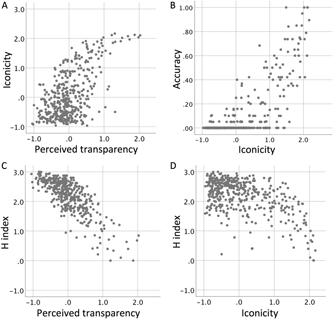
Perceived transparency ratings were significantly correlated with iconicity ratings for the same signs in ASL-LEX (r = .60, p < .001) (see Figure 5A). Thus, perhaps not surprisingly, signs that were rated as more iconic tended to be guessed with more confidence, such that participants’ guesses were rated as more obvious to others, although their guesses could, in fact, be wrong. Nonetheless, only a relatively small proportion of ASL signs were guessed correctly by our strict criteria. A guess was considered correct if it matched the English translation provided in ASL-LEX, although morphological variants (e.g., ‘crying’ for CRY) or synonyms that are somewhat interchangeable (e.g., TABLE and DESK) were accepted. However, similar, semantically related words were not considered correct in this study (e.g., ‘grab’ or ‘take’ for GET or ‘brush’ for COMB). Two coders judged whether a guess was correct or incorrect. The inter-rater reliability analysis revealed that there was high agreement (93%) between the coders (Cohen’s κ = .93, p < .001).
(A) The correlation between perceived transparency and iconicity Z-scores; (B) the correlation between iconicity Z-scores and accuracy (i.e., objective transparency of signs assessed as proportion of correct guesses); (C) the correlation between perceived transparency Z-scores and H index; and (D) the correlation between iconicity Z-scores and H index.

Only 3% of signs (14/430) were guessed correctly with 70% accuracy (i.e., at least 70% of participants guessed the correct meaning of the sign). The meanings of 71% of signs (306/430) were never guessed correctly by any participant, and only 4 signs were guessed with 100% accuracy (CRY, DRINK, FOUR, and SAD). The overall accuracy of guesses across all participants was 10% (860 correct guesses per 8600 total responses). This relatively low percentage of correctly guessed ASL signs is consistent with other studies that used a smaller set of ASL signs (Bellugi & Klima, Reference Bellugi and Klima1976; Griffith, Robinson, & Panagos, Reference Griffith, Robinson and Panagos1981; Hoemann, Reference Hoemann1975). Although speakers can guess the meanings of sound-symbolic words (e.g., ideophones) above chance when given a choice of possible meanings (Dingemanse et al., Reference Dingemanse, Schuerman, Reinisch, Tufvesson and Mitterer2016), we know of no study that has asked speakers to guess the meanings of a large set of foreign words without context. Claims about perceivers’ ability to detect form–meaning mappings in the spoken modality have been mainly based on results from forced choice tasks (e.g., Lockwood, Dingemanse, & Hagoort, Reference Lockwood, Dingemanse and Hagoort2016) which might be considerably easier than guessing the word meaning without cues or context. Without choices or context, the percentage of correctly guessed words in spoken language may be significantly lower than what has been reported for both spoken or signed languages thus far, a hypothesis that warrants further research.
The accuracy of participants’ guesses was correlated with iconicity ratings (r = .75, p < .001) (Figure 5B) and with perceived transparency ratings (r = .58, p < .001), suggesting that iconicity assists sign-naive participants in identifying the correct meaning of ASL signs and makes them more confident about their guesses. The weaker correlation between accuracy and perceived transparency may reflect the fact that some relatively iconic signs were considered non-transparent, and some relatively non-iconic signs were considered transparent (see below for examples and further discussion). However, because accuracy data was highly skewed towards zero accuracy (most guesses (71%) were incorrect), we must interpret these correlations with caution.
To quantitatively represent the semantic potential of signs, we assessed the dispersion of participants’ guesses using Shannon’s diversity index (H), where p i was the proportion of participants per each response type (guess):
 $$H{\rm{'}} = - \sum {{p_i}*ln\,{p_i}}$$
H values closer to 0 indicate smaller dispersion (greater consistency) of guesses and values further away from 0 indicate a larger dispersion ratio. For example, the ASL sign DRINK was guessed as meaning ‘drink’ by all 20 participants (100% accuracy), and this resulted in a dispersion index of 0. In contrast, for the ASL sign MOCK (0% accuracy) the H index was 3 because all 20 participants gave different, unrelated translations (e.g., ‘wrong’, ‘confirm’, ‘poke’, ‘sit’, ‘calm’, etc.). The sign MOCK is a two-handed symmetrical sign in which only the pinky and index fingers are extended and is produced with a short, repeated movement in front of the signer’s body. We found that the greater the dispersion of participants’ guesses (H index), the lower the perceived transparency rating (r = –0.78, p < .001), and the lower the non-signers’ iconicity ratings (r = –0.56, p < .001) (see Figures 5C and 5D). These results suggest that the strength of form–meaning mappings as assessed by iconicity ratings is related to the number of possible inferred meanings, and that non-signers were more unified and confident in the perceived transparency of signs that were rated as more iconic.
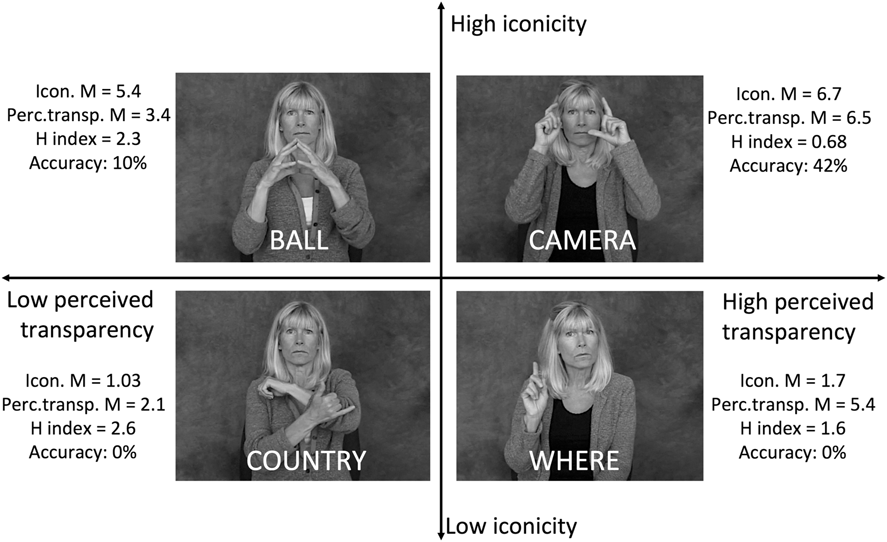
However, not all signs conformed to the linear relationship between iconicity and perceived transparency. For example, some signs that were rated as highly iconic when the meaning was provided were rated as weakly transparent by non-signers when the meaning had to be guessed, e.g., BALL (see Figure 6). In addition, some signs that were rated as highly iconic were never (or rarely) guessed correctly; rather, the guesses reflected participants’ focus on a different iconic mapping. For example, the iconic sign LIPSTICK (5% accuracy) which is produced at the lips was translated as ‘quiet’ in 79% of guesses, and the iconic sign MY (35% accuracy) was often incorrectly guessed as ‘chest’ or ‘heart’.
Examples of signs that did and did not conform to the linear relationship between iconicity and perceived transparency ratings.

Further, some signs with low iconicity ratings received high perceived transparency ratings because non-signers were confident of their incorrect guesses. For example, the non-iconic sign WHERE (Figure 6) resembles a ‘no’ gesture, which was the word provided for this sign in 65% of the guesses. Similarly, the sign LONELY resembles the ‘shh’ gesture, and indeed ‘quiet’ or ‘be quiet’ was the guess provided in 70% of the responses. Figure 6 also provides examples of signs in which the iconicity and transparency ratings were parallel – either both high (CAMERA) or both low (COUNTRY).
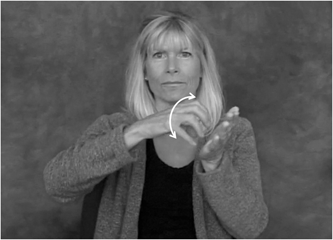
Finally, we are currently analyzing the nature of the incorrect guesses provided by non-signers to identify patterns for how meaning is extracted from manual forms and to assess the semantic potential of different components of a sign (i.e., the ability of different phonological parameters to evoke a consistent meaning). To give just a couple of examples, the ASL sign COOKIE, which consists of a clawed handshape making a twisting movement on the palm of the non-dominant hand (Figure 7), was often guessed as ‘turn/twist’ or ‘open/close’, which are responses that focus primarily on the movement of the sign. Some participants guessed ‘spider’, which focuses more on the hand configuration of the sign. The sign BALL (Figure 6) was occasionally guessed correctly and one person guessed ‘whole’ – these guesses focus on the shape created by the hands. However, the meaning of BALL was more often guessed as ‘together,’ ‘gather,’ or ‘meet’ – guesses that focus more on the movement of the hands coming together.
ASL sign for ‘cookie’.

3. Summary and conclusions
The study revealed that the perceived mapping between form and meaning in ASL is influenced by whether the individual knows ASL and also by the type of task. Although iconicity is a general principle of language, our findings revealed that knowledge of the relevant linguistic system (i.e., ASL) mediated the perceived iconicity of signs. Hearing non-signers rated ASL signs as more iconic than deaf signers, possibly because they attempted to map any and all aspects of the sign’s form to the meaning that was given to them. In contrast, ASL signers may intuitively know that some aspects of a sign’s form reflect phonological patterns across the lexicon and thus are not involved in the iconic mapping. Nonetheless, it is important to recognize that the ratings from deaf ASL signers and hearing non-signers were highly correlated (r = .82), indicating that, in general, the two groups were relatively similar in how they rated the iconicity of a large set of ASL signs (see Figure 1).
Despite overall similarities in the average ratings between the two groups, different patterns of iconicity ratings emerged when we examined subclasses of signs – nouns vs. verbs, handling signs vs. entity signs, and one- vs. two-handed signs – pointing to more nuanced influences on how these two groups perceive iconic mappings. Deaf signers rated the iconicity of ASL nouns and verbs as similar, but hearing non-signers judged ASL verbs as more iconic than nouns (Figure 2). We suggest that this result reflects the bias of hearing people to use action gestures over other gesture strategies when depicting meaning in silent gesture (Micklos, Reference Micklos2017; Ortega & Özyürek, Reference Ortega, Özyürek, Papafragou, Grodner, Mirman and Trueswell2016; van Nispen et al., Reference van Nispen, van de Sandt-Koenderman and Krahmer2017). Similarly, non-signers perceived handling signs as more iconic than did the signers, which could be explained as a preference for hand-as-hand iconicity when they gesture, i.e., showing how an object is manipulated using their hand(s). In contrast, signers rated entity signs which use a ‘hand-as-entity’ mapping strategy as more iconic than did the non-signers (Figure 3). We suggest that knowledge of the ASL classifier system in which handshape morphemes can represent whole or part entities may have increased signers’ iconicity ratings for these signs. In addition, signers may be more sensitive than non-signers to structural alignments in which the hand is construed as representing an object or object part, given the relative frequency of this type of mapping strategy across the lexicon (e.g., 190 entity vs. 104 handling signs were identified in ASL-LEX). Finally, the two groups differed in the pattern of iconicity ratings for one- vs. two-handed signs, with non-signers rating these sign types as equally iconic, while signers rated one-handed signs as less iconic than two-handed signs (Figure 4). We speculate that the knowledge of semantic–phonological patterns that encode a wide variety of plurality concepts across the ASL lexicon (Börstell et al., Reference Börstell, Lepic and Belsitzman2017; Lepic et al., Reference Lepic, Börstell, Belsitzman and Sandler2016) may have impacted signers’ iconicity ratings, although a systematic study in which signs are coded for plurality is required to confirm this idea.
When asked to guess the meaning of unknown ASL signs, hearing non-signers’ guesses were almost always incorrect (90%) and were guided by resemblance to common pantomimes or cultural emblems. This perceived resemblance could lead to a correct guess (e.g., for ASL signs DRINK and CRY) or an incorrect but confident guess (e.g., for the signs WHERE and LONELY). These findings nicely complement those of Ortega et al. (Reference Ortega, Schiefner, Özyürek, Gunzelmann, Howe and Tenbrink2017), who found that the gestural repertoire of non-signers was recruited to make judgments about the meanings of lexical signs. These results have important implications for designing studies that assess how sign iconicity impacts sign learning or sign perception. For example, some signs that are rated as non-iconic may nonetheless have a strong potential to evoke a meaning for sign-naive participants because the signs happen to resemble unrelated gestures or because the participants are able to create their own form–meaning mapping, e.g., interpreting the relatively non-iconic sign COOKIE as meaning ‘turn’ or ‘open’ (Figure 7). Similarly, researchers cannot assume that highly iconic signs are also easy to guess correctly (i.e., that they are transparent). Although we found a positive correlation between iconicity and perceived transparency ratings (r = .60) (Figure 5A), there were examples in which the two ratings were not parallel (Figure 6). Despite relatively high iconicity ratings, some signs were not guessed with high accuracy or confidence, such as BALL (guessed as ‘together’) or MY (guessed as ‘chest’). Thus, for some signs, high iconicity ratings depend upon knowing the meaning associated with the sign.
Finally, we have developed two new measures that provide an index of the semantic potential of a sign form, i.e., the ability of a sign to evoke a clear and consistent meaning for sign-naive participants. Perceived transparency ratings provide a measure of the strength (clarity) of a guessed meaning, independent of whether the guess is correct or not. The diversity of participants’ guesses (assessed by Shannon’s H index) provides an objective measure of the consistency of the form–meaning mappings that were perceived across participants. These measures were negatively correlated with each other (r = –0.78; Figure 5C), such that signs with lower perceived transparency ratings had a greater diversity of guessed meanings and were also rated as less iconic (Figure 5D). Future work could examine whether or how a sign’s semantic potential, as assessed by these measures, might hinder or facilitate sign processing or acquisition (by either L1 or L2 learners).
In sum, the contention that iconicity is some type of a generalizable property of signs needs to be revised. Comparing the signers and non-signers’ iconicity judgments is valuable in understanding the iconic patterning of lexical signs. This study moves us closer to an understanding of the mechanisms that give rise to iconicity effects and the extent to which such effects may be driven by language knowledge, gesture experience, or type of task.
Supplementary materials
For supplementary materials for this paper, please visit <http://doi.org/10.1017/langcog.2019.18>.
Appendix A: written English instructions to deaf participants in the iconicity rating study
For this task we want to know how iconic you think some signs in American Sign Language are. First we will explain what we mean by iconic: some signs look like what they mean. For example, the sign DRINK is generally thought to be very iconic, because it looks like a person holding a cup and bringing it to their mouth. A person who does not know sign language might be able to guess this sign’s meaning. Other signs are not iconic at all; for example, the sign FARM does not look like a farm. Signs can be iconic for different reasons. Some signs, like the sign for ‘drink’, show the way an object is used. Other signs, like the sign for ‘ball’ show the shape of the object.
For each sign that you will see, rate on a scale of 1 to 7 how iconic you think the sign is, with 1 as not iconic at all and 7 as very iconic. For example DRINK is extremely iconic; it looks just like drinking from a cup, so this would be a 7. FARM is not at all iconic and would be a 1. Signs that are intermediate in iconicity, of course, should be rated appropriately between the two extremes; for example the sign COOK may have a rating of 3 or 4. In order for a sign to be considered iconic, the sign has to resemble its meaning in some way, rather than being related to an English word by containing a fingerspelled letter. For example, the sign WATER contains a handshape that looks like the letter ‘W’, but the sign does not look like the object it refers to, and therefore, this sign would not be considered very iconic.
Please use the entire range of numbers, from 1 to 7; at the same time, don’t be concerned about how often you use a particular number as long as you are honest in your ratings. Work fairly quickly but do not be careless in your ratings, the important thing is for you to be as accurate as possible. It’s important that you take this test seriously because your (anonymous) data will become part of a database that is used by others (e.g., teachers, researchers, students). So, please do not guess or just pick any number. After you’ve rated the sign and clicked the number, sometimes you will see a white box under the sign that says ‘English Translation’. If you see that box, then you need put down the English word based on the sign you just saw. We really appreciate you doing this task for us. Thank you.
Appendix B. written English instructions to hearing participants in the transparency rating study
In this experiment, you will see videos of signs from American Sign Language (ASL). In ASL, some signs look like the object or concept they represent, other ASL signs do not look like the things they represent. The meaning of some signs could be guessed just by looking at the shape and/or motion of the sign. The purpose of this study is to determine which signs can be guessed by people who have no previous experience with American Sign Language.
We will show you videos of signs in ASL. Each video contains one ASL sign. Your task is to guess the meaning of that sign and type it in the response box below [we understand you do not know ASL but would like you to give your best guess as to what the sign could mean]. Use one English word for each sign if possible. Please provide a response to each sign even if you are very unsure of your guess. For each guess, we will also ask you to judge how obvious the meaning you guessed would be to others. One way of thinking about this is that you are judging how likely another non-signer would be to guess the same meaning. Using a scale of 1 to 7, please rate how well each sign depicts your guess. Please use the entire range of numbers, from 1 to 7; at the same time, don’t be concerned about how often you use a particular number as long as you are honest in your ratings. Please work as quickly and carefully as possible. For each sign, you will also have the opportunity to make a second guess (and rating), should another possible meaning come to mind.