INTRODUCTION
Transition from one-word to two-word production
The emergence of two-word combinations is an important milestone in a child's language development in English because these first combinations mark the beginning of morphosyntax. In English, early word combinations tend to follow the adult target word order, and grammatical morphemes mostly develop after the child starts producing two-word combinations (Brown, Reference Brown1973). Children typically begin combining words around 1 ; 6, and by 2 ; 0 they are producing two-word or multiword utterances productively (see, e.g., Bates, Bretherton & Snyder, Reference Bates, Bretherton and Synder1988; Bloom, Reference Bloom1993).
Although the emergence of two-word combinations is a milestone in morphosyntactic development, changes in other domains of language may affect when a child becomes able to produce them. For instance, Donahue (Reference Donahue1986) reported that one child's phonological ability seemed to influence the onset of two-word combinations. This child, Sean, exhibited strong consonant harmony constraints during his one-word stage. Donahue argued that this limitation prevented Sean from combining words productively until 1 ; 6 although his vocabulary size was large for his age. Once Sean was able to produce a variety of consonants in one utterance, his ability to combine words improved.
Fillers and the transition from one-word to two-word production
It has been reported that early in the language acquisition process some children produce syllables that do not have clear adult targets. These have been called ‘dummy syllables’ or presyntactic devices (PSDs) (Dore, Franklin, Miller & Ramer, Reference Dore, Franklin, Miller and Ramer1976), ‘prefixed additional elements’ (Veneziano & Sinclair, Reference Veneziano and Sinclair2000), or ‘Fillers’ (Peters, Reference Peters1987; Reference Peters2001).
Peters (Reference Peters2001) proposes three stages in the development of Fillers: (1) premorphological, (2) protomorphological, and (3) (full) morphology. At the premorphological stage, Fillers appear to function mainly as phonological extensions: while their adult targets are uncertain, they make a child's utterances sound more adult-like. During the protomorphological stage, Fillers begin to have some characteristics of adult morphemes, both distributionally and phonologically (Peters, Reference Peters2001: 234). Dore et al. (Reference Dore, Franklin, Miller and Ramer1976) included dummy syllables among their PSDs, also noting the role of meaningless syllables in phonologically lengthening an utterance.
Final syllable lengthening
Snow (Reference Snow1994; Reference Snow1997) reported that prosodic changes occur when children begin producing productive combinatorial speech, and suggested that multiple developmental changes are occurring in different domains of language. He defined the onset of productive combinatorial speech as the time at which ‘the first 100 utterances of the transcription contained at least three lexical word combinations’ (Snow, Reference Snow1997: 41), roughly corresponding to a mean chronological age of 1 ; 9 (Snow, Reference Snow1994; Reference Snow1997). He then compared prosodic measures for sessions at three different stages: the one-word period (session −1), the onset of productive combinatorial speech (session 0), and the two-word period (session +1), using these relative age points instead of chronological ages to anchor developmental changes.
Snow (Reference Snow1994; Reference Snow1997) studied children who were going through the transition from one-word to two-word production. For each child there were four data collection sessions, separated by three months. Once he had established session 0 for each child, he compared the occurrence of final syllable lengthening (FSL) across sessions. It was found that syllable durations showed a different pattern at the onset of word combinations; the final syllable was longer than the first syllable (hence FSL) during the one-word and two-word stages, but not at the onset of word combinations (Snow, Reference Snow1994; Reference Snow1997). Snow (Reference Snow1997) suggests that changes occur in syllable durations around the onset of combinatorial speech because FSL is associated with the development of syntax. Early on, FSL may reflect ‘passively controlled’ speech timing; diminishing FSL around the onset of two-word combinations may indicate learning of language-specific patterns in syllable duration (Snow, Reference Snow1994: 839; see also Robb & Saxman, Reference Robb and Saxman1990; Vihman, DePaolis & Davis, Reference Vihman, DePaolis and Davis1998, for similar proposals).
In summary, previous studies (Donahue, Reference Donahue1986; Snow Reference Snow1994; Reference Snow1997) have shown that changes are occurring in both phonological and prosodic domains at the same time as children begin combining two words productively. Peters (Reference Peters2001) proposes that Filler characteristics are changing from premorphological to protomorphological at about this same time. Snow (Reference Snow1994: 839) suggests a possible ‘period of reorganization’ in children's ability to control syllable timing around the onset of syntax.
This study
The main purpose of this study is to investigate simultaneous developmental changes occurring in phonology and emerging morphosyntax during the transition from one-word to two-word production. Specifically, this study investigates the child's strategies to lengthen utterances at the phonological level (Fillers) and to control utterances at the suprasegmental level (FSL). We hypothesize that there will be a period of reorganization in phonology around the onset of word combinations which will be indicated by regressions in Fillers and FSL.
METHOD
The data
The data are from a longitudinal study of one male child (Seth). Seth's speech was recorded by his father for a period of one to three hours per week between 1 ; 4 and 4 ; 4 (Wilson, Reference Wilson1985). He was born with an underdeveloped optic nerve and was totally blind during his first year of life; after that he slowly developed a small amount of useful vision. By 2 ; 4, he was able to discriminate boldly written two-inch-high letters (Peters, Reference Peters1987). Despite this visual impairment, previous studies of Seth's language development (e.g. Peters, Reference Peters1987; Peters & Menn, Reference Peters and Menn1993) show that his development is comparable to typically developing sighted children reported in studies such as Bloom (Reference Bloom1993) and Bates et al. (Reference Bates, Bretherton and Synder1988). For example, his onset of word combinations was similar to the average of children studied in Snow (Reference Snow1997). Although this is a single case study, it is one of the few databases that provide detailed weekly transcriptions with morphological and phonological coding. Only this type of database can make it possible to track and relate fine developmental changes in different domains.
Transcription and coding
All 214 hours of audio recordings have been digitized at 8-bit and 11,025 Hz. Most of the transcriptions used in this study have been contributed to the Child Language Data Exchange System. The transcriptions are formatted in CHAT (Codes for the Human Analysis of Transcripts) and analyzed using CLAN (Computerized Language ANalysis). Transcriptions contain all the utterances produced by Seth and any other adult participants (mostly his father). Each child utterance also contains broad phonetic transcriptions (%pho), speech-act coding (%spa) and syllable (%syl) tiers. The %spa coding distinguishes spontaneous, repeated and imitated utterances. On the %syl tiers Seth's utterances were coded as sequences of Lexical and Filler syllables. Each transcript was worked on successively by at least two people, and all transcripts were re-checked by the second author for consistency.
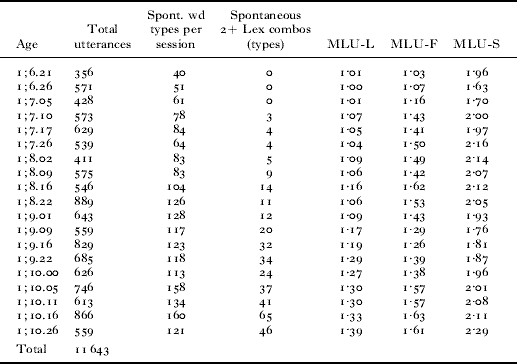
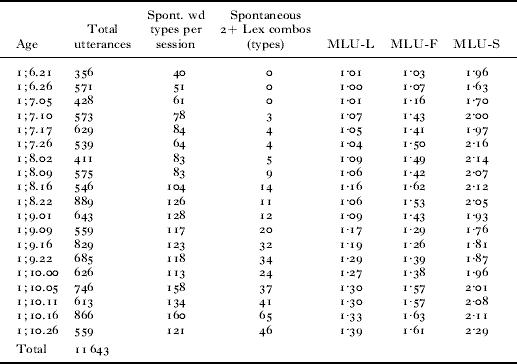
Our focus is on the transition from one-word to productive two-word combinations. Weekly recordings of one hour were analyzed between 1 ; 6.21 and 1 ; 10.26 for a total of twenty hours. These recordings provide 11,643 child utterances (see Table 1).
Numbers of two-word combinations, MLU-L, MLU-F and MLU-S
Seth's transition from one word to two words
Following Snow's (Reference Snow1994; Reference Snow1997) criteria, we examined all two-Lexeme combinations in the data, looking for the point at which Seth produced at least three different spontaneous two-word combinations in a single session. We used the following criteria to classify an utterance as spontaneous and productive.
(a) The utterance must include at least two identifiable Lexemes. Fillers are not counted.
(b) The two Lexemes must be different.
(c) Compound words, proper names, formulaic speech and other memorized chunks are counted as one.
(d) Utterances containing unintelligible parts as well as sound plays are excluded.
The longest spontaneous utterances were extracted from each transcript using the %spa tiers, and the second author checked anew that each was productive and spontaneous. Table 1 includes the numbers of different productive two-word combinations at each data point. No utterances meet the criteria between 1 ; 6.21 and 1 ; 7.05; the first spontaneous two-word productions appear at 1 ; 7.10. Between 1 ; 7.10 and 1 ; 9 ; 01, the number of spontaneous combinations steadily increase. At 1 ; 9.09, their number increases to 20 and never again decreases below that.
Studies such as Fonagy (Reference Fonagy1972) and Branigan (Reference Branigan1979) differentiated early word combinations by duration of pause between the two words. Specifically, Branigan (Reference Branigan1979) called two-word utterances ‘successive single word utterances (SSWU)’ if the pause in between the two words was longer than 1100 ms. Since we did not consistently measure the duration of pauses, we do not know whether any of our candidate word combinations are SSWUs according to Branigan's criteria. Although the exact onset of two-word combination is a matter of estimation, it is clear that Seth made the transition to productive two-word production during the period investigated.
MLU-L, MLU-F, MLU-S, Fillers and syllable configurations
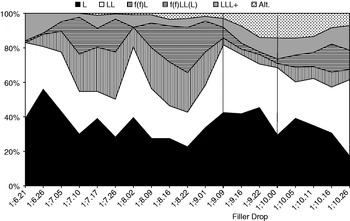
As a measure of Seth's morphosyntactic and phonological development three types of Mean Length of Utterance were calculated: MLU in Lexemes (MLU-L), MLU with Fillers (MLU-F) and MLU in syllables (MLU-S). MLU-L is the total number of identifiable Lexemes (i.e. excluding Fillers) divided by the total number of utterances. MLU-F includes all the Fillers as well. MLU-S is the average number of syllables per utterance. MLU-S was computed using only syllables identifiable as Lexemes or Fillers. The %syl tier was used to categorize the syllabic configurations of all Seth's utterances. Categories are: monosyllabic Lexeme (L), disyllabic Lexeme (LL), one or two Filler syllables followed by a Lexical syllable (f(f)L), one or two Filler syllables followed by two to three Lexical syllables f(f)LL(L), Lexemes or combinations of Lexemes with three or more syllables (LLL+), and all alternating patterns combined (Alt.).
Acoustic measurements
Vowel durations of disyllabic utterances were measured to examine FSL. Vowel durations were measured instead of syllable durations because the onset and offset of consonants are difficult to identify in recordings of natural child speech. We followed Snow (Reference Snow1994; Reference Snow1997) and Vihman et al. (Reference Vihman, DePaolis and Davis1998) in our criteria for selecting syllables for acoustic analysis: (a) the utterance is a disyllabic word with falling intonation, (b) both syllables have a vowel nucleus and (c) there is a non-glide consonant between the two vowels. Seth's idiosyncratic words (e.g. kokowk ‘cold drink’) and disyllabic words that were one meaningful unit (e.g. airplane [e:pen], cleaning [kini]) were included, but disyllabic combinations of Lexemes (e.g. swing high) or Filler–Lexeme combinations (e.g. m play) were excluded. This analysis was thus limited to disyllabic utterances containing one meaningful unit. All analyzed disyllables occurred at the ends of utterances, so the second syllables were both word- and utterance-final.
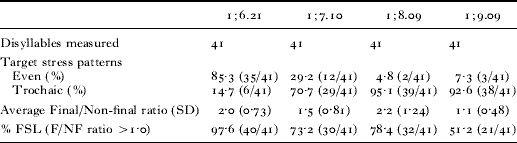
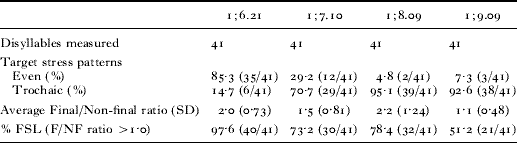
The disyllables that met the criteria were extracted from recordings at four points about a month apart. The first point was the first session in this study (1 ; 6.21); the second point was when Seth's first two-word combination appeared (1 ; 7.10). The third point was about a month later at 1 ; 8.09 and the last point was 1 ; 9.09. These points were selected to track monthly changes during the transition from one-word to two-word production. For the recording at 1 ; 6.21 we measured all disyllabic utterances that met the criteria and were suitable for acoustic analysis (i.e. no overlap noise or whispering). There were 41 of them. For the other sessions, we analyzed the first 41 tokens that met the criteria. Since there were only 32 suitable disyllables at 1 ; 8.09, 9 more were added from 1 ; 8.16. All disyllables meeting the criteria were measured; therefore, vowel quality, syllable structure and stress patterns were not controlled. All target stress patterns were either trochaic (e.g. daddy, teddy) or evenly stressed (e.g. knock-knock); none were iambic. Table 2 shows the changes in distribution of evenly stressed vs. trochaic disyllables.
Final syllable lengthening in disyllabic utterances at four monthly points
The durations of the vowels were measured by the first author using wideband spectrograms produced by Pitchworks. The onset and offset of the vowels were demarcated based on the formant patterns with a reference to acoustic characteristics of vowels (e.g. Kent & Read, Reference Kent and Read1992). Approximately 20% of the disyllabic utterances (32 syllables, 64 vowels) were re-measured by the first author for reliability. The average re-measurement difference for vowel duration was 14·4 ms.
RESULTS
MLU-L, MLU-F and MLU-S
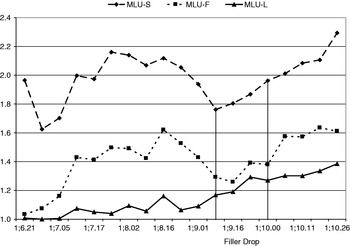
Table 1 lists MLU-L, MLU-F and MLU-S at each data point. MLU-L increases from 1·01 at 1 ; 6.21 to 1·39 at 1 ; 10.26. Between 1 ; 6.21 and 1 ; 7.05 it is close to 1·0 because Seth is only producing a single Lexeme per utterance. From 1 ; 7.10 to 1 ; 9 ; 01, MLU-L ranges between 1·00 and 1·16, reflecting an occasional two-Lexeme utterance. In contrast, MLU-F increases from 1·03 at 1 ; 6.21 to 1·62 at 1 ; 8.16. From 1 ; 9.09 to 1 ; 10.00, as Seth produces increasingly many two-Lexeme utterances, MLU-F decreases so that it is very close to MLU-L. We call this massive decrease in the number of Fillers ‘the Filler Drop’; it is temporary and MLU-F increases again from 1 ; 10.05 (see Figure 1). MLU-S is higher than MLU-L and MLU-F at any of our data points. The relatively high MLU-S throughout the period attests to Seth's ability to produce two syllables.
Changes in MLU-L, MLU-F and MLU-S between 1 ; 6.21 and 1 ; 10.26.

For each MLU value and age in Table 1, Pearson correlation statistics (2-tailed) were computed to evaluate the relationship between each MLU measure and chronological age. These analyses show that MLU-L is significantly correlated with age (r(19)=0·94, p<0·001). MLU-F is also significantly correlated with age (r(19)=0·63, p=0·004), but MLU-S is not (r(19)=0·37, p>0·1). These results indicate that Seth's utterances in Lexemes and with Fillers increase in length with age, but they do not significantly increase in the number of syllables.
Fillers and syllable configurations
The relative percentages of each syllable configuration pattern are graphed in Figure 2. Between 1 ; 6.21 and 1 ; 7.05, approximately 80% of Seth's utterances are monosyllables or disyllables. At 1 ; 10.26 only 67% of his utterances have only one or two syllables (monosyllable 17%, Filler plus monosyllable 6%, disyllable 44%), whereas 37% are longer. A syntactically important development beginning at 1 ; 7.17 is the emergence of multisyllabic utterances in which Fillers and Lexemes appear in diverse orders, such as LfL (e.g. brush [ə] teeth), fLf (e.g. [ə] fix'i), and fLfL (e.g. n close [ə] door) (shown as Alt. in Figure 2).
Percentages of utterances with different syllable configurations.

Vowel durations in disyllabic utterances
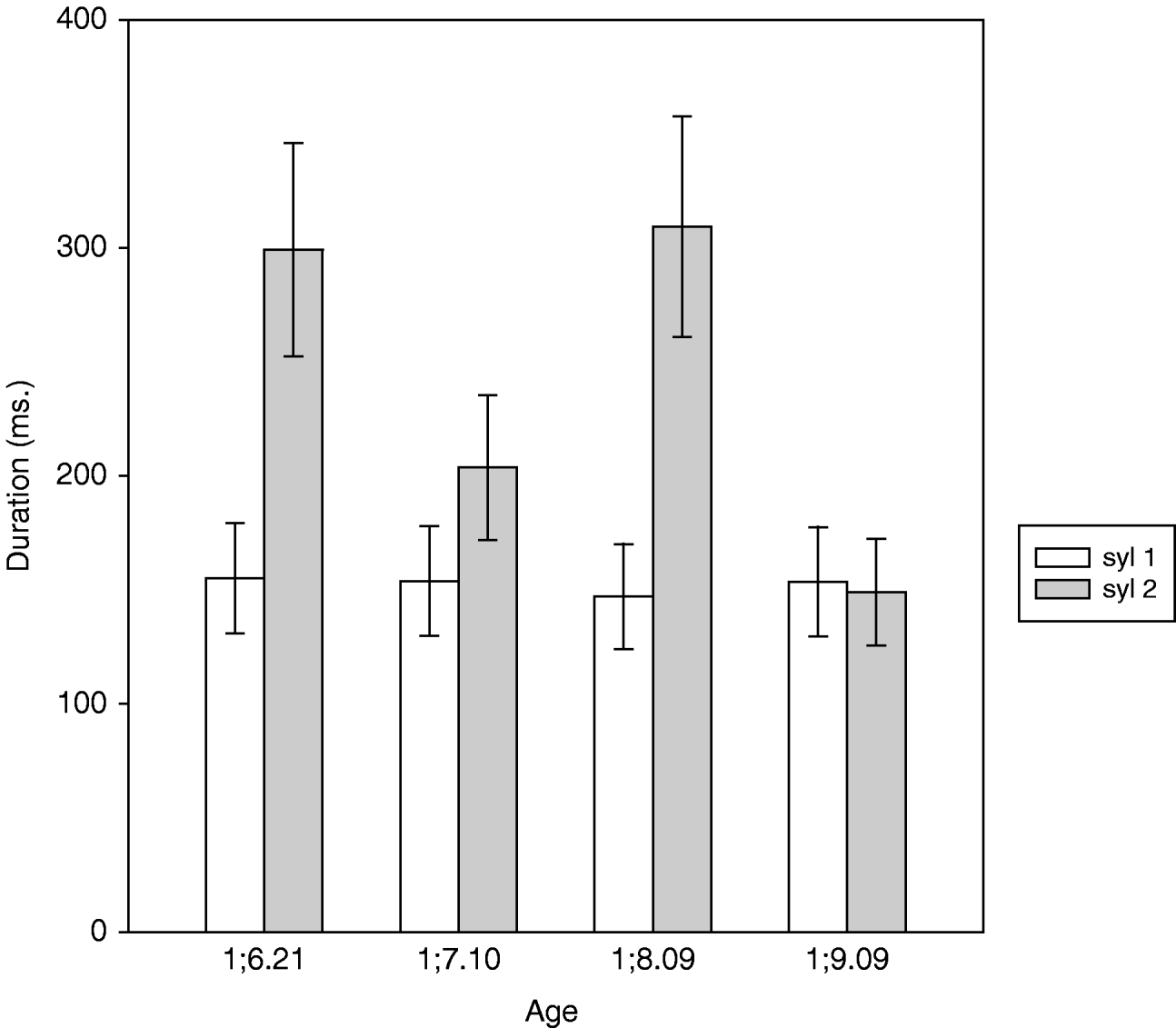
The average vowel durations in milliseconds of the first and second syllables are presented in Figure 3.
Average vowel durations in disyllabic utterances at four monthly points (error bars indicate standard errors).
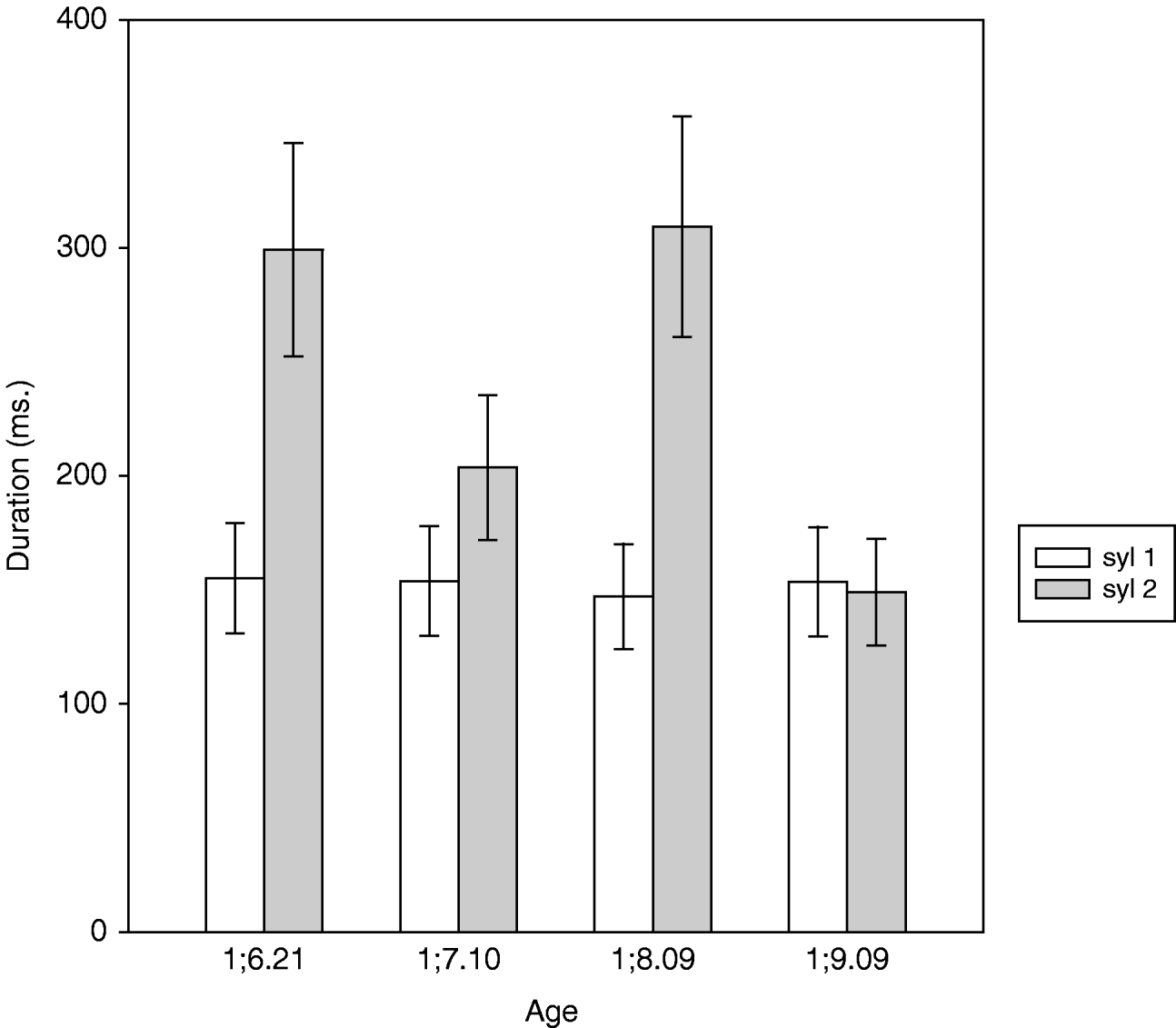
A (4) age×(2) syllable position ANOVA was conducted on the vowel durations of 328 syllables (41 disyllables×2 syllables×4 points). This analysis yielded a significant main effect of Age (F(3, 160)=19·24, p<0·001, ηp2=0·27) and Position (F(1, 160)=109·86, p<0·001, ηp2=0·41). The two-way interaction Age×Position was significant (F(3, 160)=22·16, p<0·001, ηp2=0·29). Tukey's post hoc tests for the main effect of Age indicate that on average Seth's syllables at 1 ; 6 and 1 ; 8 (mean 227 ms and 228 ms) are significantly longer than those at 1 ; 7 and 1 ; 9 (means 179 ms and 151 ms) (p<0·001). The main effect of Position was significant because the durations of second syllables (mean 240 ms) are longer than the first syllables (mean 152 ms). The two-way interaction (Age×Position) was significant because the durations of the first and second syllables do not differ statistically at 1 ; 9 (mean 154 vs. 149 ms, p>0·05), whereas the second syllable is longer than the first syllable at 1 ; 6, 1 ; 7 and 1 ; 8 (p<0·05, 155 vs. 299 ms at 1 ; 6, and 153 vs. 203 ms at 1 ; 7, and 147 vs. 309 ms at 1 ; 8).
Ratios of final to non-final (F/NF) vowel durations were computed for each disyllable to examine FSL during this period (see Table 2). At 1 ; 6, the second syllable was longer than the first in almost all cases (97·6%), but at 1 ; 9, only half of the disyllables (51·2%) had a F/NF ratio larger than 1·0. The percentage of FSL in disyllables was intermediate at 1 ; 7 (73·2%) and at 1 ; 8 (78·4%).
A one-way ANOVA was conducted on the 164 F/NF ratios of disyllables (41 disyllables×4 data points) to examine differences in F/NF ratios across age points. This analysis yielded a significant effect of Age (F(3, 160)=15·64, p<0·001, Cohen's f=0·46). Tukey's post hoc tests indicated that the F/NF ratios at 1 ; 6 and 1 ; 8 (means 2·0 and 2·2) were significantly larger than those at 1 ; 7 and 1 ; 9 (means 1·5 and 1·1) (p<0·05).
DISCUSSION
The results of this study demonstrate that Seth's shift from one-word to two-word productions is gradual, lasting over the two-month period spanning 1 ; 7 and 1 ; 8. Three different MLU measures manifest different patterns across the period of study (Table 1 and Figure 1). MLU-L steadily increases, whereas MLU-S fluctuates between 1·6 and 2·3. MLU-F is low (<1·2) between 1 ; 6.21 and 1 ; 7.05, high (1·4–1·6) when Seth starts combining two words (1 ; 7.10–1 ; 9.01), and decreases at 1 ; 9.09 before increasing again. MLU-S is not significantly correlated with age, indicating that his length of utterances in syllables does not increase significantly over this period. FSL is seen in most of the disyllables between 1 ; 6 and 1 ; 8 (73·2–97·6%), but only 51·2% of his disyllables exhibit F/NF ratios larger than 1:0 at 1 ; 9.
The main purpose of this study was to investigate the child's strategies to lengthen his utterances on the phonological level (Fillers) and to control his utterances suprasegmentally (FSL). Our findings indicate that Fillers do lengthen Seth's utterances throughout the period when he is mostly producing one Lexeme per utterance, as indicated by the high MLU-F (Figure 1 and Table 1) and patterns of syllable configurations (Figure 2). We believe that adding a Filler enabled Seth to lengthen his utterances phonologically before he started combining Lexemes productively. We hypothesized that there is a period of reorganization in phonology around the onset of word combination. Both the insertion of Fillers and FSL show a regression around 1 ; 9, corresponding to increases in combination of Lexemes. We suggest that these regressions are signs of a period of phonological reorganization while Seth was making the transition from one-word to two-word combinations.
Interestingly, his very first lexical combinations (pop balloon [bun], n trunk leaves, and swing high at 1 ; 7.10) were combinations of monosyllables, although many of Seth's early words were disyllabic or reduplications of adult words. This suggests a production limitation restricting him to two meaningful units of one syllable each, or to two syllables consisting of one meaningful unit plus an optional Filler. Demuth (Reference Demuth, Morgan and Demuth1996) proposes that children's early words are prosodically constrained to one foot, and it is possible that early word combinations are constrained to one foot as well.
Regarding FSL, our findings bear striking similarities to those of Snow (Reference Snow1994; Reference Snow1997). All three studies show the diminishing of FSL corresponding roughly to a chronological age of 1 ; 9. The second syllable was longer than the first, on the average, in Seth's disyllabic words between 1 ; 6 and 1 ; 8, but not at 1 ; 9. The F/NF ratio of 1·1 at 1 ; 9 is smaller than the overall F/NF ratio reported in adult speech in English (e.g. 1·53 in Delattre, Reference Delattre1966). Moreover, the decrease in FSL at 1 ; 9.09 coincides with the Filler Drop. When Fillers increase again from 1 ; 10.05, it appears that Seth begins associating them with adult grammatical morphemes (e.g. brush [ə] teeth). Therefore, his Filler production over this four-month period suggests a U-shaped developmental pattern. Snow (Reference Snow1994) also indicates that FSL was observed again during the two-word period, also indicating a U-shaped pattern. We speculate that the Filler Drop occurred when it did because purely phonological Fillers were no longer useful at this age, and Fillers reappear as protomorphemes (Peters, Reference Peters2001) during the two-word stage. It is not certain what role FSL plays in relation to morphosyntax. One possibility is that diminishing FSL indicates the child's better timing control, which, in turn, helps him to combine two Lexemes into a single utterance. In any case, changes in both Fillers and FSL suggest this was a period of reorganization in Seth's developing language (see Snow, Reference Snow1994).
This study is limited by several factors. First, it is based on the data from one child, and the developmental patterns observed in this study may not be found in other children. In particular, the findings on MLU-F will not be relevant to children who do not produce Fillers. Second, MLU-S was employed as one measure of phonological development, but it is possible that his utterances also improved in other ways, such as syllable structure. Third, the findings on FSL must be interpreted with caution because there are individual differences in timing control among young children (see Robb & Saxman, Reference Robb and Saxman1990). Finally, the tokens for the acoustic measurements were not controlled. It would be preferable to examine FSL in a data set where syllable structure, vowel quality and stress patterns have all been controlled.
In summary, the data from this study support simultaneous changes in Fillers and FSL when Seth began combining words. Although all the data are from one child, we hope that this study contributes to an understanding of the interactions among different domains in developing child language.