Introduction
South American camelids in Argentina include the domestic llama (Lama glama) and the wild guanaco (Lama guanicoe) and vicuña (Vicuña vicuña) species. Meat and fibre from llamas play an important role in securing food and cash for the most vulnerable rural population in the highlands of the Andes (Paz et al., Reference Paz, Sossa Valdez, Lamas, Echazu and Califano2012). Argentina's wild camelid population of guanacos and vicuñas is the largest in the world and niche markets are developing for their fibres locally and internationally (Duba, Reference Duba1999). The potential for expanding cash income from llama fibres and taking advantage from fibre niche markets appears to be big and is largely dependent on the offer of high-quality fibre (Frank et al., Reference Frank, Hick, Gauna, Lamas, Renieri and Antonini2006a). Quispe et al. (Reference Quispe, Rodríguez, Iñiguez and Mueller2009) and Cardellino and Mueller (Reference Cardellino and Mueller2009) provide general information on South American camelid fibre production in Peru, Bolivia and Argentina. However, characterization of the quality of camelid fibres currently produced in Argentina is partial and circumscribed to specific populations (e.g. Mueller, Elvira and Sacchero, Reference Mueller, Elvira, Sacchero and Allain2013). In view of the interest in designing national and regional development strategies for llama producers (PLC, 2008; MECON, 2010; PGTF, 2013) and the need of updating management programmes for vicuña and guanaco populations (MECON, 2006; Arzamendia, Baldo and Vilá, Reference Arzamendia, Baldo and Vilá2012), it becomes necessary to assess the quantity and quality of the fibre produced by these animal genetic resources in the country. This review examines published information and own unpublished data on domestic and wild camelid fibre quality in Argentina.
Population of camelids
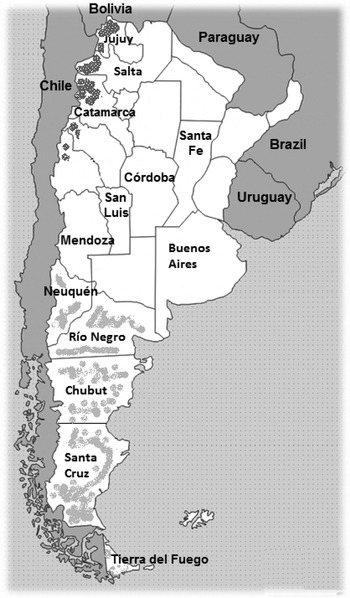
The last national livestock census dates the year 2002 and indicates that there were 161 402 llamas in Argentina (INDEC, 2002). About 68 percent of that population was located in the province of Jujuy, 16 percent in Catamarca, 12 percent in Salta and only 4 percent in other provinces (Figure 1). A survey of 2008 in the North-Western Departments of Jujuy indicated that the llama population had increased since 2002 by 40 percent, largely at the expense of sheep (Roisinblit, Reference Roisinblit2011) and a study by FAO (2005a) shows that herd size of llamas is larger than reported in the census of 2002. It is estimated that the number of llamas by 2014 is at least 200 000 heads, with more than 90 percent reared in the Andean Puna. The Puna is a natural rangeland environment above 3 000 m above sea level occupying much of the province of Jujuy and parts of Salta and Catamarca. One can still find llamas in other, lower altitude and regions of the country, but these are likely to be in commercial or hobby farmer herds rather than in smallholder – low-input systems. It is generally accepted that there are no alpacas (Lama pacos) in Argentina. However, given that there are alpacas in contiguous environments of Chile and Bolivia, there may well be some alpacas in Argentina. These alpacas and llamas looking like alpacas, or perhaps crossed with alpacas, the so-called Alpacunos, would be included in the llama population figures.
Map of Argentina, including provinces relevant in camelid fibre production or named in the text. Areas with llamas and vicuñas are dark shaded and correspond to “Puna” highland environments of Northern provinces. Areas with guanacos are light shaded and correspond to “Patagonia” desert environments of Southern provinces.

Together with Peru, Argentina has the largest vicuña population in the world. A comprehensive survey on vicuñas yielded a total number of 131 220 animals (CNVG, 2007). This figure is much larger than expected since the previous census of 1980 estimated a population of only half of this number. Vicuñas share the Puna environment with llamas, 42 percent of all vicuñas are located in Jujuy, 31 percent in Catamarca and 19 percent in Salta. Only 8 percent of vicuñas are in other provinces. Guanacos inhabit the cold desert of Patagonia in Southern Argentina. A census carried out in the Patagonian provinces in 2000 estimated a population of 439 693 guanacos (Amaya, von Thüngen and De Lamo, Reference Amaya, von Thüngen and De Lamo2001), 57 percent in Santa Cruz, 20 percent in Chubut and 23 percent in Río Negro and Neuquén. A recent survey held just in Santa Cruz Province, confirmed a guanaco population between 893 307 and 1 261 755 (Manero et al., Reference Manero, Dragnic, Clifton and Vargas2013). The huge jump in the estimated guanaco population of Santa Cruz may be related to the consequences of the eruption of the Hudson volcano in 1991. The ashes from the volcano covered extensive sheep grazing areas forcing the abandonment of farms and therefore facilitating the invasion of wildlife, including guanacos. The perception of experts is that the country's guanaco population may be close to 2 million, by far the largest in the world.
It should be noted that indiscriminate hunting of both camelid species in the past let to a massive reduction of the populations and risk of extinction, especially of vicuñas. Eventually Argentina subscribed the inclusion of guanacos and vicuñas in Appendix II of the “Convention on International Trade in Endangered Species of wild fauna and flora” (CITES). Hence, observing strict protection programmes which ban hunting and control fibre trade. The increasing population size of guanacos and vicuñas can therefore also be related to the successful implementation of the protection programmes. In fact, management programmes are necessary to maintain a balance of population size with available forage resources and other farming activities, such as the predominant sheep production (von Thüngen and Lanari, Reference Von Thüngen and Lanari2010).
Fibre production
The production of llamas is concentrated where poverty rate is high (FAO, 2005a). According to the census of 2002 there were a total of 2 803 farmers rearing llamas in mixed livestock production systems (INDEC, 2002) along Argentina. Figures from a census performed in 2008 in the province of Jujuy indicate that the number of farmers remained almost the same but the llama population increased 30 percent from 108 413 to 140 882 (Roisinblit, Reference Roisinblit2011).
The typical livestock holder in Jujuy runs 161 sheep, 69 llamas, 29 goats and 3 cows (Paz et al., Reference Paz, Sossa Valdez, Lamas, Echazu and Califano2012). In the Puna region of Catamarca, a typical farmer holds 70 llamas in addition to about 97 sheep, 101 goats and 64 cattle (PROSAP, 2010). The main product of llamas is meat followed by fibre. In Jujuy raw fibre sales and fibre handcrafts sales contribute about 10 percent to the total income of a household (Paz et al., Reference Paz, Sossa Valdez, Lamas, Echazu and Califano2012). The proportion of adult llamas which are shorn in a year varies between 20 and 40 percent, depending on the region, the price of the fibre and the needs of the farmers (Frank and Whebe, Reference Frank, Whebe and Mueller1993). Most fibre collected from skins and from llamas for slaughter is home-used. Since a large proportion of the fibre collected is used within the households or is sold on informal markets, exact figures on the quantity of fibre produced are difficult to assess. It is estimated that the annual amount of llama fibre produced is about 60 000 kg, including about 20 000 kg home-used fibre (MECON, 2010).
Fibre and hides from vicuñas and guanacos were traditionally used for clothes, construction of shelters, textiles and decorations by indigenous people. Protection programmes were established restricting shearing to live animals under strict control and monitoring by trained wildlife authorities. Vicuña and guanaco fibre from monitored populations can be obtained either from free ranging animals or from animals kept captive in appropriately fenced paddocks. Recent research confirmed that by applying proper welfare protocols during capture and shearing, population demographics of both species are not altered (Arzamendia and Vilá, Reference Arzamendia and Vilá2012; Rey et al., Reference Rey, Novaro, Sahores and Guichón2012). The capture and shearing practices of vicuñas and guanacos kept in captivity were described by Amendolara (Reference Amendolara2001) and Amaya and von Thüngen (Reference Amaya and von Thüngen2001), respectively. Whereas the capture and shearing practices of free ranging vicuñas and guanacos were described by Rigalt, Sabadzija and Rojas (Reference Rigalt, Sabadzija, Rojas, Miragaya, Olivera and Puig2006b) and by Lichtenstein and Carmanchahi (Reference Lichtenstein and Carmanchahi2012), respectively. Any farmer or community can start a wild camelid farming enterprise if the corresponding legal requirements are met. These requirements include regular controls of management plans based on population dynamics data which are difficult and expensive to obtain, therefore the actual number of farmers involved in wild camelid fibre harvest is very low. In 2013, there were only 14 farmers rearing vicuñas in captivity (DFS, 2014). In the same year, nine populations of free ranging vicuñas were captured and shorn (DFS, 2014). Owing to the wildlife management controls there are detailed figures on the amount of fibre collected from these legally shorn wild camelids. For example in 2013, a total number of 3 623 vicuñas were shorn and 845 kg of fibre was harvested (DFS, 2014). In 2008, a total number of 6 230 guanacos were shorn in 21 capture events and 2 117 kg of fibre was harvested in the two Patagonian provinces of Río Negro and Neuquén (Cancino, 2010, unpublished). For the remaining Patagonian provinces similar quantities of legally obtained guanaco fibre were estimated although guanaco fibre production figures have dropped in recent years. It is estimated that the legally obtained fibre from wild camelids represents only about two-thirds of the total fibre marketed. In any case, wild camelid fibre production is very low but it should be noted that its market price can be very high. For example, raw vicuña fibre averaged 500 USD/kg in public auctions in years 2011–2013. Table 1 shows a summary of current (2013) Argentinean domestic and wild camelid fibre production statistics.
Approximate population size, number of animals shorn, production units and fibre production of domestic and wild camelids in Argentina in 2013.

Source: Mueller et al. (Reference Mueller, Elvira, Sacchero and Allain2013) and own updated estimates.
1Legally shorn animals and legally marketed fibre.
2Management units, including breeding units and regularly captured wild populations.
Fleece and fibre traits
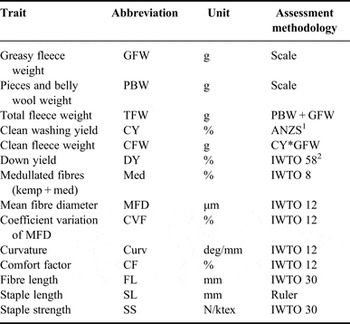
Important characteristics of the fleece and the fibre of camelids are: fleece structure, greasy fleece weight, clean washing yield, fibre colour, proportion of down fibre, mean fibre diameter, variation of down fibre diameter, fibre length and comfort factor (Frank et al., Reference Frank, Hick, Gauna, Lamas, Renieri and Antonini2006a; Frank, Hick and Adot, Reference Frank, Hick and Adot2012). The relative importance of each of these characteristics depends on the camelid species and on the step of fibre marketing and fibre processing considered (McGregor, Reference McGregor2006). For llama farmers fleece weight is of major importance followed by fibre colour, fleece structure and mean fibre diameter. Mean fibre diameter is of major importance for the textile industry, followed by fibre length and fibre uniformity. For guanacos and vicuñas fleece weight is the most important trait followed by fibre length and less so the fibre diameter. The methodology used in the assessment of the various fibre traits may differ between studies and should be verified with the original publications. Our own assessments are based on standard methods applied at the INTA Bariloche Textiles fibre Laboratory in Rio Negro, Argentina (Table 2). Whenever appropriate, statistical analyses of own data were performed using mixed models with location, year, sex and age as fixed effects and considering differences in least-squares means significant at P < 0.05.
Camelid fibre traits and methodology of its assessment at the INTA Bariloche Textiles Fiber Laboratory in Rio Negro, Argentina.

1Australian – New Zealand Standards.
2International Wool Textile Organization.
Fibre characteristics of llamas
In Argentina, as well as in Bolivia and Peru, there are two types of llamas. There is the Pelado (or K'ara) type and the Lanudo (or T́amphulli or Ch'aku) type. The two types can be differentiated phenotypically by their head, ear insertion and body structure and also by the quantity and quality of their fibre. A genetic base for this phenotypic differentiation is however not yet known (Iñiguez et al., Reference Iñiguez, Alem, Wauer and Mueller1998). Pelado llamas have much less fibre on neck and extremities than Lanudo llamas. The Pelado type has a more meat animal body structure and produces less but somewhat finer fibre. The average fleece weight of Pelados under on-farm conditions is seldom higher than 800 g, whereas Lanudos have fleeces weighing more than 1 000 g (Cancino et al., Reference Cancino, Rebuffi, Mueller, Duga, Rigalt, Miragaya, Olivera and Puig2006). A comprehensive survey on llama types was undertaken by Hick et al. (Reference Hick, Lamas, Echenique, Prieto, Castillo and Frank2009) covering six sites located between 3 500 and 4 500 masl in the departments of Santa Catalina, Rinconada, Cochinoca and Yavi of the province of Jujuy. A total number of 10 760 animals from 143 herds were included in the study. About 56 percent of all animals were classified as Lanudos, 37 percent as intermediate and the remaining 7 percent were classified as Pelados and Alpacunos. The fleeces of both Pelado and Lanudo llamas may be single-coated (SC), double-coated (DC) or luster (L). Most Lanudos have single or luster coats and most Pelados have a double coat, but there are also intermediate types. SC fleeces have thick and thin crimped fibres. DC fleeces have highly visible guard fibres and crimped shorter down fibres. Luster fleeces have thick and thin straight fibres in curled staples with a thin tip (Frank, Hick and Adot, Reference Frank, Hick and Adot2007). Fleeces in-between SC and L are defined as hemi-luster and fleeces in-between SC and DC are defined as intermediates. Following this definitions, Hick et al. (Reference Hick, Lamas, Echenique, Prieto, Castillo and Frank2009) classified 43 percent of llamas surveyed in Jujuy as being SC, 27 percent as DC, 18 percent as hemi-luster and the remaining fleeces as intermediate and luster.
Furthermore, the results of Hick et al. (Reference Hick, Lamas, Echenique, Prieto, Castillo and Frank2009) and Frank et al. (Reference Frank, Hick, Gauna, Lamas, Renieri and Antonini2006a) indicate that according to the coat colour 41 percent of llamas were white, 27 percent were brown or tan coloured and 16 percent chestnut coloured. Only 16 percent were of other colours such as black, grey or mixed. In the province of Catamarca, brown llamas are more common (Rigalt, 2010, unpublished). For example Frank and Nuevo Freire (Reference Frank and Nuevo Freire1985) observed 87 brown (58 percent) and 27 black (15 percent) animals in a herd of 150 llamas in the region of Laguna Blanca in Catamarca.
Hick et al. (Reference Hick, Lamas, Echenique, Prieto, Castillo and Frank2009) classified 50 percent of llamas as superfine (<21.9 µm), 33 percent fine (22–24.9 µm), 14 percent medium (25–29.9 µm) and only 2 percent as coarse (>30 µm). The weighted average fibre diameter was 22.3 µm. Frank et al. (Reference Frank, Hick, Lamas, Gauna and Molina2006b) measured 22.9 µm in a mixed sex herd of Yavi, Jujuy. In Abra Pampa, Jujuy, Cancino et al. (Reference Cancino, Rebuffi, Mueller, Duga, Rigalt, Miragaya, Olivera and Puig2006) measured 20.0, 23.8 and 23.4 µm in samples collected from male llamas aged 13, 24 and 36 months, respectively. An increase of average fibre diameter with age was also observed by Frank et al. (Reference Frank, Hick, Lamas, Gauna and Molina2006b).
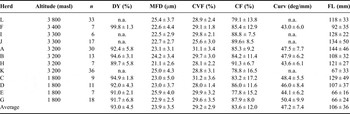
In the province of Catamarca, Frank and Nuevo Freire (Reference Frank and Nuevo Freire1985) obtained a fibre diameter of 26.8 µm from a llama herd (n = 70) in Laguna Blanca. Rigalt (2010, unpublished) collected samples from eleven llama herds in Laguna Blanca, Antofagasta and Santa María. Fibre diameter ranged 21–25 µm and other traits also varied considerably (Table 4).
Fibre quality of annually shorn llama males of different ages.

Source: Cancino et al. (Reference Cancino, Rebuffi, Mueller, Duga, Rigalt, Miragaya, Olivera and Puig2006).
See abbreviations in Table 2.
Fibre quality of adult llamas in herds of Catamarca (average ± SD).

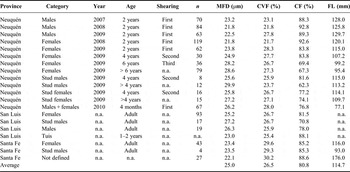
Away from their traditional rearing environment of the highlands of Jujuy, Salta and Catamarca, there are llama herds in other provinces and at lower altitude. For example, in the province of Neuquén at 800 masl, where summers are frosty and winters are cold with intensive snow cover, a large llama herd is run to produce fibre for a handcraft production company (Cancino 2010, unpublished). The foundation animals of this herd came from the highlands of Jujuy and the overall average fibre diameter of the herd is 24.4 µm (n = 661). Fibre diameter of males and females at first shearing is 21.8–23.8 µm and at second and third shearing between 24.9 and 29.9 µm (Table 5). In milder and more humid environments of the provinces of San Luis and Santa Fe, the fibre diameter of adult llamas is between 23.5 and 27.2 µm.
Fibre quality of llamas in lowland environments.

Llamas can also be found in other provinces of Argentina such as Río Negro, Córdoba and Buenos Aires. Coates and Ayerza (Reference Coates and Ayerza2004) report fibre quality of llamas in Buenos Aires, which originally were introduced from the highlands. Females and males averaged fibre diameters of 29.3 and 29.0 µm, respectively. These results for fibre diameter are much higher than figures obtained in the highlands, which might be attributed to the better feeding conditions in this environment and production system.
The observed phenotypic differences within and between herds in fleece weights and fibre diameter and the medium-to-high heritabilities reported for these traits (Wurzinger et al., Reference Wurzinger, Delgado, Nürnberg, Valle Zárate, Stemmer, Ugarte and Sölkner2006; Frank et al., Reference Frank, Hick, Molina and Caruso2011) enable successful selective breeding. Llama breeding programmes aimed at improving fibre traits were implemented in Abra Pampa (Jujuy) and in Santa Maria (Catamarca) but the results are not documented. In INTA Abra Pampa, the breeding programme started in 1993 with animals grouped into five coat colour herds. Total herd size by 2013 is 650 breeding animals. Birth weight and weaning weight at the age of 7–8 months are recorded and fleece samples are collected from males at first shearing. Males are selected in three stages. First on uniformity of coat colour and sound body conformation, then selection is based on records of body weight, fleece weight and mean fibre diameter. In a third stage, before mating or sale, a final visual inspection is done. Cancino, Rebuffi and Aller (Reference Cancino, Rebuffi and Aller2001b) recorded greasy fleece weights of 1 080 g (n = 74), 1 150 g (n = 48) and 1 260 g (n = 13) for males from the Abra Pampa base population (general herd) at the age of 1, 2 and 3 years, respectively. Selected males in the nucleus had an approximately 10 percent higher fleece weight and better fibre quality than the base population.
Fibre characteristics of guanacos
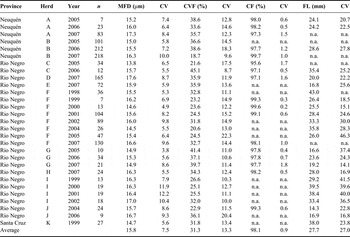
Shearing of guanacos is performed with mechanical scissors and usually includes fleece and belly sites, in general only the neck of the animal is left unshorn. It is uncommon that the same free-ranging guanaco is caught for shearing in consecutive years; therefore in a particular shearing event animals with different fibre growth periods are shorn. Shearing season seems not to affect significantly fleece weights but first shearing of an animal yields more fibre than a second shearing of the same animal (von Thüngen et al., Reference Von Thüngen, Lheure, Seguineau De Preval, Perazzo, Perez-Cabal, Gutierrez, Cervantes and Alcalde2012). It has been shown that lifetime fibre production is higher with annual shearing's (Cancino et al., Reference Cancino, Abad, Taddeo and Sacchero2008). Fleece weight of adult guanacos is in the range 300–700 g and animals at the age of 1 year have been recorded with fleece weights up to 420 g (Bacchi, Lanari and von Thüngen, Reference Bacchi, Lanari and von Thüngen2010). Guanaco fleeces, such as vicuña fleeces, have two types of fibres: fine and short down fibres and coarse and long guard fibres. Although the guanaco down yield is about 80–90 percent (Table 6) the actual proportion of down fibre obtained after mechanical dehairing is usually only about 50 percent (Adot, Cossio and Maguire, Reference Adot, Cossio, Maguire, Frank, Antonini and Toro2008). Some producers clean the fleeces from soil and vegetable matter, and take out the guard fibres before selling the fleece or submitting for testing. Depending on the cleaning level, the proportion of down fibres measured in the cleaned fraction may increase to values of 65–95 percent (Sacchero, Maurino and Lanari, Reference Sacchero, Maurino and Lanari2006). Fibre diameter varies between animals and age groups. Bacchi, Lanari and von Thüngen (Reference Bacchi, Lanari and von Thüngen2010) observed less fibre production (159 versus 254 g) and finer fibres (14.2 versus 15.0 µm) in guanaco calves (animals up to 1 year but with primary incisors) than in yearling guanacos (animals 1–2 years of age and with permanent incisors). Sacchero, Maurino and Lanari (Reference Sacchero, Maurino and Lanari2006) reported a fibre diameter ranging between 14.5 and 19.3 µm and a proportion of down fibres between 64.9 and 94.5 percent in seven different guanaco populations of the North of Patagonia. In that study, MFD of the whole sample was compared with the mean fibre diameter of down fibres. Down fibres were only 0.6 µm finer than all fibres in the sample. A further study of fibre quality in several guanaco populations is summarized in Table 6. It should be noted that on average the within sample fibre diameter variability (CVF = 31.3 percent) is more than four-times the between-animal fibre diameter variability (CV of MFD = 7.5 percent), whereas the between-animal variability in down fibre length is high (CV of FL = 27.0 percent). Llama herds G and J sampled for this study grazed on very poor rangelands and this may explain the particular short fibres measured (Table 6).
Fibre quality of adult guanaco herds and its between-animal coefficient of variation (CV, %).

Source: Sacchero and Cancino (2013, unpublished).
n.a.: not available.
See abbreviations in Table 2.
In another study, three guanaco populations were investigated and fibre diameters of 14.6 ± 0.7 to 16.5 ± 1.7 µm and fibre length of 14.4 ± 3.3 to 38.1 ± 9.1 mm were recorded (von Thüngen et al., Reference Von Thüngen, Gálvez, Sacchero and Duga2005). A project run by a smallholder cooperative in the province of Mendoza managed to shear a total of 569 guanacos captured in 12 round-ups in the period 2005–2010 and obtained 208.5 kg fibre with an average fibre diameter of 15.8 µm and fibre length of 36 mm (Lichtenstein and Carmanchahi, Reference Lichtenstein and Carmanchahi2012). It should be noted that in some years of this study the belly area of the animals were left unshorn.
Fibre characteristics of vicuñas
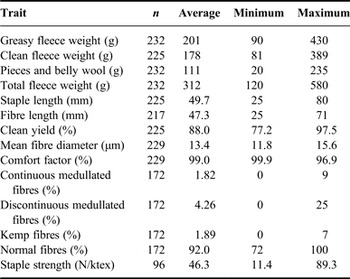
Vicuñas are either shorn with scissors or with electrical or mechanical shearing equipment. It is thought that shearing with scissors or shearing only part of the animal's body reduces the risk of cold-stress but there is no research confirming this. There are also accounts on higher (up to 100 g more) fibre harvest from mechanically shorn animals rather than from animals shorn with scissors, although mechanical shearing is said to yield more contaminated fibre. For the subspecies Vicugna vicugna vicugna, which is the one present in Argentina, extensive information on the fibre characteristics is available from a herd kept in captivity at the INTA Abra Pampa experimental station (Rebuffi, Reference Rebuffi1999). The herd was established in 1965 with only 16 animals captured in the wild, but since then the number has increased to almost 1 300. Animals from this herd are distributed to private farmers interested in starting a commercial herd. Vicuña fibre from this station is sold to local artisans and to dehairing companies which export the processed fibre. Results from the INTA Abra Pampa herd show average MFD of 13.4 µm and FL of 47.3 mm with a high range of values between animals (Table 7). Additional information from this herd and Catamarca populations is summarized in Table 8. The Catamarca data were analysed for year and sex effect. Year effects resulted significant (P < 0.05) only for MFD and CVF; sex was not significant for any trait.
Fibre characteristics at first shearing of male vicuñas in Abra Pampa.

Source: Adapted from Rebuffi (Reference Rebuffi1999).
Fibre quality of adult vicuñas and its between-animal coefficient of variation (CV, %).

Source: Sacchero, Lamas and Rigalt (2014, unpublished).
n.a.: not available.
See abbreviations in Table 2.
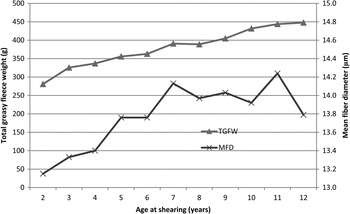
Figure 2 shows the development of total greasy fleece weight and fibre fineness in males according to the age of first shearing. A clear trend in increasing fleece weight with age can be observed. The linear regression shows an increase of 15.6 g/year (r 2 = 0.97). On the other hand the increase of fibre diameter with age is very low and seems to disappear at the age of 7–8 years. In later studies of the same herd, average fibre diameters of 13.8 µm (SD 3.0 µm) for de-haired samples and 14.1 µm (SD 4.5 µm) from complete samples were recorded (Sacchero and Mueller, Reference Sacchero and Mueller2005). The difference being small given that down yield of vicuñas is above 85 percent (Tables 7 and 8) and few guard fibres contribute to increase fibre diameter. Mechanical dehaired vicuña fibre yields about 70 percent of down fibre (Adot, Cossio and Maguire, Reference Adot, Cossio, Maguire, Frank, Antonini and Toro2008).
Total greasy fleece weight (TGFW) and mean fibre diameter (MFD) in male vicuñas shorn for the first time at different ages. Source: adapted from Rebuffi (Reference Rebuffi1999).

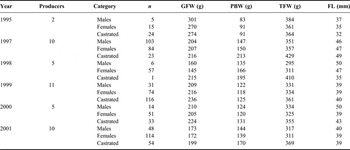
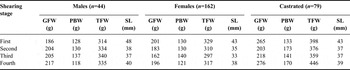
Cancino, Rebuffi and Aller (Reference Cancino, Rebuffi and Aller2001a) analysed data from vicuñas reared in captive systems by private producers. In vicuña males, a range in fibre diameter between 11.9 and 22.0 µm with an average value of 13.6 µm (SD 4.0 µm) was observed. Production data per year of shearing and sex of animals from different producers are presented in Table 9. Note that these animals were shorn in a bi-annual interval. In Table 10, the effect of successive bi-annual shearing of the same animals is presented. One can observe that the fibre length remains more or less constant after the first shearing and females produce in general less fibre than males and castrated males.
Vicuña fibre production of private producers according to year and sex.

Source: Cancino et al. (Reference Cancino, Rebuffi and Aller2001a).
See abbreviations in Table 2.
Fibre production of vicuñas according to sex and shearing stage (bi-annual) in private herds.

Source: Cancino et al. (Reference Cancino, Rebuffi and Aller2001a).
See abbreviations in Table 2.
Information on different fibre traits from vicuñas captured in the wild is still very scarce. Captures of wild vicuñas were organized by the Laguna Blanca community in Catamarca in the years 2003, 2004 and 2005. In these occasions greasy fleece weight from 169, 77 and 93 animals was measured and resulted 206, 286 and 313 g, respectively (Rigalt, Sabadzija and Rojas, Reference Rigalt, Sabadzija, Rojas, Miragaya, Olivera and Puig2006b). Rigalt et al. (Reference Rigalt, Rebuffi, Vera, Pivotto, Miragaya, Olivera and Puig2006a) took fleece samples from 61 of these vicuñas and recorded an average fibre diameter of 12.6 µm (SD 4.4 µm) and fibre length in the laboratory of 37.7 and 31.0 mm measured in the field with a ruler. Only animals, which were not shorn in the previous year, were included in the shearing. In captures of vicuñas from populations in higher altitudes (3 800 masl) in the year 2008 and 2009 values for greasy fleece weight exceeded the average values from Abra Pampa and Laguna Blanca (3 200 masl), with similar fibre diameter but longer staples. For example in Laguna Colorada (3 650 masl), the average greasy fleece weight of 207 animals reached 460 g, with some animals even reaching 1 000 g. One possible explanation for this could be that the lower temperature at higher altitudes induces more fibre production, but research is needed to determine possible confounded effects such as feed availability or body size.
Discussion
Argentine camelid fibre quality in perspective
From the available data some general observations and particularities of Argentinian llama fibres can be made. Almost half of the llamas are of the SC Lanudo type, whereas less than a quarter is of the double-coated, low fibre producing Pelado type. The advantage of SC animals is that dehairing efforts can be reduced, the fine fibre yield is higher and therefore the value of their fleece is higher. This contrasts findings in Bolivia where 74.4 percent of llamas were reported to be of the Pelado type (FAO, 2005b). It should be noted however that there are also llama populations in Bolivia and Peru with similar characteristics of the Argentinean highland llama populations (Maquera, Reference Maquera1991; Martinez, Iniguez and Rodríguez, Reference Martinez, Iniguez and Rodríguez1995; Iñiguez et al., Reference Iñiguez, Alem, Wauer and Mueller1998; Stemmer et al., Reference Stemmer, Valle Zárate, Nürnberg, Delgado, Wurzinger and Sölkner2005). One important feature of the fibre from Argentinian llamas is that although white colour is predominant a wide range of colours is covered. A survey indicated that black, white and grey fibre fetch best prices (PROSAP, 2010). More than 80 percent of the Argentinian llama fibre is finer than 24 µm (Hick et al., Reference Hick, Lamas, Echenique, Prieto, Castillo and Frank2009), which is equivalent to the Peruvian “superfine” (21–24 µm) class of commercial alpaca fibre. In comparison only 10 percent of Huacaya alpacas of Australian herds have fibre diameter below 24 µm (McGregor, Reference McGregor2006).
Standard deviations in fibre quality traits across different herds and groups of animals are large. For example, the between animals coefficient of variation for fibre diameter in 12 different llama herds (Table 4) is on average about 15 percent (3.5/23.9). This is high if compared with the coefficient of variation for wool fibre diameter in sheep. One possible explanation for this large CV is that animals of different ages are included in the llama sampling, but it also can be a result of low selection pressure for uniformity.
Fibre length can be an issue and one of the problems in analysing reports on fibre length is that in many cases the growth period is not mentioned and in some other cases it is not clear if the fibre samples have undergone a manual dehairing before analysis. Standard IWTO 12 procedures are based on samples without previous dehairing. However, for example, results reported by Siguayro and Aliaga (Reference Siguayro and Aliaga2009) on fibre quality from Pelado-type llamas from Peru are based on previously dehaired samples. Eliminating kemp fibres from the raw fibre sample reduces the fibre diameter of the remaining fibre by 1–2 µm. Coates and Ayerza (Reference Coates and Ayerza2004) also discuss this sample preparation procedure as a possible source for differences between populations.
Little information is available on fibre quality of wild camelid populations in other countries. Quispe et al. (Reference Quispe, Ramos, Mayhua and Alfonso2010) sampled vicuñas in Huancavelica, Peru at 4 600 masl and obtained GFW of 189.7 g which is considerably less than most fleeces weighted in the Argentinian Puna. Fibre length in Huancavelica was 30.9 mm, MFD was 13.2 µm (CV 19.5 percent) and fibre curvature was 79.9 deg/mm. The lower fleece weights and shorter fibre length in this population compared to the figures from the Puna may be related to differences in the environment but also due to differences in the shearing system and fibre conditioning.
Improvement of camelid fibre quality
Fibre quality depends on several environmental and genetic factors. In low-input systems farmers have limited control over forage supply but can adjust shearing procedures to improve fibre quality. For example shearing on clean surface and basic conditioning and skirting as well as packing can considerably improve fibre offered. Fibre growth in llamas grazing Puna rangelands is affected by nutritional restrictions from July to October. If shearing is annual and during this period, instead of the regular shearing date of November, the breaking point of the fibres, due to nutritional stress, would be closer to the extremes of the fibre and therefore the effective fibre length would be larger than fibres shorn at another point of time. With bi-annual shearing regimes fibre breaking points are unavoidable and staple strength depends on health and nutritional status along the 2 years of fibre growth. Staple strength is especially important for fibre destined to mechanical dehairing, due to the tensions imposed in the process. Further studies on the profile of fibre diameter along the staples in different production areas would help to identify the best shearing dates and shearing frequencies.
Markets and processing
The llama fibre production could easily be doubled by an increase in the number of llamas shorn and by an increase in the frequency of their shearing. The main incentive for this to happen is of course the price paid for the fibre. Llama fibre is usually sold unclassified but there are some communities in Jujuy who organize a joint offer of classed fibre (Lamas, Reference Lamas2013). These communities clean the fleeces from soil and other contaminations and apply a basic classing protocol based on nine colour classes and four visually assessed fibre fineness classes. Homogenous groups combining colours and fineness classes are formed and tendered. Such fibre sales fetch up to double the price an individual farmer would get for his llama fibre. Thus, classing fleeces according to quality and strengthening the handling and storage capacities of communities improve income and interest to produce better and more fibre. The physical characteristics of the camelid fibres make up its commercial value, but also do so intangible features such as the association of the fibre with particular environments and exotic cultures. Llama and vicuña fibre is often associated with the Andean highlands and the remains of the Inca-culture, whereas guanacos are associated with the vast Patagonian desert. In order to be able to exploit these intangible values, promotion and marketing skills are needed. In Argentina, there is a lack of llama producerś organizations which promote production of high-quality fibre, especially in the regions of origin.
There is a shortage of legally produced vicuña fibre for the local artisan market, where an estimated volume of 400 kg per year is needed. If this demand cannot be satisfied with legally obtained fibre and at a reasonable price, poaching will increase. Artisans prefer processing individual vicuña fleeces rather than bulk vicuña fibre to be able to separate more easily guard hairs and classify for fibre colour. Skilled artisans separate up to six vicuña colours from a single fleece. About one-third of the fleece is white. The different colours are spun separately into yarn which is then transformed into “Ponchos” and other popular garments using traditional looms.
Guanacos produce down fibres that are at the lower limit of fibre length that is acceptable by the textile industry. Short fibres are also difficult to spin by artisans. Most guanaco fibre samples have an average fibre length in the range 25–35 mm and are processed through the woollen system. With coefficients of variation of fibre length at 30 percent there is a high proportion of fibres below 10 mm which typically would produce pilling in finished products. Often guanaco fibres are also tender and break in the carding process and therefore reduce its yield. Thus, pure guanaco fibres are difficult to get through the combing process. Local experiences indicate that guanaco fibres can be successfully blended with merino wool (in for example 20:80 proportions, respectively) in order to increase spinning performance and produce high-valued products (Guenguel, 2014). Vicuñas have a slightly higher fibre length but face similar challenges as guanaco fibres. Studies to identify fibre quality differences along the fleece of guanacos of both sexes and different ages have been performed in order to detect eventual fibre classing needs (Cancino, Mueller and Giovannini, Reference Cancino, Mueller and Giovannini2011). Hick et al. (Reference Hick, Frank, Adot, Maguirre, Seghetti and Fabbio2005) conclude that such classing should be based on the results of differences in dehaired fibre quality along the fleece. The cost-effectiveness of such additional work remains an open question.
Fine-tuning the shearing dates and shearing regime can improve the length, down yield and fibre diameter of these special fibres. It seems also necessary to study more guanaco and vicuña ecotypes and populations to investigate if there is a relation between fleece weight, fibre length, altitude and temperature. This knowledge would help to better target wild camelid populations for capture and shearing.
Spinning camelid fibres on farm and selling the yarn can increase profit substantially (von Thüngen and Lanari, Reference Von Thüngen and Lanari2010). At the community level, small-scale fibre processing plants such as the “Mini-mills” (Belfast Mini-mills, 2014) are being tested in the country. At these small scale but versatile mills, yarn and felt products are already produced with cashmere, wool and camelid fibres in various blends (Sacchero, Reference Sacchero2014).
Conclusions
The Puna highlands in the northwest of Argentina and the vast Patagonian cold desert in the South are home to llamas, vicuñas and guanacos which produce noble fibres used by artisans and the textile industry to produce high-valued textile products. Fibre production potential is high as is further improvement of fibre quality and added value.
Acknowledgement
This review includes research financed by the National Institute for Agricultural Technology (INTA), Argentina.