Introduction
Over the last ten years, the poultry meat industry in France has been impacted by many issues including increasing feed prices, competition from low-cost producing countries, tight margins, media attention on welfare and a lingering recession. Indeed, it would appear reasonable to assume that these challenges have led to changes in the way that French consumers shop for poultry meat and the factors that influence their purchase decisions; information that is important to poultry producers if they are to market poultry meat successfully in France.
The aim of this paper, therefore, is to review contemporary information regarding the market for poultry meat in France. The paper will present findings relating to purchase patterns, consumer perceptions, and the factors impacting consumer decision making. To begin, however, it is propitious to outline the background to the paper in terms of the market for poultry meat in France and the industry structure.
Poultry meat in France
According to AVEC (2011) French consumption of poultry meat was at its highest in 2001 when consumption stood at 26 kg per person and BSE was a concern for many consumers however in recent times consumption has declined somewhat but still remains relatively high at 23.5 kg per person. This recent figure includes chicken consumption of 13.1 kg per person and turkey consumption of 4.9 kg per person.
While the French market has moved away from eating whole birds to individual cuts and processed products, the whole bird market remains significant, representing 38% of consumption, versus individual cuts at 40% and processed products at 22% (ITAVI-GEM, 2005; Jez et al., Reference JEZ, BEAUMONT, MAGDELAINE and PAILLARD2009). Ducks, chicken and guinea fowl account for a small but significant proportion of the market, making the French consumers of a greater range of poultry products than many other European countries (ITAVI-GEM, 2005; Jez et al., Reference JEZ, BEAUMONT, MAGDELAINE and PAILLARD2009).
Consumption of poultry meat is relatively high in France not only because it is versatile and can be cooked in a variety of ways, but also because there are no religious or cultural impediments to its consumption (Magdelaine et al., Reference MAGDELAINE, SPIESS and VALCESCHINI2008) and it has been widely promoted as a healthy alternative to red meat (CSA, 2005; Jez et al., Reference JEZ, BEAUMONT, MAGDELAINE and PAILLARD2009).
According to Hingley (Reference HINGLEY2008) consumers across Europe have become concerned about animal welfare and production methods and the French consumer is no exception. The value that consumers attach to the welfare of animals is a reflection of the human satisfaction, assurance and comfort derived from believing that the animal has been treated in the right manner. The source of these feelings can be ethical, cultural or individual sensitivities but the result can be seen in the increasing importance that consumers attach to buying criteria such as quality labels.
There are several quality labels that are used in France including Organic Food, Label Rouge, Free-Range, French Meat, and Protected Geographic Indication (a European Label). The Organic Food label assures quality standards linked to environmental friendly practices and high levels of animal welfare. It represents a sustainable production system that meets the Council Regulation 834/2007 which is the official legal standard within the European Union (European Union, 2007a). The French Label Rouge is an assurance of high quality operated by the National Institute for Origin and Quality (2013) for specific products including poultry. Consumption of Label Rouge products in France represents 30% of individual cuts and processed chicken and 62% of whole broilers (Magdelaine et al., Reference MAGDELAINE, SPIESS and VALCESCHINI2008). The Free-Range label applies separately to individual poultry species, and is regulated by Appendix IV of Commission Regulation (EEC) No 1538/91 (European Union, 1991). The French Meat label indicates that the animal was born, bred, slaughtered and processed in France. The Protected Geographic Indication attests that products are linked with a geographic area within the European Union and thus subject to certain welfare regulations (European Union, 2006).
In recent times the poultry industry has been impacted by various food crises including BSE in cattle and avian flu. As a consequence, consumers have become interested in food provenance (Magdelaine et al., Reference MAGDELAINE, SPIESS and VALCESCHINI2008; Clonan et al., Reference CLONAN, HOLDSWORTH, SWIFT and WILSON2010) and product quality, country of origin, organic production and even waste management (Foxcroft and Woodgate, Reference FOXCROFT and WOODGATE2004; Woodgate, Reference WOODGATE2006) have become important purchase criteria in addition to animal welfare. Indeed, Hall and Sandilands (Reference HALL and SANDILANDS2007), Hingley (Reference HINGLEY2008) and Clonan et al. (Reference CLONAN, HOLDSWORTH, SWIFT and WILSON2010) suggest that consumers are willing to pay more for superior product quality and welfare assured poultry products.
Annual production levels of poultry meat have to some extent mirrored changes in consumption levels. According to AVEC (2011), in 2010, French poultry production totalled 1,850,000 tonnes. Chicken production stood at 1,045,000 tonnes while turkey and duck production were 412,000 tonnes and 240,000 tonnes, respectively.
Over the last decade French production of poultry products has decreased while world production has increased (France AgriMer, 2009). It would appear that despite the advantage of relatively low feed costs, broiler production in France is not competitive on an international basis. This could be due to the additional costs arising from recent EU legislation relating to poultry production methods such as Directive 2007/43/EC (European Union, 2007b). Indeed, in 2008 consumption of imported poultry meat stood at 24% which is significantly higher than in 1998 when it was only 10% (France AgriMer, 2009).
The Establishment National Des Products De L'Agriculture Et De La Mer (French Institute for Agricultural and Sea Products) suggests that the majority of poultry sales in France take place in supermarkets (67%) and a lesser, though still significant, amount of sales are from local grocers or farm shops (9%) and butchers (8%) (France AgriMer, 2009).
Research design and sampling
The information on which this paper was based is derived from a database originally established by Jones and Parrott (Reference JONES and PARROTT1997). A review of the literature was used to inform the development of a research instrument that has been used to survey consumers at intervals during the intervening years. This research instrument has evolved over time to reflect contemporary issues, but in the most recent 2012 version it focused on purchase patterns (Vukasovic, Reference VUKASOVIC2010; Sismanoglou and Tzimitra-Kalogianni, Reference SISMANOGLOU and TZIMITRA-KALOGIANNI2011), consumer perceptions (Charles, Reference CHARLES1975; Yeung and Morris Reference YEUNG and MORRIS2001; Kennedy et al., Reference KENNEDY, STEWART-KNOX, MITCHELL and THURNHAM2004; Vukasovic, Reference VUKASOVIC2009; Reference VUKASOVIC2010; Sismanoglou and Tzimitra-Kalogianni, Reference SISMANOGLOU and TZIMITRA-KALOGIANNI2011; Vukasovic, Reference VUKASOVIC2012) and the factors impacting on consumer decision making (Kennedy et al., Reference KENNEDY, STEWART-KNOX, MITCHELL and THURNHAM2004; Vukasovic, Reference VUKASOVIC2010; Sismanoglou and Tzimitra-Kalogianni, Reference SISMANOGLOU and TZIMITRA-KALOGIANNI2011). A total of 3,000 questionnaires were delivered by hand to a cross-section of housing types at each survey round. The data was analysed using the current version of SPSS. A review of the most recent information entered into the database formed the basis of the remainder of the survey.
Survey findings
Data concerning the consumption of poultry meat is presented in Table 1. Of the 460 people who contributed to the 2012 review, 455 (98.9%) confirmed that they do eat poultry meat.
Consumption of poultry meat.

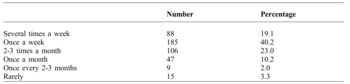
Data concerning the frequency of purchasing poultry meat is shown in Table 2. The modal purchase frequency for poultry meat was once a week, with 185 respondents (40.2%) buying this often. It is interesting to note that 88 respondents (19.1%) bought it even more often and 106 (23.0%) bought it 2-3 times a month, so that overall 379 (82.3%) of respondents bought poultry meat almost weekly, which confirmed its popularity with many people in France. This may be due to poultry meat being perceived as a healthy and nutritious food (CSA, 2005; Jez et al., Reference JEZ, BEAUMONT, MAGDELAINE and PAILLARD2009).
Frequency of purchase.

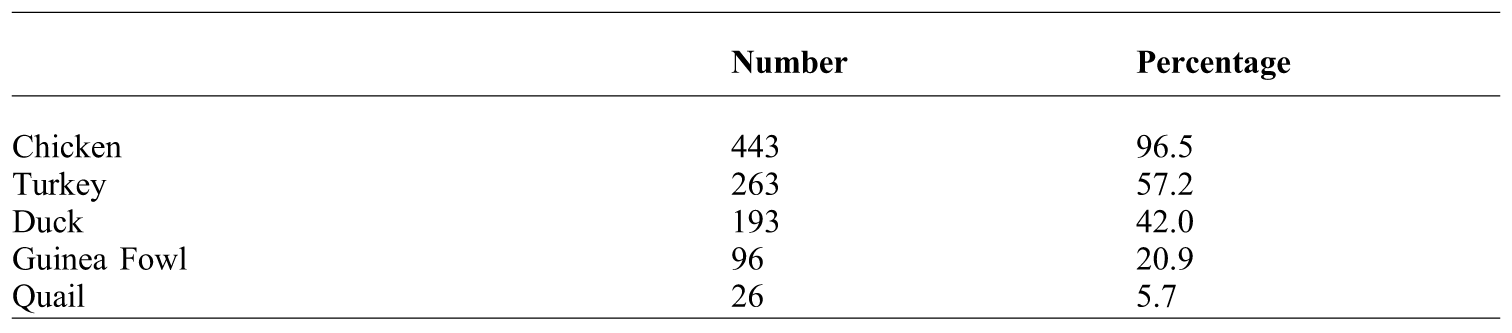
Data indicating the type of poultry meat purchased in France is presented in Table 3. Chicken was by far the most popular poultry meat in France with 443 (96.5%) of the respondents purchasing. However, turkey and duck were still popular with 263 (57.2%) and 193 (42.0%) of respondents purchasing respectively. A significant minority of respondents, 96 (20.9%) and 26 (5.7%) purchased guinea fowl and quail respectively. It would appear, therefore, that poultry meat is a popular food in France and that French consumers appreciate a broad range of poultry meats.
Type of poultry meat purchased.
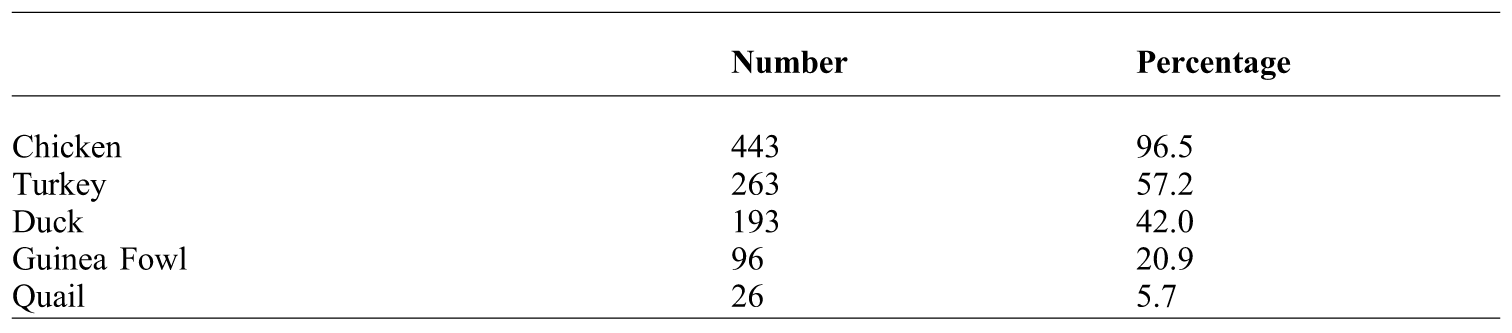
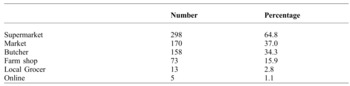
Table 4 presents data relating to the place where the respondents purchased poultry meat. As might be expected, the majority of respondents 298 (64.8%) bought poultry meat from the supermarket, making it the single most important outlet. However, significant numbers of respondents also purchased poultry meat via other outlets, with 170 (37.0%) buying at markets, 158 (34.3%) at butchers’ shops and 73 (15.9%) at farm shops. While the supermarkets obviously dominate the supply chain for poultry meat in France, the level of dominance was not as high as in other countries, such as the UK, and many French consumers appear happy to shop for poultry products at other types of outlet.
Place of purchase of poultry meat.

Consumer perceptions of poultry meat
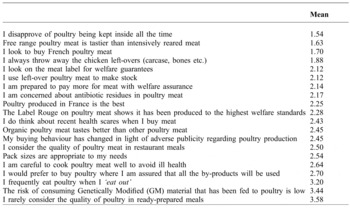
Data relating to consumer perceptions of poultry meat is presented in Table 5. The statements were ordered using the respondents’ mean scores to aid interpretation. Essentially, the statements at the top of the list are those that respondents agreed with more strongly while the statement at the bottom is the only one with which, albeit fairly mildly, they disagreed.
The statement that respondents most strongly agreed with was ‘I disapprove of poultry being kept inside all the time’ which on the face of it appears to suggest that French consumers are particularly concerned about animal welfare. Further evidence to support this contention was provided with the respondents’ tendency to concur with the statements ‘I look on the meat label for welfare guarantees’, ‘I am prepared to pay more for meat with welfare assurance’ and ‘The Label Rouge on poultry meat shows it has been produced to the highest welfare standards’. However, the respondents demonstrated strong support for the statement ‘Free range poultry meat is tastier than intensively reared meat’ which raises the suspicion that the reason that French consumers disapprove of poultry being kept inside all the time and make use of indicators of animal welfare is actually more to do with the impact on taste rather than animal welfare.
The respondents also strongly agreed with the statement ‘I look to buy French poultry meat’ even though their support for the statement ‘Poultry produced in France is the best’ was somewhat weaker. This preference for French poultry even when it may not be the best is probably further evidence of the well documented phenomenon of consumer ethnocentrism (Zolfagharian and Sun, Reference ZOLFAGHARIAN and SUN2010; Vukasovic, Reference VUKASOVIC2014).
As the respondents agreed with the statements ‘Pack sizes are appropriate to my needs’, ‘I would prefer to buy poultry where I am assured that all the by-products will be used’, and ‘I use left-over poultry meat to make stock’ it appears that French consumers are very much aware of food waste as an issue and do act to reduce it. However, the fact that they also agreed with the statement ‘I always throw away the chicken left-overs (carcase, bones etc.)’ suggested that there is still some potential to reduce waste still further and that a programme of education might be useful in this respect.
The respondents tended to agree with the statements ‘I am concerned about antibiotic residues in poultry meat’, ‘I do think about recent health scares when I buy meat’, and ‘I am careful to cook poultry meat well to avoid ill health’ and disagreed that ‘The risk of consuming Genetically Modified (GM) material that has been fed to poultry is low’. As such, French consumers appear to be aware of the risks of contamination arising from eating poultry meat, and it is probably this that led to the respondents agreeing with the statement ‘I consider the quality of poultry meat in restaurant meals’ and disagreeing with the statement ‘I rarely consider the quality of poultry in ready-prepared meals’. It would appear, therefore that French consumers give some thought to the purchase and consumption of poultry meat which suggests that ‘involvement’ was a little higher than might be expected. Indeed, the thinking behind the purchase of poultry meat in France may have contributed both to the respondents agreeing with the statement ‘My buying behaviour has changed in light of adverse publicity regarding poultry production’ and with ‘Organic poultry meat tastes better than other poultry meat’.
Perceptions of French poultry.

Note: Don't knows omitted from mean calculation.
Decision factors
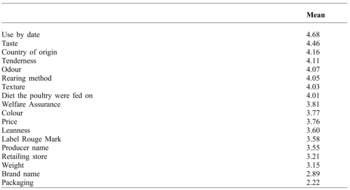
Data relating to the factors that impact the consumer purchase decision for poultry meat is presented in Table 6. The factors are ordered according to their importance, with the most important at the top of the list and the least important at the bottom.
In the first instance it is important to note that in rating all the factors the respondents were confirming that they are all of some importance in the decision to buy poultry meat. It is, however, clear that some factors were considered much more important than others. Thus, while factors at the bottom of the table, such as ‘Packaging’, ‘Brand name’ and ‘Weight’, did impact the purchase decision for poultry meat, the factors at the top of the table, such as ‘Use by date’, ‘Taste’, ‘Country of origin’ and ‘Tenderness’, played a much more significant role.
It is interesting to note that most of the factors at the top of the table are either the main proxy for product quality (e.g. ‘Use by date’) or are actual measures of product quality (‘Taste’, and ‘Tenderness’). These factors were seen as more important than most of the marketing factors or of price, and so it would appear that the most important factors impacting the French consumers’ purchase of poultry meat are technical indicators of product quality.
The exception to the most important factors being technical in nature is ‘Country of origin’ which was rated by respondents as the third most important factor in the purchase decision for poultry meat. This indicates that French consumers prefer to buy poultry meat originating in France, but that they may compromise their preference in respect of high quality poultry meat originating overseas.
Respondents were asked about animal welfare, but the surveyed statements on ‘Welfare assurance’ and ‘Label Rouge mark’ were only mid-way down the table. This lends further evidence to the view that, while French consumers may wish animals to be cared for properly and will indicate this when asked about the subject out of context, when it comes to purchasing, it is not such an important issue.
Factors impacting the purchase of poultry meat in France.

Note: Don't knows omitted from mean calculation.
Recommendations
The data presented in this paper permitted the development of a number of recommendations. These recommendations relate primarily to the marketing of poultry meat in France and as such are intended to inform the decision making of marketing practitioners. However they should also be of interest to policy makers, academics and others with an interest in this sector.
The first recommendation arising from this study is that marketing practitioners should seek to create, develop and enhance the competitive advantage of their poultry meat products in respect of all the factors impacting the consumers' purchase decision, and should give particular emphasis to aspects of product quality such as taste and tenderness. Additionally in order to produce poultry meat of the standard required by consumers, managers should seek to develop rigorous quality assurance systems incorporating low tolerance levels in order to drive up standards. Marketers need to commission advertising and promotional material that emphasises the French origins of poultry meat as well as its high quality level. Managers should seek to develop supply chain strategies that acknowledge the dominance of the supermarkets as an outlet for poultry meat in France but also allow for a reasonable amount of supply through markets, butchers and farm shops. Managers should work to ensure the welfare of their birds but recognise that it is not the most important factor in the French consumers purchase decision for poultry meat. Finally policy makers might consider a programme of education that would seek to inform and encourage French consumers to make better use of their poultry purchases in order to reduce waste.
Conclusions
The aim of this paper was to survey and review information regarding the market for poultry meat in France for the benefit of marketing practitioners and to provide insight for those involved in the production and sales of poultry meat in France. Indeed, it is recommended that managers focus their attention on various aspects of product quality, seek to enhance standards via improved quality assurance systems and seek to build reputation by promoting these aspects of poultry meat to the consumer.